1999 Roosevelt Dime Coin Value: How Much Is It Worth?
Most 1999 Roosevelt dimes pulled from circulation are worth face value — ten cents, no more. In mint state, a USA Coin Book guide estimate places an MS65 Philadelphia or Denver strike at about $2.50.
The S clad proof sits around $4.96 in PR65, while the S silver proof reaches roughly $12.04 at the same grade. Actual value depends on the specific version, condition, and whether authenticated errors are present.
These guide figures are estimates, not guaranteed sale prices.
Fast Way to Identify Your 1999 Roosevelt Dime
The quickest way to start figuring out what you have is to upload clear photos of both the front and back of your 1999 dime. That lets our identifier give you a preliminary read on the mintmark, finish type, and any obvious oddities.
Good lighting and a steady hand help — blurry shots make everything harder.
1999 Roosevelt Dime Value
Upload both sides of your 1999 Roosevelt Dime.
Front Obverse
Upload photo
Back Reverse
Upload photo
Which 1999 Roosevelt Dime Versions Are Worth Money?
- Mint-state 1999-P or 1999-D dimes with sharp, fully separated torch bands — the Full Bands strike designation adds collector appeal above a normal MS65.
- 1999-S silver proof, confirmed by weight (2.50 g) and edge color — guide value is roughly $12.04 in PR65, well above the clad proof.
- 1999-S clad proof in original condition — guide value sits near $4.96 in PR65, separate from the silver version.
- Authenticated Broadstrike on Cent Planchet (1999-D) — one certified example sold for $6,325.
- Bonded Multiple Strike (1999-P, three planchets) — one certified example brought $3,055 at auction.
- Quadruple-Struck Dime (1999-D) — a certified specimen sold for $2,040 in 2023.
- Obverse Clad Layer Missing (1999-P) — a certified example sold for $139 in 2025.
Step 1: Identify Your 1999 Roosevelt Dime Mint Mark and Version
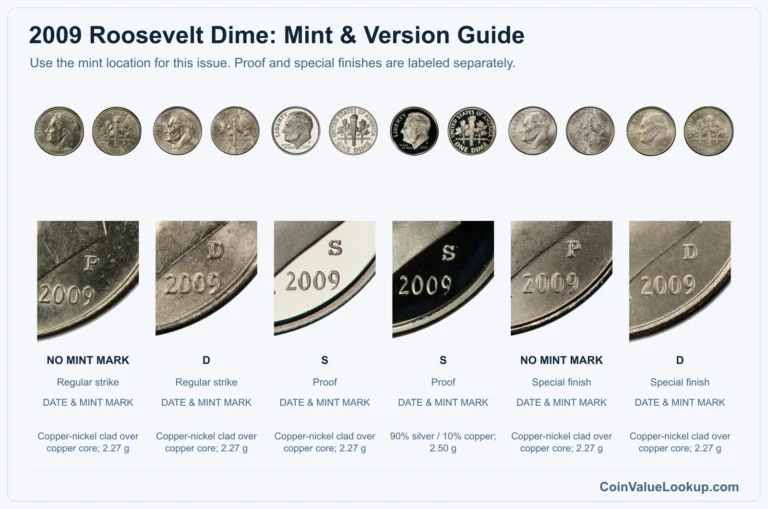
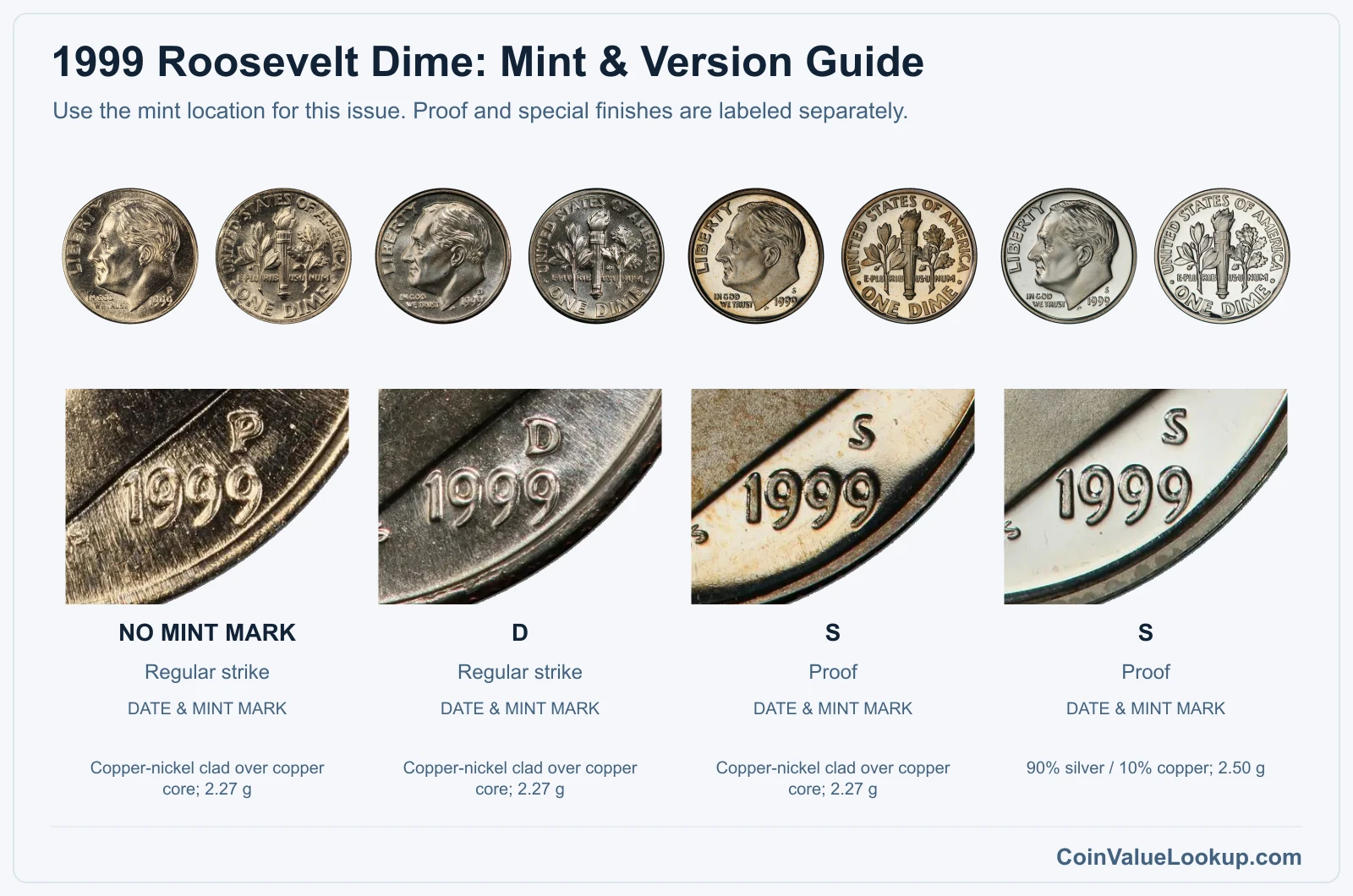
Start by confirming the date reads 1999, with Roosevelt's portrait on the obverse and the torch-and-branches design on the reverse. Look near the date for the mintmark: P for Philadelphia, D for Denver, S for San Francisco.
P and D strikes are copper-nickel clad, weighing about 2.27 grams with a diameter around 17.9 mm. Both S-mint versions — clad proof and silver proof — carry the same mintmark and identical design, so you cannot tell them apart by appearance alone.
Weight is your friend here. A silver proof weighs approximately 2.50 grams versus 2.27 grams for clad.
Check the edge too: a silver proof shows a uniform gray-white edge, while a clad coin reveals a visible copper-colored stripe. Original government packaging, if you still have it, settles the question immediately.
Color alone is unreliable. Toning, cleaning, and environmental exposure can all fool your eyes, so lean on weight, edge inspection, and packaging when separating clad from silver.
Step 2: Check Your 1999 Roosevelt Dime Grade
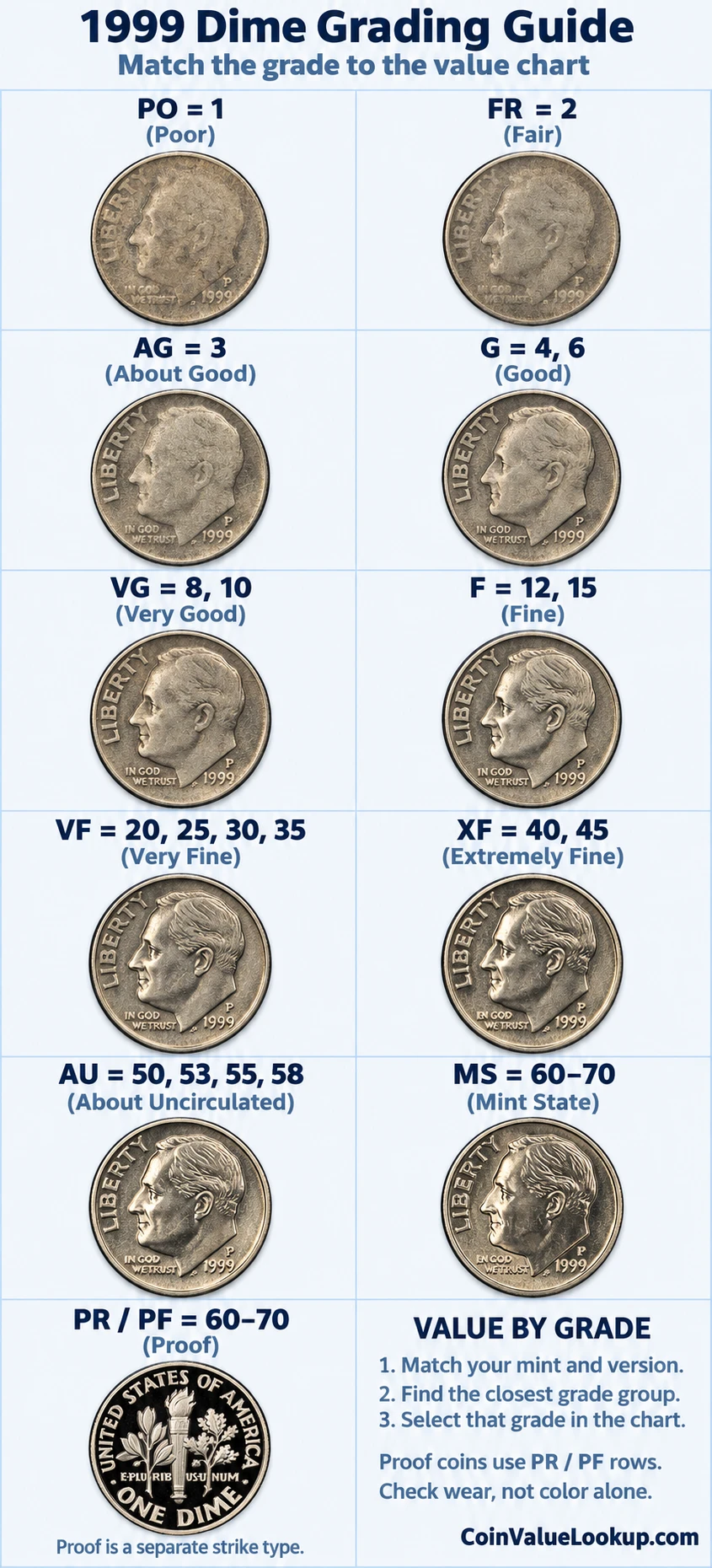
Check for wear on Roosevelt's cheekbone, jawline, and the hair above his ear — these are the first spots to lose detail. On the reverse, the torch flame and the horizontal bands between the branches show wear early.
Do not confuse a weak strike with actual wear. Full Bands is a strike designation used by grading services when both horizontal torch-band pairs show clean separation.
It does not mean a different metal or a higher category — just a sharper hit from the die. Use the comparison image alongside your coin to gauge luster loss versus strike softness.
Proof coins have their own grading scale. Look for hairlines, haze, or fingerprint marks rather than traditional rub.
A cleaned or damaged coin of any type gets a condition qualifier, which affects value differently than a straight grade.
Coin Value Lookup can help you look up guides for Roosevelt dimes and other series when you want a quick reference for different years and versions.
Step 3: Check 1999 Roosevelt Dime Value by Mint and Version
1999 Roosevelt Dime — P Business Strike
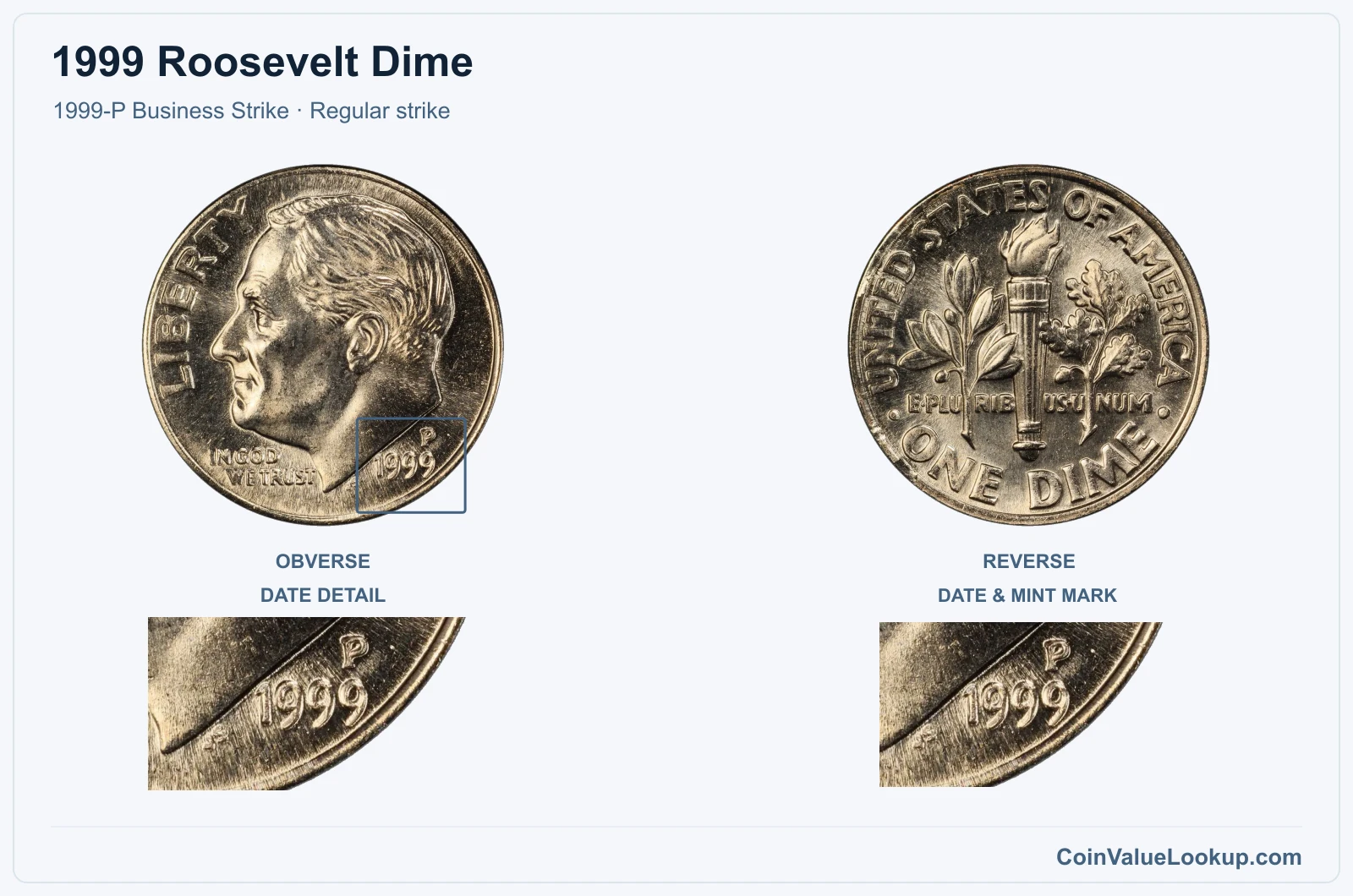
The 1999-P is a Philadelphia business strike on copper-nickel clad, weighing 2.27 grams. Millions were made, so circulated examples are common at face value.
Where it gets interesting is in higher mint-state grades with strong strikes.
A USA Coin Book guide estimate puts a generic MS65 at about $2.50. Coins with fully separated horizontal torch bands — the Full Bands designation — appeal to specialists and can carry a premium above that baseline.
Check your coin's torch under magnification before assuming it qualifies.
Range Grade
Price Auction Records Appraisal PO PO 1
—
Coin Identifier FR FR 2
—
Coin Identifier AG AG 3
—
Coin Identifier G G 4
—
Coin Identifier
G 6
—
Coin Identifier VG VG 8
—
Coin Identifier
VG 10
—
Coin Identifier F F 12
—
Coin Identifier
F 15
—
Coin Identifier VF VF 20
—
Coin Identifier
VF 25
—
Coin Identifier
VF 30
—
Coin Identifier
VF 35
—
Coin Identifier XF XF 40
—
Coin Identifier
XF 45
—
Coin Identifier AU AU 50
—
Coin Identifier
AU 53
—
Coin Identifier
AU 55
—
Coin Identifier
AU 58
—
Coin Identifier MS MS 60
—
Coin Identifier
MS 61
—
Coin Identifier
MS 62
—
Coin Identifier
MS 63
—
Coin Identifier
MS 64
—
Coin Identifier
MS 65
Coin Identifier
MS 66
—
Coin Identifier
MS 67
Coin Identifier
MS 68
Coin Identifier
MS 69
—
Coin Identifier
MS 70
—
—
—
1999 Roosevelt Dime — D Business Strike
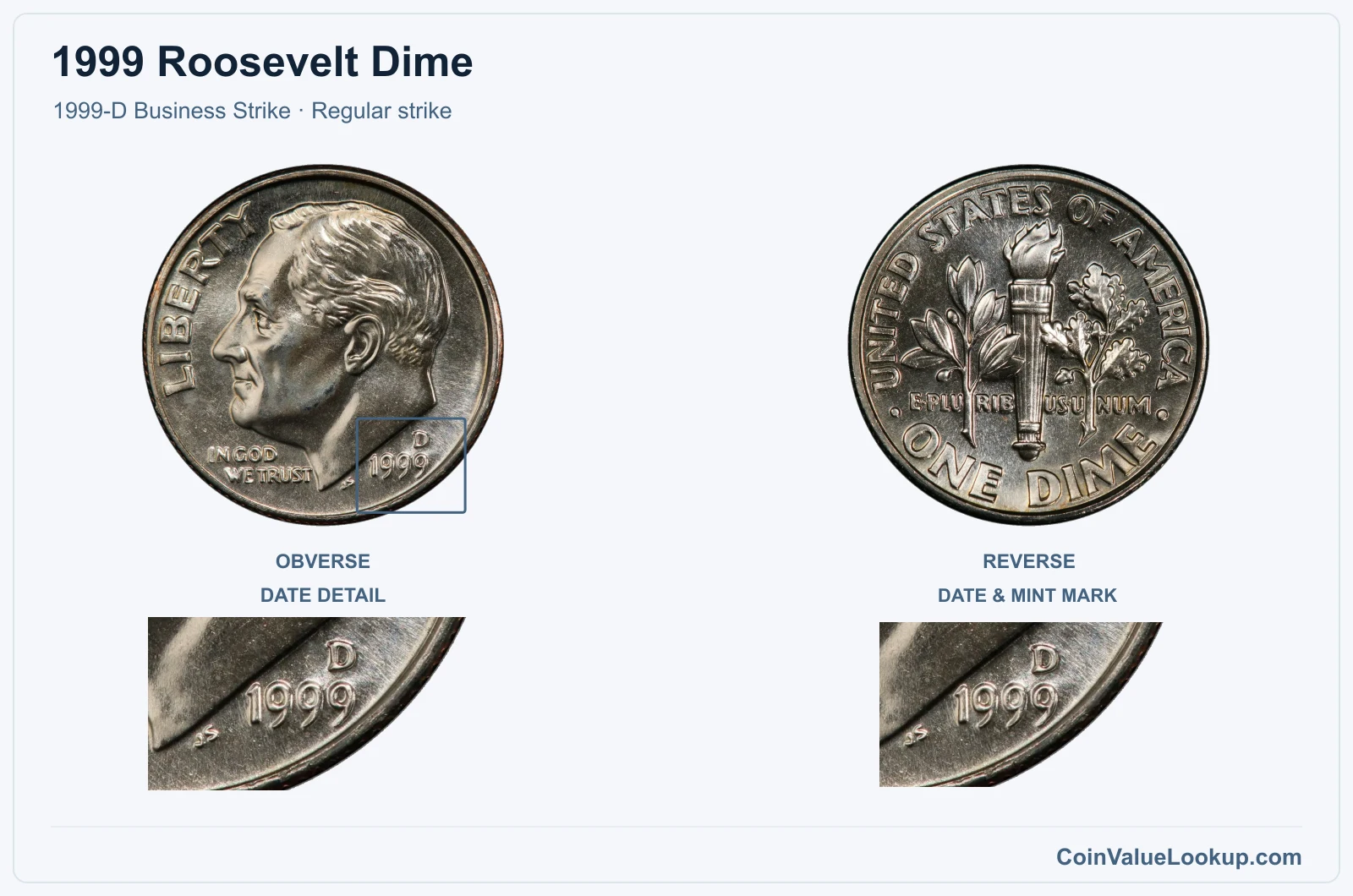
Denver's 1999-D shares the same copper-nickel clad composition and 2.27-gram weight as its Philadelphia twin. In everyday grades, it is another face-value coin.
The USA Coin Book guide estimate is around $2.50 at MS65. As with the P mint, the Full Bands strike designation can push value upward when both horizontal band pairs show clean separation.
Strike quality varied across production runs, so not every uncirculated example will qualify. Compare yours to the reference image under good light.
Range Grade
Price Auction Records Appraisal PO PO 1
—
Coin Identifier FR FR 2
—
Coin Identifier AG AG 3
—
Coin Identifier G G 4
—
Coin Identifier
G 6
—
Coin Identifier VG VG 8
—
Coin Identifier
VG 10
—
Coin Identifier F F 12
—
Coin Identifier
F 15
—
Coin Identifier VF VF 20
—
Coin Identifier
VF 25
—
Coin Identifier
VF 30
—
Coin Identifier
VF 35
—
Coin Identifier XF XF 40
—
Coin Identifier
XF 45
—
Coin Identifier AU AU 50
—
Coin Identifier
AU 53
—
Coin Identifier
AU 55
—
Coin Identifier
AU 58
—
Coin Identifier MS MS 60
—
Coin Identifier
MS 61
—
Coin Identifier
MS 62
—
Coin Identifier
MS 63
—
Coin Identifier
MS 64
Coin Identifier
MS 65
Coin Identifier
MS 66
Coin Identifier
MS 67
Coin Identifier
MS 68
Coin Identifier
MS 69
—
Coin Identifier
MS 70
—
—
—
1999 Roosevelt Dime — S Clad Proof
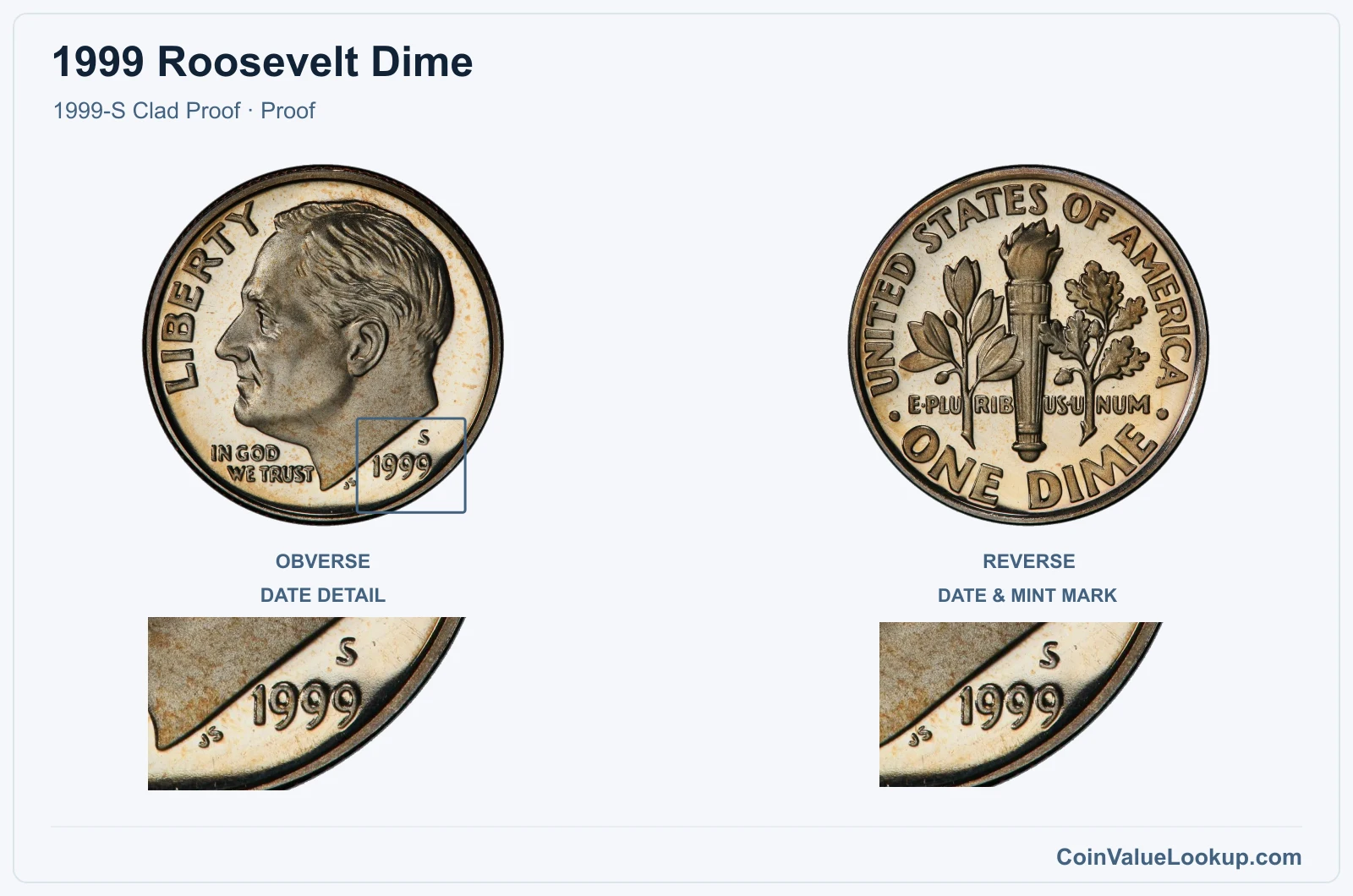
The 1999-S clad proof was struck at San Francisco on the same copper-nickel clad planchet used for business strikes. It weighs 2.27 grams.
Proof finish means mirrored fields and frosted devices — a manufacturing process, not a grade above mint state.
USA Coin Book places a PR65 around $4.96. Since both S-mint proofs look similar at a glance, confirm you have the clad version by weighing the coin or checking the edge for a copper stripe.
Original mint packaging removes any doubt. Hairlines and haze are the main condition concerns for proofs, not traditional wear.
Range Grade
Price Auction Records Appraisal PR PR 1
—
Coin Identifier
PR 2
—
Coin Identifier
PR 3
—
Coin Identifier
PR 4
—
Coin Identifier
PR 6
—
Coin Identifier
PR 8
—
Coin Identifier
PR 10
—
Coin Identifier
PR 12
—
Coin Identifier
PR 15
—
Coin Identifier
PR 20
—
Coin Identifier
PR 25
—
Coin Identifier
PR 30
—
Coin Identifier
PR 35
—
Coin Identifier
PR 40
—
Coin Identifier
PR 45
—
Coin Identifier
PR 50
—
Coin Identifier
PR 53
—
Coin Identifier
PR 55
—
Coin Identifier
PR 58
—
Coin Identifier
PR 60
Coin Identifier
PR 61
—
Coin Identifier
PR 62
—
Coin Identifier
PR 63
—
Coin Identifier
PR 64
—
Coin Identifier
PR 65
—
Coin Identifier
PR 66
—
Coin Identifier
PR 67
—
Coin Identifier
PR 68
Coin Identifier
PR 69
Coin Identifier
PR 70
Coin Identifier
1999 Roosevelt Dime — S Silver Proof
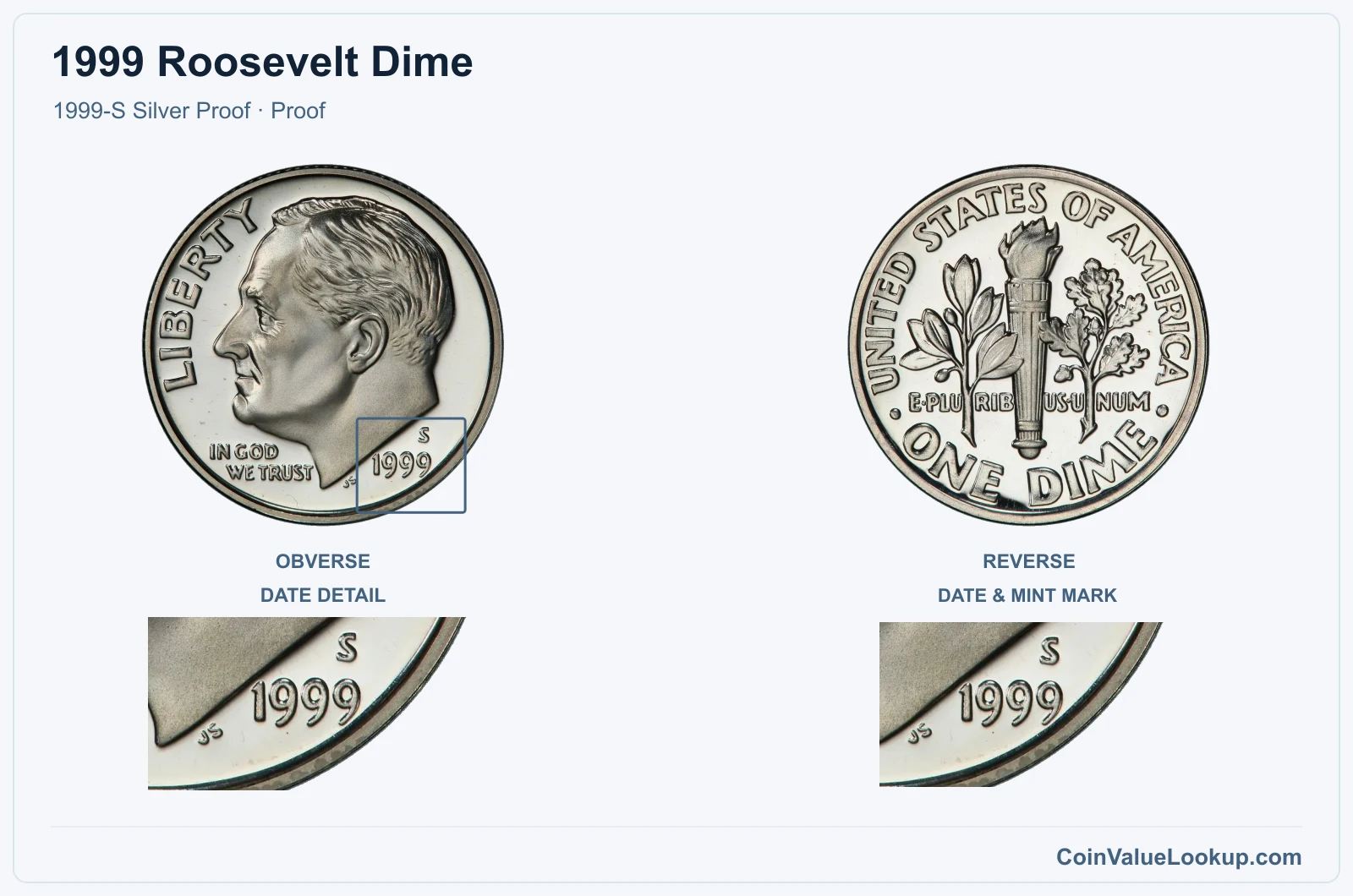
The 1999-S silver proof contains 90 percent silver and 10 percent copper, tipping the scale at about 2.50 grams — noticeably heavier than the 2.27-gram clad proof. The Mint reintroduced silver proof sets in 1992, and this dime was part of that continuing program.
USA Coin Book estimates PR65 at roughly $12.04, making it the highest guide value among the four regular 1999 dime versions at that grade level. The edge appears uniformly silver-gray with no copper band.
Weight, edge color, and original Silver Proof Set packaging are your three best tools for confirming this is genuinely the silver issue rather than clad.
Range Grade
Price Auction Records Appraisal PR PR 1
—
Coin Identifier
PR 2
—
Coin Identifier
PR 3
—
Coin Identifier
PR 4
—
Coin Identifier
PR 6
—
Coin Identifier
PR 8
—
Coin Identifier
PR 10
—
Coin Identifier
PR 12
—
Coin Identifier
PR 15
—
Coin Identifier
PR 20
—
Coin Identifier
PR 25
—
Coin Identifier
PR 30
—
Coin Identifier
PR 35
—
Coin Identifier
PR 40
—
Coin Identifier
PR 45
—
Coin Identifier
PR 50
—
Coin Identifier
PR 53
—
Coin Identifier
PR 55
—
Coin Identifier
PR 58
—
Coin Identifier
PR 60
Coin Identifier
PR 61
—
Coin Identifier
PR 62
—
Coin Identifier
PR 63
—
Coin Identifier
PR 64
—
Coin Identifier
PR 65
—
Coin Identifier
PR 66
—
Coin Identifier
PR 67
—
Coin Identifier
PR 68
Coin Identifier
PR 69
Coin Identifier
PR 70
Coin Identifier
1999 Roosevelt Dime Error List
1. 1999 Roosevelt Dime — Bonded Multiple Strike
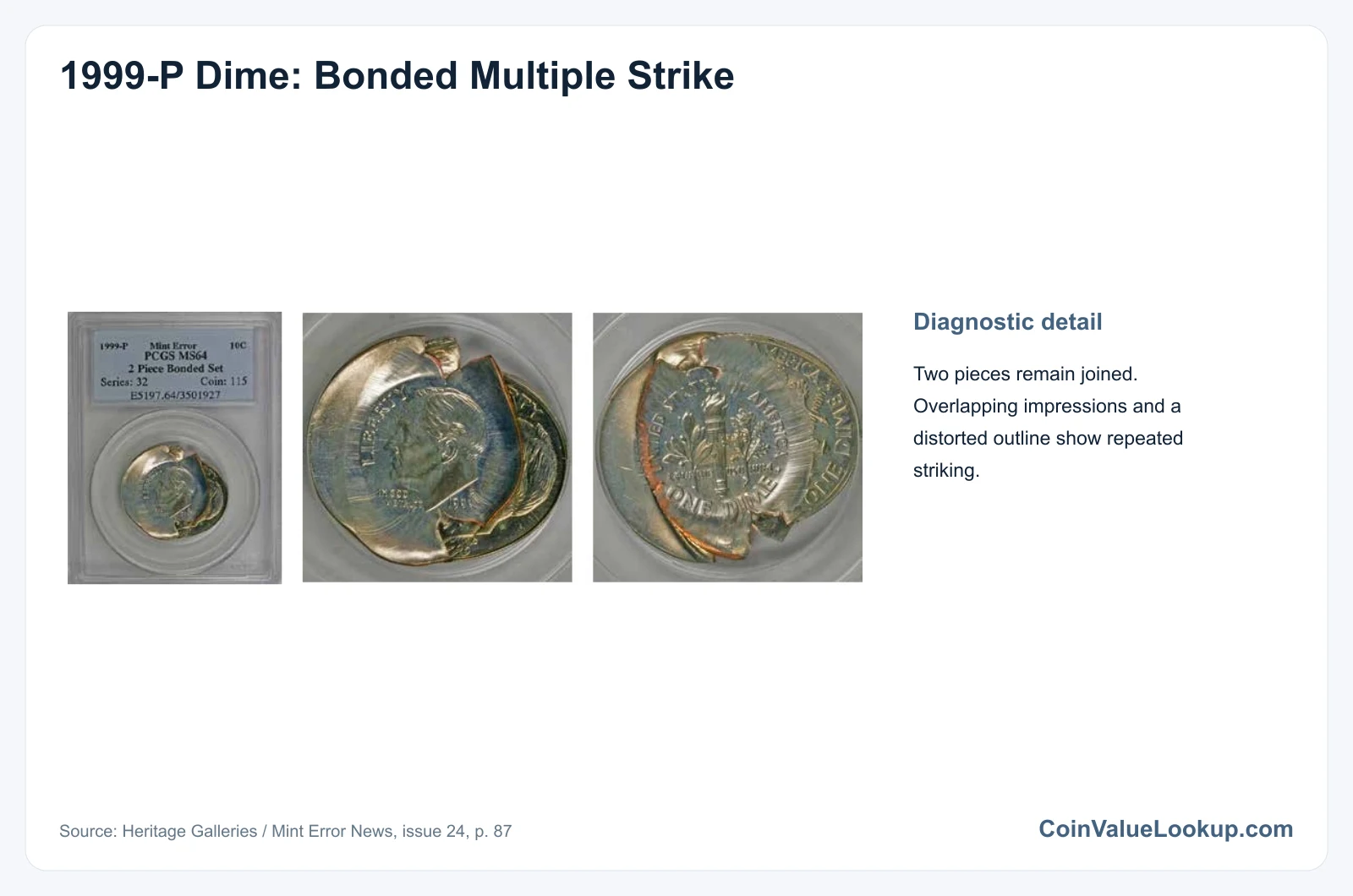
A bonded multiple strike means two or more planchets were fed into the press together and fused by the force of the dies. On this 1999-P example, three overlapping blanks are bonded, with partial displaced impressions visible alongside a readable date.
A Heritage Auctions sale in January 2014 brought $3,055 for an NGC MS64 specimen of this exact type. These are scarce — the odds of three blanks entering simultaneously and surviving quality control are extremely low.
Watch out for coins glued or mechanically pressed together after leaving the Mint. Genuine bonded strikes show metal flow and die impressions that cross from one blank onto the neighboring one.
Authentication by a major grading service is essential before assigning any premium.
2. 1999 Roosevelt Dime — Broadstrike on Cent Planchet
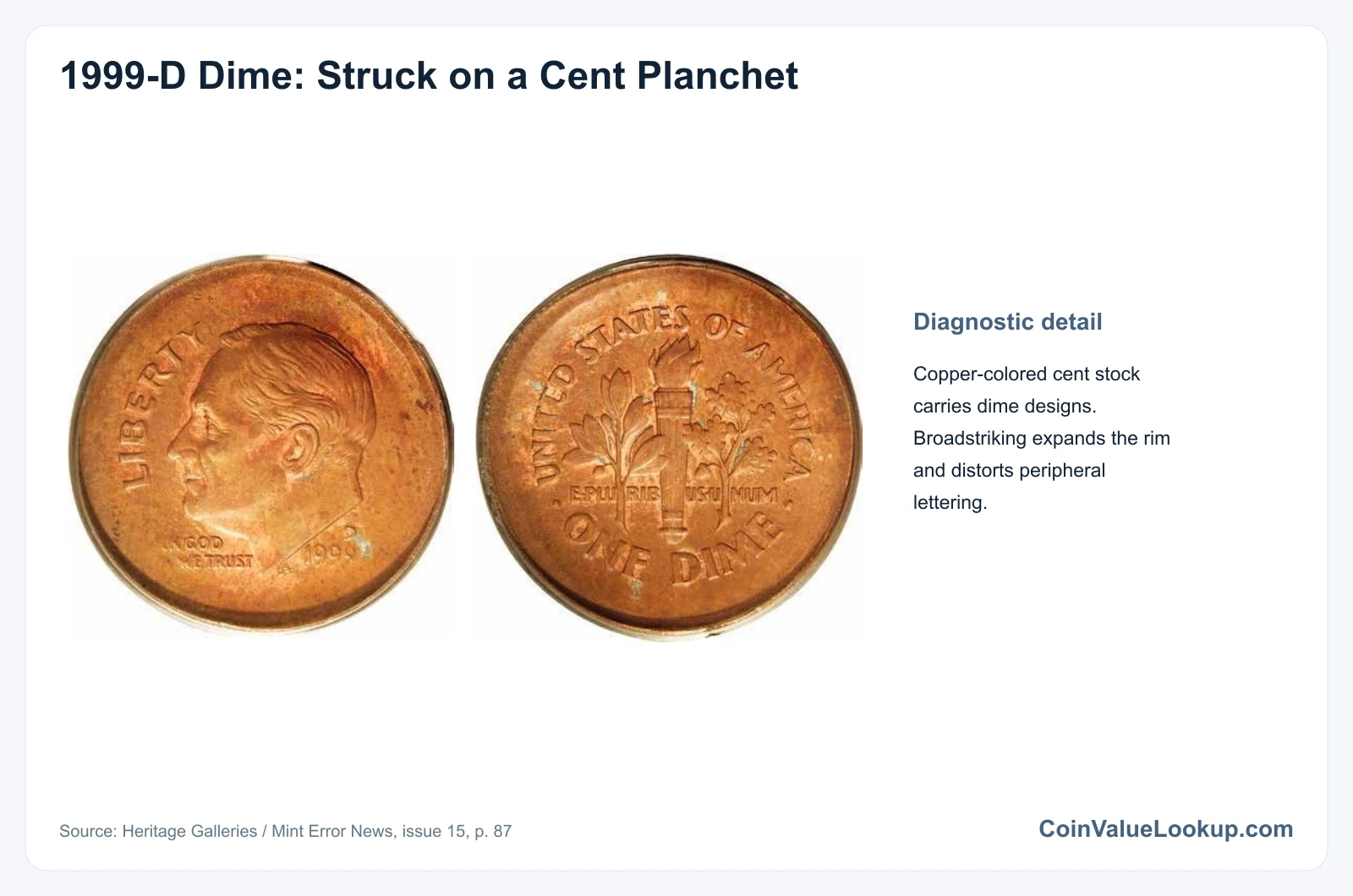
This is a compound error: a 1999-D dime design struck onto a Lincoln cent planchet without a collar. You get the full Roosevelt portrait and torch, but on a smaller, lighter copper-plated zinc blank.
The missing collar allowed the metal to spread outward, and you may see exposed zinc at the rim.
One PCGS MS64 Brown example sold at Heritage Auctions in April 2006 for $6,325. That price reflects both the wrong-planchet and broadstrike aspects combined.
Do not confuse this with a copper-toned normal dime or a regular cent that picked up random marks. A genuine wrong-planchet dime will weigh noticeably less than a standard clad dime and show the complete dime design.
Third-party certification is critical for this kind of claim.
3. 1999 Roosevelt Dime — Straight Clipped Planchet
A straight clipped planchet occurs when the blank is incompletely cut from the metal strip, leaving a flat missing section along one edge. On this 1999-P, the straight edge is uniform and the coin retains a full date on both sides.
Genuine clips show a natural transition where the missing metal meets the struck rim — no tool marks, no rough filing. A normal dime that was cut or ground down after striking will typically show scratches, uneven edges, or distorted rim lettering.
No specific price range is adopted here. Value depends on the severity of the clip, the coin's overall condition, and authentication.
An individually certified example will command attention, but each piece needs its own assessment.
4. 1999 Roosevelt Dime — Quadruple-Struck Dime
Four separate die impressions overlap on a single 1999-D planchet. You can trace Roosevelt's portrait and the date through each successive strike, and later impressions that escaped the collar caused the rim to expand beyond normal diameter.
A Heritage Auctions sale in March 2023 recorded $2,040 for an NGC MS66 specimen. Multiple-strike errors become more dramatic — and more valuable — as the strike count increases.
Do not confuse this with shelf doubling, die deterioration, or a simple broadstrike. A quadruple strike shows four distinct, offset impressions of the full design, not just a slight doubling of letters.
Each impression is a separate event. Certification confirms the count and rules out post-mint damage.
5. 1999 Roosevelt Dime — Mated Double-Strike/Brockage Pair
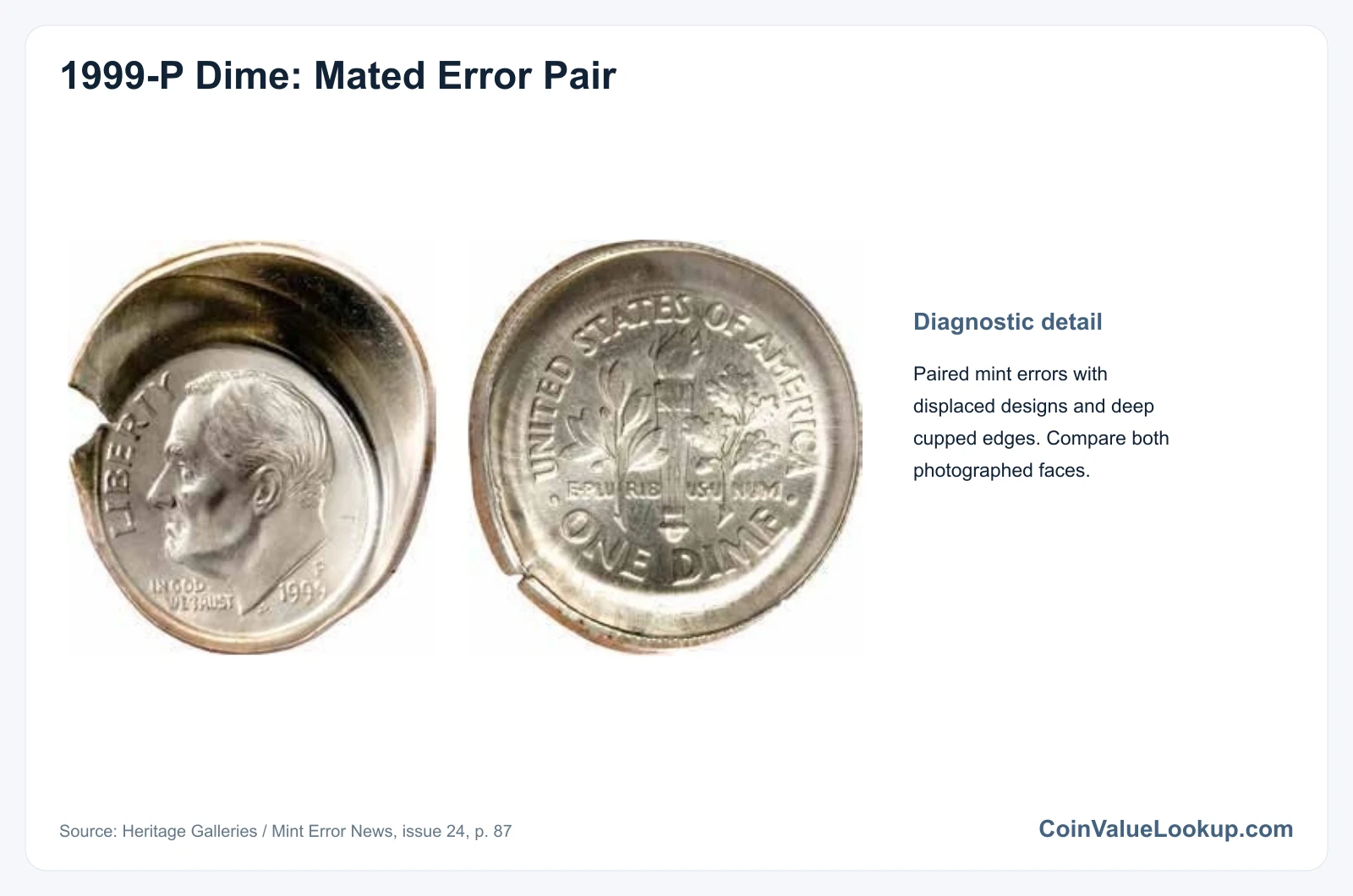
A mated pair is two coins that were in the press at the same time — one receives a double strike, and its neighbor picks up the matching brockage impression. This 1999-P pair consists of a double-struck coin graded MS62 and its brockage companion graded MS63.
Heritage Auctions sold the pair together in July 2021 for $552 total. That figure covers both coins as a unit; dividing it evenly would be misleading since each coin's role differs.
Keep mated pairs together whenever possible. A loose coin with a random incuse mark or an unrelated broadstrike cannot prove it was part of a specific mating event.
Authentication and documentation linking the two coins are what give this error its premium.
6. 1999 Roosevelt Dime — Broadstrike
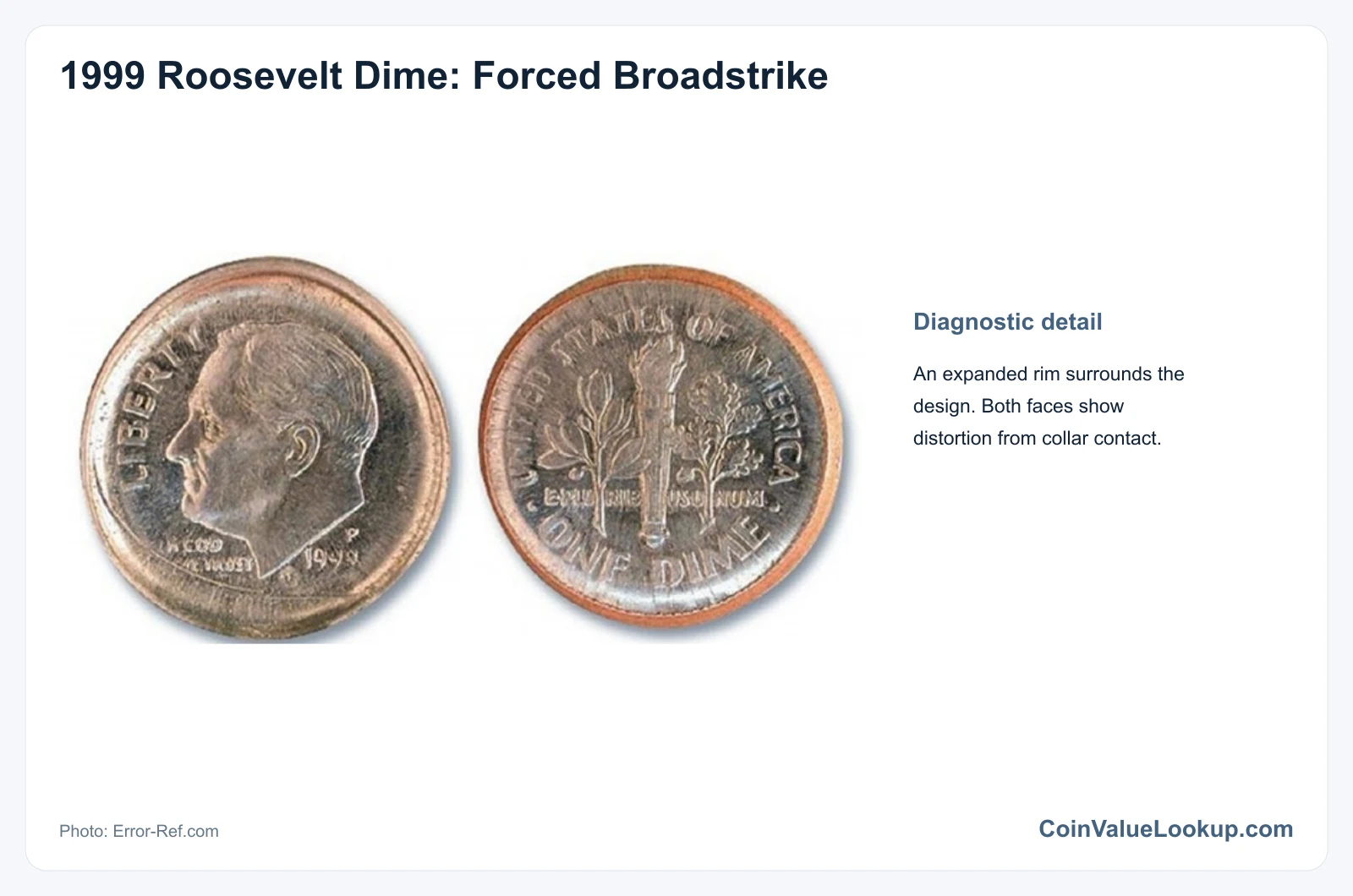
A broadstrike happens when the collar fails to contain the planchet during striking. The dime receives a complete impression from both dies but expands slightly beyond its normal 17.9 mm diameter.
The edge is smooth and rounded rather than reeded.
Heritage Auctions recorded a 1999-P broadstruck NGC MS66 selling for $49 in April 2006 — roughly one millimeter wider than standard. Broadstrikes on dimes are not exceptionally rare, which keeps prices modest compared to more dramatic errors.
Check that the expansion is uniform and the design is fully struck. Post-mint flattening from a vise or hammer produces uneven distortion, and an off-center strike leaves part of the design missing entirely.
A genuine broadstrike shows neither of these traits.
7. 1999 Roosevelt Dime — Obverse Clad Layer Missing
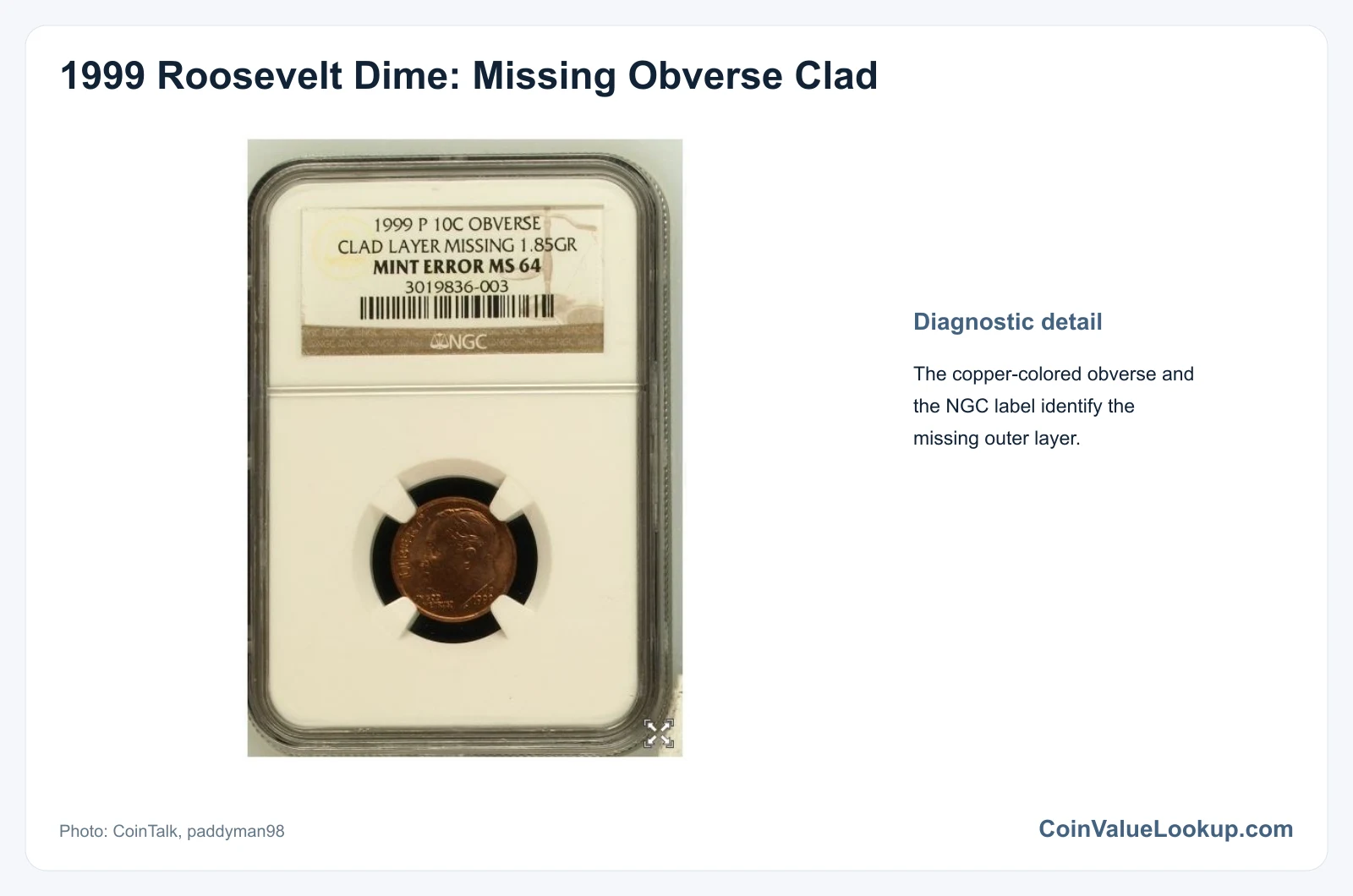
When the obverse clad layer is missing, the copper core is exposed on the front of the coin while the reverse retains its normal nickel surface. On this 1999-P example, the obverse appears bright copper-orange, and the edge shows an abrupt transition between the two sides.
A PCGS MS62 specimen sold through Heritage Auctions in March 2025 for $139. These are verified by confirming reduced weight and a visible edge transition — not just unusual color.
Environmental damage, polishing, and chemical exposure can all turn a normal dime coppery. The difference is that a genuine missing-clad coin weighs less than the standard 2.27 grams and shows the layer boundary clearly at the edge.
A full-weight copper-colored coin is almost certainly damaged, not a mint error.
8. 1999 Roosevelt Dime — Off-Center Strike
An off-center strike means the planchet was not properly seated when the dies closed, so part of the design is missing and an unstruck crescent of blank metal appears along one side. The farther off center the strike, the more dramatic the visual effect.
For a 1999 dime off-center strike, the date must remain visible for the coin to be attributed to this specific year. Pieces where the date is lost in the unstruck area cannot be confirmed as 1999 issues.
No specific price range is adopted. Value depends on the percentage off center, whether the date is readable, and overall condition.
Do not confuse an off-center strike with a clipped planchet or one-sided die misalignment — those produce different visual signatures. Authentication matters here.
9. 1999 Roosevelt Dime — Doubled Die Obverse
A doubled die obverse on a 1999 dime shows consistent doubling in the design elements — typically letters, the date, or portions of Roosevelt's profile. The key word is consistent: the separation or notching appears in the same direction across multiple features.
Compare your coin's obverse lettering to a normal 1999 dime under identical lighting. Genuine doubled dies produce raised, separated impressions that repeat at each affected element.
Machine doubling, by contrast, tends to show flat shelf-like distortion without true separation.
No specific price range is adopted for this category. Value depends on the strength and visibility of the doubling and the coin's condition.
If you suspect a doubled die, examination under magnification alongside a confirmed normal example is the best starting point. Certification confirms the variety.