2009 Roosevelt Dime Coin Value: How Much Is It Worth?
Ordinary circulated 2009 Roosevelt dimes from Philadelphia or Denver are worth face value — ten cents. In mint state at MS65, a USA Coin Book guide estimate puts the P or D business strike at about $2.50.
The S clad proof is listed around $3.08 in PR65, while the S silver proof reaches roughly $10.69 at the same grade. Before applying any higher-grade pricing, you need to pin down which mint, metal and finish your coin actually is.
Fast Way to Identify Your 2009 Roosevelt Dime
Snap clear photos of both the front and back of your 2009 dime and upload them here for a preliminary identification. The identifier can help you sort out mintmark location, distinguish a business strike from a Satin Finish issue, and point you toward the right branch for your coin.
It works from photos alone, so good lighting and focus help.
2009 Roosevelt Dime Value
Upload both sides of your 2009 Roosevelt Dime.
Front Obverse
Upload photo
Back Reverse
Upload photo
Which 2009 Roosevelt Dime Versions Are Worth Money?
- 2009 P or D business strikes in high mint state (MS65 and above) with fully separated torch bands are worth checking carefully.
- 2009-S silver proofs, distinguished from clad proofs by weight (2.50 g versus 2.27 g) and edge color, carry a higher guide estimate at PR65.
- Satin Finish P and D dimes from 2009 Mint Sets are a separate collectible branch — do not confuse them with ordinary business strikes.
- Several mint error types have been reported for 2009 dimes, including lamination, doubled die obverse and off-center strikes, which can carry significant premiums depending on condition and visibility.
Step 1: Identify Your 2009 Roosevelt Dime Mint Mark and Version
Start with the basics. Confirm the 2009 date on the obverse, the Roosevelt portrait facing left, and the torch-with-branches reverse.
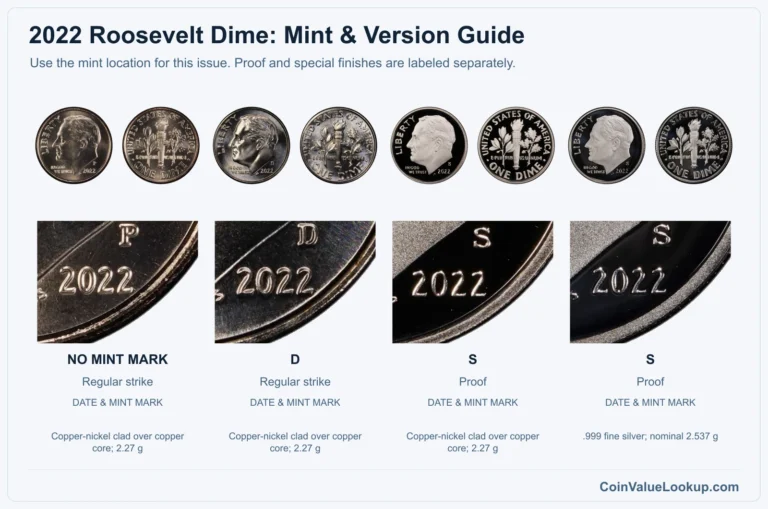
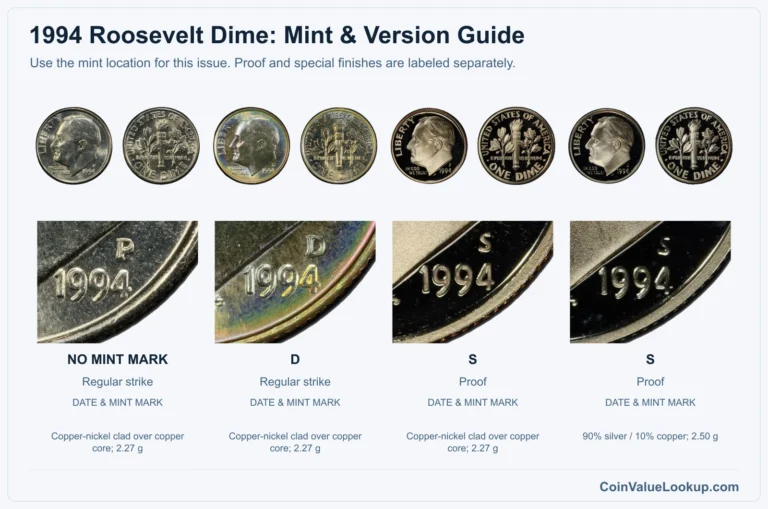
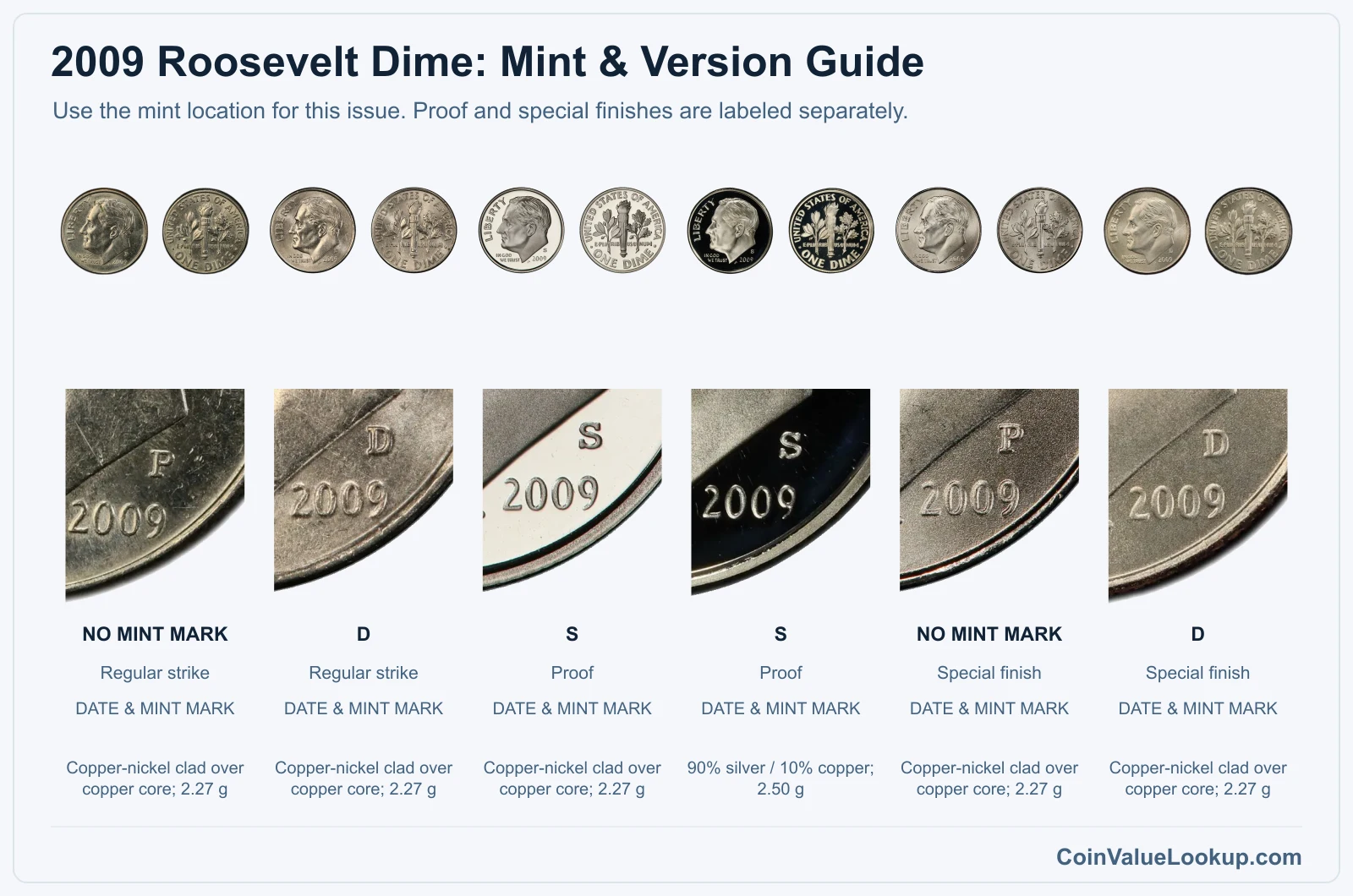
Flip the coin over and check just below the date on the obverse for the mintmark: P for Philadelphia, D for Denver, or S for San Francisco. An S-mint dime is always a proof or special collector issue and was never released for pocket change.
Clad versions — business strikes and Satin Finish alike — weigh 2.27 grams and are copper-nickel clad over a copper core. The silver proof weighs 2.50 grams and is 90% silver with 10% copper.
Both types measure roughly 17.9 mm across, so weight and edge color are your best physical separators.
A quick edge check helps: a clad dime shows a visible copper-toned stripe along the edge, while the silver proof edge is uniformly gray-white. If you still have the original Mint packaging, that settles the question outright.
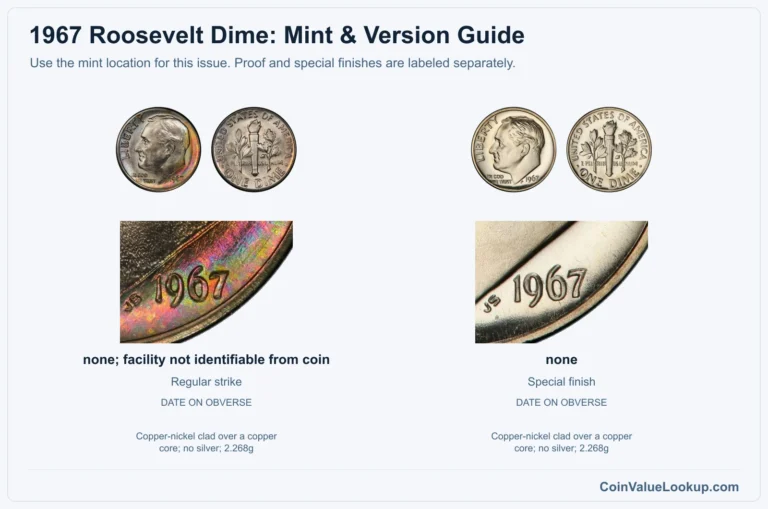
One important distinction for 2009: the Mint issued P and D dimes in two formats. Regular business strikes went into circulation, and separate Satin Finish strikes were packaged in annual Mint Sets.
Lower overall mintage for 2009 dimes does not make a coin an error — it just reflects the production year.
Step 2: Check Your 2009 Roosevelt Dime Grade
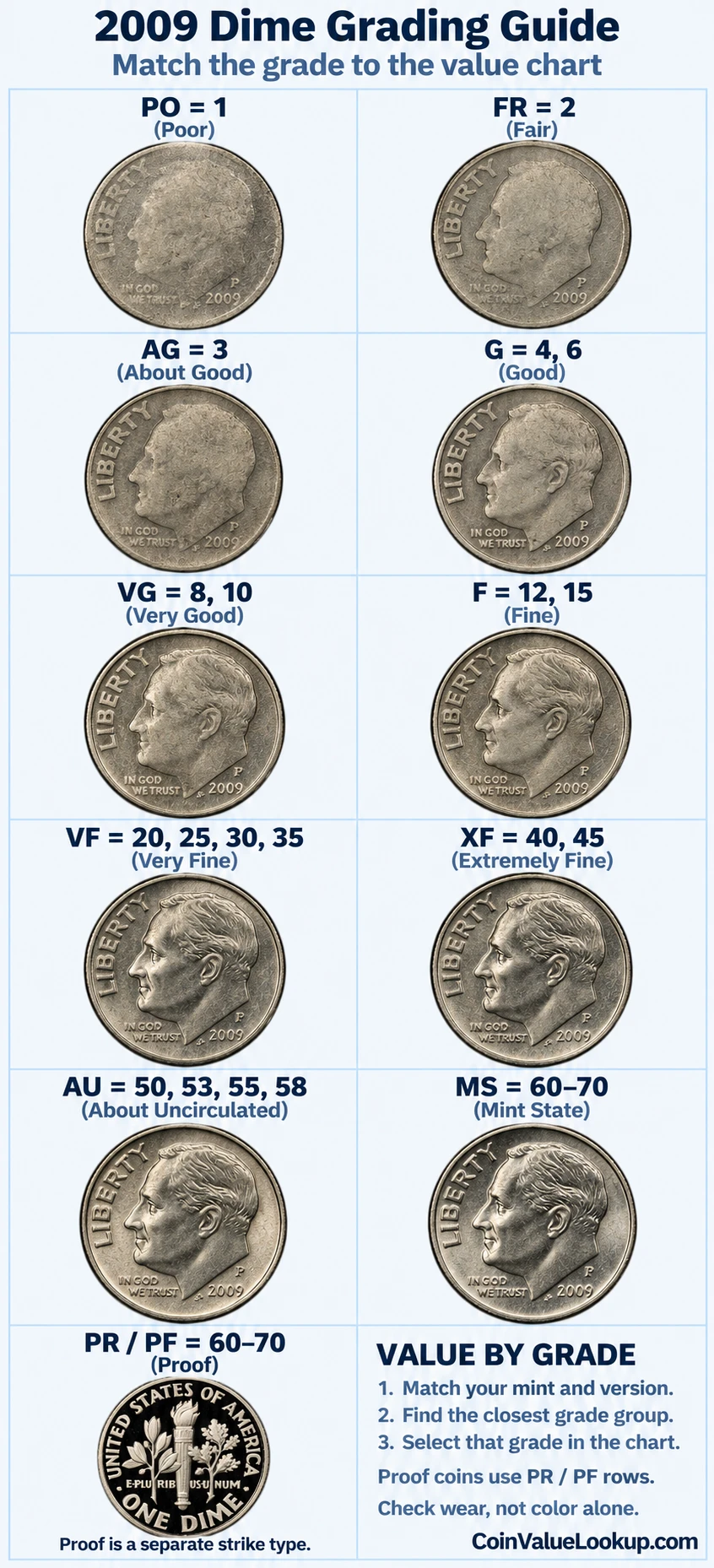
Focus on Roosevelt's cheek and jawline first; these are the highest relief points and show friction earliest. Then check the hair detail above the ear and the torch bands and branch leaves on the reverse.
Original mint luster has a cartwheel effect when you tilt the coin under a single light source. A cleaned coin may look bright but will show fine hairlines under magnification — that is not the same thing.
For Full Bands designation, both horizontal bands on the torch must show complete separation. This is a strike characteristic, not a grade, so a well-preserved coin can still lack Full Bands if the strike was soft.
Proof coins and Satin Finish coins have intentionally different surface textures from business strikes. Compare your coin's surface against a known same-finish example rather than judging it against a circulation strike.
The comparison image beside this section can help you match wear levels on matching-finish pieces.
Step 3: Check 2009 Roosevelt Dime Value by Mint and Version
2009 Roosevelt Dime — P Business Strike
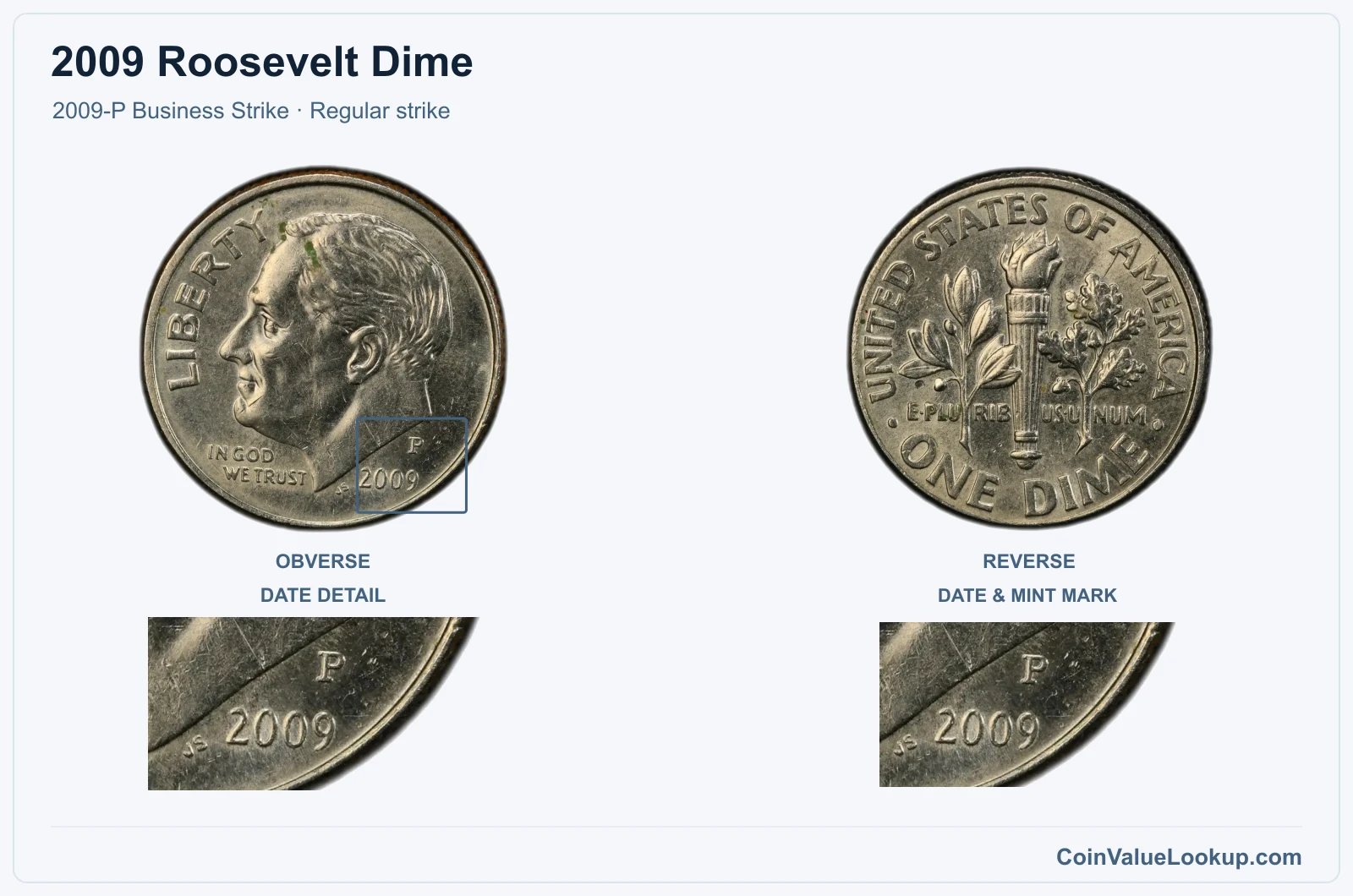
The 2009-P business strike is a copper-nickel clad dime weighing 2.27 grams, struck at Philadelphia with a P mintmark below the date. These entered normal circulation.
A USA Coin Book guide estimate places the MS65 value at about $2.50.
Look for original luster and minimal bag marks. Coins with fully separated torch bands are more desirable at every grade level.
Do not confuse a regular business strike with a Satin Finish version — the surfaces are noticeably different under magnification.
Range Grade
Price Auction Records Appraisal PO PO 1
—
Coin Identifier FR FR 2
—
Coin Identifier AG AG 3
—
Coin Identifier G G 4
—
Coin Identifier
G 6
—
Coin Identifier VG VG 8
—
Coin Identifier
VG 10
—
Coin Identifier F F 12
—
Coin Identifier
F 15
—
Coin Identifier VF VF 20
—
Coin Identifier
VF 25
—
Coin Identifier
VF 30
—
Coin Identifier
VF 35
—
Coin Identifier XF XF 40
—
Coin Identifier
XF 45
—
Coin Identifier AU AU 50
—
Coin Identifier
AU 53
—
Coin Identifier
AU 55
—
Coin Identifier
AU 58
—
Coin Identifier MS MS 60
—
Coin Identifier
MS 61
—
Coin Identifier
MS 62
—
Coin Identifier
MS 63
—
Coin Identifier
MS 64
—
Coin Identifier
MS 65
—
Coin Identifier
MS 66
—
Coin Identifier
MS 67
—
Coin Identifier
MS 68
—
—
—
MS 69
—
—
—
MS 70
—
—
—
2009 Roosevelt Dime — D Business Strike
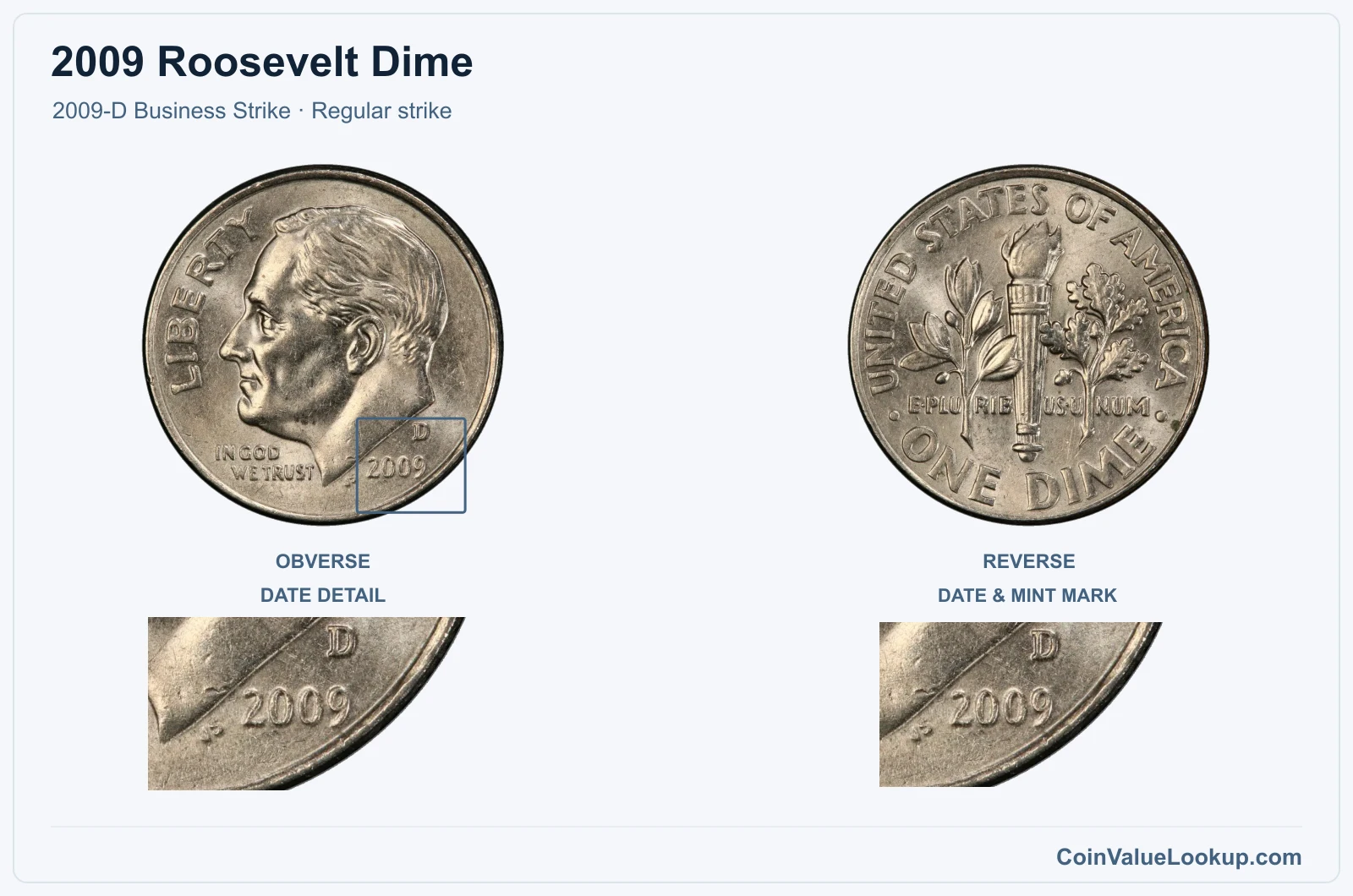
Denver's 2009-D business strike shares the same copper-nickel clad composition and 2.27-gram weight as its Philadelphia counterpart, with a D mintmark below the date. The USA Coin Book guide estimate at MS65 is also $2.50.
Circulated examples are worth face value. In uncirculated grades, check for clean fields and strong torch bands.
As with the P mint, distinguish the regular business strike from the Satin Finish version before looking up values.
Range Grade
Price Auction Records Appraisal PO PO 1
—
Coin Identifier FR FR 2
—
Coin Identifier AG AG 3
—
Coin Identifier G G 4
—
Coin Identifier
G 6
—
Coin Identifier VG VG 8
—
Coin Identifier
VG 10
—
Coin Identifier F F 12
—
Coin Identifier
F 15
—
Coin Identifier VF VF 20
—
Coin Identifier
VF 25
—
Coin Identifier
VF 30
—
Coin Identifier
VF 35
—
Coin Identifier XF XF 40
—
Coin Identifier
XF 45
—
Coin Identifier AU AU 50
—
Coin Identifier
AU 53
—
Coin Identifier
AU 55
—
Coin Identifier
AU 58
—
Coin Identifier MS MS 60
—
Coin Identifier
MS 61
—
Coin Identifier
MS 62
—
Coin Identifier
MS 63
—
Coin Identifier
MS 64
—
Coin Identifier
MS 65
—
Coin Identifier
MS 66
—
Coin Identifier
MS 67
—
Coin Identifier
MS 68
—
Coin Identifier
MS 69
—
Coin Identifier
MS 70
—
—
—
2009 Roosevelt Dime — S Clad Proof
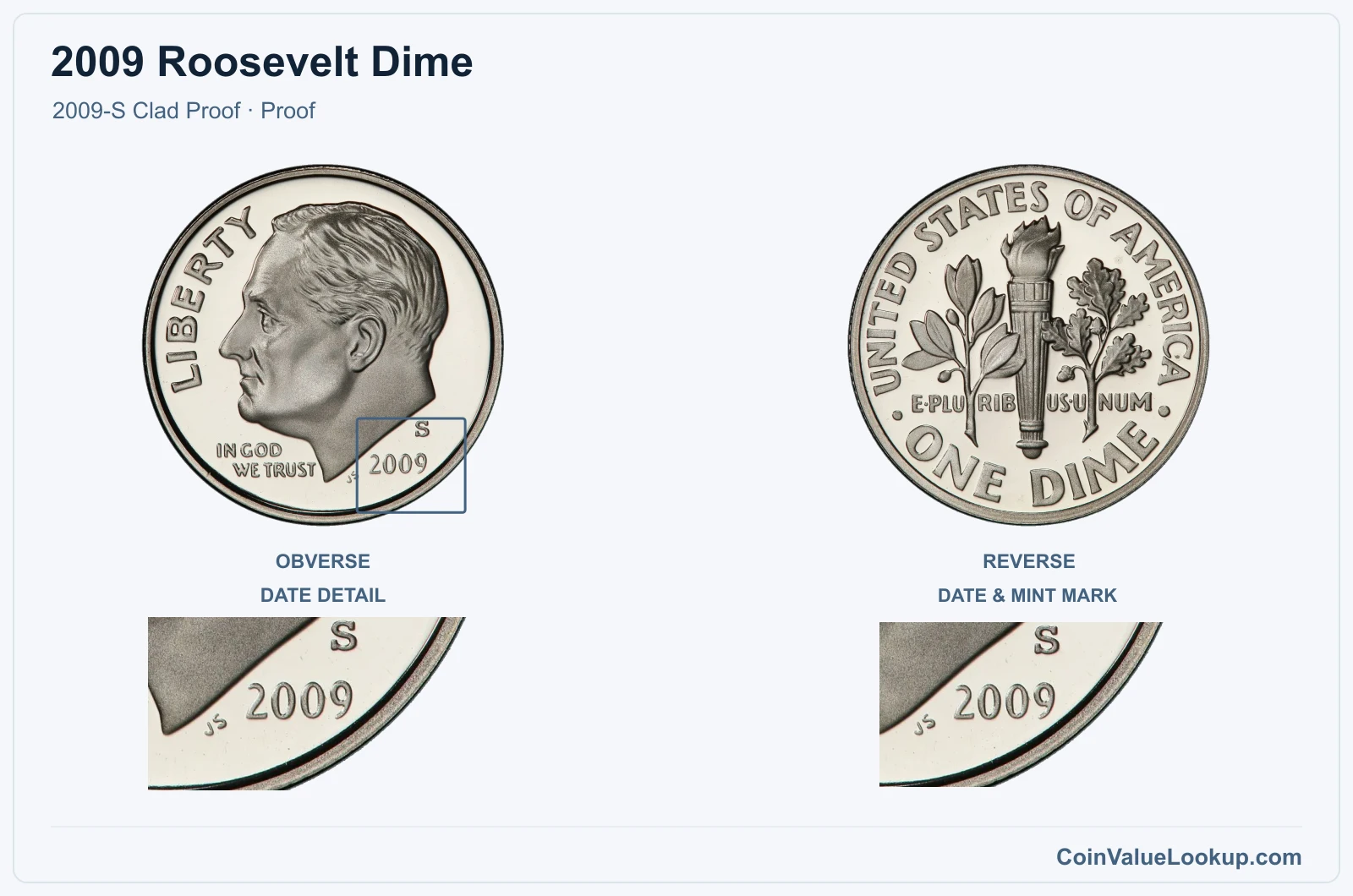
The 2009-S clad proof was struck at San Francisco on copper-nickel clad planchets and sold in annual proof sets. It weighs 2.27 grams, the same as a business strike, so weight alone will not separate it from circulated clad dimes — but the mirrored fields and sharp design relief will.
A USA Coin Book guide estimate for PR65 is $3.08. Higher grades with strong contrast between frosted devices and mirror fields can command more.
Handle only by edges, because proof surfaces show fingerprints instantly.
Range Grade
Price Auction Records Appraisal PR PR 1
—
Coin Identifier
PR 2
—
Coin Identifier
PR 3
—
Coin Identifier
PR 4
—
Coin Identifier
PR 6
—
Coin Identifier
PR 8
—
Coin Identifier
PR 10
—
Coin Identifier
PR 12
—
Coin Identifier
PR 15
—
Coin Identifier
PR 20
—
Coin Identifier
PR 25
—
Coin Identifier
PR 30
—
Coin Identifier
PR 35
—
Coin Identifier
PR 40
—
Coin Identifier
PR 45
—
Coin Identifier
PR 50
—
Coin Identifier
PR 53
—
Coin Identifier
PR 55
—
Coin Identifier
PR 58
—
Coin Identifier
PR 60
—
Coin Identifier
PR 61
—
Coin Identifier
PR 62
—
Coin Identifier
PR 63
—
Coin Identifier
PR 64
—
Coin Identifier
PR 65
—
Coin Identifier
PR 66
—
Coin Identifier
PR 67
—
Coin Identifier
PR 68
—
Coin Identifier
PR 69
Coin Identifier
PR 70
Coin Identifier
2009 Roosevelt Dime — S Silver Proof
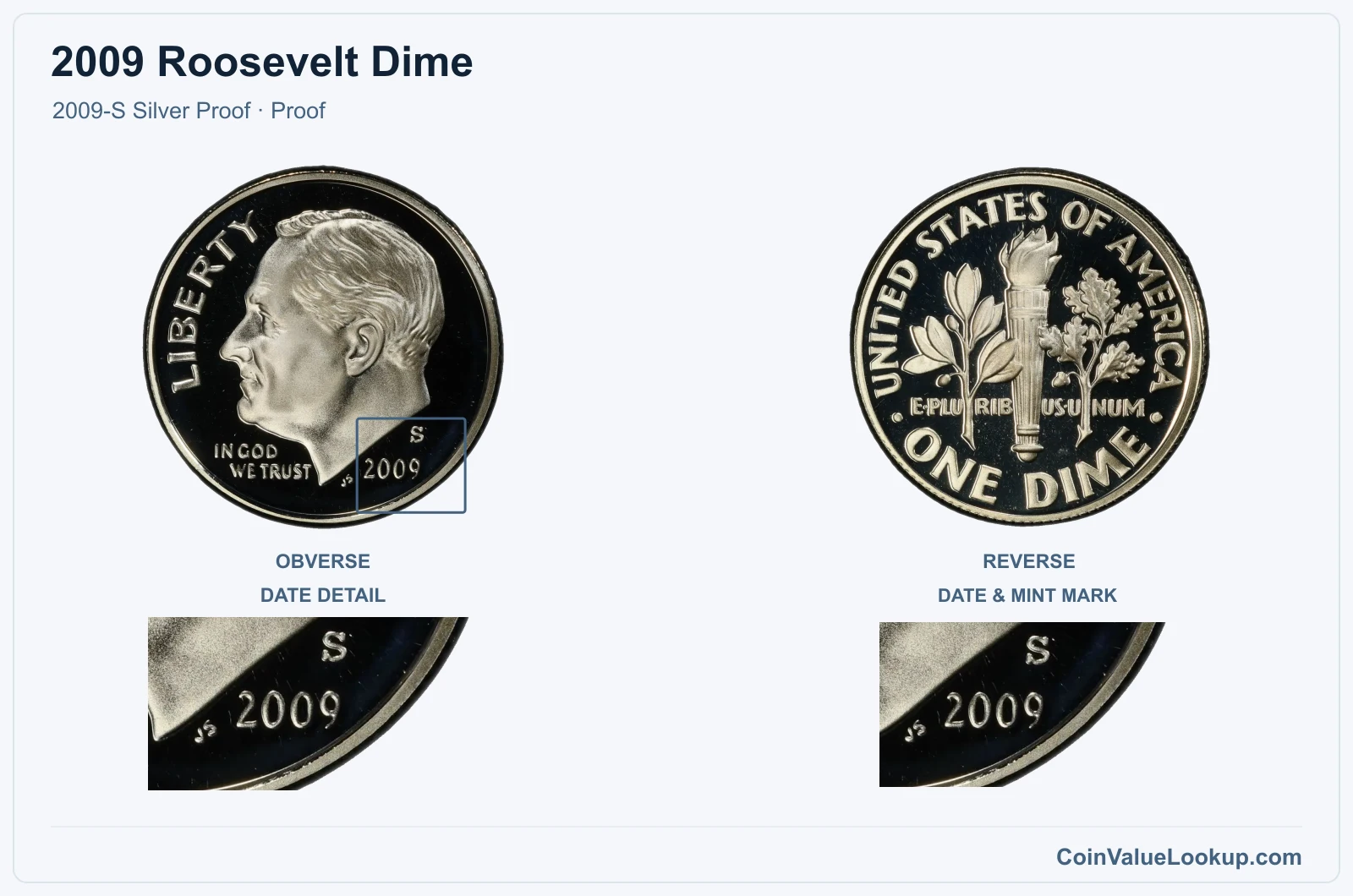
The 2009-S silver proof is the premium collector issue. It is struck on a 90% silver, 10% copper planchet weighing 2.50 grams — noticeably heavier than the 2.27-gram clad versions.
The edge will appear uniformly silver-white with no copper stripe.
At PR65, the USA Coin Book guide estimate is approximately $10.69. That makes it the highest-valued standard branch for this date at equivalent grade.
Confirm silver content by weight or original packaging before assuming you have one; the S mintmark alone does not prove silver, since San Francisco also struck clad proofs the same year.
Coin Value Lookup is a good place to compare guide values across Roosevelt dime dates and finishes if you are building a set or just curious about a specific year.
Range Grade
Price Auction Records Appraisal PR PR 1
—
Coin Identifier
PR 2
—
Coin Identifier
PR 3
—
Coin Identifier
PR 4
—
Coin Identifier
PR 6
—
Coin Identifier
PR 8
—
Coin Identifier
PR 10
—
Coin Identifier
PR 12
—
Coin Identifier
PR 15
—
Coin Identifier
PR 20
—
Coin Identifier
PR 25
—
Coin Identifier
PR 30
—
Coin Identifier
PR 35
—
Coin Identifier
PR 40
—
Coin Identifier
PR 45
—
Coin Identifier
PR 50
—
Coin Identifier
PR 53
—
Coin Identifier
PR 55
—
Coin Identifier
PR 58
—
Coin Identifier
PR 60
—
Coin Identifier
PR 61
—
Coin Identifier
PR 62
—
Coin Identifier
PR 63
—
Coin Identifier
PR 64
—
Coin Identifier
PR 65
—
Coin Identifier
PR 66
—
Coin Identifier
PR 67
—
Coin Identifier
PR 68
—
Coin Identifier
PR 69
Coin Identifier
PR 70
Coin Identifier
2009 Roosevelt Dime — P Satin Finish
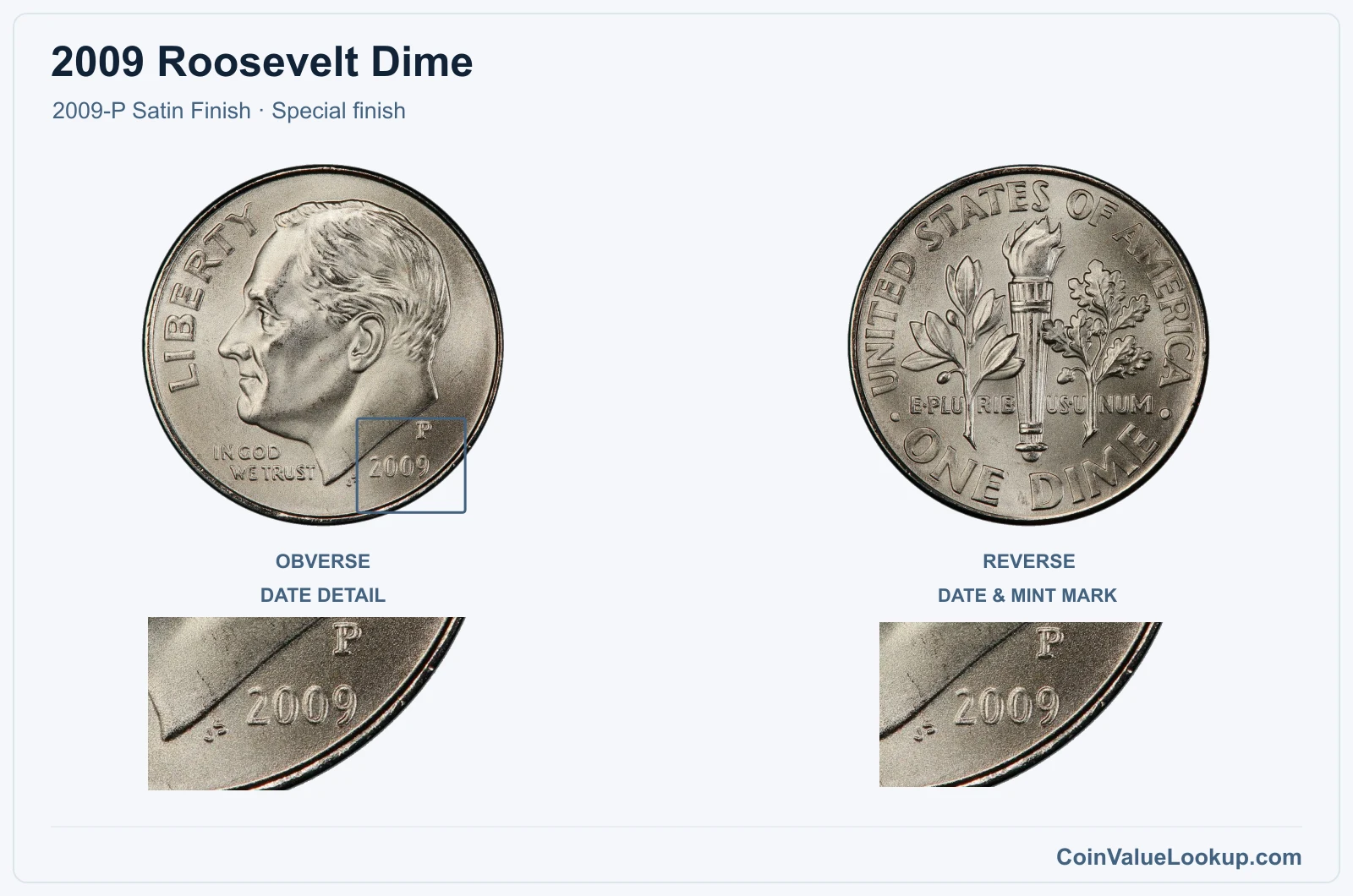
The 2009-P Satin Finish dime was included in that year's uncirculated Mint Set, not released into circulation. It carries the same P mintmark and 2.27-gram clad weight as the business strike, but its surface has a distinctive soft, even luster — neither the cartwheel shine of a business strike nor the mirror fields of a proof.
No guide price is currently adopted for this version. Value depends on authenticated identity, condition and whether any errors are present.
If you still have the original Mint Set packaging, that is the easiest confirmation you have a Satin Finish piece rather than a regular strike.
Range Grade
Price Auction Records Appraisal SP SP 1
—
Coin Identifier
SP 2
—
Coin Identifier
SP 3
—
Coin Identifier
SP 4
—
Coin Identifier
SP 6
—
Coin Identifier
SP 8
—
Coin Identifier
SP 10
—
Coin Identifier
SP 12
—
Coin Identifier
SP 15
—
Coin Identifier
SP 20
—
Coin Identifier
SP 25
—
Coin Identifier
SP 30
—
Coin Identifier
SP 35
—
Coin Identifier
SP 40
—
Coin Identifier
SP 45
—
Coin Identifier
SP 50
—
Coin Identifier
SP 53
—
Coin Identifier
SP 55
—
Coin Identifier
SP 58
—
Coin Identifier
SP 60
—
Coin Identifier
SP 61
—
Coin Identifier
SP 62
—
Coin Identifier
SP 63
—
Coin Identifier
SP 64
—
Coin Identifier
SP 65
—
Coin Identifier
SP 66
—
Coin Identifier
SP 67
—
Coin Identifier
SP 68
Coin Identifier
SP 69
Coin Identifier
SP 70
—
—
—
2009 Roosevelt Dime — D Satin Finish
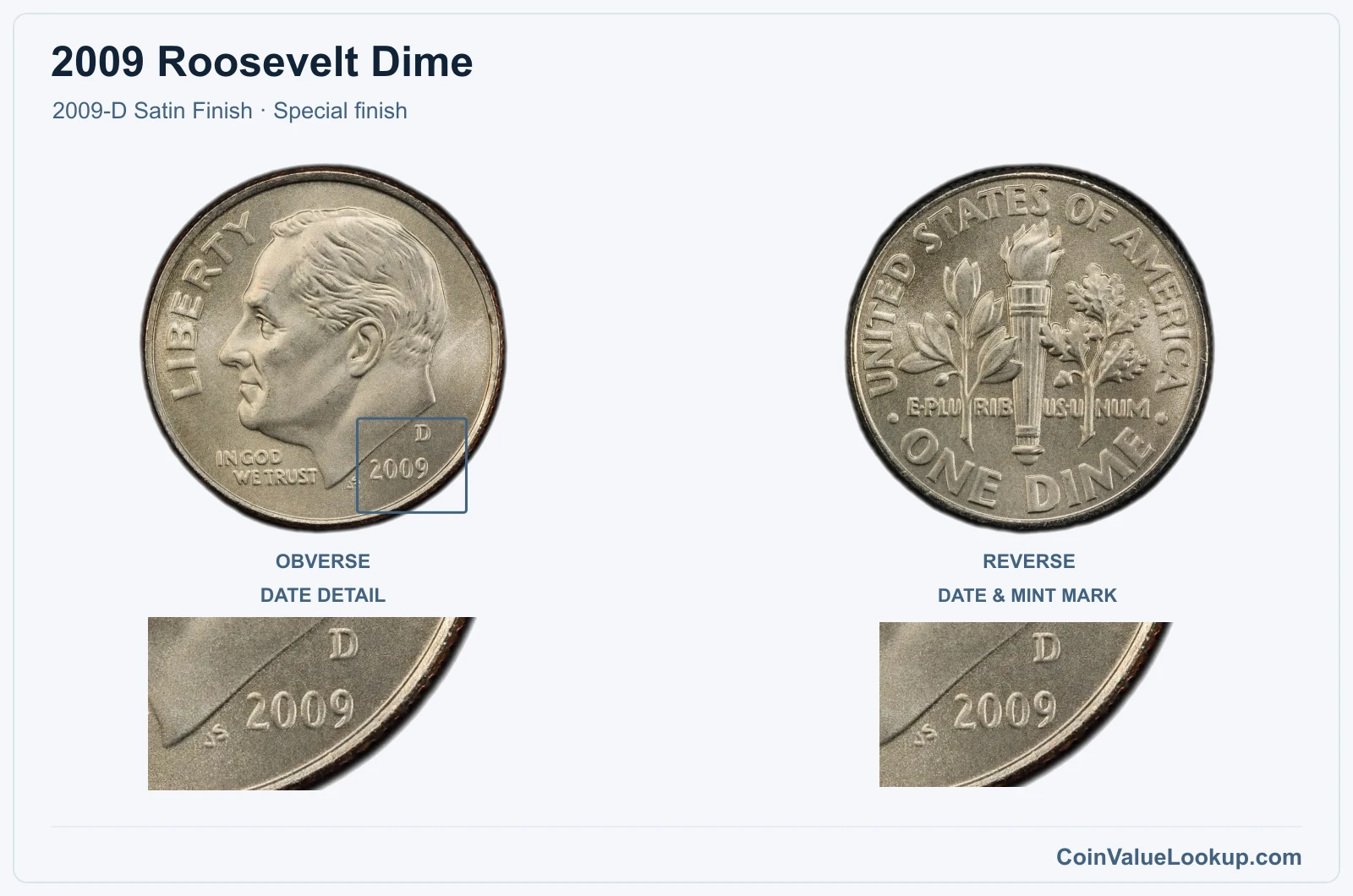
Denver's 2009-D Satin Finish dime mirrors the Philadelphia Satin issue in every way except mintmark. Same copper-nickel clad composition, same 2.27-gram weight, same soft even surface texture, and same origin inside the annual uncirculated Mint Set.
As with the P Satin, no guide price is currently adopted. Individual value depends on authenticated identity, condition and any errors present.
The surface finish is the key diagnostic — under a loupe, the Satin Finish looks matte and uniform compared to the flow-line luster of a business strike pulled from a roll.
Range Grade
Price Auction Records Appraisal SP SP 1
—
Coin Identifier
SP 2
—
Coin Identifier
SP 3
—
Coin Identifier
SP 4
—
Coin Identifier
SP 6
—
Coin Identifier
SP 8
—
Coin Identifier
SP 10
—
Coin Identifier
SP 12
—
Coin Identifier
SP 15
—
Coin Identifier
SP 20
—
Coin Identifier
SP 25
—
Coin Identifier
SP 30
—
Coin Identifier
SP 35
—
Coin Identifier
SP 40
—
Coin Identifier
SP 45
—
Coin Identifier
SP 50
—
Coin Identifier
SP 53
—
Coin Identifier
SP 55
—
Coin Identifier
SP 58
—
Coin Identifier
SP 60
—
Coin Identifier
SP 61
—
Coin Identifier
SP 62
—
Coin Identifier
SP 63
—
Coin Identifier
SP 64
—
Coin Identifier
SP 65
—
Coin Identifier
SP 66
—
Coin Identifier
SP 67
—
Coin Identifier
SP 68
—
Coin Identifier
SP 69
—
—
—
SP 70
—
—
—
2009 Roosevelt Dime Error List
1. 2009 Roosevelt Dime — Die-Adjustment / Low-Pressure Strike
A die-adjustment strike (sometimes called a setup strike) results in an overall weak impression across both sides of the coin. The design appears washed out and incomplete even on surfaces that show no wear.
Letters, the portrait and the torch all look uniformly soft rather than selectively weak in one area.
Do not confuse this with a coin that simply circulated heavily. Wear concentrates on high points first, while a die-adjustment strike affects the entire design almost equally.
Grease-filled dies and ordinary weak strikes can also mimic the look, but grease tends to blank out specific areas rather than muting the whole coin.
Condition, visibility of the remaining design, and confirmed attribution all affect what a die-adjustment strike is worth. No specific price is available for this error on 2009 dimes at this time.
2. 2009 Roosevelt Dime — Clashed Dies
Die clash marks appear when the obverse and reverse dies strike each other without a planchet between them. The impact transfers faint traces of one design onto the opposite die, and those ghost impressions then show up on subsequently struck coins.
On a 2009 dime, look for faint outlines of Roosevelt's profile somewhere in the torch-side fields, or torch and branch traces near the portrait. The transferred elements should align with where the opposite design would sit during a normal strike.
Do not mistake random scratches, raised lines from die polishing, or a partial brockage for a die clash. Clash marks are consistent across multiple coins from the same die pair and follow a predictable geometry.
Value depends on how visible and dramatic the transferred design is, along with overall coin condition.
3. 2009 Roosevelt Dime — Struck-Through Error
A struck-through error occurs when foreign material — often grease — sits between the die and the planchet during striking. The result is a localized area of missing or depressed design detail where the obstruction blocked the metal from fully filling the die.
Grease-filled examples tend to show smooth, slightly recessed patches with soft edges, often affecting a single letter, digit or design element. The surrounding design remains sharp.
A retained foreign object, by contrast, may leave a distinct impression or texture in the affected zone.
Wear, scratches and cleaning can all produce areas of lost detail, but those show different surface characteristics under magnification — abrasion lines, flattened high points, or hairlines rather than a smooth depression. Value hinges on the size and location of the affected area, plus overall condition of the coin.
4. 2009 Roosevelt Dime — Off-Center Strike
An off-center strike happens when the planchet is not properly seated in the collar before the dies come together. The result is a design that is shifted to one side, leaving an unstruck blank crescent on the opposite edge.
The percentage of off-center displacement matters a lot. A barely noticeable 2-3% shift is common and adds little.
Dramatic shifts of 10% or more — especially with the full date still visible — attract collector interest. If the date is cut off, value drops sharply because the coin cannot be positively attributed to a specific year.
Do not confuse an off-center strike with a clipped planchet (which has a curved bite missing) or with post-mint damage from a vise or hammer. An authentic off-center coin has a flat, unstruck area with the original planchet edge intact.
5. 2009 Roosevelt Dime — Feeder-Finger Marks
Feeder-finger marks are parallel or repeated impressions left on a planchet by the mechanical fingers that push blanks into the striking chamber. They appear as raised or incuse lines, often running in the same direction and spaced at regular intervals.
On a 2009 dime, look across the fields for sets of fine parallel marks that cross over the design. They should have a consistent pattern rather than the random direction you see with handling scratches or cleaning hairlines.
The key diagnostic is regularity. Post-mint scratches from coin-counting machines or album slides tend to be random and vary in depth.
Die-polish lines are generally finer and confined to specific die-state runs. Feeder-finger marks cross design elements uniformly because they were impressed before the strike.
Value depends on visibility and coin condition.
6. 2009 Roosevelt Dime — Doubled Die Obverse
A doubled die obverse on a 2009 dime shows consistent doubling of obverse design elements — lettering, date or portrait details — caused during die manufacture. The doubling appears as separation, notching or shelf-like thickening on affected features and is identical on every coin struck by that die.
Compare suspect letters or digits against a normal 2009 dime under the same lighting and magnification. True doubled die doubling is uniform and directional: every example from that die pair shows the same displacement in the same spot.
Machine doubling is the common lookalike. It produces a flat, shelf-like distortion on one side of the raised design and lacks the rounded, separated profile of a genuine doubled die.
Reflections and worn die contours can also trick the eye. No specific price is adopted for this error, as value varies with the strength of the doubling and overall condition.
7. 2009 Roosevelt Dime — Lamination / Split Planchet
A lamination error shows separation within the coin's metal layers — peeling flaps, bubbles or outright missing chunks of surface metal. These occur when impurities or gas pockets in the planchet cause the alloy to delaminate under the pressure of striking.
On a 2009 dime, look for a raised flap of metal still attached at one edge, or a smooth, recessed area where a layer has broken away. Photographing the edge alongside the affected face helps show the depth and extent of the separation.
Corrosion pitting, deliberate scraping and environmental damage can mimic lamination at first glance. Genuine lamination follows the metal's internal structure and usually has smooth, rounded edges at the separation boundary rather than sharp gouges or green corrosion deposits.
Condition, size of the affected area and whether the flap is retained all influence how collectors value this type of error.