2009 Kennedy Half Dollar Coin Value: How Much Is It Worth?
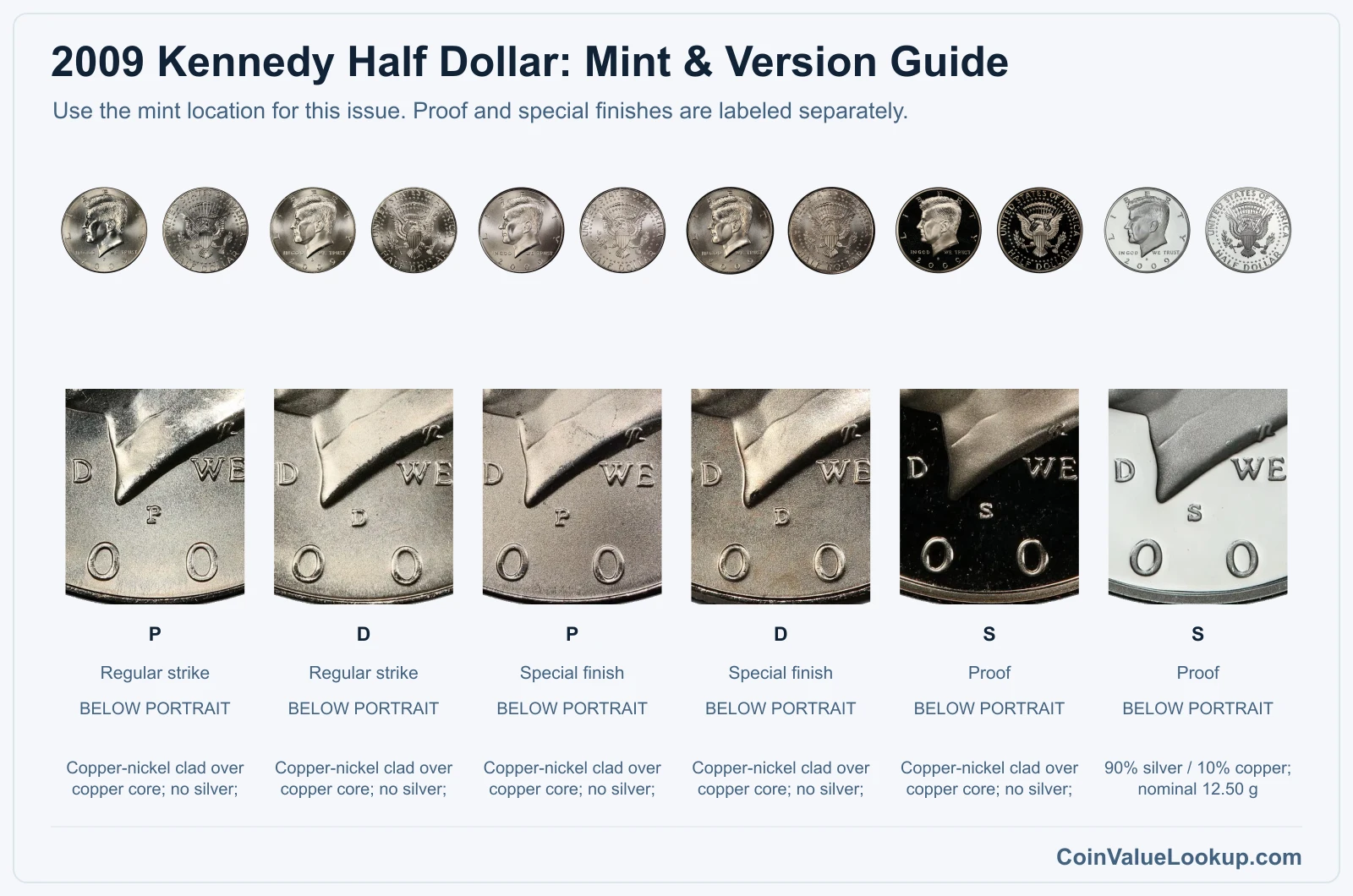
The 2009 Kennedy half dollar carries a face value of 50 cents, and most worn clad examples are worth exactly that. Collector-oriented branches — proofs, silver proofs and satin-finish specimens — push guide estimates from roughly $2.50 up to about $35.00 depending on mint, finish and grade.
Before checking any price chart, you need to know which version you actually have.
Fast Way to Identify Your 2009 Kennedy Half Dollar
Snap a clear photo of the front and back of your 2009 half dollar and upload both images. Our preliminary identifier can help you spot the mintmark, finish type and obvious visual clues that separate a face-value coin from a collectible one.
It is not a substitute for professional authentication, but it is a solid first step.
2009 Kennedy Half Dollar Value
Upload both sides of your 2009 Kennedy Half Dollar.
Front Obverse
Upload photo
Back Reverse
Upload photo
Which 2009 Kennedy Half Dollar Versions Are Worth Money?
- The S silver proof at PR65 carries a USA Coin Book guide estimate of $35.00, the highest listed value among 2009 Kennedy half branches at comparable grades.
- Satin-finish specimens from the P and D mints require individual assessment — value depends on authenticated identity and condition.
- Clad proofs from the S mint at PR65 are estimated at $6.25 by USA Coin Book, well above face value for a clad coin.
- Mint-made errors such as clipped planchets or missing clad layers can add collector interest; value depends on the specific error's visibility and severity.
Step 1: Identify Your 2009 Kennedy Half Dollar Mint Mark and Version
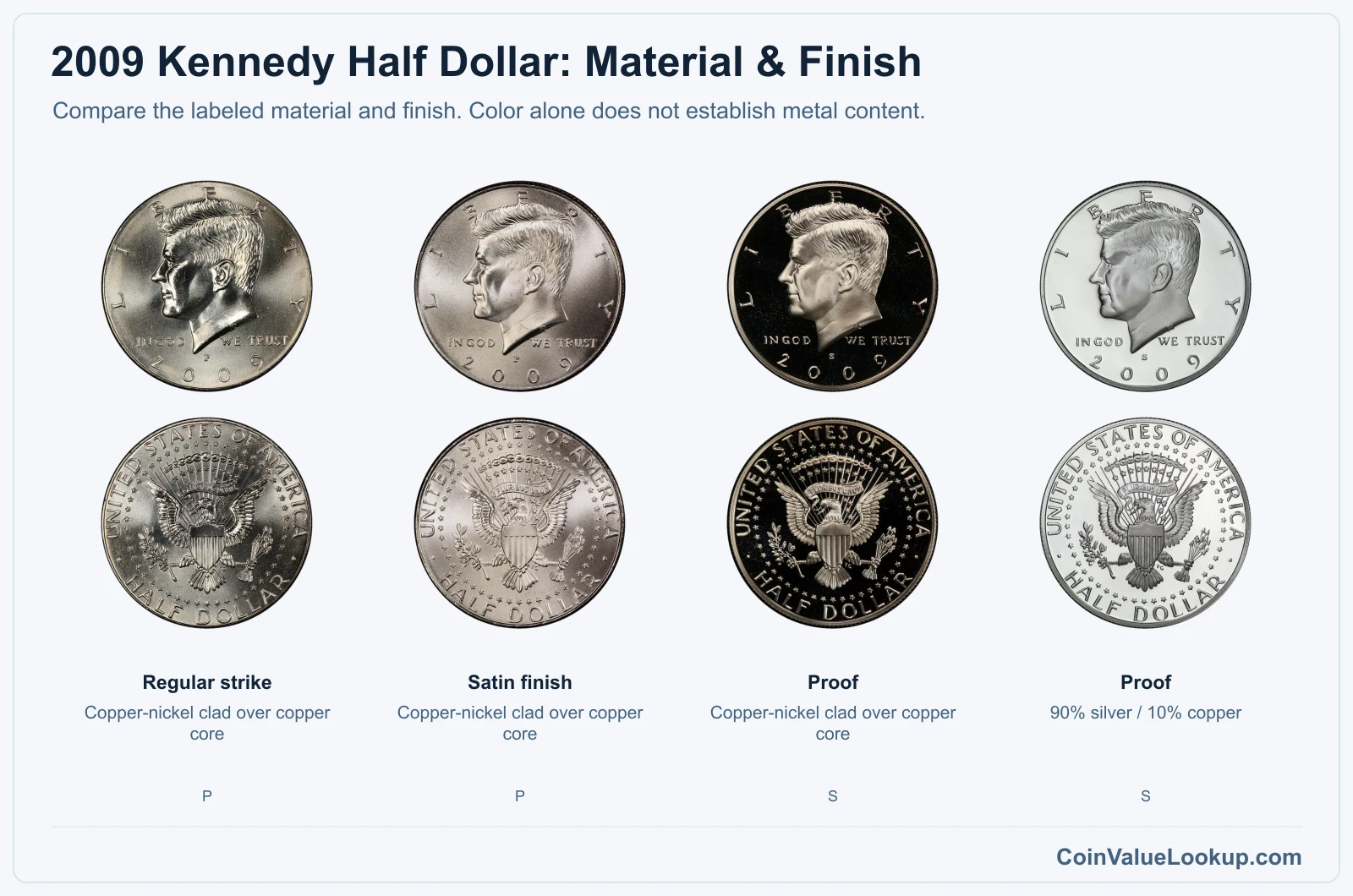
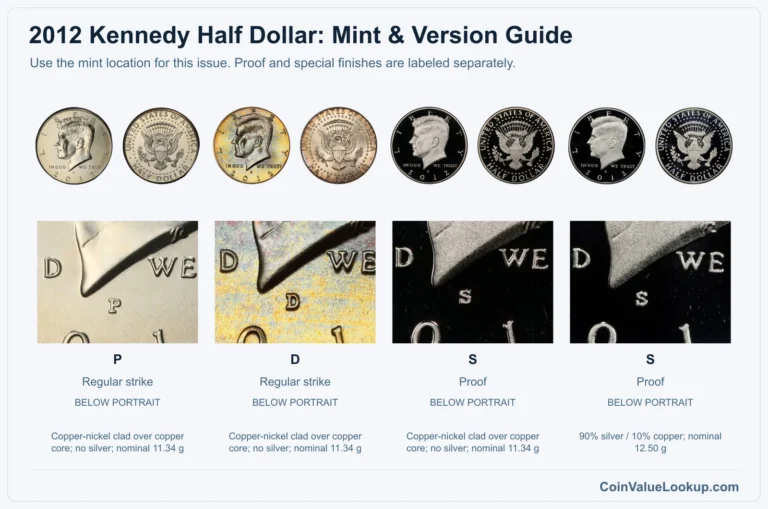
Flip the coin to Kennedy's portrait side and look just beneath his head, above the date. You should see a small letter: P for Philadelphia, D for Denver or S for San Francisco.
That single letter determines which branch of the price chart applies to your coin.
Both P and D mints struck ordinary clad business strikes and a separate satin-finish specimen version sold in mint sets. The S mint produced two different proofs — one in copper-nickel clad and one in 90% silver.
Same mintmark, two different metals.
To tell the S clad proof from the S silver proof, compare weight and edge. A clad coin weighs about 11.34 grams with a visible copper-colored stripe on its edge.
The silver proof weighs roughly 12.50 grams and shows a uniform silver-gray edge with no copper band. Toning, aftermarket plating or even camera lighting can fake a gold or silver look, so the edge stripe test matters more than surface color.
One more thing: 2009 P and D halves were not released into normal bank-roll circulation. They were distributed through collector channels, so finding one in heavy-wear condition usually means it was broken out of a mint set and spent.
Step 2: Check Your 2009 Kennedy Half Dollar Grade
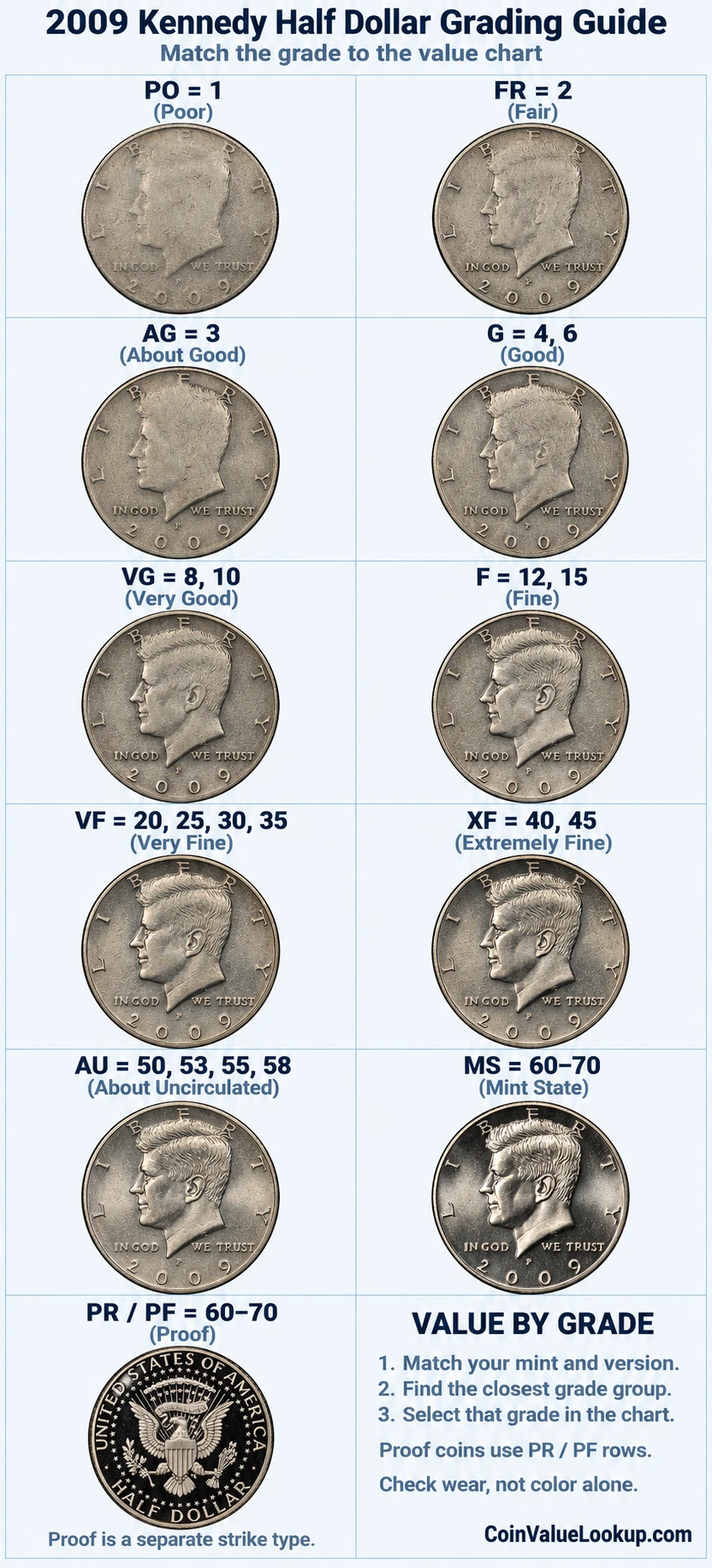
Start with Kennedy's cheekbone and jawline on the obverse. These are the highest points and show smooth, flat wear first.
Then check the hair detail directly above his ear — on a well-preserved coin every strand is crisp and separated.
On the reverse, look at the eagle's breast feathers and the tops of both wings. Wear flattens these areas early.
Compare your coin against the reference image to gauge where it falls.
Bag marks are a different problem from circulation wear. A coin can be technically uncirculated yet covered in small contact marks from bouncing against other coins during production and storage.
These dings lower the Mint State grade without meaning the coin ever saw a cash register.
Proofs get their own grading scale. Instead of checking for wear, look for hairline scratches (often from improper cleaning), haze across the mirror fields and contact marks on the frosted portrait.
A proof with heavy hairlines grades much lower than a clean one, even if neither was ever circulated.
Step 3: Check 2009 Kennedy Half Dollar Value by Mint and Version
2009 Kennedy Half Dollar — P — clad business
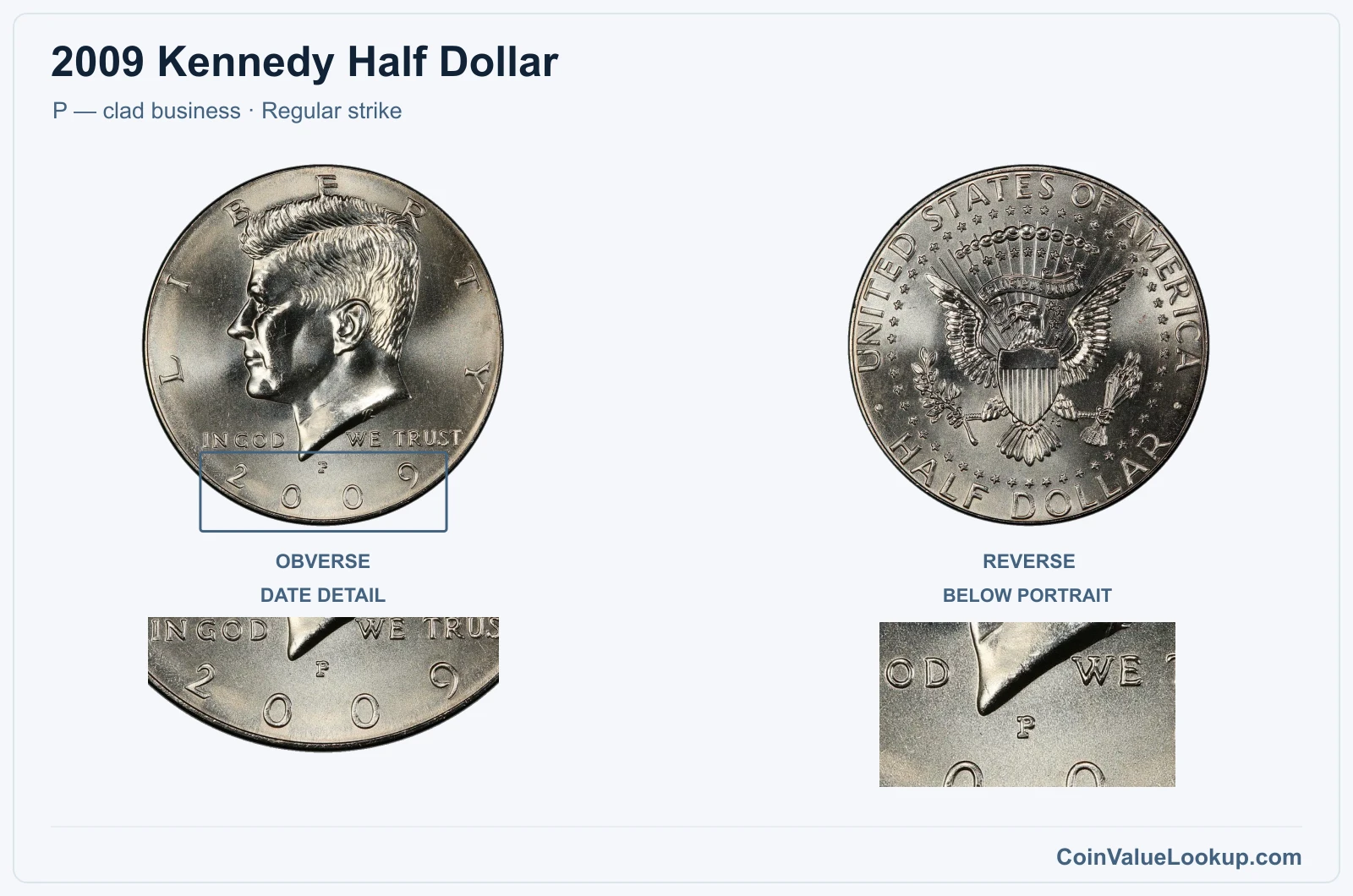
The 2009-P clad business strike is a copper-nickel clad coin weighing about 11.34 grams. Look for the P mintmark beneath Kennedy's portrait.
Worn examples typically trade at face value — fifty cents.
At MS65, the USA Coin Book guide estimate is $2.50. That is not a lot, but remember these were distributed through collector channels, not dumped into bank bags for commerce.
A coin that stayed in its original mint-set packaging and grades high could still be worth pulling aside.
Range Grade
Price Auction Records Appraisal PO PO 1
—
Coin Identifier FR FR 2
—
Coin Identifier AG AG 3
—
Coin Identifier G G 4
—
Coin Identifier
G 6
—
Coin Identifier VG VG 8
—
Coin Identifier
VG 10
—
Coin Identifier F F 12
—
Coin Identifier
F 15
—
Coin Identifier VF VF 20
—
Coin Identifier
VF 25
—
Coin Identifier
VF 30
—
Coin Identifier
VF 35
—
Coin Identifier XF XF 40
—
Coin Identifier
XF 45
—
Coin Identifier AU AU 50
—
Coin Identifier
AU 53
—
Coin Identifier
AU 55
—
Coin Identifier
AU 58
—
Coin Identifier MS MS 60
—
Coin Identifier
MS 61
—
Coin Identifier
MS 62
—
Coin Identifier
MS 63
—
Coin Identifier
MS 64
—
Coin Identifier
MS 65
—
Coin Identifier
MS 66
Coin Identifier
MS 67
Coin Identifier
MS 68
Coin Identifier
MS 69
—
—
—
MS 70
—
—
—
2009 Kennedy Half Dollar — P — clad satin specimen
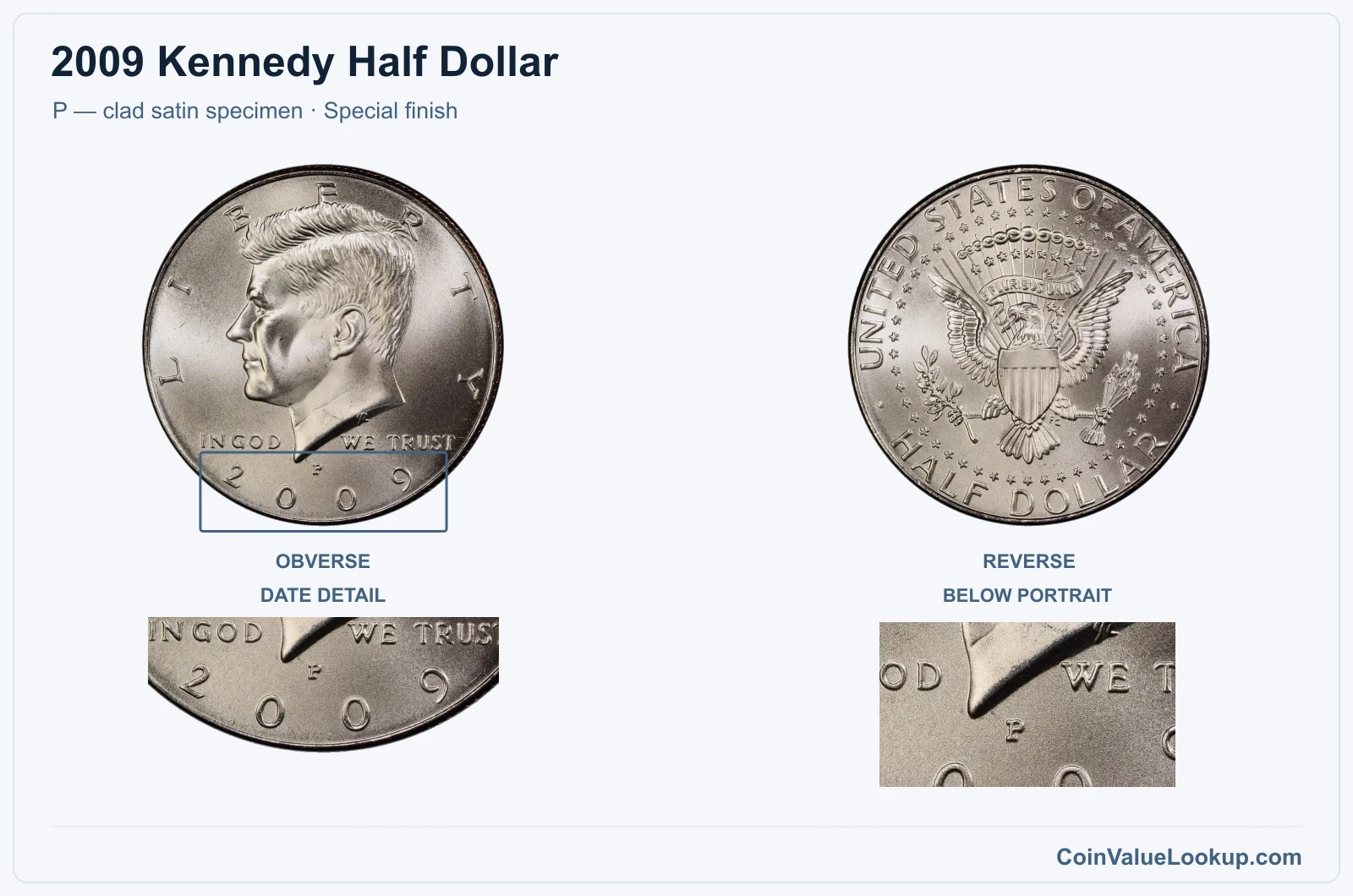
The 2009-P satin specimen was included in that year's official U.S. Mint uncirculated set. It has a distinctive soft, matte-like surface texture that differs from the sharp luster of a regular business strike.
Do not confuse a dull or toned coin with a genuine satin finish — the texture is uniform and intentional, not random.
Satin specimens are graded on the SP scale rather than the MS scale. No supported numeric guide range is available for this branch, so value depends on authenticated identity, condition and any error severity.
Having a third-party grading service confirm the satin designation is the surest way to establish what you have.
Coin Value Lookup is a good starting point if you want to look up other Kennedy half dollar years or denominations while sorting through your collection.
Range Grade
Price Auction Records Appraisal SP SP 1
—
Coin Identifier
SP 2
—
Coin Identifier
SP 3
—
Coin Identifier
SP 4
—
Coin Identifier
SP 6
—
Coin Identifier
SP 8
—
Coin Identifier
SP 10
—
Coin Identifier
SP 12
—
Coin Identifier
SP 15
—
Coin Identifier
SP 20
—
Coin Identifier
SP 25
—
Coin Identifier
SP 30
—
Coin Identifier
SP 35
—
Coin Identifier
SP 40
—
Coin Identifier
SP 45
—
Coin Identifier
SP 50
—
Coin Identifier
SP 53
—
Coin Identifier
SP 55
—
Coin Identifier
SP 58
—
Coin Identifier
SP 60
—
Coin Identifier
SP 61
—
Coin Identifier
SP 62
—
Coin Identifier
SP 63
—
Coin Identifier
SP 64
—
Coin Identifier
SP 65
—
Coin Identifier
SP 66
Coin Identifier
SP 67
Coin Identifier
SP 68
Coin Identifier
SP 69
Coin Identifier
SP 70
—
—
—
2009 Kennedy Half Dollar — D — clad business
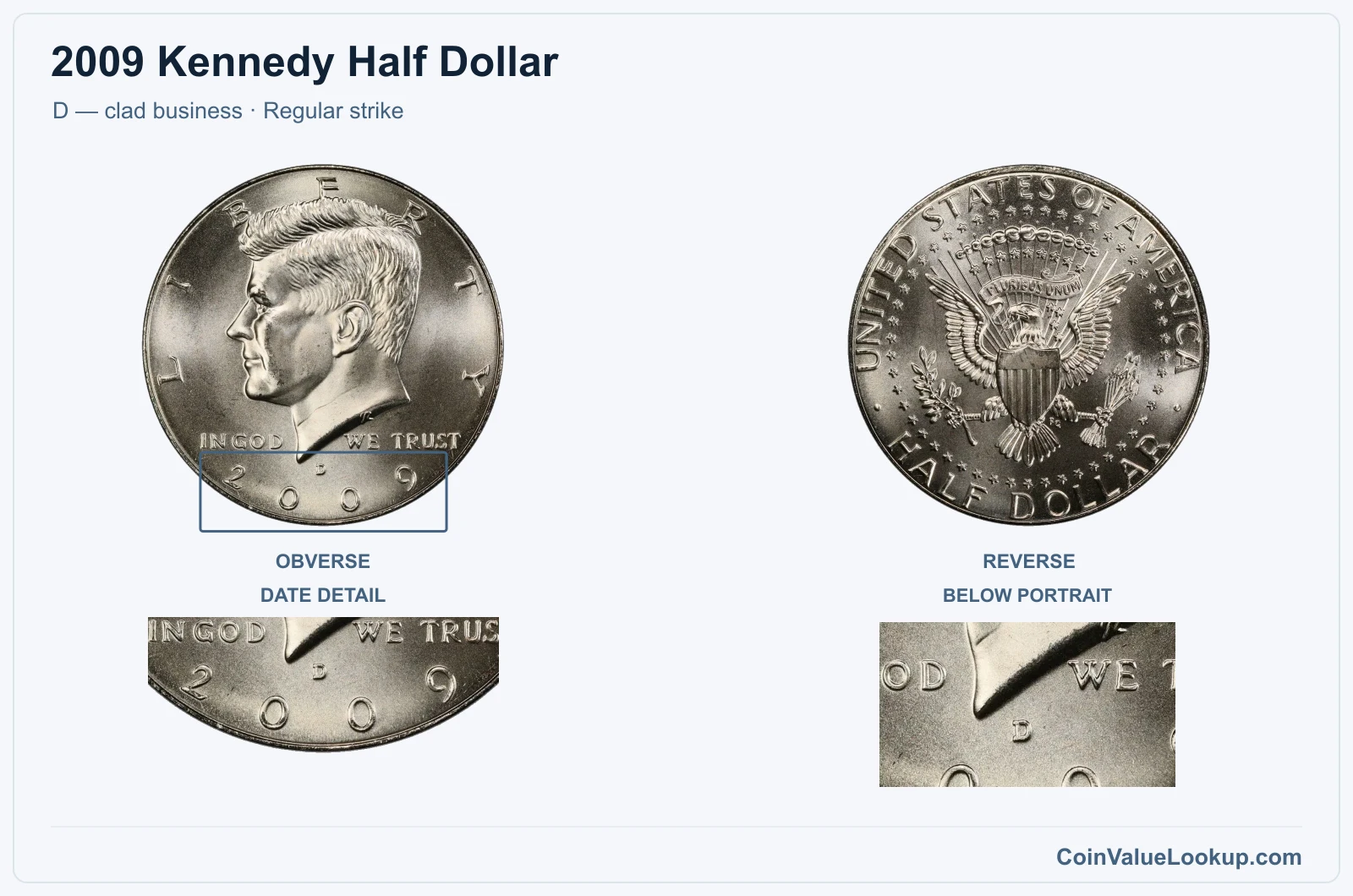
The 2009-D clad business strike is the Denver counterpart. Check for the D mintmark beneath Kennedy's portrait.
Same copper-nickel clad composition and 11.34-gram weight as the Philadelphia version.
At MS65 the USA Coin Book guide estimate is $2.50. Like the P version, these were sold through collector channels rather than released into everyday circulation.
Finding one with heavy wear means someone broke open a set and spent it.
Range Grade
Price Auction Records Appraisal PO PO 1
—
Coin Identifier FR FR 2
—
Coin Identifier AG AG 3
—
Coin Identifier G G 4
—
Coin Identifier
G 6
—
Coin Identifier VG VG 8
—
Coin Identifier
VG 10
—
Coin Identifier F F 12
—
Coin Identifier
F 15
—
Coin Identifier VF VF 20
—
Coin Identifier
VF 25
—
Coin Identifier
VF 30
—
Coin Identifier
VF 35
—
Coin Identifier XF XF 40
—
Coin Identifier
XF 45
—
Coin Identifier AU AU 50
—
Coin Identifier
AU 53
—
Coin Identifier
AU 55
—
Coin Identifier
AU 58
—
Coin Identifier MS MS 60
—
Coin Identifier
MS 61
—
Coin Identifier
MS 62
—
Coin Identifier
MS 63
—
Coin Identifier
MS 64
—
Coin Identifier
MS 65
—
Coin Identifier
MS 66
Coin Identifier
MS 67
Coin Identifier
MS 68
—
—
—
MS 69
—
—
—
MS 70
—
—
—
2009 Kennedy Half Dollar — D — clad satin specimen
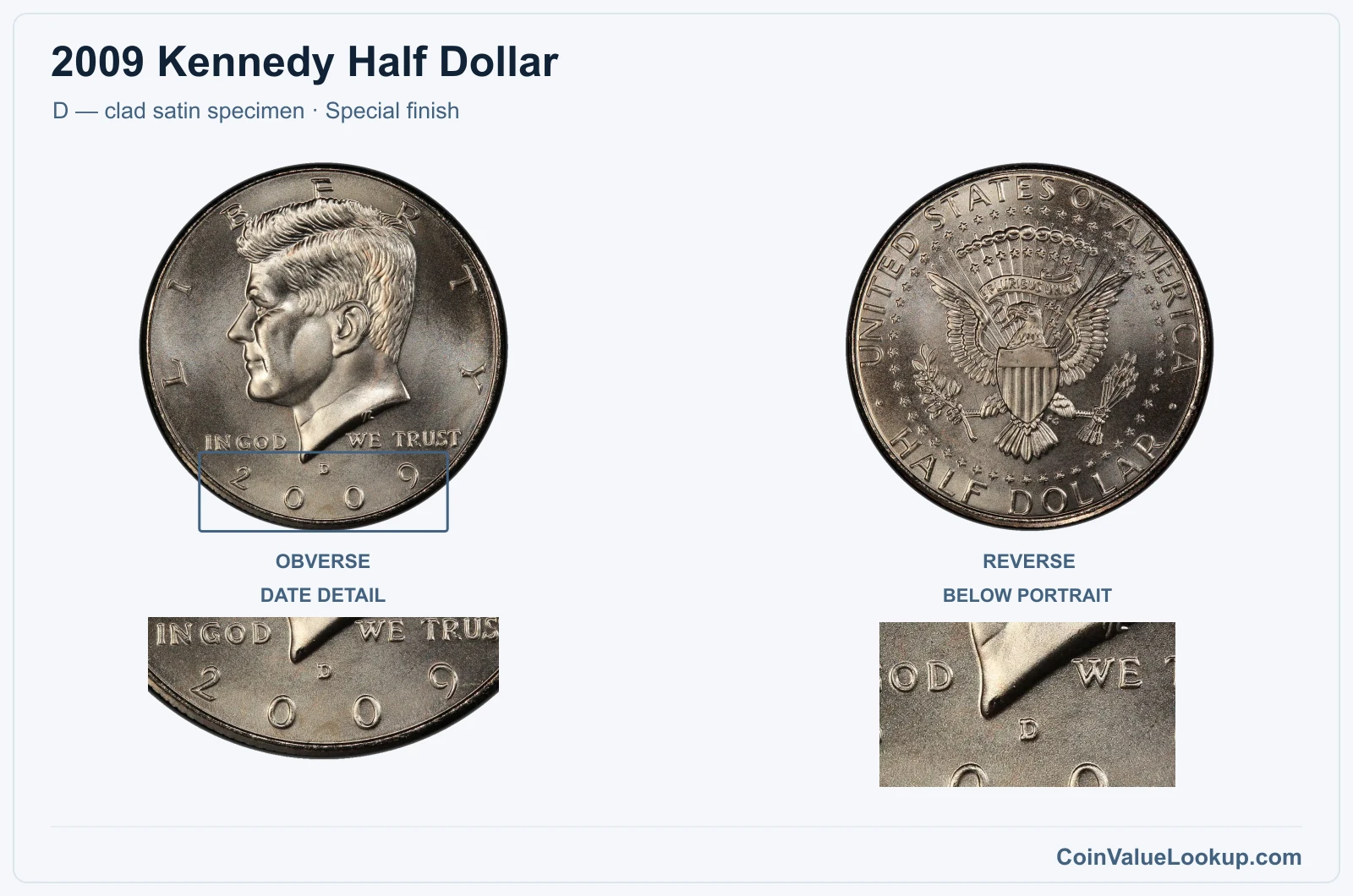
The 2009-D satin specimen shipped inside official U.S. Mint uncirculated sets, just like its Philadelphia twin. The satin texture is an intentional manufacturing finish — soft and uniform across both sides of the coin.
A regular business strike that has been lightly cleaned or toned can look vaguely similar, so be careful with the identification.
This branch uses the SP grading scale. No supported numeric guide range is available, so pricing comes down to the specific coin's authenticated identity, its condition and whether any mint error is present.
Professional authentication is the clearest path to a reliable answer.
Range Grade
Price Auction Records Appraisal SP SP 1
—
Coin Identifier
SP 2
—
Coin Identifier
SP 3
—
Coin Identifier
SP 4
—
Coin Identifier
SP 6
—
Coin Identifier
SP 8
—
Coin Identifier
SP 10
—
Coin Identifier
SP 12
—
Coin Identifier
SP 15
—
Coin Identifier
SP 20
—
Coin Identifier
SP 25
—
Coin Identifier
SP 30
—
Coin Identifier
SP 35
—
Coin Identifier
SP 40
—
Coin Identifier
SP 45
—
Coin Identifier
SP 50
—
Coin Identifier
SP 53
—
Coin Identifier
SP 55
—
Coin Identifier
SP 58
—
Coin Identifier
SP 60
—
Coin Identifier
SP 61
—
Coin Identifier
SP 62
Coin Identifier
SP 63
—
Coin Identifier
SP 64
—
Coin Identifier
SP 65
—
Coin Identifier
SP 66
Coin Identifier
SP 67
—
Coin Identifier
SP 68
Coin Identifier
SP 69
—
Coin Identifier
SP 70
—
—
—
2009 Kennedy Half Dollar — S — clad proof
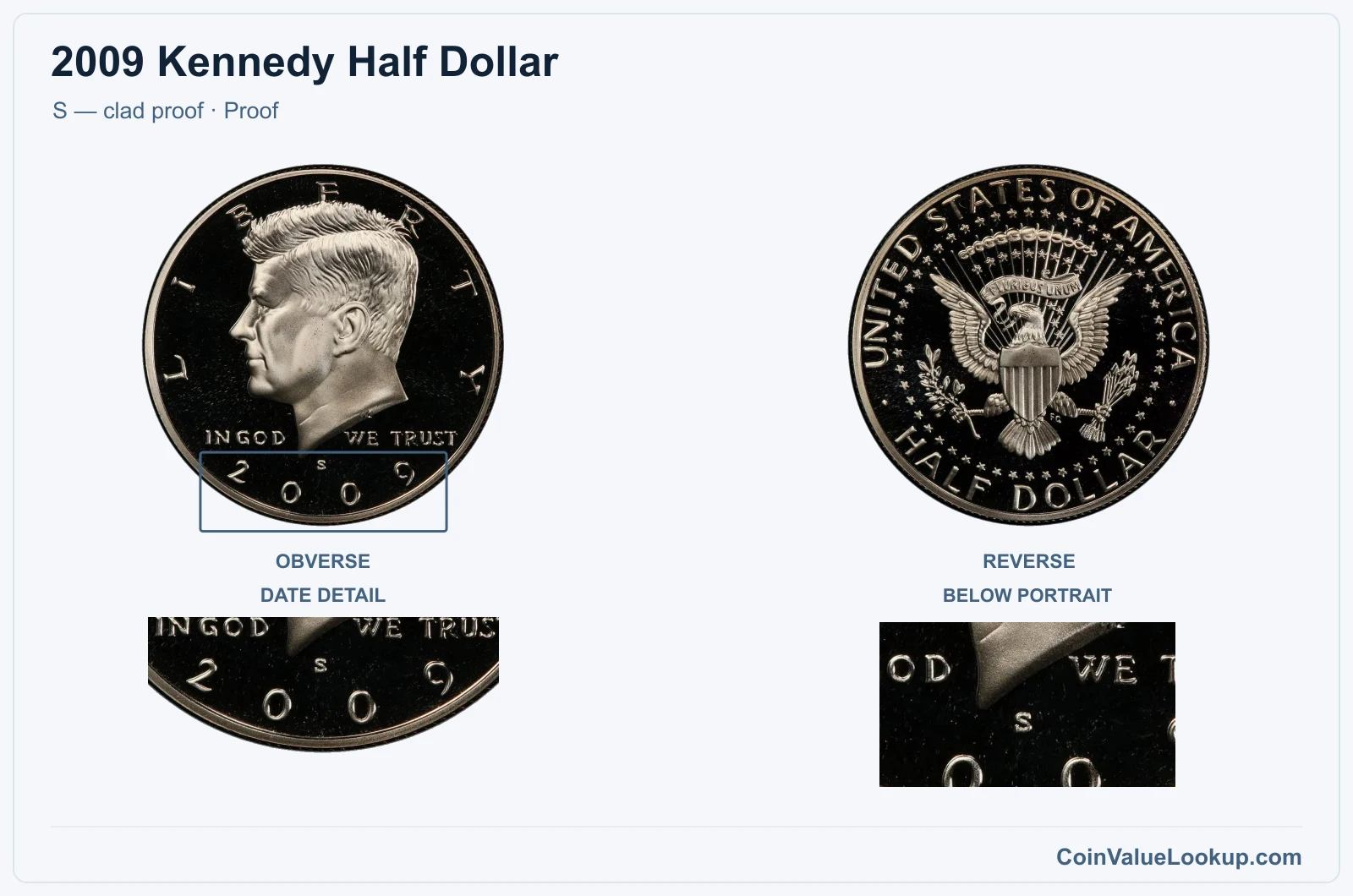
The 2009-S clad proof was struck at San Francisco on a copper-nickel clad planchet — no silver content. You will see mirror-like fields contrasting with frosted, raised design elements.
The edge shows the telltale copper stripe of a clad coin.
At PR65, the USA Coin Book guide estimate is $6.25. When grading a proof, focus on hairlines across the flat mirror fields and contact marks on the frosted portrait devices.
Haze from improper storage also knocks the grade down. A proof is a manufacturing method, not a grade above Mint State, so even a proof can grade poorly if mishandled.
Range Grade
Price Auction Records Appraisal PR PR 1
—
Coin Identifier
PR 2
—
Coin Identifier
PR 3
—
Coin Identifier
PR 4
—
Coin Identifier
PR 6
—
Coin Identifier
PR 8
—
Coin Identifier
PR 10
—
Coin Identifier
PR 12
—
Coin Identifier
PR 15
—
Coin Identifier
PR 20
—
Coin Identifier
PR 25
—
Coin Identifier
PR 30
—
Coin Identifier
PR 35
—
Coin Identifier
PR 40
—
Coin Identifier
PR 45
—
Coin Identifier
PR 50
—
Coin Identifier
PR 53
—
Coin Identifier
PR 55
—
Coin Identifier
PR 58
—
Coin Identifier
PR 60
—
Coin Identifier
PR 61
—
Coin Identifier
PR 62
—
Coin Identifier
PR 63
—
Coin Identifier
PR 64
—
Coin Identifier
PR 65
—
Coin Identifier
PR 66
—
Coin Identifier
PR 67
—
Coin Identifier
PR 68
—
Coin Identifier
PR 69
Coin Identifier
PR 70
Coin Identifier
2009 Kennedy Half Dollar — S — silver proof
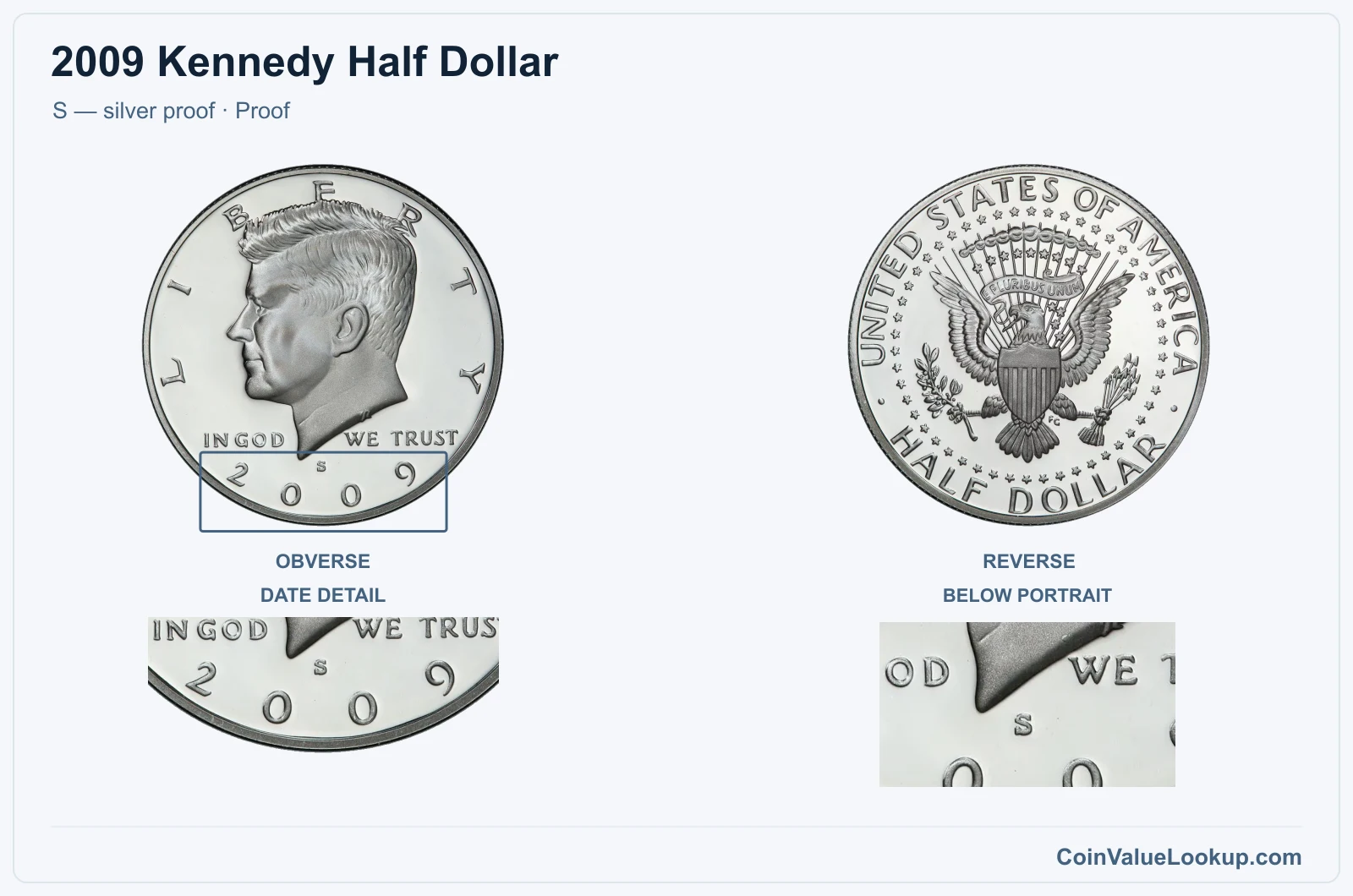
This is the one collectors tend to care about most among 2009 Kennedy halves. The S silver proof is struck on a 90% silver, 10% copper planchet weighing approximately 12.50 grams.
Both the S clad proof and S silver proof carry the same mintmark, so the edge and weight are your real confirmation tools. No copper stripe should be visible on a silver proof's edge.
At PR65 the USA Coin Book guide estimate is $35.00. That makes it the highest-valued branch in the standard 2009 Kennedy lineup at comparable grades.
Keep in mind that silver content alone adds a base melt value, but collector premiums on well-preserved proofs push things further.
Range Grade
Price Auction Records Appraisal PR PR 1
—
Coin Identifier
PR 2
—
Coin Identifier
PR 3
—
Coin Identifier
PR 4
—
Coin Identifier
PR 6
—
Coin Identifier
PR 8
—
Coin Identifier
PR 10
—
Coin Identifier
PR 12
—
Coin Identifier
PR 15
—
Coin Identifier
PR 20
—
Coin Identifier
PR 25
—
Coin Identifier
PR 30
—
Coin Identifier
PR 35
—
Coin Identifier
PR 40
—
Coin Identifier
PR 45
—
Coin Identifier
PR 50
—
Coin Identifier
PR 53
—
Coin Identifier
PR 55
—
Coin Identifier
PR 58
—
Coin Identifier
PR 60
—
Coin Identifier
PR 61
—
Coin Identifier
PR 62
—
Coin Identifier
PR 63
—
Coin Identifier
PR 64
—
Coin Identifier
PR 65
—
Coin Identifier
PR 66
—
Coin Identifier
PR 67
—
Coin Identifier
PR 68
—
Coin Identifier
PR 69
Coin Identifier
PR 70
Coin Identifier
2009 Kennedy Half Dollar Error List
1. 2009 Kennedy Half Dollar — Clipped Planchet
A clipped planchet error occurs when a portion of the coin blank is missing before the strike. On a 2009 Kennedy half, look for a curved, straight or ragged section of missing metal along the rim.
The design opposite the clip often appears weak or poorly struck because the planchet could not fill the die cavity evenly.
Do not confuse a clip with a filed edge, deliberate cut or post-mint corrosion. Genuine clips show metal flow consistent with the striking process, and the Blakesley effect — a flat or weak area on the rim directly opposite the clip — is a useful diagnostic.
Value depends on the size and visibility of the clip, plus the coin's overall condition. No specific price range is available for this error on the 2009 date.
2. 2009 Kennedy Half Dollar — Indented Strike
An indented strike happens when a second blank (or foreign object) overlaps the planchet during striking, leaving a depressed, unstruck area bounded by a visible outline. On a 2009 Kennedy half, this shows up as a sunken zone where part of the normal design is absent or only partially impressed.
The key distinction from a post-mint dent is that an indent has a defined boundary matching another planchet or object, and the surrounding struck design flows up to its edge naturally. A brockage is different too — it carries a mirrored impression of a design, not a plain depression.
Value hinges on the indent's size, location and the coin's overall condition. No specific price range is available for this error on the 2009 date.
3. 2009 Kennedy Half Dollar — Struck-Through Error
A struck-through error shows up as a depressed or obscured area where foreign material — grease, cloth fibers or shop debris — sat between the die and the planchet during striking. On a 2009 Kennedy half, you might see a mushy patch where fine detail should be sharp, or a textured impression left by a piece of fabric or other object.
Grease fill-ins tend to produce smooth, featureless depressions, while retained objects can leave distinctive patterns or textures. Do not mistake normal die wear, light circulation wear or cleaning damage for a struck-through error.
The affected area should look like it was blocked during manufacture, not rubbed away afterward. Value depends on size, visibility and what caused the obstruction.
No specific price range is available for this error on the 2009 date.
4. 2009 Kennedy Half Dollar — Missing Clad Layer
A missing clad layer error means one of the coin's outer layers was absent before striking. On a 2009 Kennedy half, the affected side may appear a different color from normal because the underlying copper core is exposed.
The coin will also weigh noticeably less than the standard 11.34 grams.
Check the edge carefully. A normal clad coin shows a sandwich of layers; a missing-clad coin will look uneven or show copper where a clad surface should be.
Do not confuse environmental toning, corrosion, aftermarket plating or acid-treated surfaces with a genuine missing clad layer — those post-mint alterations affect the surface without changing the weight. Value depends on which side is affected, the coin's condition and the degree of the error.
No specific price range is available for this error on the 2009 date.