2009 Jefferson Nickel Coin Value: How Much Is It Worth?
Most 2009 Jefferson nickels you pull from pocket change are worth face value. Uncirculated business-strike examples carry USA Coin Book guide estimates of roughly $3.62 at MS60 up to about $6.25 at MS65.
Proof and satin-finish versions follow separate pricing tracks, and genuine mint errors can push values well beyond those guide figures depending on severity and condition.
Fast Way to Identify Your 2009 Jefferson Nickel
Snap a clear photo of the front and back of your 2009 nickel and upload both images here. Our identifier can give you a preliminary read on the mint, finish type, and any obvious features, helping you figure out which branch your coin falls into before you dig deeper into values.
2009 Jefferson Nickel Value
Upload both sides of your 2009 Jefferson Nickel.
Front Obverse
Upload photo
Back Reverse
Upload photo
Which 2009 Jefferson Nickel Versions Are Worth Money?
- 2009-S Proof nickels carry a USA Coin Book guide value around $5.30 at PR65, serving collectors who want a mirror-finish example from San Francisco.
- 2009-P and 2009-D business strikes in true uncirculated condition (MS60 to MS65) are guided at $3.62 to $6.25 — well above face value but only for coins without wear.
- Satin-finish P and D coins from 2009 Mint Sets are a distinct collectible branch; values depend on authenticated condition and are best assessed individually.
- Genuine striking errors such as off-center strikes, broadstrikes, or die caps can carry premiums far above normal issues, with condition and error severity driving the price.
Step 1: Identify Your 2009 Jefferson Nickel Mint Mark and Version
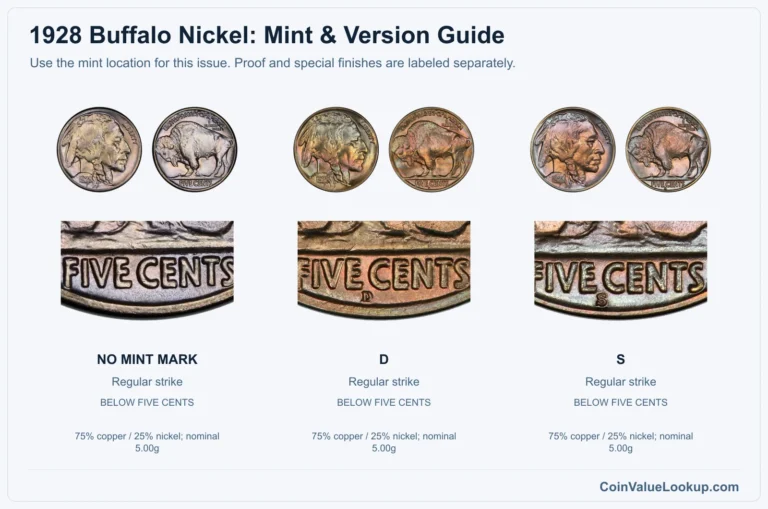
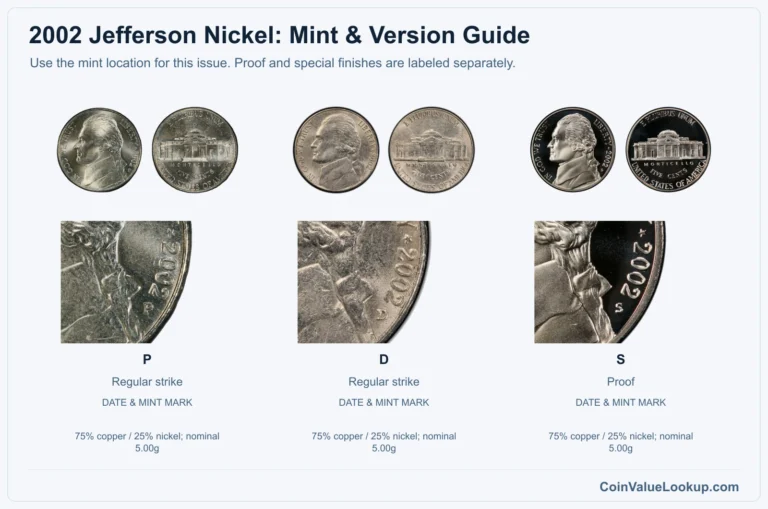
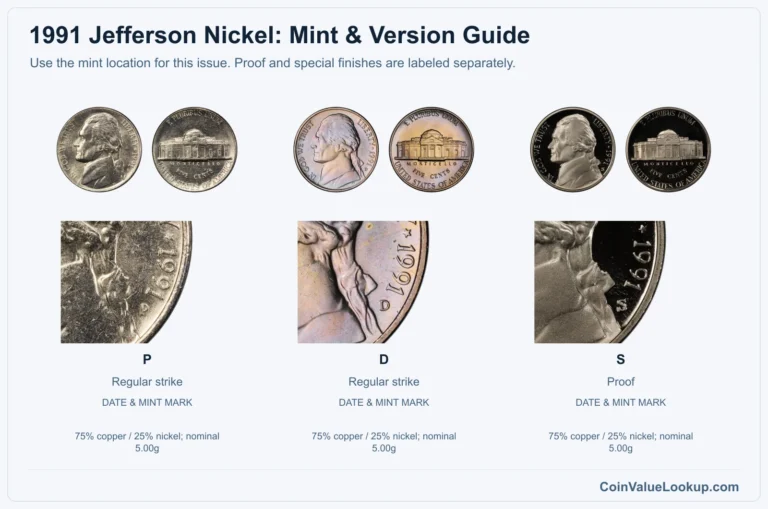
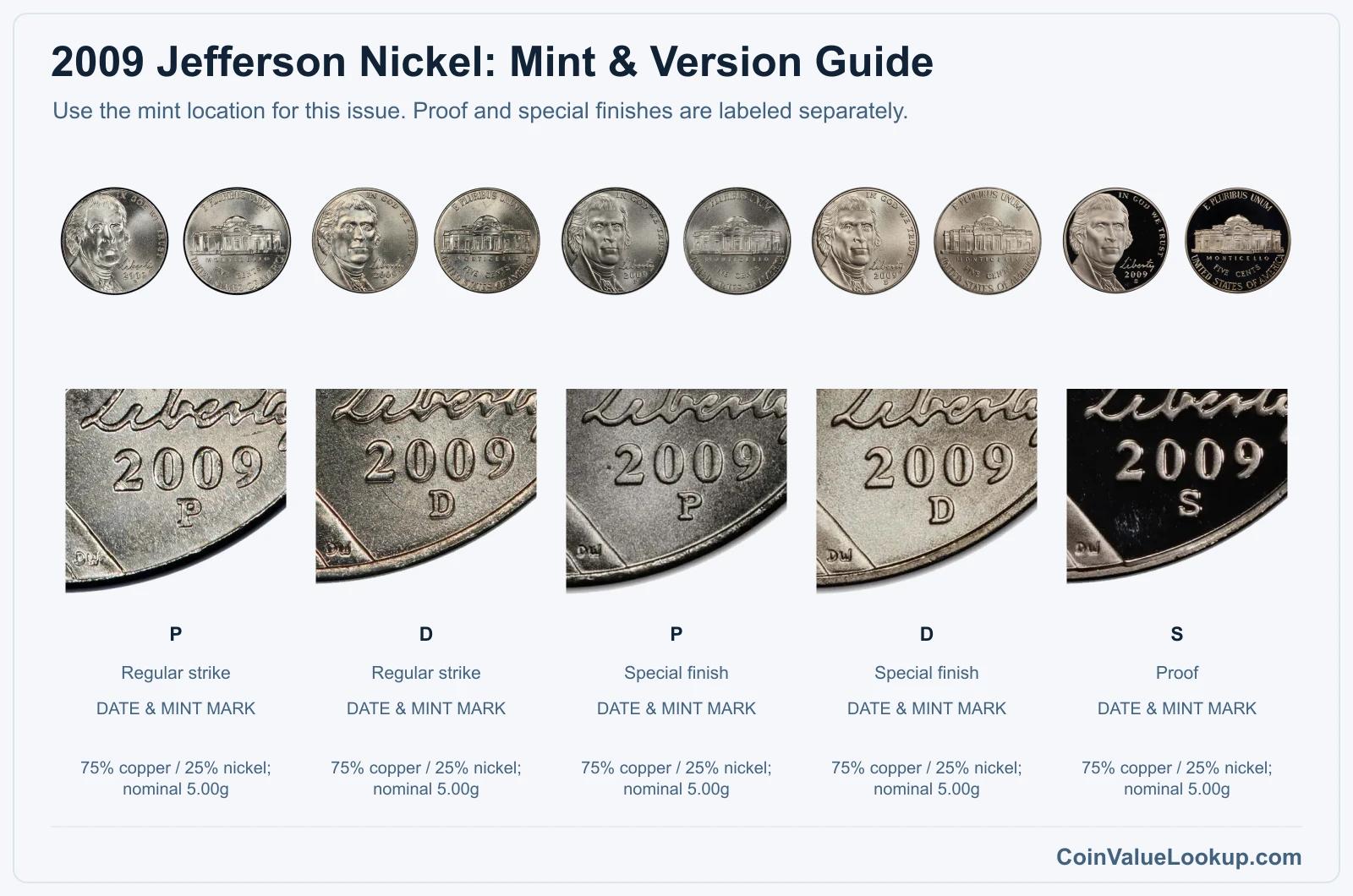
Start by finding the date on the obverse. Then look for the small mintmark letter near the date area: P for Philadelphia, D for Denver, or S for San Francisco proof.
All three share the same forward-facing Jefferson portrait and Monticello reverse that returned in 2006 after the Westward Journey series.
The standard composition is 75% copper and 25% nickel, weighing about 5 grams with a plain edge and a diameter of 21.2 mm. Color alone does not tell you the alloy, so do not assume an oddly toned coin is a different metal.
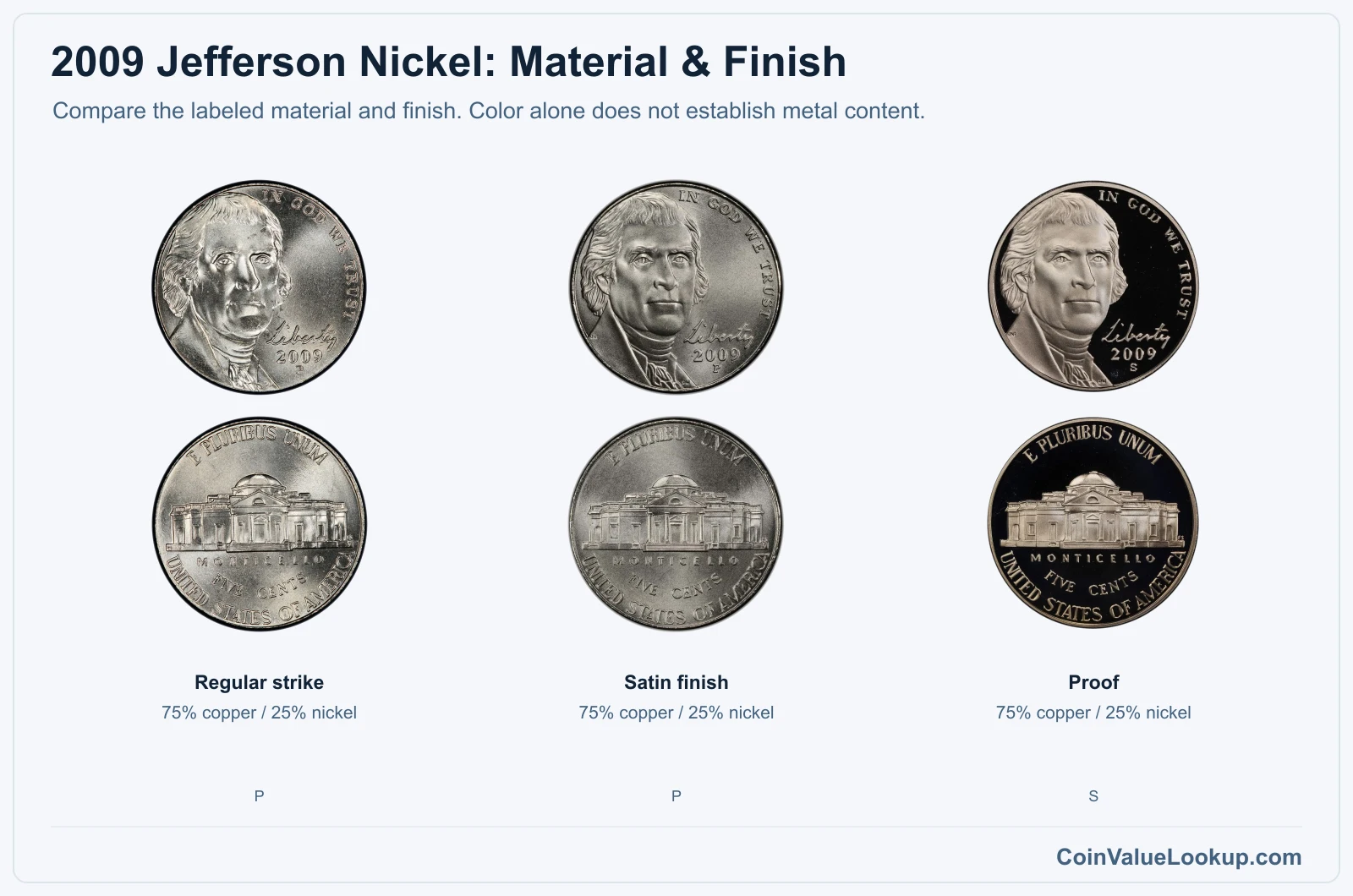
Satin-finish coins were produced for 2009 U.S. Mint Sets with both P and D mintmarks. These have a distinctly soft, even luster that differs from the cartwheel shine of a normal business strike.
A shiny circulated nickel is not automatically a satin issue; you need to compare the surface texture carefully against a known example.
Step 2: Check Your 2009 Jefferson Nickel Grade
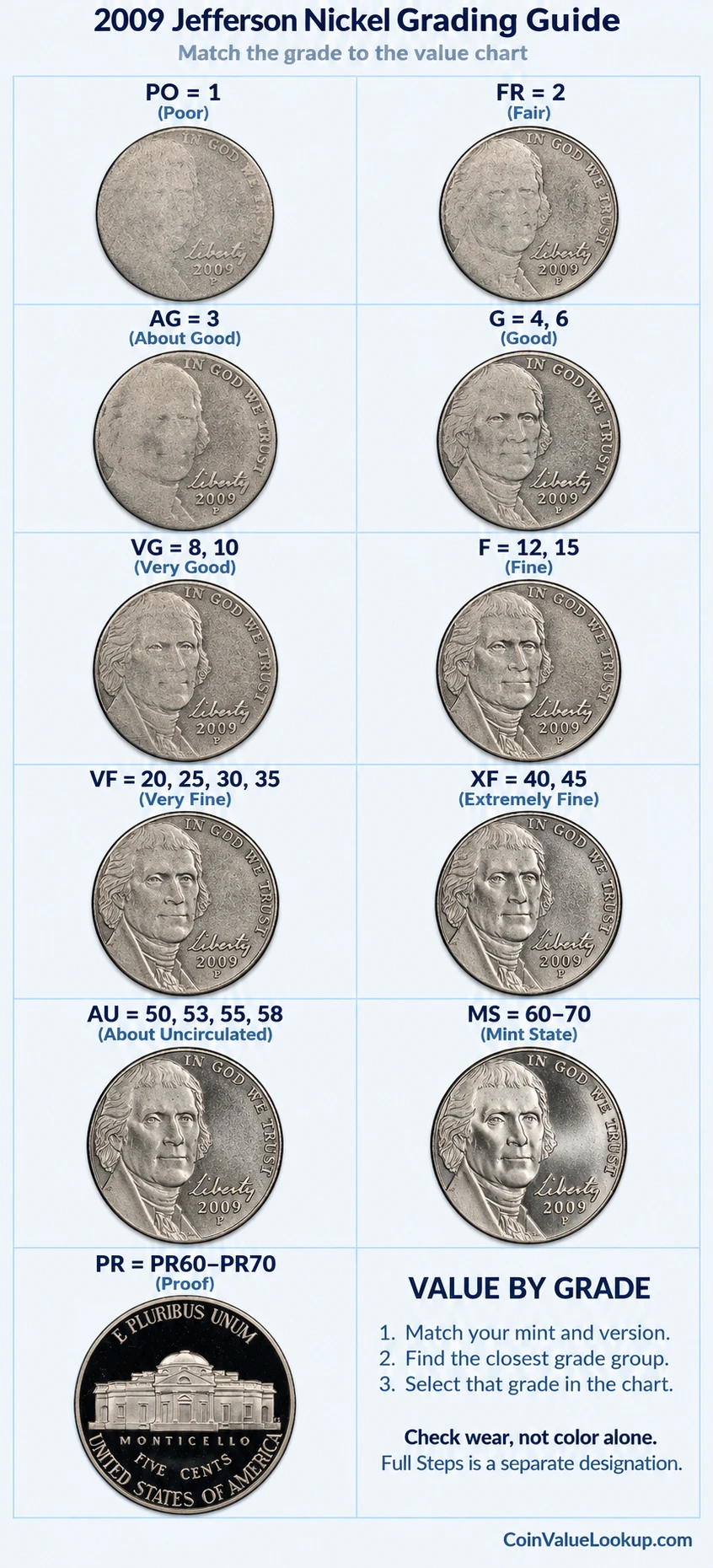
Look at the high points of Jefferson's cheek, jawline, and hair first. On a well-worn coin these areas flatten and lose detail progressively.
Then check how much original mint luster remains across the fields and whether contact marks or scratches interrupt the surfaces.
On the Monticello reverse, pay attention to the columns, triangular pediment, and the steps at the base. Step sharpness relates to strike quality rather than wear, so a coin can be fully uncirculated yet still show soft steps from a weaker strike.
Use the comparison image nearby to match your coin's wear level. Proof coins show mirrored fields and should be compared only to other proofs, not business strikes.
Satin-finish pieces have their own look as well, so grade them against satin examples specifically.
Step 3: Check 2009 Jefferson Nickel Value by Mint and Version
2009 Jefferson Nickel — P — Business strike
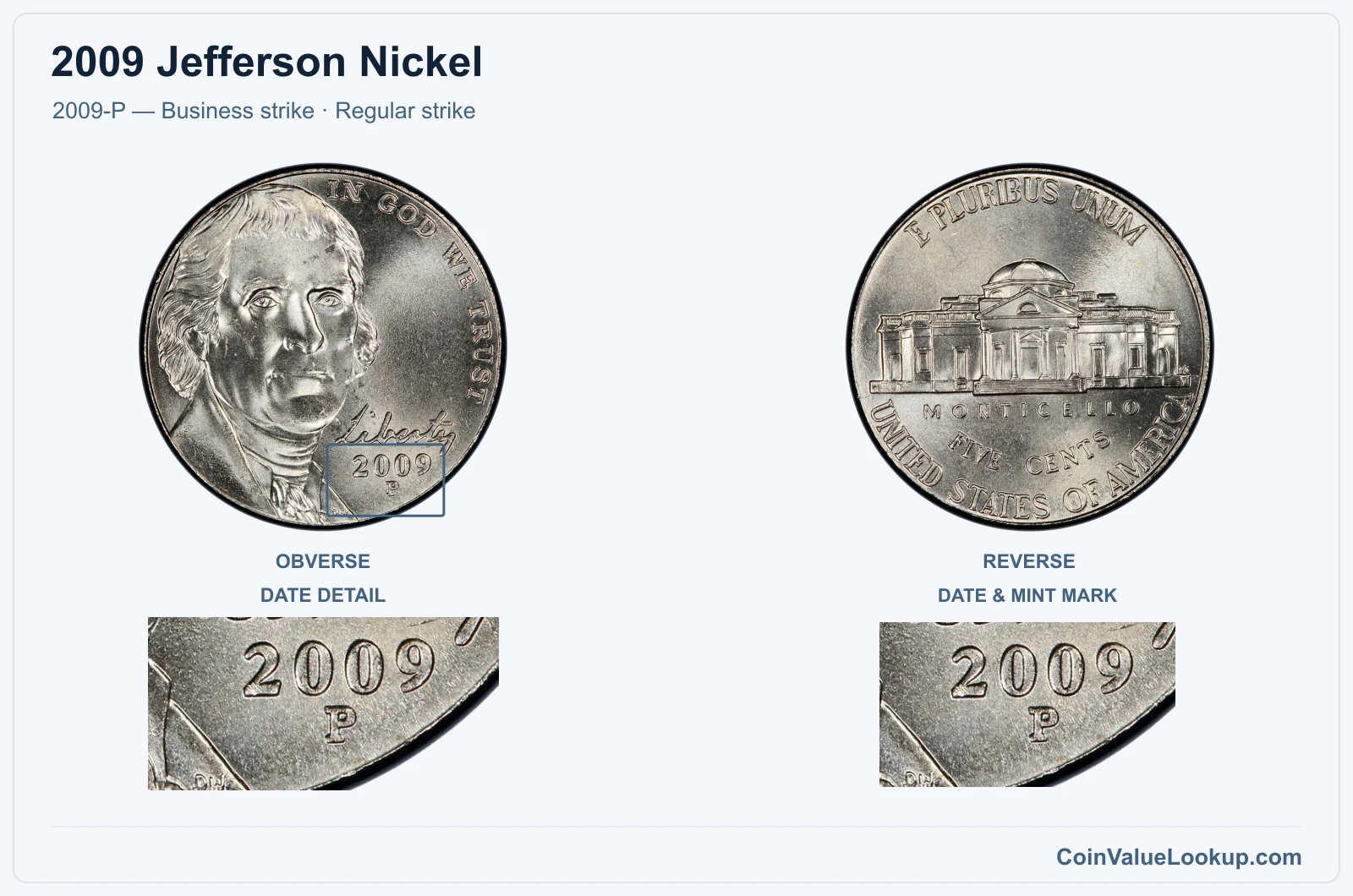
The 2009-P business strike is the standard Philadelphia issue you would find in everyday change. It shows the forward-facing Jefferson portrait on the obverse and Monticello on the reverse, struck in copper-nickel at roughly 5 grams.
USA Coin Book lists guide values of about $3.62 in MS60 and $6.25 in MS65. Those figures apply to genuinely uncirculated coins with no trace of wear.
A circulated example is generally worth face value unless it carries a recognized error.
| Range | Grade | Price | Auction Records | Appraisal |
|---|---|---|---|---|
| PO | PO 1 | — | Coin Identifier | |
| FR | FR 2 | — | Coin Identifier | |
| AG | AG 3 | — | Coin Identifier | |
| G | G 4 | — | Coin Identifier | |
| G 6 | — | Coin Identifier | ||
| VG | VG 8 | — | Coin Identifier | |
| VG 10 | — | Coin Identifier | ||
| F | F 12 | — | Coin Identifier | |
| F 15 | — | Coin Identifier | ||
| VF | VF 20 | — | Coin Identifier | |
| VF 25 | — | Coin Identifier | ||
| VF 30 | — | Coin Identifier | ||
| VF 35 | — | Coin Identifier | ||
| XF | XF 40 | — | Coin Identifier | |
| XF 45 | — | Coin Identifier | ||
| AU | AU 50 | — | Coin Identifier | |
| AU 53 | — | Coin Identifier | ||
| AU 55 | — | Coin Identifier | ||
| AU 58 | — | Coin Identifier | ||
| MS | MS 60 | — | Coin Identifier | |
| MS 61 | — | Coin Identifier | ||
| MS 62 | — | Coin Identifier | ||
| MS 63 | — | Coin Identifier | ||
| MS 64 | — | Coin Identifier | ||
| MS 65 | Coin Identifier | |||
| MS 66 | Coin Identifier | |||
| MS 67 | — | — | — | |
| MS 68 | — | — | — | |
| MS 69 | — | — | — | |
| MS 70 | — | — | — |
2009 Jefferson Nickel — P SP — Satin Finish Special Strike
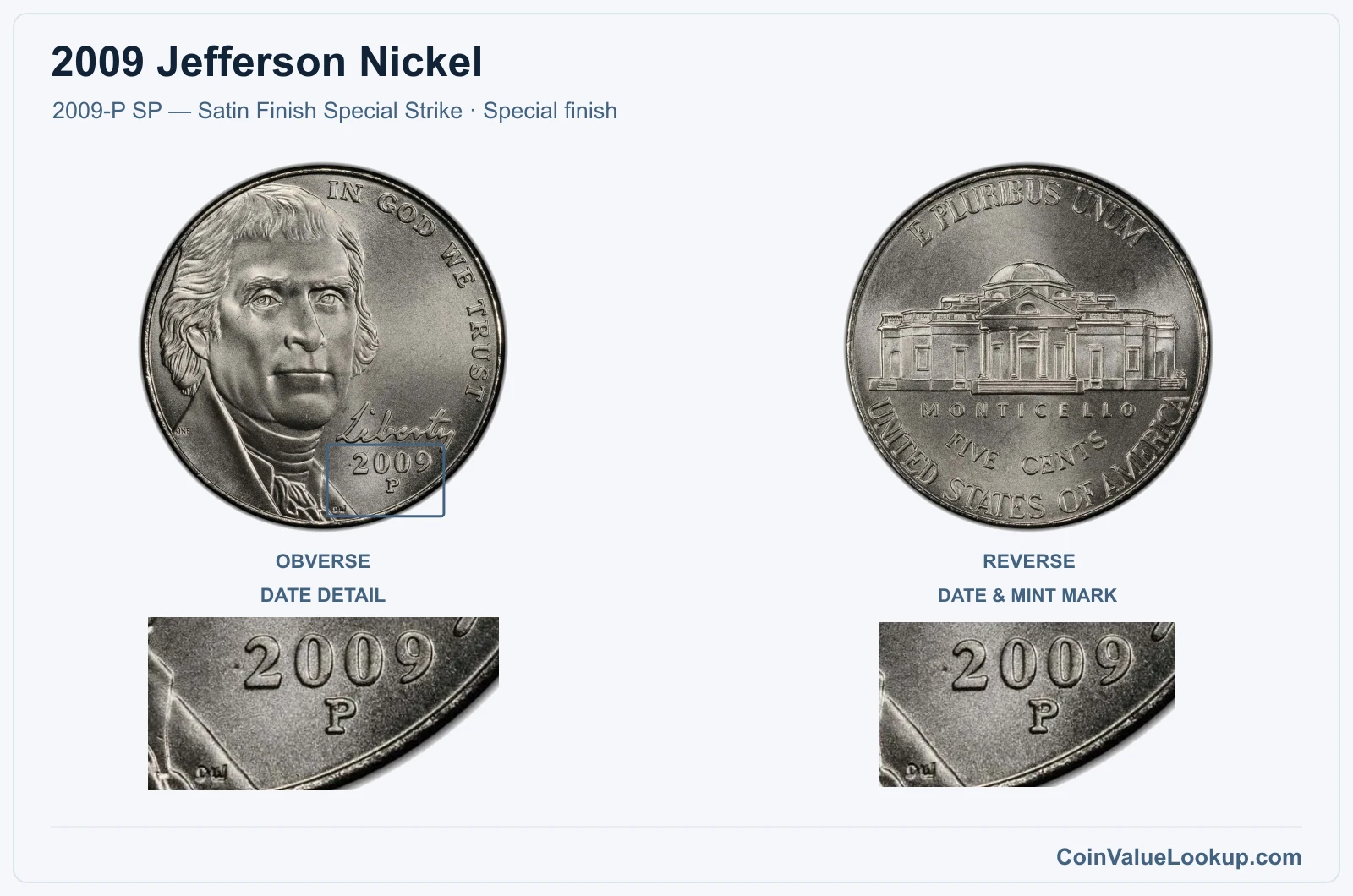
The 2009-P satin-finish nickel was produced exclusively for that year's U.S. Mint Set. It carries the same P mintmark and design as the business strike, but the surface has a distinctive matte-like, even luster instead of the bright cartwheel shine you see on regular coins.
There is no widely adopted numeric price range for this version in standard guides. Value depends on the coin's authenticated identity, its condition, and whether any errors are present.
If you think you have one, compare its surface closely to a known satin example — the texture difference is subtle but consistent across the entire coin.
| Range | Grade | Price | Auction Records | Appraisal |
|---|---|---|---|---|
| SP | SP 1 | — | Coin Identifier | |
| SP 2 | — | Coin Identifier | ||
| SP 3 | — | Coin Identifier | ||
| SP 4 | — | Coin Identifier | ||
| SP 6 | — | Coin Identifier | ||
| SP 8 | — | Coin Identifier | ||
| SP 10 | — | Coin Identifier | ||
| SP 12 | — | Coin Identifier | ||
| SP 15 | — | Coin Identifier | ||
| SP 20 | — | Coin Identifier | ||
| SP 25 | — | Coin Identifier | ||
| SP 30 | — | Coin Identifier | ||
| SP 35 | — | Coin Identifier | ||
| SP 40 | — | Coin Identifier | ||
| SP 45 | — | Coin Identifier | ||
| SP 50 | — | Coin Identifier | ||
| SP 53 | — | Coin Identifier | ||
| SP 55 | — | Coin Identifier | ||
| SP 58 | — | Coin Identifier | ||
| SP 60 | — | Coin Identifier | ||
| SP 61 | — | Coin Identifier | ||
| SP 62 | — | Coin Identifier | ||
| SP 63 | — | Coin Identifier | ||
| SP 64 | — | Coin Identifier | ||
| SP 65 | — | Coin Identifier | ||
| SP 66 | — | Coin Identifier | ||
| SP 67 | — | Coin Identifier | ||
| SP 68 | — | Coin Identifier | ||
| SP 69 | — | Coin Identifier | ||
| SP 70 | — | — | — |
2009 Jefferson Nickel — D — Business strike
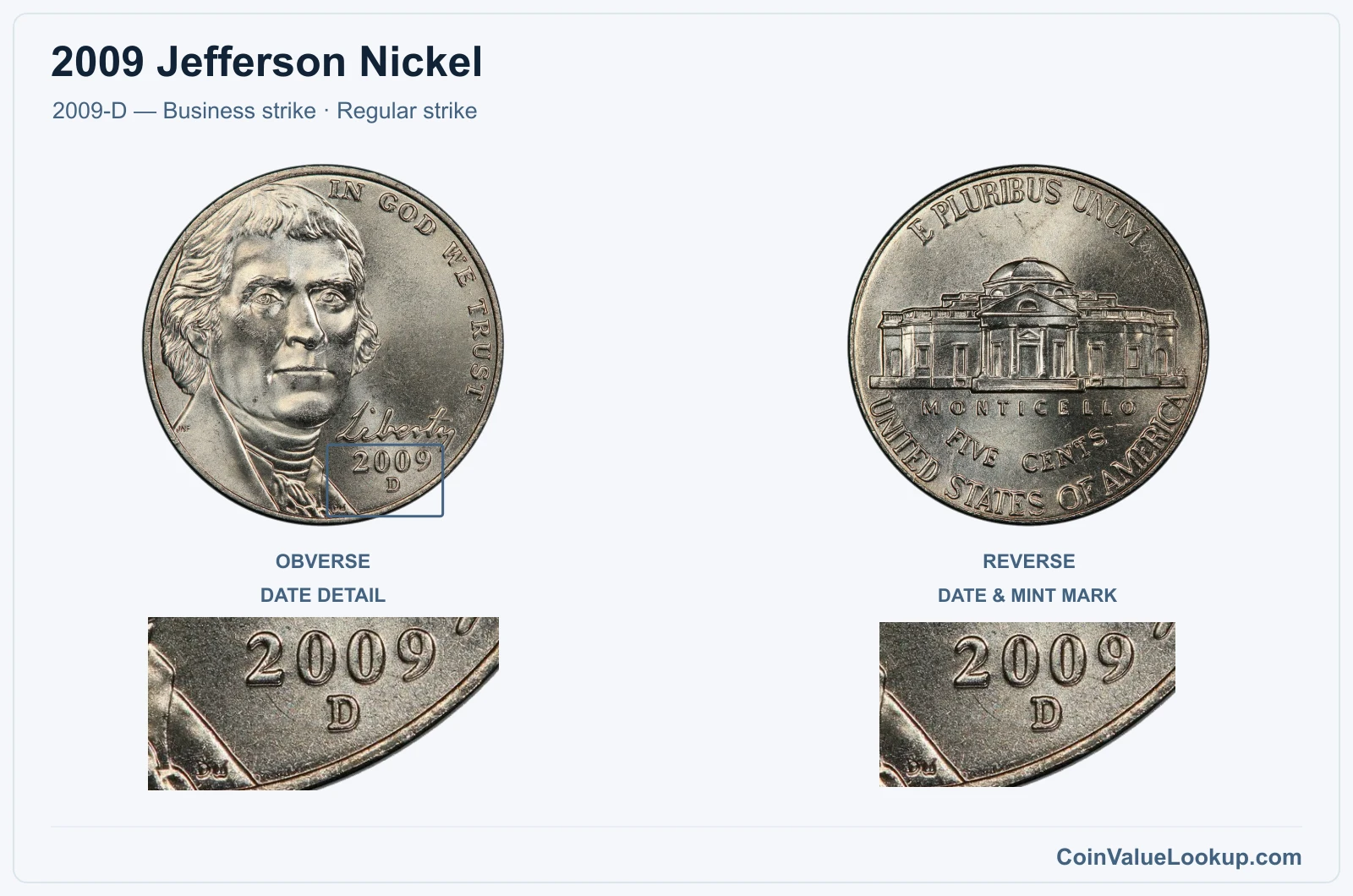
The 2009-D business strike is Denver's regular-issue nickel for the year, identical in design and composition to the Philadelphia version but carrying a D mintmark.
Guide estimates from USA Coin Book place it at about $3.62 in MS60 and $6.25 in MS65. Again, these apply only to coins that have never circulated.
Worn examples are five-cent coins, plain and simple.
Coin Value Lookup is a handy place to look up guides for other Jefferson nickel dates and denominations if you are working through a collection.
| Range | Grade | Price | Auction Records | Appraisal |
|---|---|---|---|---|
| PO | PO 1 | — | Coin Identifier | |
| FR | FR 2 | — | Coin Identifier | |
| AG | AG 3 | — | Coin Identifier | |
| G | G 4 | — | Coin Identifier | |
| G 6 | — | Coin Identifier | ||
| VG | VG 8 | — | Coin Identifier | |
| VG 10 | — | Coin Identifier | ||
| F | F 12 | — | Coin Identifier | |
| F 15 | — | Coin Identifier | ||
| VF | VF 20 | — | Coin Identifier | |
| VF 25 | — | Coin Identifier | ||
| VF 30 | — | Coin Identifier | ||
| VF 35 | — | Coin Identifier | ||
| XF | XF 40 | — | Coin Identifier | |
| XF 45 | — | Coin Identifier | ||
| AU | AU 50 | — | Coin Identifier | |
| AU 53 | — | Coin Identifier | ||
| AU 55 | — | Coin Identifier | ||
| AU 58 | — | Coin Identifier | ||
| MS | MS 60 | — | Coin Identifier | |
| MS 61 | — | Coin Identifier | ||
| MS 62 | — | Coin Identifier | ||
| MS 63 | — | Coin Identifier | ||
| MS 64 | — | Coin Identifier | ||
| MS 65 | Coin Identifier | |||
| MS 66 | Coin Identifier | |||
| MS 67 | — | — | — | |
| MS 68 | — | — | — | |
| MS 69 | — | — | — | |
| MS 70 | — | — | — |
2009 Jefferson Nickel — D SP — Satin Finish Special Strike
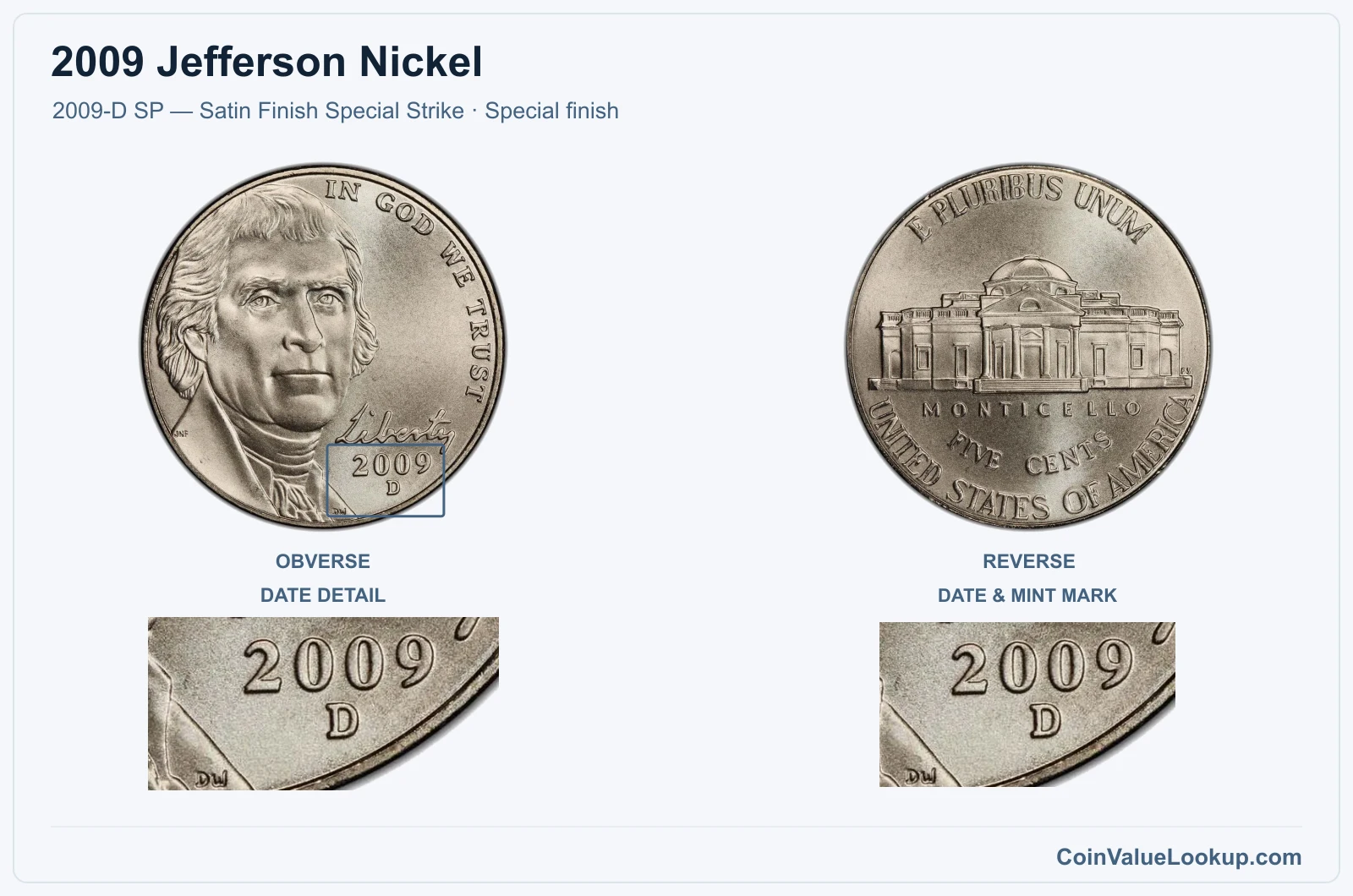
Like its Philadelphia counterpart, the 2009-D satin-finish nickel was made for the U.S. Mint Set. It has the D mintmark and the same forward-facing portrait and Monticello reverse, but its surfaces show that characteristic soft, uniform luster rather than the sharp reflective quality of a business strike.
No standard numeric price range has been adopted for this version. Valuing one requires confirming the satin finish through direct comparison, then assessing condition and any errors individually.
A coin that simply looks dull from wear or cleaning is not the same thing.
| Range | Grade | Price | Auction Records | Appraisal |
|---|---|---|---|---|
| SP | SP 1 | — | Coin Identifier | |
| SP 2 | — | Coin Identifier | ||
| SP 3 | — | Coin Identifier | ||
| SP 4 | — | Coin Identifier | ||
| SP 6 | — | Coin Identifier | ||
| SP 8 | — | Coin Identifier | ||
| SP 10 | — | Coin Identifier | ||
| SP 12 | — | Coin Identifier | ||
| SP 15 | — | Coin Identifier | ||
| SP 20 | — | Coin Identifier | ||
| SP 25 | — | Coin Identifier | ||
| SP 30 | — | Coin Identifier | ||
| SP 35 | — | Coin Identifier | ||
| SP 40 | — | Coin Identifier | ||
| SP 45 | — | Coin Identifier | ||
| SP 50 | — | Coin Identifier | ||
| SP 53 | — | Coin Identifier | ||
| SP 55 | — | Coin Identifier | ||
| SP 58 | — | Coin Identifier | ||
| SP 60 | — | Coin Identifier | ||
| SP 61 | — | Coin Identifier | ||
| SP 62 | — | Coin Identifier | ||
| SP 63 | — | Coin Identifier | ||
| SP 64 | — | Coin Identifier | ||
| SP 65 | — | Coin Identifier | ||
| SP 66 | — | Coin Identifier | ||
| SP 67 | — | Coin Identifier | ||
| SP 68 | — | Coin Identifier | ||
| SP 69 | — | Coin Identifier | ||
| SP 70 | — | — | — |
2009 Jefferson Nickel — S PR — Proof
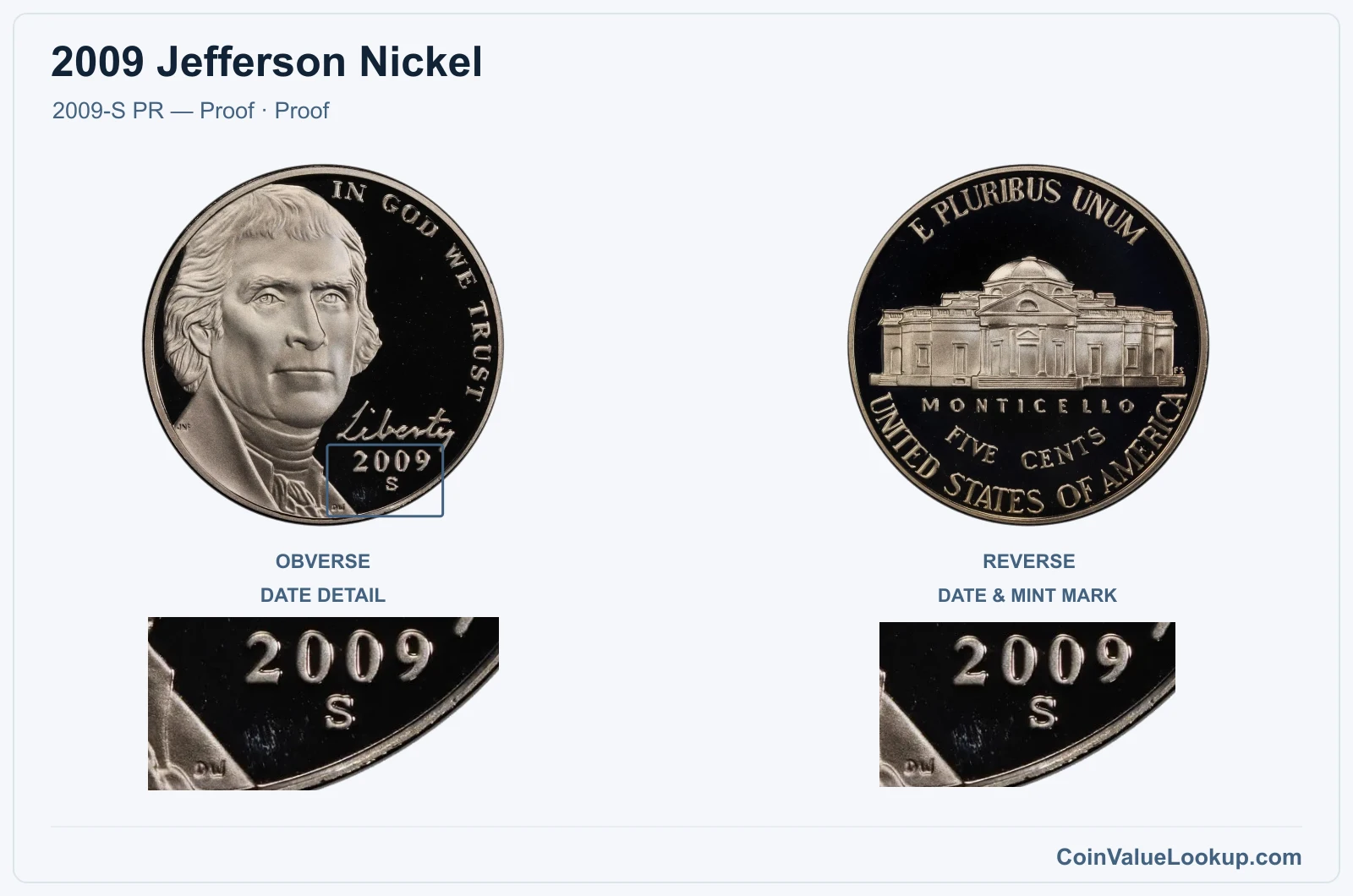
The 2009-S proof nickel was struck at San Francisco with polished dies and specially prepared planchets, producing mirror-like fields. It carries the S mintmark and was sold in proof sets, not released into circulation.
USA Coin Book lists a guide value of about $5.30 at PR65. Proof is a manufacturing method, not a grade above Mint State, so a proof can still show handling marks that lower its assigned grade.
Cameo or deep-cameo designations are separate classifications not covered by this general guide figure.
| Range | Grade | Price | Auction Records | Appraisal |
|---|---|---|---|---|
| PR | PR 1 | — | Coin Identifier | |
| PR 2 | — | Coin Identifier | ||
| PR 3 | — | Coin Identifier | ||
| PR 4 | — | Coin Identifier | ||
| PR 6 | — | Coin Identifier | ||
| PR 8 | — | Coin Identifier | ||
| PR 10 | — | Coin Identifier | ||
| PR 12 | — | Coin Identifier | ||
| PR 15 | — | Coin Identifier | ||
| PR 20 | — | Coin Identifier | ||
| PR 25 | — | Coin Identifier | ||
| PR 30 | — | Coin Identifier | ||
| PR 35 | — | Coin Identifier | ||
| PR 40 | — | Coin Identifier | ||
| PR 45 | — | Coin Identifier | ||
| PR 50 | — | Coin Identifier | ||
| PR 53 | — | Coin Identifier | ||
| PR 55 | — | Coin Identifier | ||
| PR 58 | — | Coin Identifier | ||
| PR 60 | — | Coin Identifier | ||
| PR 61 | — | Coin Identifier | ||
| PR 62 | — | Coin Identifier | ||
| PR 63 | — | Coin Identifier | ||
| PR 64 | — | Coin Identifier | ||
| PR 65 | — | Coin Identifier | ||
| PR 66 | — | Coin Identifier | ||
| PR 67 | — | Coin Identifier | ||
| PR 68 | — | Coin Identifier | ||
| PR 69 | Coin Identifier | |||
| PR 70 | Coin Identifier |
2009 Jefferson Nickel Error List
1. 2009 Jefferson Nickel — Off-Center Strike
An off-center strike happens when the blank is not properly seated between the dies at the moment of striking. The result is a displaced design with an unstruck crescent of blank metal along one edge.
On a 2009 nickel, look for a visible shift of the entire design in one direction. The date should still be readable for the coin to be most collectible.
Compare the edge closely: a genuine off-center piece shows raw planchet metal in the crescent area, not a filed or ground surface.
Do not confuse this with a clipped planchet, a one-sided misalignment, or a coin that was bent or flattened after leaving the mint. Condition, the percentage of off-center shift, and date visibility all influence what an individual example is worth.
2. 2009 Jefferson Nickel — Struck-Through Error
A struck-through-grease error occurs when foreign material, usually grease or debris, sits on the die face during striking. The affected area of the coin shows a smooth, shallow depression or missing design detail where the material blocked the impression.
On a 2009 nickel, examine both sides under good light for localized soft spots that interrupt otherwise normal detail. The depression should have a consistent texture, not the rough scratching of post-mint damage.
Ordinary wear, cleaning, or a weak strike from tired dies can all mimic this error. The key difference is that a struck-through area is sharply bounded while normal weakness tends to fade gradually.
Value depends on the size, location, and visual impact of the obstruction.
3. 2009 Jefferson Nickel — Lamination / Split Planchet
A lamination error shows up as peeling, flaking, or separation within the metal itself. On a 2009 nickel you might see a retained flap of metal still partially attached or an exposed layer where a section has broken away.
Photograph the edge alongside the affected face so the depth and character of the separation are clear. A genuine lamination follows the coin's contour and often has a smooth exposed surface underneath.
Be careful not to confuse this with surface corrosion, deliberate scraping, or a coin that has been cut. Corrosion pits tend to be random and rough, while a lamination flaw has a more uniform, sheet-like appearance.
The size and visibility of the flaw, along with overall coin condition, determine the premium.
4. 2009 Jefferson Nickel — Clipped Planchet
A double curved clipped planchet error means the blank was punched from strip metal that overlapped an area where blanks had already been cut, leaving two curved bites out of the coin's edge. Each missing section follows the arc of a neighboring blank's outline.
Look for the curved indentations along the rim and check for weakness in the design directly opposite each clip, which results from disrupted metal flow during striking. The edge at the clip should show the natural planchet texture, not tool marks.
A filed notch, deliberate edge cut, or corrosion-eaten rim will lack that telltale opposite-side weakness. Value depends on the size and number of clips plus overall condition.
5. 2009 Jefferson Nickel — Clashed Dies
A die clash occurs when the obverse and reverse dies strike each other without a blank between them. The impact transfers faint traces of one die's design onto the other.
On subsequent coins, you can spot ghostly outlines from the opposite side appearing in the fields.
On a 2009 nickel, look in the open field areas for faint lines or shapes that match features from the other side of the coin. These marks will be consistently positioned relative to the normal design, not random.
Random scratches, raised lines from a damaged die, or a brockage look superficially similar but lack the precise alignment with the opposing design. Severity and visibility drive the collector premium for clash errors.
6. 2009 Jefferson Nickel — Die Cap / Capped-Die Strike
A die cap error is dramatic. It happens when a struck coin sticks to one of the dies and is then repeatedly impressed into subsequent blanks.
The stuck coin gradually cups around the die like a bottle cap.
The die cap coin itself shows a normal strike on one side and a progressively distorted, spread-out impression on the other. Coins struck through that cap display a mirror-image impression of the stuck coin's design, often mushy and expanded.
Do not mistake a coin that was bent by a vise or stepped on for a die cap. A genuine cap shows progressive metal flow and thinning at the edges, not sharp creases.
These are among the more visually striking mint errors, and value depends on how developed the cap is and overall preservation.
7. 2009 Jefferson Nickel — Broadstrike
A broadstrike happens when the collar die that normally constrains the blank fails to engage, allowing metal to spread outward during striking. The result is a coin that is wider than normal with a full design but no raised rim or reeded edge.
On a 2009 nickel, measure the diameter — it will exceed the standard 21.2 mm. The design should be centered (unlike an off-center strike), and the edge will feel flat or spread rather than showing the usual plain-edge profile.
A coin that was flattened after minting on railroad tracks, for instance, will show distortion and damage to the design itself, while a broadstrike retains clean detail. Condition and the degree of spread affect value.
8. 2009 Jefferson Nickel — Improper Annealing
An improperly annealed planchet results from incorrect heat treatment of the blank before striking. The surface may appear unusually dark, streaky, or have a rough, granular texture that stands out from normal nickels.
To evaluate a 2009 nickel for this error, compare the surface color and texture side by side with a normal coin under the same lighting. The discoloration on a genuine annealing error is typically uniform or follows a pattern consistent with the manufacturing process, not random splotches.
Environmental toning from years in a damp drawer, corrosion, or heat damage applied after minting can all produce similar-looking surfaces. Surface appearance is a screening clue, not proof of the error, so professional authentication is recommended.
Value depends on visibility and confirmed identity.
9. 2009 Jefferson Nickel — Doubled Die Obverse
A doubled die obverse on a 2009 nickel shows consistent doubling of design elements on the front of the coin. This might appear as a slight separation or notching on letters like LIBERTY, IN GOD WE TRUST, or portions of Jefferson's portrait.
Compare the lettering and design contours carefully against a normal 2009 nickel under matching light and magnification. True hub doubling shows a clean, consistent secondary image or notch, not a flat shelf.
Machine doubling, which is far more common and much less valuable, tends to produce a flat, shelf-like distortion without the sharp secondary outline. Reflections from shiny surfaces can also trick the eye.
Condition and the strength of the doubling determine collector interest.
10. 2009 Jefferson Nickel — Doubled Die Reverse
A doubled die reverse affects the back of the coin. On a 2009 nickel with the Monticello reverse, look for doubling in the building's lettering, columns, or the words MONTICELLO, E PLURIBUS UNUM, or FIVE CENTS.
Use magnification and compare your coin's reverse legends directly against a known normal example. Genuine hub doubling produces a crisp, repeatable secondary contour that you can trace consistently across affected elements.
Machine doubling creates a flat, displaced shadow that lacks that sharp secondary profile. Random nicks, scratches, or die deterioration can also mimic doubling at a glance.
The strength and location of the doubled features, along with the coin's overall condition, determine how much collector attention the piece receives.