1923 Buffalo Nickel Coin Value: How Much Is It Worth?
A 1923 Buffalo Nickel can range from roughly $2.79 in well-worn Good-4 condition up to around $1,187 at the MS-63 level, depending on the mint. Those figures come from USA Coin Book guide estimates for the two business-strike versions produced that year — Philadelphia and San Francisco.
No regular proof coins were struck in 1923, so every authentic example is a circulation issue with the Type 2 recessed "FIVE CENTS" reverse design. Condition and mintmark make the biggest difference, and a handful of recognized minting errors can push values higher still.
Fast Way to Identify Your 1923 Buffalo Nickel
Want a quick read on your 1923 Buffalo Nickel? Upload clear photos of the front and back of your coin.
Make sure the date is legible, and get a good shot of the area below "FIVE CENTS" on the reverse where a mintmark may sit. These images allow for a preliminary identification of your coin's mint and version — a solid first step before any deeper evaluation.
1923 Buffalo Nickel Value
Upload both sides of your 1923 Buffalo Nickel.
Front Obverse
Upload photo
Back Reverse
Upload photo
Which 1923 Buffalo Nickel Versions Are Worth Money?
- The 1923-S (San Francisco) in MS-63 carries a guide estimate around $1,187 — far above its Philadelphia counterpart at the same grade, reflecting lower survival rates in top condition.
- Philadelphia issues are affordable in lower grades (around $2.79 at G-4) but climb to roughly $194 at MS-63, rewarding patience in finding well-preserved examples.
- Several recognized minting errors exist for 1923, including Two Feathers, off-center strikes, clipped planchets, lamination splits, and a missing designer initial — each can carry a premium tied to visibility and condition.
Step 1: Identify Your 1923 Buffalo Nickel Mint Mark and Version
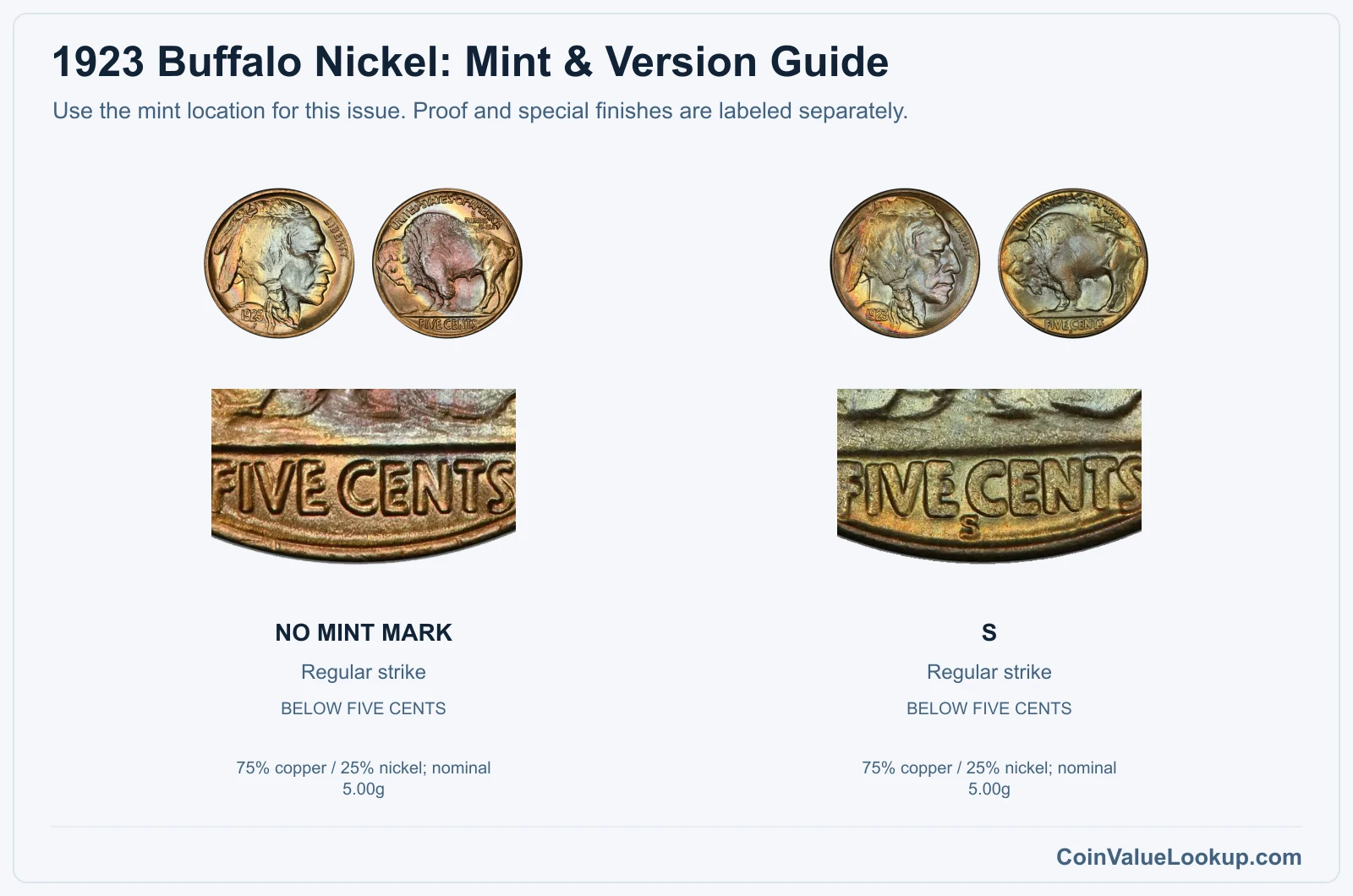
Every 1923 Buffalo Nickel uses the Type 2 reverse, where "FIVE CENTS" sits in a recessed area below the bison. There is no Type 1 variety for this date; that design was limited to the first part of 1913.
Two mints produced nickels in 1923. Philadelphia coins carry no mintmark at all.
San Francisco coins show a small "S" on the reverse, positioned just below the denomination.
The coin is struck in 75% copper and 25% nickel, weighs about 5 grams, and measures 21.2 mm with a plain edge. There is no silver version.
If your coin looks silver-colored, that is normal for this alloy — do not mistake it for a silver strike.
To identify your mint, flip the coin to the bison side and look carefully beneath "FIVE CENTS." A magnifying glass helps, especially on worn pieces where the small "S" can nearly vanish.
Step 2: Check Your 1923 Buffalo Nickel Grade
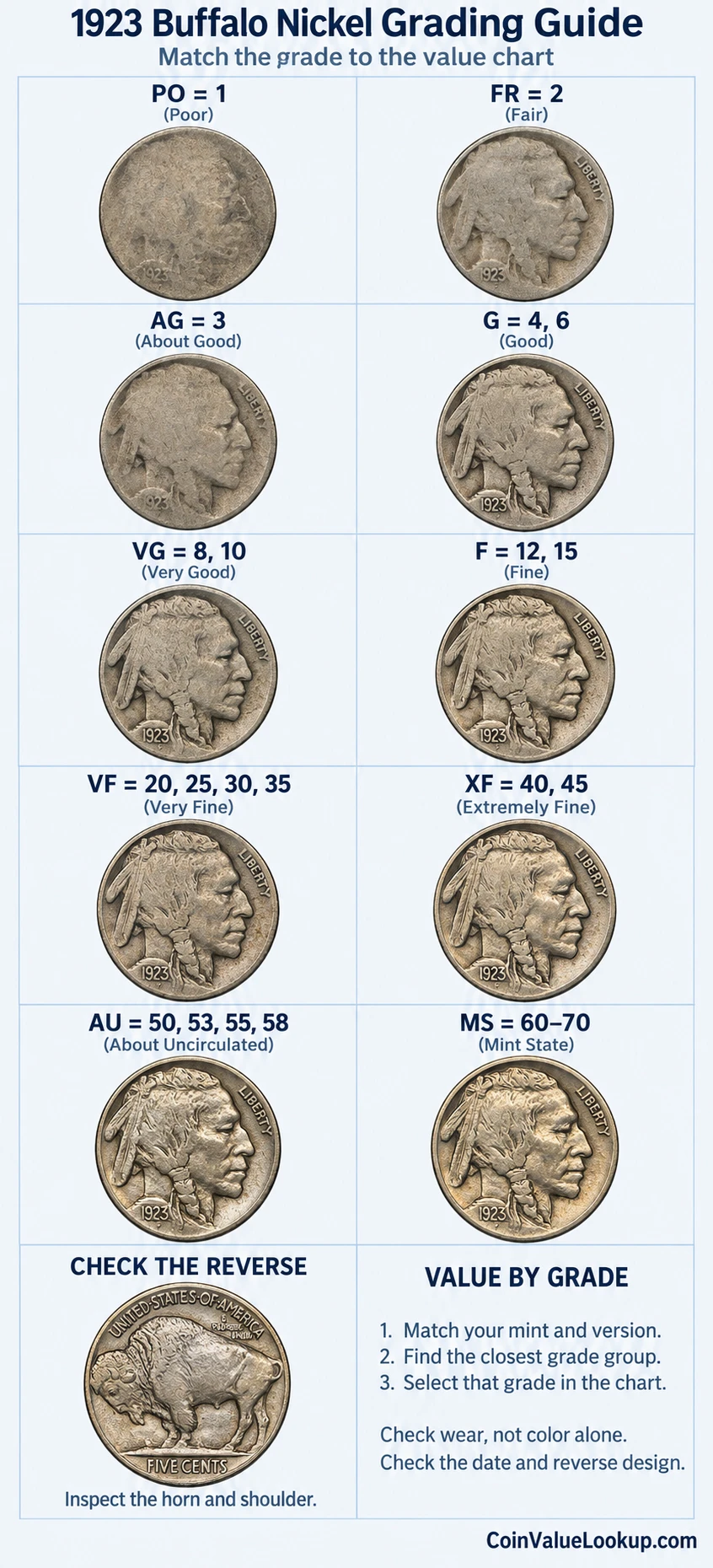
Start with the obverse. On a sharp, uncirculated coin, the Native American portrait shows full hair detail in the braid, a defined cheekbone, and crisp feather tips.
As the coin wears, the braid flattens first, then the cheek loses its contour.
On the reverse, check the bison's shoulder and horn. These are the first areas to show rub.
A fully detailed horn with no flatness suggests a high grade.
Here is the catch with 1920s Buffalo Nickels: weak strikes are common, especially from San Francisco. A coin can leave the mint with an incomplete horn or soft feather detail.
That is a strike issue, not wear. Look at the surrounding fields for original cartwheel luster — if it is there, the coin may grade higher than the soft details suggest.
Use the comparison image to match your coin's wear pattern against known grade examples. Check for scratches, rim dings, and cleaning.
Never use acid or abrasives to bring back a faded date; that destroys the coin's collector value entirely.
Step 3: Check 1923 Buffalo Nickel Value by Mint and Version
1923 Buffalo Nickel — No Mint Mark — Type2 Circulation
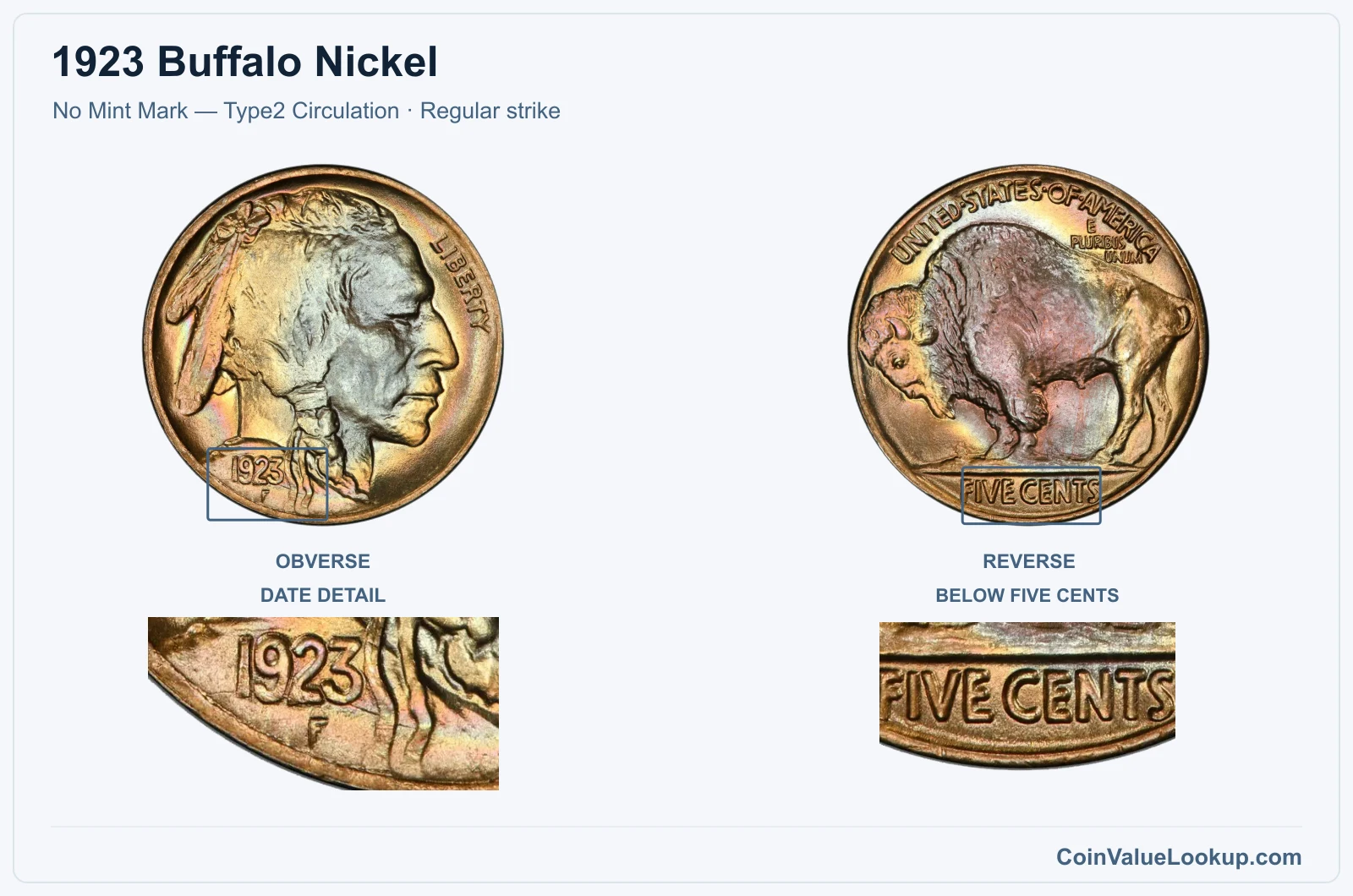
The 1923 Philadelphia Buffalo Nickel has no mintmark. Look at the reverse below "FIVE CENTS" — the space should be blank.
This is the more common of the two 1923 issues.
USA Coin Book guide estimates place this coin at about $2.79 in Good-4 condition and around $194 at MS-63. That is a big jump, and it reflects how hard it is to find original, lustrous survivors after a century of pocket change duty.
Most examples you encounter will grade somewhere in the lower circulated tiers.
Coin Value Lookup is a handy starting point if you want to look up guide values for other dates and mints in the Buffalo Nickel series. It can help you compare what your specific coin might be worth relative to the rest of the run.
Range Grade
Price Auction Records Appraisal PO PO 1
—
Coin Identifier FR FR 2
—
Coin Identifier AG AG 3
—
Coin Identifier G G 4
—
Coin Identifier
G 6
—
Coin Identifier VG VG 8
—
Coin Identifier
VG 10
—
Coin Identifier F F 12
—
Coin Identifier
F 15
—
Coin Identifier VF VF 20
—
Coin Identifier
VF 25
—
Coin Identifier
VF 30
—
Coin Identifier
VF 35
—
Coin Identifier XF XF 40
—
Coin Identifier
XF 45
—
Coin Identifier AU AU 50
Coin Identifier
AU 53
—
Coin Identifier
AU 55
—
Coin Identifier
AU 58
Coin Identifier MS MS 60
—
Coin Identifier
MS 61
—
Coin Identifier
MS 62
Coin Identifier
MS 63
Coin Identifier
MS 64
Coin Identifier
MS 65
Coin Identifier
MS 66
Coin Identifier
MS 67
Coin Identifier
MS 68
—
Coin Identifier
MS 69
—
—
—
MS 70
—
—
—
1923 Buffalo Nickel — S — Type2 Circulation
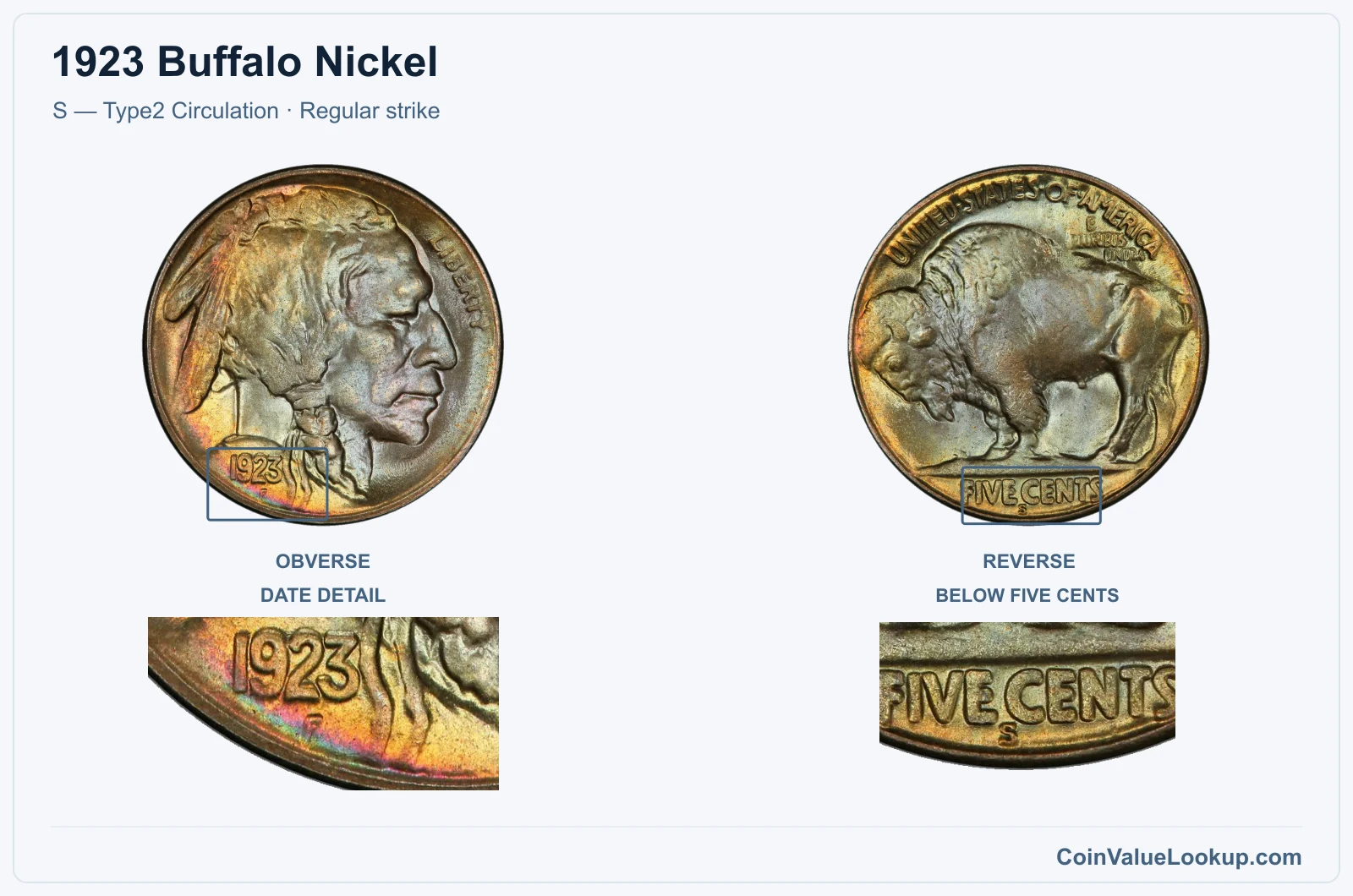
The 1923-S was struck at San Francisco and carries a small "S" mintmark on the reverse, below the denomination. On worn coins that letter can be faint, so grab a loupe.
This is the key date of the two 1923 mints. Guide estimates from USA Coin Book put the 1923-S at roughly $15 in Good-4 and about $1,187 in MS-63.
That steep premium in mint state reflects genuinely tough survival in high grades — San Francisco strikes from this era tend to be weakly struck and heavily circulated.
Do not confuse a weak strike for a low grade. Many 1923-S nickels left the press with soft horn or braid detail.
If original luster is present across the fields, the coin may grade well despite mushy spots. Both sides should be photographed clearly for any serious evaluation.
Range Grade
Price Auction Records Appraisal PO PO 1
—
Coin Identifier FR FR 2
—
Coin Identifier AG AG 3
—
Coin Identifier G G 4
—
Coin Identifier
G 6
—
Coin Identifier VG VG 8
—
Coin Identifier
VG 10
Coin Identifier F F 12
Coin Identifier
F 15
Coin Identifier VF VF 20
Coin Identifier
VF 25
Coin Identifier
VF 30
Coin Identifier
VF 35
Coin Identifier XF XF 40
Coin Identifier
XF 45
Coin Identifier AU AU 50
Coin Identifier
AU 53
Coin Identifier
AU 55
Coin Identifier
AU 58
Coin Identifier MS MS 60
—
Coin Identifier
MS 61
Coin Identifier
MS 62
Coin Identifier
MS 63
Coin Identifier
MS 64
Coin Identifier
MS 65
Coin Identifier
MS 66
Coin Identifier
MS 67
—
—
—
MS 68
—
—
—
MS 69
—
—
—
MS 70
—
—
—
1923 Buffalo Nickel Error List
1. 1923 Buffalo Nickel — Two Feathers / Abraded Third Feather
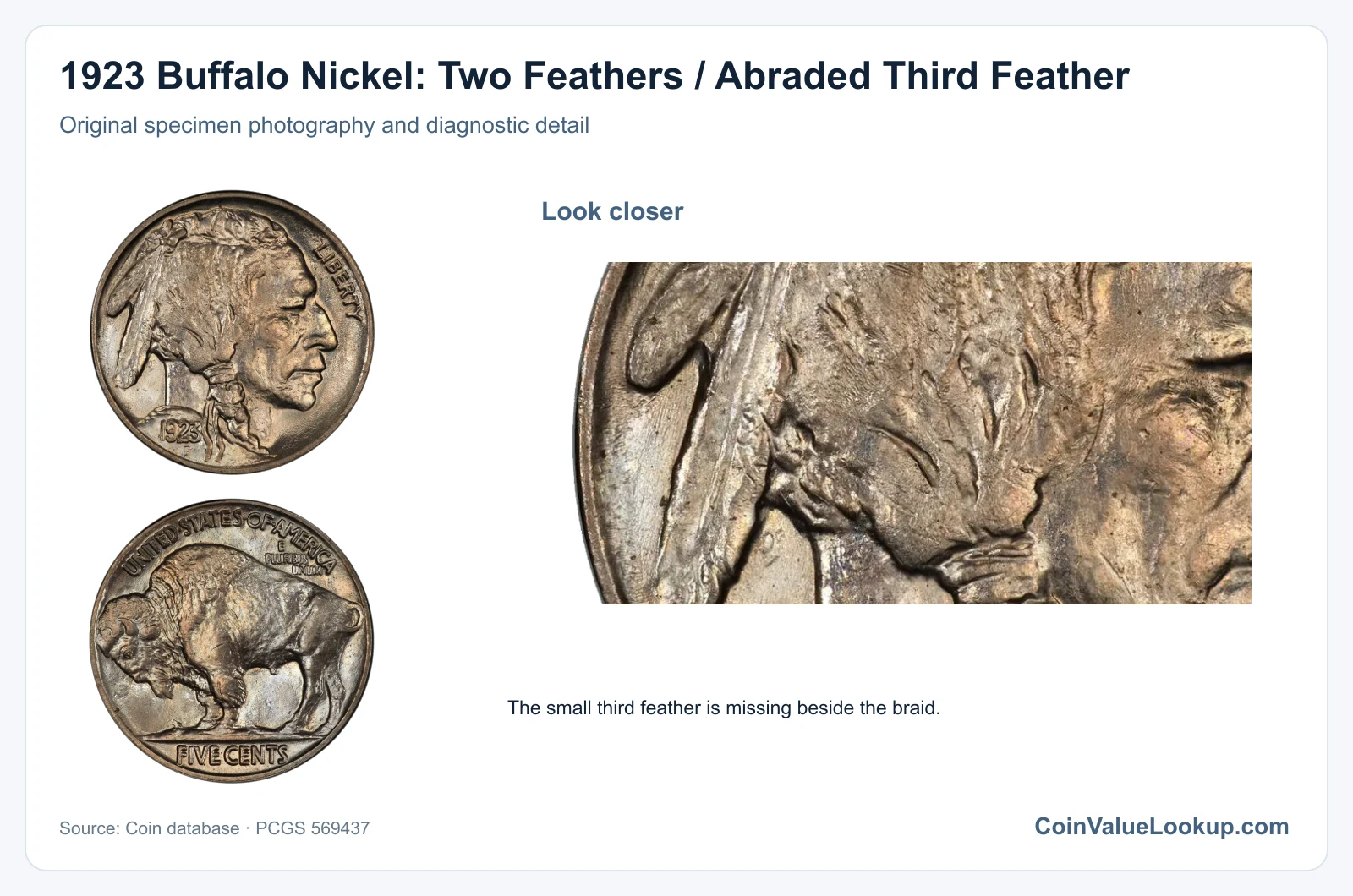
On a normal 1923 Buffalo Nickel obverse, the Native American portrait shows three feathers extending from the hair. On the Two Feathers variety, the third (smallest) feather near the neck is partially or fully missing — abraded away, likely due to die polishing or damage at the mint.
This variety is reported for the 1923 Philadelphia issue. To check yours, compare that small inner feather area against a known normal example.
You are looking for a distinctly absent or ghostly remnant of the feather, not just softness from circulation.
Be careful: heavy wear, a grease-filled die, weak strikes, and deliberate scraping can all make a feather look missing. The difference is that a genuine Two Feathers coin will show the absence consistently, with otherwise normal surrounding detail.
Value depends on how clearly the missing feather can be seen and the coin's overall condition.
2. 1923 Buffalo Nickel — Off-Center Strike
An off-center strike happens when the planchet is not seated properly between the dies, producing a design that is shifted to one side with an unstruck crescent of blank metal on the opposite edge. This error has been reported for the 1923-S Buffalo Nickel.
The key diagnostic is that displaced crescent — it should show original planchet texture, not damage. The more dramatic the shift and the more of the date that remains visible, the more desirable the coin.
Do not confuse this with a clipped planchet, which has a different shape and edge profile, or with a coin that was flattened or squeezed after it left the mint. Post-mint damage tends to distort the rim unevenly rather than leaving a clean, uniform blank area.
No specific price range is established here; value depends on the percentage of off-center shift, date visibility, and overall condition.
3. 1923 Buffalo Nickel — Clipped Planchet
A clipped planchet error occurs when the blank metal disc fed into the press was incomplete — it might show a curved bite, a straight edge, or a ragged missing section where the strip was improperly fed or cut. This error category has been reported for the 1923 Buffalo Nickel.
Look at the edge of the coin. A genuine clip will often show a smooth, slightly curved absence with metal-flow weakness on the opposite side, sometimes called the Blakesley effect.
That opposite-side weakness is a strong authenticator.
Filed notches, deliberate edge cuts, and corrosion can mimic a clip. The difference: post-mint damage usually leaves tool marks, sharp angles, or pitting that does not match the natural flow of a minting defect.
Value varies with the size and type of clip, the coin's grade, and whether the date remains intact.
4. 1923 Buffalo Nickel — Lamination / Split Planchet
Lamination errors show up as peeling, flaking, or splitting within the metal itself. On a 1923 Buffalo Nickel, you might see a thin layer lifting away from the surface, a retained flap of metal still partially attached, or — in extreme cases — a full split through the planchet.
These result from impurities or gas trapped in the alloy during production. This category has been reported for the 1923 Nickel.
Photograph both the affected face and the edge together. A genuine lamination will show a natural separation within the coin's metal layers, distinct from surface scraping or corrosion.
Deliberate cuts or gouges leave sharper, more uniform tool marks, and corrosion tends to pit rather than peel.
No specific price is established here. The size of the affected area, whether the flap is retained, and the coin's overall condition all influence what a collector might pay.
5. 1923 Buffalo Nickel — Missing Designer Initial F
James Earle Fraser's designer initial "F" normally appears on the obverse, beneath the date. On certain 1923-S nickels, this small letter is reported missing — either from die polishing, a filled die, or some other production irregularity.
To check, look directly below the date on the obverse. Compare with a normal 1923-S where the "F" is clearly present.
The absence should be clean and consistent with the surrounding field, not just worn smooth.
Be cautious: on heavily circulated coins, the "F" is one of the first details to vanish from normal wear. A filled die during striking can also obscure it temporarily on a single run.
Deliberate removal with a tool will usually leave scratches or a disturbed field. Value depends on the coin's condition and how convincingly the missing initial can be attributed to a mint-caused anomaly rather than post-strike damage.