1900 Liberty Nickel Coin Value: How Much Is It Worth?
A 1900 Liberty Nickel in well-worn G4 condition books at about $2.50 according to the USA Coin Book guide, while a clean MS63 business strike reaches roughly $175. Proofs exist for this date too, with a PR63 example anchoring around $344 in the same guide.
These are retail estimates from a single snapshot, not guaranteed sale prices, so your actual coin's value depends on its specific condition and version.
Fast Way to Identify Your 1900 Liberty Nickel
Want a quick read on what you have? Upload clear photos of both the front and back of your 1900 Liberty Nickel.
Our identifier can give you a preliminary look at the version and general condition based on those images. It does not authenticate, certify, or guarantee a grade, but it is a solid starting point before you dig deeper.
1900 Liberty Nickel Value
Upload both sides of your 1900 Liberty Nickel.
Front Obverse
Upload photo
Back Reverse
Upload photo
Which 1900 Liberty Nickel Versions Are Worth Money?
- Business strikes in MS63 or better carry a meaningful step up from circulated values, with the USA Coin Book guide listing MS63 around $175.
- Proof strikes were made in limited numbers; a PR63 example guides at about $344, well above any circulated business strike.
- A confirmed Doubled Die Reverse, as recognized by NGC, is a separate collectible variety worth investigating on any 1900 nickel.
- Wrong-planchet errors, such as strikes on a reported Nicaragua 5-centavo blank, are rare mint mistakes that attract specialist collectors.
- Repunched date varieties, where traces of an earlier punch position remain visible beside the final digits, add numismatic interest beyond ordinary examples.
Step 1: Identify Your 1900 Liberty Nickel Mint Mark and Version
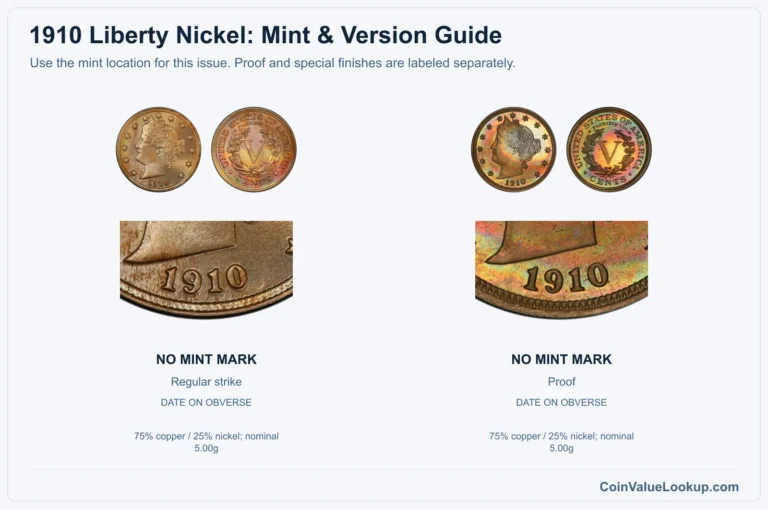
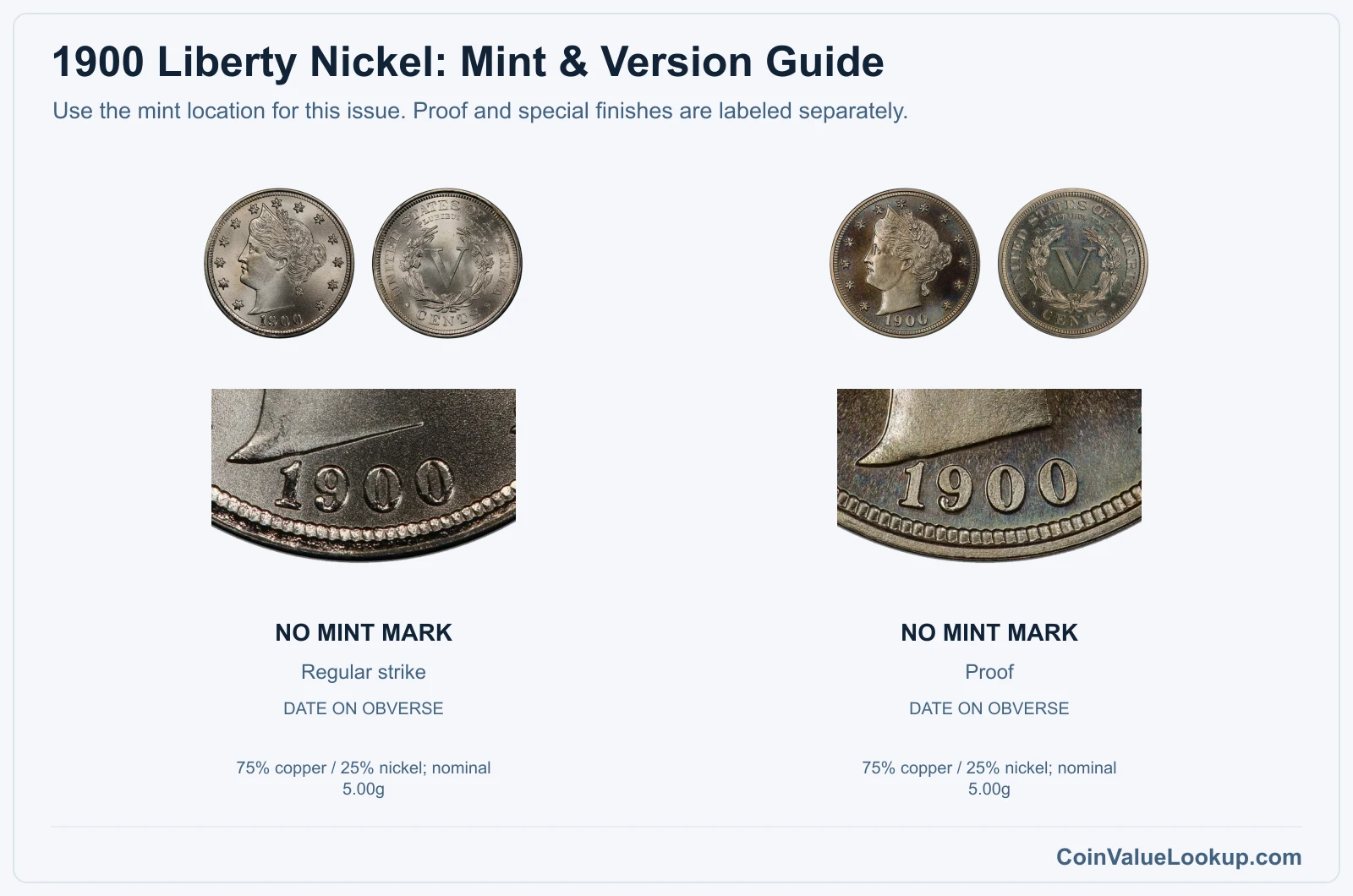
Every regular-issue 1900 Liberty Nickel was struck at the Philadelphia Mint, so there is no mintmark to hunt for. If you see a D or S on one, that coin is a different date or has been altered.
The coin is 75% copper and 25% nickel, weighs a nominal 5 grams, measures 21.2 mm across, and has a plain edge. There is no silver version for this year.
All standard 1900 nickels carry the With CENTS reverse design, meaning the Roman numeral V on the back is accompanied by the word CENTS beneath it. Both business strikes and proofs were produced.
NGC does recognize a doubled reverse variety for this date, but ordinary reverse lettering detail does not automatically mean you have a doubled die. Look carefully and compare before jumping to conclusions.
Step 2: Check Your 1900 Liberty Nickel Grade
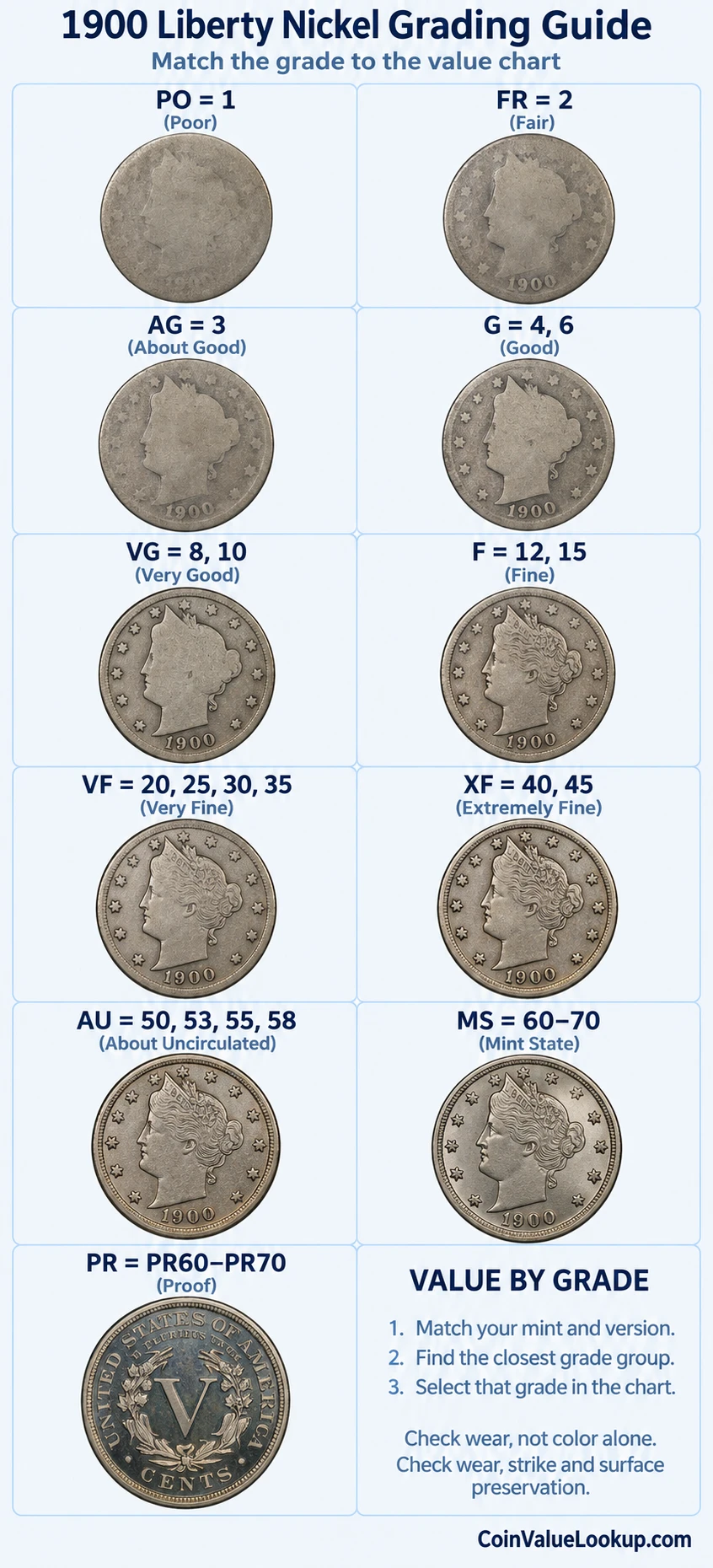
Start on the obverse. The word LIBERTY runs across the coronet above her forehead, and it wears away letter by letter as the coin circulates.
A G4 coin may show only partial letters, while an AU piece keeps them all sharp.
Check the high points of the hair curls above and behind the ear, plus the cheek. These are the first areas to lose detail.
On the reverse, inspect the ears of corn and the wreath leaves for flattening.
Weak detail does not always mean wear. Some 1900 nickels left the press with a soft strike, particularly on the hair and corn.
Compare luster in the fields and the overall surface to the reference comparison image to separate a weakly struck mint-state coin from one that actually circulated.
Proof is a manufacturing method, not a grade above Mint State. Proof coins have specially prepared mirror-like fields and sharp rims.
Look for hairlines from cleaning or handling rather than the usual bag marks you see on business strikes. If you are unsure whether yours is a proof, inspect the fields at an angle under a single light source and compare to attributed examples.
Step 3: Check 1900 Liberty Nickel Value by Mint and Version
1900 Liberty Nickel — No Mint Mark — With CENTS Circulation
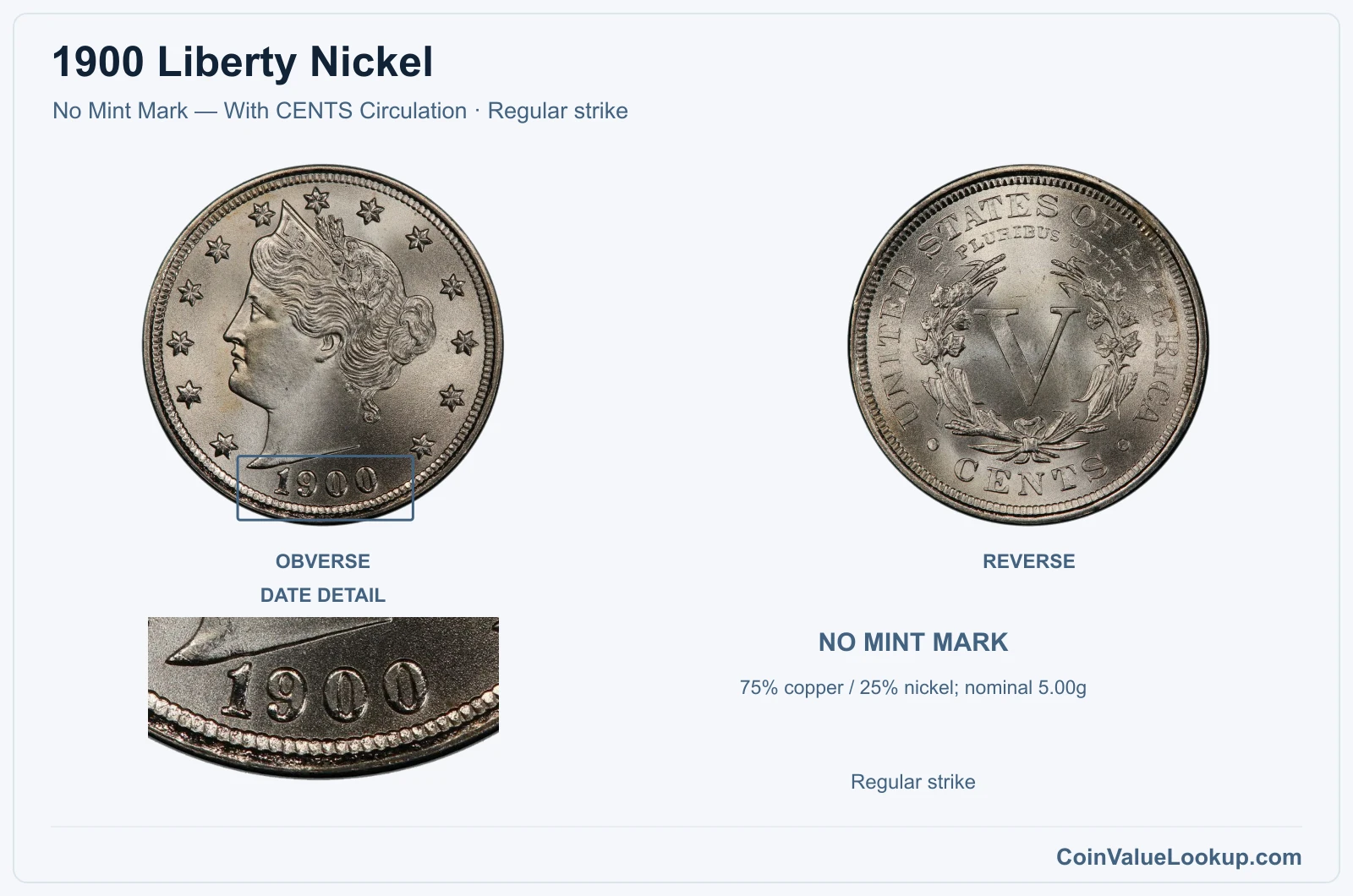
This is the standard 1900 Liberty Nickel struck for commerce at Philadelphia. No mintmark appears anywhere on the coin.
It is composed of 75% copper and 25% nickel with a plain edge.
The USA Coin Book guide places a well-worn G4 example at about $2.50 and an MS63 at roughly $175. That is a big jump, so condition matters enormously.
Most survivors sit somewhere in the circulated range, and the high-grade premiums reflect how few pieces escaped contact marks and bag wear over 125 years.
NGC recognizes a doubled reverse variety for this date. However, normal reverse lettering can look bold without being doubled, so do not assume yours qualifies without careful side-by-side comparison to a confirmed example.
Range Grade
Price Auction Records Appraisal PO PO 1
—
Coin Identifier FR FR 2
—
Coin Identifier AG AG 3
—
Coin Identifier G G 4
—
Coin Identifier
G 6
—
Coin Identifier VG VG 8
—
Coin Identifier
VG 10
—
Coin Identifier F F 12
—
Coin Identifier
F 15
—
Coin Identifier VF VF 20
—
Coin Identifier
VF 25
—
Coin Identifier
VF 30
—
Coin Identifier
VF 35
—
Coin Identifier XF XF 40
—
Coin Identifier
XF 45
—
Coin Identifier AU AU 50
—
Coin Identifier
AU 53
—
Coin Identifier
AU 55
—
Coin Identifier
AU 58
Coin Identifier MS MS 60
Coin Identifier
MS 61
Coin Identifier
MS 62
Coin Identifier
MS 63
Coin Identifier
MS 64
Coin Identifier
MS 65
Coin Identifier
MS 66
Coin Identifier
MS 67
Coin Identifier
MS 68
—
—
—
MS 69
—
—
—
MS 70
—
—
—
1900 Liberty Nickel — No Mint Mark — With CENTS Proof
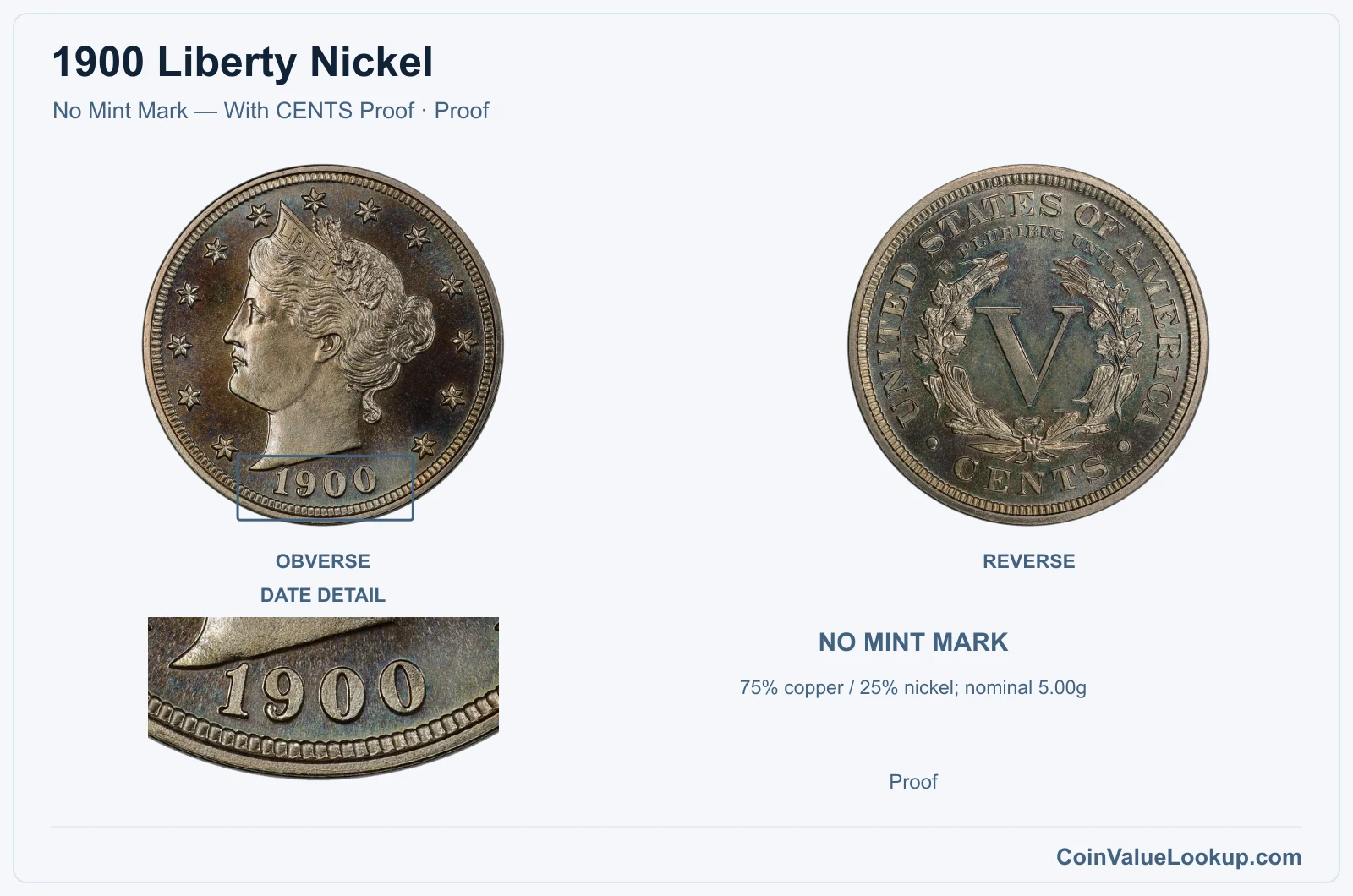
Philadelphia also produced proof 1900 Liberty Nickels for collectors. These were struck on polished planchets with specially prepared dies, yielding mirror-like fields and crisp design details that business strikes rarely match.
A PR63 proof guides at about $344 per the USA Coin Book, reflecting both the limited production run and collector demand. That figure is a retail estimate from one guide snapshot, not a guaranteed price.
When examining a suspected proof, look at the flat fields under a single light source. Genuine proofs show deep, reflective surfaces and knife-sharp rims.
Hairlines from past cleaning or storage are the main condition detractors. If the fields look merely lustrous rather than mirror-like, you likely have a well-preserved business strike instead.
Coin Value Lookup is a handy place to look up guides like this one for other dates and denominations in the Liberty Nickel series, so you can compare values across your collection.
Range Grade
Price Auction Records Appraisal PR PR 1
—
Coin Identifier
PR 2
—
Coin Identifier
PR 3
—
Coin Identifier
PR 4
—
Coin Identifier
PR 6
—
Coin Identifier
PR 8
—
Coin Identifier
PR 10
—
Coin Identifier
PR 12
—
Coin Identifier
PR 15
—
Coin Identifier
PR 20
—
Coin Identifier
PR 25
—
Coin Identifier
PR 30
—
Coin Identifier
PR 35
—
Coin Identifier
PR 40
—
Coin Identifier
PR 45
—
Coin Identifier
PR 50
—
Coin Identifier
PR 53
—
Coin Identifier
PR 55
—
Coin Identifier
PR 58
—
Coin Identifier
PR 60
Coin Identifier
PR 61
—
Coin Identifier
PR 62
Coin Identifier
PR 63
Coin Identifier
PR 64
Coin Identifier
PR 65
Coin Identifier
PR 66
Coin Identifier
PR 67
Coin Identifier
PR 68
Coin Identifier
PR 69
—
—
—
PR 70
—
—
—
1900 Liberty Nickel Error List
1. 1900 Liberty Nickel — Doubled Die Reverse
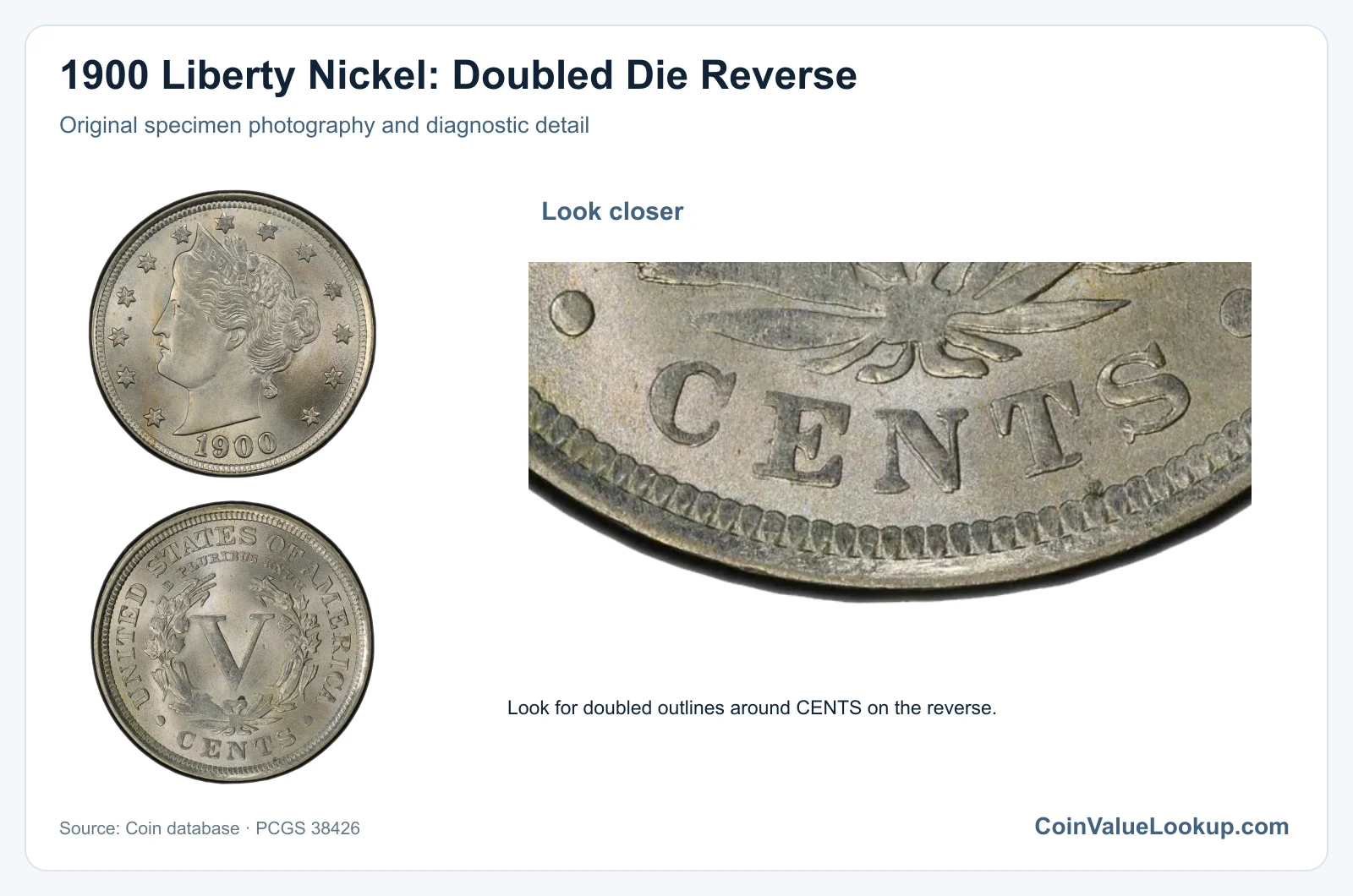
A Doubled Die Reverse on a 1900 Liberty Nickel shows doubling in the reverse legends or design elements, caused by a misalignment during the die-making process. To check for it, compare your coin's reverse lettering and wreath details closely against a normal example under magnification.
This variety is recognized by NGC for the 1900 date. That said, ordinary bold strikes can mimic doubling to the untrained eye.
Machine doubling, which is a flat, shelf-like distortion rather than a rounded secondary image, is the most common lookalike. Reflections and random surface damage can also fool you.
No specific price data was provided for this variety. Value depends on the strength and visibility of the doubling, the coin's overall condition, and whether it has been attributed by a grading service.
2. 1900 Liberty Nickel — Off-Center Strike
An off-center strike happens when the planchet is not seated properly between the dies, leaving part of the design missing and an unstruck crescent of blank metal on one side. On a 1900 Liberty Nickel, the key factor for collectibility is whether the date remains fully visible; no date usually means sharply reduced interest.
The percentage of off-center displacement matters too. A 5% shift is minor and easy to overlook, while 20% or more is dramatic and visually obvious.
Watch out for lookalikes. A clipped planchet removes metal before striking rather than shifting the design.
Post-mint flattening or vice damage can also push metal outward and simulate an off-center appearance. Genuine off-center coins show the design cleanly displaced, not smeared or crushed.
No specific price was adopted for this error. Value hinges on the degree of displacement, date visibility, and condition.
3. 1900 Liberty Nickel — Wrong Planchet / Off-Metal Strike
One of the more unusual errors reported for the 1900 Liberty Nickel is a strike on a wrong planchet, specifically a Nicaragua 5-centavo blank. This type of error occurs when a foreign planchet ends up in the striking press.
To evaluate a suspected wrong-planchet coin, compare its weight, diameter, and edge characteristics against a standard nickel. The design may be incomplete if the blank was a different size.
A normal 1900 nickel weighs about 5 grams and measures 21.2 mm, so any significant departure is a red flag worth investigating.
Lookalikes include coins that have been plated, corroded, acid-treated, or deliberately thinned after leaving the mint. These alterations can change a coin's appearance and weight enough to raise false suspicion.
Professional attribution is important for this category because the differences can be subtle.
4. 1900 Liberty Nickel — Broadstrike
A broadstrike occurs when the coin is struck without the retaining collar that normally constrains the planchet and forms the edge. The result is a coin wider than usual, with the design spreading outward and the rim poorly defined or absent.
On a 1900 Liberty Nickel, look for metal that has flowed beyond the normal 21.2 mm diameter while the full design remains centered. The edge profile will lack the neat, sharp definition of a collar-struck coin.
Do not confuse a broadstrike with an off-center error, which shifts the design rather than simply expanding it. Post-mint damage from being run over or squeezed in a vise can also flatten a coin outward, but it will typically show distorted or crushed details rather than a cleanly spread impression.
No price data was adopted for this variety. Condition and the degree of spread both influence value.
5. 1900 Liberty Nickel — Die Crack / Die Chip
Die cracks and die chips appear as raised lines or small raised blobs on the coin's surface. They are caused by fractures in the steel die itself, which then fill with metal during striking.
A crack that reaches the rim and displaces a chunk of the design is called a cud, while interior lines are simply die cracks.
On a 1900 Liberty Nickel, minor die cracks have been reported. To spot them, look for thin raised lines that follow no logical part of the design.
A die chip will appear as a small raised lump, often near lettering or design elements.
Do not mistake incuse scratches, corrosion, or crud buildup for die cracks. True die cracks are raised above the field, not cut into it.
The distinction is easy under magnification.
No guaranteed premium was reported for this category. Minor cracks are common and generally do not carry significant value unless they are large or dramatically placed.
6. 1900 Liberty Nickel — Repunched Date
A repunched date on a 1900 Liberty Nickel shows traces of an earlier date-punch position beside or beneath the final numerals. For this year, catalog descriptions note repunching on the digits 1 and 9.
The remnants appear as secondary outlines or shadow digits offset from the primary date.
This is a die variety, distinct from doubled die errors that affect the entire design. Repunched dates result from the date punch being applied more than once at slightly different positions during die preparation.
Lookalikes include damaged or corroded dates, where surface loss mimics the appearance of extra digits. Machine doubling can also create flat, shelf-like secondary images near the date but lacks the rounded character of a true repunch.
No specific price was adopted. Value depends on the clarity of the repunching, the coin's overall grade, and collector demand for the specific variety.