1910 Liberty Nickel Coin Value: How Much Is It Worth?
The 1910 Liberty Nickel is a late-date entry in a series that ran from 1883 to 1912. In well-worn condition around G4, a regular business strike runs about $2.50 according to USA Coin Book's guide estimate.
Move up to a clean MS63 example and that figure climbs to around $154. Proofs in PR63 carry a guide value near $344.
Actual proceeds depend on the individual coin's surfaces and authentication.
Fast Way to Identify Your 1910 Liberty Nickel
Snap clear, well-lit photos of both the front and back of your 1910 Liberty Nickel and upload them here. Our identifier can give you a preliminary read on which version you have — business strike or proof — based on what the photos show.
It is not a substitute for professional authentication or precise grading, but it is a solid starting point.
1910 Liberty Nickel Value
Upload both sides of your 1910 Liberty Nickel.
Front Obverse
Upload photo
Back Reverse
Upload photo
Which 1910 Liberty Nickel Versions Are Worth Money?
- Business strikes grading MS63 carry a USA Coin Book guide value around $154, a significant jump from the $2.50 G4 level.
- Proofs in PR63 are listed near $344; original, undamaged proof surfaces with minimal hairlines drive this premium.
- Coins struck on a wrong planchet are reported for this date and can carry individual premiums — proper weight and diameter measurement is essential.
- Other reported error types — lamination, struck-through, and off-center — may add value depending on severity and condition.
Step 1: Identify Your 1910 Liberty Nickel Mint Mark and Version
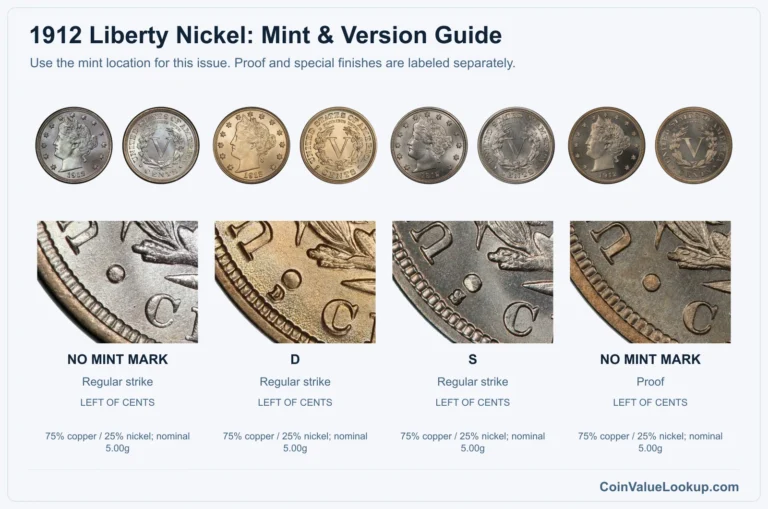
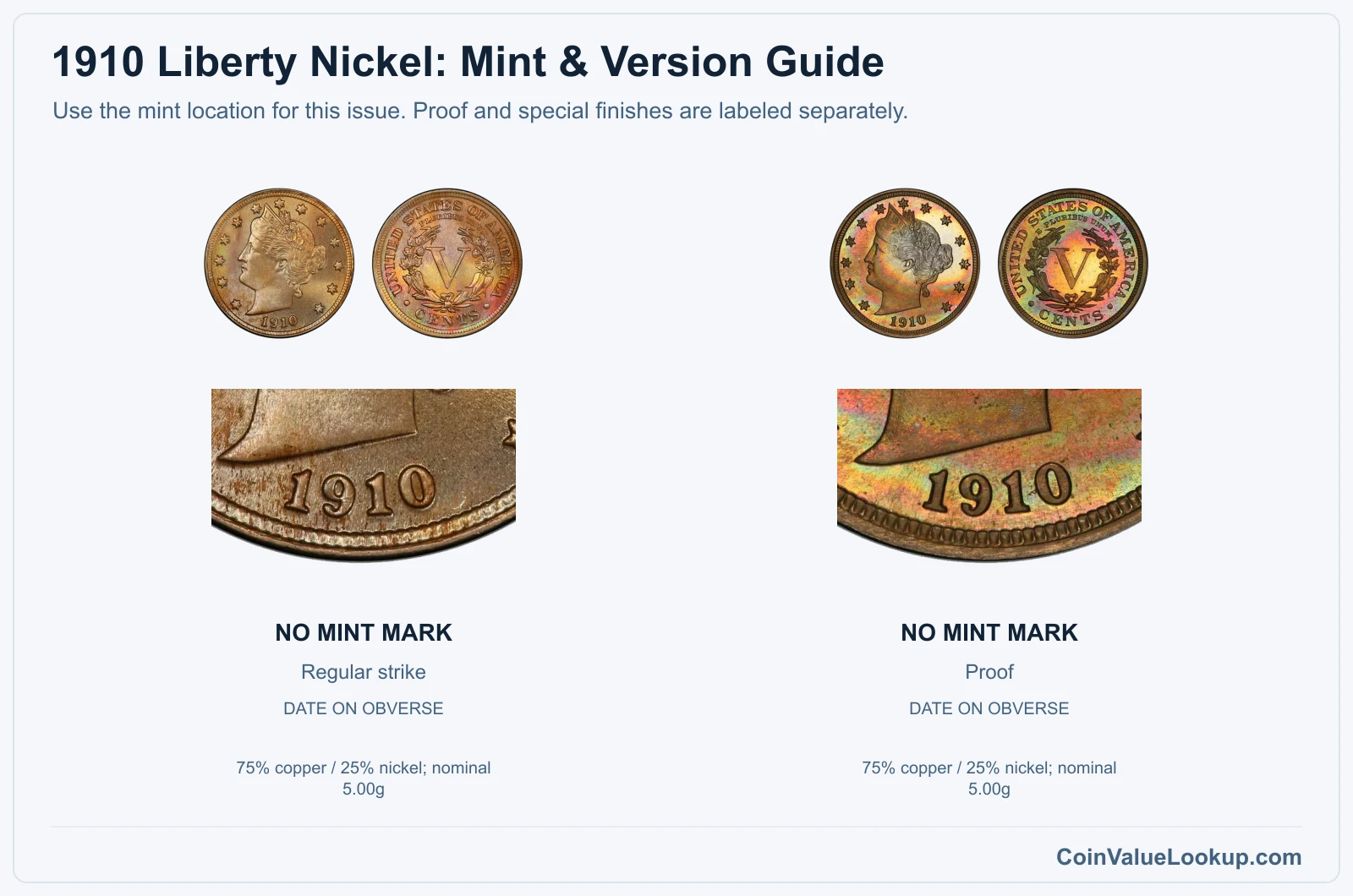
Every regular 1910 Liberty Nickel was struck at the Philadelphia Mint. There is no mintmark to look for on this date — no D, no S.
The coin is 75% copper and 25% nickel, weighs a nominal 5.00 grams, measures 21.2 mm across, and has a plain edge.
All normal examples carry the words "CENTS" on the reverse, inside the wreath beneath the Roman numeral V. The "No CENTS" variety belongs to 1883 only, so if your 1910 shows CENTS on the back, that is exactly what it should be.
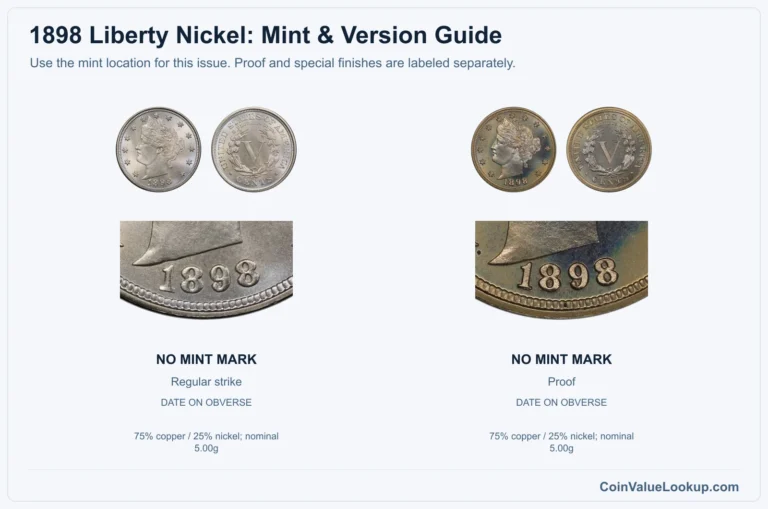
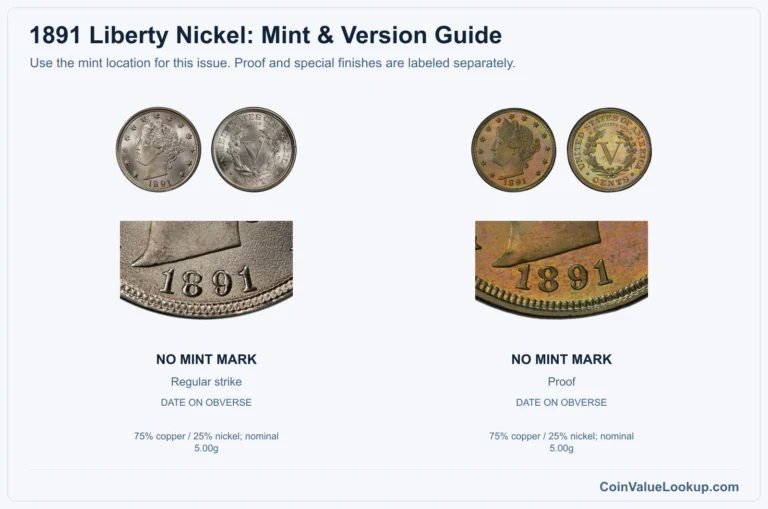
The two legitimate versions for this date are the standard business strike and the proof. Both come from Philadelphia.
There is no silver branch, no alternate metal composition, and no branch-mint variant for 1910.
Step 2: Check Your 1910 Liberty Nickel Grade
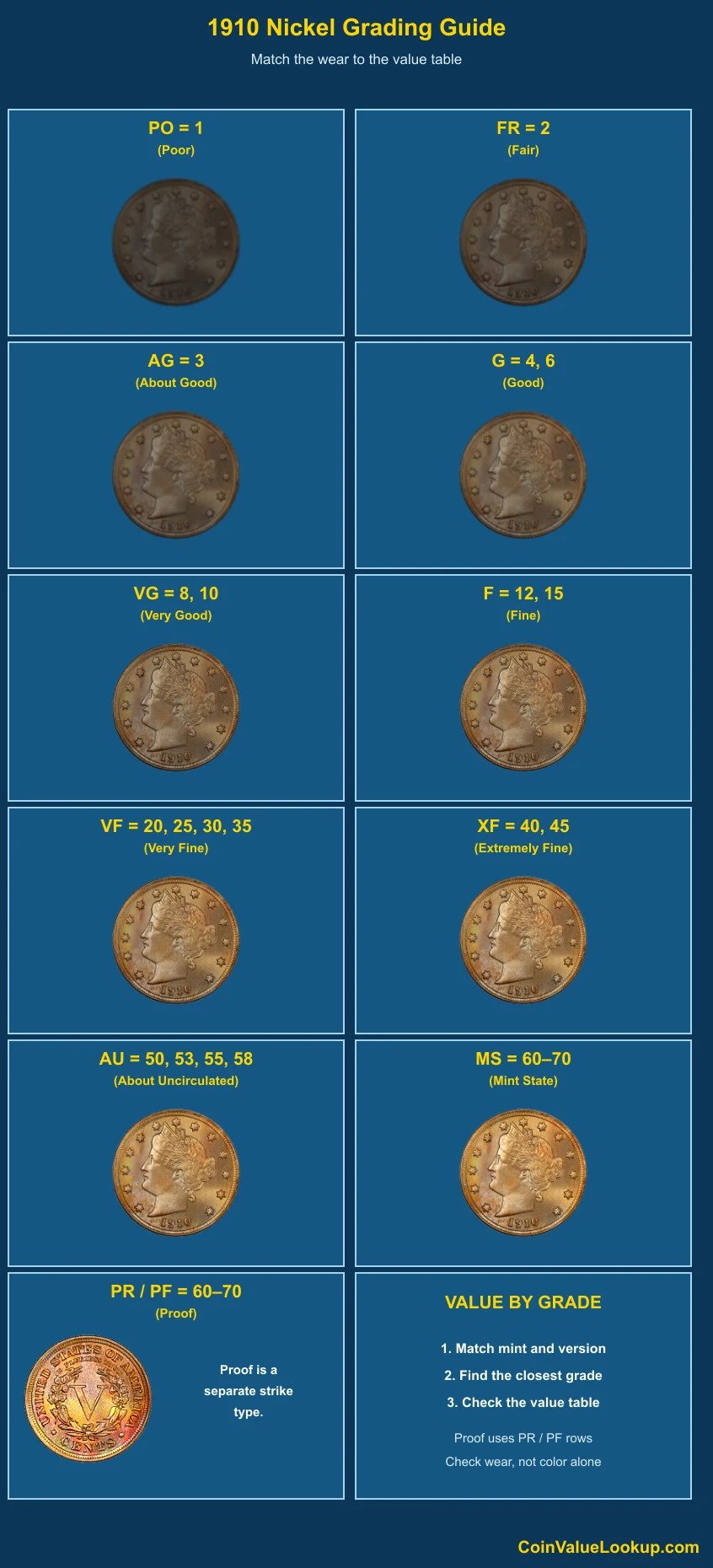
Start with the word LIBERTY stamped into the coronet (headband) on the obverse. On a well-worn coin those letters fade progressively, with the middle letters going first.
A G4 coin will show a partial LIBERTY at best, while a VF piece retains all letters with moderate softness.
Check the high points of the hair curls above Liberty's forehead and the cheek area. Flatness there usually means wear — but not always.
Weak strikes on Liberty Nickels can mimic circulation loss, so look at the fields too. Original luster and undisturbed surfaces point toward a higher grade even if the hair detail is soft.
On the reverse, the corn ears and wreath leaves lose definition as the coin wears. Compare your coin side-by-side with the grading comparison image to judge whether the loss is from use or from a soft original strike.
Proof is a manufacturing method, not a grade above Mint State. Proof surfaces should show mirror-like fields and sharp rims.
Hairlines from cleaning or mishandling will lower the proof's grade. If you are unsure whether you have a proof, examine the fields under angled light — business strikes look satiny, proofs look reflective.
Step 3: Check 1910 Liberty Nickel Value by Mint and Version
1910 Liberty Nickel — No Mint Mark — With CENTS Circulation
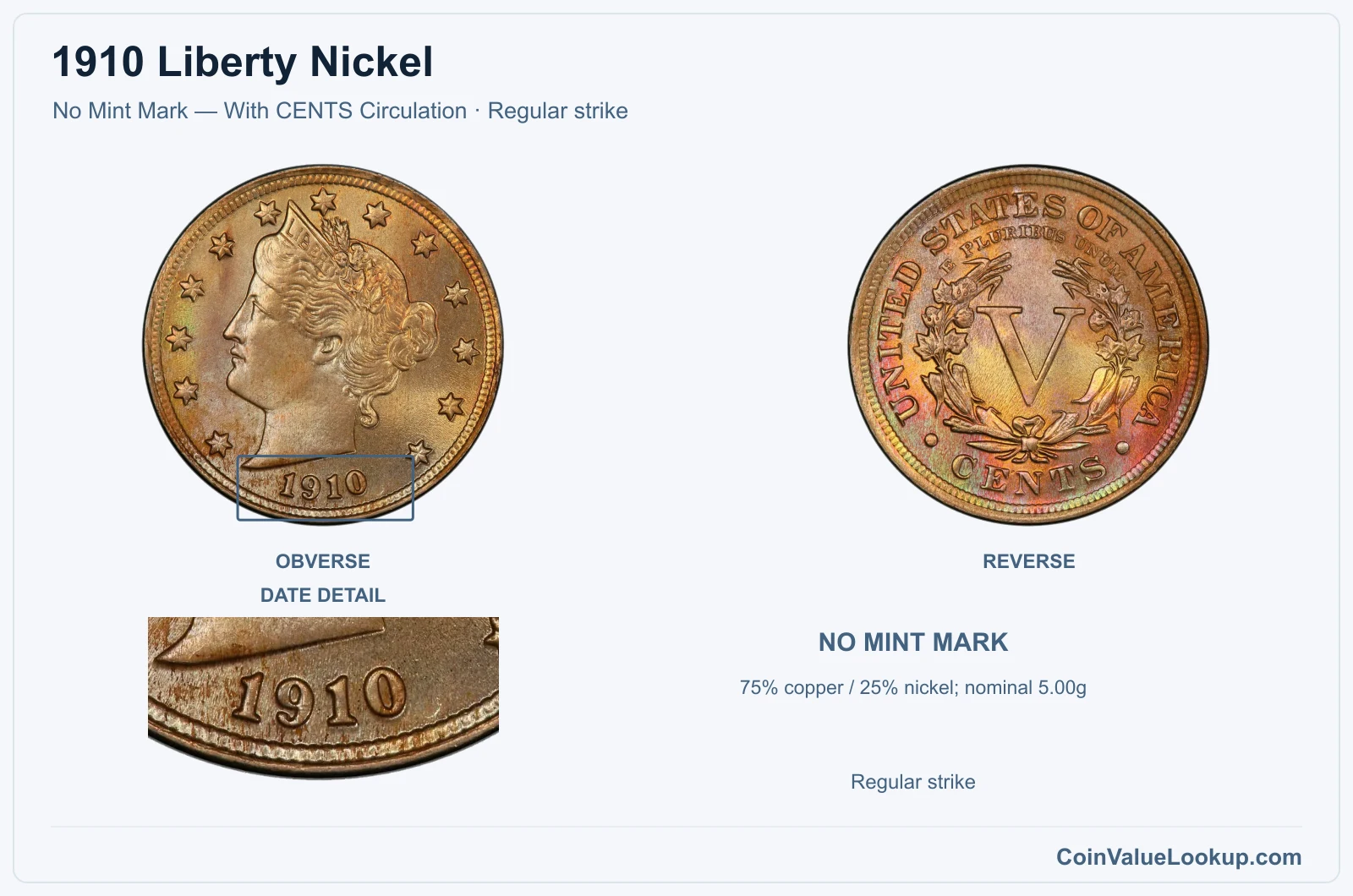
This is the standard 1910 Liberty Nickel struck for circulation at Philadelphia. No mintmark appears anywhere on the coin.
It weighs about 5 grams in copper-nickel and carries the "CENTS" legend on the reverse.
USA Coin Book's guide places a well-worn G4 example around $2.50 and an MS63 near $154. That spread tells you condition matters enormously.
A coin with full LIBERTY, strong hair curls, and original luster is worth hunting for.
Coin Value Lookup is a handy place to compare guide values across different Liberty Nickel dates and denominations when you are sorting through a group of coins.
Range Grade
Price Auction Records Appraisal PO PO 1
—
Coin Identifier FR FR 2
—
Coin Identifier AG AG 3
—
Coin Identifier G G 4
—
Coin Identifier
G 6
—
Coin Identifier VG VG 8
—
Coin Identifier
VG 10
—
Coin Identifier F F 12
—
Coin Identifier
F 15
—
Coin Identifier VF VF 20
—
Coin Identifier
VF 25
—
Coin Identifier
VF 30
—
Coin Identifier
VF 35
Coin Identifier XF XF 40
—
Coin Identifier
XF 45
Coin Identifier AU AU 50
Coin Identifier
AU 53
Coin Identifier
AU 55
—
Coin Identifier
AU 58
Coin Identifier MS MS 60
Coin Identifier
MS 61
Coin Identifier
MS 62
Coin Identifier
MS 63
Coin Identifier
MS 64
Coin Identifier
MS 65
Coin Identifier
MS 66
Coin Identifier
MS 67
Coin Identifier
MS 68
—
—
—
MS 69
—
—
—
MS 70
—
—
—
1910 Liberty Nickel — No Mint Mark — With CENTS Proof
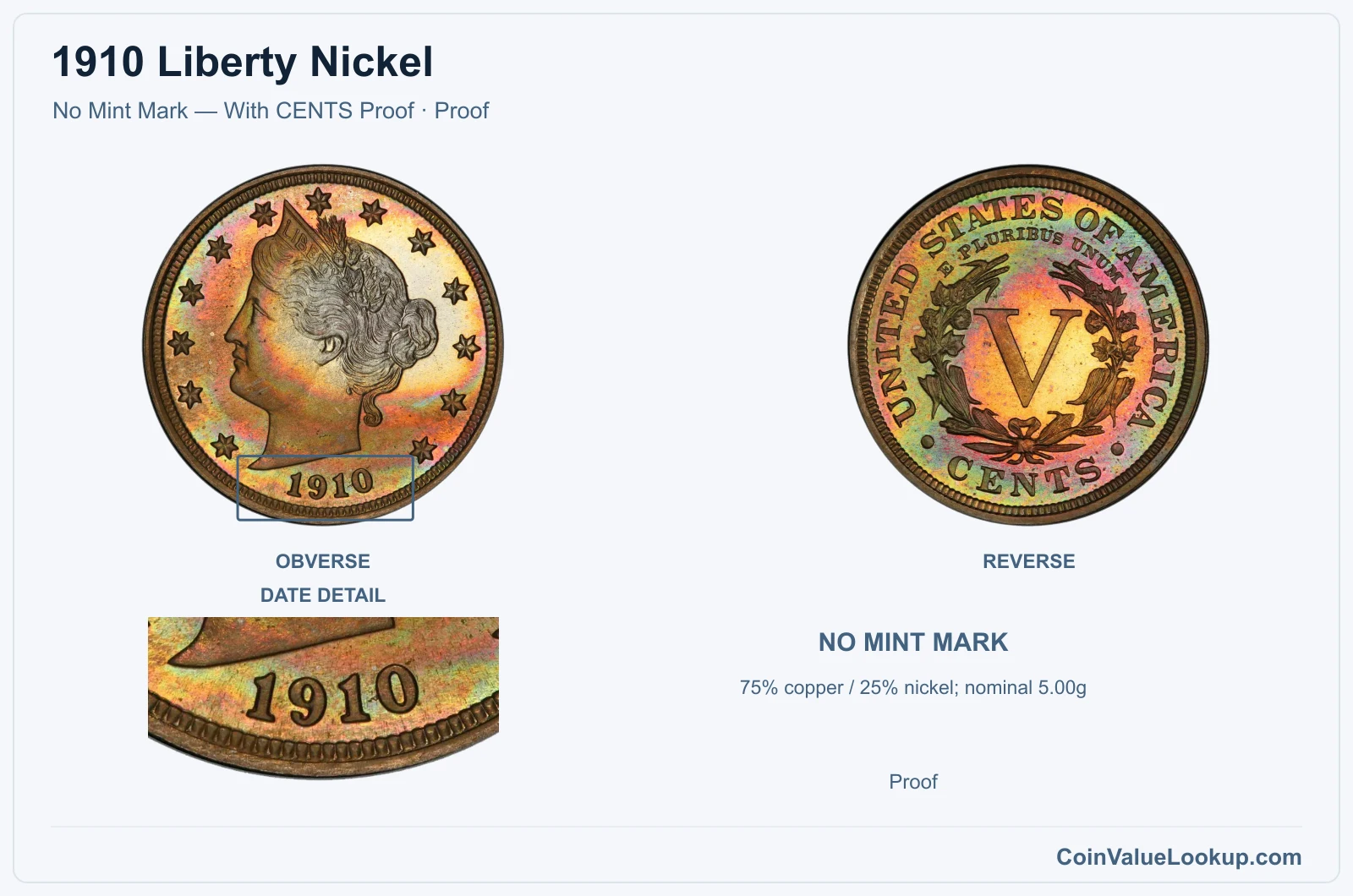
Philadelphia struck proofs of the Liberty Nickel throughout the series, and 1910 is no exception. These were sold directly to collectors, not released into general circulation.
A PR63 proof carries a guide value around $344 per USA Coin Book. The premium over a business strike reflects the mirror-finish fields and sharper detail that proof production provides.
Look for reflective surfaces, crisp rims, and squared-off edges — all hallmarks of proof manufacture.
When evaluating a proof, hairlines from improper storage or cleaning are the main grade killers. Tilt the coin under a single light source; a proof's mirror field will show every flaw.
Both faces and the rim detail matter for attribution, so photograph everything if you want a second opinion.
Range Grade
Price Auction Records Appraisal PR PR 1
—
Coin Identifier
PR 2
—
Coin Identifier
PR 3
—
Coin Identifier
PR 4
—
Coin Identifier
PR 6
—
Coin Identifier
PR 8
—
Coin Identifier
PR 10
—
Coin Identifier
PR 12
—
Coin Identifier
PR 15
—
Coin Identifier
PR 20
—
Coin Identifier
PR 25
—
Coin Identifier
PR 30
—
Coin Identifier
PR 35
—
Coin Identifier
PR 40
—
Coin Identifier
PR 45
—
Coin Identifier
PR 50
—
Coin Identifier
PR 53
—
Coin Identifier
PR 55
—
Coin Identifier
PR 58
—
Coin Identifier
PR 60
—
Coin Identifier
PR 61
—
Coin Identifier
PR 62
Coin Identifier
PR 63
Coin Identifier
PR 64
Coin Identifier
PR 65
Coin Identifier
PR 66
Coin Identifier
PR 67
Coin Identifier
PR 68
Coin Identifier
PR 69
—
—
—
PR 70
—
—
—
1910 Liberty Nickel Error List
1. 1910 Liberty Nickel — Wrong Planchet / Off-Metal Strike
A 1910 Liberty Nickel struck on the wrong planchet means the design was impressed onto a blank intended for a different denomination. This error has been reported for the date by a specialist source.
To check, compare your coin's weight and diameter against the normal specifications: roughly 5.00 grams and 21.2 mm. A wrong-planchet strike will deviate noticeably on at least one measurement, and the design may appear incomplete because the blank was the wrong size.
Photograph the edge as well — it can reveal the host blank's intended denomination.
Be cautious. Plating, acid etching, corrosion, and deliberate alteration can all make a normal nickel look lighter or thinner.
Measured weight on a precision scale is the single most useful diagnostic. No specific price range is established here because value depends on the exact planchet, the completeness of the design, and the coin's overall condition.
2. 1910 Liberty Nickel — Lamination / Split Planchet
Lamination errors occur when layers of the alloy separate, leaving a peeling flap, a void, or a visible split within the coin's thickness. This category has been reported for the 1910 Nickel.
Look for a raised or detached sliver of metal on either face, or a visible crack along the edge where the planchet is delaminating. Tilting the coin under light usually makes a retained flap obvious.
Photograph the edge profile alongside the affected surface to document the defect clearly.
Do not confuse lamination with post-mint scraping, corrosion pitting, or a coin that has been deliberately cut or peeled. Genuine lamination follows the metal's internal structure and typically has a smooth separation plane.
Value depends on the size and visibility of the defect as well as the coin's overall condition; no specific price is adopted for this category.
3. 1910 Liberty Nickel — Struck-Through Error
A struck-through error happens when foreign material — grease, a fragment of metal, cloth, or another debris — sits between the die and the planchet during striking. The result is a localized depression or a ghost impression where the design should be.
On a 1910 Liberty Nickel, look for a sunken area that interrupts the normal design without the sharp edges you would see from a scratch or gouge. Grease-filled dies tend to obliterate fine detail over a broad area, while a retained foreign object leaves a more distinct impression.
Ordinary wear, cleaning marks, and weak strikes can all mimic a struck-through appearance, so compare the suspect area to the rest of the coin's surfaces. Genuine struck-throughs usually affect one face more than the other.
The premium depends on how dramatic and identifiable the obstruction impression is, along with the coin's condition overall; no specific price is provided here.
4. 1910 Liberty Nickel — Off-Center Strike
An off-center strike means the planchet was not properly seated in the collar when the dies came together. Part of the design is missing, and you will see an unstruck crescent of blank metal along one edge.
The percentage of off-center displacement and whether the date remains visible are the two biggest factors collectors care about. A 5% shift is mildly interesting; a 20% or greater shift with a readable 1910 date is far more desirable.
Do not confuse an off-center strike with a clipped planchet, which shows a curved bite out of an otherwise fully struck coin, or with post-mint damage that flattened one side. A true off-center coin has a complete, unstruck blank area and the struck portion retains full-depth detail.
Value varies with severity and condition, so no set price applies across the board.