1910 Barber Dime Coin Value: How Much Is It Worth?
A 1910 Barber Dime in well-worn condition starts around $10.91 at G4 for a Philadelphia strike, while San Francisco pieces in MS63 can reach about $759 according to USA Coin Book guide estimates. Three mints produced dimes this year — Philadelphia, Denver, and San Francisco — so there is no New Orleans issue to hunt for.
Proofs were struck at Philadelphia only, with guide values near $616 at PR63.
Fast Way to Identify Your 1910 Barber Dime
The quickest way to start figuring out what your 1910 Barber Dime might be worth is to upload clear photos of the front and back. Our identifier uses those images for a preliminary look at your coin's mint, version, and general condition.
It does not authenticate, certify, or guarantee a grade, but it gives you a solid starting point.
1910 Barber Dime Value
Upload both sides of your 1910 Barber Dime.
Front Obverse
Upload photo
Back Reverse
Upload photo
Which 1910 Barber Dime Versions Are Worth Money?
- The San Francisco (S) mint issue carries the highest guide values of the three business strikes, reaching about $759 at MS63.
- Denver (D) pieces in MS63 list around $501, a clear step above the Philadelphia issue at the same grade.
- Philadelphia Proofs in PR63 are valued near $616; these were specially struck for collectors using polished dies.
- A Doubled Die Obverse error has been reported for the 1910 Dime — condition and visibility of the doubling affect its value.
- Even common Philadelphia coins jump sharply from about $10.91 at G4 to $253 at MS63, so preserving original surfaces matters.
Step 1: Identify Your 1910 Barber Dime Mint Mark and Version
The 1910 Barber Dime shows Liberty facing right on the obverse, wearing a cap with a laurel wreath and the word LIBERTY on a headband. The reverse displays ONE DIME inside an open wreath tied with a bow at the bottom.
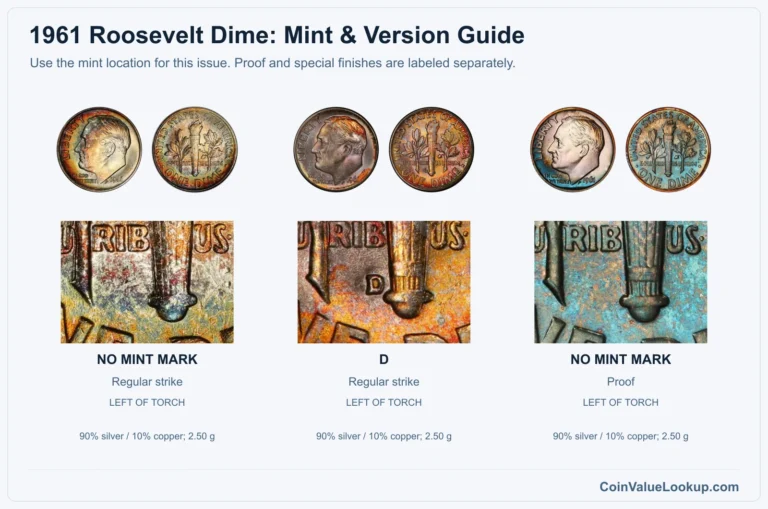
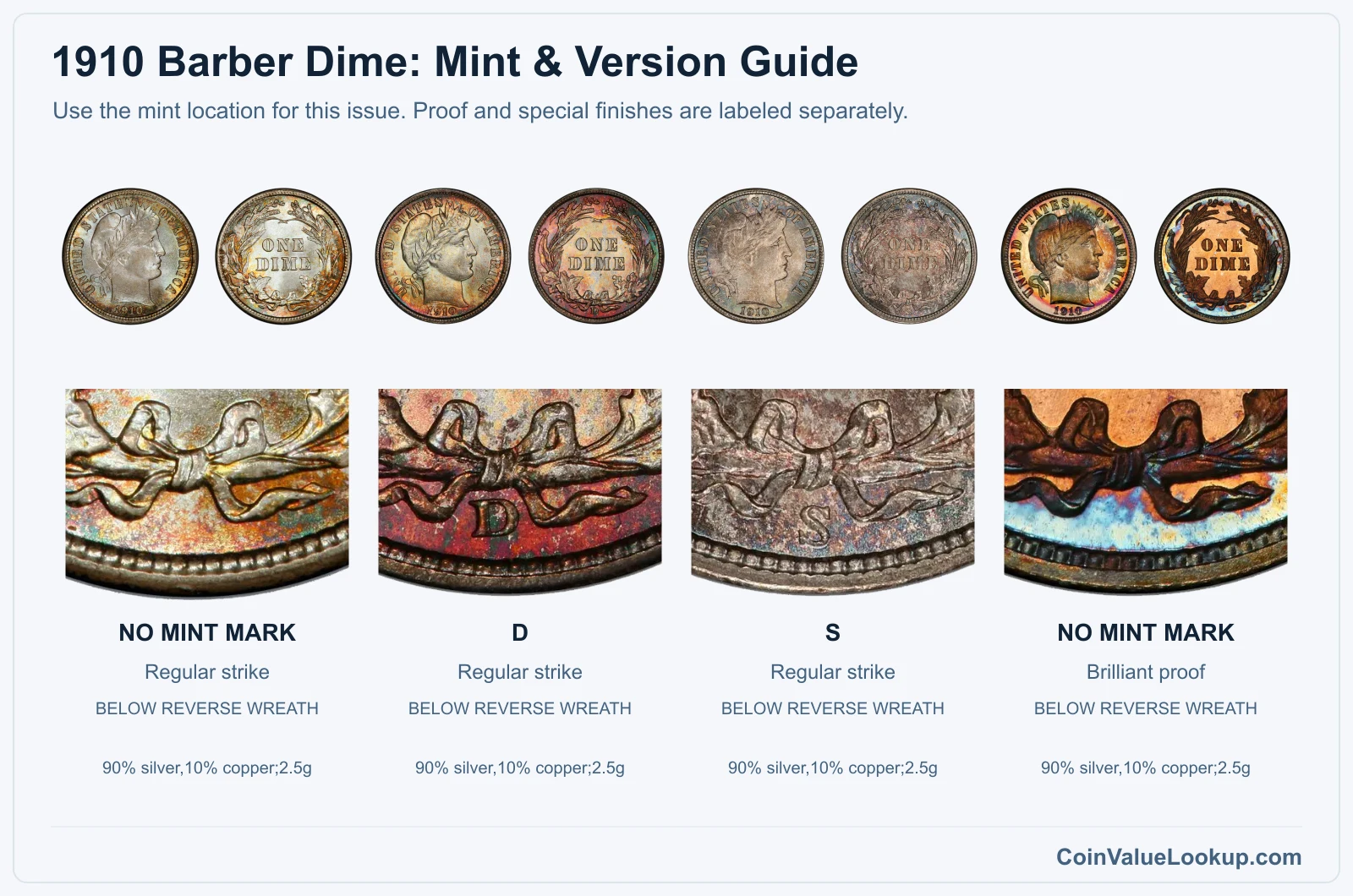
Flip the coin over and look just below that bow. A small "D" means Denver, an "S" means San Francisco, and no letter at all means Philadelphia.
That is the only spot the mintmark appears on Barber Dimes.
All three versions are struck in 90% silver and 10% copper, weigh 2.5 grams, measure 17.9 mm across, and have a reeded edge. Do not confuse this design with the Mercury Dime (winged cap) that replaced it in 1916 or with earlier Seated Liberty types — those are different series with different values.
Coin Value Lookup is a handy place to look up guides for other dates and denominations in the Barber series if you are sorting through a group of old dimes.
Step 2: Check Your 1910 Barber Dime Grade
Start with the headband. On a lightly worn coin you can still read the full word LIBERTY; on a heavily circulated example, only a few letters remain or none at all.
A coin grading around G4 will have a smooth headband with the outline of Liberty's head still visible.
Next, check the hair above the ear. In higher grades the individual strands are sharp, while moderate wear flattens that area first.
The cheek below the eye also picks up contact marks quickly, so look there for bag friction on uncirculated coins.
On the reverse, examine the wreath leaves and the ribbon bow. A coin with full separation in those leaves and strong lettering is in better shape than one where everything blends together.
Mint State means unbroken, original luster across the entire surface — not just a shiny spot or two. Check for hairlines from old cleaning, which can make a coin look bright but actually reduce its grade.
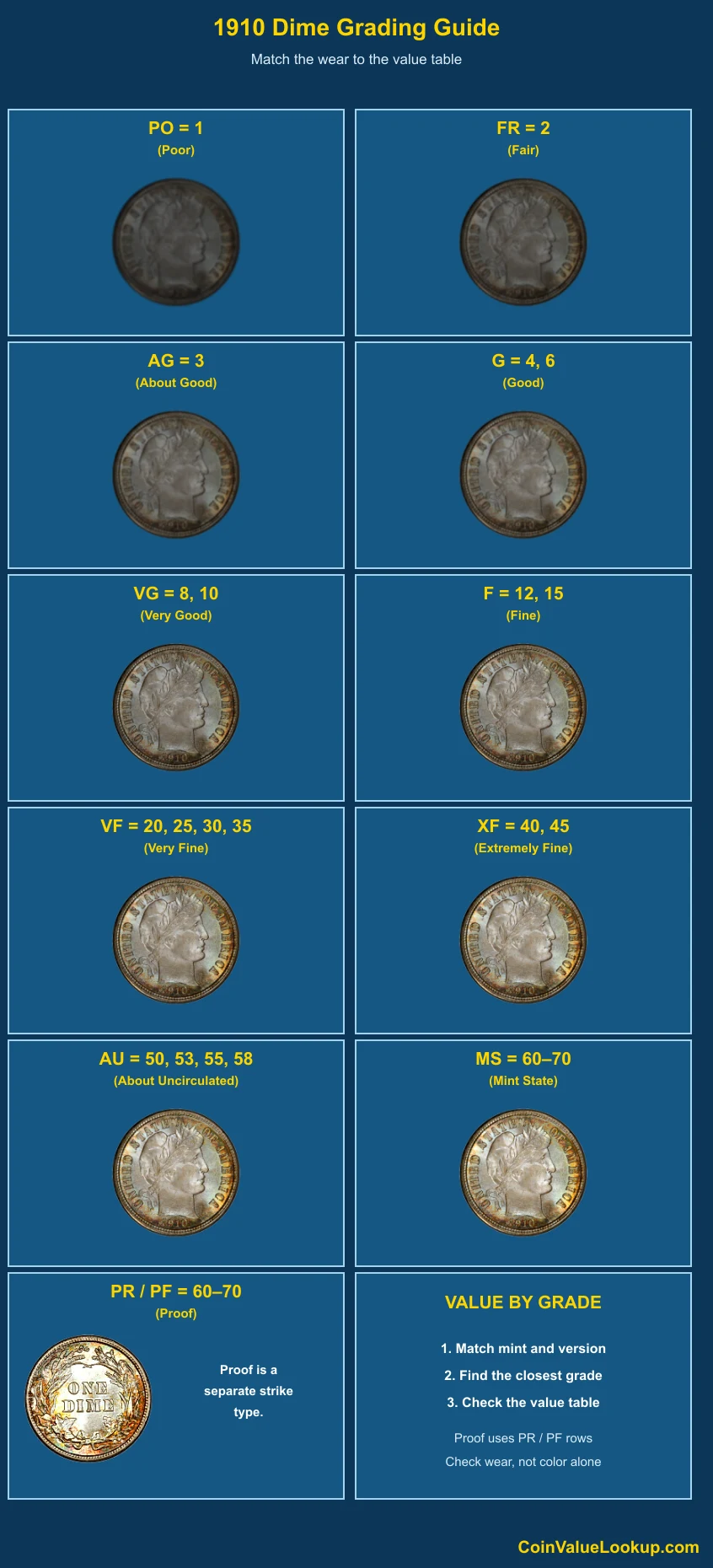
Use the comparison image to match your coin's wear pattern against known grade benchmarks.
Proof is a way a coin was made (mirror fields, sharp rims), not a grade above Mint State. Cleaned or impaired proofs still exist and are graded accordingly.
Step 3: Check 1910 Barber Dime Value by Mint and Version
1910 Barber Dime — No Mint Mark — Silver Circulation
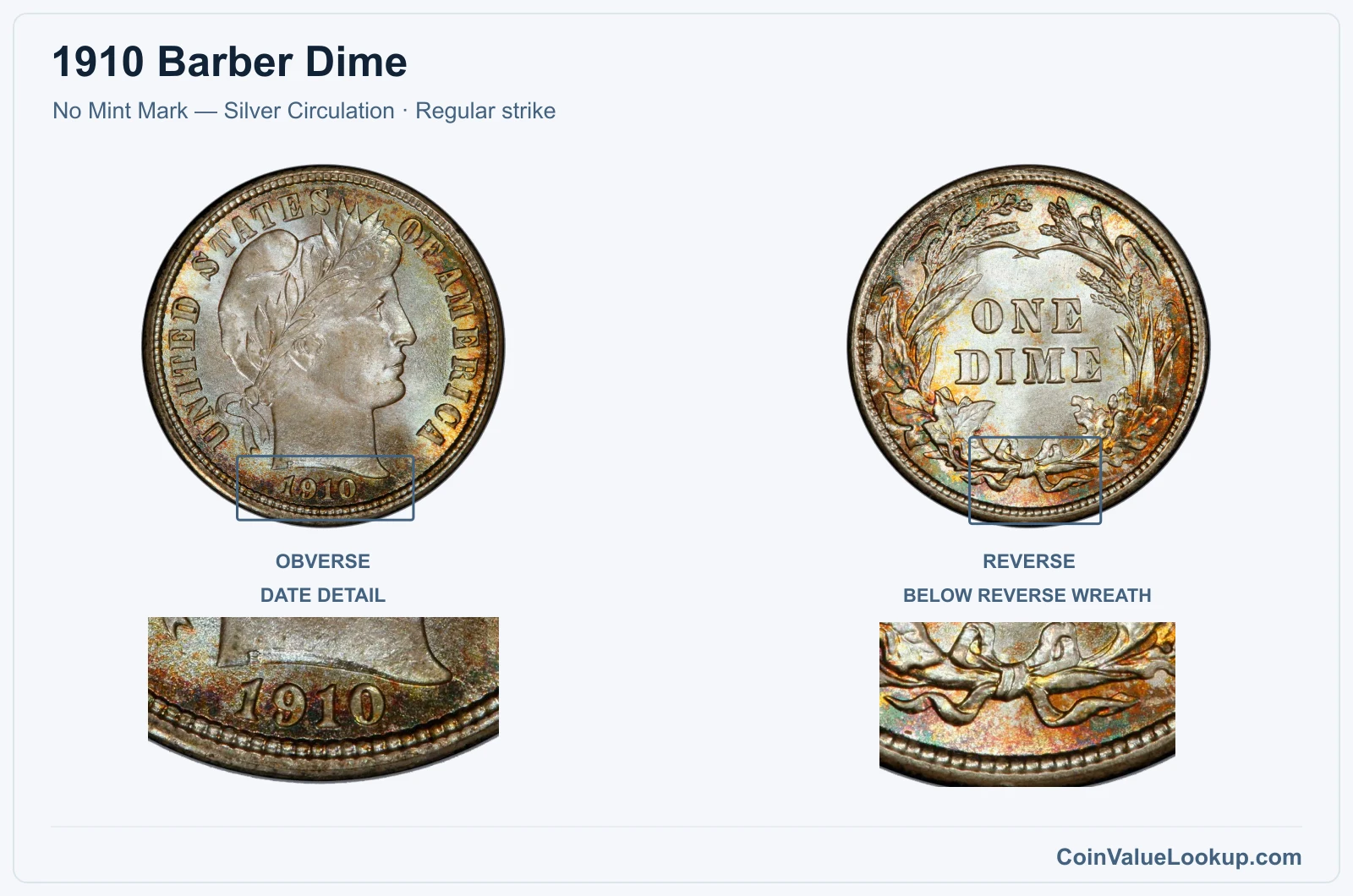
The Philadelphia 1910 Barber Dime has no mintmark — the space below the reverse wreath bow is blank. It was struck in 90% silver and 10% copper at 2.5 grams.
USA Coin Book lists about $10.91 at G4 and around $253 at MS63. That is a big spread, and it tells you condition drives the value here more than rarity.
Most surviving examples are well circulated, so a piece with full LIBERTY and strong hair detail is already above average.
Look for original, untampered surfaces. A dipped or polished coin may shine, but experienced buyers notice the difference.
Range Grade
Price Auction Records Appraisal PO PO 1
—
Coin Identifier FR FR 2
—
Coin Identifier AG AG 3
—
Coin Identifier G G 4
—
Coin Identifier
G 6
Coin Identifier VG VG 8
—
Coin Identifier
VG 10
—
Coin Identifier F F 12
—
Coin Identifier
F 15
—
Coin Identifier VF VF 20
—
Coin Identifier
VF 25
—
Coin Identifier
VF 30
—
Coin Identifier
VF 35
Coin Identifier XF XF 40
—
Coin Identifier
XF 45
Coin Identifier AU AU 50
—
Coin Identifier
AU 53
—
Coin Identifier
AU 55
Coin Identifier
AU 58
Coin Identifier MS MS 60
Coin Identifier
MS 61
Coin Identifier
MS 62
Coin Identifier
MS 63
Coin Identifier
MS 64
Coin Identifier
MS 65
Coin Identifier
MS 66
Coin Identifier
MS 67
Coin Identifier
MS 68
Coin Identifier
MS 69
—
—
—
MS 70
—
—
—
1910 Barber Dime — D — Silver Circulation
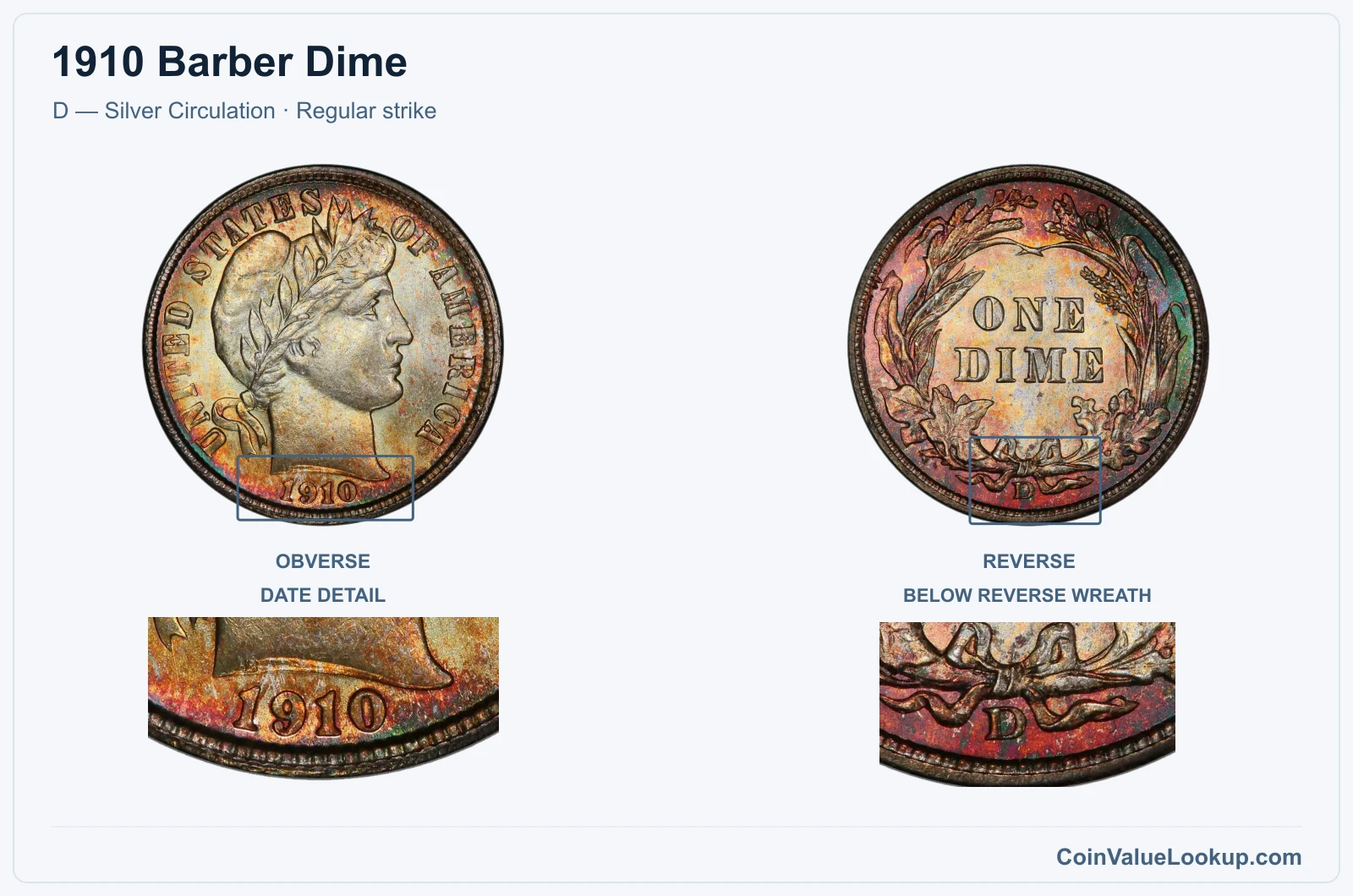
Look for a small "D" below the wreath bow on the reverse. That marks your coin as a Denver issue, struck in the same 90% silver composition.
Guide estimates from USA Coin Book place the 1910-D at about $14 in G4 and roughly $501 in MS63 — noticeably higher than the Philadelphia coin at both ends. Denver output for this year tends to be tougher to find in upper grades, which is where the premium comes from.
Make sure the mintmark is a genuine "D" and not damage or a tooled letter. A loupe helps.
Original surfaces with natural toning are preferable to cleaned examples.
Range Grade
Price Auction Records Appraisal PO PO 1
—
Coin Identifier FR FR 2
—
Coin Identifier AG AG 3
—
Coin Identifier G G 4
Coin Identifier
G 6
—
Coin Identifier VG VG 8
—
Coin Identifier
VG 10
—
Coin Identifier F F 12
—
Coin Identifier
F 15
—
Coin Identifier VF VF 20
—
Coin Identifier
VF 25
—
Coin Identifier
VF 30
—
Coin Identifier
VF 35
—
Coin Identifier XF XF 40
Coin Identifier
XF 45
—
Coin Identifier AU AU 50
—
Coin Identifier
AU 53
—
Coin Identifier
AU 55
Coin Identifier
AU 58
Coin Identifier MS MS 60
—
Coin Identifier
MS 61
—
Coin Identifier
MS 62
Coin Identifier
MS 63
Coin Identifier
MS 64
Coin Identifier
MS 65
Coin Identifier
MS 66
Coin Identifier
MS 67
Coin Identifier
MS 68
—
—
—
MS 69
—
—
—
MS 70
—
—
—
1910 Barber Dime — S — Silver Circulation
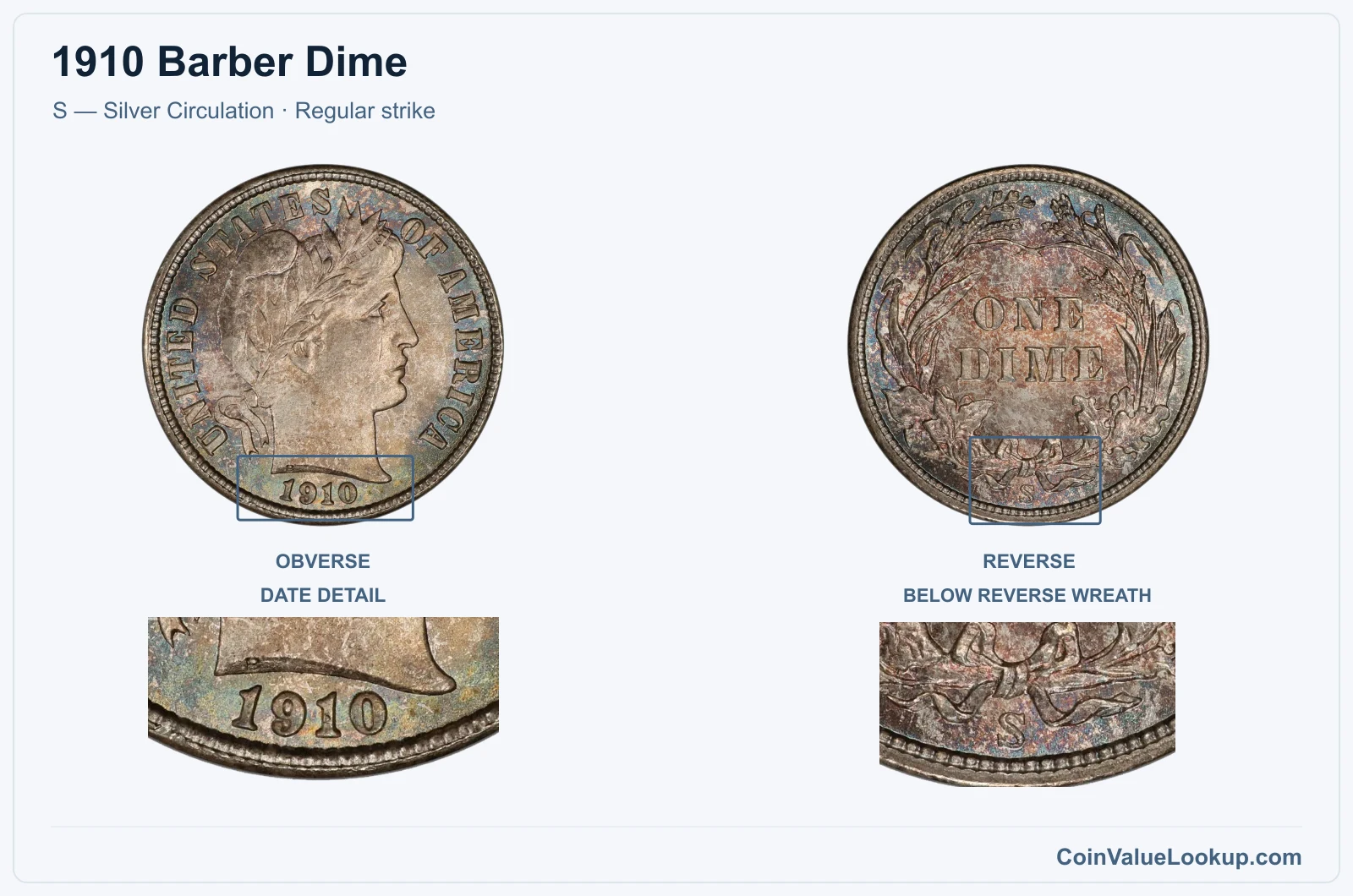
The San Francisco strike carries an "S" mintmark below the reverse wreath bow. Same 90% silver, 10% copper alloy, 2.5 grams, reeded edge.
USA Coin Book lists this one at about $16 in G4 and approximately $759 at MS63, the highest guide values among the three business-strike mints for 1910. That upper-grade premium reflects genuine scarcity in well-preserved condition.
San Francisco coins can sometimes show softer strikes than their Philadelphia counterparts, so do not mistake a weak impression for wear. Compare the overall luster and high-point detail before deciding on a grade.
Range Grade
Price Auction Records Appraisal PO PO 1
—
Coin Identifier FR FR 2
—
Coin Identifier AG AG 3
—
Coin Identifier G G 4
—
Coin Identifier
G 6
—
Coin Identifier VG VG 8
—
Coin Identifier
VG 10
—
Coin Identifier F F 12
Coin Identifier
F 15
Coin Identifier VF VF 20
Coin Identifier
VF 25
Coin Identifier
VF 30
Coin Identifier
VF 35
—
Coin Identifier XF XF 40
Coin Identifier
XF 45
Coin Identifier AU AU 50
Coin Identifier
AU 53
Coin Identifier
AU 55
Coin Identifier
AU 58
Coin Identifier MS MS 60
—
Coin Identifier
MS 61
Coin Identifier
MS 62
Coin Identifier
MS 63
Coin Identifier
MS 64
Coin Identifier
MS 65
Coin Identifier
MS 66
Coin Identifier
MS 67
Coin Identifier
MS 68
—
—
—
MS 69
—
—
—
MS 70
—
—
—
1910 Barber Dime — No Mint Mark — Brilliant Silver Proof
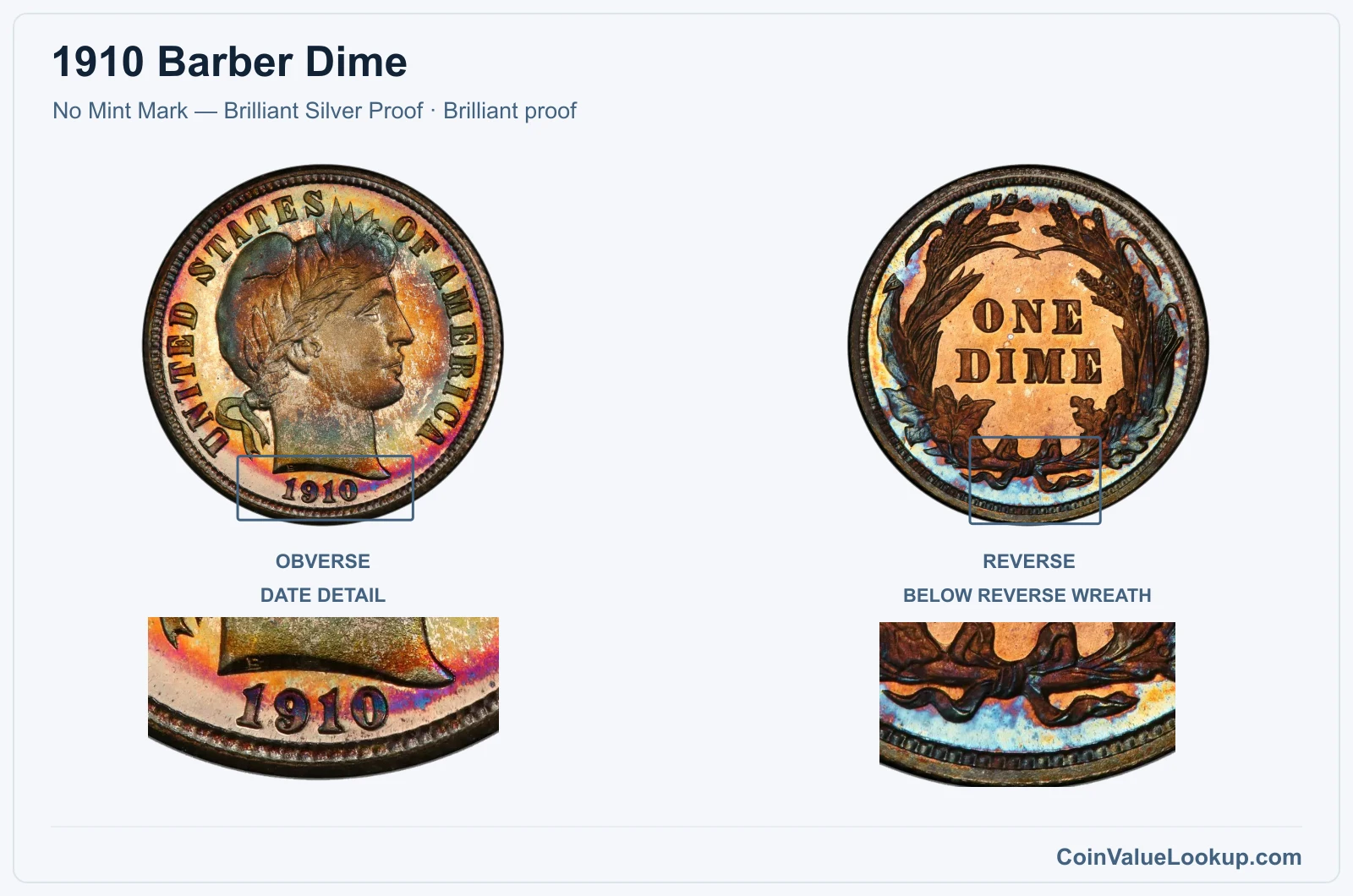
Philadelphia struck proof Barber Dimes for collectors from 1892 through 1915, and 1910 is part of that run. These coins have mirrored fields and sharply defined rims that set them apart from even the best business strikes.
USA Coin Book estimates about $616 at PR63. Cameo and Deep Cameo designations reflect the contrast between frosted devices and mirror fields; do not assume an ordinary PR63 price applies to a coin with strong contrast, as those are graded and valued separately.
To confirm a proof, look for the glass-like reflective surface across the flat areas and razor-sharp detail on the wreath and lettering. A business strike in high grade can look impressive, but it will not have that liquid-mirror finish.
Range Grade
Price Auction Records Appraisal PR PR 1
—
Coin Identifier
PR 2
—
Coin Identifier
PR 3
—
Coin Identifier
PR 4
—
Coin Identifier
PR 6
—
Coin Identifier
PR 8
—
Coin Identifier
PR 10
—
Coin Identifier
PR 12
—
Coin Identifier
PR 15
—
Coin Identifier
PR 20
—
Coin Identifier
PR 25
—
Coin Identifier
PR 30
—
Coin Identifier
PR 35
—
Coin Identifier
PR 40
—
Coin Identifier
PR 45
—
Coin Identifier
PR 50
—
Coin Identifier
PR 53
—
Coin Identifier
PR 55
—
Coin Identifier
PR 58
—
Coin Identifier
PR 60
Coin Identifier
PR 61
—
Coin Identifier
PR 62
Coin Identifier
PR 63
Coin Identifier
PR 64
Coin Identifier
PR 65
Coin Identifier
PR 66
Coin Identifier
PR 67
Coin Identifier
PR 68
Coin Identifier
PR 69
Coin Identifier
PR 70
—
—
—
1910 Barber Dime Error List
1. 1910 Barber Dime — Doubled Die Obverse
A Doubled Die Obverse has been reported for the 1910 Dime. This means the obverse die received a slightly misaligned secondary impression during its creation, leaving traces of doubling on letters, the date, or design elements.
To check your coin, compare the obverse lettering and date numerals against a normal 1910 Dime under consistent lighting and magnification. Genuine die doubling shows as a consistent separation or notching — the extra image follows the same direction on every affected element.
Do not confuse this with machine doubling, which produces a flat, shelf-like distortion and is far less desirable. Reflections, die wear, or worn surfaces can also mimic doubling at a glance.
No specific price range is available for this variety. The value depends heavily on the strength and visibility of the doubling, the coin's overall condition, and buyer interest.
A professional evaluation is worthwhile if you spot convincing separation.