1916 Barber Dime Coin Value: How Much Is It Worth?
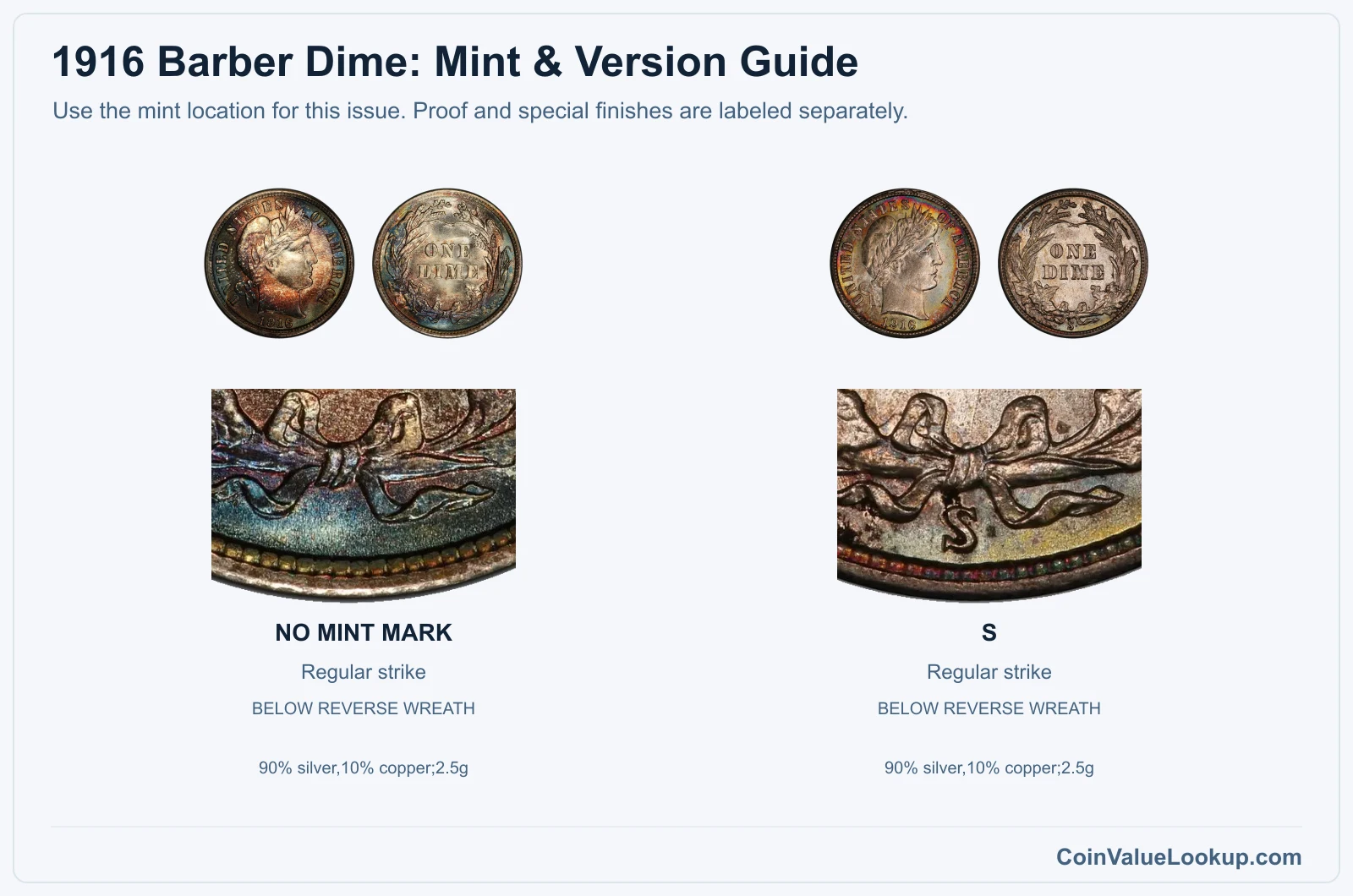
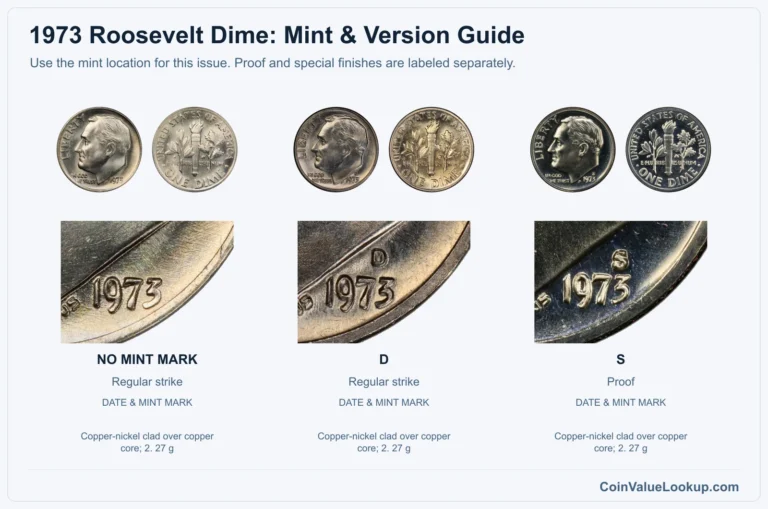
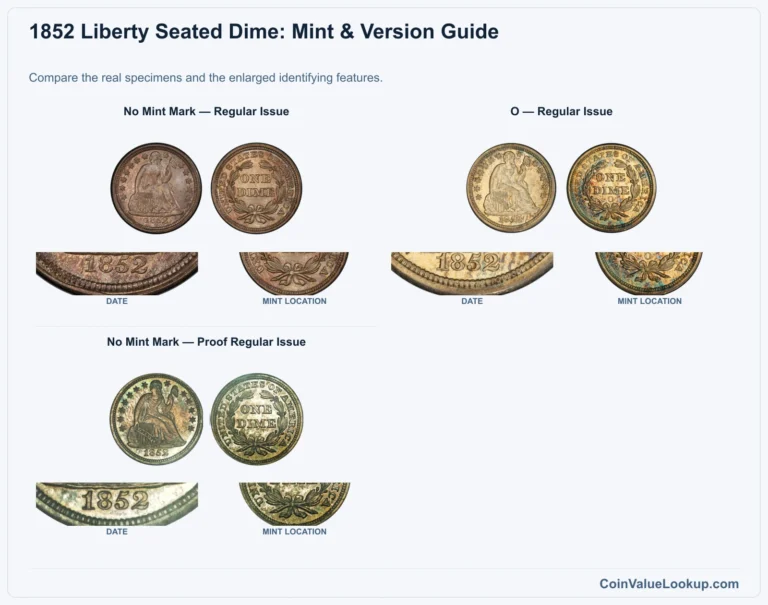
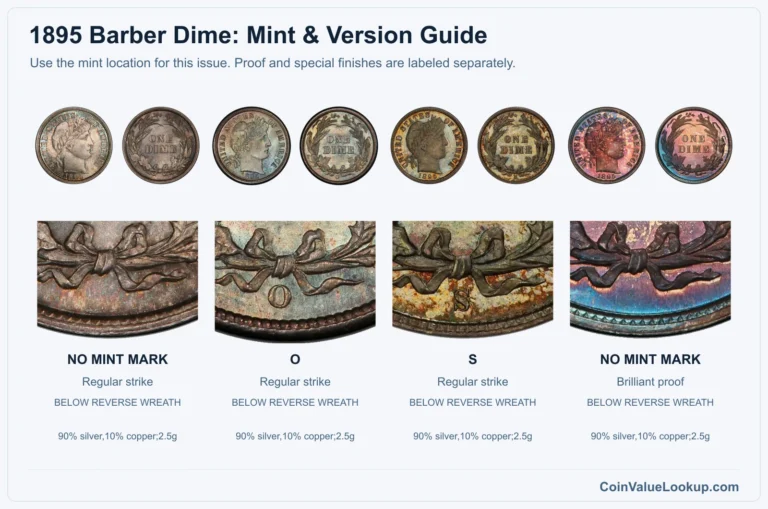
The 1916 Barber Dime comes in two business-strike mints: Philadelphia (no mintmark) and San Francisco (S). There was no Denver Barber Dime this year and no proof issue.
Guide estimates for ordinary circulation strikes range from about $10.42 at G4 to $253 at MS63, depending on mint and condition. Coins with original, unworn surfaces command the strongest premiums in this series.
Fast Way to Identify Your 1916 Barber Dime
Want a quick read on your 1916 Barber Dime? Upload clear photos of both the front and back of your coin.
Our identifier can help with preliminary identification of your mint version and surface condition. Sharp, well-lit images showing the full coin, including the area below the wreath on the reverse, give the best results.
1916 Barber Dime Value
Upload both sides of your 1916 Barber Dime.
Front Obverse
Upload photo
Back Reverse
Upload photo
Which 1916 Barber Dime Versions Are Worth Money?
- Philadelphia and San Francisco are the only Barber Dime mints for 1916 — check for the S mintmark below the reverse wreath bow.
- Unworn examples with original luster carry the strongest premiums, with guide values reaching around $253 at MS63.
- Certain error types such as broadstrikes and off-center strikes on 1916-S coins have been reported and can carry additional value depending on severity.
- Old damage, cleaning, or a weak factory strike does not automatically make a coin valuable — actual condition and originality matter most.
Step 1: Identify Your 1916 Barber Dime Mint Mark and Version
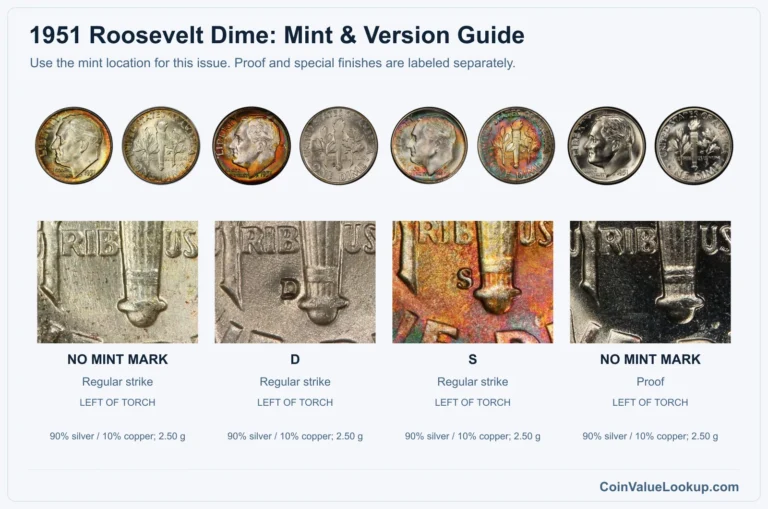
The 1916 Barber Dime features Charles Barber's Liberty portrait facing right on the obverse, with ONE DIME enclosed in a wreath on the reverse. Do not confuse it with the Mercury Dime, which is a completely different design also introduced in 1916 and covered on its own page.
Two mints produced Barber Dimes this year. Philadelphia coins carry no mintmark.
San Francisco coins display a small "S" below the wreath's bow on the reverse.
The coin is struck in 90% silver and 10% copper, weighs 2.5 grams, measures 17.9 mm in diameter, and has a reeded edge. These specs are standard for the entire Barber Dime series.
If your coin is magnetic or feels too light, something is off.
There is no 1916-D Barber Dime and no 1916 proof. If you think you have either, double-check the design type and mintmark carefully.
Step 2: Check Your 1916 Barber Dime Grade
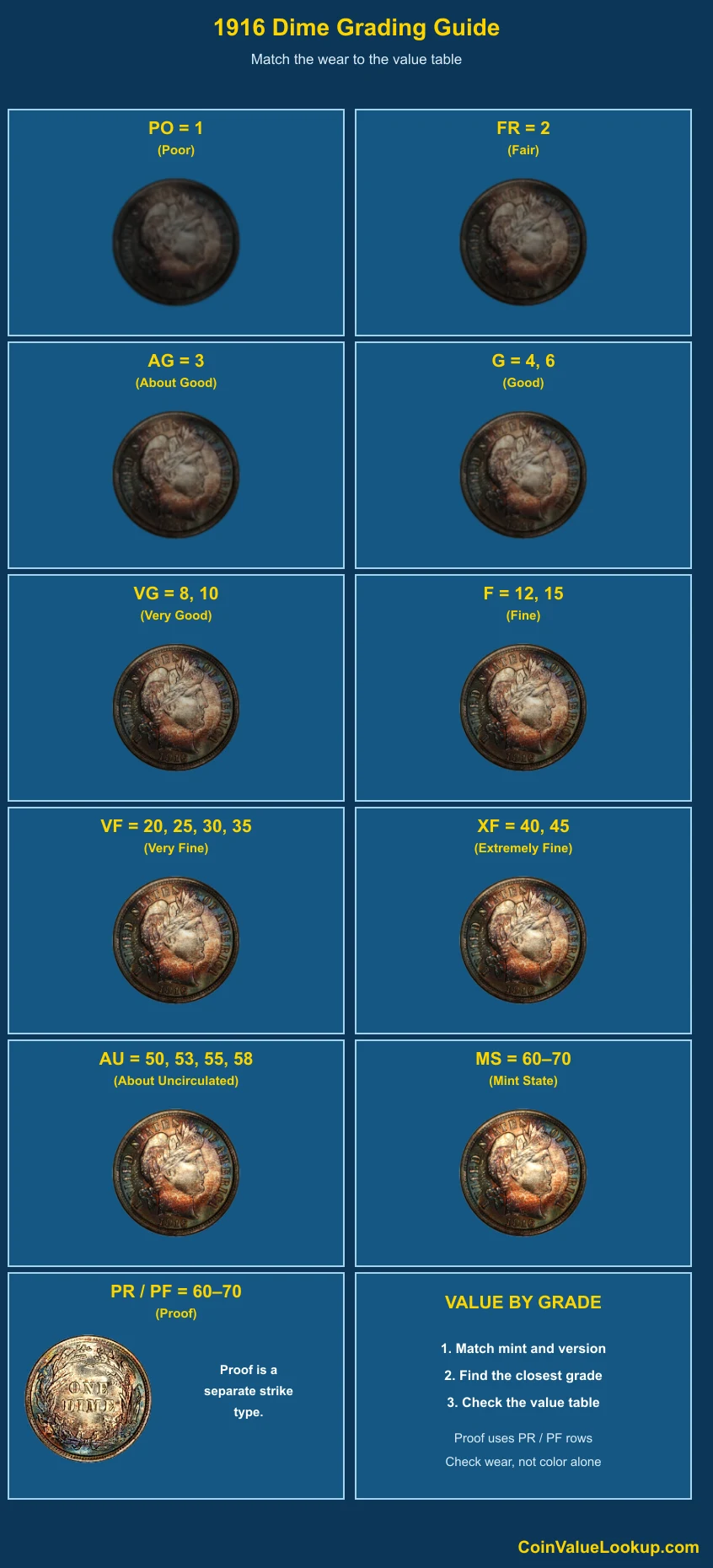
Grading a Barber Dime starts with the word LIBERTY on the headband. On a well-worn coin (around Good-4), LIBERTY is completely gone or barely traceable.
As condition improves, more letters become visible, but do not rely on letter count alone.
Check the hair above the forehead, the cheek, and the leaf details in the wreath. These areas wear first.
A coin grading Fine will show partial LIBERTY with some hair detail remaining, while Very Fine examples display a nearly complete headband inscription.
For Mint State, look for unbroken luster across the entire surface. Hairlines from cleaning or light friction on the cheek and high points of the hair will drop the grade.
Use the comparison image to match your coin's wear pattern against known examples.
Be aware that some coins, particularly from certain mints in the series, can have soft strikes from the factory. Weak detail on a high-grade coin is not the same as wear, so look at protected areas for luster before downgrading.
Step 3: Check 1916 Barber Dime Value by Mint and Version
1916 Barber Dime — No Mint Mark — Silver Circulation
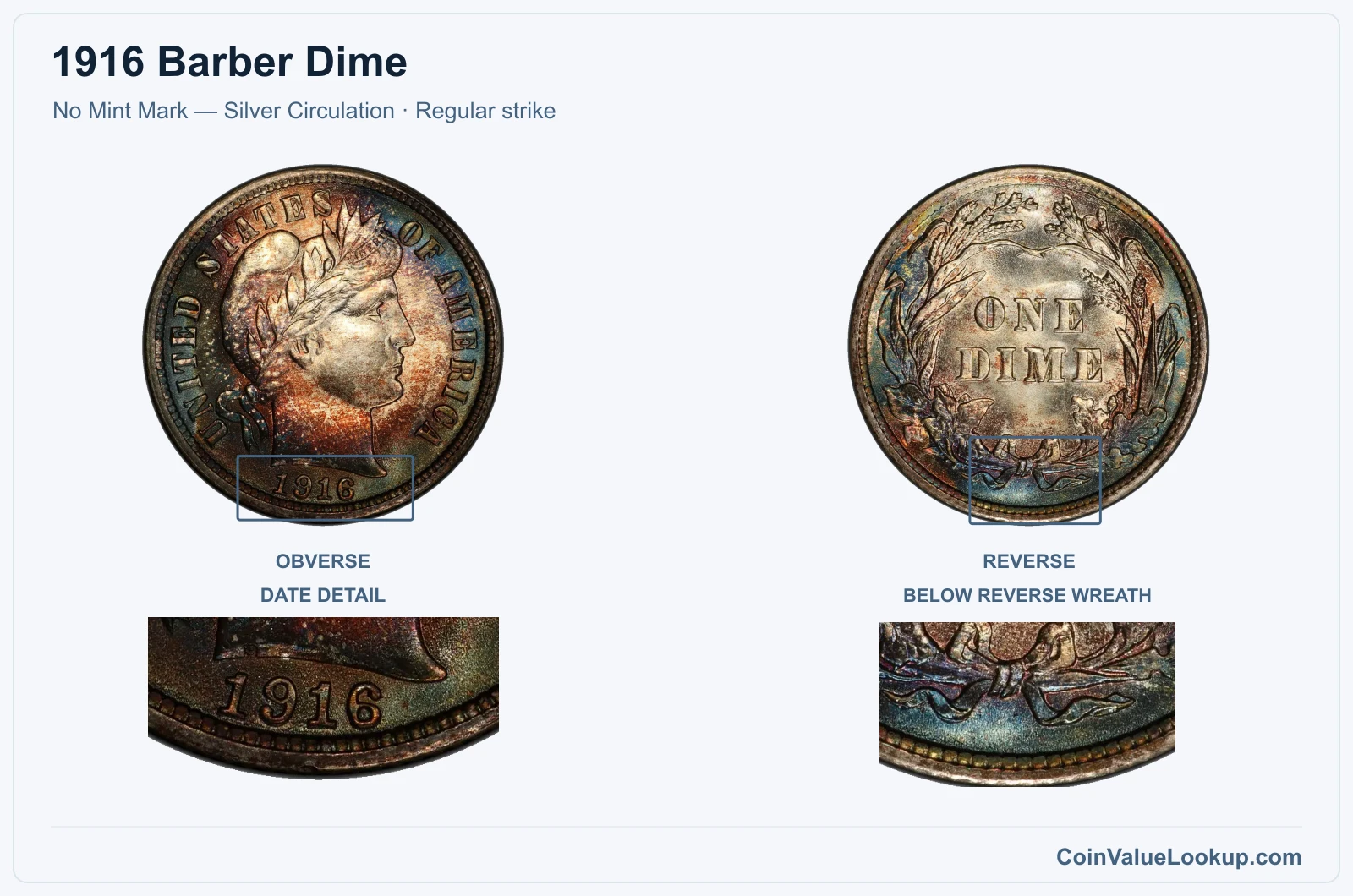
The 1916 Philadelphia Barber Dime has no mintmark. Look at the reverse below the wreath bow — if the space is blank, you have the Philadelphia issue.
Guide estimates place this coin at about $10.42 in G4 (a heavily worn but identifiable example) and around $253 in MS63 (a coin with full mint luster and only minor contact marks). Most surviving examples are well circulated, so finding one with sharp detail and original surfaces takes some patience.
Coin Value Lookup is a good starting point if you want to compare this coin against other dates and mints in the Barber Dime series. You can look up guides across multiple denominations in one place.
Range Grade
Price Auction Records Appraisal PO PO 1
—
Coin Identifier FR FR 2
—
Coin Identifier AG AG 3
—
Coin Identifier G G 4
—
Coin Identifier
G 6
—
Coin Identifier VG VG 8
—
Coin Identifier
VG 10
—
Coin Identifier F F 12
—
Coin Identifier
F 15
—
Coin Identifier VF VF 20
—
Coin Identifier
VF 25
Coin Identifier
VF 30
Coin Identifier
VF 35
Coin Identifier XF XF 40
Coin Identifier
XF 45
Coin Identifier AU AU 50
Coin Identifier
AU 53
Coin Identifier
AU 55
Coin Identifier
AU 58
Coin Identifier MS MS 60
Coin Identifier
MS 61
Coin Identifier
MS 62
Coin Identifier
MS 63
Coin Identifier
MS 64
Coin Identifier
MS 65
Coin Identifier
MS 66
Coin Identifier
MS 67
Coin Identifier
MS 68
—
—
—
MS 69
—
—
—
MS 70
—
—
—
1916 Barber Dime — S — Silver Circulation
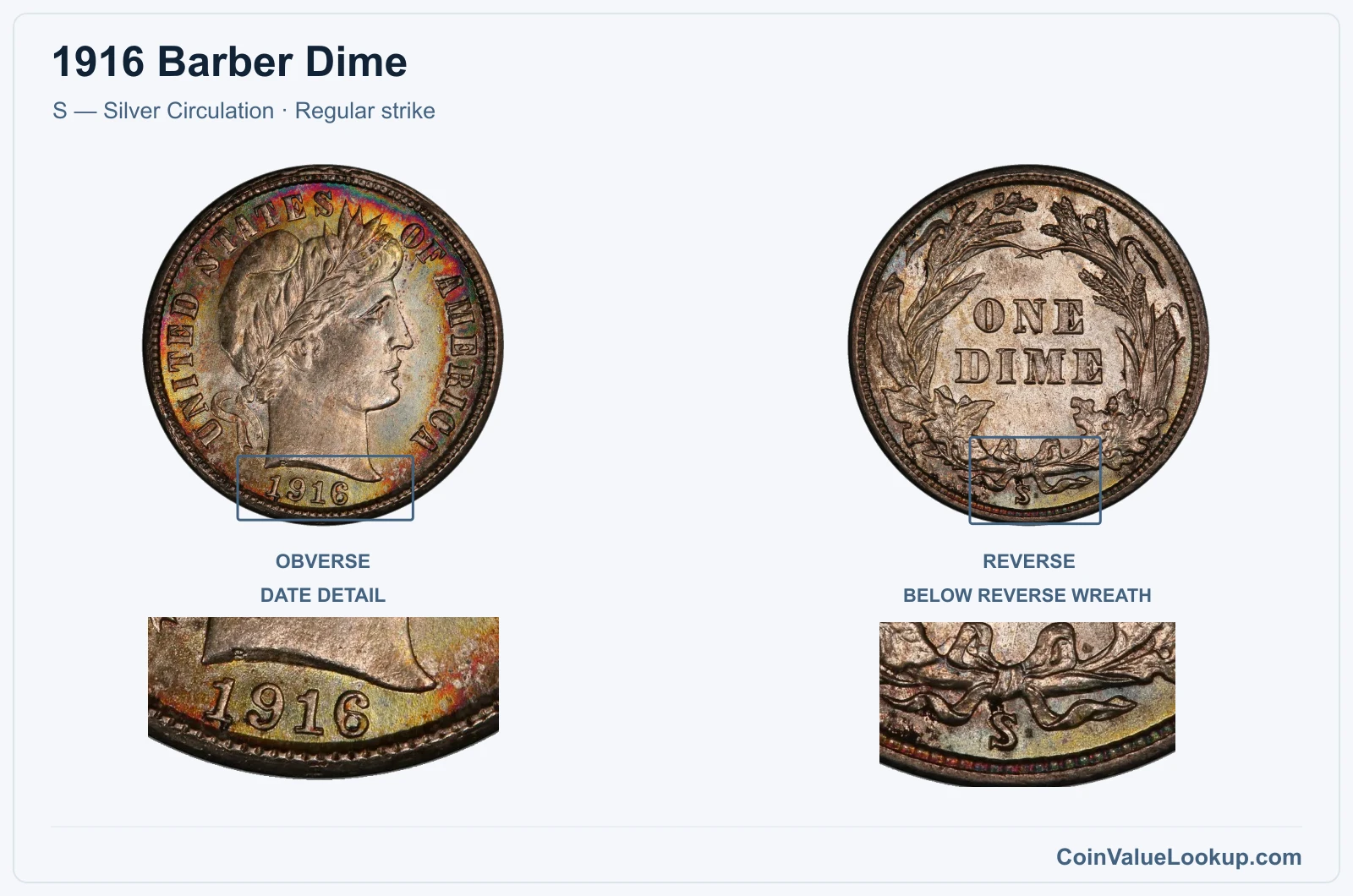
The 1916-S Barber Dime carries a small "S" mintmark positioned below the bow at the base of the reverse wreath. Grab a loupe or magnifying glass if you are having trouble spotting it — a century of wear can make small mintmarks hard to read.
Guide estimates for this San Francisco issue run about $10.42 at G4 and around $253 at MS63. These figures are retail guide snapshots and not guaranteed sale prices.
Your coin's actual value depends on its specific condition, surface quality, and whether it has been cleaned or damaged.
San Francisco Barber Dimes from this era can sometimes show softer strikes than their Philadelphia counterparts, so compare carefully against known examples before assuming wear.
Range Grade
Price Auction Records Appraisal PO PO 1
—
Coin Identifier FR FR 2
—
Coin Identifier AG AG 3
—
Coin Identifier G G 4
—
Coin Identifier
G 6
—
Coin Identifier VG VG 8
—
Coin Identifier
VG 10
—
Coin Identifier F F 12
—
Coin Identifier
F 15
—
Coin Identifier VF VF 20
—
Coin Identifier
VF 25
—
Coin Identifier
VF 30
—
Coin Identifier
VF 35
—
Coin Identifier XF XF 40
—
Coin Identifier
XF 45
—
Coin Identifier AU AU 50
Coin Identifier
AU 53
Coin Identifier
AU 55
Coin Identifier
AU 58
Coin Identifier MS MS 60
—
Coin Identifier
MS 61
Coin Identifier
MS 62
Coin Identifier
MS 63
Coin Identifier
MS 64
Coin Identifier
MS 65
Coin Identifier
MS 66
Coin Identifier
MS 67
Coin Identifier
MS 68
—
—
—
MS 69
—
—
—
MS 70
—
—
—
1916 Barber Dime Error List
1. 1916 Barber Dime — Broadstrike
A broadstrike happens when the coin is struck without the normal collar die that constrains the planchet. The result is a coin with outward metal spread — it looks slightly larger than normal, and the rim may be weak or missing entirely while the full design is still present.
This error has been reported on the 1916-S Barber Dime specifically. At least one example has been certified by NGC in high grade.
To identify a broadstrike, check the edge profile and overall diameter against a normal coin. The design should be complete but the edge will look wrong.
Do not confuse a broadstrike with an off-center strike (which shifts the design) or with a coin that was simply flattened after leaving the mint. Post-mint damage typically shows uneven distortion and tooling marks rather than the uniform spread of a genuine broadstrike.
Value depends on the severity of the error, the coin's condition, and how clearly the date and mintmark remain visible.
2. 1916 Barber Dime — Off-Center Strike
An off-center strike occurs when the planchet is not properly seated between the dies, producing a shifted design with an unstruck crescent of blank metal on one side. The more dramatic the shift, the more obvious the error — but the date needs to remain visible for a coin to hold strong collector interest.
This error type has been reported for the 1916 Barber Dime. Look for a clearly displaced design paired with a blank area that follows a smooth arc.
The unstruck portion will have the original planchet surface texture.
Do not mistake a clipped planchet (a straight or curved cut in the blank before striking) or post-mint flattening for an off-center error. A clipped coin retains the full design impression; a flattened coin shows irregular damage.
Genuine off-center strikes have a clean, consistent shift. Value depends on the percentage off-center, whether the date is readable, and overall condition.
3. 1916 Barber Dime — Die Crack / Die Chip
Die cracks appear as raised lines on the coin's surface, caused by fractures in the steel die during production. A die chip is a small raised blob where a piece of the die face broke away.
Both are transfer errors — the damage is in the die, not the coin itself.
This error type has been reported for the 1916-S Barber Dime specifically, not the Mercury design that also debuted that year. When examining your coin, look for thin raised lines that may connect to the rim or small raised lumps in the field or on the design elements.
A larger die break connecting to the rim is sometimes called a cud.
Do not confuse die cracks with scratches, which are incuse (pressed into the surface) rather than raised. Corrosion or foreign material stuck to the surface can also mimic a chip.
Run a fingernail across the mark — a genuine die crack or chip will feel raised. Value varies by size, location, and the coin's overall condition.
4. 1916 Barber Dime — Struck-Through Error
A struck-through error occurs when foreign material — grease, metal shavings, thread, or another object — sits between the die and the planchet during striking. The result is a localized depression or incomplete area in the design where the obstruction blocked the die's impression.
This error has been reported for the 1916-S Barber Dime. Grease-filled dies tend to produce smooth, shallow depressions, while a retained foreign object can leave a distinct shape or texture imprint.
These two subtypes look quite different, so note what you see.
Ordinary wear, cleaning, or a weak strike can mimic struck-through errors to the untrained eye. The key difference is that a struck-through shows a defined area of missing or altered detail surrounded by normal striking.
Wear affects high points uniformly, and cleaning leaves directional hairlines. Value depends on the size and visibility of the obstruction impression plus the coin's overall condition.