1916 Standing Liberty Quarter Coin Value: How Much Is It Worth?
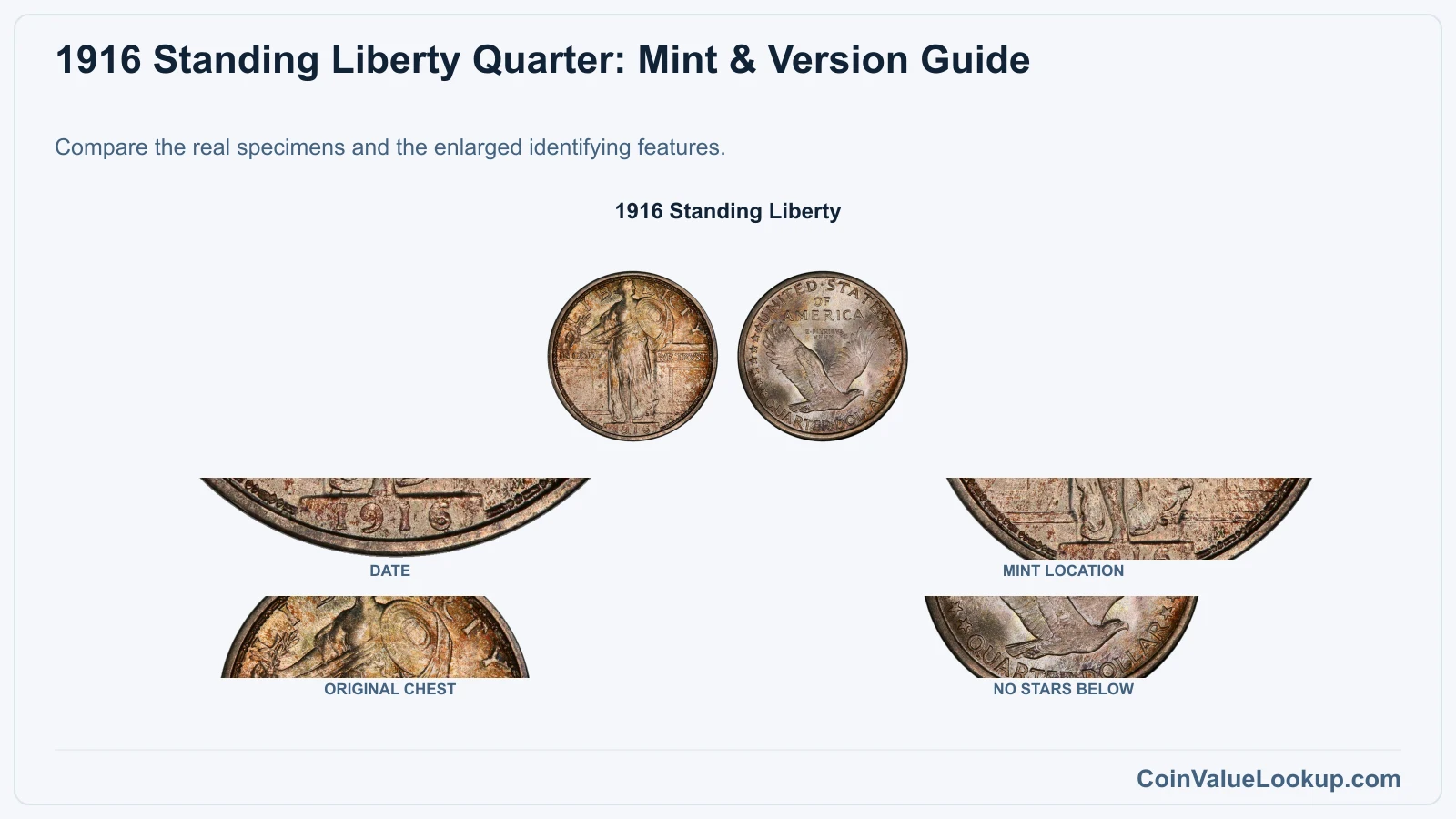
The 1916 Standing Liberty Quarter is one of the most iconic first-year issues in American numismatics. Only 52,000 were struck at the Philadelphia Mint, making it a genuine key date.
Guide estimates from USA Coin Book range from about $4,079 in Good-4 condition to $18,712 at MS63, depending on the coin's preservation and strike quality. Mint, condition, and design type all determine where a specific coin falls within that guide.
Fast Way to Identify Your 1916 Standing Liberty Quarter
Want a quick read on your 1916 quarter? Upload clear photos of both the front and back, and our identifier can provide a preliminary look at what you have.
This step helps narrow down the version, surface condition, and any obvious features before you pursue a professional opinion. Sharp, well-lit images make all the difference.
1916 Standing Liberty Quarter Value
Upload both sides of your 1916 Standing Liberty Quarter.
Front Obverse
Upload photo
Back Reverse
Upload photo
Which 1916 Standing Liberty Quarter Versions Are Worth Money?
- 1916 Standing Liberty Quarter (Philadelphia, no mintmark): USA Coin Book guide estimates reach $18,712 at MS63, with even a well-worn Good-4 example listed around $4,079 due to the extremely low mintage.
- Always confirm the mint and finish first. Damage, heavy wear, or a cleaned surface does not make a coin rare, and those conditions can sharply reduce what a buyer will pay.
Step 1: Identify Your 1916 Standing Liberty Quarter Mint Mark and Version
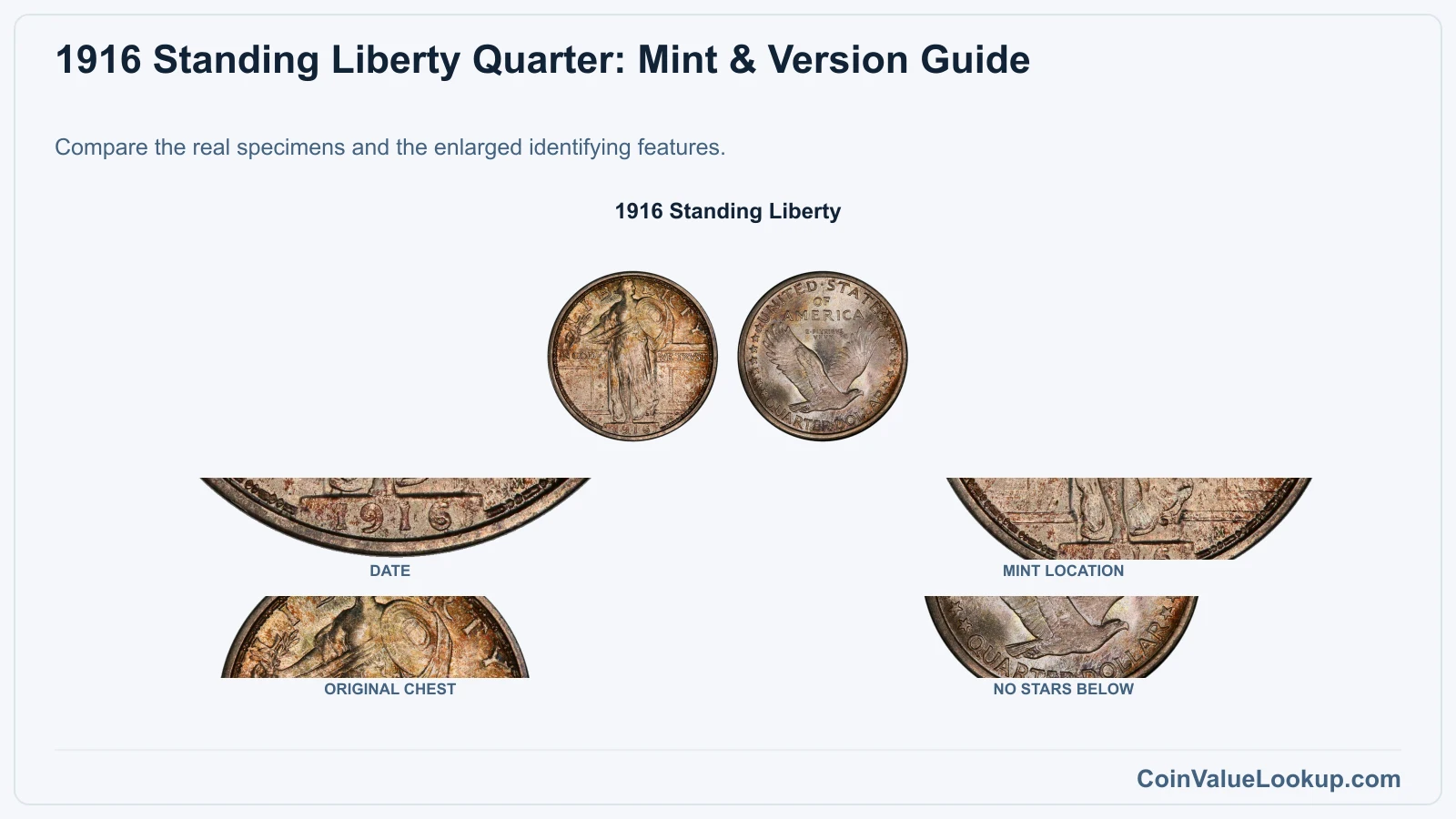
The 1916 Standing Liberty Quarter was struck only at Philadelphia, so there is no mintmark. On later dates in the series, a D or S mintmark appears beside Liberty near the left base of the wall on the obverse, but you will not find one here.
The coin is composed of 90% silver and 10% copper, weighing 6.25 grams. If your piece feels unusually light or does not respond to a silver test, that is a red flag worth investigating.
Design-wise, the 1916 falls under the Type I classification. Type I shows Liberty with an exposed breast and no stars beneath the eagle on the reverse.
Type II, introduced later, features protective chain mail on Liberty and three stars below the eagle. If your coin has the mail-covered design, it is not a 1916.
The date on the 1916 is raised, not recessed. The recessed date was a change made in 1925 to improve wear resistance.
So a 1916 with a mushy or nearly gone date is showing honest wear, not a design flaw.
Step 2: Check Your 1916 Standing Liberty Quarter Grade
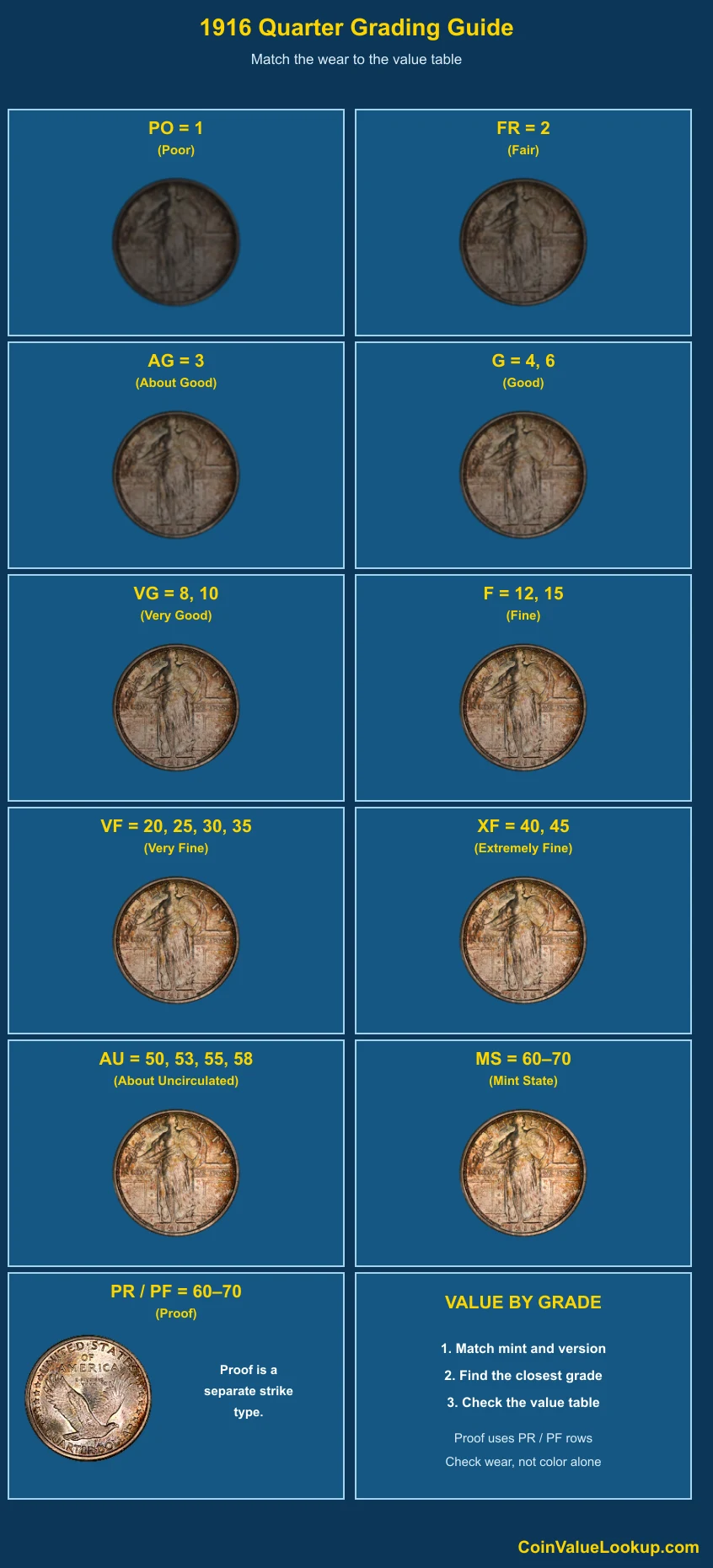
When grading a 1916 Standing Liberty Quarter, focus on Liberty's head, breast, shield, and knee on the obverse. On the reverse, check the eagle's breast feathers and wing tips.
These are the highest-relief areas and the first to show friction.
Compare your coin to the reference image. A coin in Good-4 will have a smooth, flat Liberty with most detail worn away but the outline still complete.
Move up to Mint State and you should see full luster with no wear on those high points.
Full Head is a designation you will see on certified examples. It refers to strike quality, meaning the three leaves in Liberty's hair are fully separated and sharp.
A weak strike can leave those details soft even on an unworn coin, so Full Head is not the same thing as a higher grade. Do not assume your coin is Full Head just because it looks bright or has minimal wear.
Cleaning matters here. A coin that has been harshly cleaned will show hairlines under magnification and may have an unnaturally shiny surface.
Original toning and luster are what experienced buyers look for, and a cleaned 1916 can sell for significantly less than one with natural surfaces.
Step 3: Check 1916 Standing Liberty Quarter Value by Mint and Version
1916 Standing Liberty Quarter — Standing Liberty
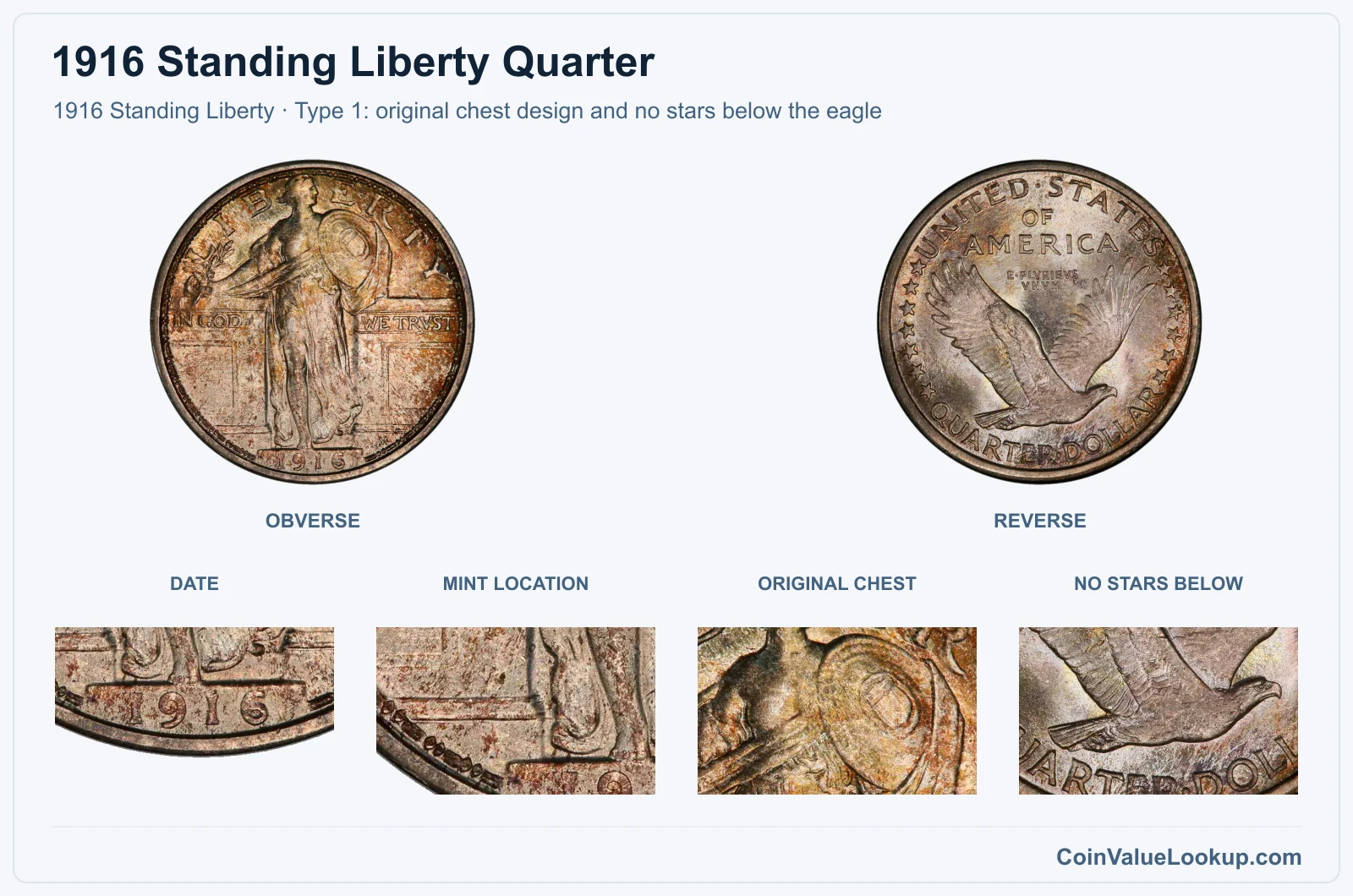
The 1916 Standing Liberty Quarter was struck only at Philadelphia with no mintmark. It uses the Type I design: Liberty stands with an exposed breast, and the reverse eagle has no stars beneath it.
The date is raised, consistent with all Standing Liberty Quarters before 1925.
USA Coin Book guide estimates place a Good-4 example at roughly $4,079, an MS60 around $15,667, and an MS63 at about $18,712. These are retail guide figures, not guaranteed sale prices.
With a total mintage of just 52,000, even heavily circulated survivors command strong money.
Before comparing your coin to these numbers, confirm original surfaces. Cleaning, polishing, or environmental damage will lower what collectors are willing to pay, sometimes dramatically.
Strike quality also matters: a sharply struck Full Head example in the same technical grade will typically outperform one with a mushy strike.
If you are exploring values for other dates and denominations, Coin Value Lookup is a useful starting point for finding coin guides organized by year and series.
Range Grade
Price Auction Records Appraisal PO PO 1
Coin Identifier FR FR 2
Coin Identifier AG AG 3
Coin Identifier G G 4
Coin Identifier
G 6
Coin Identifier VG VG 8
Coin Identifier
VG 10
Coin Identifier F F 12
Coin Identifier
F 15
Coin Identifier VF VF 20
Coin Identifier
VF 25
Coin Identifier
VF 30
Coin Identifier
VF 35
Coin Identifier XF XF 40
Coin Identifier
XF 45
Coin Identifier AU AU 50
Coin Identifier
AU 53
Coin Identifier
AU 55
Coin Identifier
AU 58
Coin Identifier MS MS 60
Coin Identifier
MS 61
Coin Identifier
MS 62
Coin Identifier
MS 63
Coin Identifier
MS 64
Coin Identifier
MS 65
Coin Identifier
MS 66
Coin Identifier
MS 67
Coin Identifier
MS 68
—
—
—
MS 69
—
—
—
MS 70
—
—
—
1916 Standing Liberty Quarter Error List
1. 1916 Standing Liberty Quarter — Doubled Die
A doubled die error on a 1916 Standing Liberty Quarter would show consistent doubling of design elements, most visibly on Liberty's face, lettering, or date. The doubling results from a misaligned impression during die production, so it appears uniform across affected areas rather than random or shelf-like.
To check, compare your coin's features side by side with a normal 1916 quarter under magnification. Look for separation, notching, or thickened lines on raised elements.
The doubling should appear in the same direction on every affected detail.
Be careful not to confuse this with machine doubling, which produces flat, shelf-like displacement without the sharp secondary image of a true doubled die. Reflections under certain lighting can also mimic doubling to the naked eye.
No specific price data is available for this error on the 1916, as condition, the strength of the doubling, and professional authentication all influence what a given example would bring.
2. 1916 Standing Liberty Quarter — Off-Center Strike
An off-center strike on a 1916 Standing Liberty Quarter occurs when the blank is not properly seated between the dies during striking. The result is a displaced design with an unstruck crescent of blank metal along one edge.
The key diagnostic is that the design shifts uniformly in one direction. If the date is still visible, the coin becomes considerably more collectible than one where the date has shifted off the planchet entirely.
Do not confuse an off-center strike with a clipped planchet, which produces a curved bite out of the edge rather than a shifted design. Post-mint flattening from damage can also make a coin look irregular, but the design will appear distorted rather than cleanly displaced.
No adopted price range exists for this error on the 1916 quarter. The degree of off-center shift, date visibility, and overall condition all factor into what a collector would pay for a confirmed example.
3. 1916 Standing Liberty Quarter — Broadstrike
A broadstrike happens when a coin is struck outside its retaining collar, allowing metal to spread outward beyond the normal diameter. On a 1916 Standing Liberty Quarter, you would see a slightly larger than normal coin with a complete or nearly complete design but no reeded edge.
The edge profile is the quickest diagnostic. A genuine broadstrike will have a smooth, expanded rim because the collar was not in place to form the reeds and contain the metal flow.
The design itself should still be centered or close to centered, which distinguishes a broadstrike from an off-center error.
Watch out for coins that were flattened after leaving the mint. Post-mint damage can spread the metal outward too, but the design will look smeared and distorted rather than cleanly impressed.
No specific price data is adopted for a 1916 broadstrike quarter. Value depends on the coin's condition, the extent of the spread, and professional verification of the error.