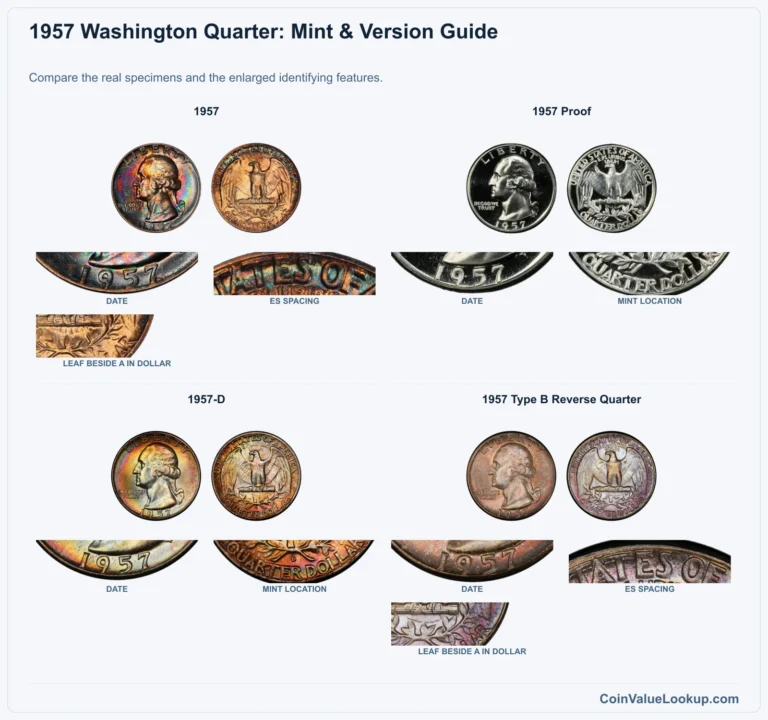
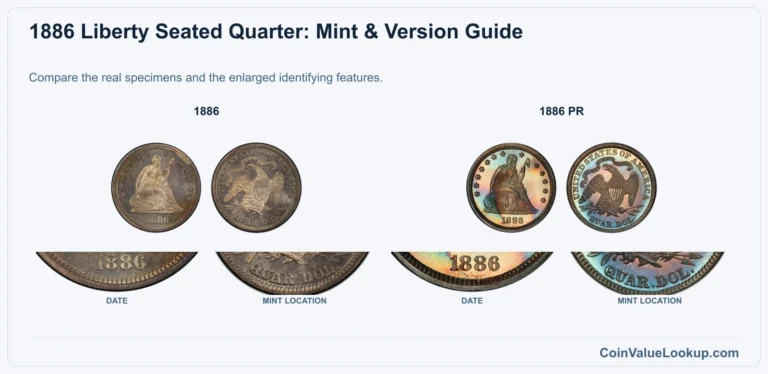
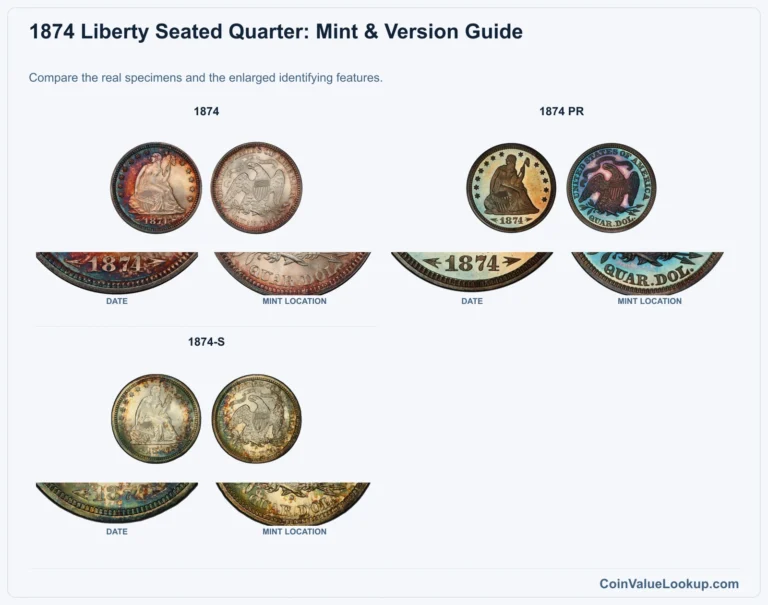
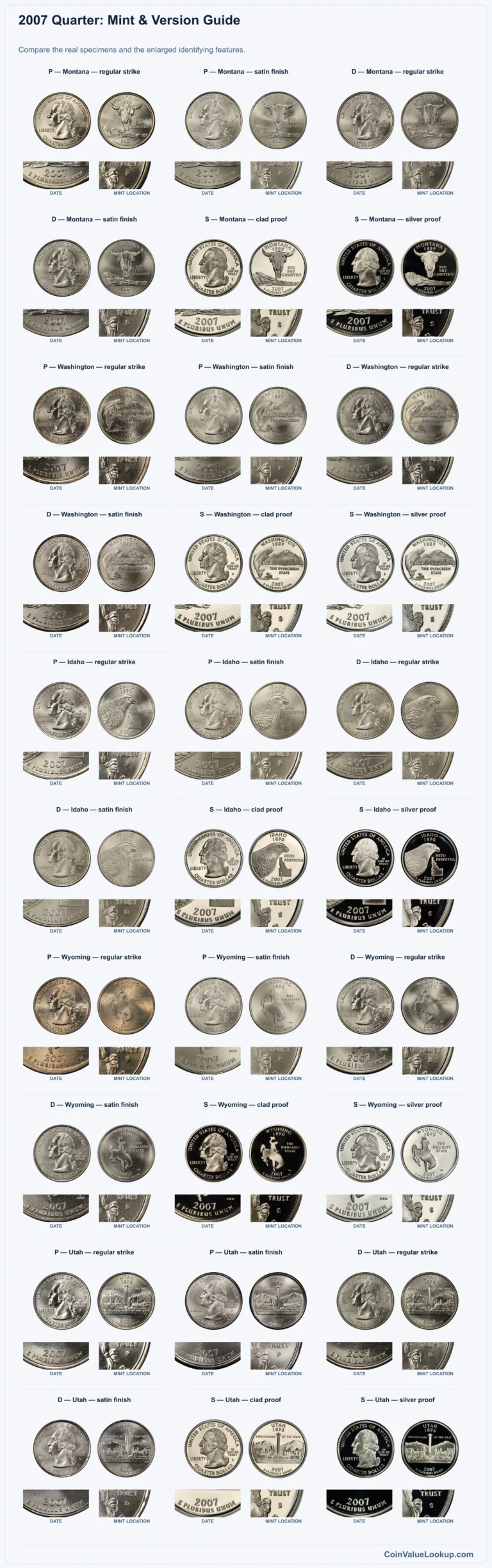
1928 Standing Liberty Quarter Coin Value: How Much Is It Worth?
The 1928 Standing Liberty quarter is a 90% silver coin that collectors sort by mint, condition and strike quality. Guide estimates from USA Coin Book range from about $17.23 in well-worn Good-4 condition up to $290.00 for an MS63 example, depending on the specific mint version.
That is not a single price for every coin — your mint, grade and surface quality determine where your quarter falls in that spread.
Fast Way to Identify Your 1928 Standing Liberty Quarter
Snap clear photos of both sides of your 1928 quarter and upload them here for a preliminary identification. We can help you spot the mintmark, check the design type and get a sense of condition.
Good lighting and a steady hand beat a blurry close-up every time. Front and back, please — one side alone leaves half the story untold.
1928 Standing Liberty Quarter Value
Upload both sides of your 1928 Standing Liberty Quarter.
Front Obverse
Upload photo
Back Reverse
Upload photo
Which 1928 Standing Liberty Quarter Versions Are Worth Money?
- 1928-S — USA Coin Book guide lists up to $290.00 at MS63; San Francisco coins are worth checking for strike quality and original surfaces.
- 1928-D — Also guided at $290.00 in MS63 by USA Coin Book; Denver quarters can vary in strike sharpness.
- 1928 (Philadelphia) — Matches the same $290.00 MS63 guide figure; no mintmark means Philadelphia.
- Check mint and finish first — damage, wear or a bright cleaned surface does not establish a rare version.
Step 1: Identify Your 1928 Standing Liberty Quarter Mint Mark and Version
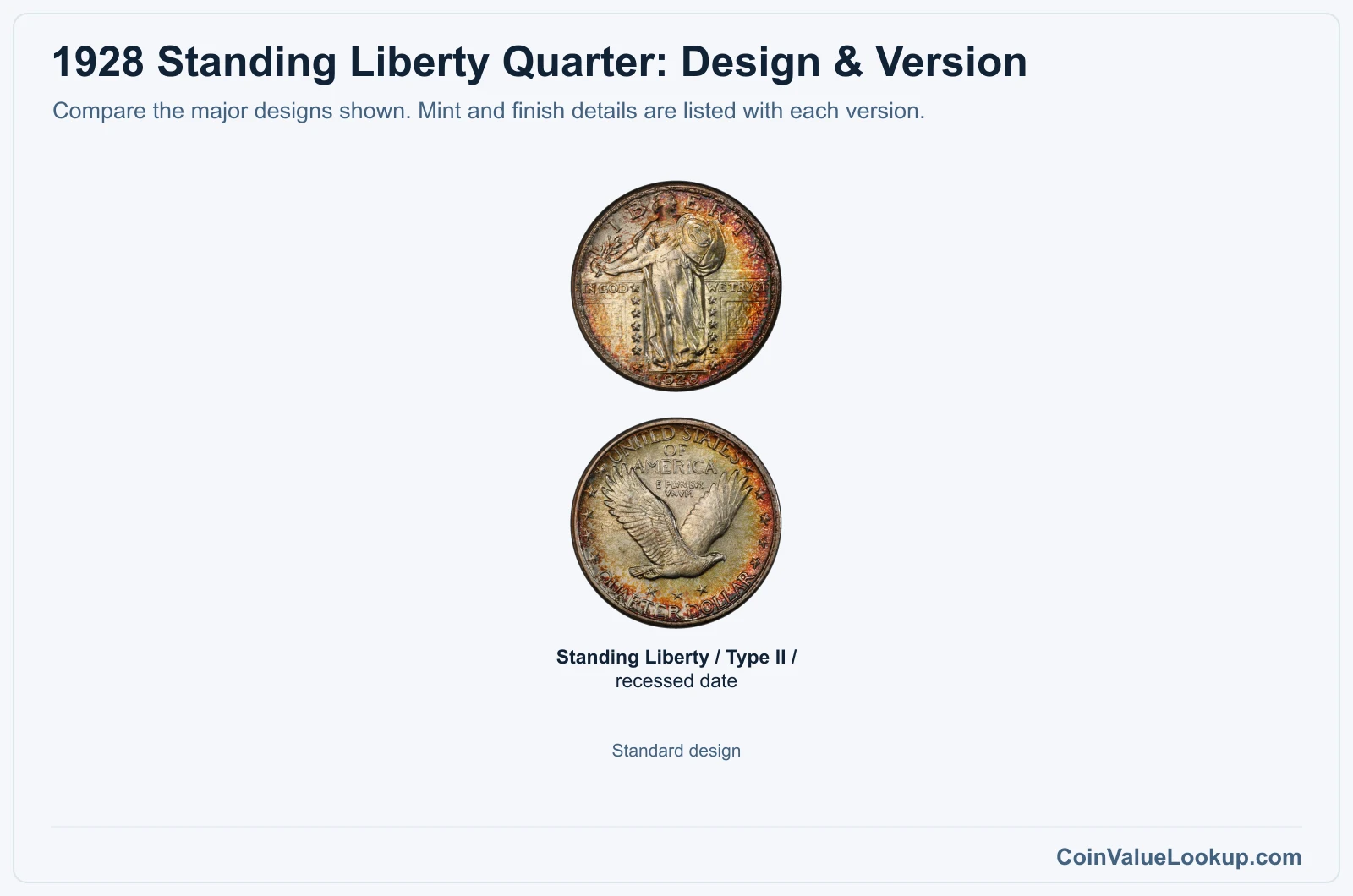
All three 1928 quarter versions use the Type II Standing Liberty design: Liberty wears protective chain mail on her chest, and three stars appear below the eagle on the reverse. The date is recessed into the coin, a change made starting in 1925 to reduce date wear.
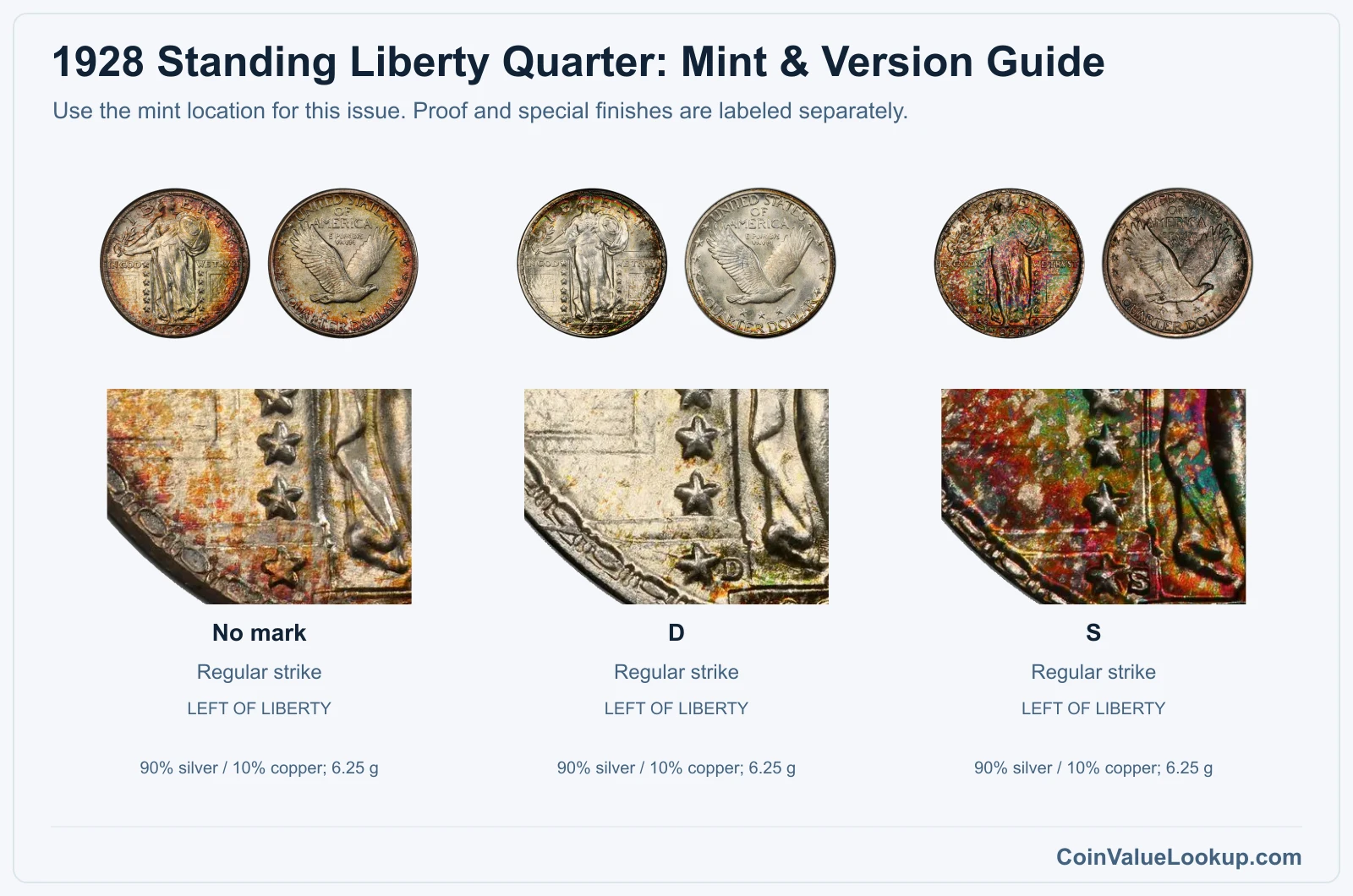
To find the mintmark, look at the obverse (front) near the left base of the wall where Liberty stands. A "D" means Denver, an "S" means San Francisco, and no letter at all means Philadelphia.
The coin weighs 6.25 grams and is struck in 90% silver with 10% copper.
Do not confuse Type I and Type II designs. Type I, used on earlier dates in the series, shows Liberty with an exposed breast and no stars beneath the eagle.
Every 1928 quarter is Type II.
Step 2: Check Your 1928 Standing Liberty Quarter Grade
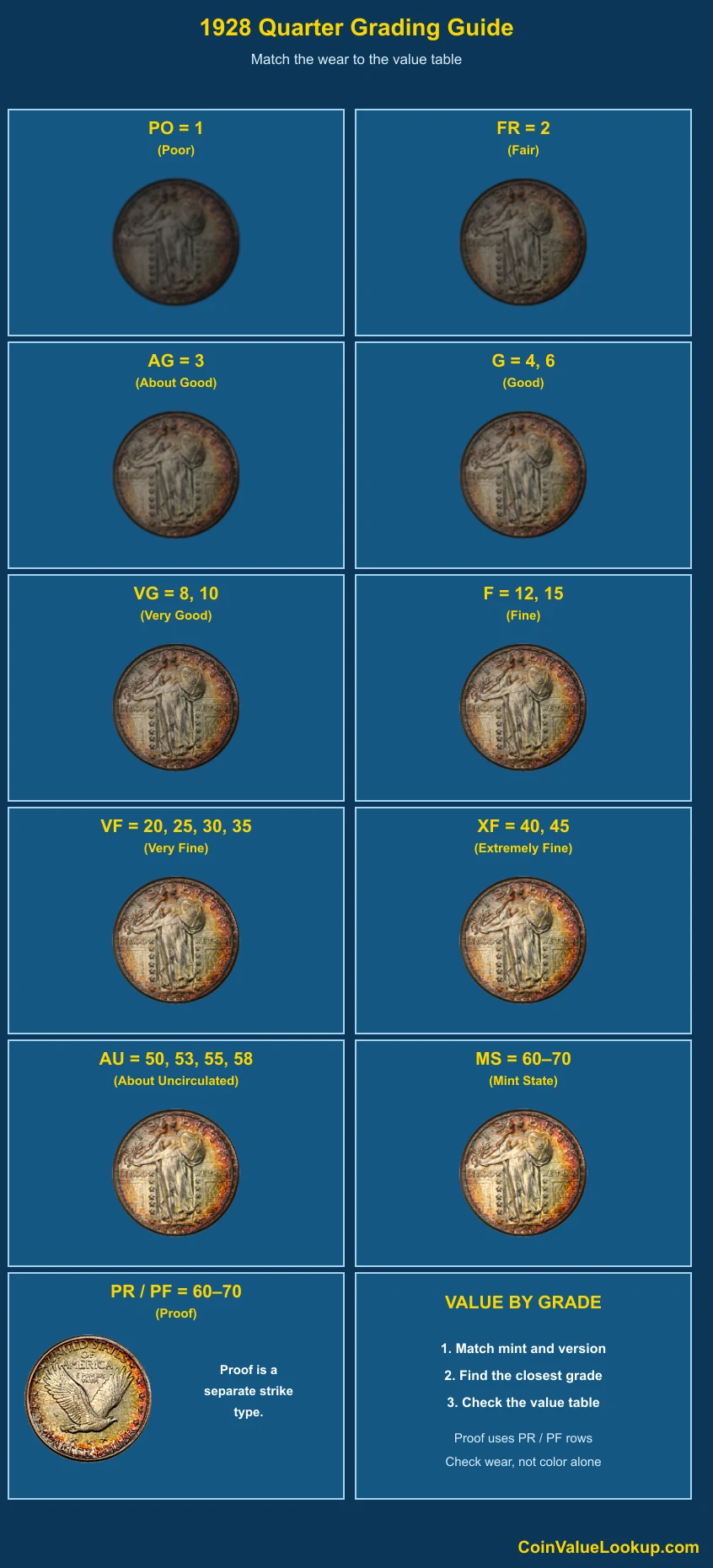
Start by checking Liberty's head, breast area, shield and knee on the obverse. On the reverse, look at the eagle's breast feathers and wing tips.
These are the first places to lose detail as a coin circulates.
A coin graded Good-4 will show a readable date and major outlines but most fine detail is gone. At MS60, the coin is uncirculated with full luster but may show contact marks or a weak strike.
MS63 adds better eye appeal with fewer marks.
The term "Full Head" refers to strike quality — whether Liberty's head shows complete hair detail, ear, and headband. It does not mean the coin is Mint State.
A weakly struck uncirculated coin can lack Full Head detail, while a firmly struck one displays it. Do not assume brightness or shininess equals a higher grade; cleaning removes original surfaces and typically lowers value.
Compare your coin to the grading image above, matching both wear and luster together for the best assessment.
Step 3: Check 1928 Standing Liberty Quarter Value by Mint and Version
1928 Standing Liberty Quarter
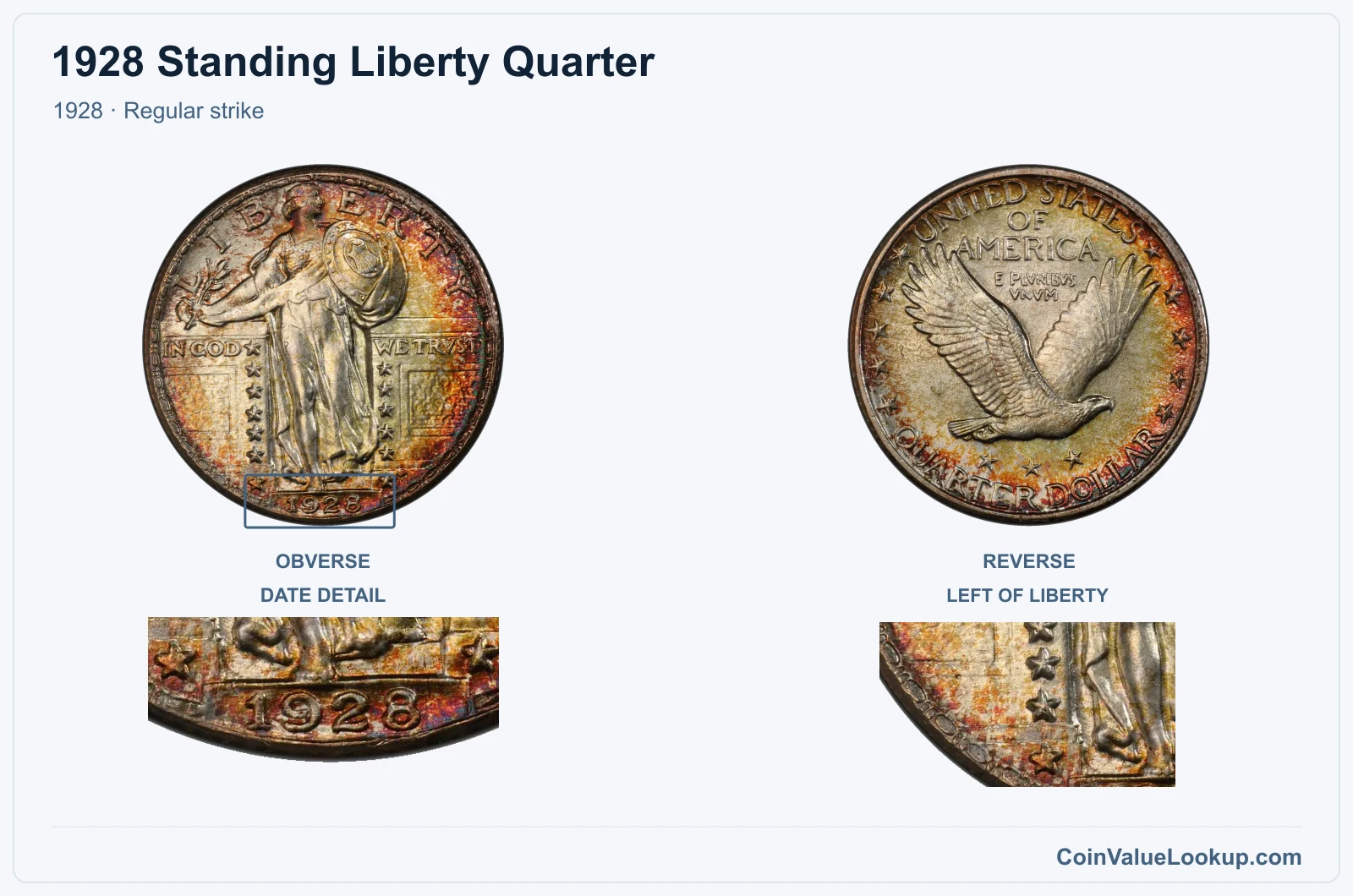
The 1928 Philadelphia quarter carries no mintmark. In well-circulated Good-4 condition, USA Coin Book estimates about $17.23.
Jump to MS60 and the guide rises to $171.00, then $290.00 at MS63. These are guide estimates, not guaranteed sale prices.
Before comparing values, confirm you have a Type II design with chain mail on Liberty and three stars below the eagle. Original, uncleared surfaces matter far more than raw shine.
A cleaned coin or one with visible damage will trade below these guide figures regardless of its wear level.
Coin Value Lookup is a good starting point if you want to look up guides for other dates and denominations in the Standing Liberty series.
Range Grade
Price Auction Records Appraisal PO PO 1
—
Coin Identifier FR FR 2
—
Coin Identifier AG AG 3
—
Coin Identifier G G 4
—
Coin Identifier
G 6
—
Coin Identifier VG VG 8
—
Coin Identifier
VG 10
—
Coin Identifier F F 12
—
Coin Identifier
F 15
—
Coin Identifier VF VF 20
—
Coin Identifier
VF 25
—
Coin Identifier
VF 30
Coin Identifier
VF 35
—
Coin Identifier XF XF 40
—
Coin Identifier
XF 45
Coin Identifier AU AU 50
Coin Identifier
AU 53
Coin Identifier
AU 55
Coin Identifier
AU 58
Coin Identifier MS MS 60
—
Coin Identifier
MS 61
—
Coin Identifier
MS 62
Coin Identifier
MS 63
Coin Identifier
MS 64
Coin Identifier
MS 65
Coin Identifier
MS 66
Coin Identifier
MS 67
Coin Identifier
MS 68
—
—
—
MS 69
—
—
—
MS 70
—
—
—
1928 Standing Liberty Quarter — D
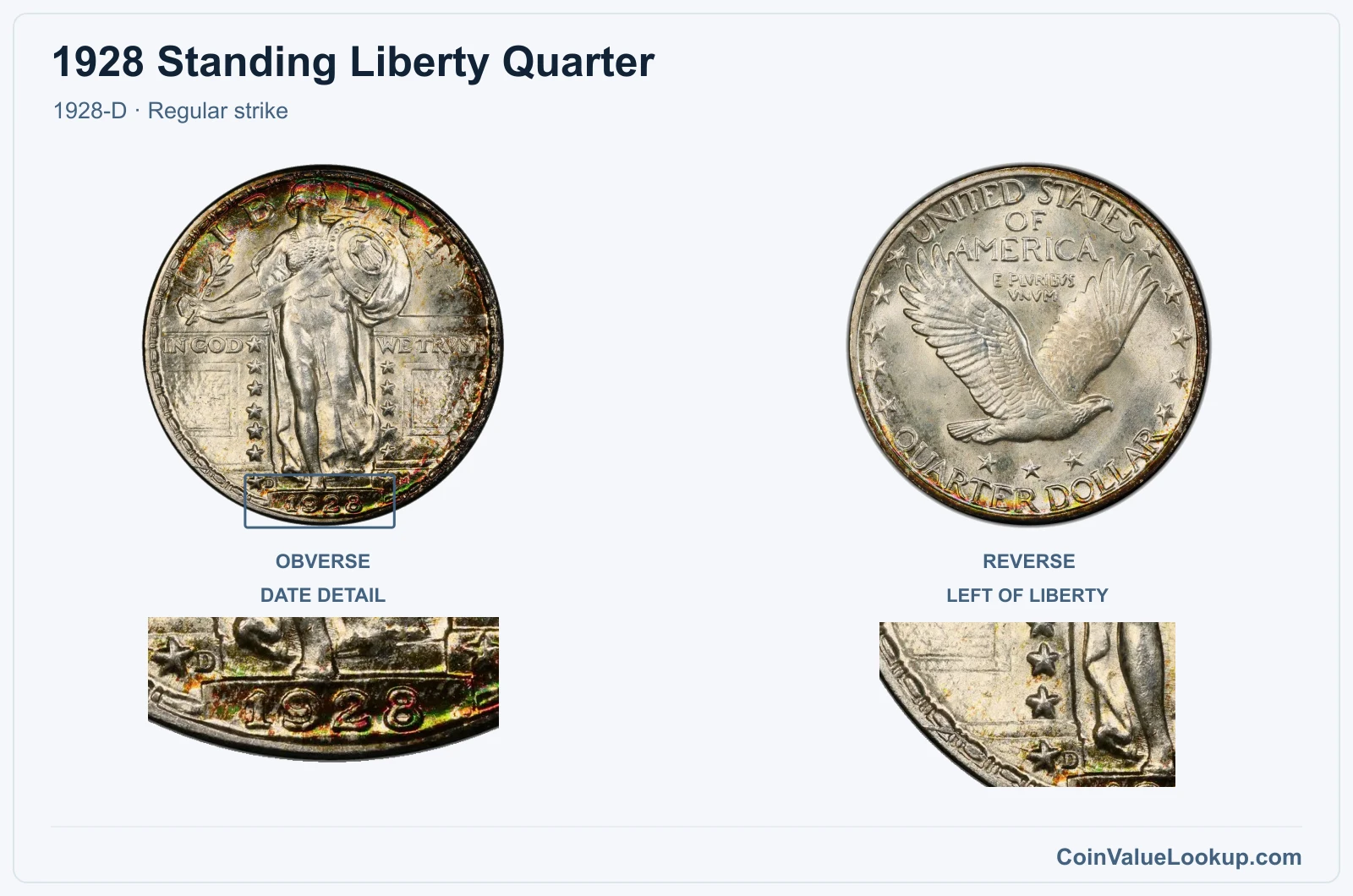
The 1928-D quarter shows a small "D" mintmark on the obverse near the base of the wall, to the left of Liberty's feet. USA Coin Book guides this version at $17.23 in Good-4, $171.00 at MS60 and $290.00 at MS63.
Denver strikes from this era can vary in sharpness, so do not assume a soft head detail means the coin saw heavy circulation. As with all Standing Liberty quarters, the recessed date on 1928 coins holds up better to wear than the raised dates on pre-1925 issues.
Cleaning or damage will pull the value below these guide figures, so original surfaces are what you want to confirm first.
Range Grade
Price Auction Records Appraisal PO PO 1
—
Coin Identifier FR FR 2
—
Coin Identifier AG AG 3
—
Coin Identifier G G 4
—
Coin Identifier
G 6
—
Coin Identifier VG VG 8
—
Coin Identifier
VG 10
—
Coin Identifier F F 12
—
Coin Identifier
F 15
—
Coin Identifier VF VF 20
—
Coin Identifier
VF 25
—
Coin Identifier
VF 30
—
Coin Identifier
VF 35
—
Coin Identifier XF XF 40
Coin Identifier
XF 45
Coin Identifier AU AU 50
Coin Identifier
AU 53
—
Coin Identifier
AU 55
Coin Identifier
AU 58
Coin Identifier MS MS 60
—
Coin Identifier
MS 61
Coin Identifier
MS 62
Coin Identifier
MS 63
Coin Identifier
MS 64
Coin Identifier
MS 65
Coin Identifier
MS 66
Coin Identifier
MS 67
Coin Identifier
MS 68
—
—
—
MS 69
—
—
—
MS 70
—
—
—
1928 Standing Liberty Quarter — S
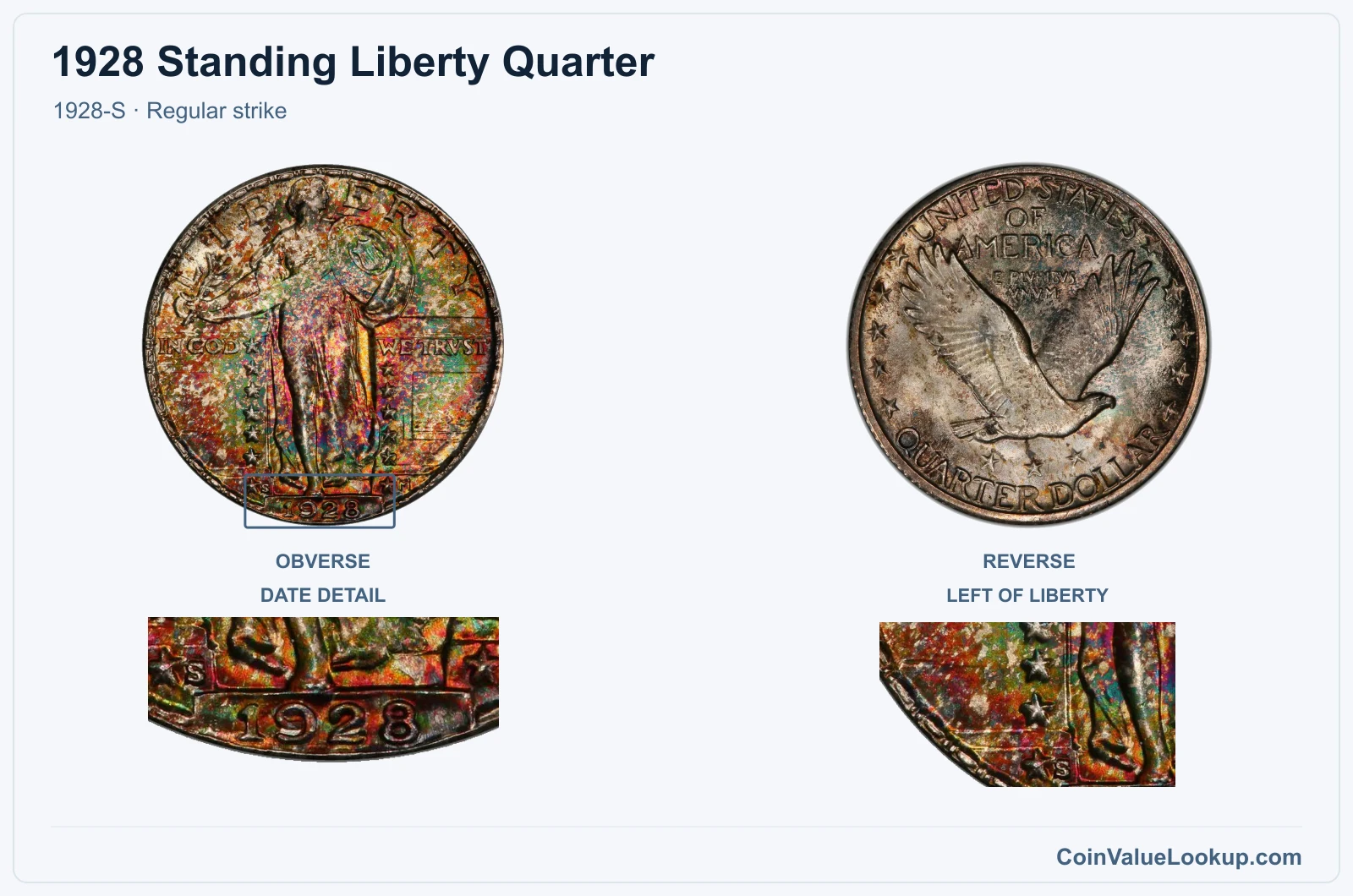
Look for a small "S" mintmark at the left base of the wall on the obverse to confirm a San Francisco strike. USA Coin Book estimates $17.23 at Good-4, stepping up to $171.00 at MS60 and $290.00 at MS63.
The 1928-S shares the Type II design with protective chain mail and three reverse stars beneath the eagle. Strike quality varies, and Full Head examples — those with complete hair, ear and headband definition — command collector attention because that detail depends on how firmly the dies struck the planchet, not just how little the coin circulated.
As always, original surfaces and honest wear beat a polished coin every time.
Range Grade
Price Auction Records Appraisal PO PO 1
—
Coin Identifier FR FR 2
—
Coin Identifier AG AG 3
—
Coin Identifier G G 4
—
Coin Identifier
G 6
—
Coin Identifier VG VG 8
—
Coin Identifier
VG 10
—
Coin Identifier F F 12
—
Coin Identifier
F 15
—
Coin Identifier VF VF 20
—
Coin Identifier
VF 25
—
Coin Identifier
VF 30
—
Coin Identifier
VF 35
—
Coin Identifier XF XF 40
—
Coin Identifier
XF 45
—
Coin Identifier AU AU 50
—
Coin Identifier
AU 53
—
Coin Identifier
AU 55
—
Coin Identifier
AU 58
Coin Identifier MS MS 60
Coin Identifier
MS 61
Coin Identifier
MS 62
Coin Identifier
MS 63
Coin Identifier
MS 64
Coin Identifier
MS 65
Coin Identifier
MS 66
Coin Identifier
MS 67
Coin Identifier
MS 68
Coin Identifier
MS 69
—
—
—
MS 70
—
—
—
1928 Standing Liberty Quarter Error List
1. 1928 Standing Liberty Quarter — Wrong Planchet / Off-Metal Strike
A wrong-planchet error occurs when a blank intended for a different denomination gets fed into the quarter press. One reported category for 1928 is a Standing Liberty quarter struck on a cent-sized planchet.
The result is a dramatically undersized coin with an incomplete design around the edges because the smaller blank cannot fill the quarter dies.
To check, compare your coin's weight, diameter and edge to a normal 1928 quarter (6.25 g, 24.3 mm). A genuine wrong-planchet strike will show consistent design elements that simply run off the edge of the undersized blank rather than looking filed down or altered.
Watch out for lookalikes: plating, corrosion, acid-treated coins or deliberate post-mint alterations can mimic an off-metal appearance. No specific price data is available here; value depends on the coin's condition, the visibility of the error and third-party verification.
2. 1928 Standing Liberty Quarter — Repunched Mintmark
A repunched mintmark happens when the mintmark punch is applied more than once in slightly different positions, leaving traces of the earlier impression. This category has been reported for the 1928-S Standing Liberty quarter specifically.
Look closely at the "S" near the base of the wall on the obverse. Under magnification, you may see a second partial letter offset from the primary mintmark — a ghost image, so to speak.
Compare your coin to a normal 1928-S at the same magnification to see whether the extra impression is genuinely die-made.
Do not confuse a repunched mintmark with machine doubling, which tends to look flat and shelf-like. Die chips or corrosion around the letter can also mimic an extra punch.
No adopted price is available for this variety; its value depends on condition, clarity of the repunching and collector demand.
3. 1928 Standing Liberty Quarter — Clashed Dies
Die clash marks appear when the obverse and reverse dies strike each other without a planchet between them, transferring ghostly traces of one design onto the opposite die. A reported variety for the 1928 quarter involves a clashed "E" — meaning part of a letter from the opposite die shows up where it should not be.
To spot it, look for faint raised design elements that do not belong on that side of the coin. These impressions should align with where the opposing die's features would sit during a normal strike, not at random angles.
Scratch marks, random raised lines or damage from a brockage can look similar at first glance but will not align consistently with the opposing design. No price data is adopted for this category; what a clashed-die quarter is worth depends on how visible the clash is, the coin's overall condition and collector interest.
4. 1928 Standing Liberty Quarter — Doubled Die
Doubled die varieties result from a misalignment during the die-making process, producing consistent doubling of design elements that shows on every coin struck by that die. This category has been reported for the Standing Liberty quarter series including 1928-dated coins.
Look for separation, notching or a second outline on design elements such as lettering, the date or Liberty's features. The doubling should be uniform across the affected area and appear on multiple coins from the same die — not random or one-sided.
Machine doubling is the most common lookalike. It produces flat, shelf-like distortion rather than the rounded, raised separation of a true doubled die.
Post-mint damage, reflections or contact marks can also fool the eye. No specific price data is adopted here; value depends on which die is involved, the strength of the doubling, and the coin's condition.