1920 Standing Liberty Quarter Coin Value: How Much Is It Worth?
The 1920 Standing Liberty quarter is a Type II design struck in 90% silver across three mints. Guide estimates from USA Coin Book range from $23.00 to $1,353.00 depending on mint, condition and strike quality.
That is not a single range for every coin — where yours falls depends on its specific mintmark, surface preservation and grade.
Fast Way to Identify Your 1920 Standing Liberty Quarter
Snap clear photos of both sides of your quarter and upload them here for a preliminary identification. Good lighting on the obverse mintmark area and the date is especially helpful.
This tool can help sort your coin into the right version and point you toward the correct guide range, though it is not a substitute for professional grading or authentication.
1920 Standing Liberty Quarter Value
Upload both sides of your 1920 Standing Liberty Quarter.
Front Obverse
Upload photo
Back Reverse
Upload photo
Which 1920 Standing Liberty Quarter Versions Are Worth Money?
- 1920-D quarter: USA Coin Book guide estimates reach $1,353.00 at MS63 — the Denver mint issue commands the highest premium in this year.
- 1920-S quarter: Guide estimates reach $938.00 at MS63, making the San Francisco coin the second-highest valued version.
- 1920 Philadelphia quarter: More available than the branch mints, with a guide estimate of $321.00 at MS63.
- Always confirm the mintmark and check for original, uncleaned surfaces before assuming a high value.
Step 1: Identify Your 1920 Standing Liberty Quarter Mint Mark and Version
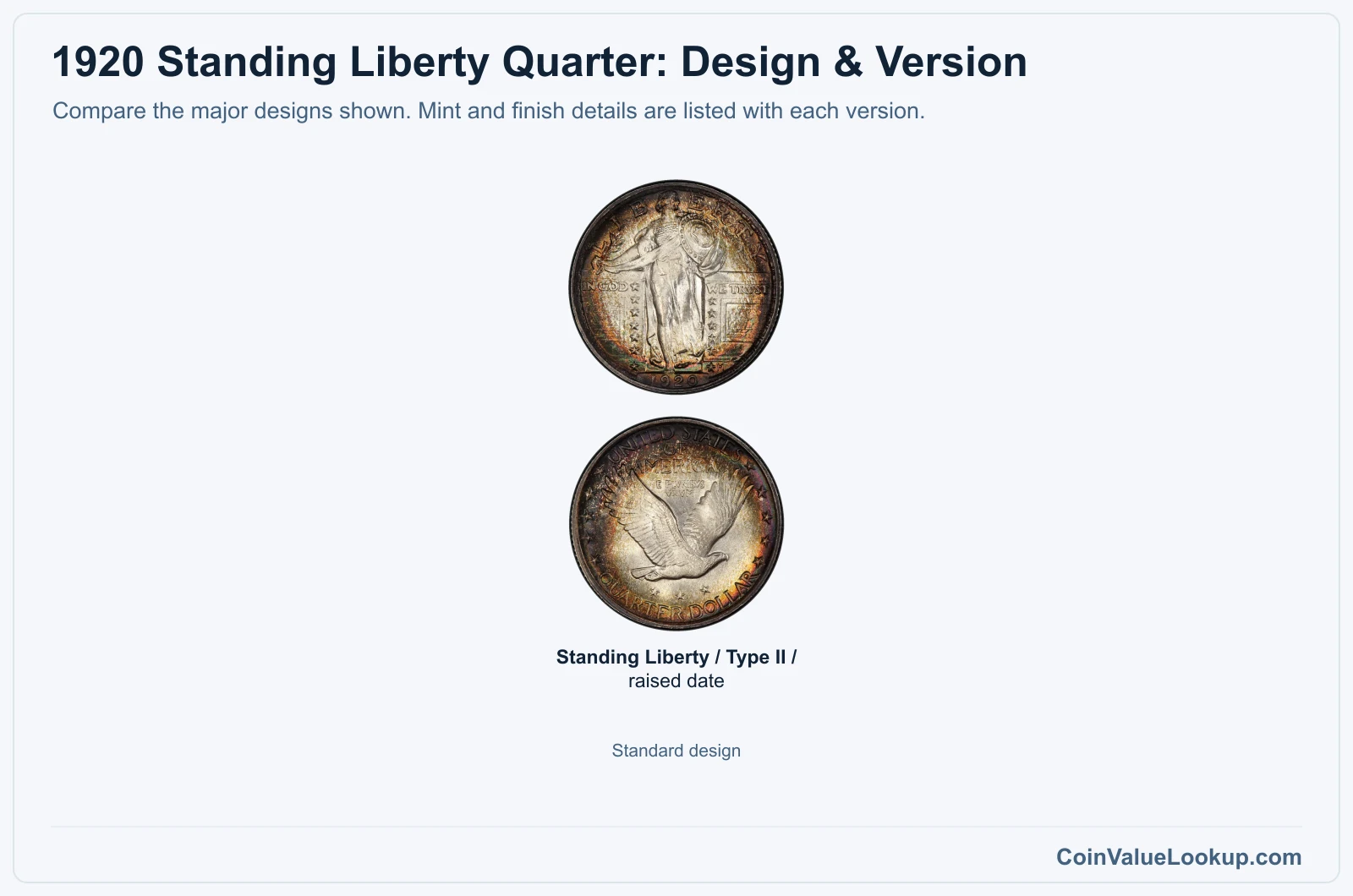
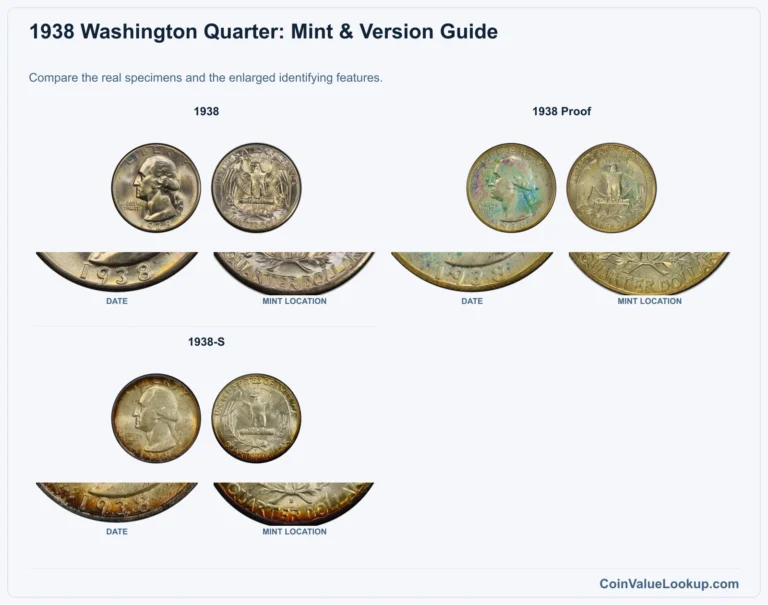
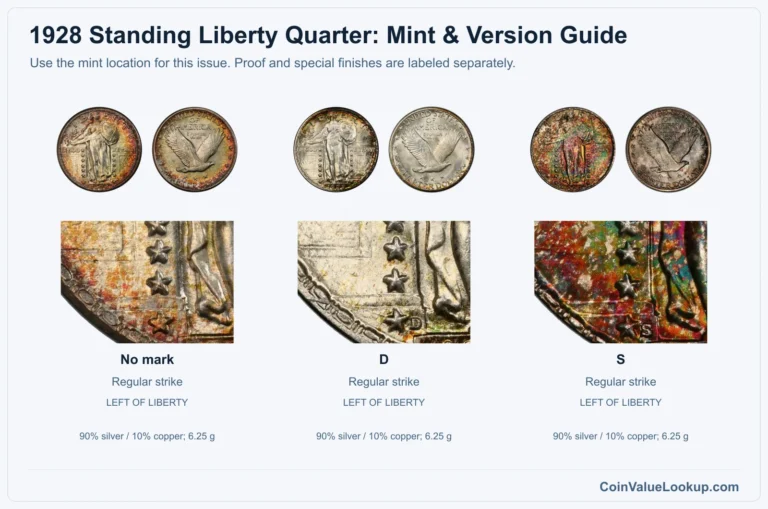
All three 1920 quarters use the Type II Standing Liberty design: Liberty wears protective chain mail on her breast, and three stars appear below the eagle on the reverse. The date is raised (the recessed-date change came in 1925).
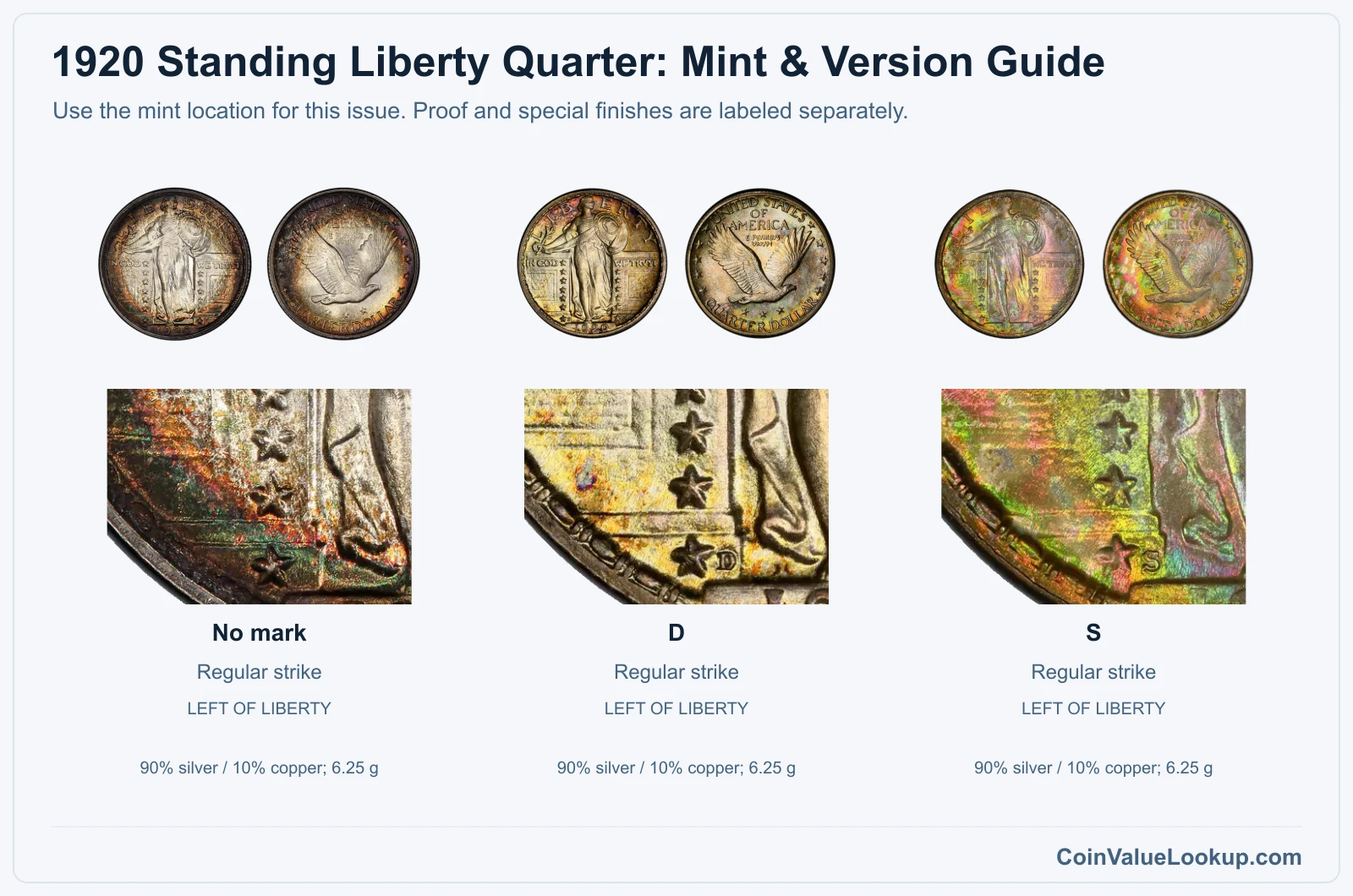
To find the mint, look at the obverse near the left base of the wall where Liberty stands. A "D" means Denver.
An "S" means San Francisco. No letter at all means Philadelphia.
The coin is 90% silver and 10% copper, weighing 6.25 grams. If your piece feels too light or the wrong color, that is a red flag worth investigating before you assume it is genuine.
Three branches exist for this year: 1920 (Philadelphia), 1920-D (Denver), and 1920-S (San Francisco). Match the mintmark first, then assess grade.
Do not confuse Type I quarters (exposed breast, no stars under the eagle) with the Type II design used in 1920.
Step 2: Check Your 1920 Standing Liberty Quarter Grade
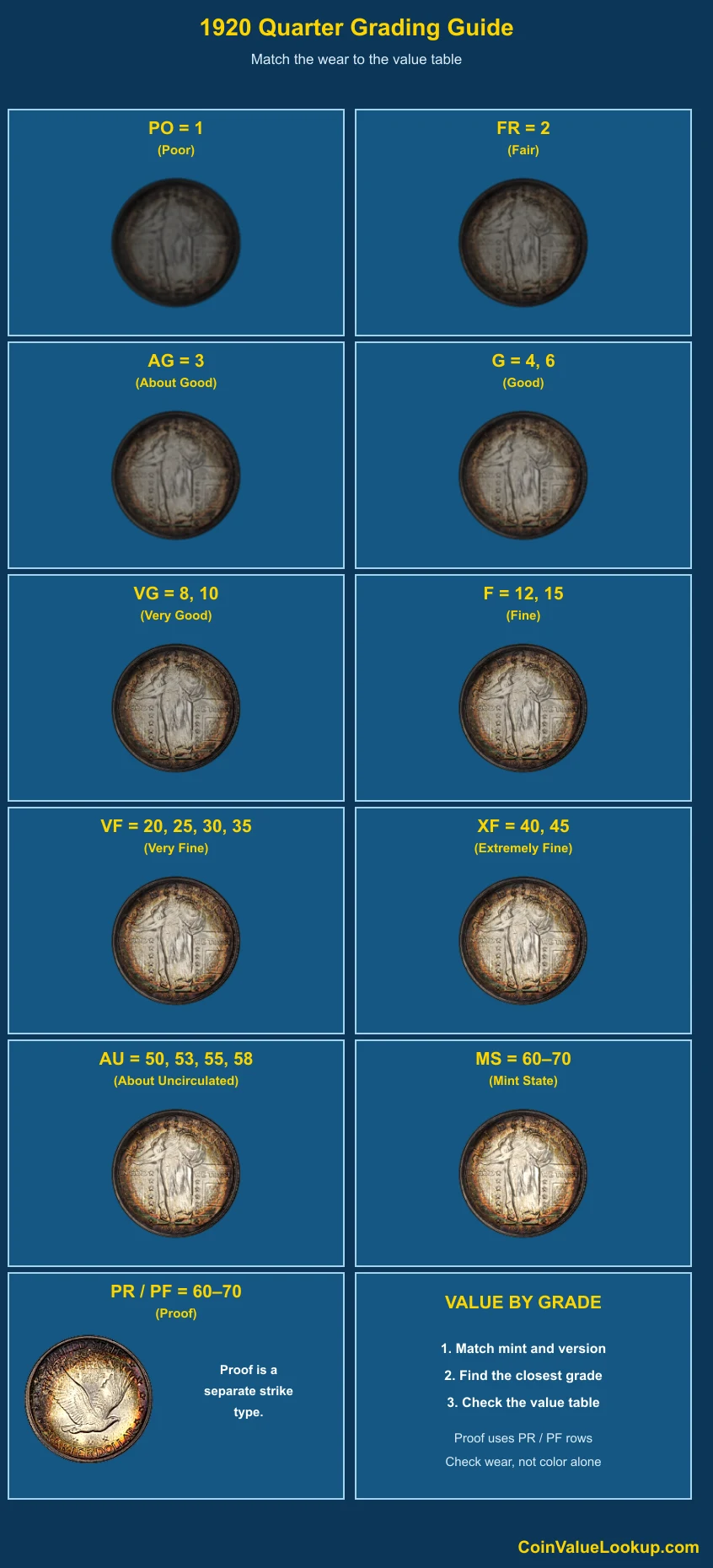
Focus on Liberty's head, breast area, shield and knee on the obverse. On the reverse, check the eagle's breast feathers and wing tips.
These high points wear first, so they tell you the most about grade.
Compare your coin to the reference image and look at both wear and luster together. A coin with full original shine but mushy head detail may be weakly struck, not heavily worn.
Full Head is a strike designation describing sharp hair and face detail — it does not automatically mean Mint State.
Cleaned coins lose their natural toning and develop a bright, washed-out look. Damaged or cleaned surfaces reduce value regardless of how much detail remains.
Original surfaces matter.
Step 3: Check 1920 Standing Liberty Quarter Value by Mint and Version
1920 Standing Liberty Quarter
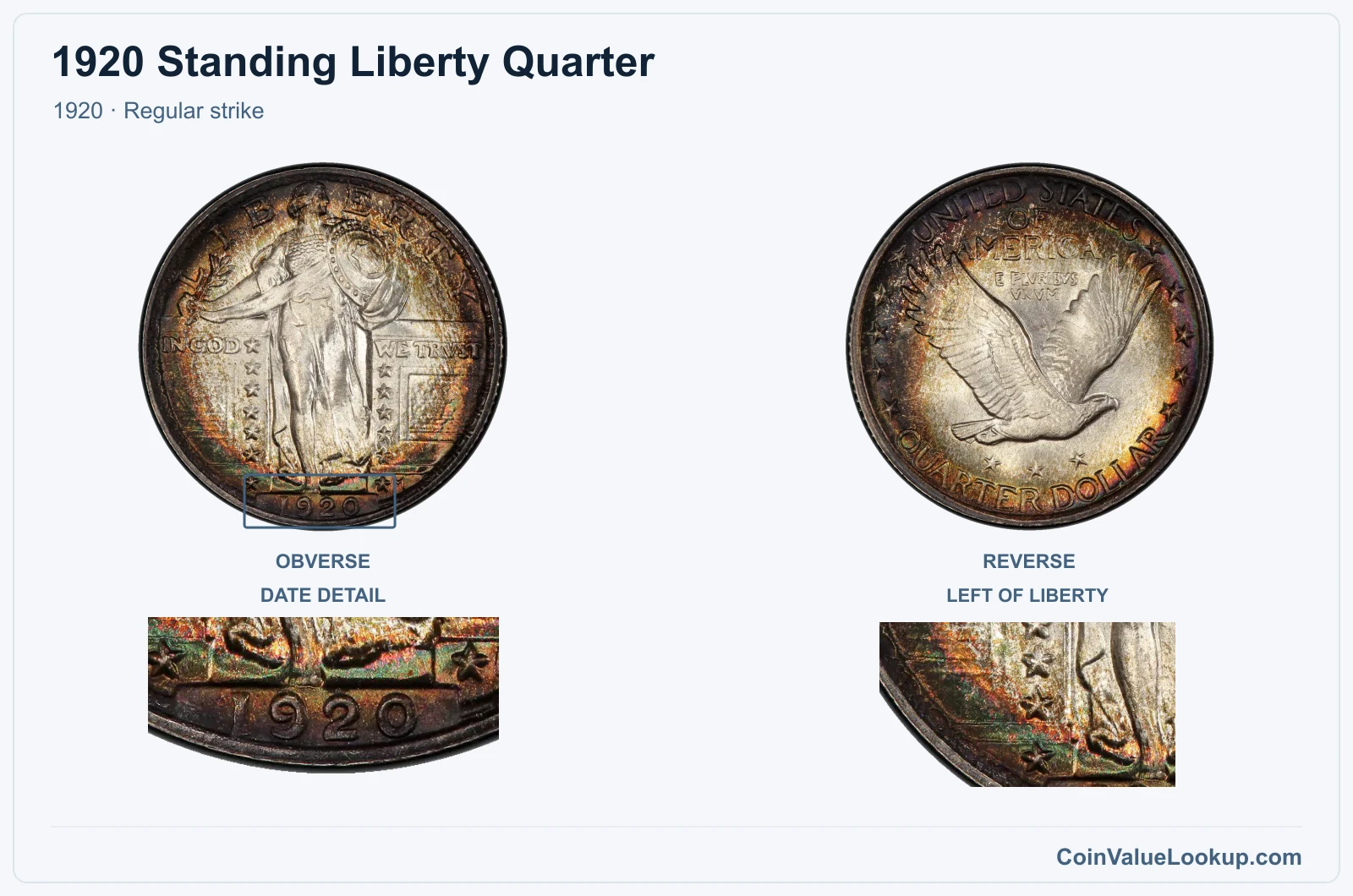
The 1920 Philadelphia quarter has no mintmark. It is the most commonly encountered version of the three 1920 issues.
USA Coin Book guide estimates place this coin at $23.00 in G4 (a well-worn but readable coin), $194.00 in MS60 (uncirculated with contact marks), and $321.00 in MS63 (a nice uncirculated piece with moderate marks). These are guide estimates, not guaranteed sale prices.
Look for the Type II design: chain mail on Liberty's chest and three stars below the eagle. Original surfaces and strike sharpness both matter.
A coin with a full, sharp head detail is more desirable than one with a flat strike, even at the same grade level.
Range Grade
Price Auction Records Appraisal PO PO 1
—
Coin Identifier FR FR 2
—
Coin Identifier AG AG 3
—
Coin Identifier G G 4
—
Coin Identifier
G 6
—
Coin Identifier VG VG 8
—
Coin Identifier
VG 10
—
Coin Identifier F F 12
Coin Identifier
F 15
—
Coin Identifier VF VF 20
—
Coin Identifier
VF 25
Coin Identifier
VF 30
Coin Identifier
VF 35
—
Coin Identifier XF XF 40
Coin Identifier
XF 45
Coin Identifier AU AU 50
Coin Identifier
AU 53
Coin Identifier
AU 55
Coin Identifier
AU 58
Coin Identifier MS MS 60
—
Coin Identifier
MS 61
Coin Identifier
MS 62
Coin Identifier
MS 63
Coin Identifier
MS 64
Coin Identifier
MS 65
Coin Identifier
MS 66
Coin Identifier
MS 67
Coin Identifier
MS 68
—
Coin Identifier
MS 69
—
—
—
MS 70
—
—
—
1920 Standing Liberty Quarter — D
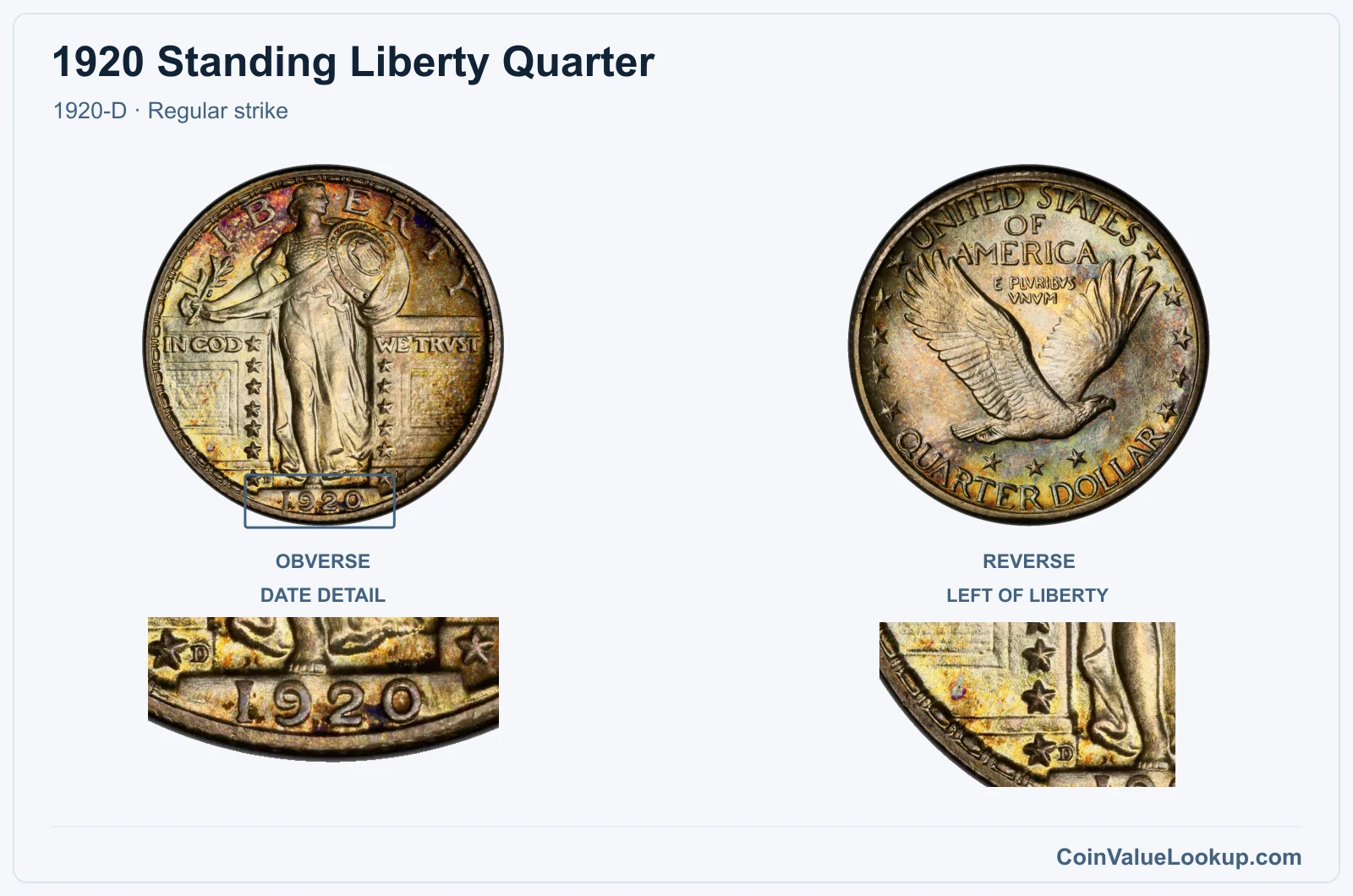
The 1920-D carries a small "D" mintmark near the left base of the wall on the obverse. Denver quarters from this era are scarcer than their Philadelphia counterparts, and the guide reflects that.
USA Coin Book estimates put the 1920-D at $111.00 in G4, $730.00 in MS60, and $1,353.00 in MS63. Even in well-worn condition, this coin holds meaningful value.
Coin Value Lookup is a good place to start if you are trying to compare your coin's details against other Standing Liberty quarter dates and mints. It offers guides across many series to help narrow down what you have.
Match the mintmark carefully — a worn "D" can sometimes be confused with surface damage. Original surfaces and the absence of cleaning are important.
A cleaned 1920-D loses much of the premium that makes the Denver issue special.
Range Grade
Price Auction Records Appraisal PO PO 1
—
Coin Identifier FR FR 2
—
Coin Identifier AG AG 3
—
Coin Identifier G G 4
Coin Identifier
G 6
Coin Identifier VG VG 8
Coin Identifier
VG 10
Coin Identifier F F 12
Coin Identifier
F 15
Coin Identifier VF VF 20
Coin Identifier
VF 25
Coin Identifier
VF 30
Coin Identifier
VF 35
Coin Identifier XF XF 40
Coin Identifier
XF 45
Coin Identifier AU AU 50
Coin Identifier
AU 53
Coin Identifier
AU 55
Coin Identifier
AU 58
Coin Identifier MS MS 60
—
Coin Identifier
MS 61
Coin Identifier
MS 62
Coin Identifier
MS 63
Coin Identifier
MS 64
Coin Identifier
MS 65
Coin Identifier
MS 66
Coin Identifier
MS 67
Coin Identifier
MS 68
—
—
—
MS 69
—
—
—
MS 70
—
—
—
1920 Standing Liberty Quarter — S
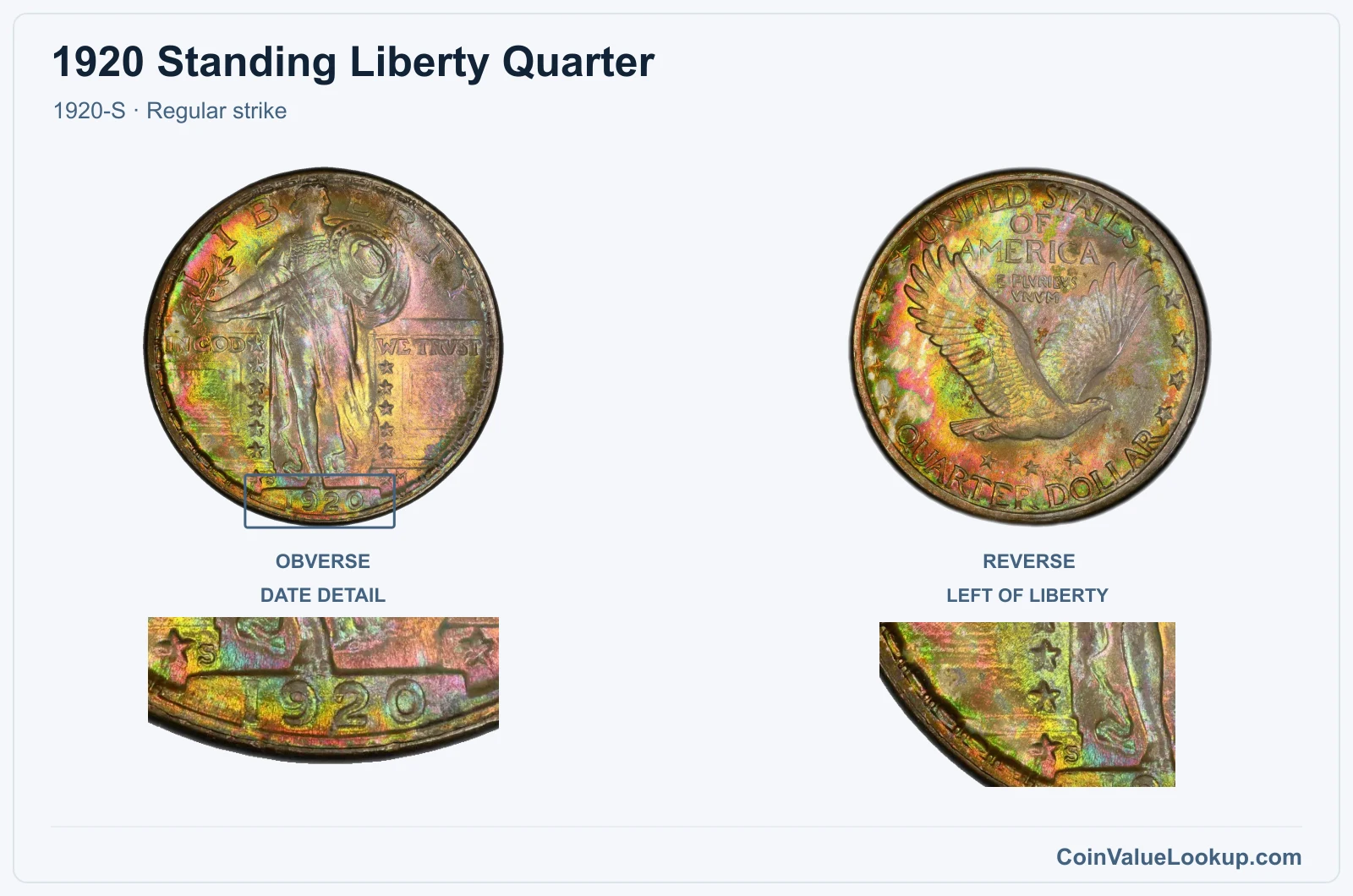
The 1920-S shows an "S" mintmark at the left base of the wall on the obverse. San Francisco pieces sit between the Philadelphia and Denver versions in terms of guide value.
USA Coin Book guide estimates are $34.00 in G4, $353.00 in MS60, and $938.00 in MS63. The jump from circulated to uncirculated grades is steep, which tells you surviving mint-state examples are not easy to find.
As with all 1920 quarters, this is the Type II design with the raised date. Confirm that chain mail covers Liberty's breast and three stars sit below the eagle on the reverse.
Cleaning or damage will knock the value well below these guide figures, so check for unnatural brightness or hairlines under magnification.
Range Grade
Price Auction Records Appraisal PO PO 1
—
Coin Identifier FR FR 2
—
Coin Identifier AG AG 3
—
Coin Identifier G G 4
—
Coin Identifier
G 6
—
Coin Identifier VG VG 8
—
Coin Identifier
VG 10
—
Coin Identifier F F 12
—
Coin Identifier
F 15
—
Coin Identifier VF VF 20
Coin Identifier
VF 25
—
Coin Identifier
VF 30
Coin Identifier
VF 35
Coin Identifier XF XF 40
Coin Identifier
XF 45
Coin Identifier AU AU 50
Coin Identifier
AU 53
Coin Identifier
AU 55
Coin Identifier
AU 58
Coin Identifier MS MS 60
Coin Identifier
MS 61
Coin Identifier
MS 62
Coin Identifier
MS 63
Coin Identifier
MS 64
Coin Identifier
MS 65
Coin Identifier
MS 66
Coin Identifier
MS 67
Coin Identifier
MS 68
—
—
—
MS 69
—
—
—
MS 70
—
—
—
1920 Standing Liberty Quarter Error List
1. 1920 Standing Liberty Quarter — Clashed Dies
A clashed-die 1920 quarter shows faint traces of the opposite die's design impressed into the fields. When the dies strike each other without a planchet between them, the obverse design can leave ghost impressions on the reverse die and vice versa.
On your coin, look for partial outlines of Liberty in the eagle's breast area, or faint eagle wing traces near Liberty's figure.
These transferred images will align with where the opposing design would normally sit. Random scratches or raised lines from contact marks do not follow that pattern.
The value of a clashed-die quarter depends on how visible and dramatic the clash is, along with the coin's overall condition. No specific price range is adopted for this error.
2. 1920 Standing Liberty Quarter — Lamination / Split Planchet
A lamination error on a 1920 quarter appears as peeling, flaking or separated layers of metal on the coin's surface. The silver alloy can develop internal weaknesses during production that later cause a section to split away or lift.
Look for a retained flap of metal still attached at one edge, or a smooth void where material has separated. Photograph the edge and the affected face together — the edge view often confirms the split runs within the metal rather than along the surface.
Do not confuse lamination with corrosion pitting, deliberate scraping or a coin that has been intentionally cut. Genuine lamination follows the metal's internal structure.
Value depends on the size and visibility of the flaw, plus overall coin condition.
3. 1920 Standing Liberty Quarter — Clipped Planchet
A clipped-planchet 1920 quarter is missing a portion of the original blank. The clip can be curved, straight or ragged, depending on what went wrong when the blank was punched from the metal strip.
A straight clip has been specifically reported for this year.
Check the edge texture around the missing area. A genuine clip typically shows a smooth, natural edge where the metal was never there, and you may notice design weakness on the opposite side of the coin from the clip — the metal had less material to flow into during striking.
Filed edges, deliberate notches or corrosion-eaten rims are not clips. Value depends on clip size, shape and the coin's overall preservation.
No specific price range is adopted.
4. 1920 Standing Liberty Quarter — Wrong Planchet / Off-Metal Strike
A wrong-planchet 1920 quarter was reportedly struck on a blank intended for a Peru 20 centavos. This is a dramatic error — the quarter dies impressed their design onto a foreign planchet.
To evaluate a suspected wrong-planchet strike, compare measured weight, diameter and edge characteristics against a normal 1920 quarter (6.25 grams, 90% silver). The foreign blank would differ in one or more of these measurements, and the design may appear incomplete if the planchet was smaller or thinner.
Do not confuse a wrong-planchet strike with a coin that has been plated, corroded, acid-treated or intentionally altered. Verification by a professional authentication service is important for an error this significant.
No specific price range is adopted.
5. 1920 Standing Liberty Quarter — Die Crack / Die Chip
Die cracks on a 1920 quarter appear as thin, raised lines running across the coin's surface. Die chips look like small raised blobs.
Both result from fractures in the steel die used during striking.
A crack that connects to the rim and displaces a section of the design is technically a cud (covered separately). Interior cracks and chips stay within the design or field area.
Look for lines that are raised above the surface, not incised into it — scratches sit below the surface and feel different under magnification.
Corrosion deposits or foreign material stuck to the coin can mimic a die chip. The value of a die-crack quarter depends on prominence and location, plus the coin's grade.
No specific price range is adopted.
6. 1920 Standing Liberty Quarter — Off-Center Strike
An off-center 1920 quarter shows the design shifted to one side, leaving a blank crescent of unstruck metal on the opposite edge. The planchet was not properly seated between the dies when struck.
Small off-center shifts of a few percent are relatively minor. Larger shifts — 10%, 20% or more — are increasingly dramatic, but collectors generally want the date still visible.
A date-visible off-center Standing Liberty quarter is a serious find.
Do not confuse an off-center strike with a clipped planchet or post-mint damage that flattened one side. A genuine off-center coin has a complete, round rim on the struck portion and a clean unstruck area.
Value depends on the percentage of displacement, date visibility and condition.
7. 1920 Standing Liberty Quarter — Die Break / Cud
A cud on a 1920 quarter is a raised, featureless blob of metal connected to the rim. It forms when a piece of the die breaks away entirely, leaving a void that fills with metal during striking.
A cud at the 6:00 position has been reported for this year.
The cud will show a smooth or slightly textured raised area where normal design detail is missing, and it must touch the rim. An interior raised blob without a rim connection is a die chip, not a cud.
Rim dents from post-mint damage push metal inward and leave a concave mark — the opposite of a cud's raised profile. Corrosion can also build up along the rim but lacks the clean boundary of a die break.
Value depends on size, location and the coin's overall condition.