1927 Standing Liberty Quarter Coin Value: How Much Is It Worth?
A 1927 Standing Liberty quarter is struck in 90% silver and can be worth anywhere from about $17 to over $9,000 depending on which mint produced it and how well it survived nearly a century of handling. The Philadelphia, Denver and San Francisco issues each carry different guide values, and condition plays a massive role.
Mint, grade and original surfaces determine where your coin lands in that spread.
Fast Way to Identify Your 1927 Standing Liberty Quarter
The fastest way to start figuring out what you have is to snap clear photos of both sides of the coin and upload them here. A front-and-back image lets us give you a preliminary identification of the mint, design type and approximate condition.
Good lighting and a steady hand go a long way toward a useful result.
1927 Standing Liberty Quarter Value
Upload both sides of your 1927 Standing Liberty Quarter.
Front Obverse
Upload photo
Back Reverse
Upload photo
Which 1927 Standing Liberty Quarter Versions Are Worth Money?
- 1927-S quarters jump dramatically in higher grades, with USA Coin Book guide estimates reaching $9,344 at MS63.
- 1927-D quarters carry a guide estimate of $407 at MS63, well above the Philadelphia issue at the same grade.
- 1927 Philadelphia coins still hold solid value in Mint State, estimated at $290 in MS63 condition.
- Even well-worn examples carry a baseline silver premium: G4 estimates start at $17.23 for Philadelphia, $27 for Denver, and $51 for San Francisco.
- Mint errors such as doubled dies and repunched mintmarks have been reported for this series and can add collector interest beyond standard guide values.
Step 1: Identify Your 1927 Standing Liberty Quarter Mint Mark and Version
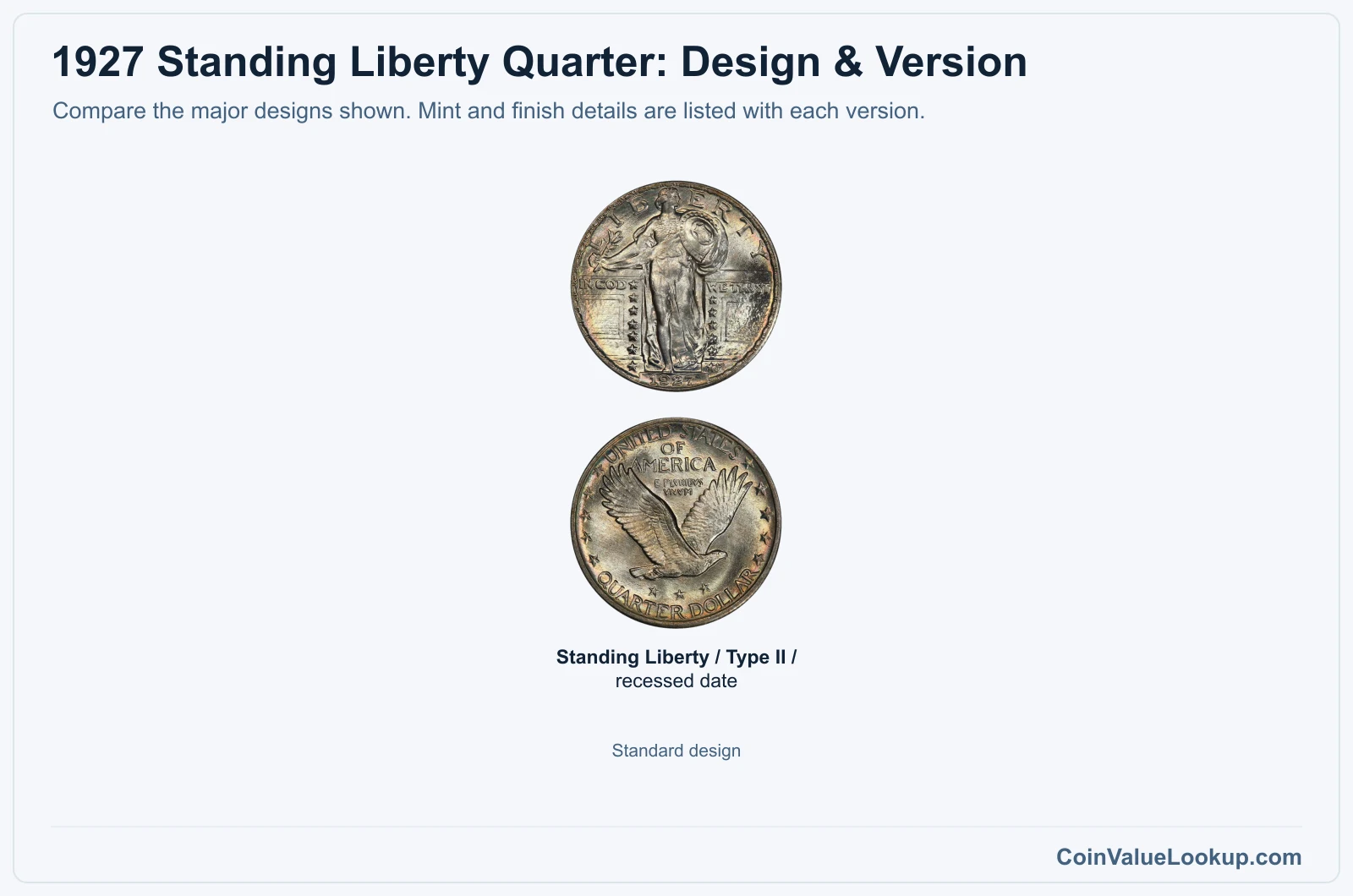
All 1927 quarters use the Type II Standing Liberty design: Liberty wears protective chain mail on her chest, and three stars sit below the eagle on the reverse. The date is recessed into the coin, a change introduced in 1925 to slow wear on the numerals.
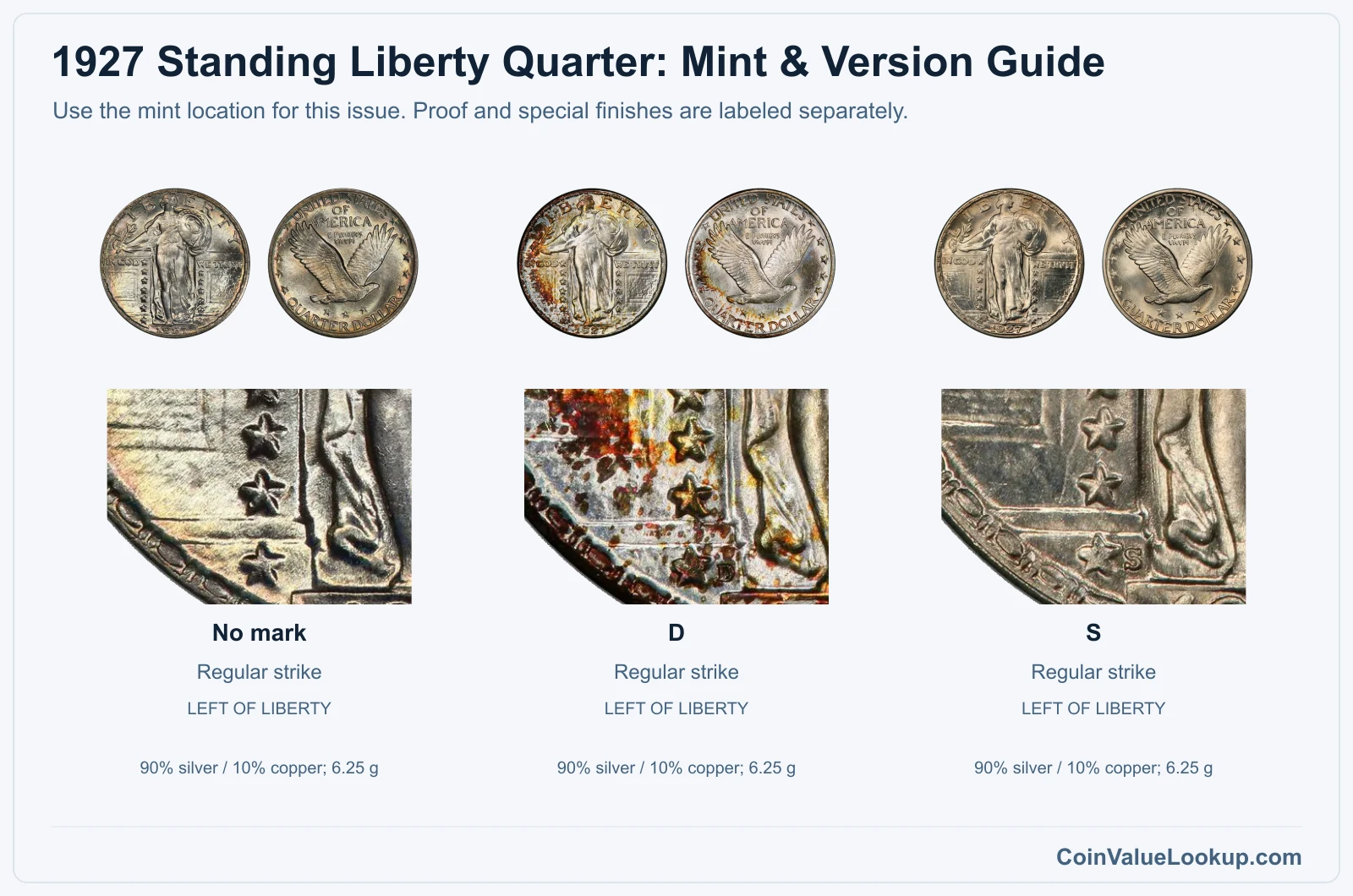
To tell the three versions apart, look for a mintmark on the obverse. It sits to the left of Liberty, right next to the base of the low wall she stands beside.
A "D" means Denver. An "S" means San Francisco.
No letter at all means Philadelphia.
The coin weighs 6.25 grams and is 90% silver, 10% copper. If yours is noticeably lighter or doesn't pass a magnet test, something is off.
Do not confuse the Type II mail-covered design with the earlier Type I, which shows an exposed breast and has no stars beneath the eagle; Type I was only used in 1916–1917.
Step 2: Check Your 1927 Standing Liberty Quarter Grade
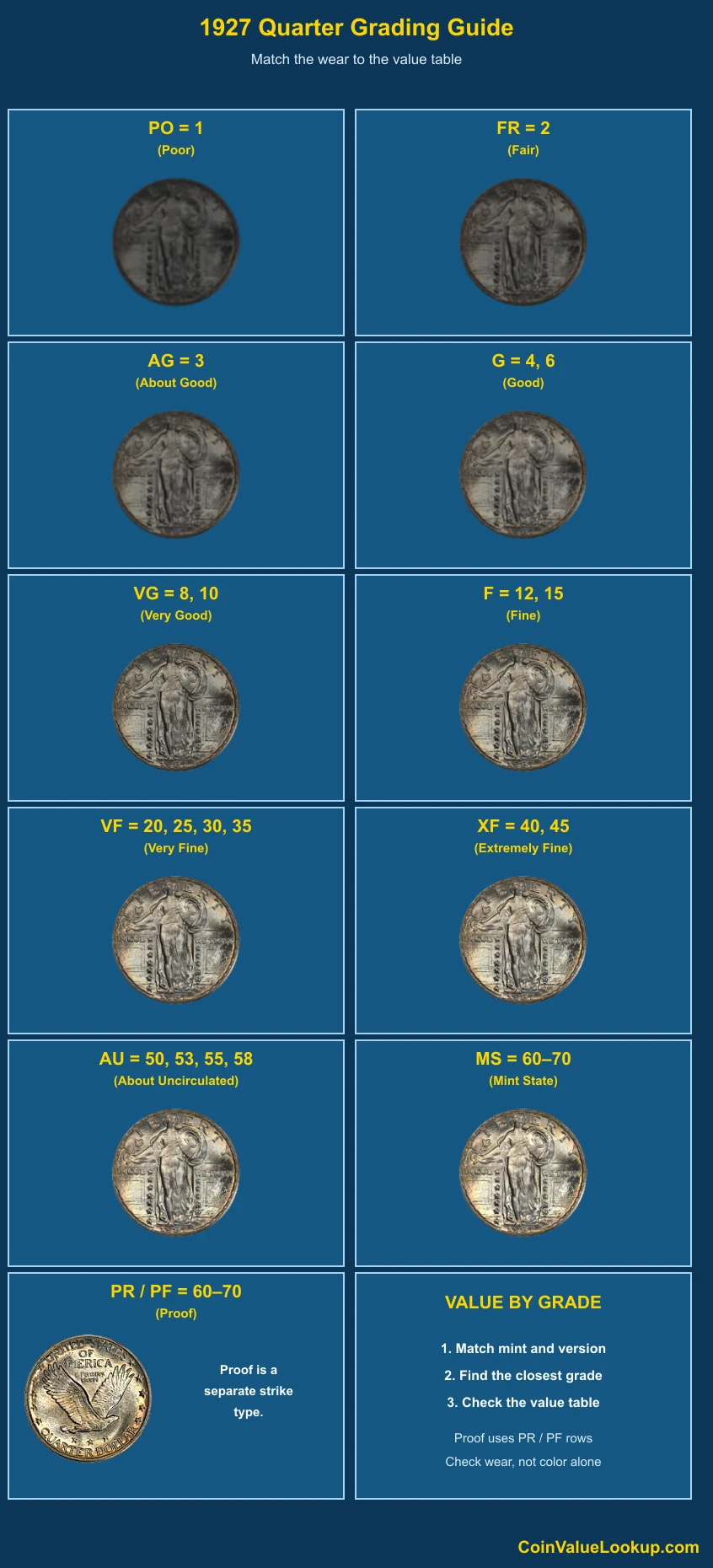
Grading a Standing Liberty quarter means tracking how much detail remains on the high points and how much original luster the surfaces still show. On Liberty, check the head, the breast area over the chain mail, the center of the shield, and the forward knee.
On the eagle, look at the breast feathers and wing tips.
A coin graded Good (G4) will have a visible outline of Liberty with most interior detail worn flat, and the date should still be readable. At Mint State 60 (MS60), there is no wear from circulation, but you may see bag marks and contact lines.
MS63 shows fewer marks and more eye appeal.
Full Head is a strike designation, not a grade. It means Liberty's head shows three distinct leaves in the hair detail.
A weakly struck coin can be technically uncirculated yet lack a Full Head, so don't assume brightness or lack of wear automatically earns it. Compare your coin against the reference image to judge wear honestly; cleaning or polishing can make a coin look shinier without improving its grade, and in fact reduces its collector value.
Step 3: Check 1927 Standing Liberty Quarter Value by Mint and Version
1927 Standing Liberty Quarter
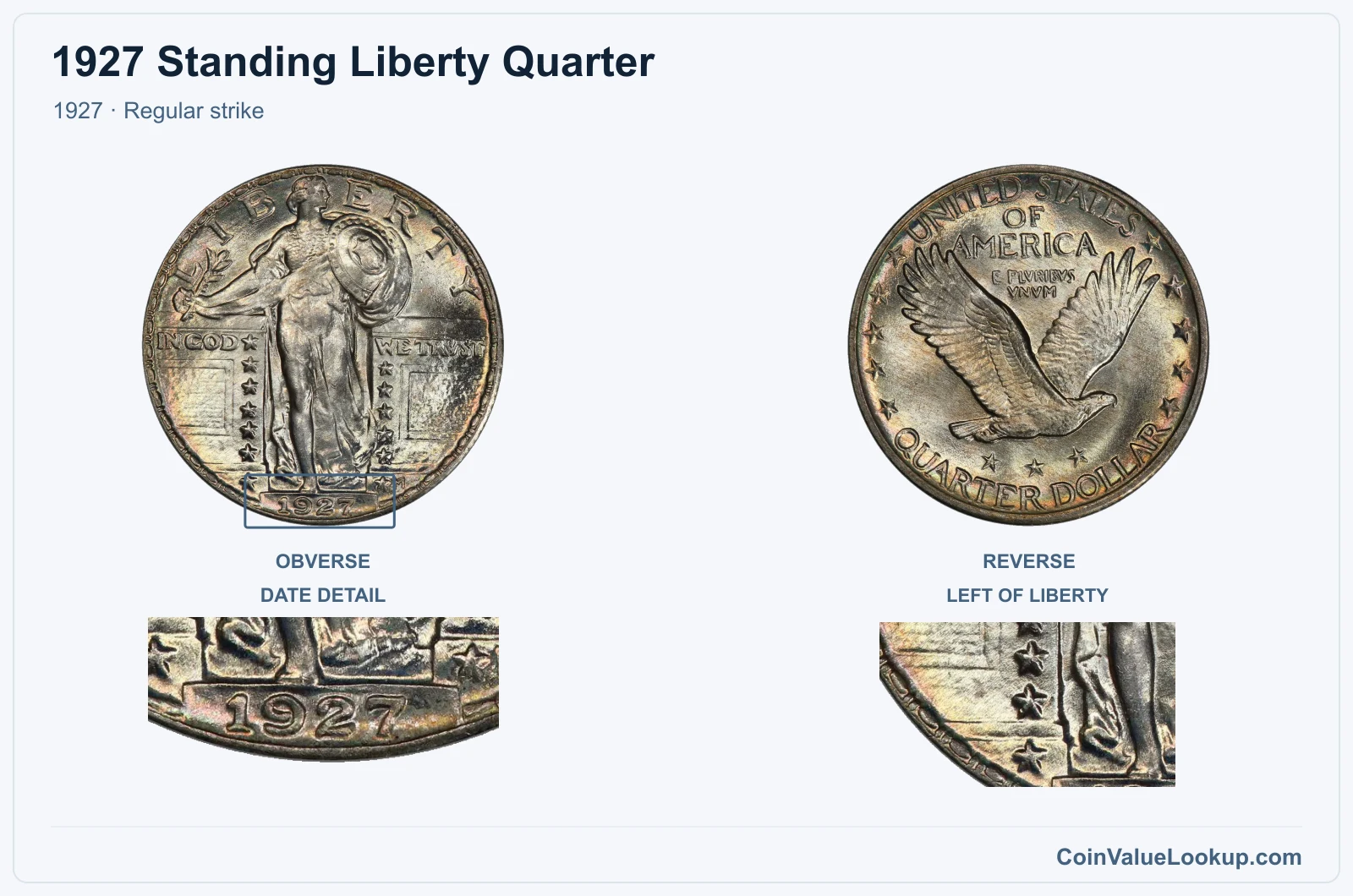
The 1927 Philadelphia quarter has no mintmark. In well-worn Good-4 condition, USA Coin Book estimates it at about $17.23.
Jump to MS60 and the guide moves to $171, then $290 at MS63. These are guide estimates, not guaranteed offers.
Philadelphia struck the largest share of 1927 quarters, so this is the version you are most likely to encounter. Even so, original uncirculated examples with strong strikes are not common junk-box material.
Look for full chain-mail detail and sharp shield lines to gauge strike quality. Cleaning or damage will push value below these estimates regardless of how much detail remains.
If you are exploring other dates and mints in the Standing Liberty series, Coin Value Lookup is a handy place to look up coin guides organized by year and denomination.
Range Grade
Price Auction Records Appraisal PO PO 1
—
Coin Identifier FR FR 2
—
Coin Identifier AG AG 3
—
Coin Identifier G G 4
—
Coin Identifier
G 6
—
Coin Identifier VG VG 8
Coin Identifier
VG 10
—
Coin Identifier F F 12
—
Coin Identifier
F 15
—
Coin Identifier VF VF 20
—
Coin Identifier
VF 25
—
Coin Identifier
VF 30
Coin Identifier
VF 35
—
Coin Identifier XF XF 40
Coin Identifier
XF 45
Coin Identifier AU AU 50
—
Coin Identifier
AU 53
Coin Identifier
AU 55
Coin Identifier
AU 58
Coin Identifier MS MS 60
Coin Identifier
MS 61
Coin Identifier
MS 62
Coin Identifier
MS 63
Coin Identifier
MS 64
Coin Identifier
MS 65
Coin Identifier
MS 66
Coin Identifier
MS 67
Coin Identifier
MS 68
—
—
—
MS 69
—
—
—
MS 70
—
—
—
1927 Standing Liberty Quarter — D
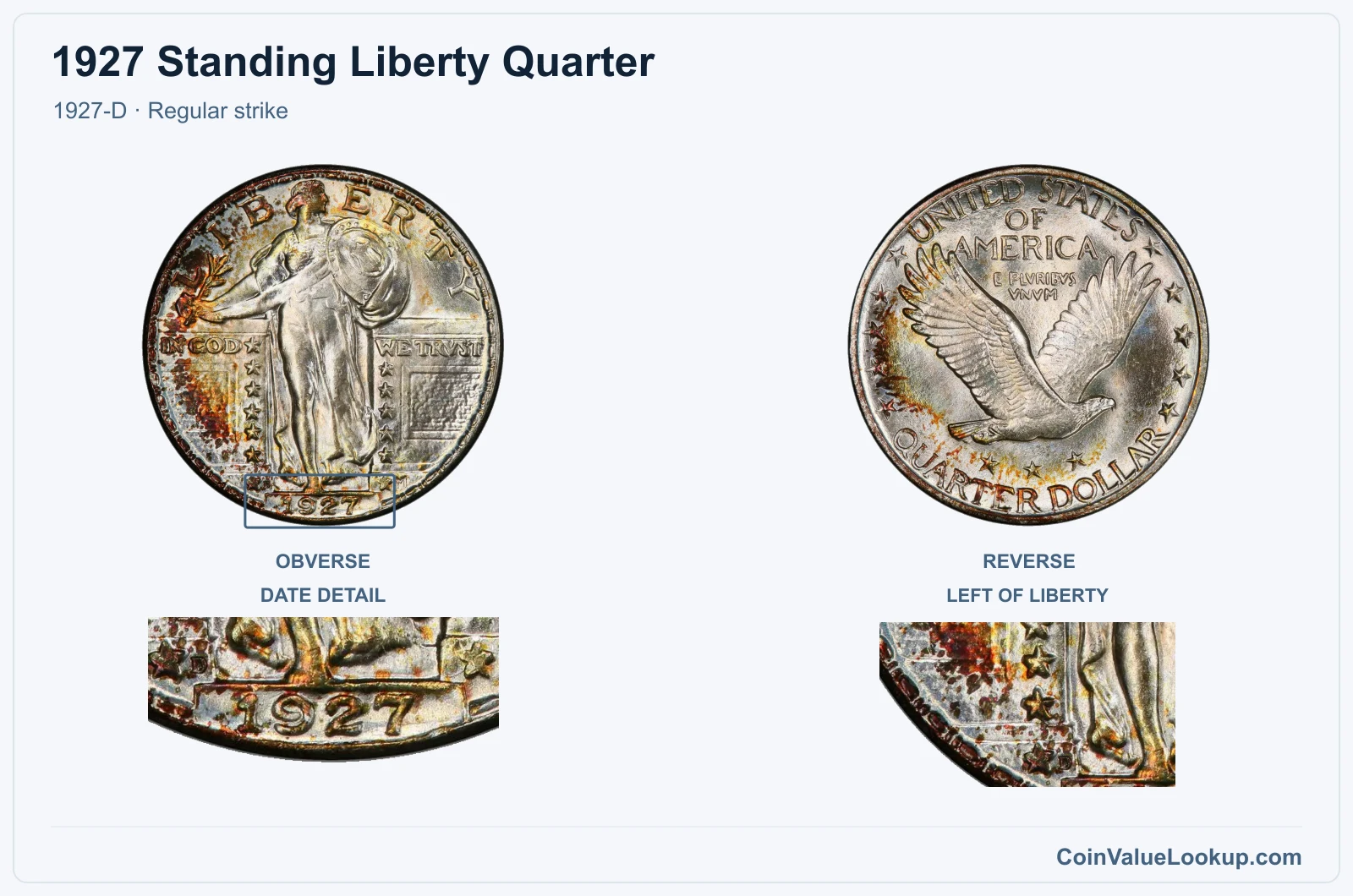
The 1927-D carries a small "D" mintmark on the obverse near the base of the wall to Liberty's left. Denver coins trade at a premium over Philadelphia across all grades.
USA Coin Book guide estimates place G4 at $27, MS60 at $290, and MS63 at $407.
Denver-mint Standing Liberty quarters from this era are often seen with softer strikes, so finding one with a sharp Full Head can be a challenge. That strike quality is separate from grade.
A coin can be MS63 without earning the Full Head designation. Always confirm the mintmark under magnification before assuming you have the Denver issue; a worn or partially filled letter is easy to misread.
Range Grade
Price Auction Records Appraisal PO PO 1
—
Coin Identifier FR FR 2
—
Coin Identifier AG AG 3
—
Coin Identifier G G 4
—
Coin Identifier
G 6
—
Coin Identifier VG VG 8
Coin Identifier
VG 10
—
Coin Identifier F F 12
—
Coin Identifier
F 15
—
Coin Identifier VF VF 20
Coin Identifier
VF 25
Coin Identifier
VF 30
Coin Identifier
VF 35
Coin Identifier XF XF 40
Coin Identifier
XF 45
Coin Identifier AU AU 50
Coin Identifier
AU 53
Coin Identifier
AU 55
Coin Identifier
AU 58
Coin Identifier MS MS 60
—
Coin Identifier
MS 61
Coin Identifier
MS 62
Coin Identifier
MS 63
Coin Identifier
MS 64
Coin Identifier
MS 65
Coin Identifier
MS 66
Coin Identifier
MS 67
Coin Identifier
MS 68
—
—
—
MS 69
—
—
—
MS 70
—
—
—
1927 Standing Liberty Quarter — S
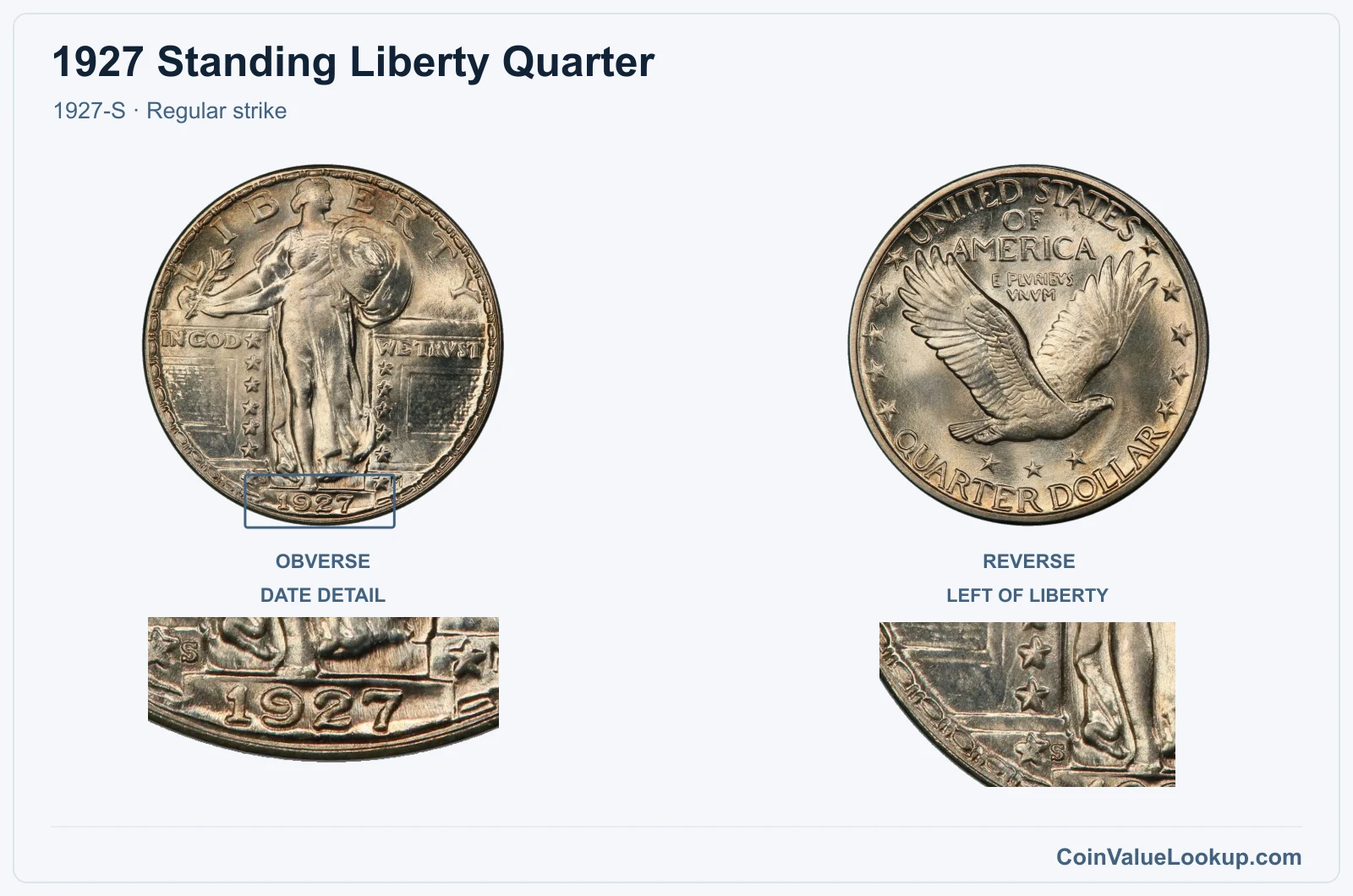
The 1927-S is the key coin of the year. It carries an "S" mintmark at the left base of the wall on the obverse.
San Francisco produced fewer quarters, and survival rates in upper grades are low.
USA Coin Book guide estimates tell the story: G4 sits at $51, already triple the Philadelphia price, but the real separation happens in Mint State. MS60 is estimated at $6,268, and MS63 climbs to $9,344.
Those figures reflect genuine scarcity, not hype.
Original surfaces matter enormously at this price level. A cleaned or whizzed coin, even if technically uncirculated, will sell for far less.
Full Head examples are especially scarce because San Francisco strikes on this date tend to be soft in the head area. If your coin has the S mintmark and shows strong detail with original luster, it deserves professional evaluation rather than a quick sale.
Range Grade
Price Auction Records Appraisal PO PO 1
—
Coin Identifier FR FR 2
—
Coin Identifier AG AG 3
Coin Identifier G G 4
Coin Identifier
G 6
Coin Identifier VG VG 8
Coin Identifier
VG 10
Coin Identifier F F 12
Coin Identifier
F 15
Coin Identifier VF VF 20
Coin Identifier
VF 25
Coin Identifier
VF 30
Coin Identifier
VF 35
Coin Identifier XF XF 40
Coin Identifier
XF 45
Coin Identifier AU AU 50
Coin Identifier
AU 53
Coin Identifier
AU 55
Coin Identifier
AU 58
Coin Identifier MS MS 60
—
Coin Identifier
MS 61
Coin Identifier
MS 62
Coin Identifier
MS 63
Coin Identifier
MS 64
Coin Identifier
MS 65
Coin Identifier
MS 66
Coin Identifier
MS 67
Coin Identifier
MS 68
—
—
—
MS 69
—
—
—
MS 70
—
—
—
1927 Standing Liberty Quarter Error List
1. 1927 Standing Liberty Quarter — Clashed Dies
A clashed-die error occurs when the obverse and reverse dies strike each other without a planchet between them, transferring ghost impressions of the opposite design onto each die. On a 1927 Standing Liberty quarter, look for faint outlines of the eagle on Liberty's side, or traces of Liberty's figure on the eagle side, positioned where the opposing design would naturally align.
These marks differ from random scratches or contact lines because they follow the contour of a recognizable design element. Scratches run in arbitrary directions; a clash impression mirrors something specific from the other die.
Brockage errors, where a struck coin acts as a die, produce a different visual pattern.
No specific price data is available for this error on the 1927 quarter. Value depends on how visible the clash is, the coin's overall condition, and which mint produced it.
A bold, clearly visible clash on an otherwise well-preserved coin will always attract more collector attention than a faint trace on a worn example.
2. 1927 Standing Liberty Quarter — Off-Center Strike
An off-center strike happens when the planchet is not seated properly between the dies, producing a design that is shifted to one side with a blank crescent of unstruck metal on the opposite edge. On a 1927 quarter, the key factor for value is whether the date remains visible despite the misalignment.
Do not confuse an off-center strike with a clipped planchet, which shows a curved bite out of the edge but keeps the design centered. Post-mint damage from a vice or impact can also flatten one side, but it will show distortion rather than a clean blank area.
No adopted price data exists for this error on the 1927 issue. The degree of off-center shift, date visibility, overall condition and the specific mint all influence what a collector will pay.
Moderate shifts with a full date tend to draw the most interest.
3. 1927 Standing Liberty Quarter — Repunched Mintmark
A repunched mintmark appears when the mintmark punch was applied more than once in slightly different positions, leaving a visible remnant of the first impression alongside the final placement. On 1927 Standing Liberty quarters, this only applies to D and S mint coins since Philadelphia pieces carry no mintmark.
To spot one, examine the mintmark area near the base of the wall under at least 5x magnification. You are looking for a doubled outline, a notch, or a secondary shadow of the letter that does not match the primary impression's angle.
Compare against a normal mintmark at the same magnification to be sure.
Machine doubling, die chips and surface corrosion can all mimic a repunched mintmark to the untrained eye. Machine doubling tends to be flat and shelf-like, while a true repunch shows raised, rounded letter forms.
No specific pricing is available; value depends on clarity of the extra impression and the coin's condition.
4. 1927 Standing Liberty Quarter — Doubled Die
A doubled-die variety results from a misaligned hub impression during die manufacturing, producing consistent doubling on every coin struck from that die. On a 1927 Standing Liberty quarter, look for separation or notching on design elements such as lettering, stars or Liberty's features.
The doubling should appear in the same location and direction on every affected area.
The critical distinction is between hub doubling and machine doubling. Hub doubling produces raised, rounded doubled images that are part of the die itself.
Machine doubling, caused by die bounce during striking, creates flat, shelf-like distortions that lack the sharp definition of a true doubled die. Reflections from luster or post-mint impressions from contact can also fool you.
No price data has been adopted for doubled-die varieties on the 1927 quarter. Value hinges on which elements are doubled, how dramatic the separation is, and the coin's preservation.
Professional attribution is worth pursuing if the doubling is strong and consistent across multiple design elements.