1840 Liberty Seated Quarter Coin Value: How Much Is It Worth?
The 1840 Liberty Seated Quarter sits at an interesting crossroads in the series — it's the year the design gained its drapery fold, and both Philadelphia and New Orleans were striking coins. Guide estimates place circulated examples around $65 to $90 in G4, depending on mint and variety.
Selected high-grade entries reach into the thousands, with one MS63 guide figure at $6,838. Sorting out which version you have is the first real step.
Fast Way to Identify Your 1840 Liberty Seated Quarter
Upload clear photos of both the front and back of your 1840 quarter for a preliminary identification. The tool can help narrow down your mint, design type and approximate condition from your images.
Make sure the date, any mintmark below the eagle, and Liberty's torso area are visible and in focus.
1840 Liberty Seated Quarter Value
Upload both sides of your 1840 Liberty Seated Quarter.
Front Obverse
Upload photo
Back Reverse
Upload photo
Which 1840 Liberty Seated Quarter Versions Are Worth Money?
- 1840-O No Drapery in higher grades: guide values reach $6,838 at MS63, well above most circulated examples of this date.
- 1840 Drapery Philadelphia business strikes: strong survivors command attention, with an MS63 guide figure of $6,266.
- 1840-O Drapery, Large O: a genuinely scarce die pairing — one PCGS MS64 example sold for $35,250 in April 2014.
- 1840 Philadelphia Proof: a rare specialist issue assessed individually by authenticated identity and condition, not routine price curves.
- 1840-O No Drapery with die clash, repunched date or other die-state features: these require expert confirmation but add collector interest.
Step 1: Identify Your 1840 Liberty Seated Quarter Mint Mark and Version
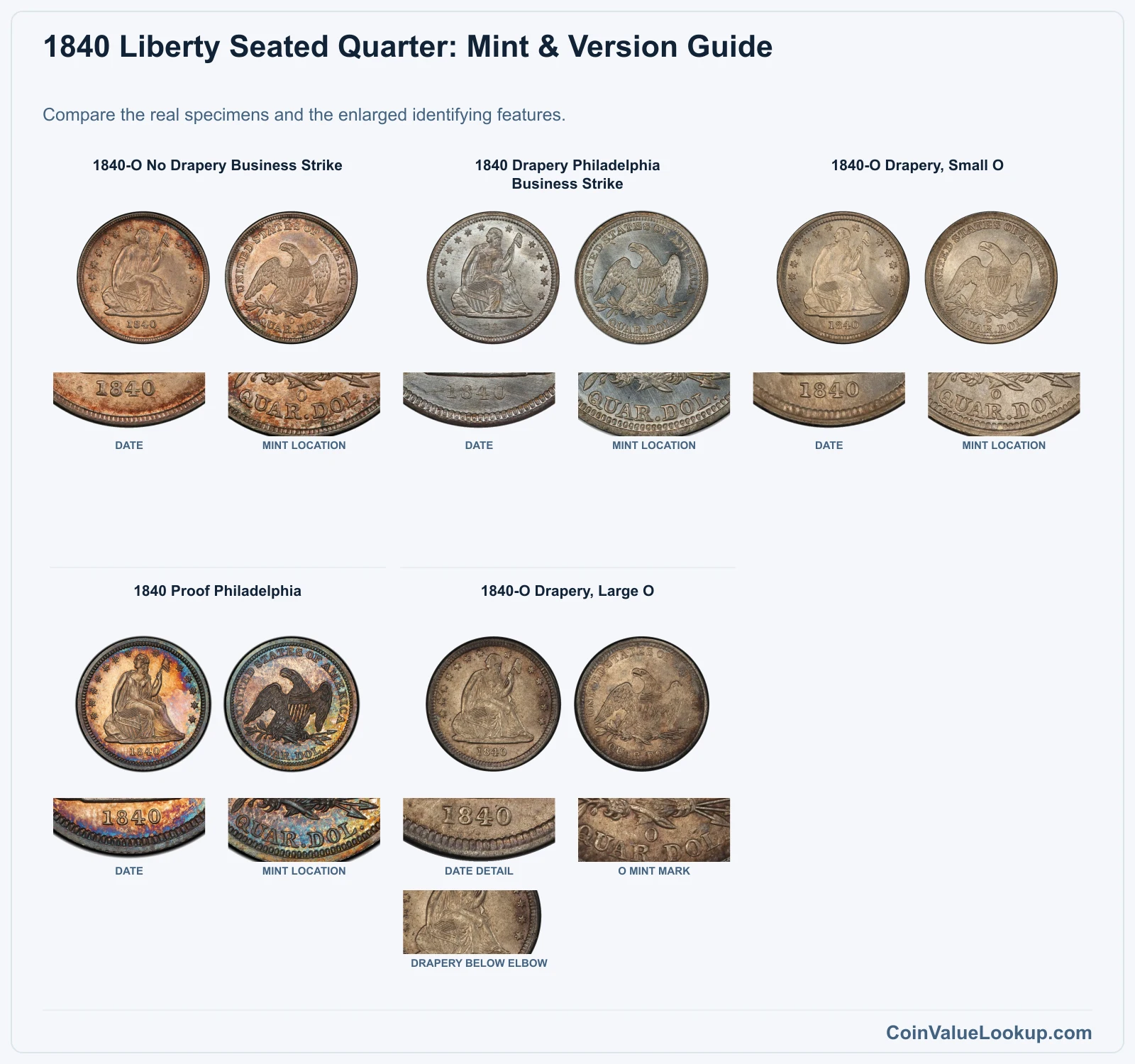
Start by confirming the date reads 1840 and that you see seated Liberty on the obverse with an eagle on the reverse. Philadelphia coins carry no mintmark.
New Orleans issues show a small "O" on the reverse beneath the eagle.
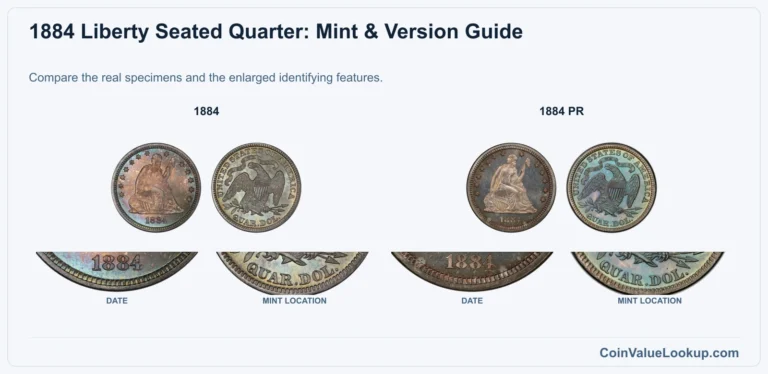
The critical design split this year is drapery. Look at Liberty's left elbow — Philadelphia strikes all have an extra fold of cloth (drapery) hanging from that arm.
New Orleans produced coins both without and with drapery, so an O-mint coin could go either way.
If your coin is from New Orleans and does have drapery, check the mintmark shape closely. The Small O is round and sits slightly left of center below the eagle.
The Large O is elongated, more centered, and appears alongside doubled reverse denticles (the tiny teeth around the rim). That Large O is genuinely scarce.
All 1840 quarters are 90% silver and 10% copper, with a nominal weight of 6.68 grams and roughly 24.3 mm diameter. Wear can reduce the weight slightly, so a light coin is not necessarily a fake — but a dramatically underweight one deserves a closer look.
Step 2: Check Your 1840 Liberty Seated Quarter Grade
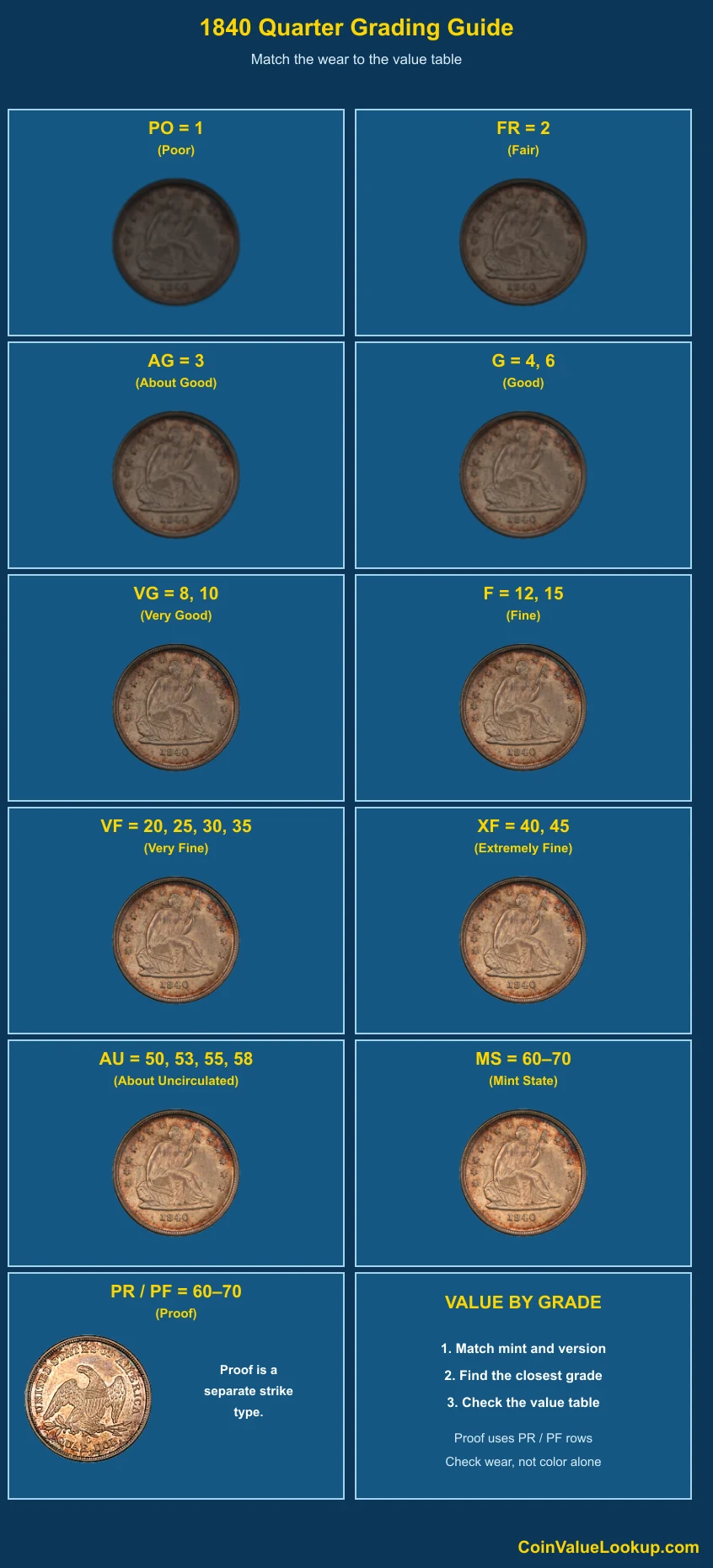
Focus on Liberty's head, breast, knee and the letters on her shield first — those are the high points that wear down earliest. Then flip the coin and check the eagle's breast feathers, wing detail and claws.
Remaining luster matters. A coin with full mint frost across both sides is a different animal than one where every trace of original shine is gone.
Use the comparison image to match your coin's wear pattern against known grade benchmarks.
Don't confuse a weak strike with wear. Some 1840 quarters left the press with soft detail on the shield letters or eagle feathers, and that's a manufacturing trait, not damage from circulation.
Shield letters alone won't pin down a grade.
Hairlines from old cleaning, smoothed fields, holes and green or dark environmental damage all reduce value significantly. If your coin looks mirror-like, that alone does not make it a proof — early proof attribution requires expert die-pair analysis, surface comparison and ideally provenance documentation.
Step 3: Check 1840 Liberty Seated Quarter Value by Mint and Version
1840 Liberty Seated Quarter — O No Drapery Business Strike
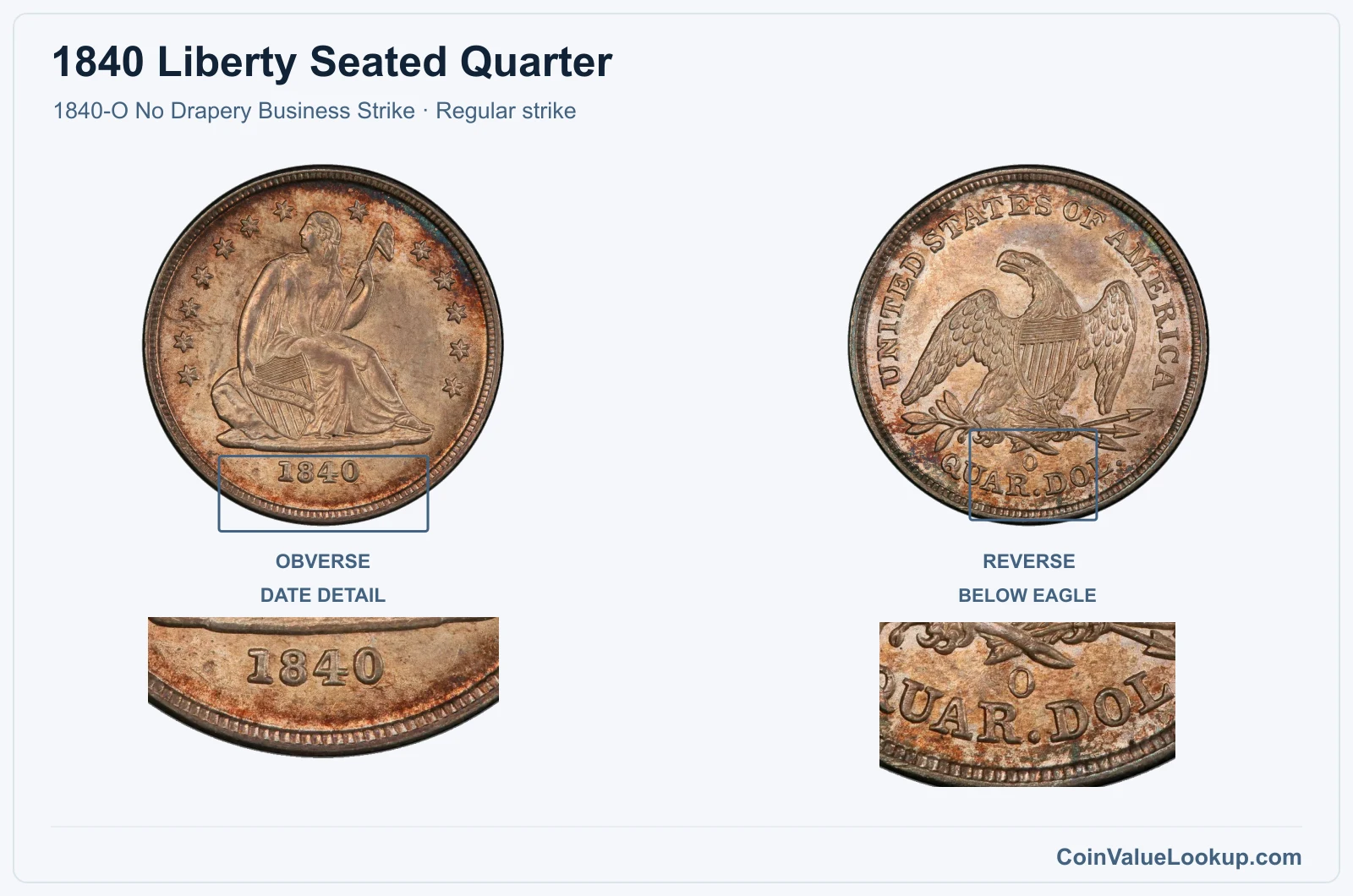
This is the New Orleans issue without the drapery fold at Liberty's elbow, continuing the earlier design used in 1838–39. Look for the "O" mintmark below the eagle on the reverse.
Guide estimates place this version at about $90 in G4, $245 in VF20 and $6,838 at MS63. Those upper-tier numbers reflect how few survivors exist in mint condition — most of these saw heavy pocket duty in the Deep South.
In circulated grades this is an affordable entry into the series, but original, problem-free surfaces matter more than you might expect.
| Range | Grade | Price | Auction Records | Appraisal |
|---|---|---|---|---|
| PO | PO 1 | — | Coin Identifier | |
| FR | FR 2 | — | Coin Identifier | |
| AG | AG 3 | — | Coin Identifier | |
| G | G 4 | — | Coin Identifier | |
| G 6 | — | Coin Identifier | ||
| VG | VG 8 | — | Coin Identifier | |
| VG 10 | Coin Identifier | |||
| F | F 12 | Coin Identifier | ||
| F 15 | Coin Identifier | |||
| VF | VF 20 | Coin Identifier | ||
| VF 25 | Coin Identifier | |||
| VF 30 | Coin Identifier | |||
| VF 35 | Coin Identifier | |||
| XF | XF 40 | Coin Identifier | ||
| XF 45 | Coin Identifier | |||
| AU | AU 50 | Coin Identifier | ||
| AU 53 | Coin Identifier | |||
| AU 55 | Coin Identifier | |||
| AU 58 | Coin Identifier | |||
| MS | MS 60 | — | Coin Identifier | |
| MS 61 | Coin Identifier | |||
| MS 62 | Coin Identifier | |||
| MS 63 | Coin Identifier | |||
| MS 64 | Coin Identifier | |||
| MS 65 | Coin Identifier | |||
| MS 66 | — | — | — | |
| MS 67 | — | — | — | |
| MS 68 | — | — | — | |
| MS 69 | — | — | — | |
| MS 70 | — | — | — |
1840 Liberty Seated Quarter — Drapery Philadelphia Business Strike
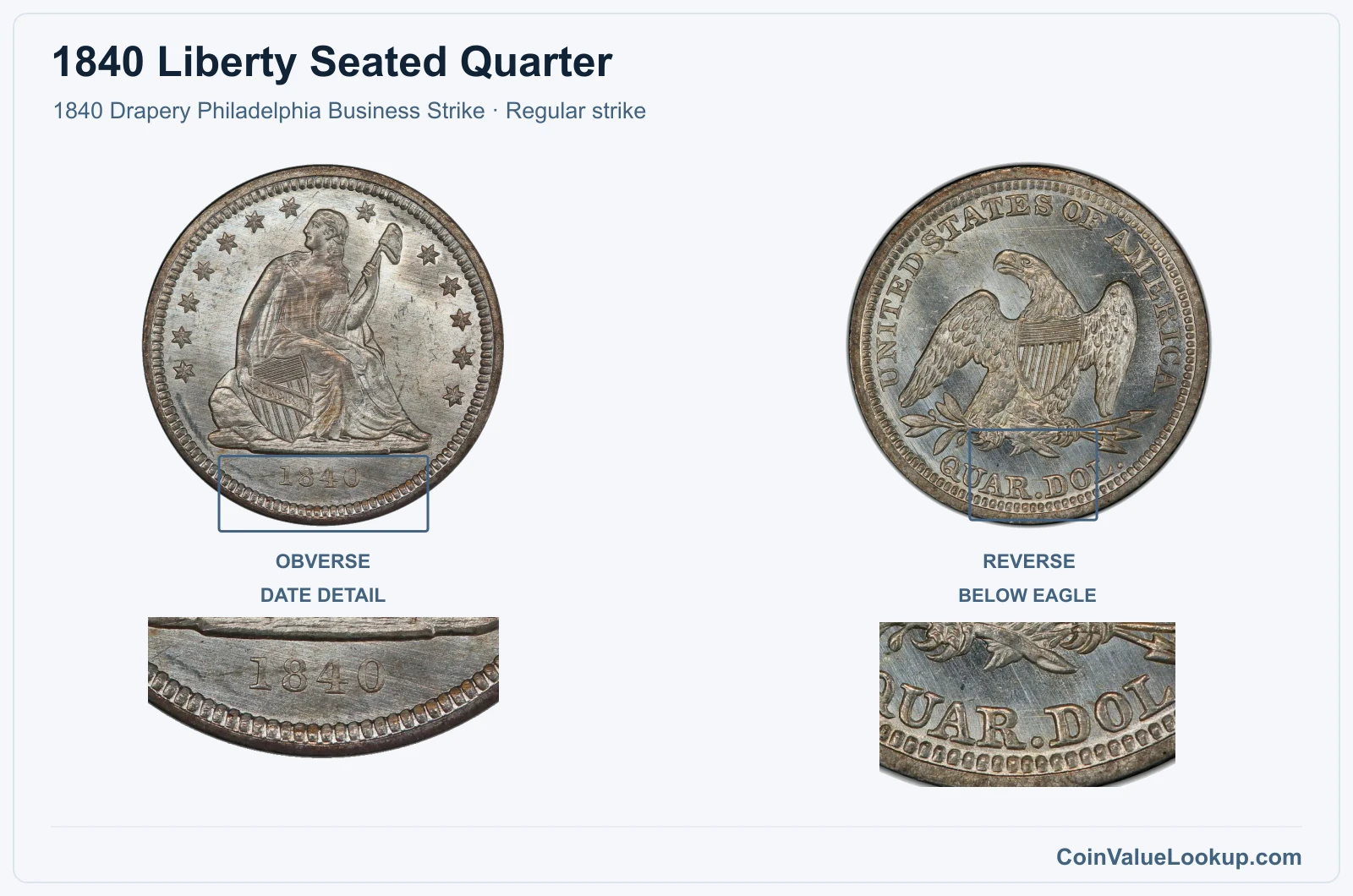
Philadelphia's 1840 quarter always shows the drapery fold hanging from Liberty's left elbow — there is no Philadelphia "No Drapery" branch for this year. No mintmark appears anywhere on the coin.
Guide values sit at roughly $82 in G4, $226 in VF20 and $6,266 at MS63. The jump from mid-grade circulated to uncirculated is steep because clean, lustrous survivors are hard to find.
If yours has original surfaces and sharp detail, it is worth a careful grade assessment.
Coin Value Lookup is a handy starting point when you want to look up guides for other dates and denominations in the Seated quarter series or beyond.
| Range | Grade | Price | Auction Records | Appraisal |
|---|---|---|---|---|
| PO | PO 1 | — | Coin Identifier | |
| FR | FR 2 | — | Coin Identifier | |
| AG | AG 3 | — | Coin Identifier | |
| G | G 4 | — | Coin Identifier | |
| G 6 | — | Coin Identifier | ||
| VG | VG 8 | — | Coin Identifier | |
| VG 10 | — | Coin Identifier | ||
| F | F 12 | — | Coin Identifier | |
| F 15 | Coin Identifier | |||
| VF | VF 20 | Coin Identifier | ||
| VF 25 | Coin Identifier | |||
| VF 30 | Coin Identifier | |||
| VF 35 | Coin Identifier | |||
| XF | XF 40 | Coin Identifier | ||
| XF 45 | Coin Identifier | |||
| AU | AU 50 | Coin Identifier | ||
| AU 53 | Coin Identifier | |||
| AU 55 | Coin Identifier | |||
| AU 58 | Coin Identifier | |||
| MS | MS 60 | — | Coin Identifier | |
| MS 61 | Coin Identifier | |||
| MS 62 | Coin Identifier | |||
| MS 63 | Coin Identifier | |||
| MS 64 | Coin Identifier | |||
| MS 65 | Coin Identifier | |||
| MS 66 | Coin Identifier | |||
| MS 67 | — | — | — | |
| MS 68 | — | — | — | |
| MS 69 | — | — | — | |
| MS 70 | — | — | — |
1840 Liberty Seated Quarter — O Drapery, Small O
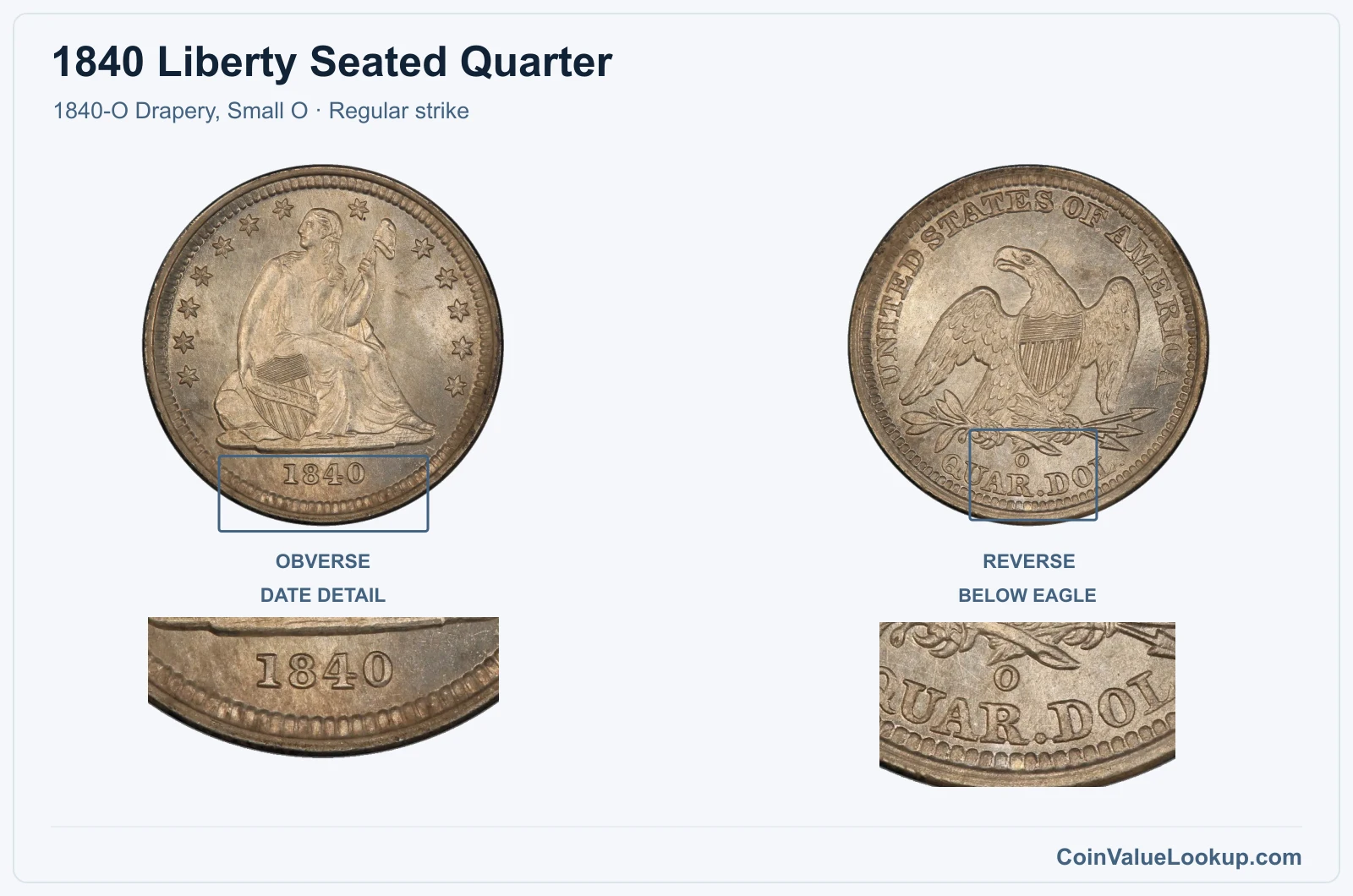
Once you confirm your 1840-O has the drapery fold, look at the mintmark shape. The Small O is round and positioned slightly left of center beneath the eagle.
This is the more commonly encountered of the two O-mint drapery pairings. General O-mint drapery guide figures run about $65 in G4, $278 in VF20 and $4,761 at MS63.
No independent premium for mintmark size is established in the guide data, so value here tracks the broader O-mint drapery population. Condition and original surfaces drive the price more than the mintmark variety alone.
Ordinary-issue reference: Ordinary-issue reference only: The table below shows the related standard issue (1840-O Drapery). It does not represent the value of the specific 1840-O Drapery, Small O variety or its variety premium. The year, mint, metal and strike type are matched; the specific variety is not priced by this table.
Range Grade
Price Auction Records Appraisal PO PO 1
—
Coin Identifier FR FR 2
—
Coin Identifier AG AG 3
—
Coin Identifier G G 4
—
Coin Identifier
G 6
—
Coin Identifier VG VG 8
—
Coin Identifier
VG 10
Coin Identifier F F 12
Coin Identifier
F 15
—
Coin Identifier VF VF 20
Coin Identifier
VF 25
Coin Identifier
VF 30
Coin Identifier
VF 35
Coin Identifier XF XF 40
Coin Identifier
XF 45
Coin Identifier AU AU 50
Coin Identifier
AU 53
Coin Identifier
AU 55
Coin Identifier
AU 58
Coin Identifier MS MS 60
—
Coin Identifier
MS 61
Coin Identifier
MS 62
Coin Identifier
MS 63
Coin Identifier
MS 64
Coin Identifier
MS 65
Coin Identifier
MS 66
—
—
—
MS 67
—
—
—
MS 68
—
—
—
MS 69
—
—
—
MS 70
—
—
—
1840 Liberty Seated Quarter — Proof Philadelphia
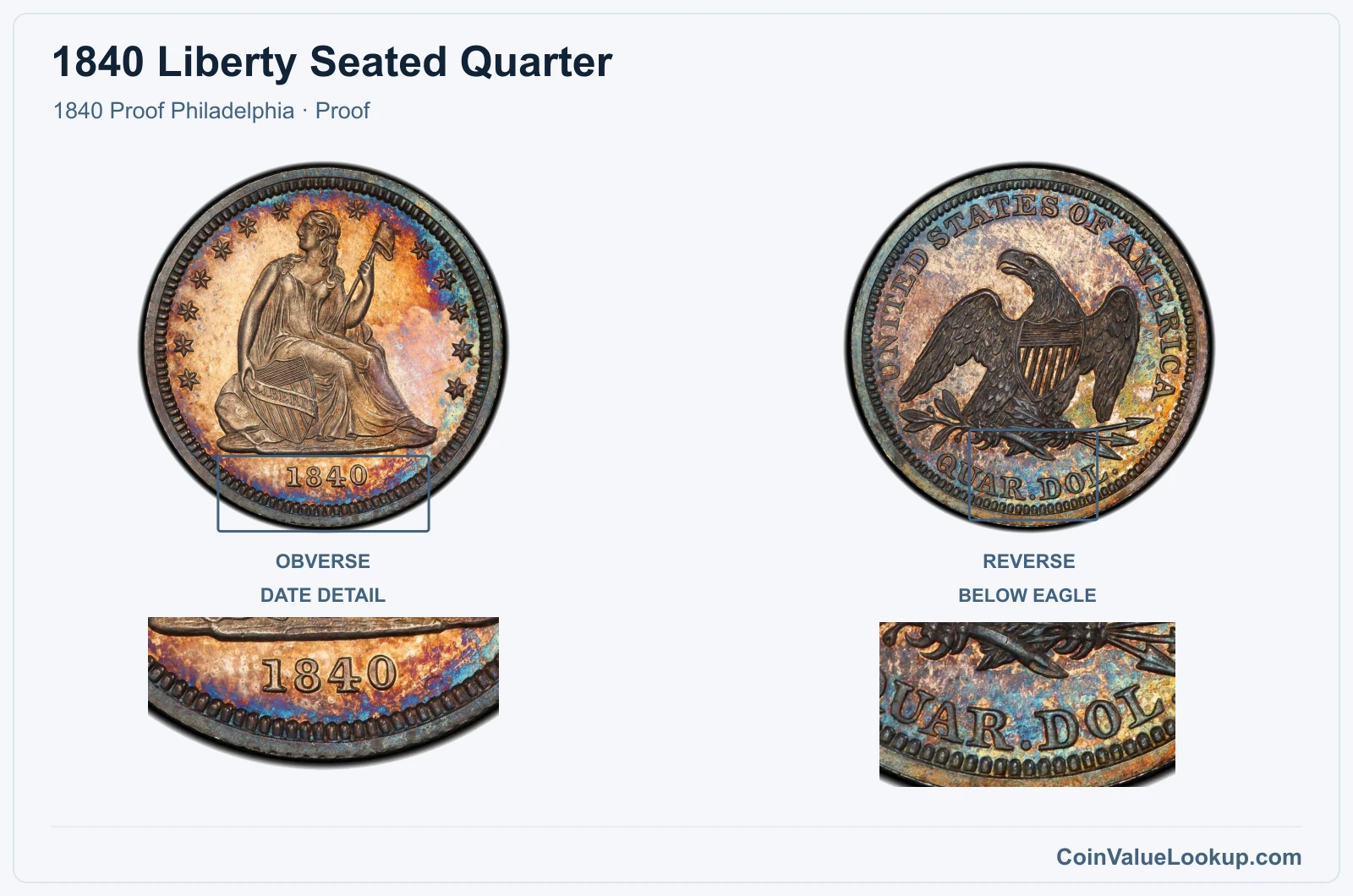
Early Philadelphia proofs from 1840 are rare specialist pieces. These carry the drapery design and were struck at Philadelphia with no mintmark, same as the business strikes — but from specially prepared dies on polished planchets.
A shiny coin is not automatically a proof. Genuine proof attribution requires expert comparison of die characteristics, surface quality and ideally documented provenance.
No routine price curve is adopted for this issue; each authenticated example is assessed individually based on its identity, condition and any die features present. If you suspect you have one, third-party certification by a major grading service is the appropriate next step.
| Range | Grade | Price | Auction Records | Appraisal |
|---|---|---|---|---|
| PR | PR 1 | — | Coin Identifier | |
| PR 2 | — | Coin Identifier | ||
| PR 3 | — | Coin Identifier | ||
| PR 4 | — | Coin Identifier | ||
| PR 6 | — | Coin Identifier | ||
| PR 8 | — | Coin Identifier | ||
| PR 10 | — | Coin Identifier | ||
| PR 12 | — | Coin Identifier | ||
| PR 15 | — | Coin Identifier | ||
| PR 20 | — | Coin Identifier | ||
| PR 25 | — | Coin Identifier | ||
| PR 30 | — | Coin Identifier | ||
| PR 35 | — | Coin Identifier | ||
| PR 40 | — | Coin Identifier | ||
| PR 45 | — | Coin Identifier | ||
| PR 50 | — | Coin Identifier | ||
| PR 53 | — | Coin Identifier | ||
| PR 55 | — | Coin Identifier | ||
| PR 58 | — | Coin Identifier | ||
| PR 60 | — | Coin Identifier | ||
| PR 61 | — | Coin Identifier | ||
| PR 62 | — | Coin Identifier | ||
| PR 63 | — | Coin Identifier | ||
| PR 64 | — | Coin Identifier | ||
| PR 65 | Coin Identifier | |||
| PR 66 | — | — | — | |
| PR 67 | — | — | — | |
| PR 68 | — | — | — | |
| PR 69 | — | — | — | |
| PR 70 | — | — | — |
1840 Liberty Seated Quarter — O Drapery, Large O
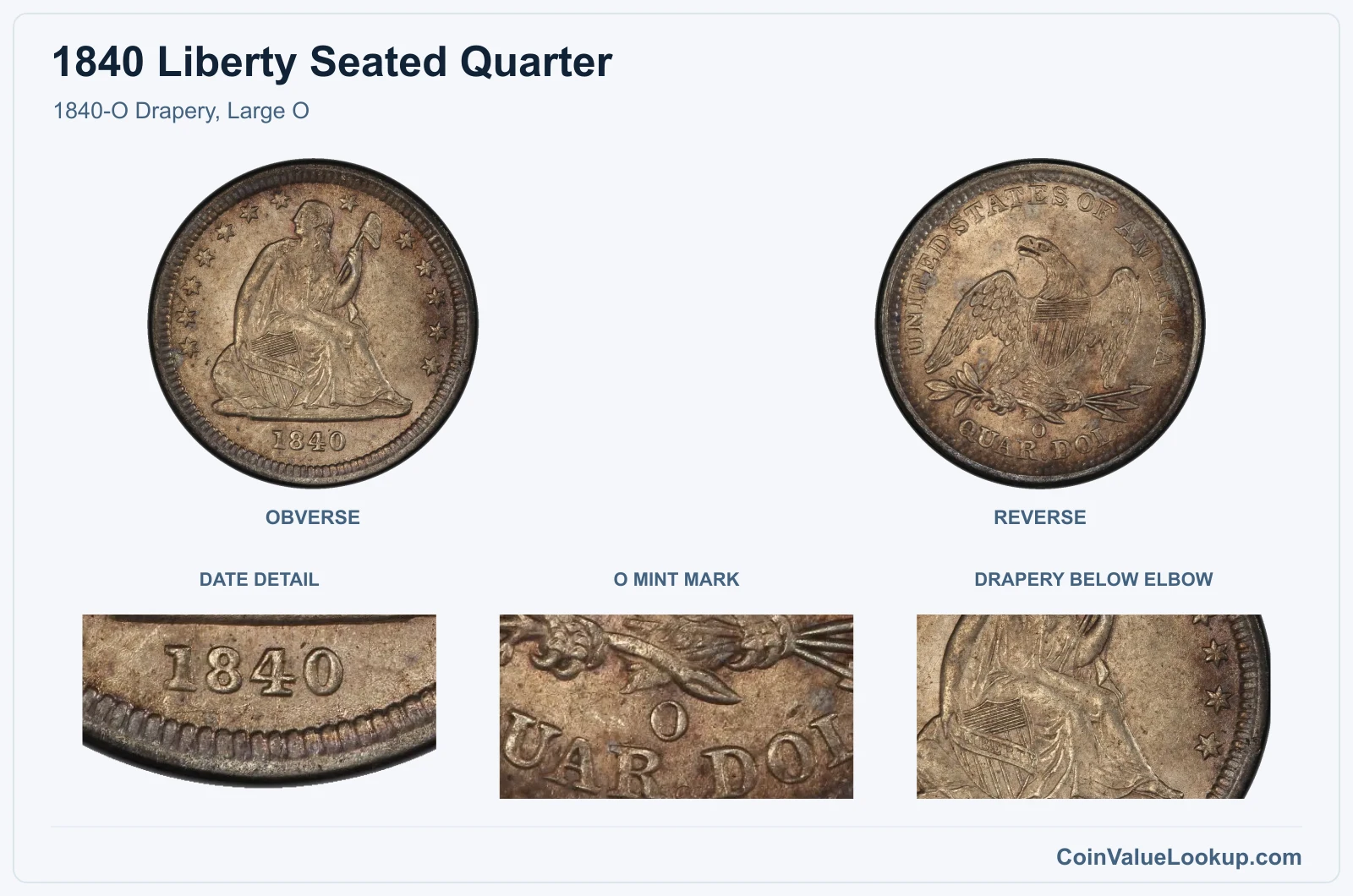
This is the one collectors chase. The Large O mintmark is elongated and centered beneath the eagle, distinctly different from the round, off-center Small O.
A second diagnostic is doubled denticles visible along portions of the reverse rim — the result of a normal die-pairing characteristic, not an error. Together these features confirm the scarce Large O die marriage.
A PCGS MS64 example sold for $35,250 at auction in April 2014. That price reflects the overall rarity of the die pairing in high grade, not just a single feature.
In lower circulated grades the coin is still scarce and desirable, but that sale represents an exceptional survivor and should not be read as a typical value for worn pieces. Careful mintmark comparison is essential — do not assume Large O without checking both the shape and the denticle doubling.
Range Grade
Price Auction Records Appraisal PO PO 1
—
Coin Identifier FR FR 2
—
Coin Identifier AG AG 3
Coin Identifier G G 4
—
Coin Identifier
G 6
—
Coin Identifier VG VG 8
—
Coin Identifier
VG 10
—
Coin Identifier F F 12
Coin Identifier
F 15
Coin Identifier VF VF 20
—
Coin Identifier
VF 25
Coin Identifier
VF 30
—
Coin Identifier
VF 35
Coin Identifier XF XF 40
Coin Identifier
XF 45
—
—
— AU AU 50
—
—
—
AU 53
—
—
—
AU 55
—
—
—
AU 58
—
—
— MS MS 60
—
—
—
MS 61
—
—
—
MS 62
—
—
—
MS 63
Coin Identifier
MS 64
—
—
—
MS 65
—
—
—
MS 66
—
—
—
MS 67
—
—
—
MS 68
—
—
—
MS 69
—
—
—
MS 70
—
—
—
1840 Liberty Seated Quarter Error List
1. 1840 Liberty Seated Quarter — Reverse Die Crack
On the rare 1840-O Drapery Large O die pairing, a raised crack runs from the rim through the "N" in UNITED and extends toward the eagle's wing. This is a thin, slightly irregular raised line — metal was forced up through the developing crack in the reverse die during striking.
Separate die bulges have also been cataloged on this specimen.
Do not confuse a die crack with a scratch or post-mint damage. Scratches are incuse (cut into the surface) and often cross design elements at odd angles.
A genuine die crack sits slightly above the surrounding field and follows a path consistent with die stress. No separate crack premium is adopted here; the $35,250 April 2014 MS64 sale price reflects the total coin — its rare Large O identity, grade and die state combined.
2. 1840 Liberty Seated Quarter — Die Clash
Die clashes occur when the obverse and reverse dies strike each other without a planchet between them, transferring faint design outlines onto the wrong die. On 1840-O No Drapery quarters, a clashed outline has been documented crossing diagonally through the reverse shield area.
Look for faint, ghostly lines that do not belong to the normal shield or eagle design.
This is easy to misidentify. Normal shield lines, light scratches and incuse brockage marks can all mimic a clash at first glance.
The true clash impression will appear as a soft transferred element from the opposite die, consistent across the field. No supported price premium is adopted for this feature; value depends on the individual coin's authenticated identity, overall condition and how visibly dramatic the clash appears.
3. 1840 Liberty Seated Quarter — Repunched Date
On some 1840-O No Drapery dies, the digit 8 in the date was punched into the working die more than once before the position was finalized. The earlier punch remnant is visible south (below) the final 8.
This happened during die preparation at the mint — the date was hand-punched into each die individually, and a misaligned first impression was corrected with a second blow.
This is not a coin struck twice (that would be a doubled strike). It is also not machine doubling, which produces flat, shelf-like distortion on the finished coin.
Wear and accidental gouges can look similar under magnification, so compare carefully. No numeric premium is adopted for this variety; assessment depends on the authenticated identity of the die, the coin's condition and how clearly the repunching is visible on the particular specimen.