1884 Liberty Seated Quarter Coin Value: How Much Is It Worth?
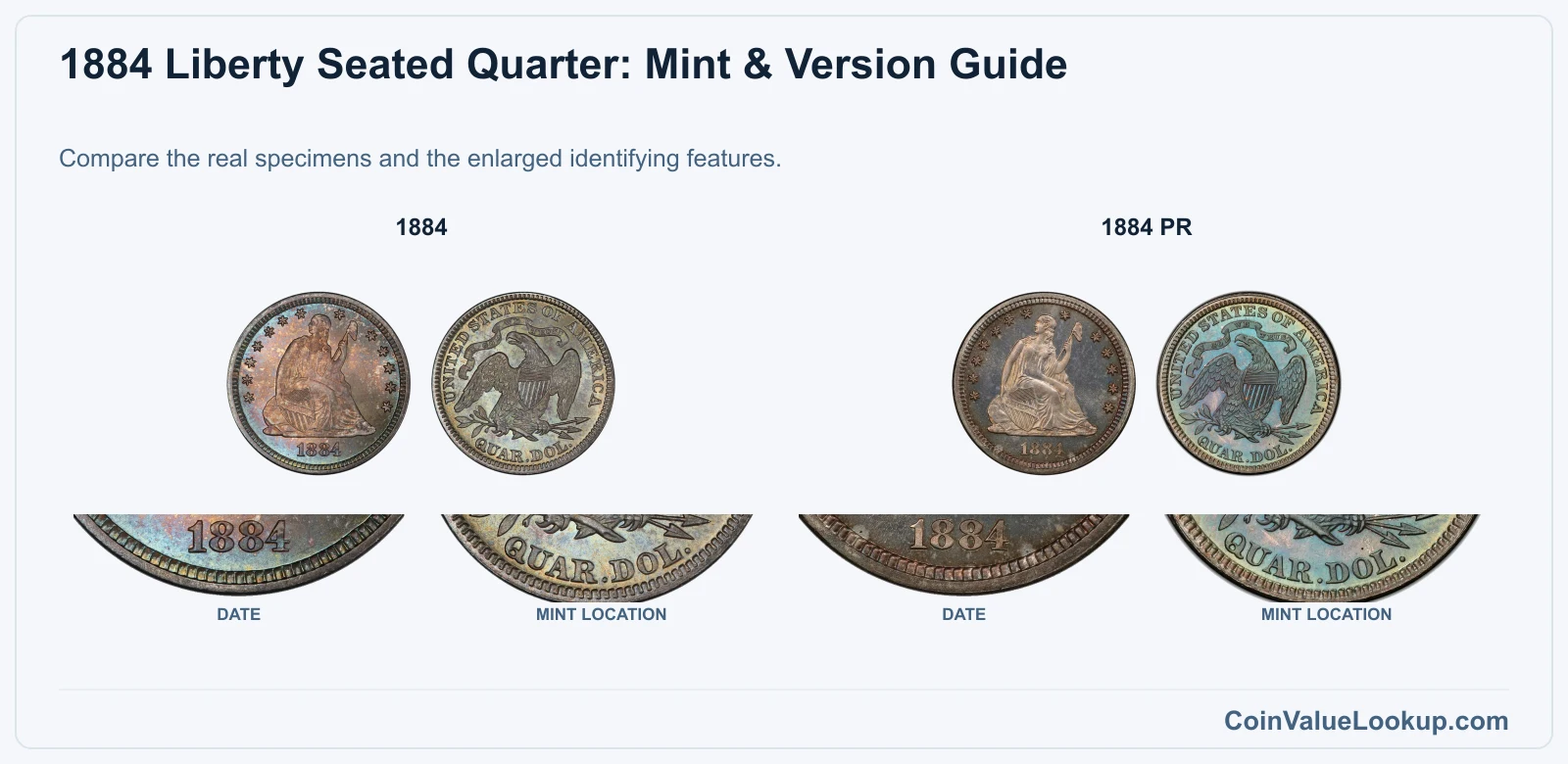
The 1884 Liberty Seated Quarter is a late-date issue in a series that ended just seven years later. Struck in 90% silver at the Philadelphia Mint, these quarters carry guide estimates ranging from about $384 in well-worn Good condition up to $1,399 in choice Mint State, depending on whether you hold a business strike or a proof.
Mint, finish, and condition all matter here, so let's sort out what yours might be worth.
Fast Way to Identify Your 1884 Liberty Seated Quarter
The quickest way to start figuring out your coin is to snap clear photos of both the front and back, then upload them here. Our identifier can give you a preliminary read on the mint, design type, and general condition.
It is not a substitute for professional grading or authentication, but it points you in the right direction fast.
1884 Liberty Seated Quarter Value
Upload both sides of your 1884 Liberty Seated Quarter.
Front Obverse
Upload photo
Back Reverse
Upload photo
Which 1884 Liberty Seated Quarter Versions Are Worth Money?
- The 1884 business strike in MS63 condition carries a USA Coin Book guide estimate of $1,399, making higher-grade examples the ones to watch for.
- The 1884 proof at PR63 lists at $938 in the same guide, and proofs in any collectible grade attract dedicated type-set and series collectors.
- Check your coin's finish first: a proof commands strong value even at moderate grades, while a business strike needs to be relatively high grade to reach four figures.
- Damage, heavy wear, or a cleaned surface does not make a coin rare. Condition and originality drive the premium on this date.
Step 1: Identify Your 1884 Liberty Seated Quarter Mint Mark and Version
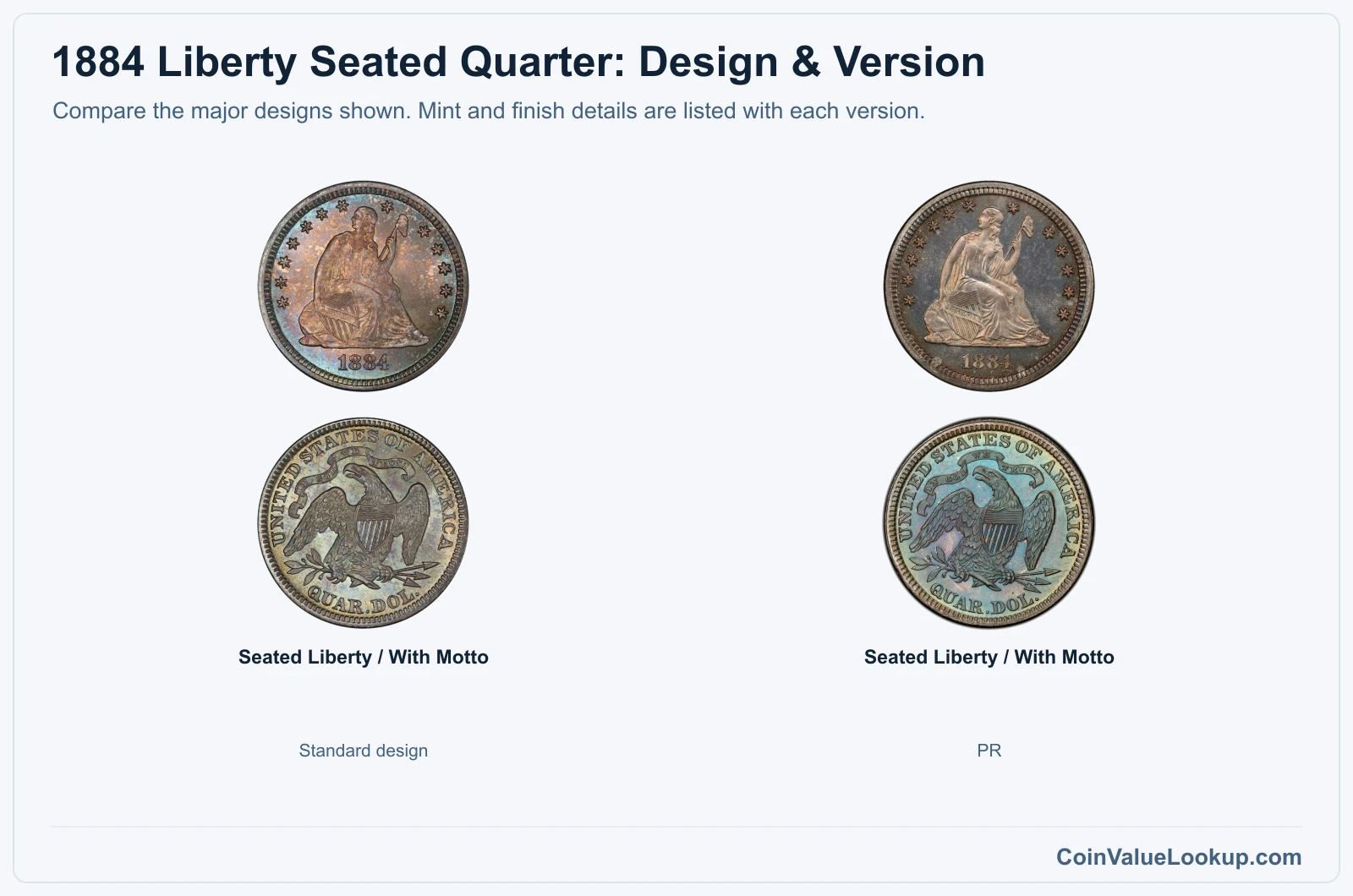
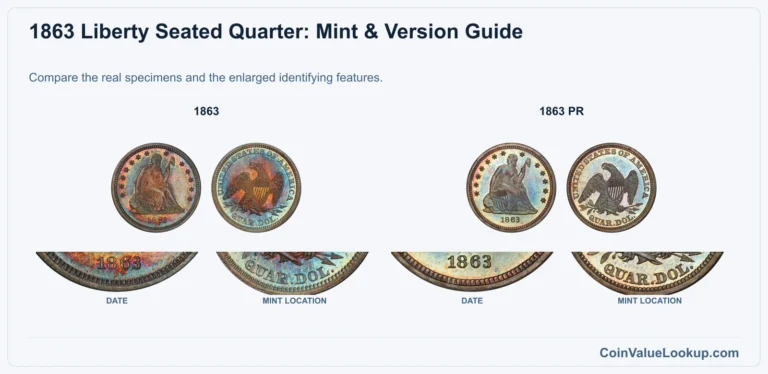
Every 1884 quarter was struck at Philadelphia, so there is no mintmark on the reverse. If you see an O, S, or CC below the eagle, you have a different date or a misattributed coin.
The obverse shows a seated figure of Liberty holding a pole and cap, with thirteen stars around the rim and the date at the bottom. The reverse features an eagle with a shield on its breast and a banner reading IN GOD WE TRUST, the motto added to the design starting in 1866.
Two versions exist for 1884: the regular business strike and the proof. Proofs were made in small numbers for collectors and have squared, knife-like rims, deeply mirrored fields, and sharper design detail from the start.
A shiny circulated coin is not a proof. If the fields look glassy and reflective under a single light source, and the rims are unusually sharp, you may have a proof.
Otherwise, assume business strike.
The coin weighs 6.25 grams and is composed of 90% silver and 10% copper.
Step 2: Check Your 1884 Liberty Seated Quarter Grade
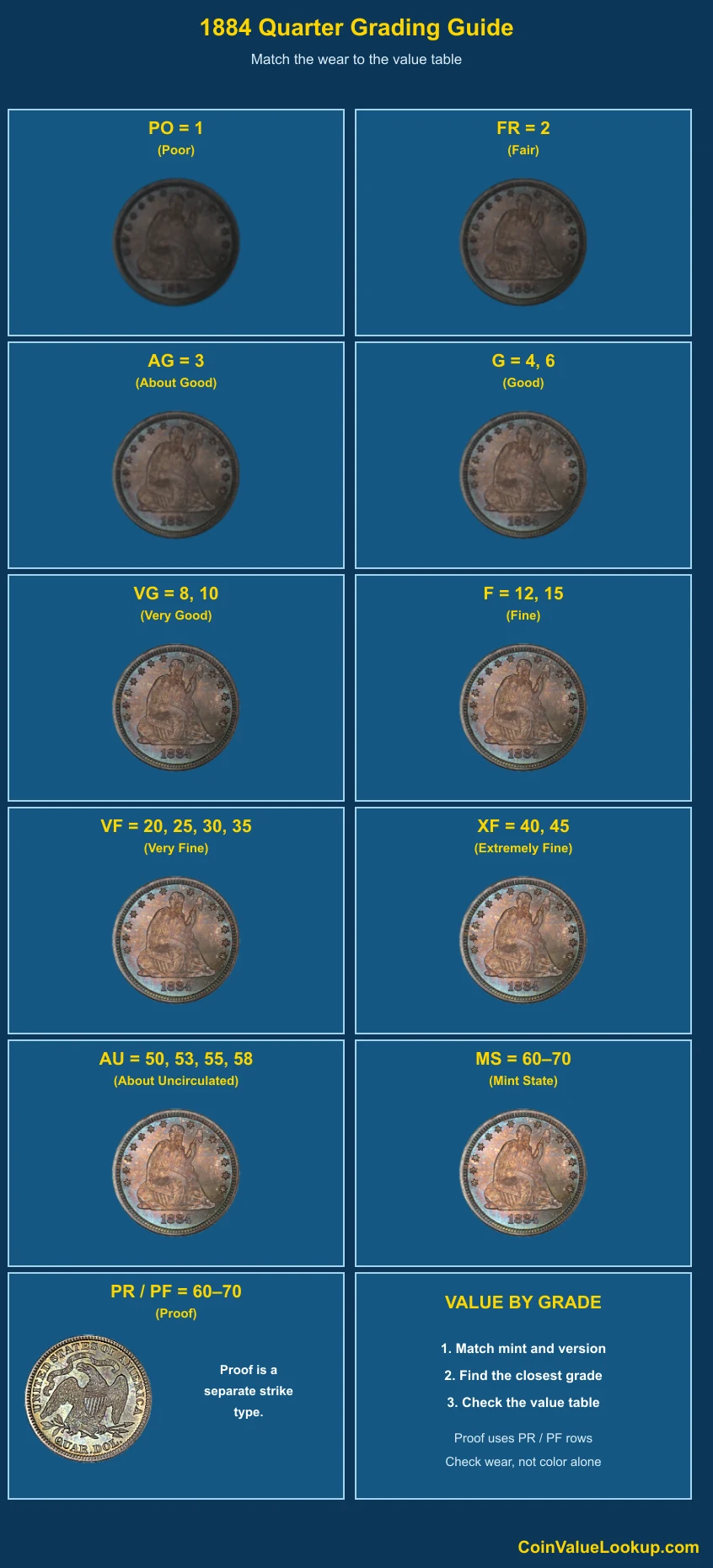
Start by examining Liberty's head, the details across her breast, and the knee area. On a well-worn piece those features blend together.
The shield on her lap loses its horizontal lines early, too.
Flip the coin over. The eagle's breast feathers and upper wing tips are the first spots to flatten with circulation.
A coin grading Good-4 will have a readable date and outline of Liberty but almost no interior detail.
Compare your coin to the reference image showing different wear levels for this type. Look at both detail sharpness and surface luster at the same time.
A weak original strike can leave the centers soft even on an unworn coin, so don't confuse strike weakness with wear.
Cleaning is the silent killer of value. If the surfaces look bright and scratchy under magnification, or the color is unnaturally white for a coin this old, it has likely been cleaned.
Cleaned coins trade well below guide prices for the same technical grade.
Step 3: Check 1884 Liberty Seated Quarter Value by Mint and Version
1884 Liberty Seated Quarter
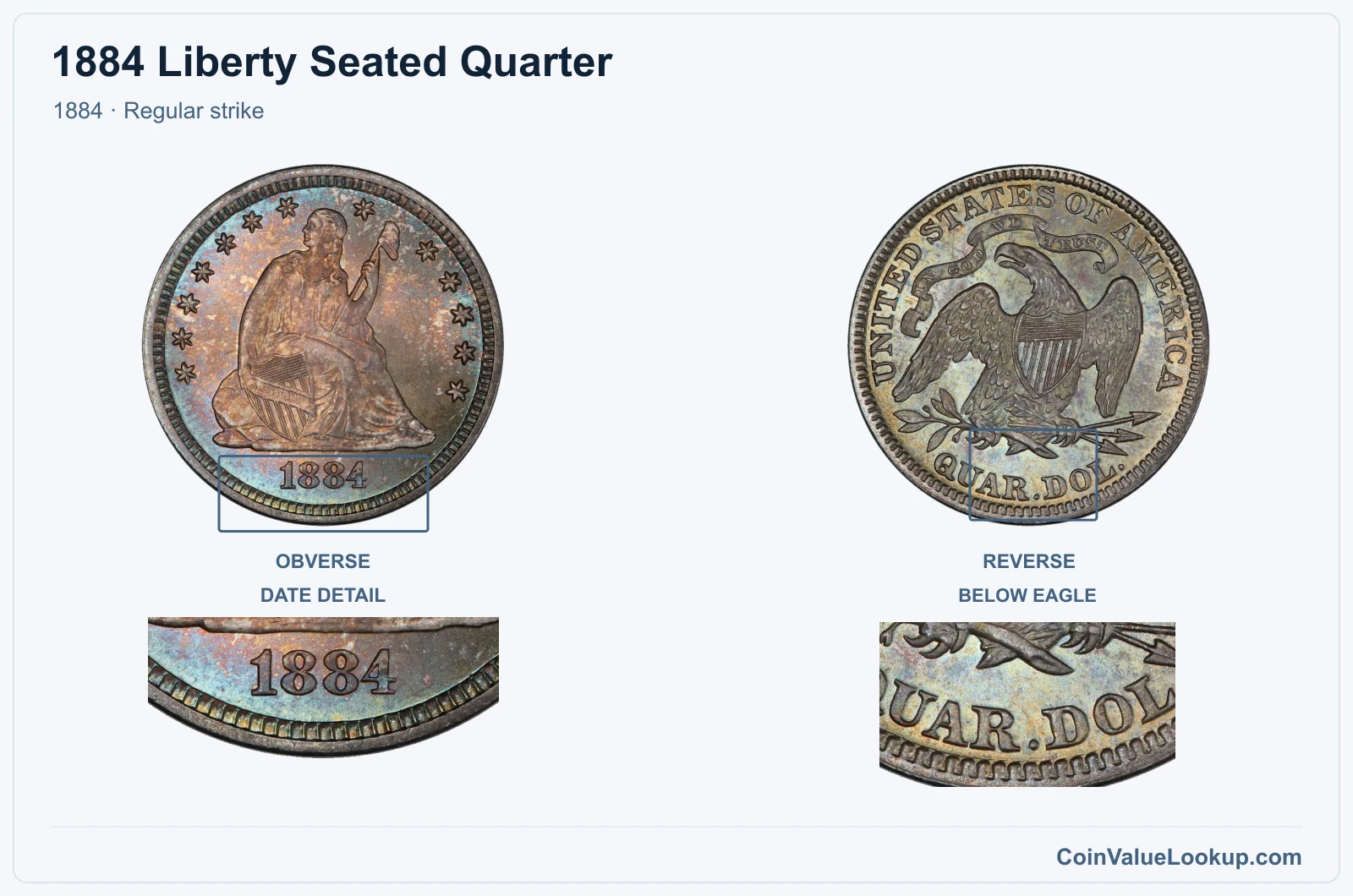
The 1884 business-strike quarter was produced at Philadelphia with no mintmark. It weighs 6.25 grams of 90% silver and carries the With Motto eagle reverse.
USA Coin Book guide estimates place this coin at roughly $384 in G4, $1,136 in MS60, and $1,399 in MS63. Those figures are retail guide estimates, not guaranteed sale prices.
A heavily worn or cleaned example will fall below even the G4 number.
Original surfaces matter a lot. Collectors want coins with natural toning or undisturbed luster, not pieces that have been polished to look shiny.
Strike quality varies, so check the center of Liberty and the eagle's breast feathers before assuming you have a high-grade coin.
Coin Value Lookup is a good starting point if you want to compare this quarter's value to other dates and denominations in your collection.
Range Grade
Price Auction Records Appraisal PO PO 1
—
Coin Identifier FR FR 2
—
Coin Identifier AG AG 3
—
Coin Identifier G G 4
—
Coin Identifier
G 6
—
Coin Identifier VG VG 8
Coin Identifier
VG 10
—
Coin Identifier F F 12
Coin Identifier
F 15
Coin Identifier VF VF 20
Coin Identifier
VF 25
Coin Identifier
VF 30
Coin Identifier
VF 35
Coin Identifier XF XF 40
Coin Identifier
XF 45
Coin Identifier AU AU 50
—
Coin Identifier
AU 53
Coin Identifier
AU 55
Coin Identifier
AU 58
Coin Identifier MS MS 60
—
Coin Identifier
MS 61
Coin Identifier
MS 62
Coin Identifier
MS 63
Coin Identifier
MS 64
Coin Identifier
MS 65
Coin Identifier
MS 66
Coin Identifier
MS 67
Coin Identifier
MS 68
—
—
—
MS 69
—
—
—
MS 70
—
—
—
1884 Liberty Seated Quarter — PR
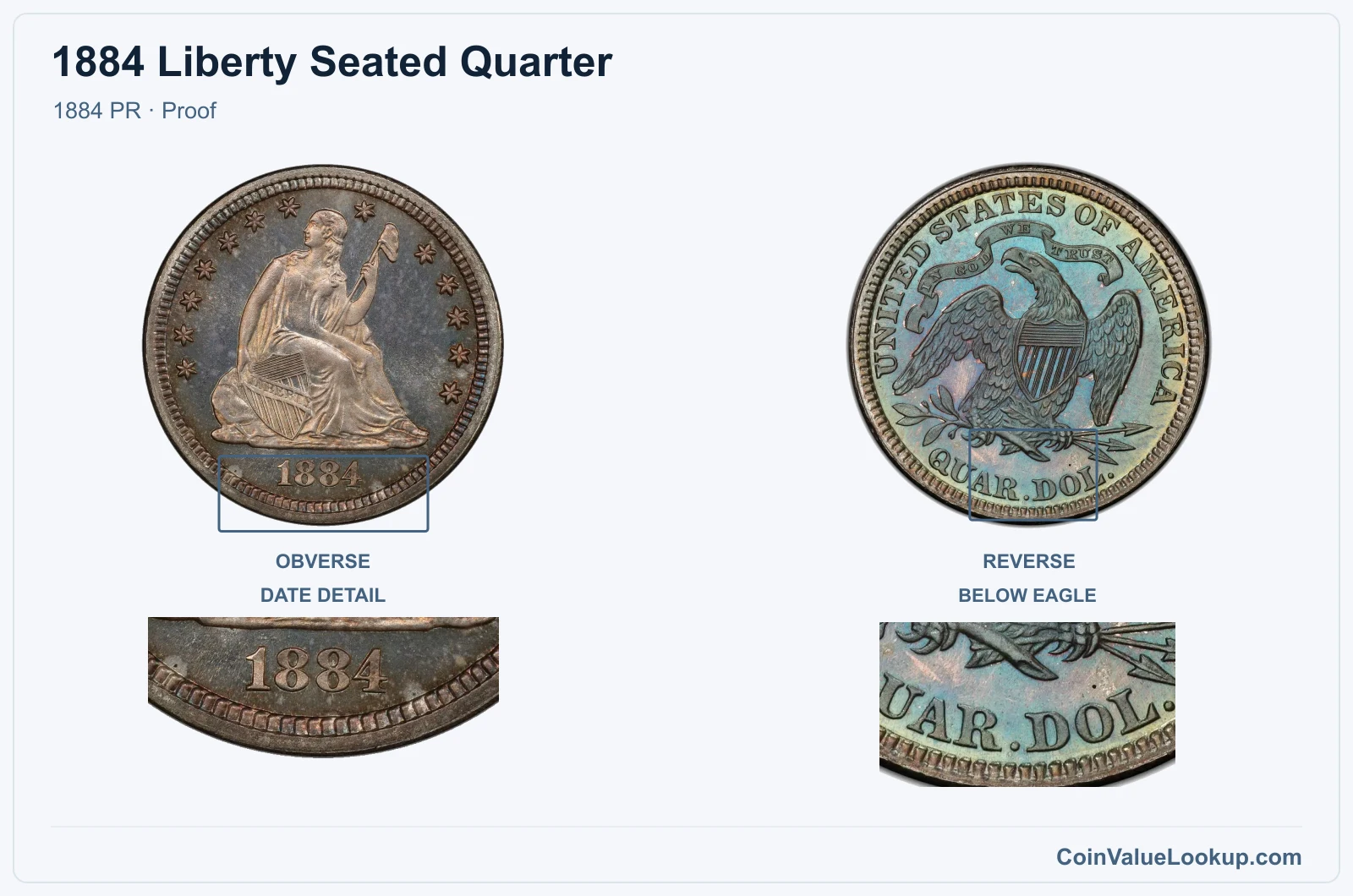
The 1884 proof quarter was a collector-only issue struck at Philadelphia. Like the business strike, it carries no mintmark, weighs 6.25 grams, and is 90% silver.
Proofs were made with polished dies and specially prepared planchets. The result is deeply mirrored fields, frosted design elements, and razor-sharp rims that differ clearly from a regular coin.
If you tilt the coin under a single point light and the flat areas act like a mirror, that is a strong sign of proof manufacture. A shiny business strike does not behave the same way.
USA Coin Book lists the PR63 grade at about $938 as a retail guide estimate, not a guaranteed offer. Hairlines, haze, and fingerprint residue are the most common problems that knock proof grades down.
Even light wiping with a cloth can leave fine scratches visible under magnification, so handling history matters as much as visual appeal.
Range Grade
Price Auction Records Appraisal PR PR 1
—
Coin Identifier
PR 2
—
Coin Identifier
PR 3
—
Coin Identifier
PR 4
—
Coin Identifier
PR 6
—
Coin Identifier
PR 8
—
Coin Identifier
PR 10
—
Coin Identifier
PR 12
—
Coin Identifier
PR 15
—
Coin Identifier
PR 20
—
Coin Identifier
PR 25
—
Coin Identifier
PR 30
—
Coin Identifier
PR 35
—
Coin Identifier
PR 40
—
Coin Identifier
PR 45
—
Coin Identifier
PR 50
—
Coin Identifier
PR 53
—
Coin Identifier
PR 55
Coin Identifier
PR 58
—
Coin Identifier
PR 60
—
Coin Identifier
PR 61
Coin Identifier
PR 62
Coin Identifier
PR 63
Coin Identifier
PR 64
Coin Identifier
PR 65
Coin Identifier
PR 66
Coin Identifier
PR 67
Coin Identifier
PR 68
Coin Identifier
PR 69
—
—
—
PR 70
—
—
—