1863 Liberty Seated Quarter Coin Value: How Much Is It Worth?
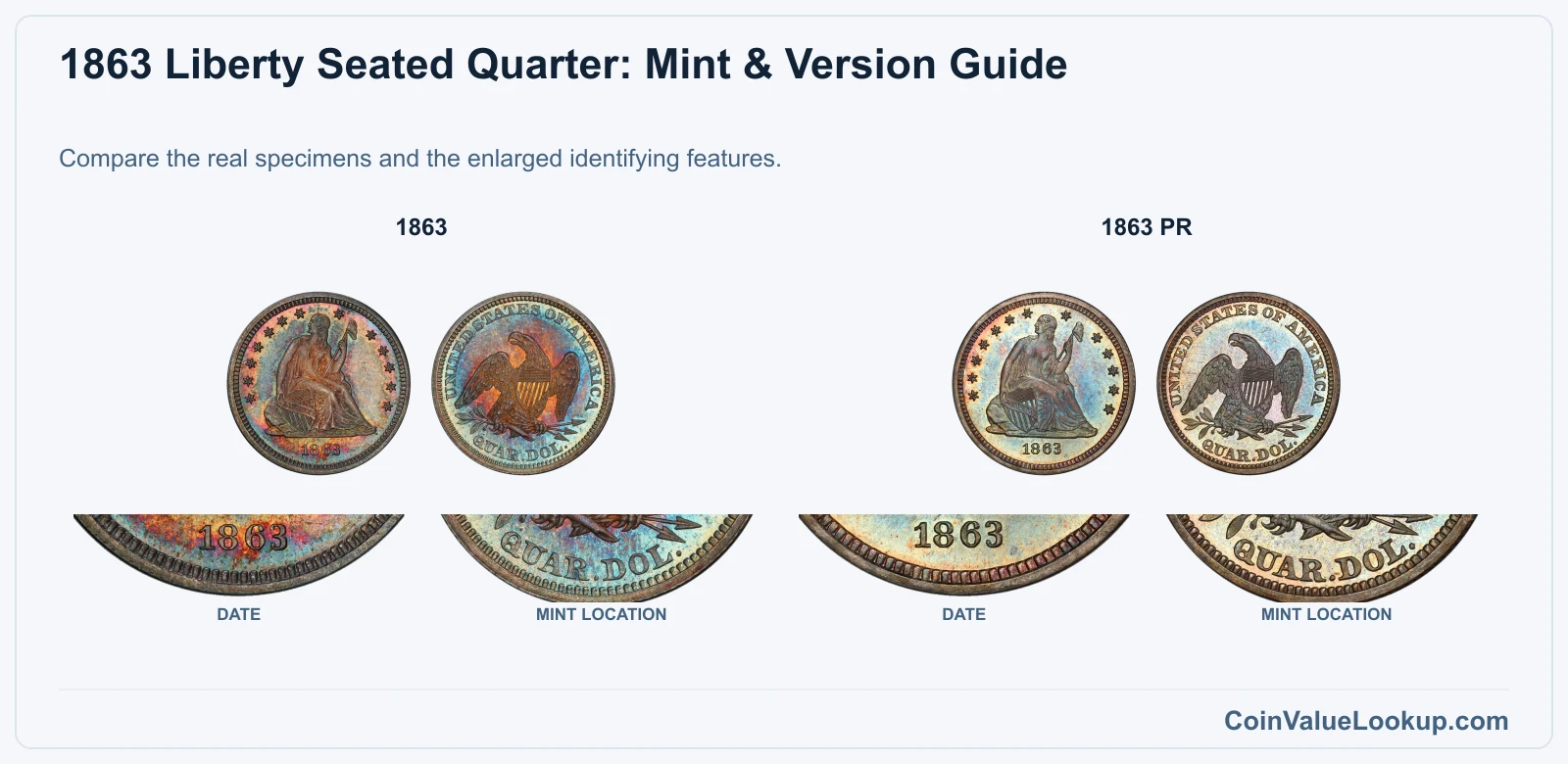
The 1863 Liberty Seated Quarter is a Civil War-era silver coin struck at the Philadelphia Mint. Guide estimates from USA Coin Book range from $89.00 in well-worn condition up to $1,683.00 for uncirculated business strikes, while proofs carry their own pricing.
Your coin's actual value depends on whether it is a regular strike or a proof, its condition, and whether original surfaces survive.
Fast Way to Identify Your 1863 Liberty Seated Quarter
The quickest way to start figuring out what your 1863 quarter is worth is to upload clear photos of the front and back. Our identifier can give you a preliminary read on which version you have and its general condition.
Snap both sides in even lighting, avoiding glare, and let the tool do the initial sorting for you.
1863 Liberty Seated Quarter Value
Upload both sides of your 1863 Liberty Seated Quarter.
Front Obverse
Upload photo
Back Reverse
Upload photo
Which 1863 Liberty Seated Quarter Versions Are Worth Money?
- 1863 business strike: USA Coin Book estimates reach $1,683.00 at MS63, making higher-grade uncirculated survivors the top targets for this date.
- 1863 Proof: Guide value of $1,453.00 at PR63; genuine proofs are scarce and must show true proof manufacture, not just a shiny surface.
- Check finish first: a proof and a business strike are priced on completely separate scales, and misidentifying one as the other leads to wrong expectations.
- Condition and originality drive value; damage, cleaning, or heavy wear can place even a scarce Civil War date near the lower end of the guide range.
Step 1: Identify Your 1863 Liberty Seated Quarter Mint Mark and Version
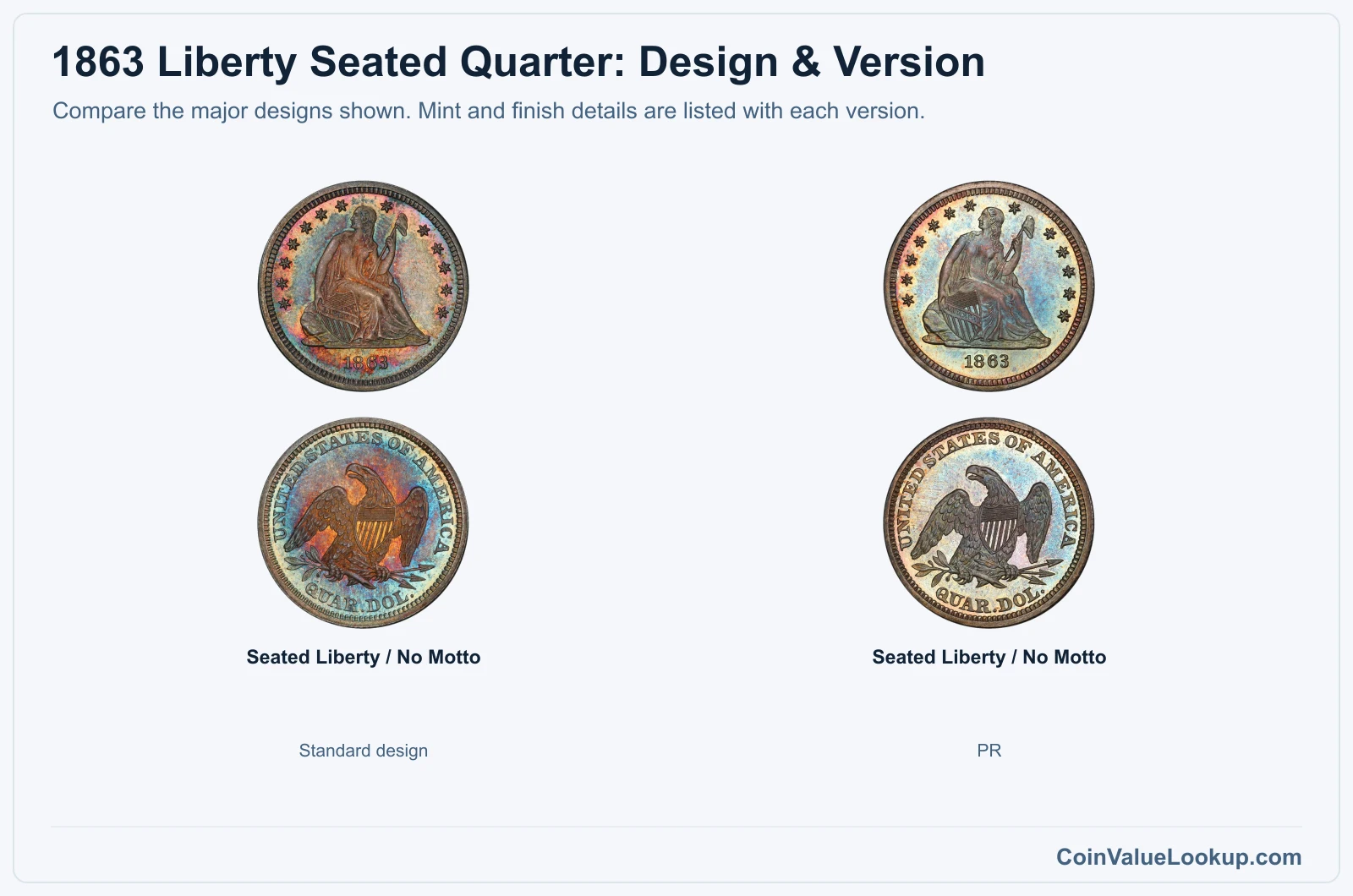
Every 1863 quarter was struck at Philadelphia, so there is no mintmark on any genuine example. The reverse shows an eagle without a motto banner above it; the IN GOD WE TRUST motto was not added to this series until 1866.
The coin is composed of 90% silver and 10% copper, with a standard weight of 6.22 grams. If your piece feels too light or has an off color, that is worth investigating before worrying about grade.
Two versions exist for 1863: the regular business strike and the proof. Proofs were made in small numbers for collectors and have a distinctly different surface character, with sharply squared rims and mirror-like fields.
A shiny circulated coin is not a proof. Look for the combination of sharp detail, mirrored fields, and squared edges before assuming proof status.
Step 2: Check Your 1863 Liberty Seated Quarter Grade
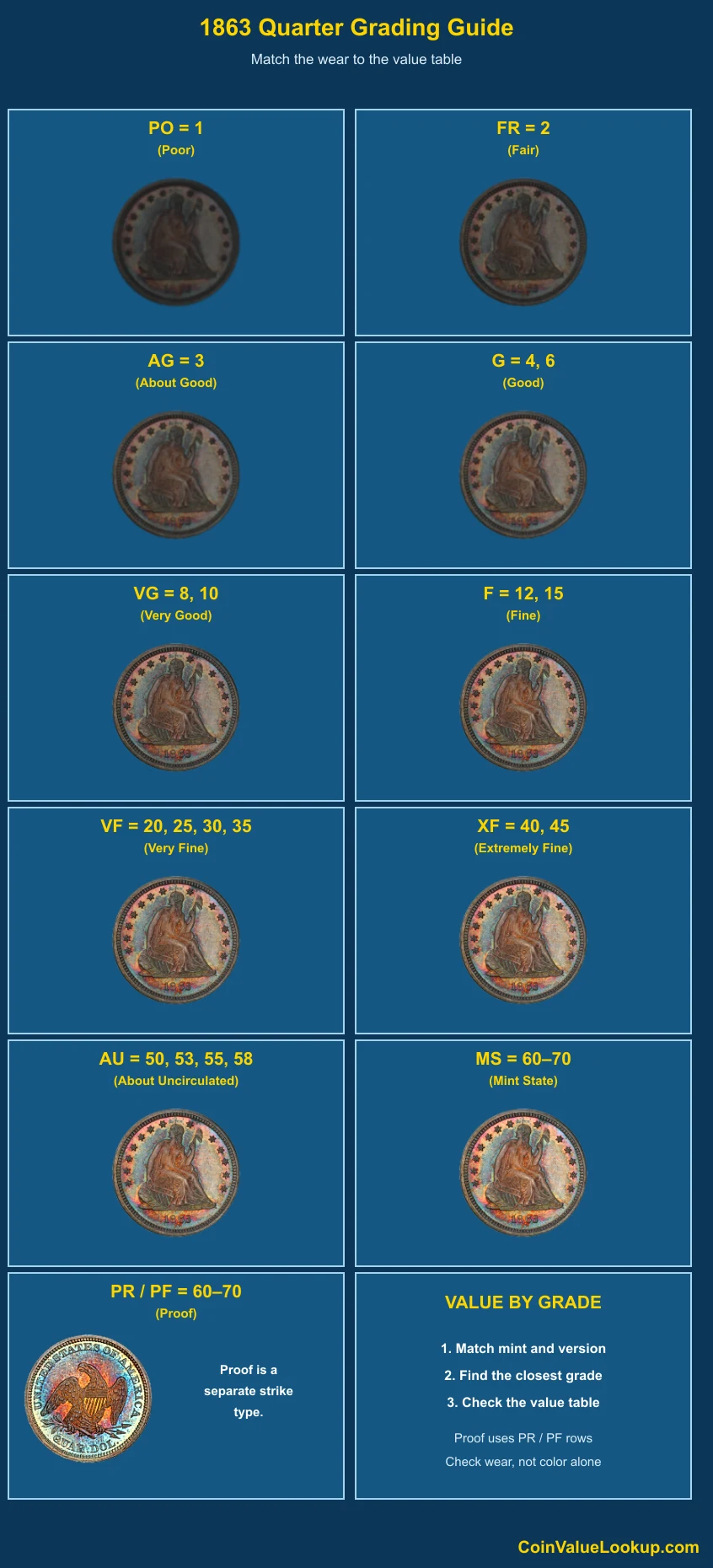
On a business-strike 1863 quarter, wear first appears on Liberty's knee, the top of her head, the breast area, and across the shield on her lap. Flip the coin over and check the eagle's breast feathers and upper wing tips for the same softness.
Compare your coin to the reference image showing wear stages for this type. A coin grading Good (G4) will have Liberty's outline visible but most interior detail worn flat.
An uncirculated piece (MS60 and above) retains full luster across the fields with no wear on the high points.
Don't confuse a weak strike with wear. Some Philadelphia quarters of this era came off the press with soft central detail, especially on Liberty's head.
Luster in the fields is the giveaway: if the fields still show original mint frost, the coin may be uncirculated despite looking soft in the center.
Cleaning kills collector premium fast. A coin that has been polished or dipped to look bright will often show hairlines under magnification and a washed-out, unnatural sheen.
That matters when pricing, because cleaned coins trade well below their apparent grade.
Coin Value Lookup is a handy starting point when you want to look up guides for other dates or denominations in this series.
Step 3: Check 1863 Liberty Seated Quarter Value by Mint and Version
1863 Liberty Seated Quarter
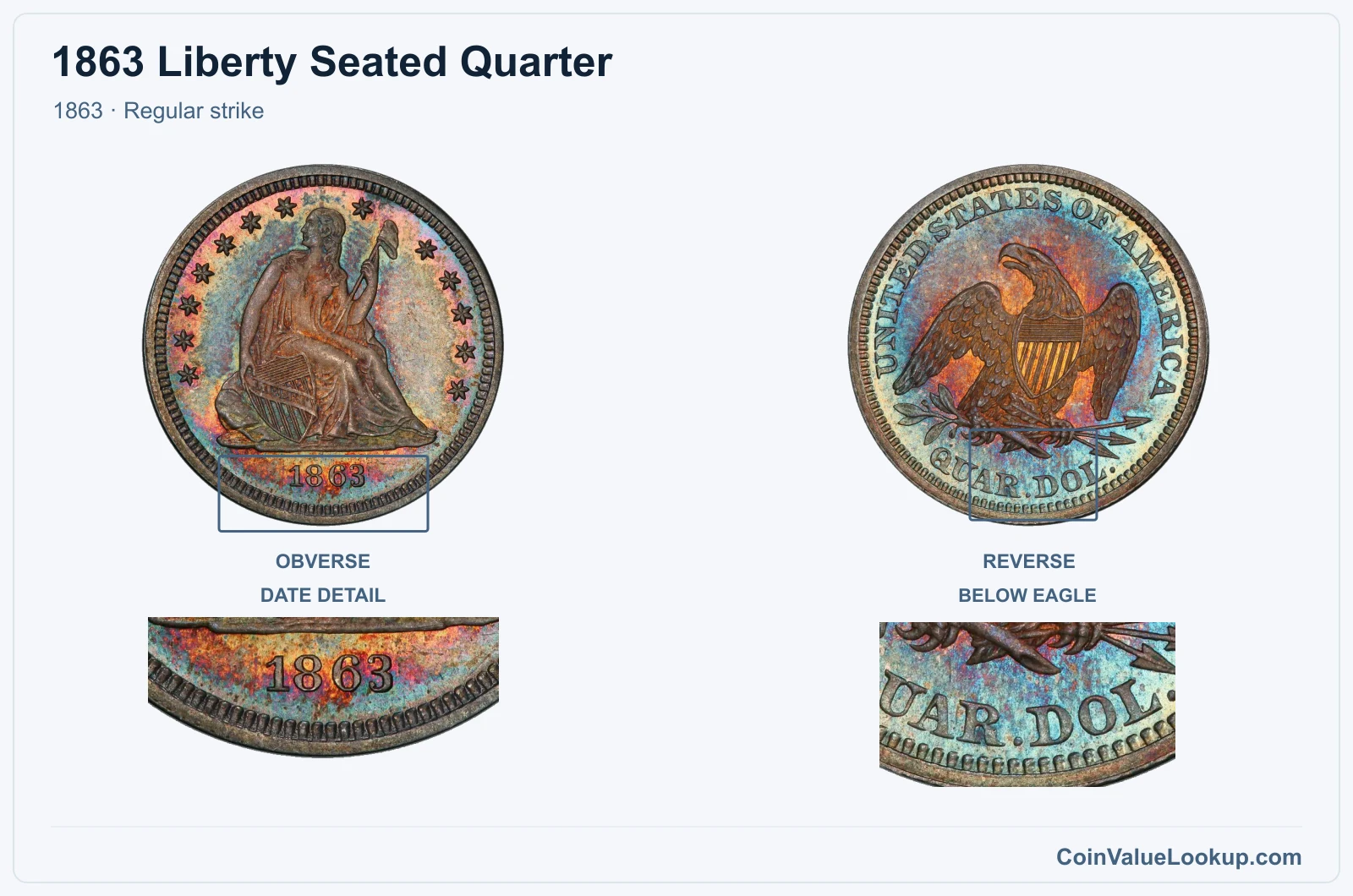
The 1863 business-strike quarter was produced at Philadelphia with no mintmark. It features the Seated Liberty obverse and an eagle reverse without the IN GOD WE TRUST motto.
This is a Civil War-era issue, and many survivors show heavy circulation.
USA Coin Book estimates place a well-worn Good-4 example at about $89.00. Jump to Mint State and the numbers shift considerably: an MS60 is estimated around $1,006.00, while an MS63 reaches $1,683.00.
These are guide estimates, not guaranteed sale prices.
Original surfaces matter a lot here. A coin with natural toning and no signs of cleaning will command more attention than one that has been scrubbed to look bright.
Match the mint (Philadelphia, no mintmark), the design (no motto), and confirm it is a regular strike before comparing grades.
Range Grade
Price Auction Records Appraisal PO PO 1
—
Coin Identifier FR FR 2
—
Coin Identifier AG AG 3
—
Coin Identifier G G 4
—
Coin Identifier
G 6
—
Coin Identifier VG VG 8
—
Coin Identifier
VG 10
—
Coin Identifier F F 12
—
Coin Identifier
F 15
Coin Identifier VF VF 20
Coin Identifier
VF 25
Coin Identifier
VF 30
Coin Identifier
VF 35
Coin Identifier XF XF 40
Coin Identifier
XF 45
Coin Identifier AU AU 50
Coin Identifier
AU 53
Coin Identifier
AU 55
Coin Identifier
AU 58
Coin Identifier MS MS 60
—
Coin Identifier
MS 61
Coin Identifier
MS 62
Coin Identifier
MS 63
Coin Identifier
MS 64
Coin Identifier
MS 65
Coin Identifier
MS 66
Coin Identifier
MS 67
—
—
—
MS 68
—
—
—
MS 69
—
—
—
MS 70
—
—
—
1863 Liberty Seated Quarter — PR
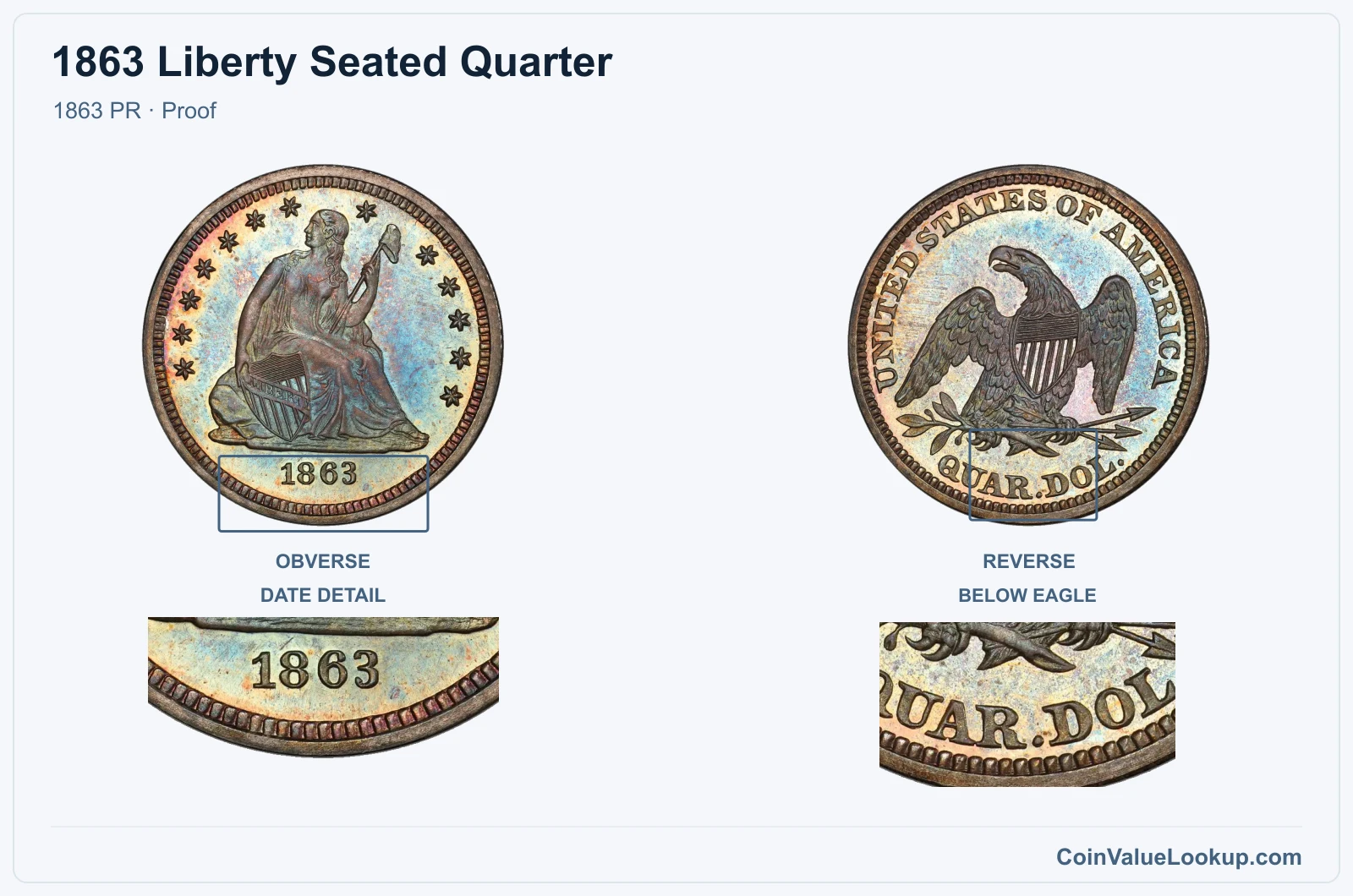
The 1863 Proof quarter was a limited collector issue from the Philadelphia Mint, struck with polished dies on prepared planchets. Genuine proofs display mirrored fields, frosted or at least sharply defined devices, and precisely squared rims that business strikes lack.
USA Coin Book estimates a PR63 example at $1,453.00. That is a guide figure, not a standing offer.
Surface quality within the proof grade matters enormously: hairlines from mishandling, haze from improper storage, and any retoning all factor into what a buyer will pay.
Do not assume your coin is a proof just because it looks shiny. A lightly circulated business strike can appear mirror-like after cleaning, but it will lack the sharp rim geometry and die characteristics of a true proof.
If you are unsure, professional authentication is the safest route. There is no mintmark on proofs of this date, same as the business strike, so that alone will not distinguish the two.
Range Grade
Price Auction Records Appraisal PR PR 1
—
Coin Identifier
PR 2
—
Coin Identifier
PR 3
—
Coin Identifier
PR 4
—
Coin Identifier
PR 6
—
Coin Identifier
PR 8
—
Coin Identifier
PR 10
—
Coin Identifier
PR 12
—
Coin Identifier
PR 15
—
Coin Identifier
PR 20
—
Coin Identifier
PR 25
—
Coin Identifier
PR 30
—
Coin Identifier
PR 35
—
Coin Identifier
PR 40
—
Coin Identifier
PR 45
—
Coin Identifier
PR 50
—
Coin Identifier
PR 53
—
Coin Identifier
PR 55
—
Coin Identifier
PR 58
—
Coin Identifier
PR 60
—
Coin Identifier
PR 61
Coin Identifier
PR 62
Coin Identifier
PR 63
Coin Identifier
PR 64
Coin Identifier
PR 65
Coin Identifier
PR 66
Coin Identifier
PR 67
Coin Identifier
PR 68
—
—
—
PR 69
—
—
—
PR 70
—
—
—