1892 Barber Quarter Coin Value: How Much Is It Worth?
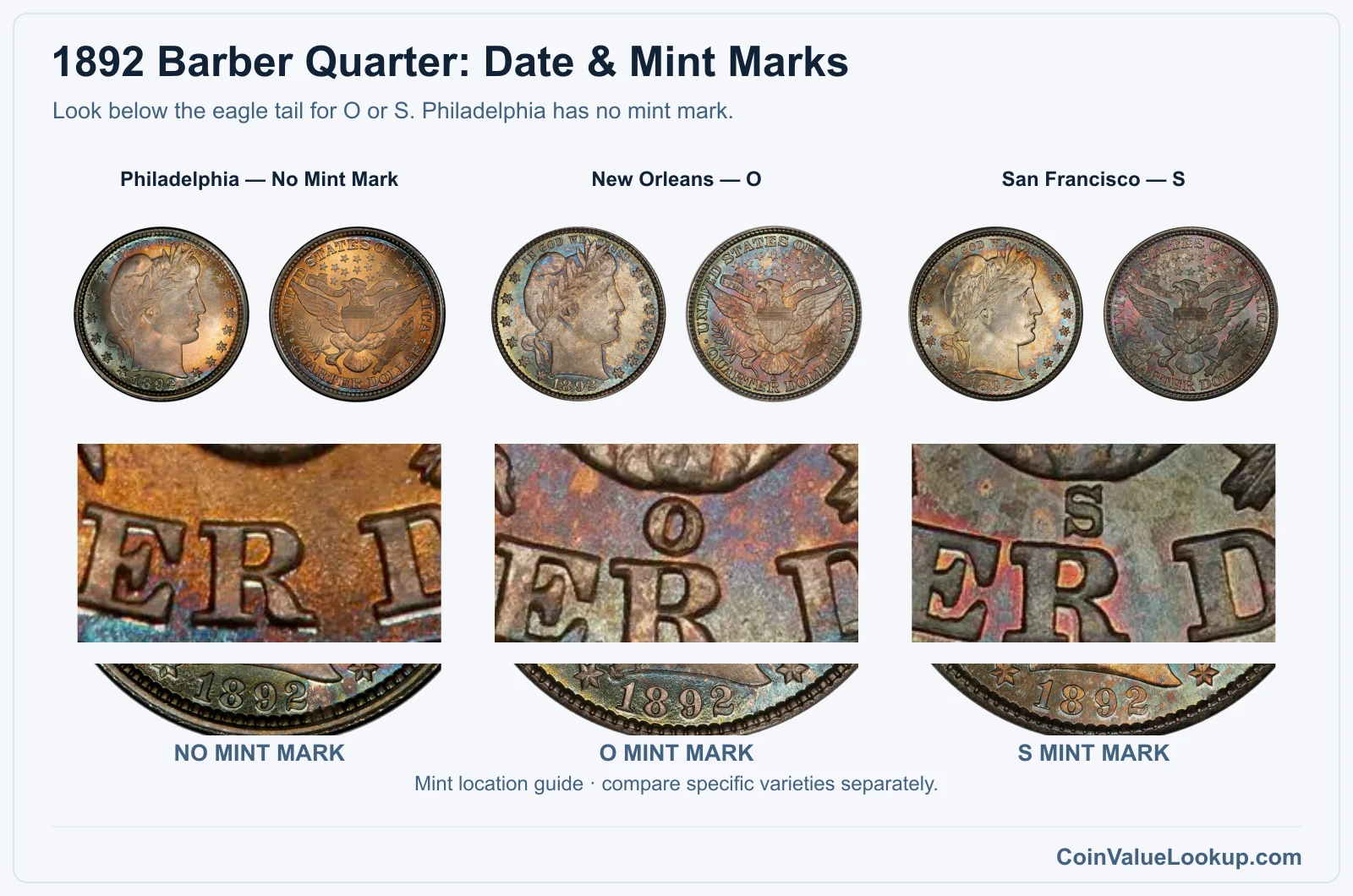
The 1892 Barber quarter was the first year of Charles Barber's new design, struck in 90% silver across three mints and two reverse hub types. USA Coin Book guide estimates for the various versions range from $24.00 to $1,399.00, depending on mint, reverse type, condition and whether the coin is a business strike or proof.
Not every 1892 quarter falls at the high end — your specific combination of mint, finish and grade determines where it lands.
Fast Way to Identify Your 1892 Barber Quarter
The quickest way to start figuring out what you have is to upload clear photos of both sides of your coin. A front-and-back image lets us offer a preliminary identification of your mint, reverse type and approximate condition.
That is not a substitute for professional authentication, but it gets you pointed in the right direction fast.
1892 Barber Quarter Value
Upload both sides of your 1892 Barber Quarter.
Front Obverse
Upload photo
Back Reverse
Upload photo
Which 1892 Barber Quarter Versions Are Worth Money?
- San Francisco issues (S mint) with either reverse type carry the highest USA Coin Book guide anchors at their listed grade, reaching $1,399.00 for business strikes.
- Philadelphia proof issues with the Type II reverse show a guide anchor up to $799.00 at the listed proof grade.
- The two reverse hub types (Type I vs. Type II) create distinct collectible branches at every mint — check the eagle wingtip against the E in UNITED.
- New Orleans (O mint) coins exist in both reverse types and are separately collected, so identify yours before assuming a value.
- Proof coins were struck only at Philadelphia; a mirror-like surface from another mint is more likely a polished business strike.
Step 1: Identify Your 1892 Barber Quarter Mint Mark and Version
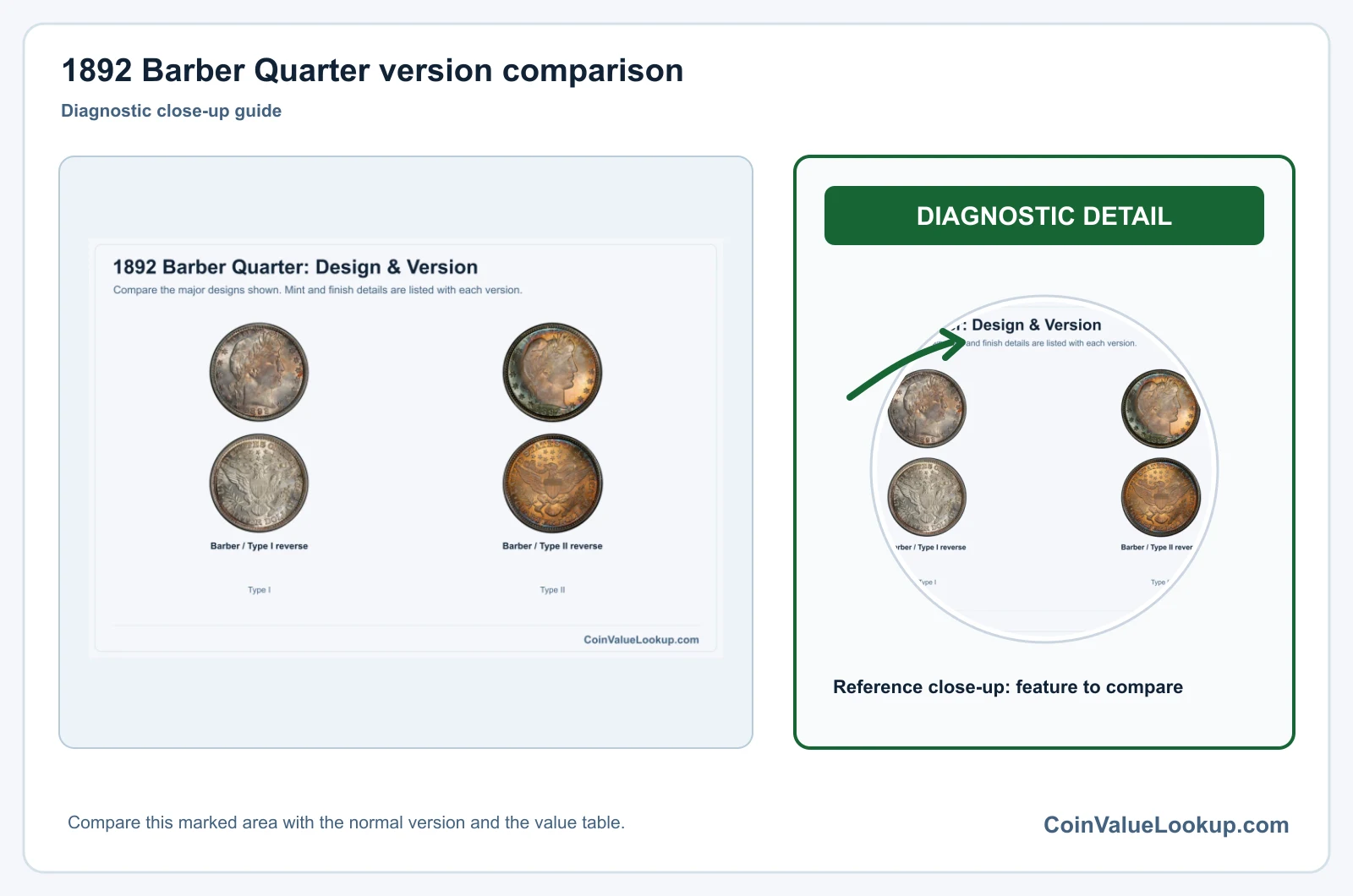
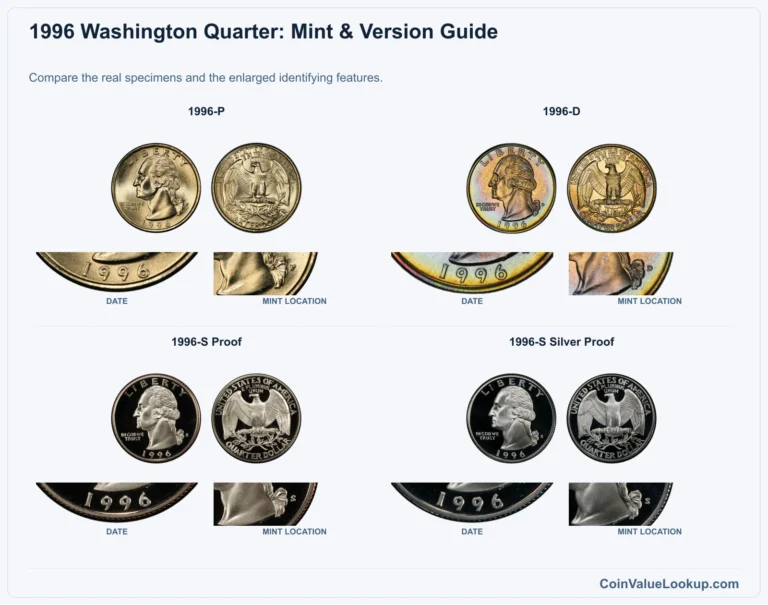
Start by flipping the coin over. The mintmark — O for New Orleans, S for San Francisco — sits on the reverse below the eagle's tail feathers, just above the denomination.
No mintmark means Philadelphia.
Next, determine the reverse type. Look at the eagle's right wingtip and the letter E in UNITED.
On the Type I reverse, the wingtip barely reaches the right serif of the E. On the Type II reverse, the wingtip extends much further, overlapping the crossbar of the E.
This is a deliberate hub redesign during 1892, not an error.
All 1892 Barber quarters are struck in 90% silver and 10% copper, weighing 6.25 grams. The obverse shows Liberty wearing a laurel wreath and Phrygian cap, with LIBERTY inscribed on the headband.
The reverse carries a heraldic eagle.
With three mints, two reverse types and two finishes (business and proof, the latter only from Philadelphia), you have eight possible branches for this single year. Confirming the right one matters before you start looking up values.
Step 2: Check Your 1892 Barber Quarter Grade
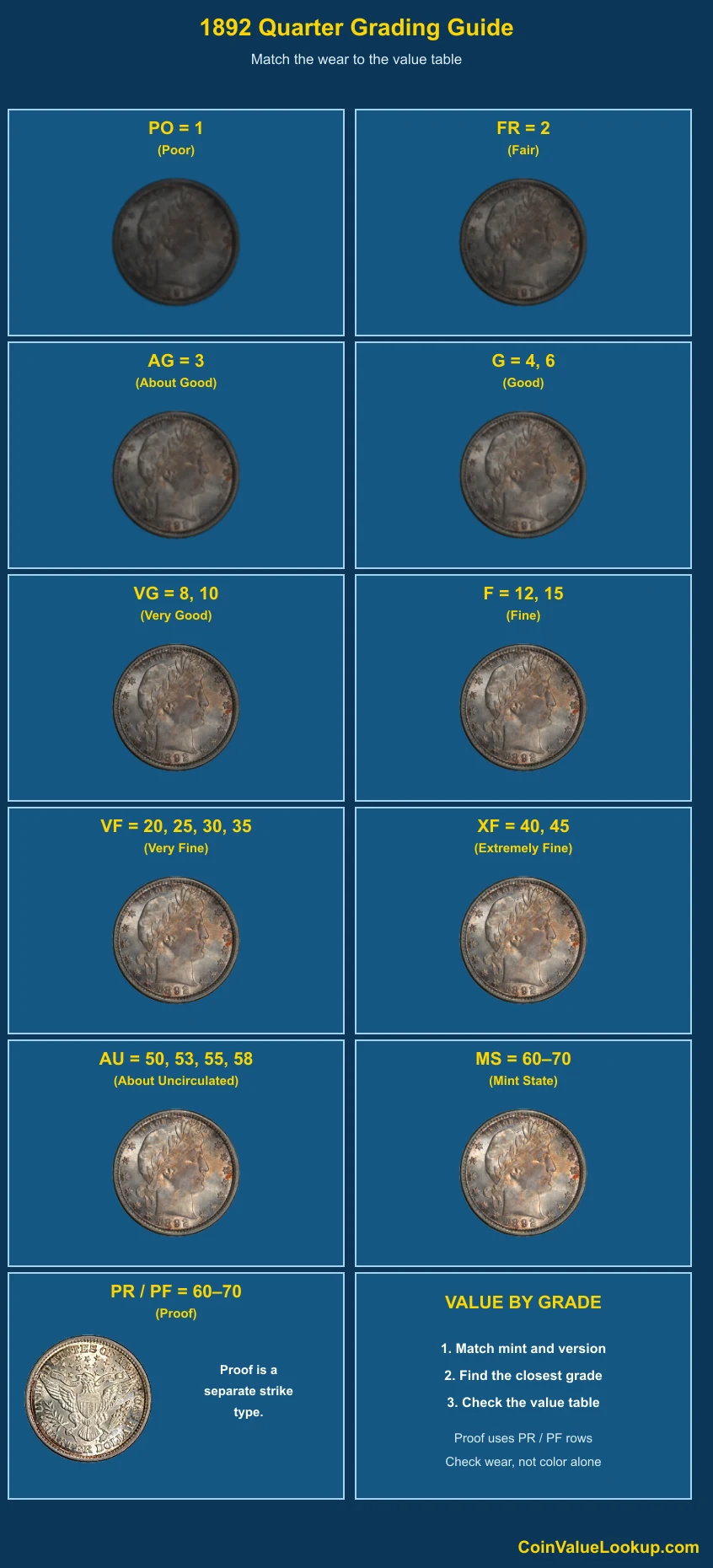
Focus on a few key wear points. On the obverse, check the hair above Liberty's forehead, the cheek and the wreath leaves — these are the first areas to lose detail.
On the reverse, look at the eagle's breast, the tops of the wings and the tail feathers.
The word LIBERTY on the headband is a classic grading shortcut, but do not rely on it alone. Combine it with overall surface wear and remaining luster.
Compare your coin to the reference image. A coin with full LIBERTY but dull, worn fields is not the same grade as one with partial LIBERTY but strong cartwheel luster.
A weak strike can also reduce detail on a coin that has never circulated, so do not confuse soft features from a weak strike with actual wear.
Step 3: Check 1892 Barber Quarter Value by Mint and Version
1892 Barber Quarter — No mark — Type I reverse — business
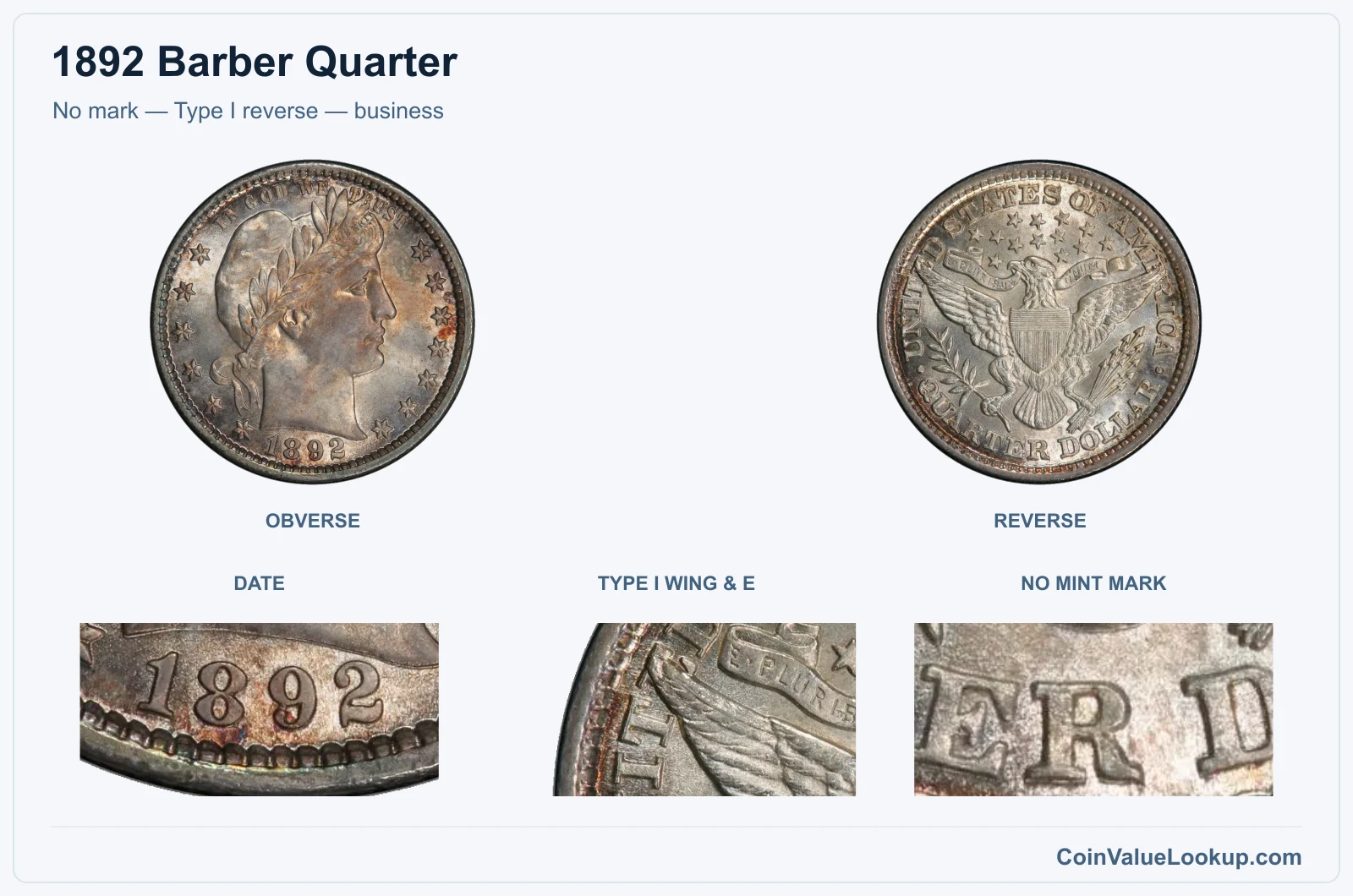
The Philadelphia Type I reverse business strike pairs the first-year obverse with the original reverse hub. On this version the eagle's right wingtip just reaches the right serif of the E in UNITED — it does not overlap the crossbar.
Because this is the inaugural Barber quarter issue, collector demand is steady, though no specific Type I guide price is separately adopted. Value depends on authenticated identity, condition and any die variety present.
Have your coin confirmed before assuming either reverse type.
Ordinary-issue reference: Ordinary-issue reference only: The table below shows prices for the 1892 Barber Quarter (regular strike). It does not represent the value of the specific No mark — Type I reverse — business variety or its variety premium. Year, mint, metal and strike type are matched; the specific variety is not priced by this table.
Range Grade
Price Auction Records Appraisal PO PO 1
—
Coin Identifier FR FR 2
—
Coin Identifier AG AG 3
—
Coin Identifier G G 4
—
Coin Identifier
G 6
—
Coin Identifier VG VG 8
—
Coin Identifier
VG 10
—
Coin Identifier F F 12
—
Coin Identifier
F 15
—
Coin Identifier VF VF 20
—
Coin Identifier
VF 25
Coin Identifier
VF 30
Coin Identifier
VF 35
Coin Identifier XF XF 40
Coin Identifier
XF 45
Coin Identifier AU AU 50
Coin Identifier
AU 53
Coin Identifier
AU 55
Coin Identifier
AU 58
Coin Identifier MS MS 60
Coin Identifier
MS 61
Coin Identifier
MS 62
Coin Identifier
MS 63
Coin Identifier
MS 64
Coin Identifier
MS 65
Coin Identifier
MS 66
Coin Identifier
MS 67
Coin Identifier
MS 68
Coin Identifier
MS 69
—
—
—
MS 70
—
—
—
1892 Barber Quarter — No mark — Type II reverse — business
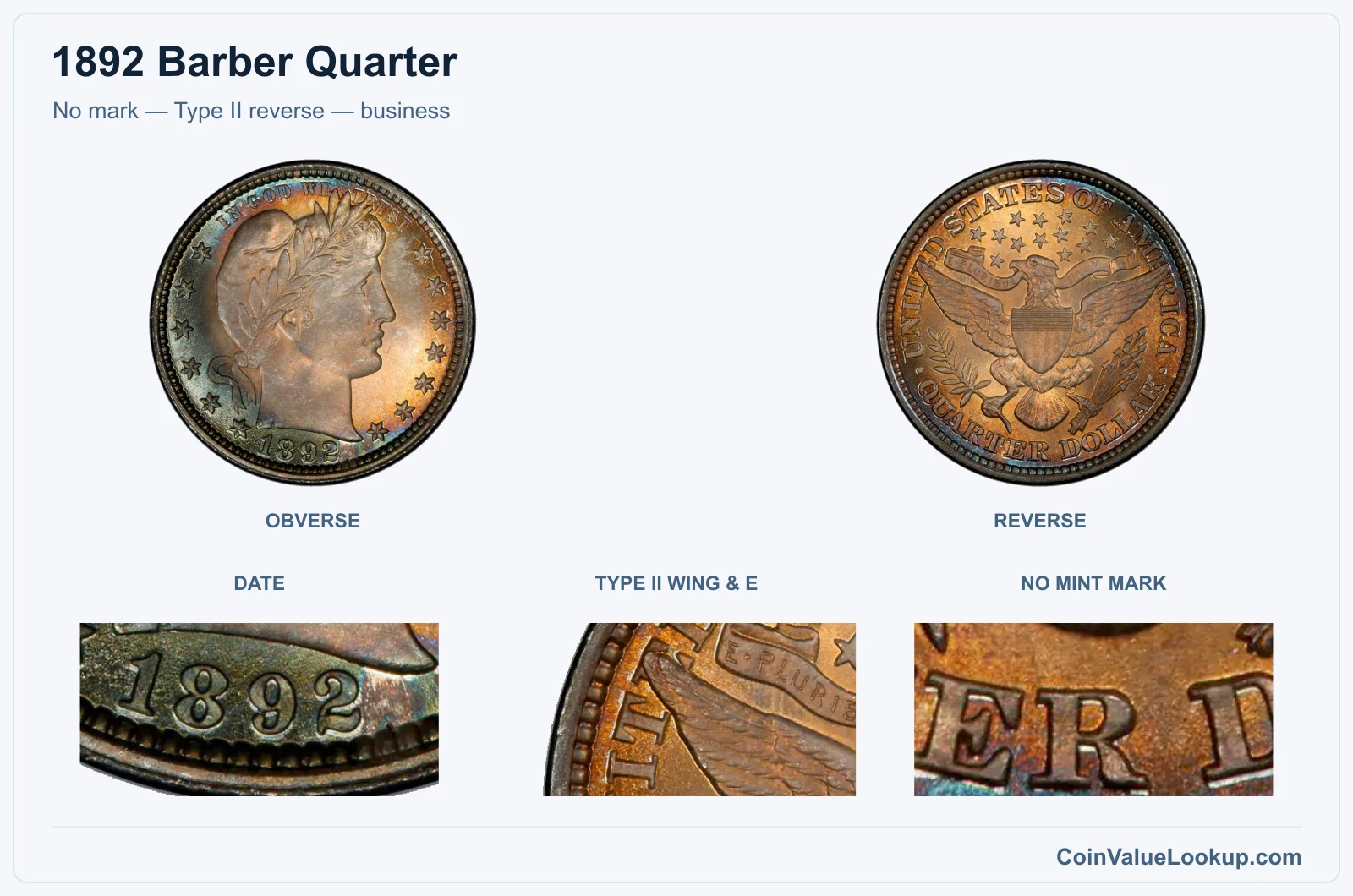
Philadelphia's Type II reverse business strike uses the revised hub where the eagle's wingtip clearly overlaps the crossbar of the E in UNITED. Side by side with a Type I the difference is obvious; on its own it takes a careful look.
No separately adopted guide price exists for this specific version, so value comes down to individual assessment of grade, eye appeal and authentication. Both Philadelphia reverse types were produced in the same year, and telling them apart is the first step.
Coin Value Lookup is a good starting point if you want to compare your 1892 quarter against other Barber dates and mints in the series.
Ordinary-issue reference: Ordinary-issue reference only: The table below shows prices for the 1892 Barber Quarter (regular strike). It does not represent the value of the specific No mark — Type II reverse — business variety or its variety premium. Year, mint, metal and strike type are matched; the specific variety is not priced by this table.
Range Grade
Price Auction Records Appraisal PO PO 1
—
Coin Identifier FR FR 2
—
Coin Identifier AG AG 3
—
Coin Identifier G G 4
—
Coin Identifier
G 6
—
Coin Identifier VG VG 8
—
Coin Identifier
VG 10
—
Coin Identifier F F 12
—
Coin Identifier
F 15
—
Coin Identifier VF VF 20
—
Coin Identifier
VF 25
Coin Identifier
VF 30
Coin Identifier
VF 35
Coin Identifier XF XF 40
Coin Identifier
XF 45
Coin Identifier AU AU 50
Coin Identifier
AU 53
Coin Identifier
AU 55
Coin Identifier
AU 58
Coin Identifier MS MS 60
Coin Identifier
MS 61
Coin Identifier
MS 62
Coin Identifier
MS 63
Coin Identifier
MS 64
Coin Identifier
MS 65
Coin Identifier
MS 66
Coin Identifier
MS 67
Coin Identifier
MS 68
Coin Identifier
MS 69
—
—
—
MS 70
—
—
—
1892 Barber Quarter — O — Type I reverse — business
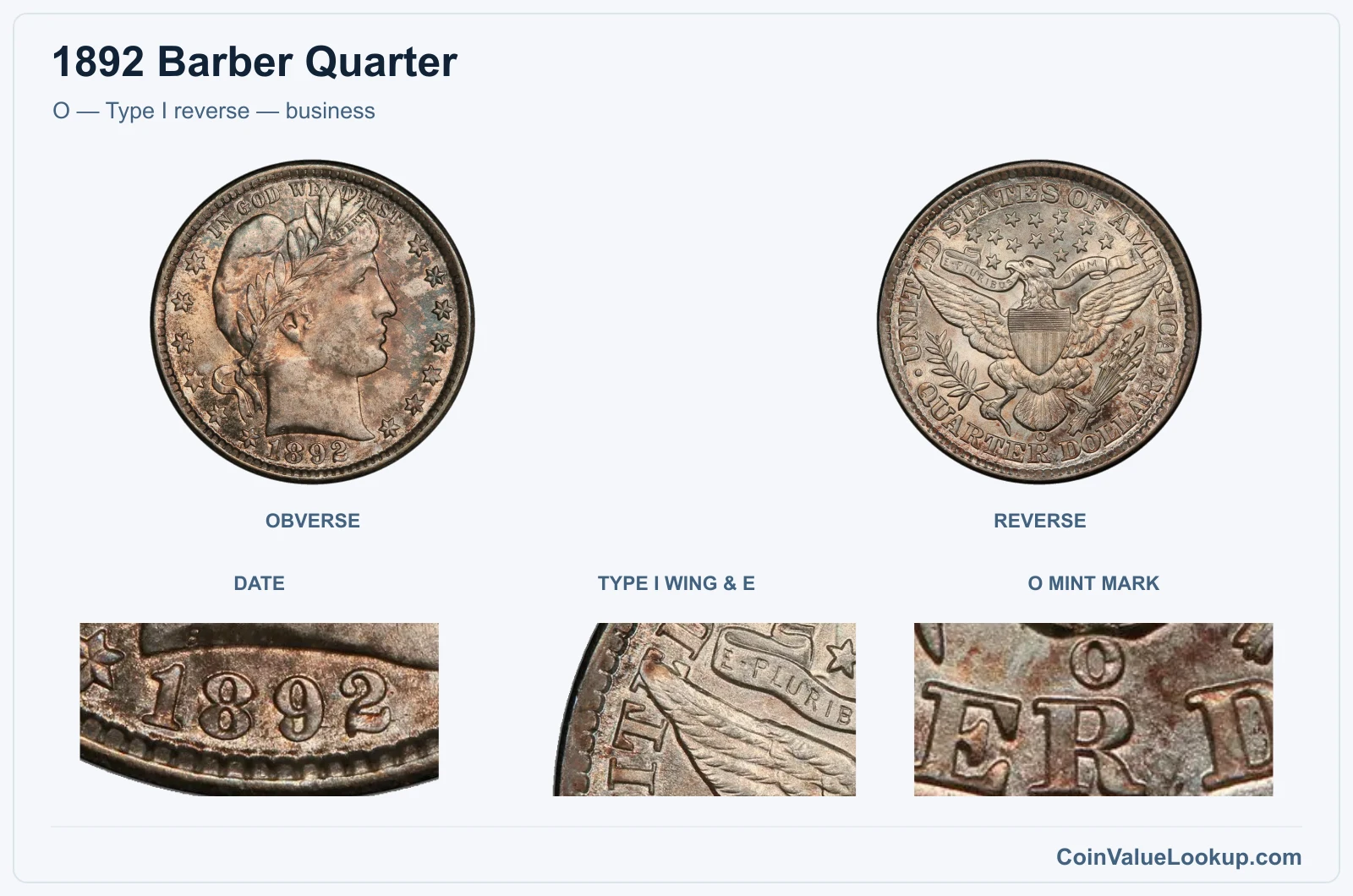
New Orleans struck 1892 Barber quarters with the Type I reverse hub. The O mintmark appears below the eagle's tail.
On this version the eagle's right wingtip reaches only the right serif of the E in UNITED. No separately adopted guide price exists for the O-mint Type I specifically, so value hinges on authenticated condition, eye appeal and any die varieties.
New Orleans coins from this era can show softer strikes, so examine carefully before judging wear.
Ordinary-issue reference: Ordinary-issue reference only: The table below shows prices for the 1892-O Barber Quarter (regular strike). It does not represent the value of the specific O — Type I reverse — business variety or its variety premium. Year, mint, metal and strike type are matched; the specific variety is not priced by this table.
Range Grade
Price Auction Records Appraisal PO PO 1
—
Coin Identifier FR FR 2
—
Coin Identifier AG AG 3
—
Coin Identifier G G 4
—
Coin Identifier
G 6
—
Coin Identifier VG VG 8
—
Coin Identifier
VG 10
—
Coin Identifier F F 12
Coin Identifier
F 15
—
Coin Identifier VF VF 20
—
Coin Identifier
VF 25
—
Coin Identifier
VF 30
Coin Identifier
VF 35
—
Coin Identifier XF XF 40
Coin Identifier
XF 45
Coin Identifier AU AU 50
Coin Identifier
AU 53
Coin Identifier
AU 55
Coin Identifier
AU 58
Coin Identifier MS MS 60
Coin Identifier
MS 61
Coin Identifier
MS 62
Coin Identifier
MS 63
Coin Identifier
MS 64
Coin Identifier
MS 65
Coin Identifier
MS 66
Coin Identifier
MS 67
Coin Identifier
MS 68
—
—
—
MS 69
—
—
—
MS 70
—
—
—
1892 Barber Quarter — O — Type II reverse — business
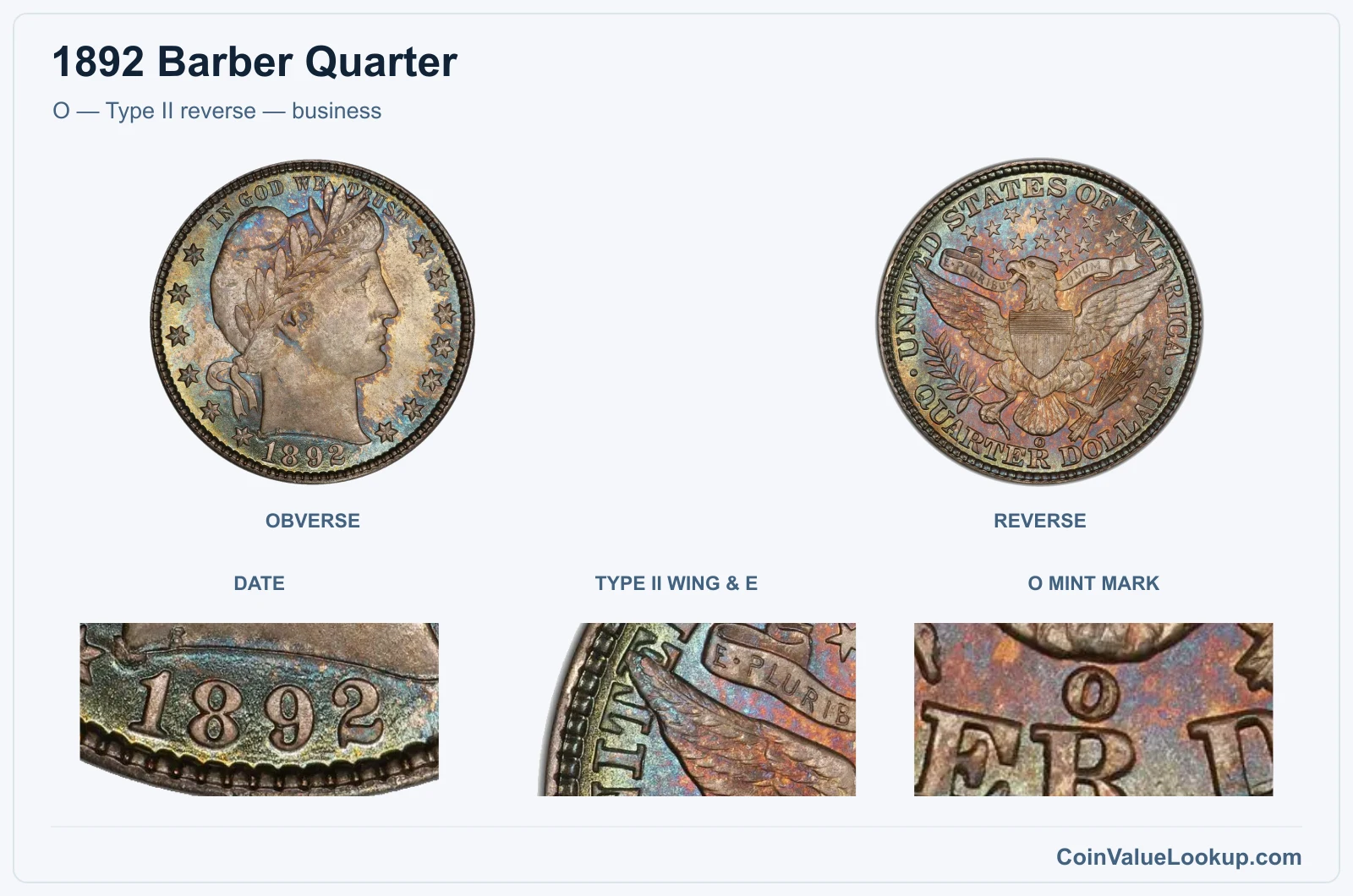
The O-mint Type II reverse uses the revised hub — the eagle wingtip overlaps the crossbar of the E in UNITED. Otherwise the specifications are the same: 90% silver, 6.25 grams, O mintmark below the eagle tail.
As with other 1892 branches, no separately adopted guide price is available for this particular combination. Individual assessment based on grade, surfaces and confirmation of the reverse type is the way to determine what your coin is worth.
Ordinary-issue reference: Ordinary-issue reference only: The table below shows prices for the 1892-O Barber Quarter (regular strike). It does not represent the value of the specific O — Type II reverse — business variety or its variety premium. Year, mint, metal and strike type are matched; the specific variety is not priced by this table.
Range Grade
Price Auction Records Appraisal PO PO 1
—
Coin Identifier FR FR 2
—
Coin Identifier AG AG 3
—
Coin Identifier G G 4
—
Coin Identifier
G 6
—
Coin Identifier VG VG 8
—
Coin Identifier
VG 10
—
Coin Identifier F F 12
Coin Identifier
F 15
—
Coin Identifier VF VF 20
—
Coin Identifier
VF 25
—
Coin Identifier
VF 30
Coin Identifier
VF 35
—
Coin Identifier XF XF 40
Coin Identifier
XF 45
Coin Identifier AU AU 50
Coin Identifier
AU 53
Coin Identifier
AU 55
Coin Identifier
AU 58
Coin Identifier MS MS 60
Coin Identifier
MS 61
Coin Identifier
MS 62
Coin Identifier
MS 63
Coin Identifier
MS 64
Coin Identifier
MS 65
Coin Identifier
MS 66
Coin Identifier
MS 67
Coin Identifier
MS 68
—
—
—
MS 69
—
—
—
MS 70
—
—
—
1892 Barber Quarter — S — Type I reverse — business
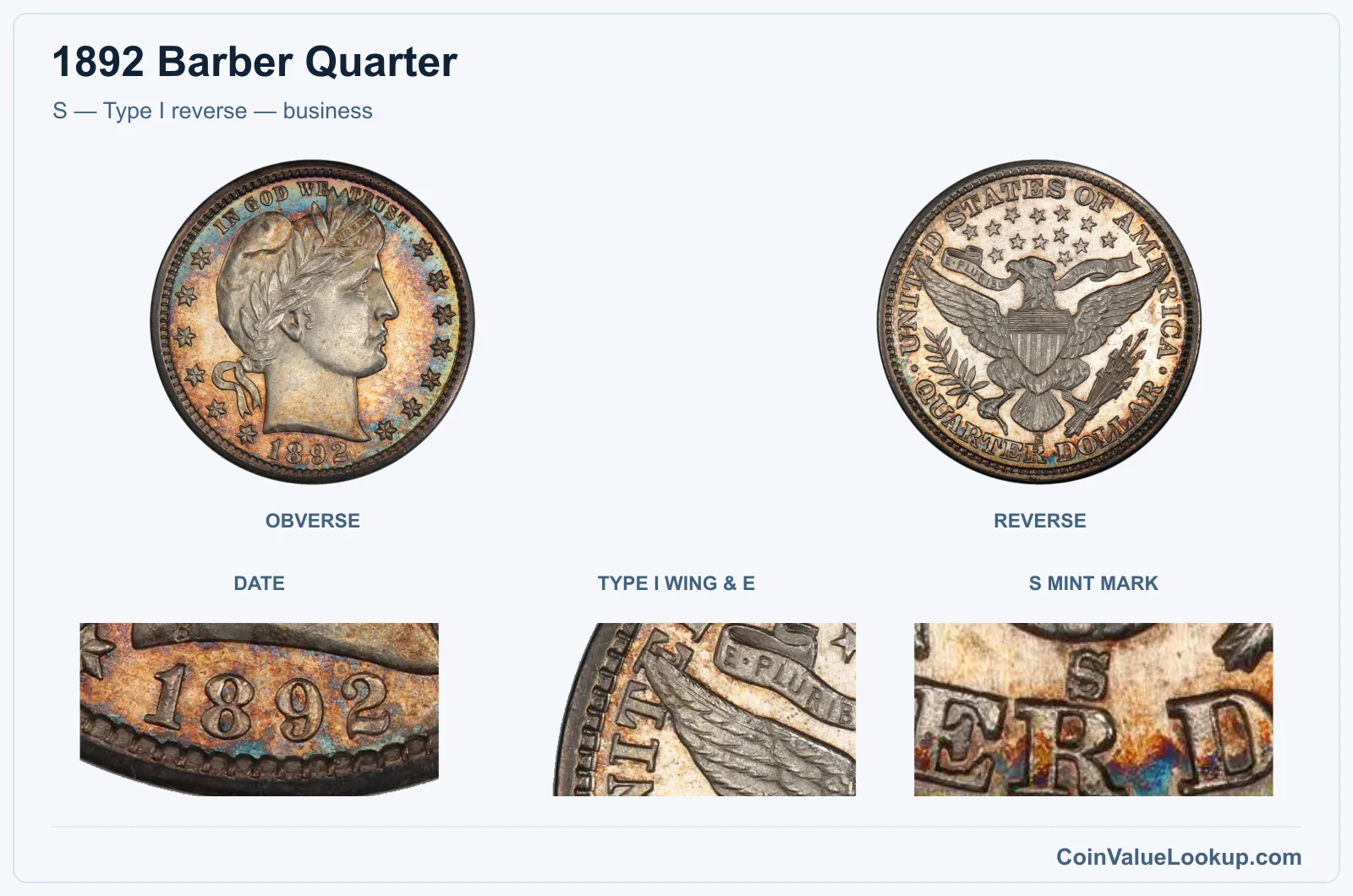
San Francisco's Type I reverse is one of the higher-valued 1892 branches. The S mintmark sits below the eagle's tail, and the wingtip reaches only the right serif of the E in UNITED.
USA Coin Book lists the unseparated 1892-S business strike at up to $1,399.00 at its listed guide grade, but no separately adopted Type I-specific price exists. Actual value depends on authenticated identity, condition and any die variety.
S-mint Barber quarters from the early years tend to draw strong collector interest, so proper attribution pays off.
Ordinary-issue reference: Ordinary-issue reference only: The table below shows prices for the 1892-S Barber Quarter (regular strike). It does not represent the value of the specific S — Type I reverse — business variety or its variety premium. Year, mint, metal and strike type are matched; the specific variety is not priced by this table.
Range Grade
Price Auction Records Appraisal PO PO 1
—
Coin Identifier FR FR 2
—
Coin Identifier AG AG 3
—
Coin Identifier G G 4
Coin Identifier
G 6
—
Coin Identifier VG VG 8
—
Coin Identifier
VG 10
—
Coin Identifier F F 12
Coin Identifier
F 15
Coin Identifier VF VF 20
Coin Identifier
VF 25
Coin Identifier
VF 30
Coin Identifier
VF 35
Coin Identifier XF XF 40
Coin Identifier
XF 45
Coin Identifier AU AU 50
Coin Identifier
AU 53
Coin Identifier
AU 55
Coin Identifier
AU 58
Coin Identifier MS MS 60
—
Coin Identifier
MS 61
Coin Identifier
MS 62
Coin Identifier
MS 63
Coin Identifier
MS 64
Coin Identifier
MS 65
Coin Identifier
MS 66
Coin Identifier
MS 67
Coin Identifier
MS 68
—
—
—
MS 69
—
—
—
MS 70
—
—
—
1892 Barber Quarter — S — Type II reverse — business
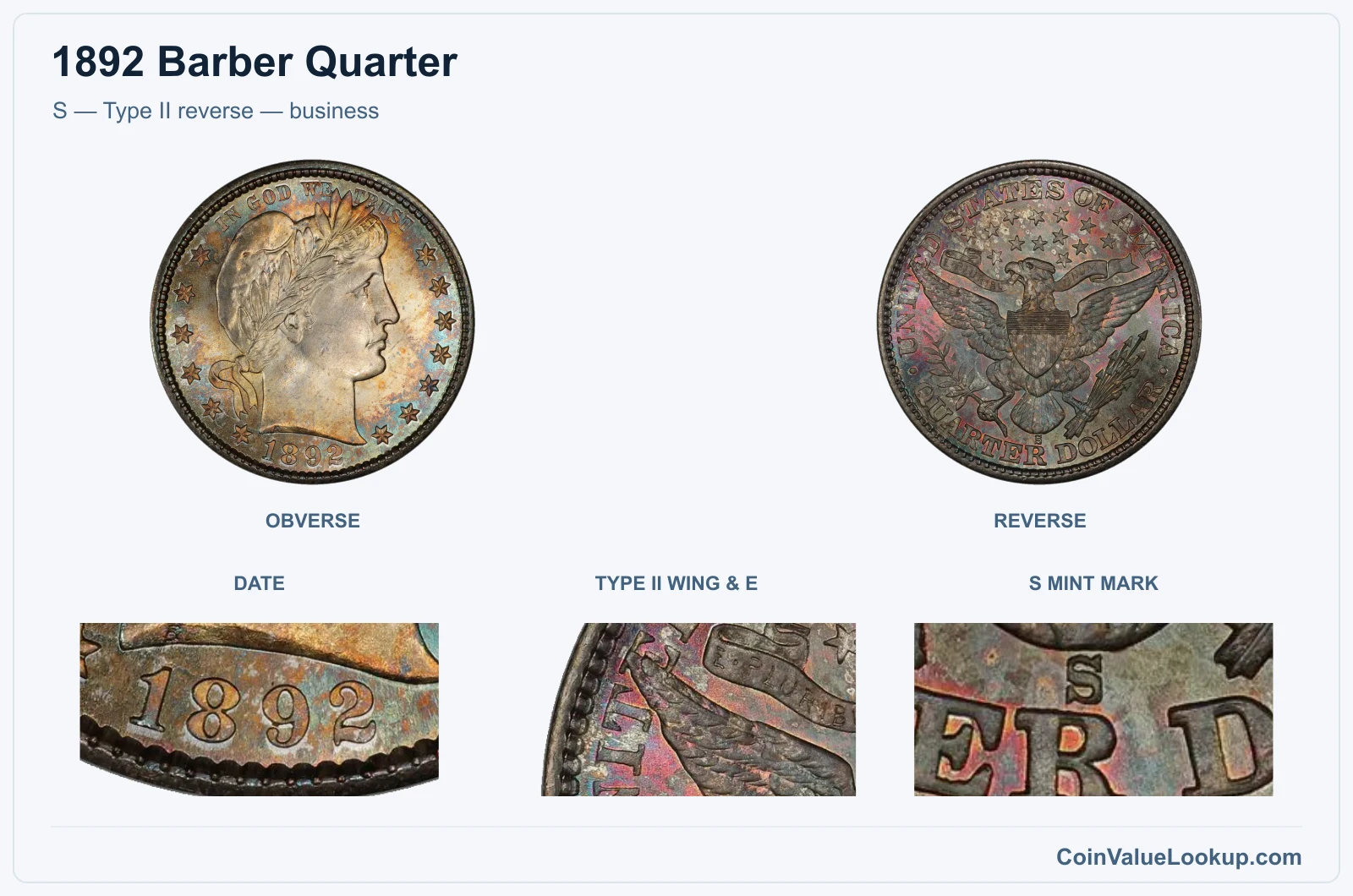
The S-mint Type II reverse features the revised eagle wingtip that overlaps the crossbar of the E in UNITED. Like its Type I sibling, the unseparated 1892-S carries a USA Coin Book guide anchor up to $1,399.00 at its listed grade, though no separately adopted price for Type II alone is available.
Value depends on authenticated grade and die variety. San Francisco coins from this year can show variable strike quality, so distinguish a genuinely worn coin from one that was simply softly struck before drawing conclusions about grade.
Ordinary-issue reference: Ordinary-issue reference only: The table below shows prices for the 1892-S Barber Quarter (regular strike). It does not represent the value of the specific S — Type II reverse — business variety or its variety premium. Year, mint, metal and strike type are matched; the specific variety is not priced by this table.
Range Grade
Price Auction Records Appraisal PO PO 1
—
Coin Identifier FR FR 2
—
Coin Identifier AG AG 3
—
Coin Identifier G G 4
Coin Identifier
G 6
—
Coin Identifier VG VG 8
—
Coin Identifier
VG 10
—
Coin Identifier F F 12
Coin Identifier
F 15
Coin Identifier VF VF 20
Coin Identifier
VF 25
Coin Identifier
VF 30
Coin Identifier
VF 35
Coin Identifier XF XF 40
Coin Identifier
XF 45
Coin Identifier AU AU 50
Coin Identifier
AU 53
Coin Identifier
AU 55
Coin Identifier
AU 58
Coin Identifier MS MS 60
—
Coin Identifier
MS 61
Coin Identifier
MS 62
Coin Identifier
MS 63
Coin Identifier
MS 64
Coin Identifier
MS 65
Coin Identifier
MS 66
Coin Identifier
MS 67
Coin Identifier
MS 68
—
—
—
MS 69
—
—
—
MS 70
—
—
—
1892 Barber Quarter — No mark — Type I reverse — proof
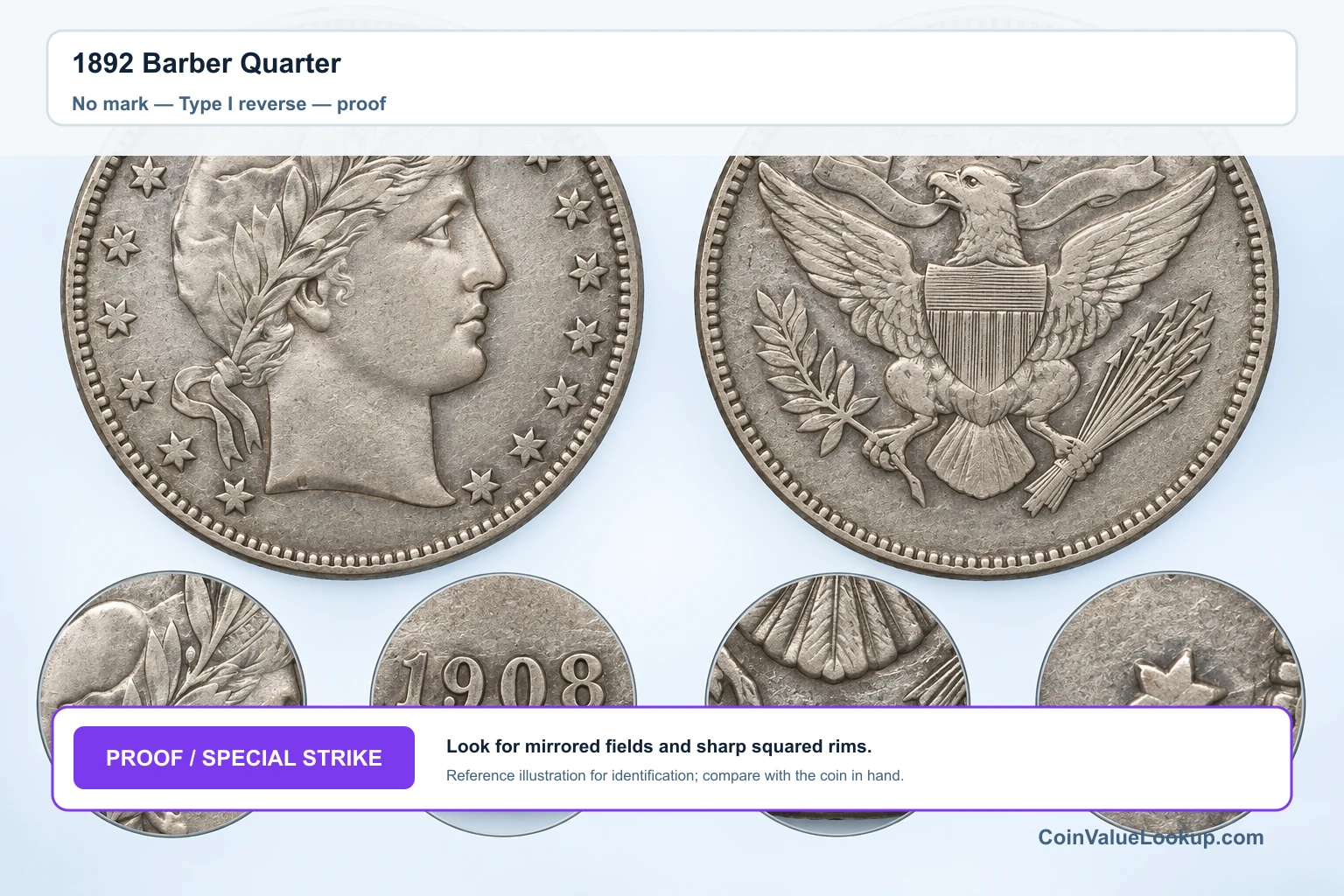
Philadelphia produced proof Barber quarters with the Type I reverse hub in 1892. Proofs have mirror-like fields and sharp detail from specially prepared dies.
The wingtip-to-E relationship is the same as the business-strike Type I — reaching only the right serif. No separately adopted Type I proof guide price exists, so value depends on authenticated condition, surface quality and the presence or absence of toning or hairlines.
Remember that proof describes the manufacturing process, not a grade above Mint State.
Ordinary-issue reference: Ordinary-issue reference only: The table below shows prices for the 1892 Barber Quarter (proof). It does not represent the value of the specific No mark — Type I reverse — proof variety or its variety premium. Year, mint, metal and strike type are matched; the specific variety is not priced by this table.
Range Grade
Price Auction Records Appraisal PR PR 1
—
Coin Identifier
PR 2
—
Coin Identifier
PR 3
—
Coin Identifier
PR 4
—
Coin Identifier
PR 6
—
Coin Identifier
PR 8
—
Coin Identifier
PR 10
—
Coin Identifier
PR 12
—
Coin Identifier
PR 15
—
Coin Identifier
PR 20
—
Coin Identifier
PR 25
—
Coin Identifier
PR 30
—
Coin Identifier
PR 35
—
Coin Identifier
PR 40
—
Coin Identifier
PR 45
—
Coin Identifier
PR 50
—
Coin Identifier
PR 53
—
Coin Identifier
PR 55
—
Coin Identifier
PR 58
—
Coin Identifier
PR 60
Coin Identifier
PR 61
Coin Identifier
PR 62
Coin Identifier
PR 63
Coin Identifier
PR 64
Coin Identifier
PR 65
Coin Identifier
PR 66
Coin Identifier
PR 67
Coin Identifier
PR 68
Coin Identifier
PR 69
—
—
—
PR 70
—
—
—
1892 Barber Quarter — No mark — Type II reverse — proof
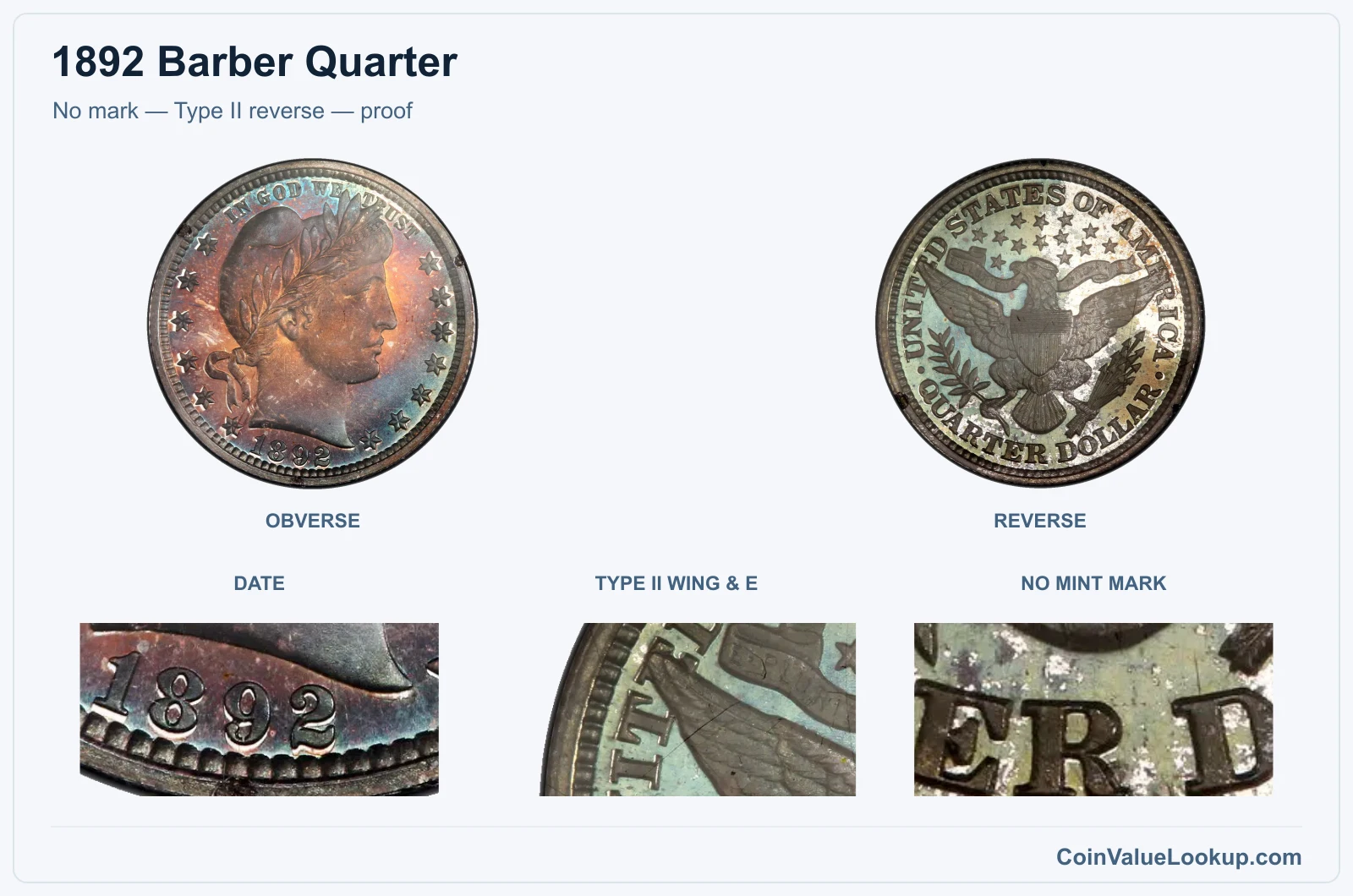
The Type II reverse proof from Philadelphia uses the revised hub where the eagle's wingtip clearly crosses the E's crossbar. USA Coin Book lists the unseparated 1892 proof at up to $799.00 at its listed guide grade, but no separately adopted Type II proof price exists.
Individual assessment of surfaces, hairlines and any toning determines actual value. Proof coins were struck only at Philadelphia, so if your coin has mirror fields and an O or S mintmark, look again — it may be a polished or prooflike business strike instead.
Ordinary-issue reference: Ordinary-issue reference only: The table below shows prices for the 1892 Barber Quarter (proof). It does not represent the value of the specific No mark — Type II reverse — proof variety or its variety premium. Year, mint, metal and strike type are matched; the specific variety is not priced by this table.
Range Grade
Price Auction Records Appraisal PR PR 1
—
Coin Identifier
PR 2
—
Coin Identifier
PR 3
—
Coin Identifier
PR 4
—
Coin Identifier
PR 6
—
Coin Identifier
PR 8
—
Coin Identifier
PR 10
—
Coin Identifier
PR 12
—
Coin Identifier
PR 15
—
Coin Identifier
PR 20
—
Coin Identifier
PR 25
—
Coin Identifier
PR 30
—
Coin Identifier
PR 35
—
Coin Identifier
PR 40
—
Coin Identifier
PR 45
—
Coin Identifier
PR 50
—
Coin Identifier
PR 53
—
Coin Identifier
PR 55
—
Coin Identifier
PR 58
—
Coin Identifier
PR 60
Coin Identifier
PR 61
Coin Identifier
PR 62
Coin Identifier
PR 63
Coin Identifier
PR 64
Coin Identifier
PR 65
Coin Identifier
PR 66
Coin Identifier
PR 67
Coin Identifier
PR 68
Coin Identifier
PR 69
—
—
—
PR 70
—
—
—
1892 Barber Quarter Error List
1. 1892 Barber Quarter — Doubled Die
Doubled die varieties have been reported for the 1892 Barber quarter. On a doubled die, elements of the design — such as lettering, the date or Liberty's profile — show consistent, uniform separation or notching that repeats across multiple coins from the same die.
Look for this doubling under magnification, comparing suspect areas against a normal example.
Do not confuse it with machine doubling, which tends to produce flat, shelf-like distortion rather than raised, rounded secondary images. Reflections from proof-like surfaces can also mimic doubling to the naked eye.
The specific mint and die involved are not further specified in the available sources. Value depends on the visibility of the doubling, overall condition and professional authentication.
2. 1892 Barber Quarter — Repunched Date
A repunched date on the 1892 Barber quarter shows remnants of an earlier date-punch position next to the final digits. You might see a faint shadow of a numeral slightly offset from its final resting place — often visible near the base or top of one of the four digits.
This is a die variety created during production when the date punch was applied more than once at slightly different positions. It is distinct from a doubled die, which involves the entire hub impression.
Do not confuse it with post-mint damage to the date area or flat machine doubling. The value of a repunched date depends on how dramatic the remnant is, the coin's condition and professional confirmation of the variety.
3. 1892 Barber Quarter — Clashed Dies
A die clash occurs when the obverse and reverse dies strike each other without a planchet between them, transferring traces of each design onto the opposing die. One reported example on the 1892 Barber quarter describes a clash where the outline of the O mintmark appears below the E in WE on the obverse — transferred from the reverse die.
Look for faint, raised outlines that match features of the opposite side of the coin. These marks will be in predictable positions relative to the full design.
Scratches, random raised lines or damage from a brockage can look similar but will not align with the opposing die's layout. Value depends on the clarity of the clash, the coin's overall condition and authentication.
4. 1892 Barber Quarter — Die Crack / Die Chip
Die cracks and die chips have been reported on the 1892 Barber quarter. One documented example shows light die cracks connecting the upper portions of ED in UNITED, TE in STATES, and RICA in AMERICA on the reverse.
These appear as thin, raised lines on the coin's surface where the steel die fractured during use.
A die chip is a small raised blob where a piece of the die broke away. A larger break connecting to the rim is sometimes called a cud.
Distinguish these from incuse scratches, which are recessed rather than raised, and from corrosion or foreign material sitting on the surface. Value depends on the size and visual impact of the crack or chip, along with the coin's grade.
5. 1892 Barber Quarter — Overdate
An overdate on the 1892 Barber quarter would show traces of an earlier date beneath the final numerals — for example, contours of a different digit visible under one of the four date numerals. This happens when a die intended for one year is re-punched with a new date.
The category has been reported in reference sources for this year, though details on the specific digits involved are limited. Examine each numeral under magnification for any underlying shapes that do not belong to the visible digit.
Do not confuse a damaged or weakly struck date with an overdate; legitimate overdates show consistent, die-produced remnants. Value depends on clarity of the underlying digit, condition and professional authentication.
6. 1892 Barber Quarter — Misplaced Date
A misplaced date occurs when a date-punch digit is accidentally impressed into an area of the die outside the normal date position — often partly visible in the denticles, the bust truncation or the field near the date. The final date is then punched in the correct location, leaving the stray impression as a remnant.
For the 1892 Barber quarter, this category has been reported in reference sources. Look for partial digit outlines where no digit should appear, then confirm the normal date is present in its usual place.
A scratch, die crack or random dent in the same area can mimic a misplaced digit, so compare your find with known examples before drawing conclusions. Value depends on the visibility and position of the misplaced element, along with overall coin condition.