1892 Liberty Nickel Coin Value: How Much Is It Worth?
The 1892 Liberty Nickel is a single-mint Philadelphia issue that still turns up in old collections and junk boxes. A guide estimate from USA Coin Book places a well-worn G4 example around $7.29, climbing to roughly $224 in MS63 for business strikes.
Proof examples carry their own premium, with a PR63 anchor near $344. Condition, strike quality, and the occasional mint error all shape what a specific coin is actually worth.
Fast Way to Identify Your 1892 Liberty Nickel
Snap clear, well-lit photos of both the front and back of your 1892 Liberty Nickel and upload them here. Our identifier can offer a preliminary read on your coin's version and general condition based on those images.
It will not authenticate, certify, or assign an exact grade, but it gives you a solid starting point before seeking professional evaluation.
1892 Liberty Nickel Value
Upload both sides of your 1892 Liberty Nickel.
Front Obverse
Upload photo
Back Reverse
Upload photo
Which 1892 Liberty Nickel Versions Are Worth Money?
- Business strikes in MS63 or higher carry a guide estimate near $224, well above the $7.29 G4 level, making original high-grade survivors worth checking carefully.
- Proof strikes graded PR63 anchor around $344 according to the USA Coin Book guide, so any coin with mirror-like fields and sharp rims deserves close inspection.
- Off-center strikes, wrong-planchet errors, and brockage pieces are reported for this date and can command premiums that depend on the severity, visibility, and condition of the specific coin.
Step 1: Identify Your 1892 Liberty Nickel Mint Mark and Version
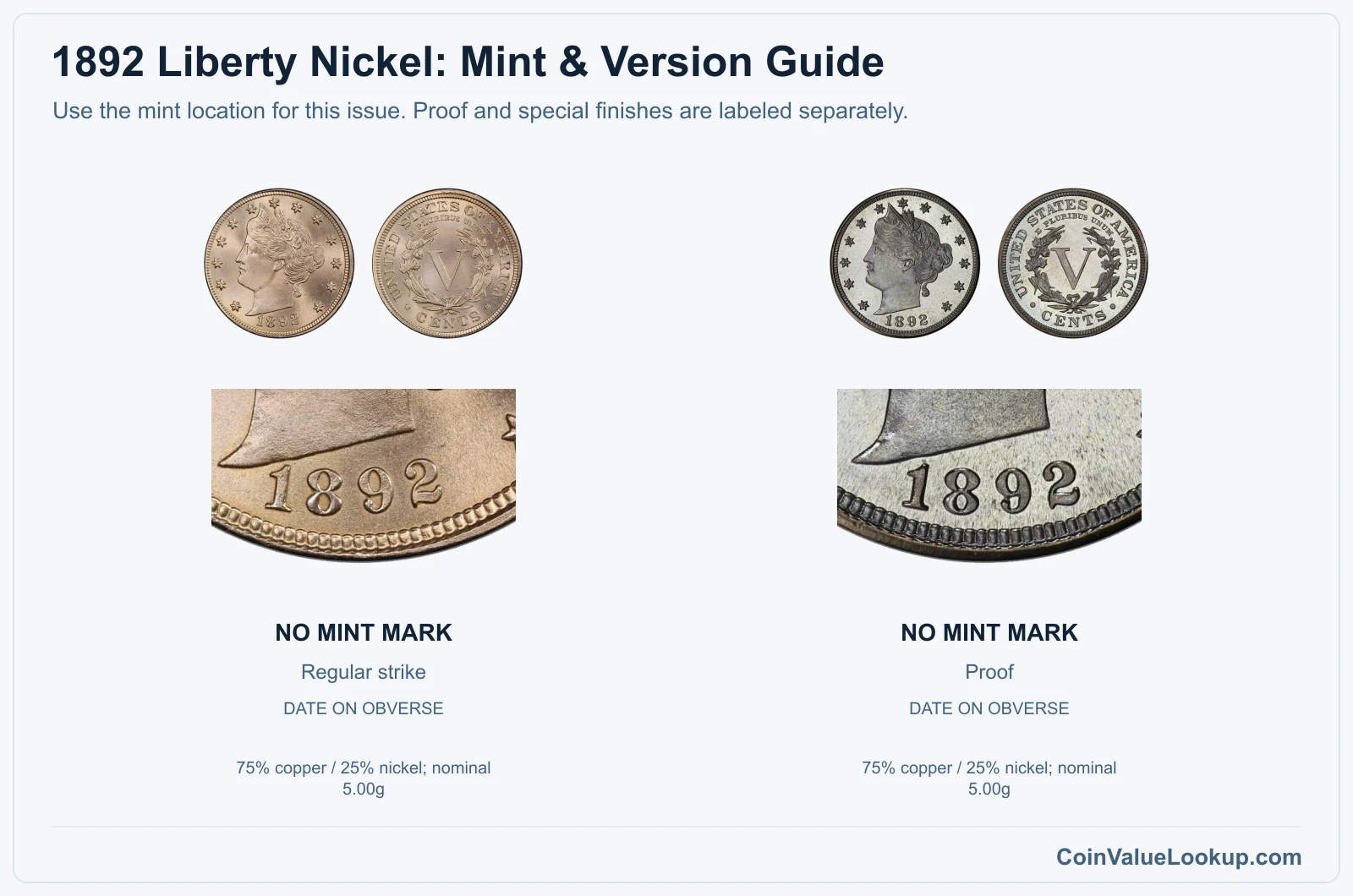
Every regular 1892 Liberty Nickel was struck at Philadelphia. There is no mintmark to hunt for, and no branch-mint versions exist for this date.
The coin is 75% copper and 25% nickel, weighs a nominal 5 grams, and measures 21.2 mm with a plain edge. There is no silver variety.
All standard 1892 nickels carry the "With CENTS" reverse design, showing the denomination inside a wreath. The earlier "No CENTS" design was used only in 1883, so if your coin reads 1892 and lacks "CENTS" on the back, something is off.
Both business strikes and proofs share the same basic appearance, but proofs were made with a different manufacturing process that produces mirror-like fields.
To confirm authenticity, check the weight and diameter against the nominal specs. Gold-plated pieces and other post-mint alterations are not collectible varieties.
Step 2: Check Your 1892 Liberty Nickel Grade
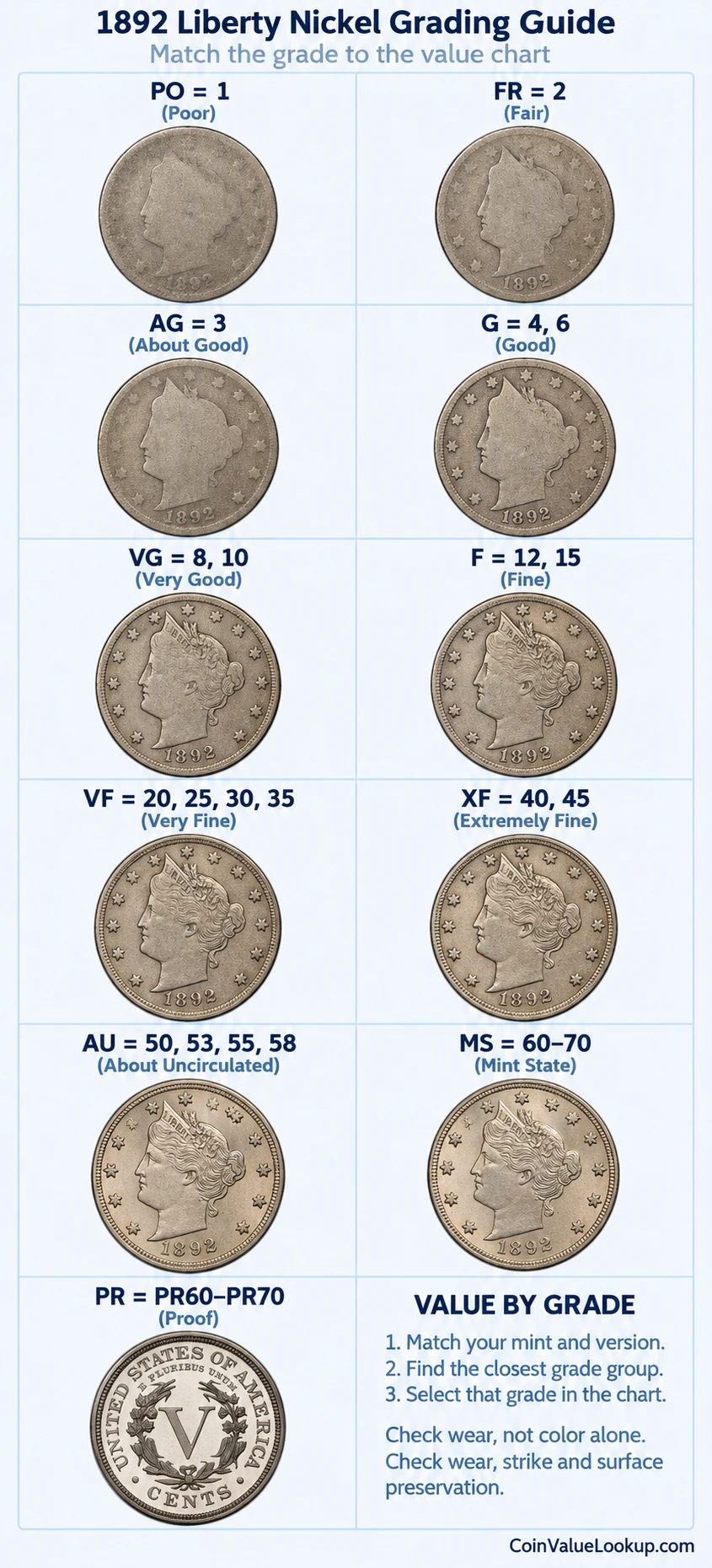
Start with the word LIBERTY on the coronet above Miss Liberty's forehead. On a well-circulated coin those letters blur and merge early, so a full, sharp LIBERTY is a quick sign of a higher grade.
The high points of the hair curls just behind the coronet and the cheek below the eye are the next wear checkpoints.
Flip the coin over and look at the corn ears and wreath detail. Flat spots there can mean wear, but they can also mean a weak strike from the original dies.
Compare your coin's details side by side with the reference image provided on this page to separate genuine circulation loss from strike softness.
For uncirculated pieces, focus on luster across the fields. Bag marks, scattered contact tics, and any dullness from cleaning all matter.
A coin can look sharp in detail yet still show enough marks to pull it well below gem grades.
Proof is a way of making the coin, not a grade above Mint State. Proof fields should be deeply reflective, and rims tend to be sharp and squared.
Hairlines from old cleanings are common on proofs and reduce their appeal significantly.
Step 3: Check 1892 Liberty Nickel Value by Mint and Version
1892 Liberty Nickel — No Mint Mark — With CENTS Circulation
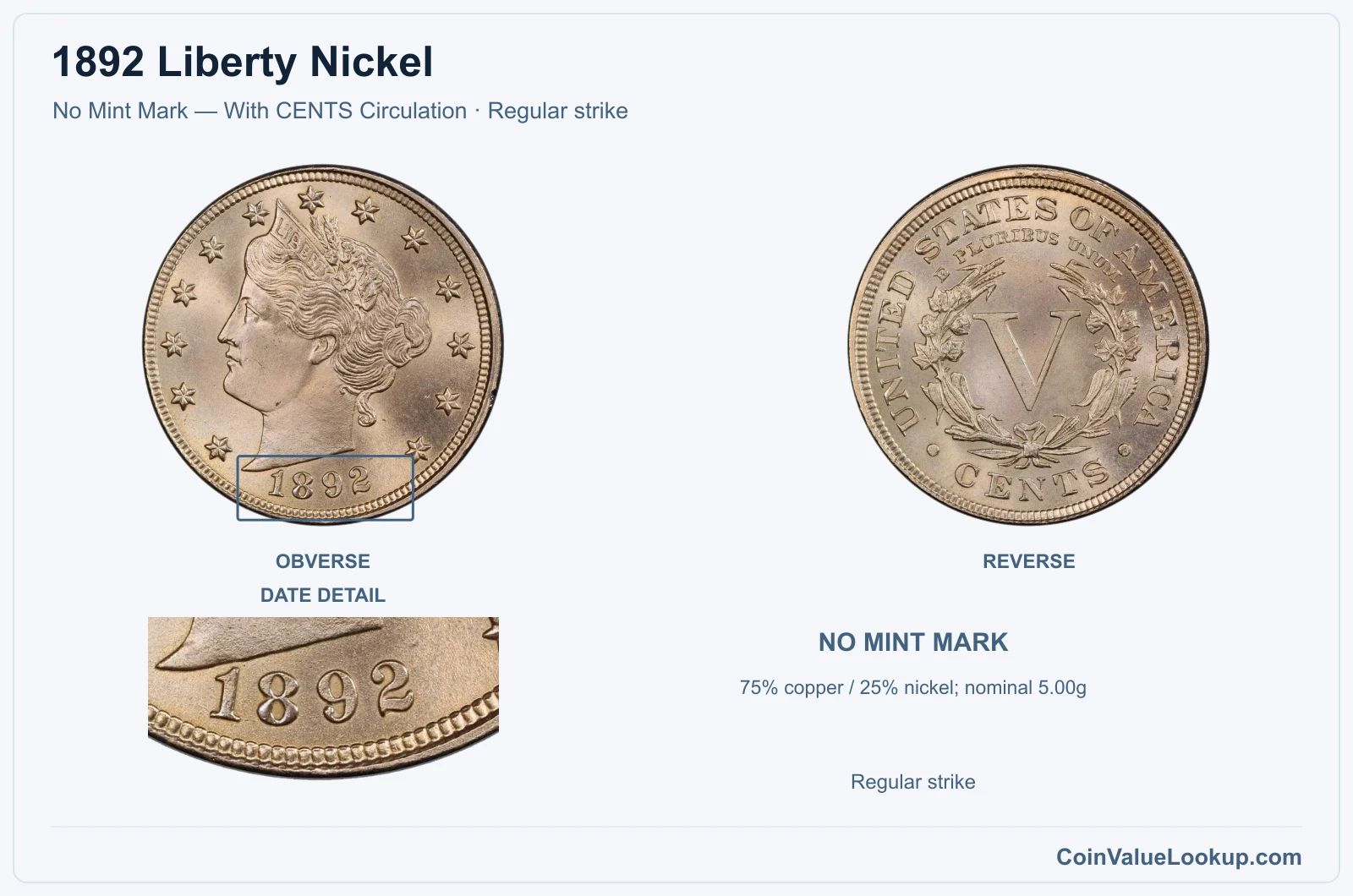
This is the standard 1892 Liberty Nickel struck for circulation at Philadelphia. No mintmark appears anywhere on the coin.
The reverse displays the large Roman numeral V surrounded by a wreath with "CENTS" below, confirming the With CENTS design used from late 1883 onward.
A USA Coin Book guide snapshot places this version at about $7.29 in G4 and around $224 in MS63. Those are retail estimates from a single February 2026 reading, not guaranteed sale prices.
Most survivors fall in the lower circulated grades, so a piece with full original luster and minimal marks stands out.
Coin Value Lookup is a handy place to look up guides for other dates and denominations in the Liberty Nickel series, especially if you are sorting through a mixed group of old nickels.
Range Grade
Price Auction Records Appraisal PO PO 1
—
Coin Identifier FR FR 2
—
Coin Identifier AG AG 3
—
Coin Identifier G G 4
—
Coin Identifier
G 6
—
Coin Identifier VG VG 8
—
Coin Identifier
VG 10
—
Coin Identifier F F 12
—
Coin Identifier
F 15
—
Coin Identifier VF VF 20
—
Coin Identifier
VF 25
—
Coin Identifier
VF 30
—
Coin Identifier
VF 35
Coin Identifier XF XF 40
Coin Identifier
XF 45
Coin Identifier AU AU 50
Coin Identifier
AU 53
—
Coin Identifier
AU 55
Coin Identifier
AU 58
Coin Identifier MS MS 60
—
Coin Identifier
MS 61
Coin Identifier
MS 62
Coin Identifier
MS 63
Coin Identifier
MS 64
Coin Identifier
MS 65
Coin Identifier
MS 66
Coin Identifier
MS 67
Coin Identifier
MS 68
—
—
—
MS 69
—
—
—
MS 70
—
—
—
1892 Liberty Nickel — No Mint Mark — With CENTS Proof
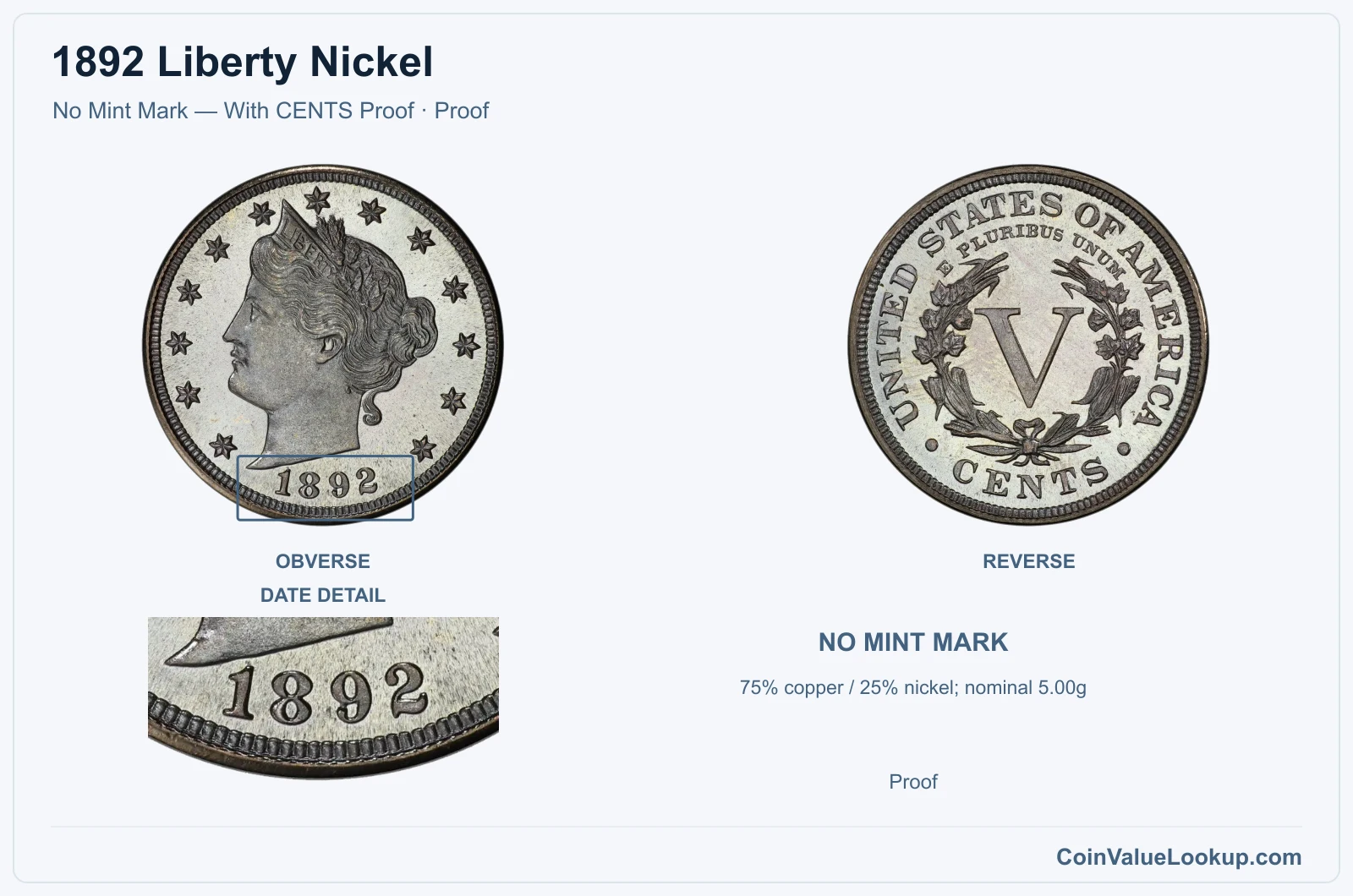
Philadelphia struck proof Liberty Nickels for collectors in 1892 using specially prepared dies and planchets. The result is a coin with mirror-like fields and crisp design edges that look distinctly different from a business strike, even at the same technical sharpness.
The PR63 guide anchor sits at roughly $344 per the USA Coin Book estimate. That figure is a single retail guide snapshot, not a guaranteed offer.
Hairlines, haze, and fingerprint residue are common on proofs that were handled without care over the decades, and those flaws pull the effective grade down quickly.
When photographing a proof for evaluation, capture both faces under angled light so the reflective fields and any hairlines are visible. Sharp rim detail and the squared edge profile also help distinguish a genuine proof from a particularly well-struck business coin.
Range Grade
Price Auction Records Appraisal PR PR 1
—
Coin Identifier
PR 2
—
Coin Identifier
PR 3
—
Coin Identifier
PR 4
—
Coin Identifier
PR 6
—
Coin Identifier
PR 8
—
Coin Identifier
PR 10
—
Coin Identifier
PR 12
—
Coin Identifier
PR 15
—
Coin Identifier
PR 20
—
Coin Identifier
PR 25
—
Coin Identifier
PR 30
—
Coin Identifier
PR 35
—
Coin Identifier
PR 40
—
Coin Identifier
PR 45
—
Coin Identifier
PR 50
—
Coin Identifier
PR 53
—
Coin Identifier
PR 55
—
Coin Identifier
PR 58
—
Coin Identifier
PR 60
Coin Identifier
PR 61
Coin Identifier
PR 62
Coin Identifier
PR 63
Coin Identifier
PR 64
Coin Identifier
PR 65
Coin Identifier
PR 66
Coin Identifier
PR 67
Coin Identifier
PR 68
Coin Identifier
PR 69
—
—
—
PR 70
—
—
—
1892 Liberty Nickel Error List
1. 1892 Liberty Nickel — Off-Center Strike
An off-center 1892 Liberty Nickel shows a displaced design with an unstruck crescent of blank metal along one edge. The farther off center the strike landed, the more dramatic the blank area.
A Heritage Auctions listing documents a 40% off-center example graded AU50, confirming the error exists for this date.
The key requirement for collectibility is that the date remains fully visible. Without a readable 1892, the coin loses most of its attribution value.
When examining your coin, compare the blank crescent to the opposite rim: on a genuine off-center strike the design shifts uniformly.
Watch out for lookalikes. A clipped planchet removes metal from the edge before striking, so the design still centers normally.
Post-mint flattening or one-sided die misalignment can also mimic the look. Condition, the percentage of off-center displacement, and overall eye appeal all affect what an off-center piece is worth, so no single price applies.
2. 1892 Liberty Nickel — Wrong Planchet / Off-Metal Strike
A wrong-planchet error means the 1892 Liberty Nickel design was struck on a blank intended for a different denomination. A catalog listing documents an 1892 Liberty nickel struck on a cent planchet, which would differ noticeably in weight, diameter, and possibly edge character from a standard nickel blank.
To check, weigh and measure your coin carefully. A normal nickel planchet is about 5 grams and 21.2 mm across.
A cent planchet of the era would be lighter, smaller, or both, and the design may appear incomplete where the smaller blank ran out of metal.
Do not confuse a wrong-planchet error with post-mint damage. Plating, acid etching, corrosion, and deliberate thinning can all change a coin's color, weight, or diameter after the fact.
Genuine wrong-planchet pieces are rare, and their value depends on the specific planchet involved, the completeness of the design, and overall condition. Professional attribution is strongly recommended.
3. 1892 Liberty Nickel — Partial Brockage with Partial Collar
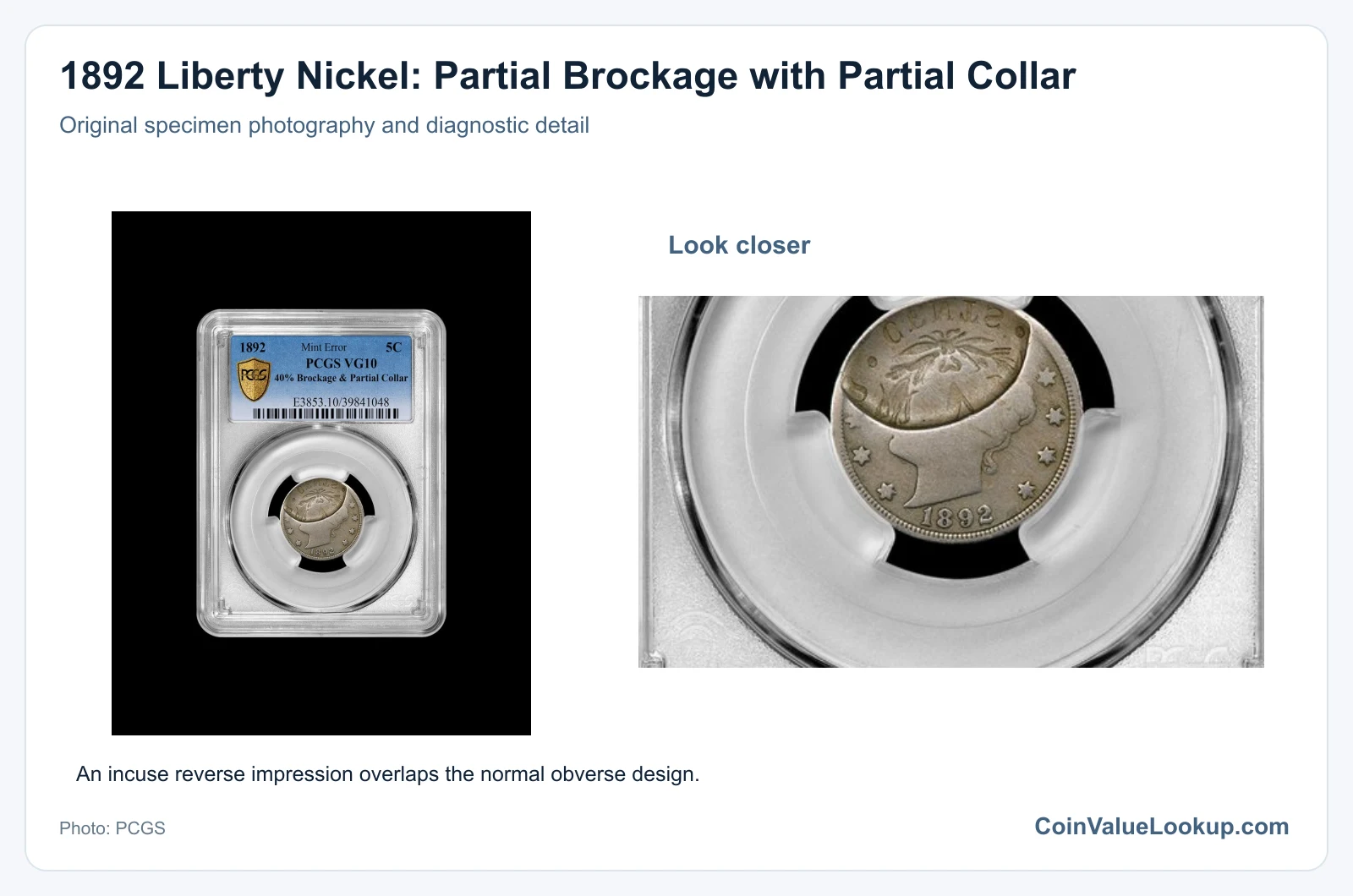
A brockage occurs when a previously struck coin stays on one die and impresses its image into the next blank in mirror-image relief. A reported 1892 example combines a roughly 40% partial brockage with a partial collar, meaning part of the coin also escaped the collar die during striking, producing a visible step or flare at the rim.
To spot it, look for an incuse, reversed impression on one side alongside the normally struck design on the other. Then check the edge for any collar step where part of the rim is normal and part fans out.
Both features on the same coin point to this combined error.
Coins squeezed against another coin after leaving the mint, or pieces with simple rim damage, can look superficially similar. Genuine brockage impressions are mirror-reversed and blend smoothly into the planchet surface.
Value depends on the severity of the brockage, the collar anomaly, and the coin's preservation, so individual assessment by a professional service is the safest route.