1886 Liberty Nickel Coin Value: How Much Is It Worth?
The 1886 Liberty Nickel is a scarce circulation date, and that scarcity shows in guide estimates. A well-worn example in G4 condition starts around $249, while a business-strike piece grading MS63 can reach roughly $2,629 according to a USA Coin Book retail estimate from February 2026.
Proof strikes are a separate category, with a PR63 anchor at about $790. These are guide figures, not guaranteed sale prices — actual value depends on the individual coin's condition and authentication.
Fast Way to Identify Your 1886 Liberty Nickel
Want a quick read on what you have? Upload clear photos of both the front and back of your 1886 Liberty Nickel.
This gives a preliminary identification of the coin's version and general condition. Sharp, well-lit images help distinguish a business strike from a proof and can flag potential varieties worth a closer look.
1886 Liberty Nickel Value
Upload both sides of your 1886 Liberty Nickel.
Front Obverse
Upload photo
Back Reverse
Upload photo
Which 1886 Liberty Nickel Versions Are Worth Money?
- Business strikes range from about $249 in G4 to $2,629 in MS63, making even lower-grade examples worth checking carefully.
- Proof strikes in PR63 carry a guide value around $790 — confirm proof surfaces before assuming this category.
- High-grade coins with original, undisturbed surfaces can carry premiums above typical guide figures.
- Repunched date, broadstrike, and off-center strike errors have been reported for this year and are worth inspecting for.
Step 1: Identify Your 1886 Liberty Nickel Mint Mark and Version
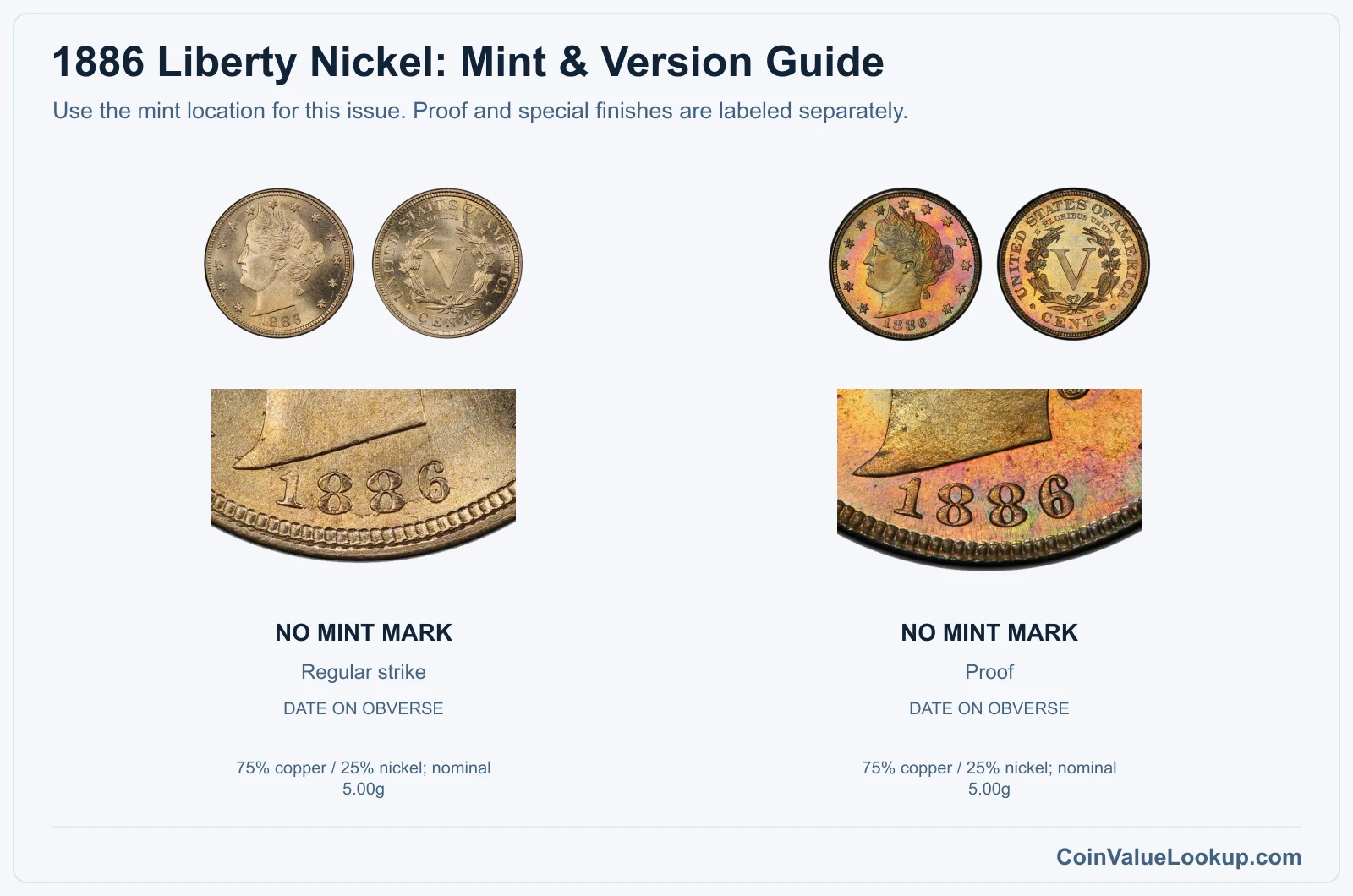
Every 1886 Liberty Nickel was struck at Philadelphia. There is no mintmark, and there are no branch-mint versions — no D, no S.
Don't go hunting for one under the wreath; it isn't there.
The coin is 75% copper and 25% nickel, weighs about 5 grams, measures 21.2 mm across, and has a plain edge. There is no silver branch for this year.
All 1886 nickels carry the "With CENTS" reverse design. The earlier "No CENTS" variety only applies to 1883, so if your coin reads 1886 and has CENTS on the back, that's exactly what it should say.
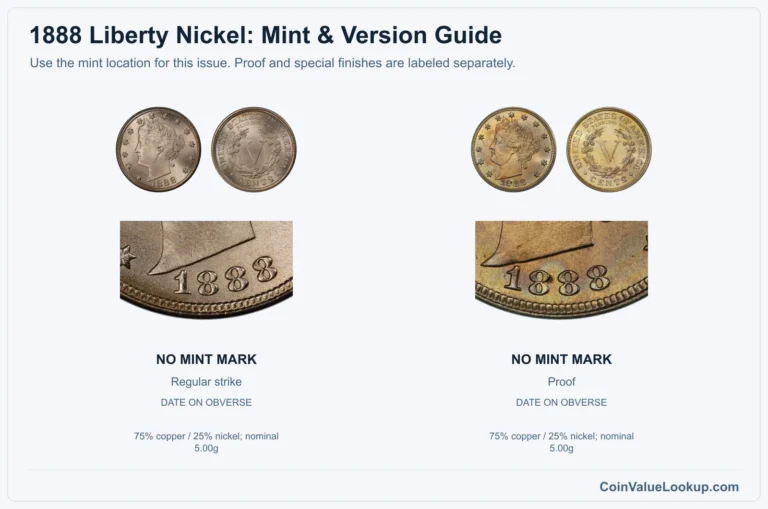
The key distinction is between a business strike (made for circulation) and a proof (a specially manufactured coin with mirror-like fields and sharp rims). These are separate categories with different values, and mixing them up will lead you astray.
Step 2: Check Your 1886 Liberty Nickel Grade
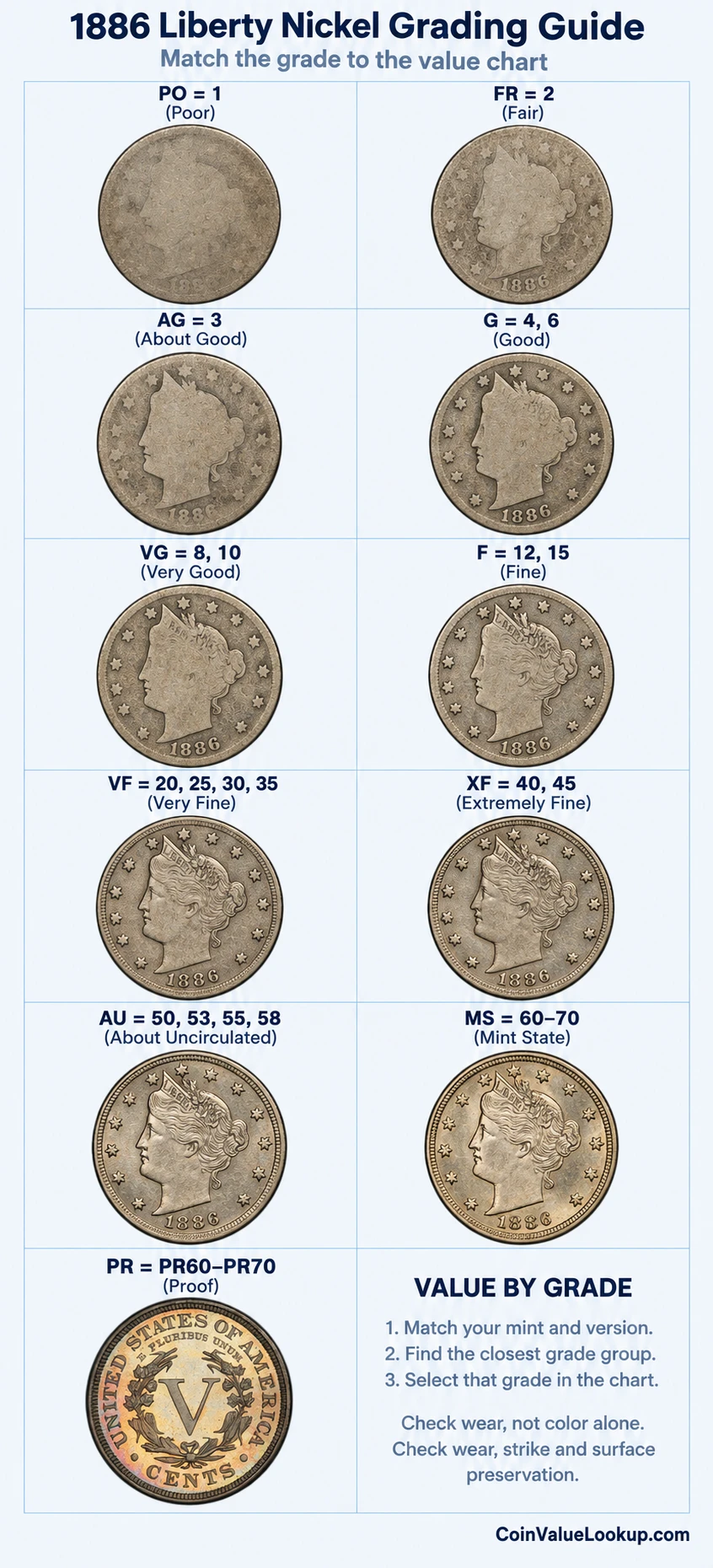
Start with the word LIBERTY on the coronet above the forehead. On a well-circulated coin, those letters wear down progressively — L and Y tend to go first.
If all letters are sharp and fully separated, the coin has seen little to no wear.
Check the high hair curls just above the ear and the cheek area. These are the first spots to show friction.
On the reverse, examine the tops of the corn ears and the fine detail in the wreath leaves.
Here's the catch: weak details on a Liberty Nickel don't always mean circulation wear. Strike weakness was common, especially on the hair and corn.
Look at the fields and luster instead. A coin with full original luster and no friction on the cheek is likely uncirculated even if some design elements seem soft.
Proof coins are identified by their manufacturing finish — mirror-like fields, squared-off rims, and a different surface character from business strikes. Hairlines from cleaning or handling reduce a proof's grade.
Compare your coin against the reference image to see how wear patterns differ from strike softness.
Step 3: Check 1886 Liberty Nickel Value by Mint and Version
1886 Liberty Nickel — No Mint Mark — With CENTS Circulation
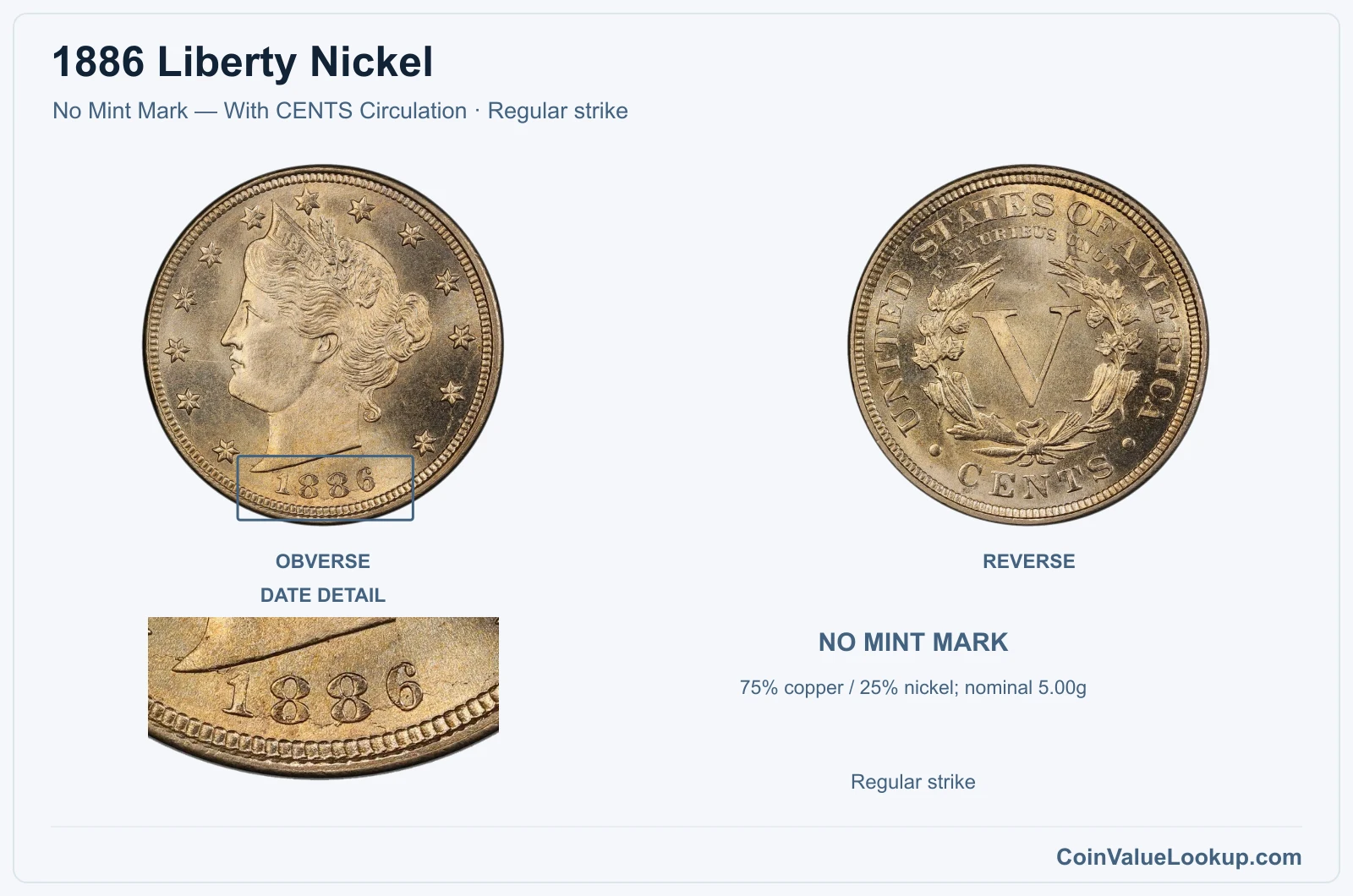
The standard 1886 Liberty Nickel business strike was produced at Philadelphia with no mintmark. It's the "With CENTS" design in 75% copper and 25% nickel, weighing about 5 grams with a plain edge.
This is a scarce date in the Liberty Nickel series. USA Coin Book's February 2026 retail estimate places a G4 example at roughly $249, climbing to about $2,629 at MS63.
That's a significant jump, which tells you original surfaces and minimal contact marks matter a great deal. Even a moderately worn piece has real value here, so don't dismiss a coin just because it isn't pristine.
Coin Value Lookup is a good starting point if you want to look up guides for other dates in the Liberty Nickel series or compare values across different denominations.
Range Grade
Price Auction Records Appraisal PO PO 1
Coin Identifier FR FR 2
Coin Identifier AG AG 3
Coin Identifier G G 4
Coin Identifier
G 6
Coin Identifier VG VG 8
Coin Identifier
VG 10
Coin Identifier F F 12
Coin Identifier
F 15
Coin Identifier VF VF 20
Coin Identifier
VF 25
Coin Identifier
VF 30
Coin Identifier
VF 35
Coin Identifier XF XF 40
Coin Identifier
XF 45
Coin Identifier AU AU 50
Coin Identifier
AU 53
Coin Identifier
AU 55
Coin Identifier
AU 58
Coin Identifier MS MS 60
Coin Identifier
MS 61
Coin Identifier
MS 62
Coin Identifier
MS 63
Coin Identifier
MS 64
Coin Identifier
MS 65
Coin Identifier
MS 66
Coin Identifier
MS 67
Coin Identifier
MS 68
—
—
—
MS 69
—
—
—
MS 70
—
—
—
1886 Liberty Nickel — No Mint Mark — With CENTS Proof
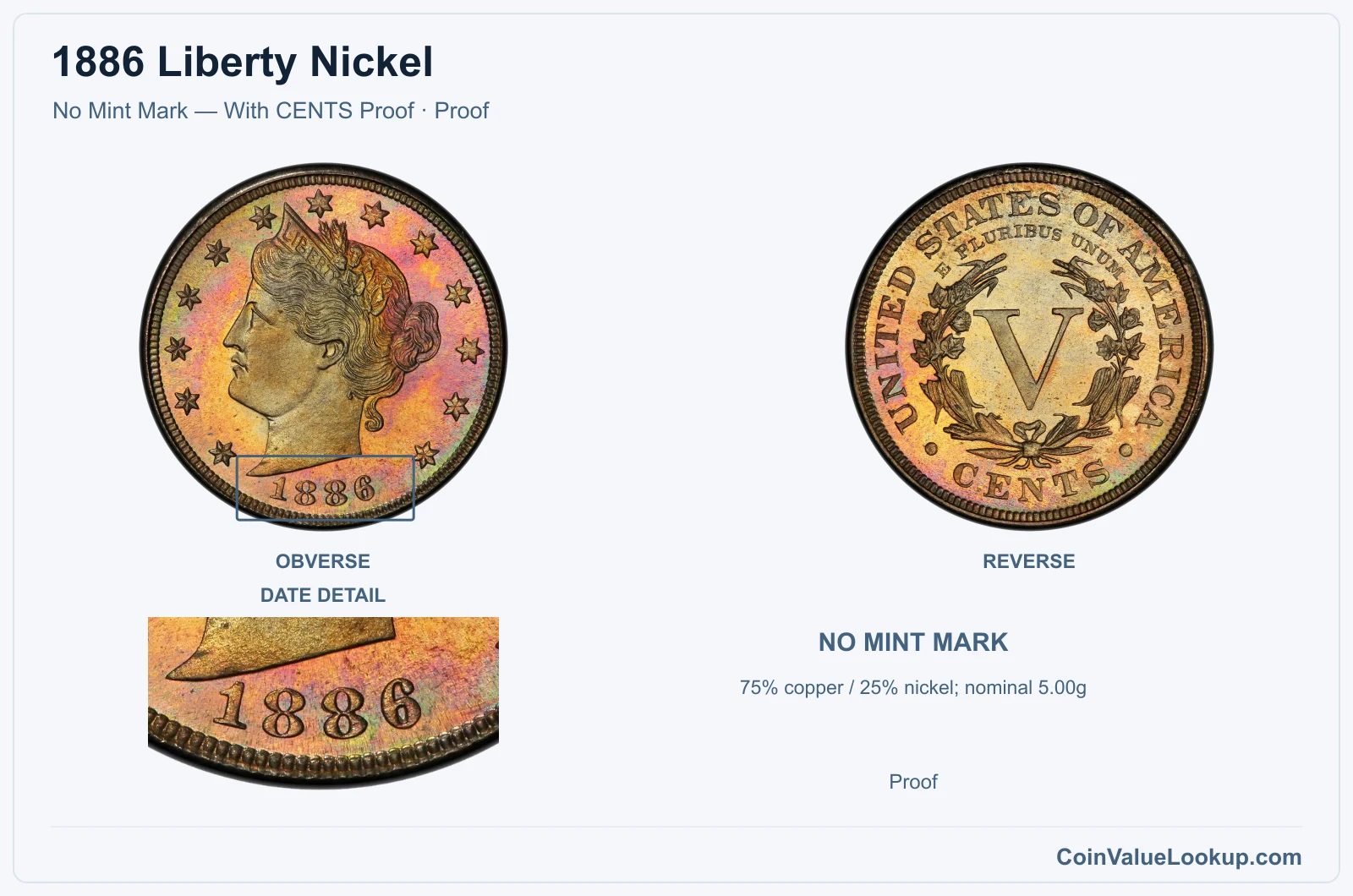
Proof 1886 Liberty Nickels were struck as collector pieces at Philadelphia using the same composition as business strikes. The difference is entirely in manufacture: proof coins show mirror-like fields, sharp design edges, and carefully finished rims that business strikes lack.
A PR63 example carries a guide value of about $790 per USA Coin Book's February 2026 snapshot. Condition matters enormously — hairlines, haze, and fingerprints all reduce the grade and the coin's appeal.
When examining a suspected proof, look at the flat fields under good lighting for that characteristic reflective surface. Show both faces and focus on the field and rim detail if seeking professional attribution.
Proofs and business strikes should never be compared on the same value scale.
Range Grade
Price Auction Records Appraisal PR PR 1
—
Coin Identifier
PR 2
—
Coin Identifier
PR 3
—
Coin Identifier
PR 4
—
Coin Identifier
PR 6
—
Coin Identifier
PR 8
—
Coin Identifier
PR 10
—
Coin Identifier
PR 12
—
Coin Identifier
PR 15
—
Coin Identifier
PR 20
—
Coin Identifier
PR 25
—
Coin Identifier
PR 30
—
Coin Identifier
PR 35
—
Coin Identifier
PR 40
—
Coin Identifier
PR 45
—
Coin Identifier
PR 50
—
Coin Identifier
PR 53
—
Coin Identifier
PR 55
—
Coin Identifier
PR 58
Coin Identifier
PR 60
Coin Identifier
PR 61
—
Coin Identifier
PR 62
Coin Identifier
PR 63
Coin Identifier
PR 64
Coin Identifier
PR 65
Coin Identifier
PR 66
Coin Identifier
PR 67
Coin Identifier
PR 68
Coin Identifier
PR 69
—
—
—
PR 70
—
—
—
1886 Liberty Nickel Error List
1. 1886 Liberty Nickel — Repunched Date
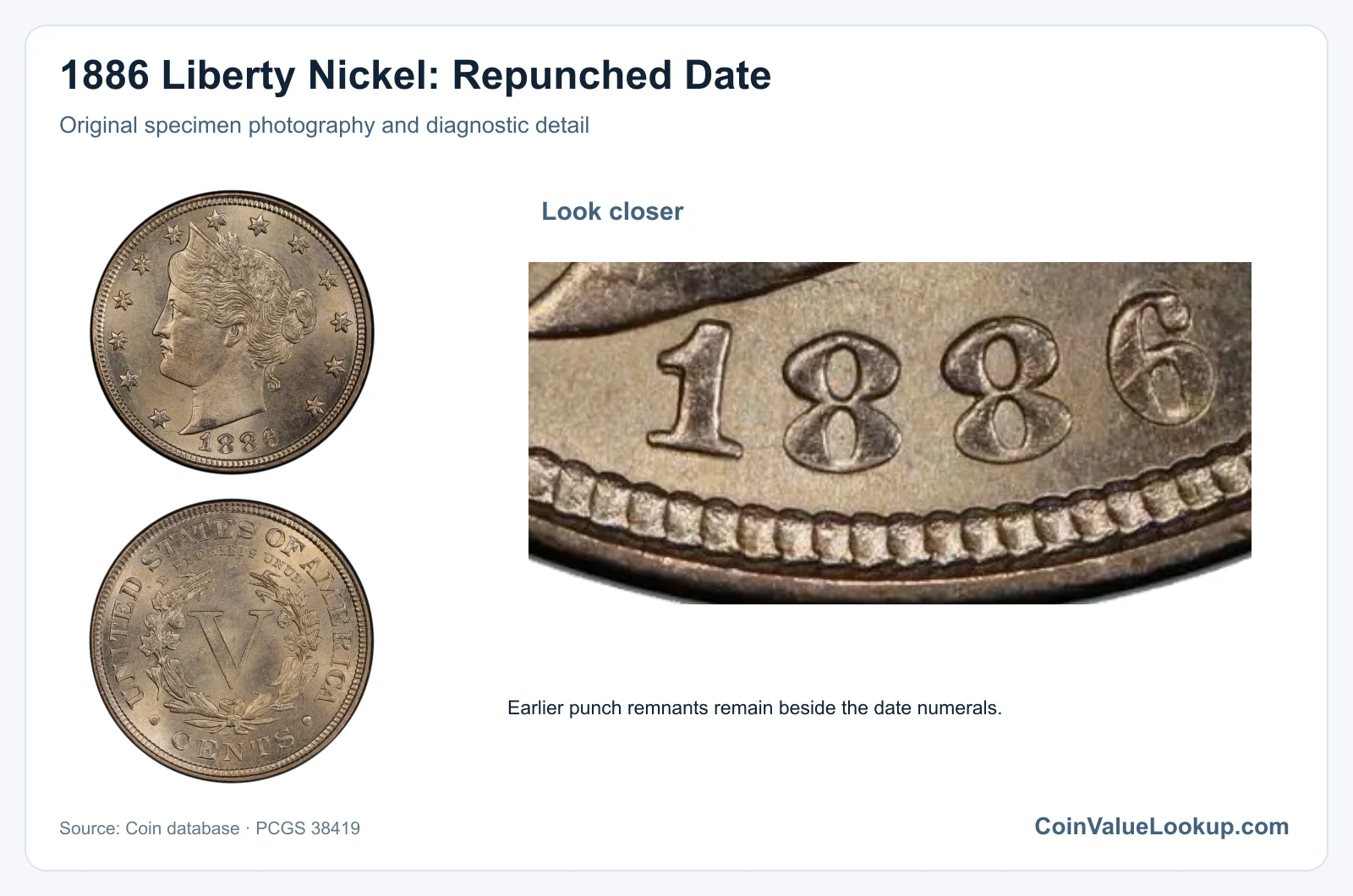
A repunched date on an 1886 Liberty Nickel shows remnants of an earlier date-punch position alongside the final numerals. You'll typically see a ghostly shadow or offset impression near one or more digits — look closely at the 1, 8, and 6 under magnification.
This is a die variety, not a striking error. The date was hand-punched into the die, and if the engraver's first attempt was slightly off, a second blow left overlapping impressions.
It is distinct from doubled-die varieties, which involve doubling of the entire design, not just the date logotype.
Watch for lookalikes: a damaged date from post-mint hits can mimic repunching, and machine doubling produces flat, shelf-like doubling that lacks the raised, separated character of a genuine repunched date. No specific price data is available for this variety — value depends on the visibility of the repunching, overall coin condition, and professional attribution.
2. 1886 Liberty Nickel — Broadstrike
A broadstrike occurs when the coin is struck without the normal restraining collar that forms the edge and controls diameter. The result is a coin that spreads outward, appearing slightly wider than normal with a less defined or missing rim.
On an 1886 Liberty Nickel, look for metal that has flowed beyond the expected 21.2 mm diameter. The full design should still be present and centered — that's what separates a broadstrike from an off-center error.
The edge profile will look unusual, lacking the sharp containment of a properly collared strike. An NGC VF35 broadstrike example has been reported for this date.
Don't confuse a broadstrike with a coin that was flattened after leaving the mint or one with off-center design loss. Post-mint damage won't show the uniform radial spread of a genuine broadstrike.
Value depends on the coin's condition, the degree of spread, and professional confirmation of the error.
3. 1886 Liberty Nickel — Off-Center Strike
An off-center strike happens when the planchet isn't properly seated between the dies at the moment of striking. The result is a displaced design with an unstruck crescent of blank metal on one side.
A 7% off-center example has been cataloged for the 1886 Liberty Nickel.
The key detail collectors look for is date visibility. If the date is fully readable despite the misalignment, the coin is far more identifiable and desirable.
Minor off-center strikes can be subtle — compare the rim width on opposite sides of the coin.
Lookalikes include clipped planchets, which have a curved missing section but a fully centered design, and one-sided die misalignment, which shifts only one side's impression. Post-mint flattening from a vise or hammer can also distort a coin's shape without the telltale blank crescent.
No specific price data is available for this error on the 1886 date — value depends on the percentage of misalignment, date visibility, and overall condition.