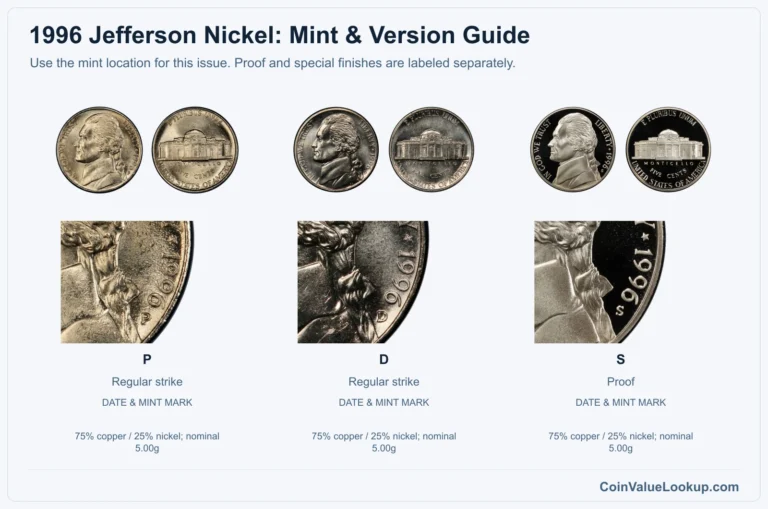
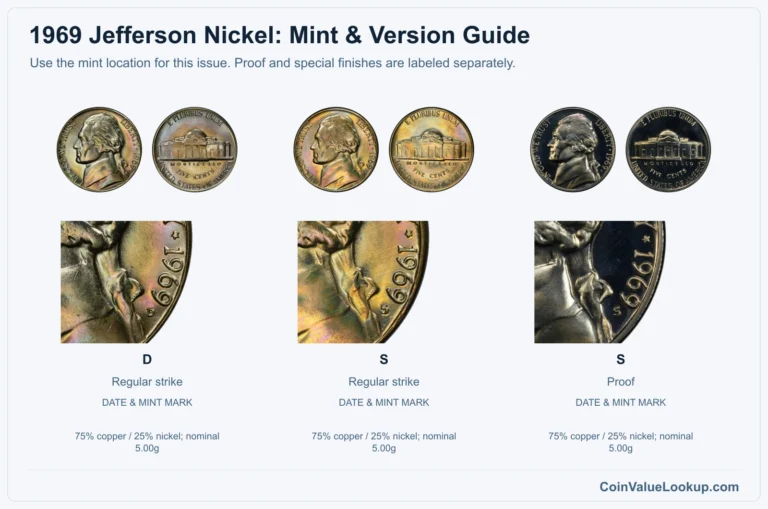
1972 Jefferson Nickel Coin Value: How Much Is It Worth?
The 1972 Jefferson Nickel is a common date, and most circulated examples are worth face value. Uncirculated coins carry modest premiums, with guide estimates around $0.30 at MS60 and $3.62 at MS65 according to USA Coin Book.
Proofs and authenticated error coins occupy their own price brackets entirely.
Fast Way to Identify Your 1972 Jefferson Nickel
Snap clear photos of both sides of your 1972 nickel and upload them here for a preliminary identification. Good lighting helps capture the mintmark location below the date on the obverse and the condition of the Monticello reverse.
This is not a substitute for professional authentication or grading, but it gives you a solid starting point.
1972 Jefferson Nickel Value
Upload both sides of your 1972 Jefferson Nickel.
Front Obverse
Upload photo
Back Reverse
Upload photo
Which 1972 Jefferson Nickel Versions Are Worth Money?
- Certified Full Steps business strikes from Philadelphia or Denver can command premiums above standard uncirculated prices, though a single shiny coin does not guarantee this designation.
- The 1972-S Proof follows a separate market from pocket-change coins; cameo and deep cameo finishes have their own value tiers beyond the base proof estimate.
- A double-struck proof authenticated by ANACS brought $4,312.50 at a 2008 Heritage auction, making error proofs the standout rarities for this date.
- A 1972-D nickel struck on a Philippines 25-sentimos blank sold for $230 at Heritage in 2006, illustrating how wrong-planchet errors generate collector interest.
- Off-center strikes and die breaks are reported for this year and can carry premiums depending on severity and condition.
Step 1: Identify Your 1972 Jefferson Nickel Mint Mark and Version
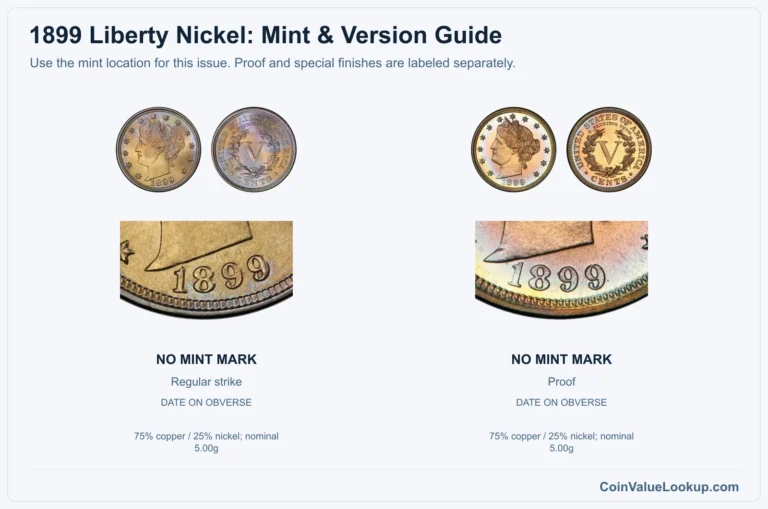
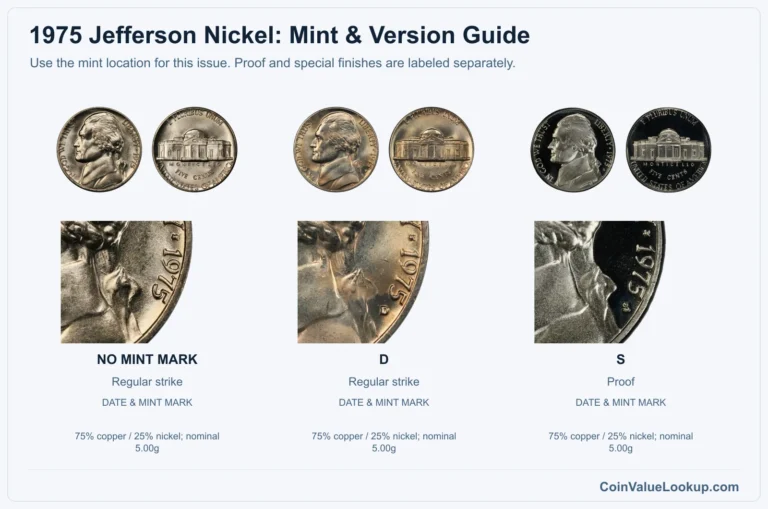
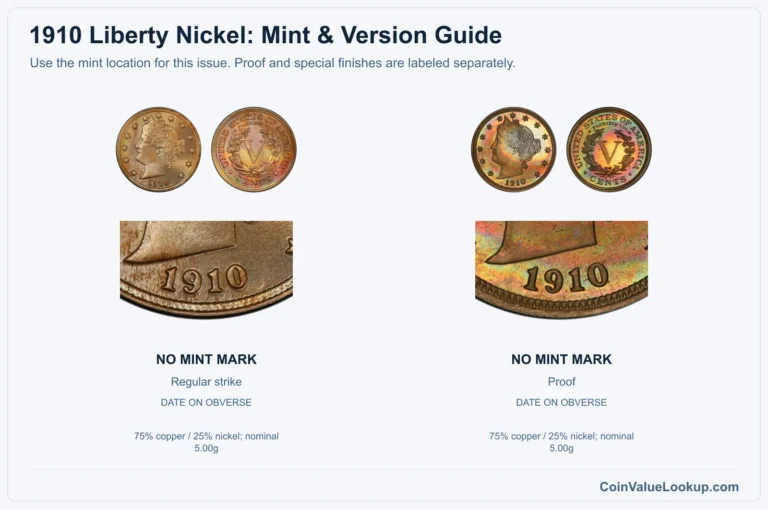
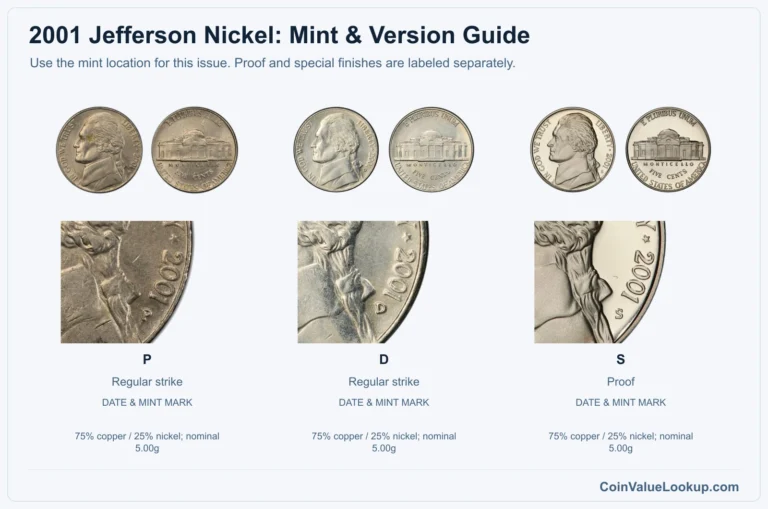
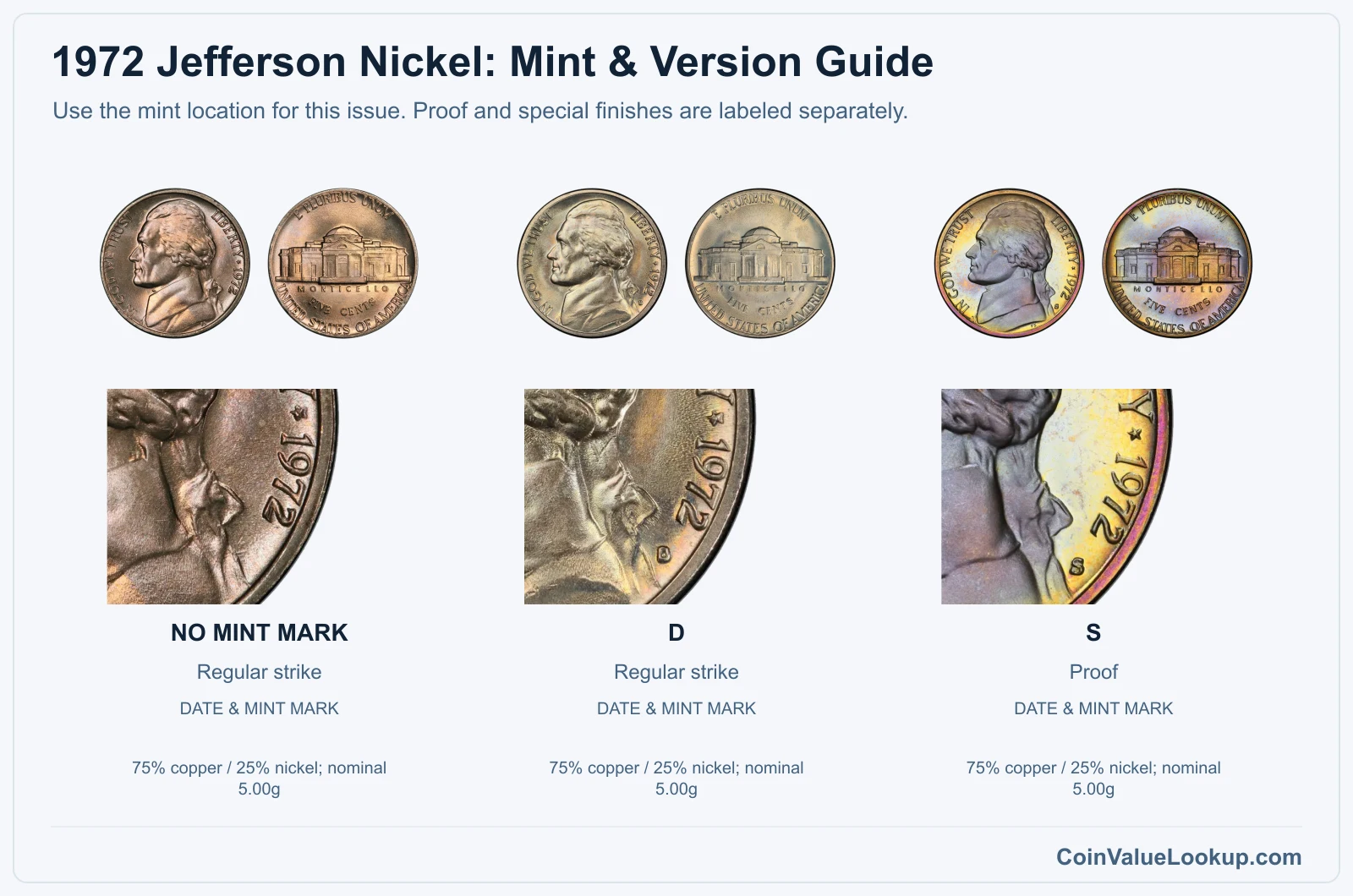
Three versions of the 1972 Jefferson Nickel exist, and identifying yours takes about ten seconds. Look at the obverse just below the date.
No mintmark means Philadelphia. A small "D" means Denver.
An "S" means San Francisco, and those are proof coins only.
All three share the same composition: 75% copper and 25% nickel, weighing approximately 5 grams with a plain edge and a diameter of 21.2 mm. This is a solid copper-nickel alloy, not a clad sandwich.
Proof finish is a manufacturing method, not a grade higher than Mint State. A proof coin with bag marks and haze can grade lower than a pristine business strike.
When examining your coin, record both faces, the date, the mintmark, and any unusual features like odd size or displaced design elements.
Step 2: Check Your 1972 Jefferson Nickel Grade
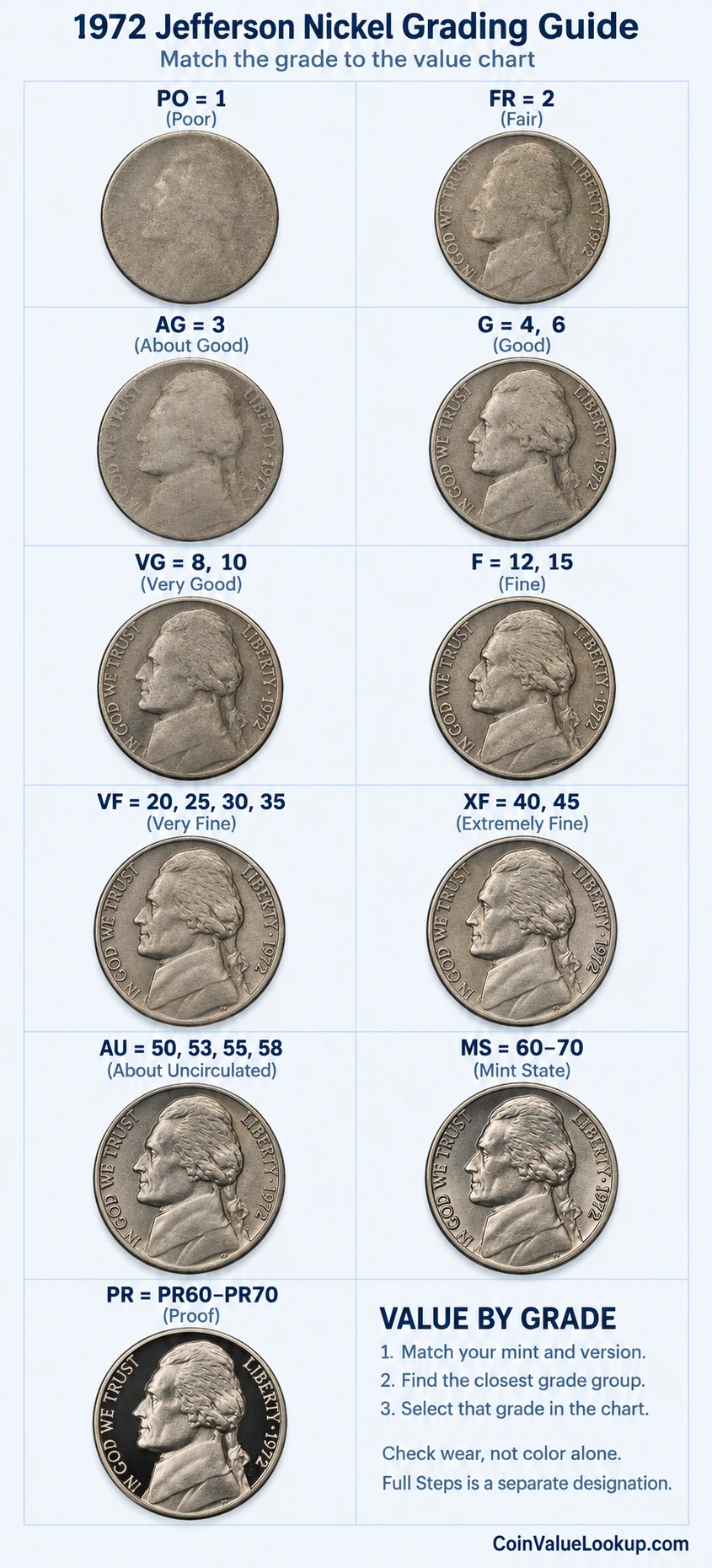
Jefferson's cheekbone and the hair detail behind his ear show wear first. On heavily circulated coins, the cheek flattens and blends into the jaw.
Flip the coin over and check the columns and steps of Monticello for softness.
Full Steps is an attributed strike-quality designation for business strikes, not a grade. It requires uninterrupted step lines on Monticello.
A coin can be technically uncirculated yet lack Full Steps because the die didn't strike the metal fully.
The comparison image is your friend here. Hold your coin beside it and match the high points.
Luster, surface preservation, and the severity of contact marks all factor into the final grade. A bag-marked MS63 and a clean MS65 can look quite different in hand even though both are uncirculated.
Step 3: Check 1972 Jefferson Nickel Value by Mint and Version
1972 Jefferson Nickel — No mintmark (Philadelphia) Business strike
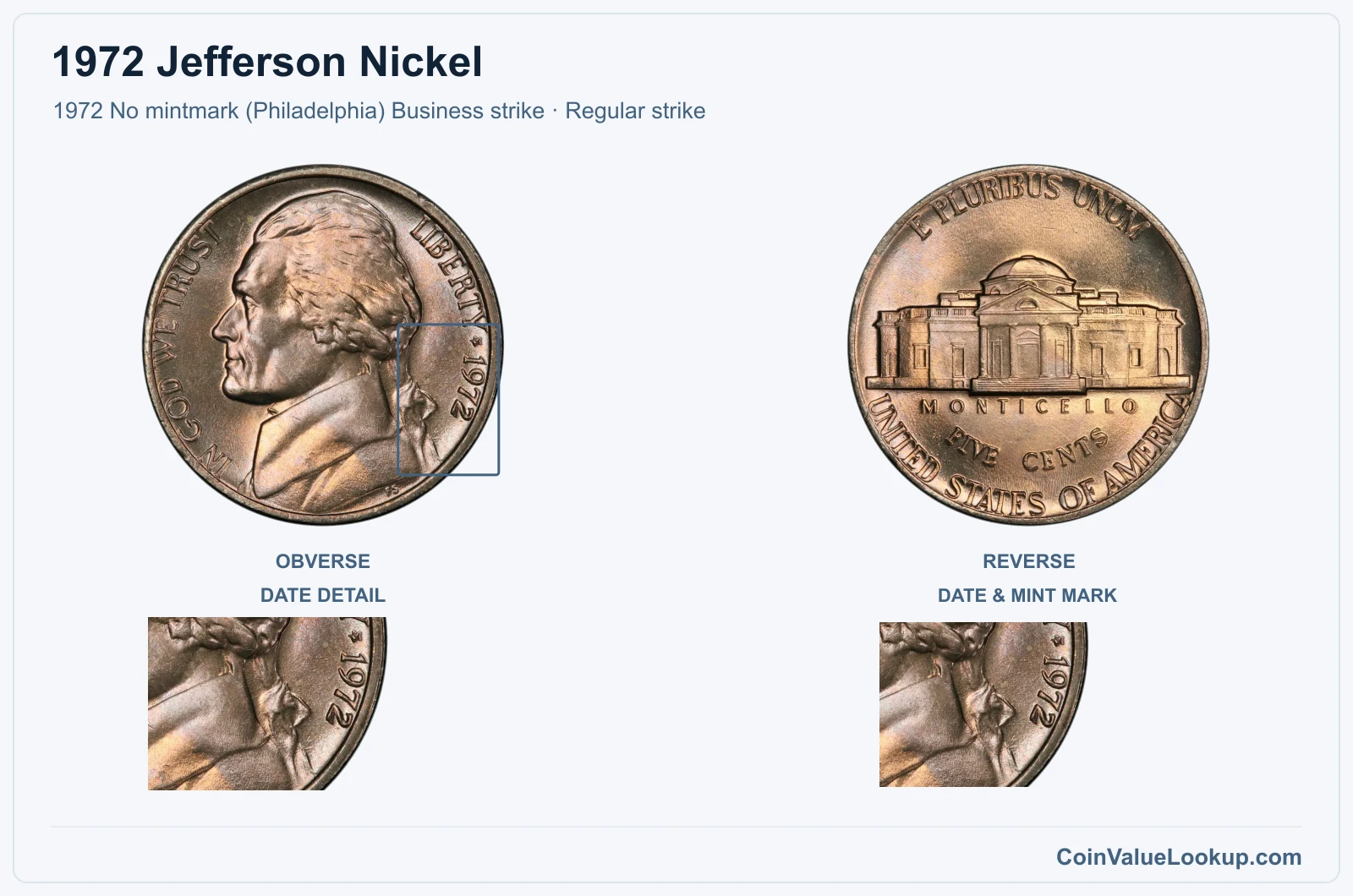
The 1972 Philadelphia nickel has no mintmark. Look below the date on the obverse, and if the space is blank, this is your coin.
Hundreds of millions were struck, so circulated examples are worth five cents.
Uncirculated specimens carry small premiums. USA Coin Book lists guide estimates of about $0.30 at MS60 and $3.62 at MS65.
Coins certified with Full Steps can merit more, since that designation confirms sharp, uninterrupted lines across Monticello's base. Without that attribution, even a lustrous uncirculated piece sits in the standard range.
| Range | Grade | Price | Auction Records | Appraisal |
|---|---|---|---|---|
| PO | PO 1 | — | Coin Identifier | |
| FR | FR 2 | — | Coin Identifier | |
| AG | AG 3 | — | Coin Identifier | |
| G | G 4 | — | Coin Identifier | |
| G 6 | — | Coin Identifier | ||
| VG | VG 8 | — | Coin Identifier | |
| VG 10 | — | Coin Identifier | ||
| F | F 12 | — | Coin Identifier | |
| F 15 | — | Coin Identifier | ||
| VF | VF 20 | — | Coin Identifier | |
| VF 25 | — | Coin Identifier | ||
| VF 30 | — | Coin Identifier | ||
| VF 35 | — | Coin Identifier | ||
| XF | XF 40 | — | Coin Identifier | |
| XF 45 | — | Coin Identifier | ||
| AU | AU 50 | — | Coin Identifier | |
| AU 53 | — | Coin Identifier | ||
| AU 55 | — | Coin Identifier | ||
| AU 58 | — | Coin Identifier | ||
| MS | MS 60 | — | Coin Identifier | |
| MS 61 | — | Coin Identifier | ||
| MS 62 | — | Coin Identifier | ||
| MS 63 | — | Coin Identifier | ||
| MS 64 | Coin Identifier | |||
| MS 65 | Coin Identifier | |||
| MS 66 | Coin Identifier | |||
| MS 67 | — | Coin Identifier | ||
| MS 68 | — | — | — | |
| MS 69 | — | — | — | |
| MS 70 | — | — | — |
1972 Jefferson Nickel — D Business strike
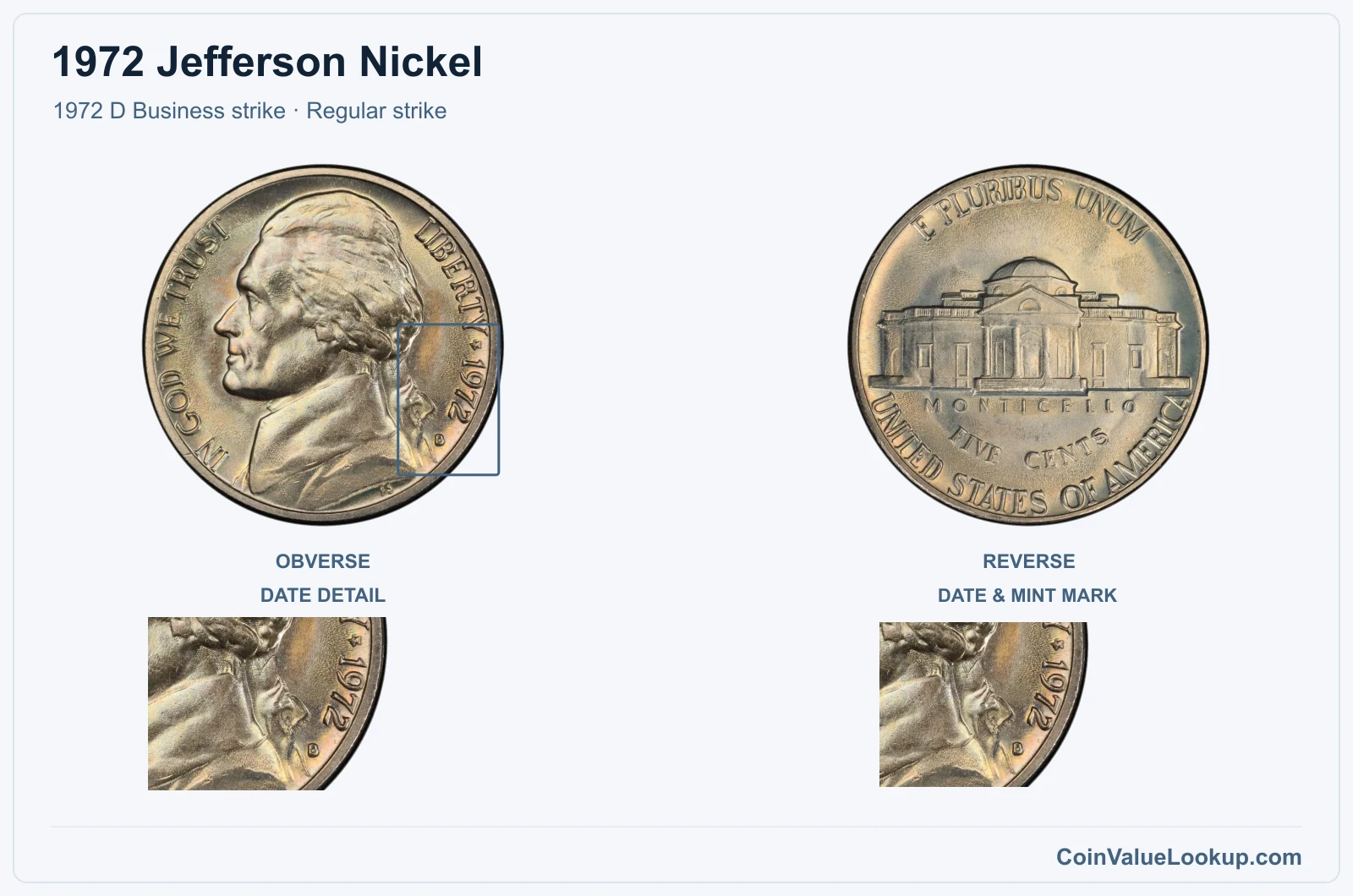
The 1972-D was struck in Denver and carries a small "D" mintmark on the obverse below the date. Same alloy, same weight, same design as Philadelphia.
Guide estimates from USA Coin Book place this version at roughly $0.30 in MS60 and $3.62 in MS65. Like its Philadelphia counterpart, a Full Steps designation can push the price above these standard benchmarks.
Circulated 1972-D nickels are common and generally trade at face value.
Coin Value Lookup is a helpful starting point if you want to look up guides for other dates and denominations in the Jefferson series.
| Range | Grade | Price | Auction Records | Appraisal |
|---|---|---|---|---|
| PO | PO 1 | — | Coin Identifier | |
| FR | FR 2 | — | Coin Identifier | |
| AG | AG 3 | — | Coin Identifier | |
| G | G 4 | — | Coin Identifier | |
| G 6 | — | Coin Identifier | ||
| VG | VG 8 | — | Coin Identifier | |
| VG 10 | — | Coin Identifier | ||
| F | F 12 | — | Coin Identifier | |
| F 15 | — | Coin Identifier | ||
| VF | VF 20 | — | Coin Identifier | |
| VF 25 | — | Coin Identifier | ||
| VF 30 | — | Coin Identifier | ||
| VF 35 | — | Coin Identifier | ||
| XF | XF 40 | — | Coin Identifier | |
| XF 45 | — | Coin Identifier | ||
| AU | AU 50 | — | Coin Identifier | |
| AU 53 | — | Coin Identifier | ||
| AU 55 | — | Coin Identifier | ||
| AU 58 | — | Coin Identifier | ||
| MS | MS 60 | — | Coin Identifier | |
| MS 61 | — | Coin Identifier | ||
| MS 62 | — | Coin Identifier | ||
| MS 63 | — | Coin Identifier | ||
| MS 64 | Coin Identifier | |||
| MS 65 | Coin Identifier | |||
| MS 66 | Coin Identifier | |||
| MS 67 | — | — | — | |
| MS 68 | — | — | — | |
| MS 69 | — | — | — | |
| MS 70 | — | — | — |
1972 Jefferson Nickel — S Proof
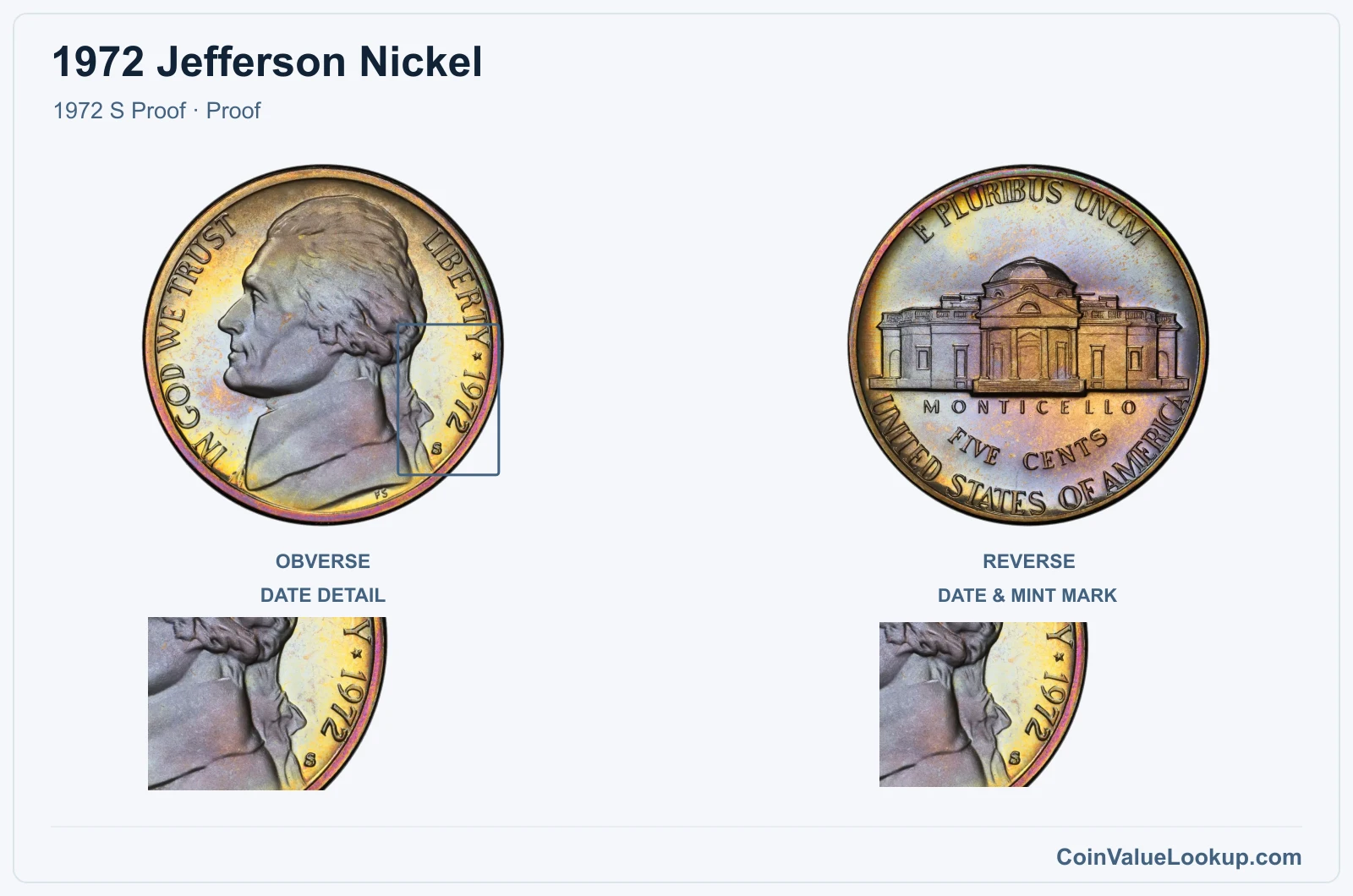
The 1972-S is a proof-only issue from San Francisco, identifiable by the "S" mintmark below the date. These were sold in official proof sets, not released into circulation.
USA Coin Book provides a base proof guide estimate of about $3.08 at PR65. That figure applies to standard proof finish only.
Cameo and deep cameo examples trade on different tiers and should not be priced using the base proof number. A proof is a method of manufacture featuring polished planchets and specially prepared dies, not a grade above Mint State.
Proof coins still receive numerical grades based on surface quality.
| Range | Grade | Price | Auction Records | Appraisal |
|---|---|---|---|---|
| PR | PR 1 | — | Coin Identifier | |
| PR 2 | — | Coin Identifier | ||
| PR 3 | — | Coin Identifier | ||
| PR 4 | — | Coin Identifier | ||
| PR 6 | — | Coin Identifier | ||
| PR 8 | — | Coin Identifier | ||
| PR 10 | — | Coin Identifier | ||
| PR 12 | — | Coin Identifier | ||
| PR 15 | — | Coin Identifier | ||
| PR 20 | — | Coin Identifier | ||
| PR 25 | — | Coin Identifier | ||
| PR 30 | — | Coin Identifier | ||
| PR 35 | — | Coin Identifier | ||
| PR 40 | — | Coin Identifier | ||
| PR 45 | — | Coin Identifier | ||
| PR 50 | — | Coin Identifier | ||
| PR 53 | — | Coin Identifier | ||
| PR 55 | — | Coin Identifier | ||
| PR 58 | — | Coin Identifier | ||
| PR 60 | — | Coin Identifier | ||
| PR 61 | — | Coin Identifier | ||
| PR 62 | — | Coin Identifier | ||
| PR 63 | — | Coin Identifier | ||
| PR 64 | — | Coin Identifier | ||
| PR 65 | Coin Identifier | |||
| PR 66 | — | Coin Identifier | ||
| PR 67 | Coin Identifier | |||
| PR 68 | Coin Identifier | |||
| PR 69 | — | Coin Identifier | ||
| PR 70 | — | — | — |
1972 Jefferson Nickel Error List
1. 1972 Jefferson Nickel — Double-struck proof
A double-struck 1972-S proof is one of the more dramatic errors for this date. The first strike landed about 5% off center, and the second hit roughly 35% off center, producing clearly displaced and repeated design elements across the coin.
The proof surfaces help make the doubled imagery unmistakable.
One example graded ANACS PR67 sold for $4,312.50 at a Heritage auction in January 2008. That is a single recorded sale, not a general market range.
Be careful not to confuse this with die doubling or accidental scratches, which produce much subtler effects. A genuine double strike shows two complete impressions of the design shifted relative to each other, and professional attribution is essential for confirmation.
2. 1972 Jefferson Nickel — Struck on Philippines25sentimos blank
A 1972-D nickel struck on a Philippines 25-sentimos blank is a confirmed wrong-planchet error. The foreign blank causes weak peripheral legends and soft Monticello steps because the planchet dimensions differ from a standard nickel blank.
One example graded PCGS AU58 sold for $230 at a Heritage auction in February 2006. That is a single auction result.
Do not assume every weak-looking nickel was struck on a foreign blank. Ordinary weak strikes and post-mint alterations to size can mimic the appearance.
Alloy or weight differences alone are not enough for a home diagnosis. Professional authentication by a third-party grading service is the only reliable way to confirm a foreign-planchet attribution.
3. 1972 Jefferson Nickel — Partial obverse counterbrockage
A partial obverse counterbrockage on a 1972-D nickel shows a distorted, transferred design impression created when struck material intervened between the die and the planchet. The result is a warped mirror-like ghost of the obverse design visible on part of the coin's surface.
One NGC MS64 example sold for $517.50 at a Heritage auction in October 2010. That price reflects one specific coin in one specific grade.
Look at the whole coin alongside any attributed closeup to understand the shape and placement of the transferred design. Vise-transfer damage and flat mechanical doubling can produce superficially similar marks, but counterbrockage has a distinctive raised, distorted character that differs from the flat, shelf-like traces left by post-mint damage.
4. 1972 Jefferson Nickel — Off-Center Strike
Off-center strikes happen when the planchet is not properly seated between the dies before the press fires. The result is a design shifted to one side with an unstruck crescent of blank metal on the opposite edge.
The farther off center the strike, the more dramatic the error looks.
For a 1972 nickel, the date needs to remain visible for the coin to be attributed to this year. Value depends on the percentage of displacement, whether the date is legible, and the coin's overall condition.
No specific price range is adopted here. Do not confuse an off-center strike with a clipped planchet, one-sided die misalignment, or post-mint flattening, all of which leave different signatures.
5. 1972 Jefferson Nickel — Die Crack / Die Chip
Die cracks and die chips appear as raised lines or small raised blobs on the coin's surface. They result from damage to the steel die itself, which transfers in relief onto every coin struck afterward.
A crack connecting to the rim is different from an interior die chip, and a large rim break is sometimes called a cud.
For the 1972 nickel, these errors are reported but no specific price range is adopted here. Value depends on the size, location, and visibility of the break, plus the coin's grade.
Look carefully at the surface: raised lines from a die crack differ from incuse scratches, corrosion pits, or foreign material stuck to the coin. Scratches are recessed into the surface, while die cracks sit above it.