1977 Jefferson Nickel Coin Value: How Much Is It Worth?
Most 1977 Jefferson nickels in your pocket change are worth face value. The action starts in uncirculated grades: USA Coin Book guide estimates range from about $0.30 at MS60 to $3.62 at MS65 for business strikes, so grade matters a lot.
Proofs and authenticated mint errors occupy their own price tier entirely.
Fast Way to Identify Your 1977 Jefferson Nickel
Want a quick read on what you have? Upload clear photos of the front and back of your 1977 nickel and our identifier will give you a preliminary take on the mint, finish, and version.
It is not a certification service, but it helps you figure out what you are looking at before going further.
1977 Jefferson Nickel Value
Upload both sides of your 1977 Jefferson Nickel.
Front Obverse
Upload photo
Back Reverse
Upload photo
Which 1977 Jefferson Nickel Versions Are Worth Money?
- Uncirculated Philadelphia or Denver business strikes certified with Full Steps can carry a premium above standard guide values for the same grade.
- San Francisco proof nickels trade in a different market from circulation strikes; cameo and deep-cameo finishes are tracked separately from base proof pricing.
- Several authenticated error types exist for 1977, including wrong-planchet strikes that have sold individually at auction for over $1,000.
Step 1: Identify Your 1977 Jefferson Nickel Mint Mark and Version
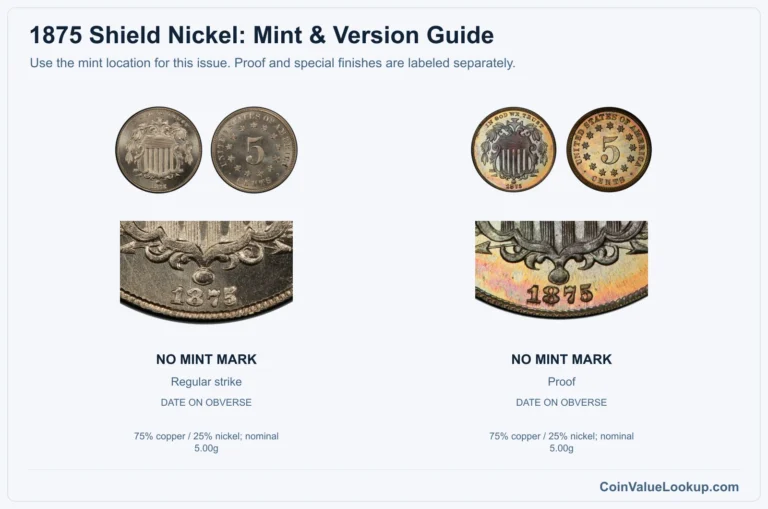
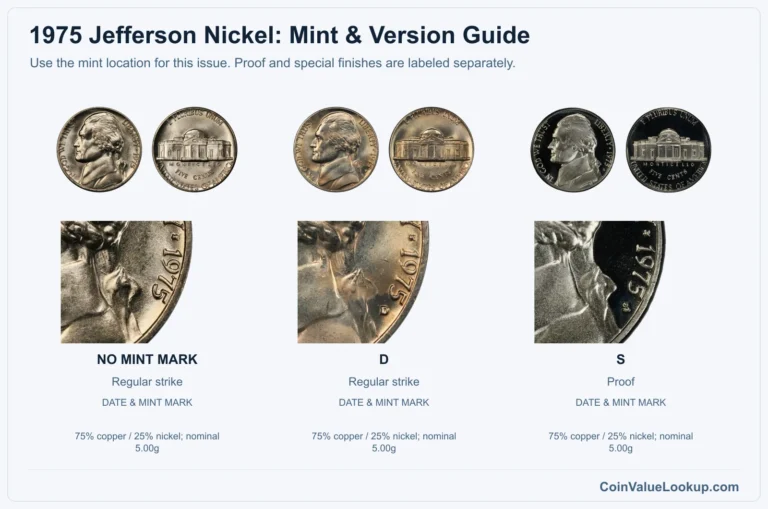
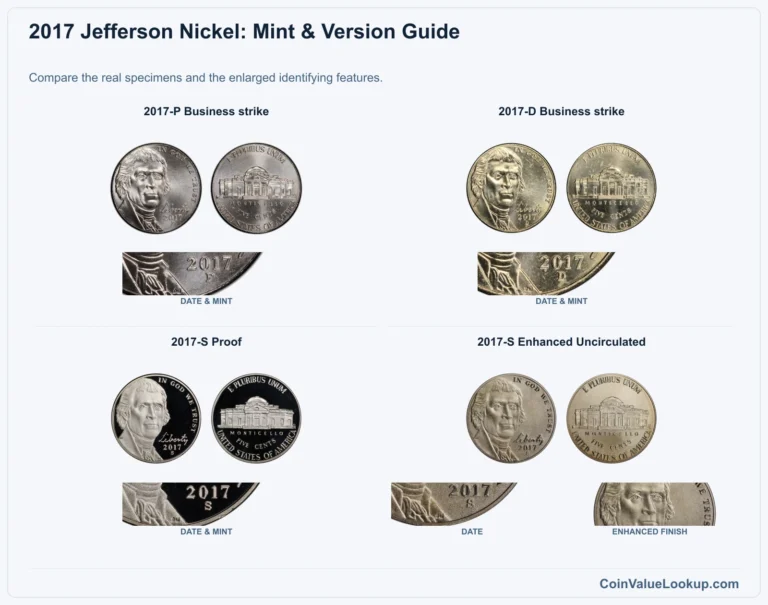
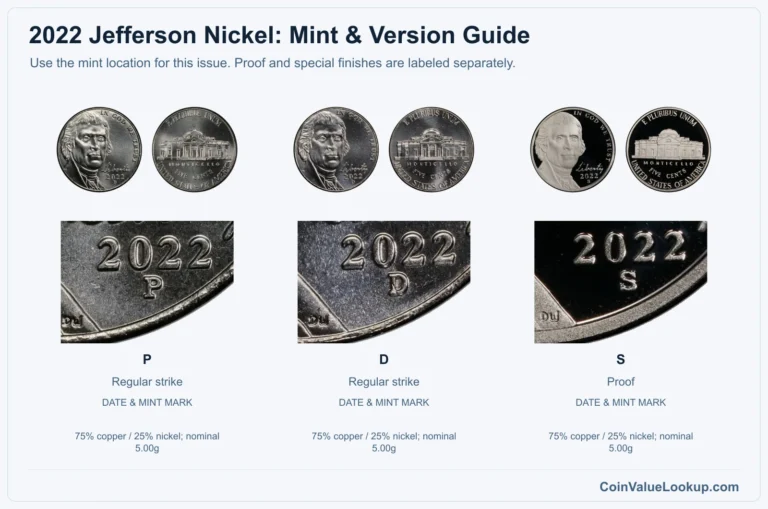
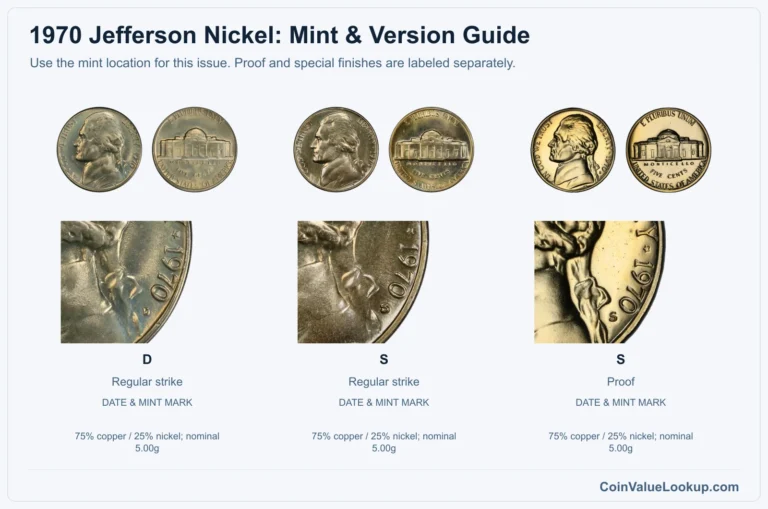
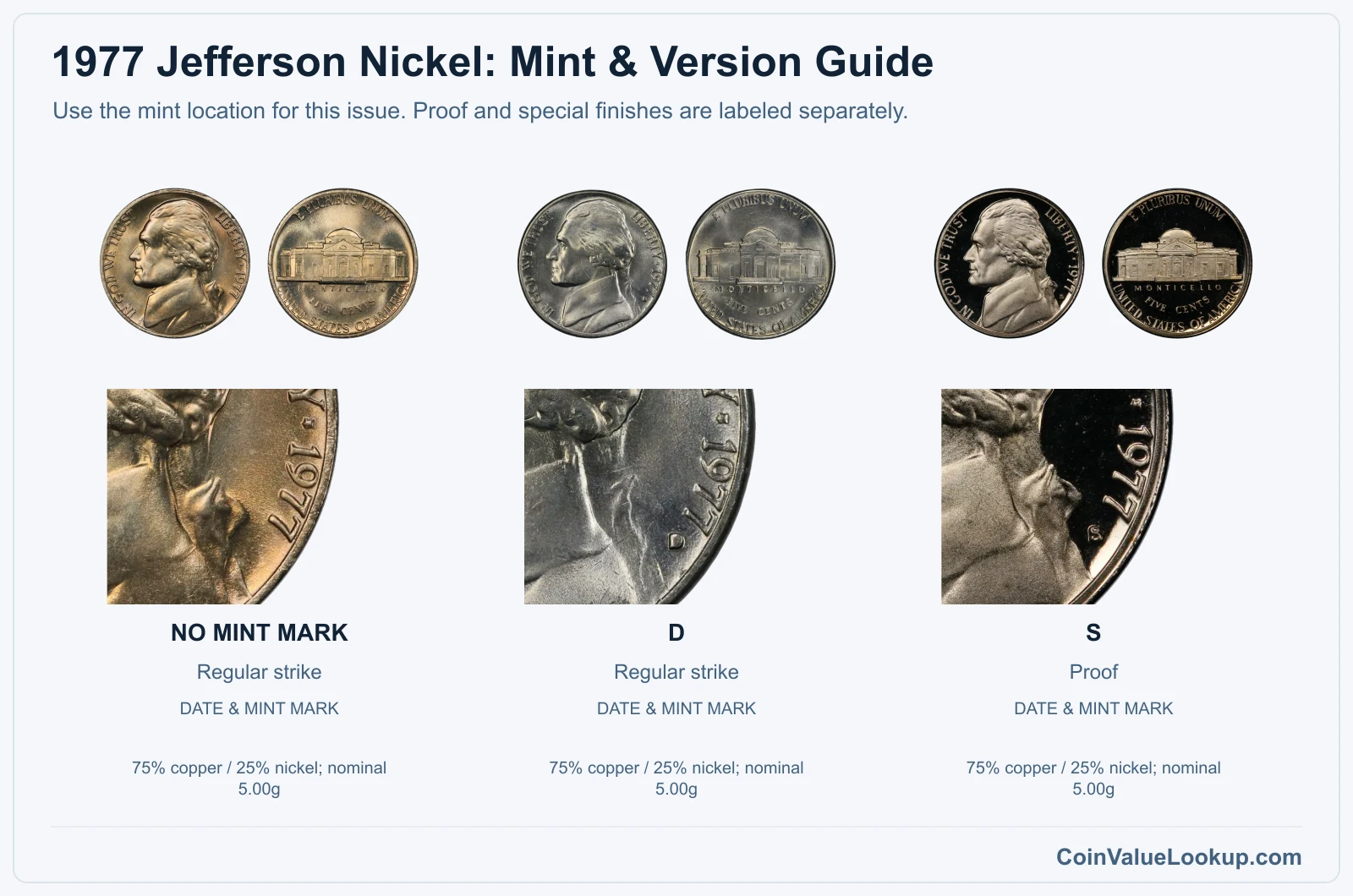
Three versions of the 1977 Jefferson nickel exist. A coin with no mintmark below the date is a Philadelphia business strike.
A small "D" in that same spot means Denver. An "S" means San Francisco, and those were struck as proofs only.
All three share the same composition: 75% copper, 25% nickel, at a nominal weight of 5 grams and a diameter of 21.2 mm with a plain edge. This is a solid copper-nickel alloy, not a clad sandwich, so do not mistake normal surface wear for a missing layer.
When examining your coin, record both faces, the date, the mintmark location, the edge, and the finish. Proof coins have mirror-like fields and sharp detail from specially prepared dies.
That is a manufacturing method, not a grade above Mint State. Cameo contrast, where the devices appear frosted against the mirror fields, is a separate finish attribute with its own market.
Step 2: Check Your 1977 Jefferson Nickel Grade
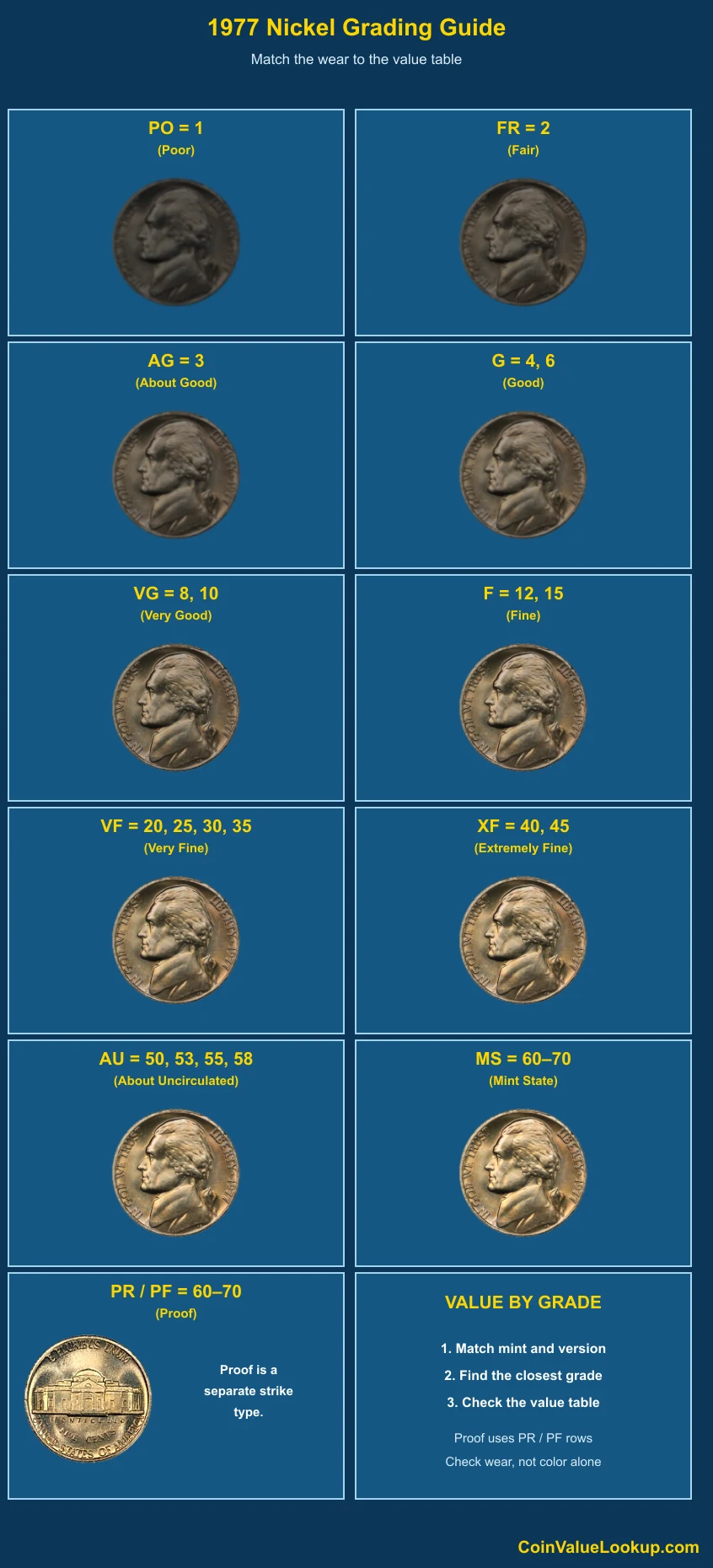
Start on the obverse. Jefferson's cheekbone and the hair behind his ear show wear first.
A coin that has been in circulation will flatten those high points before anything else disappears.
Flip to the reverse. The four columns and steps of Monticello tell the rest of the story.
Steps that are mushy or incomplete may reflect wear, but they can also indicate a weak strike from the factory.
Full Steps is a strike-quality designation applied to Mint State coins where the Monticello staircase lines remain uninterrupted. It is not the same as a high grade.
A coin can grade MS65 without Full Steps, or earn the Full Steps attribution at MS63.
Use the comparison image to gauge surface preservation, remaining luster, and the severity of contact marks. Bag marks from bulk storage are normal on business strikes and affect the grade even when no circulation wear is present.
Step 3: Check 1977 Jefferson Nickel Value by Mint and Version
1977 Jefferson Nickel — No mintmark (Philadelphia) Business strike
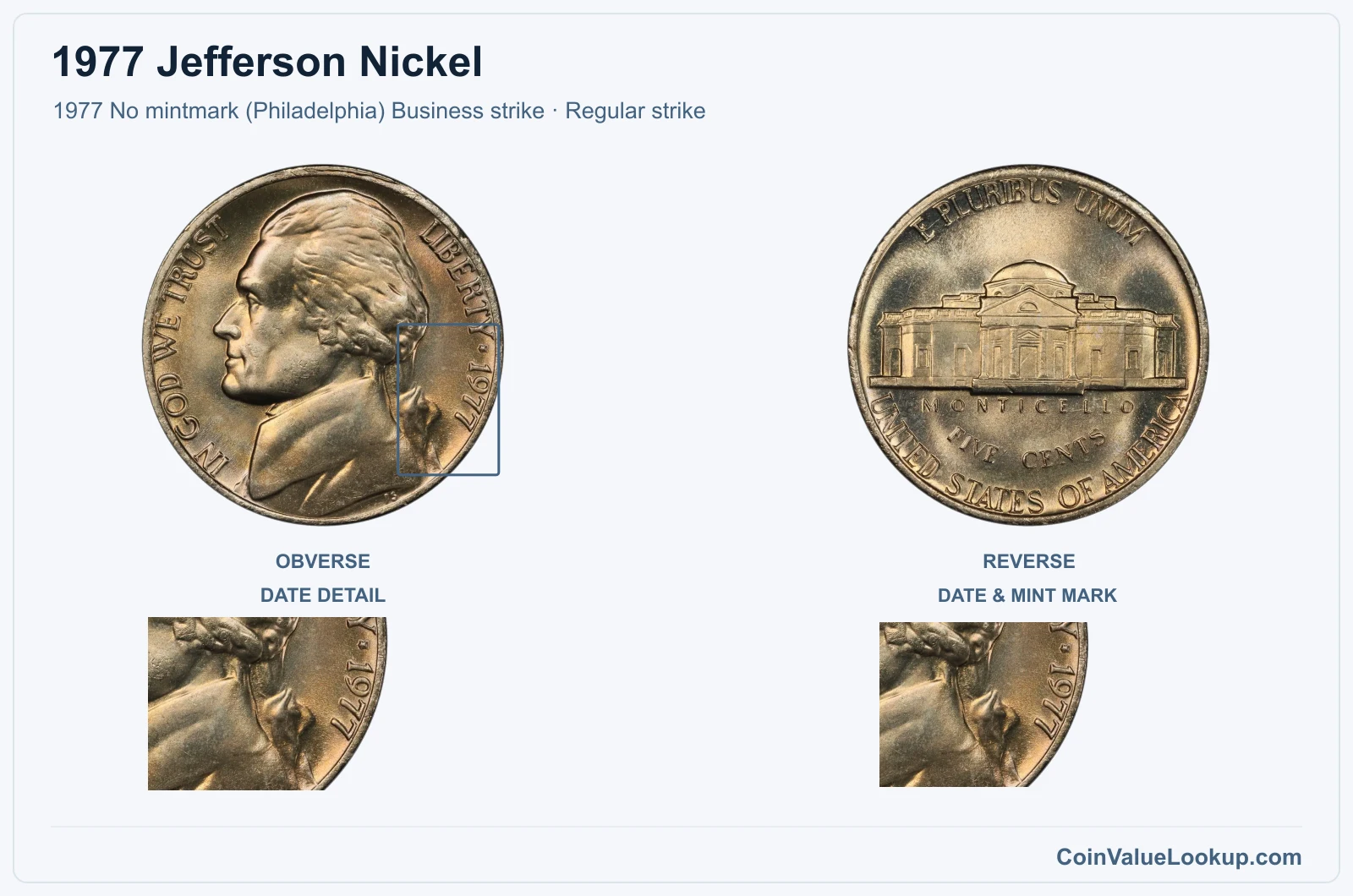
The 1977 Philadelphia nickel has no mintmark. Look below the date on the obverse and you should see bare field.
It is struck on a 75% copper, 25% nickel blank weighing about 5 grams.
USA Coin Book estimates place this coin at roughly $0.30 in MS60 condition and $3.62 at MS65. Circulated examples are generally worth face value.
Coins certified with Full Steps at high Mint State grades can command a premium, but do not assume any shiny nickel qualifies.
Coin Value Lookup is a good starting point if you want to compare this coin against other Jefferson nickel years and mints.
| Range | Grade | Price | Auction Records | Appraisal |
|---|---|---|---|---|
| PO | PO 1 | — | Coin Identifier | |
| FR | FR 2 | — | Coin Identifier | |
| AG | AG 3 | — | Coin Identifier | |
| G | G 4 | — | Coin Identifier | |
| G 6 | — | Coin Identifier | ||
| VG | VG 8 | — | Coin Identifier | |
| VG 10 | — | Coin Identifier | ||
| F | F 12 | — | Coin Identifier | |
| F 15 | — | Coin Identifier | ||
| VF | VF 20 | — | Coin Identifier | |
| VF 25 | — | Coin Identifier | ||
| VF 30 | — | Coin Identifier | ||
| VF 35 | — | Coin Identifier | ||
| XF | XF 40 | — | Coin Identifier | |
| XF 45 | — | Coin Identifier | ||
| AU | AU 50 | — | Coin Identifier | |
| AU 53 | — | Coin Identifier | ||
| AU 55 | — | Coin Identifier | ||
| AU 58 | — | Coin Identifier | ||
| MS | MS 60 | — | Coin Identifier | |
| MS 61 | — | Coin Identifier | ||
| MS 62 | — | Coin Identifier | ||
| MS 63 | — | Coin Identifier | ||
| MS 64 | Coin Identifier | |||
| MS 65 | — | Coin Identifier | ||
| MS 66 | Coin Identifier | |||
| MS 67 | — | — | — | |
| MS 68 | — | — | — | |
| MS 69 | — | — | — | |
| MS 70 | — | — | — |
1977 Jefferson Nickel — D Business strike
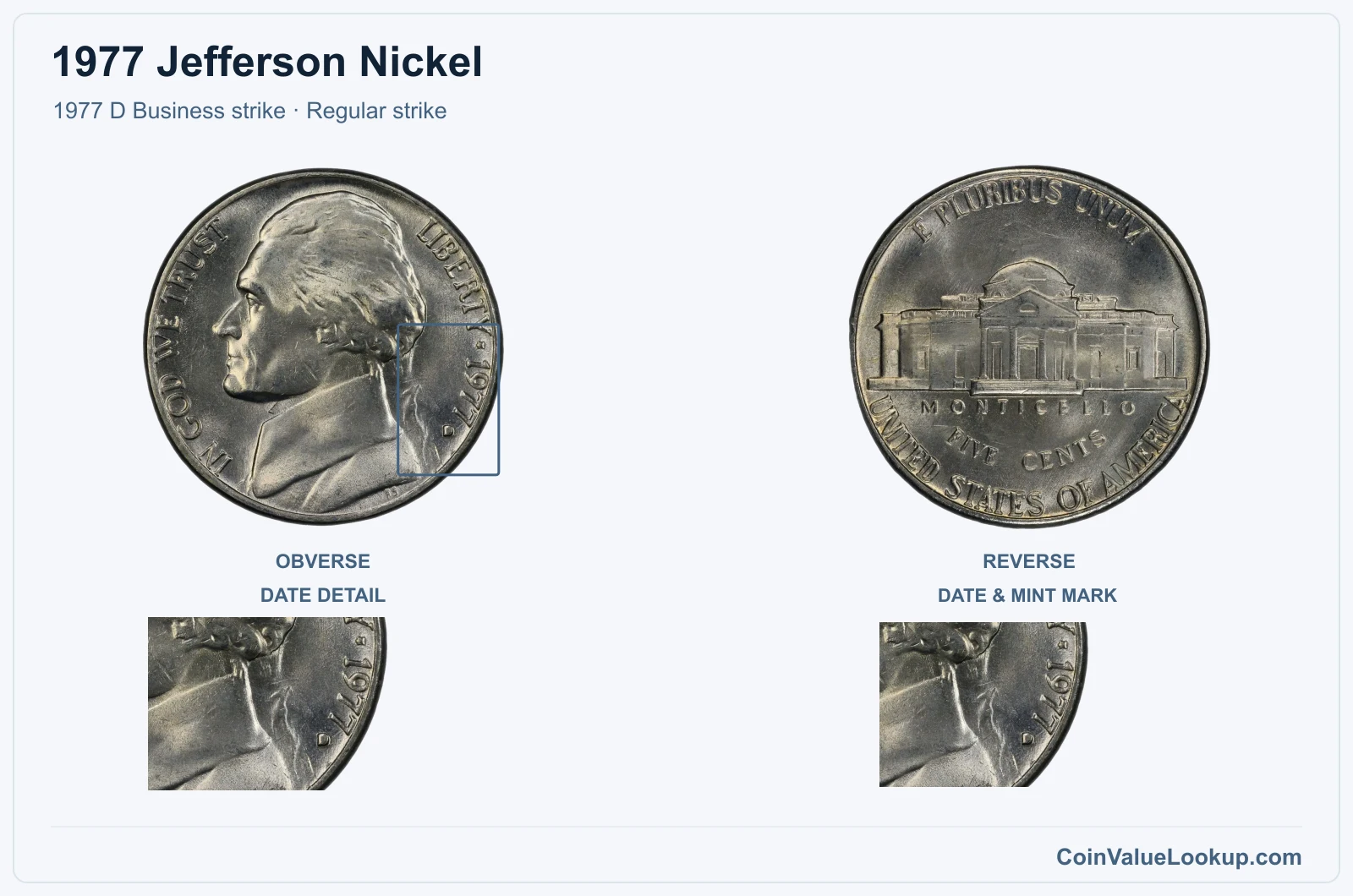
The 1977-D was struck in Denver and carries a small "D" mintmark on the obverse below the date. Same alloy, same weight, same design as its Philadelphia sibling.
Guide estimates from USA Coin Book put this version at about $0.61 in MS60 and $3.62 at MS65. In worn condition it is a five-cent coin.
High-grade examples with strong Monticello step detail are the ones collectors single out, so check the reverse carefully before writing it off.
| Range | Grade | Price | Auction Records | Appraisal |
|---|---|---|---|---|
| PO | PO 1 | — | Coin Identifier | |
| FR | FR 2 | — | Coin Identifier | |
| AG | AG 3 | — | Coin Identifier | |
| G | G 4 | — | Coin Identifier | |
| G 6 | — | Coin Identifier | ||
| VG | VG 8 | — | Coin Identifier | |
| VG 10 | — | Coin Identifier | ||
| F | F 12 | — | Coin Identifier | |
| F 15 | — | Coin Identifier | ||
| VF | VF 20 | — | Coin Identifier | |
| VF 25 | — | Coin Identifier | ||
| VF 30 | — | Coin Identifier | ||
| VF 35 | — | Coin Identifier | ||
| XF | XF 40 | — | Coin Identifier | |
| XF 45 | — | Coin Identifier | ||
| AU | AU 50 | — | Coin Identifier | |
| AU 53 | — | Coin Identifier | ||
| AU 55 | — | Coin Identifier | ||
| AU 58 | — | Coin Identifier | ||
| MS | MS 60 | — | Coin Identifier | |
| MS 61 | — | Coin Identifier | ||
| MS 62 | — | Coin Identifier | ||
| MS 63 | — | Coin Identifier | ||
| MS 64 | Coin Identifier | |||
| MS 65 | — | Coin Identifier | ||
| MS 66 | Coin Identifier | |||
| MS 67 | Coin Identifier | |||
| MS 68 | — | — | — | |
| MS 69 | — | — | — | |
| MS 70 | — | — | — |
1977 Jefferson Nickel — S Proof
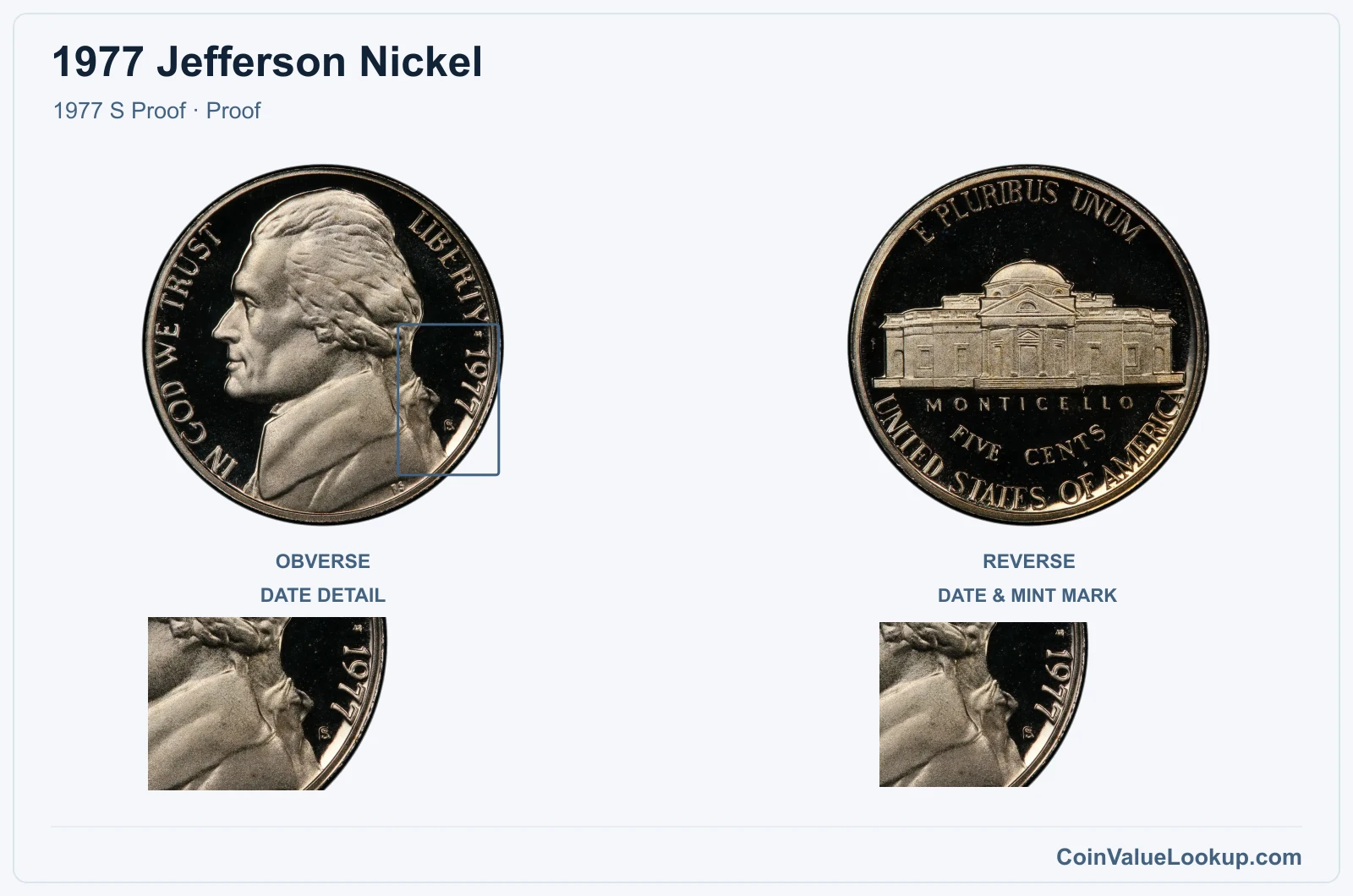
The 1977-S proof was struck at San Francisco for collector sets, not for circulation. It carries an "S" mintmark below the date and shows mirror fields with sharply struck devices.
USA Coin Book lists a base proof value of about $2.50 at PR65. That figure covers a standard proof finish only.
Cameo and deep-cameo versions are tracked separately and are not covered by that base estimate. A proof is a method of manufacture, not a grade level above Mint State.
Condition still matters, and contact marks or haze reduce the assigned grade just as they would on a business strike.
| Range | Grade | Price | Auction Records | Appraisal |
|---|---|---|---|---|
| PR | PR 1 | — | Coin Identifier | |
| PR 2 | — | Coin Identifier | ||
| PR 3 | — | Coin Identifier | ||
| PR 4 | — | Coin Identifier | ||
| PR 6 | — | Coin Identifier | ||
| PR 8 | — | Coin Identifier | ||
| PR 10 | — | Coin Identifier | ||
| PR 12 | — | Coin Identifier | ||
| PR 15 | — | Coin Identifier | ||
| PR 20 | — | Coin Identifier | ||
| PR 25 | — | Coin Identifier | ||
| PR 30 | — | Coin Identifier | ||
| PR 35 | — | Coin Identifier | ||
| PR 40 | — | Coin Identifier | ||
| PR 45 | — | Coin Identifier | ||
| PR 50 | — | Coin Identifier | ||
| PR 53 | — | Coin Identifier | ||
| PR 55 | — | Coin Identifier | ||
| PR 58 | — | Coin Identifier | ||
| PR 60 | — | Coin Identifier | ||
| PR 61 | — | Coin Identifier | ||
| PR 62 | — | Coin Identifier | ||
| PR 63 | — | Coin Identifier | ||
| PR 64 | — | Coin Identifier | ||
| PR 65 | — | Coin Identifier | ||
| PR 66 | — | Coin Identifier | ||
| PR 67 | Coin Identifier | |||
| PR 68 | Coin Identifier | |||
| PR 69 | Coin Identifier | |||
| PR 70 | Coin Identifier |
1977 Jefferson Nickel Error List
1. 1977 Jefferson Nickel — Proof struck on clad dime blank
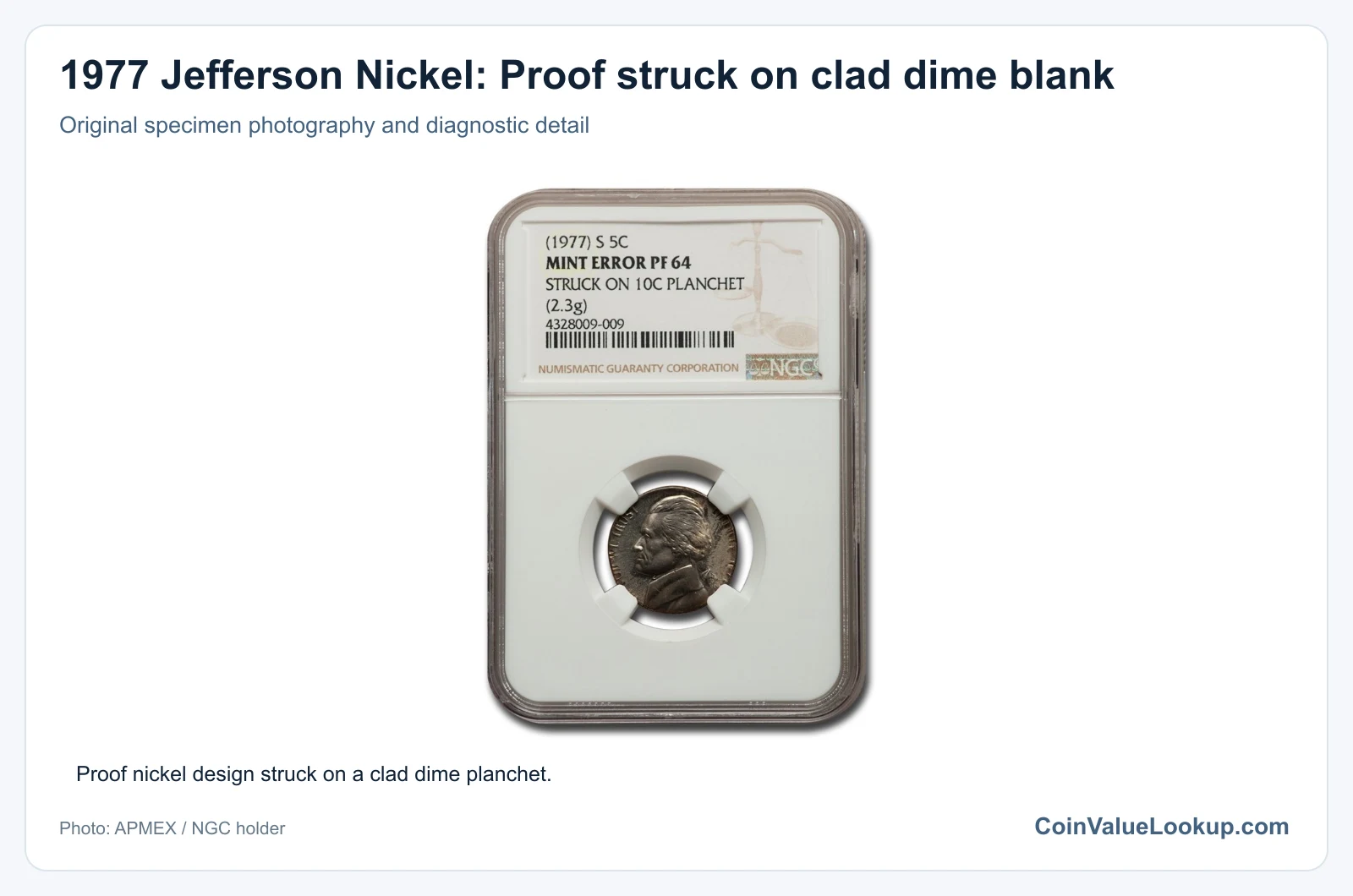
This error is a 1977-S proof nickel struck on an undersized clad dime blank. Because the planchet is smaller than normal, the outer portions of the nickel design are stretched or cropped.
The coin looks obviously wrong in hand: thinner, lighter, and missing rim detail.
This is strictly a proof issue. Do not apply it to circulation strikes.
A Heritage Auctions example graded PCGS PR68 Cameo sold for $1,440 in May 2022. That is one recorded sale, not a guaranteed market price for every specimen.
Lookalikes include clipped normal proofs or ordinary nickels with post-mint damage. The key distinction is that the entire coin diameter is reduced and the design wraps around an undersized blank, rather than a chunk being missing from one side.
2. 1977 Jefferson Nickel — Proof on cent blank with rotated dies
This is a 1977-S proof nickel struck on a copper cent blank that also exhibits a nearly 180-degree die rotation. Two errors on one coin.
The copper planchet gives the surfaces a reddish-brown tone instead of the usual silver-gray, and flipping the coin top to bottom reveals the reverse is oriented almost medal-turn rather than the normal coin-turn alignment.
A Heritage Auctions example graded NGC PR65 RB realized $1,860 in August 2021 for the combined error. That is a single sale, not a blanket value.
To confirm this error you need to photograph both faces with a controlled top-to-bottom flip. Lookalikes include copper-plated nickels and images where the camera itself was rotated.
The weight should be close to 3.1 grams, matching a cent blank, not the usual 5 grams.
3. 1977 Jefferson Nickel — Business strike on cent blank
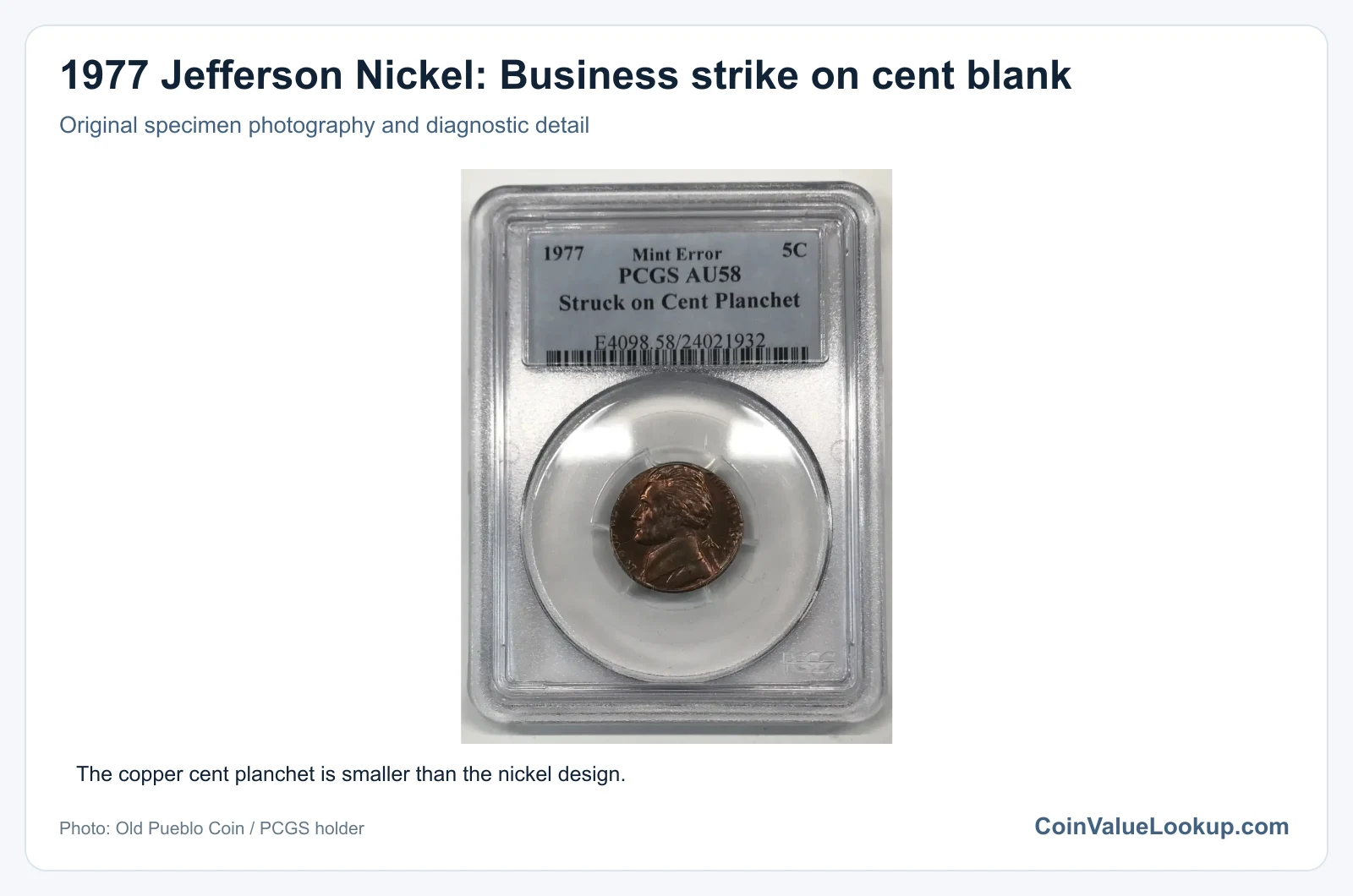
A 1977 Philadelphia business-strike nickel struck on a copper cent blank. The coin is noticeably smaller and lighter than a standard nickel, weighing about 3.1 grams.
Nickel designs appear on both sides, but the outer lettering and rim detail are cropped because the blank was too small to receive the full impression.
A Heritage Auctions example graded NGC MS62 Brown sold for $218.50 in April 2006.
Copper plating, chemical toning, and edge grinding can all mimic the look of a wrong-planchet strike. Weigh the coin and examine both faces.
An authentic example will carry the full nickel design, proportionally shrunken, on a clearly copper-colored blank with no trace of nickel alloy at the edge.
4. 1977 Jefferson Nickel — Partial collar with indent
A partial collar error occurs when the collar die does not fully engage during striking. On a 1977 nickel, this produces a stepped or shelf-like edge where part of the rim is normal and part flares outward.
Some examples also show an indent from an adjacent blank that was caught in the press during the strike, making it a compound error.
An example graded ANACS MS64 has been authenticated. Value depends on the severity of the collar misalignment, the presence of any secondary error, and the coin's overall condition, so each piece requires individual assessment.
Lookalikes include filed or ground edges and post-mint dents. A genuine partial collar will show a consistent transition from the properly formed rim into the malformed section, and the design on both faces will be fully struck.
5. 1977 Jefferson Nickel — Off-Center Strike
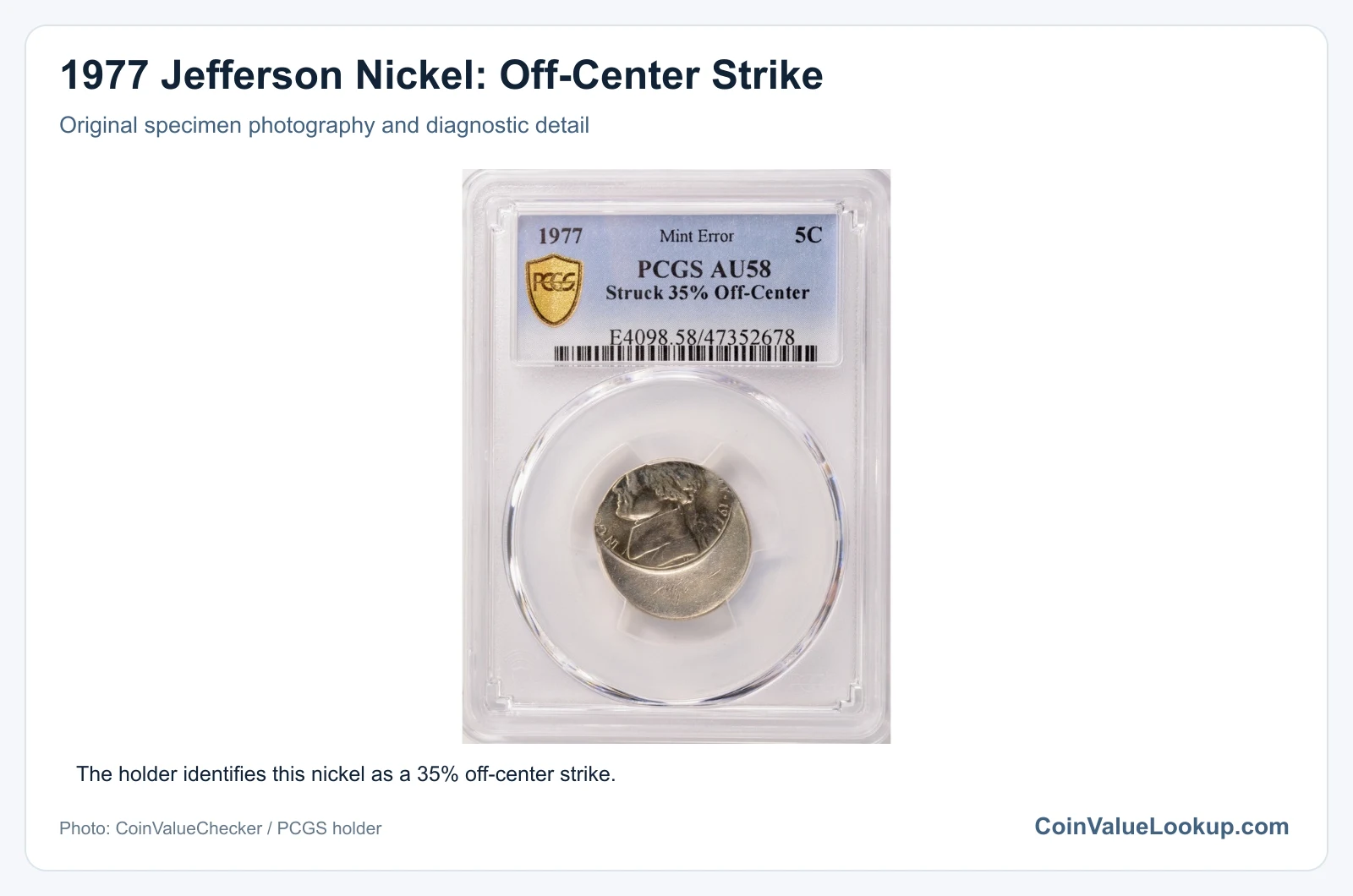
An off-center strike happens when the blank is not seated properly between the dies. The result is a displaced design with an unstruck crescent of bare metal along one side.
The farther off center the strike, the more dramatic the appearance.
For a 1977 nickel, the date needs to remain visible for the coin to be attributed to this year. Percentage of off-center displacement, condition, and date visibility all affect desirability.
Do not confuse this with a clipped planchet, which removes a curved section but leaves the design centered, or with post-mint flattening that distorts the shape without creating an unstruck crescent. A one-sided die misalignment can also look similar but produces a weak strike rather than a shifted image.
6. 1977 Jefferson Nickel — Doubled Die Obverse
A doubled die obverse on a 1977 nickel shows consistent doubling in the obverse lettering or portrait detail. This doubling is created during the die-making process, so every coin struck by that die carries the same markers.
Under magnification, look for separation or notching on letters such as LIBERTY, IN GOD WE TRUST, or the date digits. The doubling should appear in the same direction and degree across multiple design elements.
Machine doubling is the most common lookalike. It produces a flat, shelf-like distortion rather than the rounded, separated profiles of a true doubled die.
Reflections under certain lighting and worn die contours can also mimic doubling. Condition and the strength of the doubling both factor into value.
7. 1977 Jefferson Nickel — Die Crack / Die Chip
Die cracks and die chips appear as raised lines or small raised blobs on the coin's surface. They originate from physical damage to the steel die, which transfers as raised metal during striking.
A crack that reaches the rim and produces a larger raised area is called a cud.
On a 1977 nickel, inspect both sides for fine raised lines running across the design or small lumps in the field. A rim-connected cud will look like a raised blob at the edge, distinct from an interior die chip that sits within the design area.
Lookalikes include incuse scratches, corrosion deposits, and foreign material stuck to the surface. Scratches are recessed, not raised.
Corrosion tends to be irregular and pitted. Value depends on prominence, location, and the coin's overall condition.
8. 1977 Jefferson Nickel — Clashed Dies
Clashed dies result when the obverse and reverse dies strike each other without a blank between them. The impact transfers faint traces of each die's design onto the opposing die.
Subsequent coins struck by those damaged dies carry ghost images of the wrong side's features.
On a 1977 nickel, look for faint outlines in the open fields: traces of Monticello's columns on the obverse, or Jefferson's profile echoed on the reverse. These ghost images should align with where the opposite design would naturally contact.
Random scratches, raised lines from debris, and brockage errors can all mimic a clash. True clash marks repeat in a predictable position relative to the opposing design.
Condition and the clarity of the transferred image both influence collector interest.
9. 1977 Jefferson Nickel — Struck-Through Error
A struck-through error occurs when foreign material sits between the die and the blank during striking. The obstruction leaves a localized depression or impression in the finished coin's surface, and the affected area shows incomplete or distorted design detail.
On a 1977 nickel, look for a distinct area where the design is flattened or carries the texture of an intervening object. Grease fill-ins produce soft, rounded missing detail, while a retained foreign object can leave a sharp impression or even remain embedded in the coin.
Wear, cleaning, and ordinary weak strikes are the main lookalikes. Wear removes detail uniformly from high points, while a struck-through affects a localized, often irregularly shaped zone.
Value depends on the size, sharpness, and visual impact of the obstruction impression, plus the coin's condition.
10. 1977 Jefferson Nickel — Repunched Mintmark
A repunched mintmark on a 1977 nickel shows remnants of a second, slightly offset mintmark impression beneath or beside the primary one. This happened during die preparation when the mintmark punch was applied more than once in slightly different positions.
Inspect the mintmark area below the date under magnification. Compare what you see against a normal mintmark at the same magnification.
You are looking for traces of an additional impression, such as a partial letter offset from the main mark.
Machine doubling can create a flat shelf near the mintmark. Die chips and corrosion around the mark also mimic a repunched appearance.
A true repunched mintmark shows a distinctly separate, rounded impression. Condition and the visibility of the secondary punch both affect value.