1977 Lincoln Penny Coin Value: How Much Is It Worth?
Most 1977 Lincoln pennies you find in pocket change are worth face value and not much more. A USA Coin Book guide estimate places an uncirculated MS65 example around $1.24, while a proof in PR65 condition sits near $3.08.
The real action comes from authenticated error coins, where a single aluminum specimen brought over $50,000 at auction.
Fast Way to Identify Your 1977 Lincoln Penny
Snap clear photos of the front and back of your 1977 penny and upload them here for a preliminary identification. This helps narrow down which version you have — no mintmark, D, or S proof — and whether anything unusual stands out on the surfaces.
It is not a substitute for professional authentication or exact grading, but it is a solid first step.
1977 Penny Value
Upload both sides of your 1977 Lincoln Penny.
Front Obverse
Upload photo
Back Reverse
Upload photo
Which 1977 Lincoln Penny Versions Are Worth Money?
- Authenticated error coins carry the real premiums for 1977 pennies — a confirmed aluminum composition example sold for $50,400 at auction.
- Original high-grade surfaces with full red copper color matter more than the common date alone; check for striking errors and wrong-planchet coins before spending them.
Step 1: Identify Your 1977 Lincoln Penny Mint Mark and Version
The 1977 Lincoln cent carries the familiar Lincoln portrait on the obverse and the Lincoln Memorial on the reverse, with a plain (smooth) edge. Normal composition is 95% copper and 5% zinc, with a nominal weight of 3.11 grams.
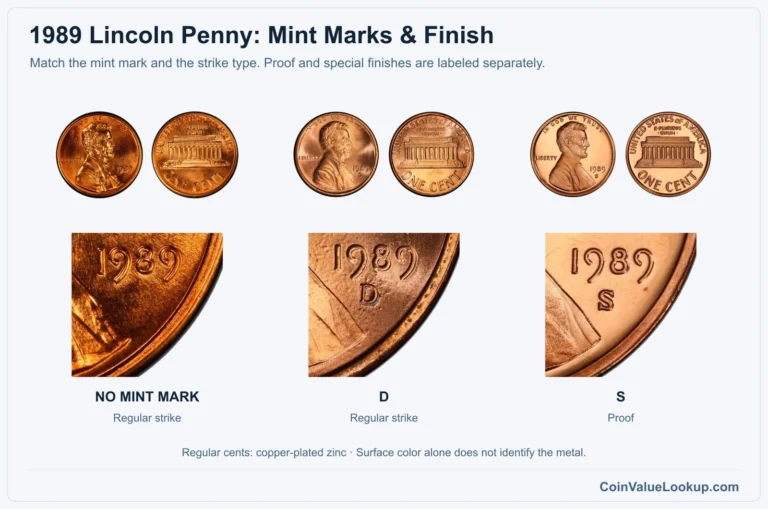
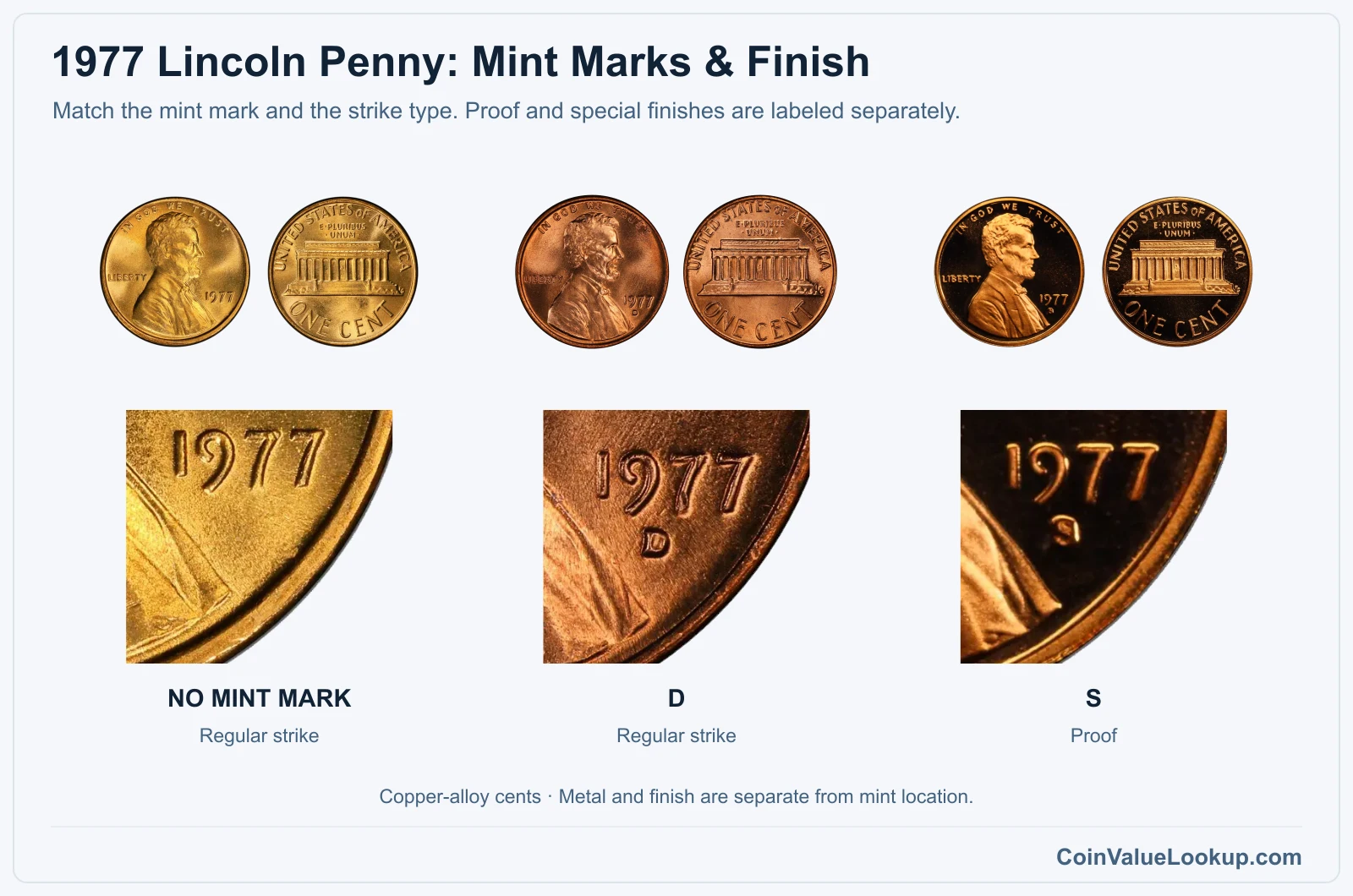
Three catalog branches exist for this year. The no-mintmark version and the D (Denver) version are business strikes made for circulation.
The S (San Francisco) version is a collector proof — there was no normal S circulation issue in 1977.
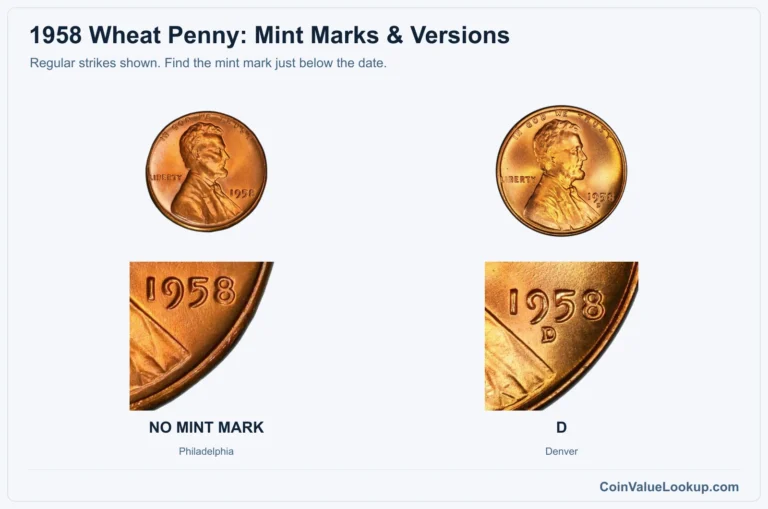
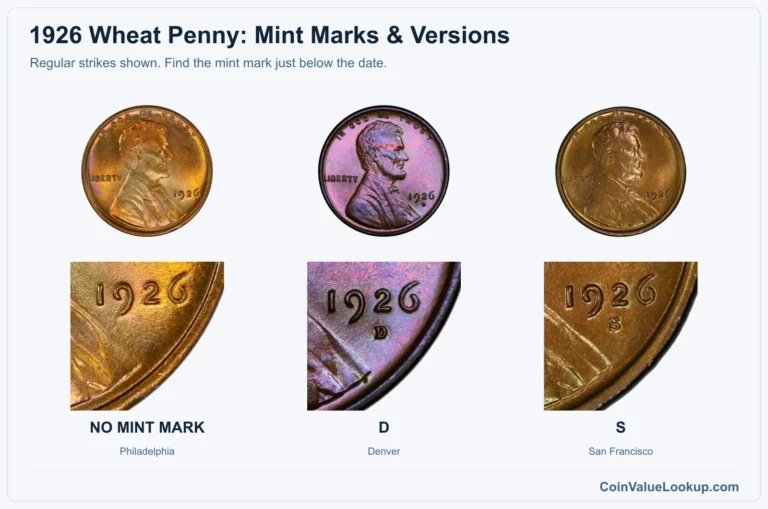
Look below the date on the obverse to find the mintmark. A small "D" means Denver.
No letter at all is the no-mintmark branch. An "S" means you have a proof coin, which should show mirror-like fields rather than the satiny luster of a business strike.
One more thing beginners trip over: BN, RB, and RD are copper color designations that describe how much original red color remains. They are not different metals.
Similarly, CAM and DCAM refer to contrast levels on proofs, not separate alloys.
Step 2: Check Your 1977 Lincoln Penny Grade
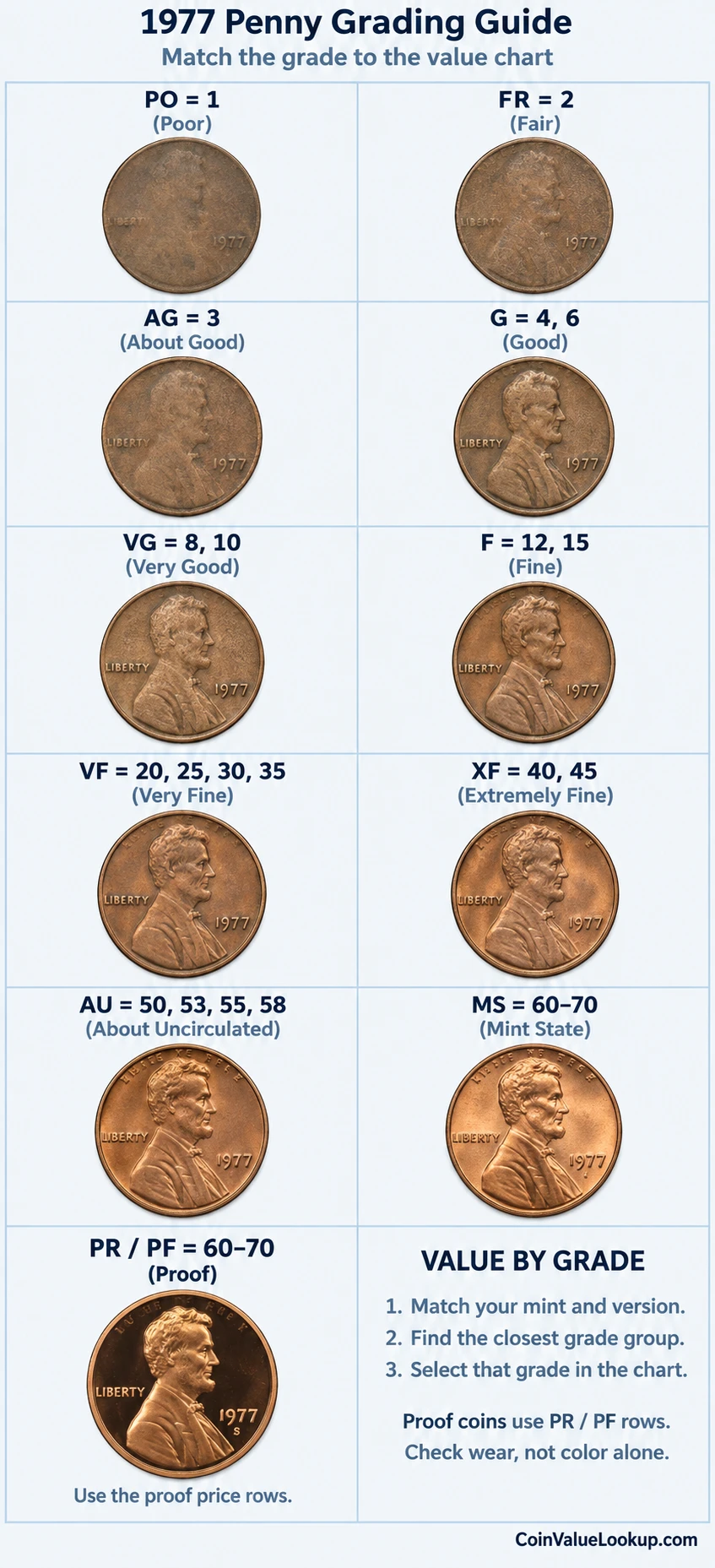
Start by checking Lincoln's cheekbone, jawline, and the hair detail above his ear. On the reverse, examine the Memorial roof and the columns.
These are the highest points and the first places to show wear.
The difference between About Uncirculated and Mint State comes down to luster interruption and high-point wear, not color alone. A coin can look coppery-red and still have friction on the cheek that keeps it out of MS territory.
For proofs, look for hairlines from improper handling, spots, or any damage to the reflective surfaces. These reduce value quickly.
Never clean a copper coin or try to remove surface toning — that causes more harm than good.
Use the comparison image to match your coin's wear pattern against known grade examples. Focus on the same high points mentioned above and compare luster quality across the fields.
Step 3: Check 1977 Lincoln Penny Value by Mint and Version
1977 Lincoln Penny
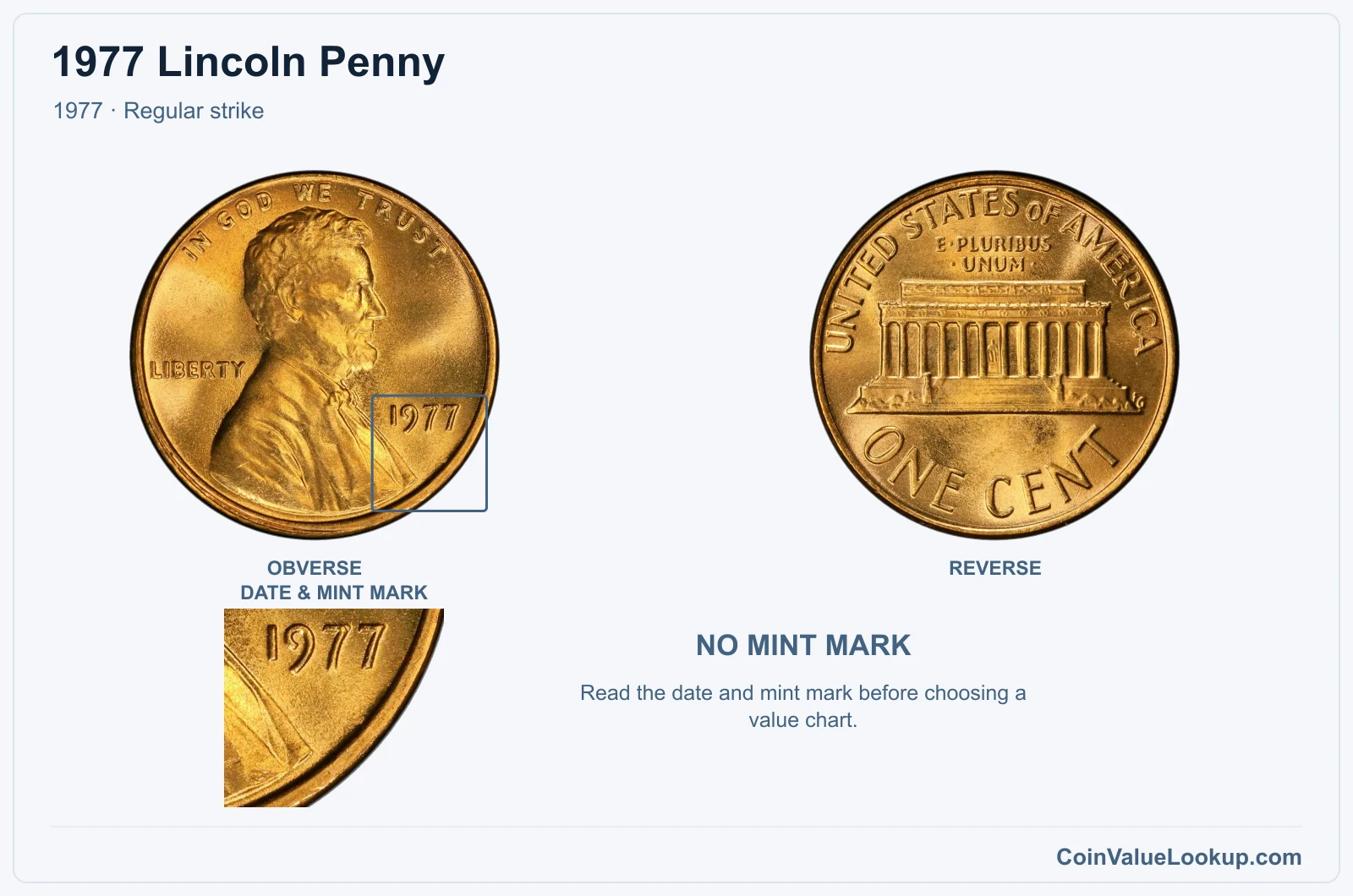
The 1977 no-mintmark Lincoln cent is a business strike on the standard 95% copper and 5% zinc planchet, weighing about 3.11 grams. There is no letter below the date.
A USA Coin Book guide estimate puts an MS65 example at roughly $1.24.
In circulated grades, these are essentially worth face value. To command a meaningful premium, you need original surfaces with strong luster and minimal contact marks.
The copper color designation — BN, RB, or RD — matters at the grading level, with full Red examples pulling the most interest. Do not confuse proof-like reflections with a higher Mint State grade; they are separate categories.
| Range | Grade | Price | Auction Records | Appraisal |
|---|---|---|---|---|
| PO | PO 1 | — | Coin Identifier | |
| FR | FR 2 | — | Coin Identifier | |
| AG | AG 3 | — | Coin Identifier | |
| G | G 4 | — | Coin Identifier | |
| G 6 | — | Coin Identifier | ||
| VG | VG 8 | — | Coin Identifier | |
| VG 10 | — | Coin Identifier | ||
| F | F 12 | — | Coin Identifier | |
| F 15 | — | Coin Identifier | ||
| VF | VF 20 | — | Coin Identifier | |
| VF 25 | — | Coin Identifier | ||
| VF 30 | — | Coin Identifier | ||
| VF 35 | — | Coin Identifier | ||
| XF | XF 40 | — | Coin Identifier | |
| XF 45 | — | Coin Identifier | ||
| AU | AU 50 | — | Coin Identifier | |
| AU 53 | — | Coin Identifier | ||
| AU 55 | — | Coin Identifier | ||
| AU 58 | — | Coin Identifier | ||
| MS | MS 60 | — | Coin Identifier | |
| MS 61 | — | Coin Identifier | ||
| MS 62 | — | Coin Identifier | ||
| MS 63 | — | Coin Identifier | ||
| MS 64 | — | Coin Identifier | ||
| MS 65 | Coin Identifier | |||
| MS 66 | Coin Identifier | |||
| MS 67 | Coin Identifier | |||
| MS 68 | — | Coin Identifier | ||
| MS 69 | — | — | — | |
| MS 70 | — | — | — |
1977 Lincoln Penny — D
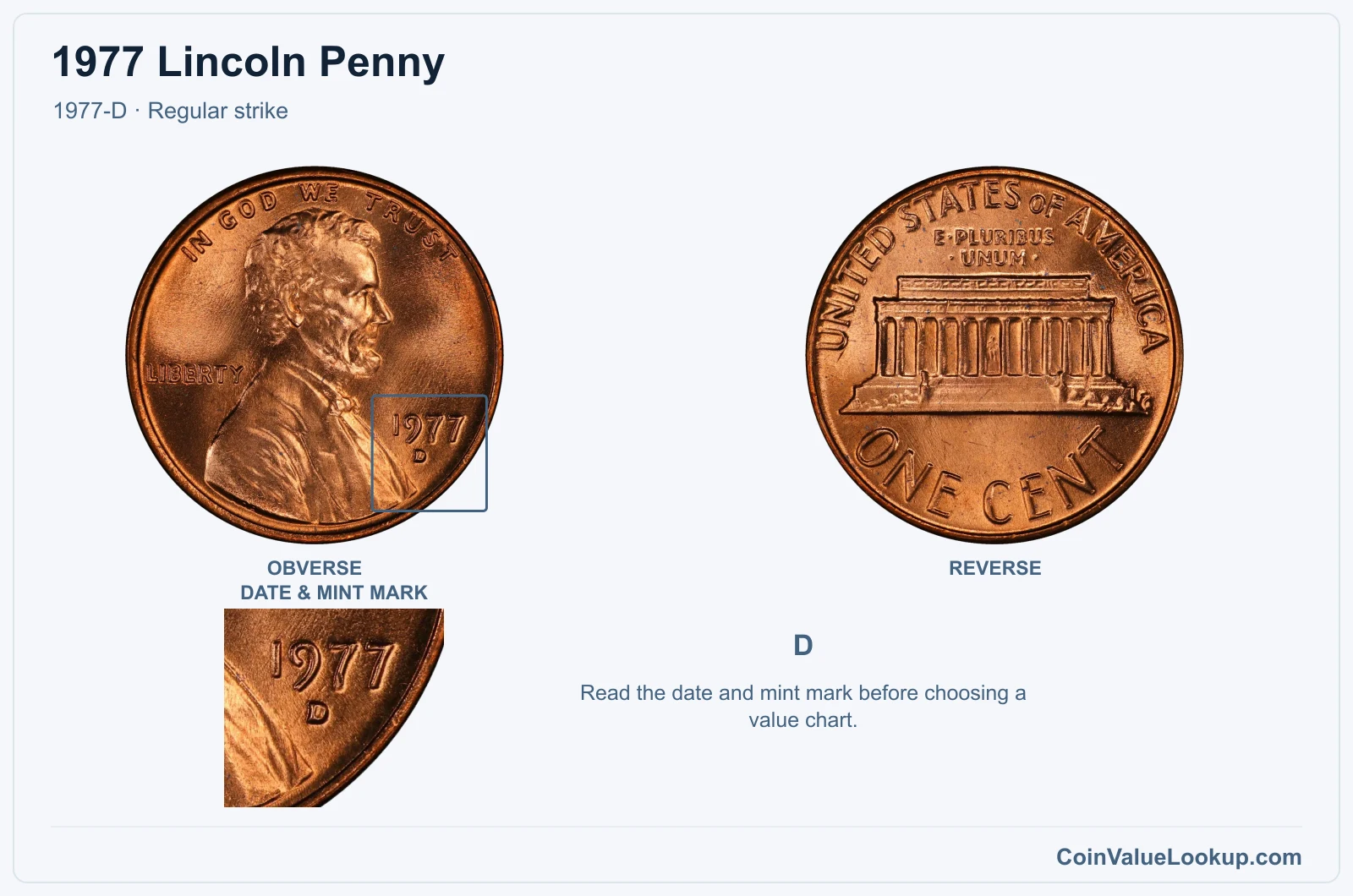
The 1977-D comes from Denver and carries a small "D" mintmark below the date. Same composition and weight as the no-mintmark version: 95% copper, 5% zinc, 3.11 grams.
The USA Coin Book guide estimate for MS65 is around $1.24.
Denver struck huge quantities this year, so finding one is easy. Finding one in gem condition with original red surfaces is another story.
Look for bag marks and luster breaks across the fields — those are what separate a dollar coin from a spender.
Coin Value Lookup is a handy starting point if you want to check guide values for other dates and mints across the Lincoln cent series.
| Range | Grade | Price | Auction Records | Appraisal |
|---|---|---|---|---|
| PO | PO 1 | — | Coin Identifier | |
| FR | FR 2 | — | Coin Identifier | |
| AG | AG 3 | — | Coin Identifier | |
| G | G 4 | — | Coin Identifier | |
| G 6 | — | Coin Identifier | ||
| VG | VG 8 | — | Coin Identifier | |
| VG 10 | — | Coin Identifier | ||
| F | F 12 | — | Coin Identifier | |
| F 15 | — | Coin Identifier | ||
| VF | VF 20 | — | Coin Identifier | |
| VF 25 | — | Coin Identifier | ||
| VF 30 | — | Coin Identifier | ||
| VF 35 | — | Coin Identifier | ||
| XF | XF 40 | — | Coin Identifier | |
| XF 45 | — | Coin Identifier | ||
| AU | AU 50 | — | Coin Identifier | |
| AU 53 | — | Coin Identifier | ||
| AU 55 | — | Coin Identifier | ||
| AU 58 | — | Coin Identifier | ||
| MS | MS 60 | — | Coin Identifier | |
| MS 61 | — | Coin Identifier | ||
| MS 62 | — | Coin Identifier | ||
| MS 63 | — | Coin Identifier | ||
| MS 64 | Coin Identifier | |||
| MS 65 | Coin Identifier | |||
| MS 66 | Coin Identifier | |||
| MS 67 | Coin Identifier | |||
| MS 68 | Coin Identifier | |||
| MS 69 | — | — | — | |
| MS 70 | — | — | — |
1977 Lincoln Penny — S PR
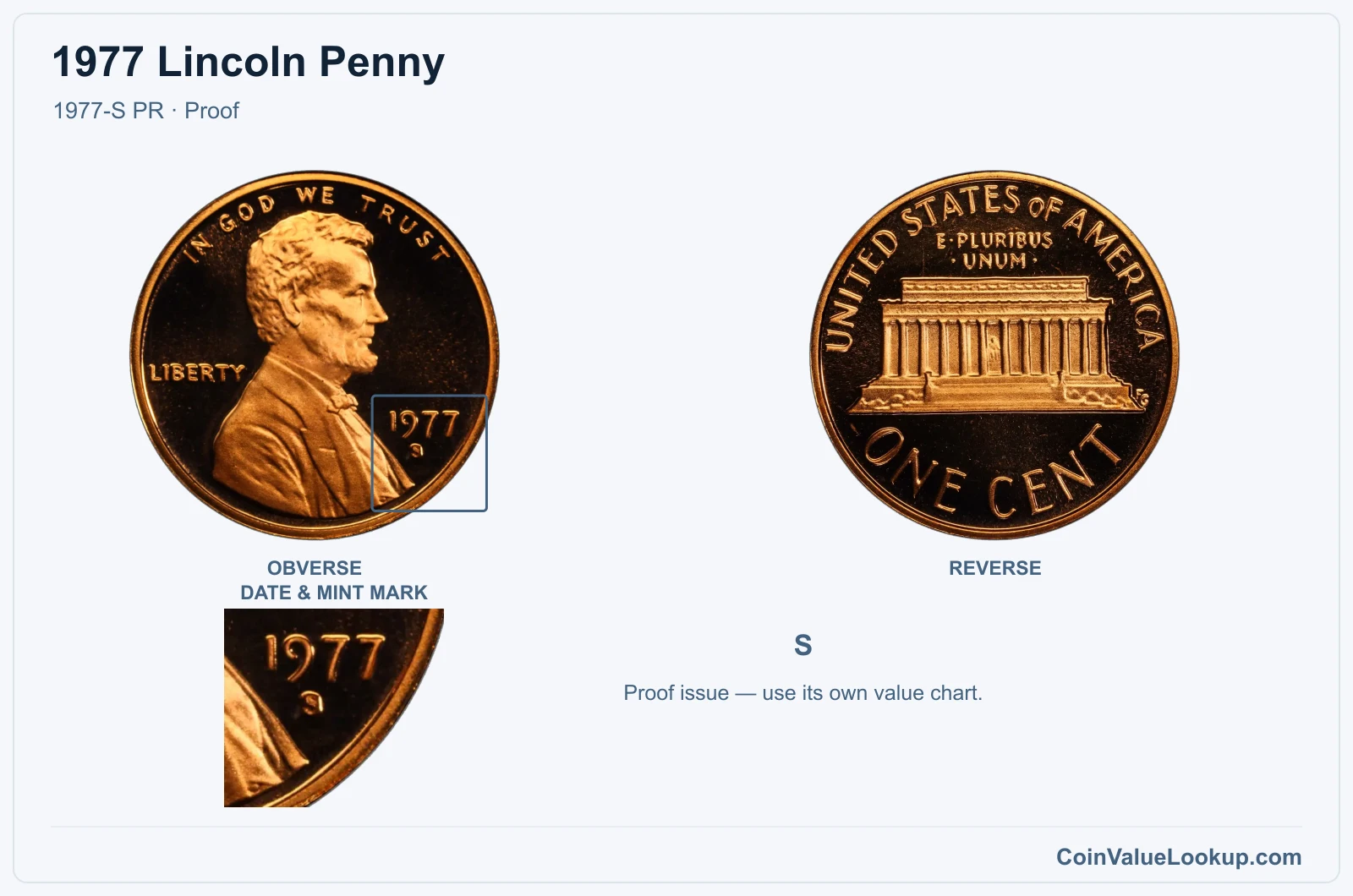
The 1977-S is exclusively a proof issue from San Francisco. It features the "S" mintmark below the date and should display mirror-like fields — that is a manufacturing finish, not a grade above Mint State.
Standard composition is 95% copper and 5% zinc. A USA Coin Book guide estimate places a PR65 example near $3.08.
Proof coins were sold in collector sets, so most survivors are well preserved. Hairlines from slides or improper storage are the main condition killers.
Cameo (CAM) and Deep Cameo (DCAM) designations describe the contrast between frosted devices and mirrored fields, and strong contrast examples are preferred by collectors.
| Range | Grade | Price | Auction Records | Appraisal |
|---|---|---|---|---|
| PR | PR 1 | — | Coin Identifier | |
| PR 2 | — | Coin Identifier | ||
| PR 3 | — | Coin Identifier | ||
| PR 4 | — | Coin Identifier | ||
| PR 6 | — | Coin Identifier | ||
| PR 8 | — | Coin Identifier | ||
| PR 10 | — | Coin Identifier | ||
| PR 12 | — | Coin Identifier | ||
| PR 15 | — | Coin Identifier | ||
| PR 20 | — | Coin Identifier | ||
| PR 25 | — | Coin Identifier | ||
| PR 30 | — | Coin Identifier | ||
| PR 35 | — | Coin Identifier | ||
| PR 40 | — | Coin Identifier | ||
| PR 45 | — | Coin Identifier | ||
| PR 50 | — | Coin Identifier | ||
| PR 53 | — | Coin Identifier | ||
| PR 55 | — | Coin Identifier | ||
| PR 58 | — | Coin Identifier | ||
| PR 60 | — | Coin Identifier | ||
| PR 61 | — | Coin Identifier | ||
| PR 62 | — | Coin Identifier | ||
| PR 63 | — | Coin Identifier | ||
| PR 64 | Coin Identifier | |||
| PR 65 | — | Coin Identifier | ||
| PR 66 | — | Coin Identifier | ||
| PR 67 | Coin Identifier | |||
| PR 68 | Coin Identifier | |||
| PR 69 | Coin Identifier | |||
| PR 70 | Coin Identifier |
1977 Lincoln Penny Error List
1. 1977 Lincoln Penny — Aluminum Composition Anomaly
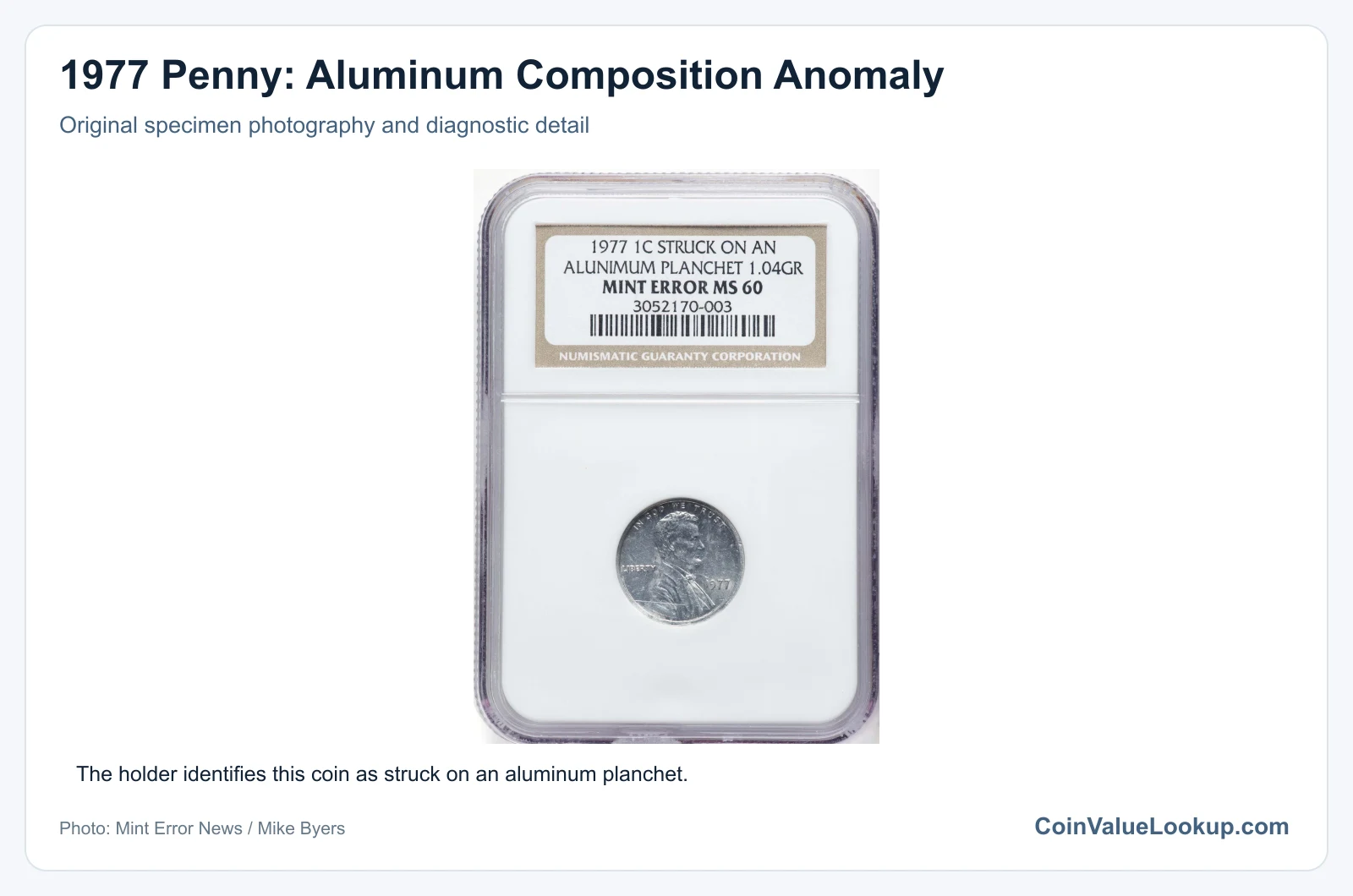
This is the headline error for 1977 pennies: a cent struck on an aluminum blank instead of the normal copper-zinc planchet. The authenticated specimen weighs just 1.04 grams — dramatically lighter than the standard 3.11 grams.
An NGC MS60 example sold for $50,400 at Heritage Auctions in August 2025.
The production origin of this piece has not been definitively resolved. Several possible explanations have been discussed, but none has been confirmed as the sole cause.
What matters for identification is the weight and confirmed aluminum composition through professional authentication.
Do not confuse this with a chemically altered or plated copper cent that merely looks silver-toned. A kitchen scale showing roughly one gram is a starting clue, but only third-party authentication can confirm the alloy.
That single auction result reflects one exceptional coin, not a broad market price.
2. 1977 Lincoln Penny — Cud Die Break
A cud is a raised, rim-connected lump of metal that replaces part of the normal design. It happens when a piece of the die itself breaks away.
On 1977 no-mintmark cents, these have been documented and sold at auction.
A PCGS MS63 Red-Brown example brought $138 at Heritage Auctions in May 2021. That is one individual sale, not a guaranteed market value — size, location, and condition of the cud all affect desirability.
To spot one, look along the rim for a blob of raised metal that flows into the rim and obliterates the design beneath it. The key distinction from damage: a cud replaces design cleanly because it was never struck, while a dent or solder blob pushes existing design metal aside and leaves disturbed surfaces.
3. 1977 Lincoln Penny — Struck on a Dime Blank
A 1977 no-mintmark cent struck on a dime-sized clad blank weighing about 2.3 grams is a genuine wrong-planchet error. The smaller blank means the Lincoln design is incomplete around the periphery — parts of the legend or portrait simply run off the edge of the undersized planchet.
An NGC MS65 example sold for $552 at Heritage Auctions in January 2022. Again, that is a single sale for one specific coin.
To identify this, compare the diameter and metal color against a normal cent. A dime blank is clad (copper-nickel over copper core), so it will look distinctly different from the warm copper tone of a standard cent.
Do not confuse silver-plated cents or naturally toned copper for a wrong-planchet error. Professional authentication with weight and composition verification is essential.
4. 1977 Lincoln Penny — Repunched Mintmark
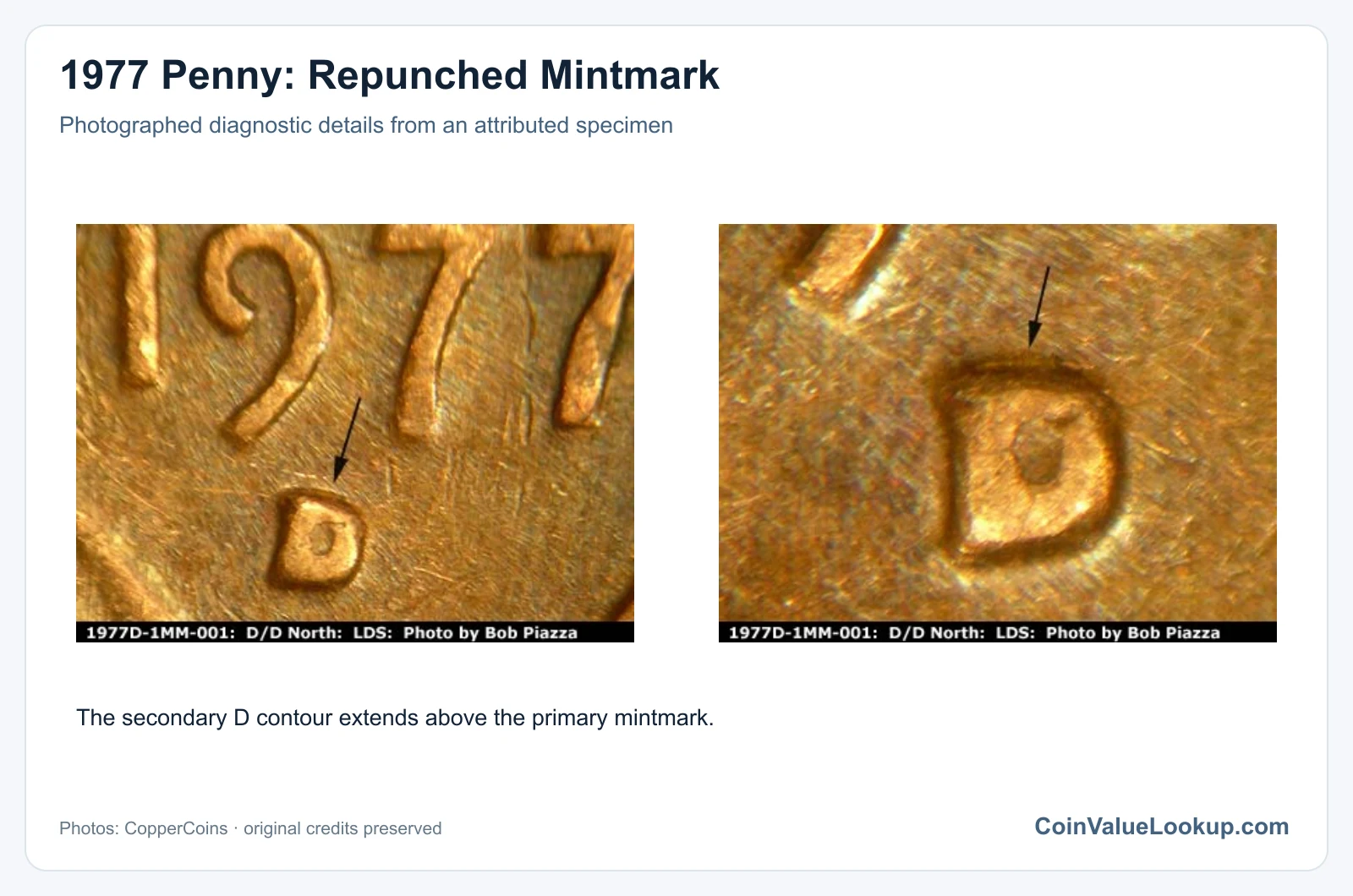
A repunched mintmark on a 1977 cent shows remnants of a second, slightly offset mintmark punch visible near the primary mintmark. This category has been reported for the 1977 cent.
Under magnification, look for traces of an extra letter — a partial outline, a serif, or a shadow — adjacent to or overlapping the main mintmark. Compare your coin to a normal example at the same magnification so you can see what belongs and what does not.
The value of a repunched mintmark depends on the visibility of the doubling, the specific variety, and the coin's overall condition. Do not mistake machine doubling, which produces a flat shelf-like appearance, for a true repunched mintmark.
Die chips or corrosion around the mintmark can also mimic a secondary impression.
5. 1977 Lincoln Penny — Doubled Die Obverse
A doubled die obverse on a 1977 cent displays consistent doubling of obverse design elements such as lettering or date numerals. This category has been reported for the 1977 cent.
Look for separation or notching on the letters of LIBERTY, IN GOD WE TRUST, or the date digits. True hub doubling produces a consistent directional shift across multiple design elements, not a random smear on one letter.
Machine doubling is the most common lookalike. It creates a flat, shelf-like distortion rather than the raised, rounded secondary image of a genuine doubled die.
Reflections under certain lighting or contours from a worn die can also fool you. Condition, the strength of the visible doubling, and the specific die variety all affect desirability and value.
6. 1977 Lincoln Penny — BIE Die Break
A BIE die break is a small raised line or bump between the letters B and E in LIBERTY on the obverse. It forms when a crack develops in the die face between those letters.
This category has been reported for 1977 cents.
The raised area typically looks like a vertical bridge connecting the two letters or a small blob floating between them. It should be raised above the field, not incused.
Inspect the surrounding surface for a clean, undisturbed field — that supports a die-origin feature.
Dirt lodged between the letters, a thin scratch, or a tiny piece of added material can look similar. The distinction is that a die break is part of the struck surface and cannot be scraped away.
Condition and the clarity of the break influence collector interest and value.
7. 1977 Lincoln Penny — Off-Center Strike
An off-center strike on a 1977 cent happens when the blank is not properly seated between the dies during striking. The result is a crescent-shaped area of blank metal on one side and a displaced, partial design on the rest.
This category has been reported for 1977 cents. Coins with a visible date are significantly more collectible than those where the date ran off the edge.
The percentage of off-center displacement also matters — dramatic shifts tend to attract more attention.
Do not confuse this with a clipped planchet, which affects the blank before striking, or with one-sided die misalignment that shifts the design differently on obverse versus reverse. Post-mint flattening from a vise or machinery can also create an odd appearance.
Condition, the degree of displacement, and date visibility all factor into value.
8. 1977 Lincoln Penny — Struck over a Roosevelt Dime
A cent struck over a previously struck Roosevelt dime is a dramatic double-denomination error. The 1977 cent design is impressed on top of a coin that already carries the dime's design, so traces of the Roosevelt portrait, torch, and dime lettering should be visible beneath the Lincoln cent elements.
This category has been reported for the 1977 cent. The key diagnostic is the survival of recognizable dime design details under the cent impression.
A coin struck on a blank dime planchet will not show any prior design — only the wrong size and metal.
Vise impressions, where two coins are pressed together outside the mint, can mimic an overstrike but typically show incuse rather than raised remnants. Condition and the clarity of the underlying dime design affect collector interest and value.