1953 Wheat Penny Coin Value: How Much Is It Worth?
A 1953 Wheat Penny in circulated condition typically runs about $0.06 around Fine-12, while uncirculated examples can reach roughly $2.50 at MS63, depending on the mint. Those figures cover standard circulation strikes from Philadelphia, Denver and San Francisco.
Proofs, major varieties and recognized errors trade on their own terms. Original surfaces, color and the degree of wear all shift what a particular coin will actually bring.
Fast Way to Identify Your 1953 Wheat Penny
Want a quick read on your 1953 penny? Snap a clear photo of the front and back under good lighting, then upload both images to our identifier.
It can offer a preliminary identification of your coin's mint, design type and general condition. This is not a substitute for professional authentication or certified grading, but it gives you a solid starting point.
1953 Wheat Penny Value
Upload both sides of your 1953 Wheat Penny.
Front Obverse
Upload photo
Back Reverse
Upload photo
Which 1953 Wheat Penny Versions Are Worth Money?
- Philadelphia (no mintmark), Denver (D) and San Francisco (S) business strikes each have different guide values at MS63; check your mintmark before assuming a price.
- The 1953 San Francisco issue lists higher in uncirculated condition at roughly $2.50 in MS63 compared to the other two mints.
- Philadelphia brilliant proofs from 1953 are a distinct collector finish, with a guide value around $38 at PR63.
- Authenticated mint errors such as repunched mintmarks, doubled dies and off-center strikes can carry premiums assessed individually by condition and severity.
- Strong original surfaces without cleaning or corrosion are important; even a lower-grade coin with honest wear outperforms a harshly cleaned example in collector appeal.
Step 1: Identify Your 1953 Wheat Penny Mint Mark and Version
Start by flipping the coin to its reverse. You should see two wheat ears framing the words ONE CENT.
That confirms the Wheat Reverse design, produced from 1909 through 1958.
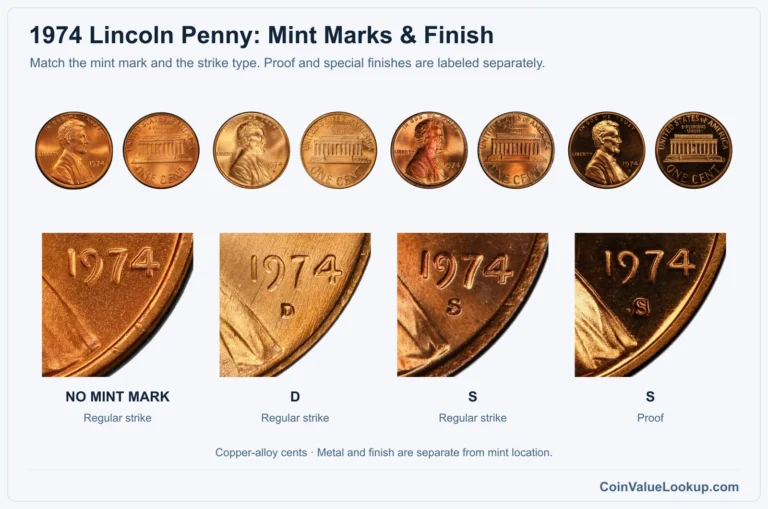
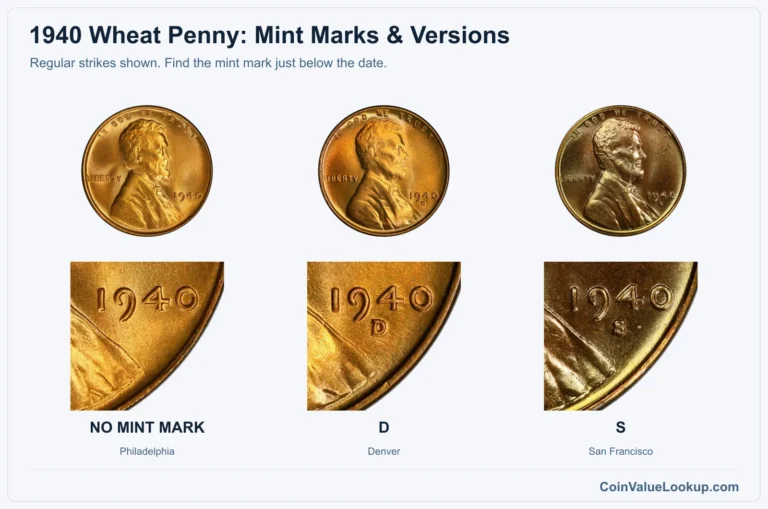
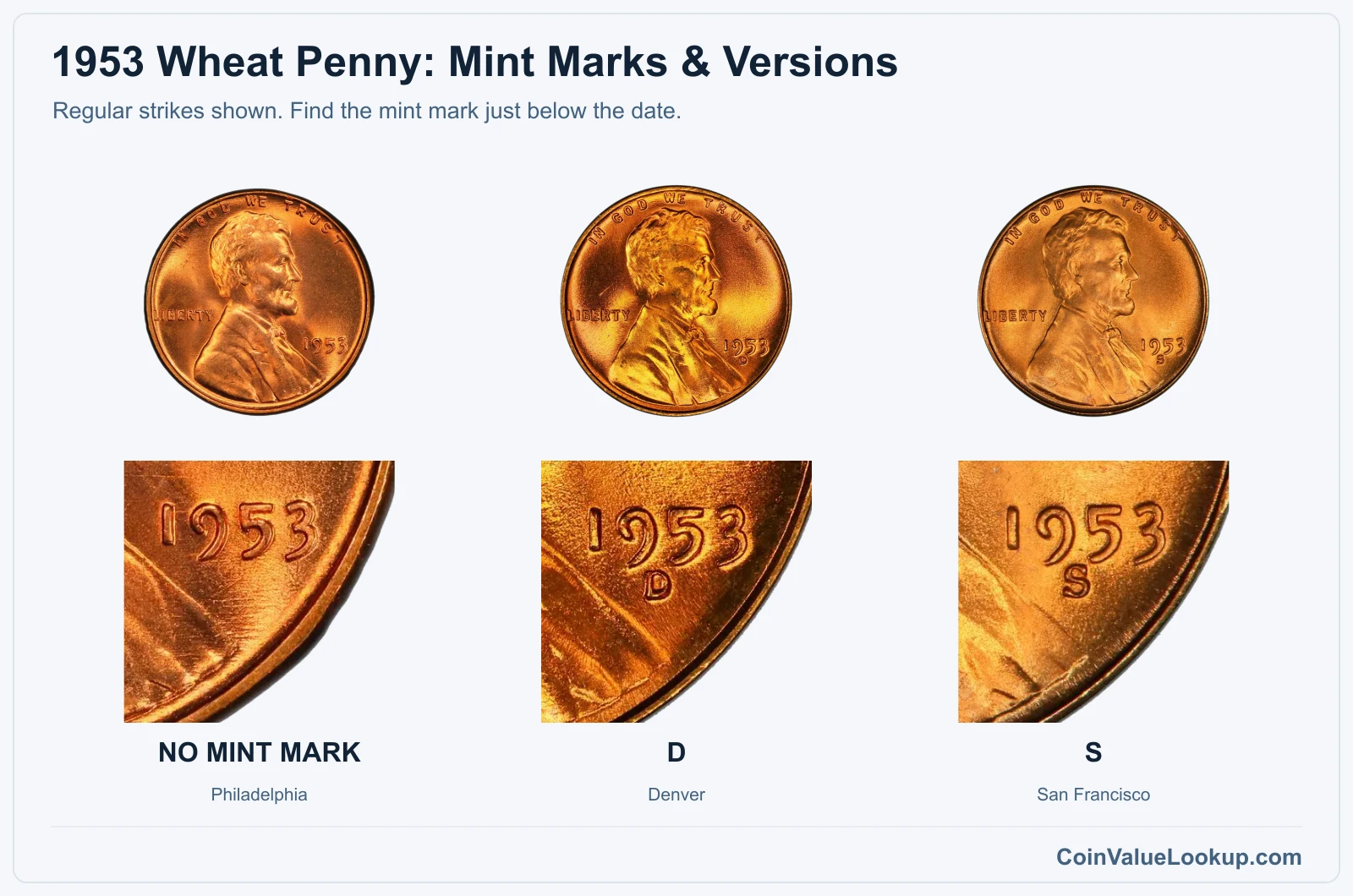
Now check the obverse, just below the date. A small "D" means Denver.
A small "S" means San Francisco. No letter at all means Philadelphia.
The 1953 cent is struck in 95% copper with 5% tin and zinc, weighs about 3.11 grams, and has a plain (smooth) edge. If your coin feels unusually light, abnormally heavy, or shows a reeded edge, set it aside for closer examination since it may be altered or an error.
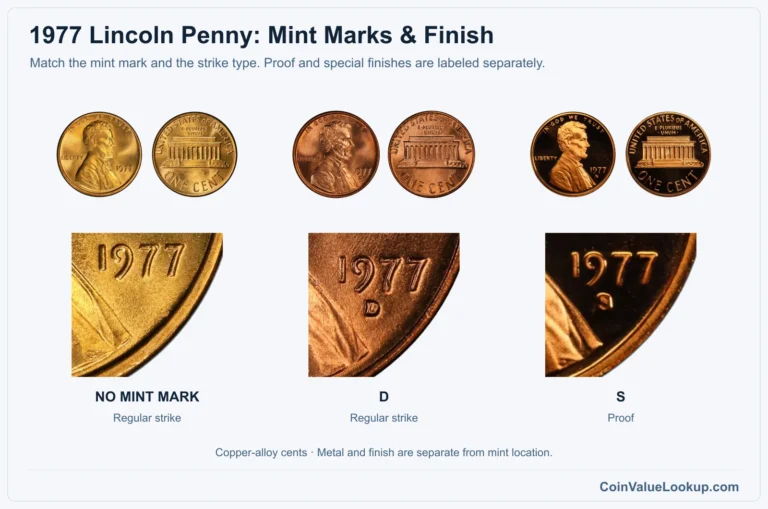
Philadelphia also produced brilliant proof cents in 1953, sold directly to collectors. A proof has deeply mirrored fields and sharp, squared-off rims that look nothing like a well-preserved circulation strike.
A polished business strike is not a proof, no matter how shiny someone made it.
Step 2: Check Your 1953 Wheat Penny Grade
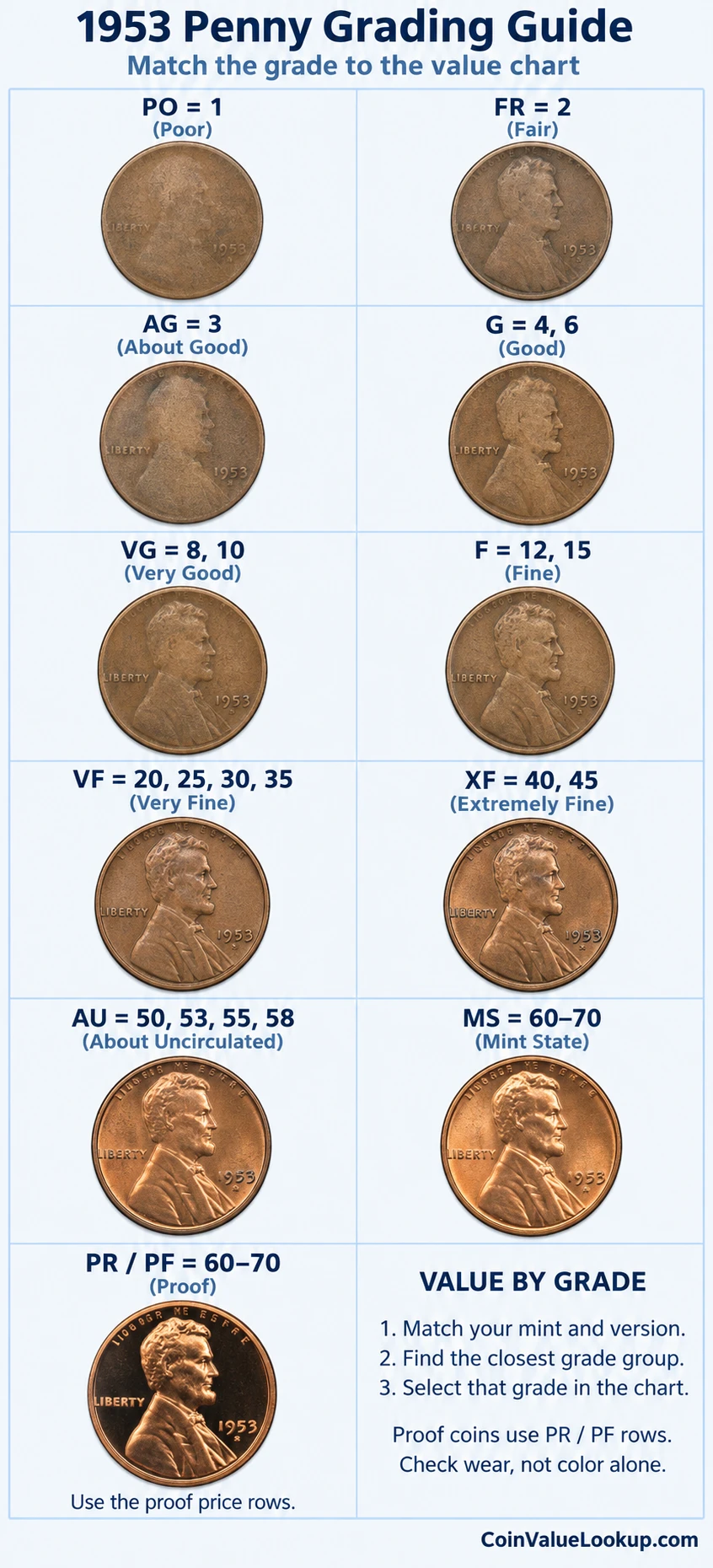
Focus on Lincoln's cheekbone, jawline and the fine hair detail above his ear. Those high points wear first.
A coin grading around Fine-12 will show moderate smoothing on the cheek and hair but most major design elements remain visible.
On the reverse, check the individual wheat grains and the horizontal lines between the stalks. These flatten as the coin circulates.
An MS63 coin should retain full original luster with no wear on the high points at all, though minor contact marks or light blemishes are expected. Compare your coin against the reference image to gauge where it falls.
Color matters separately. Red, red-brown and brown are distinct surface descriptions, not grades.
The guide prices here do not specify color, so do not assume they reflect a fully red coin. Cleaning, spots and corrosion each lower collector appeal regardless of how much design detail survives.
A weakly struck coin can also look worn when it is not, so compare both sides carefully before concluding.
Step 3: Check 1953 Wheat Penny Value by Mint and Version
1953 Wheat Penny
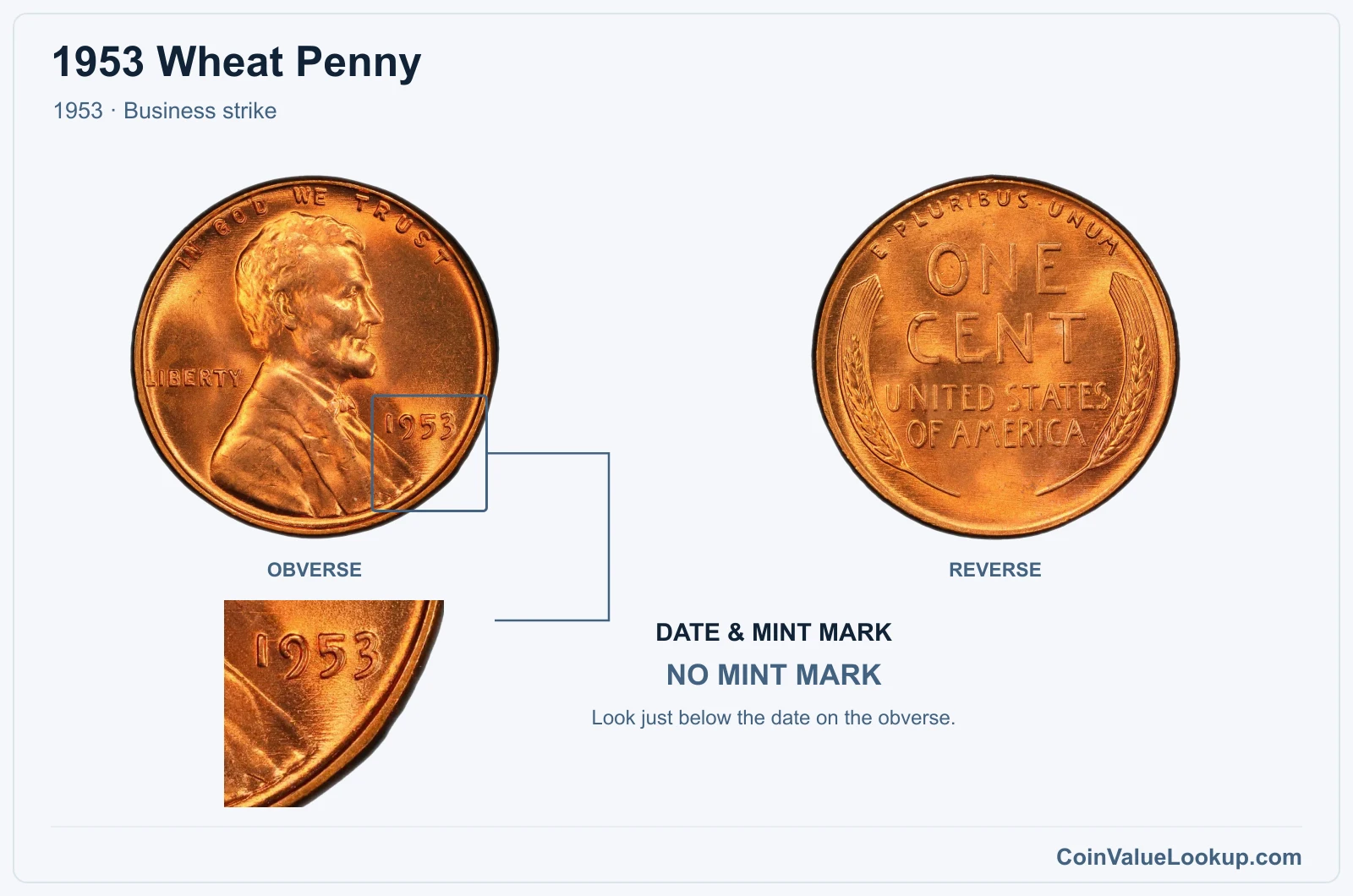
The 1953 Philadelphia cent carries no mintmark below the date. It is the most common branch of the three business-strike mints this year.
In circulated grades around Fine-12, guide estimates sit at about $0.06. Push into uncirculated territory at MS63 and the figure rises to roughly $1.24.
Look for strong hair detail above Lincoln's ear and full wheat-stalk lines on the reverse when evaluating condition. Original copper luster helps; a dull, dark coin will not command the same interest even at the same technical grade.
| Range | Grade | Price | Auction Records | Appraisal |
|---|---|---|---|---|
| PO | PO 1 | — | Coin Identifier | |
| FR | FR 2 | — | Coin Identifier | |
| AG | AG 3 | — | Coin Identifier | |
| G | G 4 | — | Coin Identifier | |
| G 6 | — | Coin Identifier | ||
| VG | VG 8 | — | Coin Identifier | |
| VG 10 | — | Coin Identifier | ||
| F | F 12 | — | Coin Identifier | |
| F 15 | — | Coin Identifier | ||
| VF | VF 20 | — | Coin Identifier | |
| VF 25 | — | Coin Identifier | ||
| VF 30 | — | Coin Identifier | ||
| VF 35 | — | Coin Identifier | ||
| XF | XF 40 | — | Coin Identifier | |
| XF 45 | — | Coin Identifier | ||
| AU | AU 50 | — | Coin Identifier | |
| AU 53 | — | Coin Identifier | ||
| AU 55 | — | Coin Identifier | ||
| AU 58 | — | Coin Identifier | ||
| MS | MS 60 | — | Coin Identifier | |
| MS 61 | — | Coin Identifier | ||
| MS 62 | — | Coin Identifier | ||
| MS 63 | Coin Identifier | |||
| MS 64 | Coin Identifier | |||
| MS 65 | Coin Identifier | |||
| MS 66 | Coin Identifier | |||
| MS 67 | Coin Identifier | |||
| MS 68 | — | — | — | |
| MS 69 | — | — | — | |
| MS 70 | — | — | — |
1953 Wheat Penny — D
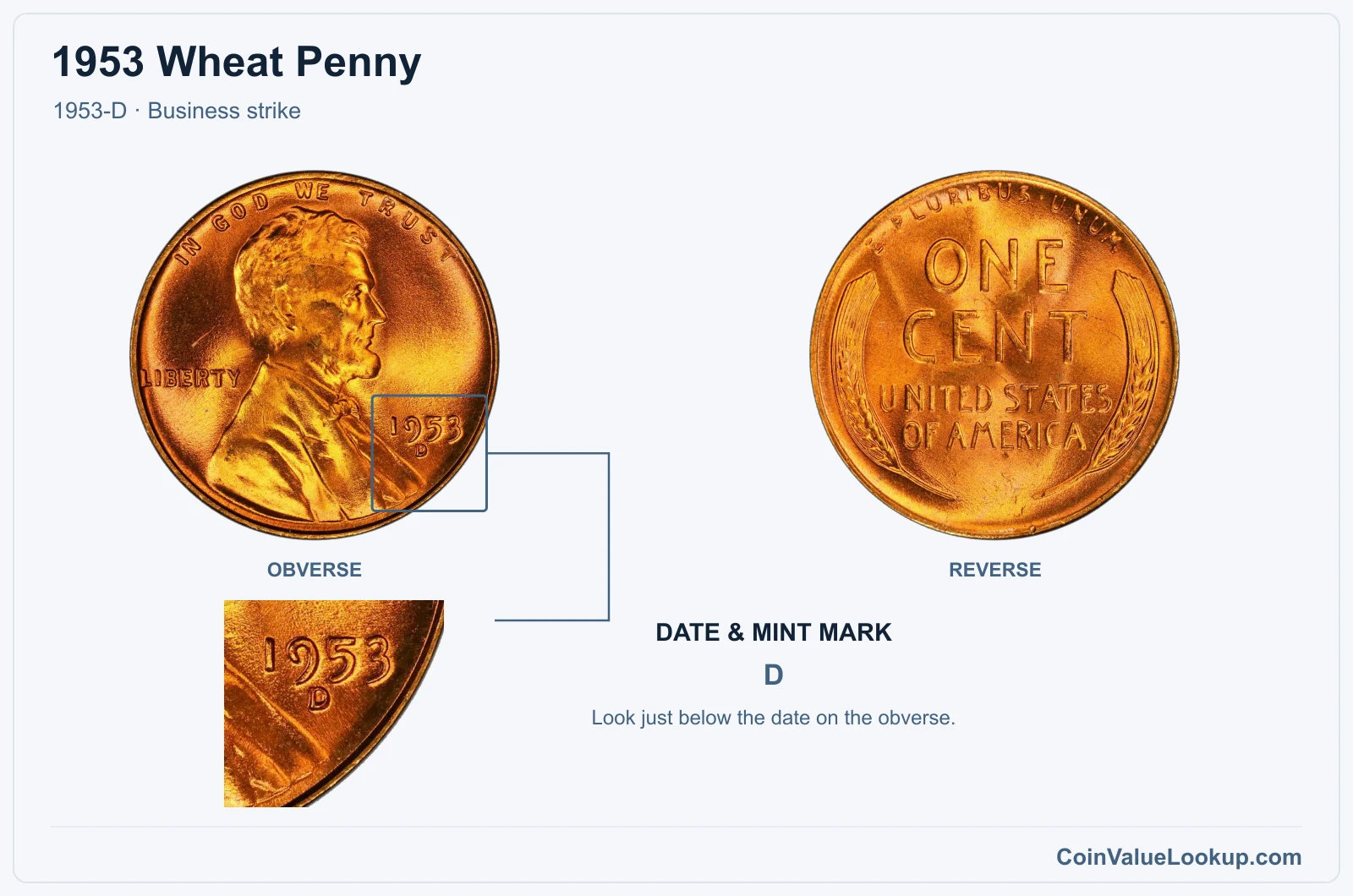
Look for a small "D" mintmark below the date. The 1953-D was struck at the Denver Mint.
Guide estimates place it at about $0.06 in Fine-12 and around $1.24 in MS63, matching the Philadelphia issue at those benchmarks.
Denver cents from this era are plentiful in lower grades, so condition really drives the conversation. An MS63 example with original surfaces is a different animal from a cleaned Fine.
Weight should be close to 3.11 grams on a standard copper-alloy planchet.
| Range | Grade | Price | Auction Records | Appraisal |
|---|---|---|---|---|
| PO | PO 1 | — | Coin Identifier | |
| FR | FR 2 | — | Coin Identifier | |
| AG | AG 3 | — | Coin Identifier | |
| G | G 4 | — | Coin Identifier | |
| G 6 | — | Coin Identifier | ||
| VG | VG 8 | — | Coin Identifier | |
| VG 10 | — | Coin Identifier | ||
| F | F 12 | — | Coin Identifier | |
| F 15 | — | Coin Identifier | ||
| VF | VF 20 | — | Coin Identifier | |
| VF 25 | — | Coin Identifier | ||
| VF 30 | — | Coin Identifier | ||
| VF 35 | — | Coin Identifier | ||
| XF | XF 40 | — | Coin Identifier | |
| XF 45 | — | Coin Identifier | ||
| AU | AU 50 | — | Coin Identifier | |
| AU 53 | — | Coin Identifier | ||
| AU 55 | — | Coin Identifier | ||
| AU 58 | — | Coin Identifier | ||
| MS | MS 60 | — | Coin Identifier | |
| MS 61 | — | Coin Identifier | ||
| MS 62 | — | Coin Identifier | ||
| MS 63 | Coin Identifier | |||
| MS 64 | Coin Identifier | |||
| MS 65 | Coin Identifier | |||
| MS 66 | Coin Identifier | |||
| MS 67 | Coin Identifier | |||
| MS 68 | — | — | — | |
| MS 69 | — | — | — | |
| MS 70 | — | — | — |
1953 Wheat Penny — S
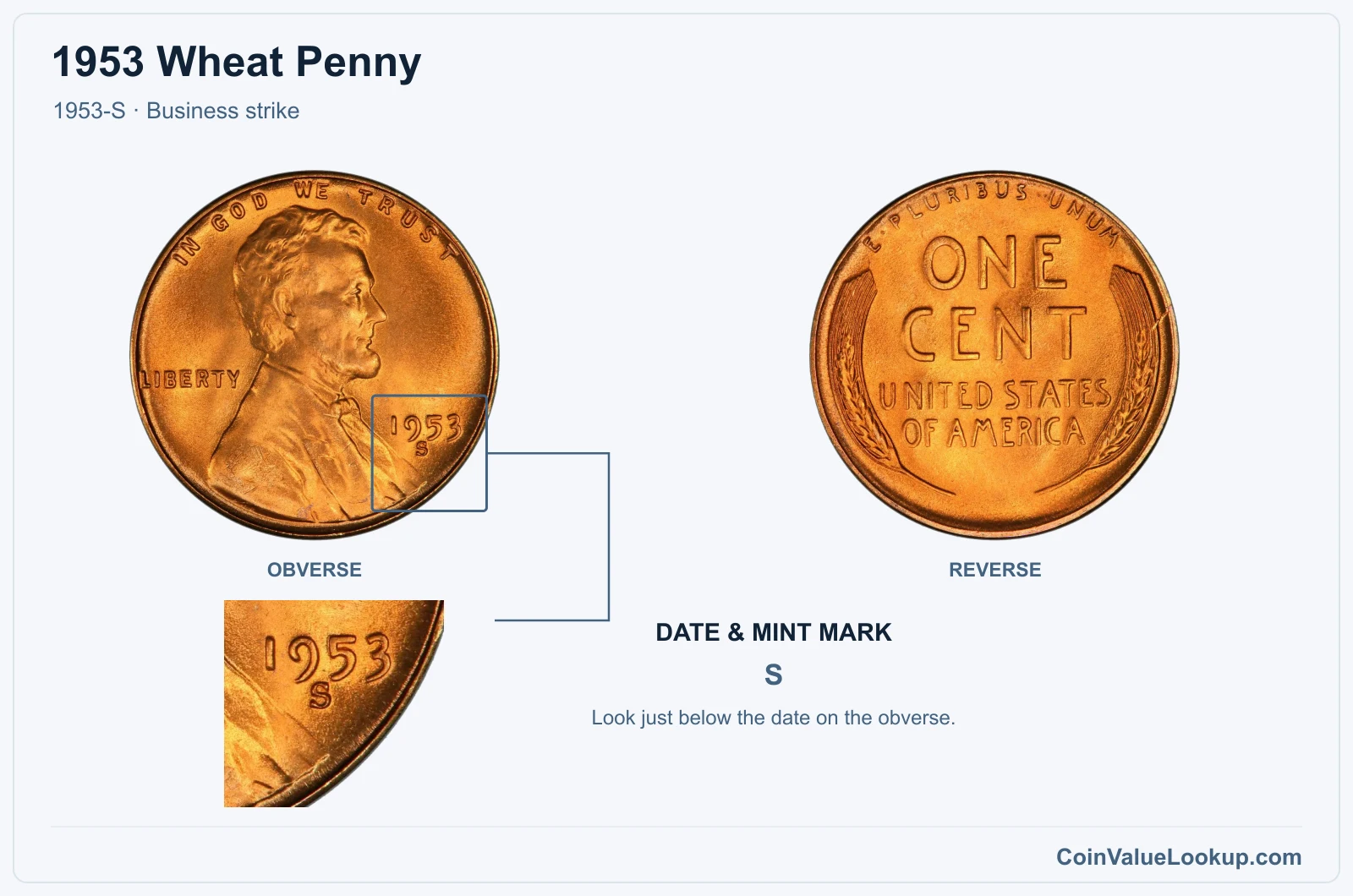
The 1953-S carries a small "S" mintmark below the date, indicating the San Francisco Mint. Guide values run about $0.06 in Fine-12, consistent with the other mints in circulated grades.
Where the San Francisco issue pulls ahead is in uncirculated condition: roughly $2.50 at MS63 versus $1.24 for the Philadelphia and Denver branches at the same grade. That gap makes it worth checking your 1953-S carefully for original luster and minimal contact marks.
Color, as always, is a separate factor not specified by these guide figures.
Coin Value Lookup is a good place to look up guides for other dates and mints in the Wheat Penny series if you are working through a collection.
| Range | Grade | Price | Auction Records | Appraisal |
|---|---|---|---|---|
| PO | PO 1 | — | Coin Identifier | |
| FR | FR 2 | — | Coin Identifier | |
| AG | AG 3 | — | Coin Identifier | |
| G | G 4 | — | Coin Identifier | |
| G 6 | — | Coin Identifier | ||
| VG | VG 8 | — | Coin Identifier | |
| VG 10 | — | Coin Identifier | ||
| F | F 12 | — | Coin Identifier | |
| F 15 | — | Coin Identifier | ||
| VF | VF 20 | — | Coin Identifier | |
| VF 25 | — | Coin Identifier | ||
| VF 30 | — | Coin Identifier | ||
| VF 35 | — | Coin Identifier | ||
| XF | XF 40 | — | Coin Identifier | |
| XF 45 | — | Coin Identifier | ||
| AU | AU 50 | — | Coin Identifier | |
| AU 53 | — | Coin Identifier | ||
| AU 55 | — | Coin Identifier | ||
| AU 58 | — | Coin Identifier | ||
| MS | MS 60 | — | Coin Identifier | |
| MS 61 | — | Coin Identifier | ||
| MS 62 | — | Coin Identifier | ||
| MS 63 | — | Coin Identifier | ||
| MS 64 | Coin Identifier | |||
| MS 65 | Coin Identifier | |||
| MS 66 | Coin Identifier | |||
| MS 67 | Coin Identifier | |||
| MS 68 | Coin Identifier | |||
| MS 69 | — | — | — | |
| MS 70 | — | — | — |
1953 Wheat Penny — PR
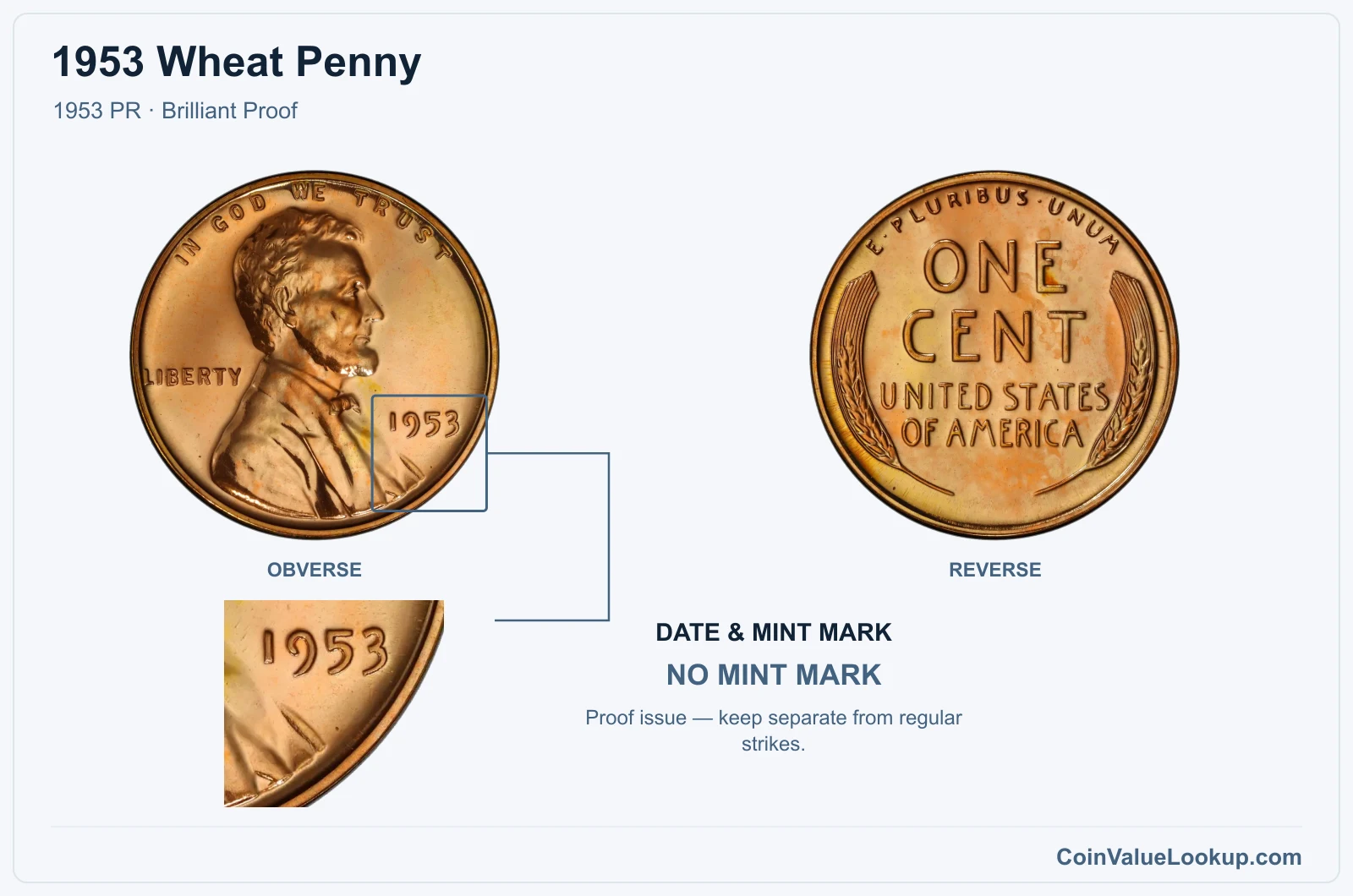
The 1953 Proof cent was struck at Philadelphia with brilliant mirrored fields and exceptionally sharp design elements. These were sold to collectors, not released into circulation.
The guide estimate is about $38 at PR63.
A genuine proof has squared-off rims and a glass-like field that reflects light in a single plane. If you have to squint and wonder, it is almost certainly a well-preserved or polished business strike instead.
Cameo and deep-cameo contrast designations describe the degree of frosting on the devices versus the mirror field; they are contrast labels, not separate error types. Weight and composition match the standard cent at 3.11 grams of 95% copper with 5% tin and zinc.
| Range | Grade | Price | Auction Records | Appraisal |
|---|---|---|---|---|
| PR | PR 1 | — | Coin Identifier | |
| PR 2 | — | Coin Identifier | ||
| PR 3 | — | Coin Identifier | ||
| PR 4 | — | Coin Identifier | ||
| PR 6 | — | Coin Identifier | ||
| PR 8 | — | Coin Identifier | ||
| PR 10 | — | Coin Identifier | ||
| PR 12 | — | Coin Identifier | ||
| PR 15 | — | Coin Identifier | ||
| PR 20 | — | Coin Identifier | ||
| PR 25 | — | Coin Identifier | ||
| PR 30 | — | Coin Identifier | ||
| PR 35 | — | Coin Identifier | ||
| PR 40 | — | Coin Identifier | ||
| PR 45 | — | Coin Identifier | ||
| PR 50 | — | Coin Identifier | ||
| PR 53 | — | Coin Identifier | ||
| PR 55 | — | Coin Identifier | ||
| PR 58 | — | Coin Identifier | ||
| PR 60 | — | Coin Identifier | ||
| PR 61 | — | Coin Identifier | ||
| PR 62 | — | Coin Identifier | ||
| PR 63 | Coin Identifier | |||
| PR 64 | Coin Identifier | |||
| PR 65 | Coin Identifier | |||
| PR 66 | Coin Identifier | |||
| PR 67 | Coin Identifier | |||
| PR 68 | Coin Identifier | |||
| PR 69 | Coin Identifier | |||
| PR 70 | — | — | — |
1953 Wheat Penny Error List
1. 1953 Wheat Penny — Repunched Mintmark
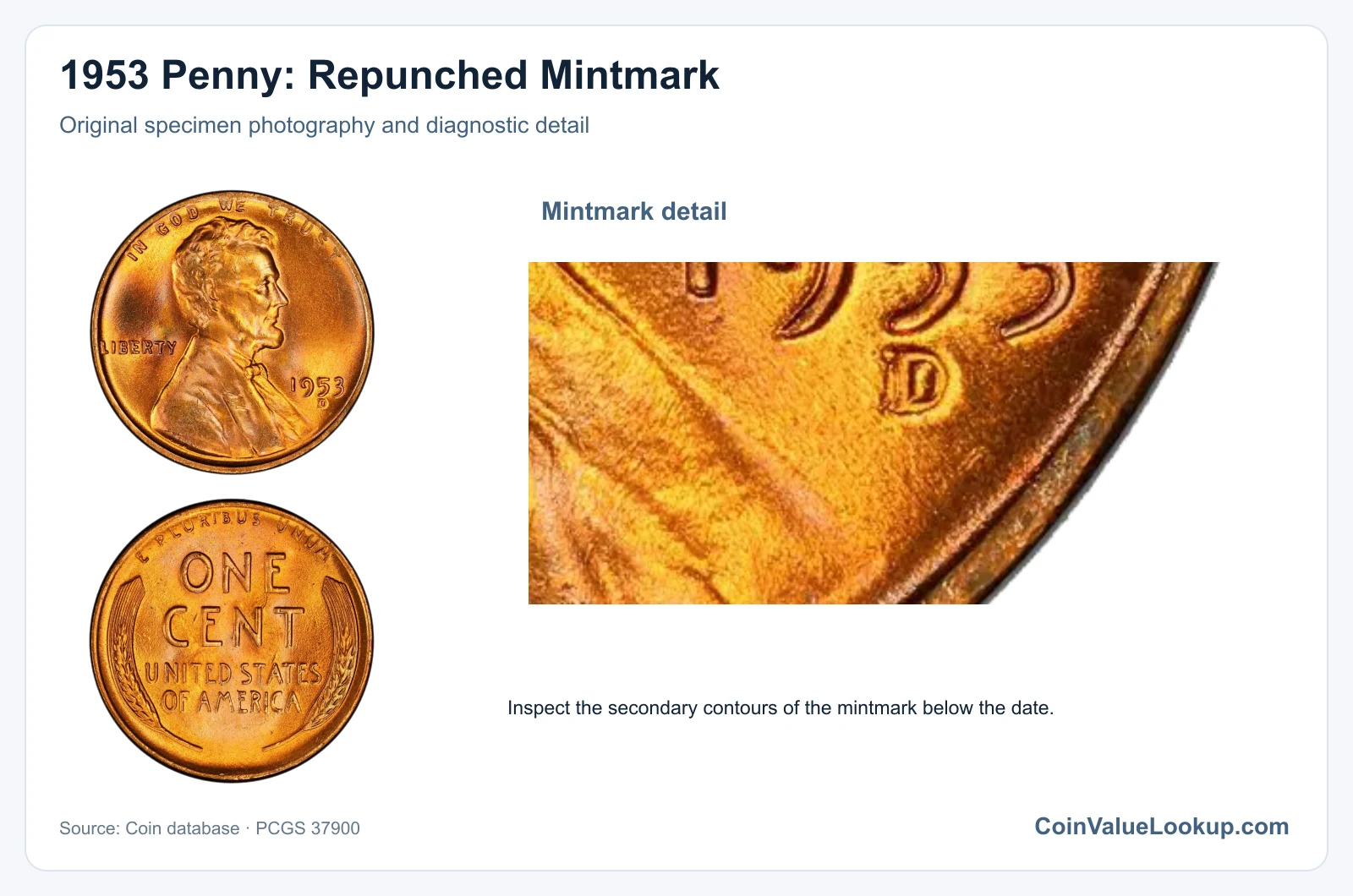
A repunched mintmark occurs when the mintmark punch was applied more than once in slightly different positions on the working die. This error applies only to the 1953-D and 1953-S branches, since Philadelphia cents carry no mintmark to repunch.
Under magnification, look for traces of an earlier mintmark impression overlapping or offset from the final position. The remnant may appear as a notch, shadow or partial letter near the primary "D" or "S" below the date.
Compare your coin at the same magnification against a confirmed normal example.
Die chips, corrosion around the mintmark and machine doubling can all mimic a repunched mintmark to the untrained eye. Value depends on the specific variety, its visual strength and the coin's authenticated condition, so individual assessment by a grading service is the practical route.
2. 1953 Wheat Penny — Doubled Die Obverse
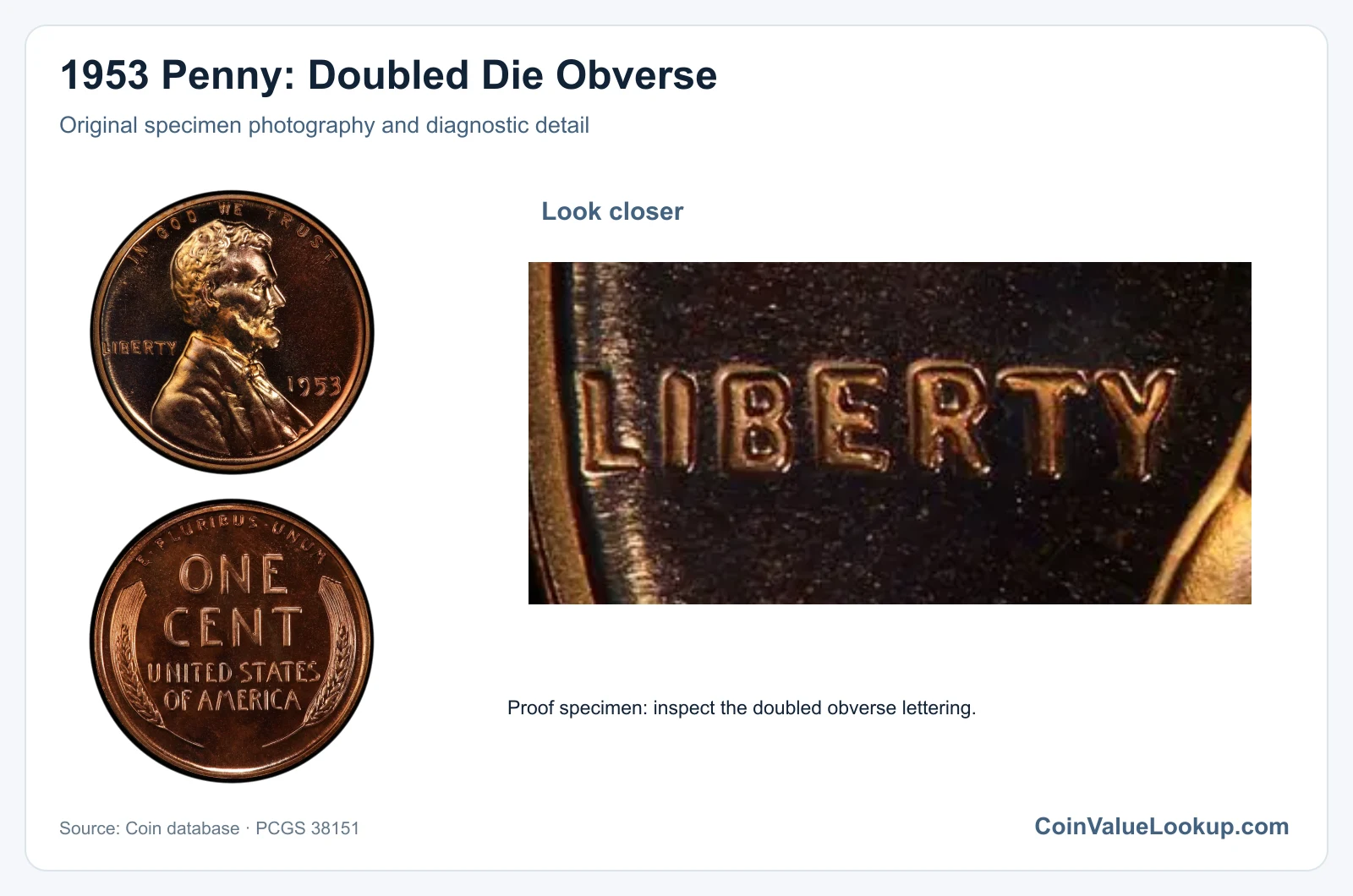
A doubled die obverse on a 1953 cent has been reported in the context of the Philadelphia Proof issue rather than as a general business-strike attribution. Look for consistent separation or notching on obverse lettering and design elements, especially IN GOD WE TRUST or LIBERTY.
Genuine doubled-die doubling shows the same directional spread across multiple letters and features. Machine doubling, by contrast, produces a flat shelf with no real separation.
Worn dies and reflections from proof surfaces can also fool you under certain lighting.
Compare your coin to a known normal 1953 Proof under matching light and angle. If doubling is present, its value depends on authenticated identity, the strength of the doubling and the coin's overall condition.
No standard price range is established here, so professional evaluation is the appropriate next step.
3. 1953 Wheat Penny — Wrong Planchet / Off-Metal Strike
A wrong-planchet or off-metal error means the 1953 cent die struck a blank intended for a different denomination or composition. The result is a coin that looks like a Lincoln cent but feels wrong in hand because the weight, diameter or edge does not match the standard 3.11-gram copper-alloy planchet.
Weigh and measure the coin carefully. Compare against published specifications for the suspected planchet.
The design may appear incomplete if the blank was smaller than a cent.
Plating loss, acid etching and deliberate alteration can all change a coin's appearance and weight enough to imitate an off-metal strike. Genuine examples need third-party authentication.
Value is assessed individually based on the confirmed wrong planchet, the completeness of the design and the coin's preservation.
4. 1953 Wheat Penny — Off-Center Strike
An off-center strike happens when the planchet is not properly seated between the dies, so part of the design is missing and a blank crescent appears on one side. The percentage of off-center shift and whether the date remains visible are the two biggest factors collectors care about.
A 1953 cent struck roughly 10-50% off-center with a full, readable date is the sweet spot for collectibility. Coins struck so far off that the date vanishes lose most of their premium because the year cannot be confirmed.
Do not confuse an off-center strike with a straight-clipped planchet or post-mint damage from a vise or hammer. A genuine off-center coin shows a corresponding shift on both sides.
Pricing depends on the degree of misalignment, date visibility and authenticated condition.
5. 1953 Wheat Penny — Struck-Through Error
A struck-through error occurs when foreign material, such as grease, a thread, a metal fragment or another obstruction, sits between the die and the planchet during striking. The result is a localized depression, a raised impression of the object, or an area of missing design detail.
Grease-filled dies tend to produce smooth, shallow voids, often in recessed areas of the die like letters. A retained foreign object, on the other hand, may leave a distinct shape pressed into the coin's surface.
Do not mistake ordinary wear, scratches from circulation or weak strikes from a tired die for a struck-through error. Genuine examples show a crisp boundary between the affected area and the surrounding normal design.
Value is assessed individually based on the size, location and visual drama of the obstruction mark, along with the coin's overall condition.