1958 Wheat Penny Coin Value: How Much Is It Worth?
The 1958 Wheat penny holds a special place as the final year of the beloved Wheat reverse design. For ordinary circulated examples, a guide estimate runs from about $0.06 in Fine-12 condition up to around $1.24 at MS63 across the Philadelphia and Denver issues.
Proofs, the extremely rare Doubled Die Obverse variety, and mint errors are priced separately. Original surfaces, color, and wear all affect what a buyer will actually pay.
Fast Way to Identify Your 1958 Wheat Penny
Want a quick read on your 1958 penny? Upload clear photos of the front and back, and our identifier can give you a preliminary idea of which version you have, whether it carries a mintmark, and what to look for next.
It is not a substitute for professional authentication or certified grading, but it is a solid first step.
1958 Wheat Penny Value
Upload both sides of your 1958 Wheat Penny.
Front Obverse
Upload photo
Back Reverse
Upload photo
Which 1958 Wheat Penny Versions Are Worth Money?
- The 1958 DDO (Doubled Die Obverse) is extremely rare and requires professional authentication; no standard guide price applies to ordinary cents.
- Philadelphia business strikes range from about $0.06 in Fine-12 to $1.24 at MS63 per guide estimates.
- Denver (1958-D) business strikes share that same guide range of roughly $0.06 to $1.24 depending on grade.
- The 1958 proof cent from Philadelphia carries a guide estimate near $10 at PR63, well above circulation issues.
- Mint errors such as off-center strikes or wrong-planchet coins are assessed individually based on authenticated identity and severity.
Step 1: Identify Your 1958 Wheat Penny Mint Mark and Version
Start by flipping the coin to look at the reverse. If you see two wheat ears framing ONE CENT, you have the right design.
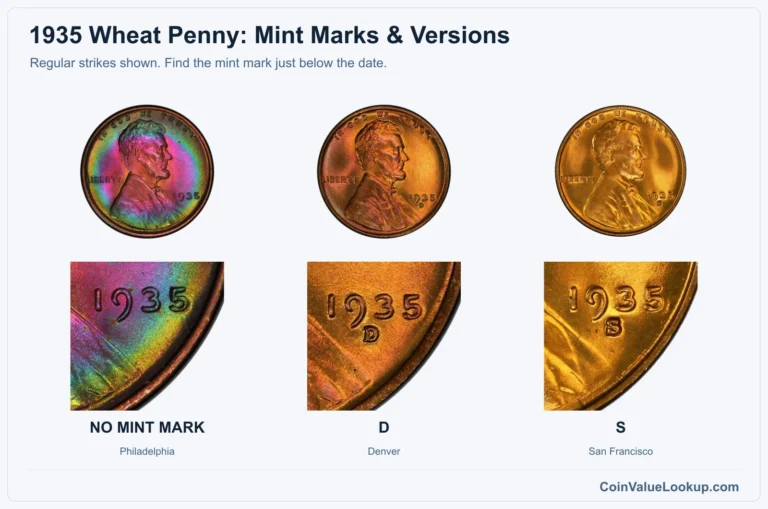
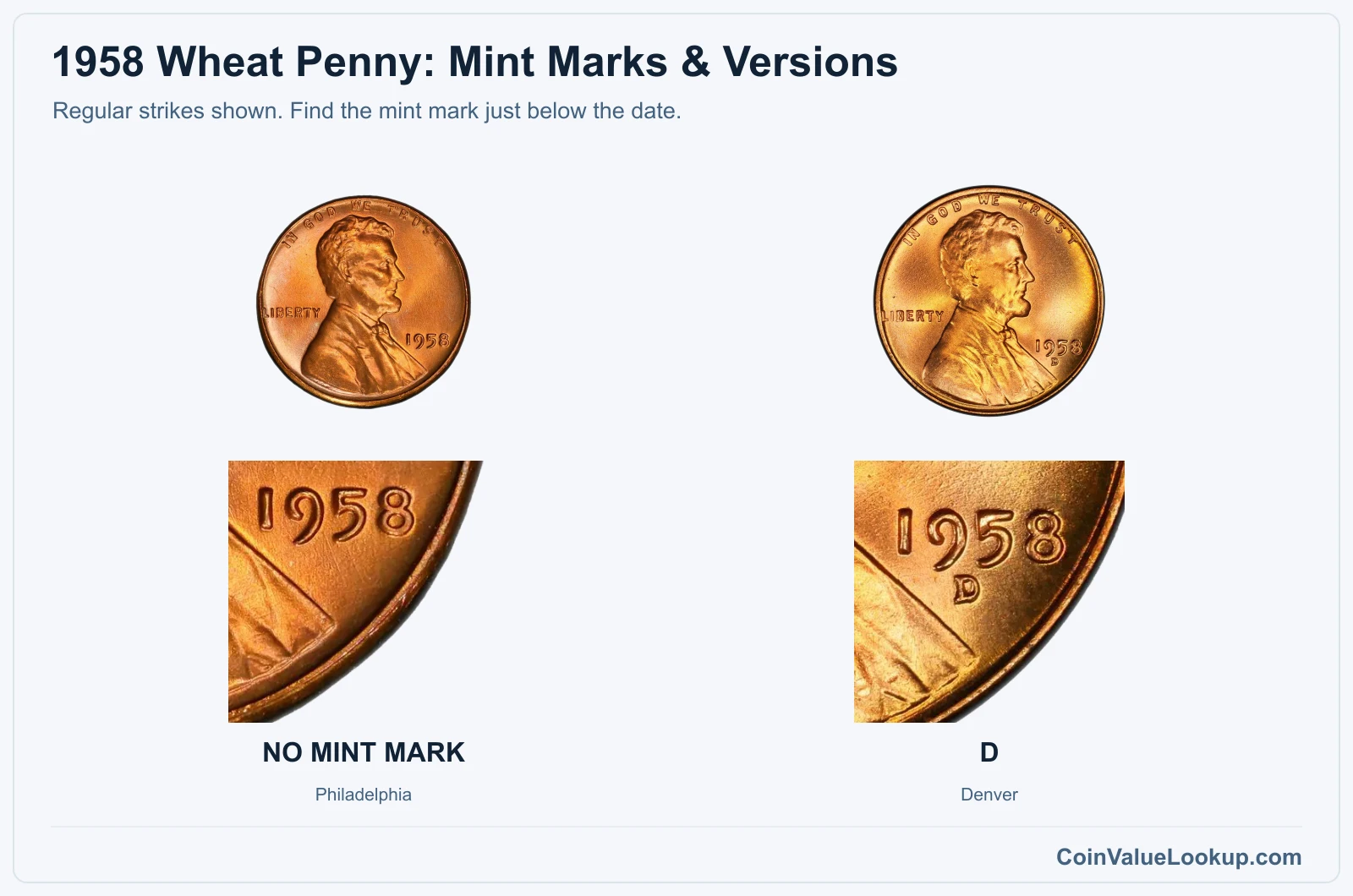
Now check the obverse, just below the date: no letter means Philadelphia, a D means Denver. There is no San Francisco issue for 1958.
The coin should weigh about 3.11 grams and have a plain edge. It is struck in a copper alloy of 95% copper with 5% tin and zinc.
If your coin is noticeably lighter, heavier, or has a reeded edge, something unusual is going on and you should investigate further.
Philadelphia also produced brilliant proof cents in 1958, but those were sold in proof sets, not released into circulation. A proof has deeply mirrored fields and sharp detail from specially prepared dies.
A shiny circulated cent that has been polished is not a proof, no matter how much it gleams.
The extremely rare 1958 Doubled Die Obverse exists but is not a pricing anchor for ordinary cents. If your coin looks normal under magnification, you almost certainly have a standard business strike.
Step 2: Check Your 1958 Wheat Penny Grade
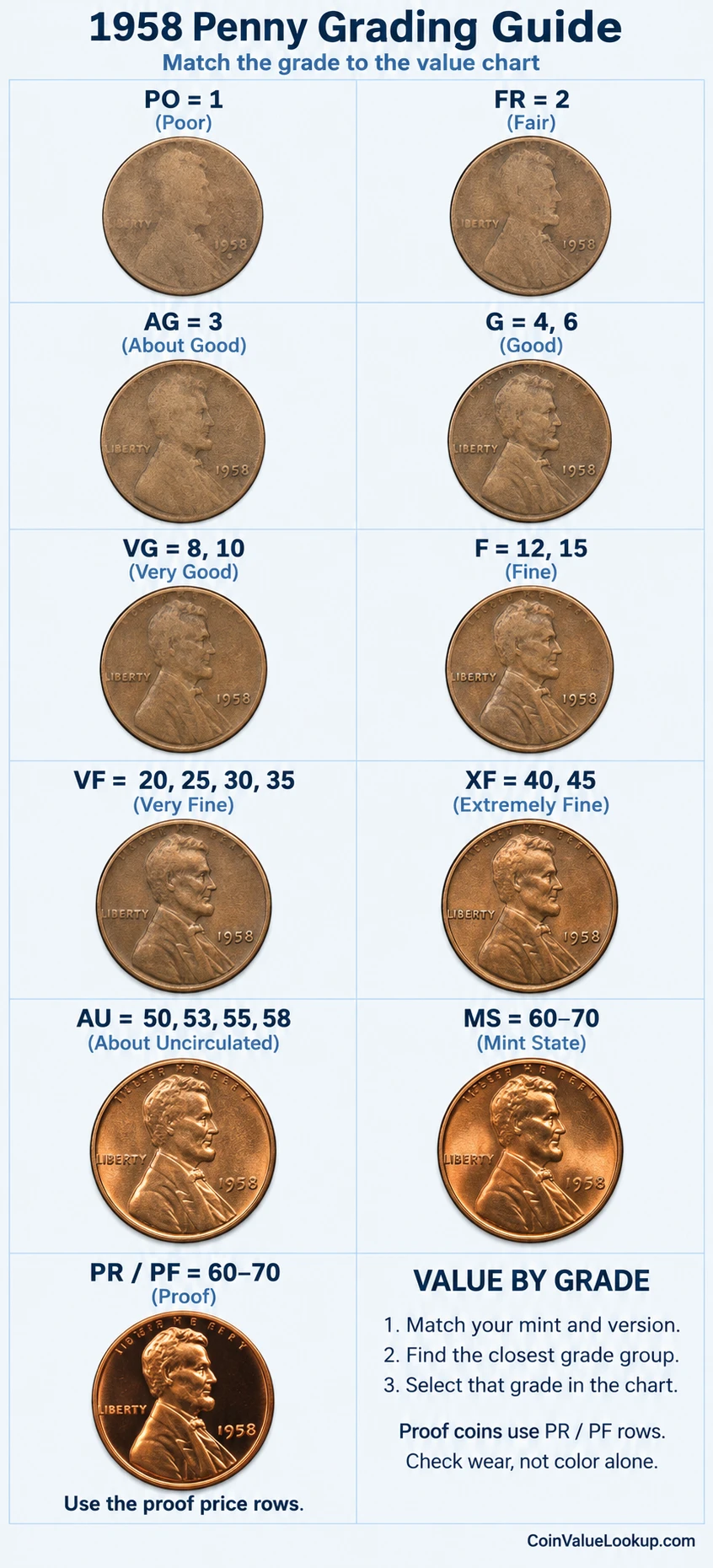
Look at Lincoln's cheekbone, jaw, and the fine hair detail above his ear. These are the first areas to show wear.
A coin grading Fine-12 will have visible but softened high points, while an MS63 piece retains full original luster with only minor contact marks.
On the reverse, examine the wheat stalks for sharpness in the individual grain lines and the parallel lines between the stalks. Weak detail there can indicate wear, but it can also come from a tired die that struck the coin softly in the first place.
Color matters separately from wear. Red, red-brown, and brown designations describe the remaining original copper luster, not the grade itself.
A brown MS63 and a red MS63 are both uncirculated, but they carry different collector premiums.
Use the comparison image to match your coin's wear pattern. Cleaning, corrosion, and spots all reduce a coin's appeal regardless of the technical grade, so check for unnatural shine or pitting before you get too excited.
Step 3: Check 1958 Wheat Penny Value by Mint and Version
1958 Wheat Penny
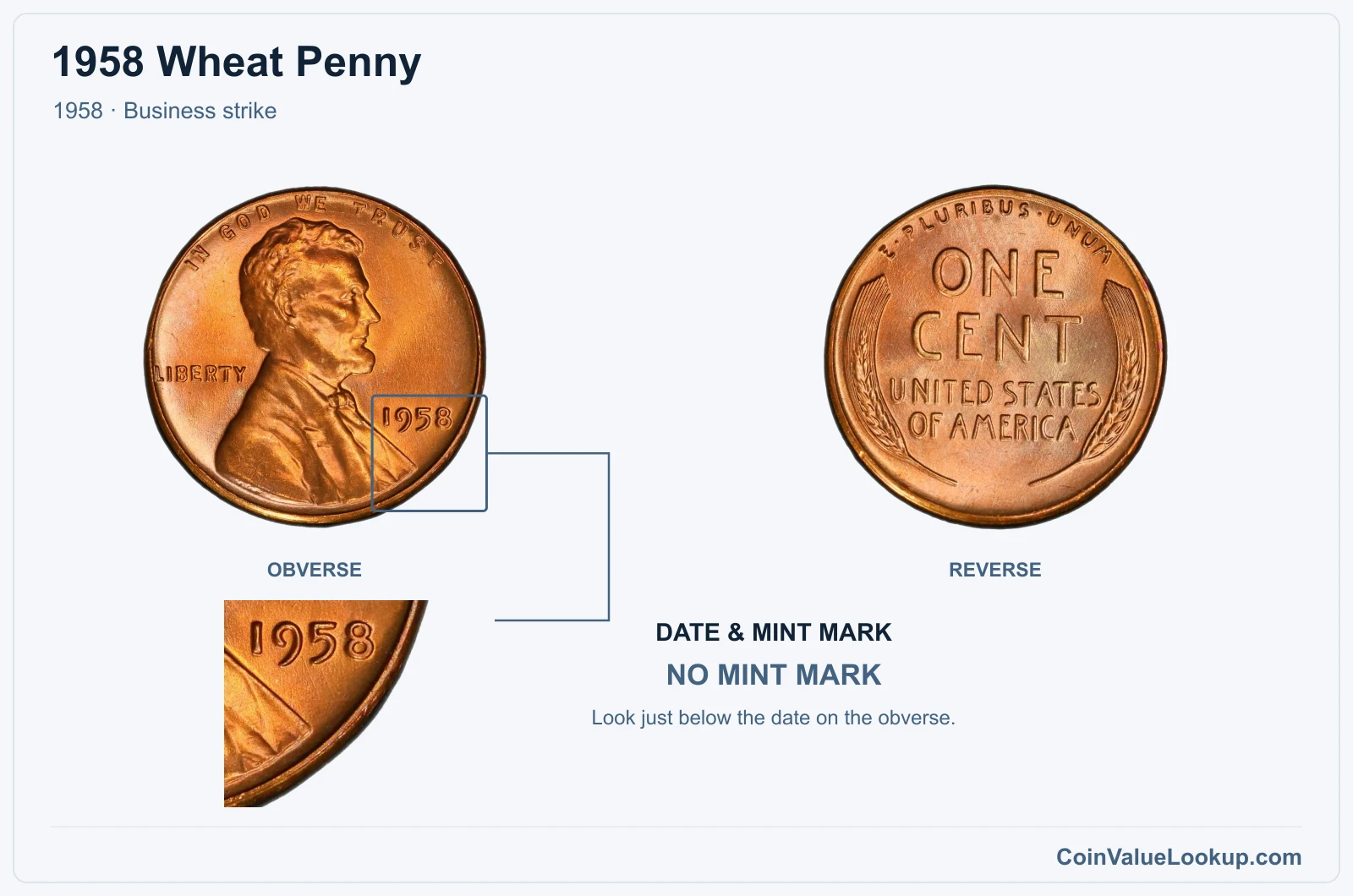
The 1958 Philadelphia cent has no mintmark below the date. It is a business strike in the standard 95% copper alloy, weighing about 3.11 grams with a plain edge.
Guide estimates place it around $0.06 in Fine-12 and about $1.24 at MS63. These figures do not specify color, so do not treat them as certified Red quotes.
As the last Philadelphia Wheat cent ever made, it gets a small sentimental bump from type collectors finishing a set. Still, mintages were large, so finding one in pocket change is not exactly a miracle.
Strong original surfaces and no cleaning are what separate a keeper from a spender.
| Range | Grade | Price | Auction Records | Appraisal |
|---|---|---|---|---|
| PO | PO 1 | — | Coin Identifier | |
| FR | FR 2 | — | Coin Identifier | |
| AG | AG 3 | — | Coin Identifier | |
| G | G 4 | — | Coin Identifier | |
| G 6 | — | Coin Identifier | ||
| VG | VG 8 | — | Coin Identifier | |
| VG 10 | — | Coin Identifier | ||
| F | F 12 | — | Coin Identifier | |
| F 15 | — | Coin Identifier | ||
| VF | VF 20 | — | Coin Identifier | |
| VF 25 | — | Coin Identifier | ||
| VF 30 | — | Coin Identifier | ||
| VF 35 | — | Coin Identifier | ||
| XF | XF 40 | — | Coin Identifier | |
| XF 45 | — | Coin Identifier | ||
| AU | AU 50 | — | Coin Identifier | |
| AU 53 | — | Coin Identifier | ||
| AU 55 | — | Coin Identifier | ||
| AU 58 | — | Coin Identifier | ||
| MS | MS 60 | — | Coin Identifier | |
| MS 61 | — | Coin Identifier | ||
| MS 62 | — | Coin Identifier | ||
| MS 63 | Coin Identifier | |||
| MS 64 | Coin Identifier | |||
| MS 65 | Coin Identifier | |||
| MS 66 | Coin Identifier | |||
| MS 67 | Coin Identifier | |||
| MS 68 | — | — | — | |
| MS 69 | — | — | — | |
| MS 70 | — | — | — |
1958 Wheat Penny — DDO
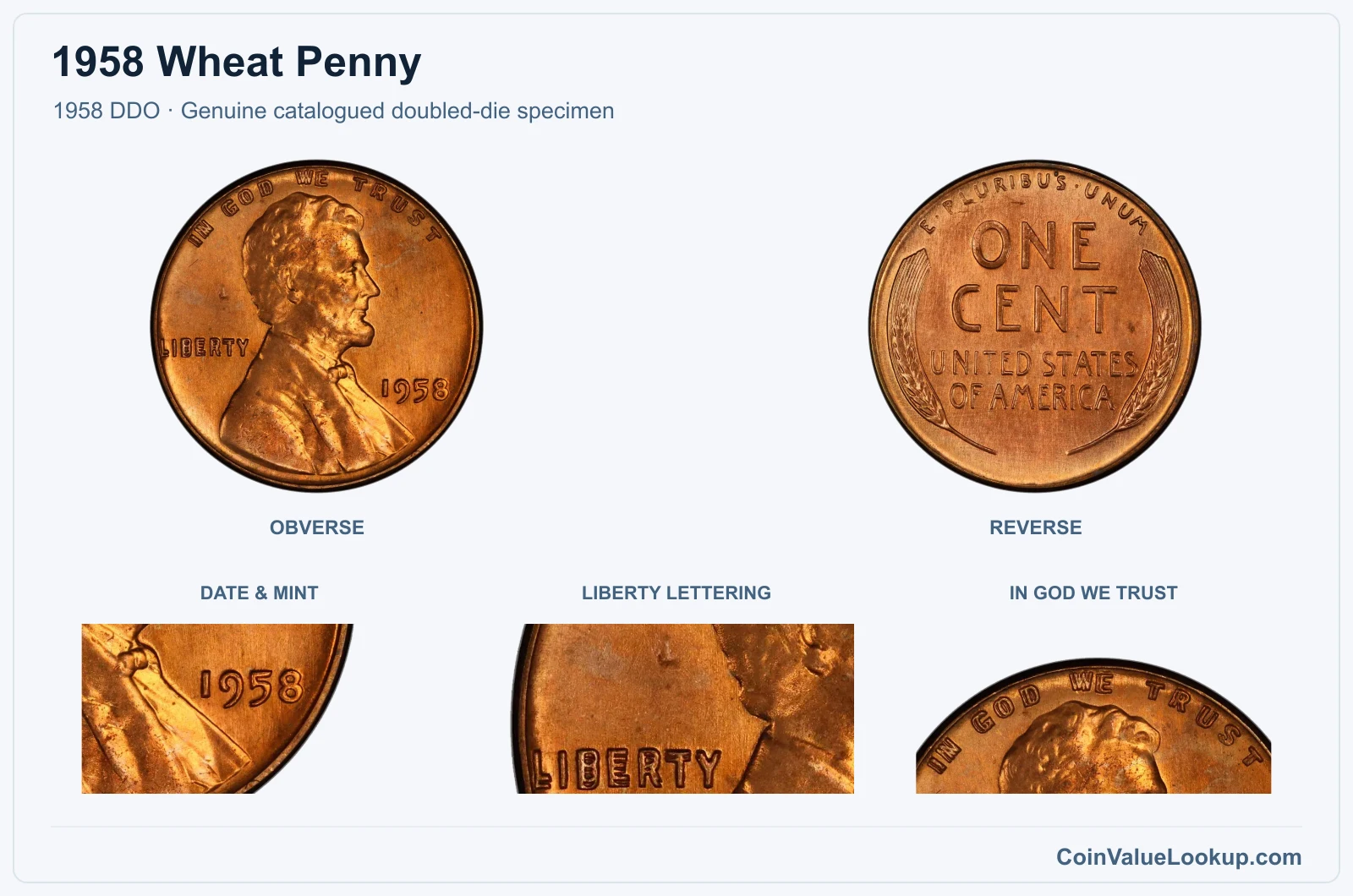
The 1958 Doubled Die Obverse is one of the most talked-about Lincoln cent varieties in the entire series. On genuine examples, the doubling is visible in the date and motto lettering on the obverse, showing consistent separation or notching rather than the flat, shelf-like distortion of machine doubling.
No standard guide price applies here. Each coin's value depends on its authenticated identity, condition, and the severity of the doubling.
Professional third-party certification is essential because the number of known specimens is very small and the stakes are high. If you think you have one, compare your coin's obverse lettering carefully against a normal 1958 cent under good light and magnification before spending money on grading fees.
Coin Value Lookup is a useful starting point if you want to look up guides for this year and other Lincoln cent dates before deciding whether to pursue professional evaluation.
| Range | Grade | Price | Auction Records | Appraisal |
|---|---|---|---|---|
| PO | PO 1 | — | Coin Identifier | |
| FR | FR 2 | — | Coin Identifier | |
| AG | AG 3 | — | Coin Identifier | |
| G | G 4 | — | Coin Identifier | |
| G 6 | — | Coin Identifier | ||
| VG | VG 8 | — | Coin Identifier | |
| VG 10 | — | Coin Identifier | ||
| F | F 12 | — | Coin Identifier | |
| F 15 | — | Coin Identifier | ||
| VF | VF 20 | — | Coin Identifier | |
| VF 25 | — | Coin Identifier | ||
| VF 30 | — | Coin Identifier | ||
| VF 35 | — | Coin Identifier | ||
| XF | XF 40 | — | Coin Identifier | |
| XF 45 | — | Coin Identifier | ||
| AU | AU 50 | — | Coin Identifier | |
| AU 53 | — | Coin Identifier | ||
| AU 55 | — | Coin Identifier | ||
| AU 58 | — | Coin Identifier | ||
| MS | MS 60 | — | Coin Identifier | |
| MS 61 | — | Coin Identifier | ||
| MS 62 | — | Coin Identifier | ||
| MS 63 | — | Coin Identifier | ||
| MS 64 | Coin Identifier | |||
| MS 65 | — | Coin Identifier | ||
| MS 66 | — | — | — | |
| MS 67 | — | — | — | |
| MS 68 | — | — | — | |
| MS 69 | — | — | — | |
| MS 70 | — | — | — |
1958 Wheat Penny — D
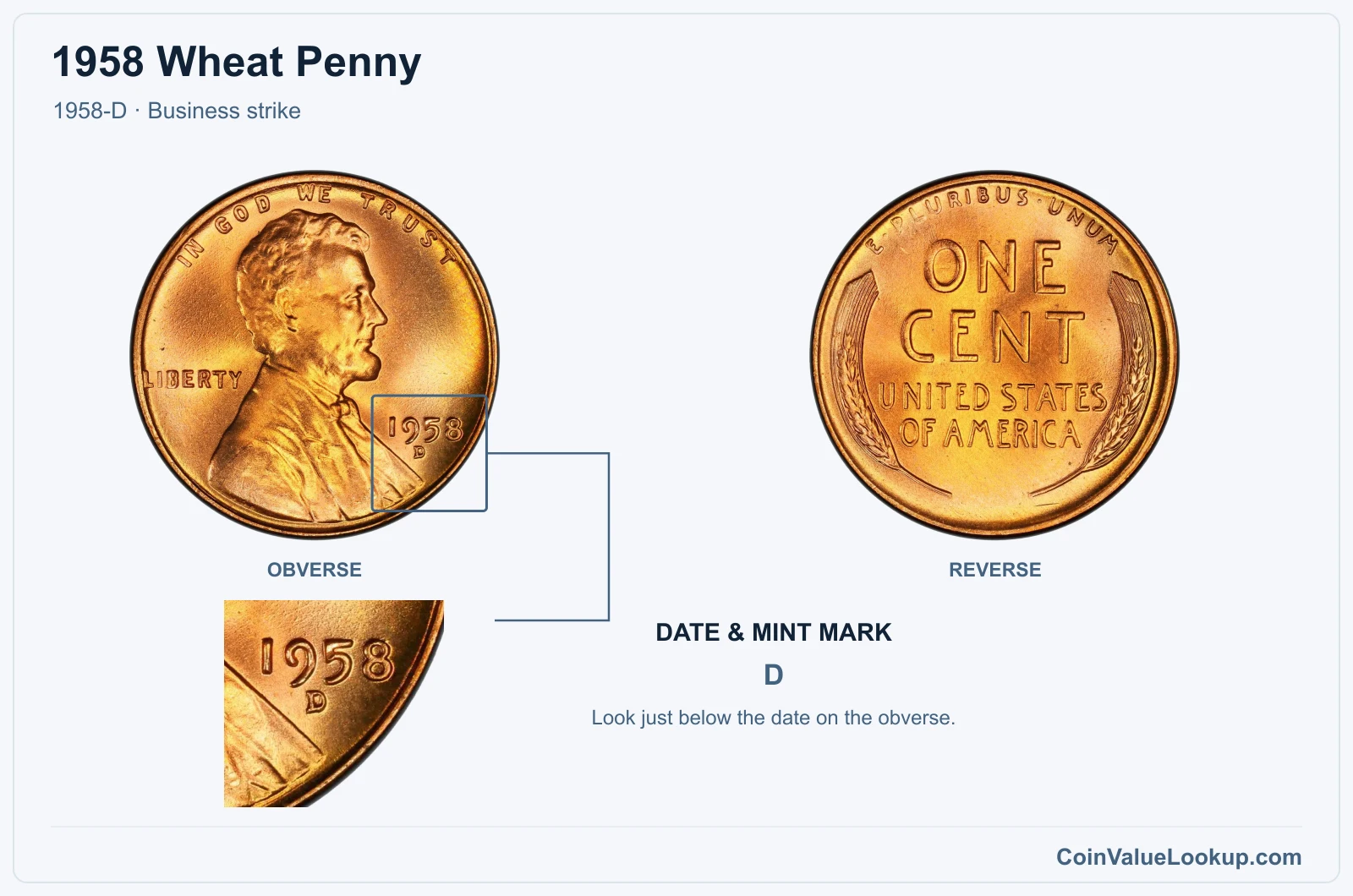
Look for a D mintmark below the date. The 1958-D comes from the Denver Mint and shares the same copper alloy composition and 3.11-gram weight as the Philadelphia issue.
Guide estimates sit at roughly $0.06 in Fine-12 and about $1.24 at MS63.
Denver struck a huge quantity of these, so circulated examples are common. Uncirculated pieces with strong original luster and minimal bag marks are where the modest premium lives.
As the final Denver Wheat cent, it rounds out many collections alongside its Philadelphia sibling.
| Range | Grade | Price | Auction Records | Appraisal |
|---|---|---|---|---|
| PO | PO 1 | — | Coin Identifier | |
| FR | FR 2 | — | Coin Identifier | |
| AG | AG 3 | — | Coin Identifier | |
| G | G 4 | — | Coin Identifier | |
| G 6 | — | Coin Identifier | ||
| VG | VG 8 | — | Coin Identifier | |
| VG 10 | — | Coin Identifier | ||
| F | F 12 | — | Coin Identifier | |
| F 15 | — | Coin Identifier | ||
| VF | VF 20 | — | Coin Identifier | |
| VF 25 | — | Coin Identifier | ||
| VF 30 | — | Coin Identifier | ||
| VF 35 | — | Coin Identifier | ||
| XF | XF 40 | — | Coin Identifier | |
| XF 45 | — | Coin Identifier | ||
| AU | AU 50 | — | Coin Identifier | |
| AU 53 | — | Coin Identifier | ||
| AU 55 | — | Coin Identifier | ||
| AU 58 | — | Coin Identifier | ||
| MS | MS 60 | — | Coin Identifier | |
| MS 61 | — | Coin Identifier | ||
| MS 62 | — | Coin Identifier | ||
| MS 63 | — | Coin Identifier | ||
| MS 64 | Coin Identifier | |||
| MS 65 | Coin Identifier | |||
| MS 66 | Coin Identifier | |||
| MS 67 | Coin Identifier | |||
| MS 68 | — | — | — | |
| MS 69 | — | — | — | |
| MS 70 | — | — | — |
1958 Wheat Penny — PR
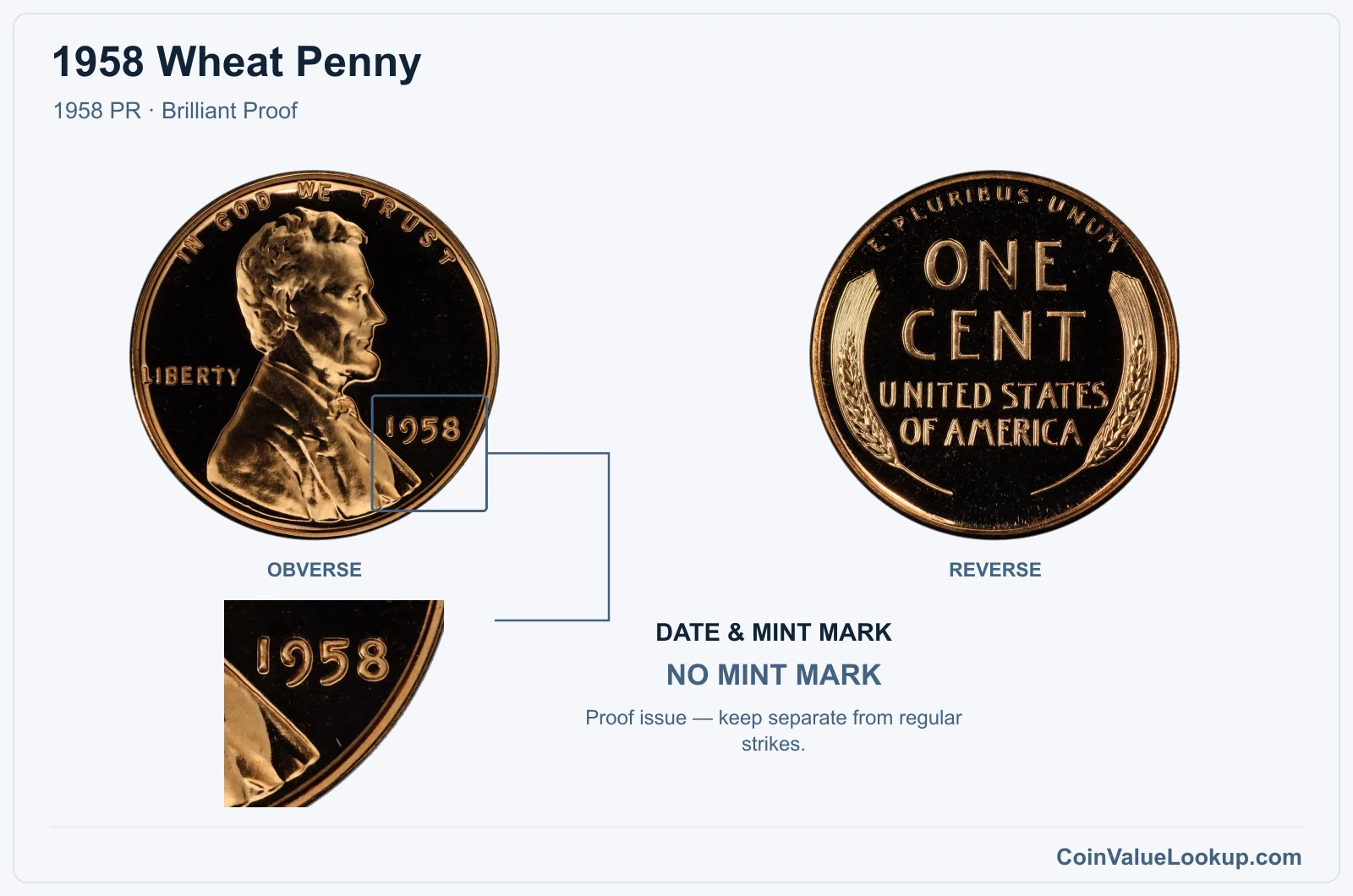
The 1958 proof cent was struck at Philadelphia using specially prepared dies and polished planchets. The result is a coin with deeply mirrored fields and razor-sharp design details that no business strike can match.
A guide estimate puts it at about $10 in PR63.
These were sold in complete proof sets and were never intended for circulation. Cameo and deep cameo contrast designations describe the degree of frosty contrast on the devices versus the mirrored fields; they are not errors.
A polished circulation cent is not a proof, regardless of how shiny it looks. Check for the characteristic mirror surface across the entire field to confirm proof status.
| Range | Grade | Price | Auction Records | Appraisal |
|---|---|---|---|---|
| PR | PR 1 | — | Coin Identifier | |
| PR 2 | — | Coin Identifier | ||
| PR 3 | — | Coin Identifier | ||
| PR 4 | — | Coin Identifier | ||
| PR 6 | — | Coin Identifier | ||
| PR 8 | — | Coin Identifier | ||
| PR 10 | — | Coin Identifier | ||
| PR 12 | — | Coin Identifier | ||
| PR 15 | — | Coin Identifier | ||
| PR 20 | — | Coin Identifier | ||
| PR 25 | — | Coin Identifier | ||
| PR 30 | — | Coin Identifier | ||
| PR 35 | — | Coin Identifier | ||
| PR 40 | — | Coin Identifier | ||
| PR 45 | — | Coin Identifier | ||
| PR 50 | — | Coin Identifier | ||
| PR 53 | — | Coin Identifier | ||
| PR 55 | — | Coin Identifier | ||
| PR 58 | — | Coin Identifier | ||
| PR 60 | — | Coin Identifier | ||
| PR 61 | — | Coin Identifier | ||
| PR 62 | — | Coin Identifier | ||
| PR 63 | — | Coin Identifier | ||
| PR 64 | Coin Identifier | |||
| PR 65 | Coin Identifier | |||
| PR 66 | Coin Identifier | |||
| PR 67 | Coin Identifier | |||
| PR 68 | Coin Identifier | |||
| PR 69 | Coin Identifier | |||
| PR 70 | — | — | — |
1958 Wheat Penny Error List
1. 1958 Wheat Penny — Doubled Die Obverse
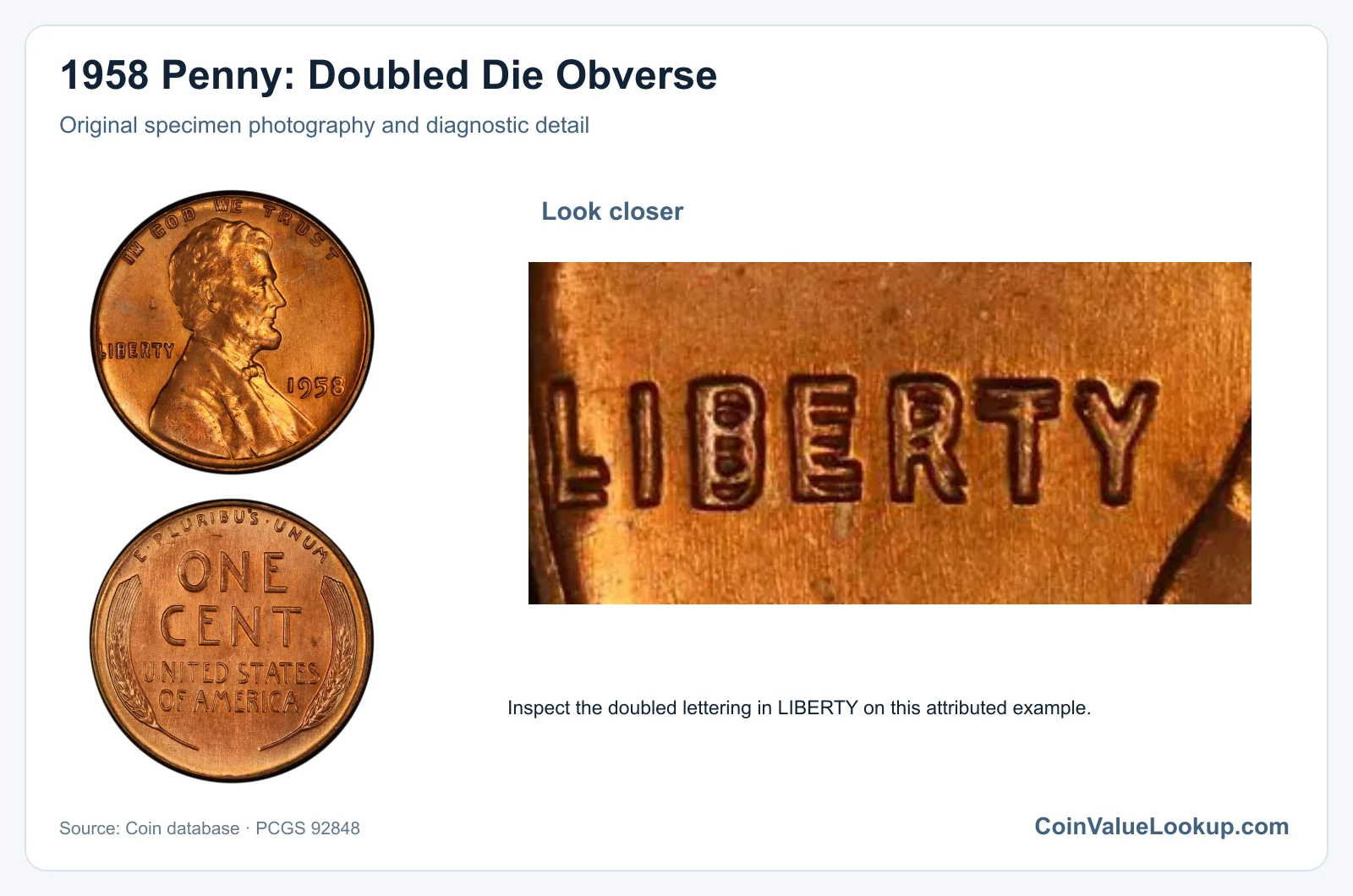
A Doubled Die Obverse on a 1958 Wheat cent shows consistent separation or notching in the obverse lettering and date. Compare your coin's inscriptions to a normal example under matching lighting and magnification.
Genuine hub doubling will repeat across multiple letters in a uniform direction, while machine doubling produces a flat, shelf-like shadow that lacks sharp secondary contours.
The 1958 DDO is extremely rare, so most coins that look slightly fuzzy are simply worn or poorly struck. No standard guide price applies.
Value depends entirely on authenticated identity, the severity of the doubling, and overall condition. Professional certification is strongly recommended before assuming you have the real thing.
2. 1958 Wheat Penny — Wrong Planchet / Off-Metal Strike
A wrong-planchet or off-metal strike means the 1958 cent die struck a blank intended for a different denomination or composition. To check, weigh your coin carefully and measure its diameter.
A normal cent weighs about 3.11 grams; a significant departure in weight, diameter, or edge type could signal a wrong planchet.
Be cautious. Plating loss, acid damage, environmental corrosion, and deliberate alterations can all make a normal copper cent look strange.
Do not assume a different metal just because the color seems off. Each wrong-planchet coin is assessed individually based on its authenticated identity and the specific blank involved, so no standard price range applies here.
3. 1958 Wheat Penny — Off-Center Strike
An off-center strike happens when the planchet is not properly seated between the dies, leaving part of the design missing and an unstruck crescent of blank metal on one side. The percentage of off-center displacement and whether the date remains visible are the two biggest factors collectors care about.
Do not confuse an off-center strike with a clipped planchet, which has a curved bite out of the edge, or with post-mint damage where someone flattened part of the coin. A true off-center error shows a cleanly displaced design with no distortion at the remaining edges.
No standard guide price is adopted; value depends on the degree of displacement, date visibility, and overall condition as confirmed by authentication.
4. 1958 Wheat Penny — Doubled Die Reverse
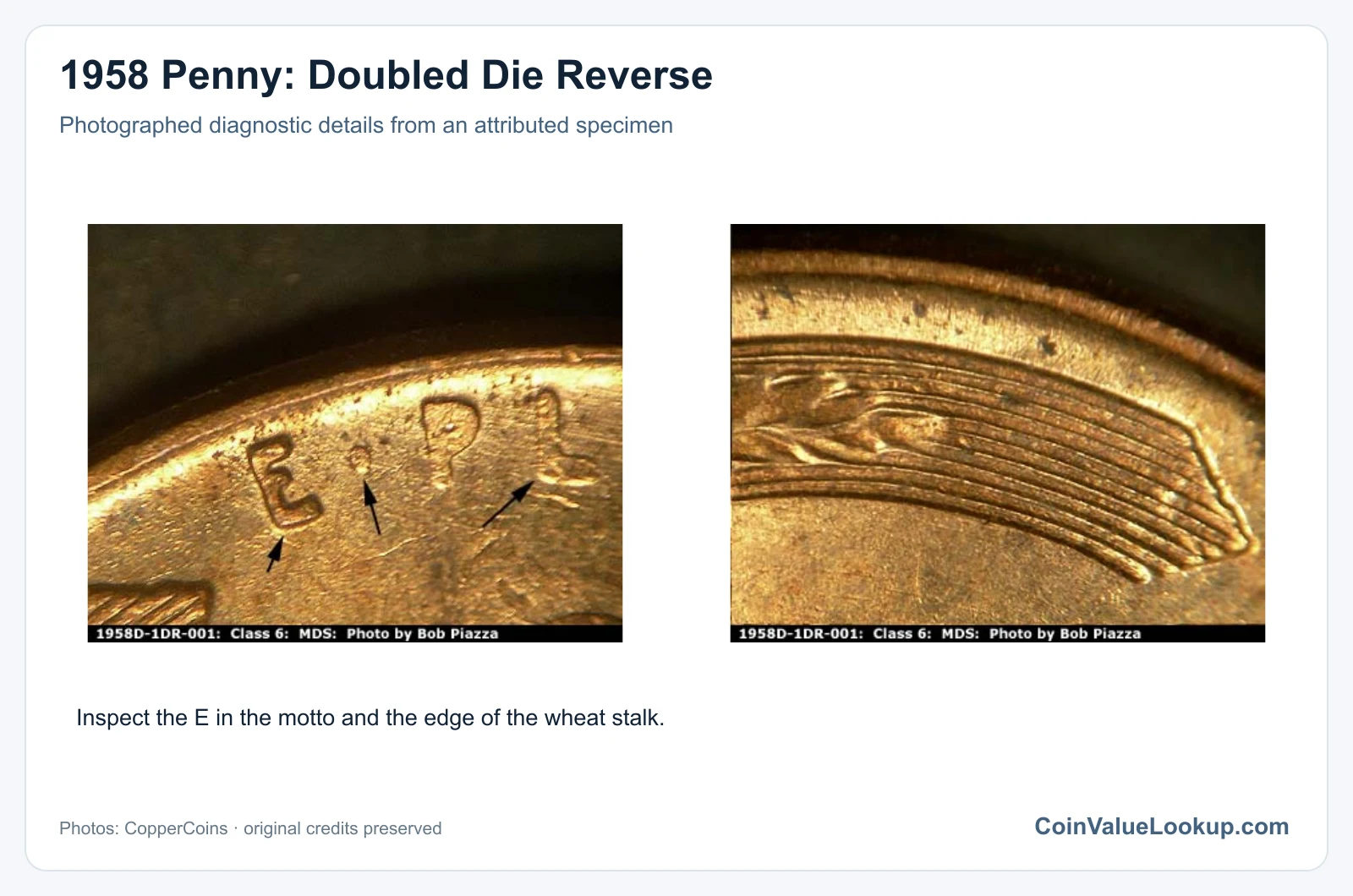
A Doubled Die Reverse on a 1958 cent shows doubling in the reverse legends or design elements, such as ONE CENT, UNITED STATES OF AMERICA, or the wheat stalks themselves. Compare your reverse closely to a normal coin under magnification.
Look for consistent separation in the lettering rather than a flat, mushy shadow.
Machine doubling and random die deterioration can mimic a doubled die to the untrained eye. The key difference is that true hub doubling creates distinct, raised secondary contours, while mechanical doubling tends to flatten and shelve the affected areas.
No standard price range applies; each example is valued individually based on authenticated identity, doubling severity, and condition.
5. 1958 Wheat Penny — BIE Die Break
A BIE die break shows up as a small raised lump or vertical bar between the letters B and E in LIBERTY on the obverse. It is caused by a crack or chip in the die that fills with metal during striking.
These are minor die varieties, common enough across many Wheat cent years but still collected by specialists.
Do not confuse a BIE with dirt, a scratch, or a bit of corrosion lodged between the letters. A genuine die break will be raised above the field and have the same metal tone as the rest of the coin.
No standard guide price applies; value depends on the size and prominence of the break and the coin's overall condition.
6. 1958 Wheat Penny — Repunched Mintmark
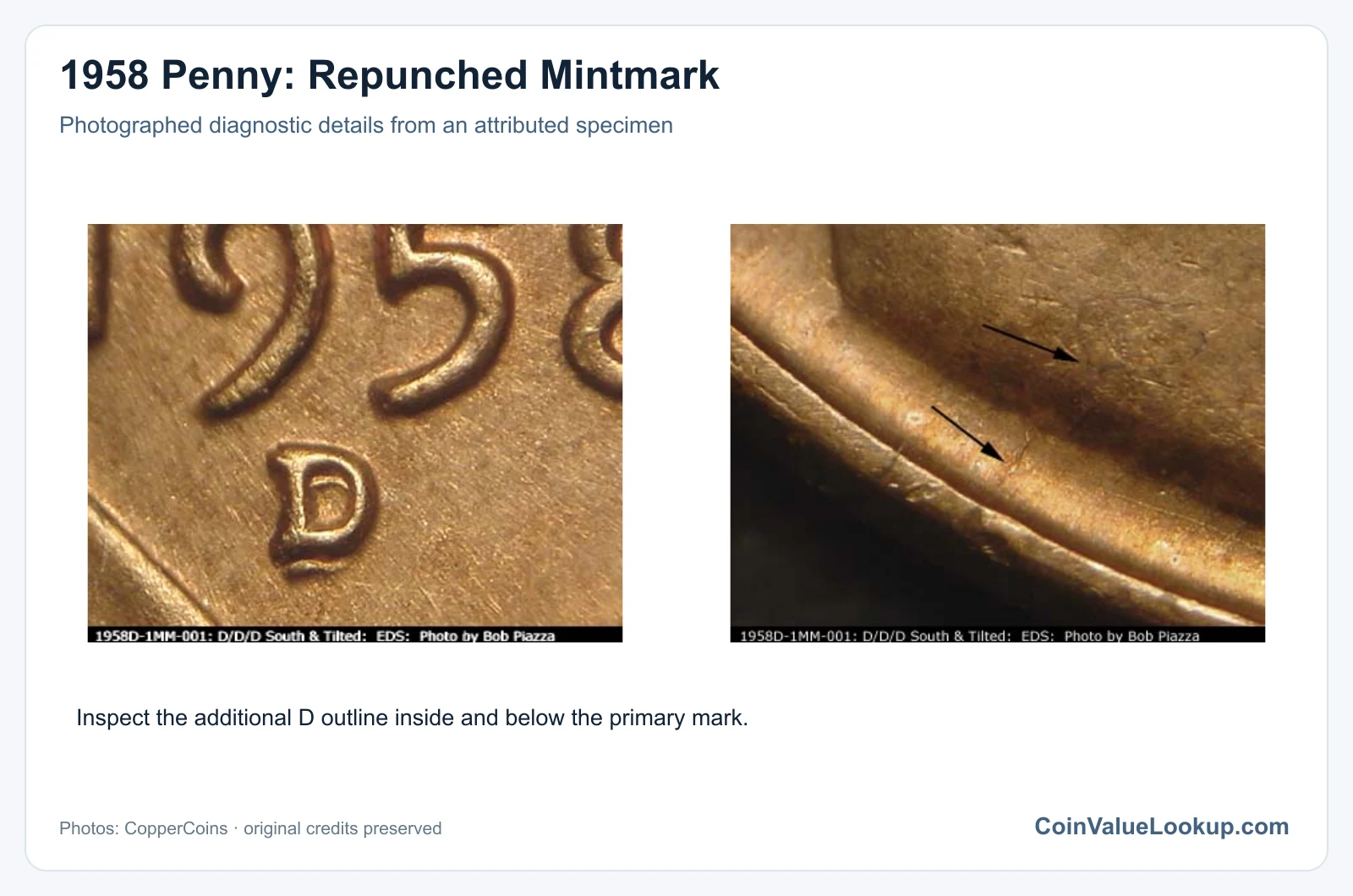
A repunched mintmark on a 1958-D cent shows traces of an earlier, slightly mispositioned D beneath or beside the final mintmark. This happened because mintmarks were hand-punched into working dies during this era, and sometimes the first punch landed off target.
To spot one, examine the D below the date under at least 5x magnification. Look for remnants of a second punch, such as a notch, extra serif, or shadow that does not match normal die wear.
Machine doubling of the mintmark and die chips or corrosion around the letter can look similar, so compare against a known normal example at matching magnification. No standard guide price is adopted for this variety; each coin is assessed individually based on the clarity of the repunching and overall condition.