1934 Wheat Penny Coin Value: How Much Is It Worth?
A 1934 Wheat Penny in circulated condition starts around $0.18 in Good-4 grade and can reach roughly $26 at MS63, depending on the mint. Those guide figures cover the two regular business-strike branches — Philadelphia and Denver — and do not include major varieties or error coins, which are priced separately.
Original surfaces, color and the degree of wear all affect what a buyer will actually pay.
Fast Way to Identify Your 1934 Wheat Penny
Want a quick read on your 1934 penny? Upload clear photos of the front and back, and our identifier can give you a preliminary idea of which mint and version you have.
Good lighting and a sharp close-up of the area below the date help the most — that is where the mintmark lives, and it determines which price column applies to your coin.
1934 Wheat Penny Value
Upload both sides of your 1934 Wheat Penny.
Front Obverse
Upload photo
Back Reverse
Upload photo
Which 1934 Wheat Penny Versions Are Worth Money?
- The 1934-D (Denver) carries a higher guide value than Philadelphia across grades — about $0.24 in G4 up to $26 in MS63 — so identifying the D mintmark is the first thing to check.
- A 1934 Philadelphia in MS63 condition guides around $10, making uncirculated examples with original surfaces worth setting aside.
- Doubled die obverse varieties on 1934 cents can carry a premium; look for consistent doubling on letters or the date rather than flat shelf-like machine doubling.
- Repunched mintmark errors apply only to the 1934-D; traces of a second D punch position can add collector interest.
- Die breaks, off-center strikes, clipped planchets and lamination errors are all reported for this date and can command individual premiums depending on severity and authentication.
Step 1: Identify Your 1934 Wheat Penny Mint Mark and Version
Start by flipping the coin over: you should see two wheat ears framing ONE CENT. That confirms you have a Wheat-reverse Lincoln cent.
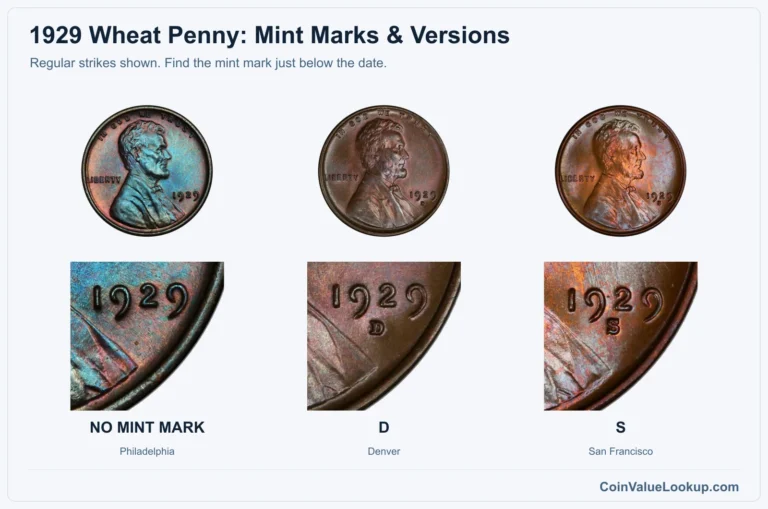
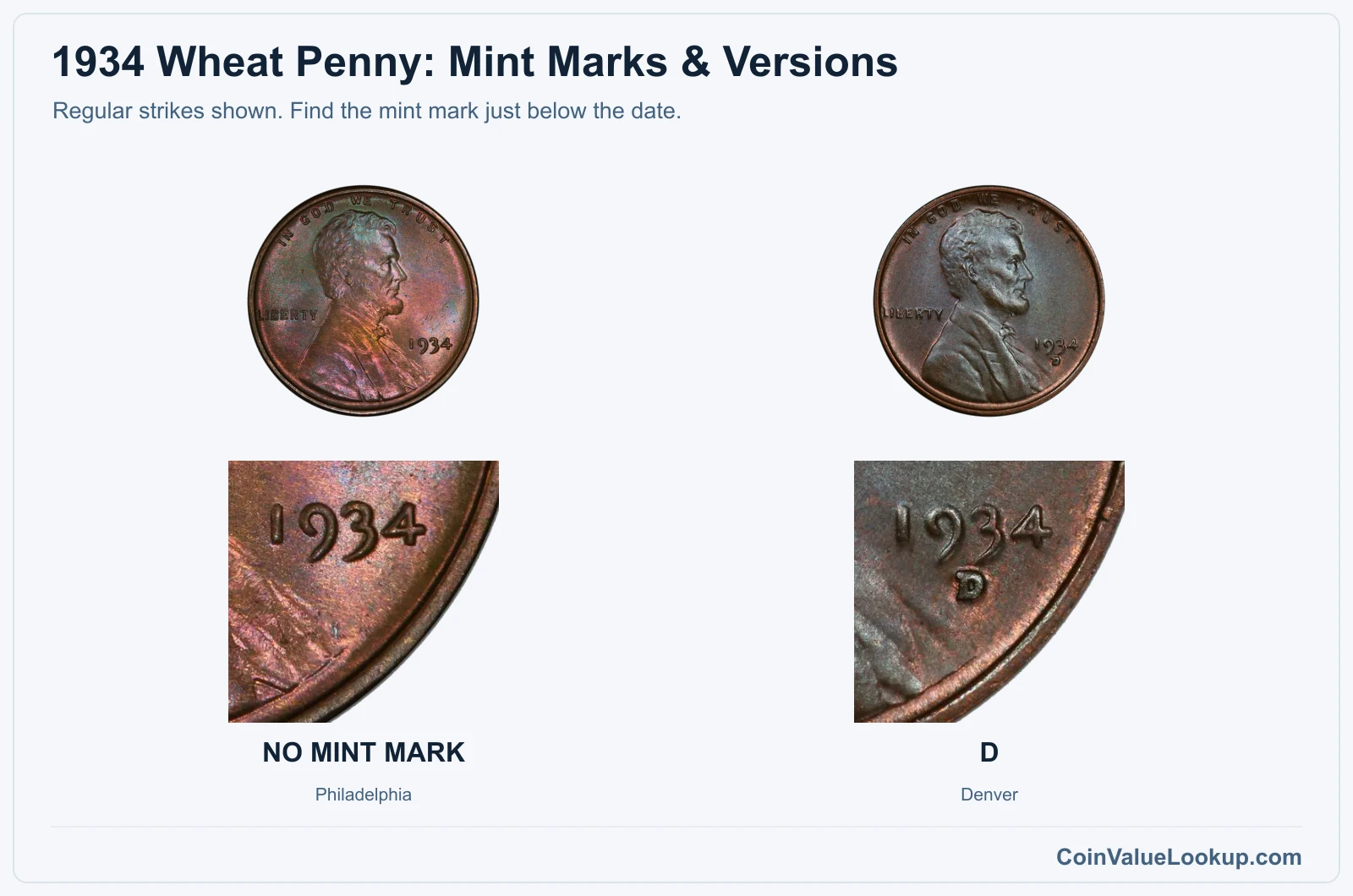
Now look at the obverse, just below the date. A small "D" means Denver.
No letter at all means Philadelphia. There is no 1934-S; San Francisco did not strike this date.
The coin is 95% copper with 5% tin and zinc, weighs about 3.11 grams, and has a plain (smooth) edge. If your coin is noticeably lighter, sticks to a magnet, or has a reeded edge, it is not a standard 1934 cent.
Color matters for value but does not determine grade by itself. A coin can be full red, red-brown, or brown depending on how the copper surface has toned over ninety years.
The guide prices referenced here do not specify a particular color designation, so treat them as general retail estimates rather than quotes for a certified red example.
Step 2: Check Your 1934 Wheat Penny Grade
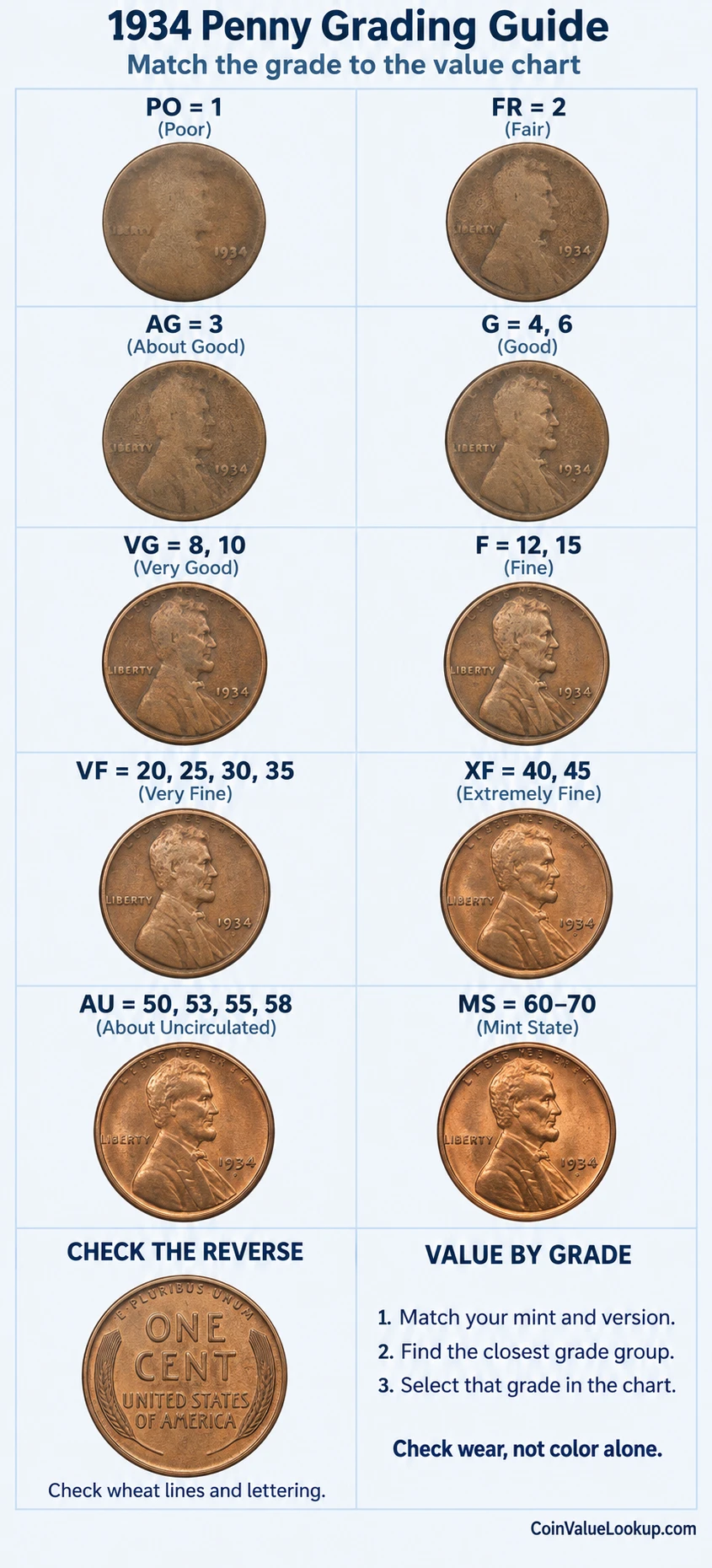
Check Lincoln's cheekbone and jawline first — those are the highest points on the obverse and the first places to show wear. On a well-worn coin grading around Good-4, the portrait outline is visible but nearly flat, and LIBERTY in the headband is mostly gone.
Move up to Fine or Very Fine and you will see individual hair strands reappearing above the ear. The wheat stalks on the reverse gain sharper grain lines as grade improves.
At Mint State (MS60 and above), no wear is present and original luster covers the surfaces. Use the comparison image to match your coin's detail level.
Keep in mind that a weak original strike can leave soft spots that look like wear but are not — check whether the softness appears on both sides in the same area, which points to a strike issue rather than circulation damage.
Separate the question of grade from the question of eye appeal. Spots, cleaning, or corrosion can make an otherwise high-grade coin less desirable and lower its market value.
Step 3: Check 1934 Wheat Penny Value by Mint and Version
1934 Wheat Penny
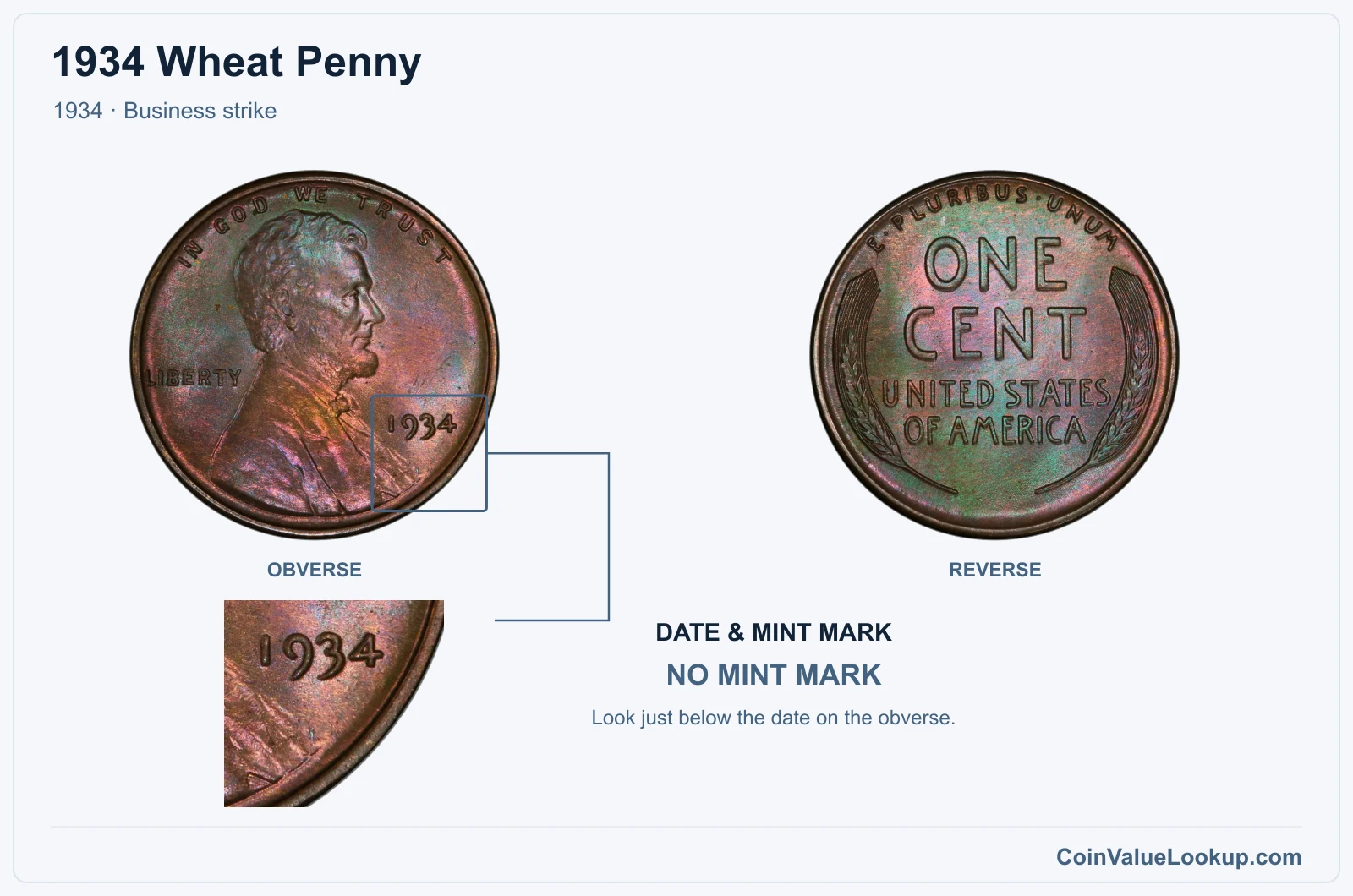
The 1934 Philadelphia cent has no mintmark — the space below the date is blank. It is a 95% copper, 5% tin-and-zinc composition coin weighing about 3.11 grams with a plain edge.
Guide estimates place a circulated example around $0.18 in Good-4 and an uncirculated piece near $10 at MS63. These are general retail estimates and do not specify a particular color grade, so a certified red coin in the same technical grade could trade differently.
Minor doubled die obverse varieties have been reported on Philadelphia 1934 cents. If you spot consistent letter separation or notching on the date or motto, it is worth a closer look under magnification.
Normal die wear and machine doubling are far more common and do not carry a premium.
Coin Value Lookup is a good starting point if you want to look up guide values for other dates and mints in the Wheat cent series.
| Range | Grade | Price | Auction Records | Appraisal |
|---|---|---|---|---|
| PO | PO 1 | — | Coin Identifier | |
| FR | FR 2 | — | Coin Identifier | |
| AG | AG 3 | — | Coin Identifier | |
| G | G 4 | — | Coin Identifier | |
| G 6 | — | Coin Identifier | ||
| VG | VG 8 | — | Coin Identifier | |
| VG 10 | — | Coin Identifier | ||
| F | F 12 | — | Coin Identifier | |
| F 15 | — | Coin Identifier | ||
| VF | VF 20 | — | Coin Identifier | |
| VF 25 | — | Coin Identifier | ||
| VF 30 | — | Coin Identifier | ||
| VF 35 | — | Coin Identifier | ||
| XF | XF 40 | — | Coin Identifier | |
| XF 45 | — | Coin Identifier | ||
| AU | AU 50 | — | Coin Identifier | |
| AU 53 | — | Coin Identifier | ||
| AU 55 | — | Coin Identifier | ||
| AU 58 | Coin Identifier | |||
| MS | MS 60 | — | Coin Identifier | |
| MS 61 | — | Coin Identifier | ||
| MS 62 | — | Coin Identifier | ||
| MS 63 | Coin Identifier | |||
| MS 64 | Coin Identifier | |||
| MS 65 | Coin Identifier | |||
| MS 66 | — | Coin Identifier | ||
| MS 67 | — | — | — | |
| MS 68 | — | — | — | |
| MS 69 | — | — | — | |
| MS 70 | — | — | — |
1934 Wheat Penny — D
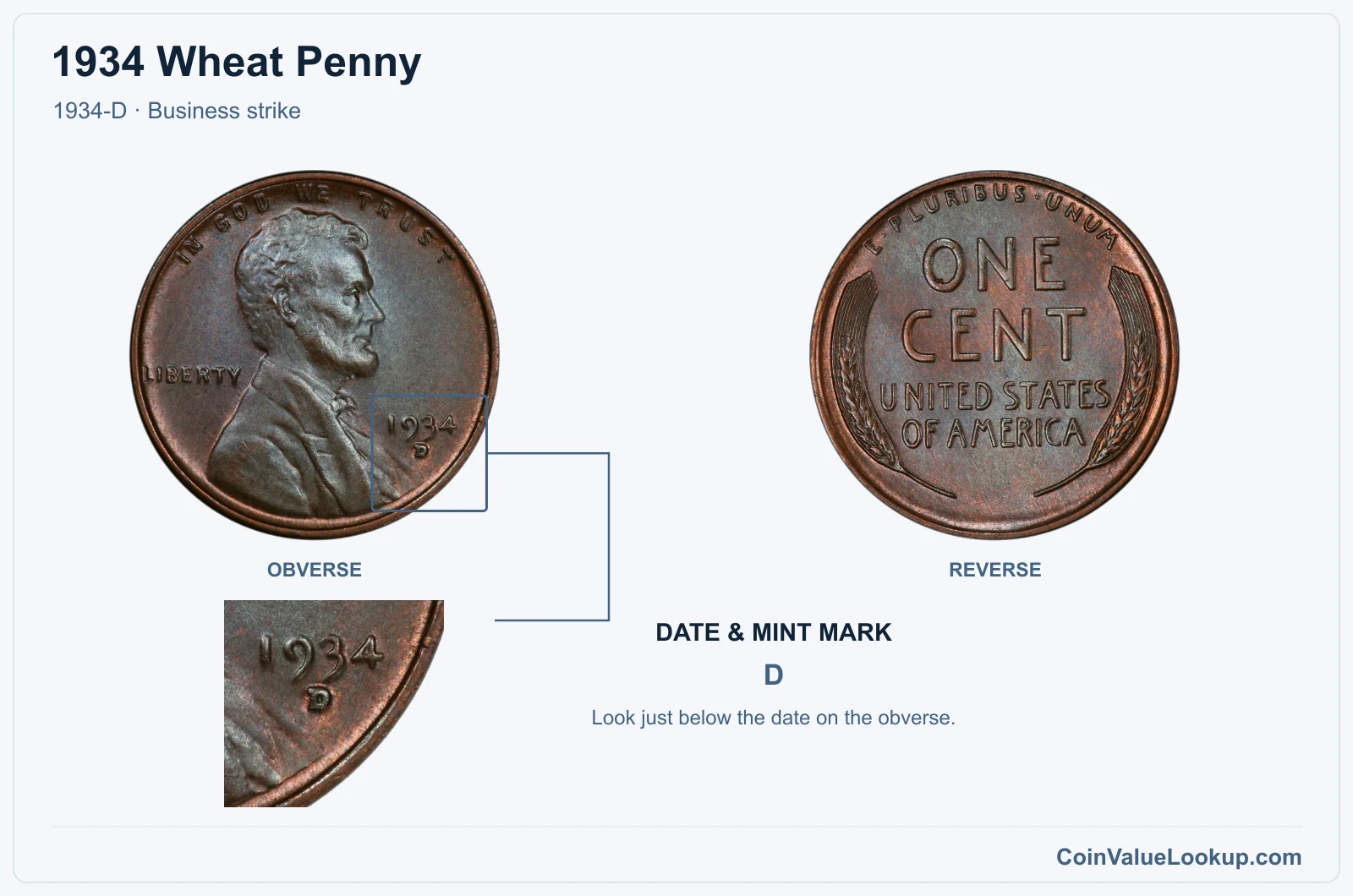
Look for the small "D" mintmark sitting below the date on the obverse. That letter confirms your coin was struck at the Denver Mint.
Same alloy and weight as the Philadelphia issue — 95% copper with 5% tin and zinc, 3.11 grams, plain edge.
Guide values run a bit higher than the no-mintmark version: roughly $0.24 in Good-4 and about $26 at MS63. The Denver issue is the pricier of the two regular 1934 branches in uncirculated grades based on these estimates.
Keep in mind these figures do not specify color, so a brown MS63 and a full-red MS63 may trade at very different levels in practice.
Because Denver used a separate mintmark punch, this is the only 1934 branch where repunched mintmark varieties can exist. Check under magnification for traces of a second D position beneath or beside the primary mark.
| Range | Grade | Price | Auction Records | Appraisal |
|---|---|---|---|---|
| PO | PO 1 | — | Coin Identifier | |
| FR | FR 2 | — | Coin Identifier | |
| AG | AG 3 | — | Coin Identifier | |
| G | G 4 | — | Coin Identifier | |
| G 6 | — | Coin Identifier | ||
| VG | VG 8 | — | Coin Identifier | |
| VG 10 | — | Coin Identifier | ||
| F | F 12 | — | Coin Identifier | |
| F 15 | — | Coin Identifier | ||
| VF | VF 20 | — | Coin Identifier | |
| VF 25 | — | Coin Identifier | ||
| VF 30 | — | Coin Identifier | ||
| VF 35 | — | Coin Identifier | ||
| XF | XF 40 | — | Coin Identifier | |
| XF 45 | — | Coin Identifier | ||
| AU | AU 50 | — | Coin Identifier | |
| AU 53 | — | Coin Identifier | ||
| AU 55 | Coin Identifier | |||
| AU 58 | Coin Identifier | |||
| MS | MS 60 | — | Coin Identifier | |
| MS 61 | — | Coin Identifier | ||
| MS 62 | — | Coin Identifier | ||
| MS 63 | — | Coin Identifier | ||
| MS 64 | — | Coin Identifier | ||
| MS 65 | Coin Identifier | |||
| MS 66 | Coin Identifier | |||
| MS 67 | — | — | — | |
| MS 68 | — | — | — | |
| MS 69 | — | — | — | |
| MS 70 | — | — | — |
1934 Wheat Penny Error List
1. 1934 Wheat Penny — Doubled Die Obverse
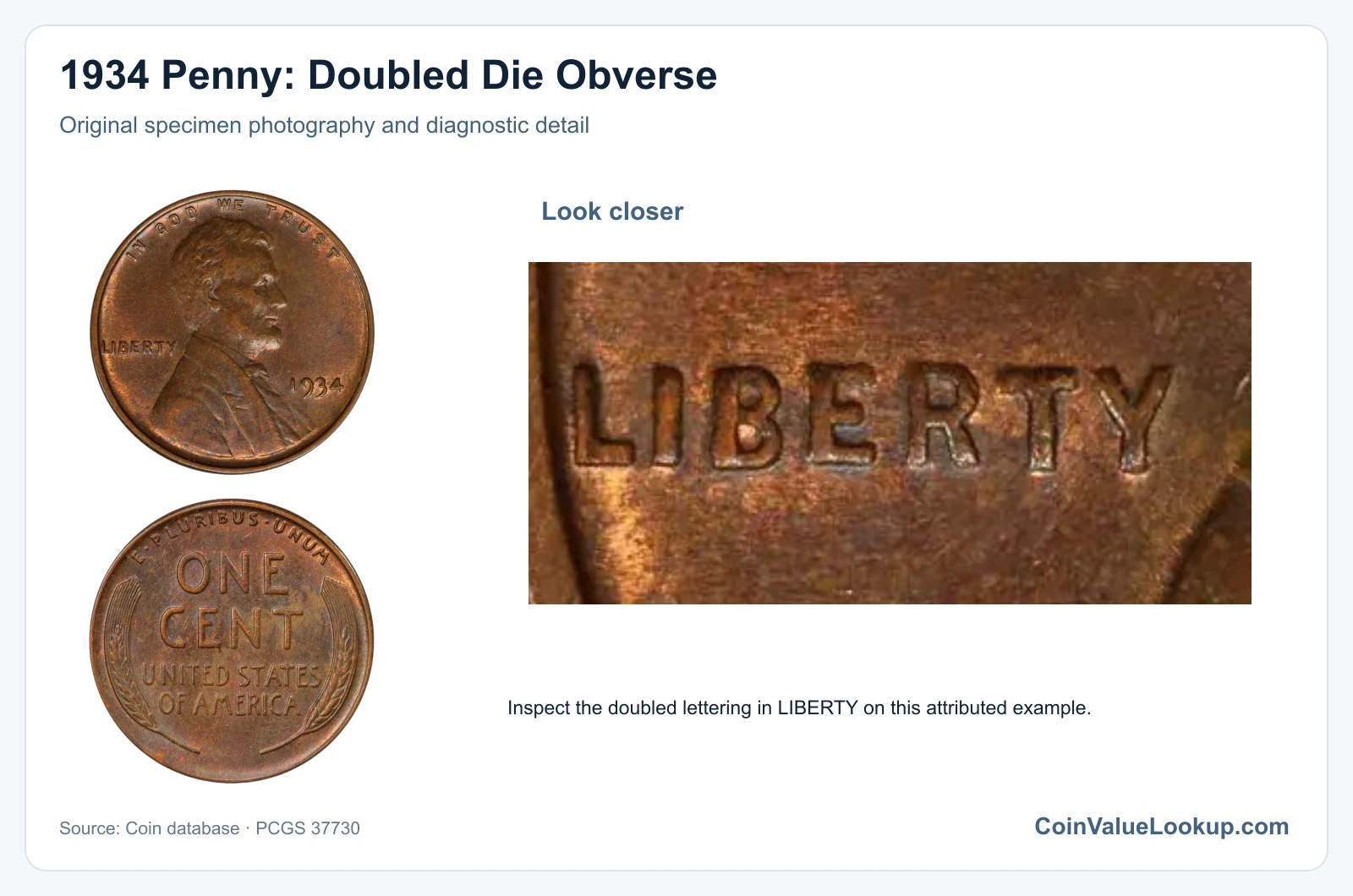
A doubled die obverse on a 1934 Wheat cent shows consistent separation or notching on design elements such as the date digits, IN GOD WE TRUST, or LIBERTY. The key word is consistent: genuine hub doubling repeats the same displacement direction across multiple letters and features on the same side of the coin.
To check, compare your coin's obverse lettering against a known normal example under the same magnification and lighting. Machine doubling — which is far more common and carries no premium — tends to produce a flat, shelf-like distortion rather than the rounded, clearly separated secondary image of a true doubled die.
Pricing for a doubled die obverse depends on which specific variety it is, how strong the doubling appears, and the coin's overall condition. Authentication by a recognized grading service is the standard way to confirm the variety and establish its market standing.
2. 1934 Wheat Penny — Repunched Mintmark
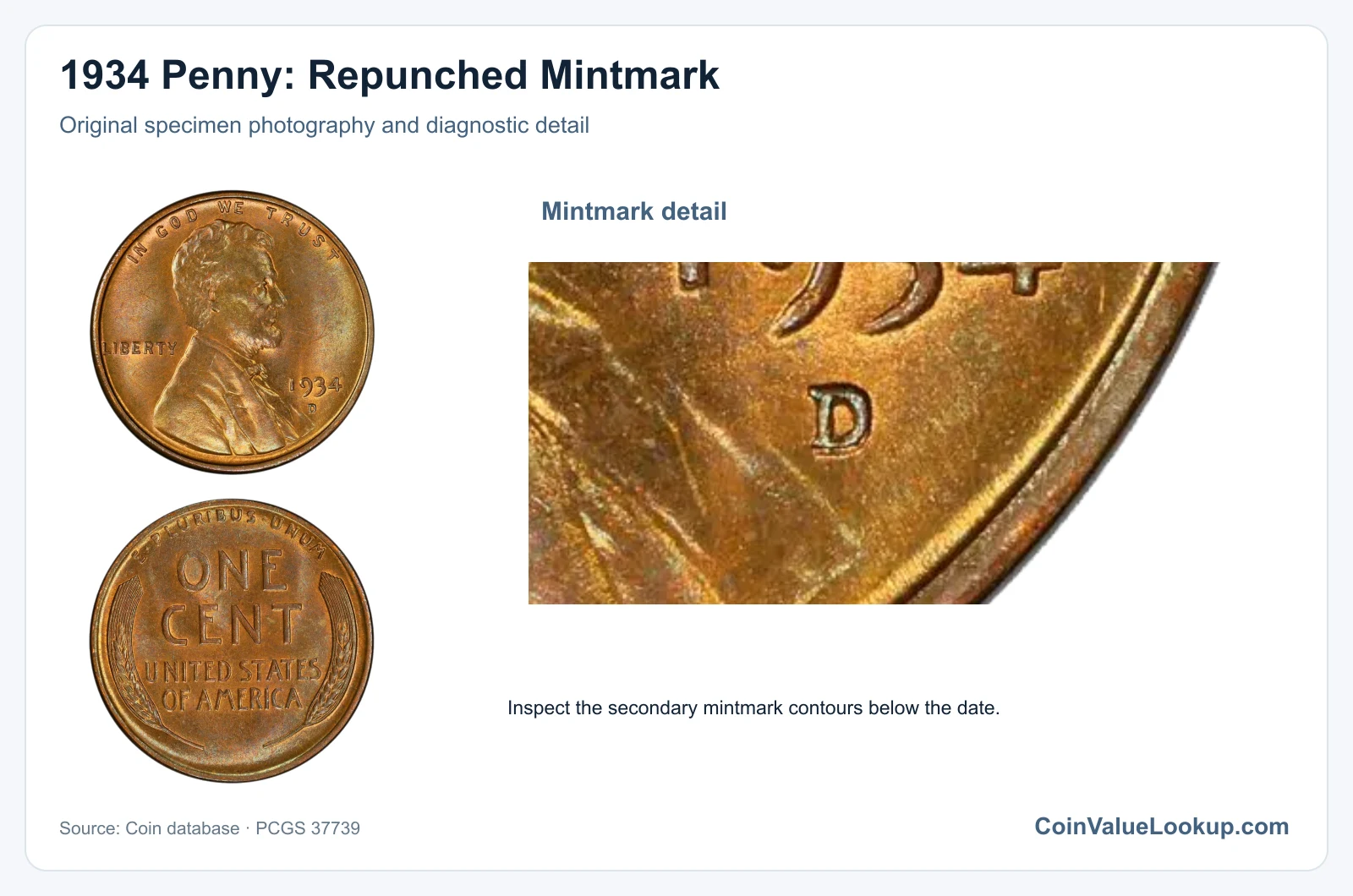
A repunched mintmark applies only to the 1934-D. Philadelphia cents have no mintmark, so there is nothing to repunch.
On an RPM, the Denver Mint punched the D into the working die more than once, leaving traces of the earlier position visible beneath or beside the final letter.
Under magnification, look for a secondary outline, serif, or shadow near the primary D. Compare it at the same angle and lighting to a normal 1934-D mintmark.
Common lookalikes include machine doubling around the D, small die chips filling the letter, and corrosion or grime that mimics a doubled outline.
There is no single adopted price range for 1934-D repunched mintmarks. Value depends on which specific RPM variety you have, how clear the repunching is, and the coin's grade and surface quality.
Third-party authentication helps confirm the variety and distinguish it from post-strike damage.
3. 1934 Wheat Penny — Die Break / Cud
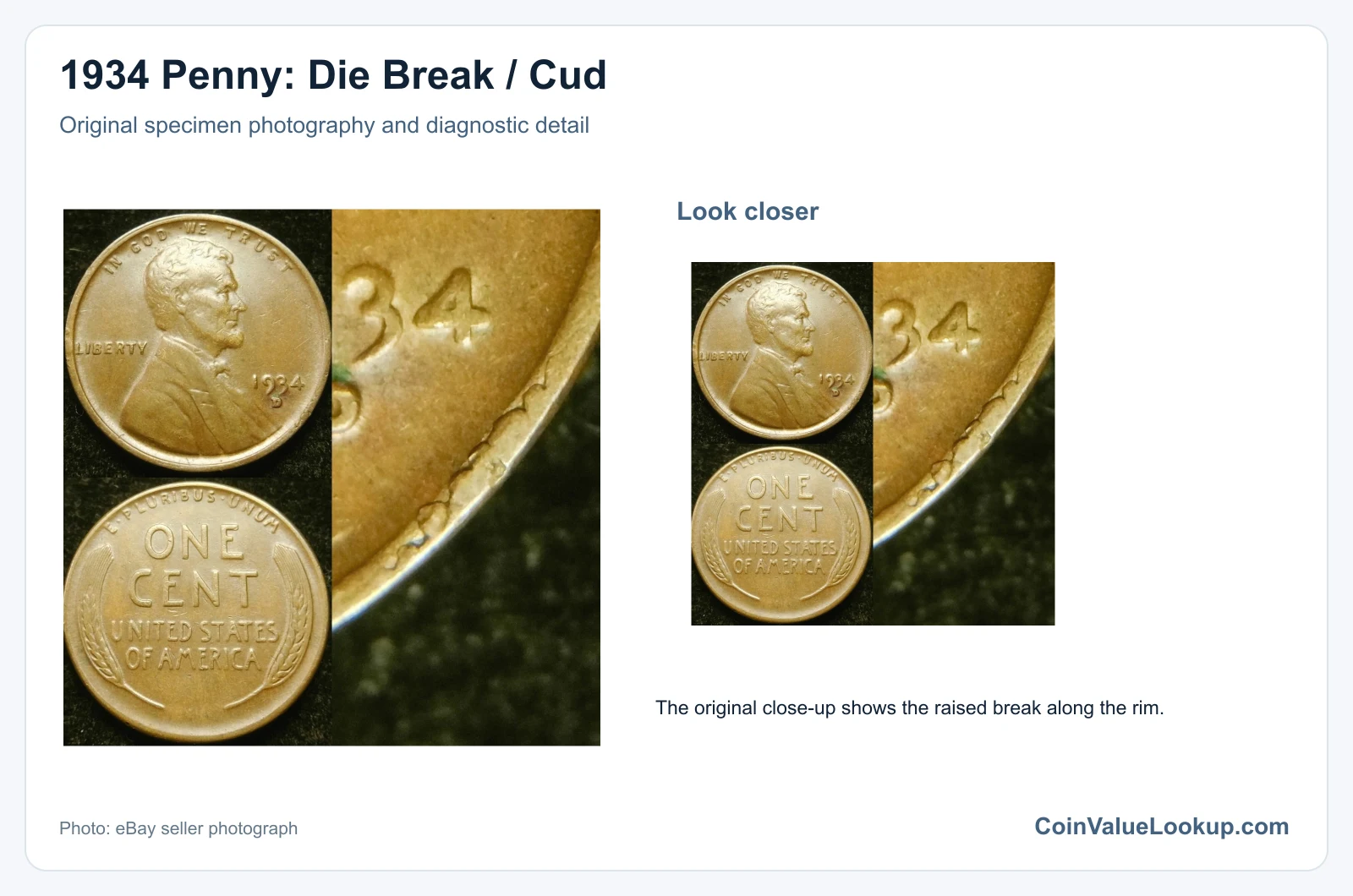
A die break shows up as a raised, irregular blob of metal on the coin's surface where a piece of the die cracked away. When that crack extends to the rim, the result is called a cud — a flat, featureless lump connected to the edge.
Both types are reported on 1934 Wheat cents.
Inspect the rim and nearby design carefully. A genuine cud displaces the normal design underneath it; the affected area is smooth and level with or slightly above the rim.
Compare that to a rim dent or contact mark, which pushes metal inward rather than raising it.
Interior die cracks are thinner raised lines that do not reach the rim. They are less dramatic than a full cud but still collectible.
Pricing for any die break depends on its size, location and the coin's overall condition. Individual assessment by a grading service is the reliable path to establishing value.
4. 1934 Wheat Penny — Off-Center Strike
An off-center strike happens when the planchet is not seated properly between the dies, so part of the design is missing and a blank crescent appears on one side. The percentage of off-center displacement and whether the date remains visible are the two biggest factors for collector interest.
On a 1934 cent, look for a clearly shifted design with an unstruck area that follows a smooth curve matching the original blank's edge. If the date is fully readable, the coin is far more desirable than one where the year is clipped away.
Do not confuse an off-center strike with a clipped planchet, which removes metal before striking, or with post-mint damage like a vise squeeze that flattens one side. No specific price range is adopted for this error; value depends on the degree of misalignment, date visibility, and authenticated condition.
5. 1934 Wheat Penny — Clipped Planchet
A clipped planchet error means part of the metal blank was missing before the coin was struck. The clip can be curved (most common), straight, or ragged, depending on what went wrong during blank production.
On a 1934 cent, look for a section of the rim and design that simply is not there, with the adjacent metal showing slight thinning or weakness.
A useful confirmation: genuine clips often produce a weak area on the opposite side of the coin, sometimes called the Blakesley effect. That weakness results from uneven metal flow during striking.
Watch out for filed edges, cut coins, or corrosion that can mimic a missing section. Filed areas usually show tool marks or a flat, unnatural edge profile rather than the smooth curve of a genuine clip.
No specific price range applies across the board; value depends on clip size, location, and the coin's authenticated grade.
6. 1934 Wheat Penny — BIE Die Break
This is one of the more fun minor errors to hunt for on Wheat cents. A BIE die break shows a small raised vertical bar or blob between the letters B and E in LIBERTY.
It is caused by a crack in the die that fills with metal during striking.
Look at your 1934 cent's LIBERTY under magnification. A genuine BIE appears as a raised feature with the same surface texture as the surrounding letters — it is part of the coin, not sitting on top of it.
Dirt, a stray fiber, or a scratch can look similar at first glance but will not share the coin's metal luster or be raised in the same way.
BIE errors are collected as a category across many Wheat cent dates. No specific price range is adopted for the 1934 date; individual examples are assessed based on the clarity of the break and the coin's condition.
7. 1934 Wheat Penny — Lamination / Split Planchet
A lamination error appears as peeling, flaking, or splitting within the coin's metal. On a 1934 copper cent, this can look like a thin layer lifting away from the surface, a retained flap of metal still partially attached, or in extreme cases a full split through the planchet's thickness.
To identify one, photograph both the affected face and the coin's edge together. Genuine laminations show separation within the alloy itself — the exposed layer has the same copper color and texture as the rest of the coin.
Compare that to post-mint scraping or deliberate cutting, which typically leaves tool marks, bright scratches, or an unnaturally clean exposed surface.
Corrosion can also cause surface flaking that mimics a lamination, but corroded areas usually show pitting or discoloration rather than clean metal separation. Value for lamination errors varies by size, location, and overall coin condition, and authentication is recommended to confirm the error's origin.