1962 Lincoln Penny Coin Value: How Much Is It Worth?
A 1962 Lincoln penny in typical circulated condition is worth about one cent. Uncirculated examples carry USA Coin Book guide estimates around $0.18 at MS60 and $1.24 at MS65 for either Philadelphia or Denver issues.
Proofs sit near $1.88 at PR65. The real action is in authenticated error coins, where a proof doubled-die reverse or a wrong-planchet strike can reach four figures.
Fast Way to Identify Your 1962 Lincoln Penny
Snap clear photos of both sides of your 1962 penny and upload them here for a preliminary identification. The tool can help you figure out which mint version you have and flag visible features worth a closer look.
It works from your images alone, so good lighting and a steady hand help a lot.
1962 Penny Value
Upload both sides of your 1962 Lincoln Penny.
Front Obverse
Upload photo
Back Reverse
Upload photo
Which 1962 Lincoln Penny Versions Are Worth Money?
- Uncirculated Philadelphia and Denver cents in full Red color carry higher guide values than brown or worn examples — preservation and original copper luster drive the premium.
- Proof coins with clean mirror fields and no hairlines or spots hold their value best; cameo contrast adds a further layer of collectibility.
- A proof doubled-die reverse is a recognized variety where the reverse lettering shows true split or notched contours under magnification — a PR67 Red example was reported at $2,200.
- A cent struck on a wrong silver dime planchet is a dramatic Mint error; a PCGS MS63 sold for $1,110 in 2022.
- Double-struck cents with a second impression off center are scarce and visually distinctive.
- Denver issues should be checked for repunched mintmarks and die breaks, which can carry premiums depending on severity and condition.
Step 1: Identify Your 1962 Lincoln Penny Mint Mark and Version
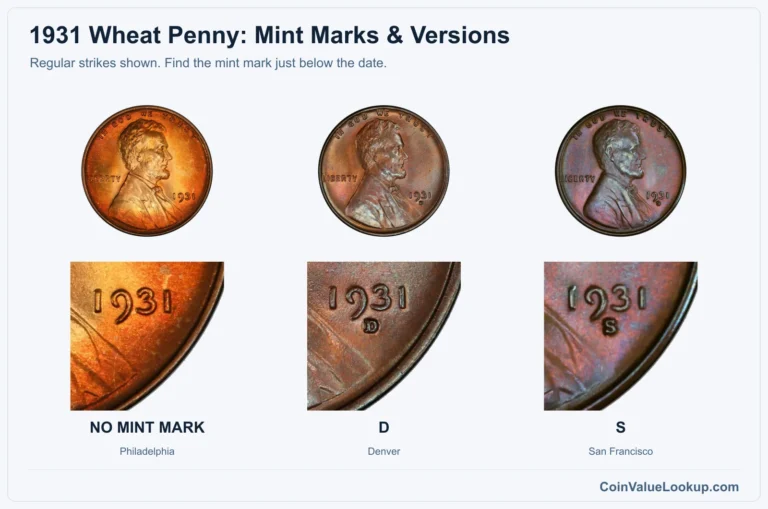
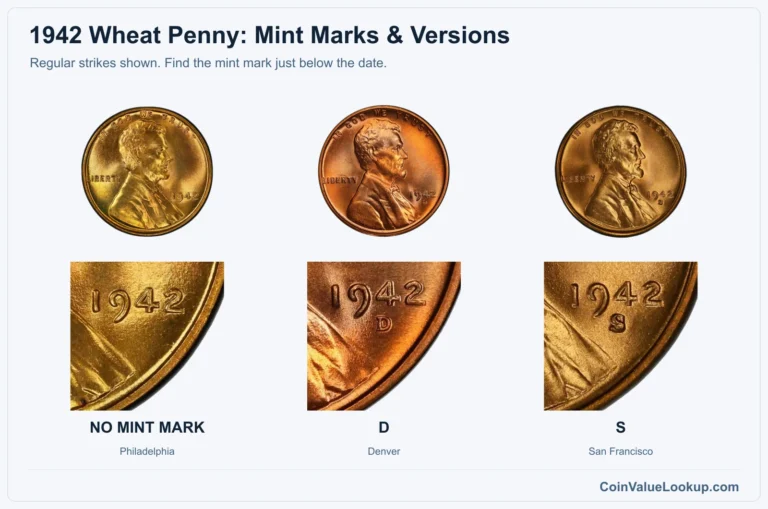
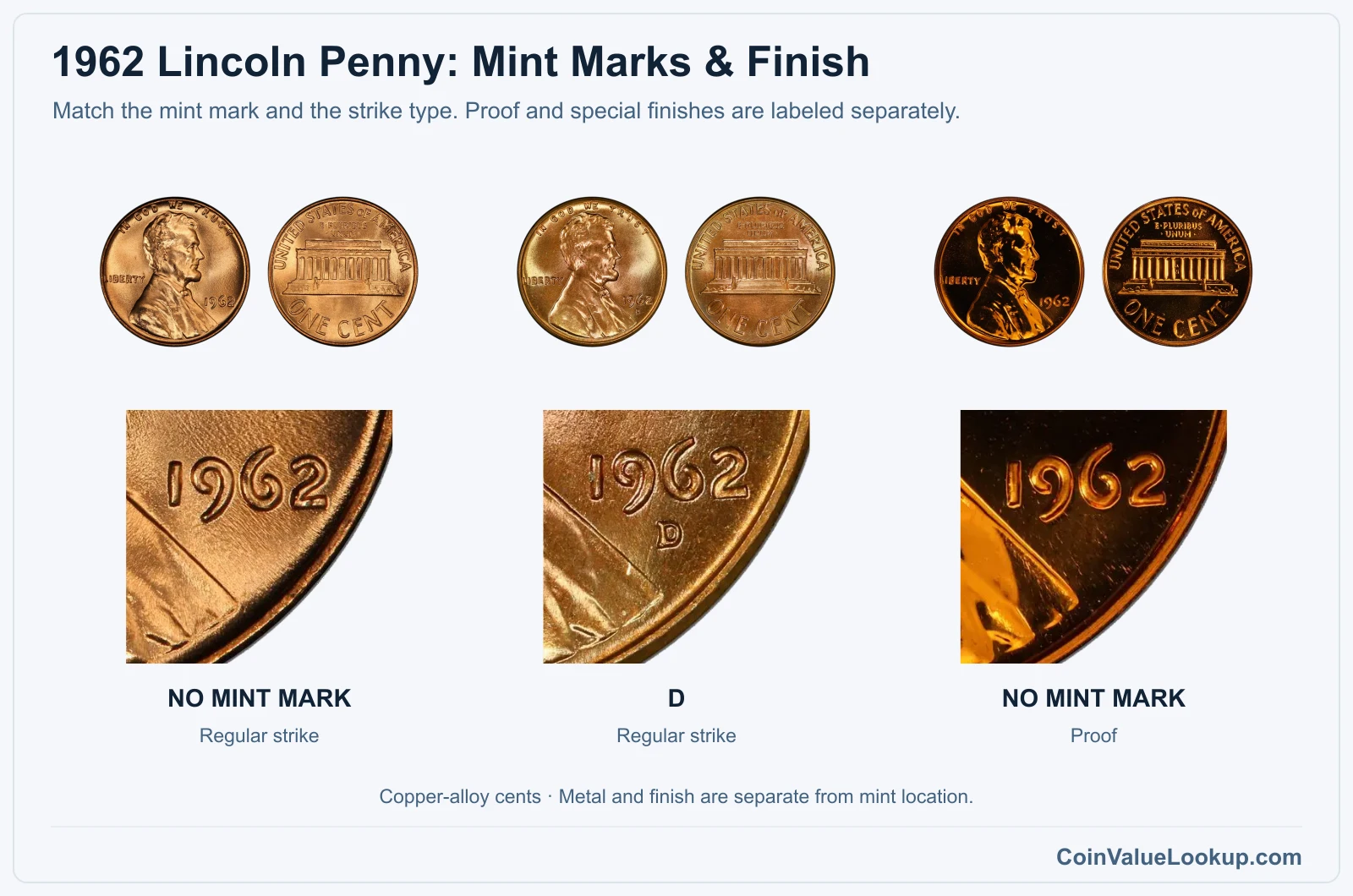
Look below the date on the obverse. No letter means Philadelphia.
A small D means Denver. There is no San Francisco mint mark for regular 1962 cents.
Every 1962 penny is a copper-alloy coin — 95% copper, 5% zinc — with a plain edge and a nominal weight of 3.11 grams. This was the year tin was officially removed from the cent alloy, but that change does not produce a visible difference you can use to sort coins at home without laboratory analysis.
Do not confuse these with the later zinc-core pennies that started in 1982. A 1962 cent is solid copper alloy all the way through.
Separating business strikes from proofs requires looking at the surfaces, not just the shine. Proofs have mirror-like fields and sharply defined rims from specially prepared dies.
A shiny circulated coin is not a proof. Red, Red-Brown, and Brown are color designations that describe how much original copper luster remains — they are not different metals.
Step 2: Check Your 1962 Lincoln Penny Grade
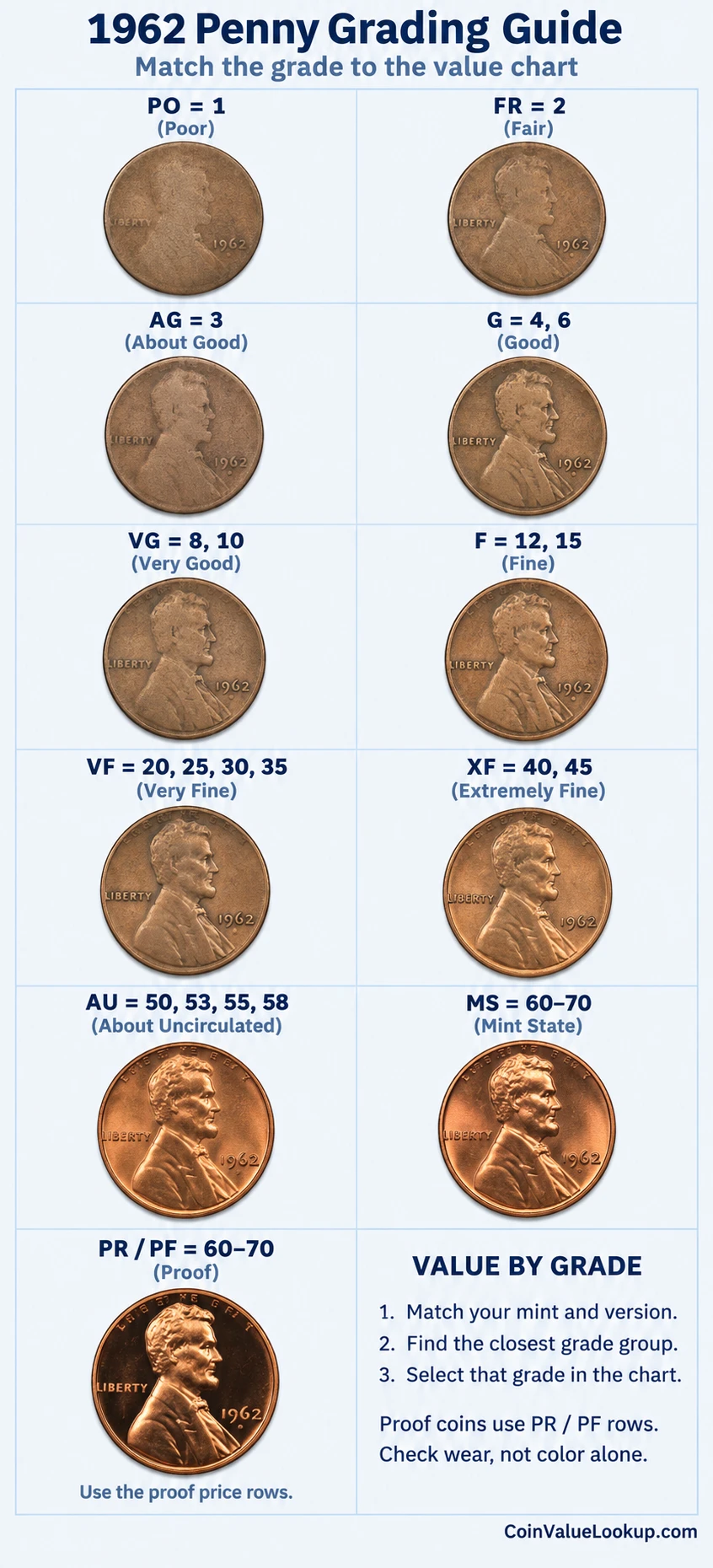
Start on Lincoln's cheek and jawline. These are the highest points and show wear first.
Then check the hair detail above the ear. On the reverse, look at the Memorial roof, the tops of the columns, and the steps at the base.
A coin can be dark and still uncirculated. It can also be shiny and heavily cleaned.
Luster continuity matters more than color when distinguishing AU from MS grades. Compare your coin to the grading image and look for unbroken mint luster across the flat areas.
For proofs, examine the mirror fields for hairlines, spots, or haze. Cameo contrast — where the devices appear frosted against mirror fields — is a separate designation within proof grading.
Coin Value Lookup is a handy place to look up value guides for Lincoln cents and other series when you want a quick reference while sorting your coins.
Step 3: Check 1962 Lincoln Penny Value by Mint and Version
1962 Lincoln Penny — No Mint Mark — Business Strike
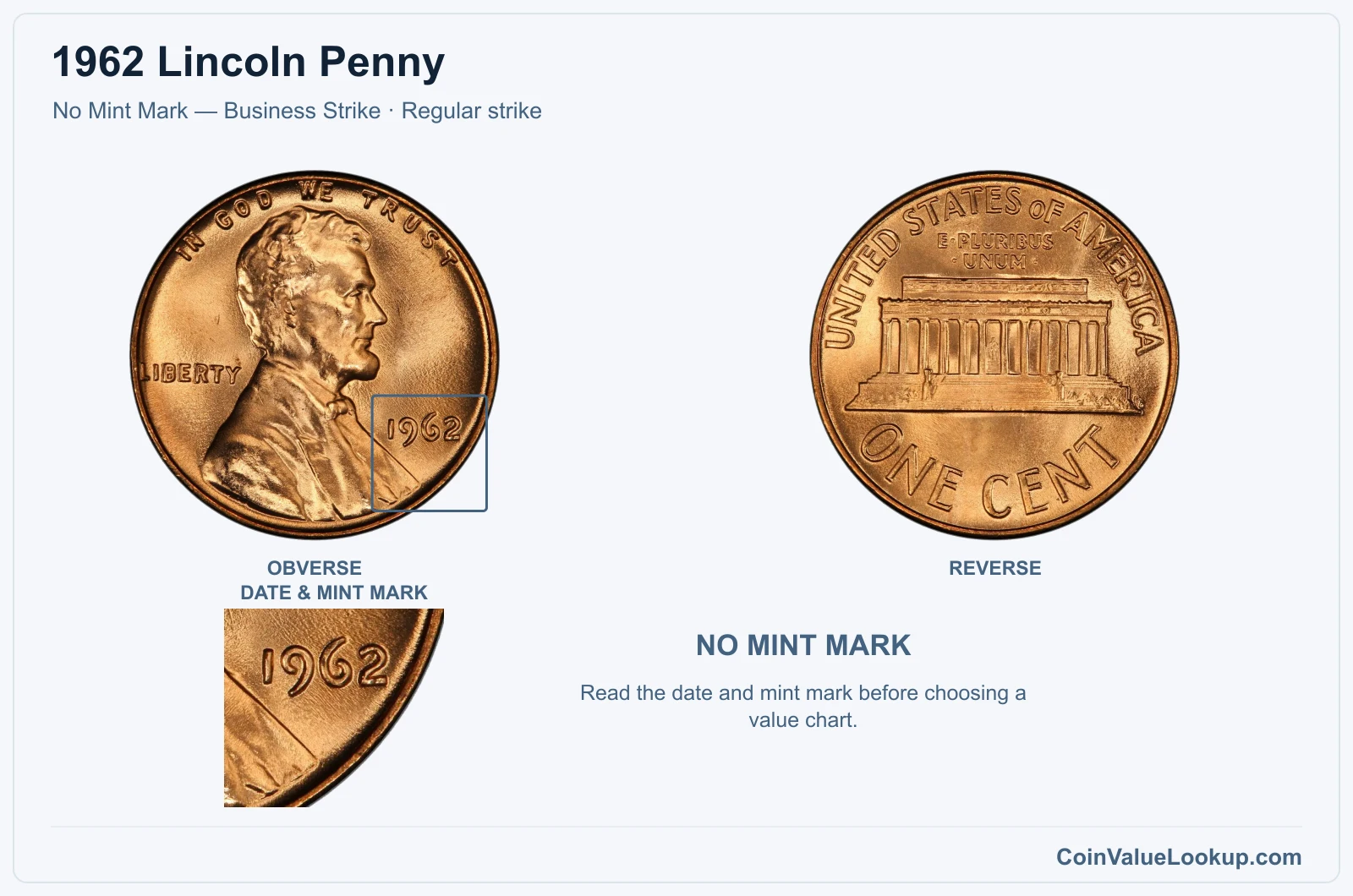
The 1962 no-mint-mark Philadelphia cent is the most common version. It shows Lincoln on the obverse and the Memorial reverse, struck on a 95% copper, 5% zinc planchet weighing about 3.11 grams.
Millions were made and most survivors live in jars and piggy banks.
In circulated grades, these trade at face value. USA Coin Book guide estimates place an MS60 example around $0.18 and an MS65 around $1.24.
Full original Red color at the MS65 level is where the modest premium lives. Cleaned or spotted coins do not qualify for those designations.
Range Grade
Price1962 No Mint Mark — Business Strike (BN) Price1962 No Mint Mark — Business Strike (RB) Price1962 No Mint Mark — Business Strike (RD) Auction Records Appraisal PO PO 1
—
Coin Identifier FR FR 2
—
Coin Identifier AG AG 3
—
Coin Identifier G G 4
—
Coin Identifier
G 6
—
Coin Identifier VG VG 8
—
Coin Identifier
VG 10
—
Coin Identifier F F 12
—
Coin Identifier
F 15
—
Coin Identifier VF VF 20
—
Coin Identifier
VF 25
—
Coin Identifier
VF 30
—
Coin Identifier
VF 35
—
Coin Identifier XF XF 40
—
Coin Identifier
XF 45
—
Coin Identifier AU AU 50
—
Coin Identifier
AU 53
—
Coin Identifier
AU 55
—
Coin Identifier
AU 58
Coin Identifier MS MS 60
—
—
Coin Identifier
MS 61
—
—
Coin Identifier
MS 62
—
Coin Identifier
MS 63
Coin Identifier
MS 64
Coin Identifier
MS 65
—
Coin Identifier
MS 66
Coin Identifier
MS 67
—
Coin Identifier
MS 68
—
—
—
Coin Identifier
MS 69
—
—
—
—
—
MS 70
—
—
—
—
—
1962 Lincoln Penny — D — Business Strike
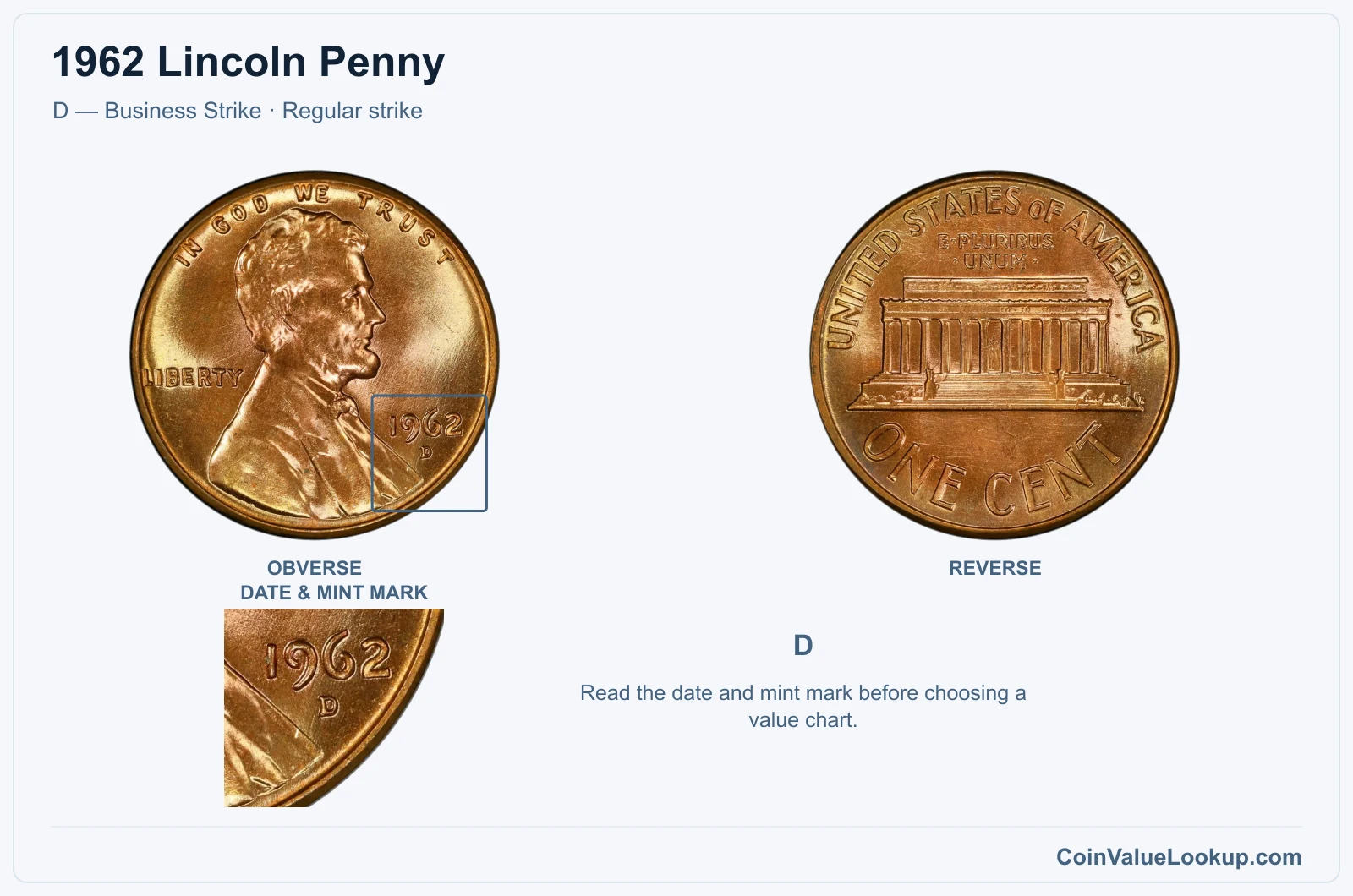
The 1962-D comes from Denver and carries a small D below the date. Same alloy, same weight, same design.
Production was massive, so circulated pieces are worth a cent.
Guide estimates match the Philadelphia issue: roughly $0.18 at MS60 and $1.24 at MS65 per USA Coin Book. When examining your D-mint coin, pay extra attention to the mintmark itself.
Some 1962-D cents show evidence of a repunched mintmark, which is a separate collectible variety. A loupe and patience help here.
Range Grade
Price1962 D — Business Strike (BN) Price1962 D — Business Strike (RB) Price1962 D — Business Strike (RD) Auction Records Appraisal PO PO 1
—
Coin Identifier FR FR 2
—
Coin Identifier AG AG 3
—
Coin Identifier G G 4
—
Coin Identifier
G 6
—
Coin Identifier VG VG 8
—
Coin Identifier
VG 10
—
Coin Identifier F F 12
—
Coin Identifier
F 15
—
Coin Identifier VF VF 20
—
Coin Identifier
VF 25
—
Coin Identifier
VF 30
—
Coin Identifier
VF 35
—
—
Coin Identifier XF XF 40
—
Coin Identifier
XF 45
—
Coin Identifier AU AU 50
—
Coin Identifier
AU 53
—
Coin Identifier
AU 55
Coin Identifier
AU 58
—
Coin Identifier MS MS 60
—
—
Coin Identifier
MS 61
—
—
Coin Identifier
MS 62
—
Coin Identifier
MS 63
Coin Identifier
MS 64
—
Coin Identifier
MS 65
Coin Identifier
MS 66
—
Coin Identifier
MS 67
—
—
Coin Identifier
MS 68
—
—
—
—
—
MS 69
—
—
—
—
—
MS 70
—
—
—
—
—
1962 Lincoln Penny — No Mint Mark — Proof
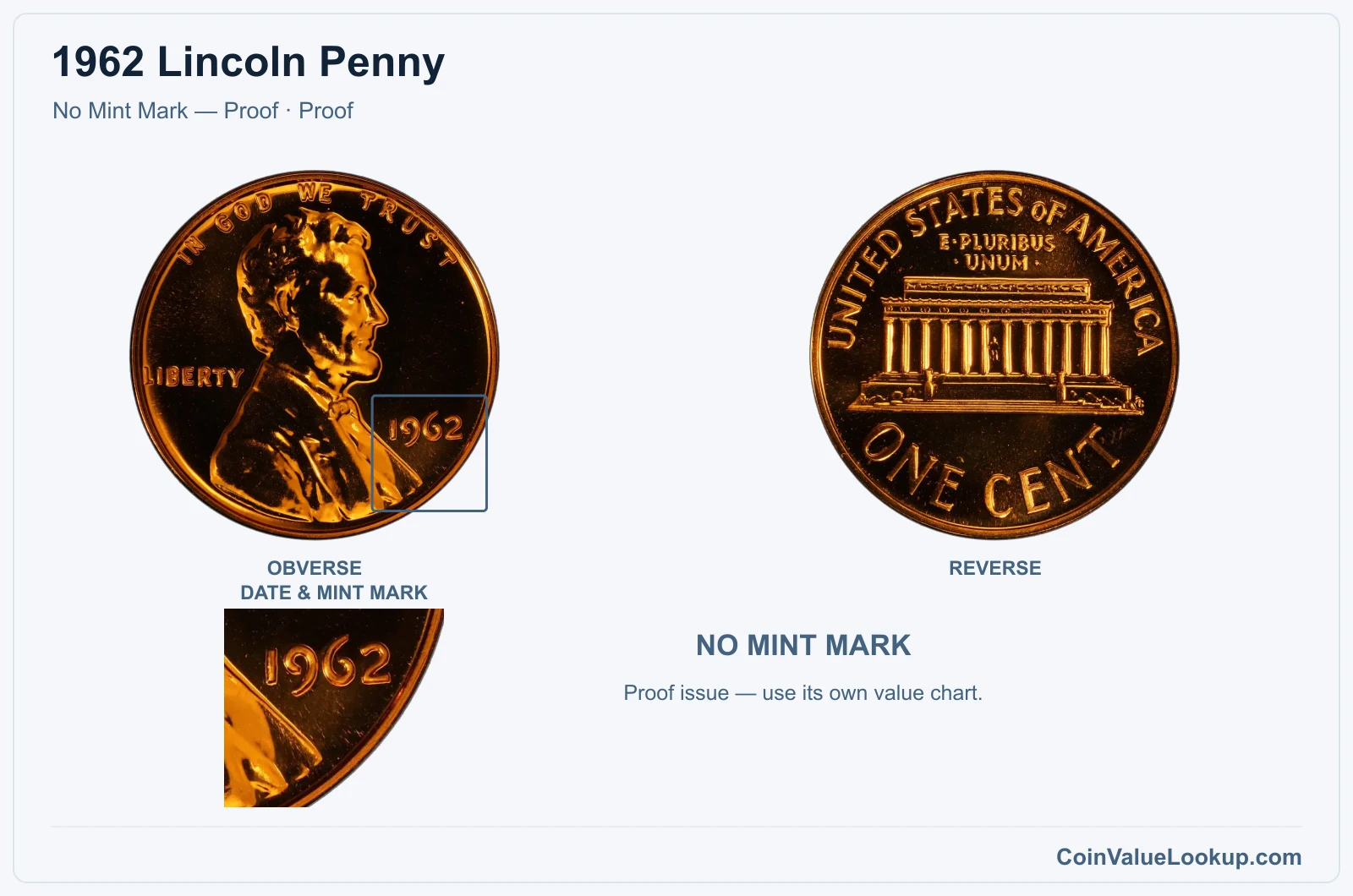
Philadelphia also struck proof cents in 1962 for collector sets. These have no mint mark, just like the business strikes, so you identify them by their mirror fields, sharp rims, and documented provenance from a proof set.
USA Coin Book places a PR65 around $1.88. That is a baseline; cameo contrast and full Red color push values higher within the proof category.
Impaired proofs with fingerprints, haze, or heavy hairlines should not be compared directly to problem-free guide grades.
The reverse of proof 1962 cents deserves extra scrutiny. A recognized doubled-die reverse variety exists, and confirmed examples have sold well into four figures.
Check the reverse inscriptions with magnification before you set any proof aside as ordinary.
Range Grade
Price1962 No Mint Mark — Proof (CAM) Price1962 No Mint Mark — Proof (DCAM) Auction Records Appraisal PR PR 1
—
Coin Identifier
PR 2
—
Coin Identifier
PR 3
—
Coin Identifier
PR 4
—
Coin Identifier
PR 6
—
Coin Identifier
PR 8
—
Coin Identifier
PR 10
—
Coin Identifier
PR 12
—
Coin Identifier
PR 15
—
Coin Identifier
PR 20
—
Coin Identifier
PR 25
—
Coin Identifier
PR 30
—
Coin Identifier
PR 35
—
Coin Identifier
PR 40
—
Coin Identifier
PR 45
—
Coin Identifier
PR 50
—
Coin Identifier
PR 53
—
Coin Identifier
PR 55
—
Coin Identifier
PR 58
—
Coin Identifier
PR 60
—
Coin Identifier
PR 61
—
Coin Identifier
PR 62
—
Coin Identifier
PR 63
—
Coin Identifier
PR 64
Coin Identifier
PR 65
Coin Identifier
PR 66
Coin Identifier
PR 67
Coin Identifier
PR 68
Coin Identifier
PR 69
Coin Identifier
PR 70
—
—
—
—
1962 Lincoln Penny Error List
1. 1962 Lincoln Penny — Proof Doubled Die Reverse
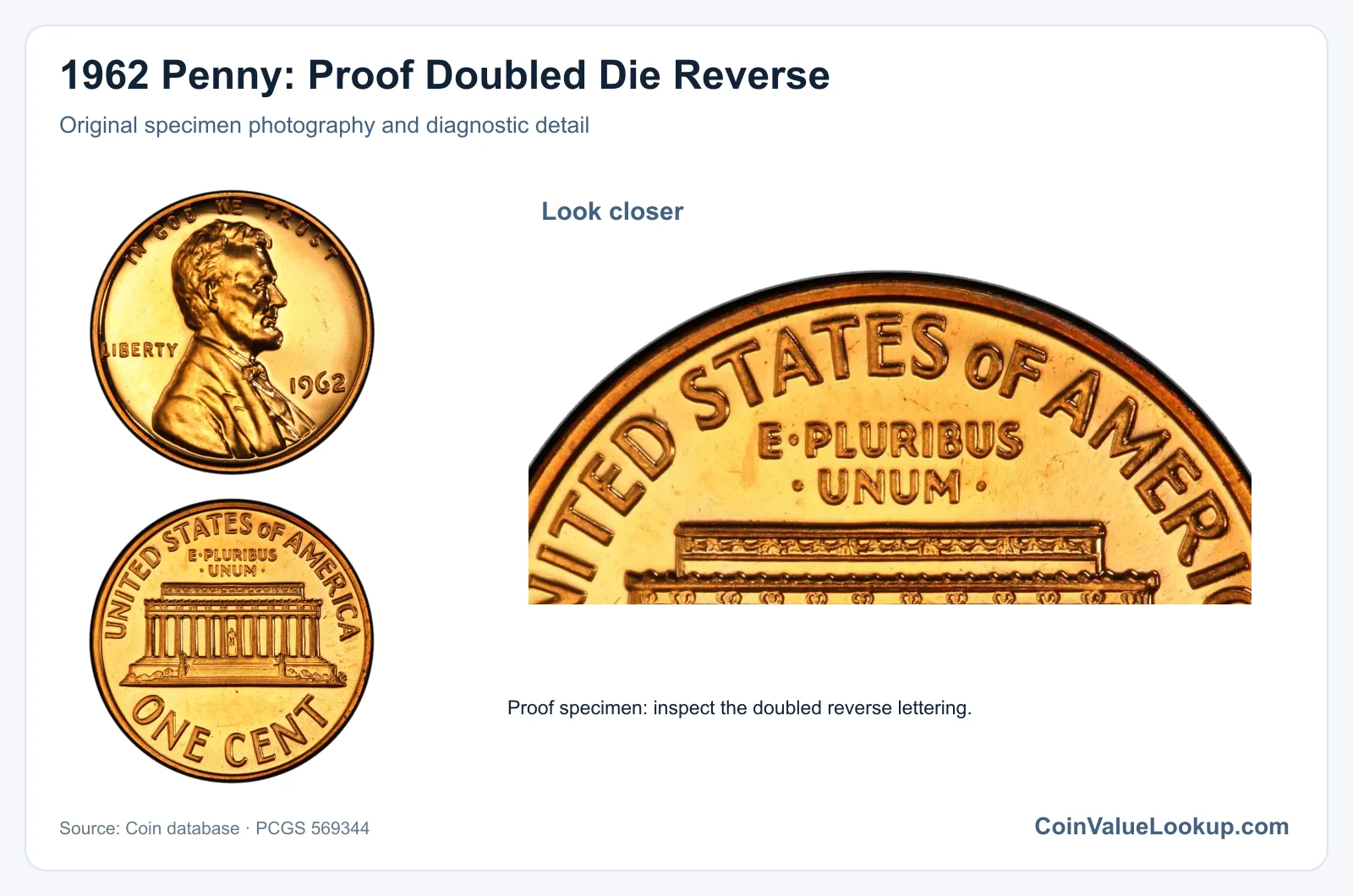
This is a recognized doubled-die reverse found on 1962 proof cents. Under magnification, the reverse lettering — particularly around UNITED STATES OF AMERICA and ONE CENT — shows split serifs or notched contours that repeat consistently across the inscription.
This is a die variety, not random distortion.
Verify proof finish first: mirror fields, squared rims, no luster flow lines. Then compare the reverse letter edges to a normal proof at the same magnification.
True hub doubling produces separated, raised contours; machine doubling, by contrast, leaves flat shelf-like distortion that looks smeared rather than sharply split.
A PCGS PR67 Red example was reported at $2,200 from David Lawrence in November 2022. That is a single recorded result at a high grade, not a broad market range.
2. 1962 Lincoln Penny — Struck on a Silver Dime Planchet
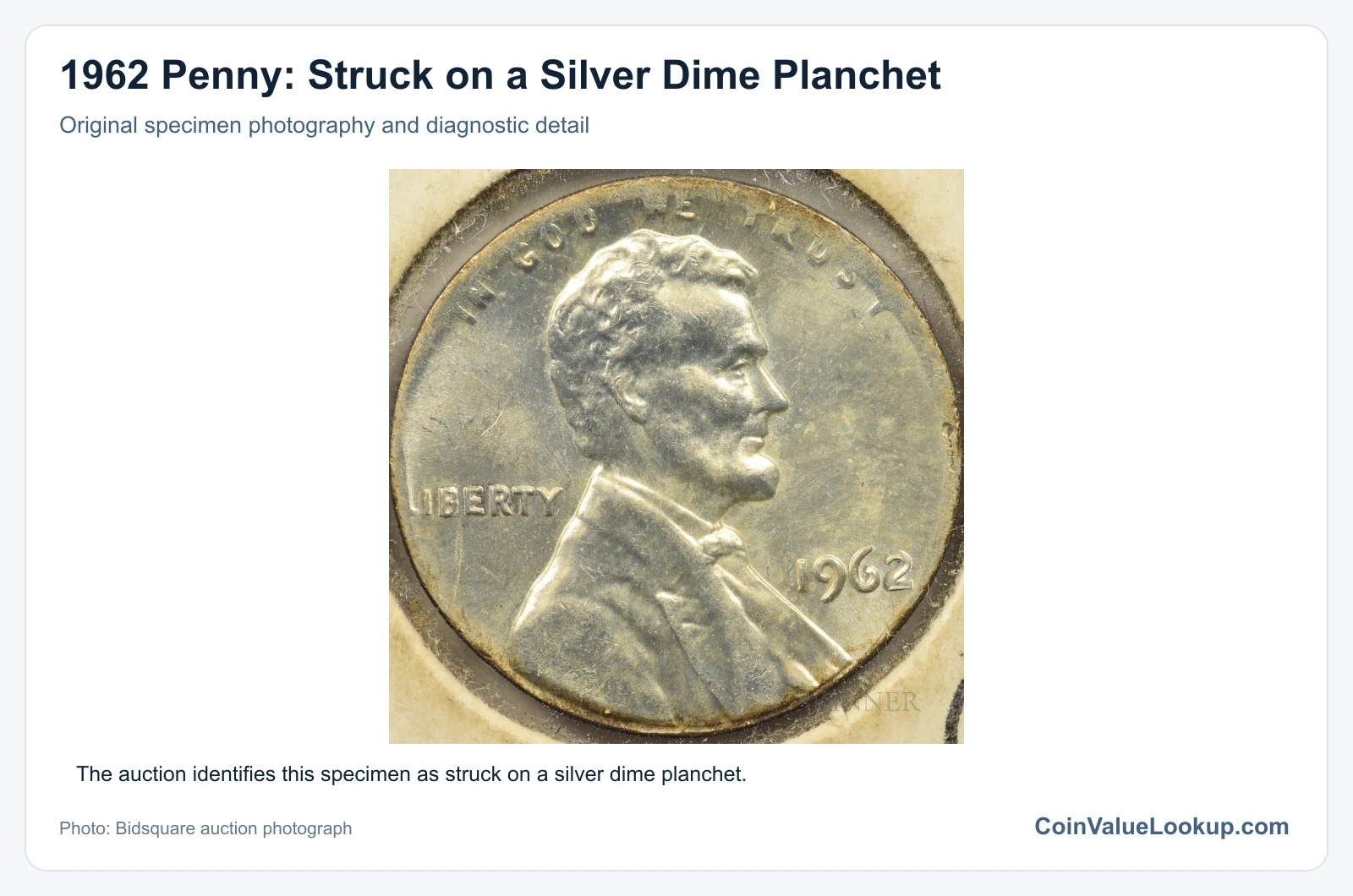
A 1962 Philadelphia cent struck on a silver dime planchet is a wrong-planchet error. The blank was 90% silver, smaller in diameter than a normal cent planchet, and lighter.
The result is a coin with a full Lincoln design that looks squeezed and slightly undersized, often with weak detail toward the center and stretched lettering at the periphery.
Weight is your first clue: a silver dime blank weighs about 2.5 grams versus 3.11 grams for a normal cent. Color will also appear distinctly silver-white, not copper.
Do not confuse this with a copper cent that someone silver-plated after the fact. Plating sits on the surface and often shows bubbling or uneven edges.
A PCGS MS63 example sold for $1,110 in May 2022, but that is a single documented sale, not a price guarantee.
3. 1962 Lincoln Penny — Double Strike, Second Strike Off Center
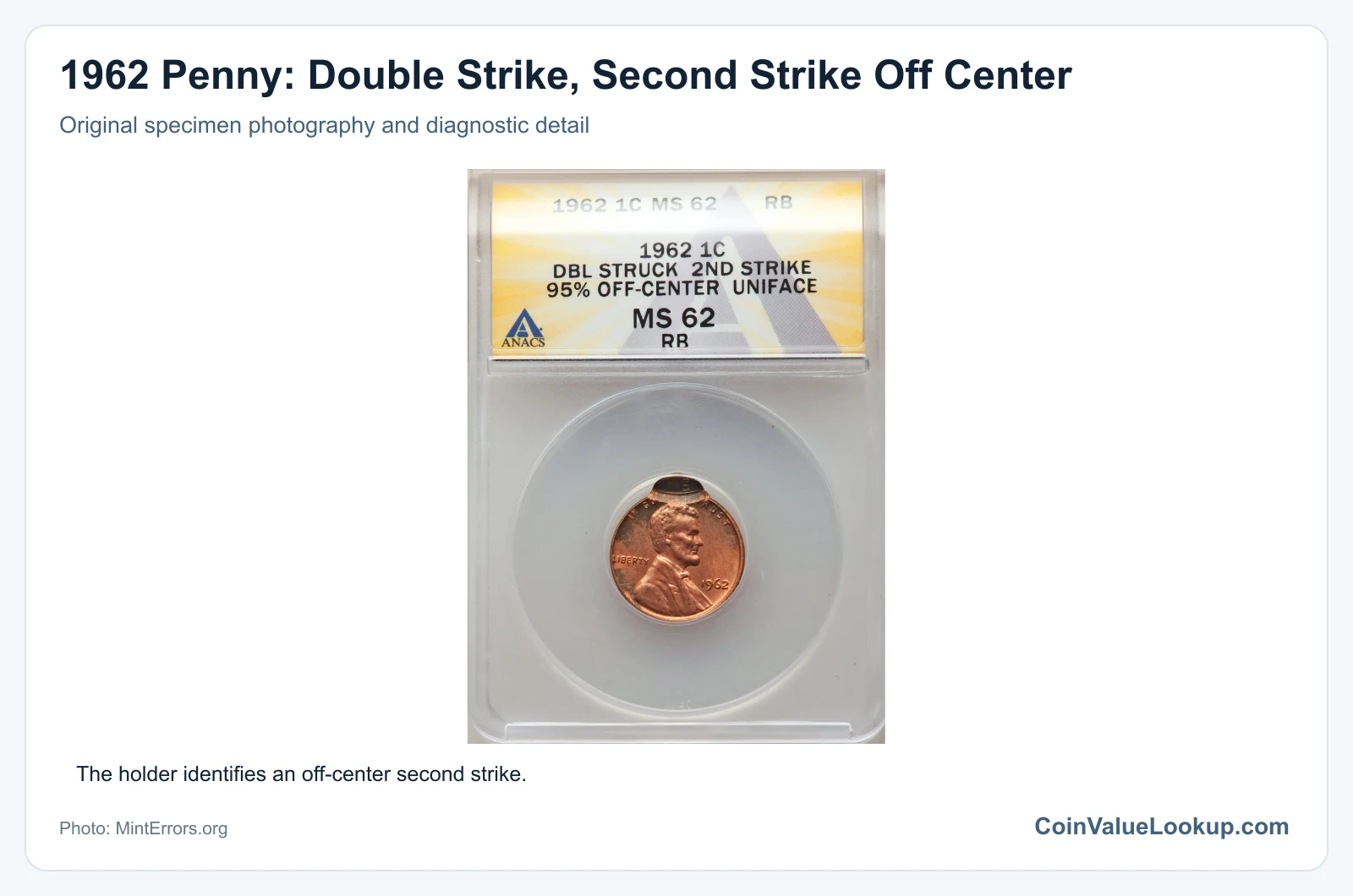
A double-struck 1962 cent carries two impressions from the dies, with the second strike landing dramatically off center — reported at about 95% off center in one documented example. You will see a normal first strike with full design, plus a small crescent or sliver of displaced design at the coin's edge from the second hit.
This is not the same as a doubled die, which involves a single strike from a doubled die. A double strike physically moves the planchet between impacts.
Post-mint rim damage or vice marks can mimic the displaced look, but a genuine double strike shows die-struck detail in the second impression, not flat crushing.
An ANACS MS62 Red-Brown example sold for $99 in January 2022. Value depends on the severity and visual appeal of the second strike as well as the coin's overall condition.
4. 1962 Lincoln Penny — Clamshell Lamination
A clamshell lamination on a 1962-D cent occurs when a poorly bonded layer of the copper alloy separates and opens like a hinged shell. The flap remains partially attached, revealing raw metal underneath.
This is a planchet defect that happened before or during striking.
Look at the edge where the flap meets the coin's surface. A genuine lamination has a smooth, natural separation line that follows the metal's internal structure.
Deliberate cuts, corrosion pits, or post-mint gouges leave sharper, more irregular boundaries.
Do not bend the flap to test it — that damages the coin. The value of a lamination error depends on its size, visibility, and whether the coin is otherwise well-preserved.
Authentication by a grading service helps establish the error's legitimacy for any potential buyer.
5. 1962 Lincoln Penny — Repunched Mintmark
Some 1962-D cents display a repunched mintmark, where the D was impressed into the die more than once in slightly different positions. Under magnification, you will see traces of a second D peeking out from behind or beside the primary mintmark — sometimes as a notch, sometimes as a clear secondary outline.
Compare the mintmark area at 10x or higher to a known normal 1962-D. Machine doubling around the mintmark looks flat and shelf-like, while a true repunched mintmark shows raised, separately defined remnants of the earlier punch.
Die chips or corrosion near the mintmark can also mimic an extra impression, so clean optics and a reference image matter. Value depends on the visibility of the repunching, the specific variety, and the coin's overall grade.
6. 1962 Lincoln Penny — Die Break / Cud
A die break or cud on a 1962-D cent results from a chunk of the die breaking away. When that broken section connects to the rim, it leaves a raised, featureless blob of metal on the finished coin — that is a cud.
Interior die breaks that do not reach the rim appear as raised irregular lines across the design.
To confirm, look for a smooth raised area that displaces part of the normal design and connects cleanly to the rim edge. A rim dent goes inward; a cud pushes outward.
Corrosion creates pitting, not a smooth raised plateau.
The size and location of the break determine collector interest. A large cud that obliterates a recognizable design element draws more attention than a tiny rim cud.
Value varies with severity and the coin's condition, so authentication is recommended for any significant example.