1964 Lincoln Penny Coin Value: How Much Is It Worth?
Most 1964 Lincoln pennies you find in jars and rolls are worth a modest premium at best. A USA Coin Book guide estimate places an ordinary uncirculated example at about $1.24 in MS65 grade.
The real excitement comes from authenticated errors, preserved original copper color, and the exceptionally rare attributed special strike, which is a completely separate branch from normal business and proof issues.
Fast Way to Identify Your 1964 Lincoln Penny
Snap a clear photo of both sides of your 1964 penny and upload them here for a preliminary identification. This can help you figure out which version you have — Philadelphia, Denver, proof, or something unusual — and whether it is worth a closer look.
It is not a substitute for professional grading or authentication, but it is a solid starting point.
1964 Penny Value
Upload both sides of your 1964 Lincoln Penny.
Front Obverse
Upload photo
Back Reverse
Upload photo
Which 1964 Lincoln Penny Versions Are Worth Money?
- The attributed 1964 special strike is an exceptional rarity, with a PCGS SP65 Red-Brown example recorded at $9,000 in April 2019.
- Authenticated mint errors such as wrong-planchet strikes, severe clips and dramatic off-center or double strikes can carry significant premiums over ordinary examples.
Step 1: Identify Your 1964 Lincoln Penny Mint Mark and Version
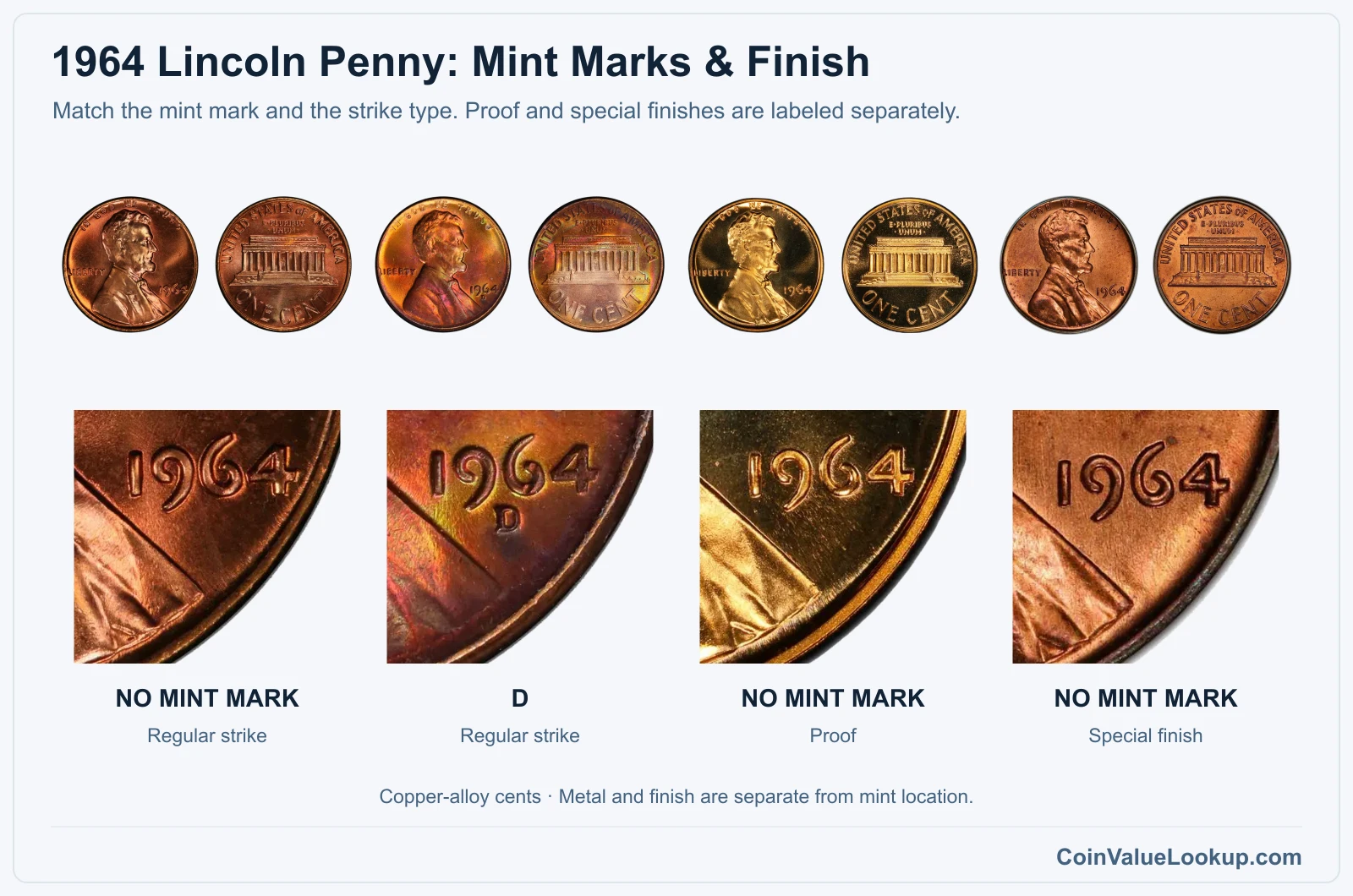
The 1964 Lincoln cent carries the Lincoln portrait on the obverse and the Lincoln Memorial on the reverse. The alloy is 95% copper and 5% zinc, with a nominal weight of 3.11 grams and a plain edge.
These are not the copper-plated zinc cents that came later.
Look below the date for a mintmark. No letter means Philadelphia.
A small "D" means Denver. Proofs also carry no mintmark and were struck at Philadelphia, so you need to evaluate the finish, not just the absence of a letter.
Copper color designations — Red (RD), Red-Brown (RB) and Brown (BN) — describe how much original copper luster survives. They are not different metals or automatic grade bumps.
A dark brown penny can still be uncirculated, and a bright shiny one may have been cleaned.
The rare 1964 special strike (sometimes called SMS) is an attributed specimen issue that requires specialist certification or documented provenance. A satin-looking surface alone does not confirm it.
Altered, plated or chemically cleaned coins are not errors either — check carefully before jumping to conclusions.
Step 2: Check Your 1964 Lincoln Penny Grade
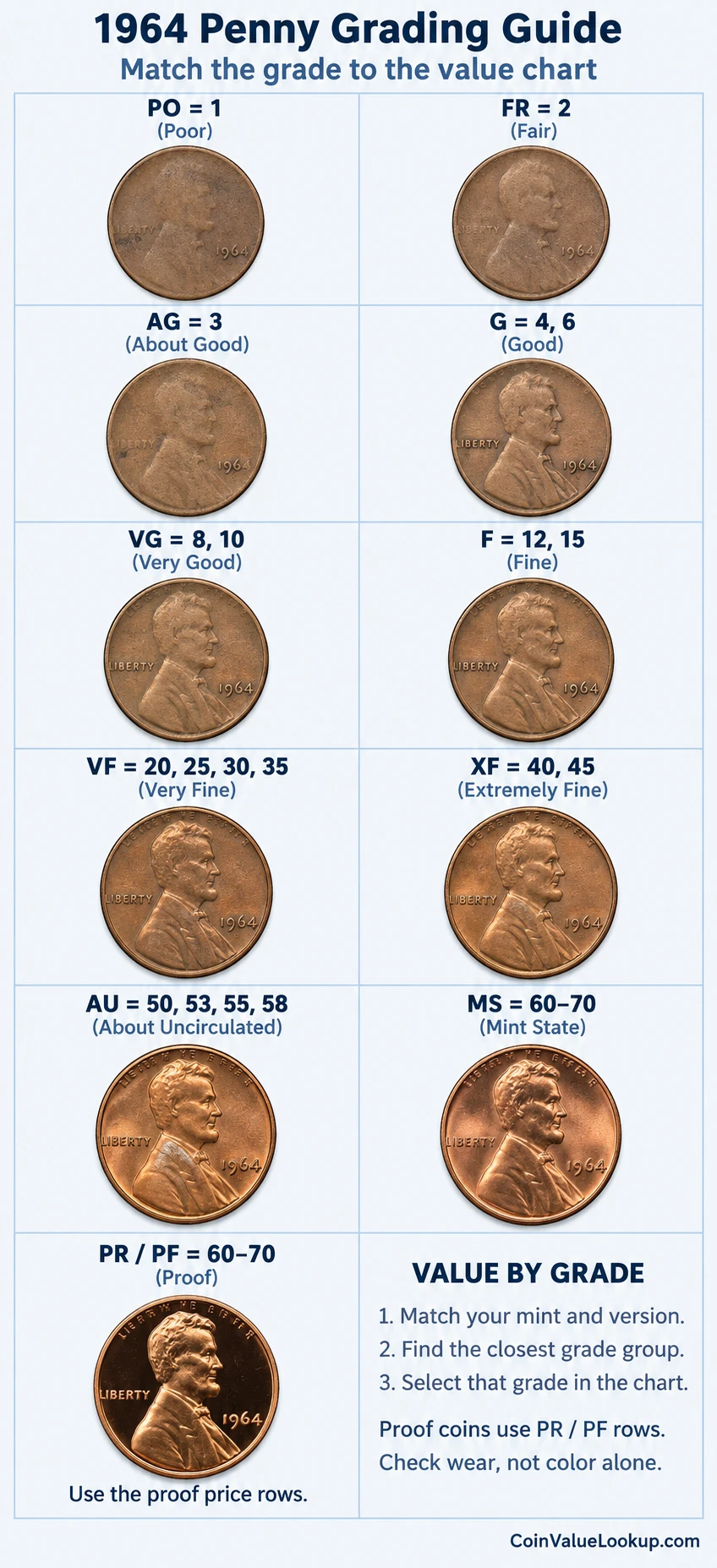
Start on the obverse. Lincoln's cheek, jawline and the hair detail above his ear are the first places to lose sharpness.
On the reverse, check the roof of the Memorial and the tops of the columns.
Separate contact marks from actual wear. A coin can have bag marks from jostling at the mint and still be uncirculated if the original luster remains unbroken across the high points.
Dark toned copper does not mean circulated.
Bright, unnaturally uniform copper often signals cleaning, which hurts value. Compare your coin against the reference image to gauge where it falls on the wear scale.
Proof finish and copper-color designation are separate factors from the numerical grade. A PR65 Red coin and a PR65 Brown coin are the same grade but different prices, so match all three filters — grade, finish and color — when checking values.
Step 3: Check 1964 Lincoln Penny Value by Mint and Version
1964 Lincoln Penny — No Mint Mark — Business
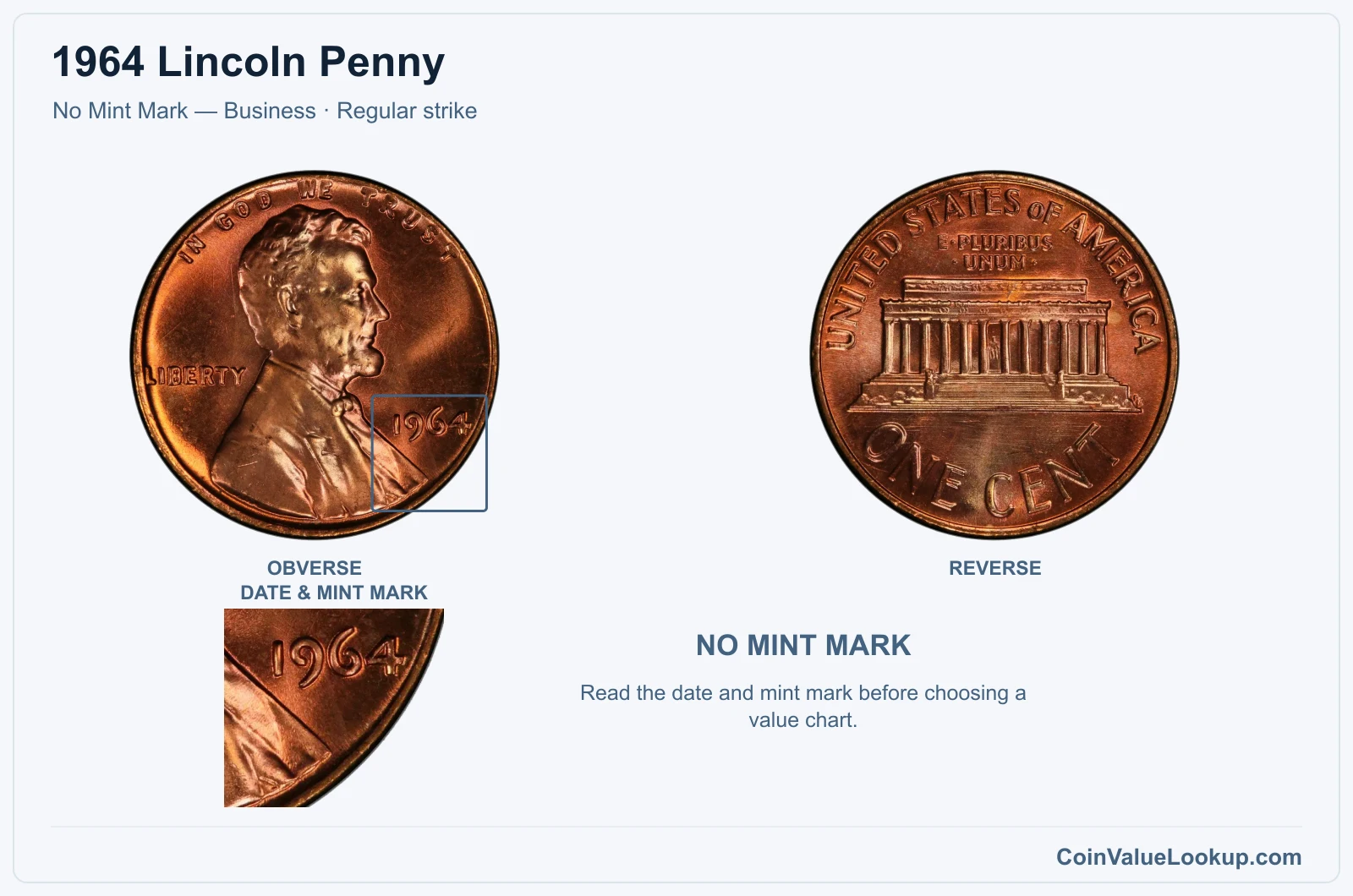
The 1964 no-mintmark Philadelphia business strike is the bread-and-butter issue of this date. Billions were made, so condition and original color are everything.
A USA Coin Book guide estimate puts MS65 at about $1.24. Match your coin's copper-color designation — BN, RB or RD — before comparing prices, because original red examples command more than toned brown ones at the same grade.
Range Grade
Price1964 No Mint Mark — Business (BN) Price1964 No Mint Mark — Business (RB) Price1964 No Mint Mark — Business (RD) Auction Records Appraisal PO PO 1
—
Coin Identifier FR FR 2
—
Coin Identifier AG AG 3
—
Coin Identifier G G 4
—
Coin Identifier
G 6
—
Coin Identifier VG VG 8
—
Coin Identifier
VG 10
—
Coin Identifier F F 12
—
Coin Identifier
F 15
—
Coin Identifier VF VF 20
—
Coin Identifier
VF 25
—
Coin Identifier
VF 30
—
Coin Identifier
VF 35
—
Coin Identifier XF XF 40
—
Coin Identifier
XF 45
—
Coin Identifier AU AU 50
—
Coin Identifier
AU 53
—
Coin Identifier
AU 55
—
Coin Identifier
AU 58
—
Coin Identifier MS MS 60
—
Coin Identifier
MS 61
—
Coin Identifier
MS 62
—
Coin Identifier
MS 63
—
Coin Identifier
MS 64
Coin Identifier
MS 65
Coin Identifier
MS 66
Coin Identifier
MS 67
—
—
Coin Identifier
MS 68
—
—
—
—
—
MS 69
—
—
—
—
—
MS 70
—
—
—
—
—
1964 Lincoln Penny — D — Business
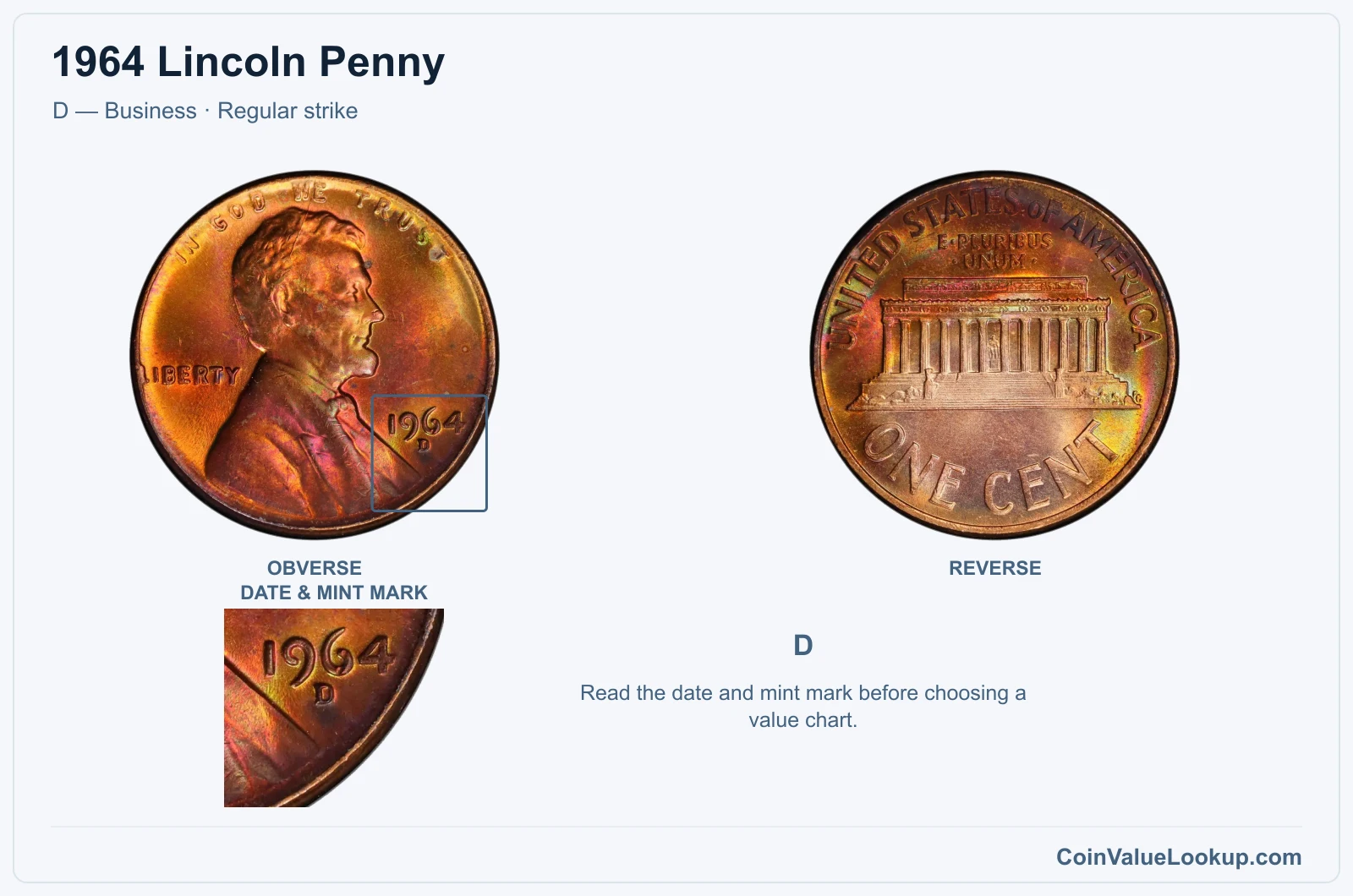
Denver's 1964-D is just as common as its Philadelphia sibling. Look for the small "D" below the date to confirm.
The USA Coin Book guide estimate is also $1.24 at MS65. Same rules apply: grade plus color designation together determine value.
A nice full-red uncirculated 1964-D is a pleasant coin, but it is not rare.
Coin Value Lookup is a handy place to check guides for other dates and denominations in the Lincoln cent series if you are building a set.
Range Grade
Price1964 D — Business (BN) Price1964 D — Business (RB) Price1964 D — Business (RD) Auction Records Appraisal PO PO 1
—
Coin Identifier FR FR 2
—
Coin Identifier AG AG 3
—
Coin Identifier G G 4
—
Coin Identifier
G 6
—
Coin Identifier VG VG 8
—
Coin Identifier
VG 10
—
Coin Identifier F F 12
—
Coin Identifier
F 15
—
Coin Identifier VF VF 20
—
Coin Identifier
VF 25
—
Coin Identifier
VF 30
—
Coin Identifier
VF 35
—
Coin Identifier XF XF 40
—
Coin Identifier
XF 45
—
Coin Identifier AU AU 50
—
Coin Identifier
AU 53
—
Coin Identifier
AU 55
—
Coin Identifier
AU 58
—
Coin Identifier MS MS 60
—
—
Coin Identifier
MS 61
—
—
Coin Identifier
MS 62
—
Coin Identifier
MS 63
Coin Identifier
MS 64
Coin Identifier
MS 65
Coin Identifier
MS 66
—
—
Coin Identifier
MS 67
—
—
Coin Identifier
MS 68
—
—
—
—
—
MS 69
—
—
—
—
—
MS 70
—
—
—
—
—
1964 Lincoln Penny — No Mint Mark — Proof
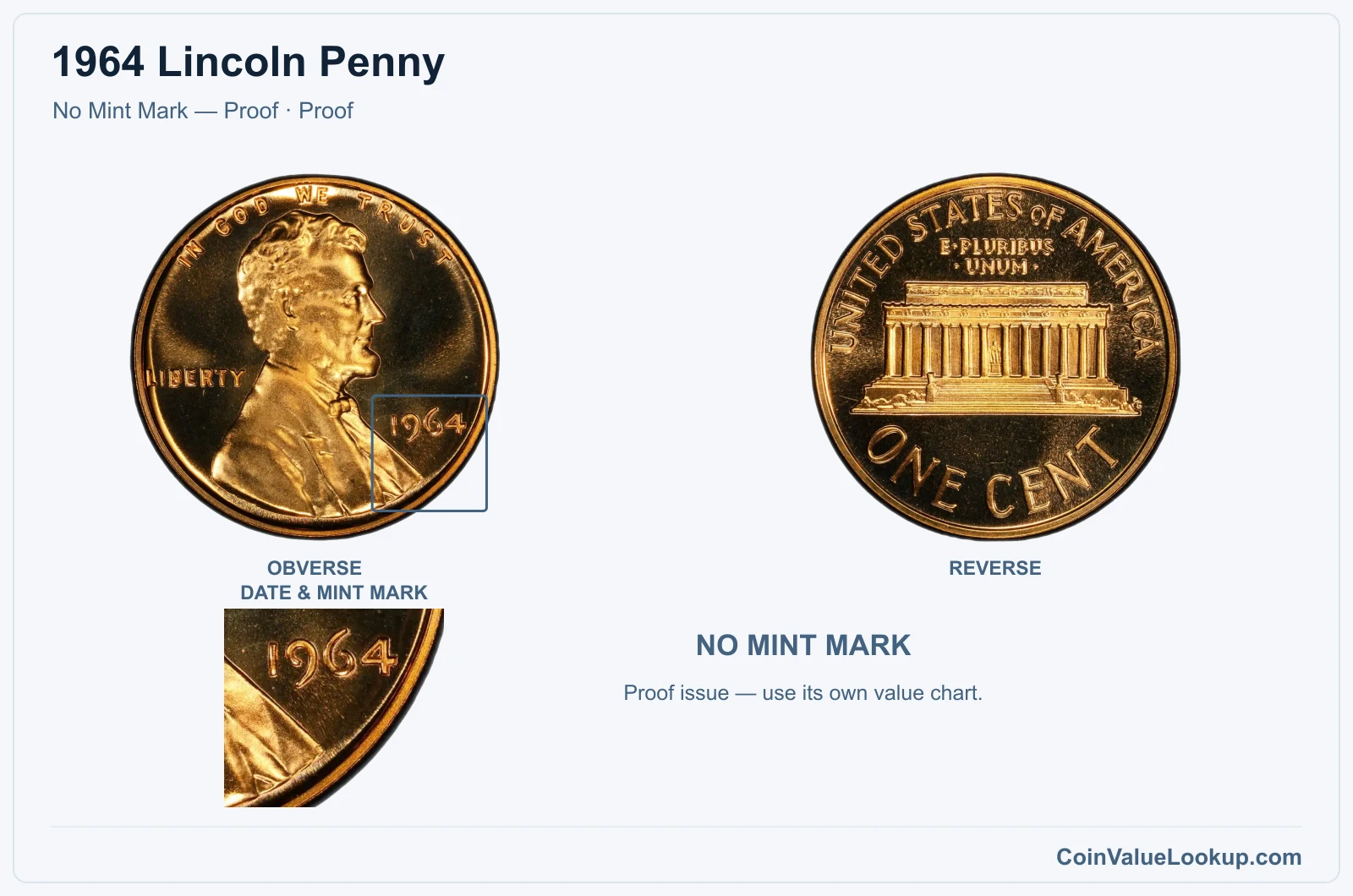
Philadelphia struck proof 1964 Lincoln cents for collectors, and they carry no mintmark. A USA Coin Book guide estimate for PR65 is $1.88.
Proofs have mirrored fields and sharp design details from specially prepared dies. Look for hairlines on those mirror surfaces — they materially reduce value.
Cameo contrast and copper-color designation are separate price factors. A proof is a manufacturing finish, not a grade above Mint State.
Range Grade
Price1964 No Mint Mark — Proof (CAM) Price1964 No Mint Mark — Proof (DCAM) Auction Records Appraisal PR PR 1
—
Coin Identifier
PR 2
—
Coin Identifier
PR 3
—
Coin Identifier
PR 4
—
Coin Identifier
PR 6
—
Coin Identifier
PR 8
—
Coin Identifier
PR 10
—
Coin Identifier
PR 12
—
Coin Identifier
PR 15
—
Coin Identifier
PR 20
—
Coin Identifier
PR 25
—
Coin Identifier
PR 30
—
Coin Identifier
PR 35
—
Coin Identifier
PR 40
—
Coin Identifier
PR 45
—
Coin Identifier
PR 50
—
Coin Identifier
PR 53
—
Coin Identifier
PR 55
—
Coin Identifier
PR 58
—
Coin Identifier
PR 60
—
Coin Identifier
PR 61
—
Coin Identifier
PR 62
—
Coin Identifier
PR 63
—
Coin Identifier
PR 64
—
Coin Identifier
PR 65
Coin Identifier
PR 66
Coin Identifier
PR 67
Coin Identifier
PR 68
Coin Identifier
PR 69
Coin Identifier
PR 70
—
—
Coin Identifier
1964 Lincoln Penny — Rare Special Strike (SMS)
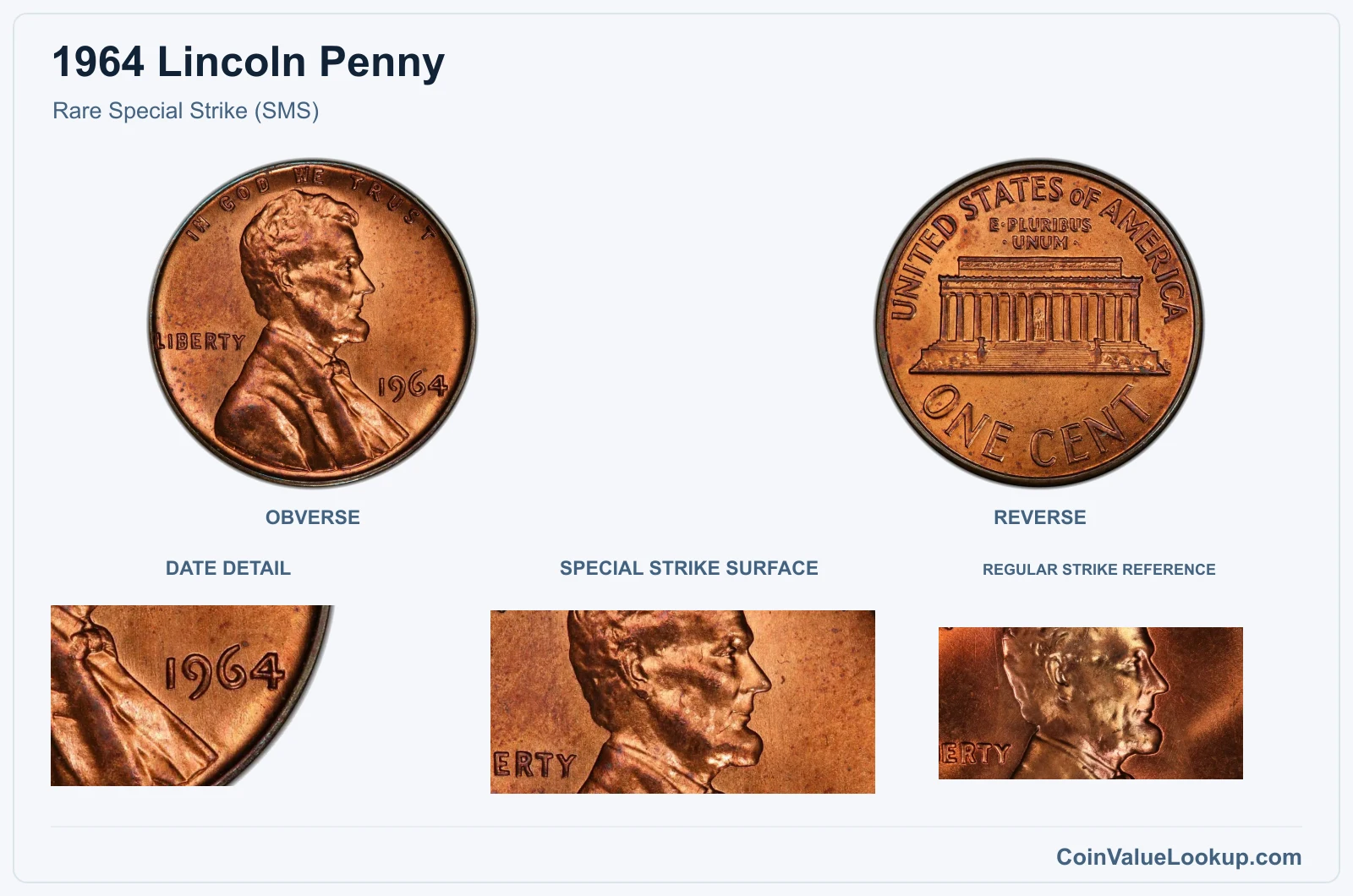
This is the one that gets people excited, and rightly so. The attributed 1964 special strike is not part of the standard SMS sets that began in 1965.
It is an exceptional specimen issue that predates that public program. PCGS recorded an SP65 Red-Brown example at $9,000 in April 2019 — a single historical sale, not a guaranteed market price.
Authentication and provenance are required. A coin that merely looks satiny or unusual does not qualify.
If you think you have one, professional certification from a major grading service is the only path to confirming it. Do not rely on surface appearance alone.
Range Grade
Price Auction Records Appraisal SP SP 1
—
Coin Identifier
SP 2
—
Coin Identifier
SP 3
—
Coin Identifier
SP 4
—
Coin Identifier
SP 6
—
Coin Identifier
SP 8
—
Coin Identifier
SP 10
—
Coin Identifier
SP 12
—
Coin Identifier
SP 15
—
Coin Identifier
SP 20
—
Coin Identifier
SP 25
—
Coin Identifier
SP 30
—
Coin Identifier
SP 35
—
Coin Identifier
SP 40
—
Coin Identifier
SP 45
—
Coin Identifier
SP 50
—
Coin Identifier
SP 53
—
Coin Identifier
SP 55
—
Coin Identifier
SP 58
—
Coin Identifier
SP 60
—
Coin Identifier
SP 61
—
Coin Identifier
SP 62
—
Coin Identifier
SP 63
—
Coin Identifier
SP 64
Coin Identifier
SP 65
Coin Identifier
SP 66
Coin Identifier
SP 67
Coin Identifier
SP 68
—
Coin Identifier
SP 69
—
—
—
SP 70
—
—
—
1964 Lincoln Penny Error List
1. 1964 Lincoln Penny — Double Strike after Broadstrike
This error involves a 1964 no-mintmark cent that was first struck as a broadstrike — meaning it spread beyond the collar — and then received a second strike approximately 99% off center. The result is an expanded first impression with a tiny sliver of a secondary design at the edge.
To identify it, look for the full but slightly oversized first strike plus a small crescent of displaced design near the rim. Show both the whole coin and a close-up of the rim area where the second strike landed.
Do not confuse this with a doubled die, which affects every coin from that die pair identically. A double strike is a feeding error unique to one coin.
A PCGS MS61 Red example sold for $219.60 in March 2026.
2. 1964 Lincoln Penny — Bowtie Clipped Planchet
A bowtie clip happens when two large curved portions of the planchet are missing before striking, leaving a shape that resembles a bowtie. The reported 1964-D example weighed only 0.53 grams — a fraction of the normal 3.11 grams — yet it still received a full strike on whatever metal remained.
Look for two symmetrical curved absences with original mint-produced edge flow where the clip occurred. The struck design, date and D mintmark should be at least partially visible on what is left.
This is not a coin someone trimmed with scissors. Cut or filed cents leave tool marks and straight or irregular edges.
An NGC MS63 Red-Brown example sold for $660 in April 2020, reflecting how dramatic and scarce this type of clip is.
3. 1964 Lincoln Penny — Struck on a Silver Dime Blank
A 1964 no-mintmark Lincoln cent struck on a silver dime planchet is a wrong-planchet error — the cent dies impressed a blank intended for a dime. The coin will be noticeably smaller and lighter than a normal cent, and the metal will be silver rather than copper.
Identification requires measured dimensions, alloy testing and attributed certification. Color alone is not sufficient because plated normal cents can mimic a silver appearance.
A PCGS MS62 example has been documented, but no supported price range is adopted here. Value depends on authenticated identity, condition and the severity of the error, so individual professional assessment is the way to go.
4. 1964 Lincoln Penny — Doubled Die Obverse
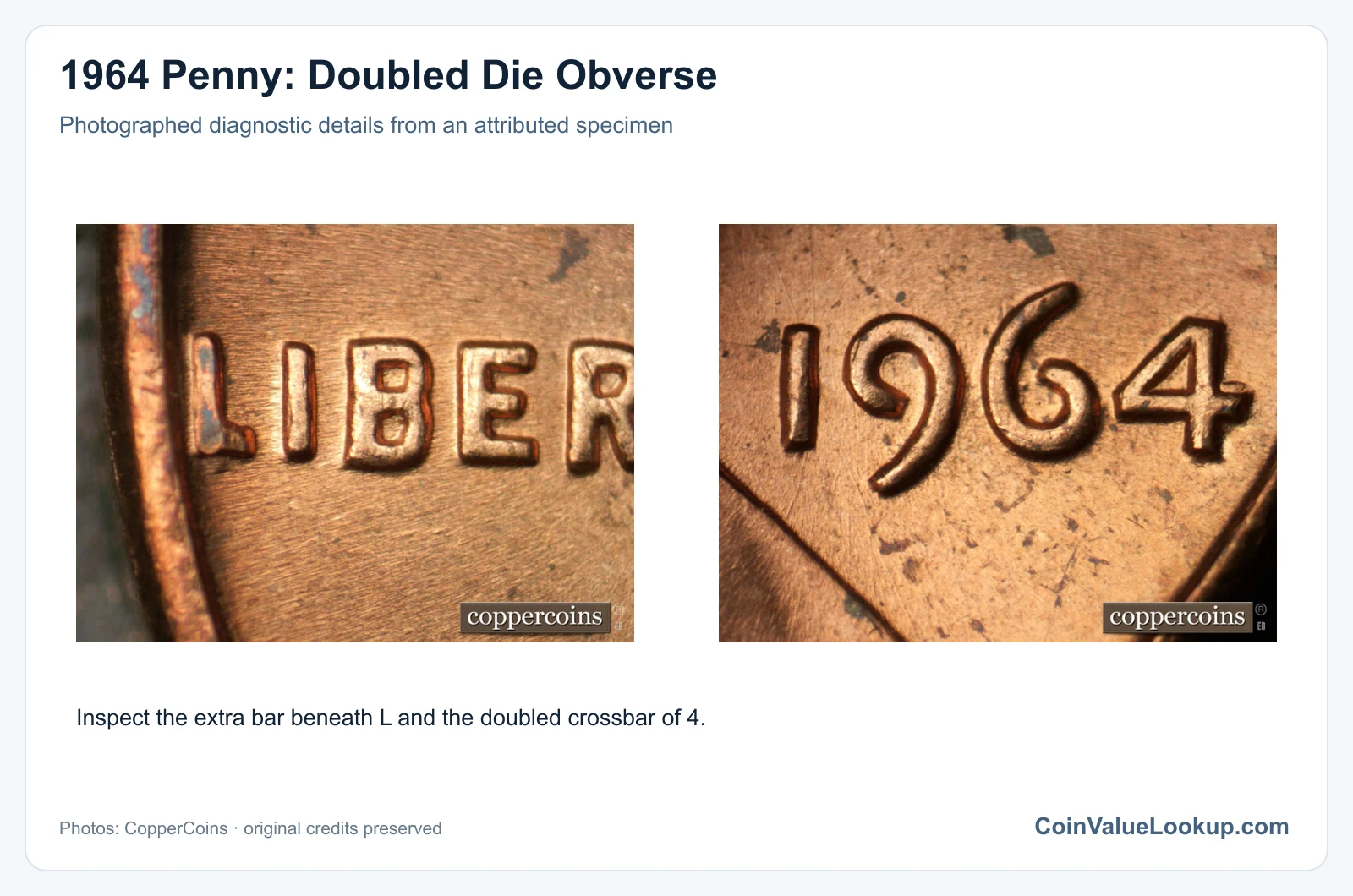
A doubled die obverse on the 1964 cent shows consistent doubling in the obverse lettering or design elements — separation or notching that repeats on every coin struck from that particular die. Compare suspect letters with a normal 1964 cent under the same lighting and magnification.
The key distinction is consistency. True doubled dies show the same doubling in the same direction across multiple design elements.
Machine doubling, by contrast, tends to produce a flat shelf on one side of the letter without true separation.
No specific price range is adopted for this variety. Condition, the visibility of the doubling and the specific die involved all affect what a given example might bring.
5. 1964 Lincoln Penny — Doubled Die Reverse
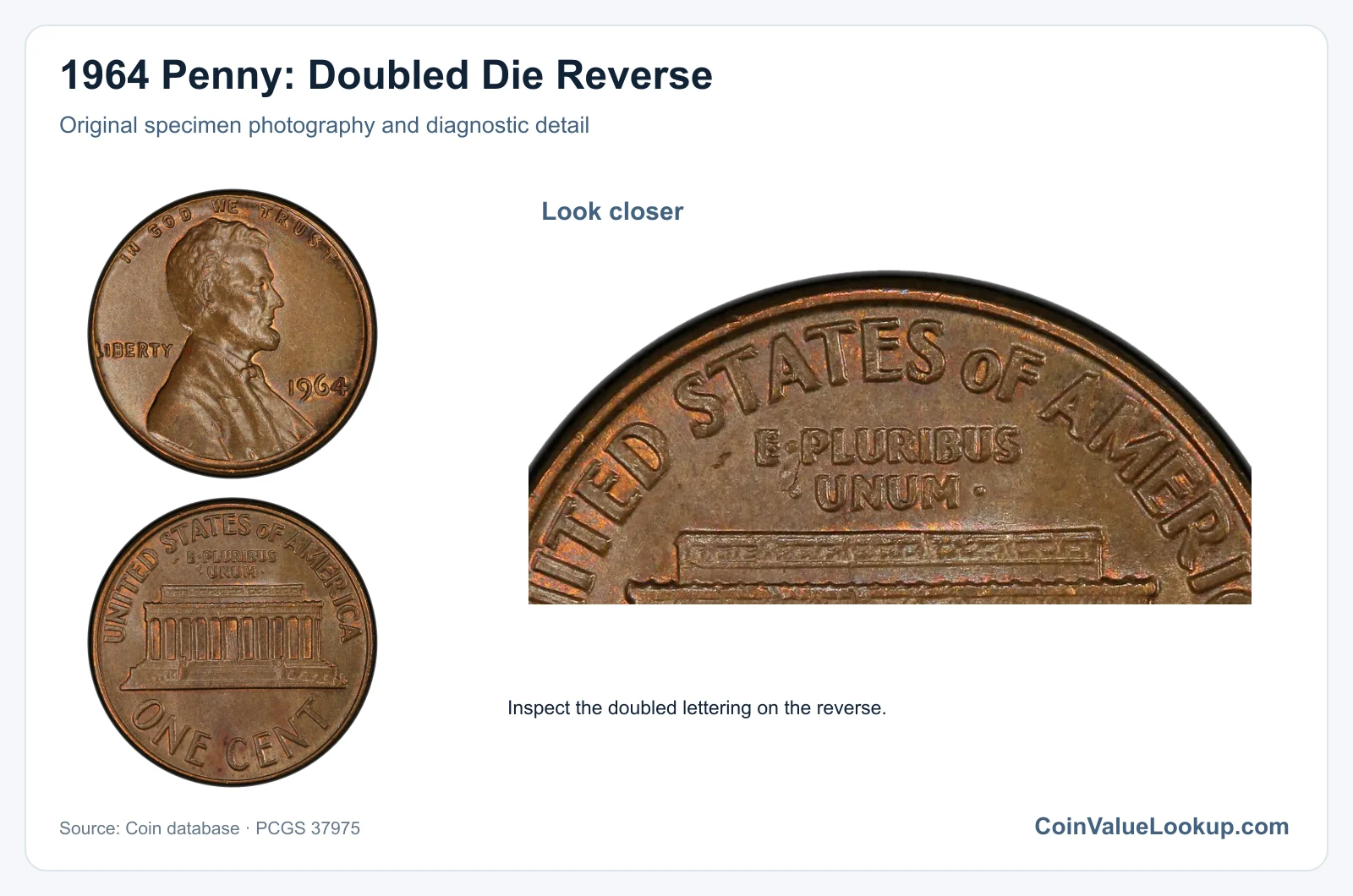
A doubled die reverse on the 1964 cent affects the Memorial side — look for doubling in the legends, columns or other reverse design contours. Place your coin next to a known normal example and compare under magnification.
True hub doubling shows distinct separation or notching that is consistent across the affected area of the design. Machine doubling and random damage produce different patterns: flat shelves, inconsistent direction, or isolated marks that do not repeat logically.
No numerical price range is adopted for this category. The specific die, the strength of the doubling and the coin's overall condition all factor into value, so professional evaluation is recommended for any strong candidate.
6. 1964 Lincoln Penny — Repunched Mintmark
A repunched mintmark on the 1964-D cent shows remnants of a second or earlier D punch position beneath or beside the final mintmark. You need magnification to see it clearly.
Compare your coin's mintmark against a normal 1964-D at matching magnification. Look for a partial extra outline, a notch or a shadow that is not present on the normal example.
Die chips, corrosion and machine doubling can all mimic an RPM at first glance, so careful comparison is important.
No specific price range is adopted. Value depends on the visibility of the repunching, the particular die pair and the coin's overall condition.
7. 1964 Lincoln Penny — Off-Center Strike
An off-center strike on a 1964 cent results when the planchet is not properly seated in the collar before the dies close. The design shifts to one side and an unstruck crescent of blank metal appears opposite.
The date needs to be visible for the coin to be attributed to 1964. A small percentage off-center is common and modest; dramatic shifts with a readable date are much harder to find.
Do not confuse an off-center strike with a clipped planchet or one-sided die misalignment. Post-mint damage from a vise or hammer can also flatten one side.
No numerical price range is adopted; value depends on the percentage of offset, date visibility and condition.
8. 1964 Lincoln Penny — Die Cap / Capped-Die Strike
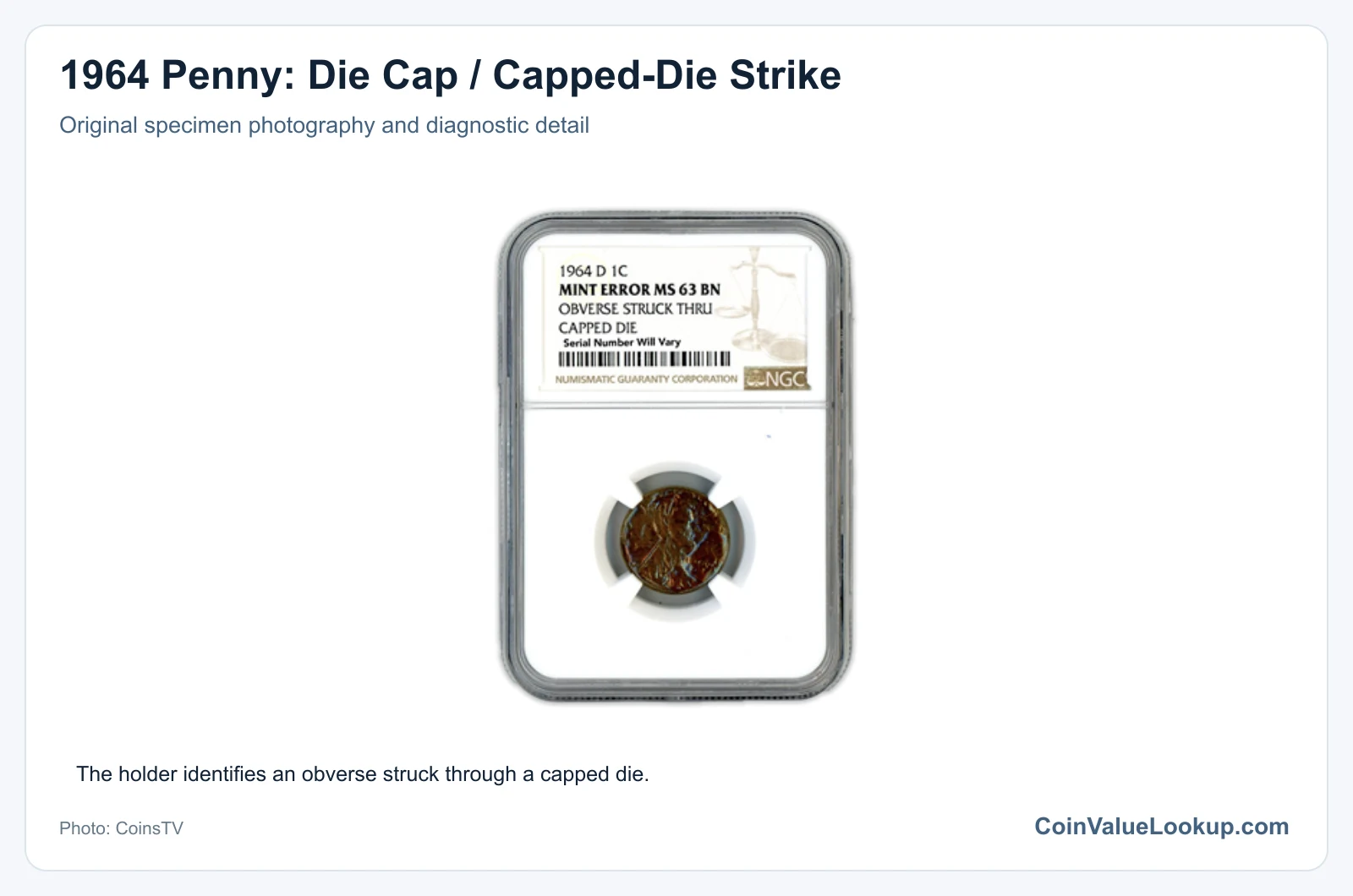
A capped-die strike occurs when a previously struck coin sticks to one of the dies and continues to strike subsequent blanks. The stuck coin gradually cups into a cap shape.
Coins struck through that cap pick up a mushy, distorted impression of the design.
To identify the cap itself, look for a deeply cupped coin with a raised obverse or reverse from repeated impacts. Coins struck by the capped die show a softened, spread-out mirror image on the affected side.
This is not a bent coin from someone's pliers or a vise. Genuine die caps show progressive distortion and evidence of multiple strikes.
No numerical price range is adopted; individual assessment based on authentication, condition and the stage of the cap determines value.
9. 1964 Lincoln Penny — Struck over an Earlier-Dated Cent
This reported variety involves a 1964-D impression struck over a 1963 cent. Surviving traces of the earlier date and design should be visible beneath the 1964-D details, distinguishing it from ordinary die doubling.
Look for ghost images of the prior year's date or design elements that do not align with the 1964 strike. Both dates present on the same coin is the clearest confirmation.
A true overstrike is mechanically distinct from a clash, which leaves only faint die-surface impressions, and from vise-made novelty coins pressed outside the mint.
No numerical price range is adopted. Value depends on the clarity of the underlying date, the coin's condition and professional authentication confirming it as a genuine mint-produced overstrike rather than post-mint manipulation.