1948 Wheat Penny Coin Value: How Much Is It Worth?
A 1948 Wheat penny in circulated condition starts around $0.06 at Fine-12, while uncirculated examples can reach roughly $2.50 to $3.62 at MS63 depending on the mint. Those are guide estimates across the three mint branches, not guaranteed offers.
Proofs were not produced for this date. Errors, original surfaces and color all affect what a specific coin might bring.
Fast Way to Identify Your 1948 Wheat Penny
Want a quick read on your 1948 penny? Upload clear photos of the front and back, and our identifier can give you a preliminary idea of which mint branch and general category your coin falls into.
It works from images alone, so good lighting and a steady hand help. This is not a substitute for professional authentication or grading, but it is a solid starting point.
1948 Wheat Penny Value
Upload both sides of your 1948 Wheat Penny.
Front Obverse
Upload photo
Back Reverse
Upload photo
Which 1948 Wheat Penny Versions Are Worth Money?
- The 1948-S trades at a slightly higher guide value than the Philadelphia or Denver issues, with about $0.12 at Fine-12 and $3.62 at MS63.
- All three mints produced business strikes only; no proofs exist for 1948, so every collectible example comes from circulation-strike rolls.
- Strong original surfaces without cleaning or corrosion make a meaningful difference in what a 1948 penny is worth, especially in higher grades.
- Doubled die obverse, repunched mintmark and other error types are reported for this date and can carry individual premiums assessed by severity and authentication.
Step 1: Identify Your 1948 Wheat Penny Mint Mark and Version
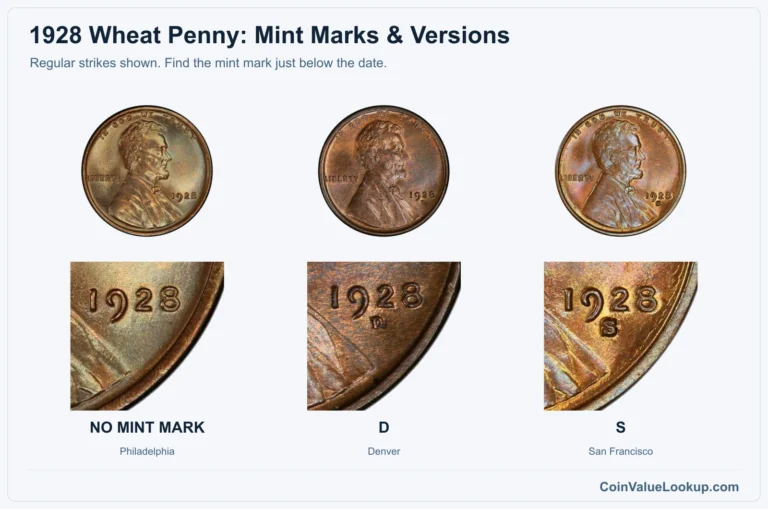
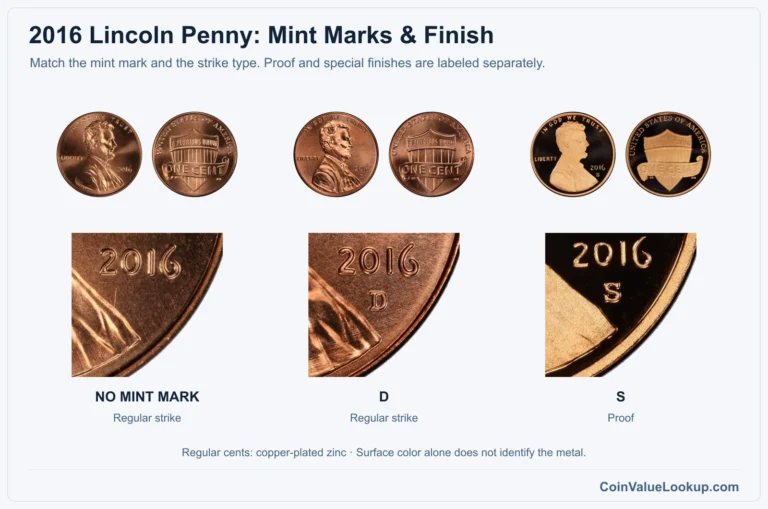
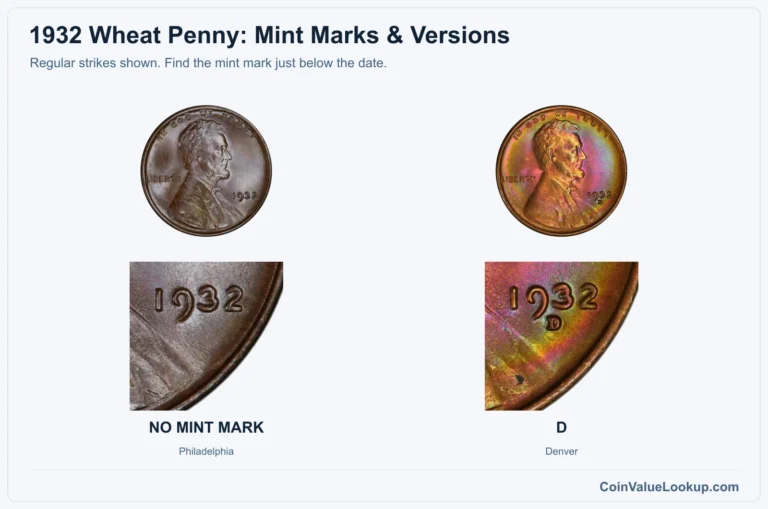
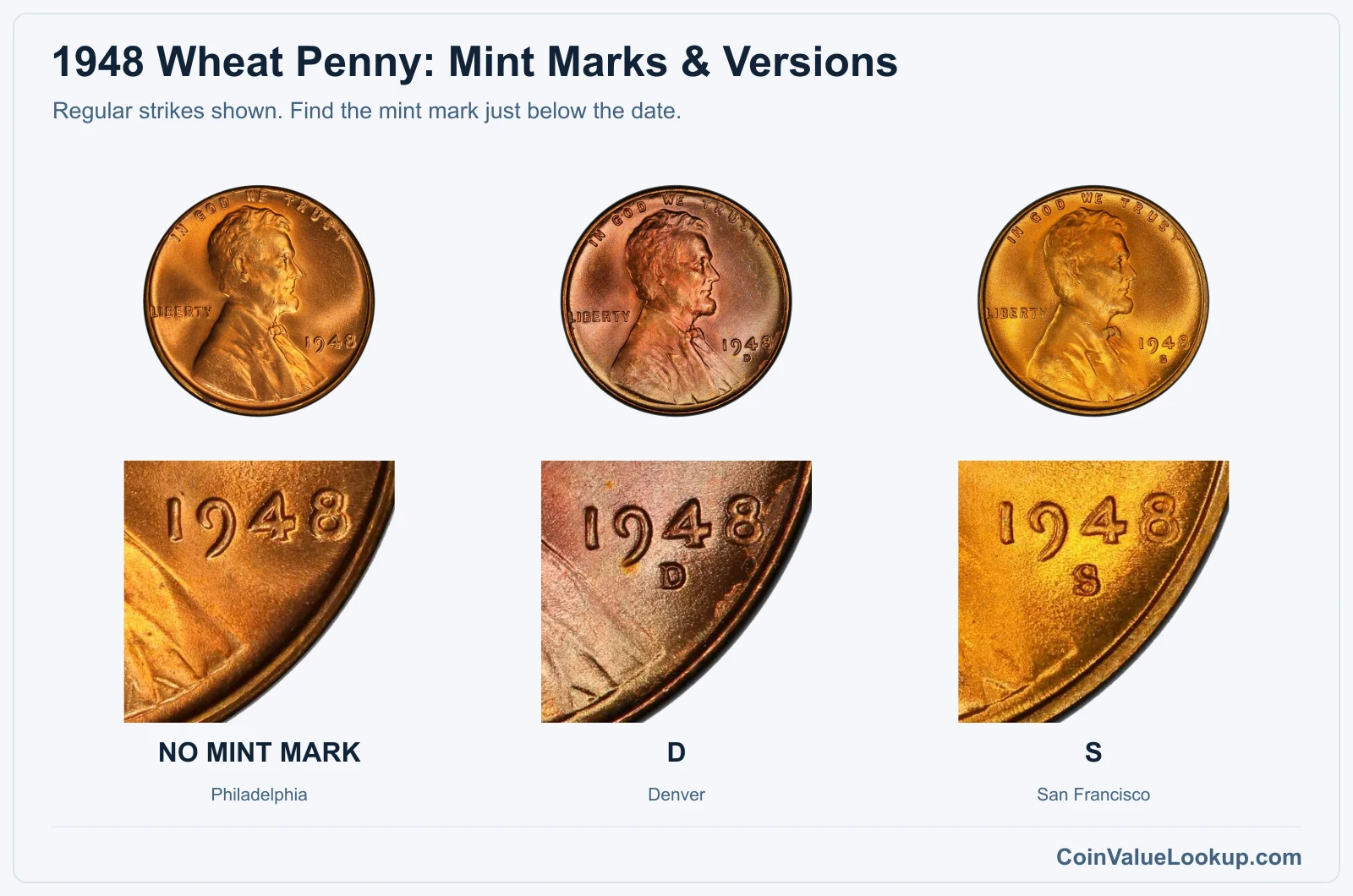
Flip your coin over to the obverse and look just below the date. If there is no small letter, you have a Philadelphia strike.
A tiny "D" means Denver, and an "S" means San Francisco. Those are the only three mints that produced 1948 Lincoln cents.
All three share the same design: Lincoln's portrait on the front and two wheat stalks framing ONE CENT on the back. The composition is 95% copper with 5% tin and zinc, weighing about 3.11 grams on a plain-edge planchet.
No regular proof coins were struck for the 1948 date. The U.S. Mint suspended proof production from 1943 through 1949, so if someone offers you a "1948 proof," that is a red flag.
Every genuine 1948 cent is a business strike from one of those three facilities.
Step 2: Check Your 1948 Wheat Penny Grade
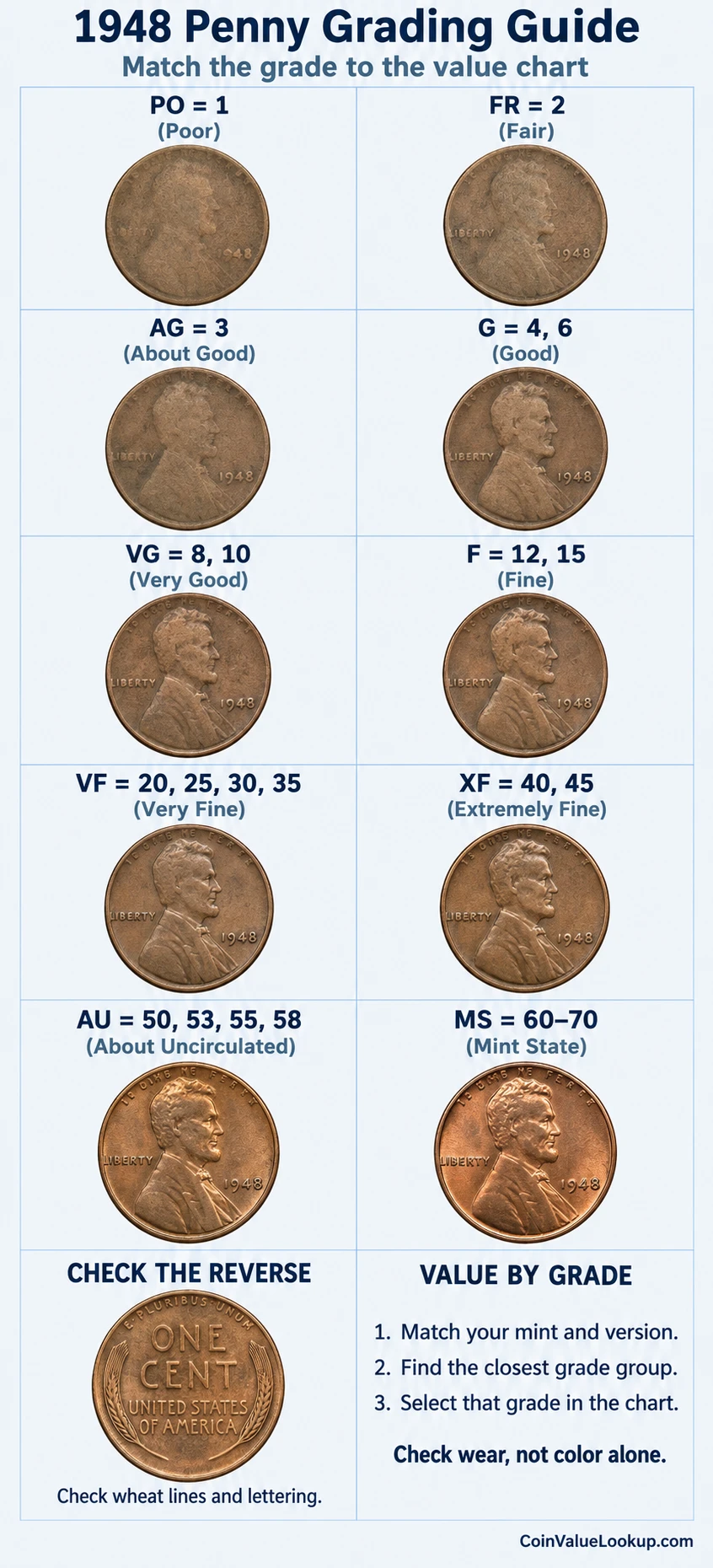
Start with Lincoln's cheekbone, jawline and the fine hair detail above the ear. These are the highest points on the obverse and the first places wear shows up.
On the reverse, check the individual wheat grain lines and the horizontal lines between the stalks.
A coin grading Fine-12 will show moderate wear on those high points but still retain clear major detail. Move up to Mint State and the original luster should be unbroken across both sides, with no flat spots from circulation.
One thing to watch: a weak original strike can leave soft detail that looks like wear but is not. Compare your coin to the reference image, paying attention to whether the softness is uniform or only on the high points.
Color matters separately from wear. Red, red-brown and brown describe the copper's surface tone, not the coin's grade.
Cleaning, spots and corrosion also affect desirability and should be evaluated on their own rather than folded into a wear grade.
Step 3: Check 1948 Wheat Penny Value by Mint and Version
1948 Wheat Penny
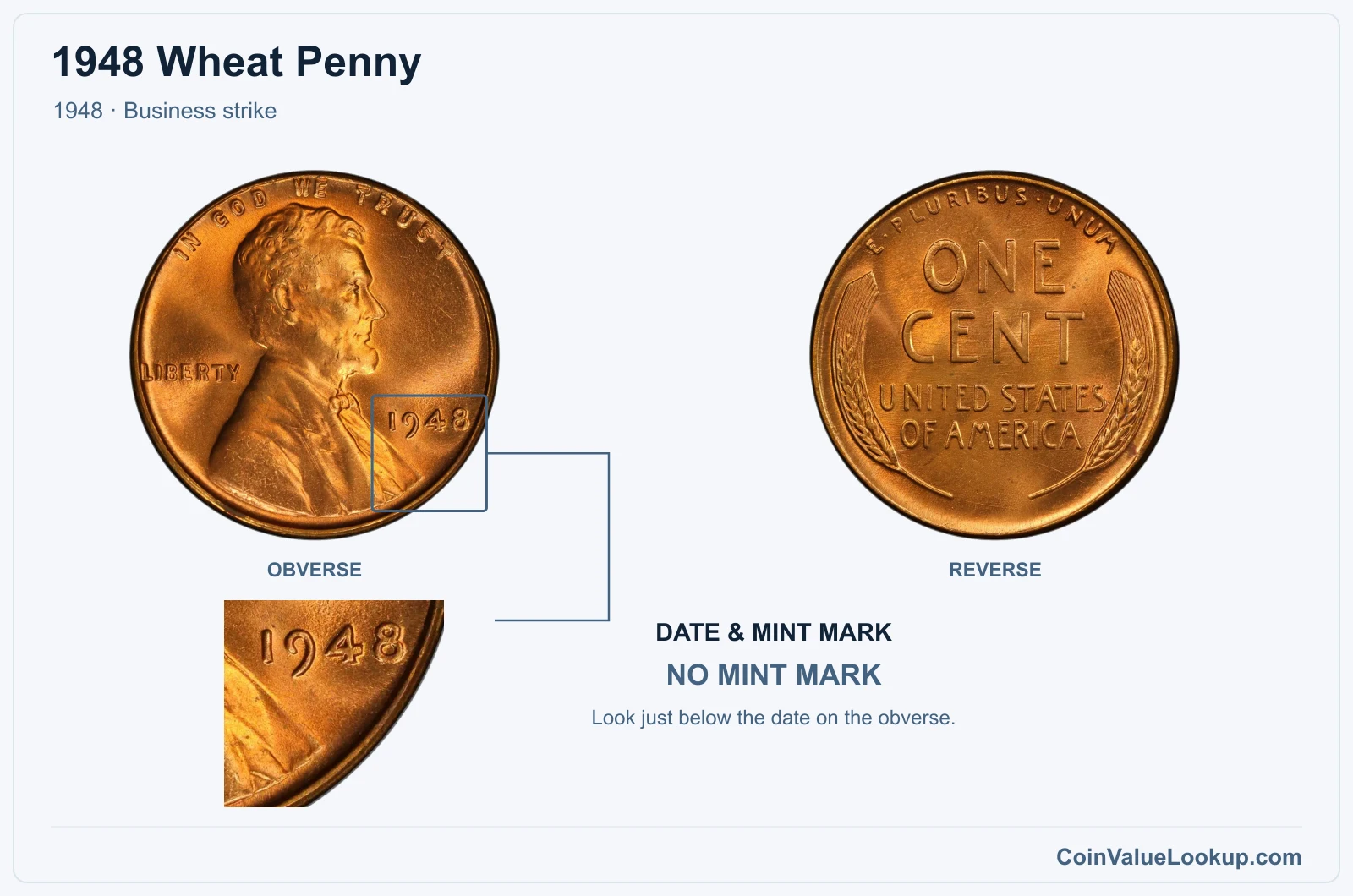
The 1948 Philadelphia cent carries no mintmark below the date. It is the most common branch for this year and a straightforward coin to find in circulated grades.
Guide estimates from USA Coin Book place it around $0.06 in Fine-12 and about $2.50 in MS63. Those figures assume original, undamaged surfaces with unspecified color, so a certified red example could trade differently.
Spotting, corrosion or evidence of cleaning will pull a coin below these benchmarks regardless of its technical grade.
| Range | Grade | Price | Auction Records | Appraisal |
|---|---|---|---|---|
| PO | PO 1 | — | Coin Identifier | |
| FR | FR 2 | — | Coin Identifier | |
| AG | AG 3 | — | Coin Identifier | |
| G | G 4 | — | Coin Identifier | |
| G 6 | — | Coin Identifier | ||
| VG | VG 8 | — | Coin Identifier | |
| VG 10 | — | Coin Identifier | ||
| F | F 12 | — | Coin Identifier | |
| F 15 | — | Coin Identifier | ||
| VF | VF 20 | — | Coin Identifier | |
| VF 25 | — | Coin Identifier | ||
| VF 30 | — | Coin Identifier | ||
| VF 35 | — | Coin Identifier | ||
| XF | XF 40 | — | Coin Identifier | |
| XF 45 | — | Coin Identifier | ||
| AU | AU 50 | — | Coin Identifier | |
| AU 53 | — | Coin Identifier | ||
| AU 55 | — | Coin Identifier | ||
| AU 58 | — | Coin Identifier | ||
| MS | MS 60 | — | Coin Identifier | |
| MS 61 | — | Coin Identifier | ||
| MS 62 | — | Coin Identifier | ||
| MS 63 | — | Coin Identifier | ||
| MS 64 | Coin Identifier | |||
| MS 65 | Coin Identifier | |||
| MS 66 | Coin Identifier | |||
| MS 67 | Coin Identifier | |||
| MS 68 | — | — | — | |
| MS 69 | — | — | — | |
| MS 70 | — | — | — |
1948 Wheat Penny — D
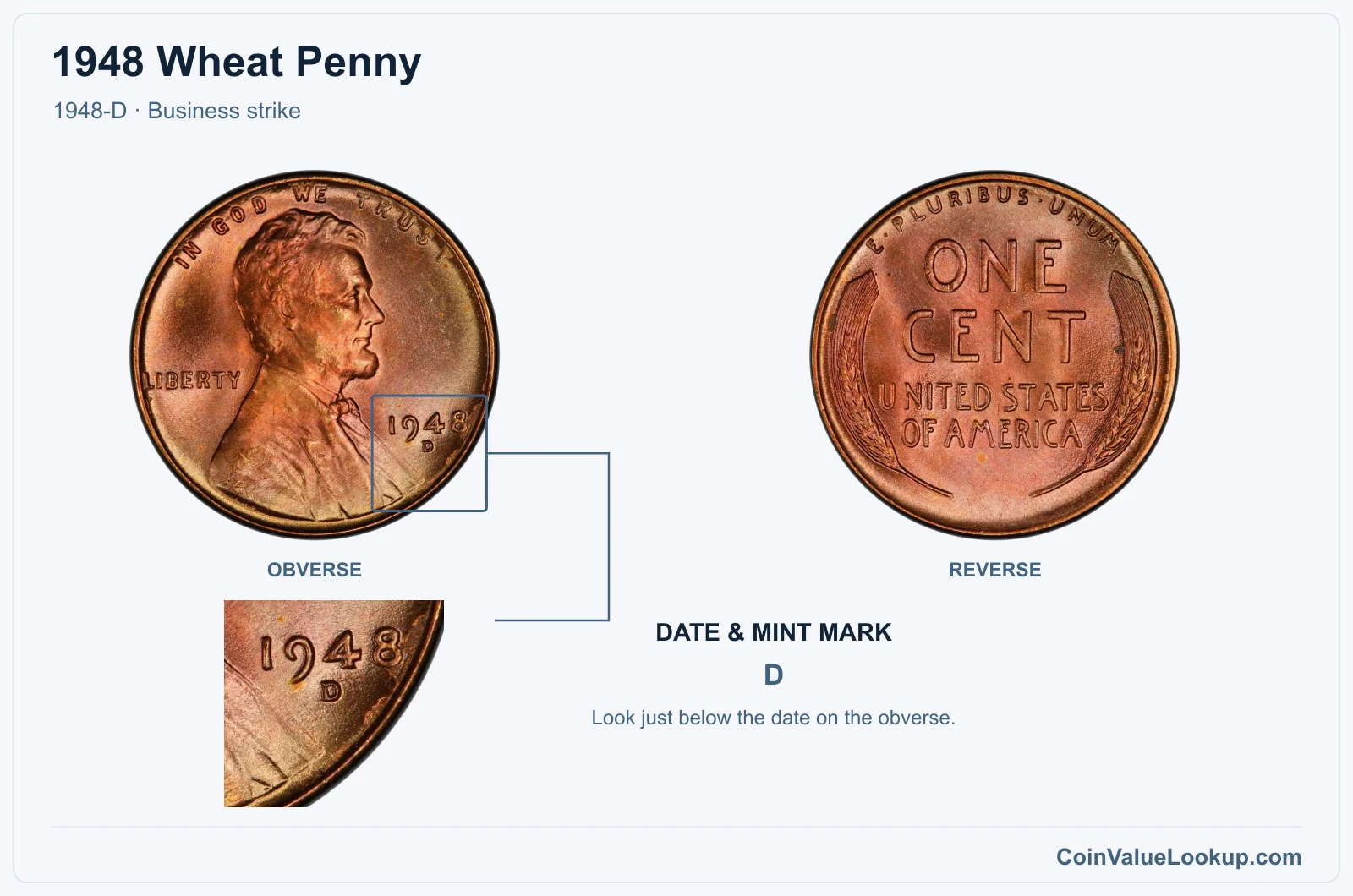
Look for a small "D" mintmark below the date to confirm a Denver strike. The 1948-D shares the same composition and design as its Philadelphia sibling, and its guide values are similar: roughly $0.06 at Fine-12 and $2.50 at MS63 per USA Coin Book.
In practice, most circulated examples you find in pocket change or old jars are worth only a few cents above face value. Uncirculated pieces with full luster and clean surfaces are where the modest premium lives.
Because this table does not specify color, do not assume the MS63 figure represents a certified red coin.
Coin Value Lookup is a handy place to look up guides for other dates and denominations in the Wheat cent series if you are working through a collection.
| Range | Grade | Price | Auction Records | Appraisal |
|---|---|---|---|---|
| PO | PO 1 | — | Coin Identifier | |
| FR | FR 2 | — | Coin Identifier | |
| AG | AG 3 | — | Coin Identifier | |
| G | G 4 | — | Coin Identifier | |
| G 6 | — | Coin Identifier | ||
| VG | VG 8 | — | Coin Identifier | |
| VG 10 | — | Coin Identifier | ||
| F | F 12 | — | Coin Identifier | |
| F 15 | — | Coin Identifier | ||
| VF | VF 20 | — | Coin Identifier | |
| VF 25 | — | Coin Identifier | ||
| VF 30 | — | Coin Identifier | ||
| VF 35 | — | Coin Identifier | ||
| XF | XF 40 | — | Coin Identifier | |
| XF 45 | — | Coin Identifier | ||
| AU | AU 50 | — | Coin Identifier | |
| AU 53 | — | Coin Identifier | ||
| AU 55 | — | Coin Identifier | ||
| AU 58 | — | Coin Identifier | ||
| MS | MS 60 | — | Coin Identifier | |
| MS 61 | — | Coin Identifier | ||
| MS 62 | — | Coin Identifier | ||
| MS 63 | — | Coin Identifier | ||
| MS 64 | Coin Identifier | |||
| MS 65 | Coin Identifier | |||
| MS 66 | Coin Identifier | |||
| MS 67 | Coin Identifier | |||
| MS 68 | — | — | — | |
| MS 69 | — | — | — | |
| MS 70 | — | — | — |
1948 Wheat Penny — S
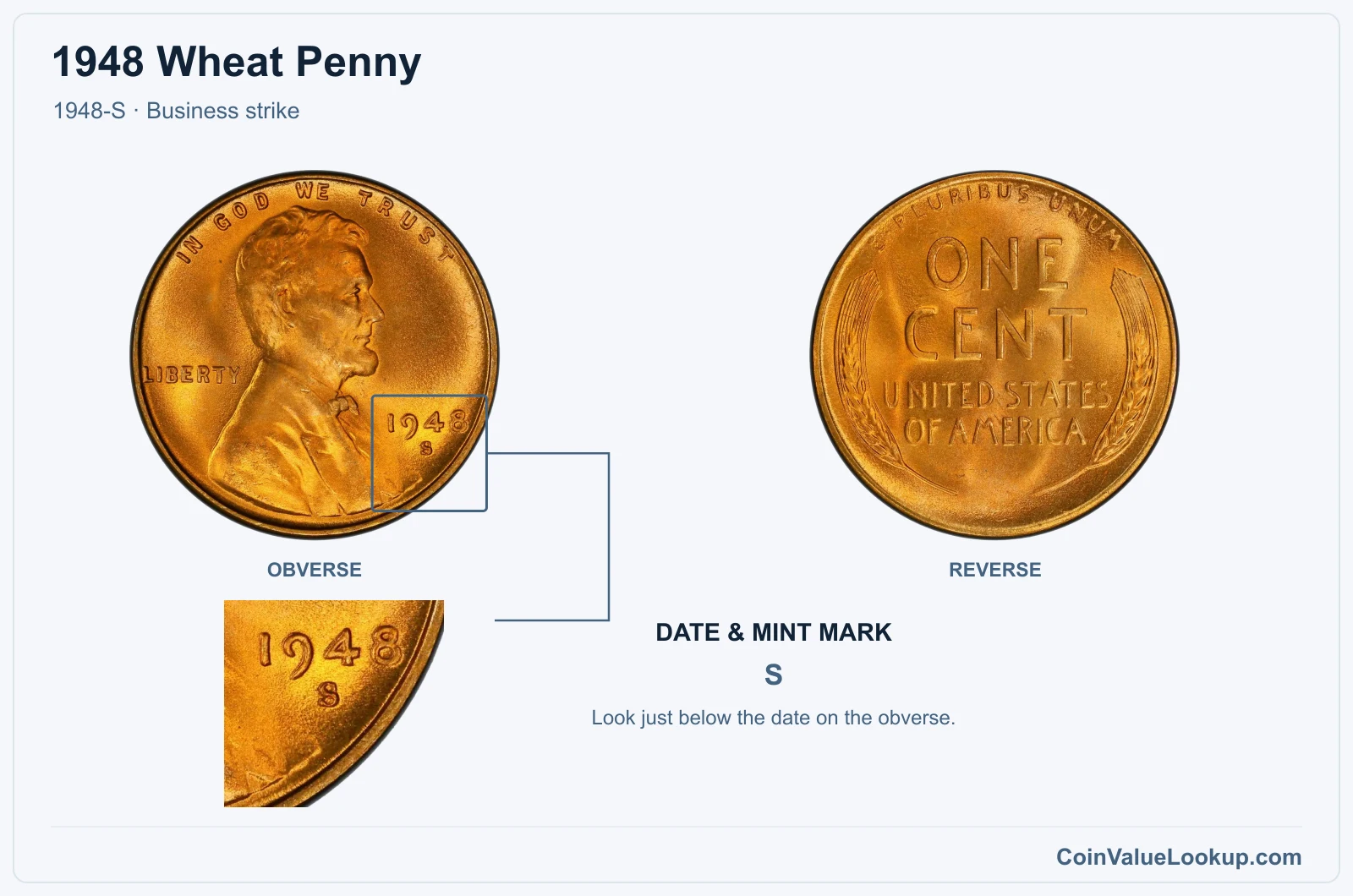
The 1948-S carries a small "S" mintmark below the date, struck at the San Francisco Mint. Among the three 1948 branches, this one has the highest listed guide values: about $0.12 at Fine-12 and $3.62 at MS63 according to USA Coin Book.
That does not make it rare, but it does give it a slight edge when you are sorting a group of 1948 cents. As with the other mints, these estimates assume original surfaces and do not specify color.
A well-preserved example with strong luster and no distracting marks will command the most attention from collectors.
| Range | Grade | Price | Auction Records | Appraisal |
|---|---|---|---|---|
| PO | PO 1 | — | Coin Identifier | |
| FR | FR 2 | — | Coin Identifier | |
| AG | AG 3 | — | Coin Identifier | |
| G | G 4 | — | Coin Identifier | |
| G 6 | — | Coin Identifier | ||
| VG | VG 8 | — | Coin Identifier | |
| VG 10 | — | Coin Identifier | ||
| F | F 12 | — | Coin Identifier | |
| F 15 | — | Coin Identifier | ||
| VF | VF 20 | — | Coin Identifier | |
| VF 25 | — | Coin Identifier | ||
| VF 30 | — | Coin Identifier | ||
| VF 35 | — | Coin Identifier | ||
| XF | XF 40 | — | Coin Identifier | |
| XF 45 | — | Coin Identifier | ||
| AU | AU 50 | — | Coin Identifier | |
| AU 53 | — | Coin Identifier | ||
| AU 55 | — | Coin Identifier | ||
| AU 58 | — | Coin Identifier | ||
| MS | MS 60 | — | Coin Identifier | |
| MS 61 | — | Coin Identifier | ||
| MS 62 | — | Coin Identifier | ||
| MS 63 | — | Coin Identifier | ||
| MS 64 | — | Coin Identifier | ||
| MS 65 | Coin Identifier | |||
| MS 66 | Coin Identifier | |||
| MS 67 | Coin Identifier | |||
| MS 68 | — | — | — | |
| MS 69 | — | — | — | |
| MS 70 | — | — | — |
1948 Wheat Penny Error List
1. 1948 Wheat Penny — Doubled Die Obverse
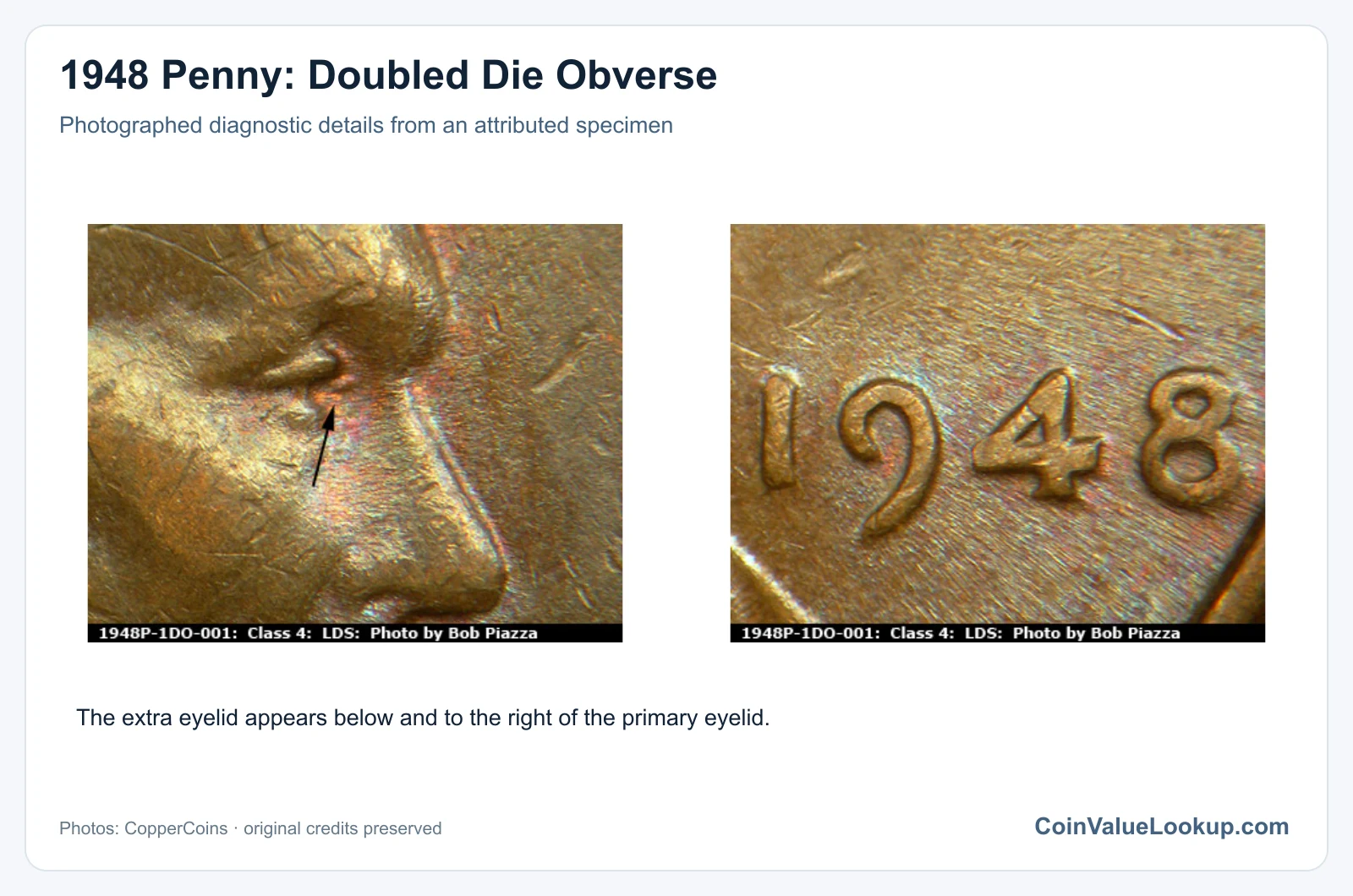
A doubled die obverse on a 1948 Wheat cent shows consistent doubling on the obverse lettering or design elements. The key word is consistent: true hub doubling produces uniform separation or notching on multiple letters, not random smearing.
Compare your coin's inscriptions, especially LIBERTY and IN GOD WE TRUST, against a normal 1948 cent under the same lighting and magnification.
The most common lookalike is machine doubling, which tends to leave a flat, shelf-like distortion rather than clearly separated letter outlines. Worn die contours and reflections can also mimic doubling at first glance.
No specific price range is adopted for this error, so value depends on the individual coin's authenticated identity, the severity of the doubling and overall condition.
2. 1948 Wheat Penny — Repunched Mintmark
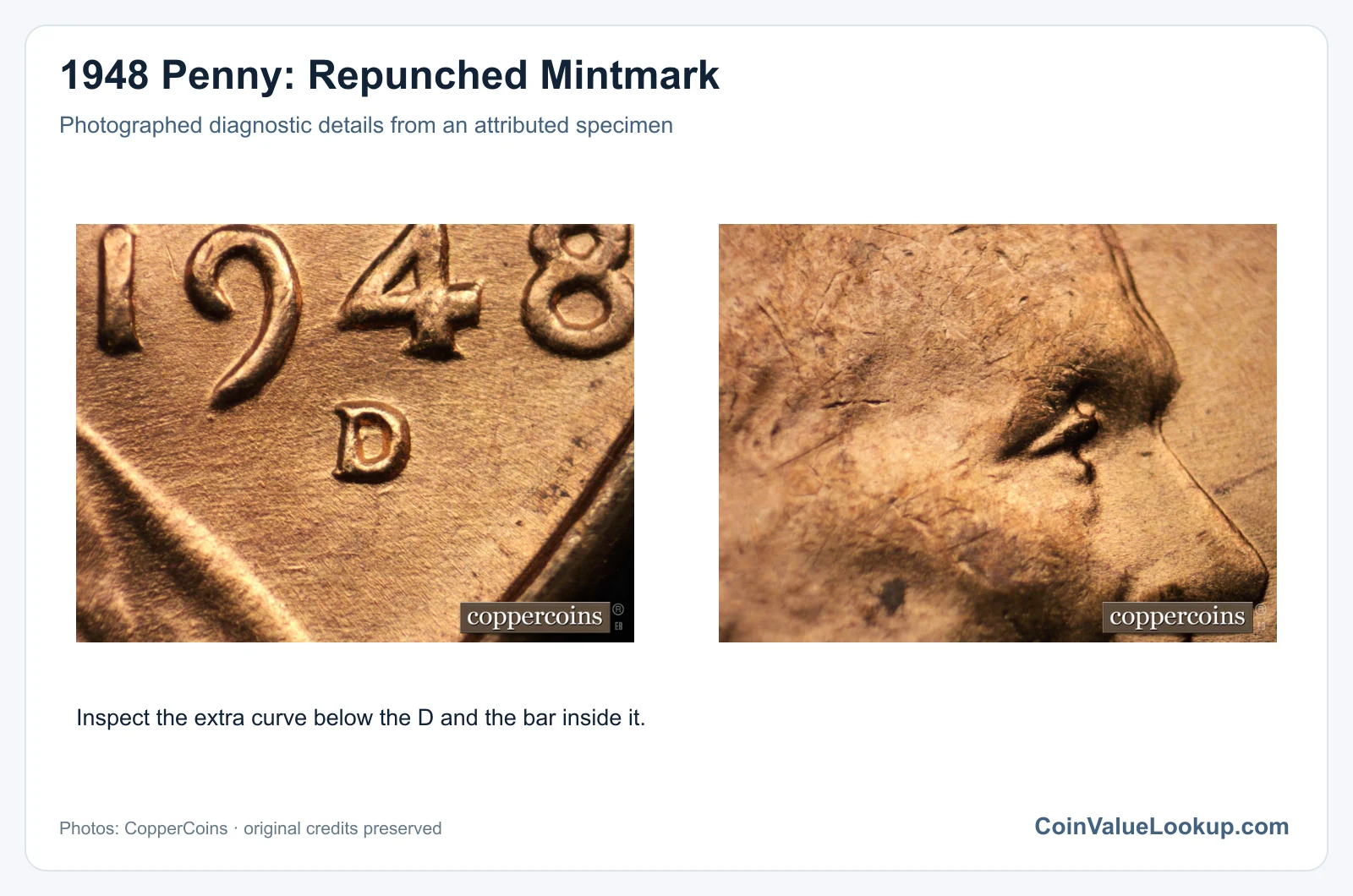
A repunched mintmark occurs when the mintmark punch was applied more than once in slightly different positions, leaving traces of the earlier placement. This error applies only to the Denver and San Francisco branches, since Philadelphia coins have no mintmark to repunch.
Under magnification, look for a secondary outline, notch or partial letter near the primary D or S below the date. Compare it side by side with a normal mintmark at the same power.
Machine doubling around the mintmark, die chips and simple corrosion can all produce lookalike effects, so careful inspection matters. No specific price range is adopted for 1948 repunched mintmarks; value is assessed individually based on authenticated identity, clarity of the repunching and the coin's overall condition.
3. 1948 Wheat Penny — BIE Die Break
A BIE die break shows up as a small raised vertical line or blob between the letters B and E in LIBERTY. It is caused by a crack or chip in the die that fills with metal during striking, producing a bump that can vaguely resemble the letter I.
To check, examine LIBERTY under magnification and look for any raised bridge connecting or sitting between B and E. The surrounding surface should be normal and undisturbed.
Dirt lodged between the letters, a scratch or a piece of foreign metal stuck to the coin can all imitate this error, so compare the texture of the raised area to genuine struck metal. No adopted price range exists for 1948 BIE breaks; each coin's value depends on the authenticated error, its prominence and the coin's grade.
4. 1948 Wheat Penny — Off-Center Strike
An off-center strike happens when the planchet is not seated properly in the collar before the dies come together. The result is a displaced design with an unstruck crescent of blank metal on one side.
The degree matters a lot. A 5% off-center coin is mildly interesting; a 50% example with the full date still visible is far more collectible.
Always confirm the date is readable, because that is what ties the error to this specific year.
Lookalikes include clipped planchets, one-sided die misalignment and coins that were flattened or bent after leaving the mint. Genuine off-center coins show a complete but shifted design, not damage patterns.
No specific price range is adopted, so each coin is assessed individually by its authenticated identity, the percentage of off-center shift and overall condition.
5. 1948 Wheat Penny — Clipped Planchet
A clipped planchet error means the blank was punched from strip metal that overlapped a previously punched hole, leaving a missing curved, straight or irregular section along the edge. Genuine clips typically show a smooth, unstruck area and may display weakness in the design directly opposite the clip, a result of metal flow during striking.
Check the edge texture carefully. A filed notch, post-mint cut or corroded edge can mimic a clip, but those will usually show tool marks or uneven surfaces inconsistent with the coin's original metal flow.
The Blakesley effect, that area of weakness on the opposite rim, is a useful confirmation when present.
No adopted price range exists for 1948 clipped planchet cents. Value depends on the type and size of the clip, the coin's authenticated identity and its overall condition.
6. 1948 Wheat Penny — Broadstrike
A broadstrike occurs when a coin is struck without the retaining collar that normally confines the planchet and forms the rim. The result is a coin that spreads outward, appearing slightly larger than normal with a weak or absent rim.
The full design is usually present, just expanded. That distinguishes a broadstrike from an off-center error, where part of the design is missing entirely.
Look at the edge profile: it should show outward metal flow rather than the sharp, defined edge of a normal coin. A coin that was simply flattened after minting will typically show damage marks and uneven distortion rather than the symmetrical spread of a genuine broadstrike.
No specific price range is adopted for 1948 broadstrikes. Each example is valued individually based on authenticated identity, the degree of spread and overall condition.
7. 1948 Wheat Penny — Struck-Through Error
A struck-through error happens when foreign material, such as grease, a thread or a fragment of metal, sits between the die and the planchet during striking. The result is a localized depression or an area of incomplete design where the obstruction blocked the die's impression.
Grease-filled dies tend to produce soft, rounded areas of missing detail, while a retained foreign object may leave a distinct impression of its shape. Look for a depression that is clearly below the normal surface plane and does not match typical wear patterns.
Wear, scratches, cleaning and weak strikes from a tired die can all mimic struck-through effects. A genuine struck-through area will usually have defined borders and a texture different from the surrounding coin surface.
No price range is adopted; value depends on authenticated identity, the type and size of the obstruction impression and the coin's condition.