1986 Lincoln Penny Coin Value: How Much Is It Worth?
Most 1986 Lincoln pennies you find in circulation are worth face value. A USA Coin Book guide estimate puts an uncirculated MS65 business strike at about $0.36, and a proof in PR65 at roughly $8.64.
The real action lies in authenticated mint errors, original copper color, and clean surfaces. Before you shrug and toss it back in the jar, it pays to know what separates pocket change from a collectible.
Fast Way to Identify Your 1986 Lincoln Penny
Want a quick read on your 1986 penny? Upload clear photos of the front and back to our identifier for a preliminary look at what you have.
It can help you sort out mintmarks and finishes. Good lighting and a steady shot make all the difference, so prop that coin on a flat surface before you snap.
1986 Penny Value
Upload both sides of your 1986 Lincoln Penny.
Front Obverse
Upload photo
Back Reverse
Upload photo
Which 1986 Lincoln Penny Versions Are Worth Money?
- High-grade uncirculated 1986 pennies with full original red copper color (RD) are the ones collectors seek out; surfaces and color matter more than the common date.
- Authenticated striking and blank errors can carry meaningful premiums. A 1986-D unplated zinc blank graded MS64 sold for $138, and off-center or double-strike errors have brought hundreds.
- Gray-colored 1986 pennies need professional authentication to confirm a genuine plating omission versus chemical stripping, which has no collector premium.
Step 1: Identify Your 1986 Lincoln Penny Mint Mark and Version
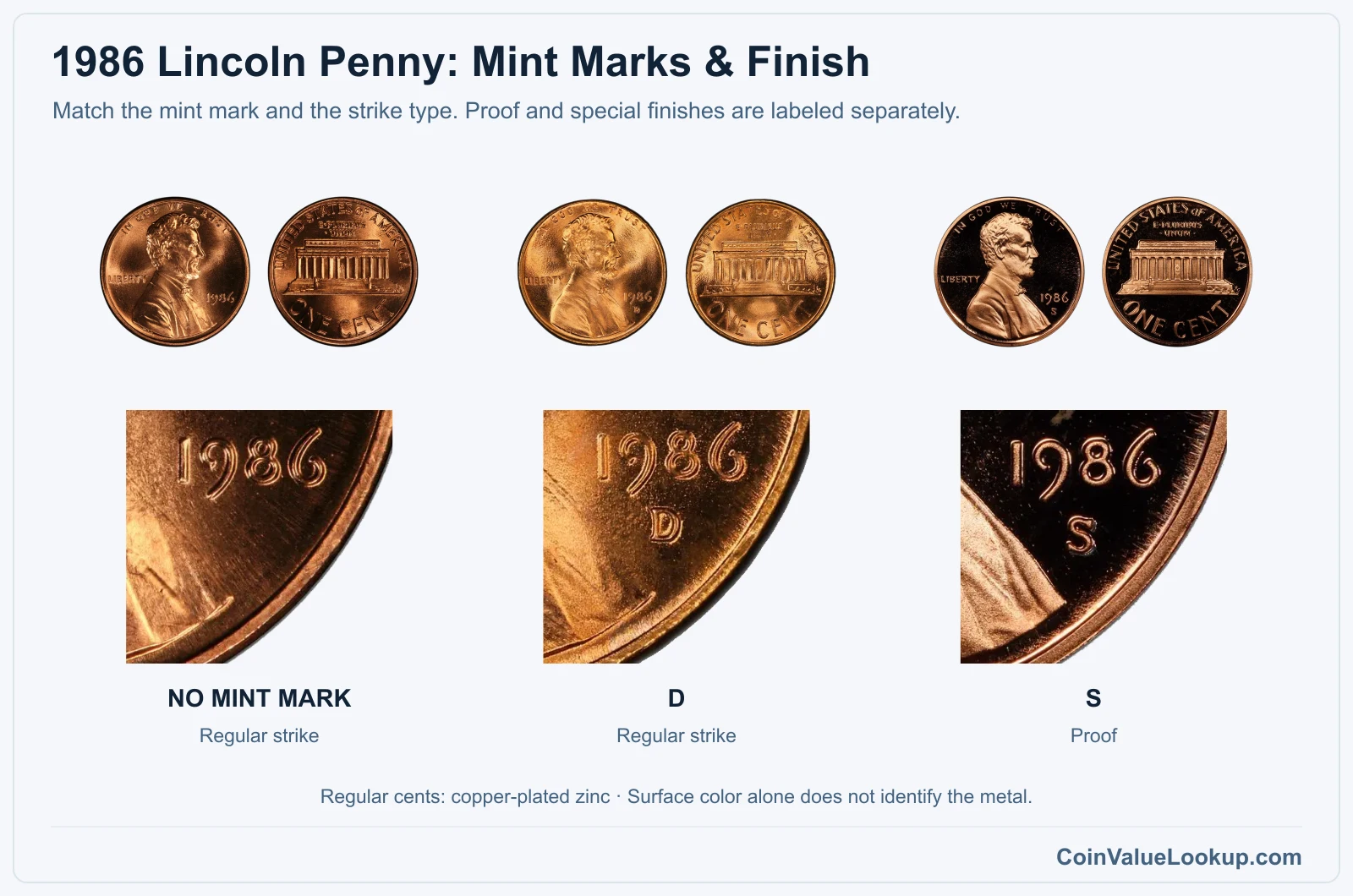
The 1986 Lincoln cent carries the familiar Lincoln portrait on the obverse and the Memorial reverse, with a plain (smooth) edge. Normal composition is copper-plated zinc, weighing about 2.50 grams, with a 97.5% zinc core under a thin copper layer.
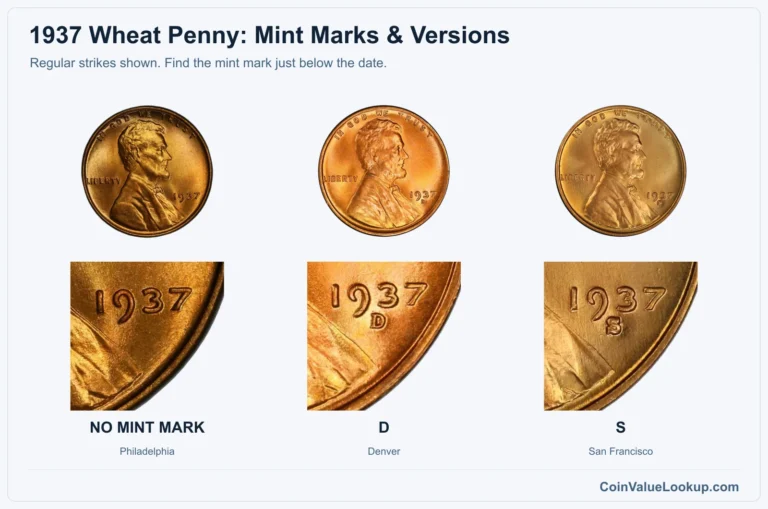
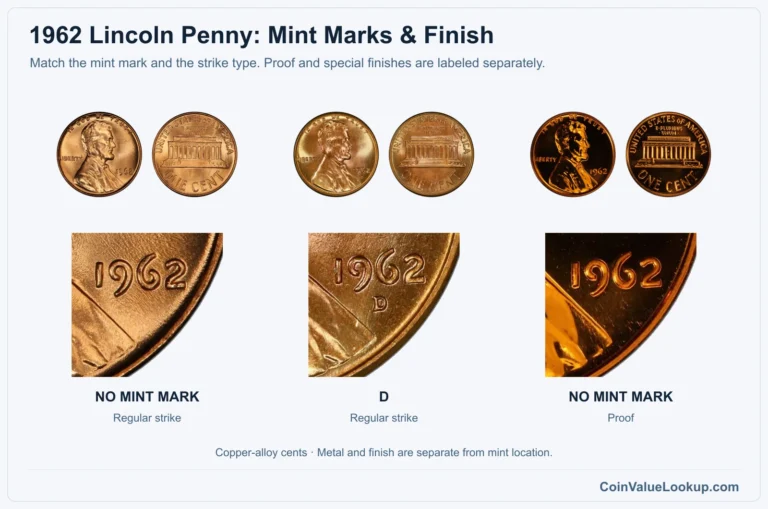
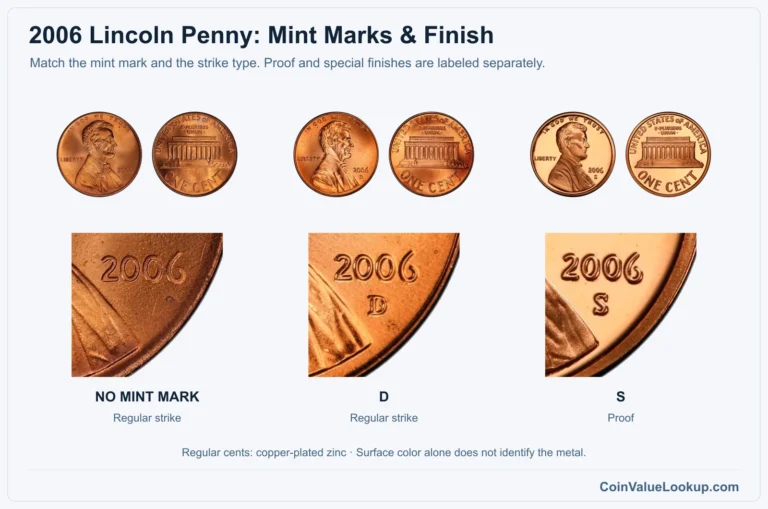
Check beneath the date for a mintmark. No mintmark means it was cataloged as the Philadelphia-type branch.
A small "D" means Denver. An "S" appears only on collector proof strikes from San Francisco; there is no normal 1986-S circulation issue.
Do not confuse copper color designations (BN, RB, RD) with different metals. Those labels describe how much original red copper tone remains.
Brown (BN) means the surface has fully toned, Red-Brown (RB) is partial, and Red (RD) retains most of the original mint color. These distinctions matter for grading, not composition.
Similarly, CAM and DCAM labels on proofs describe the contrast between frosted devices and mirror fields. They are not separate alloys or higher grades.
A proof is a manufacturing finish with mirror-like fields, not a step above Mint State.
Step 2: Check Your 1986 Lincoln Penny Grade
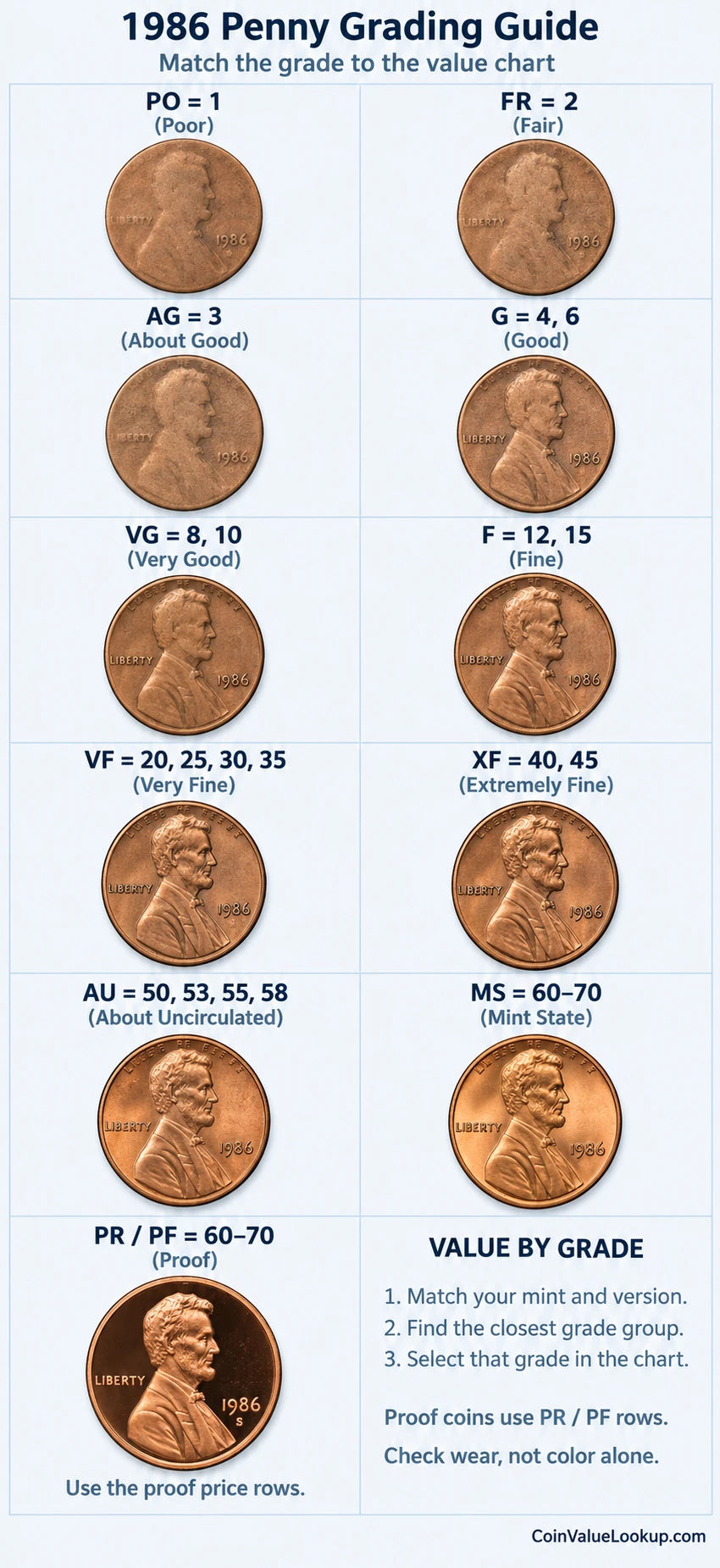
Start with Lincoln's cheek, jawline, and the hair detail above his ear. These are the first spots where wear appears.
On the reverse, check the Memorial roof and the tops of the columns.
A coin that shows full luster with no wear on those high points is a candidate for Mint State. If you see just a trace of friction on the cheek but the luster is mostly intact, that is About Uncirculated territory.
The distinction between AU and MS hinges on luster interruption and high-point wear, not color alone.
For proofs, look for hairlines across those mirror fields. Even light wipes leave fine scratches under magnification.
Spots, haze, or damaged plating all reduce the grade. Never clean a copper-plated coin or try to remove toning; that causes irreversible damage and kills collector value.
Use the comparison image to match your coin's wear pattern against known grade examples. Focus on matching the same areas, same lighting angle.
Step 3: Check 1986 Lincoln Penny Value by Mint and Version
1986 Lincoln Penny
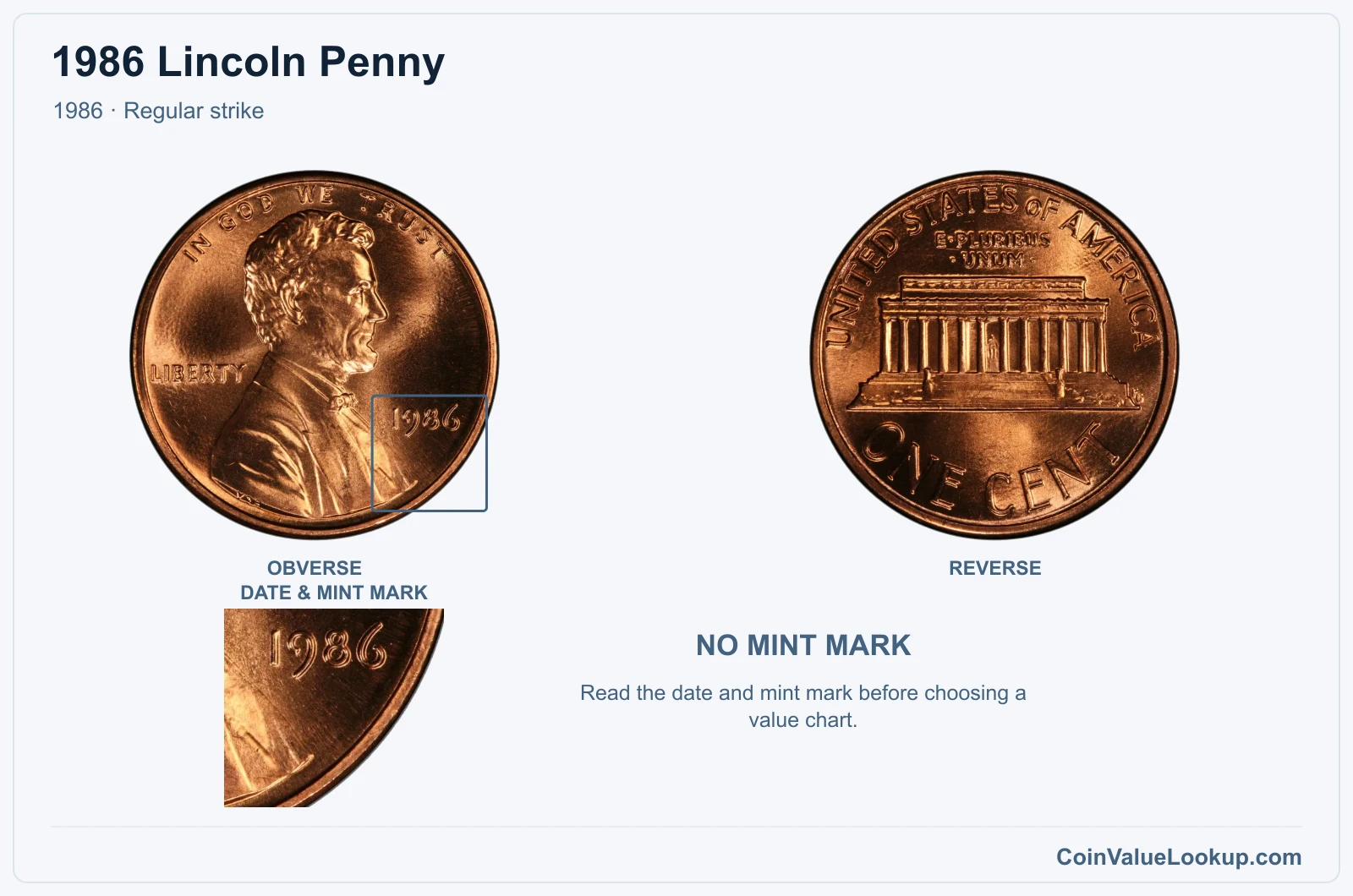
The 1986 no-mintmark penny is the Philadelphia-catalog business strike. It is copper-plated zinc, weighing about 2.50 grams.
A USA Coin Book guide estimate places an MS65 example at around $0.36.
In circulated grades, these are essentially face-value coins. What moves the needle is original surface quality.
A fully red (RD) example with no spots, no plating bubbles, and strong luster stands out from the millions that ended up brown and dinged in pocket change. Match finish and color carefully; proof mirrors do not belong in the same comparison.
Coin Value Lookup is a handy starting point if you want to look up guide values for other dates and mints in the Lincoln cent series.
| Range | Grade | Price | Auction Records | Appraisal |
|---|---|---|---|---|
| PO | PO 1 | — | Coin Identifier | |
| FR | FR 2 | — | Coin Identifier | |
| AG | AG 3 | — | Coin Identifier | |
| G | G 4 | — | Coin Identifier | |
| G 6 | — | Coin Identifier | ||
| VG | VG 8 | — | Coin Identifier | |
| VG 10 | — | Coin Identifier | ||
| F | F 12 | — | Coin Identifier | |
| F 15 | — | Coin Identifier | ||
| VF | VF 20 | — | Coin Identifier | |
| VF 25 | — | Coin Identifier | ||
| VF 30 | — | Coin Identifier | ||
| VF 35 | — | Coin Identifier | ||
| XF | XF 40 | — | Coin Identifier | |
| XF 45 | — | Coin Identifier | ||
| AU | AU 50 | — | Coin Identifier | |
| AU 53 | — | Coin Identifier | ||
| AU 55 | — | Coin Identifier | ||
| AU 58 | — | Coin Identifier | ||
| MS | MS 60 | — | Coin Identifier | |
| MS 61 | — | Coin Identifier | ||
| MS 62 | — | Coin Identifier | ||
| MS 63 | — | Coin Identifier | ||
| MS 64 | — | Coin Identifier | ||
| MS 65 | Coin Identifier | |||
| MS 66 | Coin Identifier | |||
| MS 67 | Coin Identifier | |||
| MS 68 | Coin Identifier | |||
| MS 69 | Coin Identifier | |||
| MS 70 | — | — | — |
1986 Lincoln Penny — D
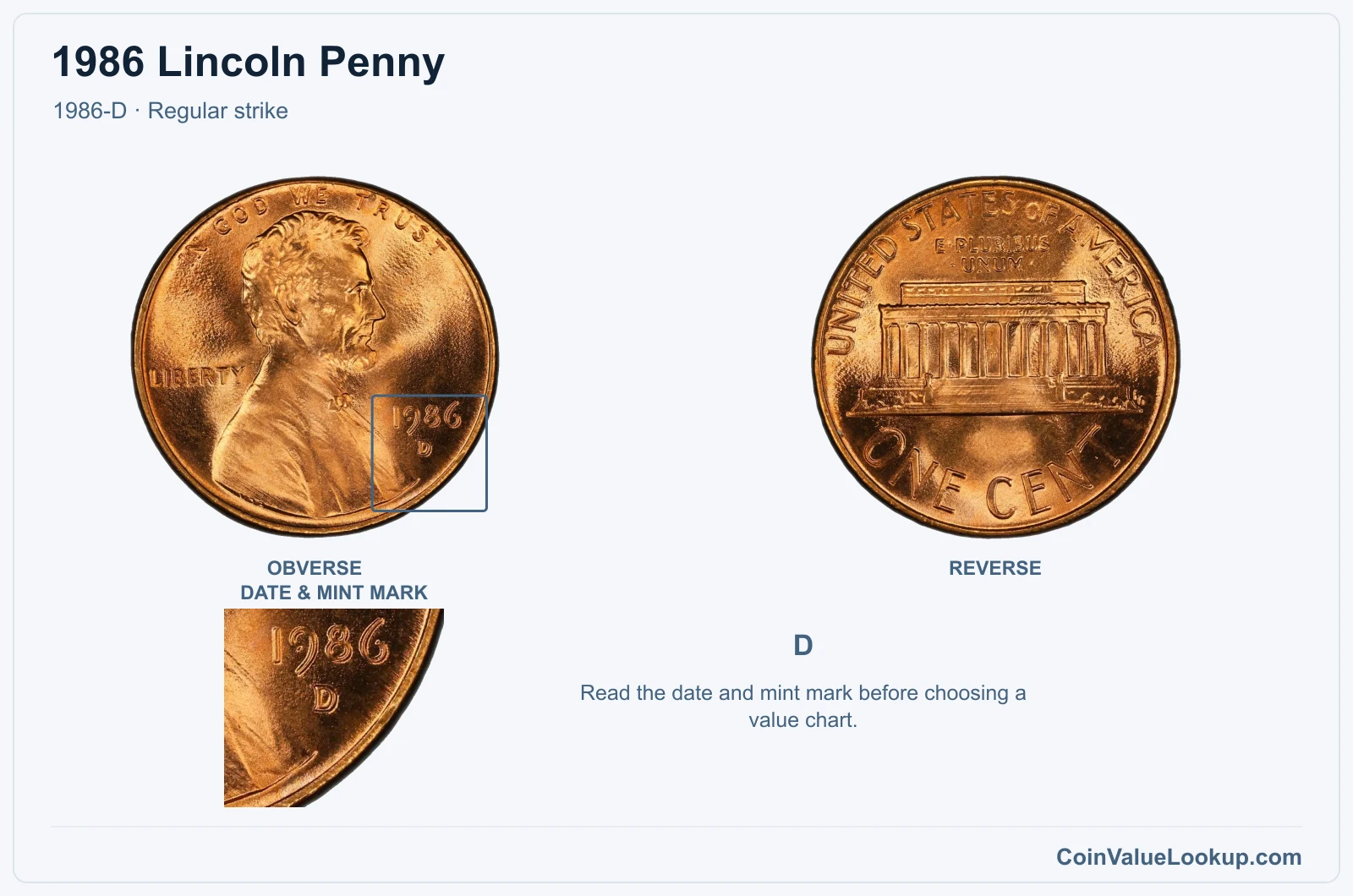
The 1986-D penny was struck at Denver, identified by a small "D" below the date. Same copper-plated zinc composition, same 2.50-gram nominal weight.
The USA Coin Book guide estimate for MS65 is about $0.36.
Denver struck enormous quantities, so circulated examples are common. As with the no-mintmark version, collectors pay attention to copper color and surface preservation in uncirculated grades.
A clean, blazing red gem stands apart from a dull, spotted survivor. This mint also produced several notable error types for the year, including off-center strikes and unplated blanks, so it is worth a careful look.
| Range | Grade | Price | Auction Records | Appraisal |
|---|---|---|---|---|
| PO | PO 1 | — | Coin Identifier | |
| FR | FR 2 | — | Coin Identifier | |
| AG | AG 3 | — | Coin Identifier | |
| G | G 4 | — | Coin Identifier | |
| G 6 | — | Coin Identifier | ||
| VG | VG 8 | — | Coin Identifier | |
| VG 10 | — | Coin Identifier | ||
| F | F 12 | — | Coin Identifier | |
| F 15 | — | Coin Identifier | ||
| VF | VF 20 | — | Coin Identifier | |
| VF 25 | — | Coin Identifier | ||
| VF 30 | — | Coin Identifier | ||
| VF 35 | — | Coin Identifier | ||
| XF | XF 40 | — | Coin Identifier | |
| XF 45 | — | Coin Identifier | ||
| AU | AU 50 | — | Coin Identifier | |
| AU 53 | — | Coin Identifier | ||
| AU 55 | — | Coin Identifier | ||
| AU 58 | — | Coin Identifier | ||
| MS | MS 60 | — | Coin Identifier | |
| MS 61 | — | Coin Identifier | ||
| MS 62 | — | Coin Identifier | ||
| MS 63 | — | Coin Identifier | ||
| MS 64 | — | Coin Identifier | ||
| MS 65 | — | Coin Identifier | ||
| MS 66 | Coin Identifier | |||
| MS 67 | Coin Identifier | |||
| MS 68 | Coin Identifier | |||
| MS 69 | Coin Identifier | |||
| MS 70 | — | — | — |
1986 Lincoln Penny — S PR
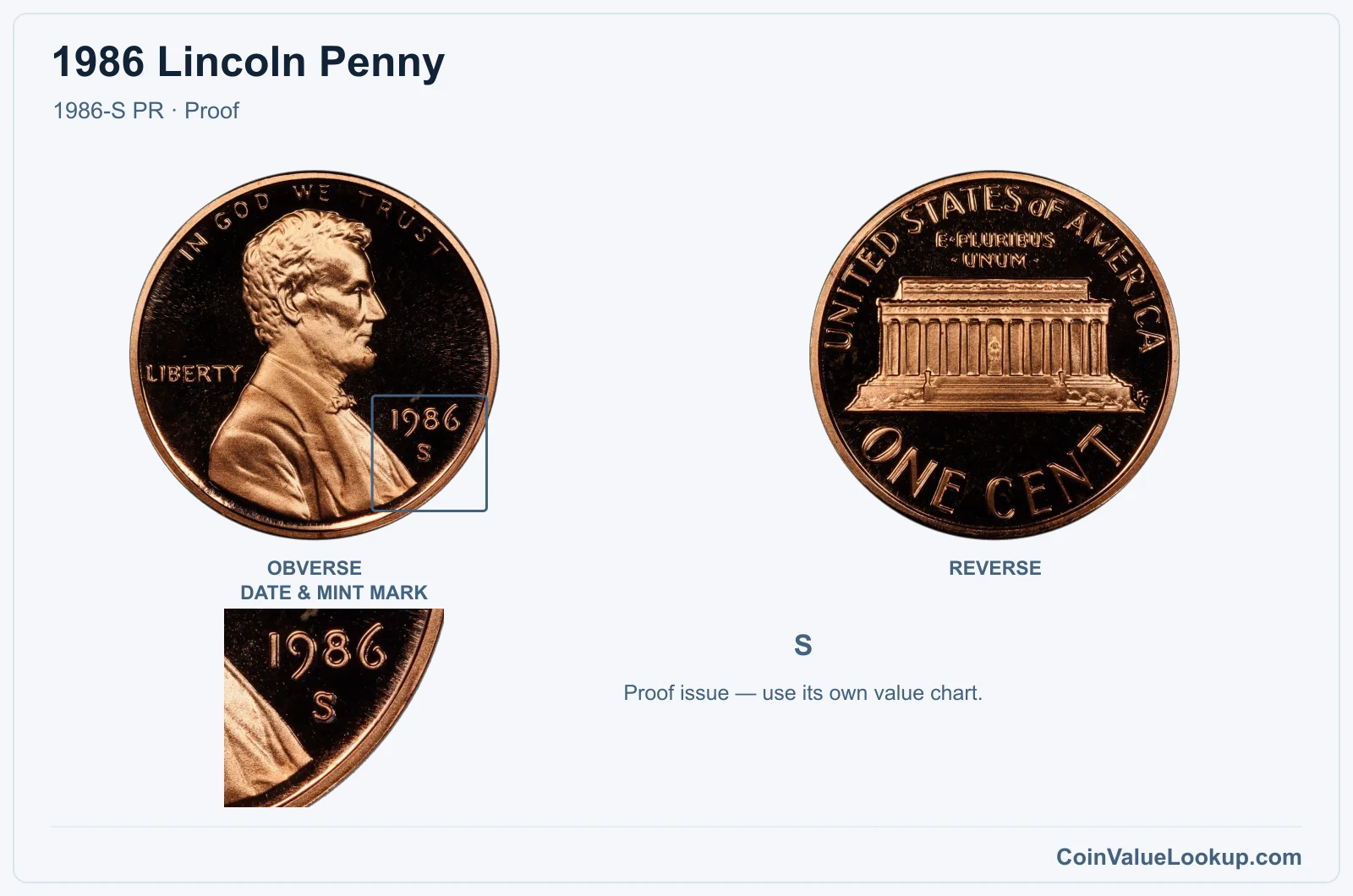
The 1986-S proof penny was struck at San Francisco exclusively for collector sets. It features mirror fields and frosted design elements on the same copper-plated zinc planchet.
The USA Coin Book guide estimate for PR65 is about $8.64.
There was no 1986-S business strike for circulation. If your penny has an S mintmark and mirror-like surfaces, it came from a proof set.
Grading focuses on hairlines, spots, and plating condition. Cameo (CAM) and deep cameo (DCAM) designations describe the degree of contrast between frosted devices and reflective fields, and stronger contrast is preferred by collectors.
Handle these by the edges only.
| Range | Grade | Price | Auction Records | Appraisal |
|---|---|---|---|---|
| PR | PR 1 | — | Coin Identifier | |
| PR 2 | — | Coin Identifier | ||
| PR 3 | — | Coin Identifier | ||
| PR 4 | — | Coin Identifier | ||
| PR 6 | — | Coin Identifier | ||
| PR 8 | — | Coin Identifier | ||
| PR 10 | — | Coin Identifier | ||
| PR 12 | — | Coin Identifier | ||
| PR 15 | — | Coin Identifier | ||
| PR 20 | — | Coin Identifier | ||
| PR 25 | — | Coin Identifier | ||
| PR 30 | — | Coin Identifier | ||
| PR 35 | — | Coin Identifier | ||
| PR 40 | — | Coin Identifier | ||
| PR 45 | — | Coin Identifier | ||
| PR 50 | — | Coin Identifier | ||
| PR 53 | — | Coin Identifier | ||
| PR 55 | — | Coin Identifier | ||
| PR 58 | — | Coin Identifier | ||
| PR 60 | — | Coin Identifier | ||
| PR 61 | — | Coin Identifier | ||
| PR 62 | — | Coin Identifier | ||
| PR 63 | — | Coin Identifier | ||
| PR 64 | — | Coin Identifier | ||
| PR 65 | — | Coin Identifier | ||
| PR 66 | — | Coin Identifier | ||
| PR 67 | — | Coin Identifier | ||
| PR 68 | Coin Identifier | |||
| PR 69 | Coin Identifier | |||
| PR 70 | Coin Identifier |
1986 Lincoln Penny Error List
1. 1986 Lincoln Penny — Unplated Zinc Blank
A genuine unplated 1986-D cent was struck on a zinc planchet that never received its copper coating. The entire coin appears silvery-gray with a matte zinc texture, yet all design details are fully struck.
Authentication is critical here. Coins that have been chemically stripped of their plating, or those where the plating has corroded away, look superficially similar but carry no collector premium.
A genuine unplated blank typically weighs slightly less than a plated example, and the surface texture is uniform rather than patchy.
A PCGS MS64 example of this error sold for $138 in January 2011. That is one recorded sale, not a guaranteed price for every gray 1986-D penny you find.
Condition, surface quality, and third-party authentication all factor into what a specific coin brings.
2. 1986 Lincoln Penny — Double Strike with Uniface Second Strike
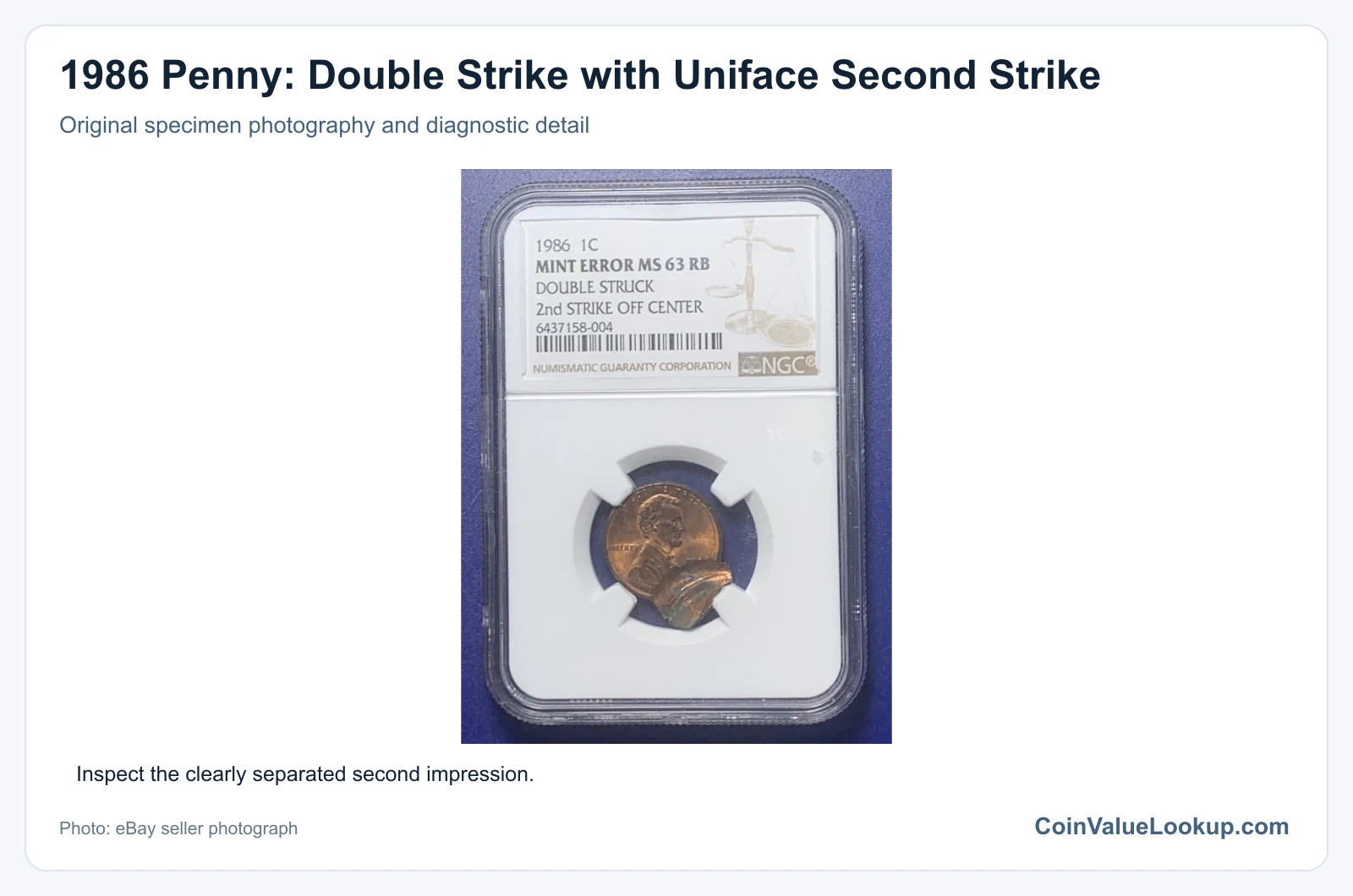
This error on a 1986-D cent shows two separate impressions from the dies. The second strike landed roughly 90% off center and is uniface, meaning one side received a design impression while another blank blocked the opposite die during the second hit.
The result is dramatic: you see the normal first strike plus a partial second impression displaced near the coin's edge, visible on only one face. This is mechanically different from machine doubling, which produces flat, shelf-like distortion on a single impression.
Post-mint pressing or vise damage can mimic a second strike, so look for properly formed rims and struck detail in the secondary impression. An ANACS MS63 Red example sold for $336 in January 2022.
That is a single auction result for a specific grade and holder, not a general market price.
3. 1986 Lincoln Penny — Off-Center Strike
An off-center 1986-D cent results from the planchet being misaligned with the dies during striking. This leaves a blank crescent on one side and a displaced, partial design on the rest.
The key collecting requirement is that the date and D mintmark remain visible, which confirms the year and mint. An 85% off-center example is extreme; most of the planchet is blank with only a small wedge of design showing.
Without a readable date, attribution becomes impossible and value drops.
Look for clean, struck edges on the design portion and a smooth unstruck area, not a ragged or bent edge. An ANACS MS60 example struck 85% off center sold for $456 in August 2021.
Severity, eye appeal, and retained date all influence what a particular specimen is worth.
4. 1986 Lincoln Penny — Doubled Die Obverse
A doubled die obverse on a 1986 cent shows consistent doubling in the design elements, lettering, or date on Lincoln's side of the coin. Under magnification, look for separation or notching on letters in LIBERTY, IN GOD WE TRUST, or the date numerals.
The doubling should appear uniform across the affected area. Compare your coin to a normal 1986 cent under the same light and magnification.
Genuine hub doubling produces raised, split lines, while machine doubling leaves flat, shelf-like distortion with a different texture.
Reflections from proof-like surfaces or simply worn dies can also mimic doubling to the untrained eye. Condition, the strength of visible doubling, and professional authentication all affect what a doubled die commands.
No specific price is adopted for this category.
5. 1986 Lincoln Penny — BIE Die Break
A BIE die break on a 1986 cent refers to a small raised vertical line or blob that appears between the letters B and E in LIBERTY. It is caused by a crack or chip in the die, which fills with metal during striking and transfers a bump onto the finished coin.
Inspect the space between B and E closely with a loupe. The break should be raised above the field, with a consistent metallic texture.
Dirt, adhesive residue, or a scratch can sit in that same spot, but those are typically recessed or loose rather than raised and integral.
The size, shape, and sharpness of the break matter to collectors. Value depends on condition and the prominence of the feature; no specific price is adopted for this category.
6. 1986 Lincoln Penny — Broadstrike
A broadstrike on a 1986 cent happens when the coin is struck without the retaining collar that normally constrains the planchet. The metal spreads outward, making the coin wider than normal with a thinner, undefined rim.
Check the edge profile. A broadstruck coin will have a rounded or flattened edge rather than the normal reeded-look plain edge with a sharp rim.
The full design should still be present, just slightly expanded. This distinguishes it from an off-center strike, where part of the design is missing entirely.
Coins flattened after leaving the mint, such as by a railroad track or vise, can look spread out too, but they lack the proper die detail and show distorted lettering. Value depends on condition and the degree of spread; no specific price is adopted for this category.
7. 1986 Lincoln Penny — Brockage
A brockage on a 1986 cent occurs when a previously struck coin sticks to a die and impresses its design into the next blank that enters the press. The result is one normal side and one side showing an incuse (sunken), mirror-image impression of the stuck coin's design.
The mirror-image detail is the giveaway. Look at the reversed side: letters and design elements read backward and sit below the surface rather than raised.
Compare this to a die clash, which leaves faint ghosted design elements but not a full incuse mirror image.
Post-mint pressing of two coins together can imitate this, but the transferred detail will be softer and the coin often shows edge damage. Value depends on condition, completeness of the brockage impression, and authentication; no specific price is adopted for this category.
8. 1986 Lincoln Penny — Die Break / Cud
A die break or cud on a 1986 cent is caused by a piece of the die cracking and breaking away. The missing section produces a raised, featureless blob on the coin.
A true cud connects to the rim, while interior die breaks appear within the design field.
Look for a smooth, raised lump that replaces part of the normal design. The boundary between the cud and the intact design should be sharp and consistent.
A rim ding or corrosion spot can look similar, but those are typically recessed or rough-textured, not smoothly raised.
Bigger cuds and those that obliterate recognizable design elements tend to attract more collector interest. Value depends on size, location, and overall coin condition; no specific price is adopted for this category.
9. 1986 Lincoln Penny — Struck-Through Error
A struck-through error on a 1986 cent happens when foreign material, like grease, a thread, or a metal fragment, gets caught between the die and the planchet during striking. The result is a localized depression, a soft area of missing detail, or an impression of the object itself.
Grease fill-ins tend to produce smooth, shallow depressions. A retained foreign object leaves a more distinct impression and sometimes the object is still embedded.
Each type looks different and carries its own appeal.
Ordinary wear, cleaning scratches, and weak strikes from a tired die can all mimic struck-through errors. The key distinction is that a struck-through area is sharply bounded by normally struck detail around it.
Value depends on condition, the size and clarity of the obstruction, and authentication; no specific price is adopted for this category.