1968 Lincoln Penny Coin Value: How Much Is It Worth?
Most 1968 Lincoln pennies you pull from a jar are worth roughly a cent. In higher uncirculated grades with original copper color, a guide estimate from USA Coin Book places an MS65 example around $1.24.
The S mintmark appears on both business strikes and proofs, so seeing an S alone does not guarantee a premium. Condition, copper color preservation and verified errors are what separate a dollar coin from a much more valuable one.
Fast Way to Identify Your 1968 Lincoln Penny
Snap a clear photo of the front and back of your 1968 penny and upload both images to our identifier. It will help with a preliminary identification of your coin's version, mintmark and general condition.
This is not a substitute for professional authentication, but it gives you a solid starting point before deciding whether to pursue formal grading.
1968 Penny Value
Upload both sides of your 1968 Lincoln Penny.
Front Obverse
Upload photo
Back Reverse
Upload photo
Which 1968 Lincoln Penny Versions Are Worth Money?
- The 1968-S proof double broadstrike is a dramatic error where two strike impressions land on a broadstruck proof blank; an ANACS PR65 Red example sold for $4,312.50 in January 2008.
- A 1968 no-mintmark cent with a large 60% curved clip sold as NGC MS64 Red-Brown for $180 in June 2023, making major clipped planchets worth checking for.
- A 1968-D cent struck 65% off center brought $144 as NGC MS65 Red in June 2023; substantial off-center strikes that retain a readable date carry collector demand.
- Several die varieties have been reported for 1968, including a proof doubled die obverse, a D doubled die reverse and a D repunched mintmark; value depends on visibility and condition.
- A 1968-D cent struck on a silver dime planchet has been reported as a wrong-planchet error; authentication is essential because plated coins mimic the look.
Step 1: Identify Your 1968 Lincoln Penny Mint Mark and Version
The 1968 Lincoln cent carries the familiar Lincoln portrait on the obverse and the Lincoln Memorial on the reverse. The alloy is 95% copper and 5% zinc, weighing about 3.11 grams with a plain edge.
These are not the copper-plated zinc cents that came later.
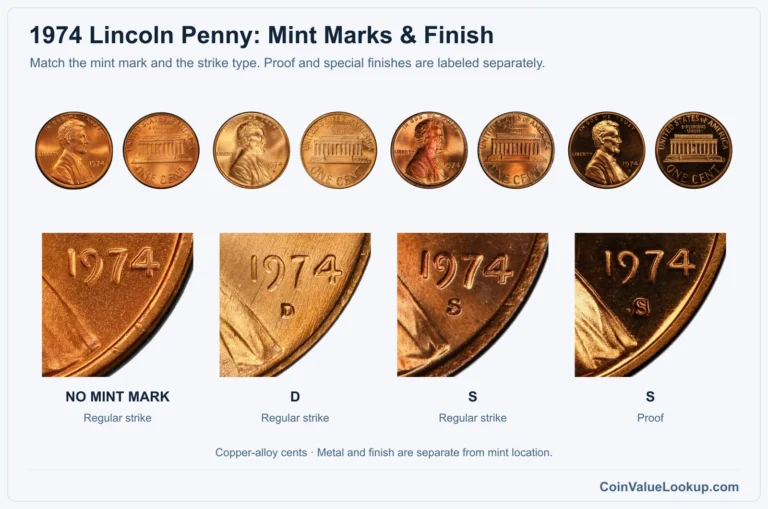
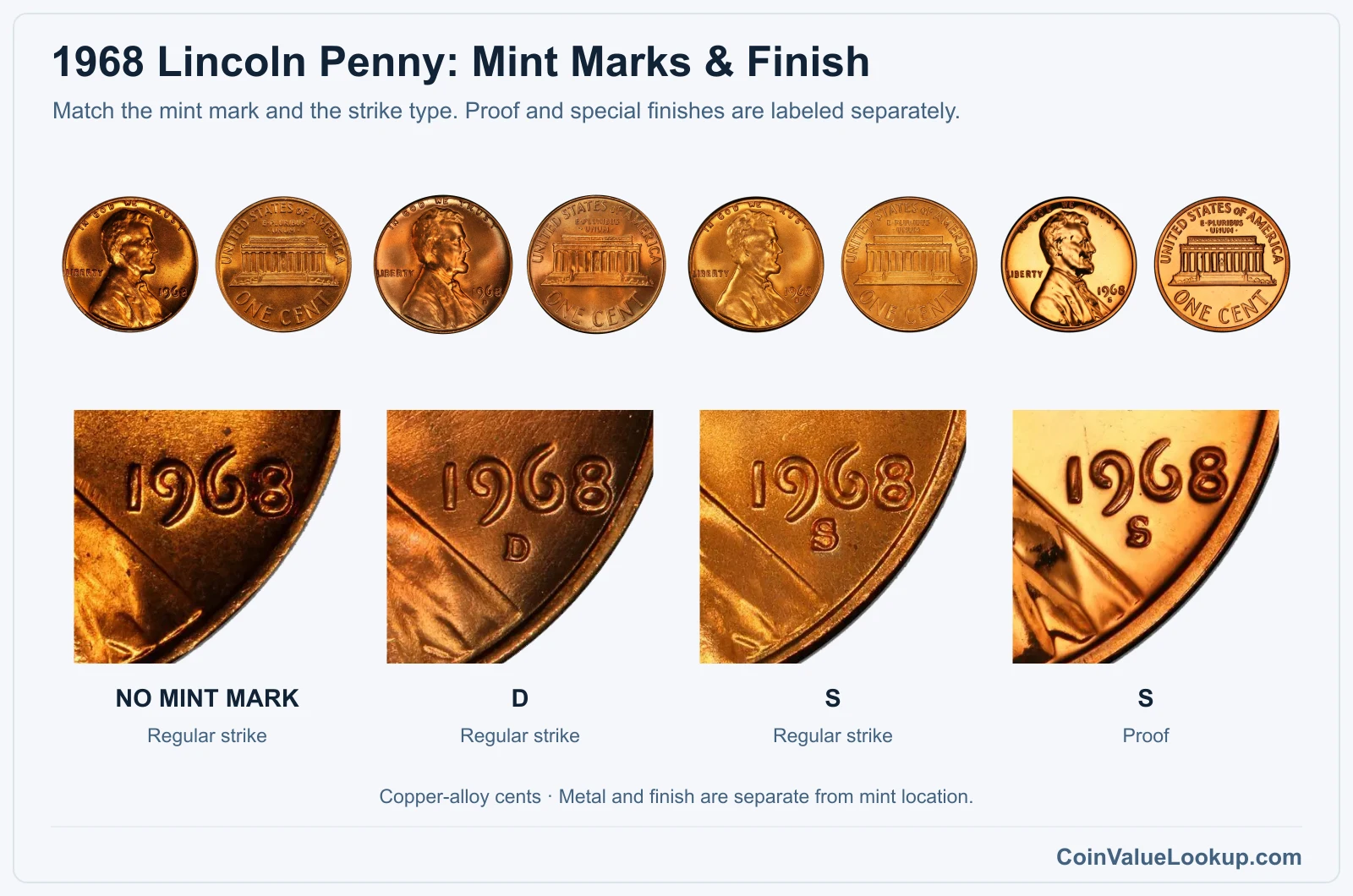
Check the date first. Then look just below it for a small letter: D for Denver, S for San Francisco, or no letter at all for the Philadelphia catalog branch.
The absence of a mintmark does not by itself confirm anything unusual.
Three business-strike branches exist: no mintmark, D and S. The S proof is a separate collector finish, not just another S coin.
Having an S under the date means you need to determine whether it is a business strike or a proof before comparing values.
Copper color matters for pricing. Red, Red-Brown and Brown describe how much original copper luster remains, not different metals.
A dark brown penny can still be uncirculated, while a suspiciously bright one may have been cleaned. Altered, plated or chemically treated coins are not errors.
Step 2: Check Your 1968 Lincoln Penny Grade
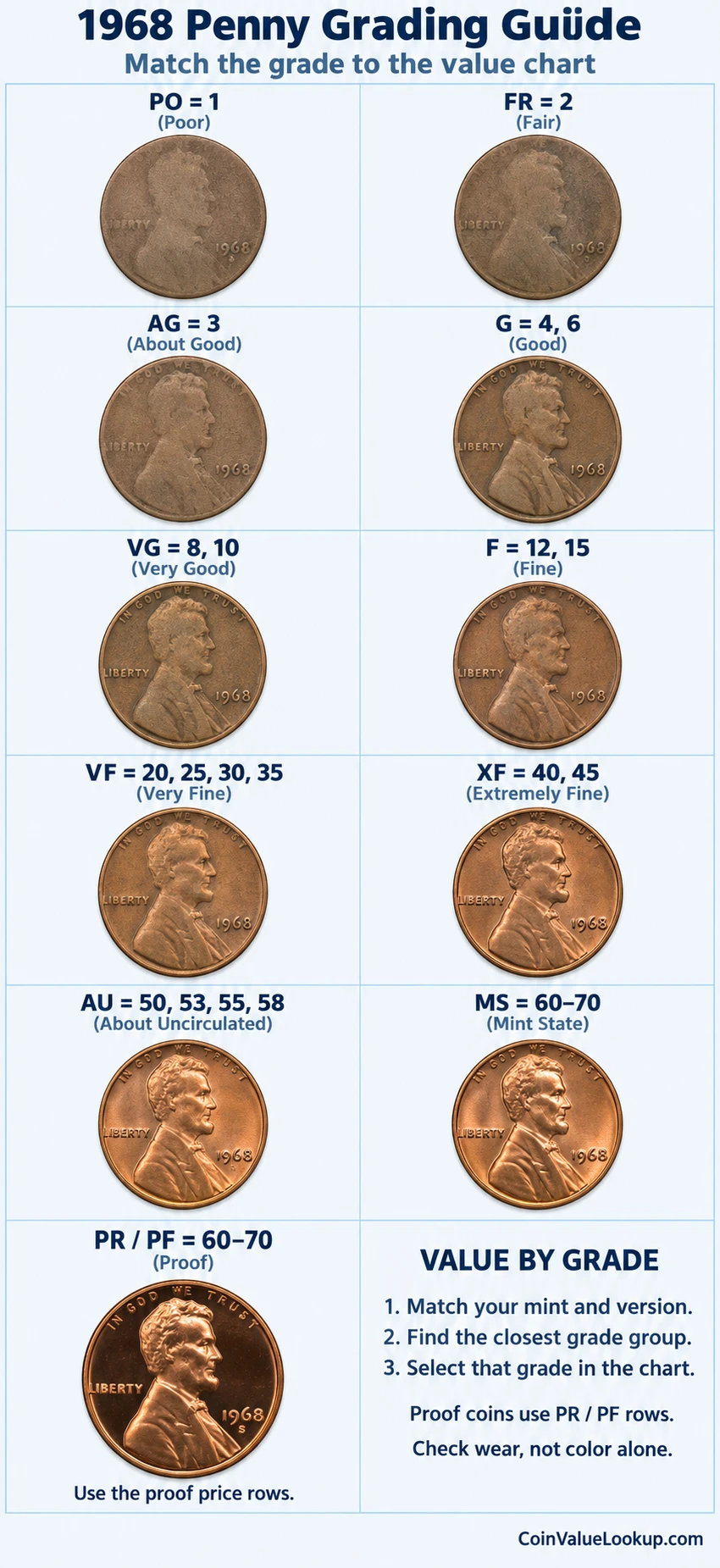
Start on the obverse. Lincoln's cheekbone, jawline and the hair detail above his ear show wear first.
If those areas are flat and smooth while the rest of the coin still has texture, you are looking at light to moderate circulation wear.
Flip it over. The Memorial columns and roofline lose sharpness early.
Compare your coin to the grading image to see how much detail remains at each level.
Separate contact marks from actual wear. A coin can have bag marks from being tossed around at the mint and still technically be uncirculated, because the high points never slid against another surface.
Remaining luster is your best friend here.
Proof coins are graded on a different scale. Hairline scratches from mishandling are the main enemy of proof grades.
Copper color designation (Red, Red-Brown, Brown) is applied separately from the numerical grade, so match both before looking up a value.
Step 3: Check 1968 Lincoln Penny Value by Mint and Version
1968 Lincoln Penny — No Mint Mark — Business
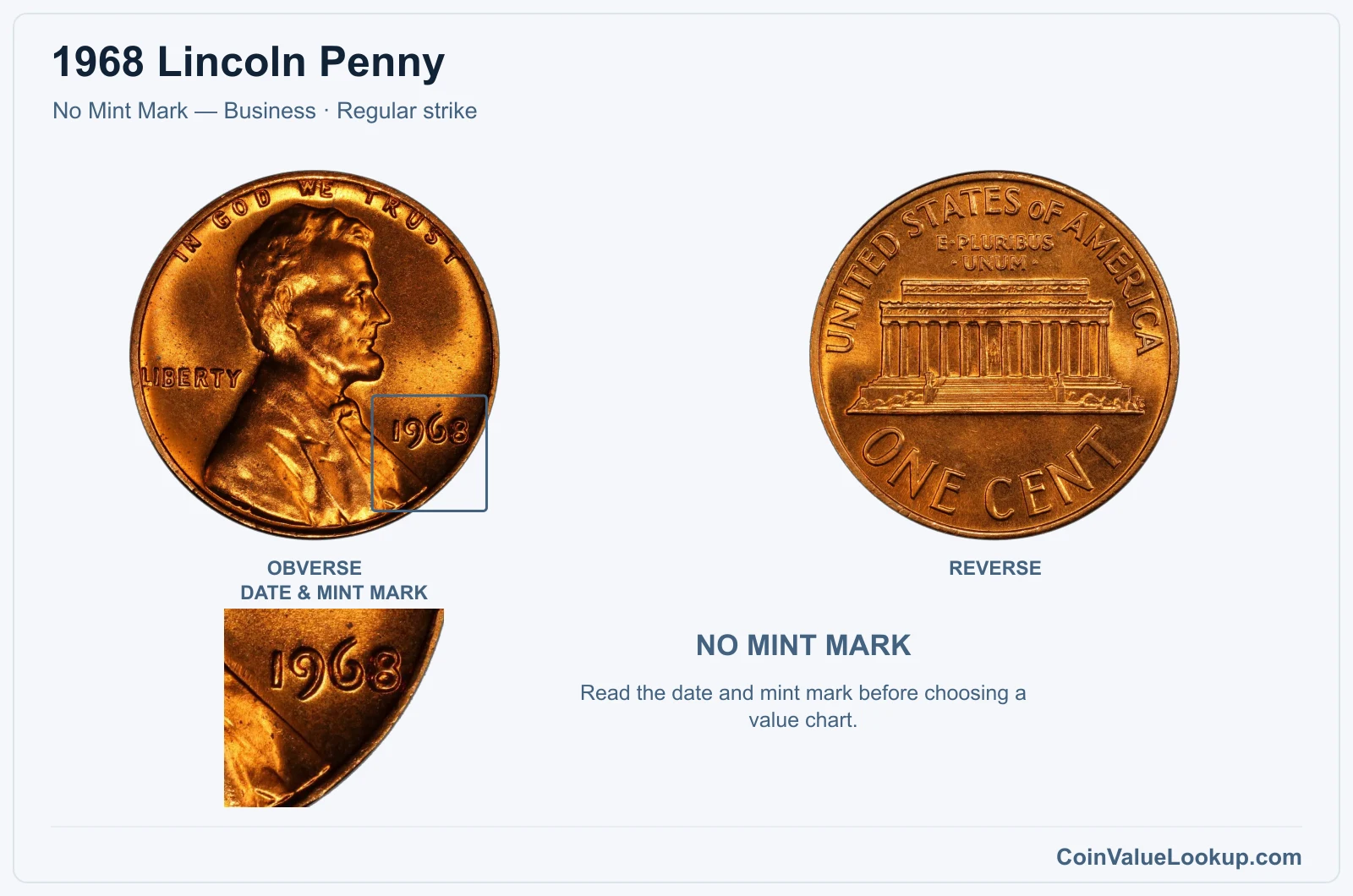
The no-mintmark 1968 penny is the Philadelphia catalog branch. Look below the date on the obverse: if there is no small letter, this is your coin.
Millions were struck for general circulation.
A USA Coin Book guide estimate places an MS65 example at about $1.24. That assumes full uncirculated surfaces with original luster.
In worn condition these are essentially face-value coins. Copper color designation (Red, Red-Brown or Brown) affects the price at every uncirculated grade, so confirm both the grade and color before comparing to any published value.
Range Grade
Price1968 No Mint Mark — Business (BN) Price1968 No Mint Mark — Business (RB) Price1968 No Mint Mark — Business (RD) Auction Records Appraisal PO PO 1
—
Coin Identifier FR FR 2
—
Coin Identifier AG AG 3
—
Coin Identifier G G 4
—
Coin Identifier
G 6
—
Coin Identifier VG VG 8
—
Coin Identifier
VG 10
—
Coin Identifier F F 12
—
Coin Identifier
F 15
—
Coin Identifier VF VF 20
—
Coin Identifier
VF 25
—
Coin Identifier
VF 30
—
Coin Identifier
VF 35
—
Coin Identifier XF XF 40
—
Coin Identifier
XF 45
—
Coin Identifier AU AU 50
—
Coin Identifier
AU 53
—
Coin Identifier
AU 55
—
Coin Identifier
AU 58
—
Coin Identifier MS MS 60
—
—
Coin Identifier
MS 61
—
—
Coin Identifier
MS 62
—
Coin Identifier
MS 63
Coin Identifier
MS 64
Coin Identifier
MS 65
Coin Identifier
MS 66
—
Coin Identifier
MS 67
—
Coin Identifier
MS 68
—
—
—
—
—
MS 69
—
—
—
—
—
MS 70
—
—
—
—
—
1968 Lincoln Penny — D — Business
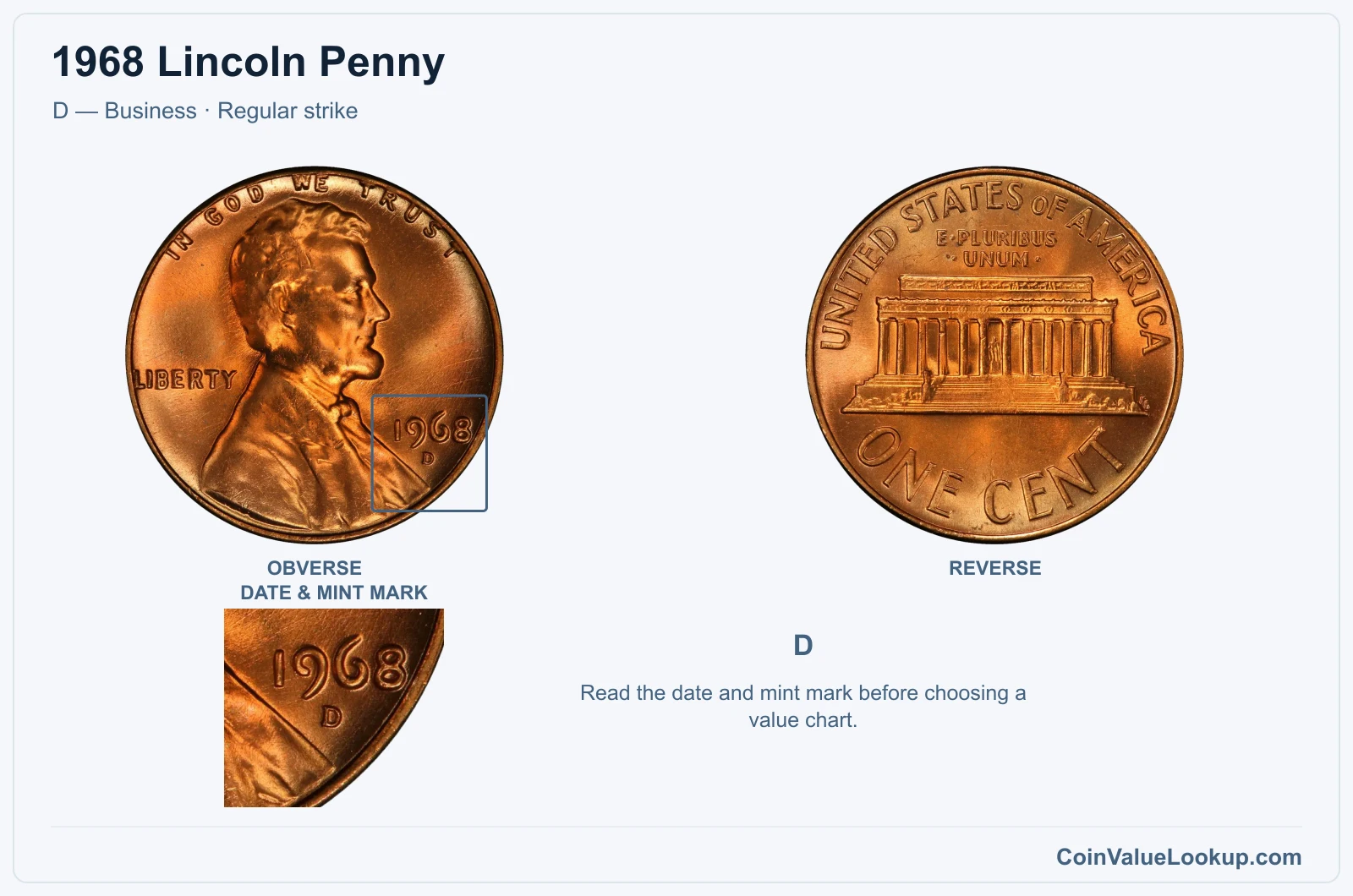
The 1968-D penny was struck at the Denver Mint. You will see a small D below the date on the obverse.
Like the no-mintmark issue, it is a high-mintage circulation coin.
At MS65 the USA Coin Book guide estimate is $1.24. Worn examples are common and trade near face value.
The D mintmark should be sharp and clearly positioned; any unusual doubling, tilting or secondary impression around the letter could indicate a repunched mintmark or other variety worth a closer look. Grade and copper color both matter when comparing prices.
Range Grade
Price1968 D — Business (BN) Price1968 D — Business (RB) Price1968 D — Business (RD) Auction Records Appraisal PO PO 1
—
Coin Identifier FR FR 2
—
Coin Identifier AG AG 3
—
Coin Identifier G G 4
—
Coin Identifier
G 6
—
Coin Identifier VG VG 8
—
Coin Identifier
VG 10
—
Coin Identifier F F 12
—
—
Coin Identifier
F 15
—
—
Coin Identifier VF VF 20
—
—
Coin Identifier
VF 25
—
—
Coin Identifier
VF 30
—
Coin Identifier
VF 35
—
Coin Identifier XF XF 40
—
Coin Identifier
XF 45
—
Coin Identifier AU AU 50
—
Coin Identifier
AU 53
—
Coin Identifier
AU 55
—
Coin Identifier
AU 58
—
Coin Identifier MS MS 60
—
—
Coin Identifier
MS 61
—
Coin Identifier
MS 62
—
Coin Identifier
MS 63
—
Coin Identifier
MS 64
Coin Identifier
MS 65
Coin Identifier
MS 66
—
Coin Identifier
MS 67
—
Coin Identifier
MS 68
—
—
—
—
—
MS 69
—
—
—
—
—
MS 70
—
—
—
—
—
1968 Lincoln Penny — S — Business
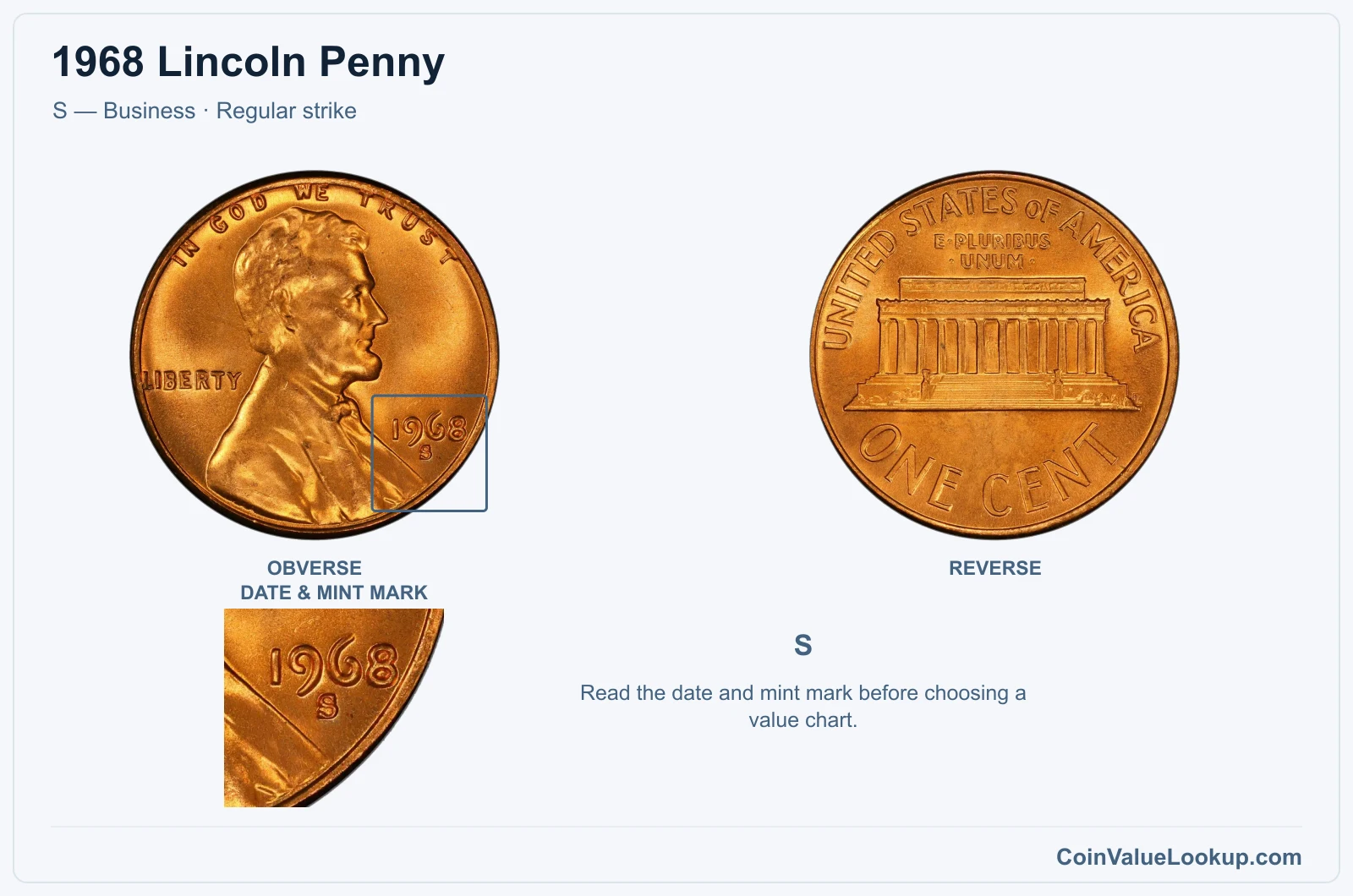
San Francisco also struck business-issue cents in 1968, marked with a small S below the date. This is not a proof.
The distinction matters because the S proof is a completely different product with a mirror finish.
A business-strike 1968-S in MS65 carries a USA Coin Book guide estimate of $1.24. Circulated examples are common.
If your coin has an S but shows normal luster rather than a mirror-like field, it belongs in this business-strike category. Check copper color and grade carefully before pricing.
Coin Value Lookup is a handy place to look up guides for other dates and denominations if you are working through a collection.
Range Grade
Price1968 S — Business (BN) Price1968 S — Business (RB) Price1968 S — Business (RD) Auction Records Appraisal PO PO 1
—
Coin Identifier FR FR 2
—
Coin Identifier AG AG 3
—
Coin Identifier G G 4
—
Coin Identifier
G 6
—
Coin Identifier VG VG 8
—
Coin Identifier
VG 10
—
Coin Identifier F F 12
—
Coin Identifier
F 15
—
Coin Identifier VF VF 20
—
Coin Identifier
VF 25
—
Coin Identifier
VF 30
—
Coin Identifier
VF 35
—
Coin Identifier XF XF 40
—
Coin Identifier
XF 45
—
Coin Identifier AU AU 50
—
Coin Identifier
AU 53
—
Coin Identifier
AU 55
—
Coin Identifier
AU 58
—
Coin Identifier MS MS 60
—
—
Coin Identifier
MS 61
—
Coin Identifier
MS 62
—
Coin Identifier
MS 63
Coin Identifier
MS 64
Coin Identifier
MS 65
Coin Identifier
MS 66
Coin Identifier
MS 67
—
Coin Identifier
MS 68
—
—
—
Coin Identifier
MS 69
—
—
—
—
—
MS 70
—
—
—
—
—
1968 Lincoln Penny — S — Proof
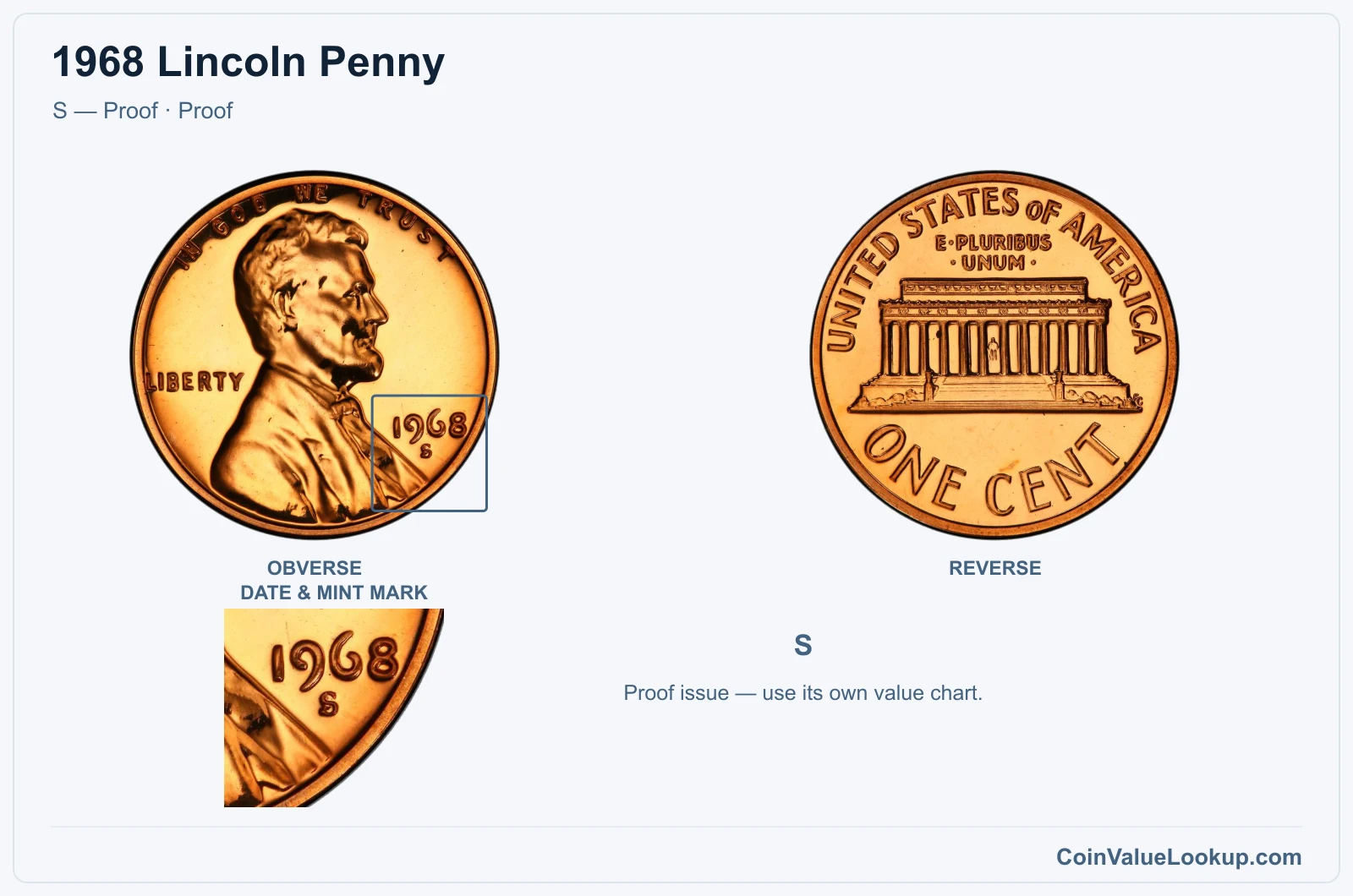
The 1968-S proof penny was made at the San Francisco Mint specifically for collector proof sets. It has mirror-like fields, sharp design edges and an S mintmark.
Surface hairlines from handling are the most common problem and can significantly reduce the grade.
A PR65 example carries a USA Coin Book guide estimate of about $1.24. Cameo contrast, where the devices appear frosted against mirror fields, is a separate designation that may affect value but is not covered by this guide figure.
Proof coins should be compared only against other proofs, not against business-strike prices.
Range Grade
Price1968 S — Proof (CAM) Price1968 S — Proof (DCAM) Auction Records Appraisal PR PR 1
—
Coin Identifier
PR 2
—
Coin Identifier
PR 3
—
Coin Identifier
PR 4
—
Coin Identifier
PR 6
—
Coin Identifier
PR 8
—
Coin Identifier
PR 10
—
Coin Identifier
PR 12
—
Coin Identifier
PR 15
—
Coin Identifier
PR 20
—
Coin Identifier
PR 25
—
Coin Identifier
PR 30
—
Coin Identifier
PR 35
—
Coin Identifier
PR 40
—
Coin Identifier
PR 45
—
Coin Identifier
PR 50
—
Coin Identifier
PR 53
—
Coin Identifier
PR 55
—
Coin Identifier
PR 58
—
Coin Identifier
PR 60
Coin Identifier
PR 61
—
Coin Identifier
PR 62
—
Coin Identifier
PR 63
—
Coin Identifier
PR 64
—
Coin Identifier
PR 65
Coin Identifier
PR 66
Coin Identifier
PR 67
Coin Identifier
PR 68
Coin Identifier
PR 69
Coin Identifier
PR 70
—
—
—
—
1968 Lincoln Penny Error List
1. 1968 Lincoln Penny — Proof Double Broadstrike
This is a 1968-S proof cent that was struck twice while broadstruck, meaning the collar die was not in place for either impression. The result is an oversized coin with two overlapping design impressions and an unusually raised, irregular edge.
One documented example was partly wrapped around the obverse die during striking.
An ANACS PR65 Red specimen sold for $4,312.50 in January 2008. That is a single recorded sale, not a guaranteed market range.
Look for two distinct, shifted sets of design details across the full coin, not just a slightly doubled letter. A normal proof that received routine multiple die impressions during manufacture or a business-strike broadstrike are not the same thing.
Professional authentication is essential for a claim this significant.
2. 1968 Lincoln Penny — Large Curved Clip
A large curved clip means a significant portion of the planchet was missing before the coin was struck. On a 1968 no-mintmark cent, one documented example had roughly 60% of the blank missing, leaving just 1.3 grams of metal with part of the design still impressed on what remained.
That NGC MS64 Red-Brown piece sold for $180 in June 2023. Look for the characteristic curved absence of metal along with flow lines from the strike pushing into the void.
The remaining design should show evidence of the metal stretching toward the missing area. A coin that has been deliberately cut or punched after striking will have sharp, clean edges at the missing section rather than the natural strike-flow pattern.
3. 1968 Lincoln Penny — Off-Center Strike
A 65% off-center 1968-D cent has most of its design pushed to one side, leaving a large blank crescent on the opposite edge. The coin was not centered between the dies when struck.
The date and the D mintmark must be visible or independently documented for the coin to be attributed to this year and mint.
An NGC MS65 Red example sold for $144 in June 2023. That is one auction result.
Do not confuse a slightly misaligned die, which shifts the design only a few percent, with a dramatic off-center strike. Also watch for coins that have been trimmed after striking to fake the blank crescent; the edge profile and strike flow should look natural under magnification.
4. 1968 Lincoln Penny — Proof Doubled Die Obverse
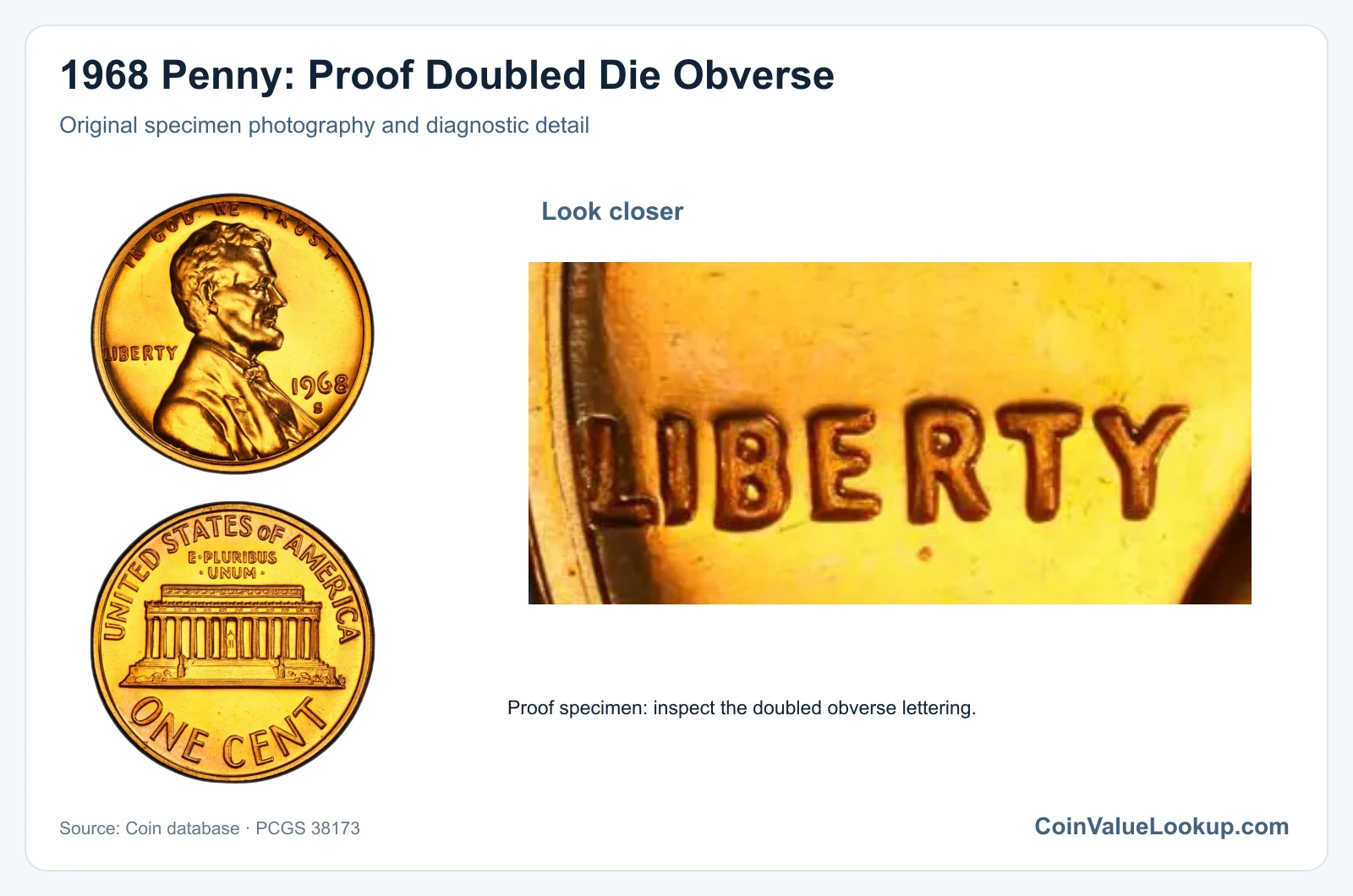
A proof doubled die obverse has been reported for the 1968-S proof cent. This variety shows consistent doubling on obverse letters or design elements, visible as separation or notching when compared side by side with a normal proof under the same lighting.
No specific price range is adopted here. Value depends on the degree of doubling, the coin's grade, copper color and surface quality.
Proof surfaces reveal doubling more clearly than business strikes, but they also reveal every handling mark.
The biggest lookalike is machine doubling, which produces a flat, shelf-like distortion rather than the rounded, separated profiles of a true doubled die. Reflections on proof fields can also trick the eye.
Compare at matching magnification and angle before drawing conclusions.
5. 1968 Lincoln Penny — Doubled Die Reverse
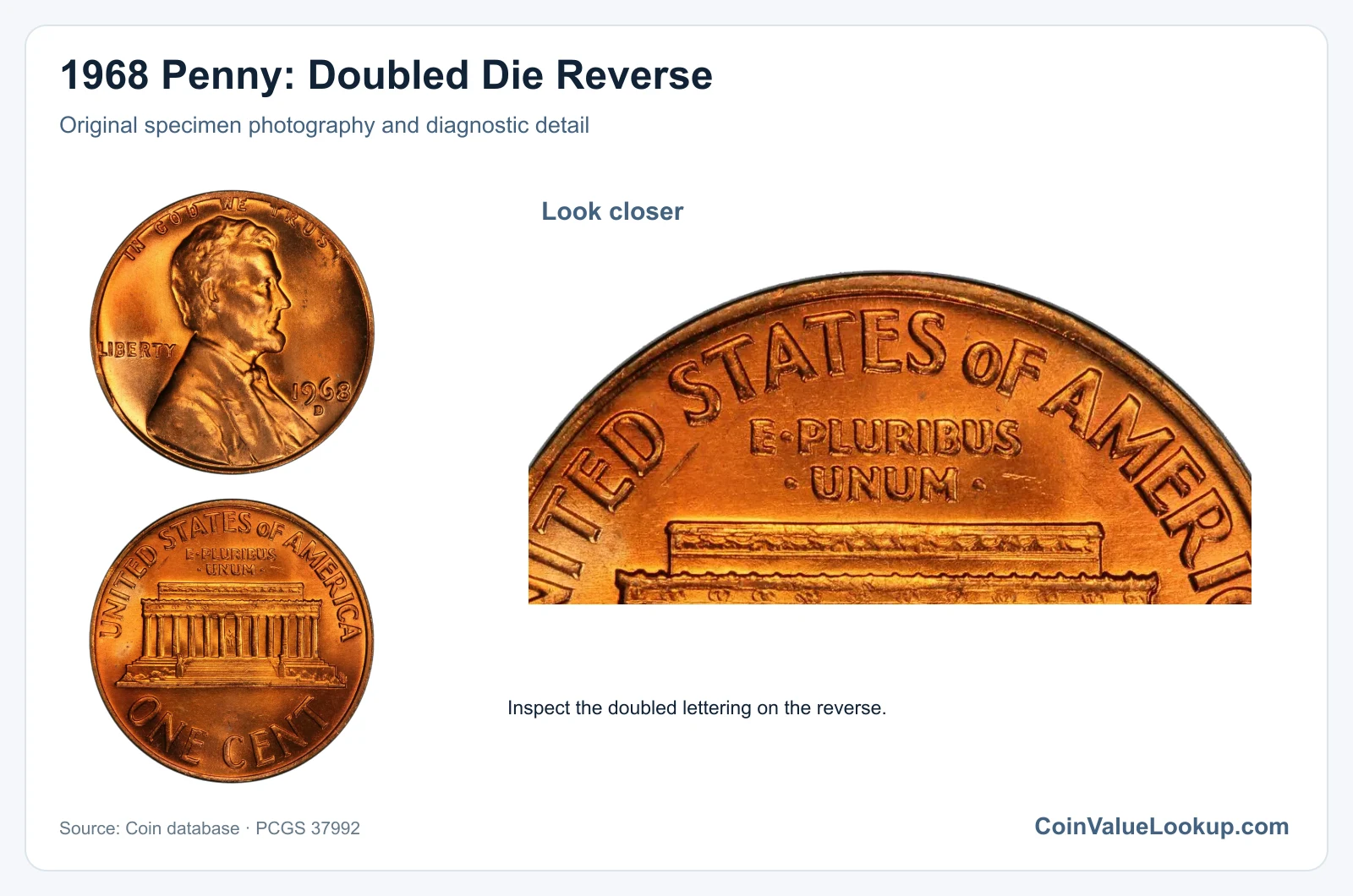
A doubled die reverse has been reported for the 1968-D business-strike cent. The doubling appears on reverse legends or design contours.
To check, compare your coin's reverse lettering and the Memorial design closely against a normal 1968-D under good magnification.
No numerical price range is adopted. The value of any doubled die depends on visibility, the specific affected area, grade and copper color.
A strongly doubled reverse visible to the unaided eye is worth more than a faint separation only seen at 10x.
Machine doubling is the most common lookalike. It leaves flat, shelf-like distortions rather than the rounded, separated contours of a genuine doubled die.
Random nicks and corrosion can also mimic doubling at first glance.
6. 1968 Lincoln Penny — Repunched Mintmark
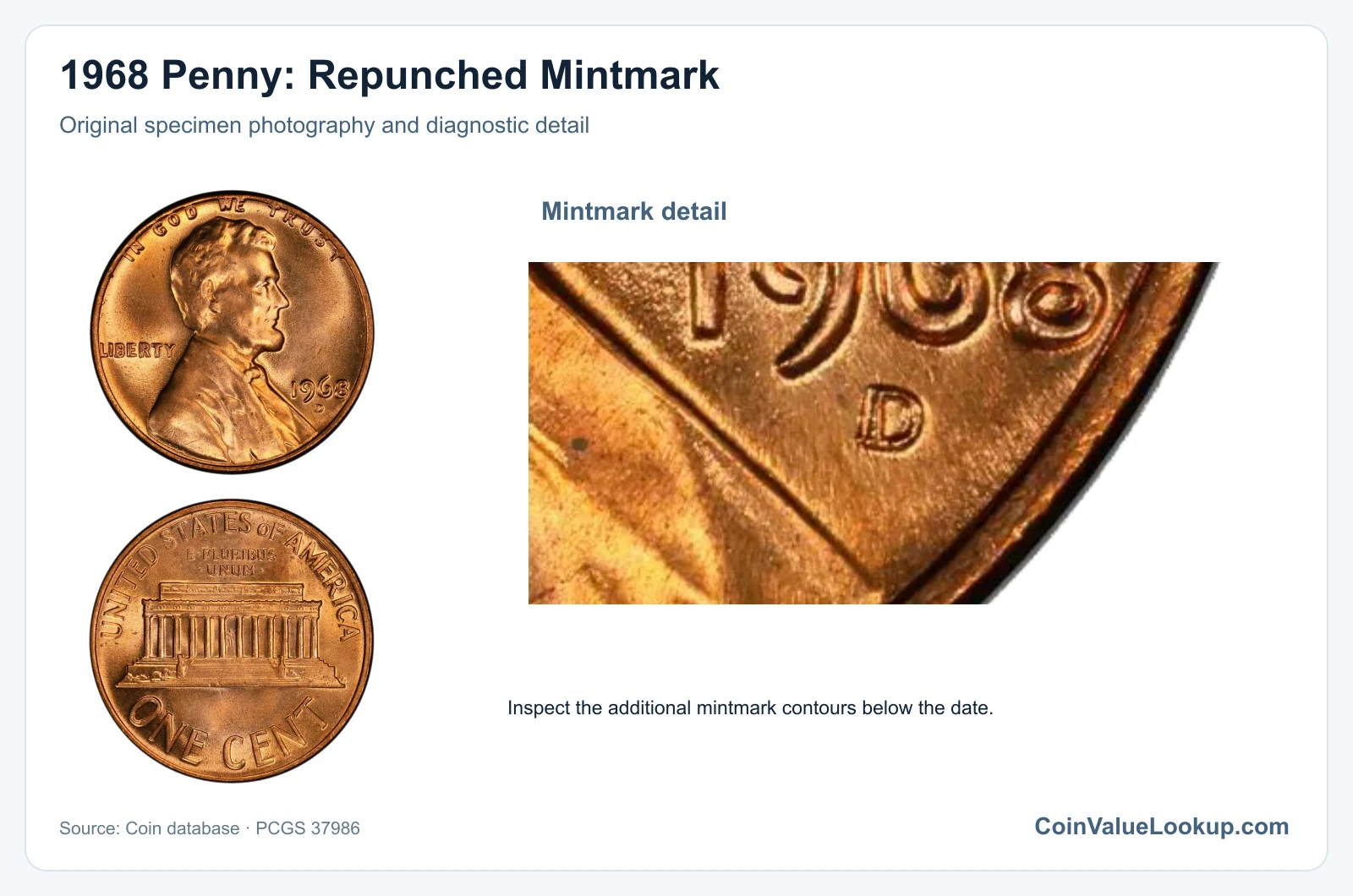
A repunched mintmark has been reported for the 1968-D cent. This occurs when the mintmark punch was applied more than once in slightly different positions, leaving a ghost image or extra notch near the D.
No specific price is adopted. Value depends on how dramatic the secondary punch impression is and the coin's overall condition.
Some repunched mintmarks are subtle enough to need 10x magnification; others jump out under a desk lamp.
Look carefully at the D below the date. Compare it at matching magnification with a normal 1968-D.
Machine doubling of the mintmark, die chips filling the letter, and corrosion around the punch can all mimic a repunched mark. A true repunched mintmark shows a distinct second position of the same letter shape.
7. 1968 Lincoln Penny — Struck on a Silver Dime Planchet
A 1968-D cent struck on a silver dime planchet has been reported. If genuine, the cent design was impressed on a blank intended for a dime, resulting in a coin that looks like a penny but is smaller, lighter or heavier than normal and has a silver-colored surface and possibly a reeded edge.
No numerical price is adopted. Authentication is absolutely critical for this type of error.
Measure the weight and compare it to the normal 3.11-gram copper cent specification. Examine the edge carefully.
The most common lookalike is a normal copper cent that has been plated with silver-colored metal after leaving the mint. Chemical alteration can also change a penny's surface color.
Silver color alone proves nothing. Professional third-party certification is the only reliable way to confirm a wrong-planchet error.
8. 1968 Lincoln Penny — Floating Roof / Overpolished Reverse
The floating roof variety, sometimes described as an overpolished reverse, has been reported for the 1968 cent. On affected coins, the connection between the Memorial roof and its supporting columns appears weakened or partially missing, making the roof look like it hovers above the building.
This is a minor die-state feature caused by die polishing at the mint, not a major production error. No price range is adopted.
Value depends on how pronounced the effect is and the coin's overall grade.
Do not confuse this with normal circulation wear, which also erodes fine lines between the roof and columns. On a floating-roof die state the rest of the coin's detail should be consistent with its grade.
Grease-filled dies can produce a similar look, and altered surfaces may mimic the effect. Compare the roof area against the detail level of surrounding design elements.