1961 Lincoln Penny Coin Value: How Much Is It Worth?
Most circulated 1961 Lincoln pennies are worth about what you would expect from a common-date cent — not much above face value. Uncirculated examples carry guide estimates around $0.18 at MS60 up to $1.24 at MS65 for either mint, while proof issues sit near $1.88 at PR65.
Where things get more interesting is original copper color, specific mintmark varieties like the D over a sideways D, and genuine striking errors that can push a single coin well beyond those modest anchors.
Fast Way to Identify Your 1961 Lincoln Penny
Snap a clear photo of the front and back of your 1961 penny and upload both images here. The identifier can provide a preliminary read on your coin's mint, finish and general version so you know what you are working with.
It is not a substitute for professional authentication, but it is a solid first step before you dig deeper.
1961 Penny Value
Upload both sides of your 1961 Lincoln Penny.
Front Obverse
Upload photo
Back Reverse
Upload photo
Which 1961 Lincoln Penny Versions Are Worth Money?
- The D over Sideways D mintmark variety on 1961-D cents is a recognized repunched mintmark worth examining under magnification.
- Original uncirculated Red copper color on either Philadelphia or Denver business strikes adds meaningfully to guide values beyond the date alone.
- Proof issues with strong cameo contrast and clean mirror fields occupy their own pricing tier above ordinary proofs.
- Wrong-planchet errors like the 1961 cent struck on a silver dime blank represent dramatic minting mistakes with individual sale prices well above normal.
- Double strikes and significant off-center strikes are scarce mechanical errors that collectors actively pursue for this date.
Step 1: Identify Your 1961 Lincoln Penny Mint Mark and Version
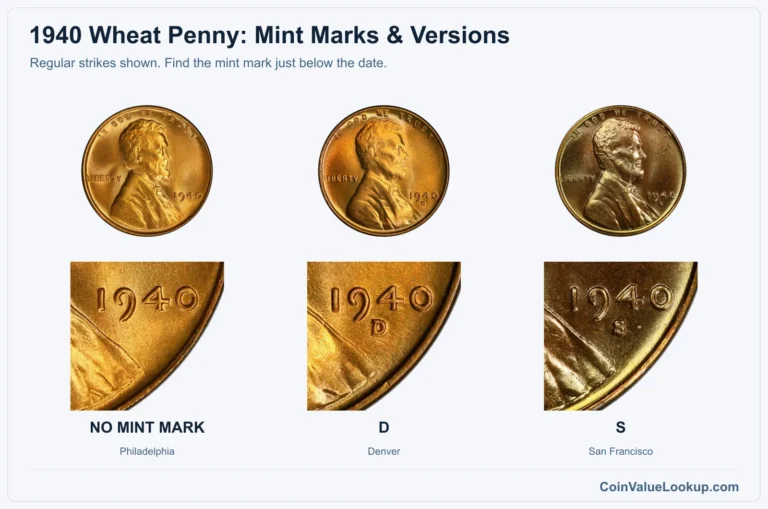
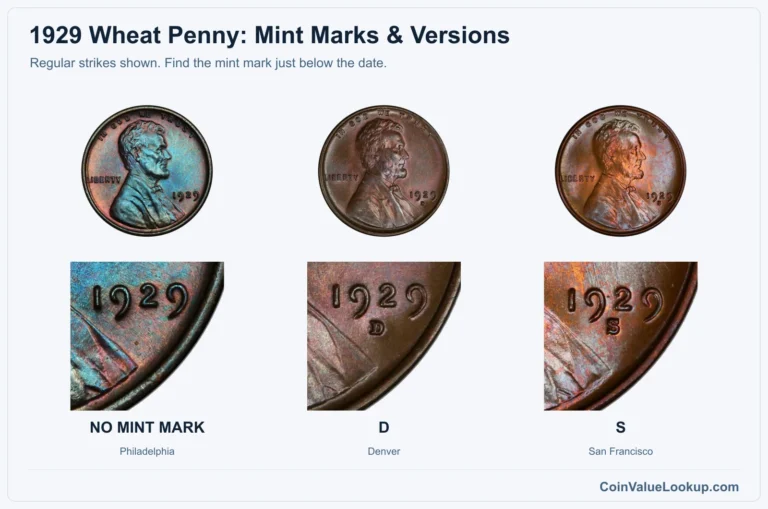
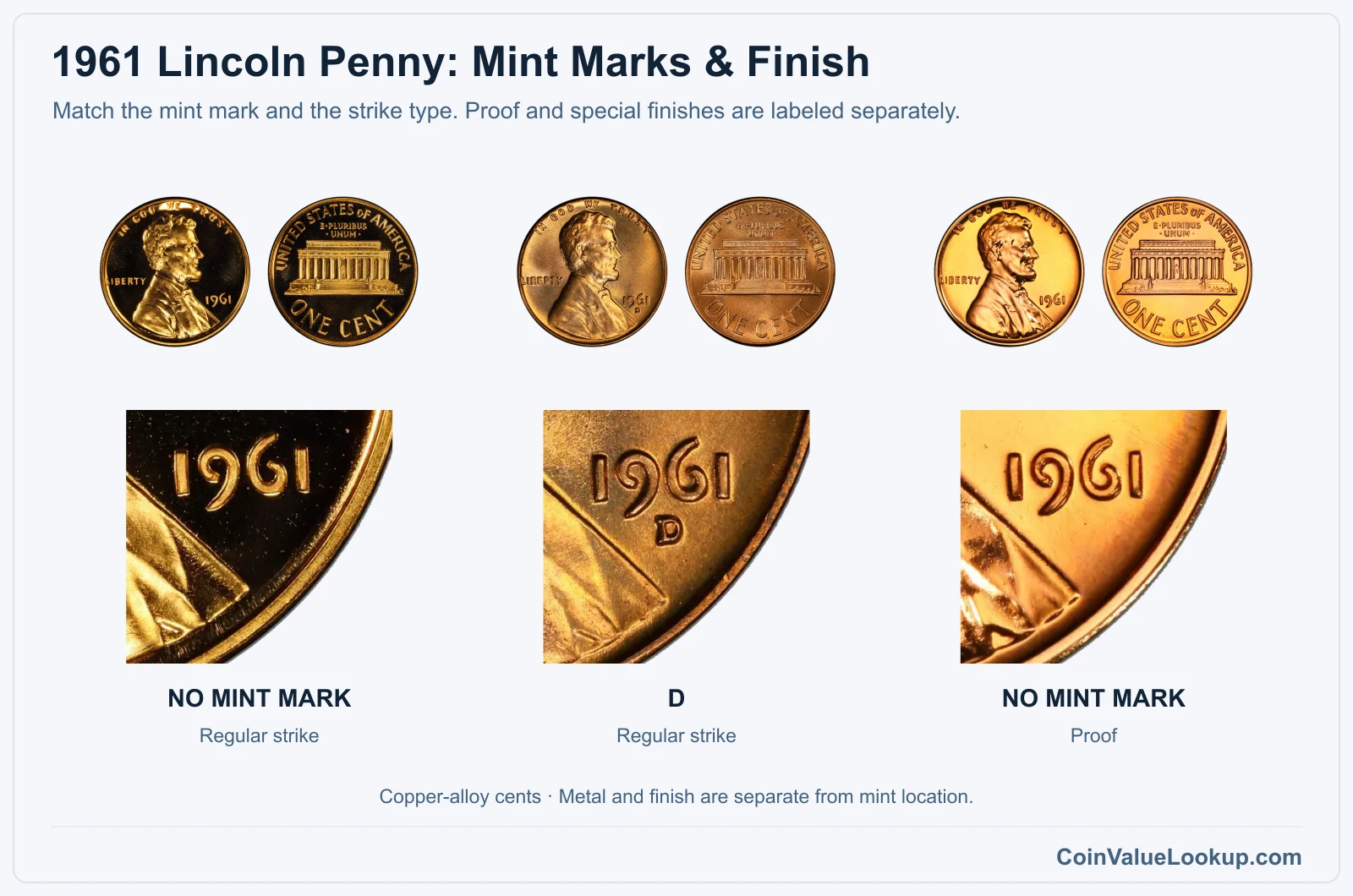
Look directly below the date on the obverse. No letter means Philadelphia.
A small D means Denver. There is no normal S-mint issue for this year.
All standard 1961 cents show the Lincoln portrait on the front and the Lincoln Memorial on the reverse, with a plain edge and a nominal weight of 3.11 grams. The alloy is 95% copper with the balance in tin and zinc — not the copper-plated zinc you see on later cents.
Do not confuse a shiny coin with a proof. Proofs were struck at Philadelphia without a mintmark, so you cannot separate them from business strikes by mint alone.
True proofs have mirror-like fields and squared-off rims from the proof manufacturing process, and they were sold in sealed sets. A business strike that has been polished is not a proof.
Red, Red-Brown and Brown are color designations that describe how much original copper luster remains, not different metals.
Step 2: Check Your 1961 Lincoln Penny Grade
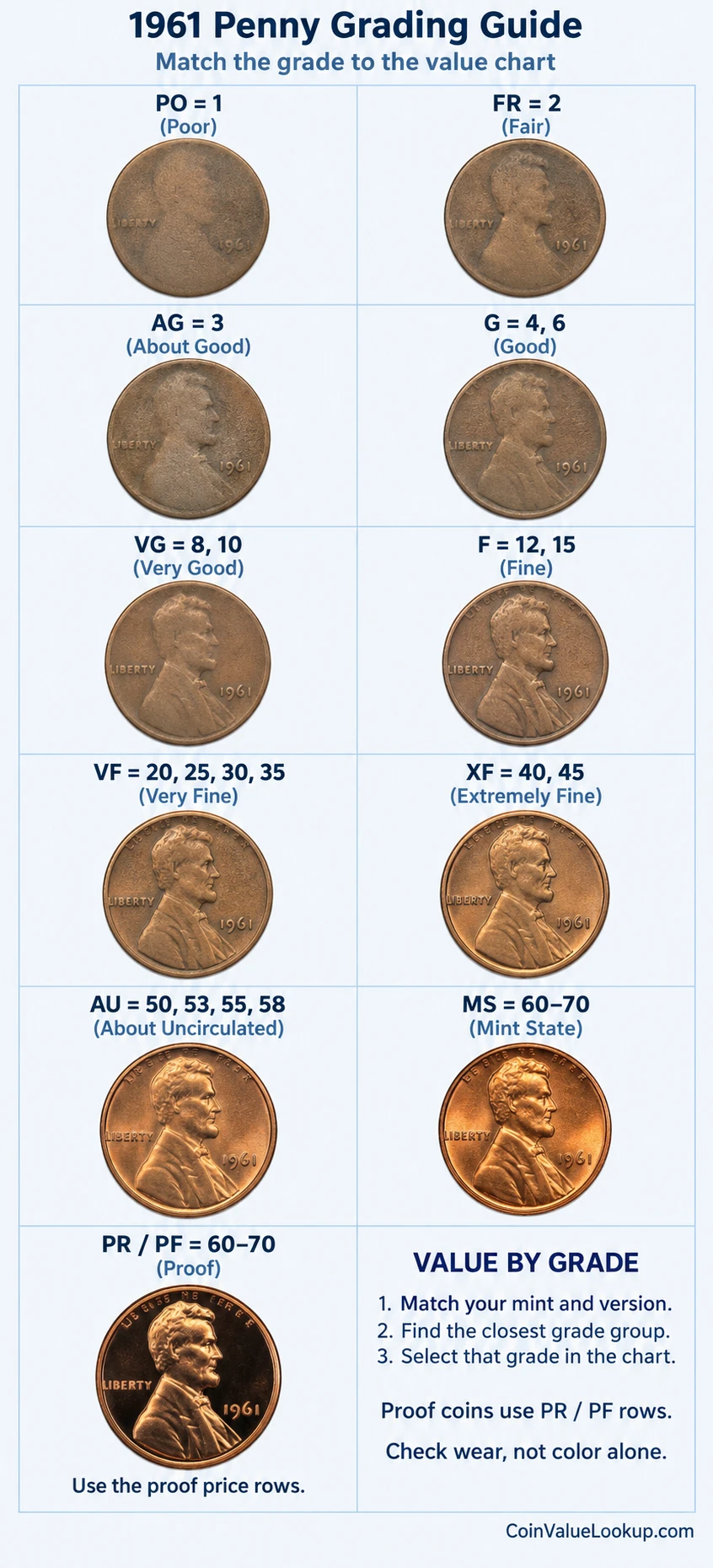
Start on the obverse. Lincoln's cheekbone, jawline and the hair detail just above his ear are the first spots to lose sharpness.
Even light circulation will soften those areas before anything else.
Flip the coin over and check the Memorial roof, the columns and especially the steps at the base. Sharp, distinct steps are a hallmark of a well-struck, unworn coin.
The difference between AU (About Uncirculated) and true Mint State comes down to luster continuity across the high points. A dark copper cent can still be uncirculated if the luster is unbroken under angled light.
A bright, shiny cent can be a cleaned coin with damaged surfaces. Use the comparison image to judge your coin's wear honestly.
Color matters for pricing. A full Red designation means the coin retains nearly all its original mint bloom.
Red-Brown is partial, and Brown means the copper has toned naturally. Cameo contrast on proofs — frosted devices against mirror fields — is a separate factor.
Whatever you do, do not clean a coin trying to make it look red. Cleaning destroys value every time.
Step 3: Check 1961 Lincoln Penny Value by Mint and Version
1961 Lincoln Penny — No Mint Mark — Business Strike
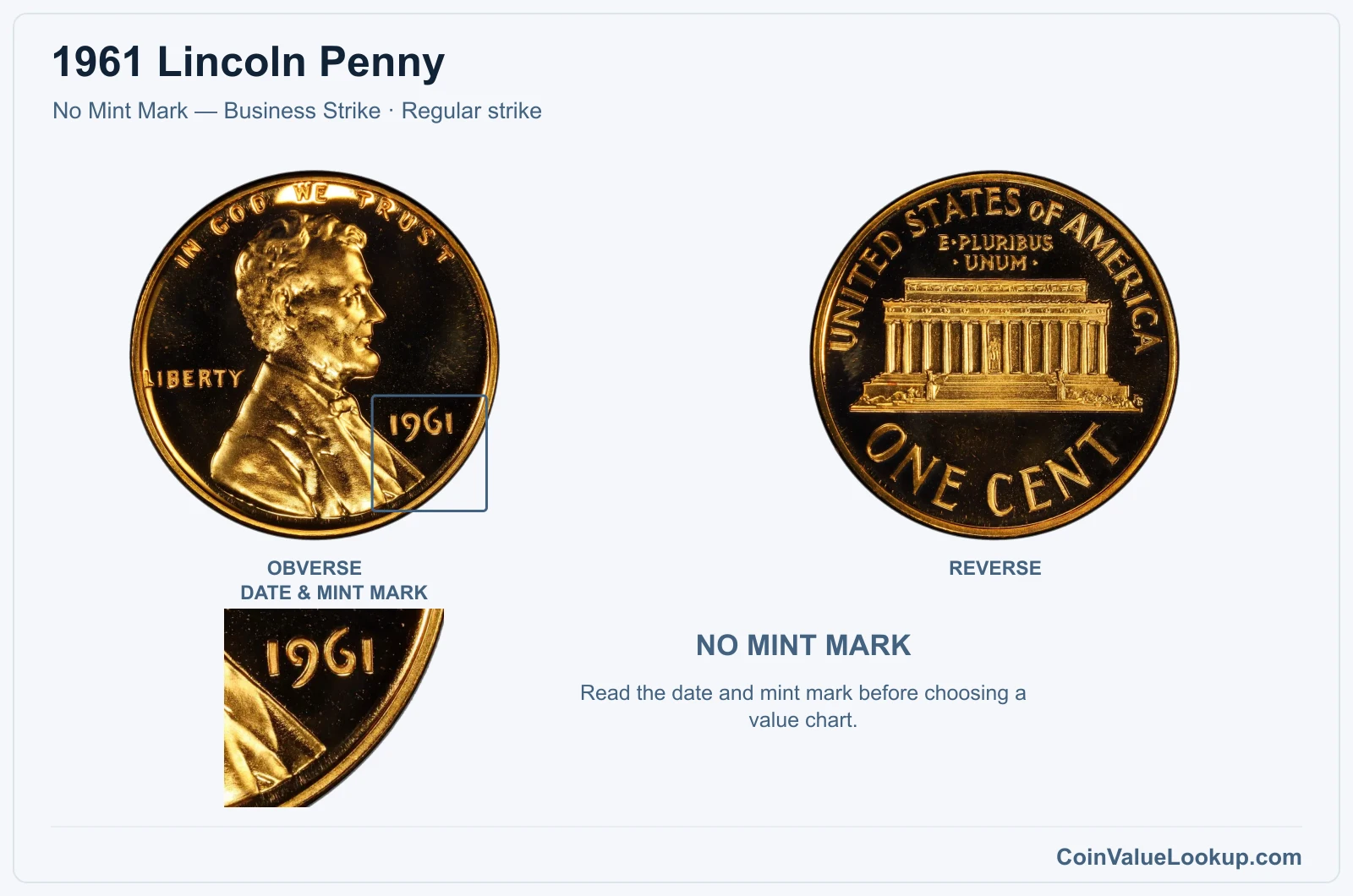
The Philadelphia business strike carries no mintmark and is the most commonly encountered version. It is a 95% copper alloy cent weighing about 3.11 grams.
Guide estimates from USA Coin Book place this coin around $0.18 at MS60 and $1.24 at MS65.
Condition and original copper color are what separate a dollar coin from a face-value coin here. A fully Red MS65 example will command the higher end of that range, while a Brown or spotted coin in the same technical grade will not.
Check for contact marks in the fields and luster breaks on Lincoln's cheek.
Range Grade
Price1961 No Mint Mark — Business Strike (BN) Price1961 No Mint Mark — Business Strike (RB) Price1961 No Mint Mark — Business Strike (RD) Auction Records Appraisal PO PO 1
—
Coin Identifier FR FR 2
—
Coin Identifier AG AG 3
—
Coin Identifier G G 4
—
Coin Identifier
G 6
—
Coin Identifier VG VG 8
—
Coin Identifier
VG 10
—
Coin Identifier F F 12
—
Coin Identifier
F 15
—
Coin Identifier VF VF 20
—
Coin Identifier
VF 25
—
Coin Identifier
VF 30
—
Coin Identifier
VF 35
—
Coin Identifier XF XF 40
—
Coin Identifier
XF 45
—
Coin Identifier AU AU 50
—
Coin Identifier
AU 53
—
Coin Identifier
AU 55
—
Coin Identifier
AU 58
—
Coin Identifier MS MS 60
—
—
Coin Identifier
MS 61
—
—
Coin Identifier
MS 62
—
Coin Identifier
MS 63
Coin Identifier
MS 64
Coin Identifier
MS 65
Coin Identifier
MS 66
—
Coin Identifier
MS 67
—
Coin Identifier
MS 68
—
—
—
—
—
MS 69
—
—
—
—
—
MS 70
—
—
—
—
—
1961 Lincoln Penny — D — Business Strike
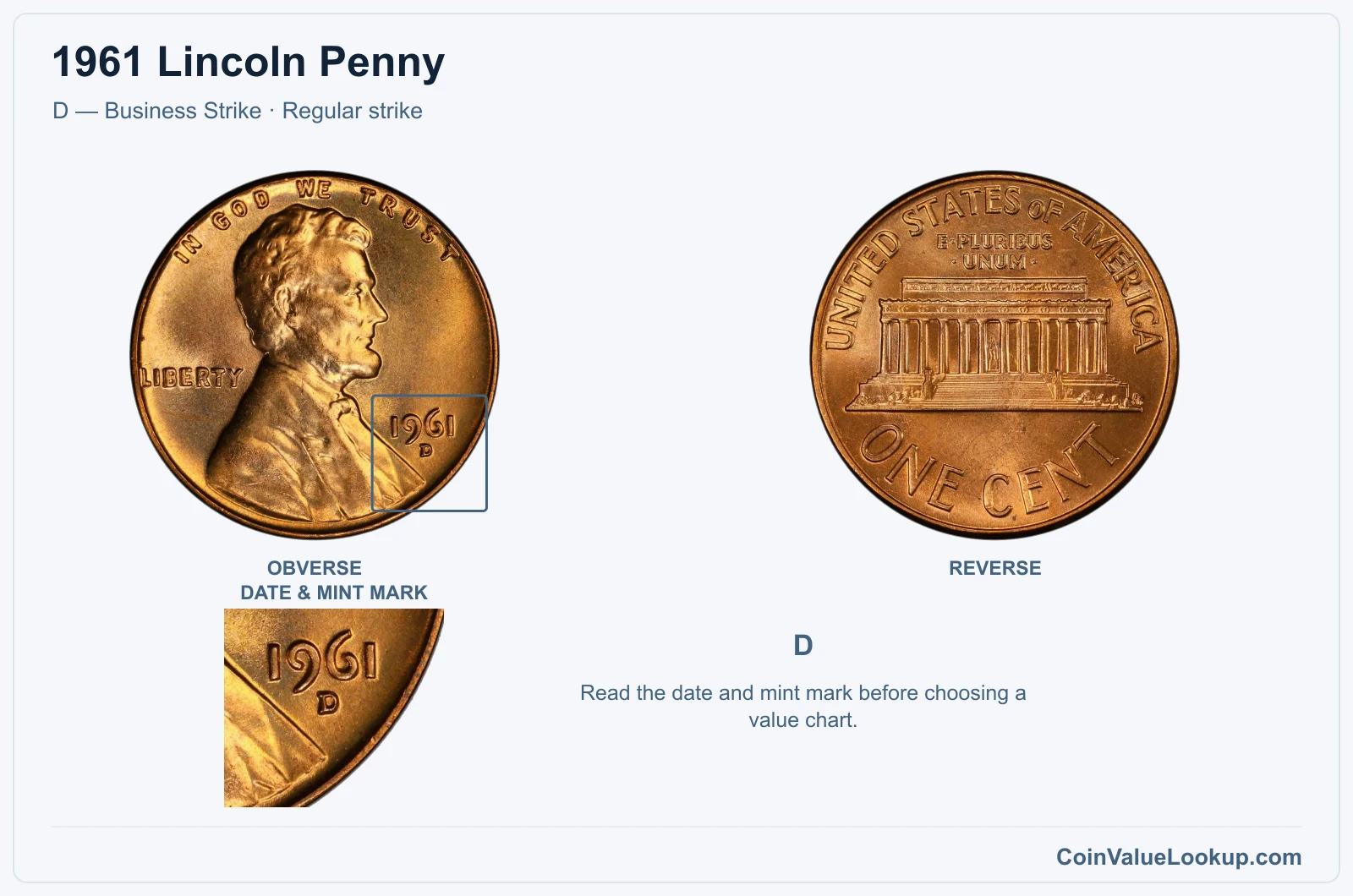
Denver cents carry a small D below the date. Same alloy, same weight, same design as Philadelphia.
USA Coin Book guide estimates are also $0.18 at MS60 and $1.24 at MS65.
Beyond preservation and color, the 1961-D is worth a closer look at the mintmark itself. Some examples show a repunched D — specifically a sideways earlier D impression beneath the final upright punch.
That variety is covered separately below, but the point is this: do not just glance at the D and move on. Grab a loupe.
Coin Value Lookup is a useful starting point if you want to look up other Lincoln cent dates and compare guide values across the series.
Range Grade
Price1961 D — Business Strike (BN) Price1961 D — Business Strike (RB) Price1961 D — Business Strike (RD) Auction Records Appraisal PO PO 1
—
Coin Identifier FR FR 2
—
Coin Identifier AG AG 3
—
Coin Identifier G G 4
—
Coin Identifier
G 6
—
Coin Identifier VG VG 8
—
Coin Identifier
VG 10
—
Coin Identifier F F 12
—
Coin Identifier
F 15
—
Coin Identifier VF VF 20
—
Coin Identifier
VF 25
—
—
Coin Identifier
VF 30
—
Coin Identifier
VF 35
—
Coin Identifier XF XF 40
—
Coin Identifier
XF 45
—
Coin Identifier AU AU 50
—
Coin Identifier
AU 53
—
Coin Identifier
AU 55
—
Coin Identifier
AU 58
—
Coin Identifier MS MS 60
—
—
Coin Identifier
MS 61
—
—
Coin Identifier
MS 62
—
Coin Identifier
MS 63
—
Coin Identifier
MS 64
Coin Identifier
MS 65
Coin Identifier
MS 66
Coin Identifier
MS 67
—
—
Coin Identifier
MS 68
—
—
—
—
—
MS 69
—
—
—
—
—
MS 70
—
—
—
—
—
1961 Lincoln Penny — No Mint Mark — Proof
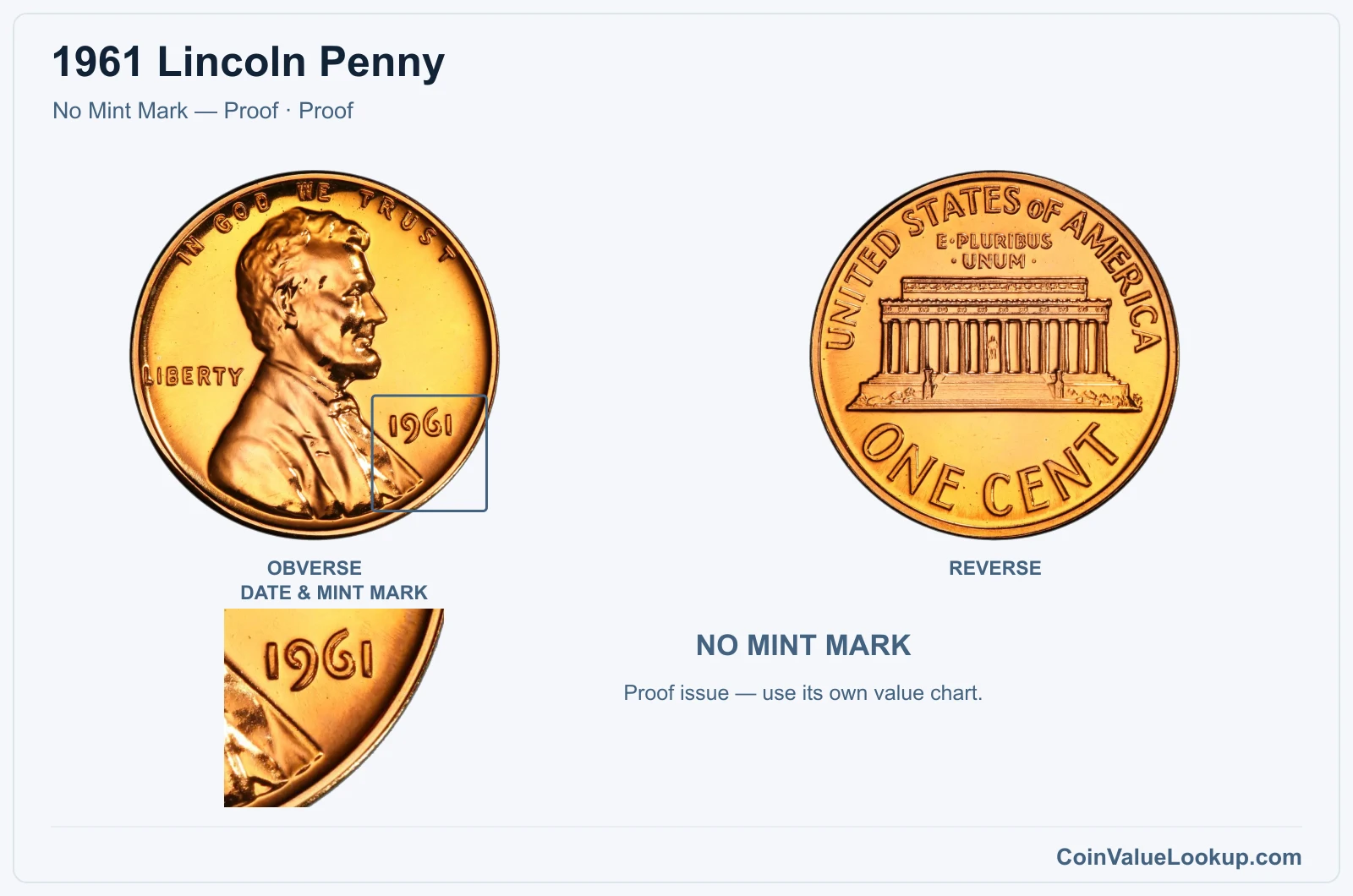
Philadelphia also produced proof cents for collector sets in 1961, and they carry no mintmark — same as the business strikes. The difference is in the surfaces: squared rims, mirror fields and sharply struck devices produced by specially prepared dies and planchets.
USA Coin Book lists a PR65 guide estimate at $1.88. Cameo contrast — frosted portrait and lettering against deep mirror fields — and full Red color are the features that separate an ordinary proof from a desirable one.
Hairlines, fingerprints and spots pull a proof below guide-grade pricing fast. Do not compare an impaired or cleaned proof to these estimates.
Range Grade
Price1961 No Mint Mark — Proof (CAM) Price1961 No Mint Mark — Proof (DCAM) Auction Records Appraisal PR PR 1
—
Coin Identifier
PR 2
—
Coin Identifier
PR 3
—
Coin Identifier
PR 4
—
Coin Identifier
PR 6
—
Coin Identifier
PR 8
—
Coin Identifier
PR 10
—
Coin Identifier
PR 12
—
Coin Identifier
PR 15
—
Coin Identifier
PR 20
—
Coin Identifier
PR 25
—
Coin Identifier
PR 30
—
Coin Identifier
PR 35
—
Coin Identifier
PR 40
—
Coin Identifier
PR 45
—
Coin Identifier
PR 50
—
Coin Identifier
PR 53
—
Coin Identifier
PR 55
—
Coin Identifier
PR 58
—
Coin Identifier
PR 60
Coin Identifier
PR 61
—
Coin Identifier
PR 62
—
Coin Identifier
PR 63
—
Coin Identifier
PR 64
—
Coin Identifier
PR 65
Coin Identifier
PR 66
Coin Identifier
PR 67
Coin Identifier
PR 68
Coin Identifier
PR 69
Coin Identifier
PR 70
—
—
—
—
1961 Lincoln Penny Error List
1. 1961 Lincoln Penny — D over a Sideways D
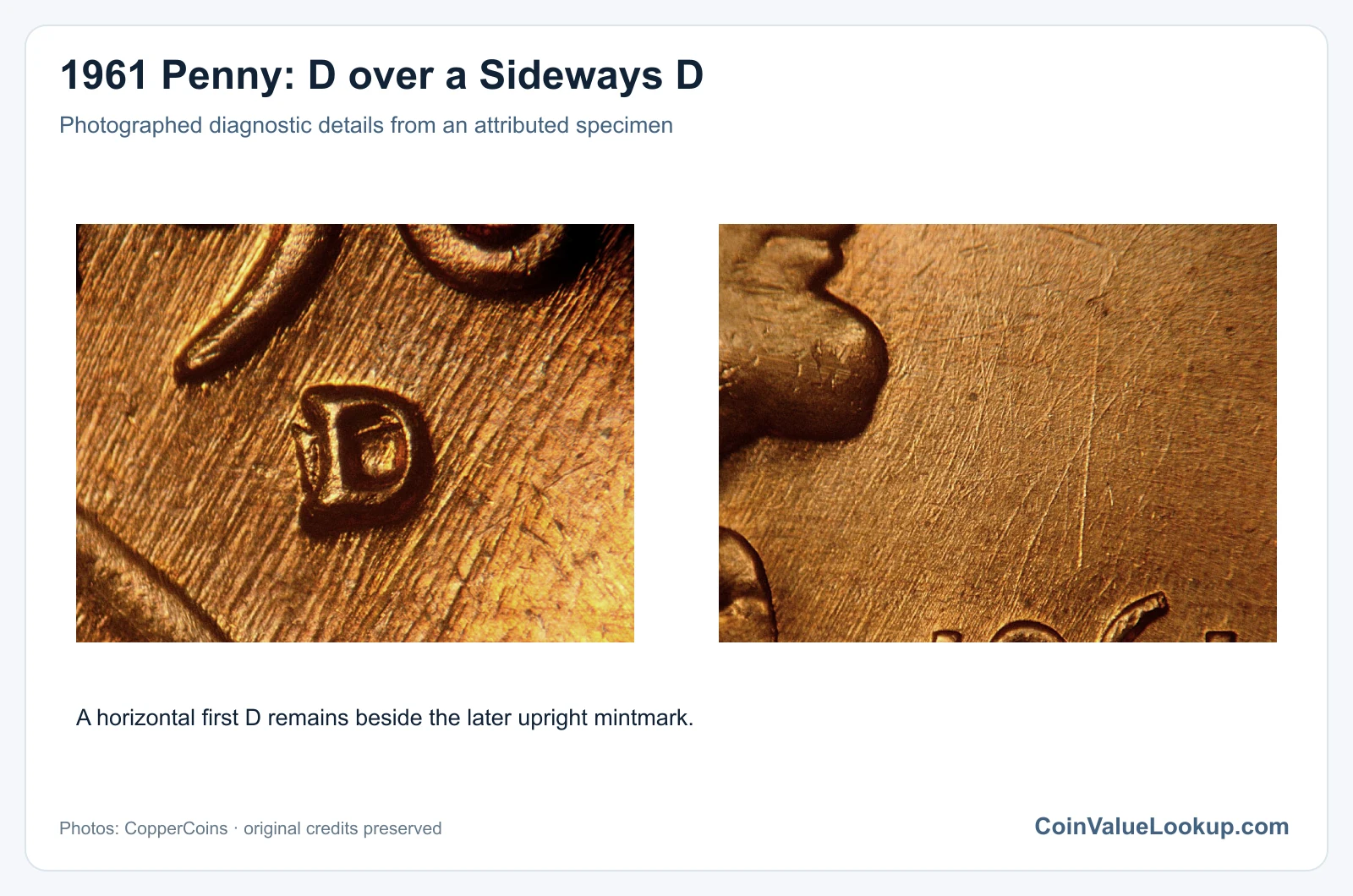
This is a repunched mintmark variety on 1961-D business strikes. The die received an initial D punch oriented horizontally — sideways — before the final upright D was impressed over it.
Under magnification, you can see remnants of that earlier horizontal punch inside or around the edges of the normal D.
Compare the mintmark carefully against a normal 1961-D cent under the same lighting. You are looking for consistent extra serifs or bars that do not belong to the standard upright letter.
Die chips can mimic extra metal near the mintmark, and flat shelf doubling from die deterioration lacks the depth and separation of a true repunched mark.
An NGC MS65 Red example sold for $84 at Heritage in October 2022. That is one recorded sale at one specific grade and color, not a general price for the variety.
2. 1961 Lincoln Penny — Struck on a Silver Dime Planchet
A 1961 cent struck on a silver dime planchet is a wrong-planchet error — the blank intended for a Roosevelt dime ended up in the cent press. The result is a silver-colored Lincoln cent that is noticeably smaller and thinner than a normal penny, with possible stretching near the rim where the smaller blank was forced into the larger cent die.
Weight and alloy verification are essential here. A normal cent weighs 3.11 grams in copper alloy; a silver dime blank is about 2.5 grams of 90% silver.
Plated cents or coins that have been cleaned to a silvery appearance are common lookalikes. If your coin is the right size and weight of a normal penny but just looks silver, it is almost certainly plated.
A PCGS MS61 example sold for $1,175 in January 2013. That is a single auction result at that grade, not a standing market price.
3. 1961 Lincoln Penny — Double Strike, Second Strike Off Center
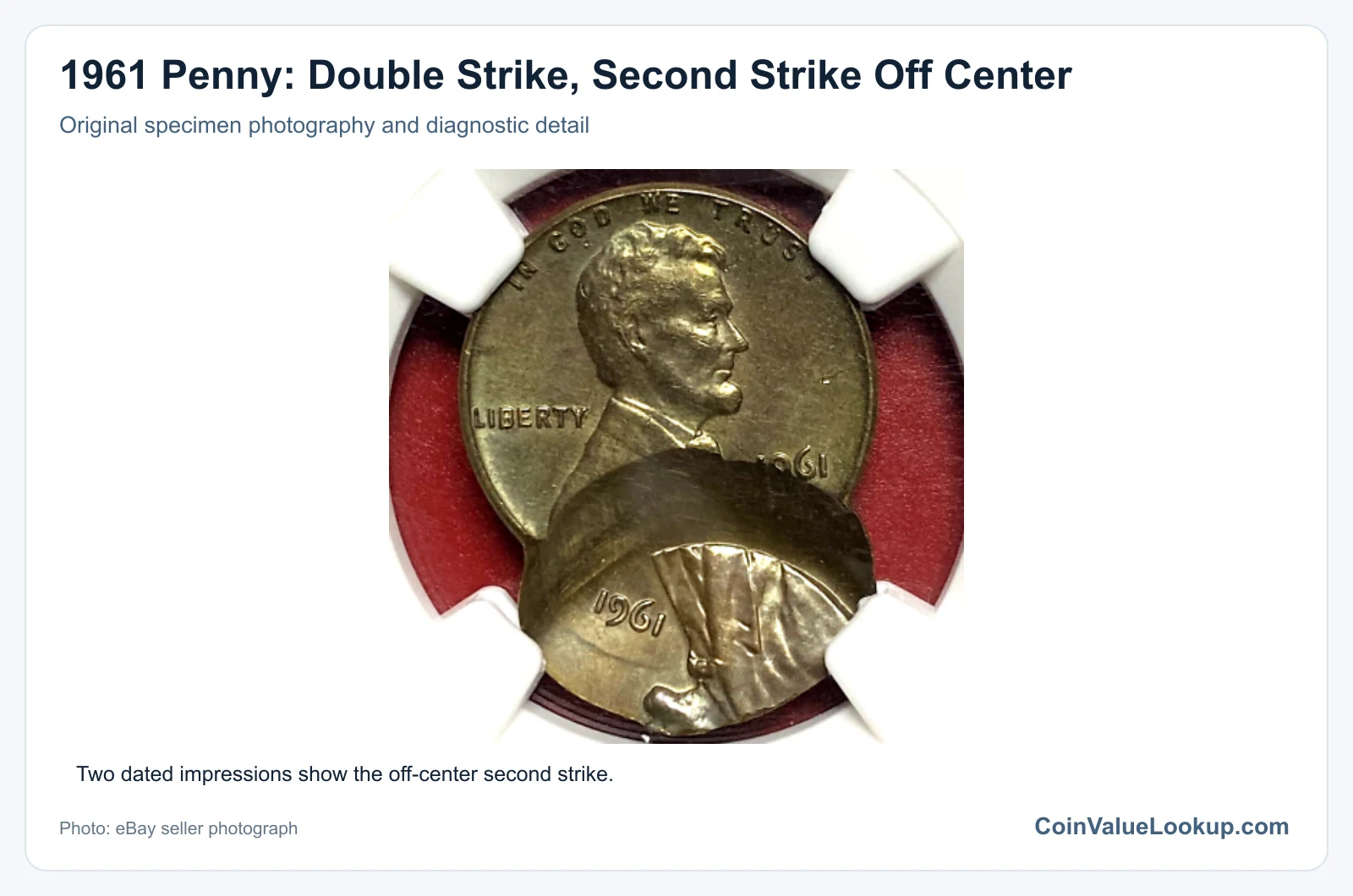
A double-struck 1961-D cent with the second strike 97% off center is a dramatic mechanical error. The coin received a nearly complete first impression, then shifted almost entirely out of the striking chamber before the dies came together a second time.
The result is a normal-looking cent with a tiny sliver of displaced design at one edge.
You need to photograph both the main strike and the small second impression at the rim. A simple rim bump from a feeding mechanism or flat machine doubling on lettering is not this error.
True double strikes show two distinct, separately positioned impressions from the dies.
A PCGS MS63 Red-Brown example sold for $69 at Heritage in March 2025 — one recorded sale for that specific combination of grade, color and off-center percentage.
4. 1961 Lincoln Penny — Struck on a Split Planchet
A 1961 cent struck on a split planchet started life as a normal copper blank that delaminated — separated into layers — before the strike. The result is a thin, underweight coin.
The recorded example weighs just 1.66 grams, roughly half the normal 3.11-gram standard.
The struck side retains design detail, but the impression may appear weak because the thinner blank could not absorb full striking pressure. The exposed inner surface typically has a rough, woody texture unlike the smooth face of a normal cent.
Do not confuse this with a coin that has been filed, ground down or acid-treated. A genuine split planchet has consistent thickness across the affected area and shows design detail appropriate to its reduced mass.
A PCGS AU55 example sold for $35 at Heritage in March 2025, lot 54072 — a single sale.
5. 1961 Lincoln Penny — Off-Center Strike
An 85% off-center 1961 cent means only about 15% of the design was struck onto the blank. Most of the planchet is bare, unstruck metal, with a small wedge of Lincoln or Memorial detail visible at one edge.
For this error to carry collector value, the surviving struck portion needs to include enough design — ideally the date — to confirm it as a 1961 issue. Without a readable date, it could be any year and loses most of its appeal.
A single misaligned die can produce a slightly shifted design but will not leave 85% of the coin blank. Damaged or cut blanks are another lookalike.
An ANACS MS60 Brown example sold for $59 at Heritage in March 2025, lot 54074. That is one graded sale, not a price guide for every off-center 1961 cent.
6. 1961 Lincoln Penny — Doubled Die Obverse
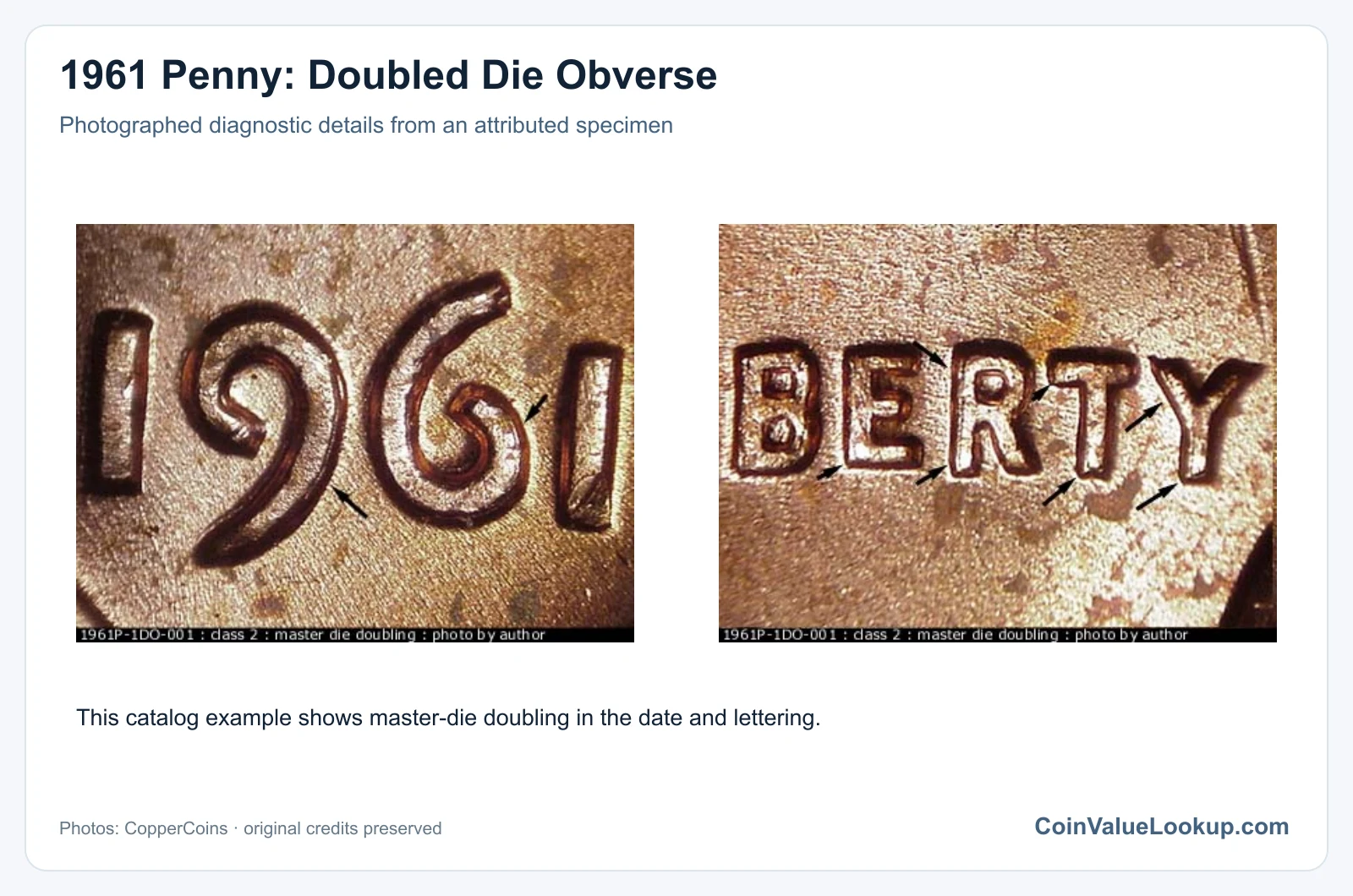
A Doubled Die Obverse on a 1961 cent shows consistent doubling on obverse design elements — typically letters in LIBERTY or IN GOD WE TRUST — caused by a misaligned hub impression during die manufacture. The key word is consistent: every coin struck from that die carries the same doubling in the same place.
Compare suspected doubling against a normal 1961 cent under the same magnification and lighting. True hub doubling produces separation or notching with depth and definition.
Machine doubling, which is far more common, leaves flat, shelf-like distortion without the sharp secondary image. Worn die contours and photographic reflections can also fool you.
Condition, the strength of visible doubling and the specific die variety all affect what a doubled die example is worth. No single price applies across the board.
7. 1961 Lincoln Penny — Struck Through a Capped Die
A capped-die strike occurs when a previously struck coin sticks to a die and acts as a cap over subsequent strikes. The coin that adhered becomes cupped and progressively more distorted.
The coins struck through that cap show softened, spread-out design from the obstruction between die and planchet.
A 1961 Lincoln cent struck through a capped die will have a mushy, ghost-like impression on one side — typically the obverse — while the opposite side may appear relatively normal. Both sides need to be photographed and shown together for any meaningful attribution.
Do not confuse this with a bent coin, vise damage or a weak strike from worn dies. Capped-die strikes have a distinctive progressive quality, and the affected side carries an impression transferred through the cap rather than directly from the die.
Value depends on the severity of the cap effect, overall condition and confirmation of the error.