1979 Lincoln Penny Coin Value: How Much Is It Worth?
Most 1979 Lincoln pennies you pull from a jar are worth face value and not much more. A USA Coin Book guide estimate places an uncirculated MS65 example at about $1.24.
That said, the 1979 series has two distinct proof mintmark styles, a handful of recognized error types, and enough quirks to make it worth a closer look before you toss it back in the change pile.
Fast Way to Identify Your 1979 Lincoln Penny
Want a quick read on what you have? Upload clear photos of the front and back of your 1979 penny, and our identifier can give you a preliminary idea of the version and condition.
It is not a substitute for professional authentication or grading, but it is a solid starting point.
1979 Penny Value
Upload both sides of your 1979 Lincoln Penny.
Front Obverse
Upload photo
Back Reverse
Upload photo
Which 1979 Lincoln Penny Versions Are Worth Money?
- Two proof mintmark styles exist for 1979-S; the clearer Type 2 S punch carries its own, slightly higher guide value at PR65.
- High-grade uncirculated business strikes with original red copper color are where the premium lives for this common date.
- Authenticated striking errors such as double strikes, die breaks, and wrong-planchet coins have sold individually for hundreds of dollars at auction.
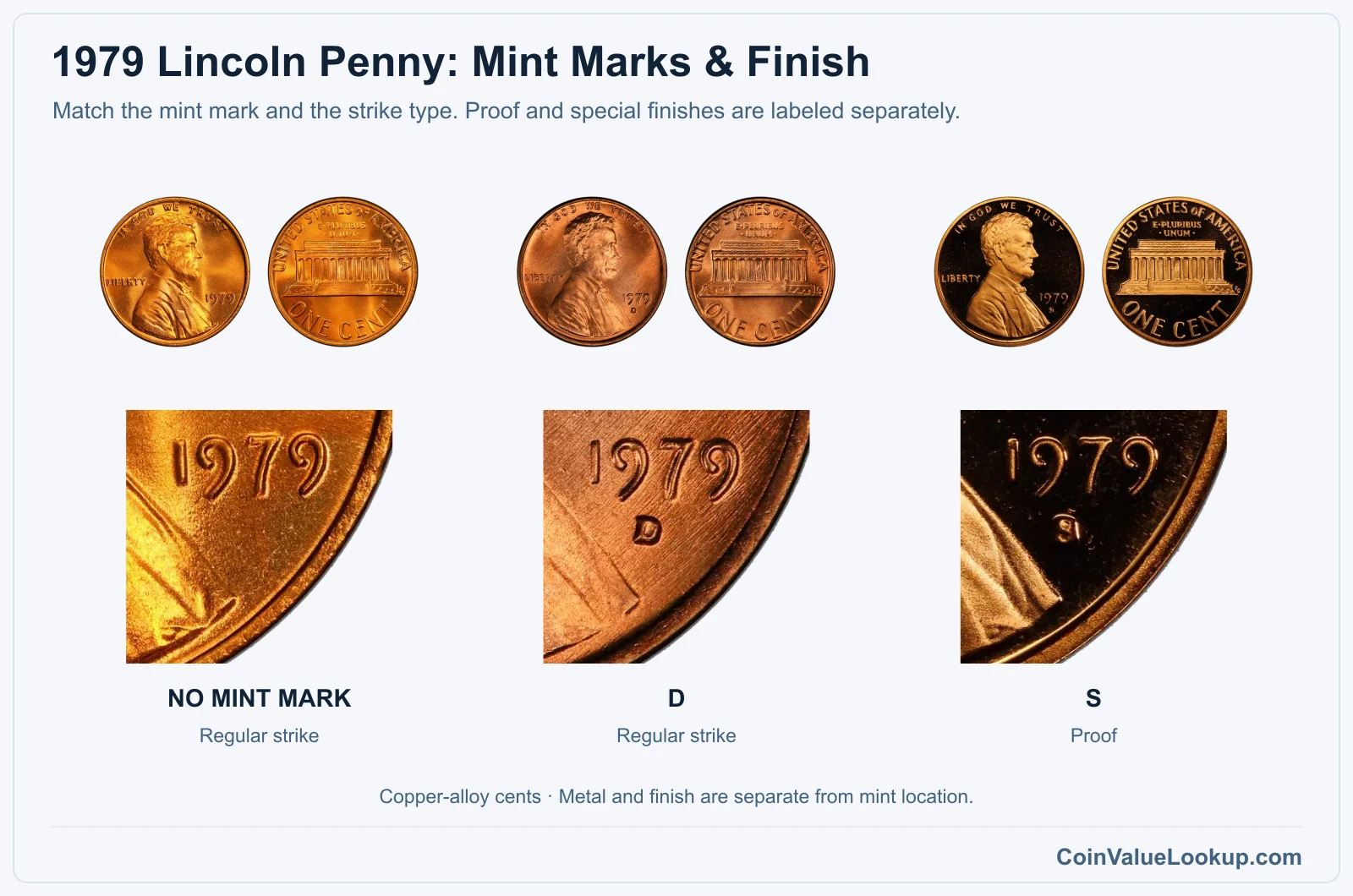
Step 1: Identify Your 1979 Lincoln Penny Mint Mark and Version
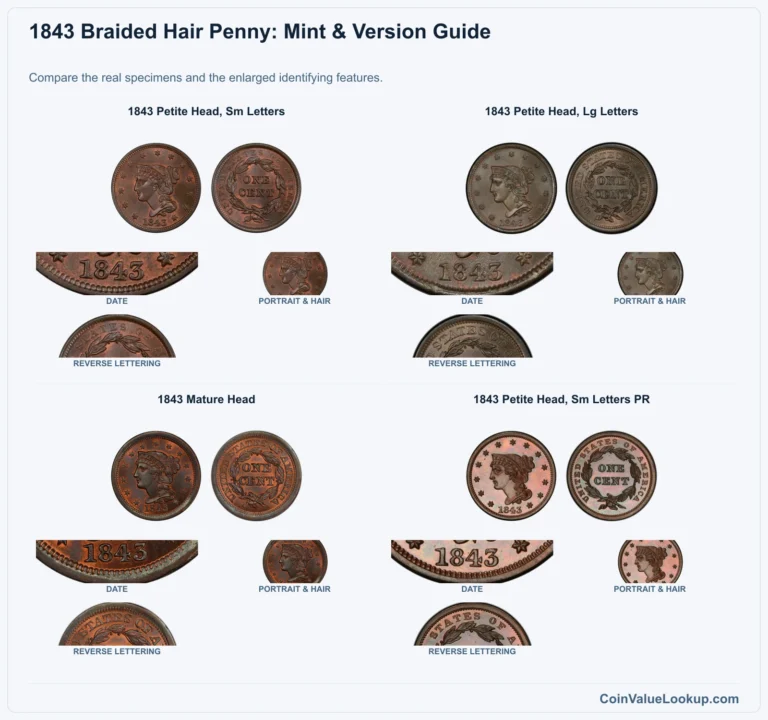
The 1979 Lincoln cent carries the familiar Lincoln obverse and Memorial reverse on a plain-edge planchet. Normal composition is 95% copper and 5% zinc, with a nominal weight of 3.11 grams.
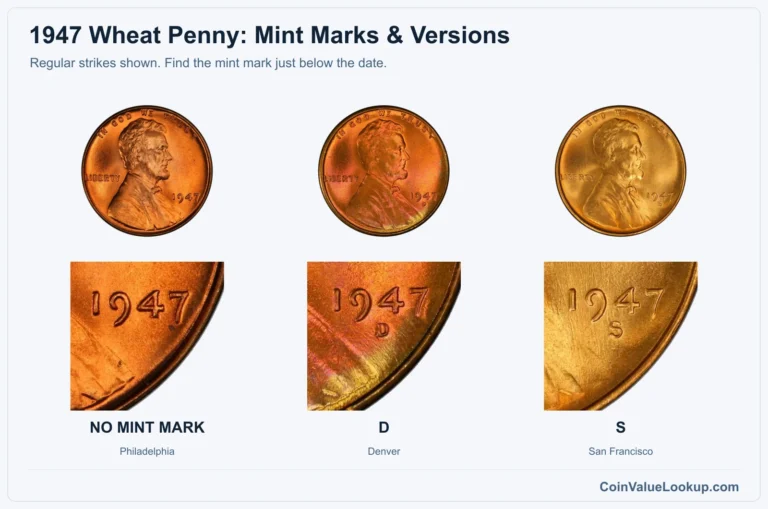
Business strikes come in two catalog branches: no mintmark (look below the date on the obverse) and D for Denver. A missing mintmark by itself does not prove which facility struck it, so do not jump to conclusions about Philadelphia attribution just because there is no letter.
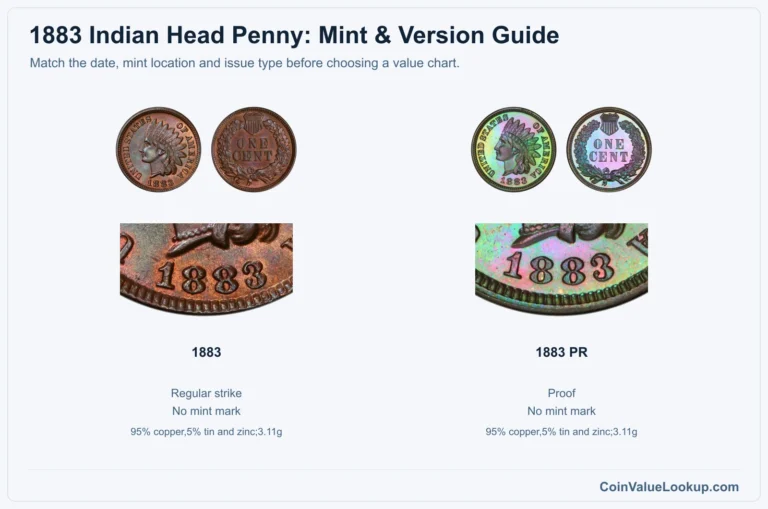
There is no normal S-mint circulation issue for 1979. Every 1979-S cent is a collector proof, struck with a mirror finish at San Francisco.
If your coin has reflective fields and sharp detail, check for that S.
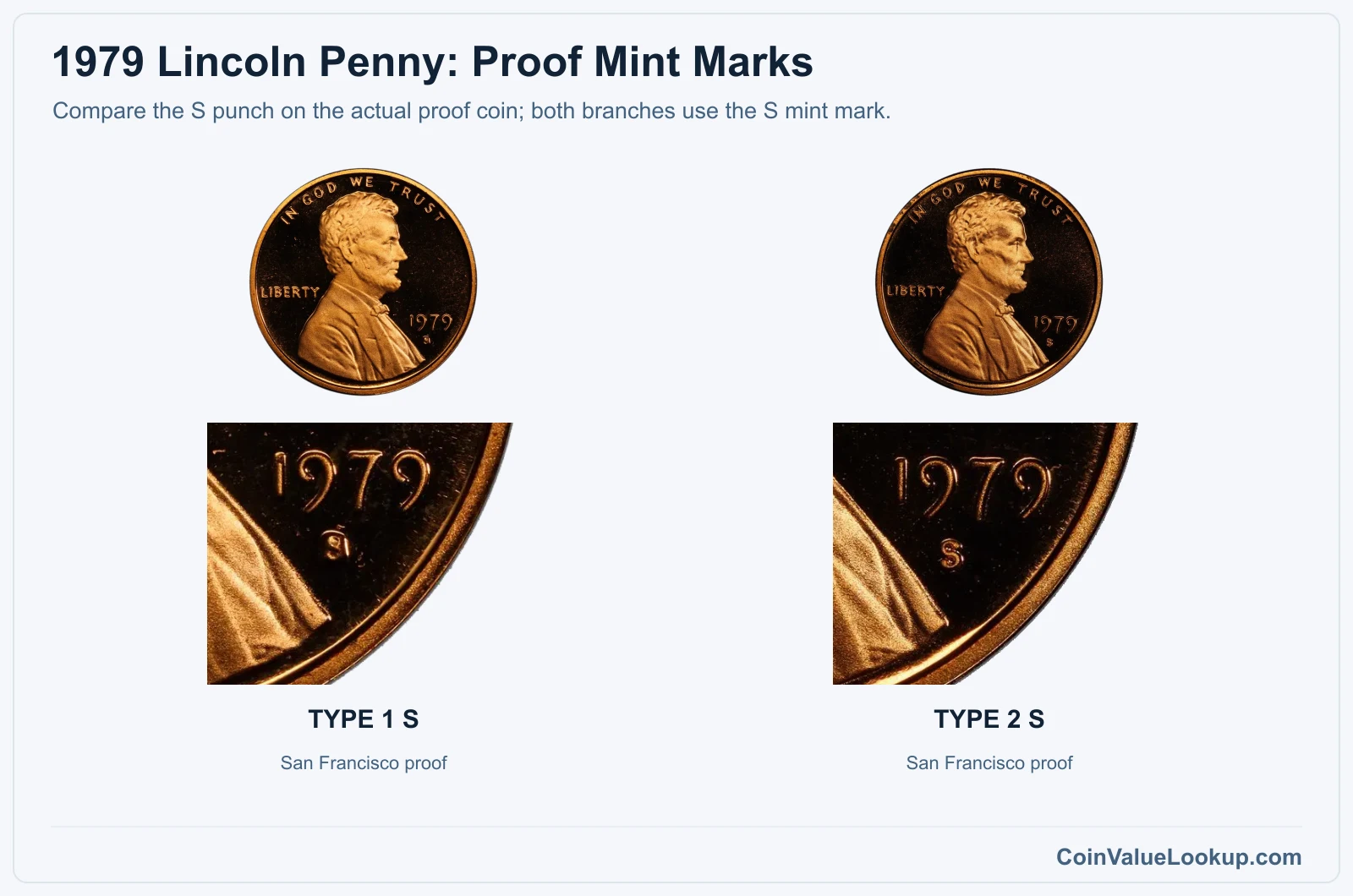
The two proof types hinge on the shape of the S mintmark punch. Type 1 has a filled, blobby S where the letter openings are partially closed.
Type 2 shows a clearer S with open, well-defined curves. Compare them at equal magnification against known examples before deciding which you have.
Copper-color designations like BN (brown), RB (red-brown), and RD (red) describe toning stages, not different metals. Similarly, CAM and DCAM on proofs refer to the degree of contrast between frosted devices and mirror fields, not a separate alloy or variety.
Step 2: Check Your 1979 Lincoln Penny Grade
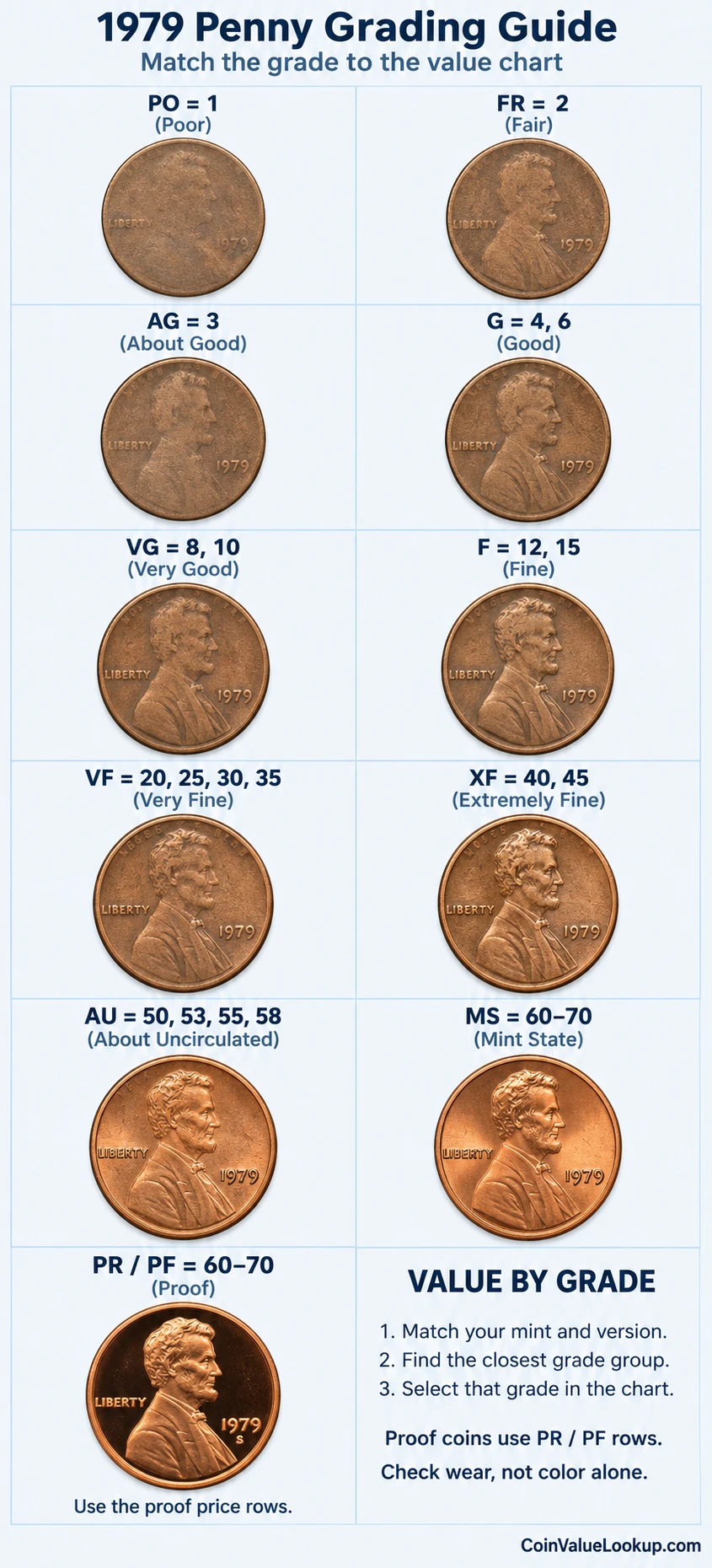
Start by checking Lincoln's cheekbone, jawline, and the hair detail above his ear. These are the first places to show smoothing.
On the reverse, examine the roof of the Memorial and the tops of the columns.
The difference between About Uncirculated and Mint State comes down to luster. If you see tiny flat spots on the high points but unbroken luster everywhere else, that is AU territory.
Once that original cartwheel luster is interrupted, the coin is circulated regardless of how pretty the color looks.
For proofs, hairlines from improper handling and spotting from moisture are the main grade killers. Do not clean a copper coin or try to strip off toning.
That always makes things worse and reduces collector appeal.
Use the comparison image to match your coin's wear pattern against known grade examples. Focus on the same high points mentioned above and compare surface quality under consistent lighting.
Step 3: Check 1979 Lincoln Penny Value by Mint and Version
1979 Lincoln Penny
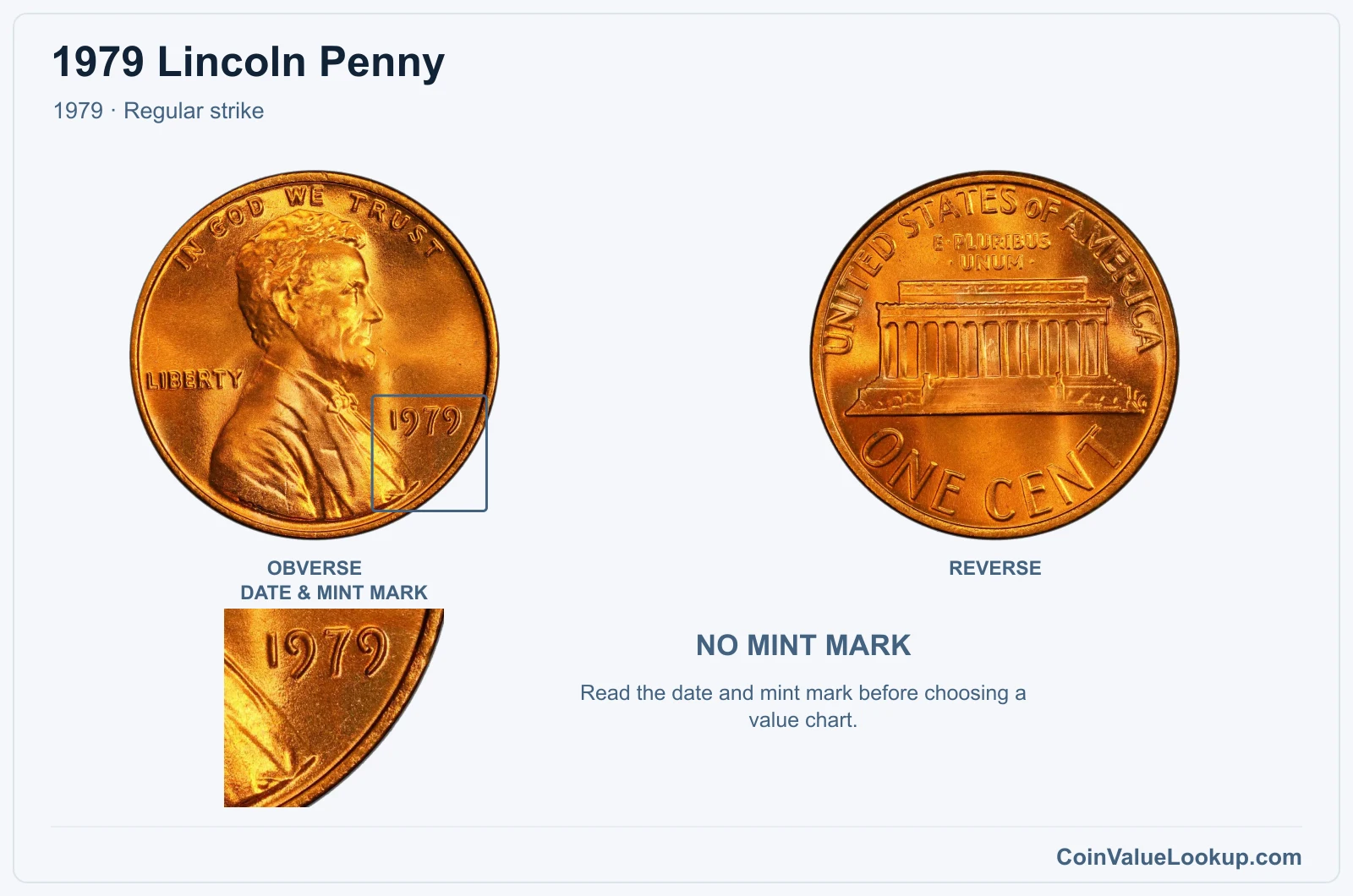
The 1979 no-mintmark Lincoln cent is the most common branch. It is a business strike on a 95% copper, 5% zinc planchet weighing about 3.11 grams.
Look below the date: no letter should appear there.
A USA Coin Book guide estimate puts an MS65 example at roughly $1.24. Circulated pieces are essentially face value.
The key to any premium is original surfaces, strong luster, and full red copper color. A brown or red-brown coin at the same grade will be worth less than one graded RD.
Do not confuse proof mirror surfaces with a higher Mint State grade; they are different manufacturing processes.
| Range | Grade | Price | Auction Records | Appraisal |
|---|---|---|---|---|
| PO | PO 1 | — | Coin Identifier | |
| FR | FR 2 | — | Coin Identifier | |
| AG | AG 3 | — | Coin Identifier | |
| G | G 4 | — | Coin Identifier | |
| G 6 | — | Coin Identifier | ||
| VG | VG 8 | — | Coin Identifier | |
| VG 10 | — | Coin Identifier | ||
| F | F 12 | — | Coin Identifier | |
| F 15 | — | Coin Identifier | ||
| VF | VF 20 | — | Coin Identifier | |
| VF 25 | — | Coin Identifier | ||
| VF 30 | — | Coin Identifier | ||
| VF 35 | — | Coin Identifier | ||
| XF | XF 40 | — | Coin Identifier | |
| XF 45 | — | Coin Identifier | ||
| AU | AU 50 | — | Coin Identifier | |
| AU 53 | — | Coin Identifier | ||
| AU 55 | — | Coin Identifier | ||
| AU 58 | — | Coin Identifier | ||
| MS | MS 60 | — | Coin Identifier | |
| MS 61 | — | Coin Identifier | ||
| MS 62 | — | Coin Identifier | ||
| MS 63 | — | Coin Identifier | ||
| MS 64 | Coin Identifier | |||
| MS 65 | Coin Identifier | |||
| MS 66 | Coin Identifier | |||
| MS 67 | Coin Identifier | |||
| MS 68 | Coin Identifier | |||
| MS 69 | — | — | — | |
| MS 70 | — | — | — |
1979 Lincoln Penny — D
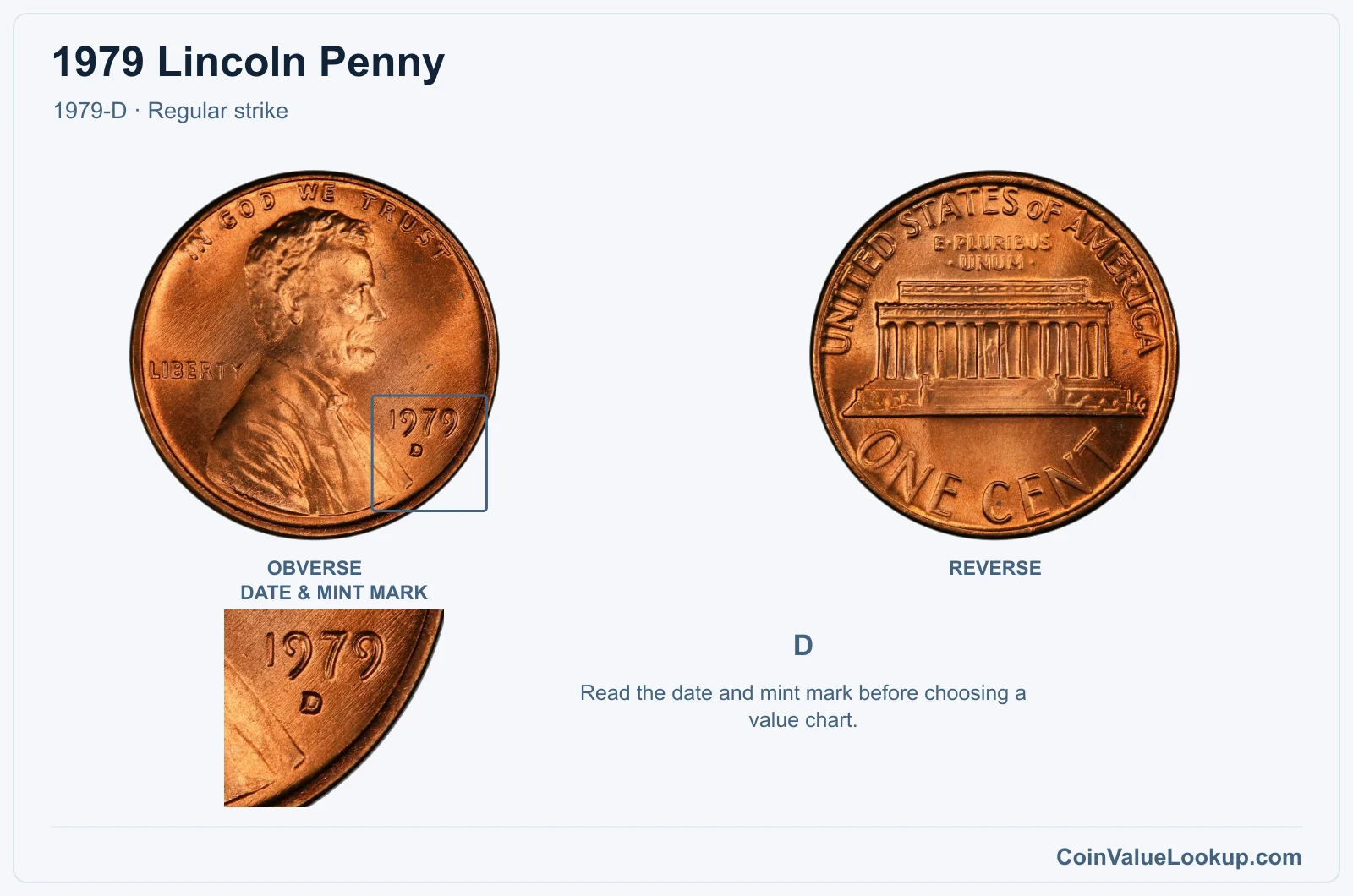
The 1979-D comes from Denver and carries a small D mintmark below the date. Same composition and weight as the no-mintmark issue: 95% copper, 5% zinc, 3.11 grams.
The USA Coin Book guide estimate for MS65 is also about $1.24. In worn condition, it is worth one cent.
Copper color designation matters here too. A fully red MS65 example will carry more collector interest than a brown one at the same technical grade.
Check for contact marks on Lincoln's cheek and the Memorial steps, as these are common on Denver cents from bag handling.
| Range | Grade | Price | Auction Records | Appraisal |
|---|---|---|---|---|
| PO | PO 1 | — | Coin Identifier | |
| FR | FR 2 | — | Coin Identifier | |
| AG | AG 3 | — | Coin Identifier | |
| G | G 4 | — | Coin Identifier | |
| G 6 | — | Coin Identifier | ||
| VG | VG 8 | — | Coin Identifier | |
| VG 10 | — | Coin Identifier | ||
| F | F 12 | — | Coin Identifier | |
| F 15 | — | Coin Identifier | ||
| VF | VF 20 | — | Coin Identifier | |
| VF 25 | — | Coin Identifier | ||
| VF 30 | — | Coin Identifier | ||
| VF 35 | — | Coin Identifier | ||
| XF | XF 40 | — | Coin Identifier | |
| XF 45 | — | Coin Identifier | ||
| AU | AU 50 | — | Coin Identifier | |
| AU 53 | — | Coin Identifier | ||
| AU 55 | — | Coin Identifier | ||
| AU 58 | — | Coin Identifier | ||
| MS | MS 60 | — | Coin Identifier | |
| MS 61 | — | Coin Identifier | ||
| MS 62 | — | Coin Identifier | ||
| MS 63 | — | Coin Identifier | ||
| MS 64 | Coin Identifier | |||
| MS 65 | Coin Identifier | |||
| MS 66 | Coin Identifier | |||
| MS 67 | Coin Identifier | |||
| MS 68 | — | — | — | |
| MS 69 | — | — | — | |
| MS 70 | — | — | — |
1979 Lincoln Penny — S Type 1 PR
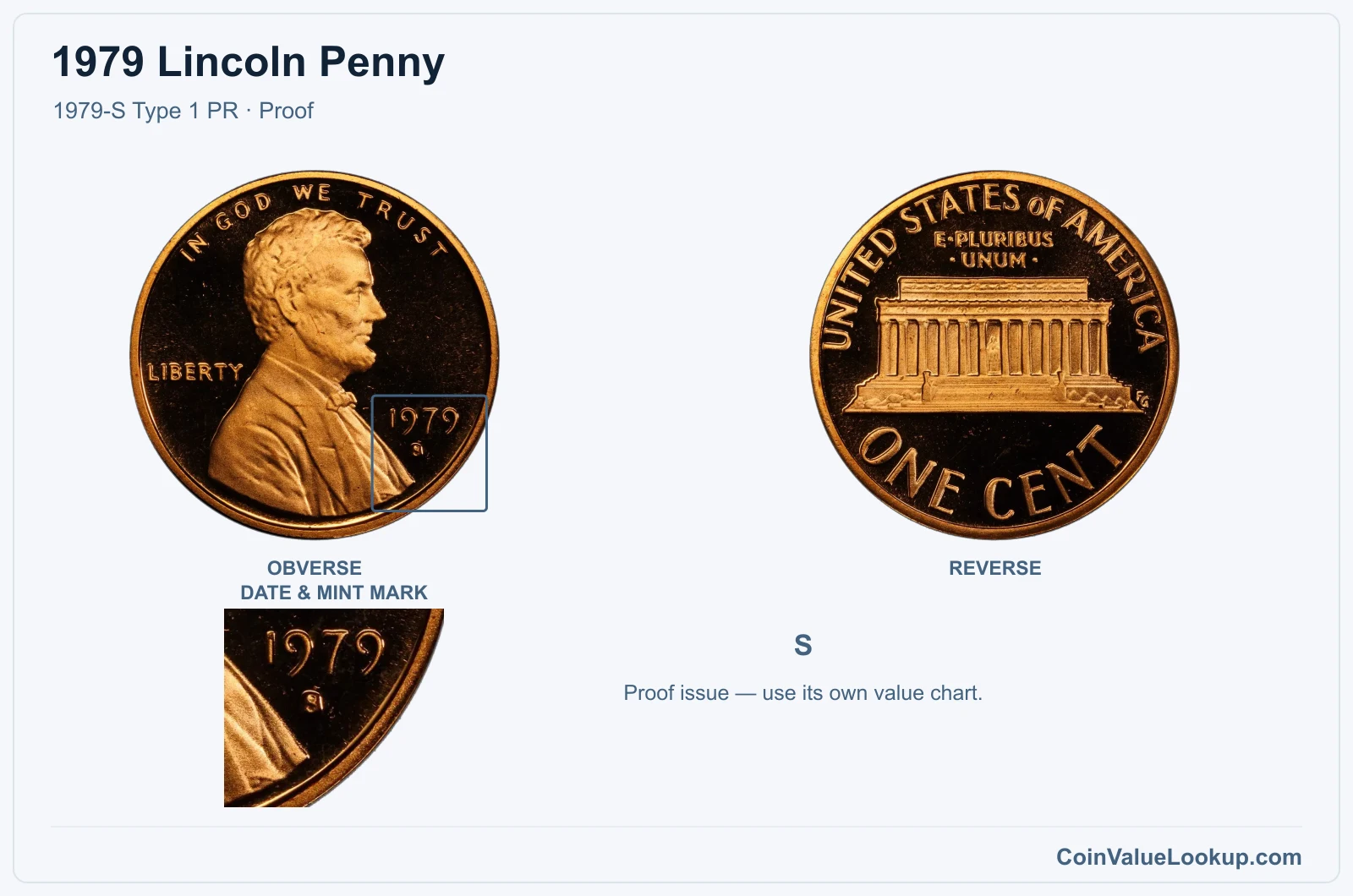
The 1979-S Type 1 proof was struck at San Francisco with a filled-looking S mintmark. The openings in the letter appear partially closed or blobby compared to the Type 2 punch.
This is the more common of the two proof styles for the year.
At PR65, the USA Coin Book guide estimate is about $6.25. You will find these in the standard 1979 proof sets.
Before assigning a value, confirm the S punch shape at magnification. The Type 1 versus Type 2 distinction is entirely about the mintmark, not about the coin's mirror quality or frost level.
Coin Value Lookup is a good place to start if you want to look up guide values for other Lincoln cents or compare proof types across different years.
| Range | Grade | Price | Auction Records | Appraisal |
|---|---|---|---|---|
| PR | PR 1 | — | Coin Identifier | |
| PR 2 | — | Coin Identifier | ||
| PR 3 | — | Coin Identifier | ||
| PR 4 | — | Coin Identifier | ||
| PR 6 | — | Coin Identifier | ||
| PR 8 | — | Coin Identifier | ||
| PR 10 | — | Coin Identifier | ||
| PR 12 | — | Coin Identifier | ||
| PR 15 | — | Coin Identifier | ||
| PR 20 | — | Coin Identifier | ||
| PR 25 | — | Coin Identifier | ||
| PR 30 | — | Coin Identifier | ||
| PR 35 | — | Coin Identifier | ||
| PR 40 | — | Coin Identifier | ||
| PR 45 | — | Coin Identifier | ||
| PR 50 | — | Coin Identifier | ||
| PR 53 | — | Coin Identifier | ||
| PR 55 | — | Coin Identifier | ||
| PR 58 | — | Coin Identifier | ||
| PR 60 | — | Coin Identifier | ||
| PR 61 | — | Coin Identifier | ||
| PR 62 | — | Coin Identifier | ||
| PR 63 | — | Coin Identifier | ||
| PR 64 | — | Coin Identifier | ||
| PR 65 | Coin Identifier | |||
| PR 66 | Coin Identifier | |||
| PR 67 | Coin Identifier | |||
| PR 68 | Coin Identifier | |||
| PR 69 | Coin Identifier | |||
| PR 70 | Coin Identifier |
1979 Lincoln Penny — S Type 2 PR
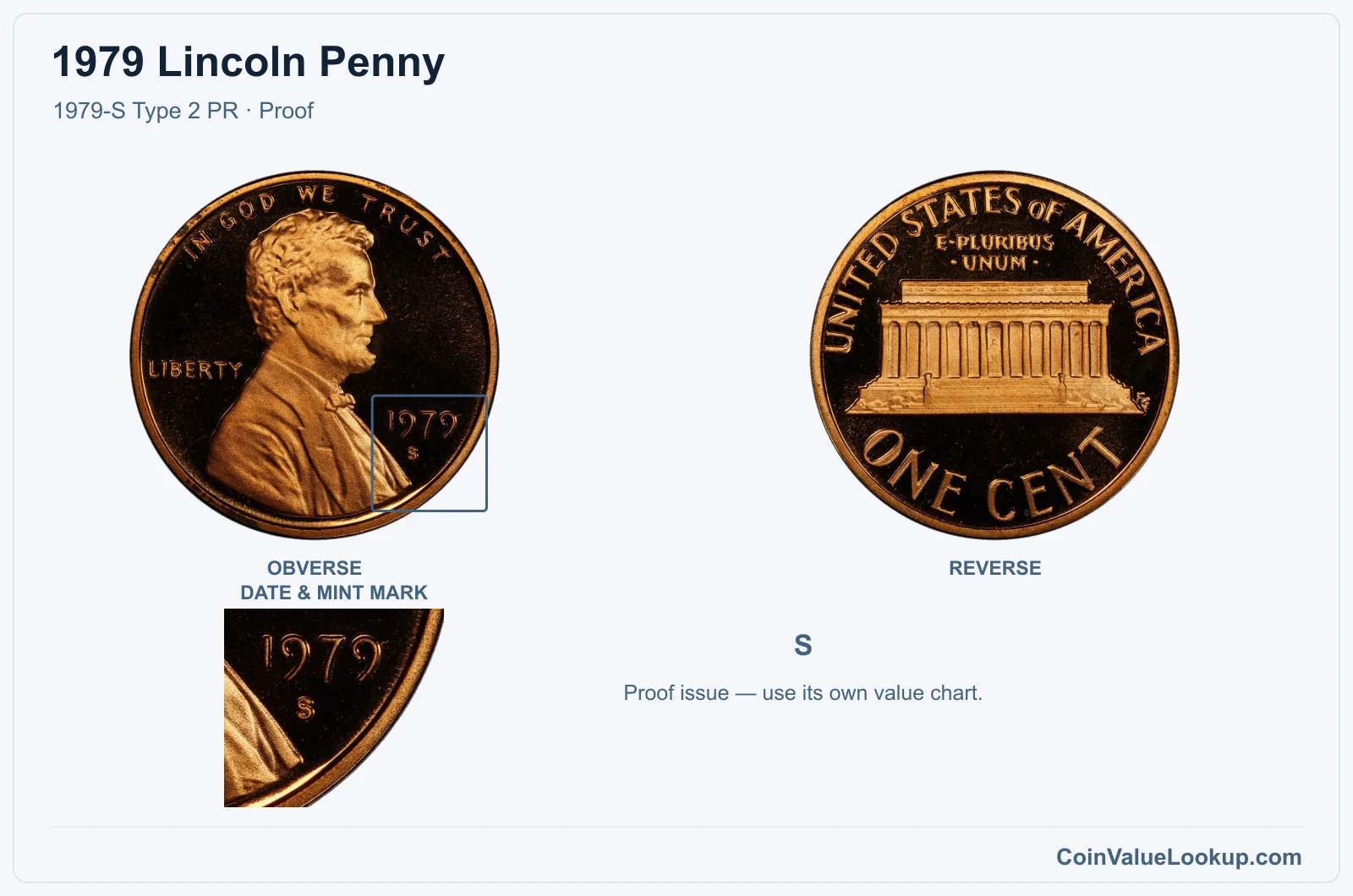
The 1979-S Type 2 proof uses a clearer S punch with well-defined open curves. This punch was later carried forward as the 1981 Type 1, so do not confuse the two year-date varieties.
For 1979, the distinction is straightforward: filled S is Type 1, clear S is Type 2.
The USA Coin Book guide estimate at PR65 is about $7.29, a small step above the Type 1. The Type 2 was produced in smaller quantities within the 1979 proof run, which accounts for the slight premium.
Confirm the mintmark shape under magnification before assuming you have the scarcer version. A loupe and a known comparison image are your best tools here.
| Range | Grade | Price | Auction Records | Appraisal |
|---|---|---|---|---|
| PR | PR 1 | — | Coin Identifier | |
| PR 2 | — | Coin Identifier | ||
| PR 3 | — | Coin Identifier | ||
| PR 4 | — | Coin Identifier | ||
| PR 6 | — | Coin Identifier | ||
| PR 8 | — | Coin Identifier | ||
| PR 10 | — | Coin Identifier | ||
| PR 12 | — | Coin Identifier | ||
| PR 15 | — | Coin Identifier | ||
| PR 20 | — | Coin Identifier | ||
| PR 25 | — | Coin Identifier | ||
| PR 30 | — | Coin Identifier | ||
| PR 35 | — | Coin Identifier | ||
| PR 40 | — | Coin Identifier | ||
| PR 45 | — | Coin Identifier | ||
| PR 50 | — | Coin Identifier | ||
| PR 53 | — | Coin Identifier | ||
| PR 55 | — | Coin Identifier | ||
| PR 58 | — | Coin Identifier | ||
| PR 60 | — | Coin Identifier | ||
| PR 61 | — | Coin Identifier | ||
| PR 62 | — | Coin Identifier | ||
| PR 63 | — | Coin Identifier | ||
| PR 64 | — | Coin Identifier | ||
| PR 65 | Coin Identifier | |||
| PR 66 | Coin Identifier | |||
| PR 67 | Coin Identifier | |||
| PR 68 | Coin Identifier | |||
| PR 69 | Coin Identifier | |||
| PR 70 | Coin Identifier |
1979 Lincoln Penny Error List
1. 1979 Lincoln Penny — Double Strike, Second Off Center
A double-struck 1979 penny shows two overlapping impressions of the design at different positions on the planchet. This is not subtle die doubling; you will see a clearly displaced second image offset from the first.
Look for a full or partial extra set of Lincoln's portrait or Memorial columns shifted from where they should be. The effect is dramatic and visible to the naked eye.
Do not confuse this with machine doubling, which produces flat shelf-like distortion on lettering, or with vise marks from post-mint damage.
One documented example, an NGC MS63 Brown no-mintmark cent with a displaced second strike, sold for $204 at auction in September 2023. That is a single sale, not a guaranteed price for every double strike.
2. 1979 Lincoln Penny — Cud Die Break
A cud is a raised blob of metal connected to the rim where a piece of the die broke away. On a 1979 no-mintmark cent, this appears as a smooth, featureless lump replacing part of the normal design at the edge.
Compare your coin to a normal 1979 cent. The cud should merge seamlessly into the rim and obliterate whatever design element was underneath.
If the blob is lumpy, crystalline, or sits on top of the surface, it is more likely solder, corrosion buildup, or damage.
A PCGS MS64 Brown example with a substantial rim-connected die break sold for $1,020 in May 2021. Size and location matter enormously; a tiny rim chip is not in the same league as a large cud.
3. 1979 Lincoln Penny — Struck on a Clad Dime Blank
This is a wrong-planchet error: a 1979-D Lincoln cent design struck onto a clad dime blank instead of a copper cent blank. The result is an undersized coin with a silvery appearance that still carries the Lincoln obverse and Memorial reverse.
Weight and edge are your first clues. A dime blank weighs about 2.27 grams versus the cent's 3.11 grams, and the edge will show clad layers rather than solid copper.
Do not confuse this with a penny that someone plated silver or a dollar denomination struck on a cent blank.
A PCGS MS64 example of this 1979-D wrong-planchet error sold for $360 in July 2022. Professional certification is essential for this type of error because the attribution depends on measurable physical properties.
4. 1979 Lincoln Penny — Doubled Die Obverse
A doubled die obverse on a 1979 cent shows consistent separation or notching on obverse design elements such as lettering, the date, or Lincoln's profile. The doubling comes from a misaligned hub impression during die manufacturing, so it appears the same way on every coin struck by that die.
Under magnification, look for split serifs on LIBERTY or IN GOD WE TRUST, or a secondary contour on the date digits. The separation should be uniform and directional, not a flat shelf.
Machine doubling produces a flat, mushy look and is worth nothing extra.
Value depends on the specific die, the visibility of the doubling, and the coin's overall condition. Each doubled die variety is assessed individually.
5. 1979 Lincoln Penny — Repunched Mintmark
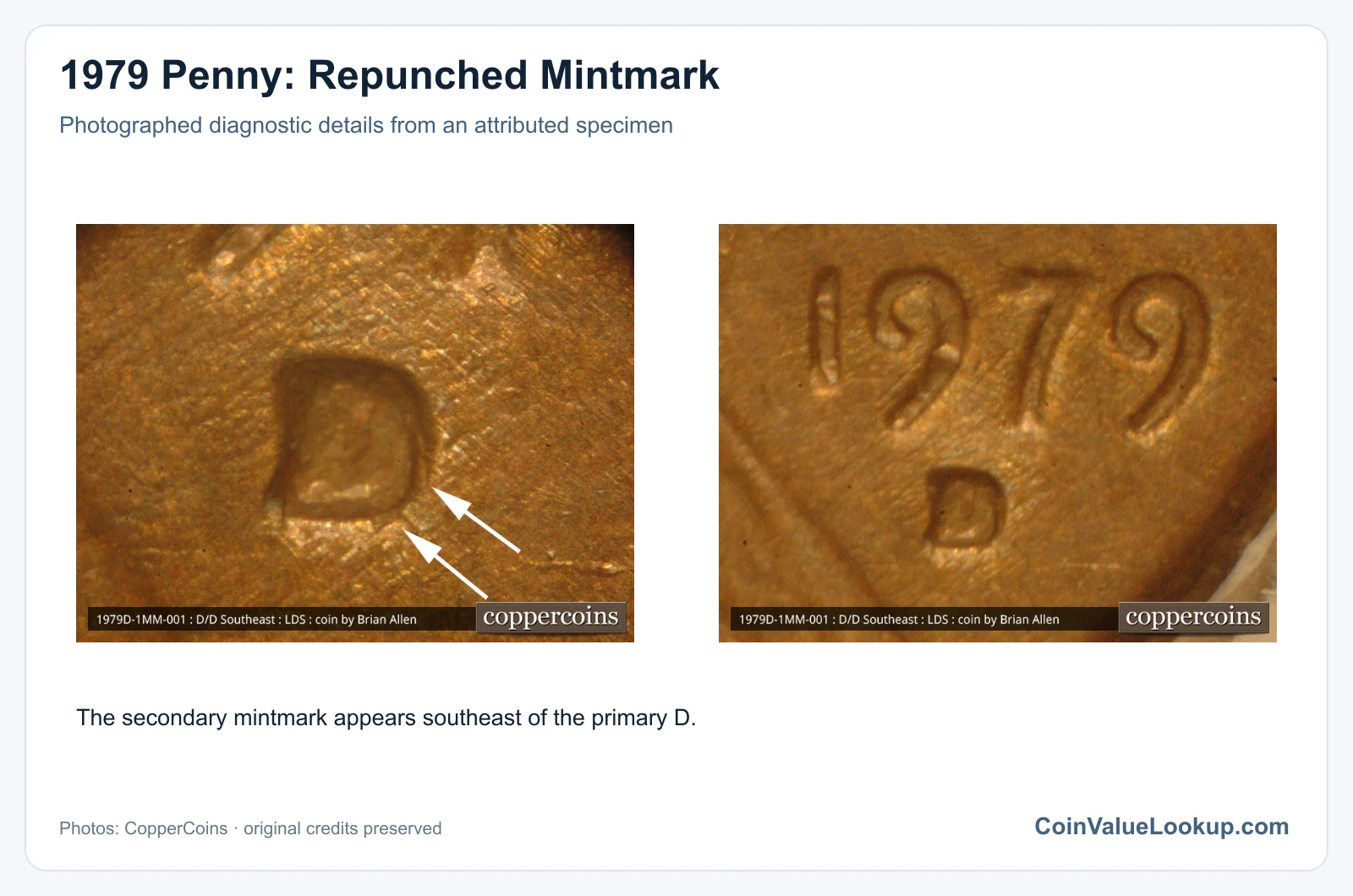
A repunched mintmark on a 1979 cent shows traces of a second or shifted mintmark position beneath or beside the primary letter. This happened when the mintmark punch was applied more than once to the working die at slightly different angles or positions.
Inspect the D mintmark under magnification. You may see a secondary outline, a notch, or a shadow of the letter offset from the main impression.
Compare to a normal 1979-D at the same scale. Do not mistake a die chip, corrosion around the letter, or machine doubling for a true repunched mintmark.
Value varies with the degree of separation and the coin's condition. Each repunched mintmark variety is evaluated on its own merits.
6. 1979 Lincoln Penny — BIE Die Break
A BIE die break is a small raised vertical line or blob between the letters B and E in LIBERTY. It forms when a crack develops in the die face between those two letters, allowing metal to flow into the gap during striking.
The result looks like a tiny capital I squeezed between B and E. Check under magnification and good light.
The bridge should be raised above the field and connected to the surrounding surface, not sitting loosely on top. Dirt lodged in the letters, a scratch, or an added piece of metal can mimic this error.
Value depends on the prominence of the break and overall coin condition. These are a popular niche collectible among Lincoln cent enthusiasts.
7. 1979 Lincoln Penny — Clipped Planchet
A clipped planchet error means the coin blank was incompletely punched from the metal strip before striking. On a 1979 cent, you will see a missing curved, straight, or irregular portion of the edge where metal simply is not there.
Look at the opposite side of the coin from the clip. Genuine clips often produce design weakness directly across from the missing area because the metal could not flow fully during striking.
The edge at the clip should show the original blank's texture, not file marks or cut lines.
Filed notches, deliberate edge cuts, and corrosion can all create similar missing-metal appearances. Value depends on the size and type of the clip and the coin's preservation.
8. 1979 Lincoln Penny — Struck-Through Error
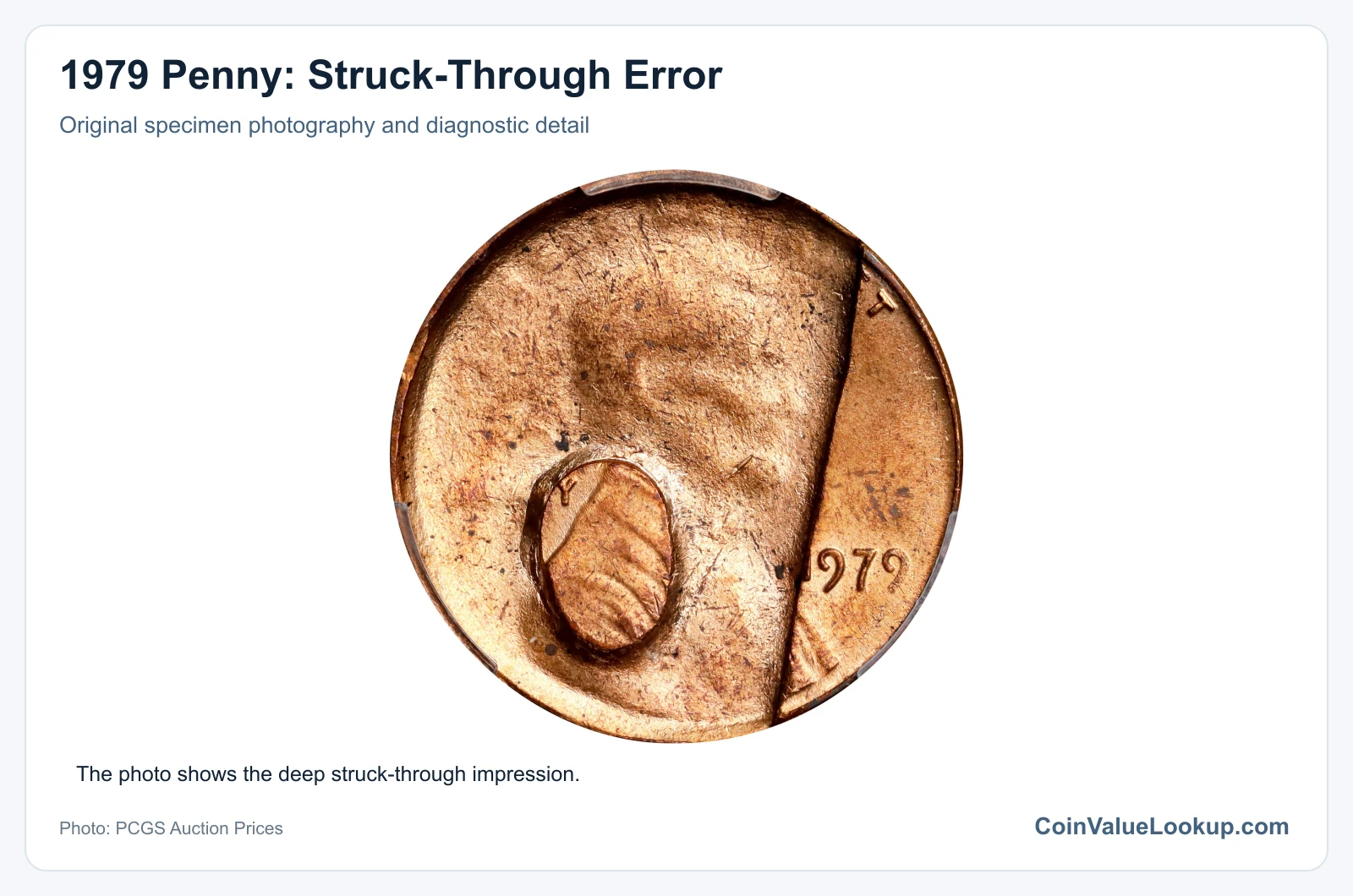
A struck-through error occurs when foreign material gets between the die and the planchet during striking. On a 1979 cent, this can appear as a localized depression, a texture impression, or an area of missing detail where something blocked the die.
Grease fills tend to produce soft, undefined areas, while a retained foreign object like a thread or metal fragment leaves a more distinct impression. Look for a smooth depression or unusual texture that does not match normal wear.
Scratches, cleaning marks, and ordinary weak strikes from a tired die are common lookalikes.
Value depends on the size and visual impact of the obstruction, the type of material involved, and the coin's overall condition.
9. 1979 Lincoln Penny — Off-Center Strike
An off-center strike happens when the planchet is not properly seated in the collar before the dies come together. The result is a design shifted to one side with an unstruck crescent of blank metal on the opposite edge.
For collector interest, the date needs to be fully visible. A 5% off-center coin is barely noticeable and carries little premium; a 50% off-center coin with a readable date is far more desirable.
Look at both sides to confirm the misalignment is consistent. A post-mint flattening or a clipped edge can sometimes look similar at first glance.
Condition, the degree of misalignment, and date visibility all factor into value. Each off-center piece is assessed on its own characteristics.
10. 1979 Lincoln Penny — Die Cap / Capped-Die Strike
A die cap forms when a struck coin sticks to one of the dies and is carried along for subsequent strikes. The adhered coin gets progressively cupped and distorted, while coins struck beneath it receive a mirror-image impression of the cap's underside.
On a 1979 cent, a true die cap will be noticeably cupped or bowl-shaped, with one side showing extreme spreading and distortion. The reverse side may display a brockage, which is a reversed incuse impression of the design.
Do not confuse a bent coin, vise damage, or a simple weak strike with a die cap.
These are dramatic errors and are evaluated individually based on the degree of cupping, design visibility, and overall preservation.