1993 Lincoln Penny Coin Value: How Much Is It Worth?
Most 1993 Lincoln pennies you pull from a jar are worth one cent, full stop. A USA Coin Book guide estimate places an ordinary uncirculated example at about $0.36 in MS65, while the 1993-S proof sits around $11.00 in PR65.
The real action is in errors — a cent-obverse paired with a dime-reverse mule once sold for over $50,000. Normal Close-AM letter spacing on a 1993 cent is not a rare error, so don't get excited about that.
Fast Way to Identify Your 1993 Lincoln Penny
Snap a clear photo of the front and back of your 1993 penny and upload both images using the identifier on this page. It will help with a preliminary identification of your coin's version, mintmark and finish.
This is not a substitute for professional authentication or certified grading, but it gives you a solid starting point before you dig deeper.
1993 Penny Value
Upload both sides of your 1993 Lincoln Penny.
Front Obverse
Upload photo
Back Reverse
Upload photo
Which 1993 Lincoln Penny Versions Are Worth Money?
- A 1993-D cent-obverse/dime-reverse mule is an exceptional wrong-die pairing — a PCGS MS65 Red example sold for $51,750 in January 2010.
- A 1993 cent struck over a 1993-P dime sold for $862.50 in NGC MS67 at a 2010 auction, showing traces of both coin designs.
- A double-struck 1993 no-mintmark cent with a displaced second impression brought $276 in NGC MS66 Red in December 2020.
- Proofs and high-grade original coins need finish and color-matched comparisons; dramatic error sale prices do not apply to normal pocket change.
Step 1: Identify Your 1993 Lincoln Penny Mint Mark and Version
The 1993 Lincoln cent carries the Lincoln portrait on the obverse and the Memorial building on the reverse. It has a plain edge and is made of copper-plated zinc, weighing about 2.50 grams.
A copper color does not mean you have a solid copper coin — these are zinc underneath.
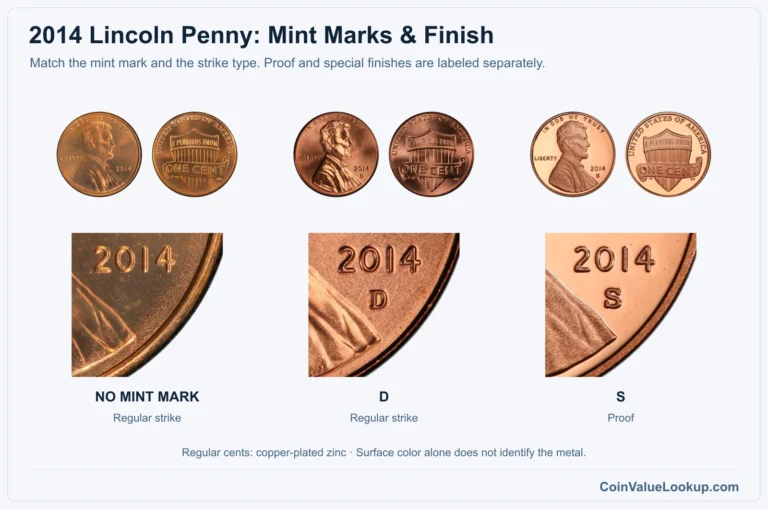
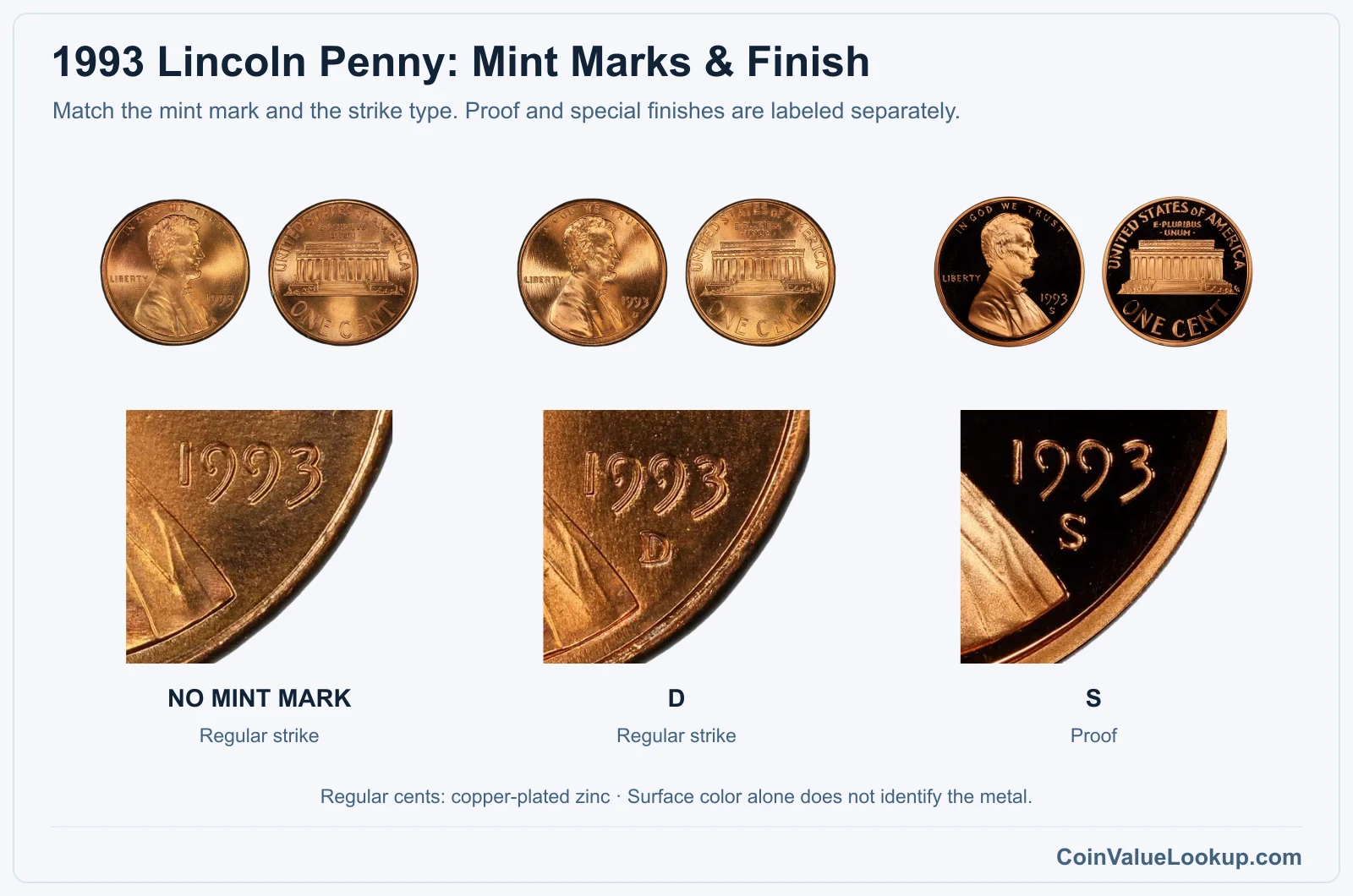
Three main branches exist: the Philadelphia issue (no mintmark), the Denver issue (D mintmark), and the San Francisco proof (S mintmark). The mintmark sits just below the date on the obverse.
There is no normal P-letter or S-letter business-strike version for this year.
A missing mintmark alone does not mean you have a rare proof omission. You need to confirm the proof finish, not just the absence of a letter.
When comparing values, keep the color designations (BN, RB, RD) and contrast labels (CAM, DCAM) as separate filters — they describe surface appearance and contrast, not different alloys.
Step 2: Check Your 1993 Lincoln Penny Grade
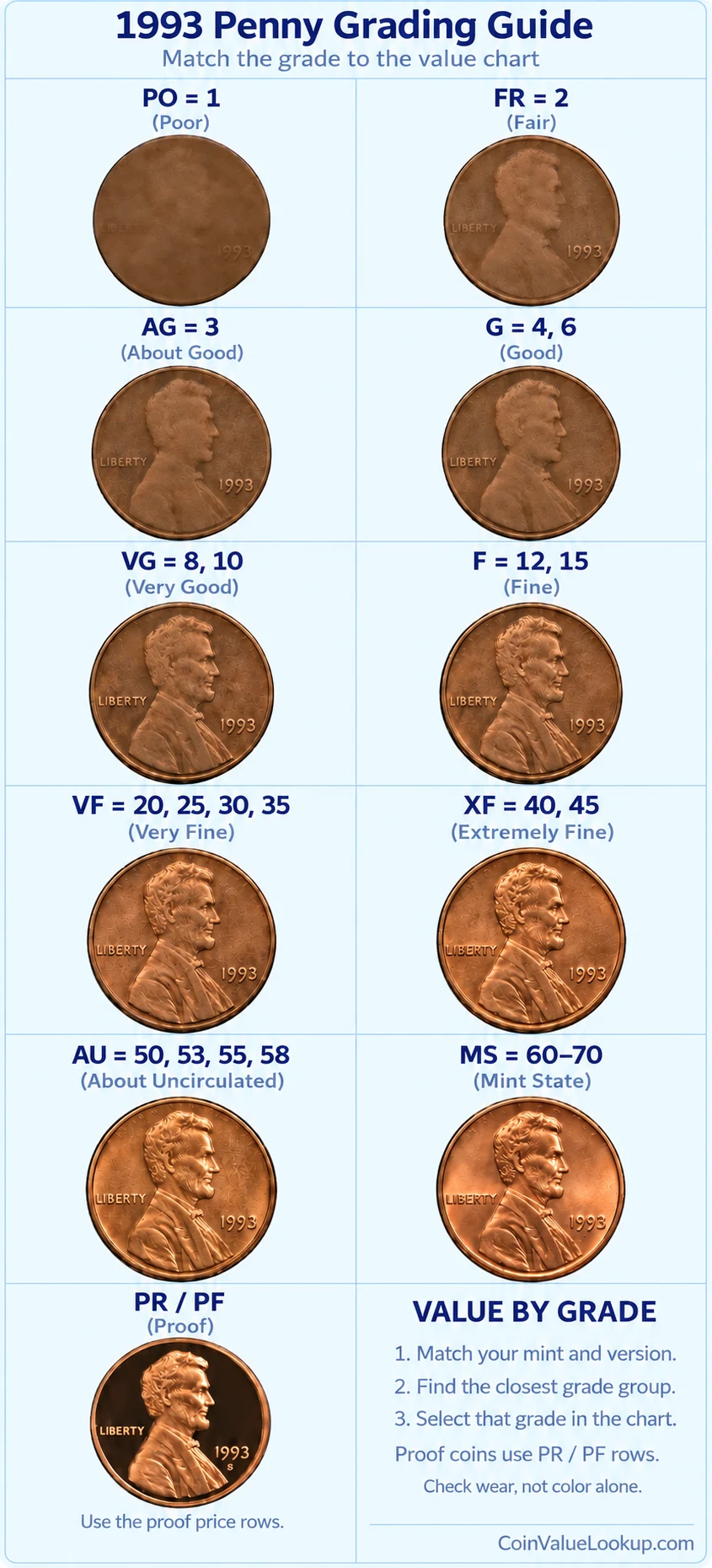
Start by checking Lincoln's cheekbone, jawline and hair detail on the obverse. These are the first areas to lose sharpness as a coin circulates.
On the reverse, look at the roof lines and columns of the Memorial — flatness there tells you the coin saw real pocket time.
Grade based on remaining luster, contact marks and actual wear, not copper color alone. A coin can look red and still be scratched to pieces.
Plating bubbles, splits and exposed zinc patches are surface problems, not minting errors that add value. Cleaning damage also counts against a coin.
Use the comparison image on this page to match your penny's wear level to a known grade bracket before assuming you have something special.
Step 3: Check 1993 Lincoln Penny Value by Mint and Version
1993 Lincoln Penny
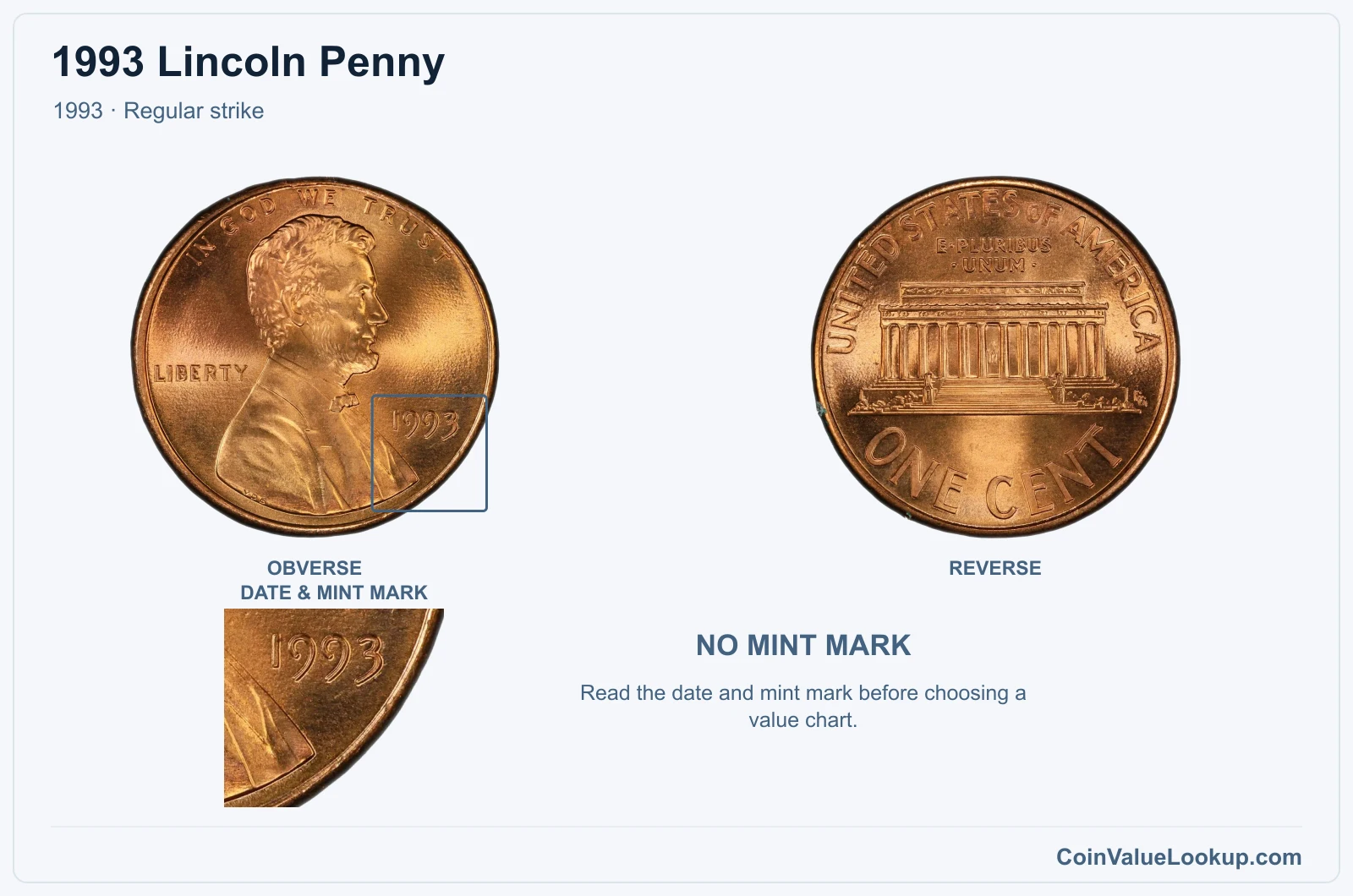
The 1993 Philadelphia cent has no mintmark below the date. It is a copper-plated zinc coin weighing about 2.50 grams with a Lincoln obverse and Memorial reverse — the same basic specs as every business-strike cent of this era.
A USA Coin Book guide estimate puts this version at roughly $0.36 in MS65. In circulated grades it is a face-value coin.
Look for clean surfaces, full luster and sharp hair detail if you think yours might grade uncirculated. Match the copper color designation as well, since a full Red coin and a Brown coin at the same numerical grade are not valued equally.
| Range | Grade | Price | Auction Records | Appraisal |
|---|---|---|---|---|
| PO | PO 1 | — | Coin Identifier | |
| FR | FR 2 | — | Coin Identifier | |
| AG | AG 3 | — | Coin Identifier | |
| G | G 4 | — | Coin Identifier | |
| G 6 | — | Coin Identifier | ||
| VG | VG 8 | — | Coin Identifier | |
| VG 10 | — | Coin Identifier | ||
| F | F 12 | — | Coin Identifier | |
| F 15 | — | Coin Identifier | ||
| VF | VF 20 | — | Coin Identifier | |
| VF 25 | — | Coin Identifier | ||
| VF 30 | — | Coin Identifier | ||
| VF 35 | — | Coin Identifier | ||
| XF | XF 40 | — | Coin Identifier | |
| XF 45 | — | Coin Identifier | ||
| AU | AU 50 | — | Coin Identifier | |
| AU 53 | — | Coin Identifier | ||
| AU 55 | — | Coin Identifier | ||
| AU 58 | — | Coin Identifier | ||
| MS | MS 60 | — | Coin Identifier | |
| MS 61 | — | Coin Identifier | ||
| MS 62 | — | Coin Identifier | ||
| MS 63 | — | Coin Identifier | ||
| MS 64 | Coin Identifier | |||
| MS 65 | Coin Identifier | |||
| MS 66 | Coin Identifier | |||
| MS 67 | Coin Identifier | |||
| MS 68 | Coin Identifier | |||
| MS 69 | Coin Identifier | |||
| MS 70 | — | — | — |
1993 Lincoln Penny — D
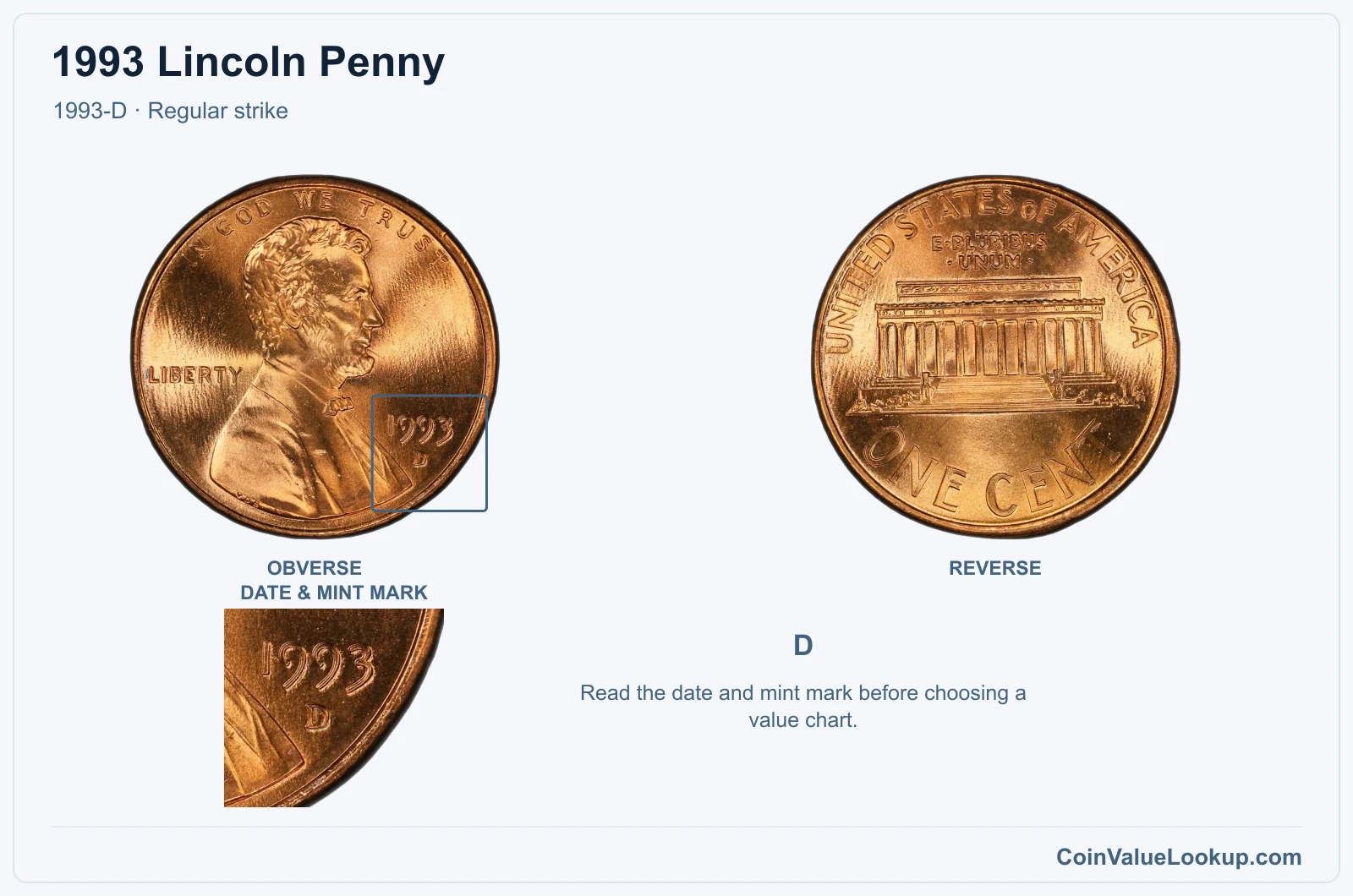
The 1993-D comes from Denver and carries a small D mintmark below the date. Same copper-plated zinc composition, same 2.50-gram target weight.
Guide value in MS65 is about $0.36 according to USA Coin Book. Like its Philadelphia sibling, this coin is common in all circulated grades.
To pull a premium you need strong original luster, minimal bag marks and a clear strike. Pay attention to surface condition — plating issues on zinc cents are cosmetic flaws, not collectible errors.
Coin Value Lookup is a handy place to look up current guide information for Lincoln cents and other series if you want to compare across years.
| Range | Grade | Price | Auction Records | Appraisal |
|---|---|---|---|---|
| PO | PO 1 | — | Coin Identifier | |
| FR | FR 2 | — | Coin Identifier | |
| AG | AG 3 | — | Coin Identifier | |
| G | G 4 | — | Coin Identifier | |
| G 6 | — | Coin Identifier | ||
| VG | VG 8 | — | Coin Identifier | |
| VG 10 | — | Coin Identifier | ||
| F | F 12 | — | Coin Identifier | |
| F 15 | — | Coin Identifier | ||
| VF | VF 20 | — | Coin Identifier | |
| VF 25 | — | Coin Identifier | ||
| VF 30 | — | Coin Identifier | ||
| VF 35 | — | Coin Identifier | ||
| XF | XF 40 | — | Coin Identifier | |
| XF 45 | — | Coin Identifier | ||
| AU | AU 50 | — | Coin Identifier | |
| AU 53 | — | Coin Identifier | ||
| AU 55 | — | Coin Identifier | ||
| AU 58 | — | Coin Identifier | ||
| MS | MS 60 | — | Coin Identifier | |
| MS 61 | — | Coin Identifier | ||
| MS 62 | — | Coin Identifier | ||
| MS 63 | — | Coin Identifier | ||
| MS 64 | — | Coin Identifier | ||
| MS 65 | — | Coin Identifier | ||
| MS 66 | Coin Identifier | |||
| MS 67 | Coin Identifier | |||
| MS 68 | Coin Identifier | |||
| MS 69 | Coin Identifier | |||
| MS 70 | — | — | — |
1993 Lincoln Penny — S PR
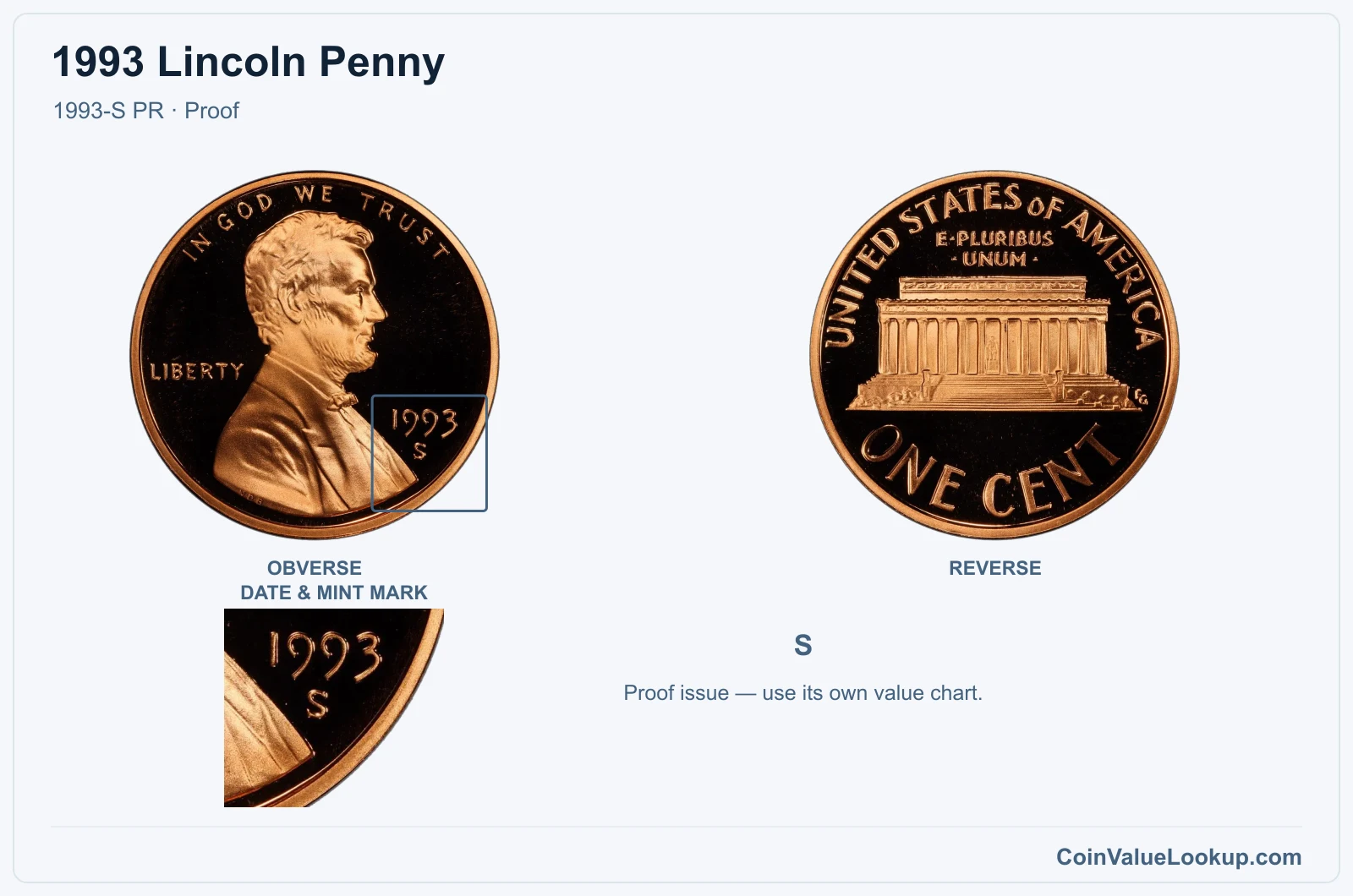
The 1993-S proof was struck at San Francisco for collectors, not for circulation. It carries an S mintmark and displays the sharp, mirrored fields characteristic of proof manufacture.
The composition remains copper-plated zinc at 2.50 grams.
A USA Coin Book guide estimate places this coin at about $11.00 in PR65. When evaluating a proof, keep contrast designations like Cameo and Deep Cameo separate from the numerical grade — they describe the frosted-versus-mirrored contrast on the surfaces, and each combination can carry a different value.
Remember that proof is a manufacturing finish, not a grade above Mint State.
| Range | Grade | Price | Auction Records | Appraisal |
|---|---|---|---|---|
| PR | PR 1 | — | Coin Identifier | |
| PR 2 | — | Coin Identifier | ||
| PR 3 | — | Coin Identifier | ||
| PR 4 | — | Coin Identifier | ||
| PR 6 | — | Coin Identifier | ||
| PR 8 | — | Coin Identifier | ||
| PR 10 | — | Coin Identifier | ||
| PR 12 | — | Coin Identifier | ||
| PR 15 | — | Coin Identifier | ||
| PR 20 | — | Coin Identifier | ||
| PR 25 | — | Coin Identifier | ||
| PR 30 | — | Coin Identifier | ||
| PR 35 | — | Coin Identifier | ||
| PR 40 | — | Coin Identifier | ||
| PR 45 | — | Coin Identifier | ||
| PR 50 | — | Coin Identifier | ||
| PR 53 | — | Coin Identifier | ||
| PR 55 | — | Coin Identifier | ||
| PR 58 | — | Coin Identifier | ||
| PR 60 | Coin Identifier | |||
| PR 61 | — | Coin Identifier | ||
| PR 62 | — | Coin Identifier | ||
| PR 63 | — | Coin Identifier | ||
| PR 64 | — | Coin Identifier | ||
| PR 65 | — | Coin Identifier | ||
| PR 66 | — | Coin Identifier | ||
| PR 67 | Coin Identifier | |||
| PR 68 | Coin Identifier | |||
| PR 69 | Coin Identifier | |||
| PR 70 | Coin Identifier |
1993 Lincoln Penny Error List
1. 1993 Lincoln Penny — Cent Obverse with Dime Reverse
This is the headline error for 1993 pennies. A mule occurs when two dies intended for different denominations are accidentally paired.
In this case, a 1993-D Lincoln cent obverse was combined with a Roosevelt dime torch reverse — one complete design on each side, struck as a single coin.
A PCGS MS65 Red example sold for $51,750 at auction in January 2010, which tells you how rare this pairing is. This is not two coins glued together or a novelty piece; it is a genuine wrong-die combination from the mint.
Be very skeptical of any ungraded example — novelty coins and altered assemblies are the usual lookalikes. Also, normal Close-AM letter spacing on a 1993 cent has nothing to do with this error.
2. 1993 Lincoln Penny — Cent Struck over a Dime
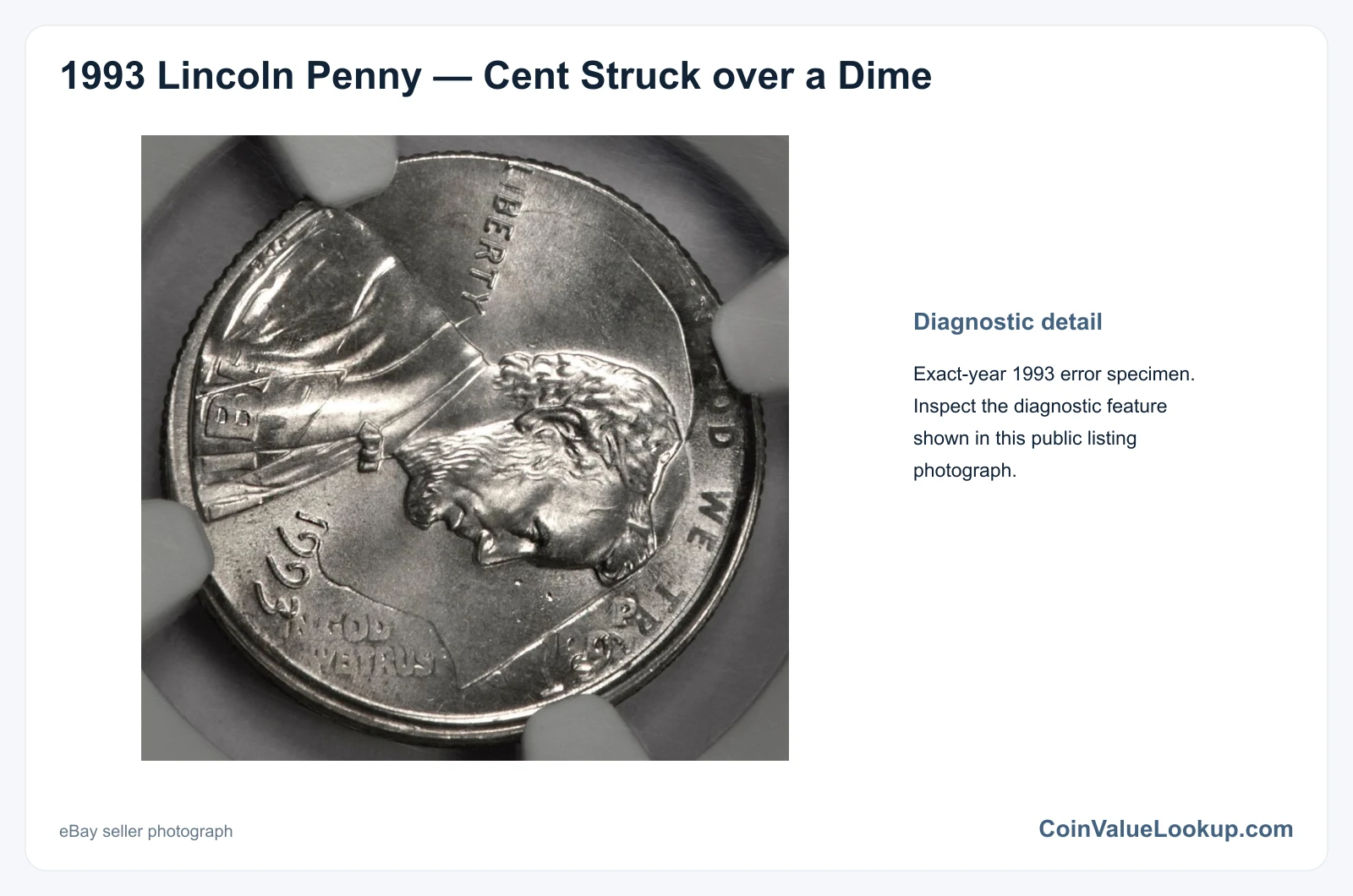
A cent struck over a dime is different from a mule. Here, an already-struck 1993-P Roosevelt dime was fed back through the press and struck with Lincoln cent dies.
Both the cent design and surviving traces of the earlier dime design are visible on the same coin.
An NGC MS67 example sold for $862.50 in April 2010. When examining a candidate, look for remnants of Roosevelt's portrait or the torch underneath the Lincoln design, and confirm both dates independently.
This is not the same as a cent struck on an unstruck dime blank, which would show no prior design. Proper attribution usually requires professional certification.
3. 1993 Lincoln Penny — Double Strike with Displaced Impression
A double strike happens when a coin is hit by the dies a second time in a displaced position. You will see two overlapping but shifted impressions of the design — two dates, two portraits, two buildings — rather than just slightly fuzzy lettering.
An NGC MS66 Red 1993 no-mintmark cent with a displaced second strike sold for $276 in December 2020. The key diagnostic is two physically separate, complete struck designs visible on the coin.
Do not confuse this with doubled die varieties, which show consistent doubling from a single strike using an improperly made die. Machine doubling — flat, shelf-like distortion — is also a different animal entirely.
4. 1993 Lincoln Penny — Doubled Die Obverse
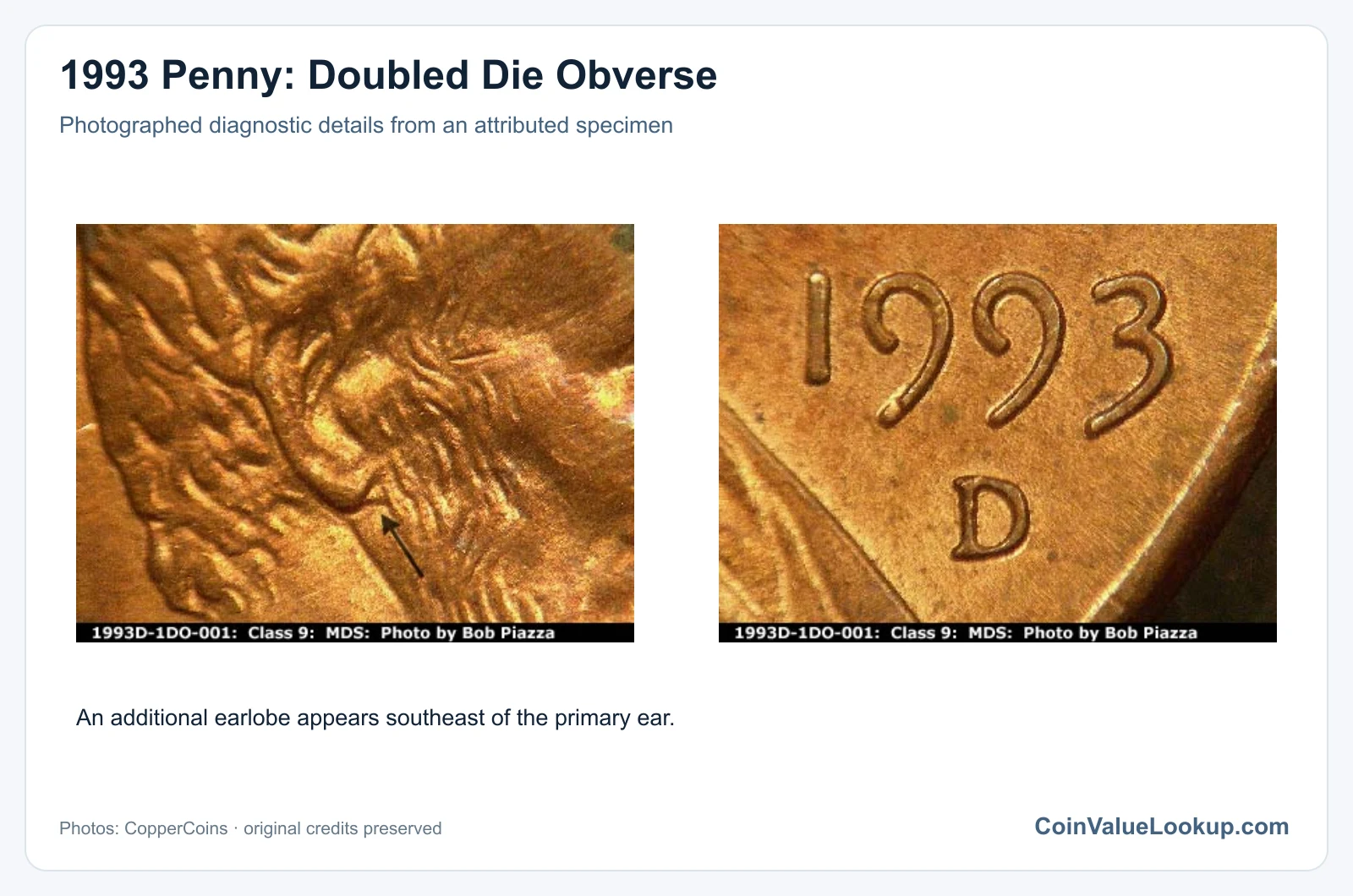
A doubled die obverse on a 1993 cent shows consistent separation or notching on obverse design elements such as lettering or date numerals. This doubling is baked into the die itself, so every coin struck from that die shows the same pattern in the same place.
Compare your coin's obverse letters and date to a normal example under the same lighting. Look for clear, raised separation rather than a flat shelf along one side of the letters.
A flat shelf usually points to machine doubling, which is a strike artifact with minimal collector interest. Reflections and worn die contours can also mimic doubling under magnification.
Value depends on condition, the strength of visible doubling and the specific variety involved.
5. 1993 Lincoln Penny — Off-Center Strike
An off-center strike occurs when the planchet is not properly seated between the dies. The result is a design shifted to one side with an unstruck crescent of blank metal on the opposite edge.
The percentage of off-center displacement and whether the date remains visible are the two biggest factors in value. A coin missing 50 percent of its design but retaining a full date is far more collectible than one where the date got clipped.
Do not confuse this with a clipped planchet, which has a curved bite out of the blank before striking, or with post-mint damage like a coin flattened under something heavy. Value depends on the degree of displacement, date visibility and overall condition.
6. 1993 Lincoln Penny — BIE Die Break
BIE errors are a die-break quirk specific to Lincoln cents. A crack develops in the die between the letters B and E in LIBERTY, and on the struck coin it appears as a small raised vertical line or blob — like an extra letter I sitting between B and E.
To check yours, look at LIBERTY under magnification. The raised bridge should be part of the coin's surface, not sitting on top like debris.
Dirt, scratches and glue residue can all mimic this feature, so clean lighting and a loupe help. BIE breaks are a popular collecting niche but are generally modest in value.
Condition and the clarity of the break determine what any individual example is worth.
7. 1993 Lincoln Penny — Broadstrike
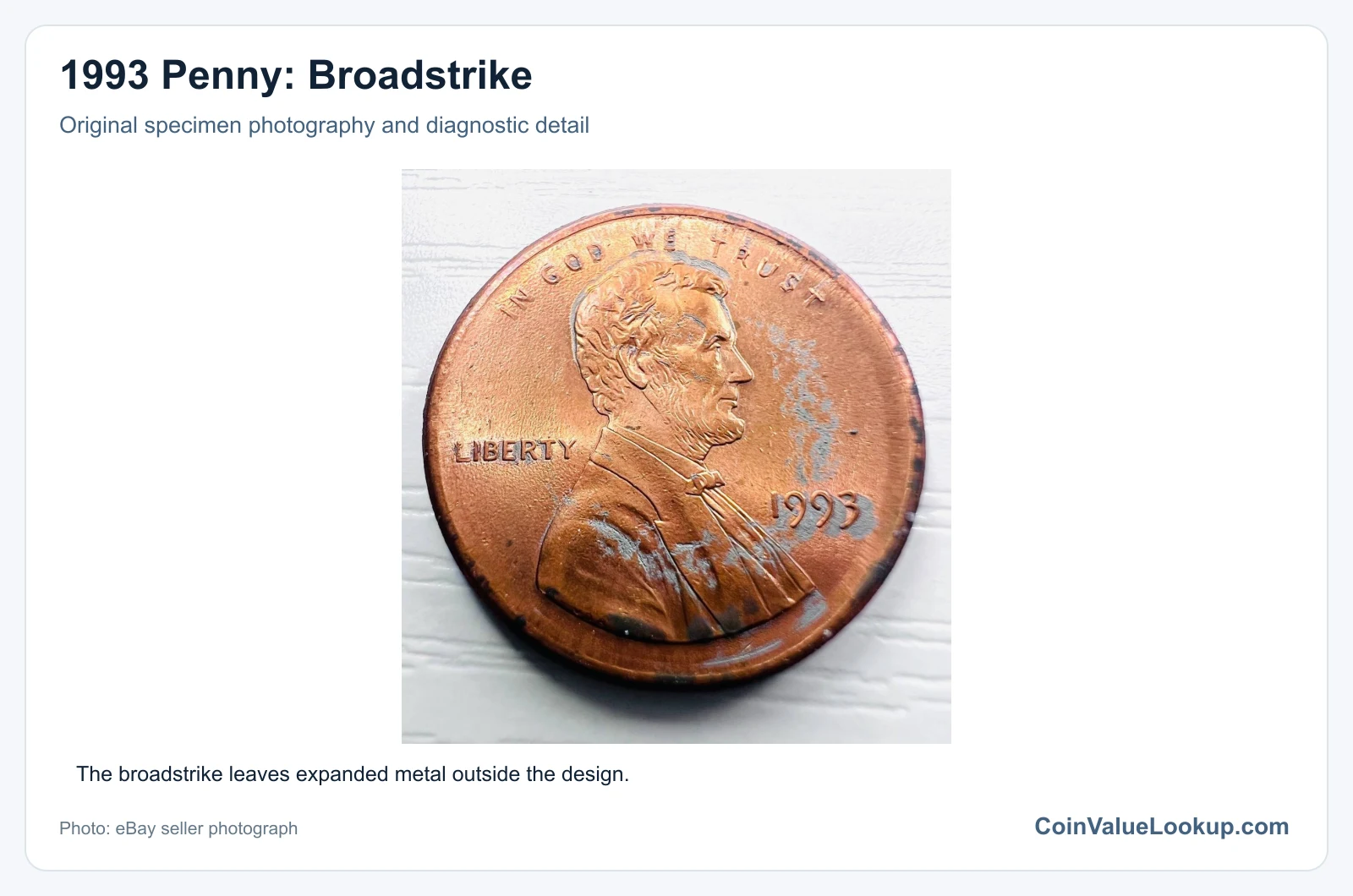
A broadstrike happens when the retaining collar that normally constrains the coin's diameter fails to engage during striking. The metal spreads outward beyond its standard size, and the design reaches closer to — or past — where the rim would normally be.
Your coin will look wider and thinner than normal, with a weaker or absent rim. The full design should still be present, just spread out.
This differs from an off-center strike, where part of the design is missing entirely. It also differs from a coin that was flattened after leaving the mint — post-mint damage won't show the uniform radial spread of a genuine broadstrike.
Value depends on how dramatic the spread is and the coin's overall condition.
8. 1993 Lincoln Penny — Die Break / Cud
A cud is a specific type of die break where a chunk of the die breaks away at the rim. The result on the coin is a raised, featureless blob connected to the rim, replacing part of the normal design.
Smaller interior die cracks and chips also occur but are technically different from a true cud, which must touch the rim. Check the boundary of any raised area carefully — a rim dent or corrosion spot can look similar at first glance.
The size and location of the cud affect collector interest; a large cud obliterating part of a major design element draws more attention than a tiny one in the field. Value varies with the specific break, its size and the coin's condition.
9. 1993 Lincoln Penny — Die Cap / Capped-Die Strike
A die cap forms when a struck coin sticks to one of the dies and keeps getting hit as new planchets feed through. The stuck coin gradually cups around the die like a bottle cap, and coins struck beneath it pick up a distorted, mirror-image impression from the cap's underside.
Two different collectibles come from this process: the capped coin itself and the coins struck through the cap. The capped coin will be noticeably cupped or domed.
Do not confuse a bent coin or one damaged in a vise with a genuine cap — post-mint bending does not produce the progressive design distortion seen on an authentic example. A normal weak strike is also unrelated.
Value depends on how developed the cap is and the coin's overall preservation.