1990 Lincoln Penny Coin Value: How Much Is It Worth?
Most 1990 Lincoln pennies you pull from a jar are worth face value. A USA Coin Book guide estimate places an ordinary example at about $0.36 in MS65, while the 1990-S proof sits around $6.25 in PR65.
The real standout is the 1990 No S proof, with a PR65 guide estimate of $3,635. Before you get excited, that variety applies only to authenticated San Francisco proofs, not regular circulation cents that happen to lack a mintmark.
Fast Way to Identify Your 1990 Lincoln Penny
Snap clear, well-lit photos of both the front and back of your 1990 penny and upload them here. This gives you a preliminary identification of the mint, finish and general condition so you can figure out which version you actually have.
It is not a substitute for professional authentication, but it points you in the right direction.
1990 Penny Value
Upload both sides of your 1990 Lincoln Penny.
Front Obverse
Upload photo
Back Reverse
Upload photo
Which 1990 Lincoln Penny Versions Are Worth Money?
- The 1990 No S proof is a rare San Francisco proof missing its mintmark, with a PR65 guide estimate of $3,635. Only authenticated proofs qualify; ordinary no-mintmark cents are common Philadelphia issues.
- Proofs and high-grade original-color business strikes need finish- and color-matched comparisons. A dramatic error sale price does not set the value of a normal circulated penny.
Step 1: Identify Your 1990 Lincoln Penny Mint Mark and Version
The 1990 Lincoln cent is a copper-plated zinc coin weighing about 2.50 grams with a plain edge. The copper color on the surface does not mean it is solid copper; the plating covers a zinc core.
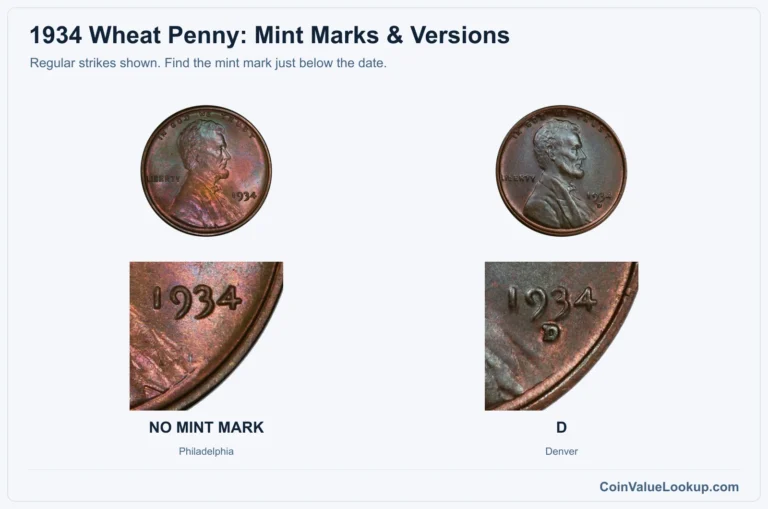
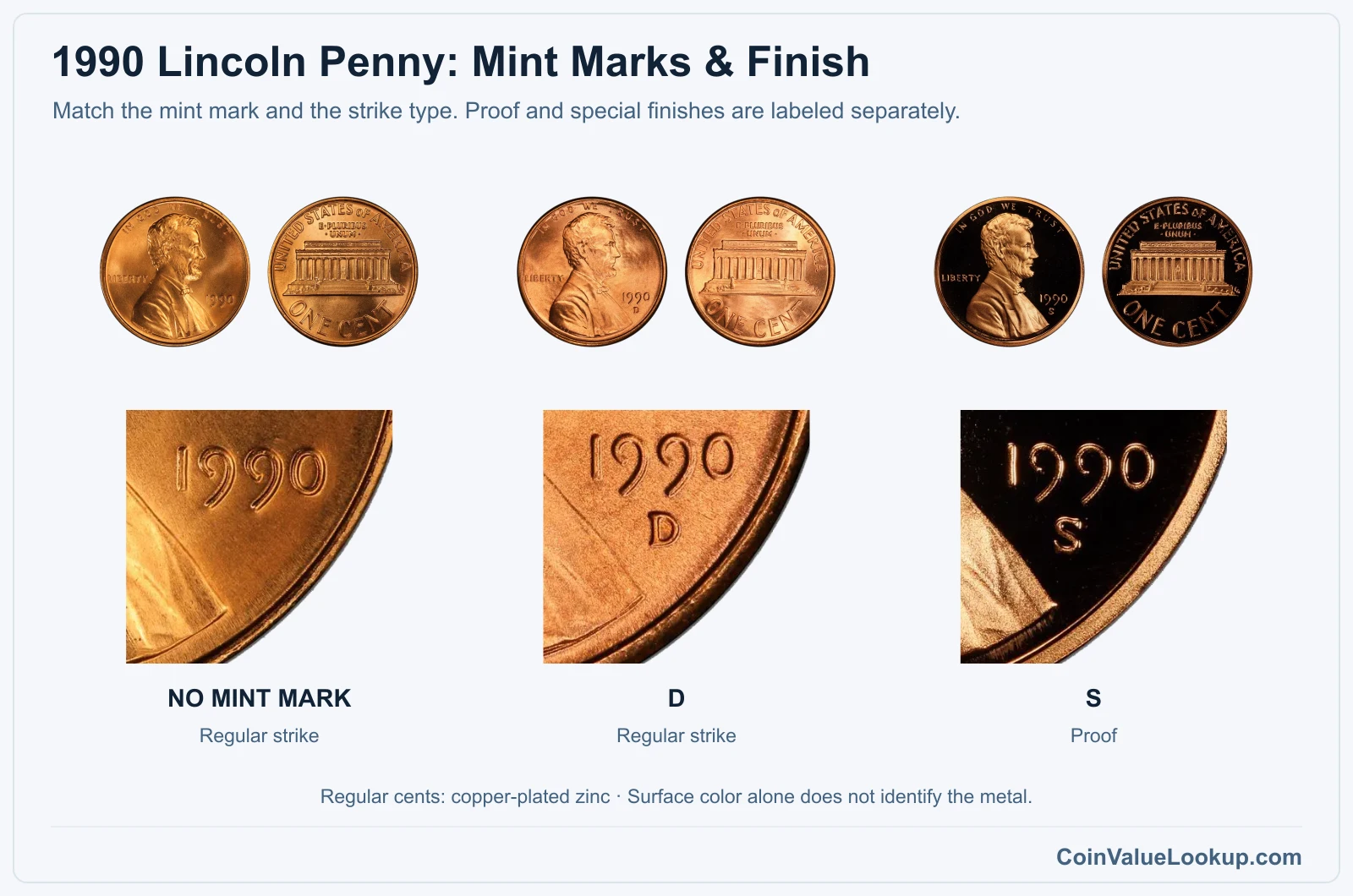
Three main branches exist: the no-mintmark Philadelphia issue, the Denver (D) issue, and the San Francisco (S) proof. There is no normal S-mint or P-letter circulation cent for this year.
The mintmark sits below the date on the obverse. A missing mintmark by itself just means you have a Philadelphia business strike, the most common branch.
It does not mean you own the rare No S proof.
The No S variety is a San Francisco proof that left the mint without its S mintmark. You need to confirm actual proof manufacture, including the mirror-like fields and sharp details consistent with proof striking, not just a shiny surface.
Authentication by a grading service is the only reliable way to confirm this variety.
Color designations like BN, RB and RD describe the remaining original copper tone, while CAM and DCAM describe contrast on proofs. These are condition and appearance filters, not different alloys or metals.
Step 2: Check Your 1990 Lincoln Penny Grade
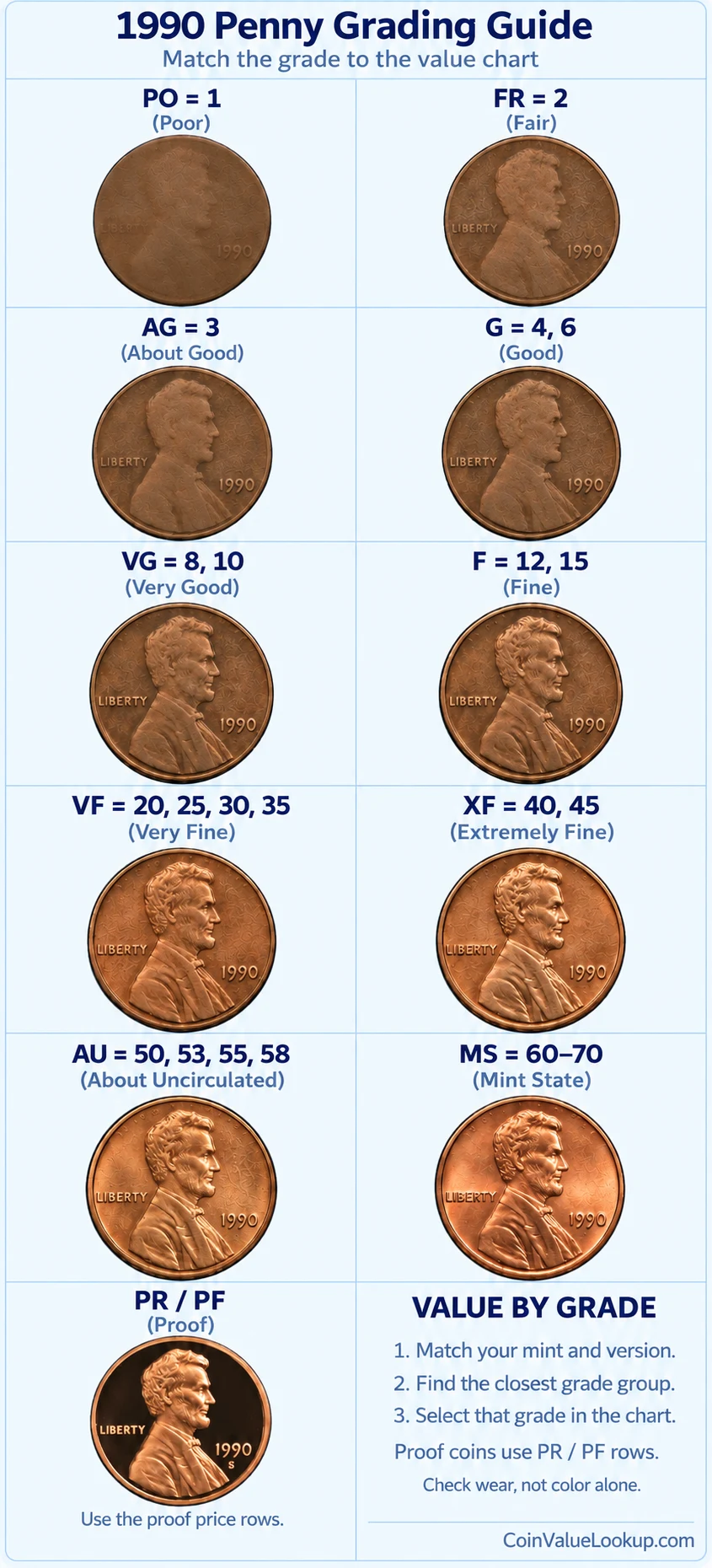
Focus on Lincoln's cheekbone, jawline and hair detail on the obverse, plus the roof and columns of the Memorial on the reverse. Those are the high points that show wear first.
Grade based on remaining luster, contact marks and actual wear, not redness alone. A bright red coin with a big gouge is not automatically better than a toned one with clean surfaces.
Plating bubbles, splits, exposed zinc and corrosion are surface issues common to copper-plated zinc cents. They lower eye appeal and grade but do not create a premium.
Not every gray patch is an error.
Use the comparison image to match your coin's wear against known grade examples. A coin with full hair detail and original luster but a few minor bag marks is typical of the MS63 to MS65 range.
Step 3: Check 1990 Lincoln Penny Value by Mint and Version
1990 Lincoln Penny
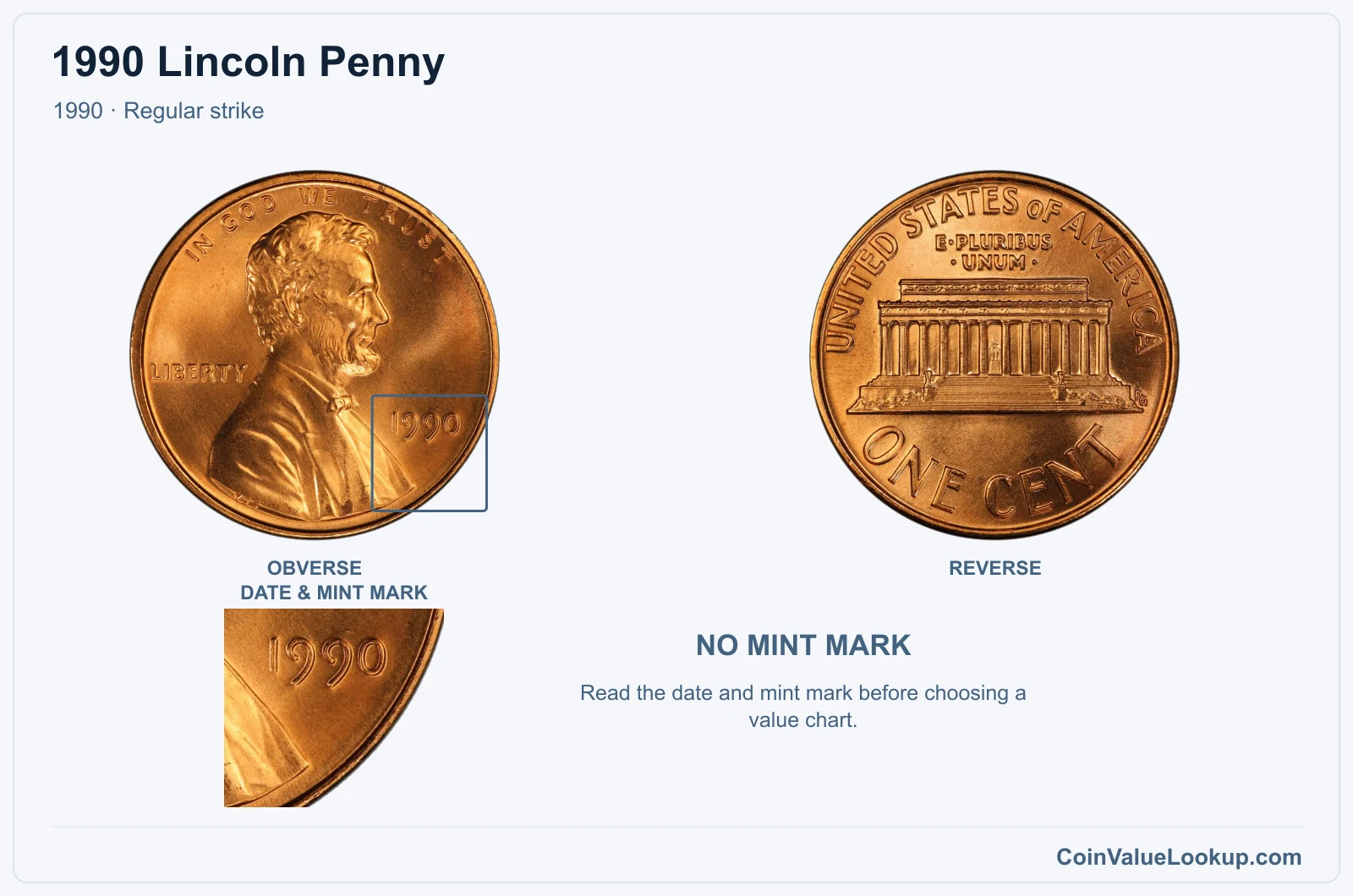
This is the standard 1990 Philadelphia cent with no mintmark below the date. It is copper-plated zinc, weighing about 2.50 grams.
Billions were struck, so even uncirculated examples are common. A USA Coin Book guide estimate puts MS65 at roughly $0.36.
Condition, surface marks and remaining copper color all matter when comparing. If yours has wear from circulation, it is essentially worth one cent.
| Range | Grade | Price | Auction Records | Appraisal |
|---|---|---|---|---|
| PO | PO 1 | — | Coin Identifier | |
| FR | FR 2 | — | Coin Identifier | |
| AG | AG 3 | — | Coin Identifier | |
| G | G 4 | — | Coin Identifier | |
| G 6 | — | Coin Identifier | ||
| VG | VG 8 | — | Coin Identifier | |
| VG 10 | — | Coin Identifier | ||
| F | F 12 | — | Coin Identifier | |
| F 15 | — | Coin Identifier | ||
| VF | VF 20 | — | Coin Identifier | |
| VF 25 | — | Coin Identifier | ||
| VF 30 | — | Coin Identifier | ||
| VF 35 | — | Coin Identifier | ||
| XF | XF 40 | — | Coin Identifier | |
| XF 45 | — | Coin Identifier | ||
| AU | AU 50 | — | Coin Identifier | |
| AU 53 | — | Coin Identifier | ||
| AU 55 | — | Coin Identifier | ||
| AU 58 | — | Coin Identifier | ||
| MS | MS 60 | — | Coin Identifier | |
| MS 61 | — | Coin Identifier | ||
| MS 62 | — | Coin Identifier | ||
| MS 63 | — | Coin Identifier | ||
| MS 64 | Coin Identifier | |||
| MS 65 | Coin Identifier | |||
| MS 66 | Coin Identifier | |||
| MS 67 | Coin Identifier | |||
| MS 68 | Coin Identifier | |||
| MS 69 | Coin Identifier | |||
| MS 70 | — | — | — |
1990 Lincoln Penny — D
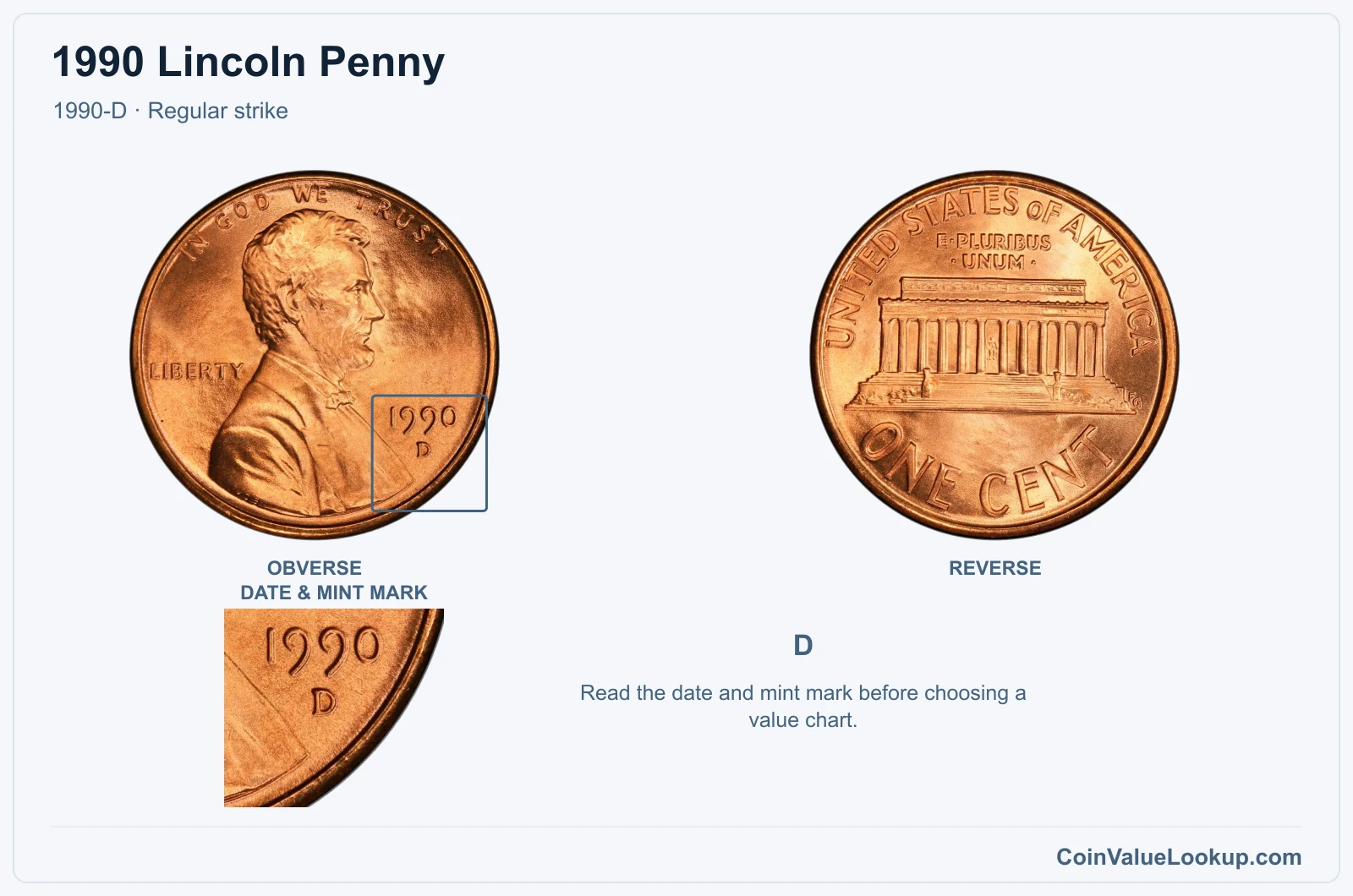
The 1990-D was struck in Denver and carries a small D below the date. Same copper-plated zinc composition and 2.50-gram weight as the Philadelphia issue.
The MS65 guide estimate is also about $0.36 per USA Coin Book. Like its no-mintmark sibling, this is a high-mintage coin.
You need a clean, lustrous example with minimal marks to approach even that modest guide figure.
Coin Value Lookup is a handy starting point if you want to look up guide values for other dates and denominations in the Lincoln series.
| Range | Grade | Price | Auction Records | Appraisal |
|---|---|---|---|---|
| PO | PO 1 | — | Coin Identifier | |
| FR | FR 2 | — | Coin Identifier | |
| AG | AG 3 | — | Coin Identifier | |
| G | G 4 | — | Coin Identifier | |
| G 6 | — | Coin Identifier | ||
| VG | VG 8 | — | Coin Identifier | |
| VG 10 | — | Coin Identifier | ||
| F | F 12 | — | Coin Identifier | |
| F 15 | — | Coin Identifier | ||
| VF | VF 20 | — | Coin Identifier | |
| VF 25 | — | Coin Identifier | ||
| VF 30 | — | Coin Identifier | ||
| VF 35 | — | Coin Identifier | ||
| XF | XF 40 | — | Coin Identifier | |
| XF 45 | — | Coin Identifier | ||
| AU | AU 50 | — | Coin Identifier | |
| AU 53 | — | Coin Identifier | ||
| AU 55 | — | Coin Identifier | ||
| AU 58 | — | Coin Identifier | ||
| MS | MS 60 | — | Coin Identifier | |
| MS 61 | — | Coin Identifier | ||
| MS 62 | — | Coin Identifier | ||
| MS 63 | — | Coin Identifier | ||
| MS 64 | — | Coin Identifier | ||
| MS 65 | — | Coin Identifier | ||
| MS 66 | Coin Identifier | |||
| MS 67 | Coin Identifier | |||
| MS 68 | Coin Identifier | |||
| MS 69 | Coin Identifier | |||
| MS 70 | — | — | — |
1990 Lincoln Penny — S PR
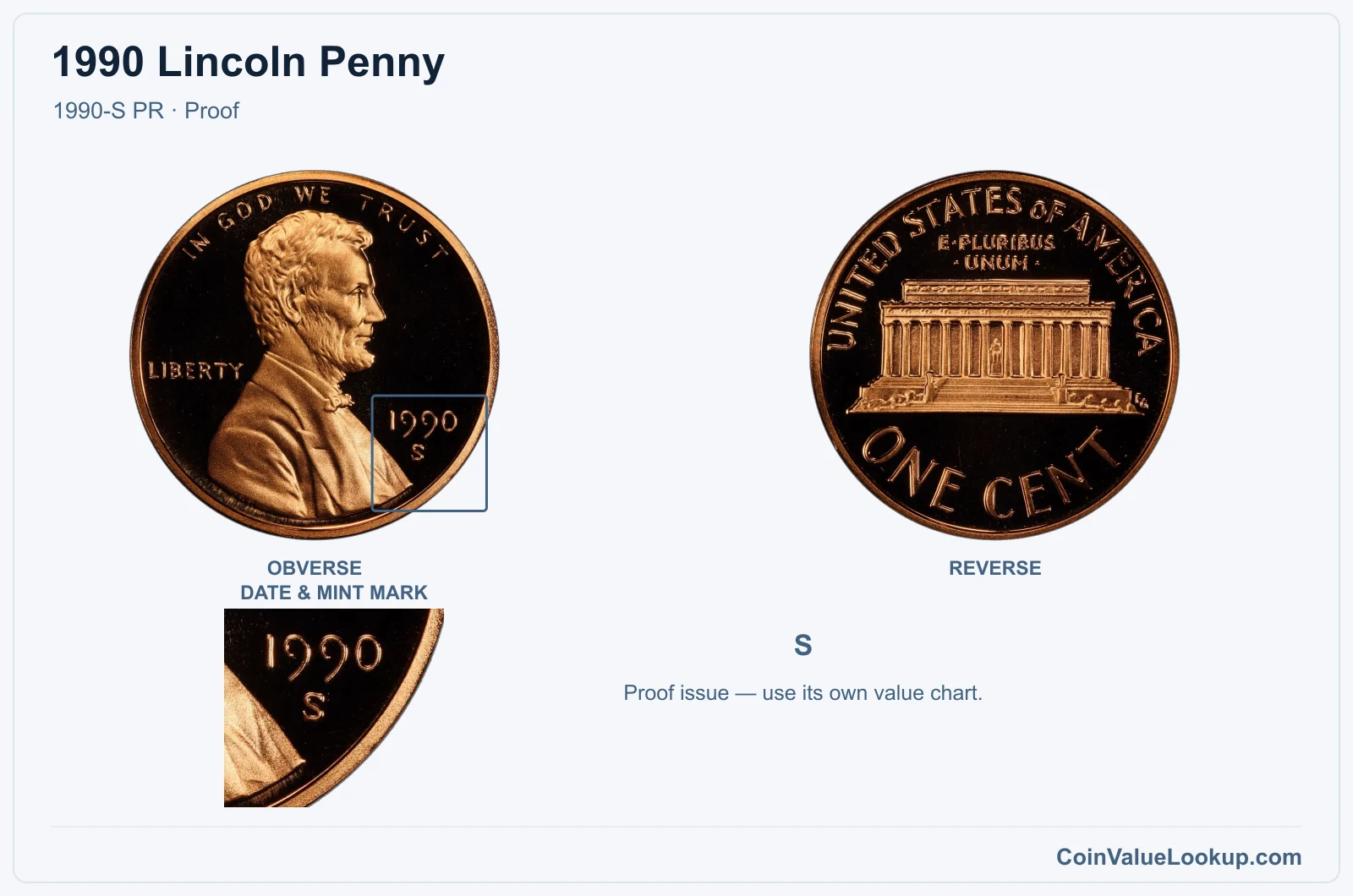
The 1990-S proof was produced at San Francisco for collector sets and carries an S mintmark below the date. It is the same copper-plated zinc composition.
A PR65 guide estimate from USA Coin Book is about $6.25. Proof finish means mirror-like fields with sharply struck details.
Contrast designations like CAM or DCAM can affect value separately from the numerical grade. Keep proof examples in protective holders; fingerprints and haze degrade the mirror surfaces quickly.
| Range | Grade | Price | Auction Records | Appraisal |
|---|---|---|---|---|
| PR | PR 1 | — | Coin Identifier | |
| PR 2 | — | Coin Identifier | ||
| PR 3 | — | Coin Identifier | ||
| PR 4 | — | Coin Identifier | ||
| PR 6 | — | Coin Identifier | ||
| PR 8 | — | Coin Identifier | ||
| PR 10 | — | Coin Identifier | ||
| PR 12 | — | Coin Identifier | ||
| PR 15 | — | Coin Identifier | ||
| PR 20 | — | Coin Identifier | ||
| PR 25 | — | Coin Identifier | ||
| PR 30 | — | Coin Identifier | ||
| PR 35 | — | Coin Identifier | ||
| PR 40 | — | Coin Identifier | ||
| PR 45 | — | Coin Identifier | ||
| PR 50 | — | Coin Identifier | ||
| PR 53 | — | Coin Identifier | ||
| PR 55 | — | Coin Identifier | ||
| PR 58 | — | Coin Identifier | ||
| PR 60 | — | Coin Identifier | ||
| PR 61 | — | Coin Identifier | ||
| PR 62 | — | Coin Identifier | ||
| PR 63 | — | Coin Identifier | ||
| PR 64 | — | Coin Identifier | ||
| PR 65 | — | Coin Identifier | ||
| PR 66 | — | Coin Identifier | ||
| PR 67 | Coin Identifier | |||
| PR 68 | Coin Identifier | |||
| PR 69 | Coin Identifier | |||
| PR 70 | Coin Identifier |
1990 Lincoln Penny — No S PR
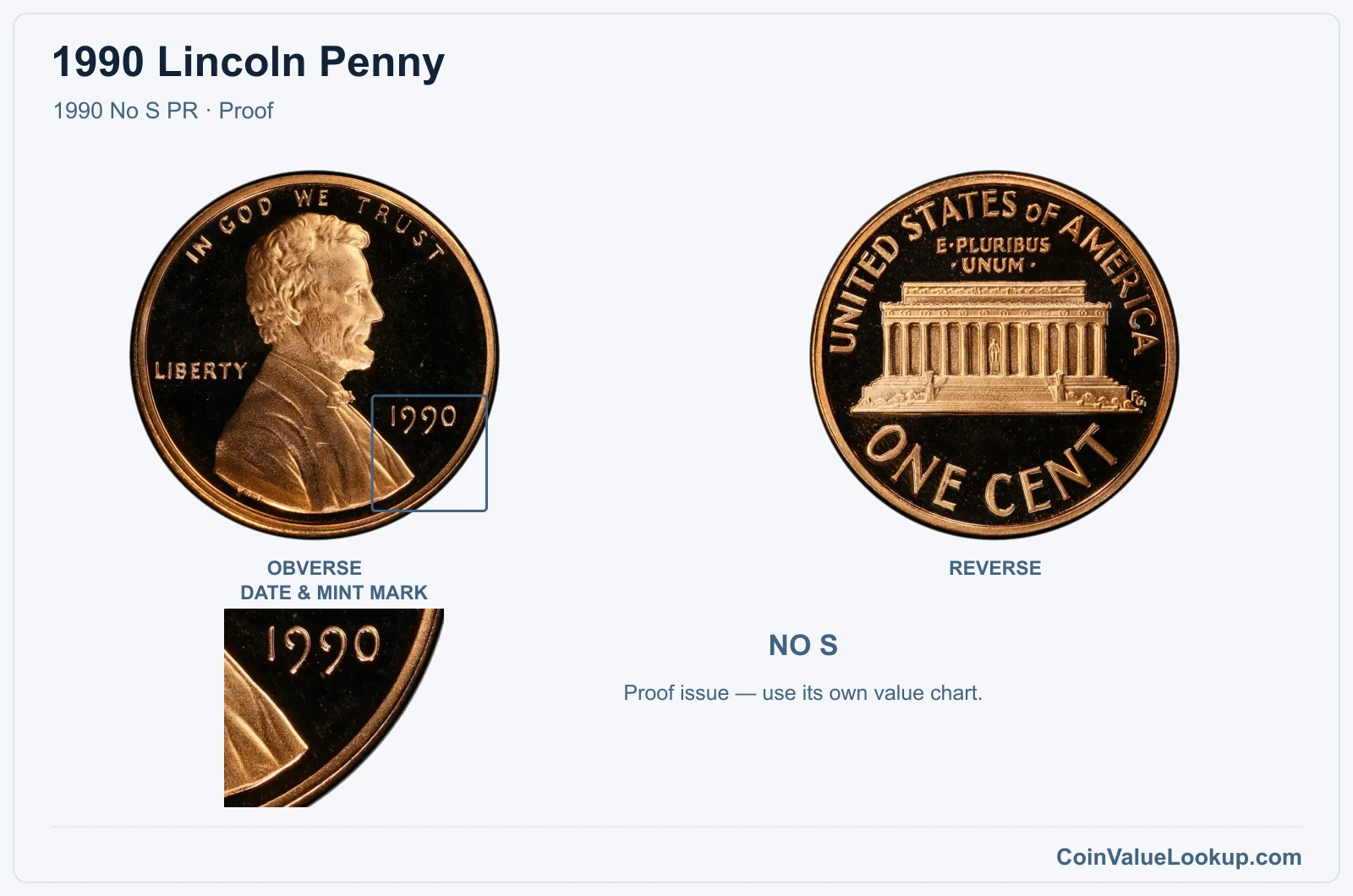
This is the famous 1990 No S proof, a San Francisco proof cent that was struck without the S mintmark. The PR65 guide estimate is $3,635 according to USA Coin Book.
That price applies exclusively to coins confirmed as proof manufacture from the San Francisco Mint, not to ordinary Philadelphia business strikes that also lack a mintmark.
Authentication is critical here. A common 1990 no-mintmark cent from pocket change is worth one cent.
The No S proof has diagnostic proof surfaces, precise rims and sharp strike detail that distinguish it from any business strike. If you believe you have one, professional third-party certification is the only reliable path to confirming it.
Do not assume a shiny surface or smooth field alone proves proof manufacture.
| Range | Grade | Price | Auction Records | Appraisal |
|---|---|---|---|---|
| PR | PR 1 | — | Coin Identifier | |
| PR 2 | — | Coin Identifier | ||
| PR 3 | — | Coin Identifier | ||
| PR 4 | — | Coin Identifier | ||
| PR 6 | — | Coin Identifier | ||
| PR 8 | — | Coin Identifier | ||
| PR 10 | — | Coin Identifier | ||
| PR 12 | — | Coin Identifier | ||
| PR 15 | — | Coin Identifier | ||
| PR 20 | — | Coin Identifier | ||
| PR 25 | — | Coin Identifier | ||
| PR 30 | — | Coin Identifier | ||
| PR 35 | — | Coin Identifier | ||
| PR 40 | — | Coin Identifier | ||
| PR 45 | — | Coin Identifier | ||
| PR 50 | — | Coin Identifier | ||
| PR 53 | — | Coin Identifier | ||
| PR 55 | — | Coin Identifier | ||
| PR 58 | — | Coin Identifier | ||
| PR 60 | — | Coin Identifier | ||
| PR 61 | — | Coin Identifier | ||
| PR 62 | — | Coin Identifier | ||
| PR 63 | Coin Identifier | |||
| PR 64 | Coin Identifier | |||
| PR 65 | Coin Identifier | |||
| PR 66 | Coin Identifier | |||
| PR 67 | Coin Identifier | |||
| PR 68 | Coin Identifier | |||
| PR 69 | Coin Identifier | |||
| PR 70 | — | — | — |
1990 Lincoln Penny Error List
1. 1990 Lincoln Penny — Missing S on a Proof
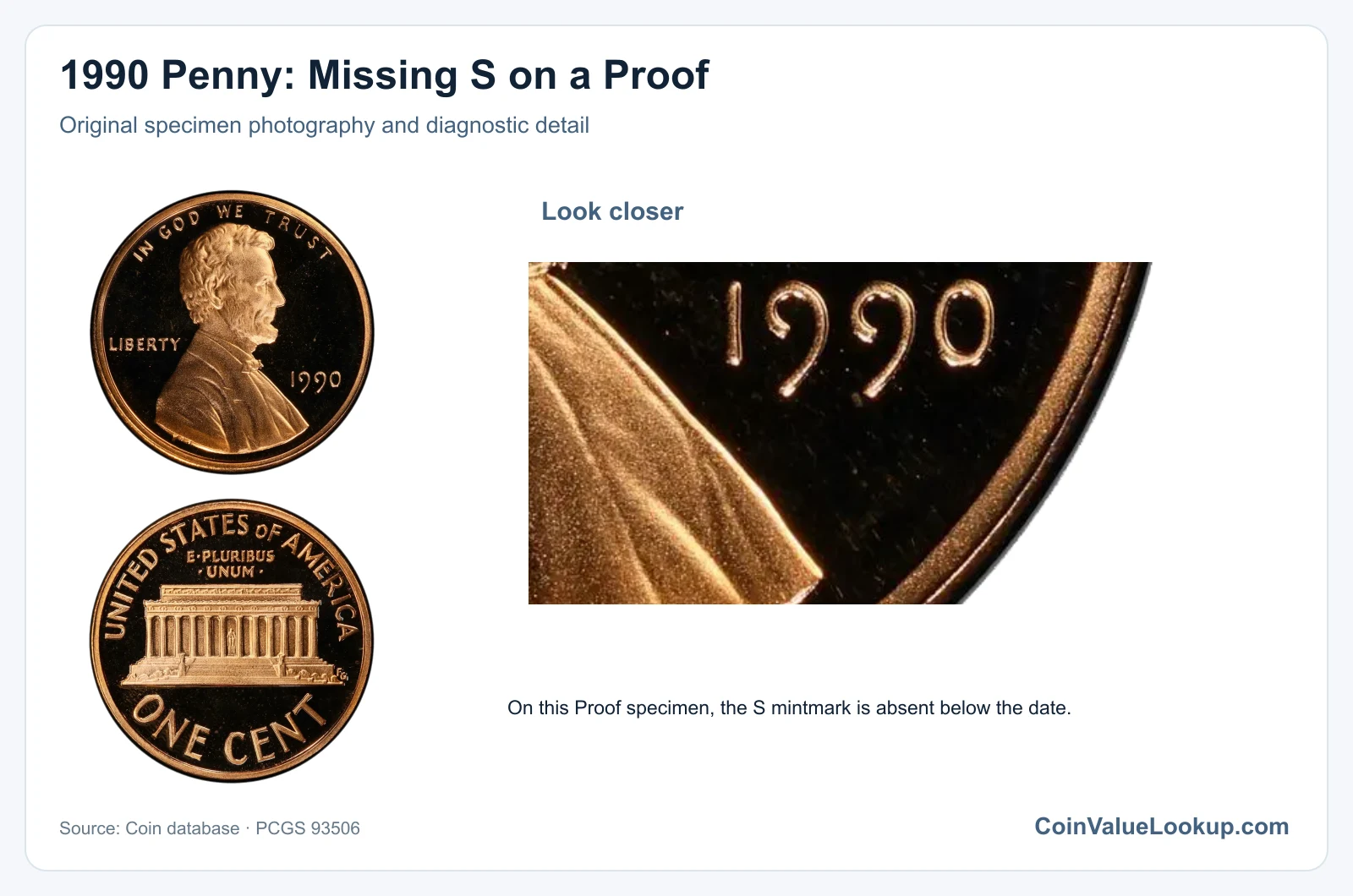
The Missing S on a 1990 proof cent is one of the most recognized modern error varieties. It occurred when San Francisco proof dies were prepared without the S mintmark.
The PCGS guide estimate for a PR65 example is $3,635.
To identify it, verify that the coin is genuinely a proof, with mirrored fields, a sharp strike and squared rims, and that no S appears below the date. Smooth fields alone are not enough.
The most common lookalike is simply an ordinary Philadelphia business strike, which never carries a mintmark in this era. A coin with a physically removed mintmark may also mimic the appearance.
Third-party authentication is essential before assigning any premium to this variety.
2. 1990 Lincoln Penny — Struck on a Clad Dime Blank
A 1990 cent struck on a clad dime blank is a wrong-planchet error. The cent dies impressed a Lincoln design onto a smaller, clad-composition blank intended for a dime.
The result is a noticeably undersized coin with possible incomplete peripheral lettering.
A PCGS MS65 example sold for $396 at Heritage Auctions in July 2022. That is a single recorded sale, not a broad market range.
To verify, you need to check the coin's weight, diameter and alloy, since a clad dime blank differs from the normal copper-plated zinc cent blank. Do not confuse this with a normal cent that looks small due to wear or damage, or with a coin struck over an already-struck dime, which is a different category.
3. 1990 Lincoln Penny — Missing Copper Plating
A 1990 cent struck on an unplated zinc blank has a silvery-gray appearance because the copper plating was absent before the coin was struck. The key diagnostic is that the zinc surface shows original mint strike texture, meaning the design details are sharp and the surface has a consistent unplated look across the entire coin.
An NGC MS65 example sold for $156 at Heritage Auctions in October 2018. That is one recorded sale.
The main lookalike is a normal cent where the copper plating was chemically stripped, abraded or corroded away after minting. Post-strike plating loss tends to be uneven, with rough patches and missing detail, while a genuinely unplated strike looks uniform.
Authentication confirms the difference.
4. 1990 Lincoln Penny — Off-Center Strike
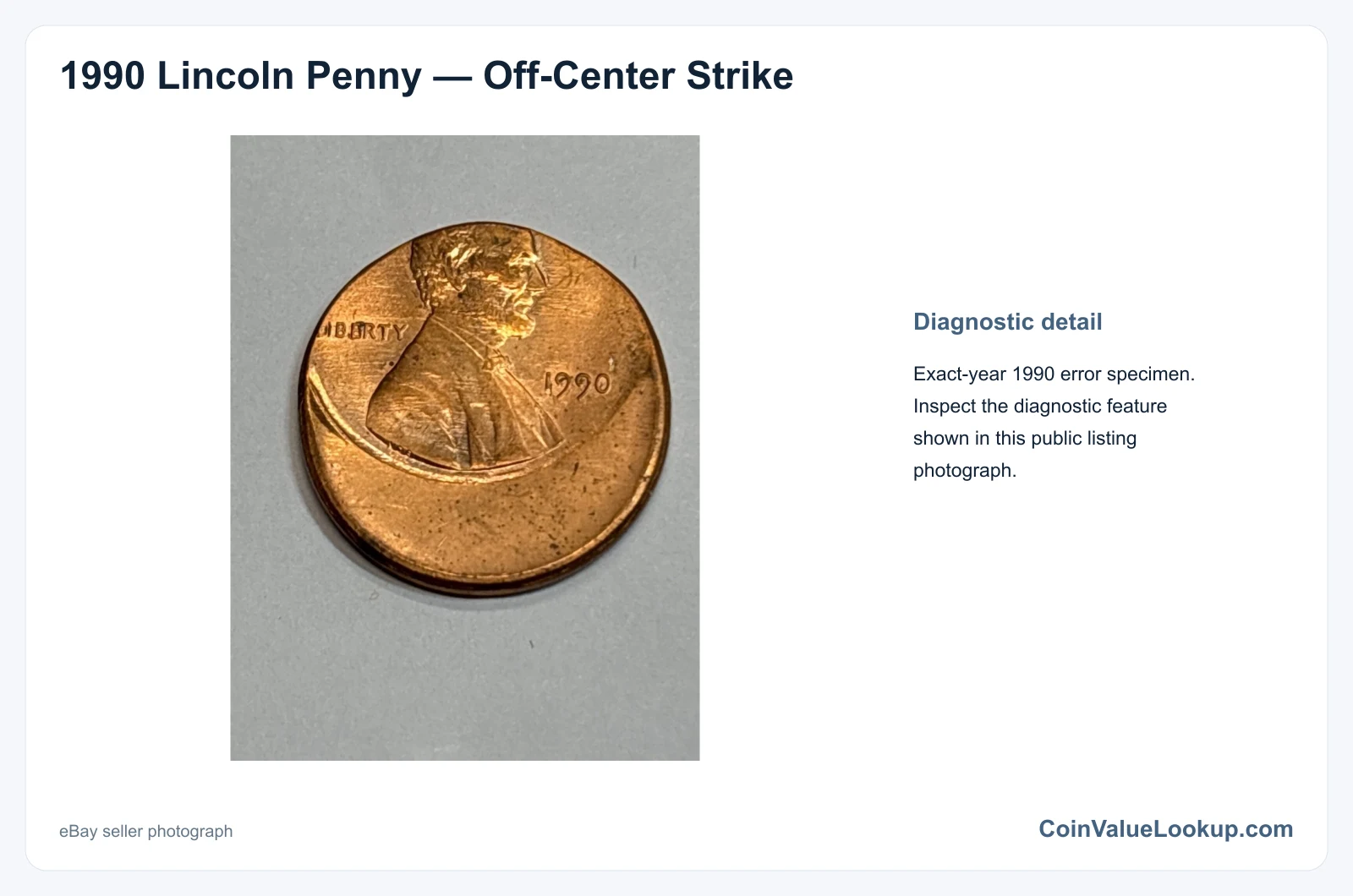
An off-center strike happens when the blank is not properly seated between the dies, so the design is displaced to one side and an unstruck crescent of blank metal remains on the opposite edge. The percentage of off-center shift and whether the date is still visible are the two biggest factors affecting collector interest.
Condition and the degree of the error both influence value; no specific price is adopted here. Lookalikes include clipped planchets, which have a different edge profile, one-sided die misalignment and coins that were flattened or bent after leaving the mint.
A genuine off-center strike shows consistent design detail that simply shifts position rather than being smashed flat.
5. 1990 Lincoln Penny — Broadstrike
A broadstrike occurs when a coin is struck without the retaining collar that normally confines the metal and forms the rim. The result is a coin that spreads wider than normal, with a thinner profile and a missing or malformed rim, while the full design is still centered.
Value depends on how dramatic the spread is and the coin's overall condition. No specific price is adopted for this variety.
The key distinction from an off-center strike is that a broadstrike keeps the design roughly centered. Do not confuse it with a coin that was flattened by machinery or stepped on after it left the mint; post-strike damage lacks the uniform metal flow of a genuine broadstrike.
6. 1990 Lincoln Penny — BIE / Die Cracks and Chips
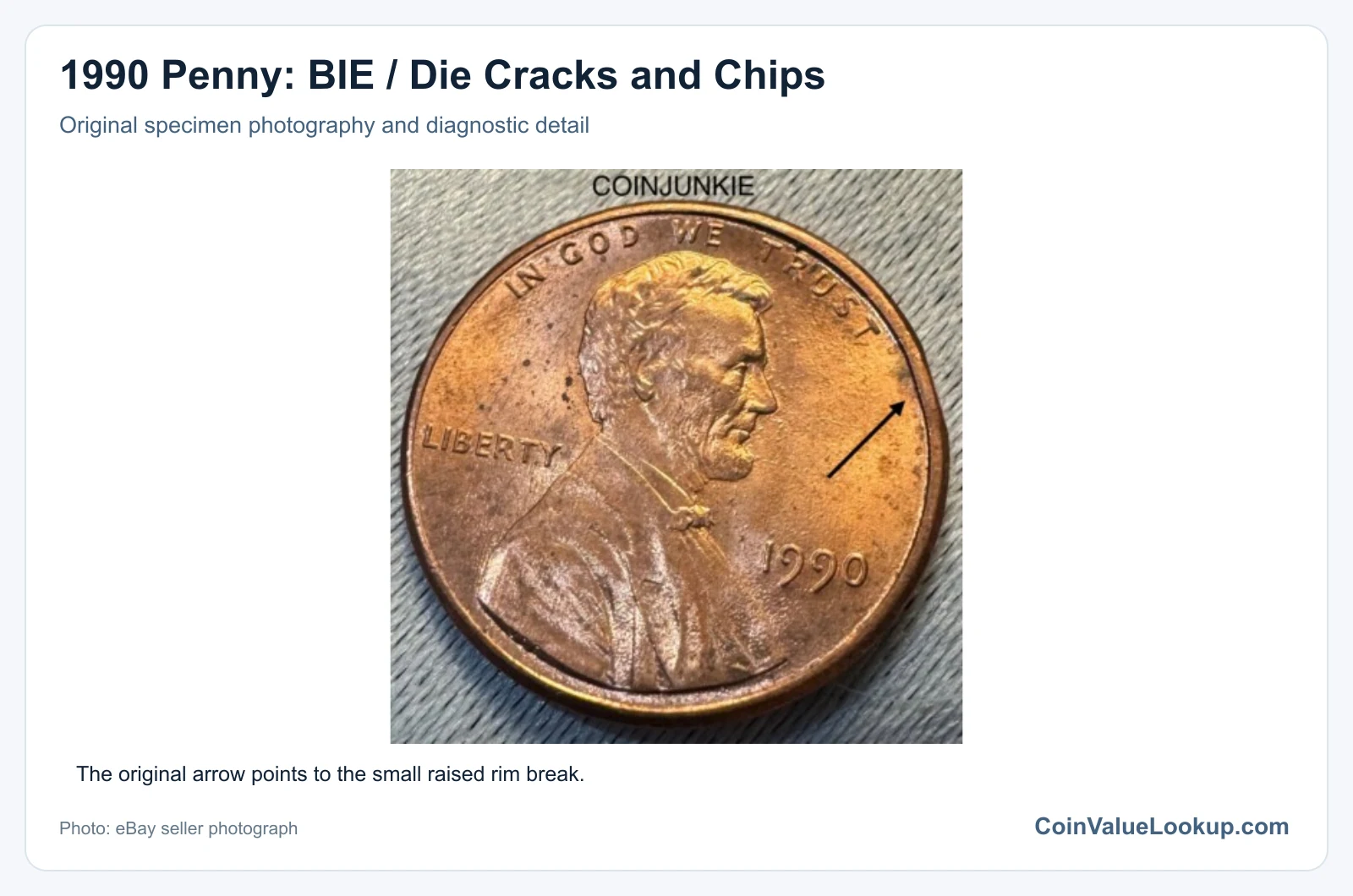
A BIE error is a specific type of die crack or chip that creates a raised vertical line or blob between the letters B and E in LIBERTY on the obverse. It happens when the die itself develops a crack or chip, and the recessed gap fills with metal during striking, leaving a raised feature on the coin.
Look carefully at LIBERTY under magnification. The raised bridge should be consistent with the surrounding letter surfaces.
Value depends on the prominence and condition of the coin, with no specific price adopted here. Dirt lodged between letters, scratches or glued debris can mimic the look, so compare edge sharpness and texture against the normal letter surfaces.
7. 1990 Lincoln Penny — Struck-Through Error
A struck-through error shows a localized depression or impression on the coin's surface where foreign material, such as grease, cloth fiber or a metal fragment, got between the die and the blank during striking. The affected area will have incomplete or distorted design detail.
Grease fill-ins tend to produce a smooth, shallow depression, while a retained foreign object may leave a more distinct impression. Value depends on the size, location and visual impact of the obstruction, and no specific price is adopted here.
Ordinary weak strikes from worn dies, post-mint scratches, cleaning damage and general wear can all look similar at first glance. A genuine struck-through will have a defined boundary and surrounding normal-strength detail.
8. 1990 Lincoln Penny — Clipped Planchet
A clipped planchet error means the blank was cut incorrectly before striking, leaving a missing curved, straight or irregular section along the edge. The Blakesley effect, a weakness on the rim opposite the clip, is a useful diagnostic because post-mint damage does not produce it.
Check the edge texture where the clip occurred; it should show the raw metal of the blank, not a filed or cut surface. Metal flow near the clip may also differ from normal rim formation.
Value depends on clip size, shape and overall coin condition, with no specific price adopted here. Lookalikes include coins with edges filed down, notched by tools or eaten away by corrosion.
Those lack the characteristic opposite-rim weakness and natural blank-edge texture.
9. 1990 Lincoln Penny — Doubled Die Obverse
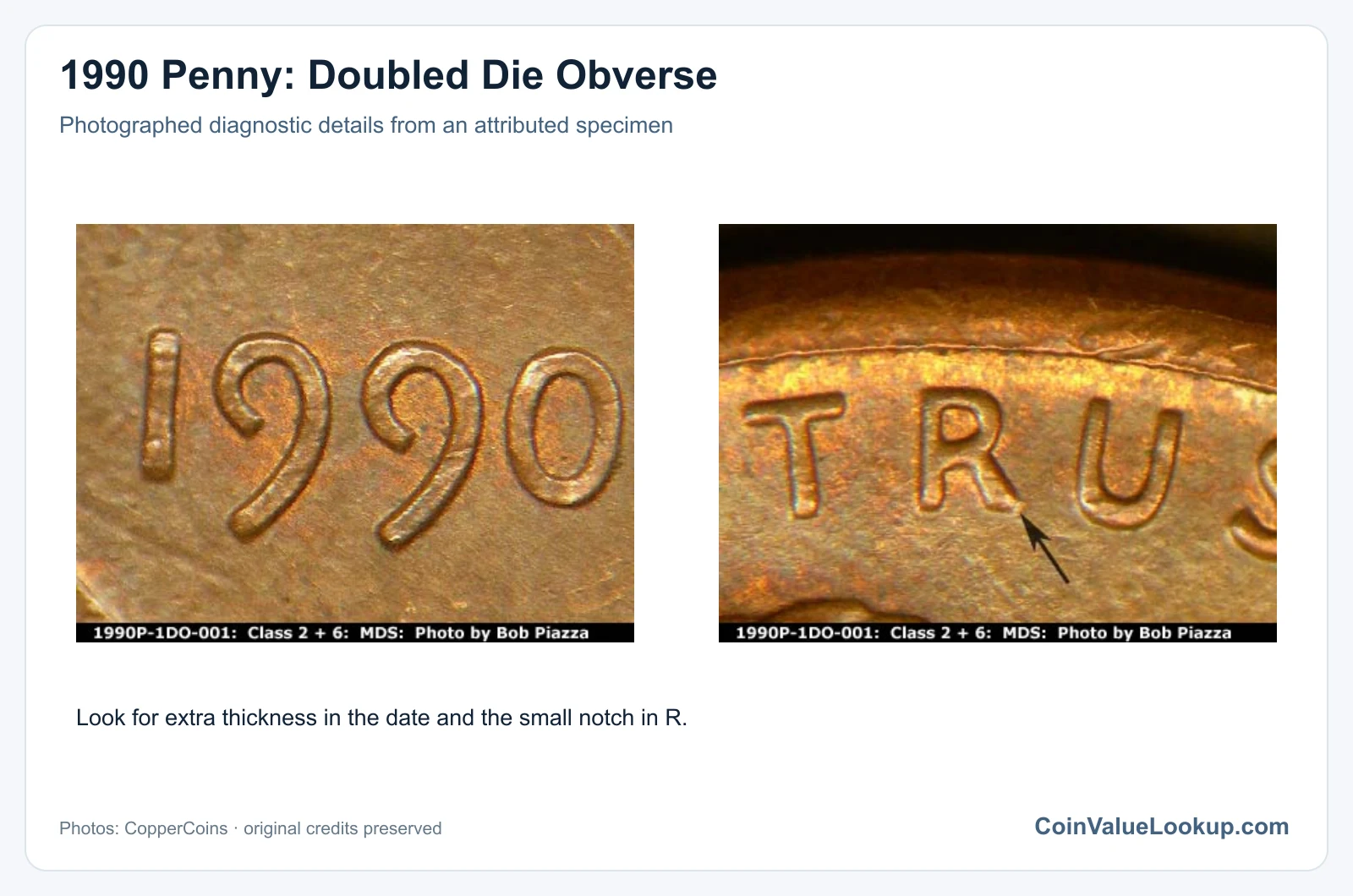
A doubled die obverse on a 1990 cent would show consistent doubling on obverse design elements such as lettering, the date or Lincoln's profile. True hub doubling produces separation or notching that repeats in the same direction on every affected element.
Compare your coin's obverse letters and date to a known normal example under identical lighting. Look for a second, slightly offset image rather than a flat shelf.
No specific price is adopted for this variety. The most common lookalike is machine doubling, also called strike doubling, which produces a flat, shelf-like distortion rather than the rounded, raised secondary image of a genuine doubled die.
Reflections and worn die contours can also trick you under certain light angles.