1992 Lincoln Penny Coin Value: How Much Is It Worth?
Most 1992 Lincoln pennies you find in pocket change are worth one cent. Ordinary uncirculated examples from Philadelphia or Denver grade around $0.36 at MS65 according to USA Coin Book, while a San Francisco proof runs about $6.25 at PR65.
The real story here is the Close AM reverse variety, which can push values into the thousands for properly attributed coins.
Fast Way to Identify Your 1992 Lincoln Penny
Want a quick read on your 1992 penny? Upload clear photos of both the front and back of your coin, and our identifier will give you a preliminary take on which version you might have.
This is not a substitute for professional authentication, but it is a solid first step toward figuring out what you are holding.
1992 Penny Value
Upload both sides of your 1992 Lincoln Penny.
Front Obverse
Upload photo
Back Reverse
Upload photo
Which 1992 Lincoln Penny Versions Are Worth Money?
- The 1992 no-mintmark Close AM variety has a USA Coin Book estimate of $12,164 at MS65; confirm the A and M nearly touch on your reverse.
- A 1992-D Close AM in MS65 sold for $14,100 at auction in February 2014 per PCGS records; the D mintmark version is equally scarce.
- San Francisco proofs in high grades with original surfaces can bring a meaningful premium over face value, with PR65 estimated at $6.25.
- Double-denomination errors, such as a cent struck over a 1992-P dime, have sold for $2,040 in top condition at Heritage Auctions.
Step 1: Identify Your 1992 Lincoln Penny Mint Mark and Version
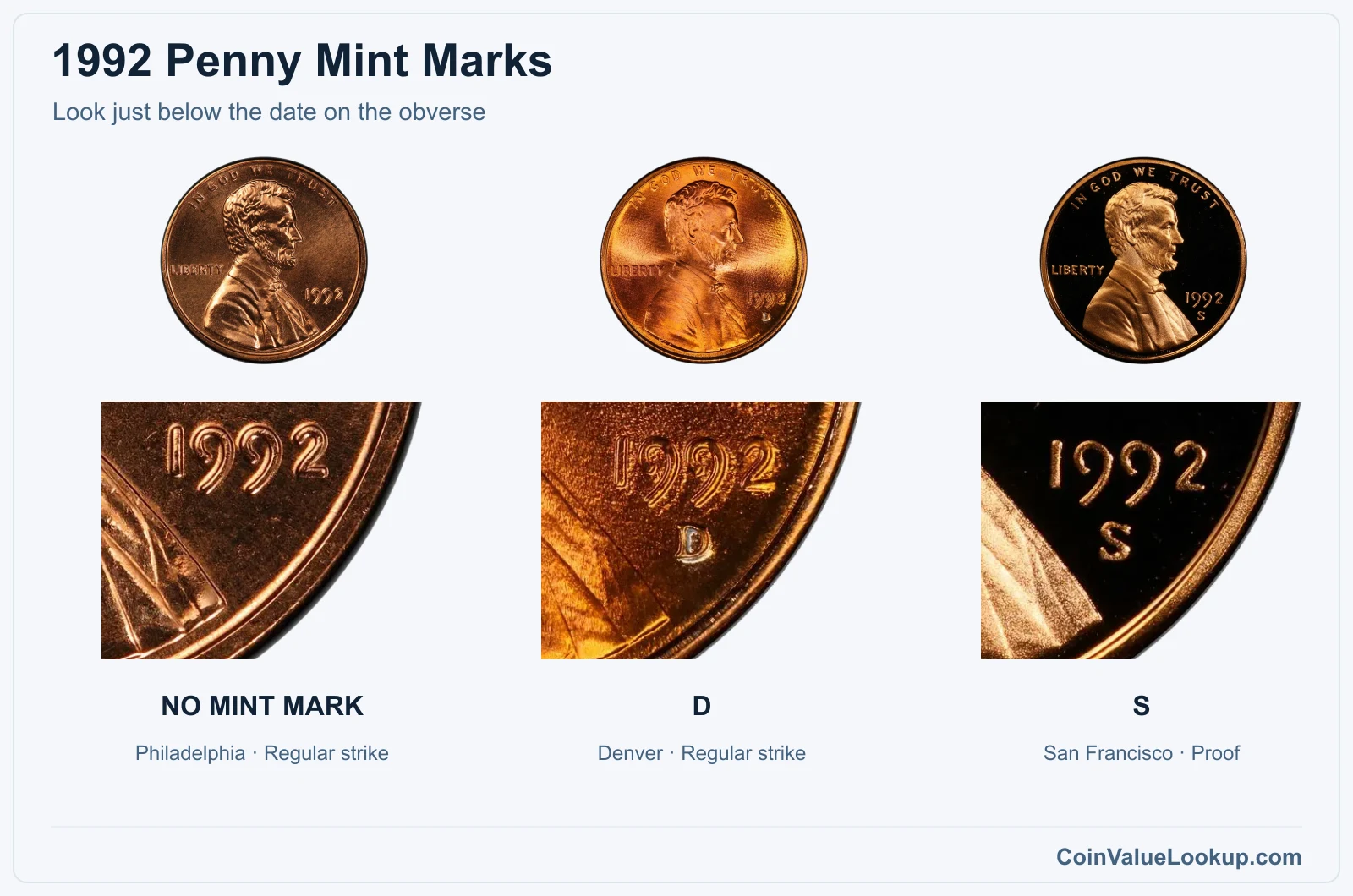
The 1992 Lincoln cent features the familiar Lincoln portrait on the obverse and the Lincoln Memorial on the reverse. Look below the date for a mintmark: no letter means Philadelphia, a D means Denver, and an S means San Francisco proof.
All 1992 cents are copper-plated zinc, weighing about 2.50 grams. The copper color is just a thin plating layer, not evidence of a solid bronze coin.
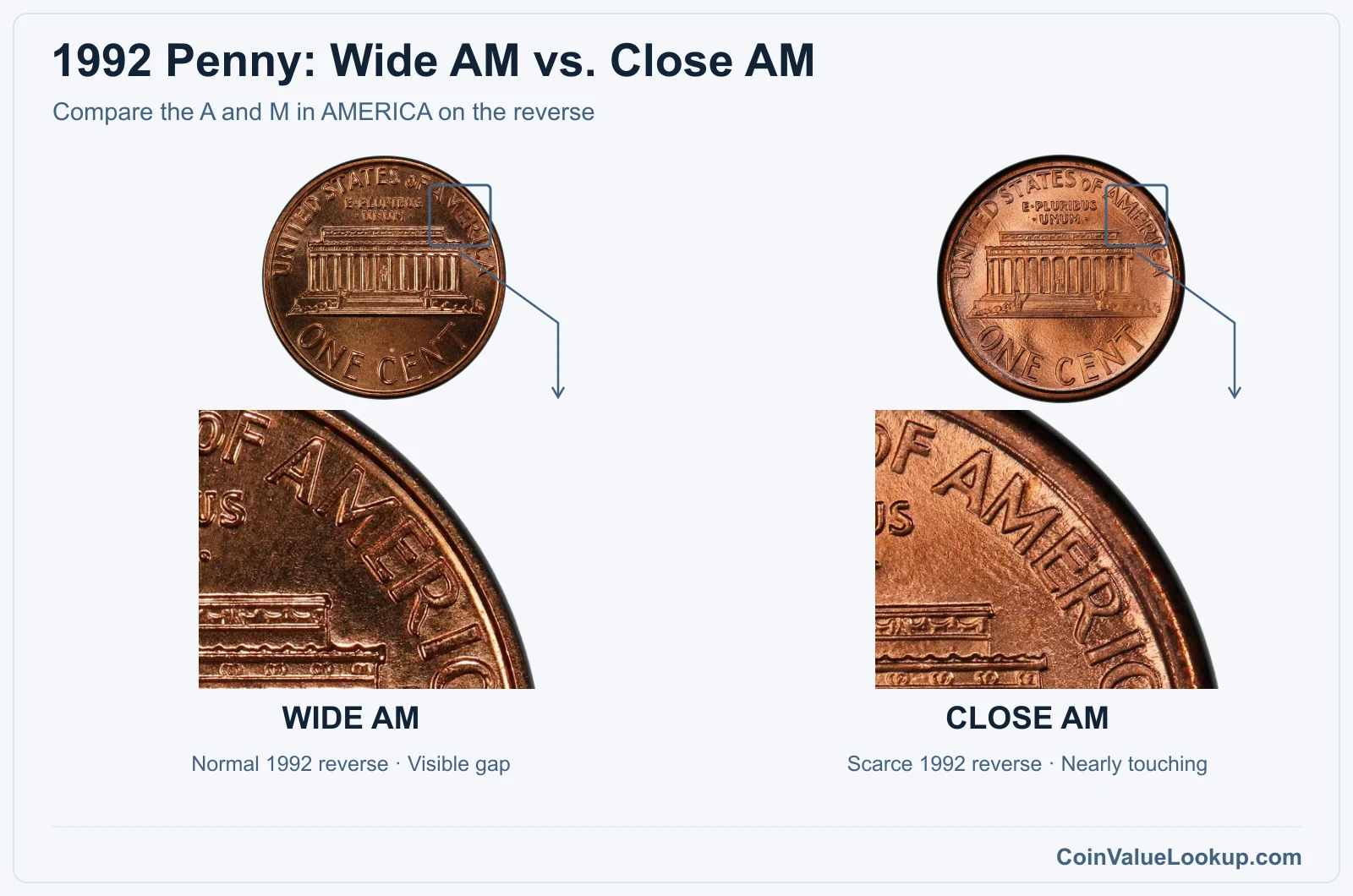
The critical identification step is the reverse. Normal 1992 business strikes and proofs use a Wide AM design, where the letters A and M in AMERICA have clear space between them.
A rare Close AM variety exists for both Philadelphia and Denver strikes, where the A and M nearly touch. You need to compare your coin at the same scale against a known Wide AM example to spot the difference.
Do not confuse a shiny circulated cent with a proof. Proofs have specially prepared mirrored surfaces and sharp design edges that circulation strikes simply do not have.
And do not assume a coin is Close AM just because an online listing calls it that. Verify the letter spacing yourself.
Step 2: Check Your 1992 Lincoln Penny Grade
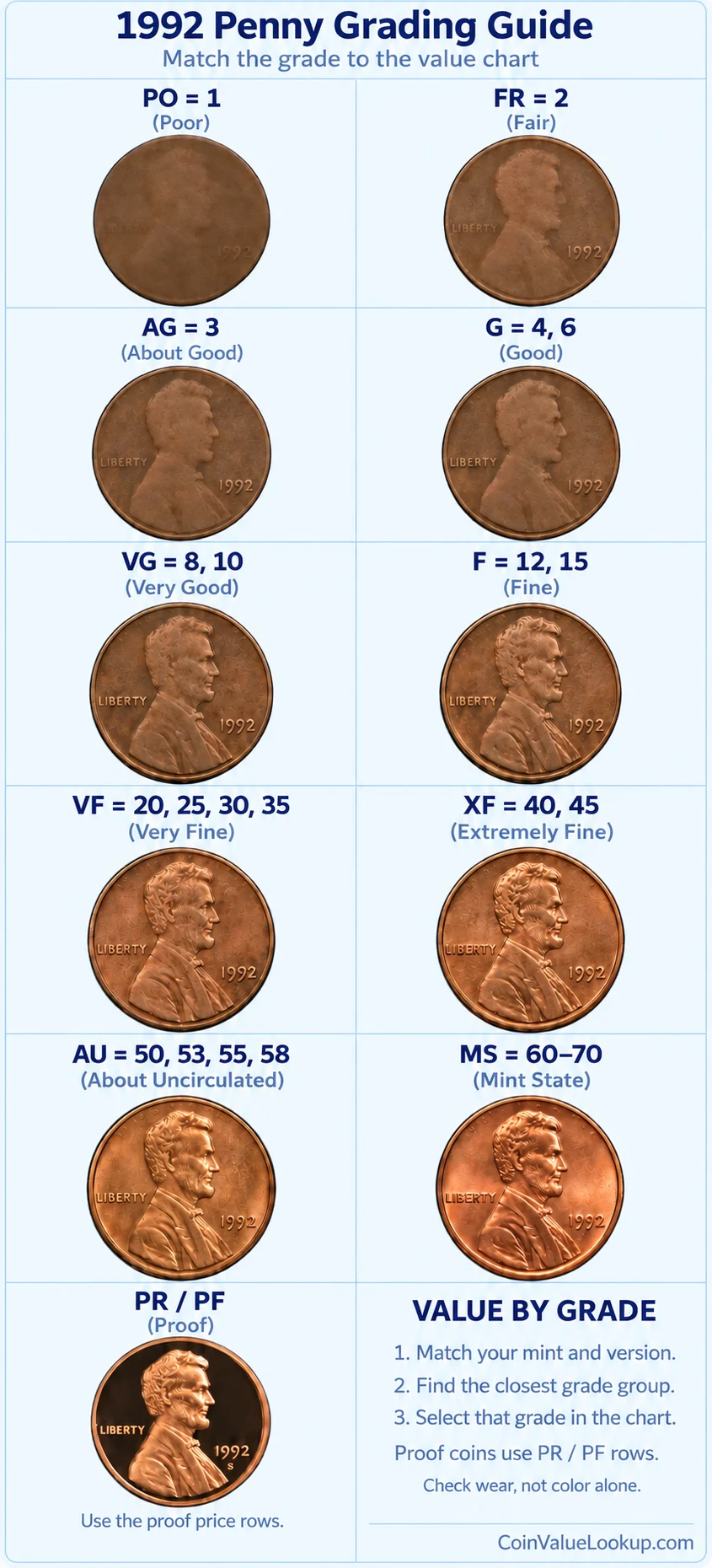
Check Lincoln's cheekbone, jawline, and hair detail first. On a well-worn coin these areas flatten quickly and merge together.
On the reverse, the Memorial columns and horizontal lines lose definition as the grade drops.
A weak strike can mimic wear, so compare both sides before concluding low grade. Look at protected areas: if they are soft too, the die was probably tired rather than the coin being heavily circulated.
Color designations matter on uncirculated pieces. BN means brown, RB is red-brown, and RD is full original red.
A coin graded MS65 RD will generally carry more appeal than MS65 BN at the same numeric grade. Do not clean a coin trying to restore red color.
Cleaning, corrosion, spotting, and plating bubbles all reduce a coin's desirability regardless of the technical grade. Use the comparison image to see how a properly graded example looks at each level.
Step 3: Check 1992 Lincoln Penny Value by Mint and Version
1992 Lincoln Penny — No Mint Mark — Normal Circulation Strike
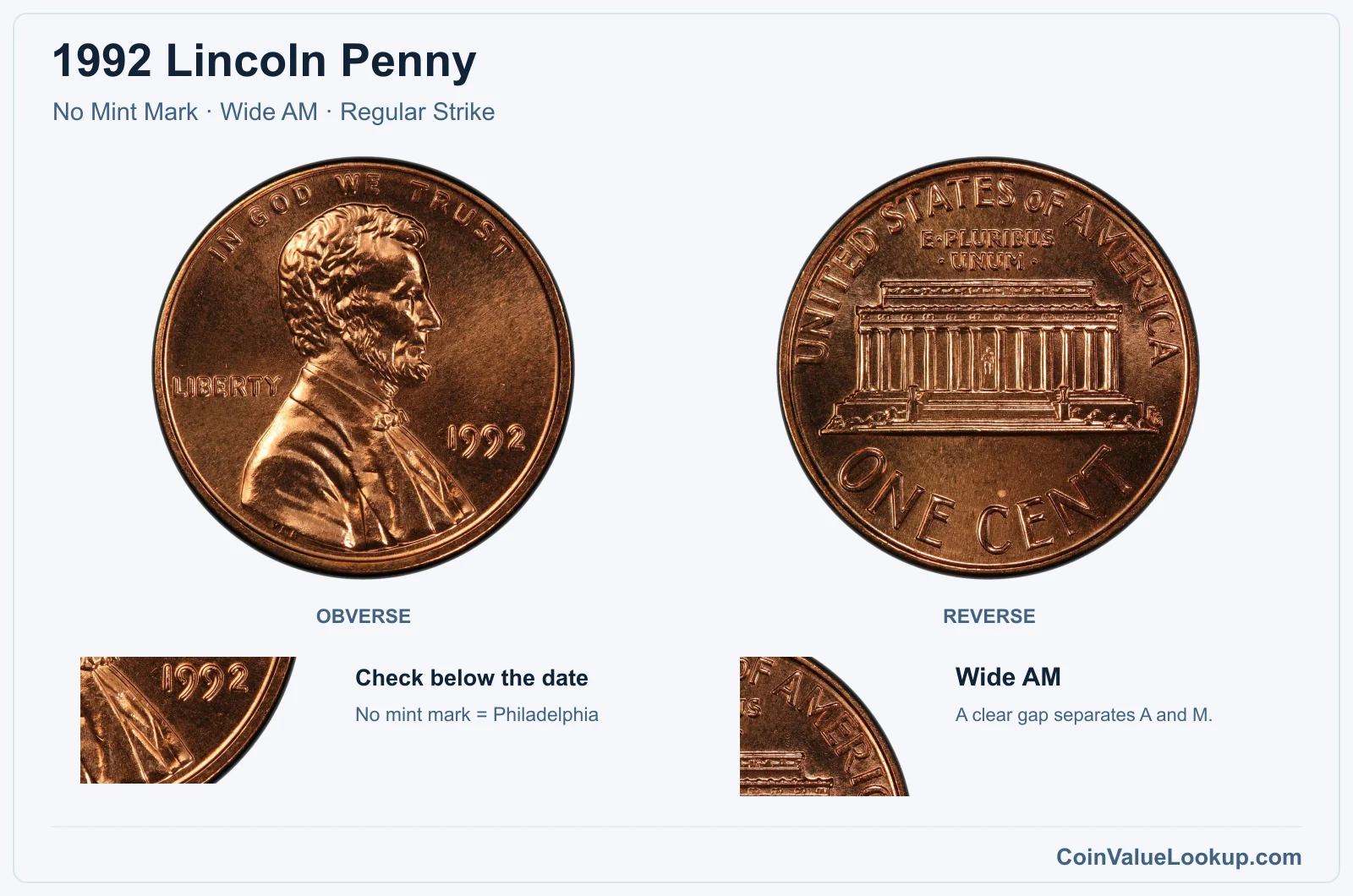
The standard 1992 Philadelphia cent has no mintmark below the date. It is struck on a copper-plated zinc planchet weighing about 2.50 grams and uses the normal Wide AM reverse, where the A and M in AMERICA are clearly separated.
In circulated condition these are worth face value. At MS65, USA Coin Book estimates roughly $0.36.
Original red color at that grade would add appeal, but most survivors have toned to brown. Do not confuse this common coin with the rare Close AM variety.
Range Grade
Price1992 No Mint Mark — Normal Circulation Strike (BN) Price1992 No Mint Mark — Normal Circulation Strike (RB) Price1992 No Mint Mark — Normal Circulation Strike (RD) Auction Records Appraisal PO PO 1
—
Coin Identifier FR FR 2
—
Coin Identifier AG AG 3
—
Coin Identifier G G 4
—
Coin Identifier
G 6
—
Coin Identifier VG VG 8
—
Coin Identifier
VG 10
—
Coin Identifier F F 12
—
Coin Identifier
F 15
—
Coin Identifier VF VF 20
—
Coin Identifier
VF 25
—
Coin Identifier
VF 30
—
Coin Identifier
VF 35
—
—
Coin Identifier XF XF 40
—
—
Coin Identifier
XF 45
—
—
Coin Identifier AU AU 50
—
—
Coin Identifier
AU 53
—
Coin Identifier
AU 55
Coin Identifier
AU 58
—
—
Coin Identifier MS MS 60
—
—
—
Coin Identifier
MS 61
—
—
—
Coin Identifier
MS 62
—
Coin Identifier
MS 63
—
Coin Identifier
MS 64
Coin Identifier
MS 65
—
Coin Identifier
MS 66
—
Coin Identifier
MS 67
—
—
Coin Identifier
MS 68
—
Coin Identifier
MS 69
—
—
Coin Identifier
MS 70
—
—
—
—
—
1992 Lincoln Penny — D — Normal Circulation Strike
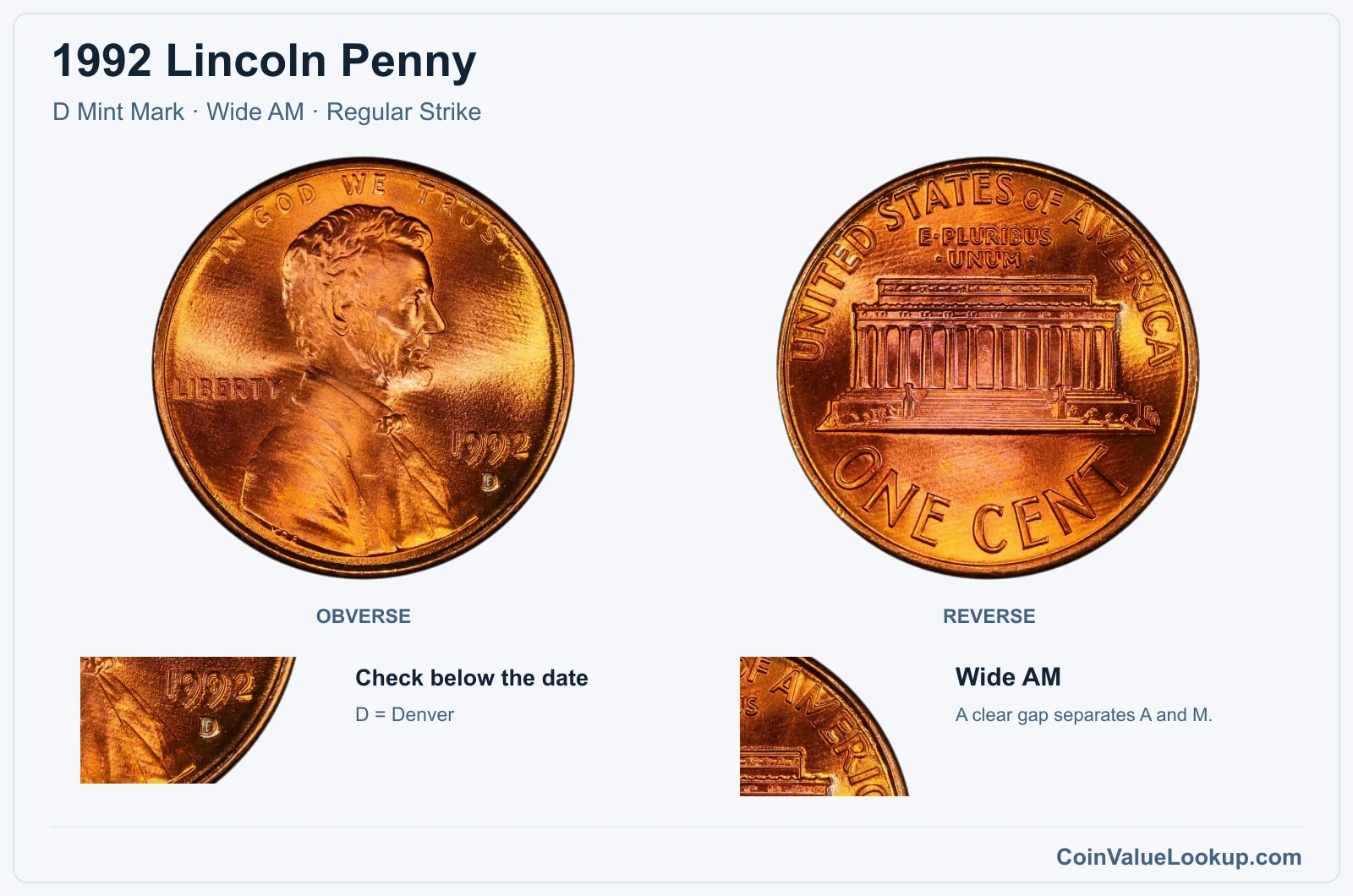
Denver's 1992-D cent is the same composition and design as the Philadelphia issue, distinguished by the small D mintmark under the date. The reverse uses the standard Wide AM layout.
Like its Philadelphia counterpart, a circulated 1992-D is a one-cent coin. USA Coin Book places an MS65 example at about $0.36.
Full red luster is the most desirable color designation, but the premium at this grade level is modest. Check your reverse letter spacing before moving on.
Range Grade
Price1992 D — Normal Circulation Strike (BN) Price1992 D — Normal Circulation Strike (RB) Price1992 D — Normal Circulation Strike (RD) Auction Records Appraisal PO PO 1
—
Coin Identifier FR FR 2
—
Coin Identifier AG AG 3
—
Coin Identifier G G 4
—
Coin Identifier
G 6
—
Coin Identifier VG VG 8
—
Coin Identifier
VG 10
—
Coin Identifier F F 12
—
Coin Identifier
F 15
—
Coin Identifier VF VF 20
—
Coin Identifier
VF 25
—
Coin Identifier
VF 30
—
Coin Identifier
VF 35
—
Coin Identifier XF XF 40
—
Coin Identifier
XF 45
—
Coin Identifier AU AU 50
—
Coin Identifier
AU 53
—
Coin Identifier
AU 55
—
Coin Identifier
AU 58
—
Coin Identifier MS MS 60
—
—
Coin Identifier
MS 61
—
—
—
Coin Identifier
MS 62
—
Coin Identifier
MS 63
—
Coin Identifier
MS 64
Coin Identifier
MS 65
—
Coin Identifier
MS 66
—
Coin Identifier
MS 67
—
Coin Identifier
MS 68
—
Coin Identifier
MS 69
—
—
Coin Identifier
MS 70
—
—
—
—
—
1992 Lincoln Penny — S — Proof
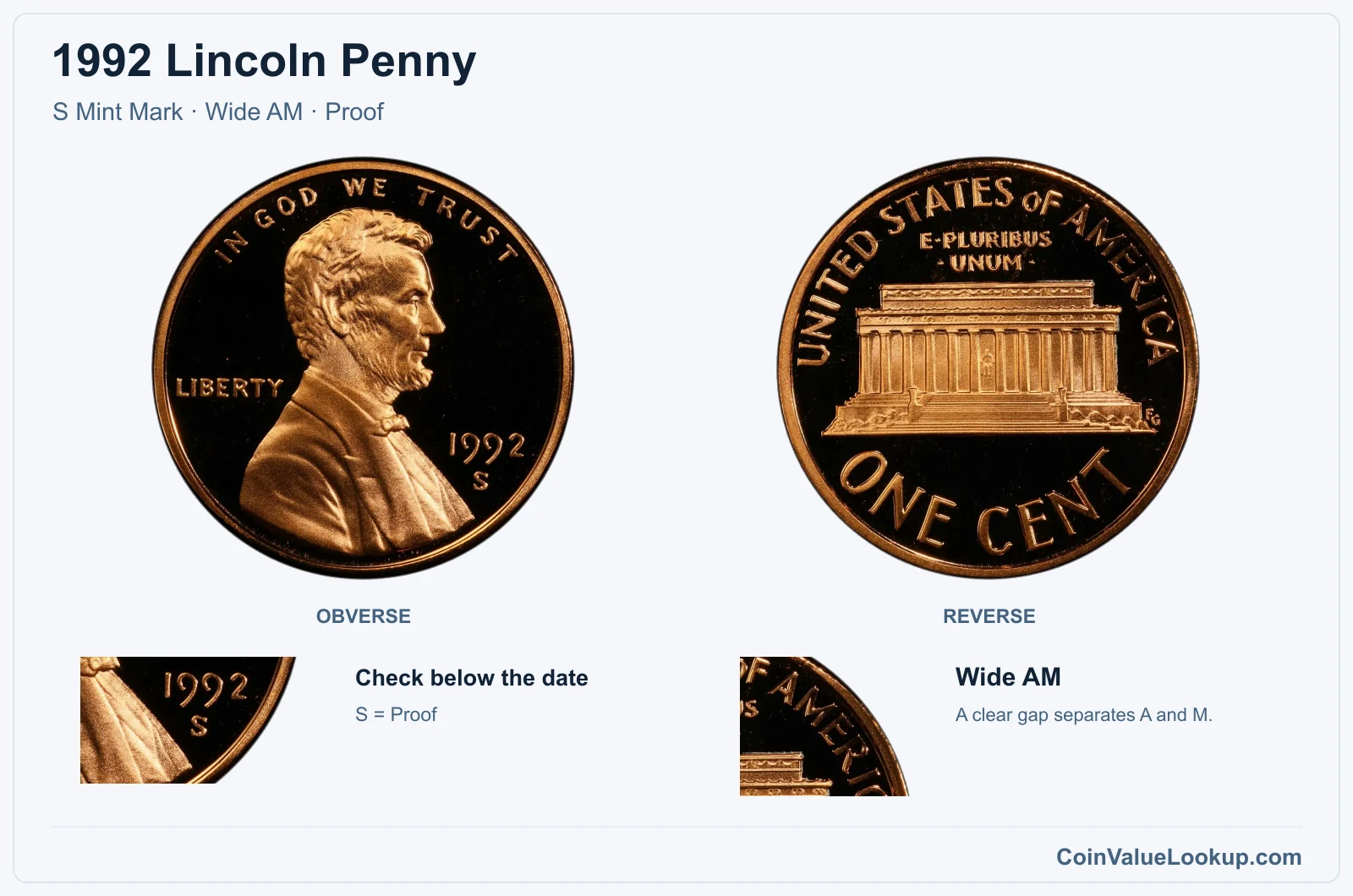
San Francisco struck 1992-S proof cents specifically for collectors, sold in proof sets. These coins have mirror-like fields and sharply struck details that no amount of polishing can replicate on a business strike.
The reverse is the normal Wide AM design.
At PR65, USA Coin Book estimates $6.25. Higher grades with cameo or deep cameo contrast can bring more, though specific premiums depend on the designation.
If your coin does not have that characteristic reflective surface, it is not a proof regardless of how shiny it looks.
Range Grade
Price Auction Records Appraisal PR PR 1
—
Coin Identifier
PR 2
—
Coin Identifier
PR 3
—
Coin Identifier
PR 4
—
Coin Identifier
PR 6
—
Coin Identifier
PR 8
—
Coin Identifier
PR 10
—
Coin Identifier
PR 12
—
Coin Identifier
PR 15
—
Coin Identifier
PR 20
—
Coin Identifier
PR 25
—
Coin Identifier
PR 30
—
Coin Identifier
PR 35
—
Coin Identifier
PR 40
—
Coin Identifier
PR 45
—
Coin Identifier
PR 50
—
Coin Identifier
PR 53
—
Coin Identifier
PR 55
—
Coin Identifier
PR 58
—
Coin Identifier
PR 60
Coin Identifier
PR 61
—
Coin Identifier
PR 62
—
Coin Identifier
PR 63
—
Coin Identifier
PR 64
—
Coin Identifier
PR 65
—
Coin Identifier
PR 66
Coin Identifier
PR 67
—
Coin Identifier
PR 68
Coin Identifier
PR 69
Coin Identifier
PR 70
Coin Identifier
1992 Lincoln Penny — No Mint Mark — Close AM
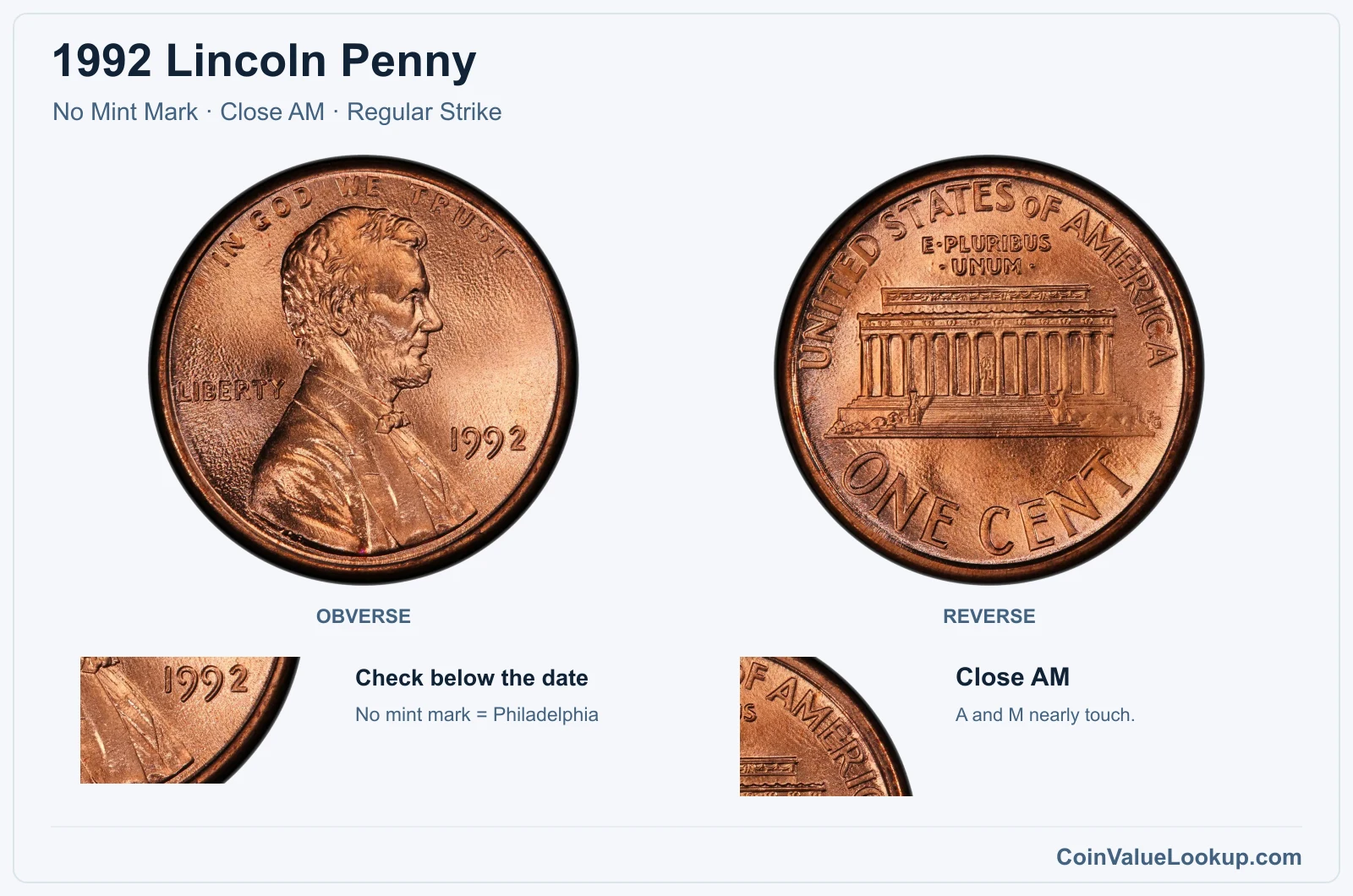
This is where things get serious. On the 1992 no-mintmark Close AM, the letters A and M in AMERICA on the reverse nearly touch, a clear departure from the wide gap found on every normal 1992 cent.
This variety was produced when a proof-style reverse die was apparently used to strike business-strike coins. USA Coin Book estimates the value at $12,164 for an MS65 example, though the color designation for that estimate is unspecified.
Authenticated examples are genuinely scarce.
If you think you have one, compare directly against a normal 1992 Wide AM at the same magnification. The difference should be obvious.
Professional attribution from a grading service is strongly recommended before buying or selling, because a lot of coins get misidentified online.
Coin Value Lookup is a useful starting point if you want to look up other Lincoln cent years while you research your find.
Range Grade
Price1992 No Mint Mark — Close AM (BN) Price1992 No Mint Mark — Close AM (RB) Price1992 No Mint Mark — Close AM (RD) Auction Records Appraisal PO PO 1
—
Coin Identifier FR FR 2
—
Coin Identifier AG AG 3
—
Coin Identifier G G 4
—
Coin Identifier
G 6
—
Coin Identifier VG VG 8
—
Coin Identifier
VG 10
—
Coin Identifier F F 12
—
Coin Identifier
F 15
—
Coin Identifier VF VF 20
—
Coin Identifier
VF 25
—
Coin Identifier
VF 30
—
Coin Identifier
VF 35
—
Coin Identifier XF XF 40
—
Coin Identifier
XF 45
—
Coin Identifier AU AU 50
—
Coin Identifier
AU 53
—
Coin Identifier
AU 55
—
Coin Identifier
AU 58
—
Coin Identifier MS MS 60
—
Coin Identifier
MS 61
Coin Identifier
MS 62
Coin Identifier
MS 63
Coin Identifier
MS 64
—
—
Coin Identifier
MS 65
—
—
—
Coin Identifier
MS 66
—
—
—
Coin Identifier
MS 67
—
—
Coin Identifier
MS 68
—
—
—
—
—
MS 69
—
—
—
—
—
MS 70
—
—
—
—
—
1992 Lincoln Penny — D — Close AM
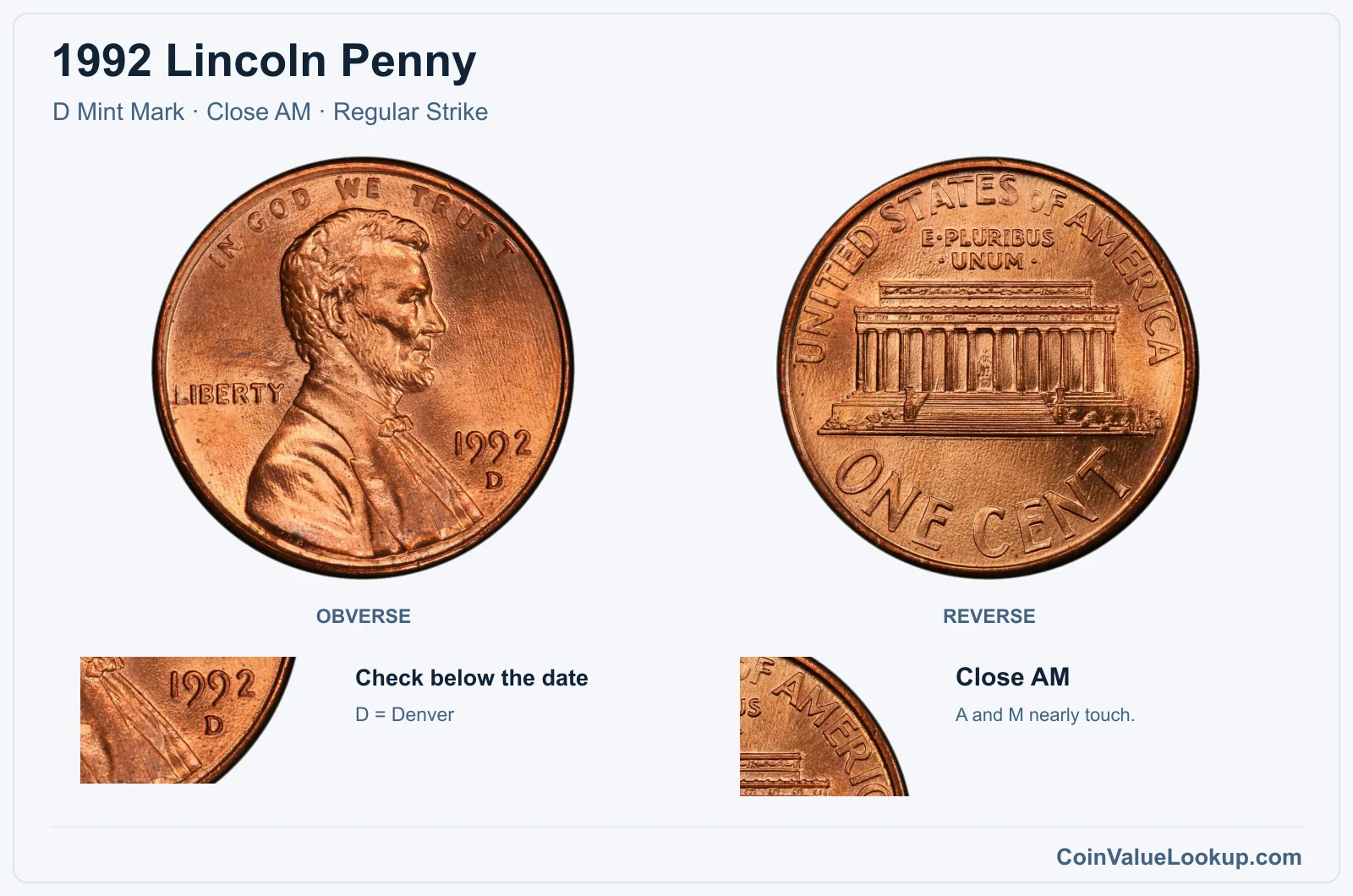
The 1992-D Close AM is the Denver counterpart of the Philadelphia variety. Same diagnostic: the A and M in AMERICA nearly touch on the reverse, while normal 1992-D cents have a wide gap.
PCGS reports that an MS65 example sold for $14,100 in February 2014 at auction. That is a single historical result, not a guaranteed current price for every grade or condition, but it demonstrates the kind of demand these coins generate.
As with the Philadelphia version, you need to verify the letter spacing carefully and seek professional attribution. Surface condition, strike quality, and color all affect what a given piece might bring.
Do not rely solely on photographs from a phone camera to make this call.
Range Grade
Price1992 D — Close AM (BN) Price1992 D — Close AM (RB) Price1992 D — Close AM (RD) Auction Records Appraisal PO PO 1
—
Coin Identifier FR FR 2
—
Coin Identifier AG AG 3
—
Coin Identifier G G 4
—
Coin Identifier
G 6
—
Coin Identifier VG VG 8
—
Coin Identifier
VG 10
—
Coin Identifier F F 12
—
Coin Identifier
F 15
—
Coin Identifier VF VF 20
—
Coin Identifier
VF 25
—
Coin Identifier
VF 30
—
Coin Identifier
VF 35
—
Coin Identifier XF XF 40
—
Coin Identifier
XF 45
—
Coin Identifier AU AU 50
—
Coin Identifier
AU 53
—
Coin Identifier
AU 55
Coin Identifier
AU 58
Coin Identifier MS MS 60
—
Coin Identifier
MS 61
—
Coin Identifier
MS 62
Coin Identifier
MS 63
—
Coin Identifier
MS 64
Coin Identifier
MS 65
Coin Identifier
MS 66
—
—
Coin Identifier
MS 67
—
—
—
—
—
MS 68
—
—
—
—
—
MS 69
—
—
—
—
—
MS 70
—
—
—
—
—
1992 Lincoln Penny Error List
1. 1992 Lincoln Penny — Close AM Reverse Variety
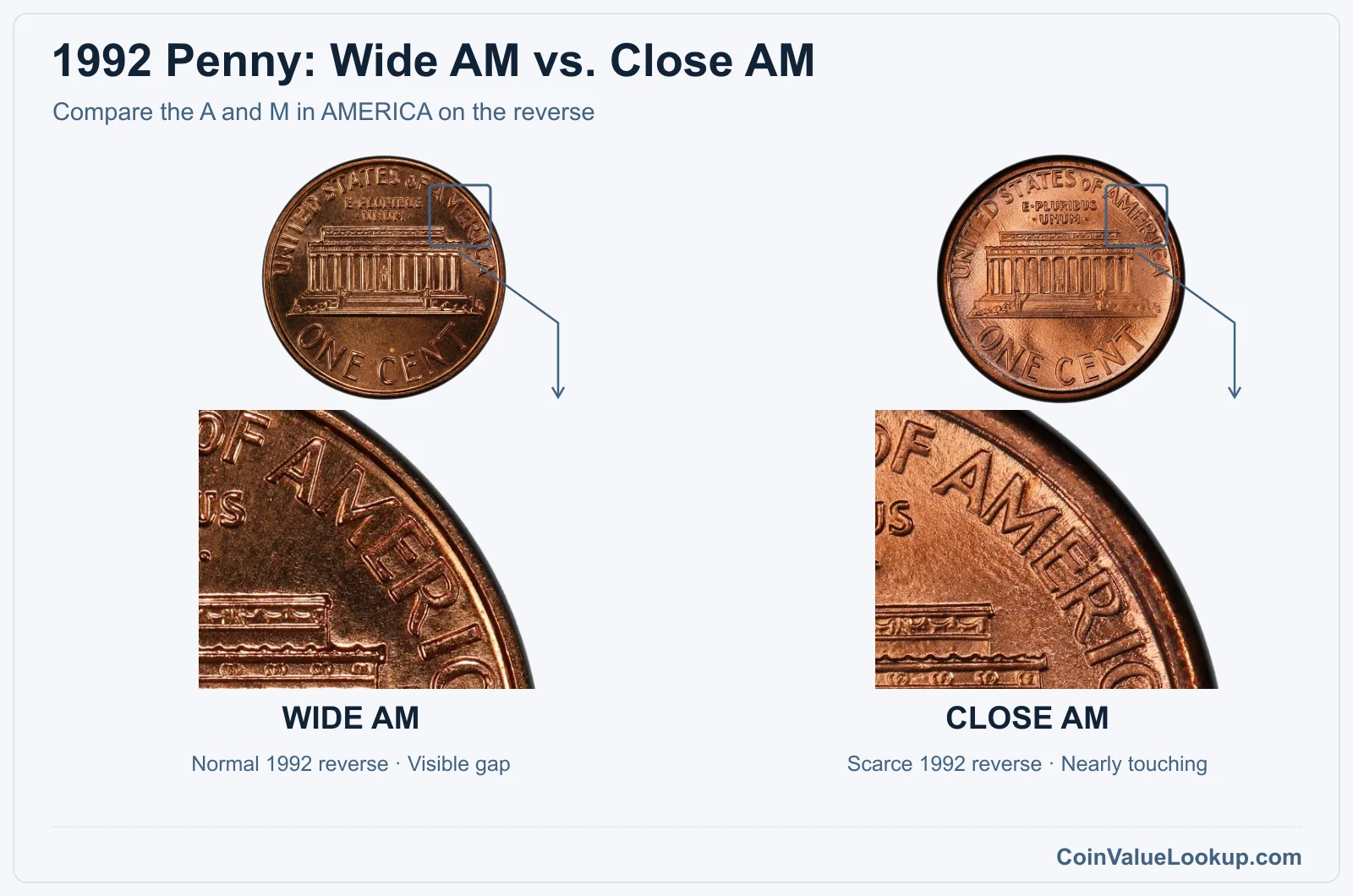
The Close AM reverse variety is not a random striking accident. It results from using a die with a different letter spacing than the standard 1992 reverse.
On a Close AM coin, the A and M in AMERICA nearly touch; on the normal Wide AM they are clearly separated.
Both the no-mintmark and D-mint 1992 cents have confirmed Close AM examples. A 1992-D Close AM graded MS65 sold for $14,100 at auction in February 2014 per PCGS records.
The Philadelphia version carries a separate valuation.
Watch out for lookalikes. The 1993 cent normally uses a Close AM reverse, so a misattributed date can fool you.
The 1998 through 2000 Wide AM varieties are the opposite situation entirely. Surface distortion or damage near the letters can also create the illusion of closer spacing.
Compare at proper magnification against a confirmed Wide AM from the same year.
2. 1992 Lincoln Penny — Off-Center Strike
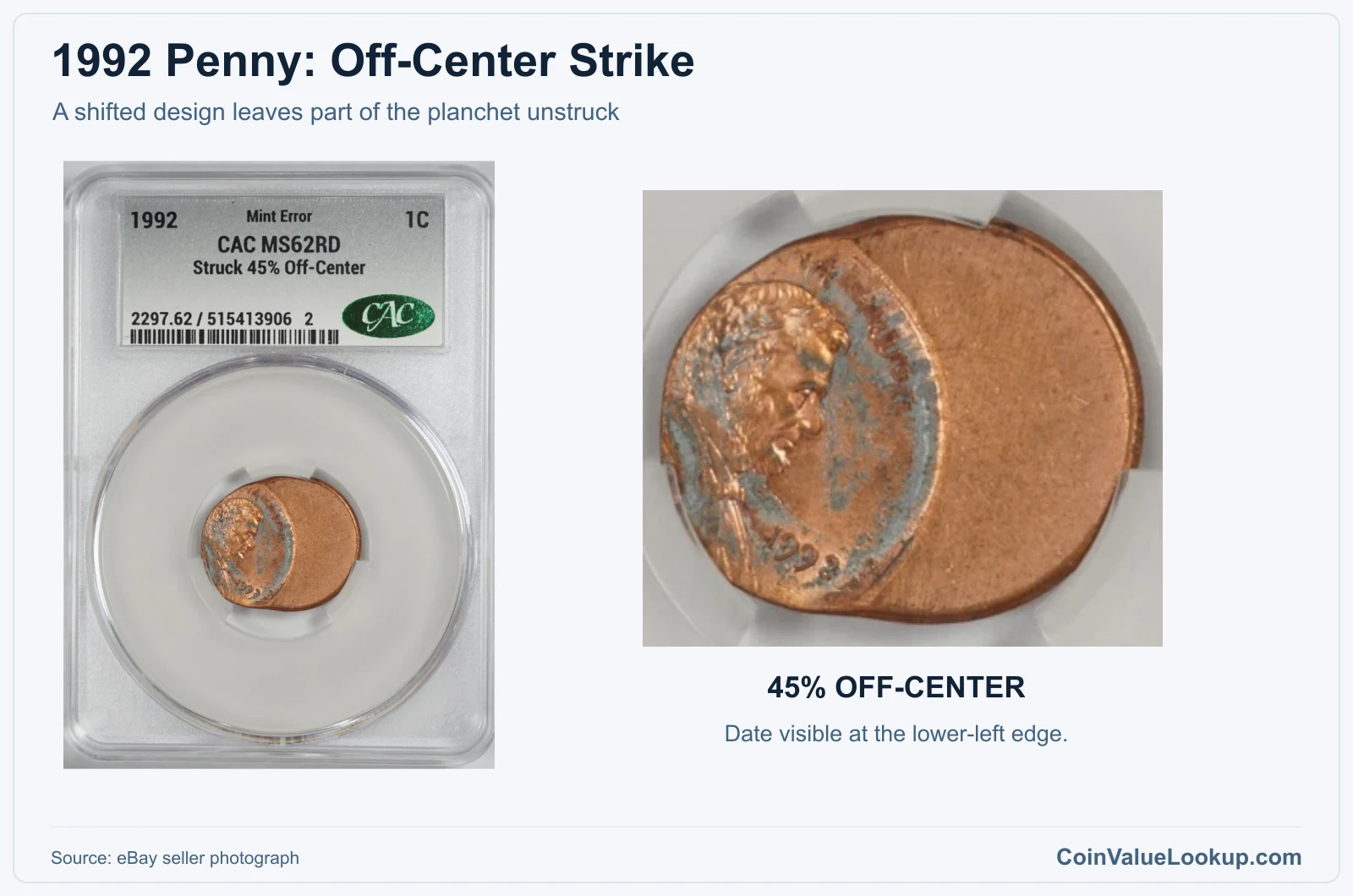
An off-center 1992 cent shows a large blank crescent where part of the design was never struck. The coin was misaligned against the dies during production, so only a portion received the full impression.
Heritage Auctions has cataloged a 1992 cent struck 70 percent off center, graded ANACS MS63 Red. The more dramatic the off-center percentage and the more date digits remain visible, the more collectors tend to value the piece.
Do not confuse a coin with uneven rims or slightly off-center design for a genuine off-center error. A true off-center strike leaves a substantial blank area with no design at all.
Value depends on the specific coin's authenticated identity, condition, and severity of the error.
3. 1992 Lincoln Penny — Broadstrike
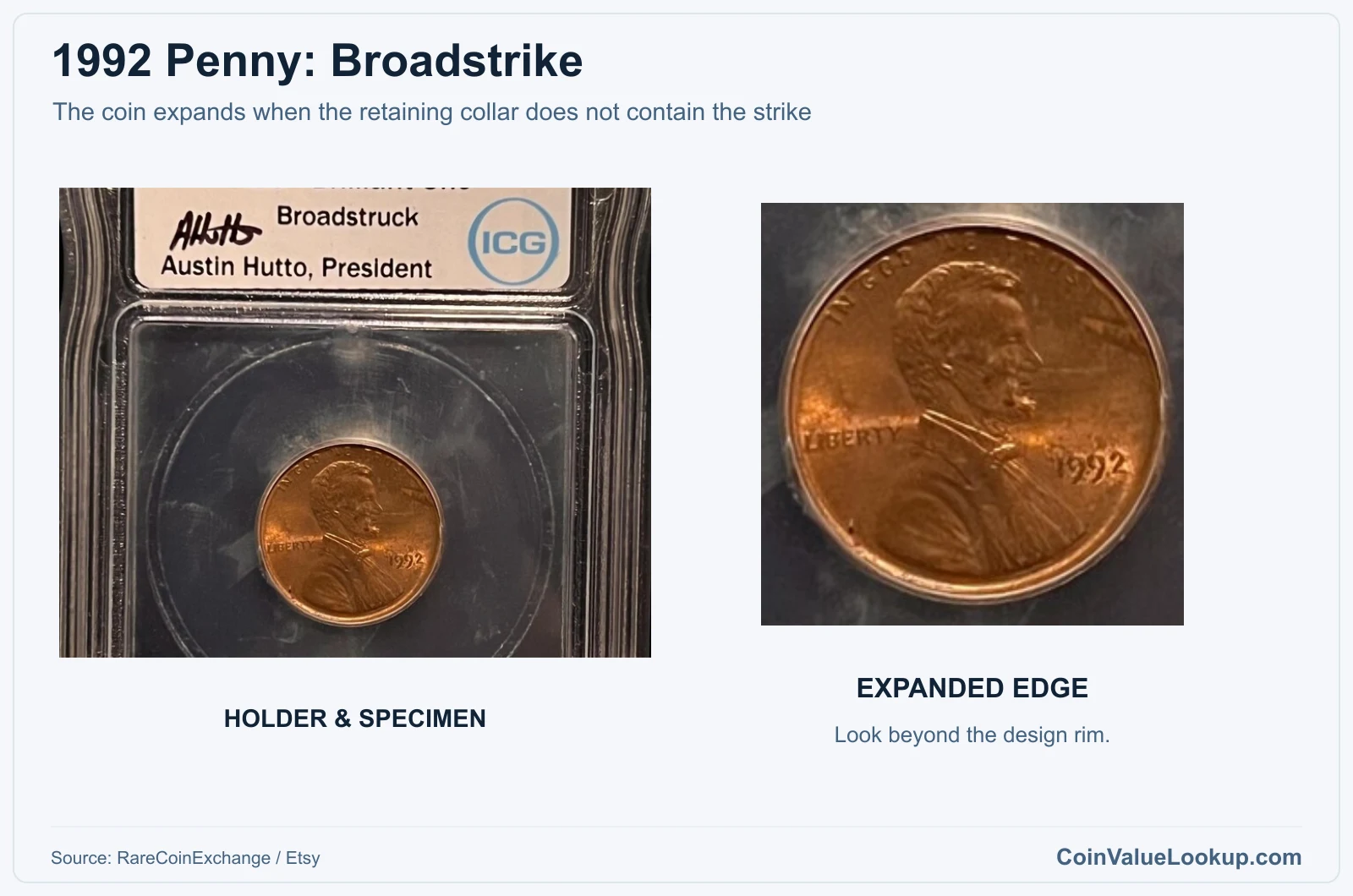
A broadstruck 1992 cent was struck outside the retaining collar that normally constrains the planchet. The result is a coin that spreads wider than standard diameter while retaining the full obverse and reverse design.
Heritage Auctions has listed a 1992 broadstruck cent graded NGC MS66 Red. The full design is present but the rim is absent or malformed, and the coin's overall diameter is larger than normal.
Do not mistake an off-center coin for a broadstrike. Off-center pieces are missing design elements.
And a coin that has been hammered flat or physically stretched after leaving the mint is post-mint damage, not a broadstrike. Value depends on authenticated identity, condition, and how pronounced the expansion is.
4. 1992 Lincoln Penny — Die Cap
A die cap forms when a coin sticks to the upper die and keeps getting struck into subsequent blanks. Over multiple impressions the stuck coin wraps around the die, becoming cup-shaped.
The obverse becomes distorted and the reverse shows expanding, mushroomed design.
A 1992 obverse deep die cap graded PCGS MS64 Red sold for $528 at Heritage Auctions in October 2021. That gives a reference point for a well-preserved example.
Look at the coin from the side. A genuine die cap has a distinctive cupped profile that is not easily faked.
A simply bent coin will not show the progressive design spreading that a real die cap exhibits. Also distinguish this from a coin that was merely struck through a cap, which looks quite different.
The struck-through piece is flat but shows an impression of the stuck coin's features.
5. 1992 Lincoln Penny — Struck on a Dime Planchet
A 1992 cent struck on a clad dime planchet carries Lincoln's design on a smaller, silver-colored blank intended for a Roosevelt dime. The coin is noticeably smaller than a normal cent, and peripheral lettering is incomplete because the planchet could not cover the full die.
A PCGS MS64 example sold for $480 at Heritage Auctions in September 2024. Metal composition and dimensions should be verified for authentication.
Do not confuse this with a silver-plated cent, which has normal cent dimensions and weight. Also, a cent struck over an already-struck dime is a different error category entirely, because the dime's design remnants will still be visible underneath the cent impression.
6. 1992 Lincoln Penny — Cent Struck Over a Dime
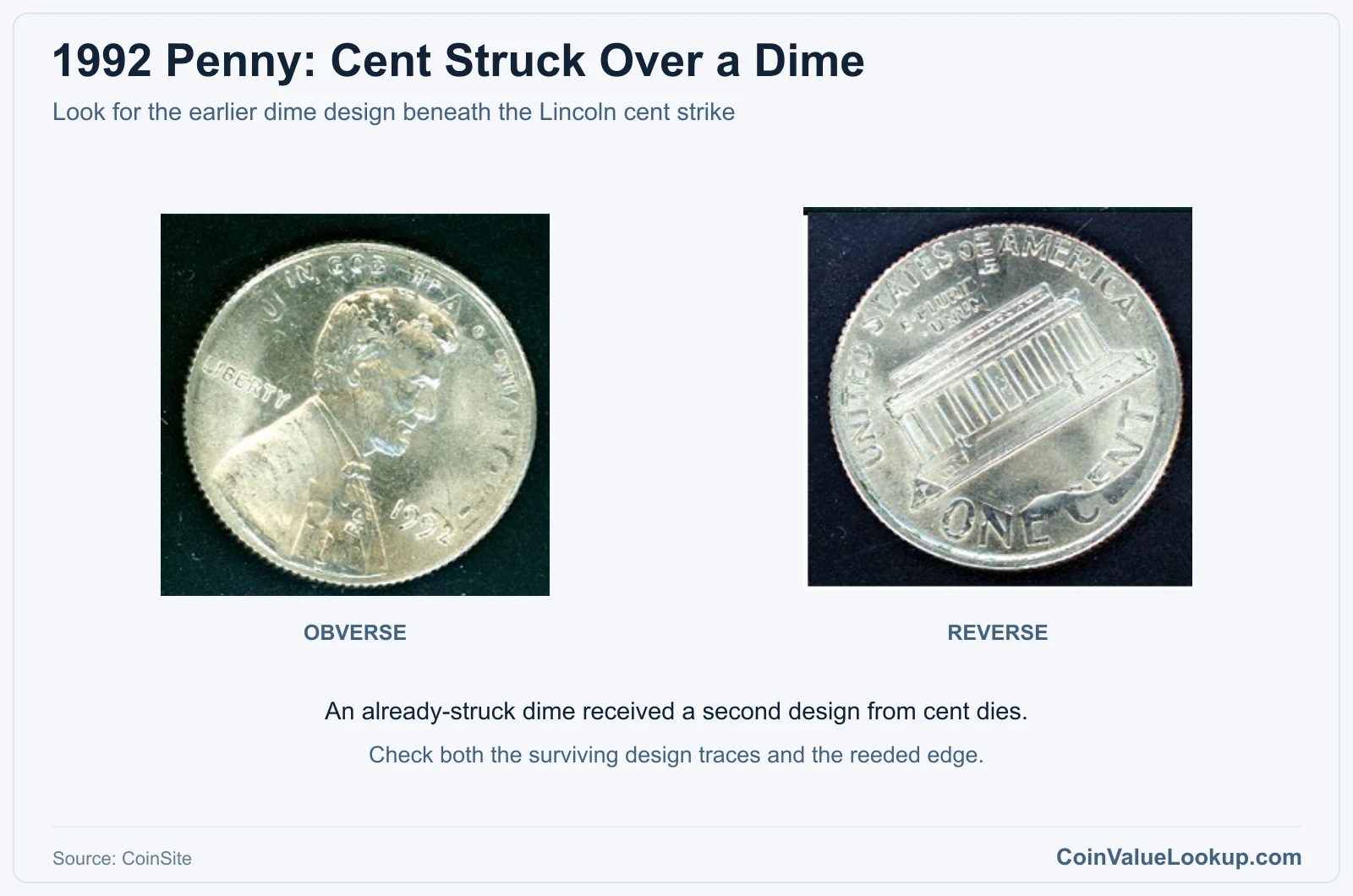
This error occurs when a 1992 Lincoln cent is struck over an already-struck 1992-P Roosevelt dime. Both sets of designs are visible: Lincoln and the Memorial on top, with traces of Roosevelt and the torch underneath.
An NGC MS67 example sold for $2,040 at Heritage Auctions in March 2025. That high grade and clear dual-design visibility contributed to the strong result.
Look at both sides carefully. You should see remnants of the dime's design, possibly including a partial date or mintmark from the underlying strike.
This is different from a cent on a blank dime planchet, which shows only cent designs. It is also different from a die clash, where design transfer comes from die-to-die contact without a second coin being involved.
7. 1992 Lincoln Penny — Doubled Die Obverse
Doubled die obverse varieties have been reported for 1992 Lincoln cents. On a genuine doubled die, you will see consistent doubling of obverse design elements such as lettering or date numerals, showing separation or notching that repeats in the same direction across multiple features.
Compare your coin's obverse against a normal 1992 cent under the same lighting. The doubling should appear as a distinct second image, not a flat shelf or fuzzy edge.
Machine doubling is the most common lookalike. It tends to produce flat, shelf-like distortion rather than the rounded, separated profiles of a true doubled die.
Reflections from bright lighting can also trick you at certain angles. Condition, visibility of the doubling, and the specific die involved all affect value, so professional attribution is recommended.
8. 1992 Lincoln Penny — Doubled Die Reverse
Doubled die reverse varieties have also been reported for the 1992 cent. These show consistent doubling on reverse design elements such as the Memorial columns, lettering, or denomination.
To check, compare your coin's reverse legends and architectural details against a normal 1992 cent at the same magnification. Genuine doubled die doubling will appear in predictable locations and directions across the design, not randomly scattered.
Machine doubling is again the usual suspect for false identifications. It creates flat, shelf-like distortion on the high points rather than the rounded separation of a true doubled die.
Random nicks, scratches, and wear can also mimic doubling at a casual glance. Value depends on the specific die, the strength of the doubling, and overall coin condition.
9. 1992 Lincoln Penny — Die Crack / Die Chip
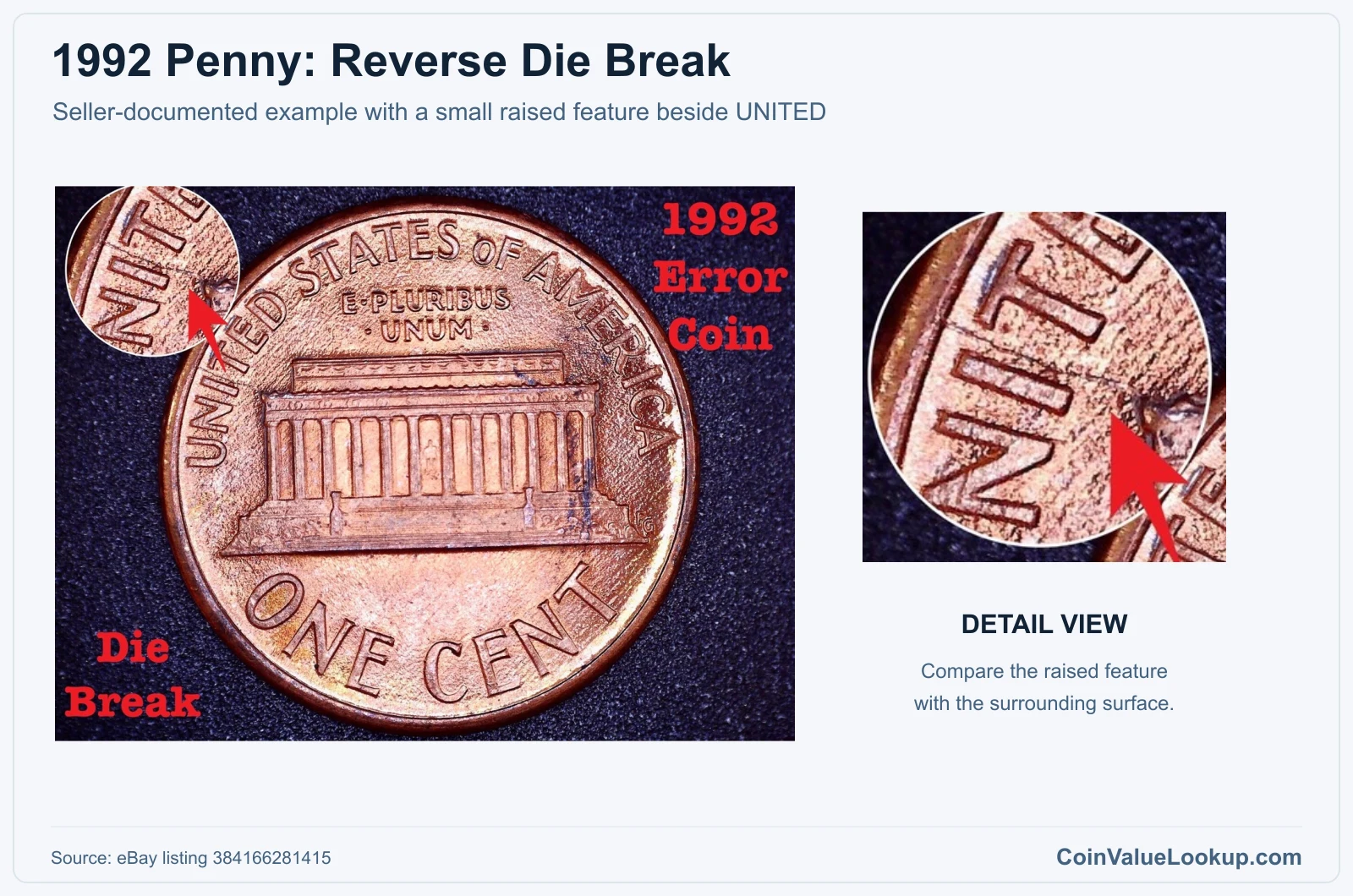
Die cracks and die chips have been reported on 1992 Lincoln cents. These show up as raised lines or small raised blobs on the coin's surface, caused by fractures in the steel die during production.
A die crack typically appears as a thin raised line running across the design, sometimes connecting the rim to an interior feature. A die chip is a small raised lump where a piece of the die surface broke away.
A larger break at the rim is sometimes called a cud.
Do not confuse these with incuse scratches, which are recessed into the surface rather than raised. Corrosion or foreign material stuck to a coin can also create bumps that mimic die chips.
The raised nature and consistent appearance across multiple coins from the same die are hallmarks of genuine die damage. Value depends on the size, location, and visual appeal of the crack or chip.
10. 1992 Lincoln Penny — Clashed Dies
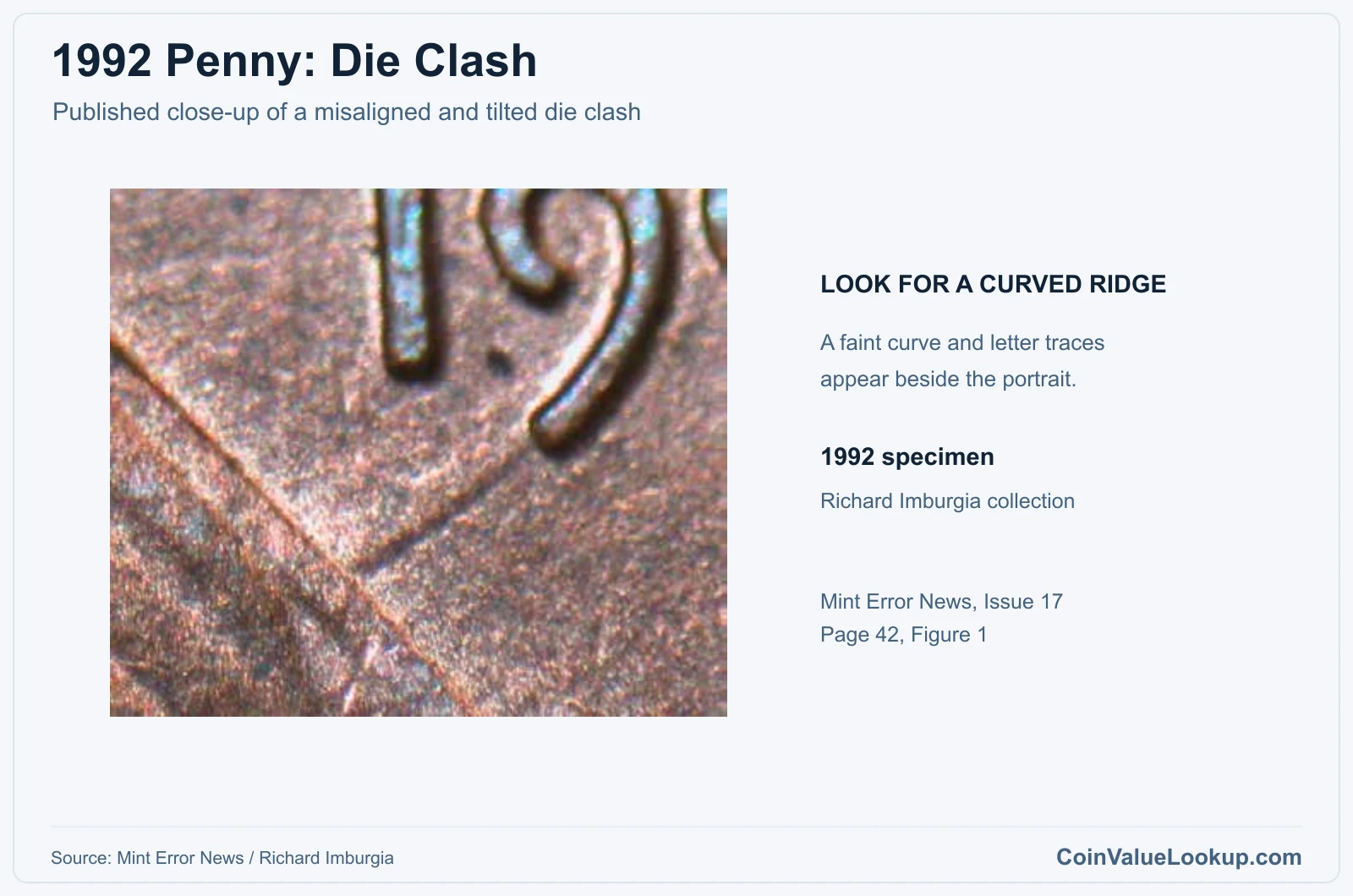
Clashed dies occur when the obverse and reverse dies strike each other without a planchet between them. This transfers ghost images of each die's design onto the other.
On a 1992 cent, you might see faint traces of the Memorial on Lincoln's side, or hints of Lincoln's profile on the reverse.
The key diagnostic is that the transferred design elements align with where the opposing die would have contacted. They appear as subtle raised outlines in the fields, not as random marks.
Scratches, random raised lines from debris, and post-mint damage can all mimic clash marks at first glance. A brockage, where a previously struck coin acts as a die, is a separate error with a much more dramatic appearance.
Value for die clashes depends on how visible and dramatic the transferred design is, along with the coin's overall condition.
11. 1992 Lincoln Penny — Struck-Through Error
Struck-through errors on 1992 cents occur when foreign material gets between the die and planchet during striking. This leaves a localized depression or incomplete design where the obstruction blocked the full impression.
Grease-filled dies create smooth, filled-in areas where fine detail disappears. A retained foreign object, like a piece of cloth or metal fragment, leaves a more distinct impression with texture or shape.
These are different categories worth describing separately when you examine your coin.
Ordinary wear, cleaning marks, and weak strikes from tired dies can all look similar to struck-through areas. The distinction is that a genuine struck-through error typically has sharp boundaries and an impression that does not match normal wear patterns.
Value depends on the size, clarity, and visual interest of the obstruction mark, along with the coin's authenticated condition.