1940 Wheat Penny Coin Value: How Much Is It Worth?
A 1940 Wheat Penny in circulated condition starts around $0.18 at the Good-4 grade level, while uncirculated examples reach roughly $4.96 at MS63, depending on which mint struck the coin. Proofs, major varieties and mint errors are priced separately from those guide anchors.
Original surfaces, color and wear all affect what a given coin will actually bring.
Fast Way to Identify Your 1940 Wheat Penny
Snap a clear photo of the front and back of your 1940 cent and upload both images here. Our identifier can give you a preliminary read on which mint version you have and its general condition.
It is not a substitute for professional authentication, but it is a solid first step before you dig deeper.
1940 Wheat Penny Value
Upload both sides of your 1940 Wheat Penny.
Front Obverse
Upload photo
Back Reverse
Upload photo
Which 1940 Wheat Penny Versions Are Worth Money?
- The 1940-D and 1940-S each list around $4.96 at MS63, slightly above the Philadelphia business strike at $3.62 in the same grade.
- The 1940 Proof, struck only at Philadelphia with brilliant mirrored fields, lists at about $56 in PR63 and is the standout collectible issue of the year.
- Authenticated doubled die obverse, repunched mintmark, or off-center strike errors can carry individual premiums well beyond normal-coin values.
- Original red surfaces on any mint's uncirculated example add collector appeal compared to cleaned or heavily toned coins.
Step 1: Identify Your 1940 Wheat Penny Mint Mark and Version
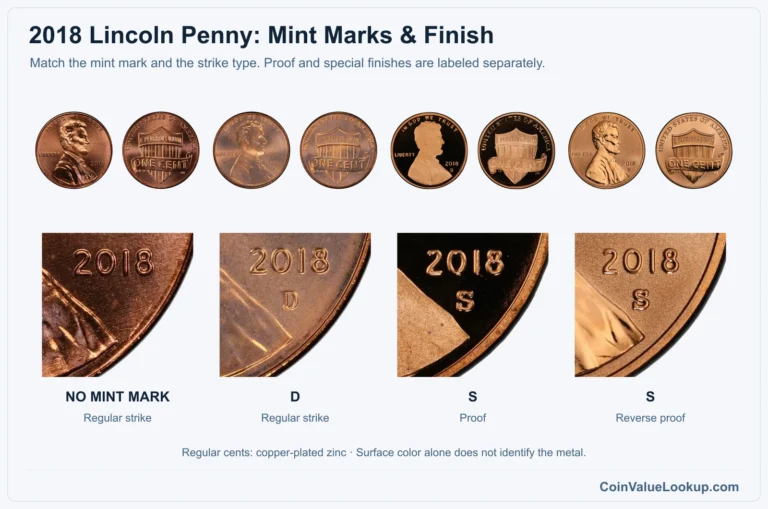
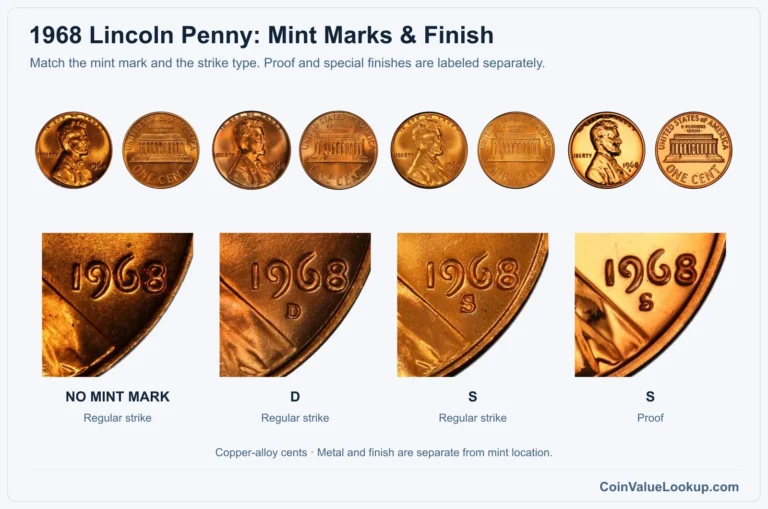
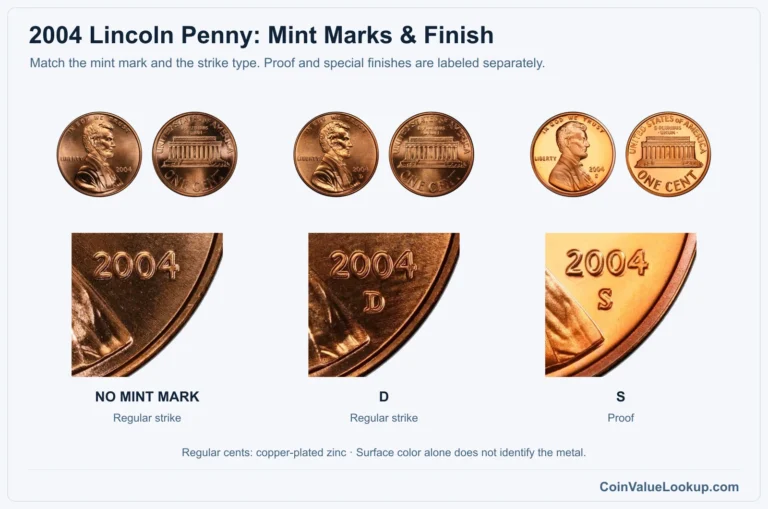
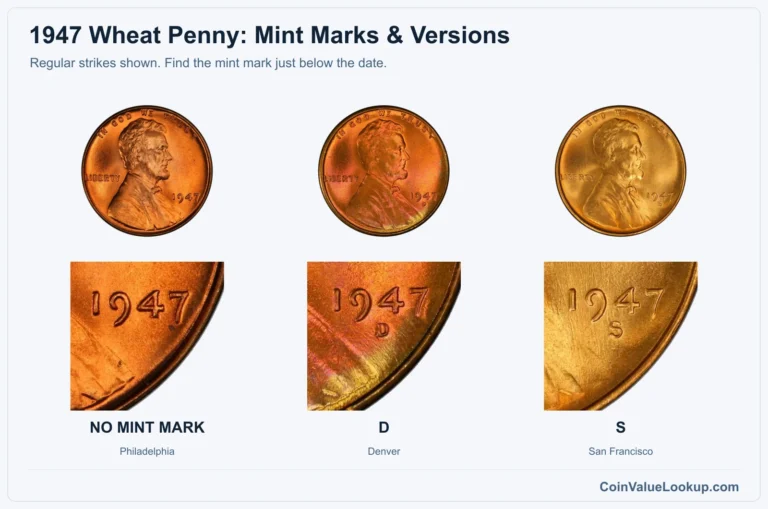
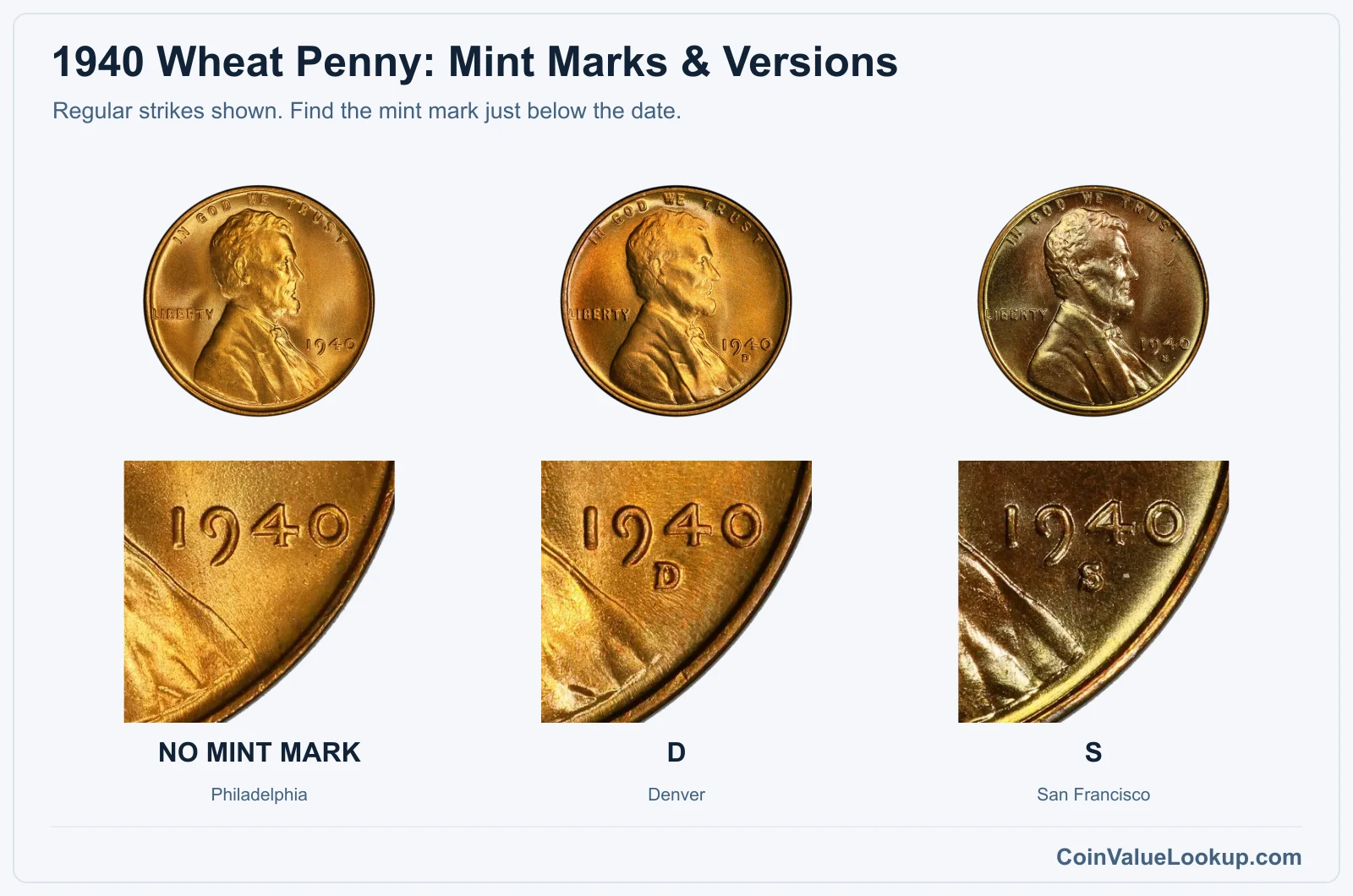
Flip your coin to the obverse and look just below the date on the right side. If there is no small letter there, you have a Philadelphia strike.
A tiny "D" means Denver, and an "S" means San Francisco. All three mints produced circulation strikes in 1940, and Philadelphia also made brilliant proof cents sold directly to collectors.
The coin itself should weigh about 3.11 grams, have a plain (smooth) edge, and be struck in a 95% copper, 5% tin and zinc alloy. The obverse features Lincoln's portrait; the reverse shows two wheat ears framing ONE CENT and UNITED STATES OF AMERICA.
Do not confuse color with grade. A coin can be red, red-brown or brown at the same wear level.
And a polished circulated cent is definitely not a proof, no matter how shiny someone made it.
Step 2: Check Your 1940 Wheat Penny Grade
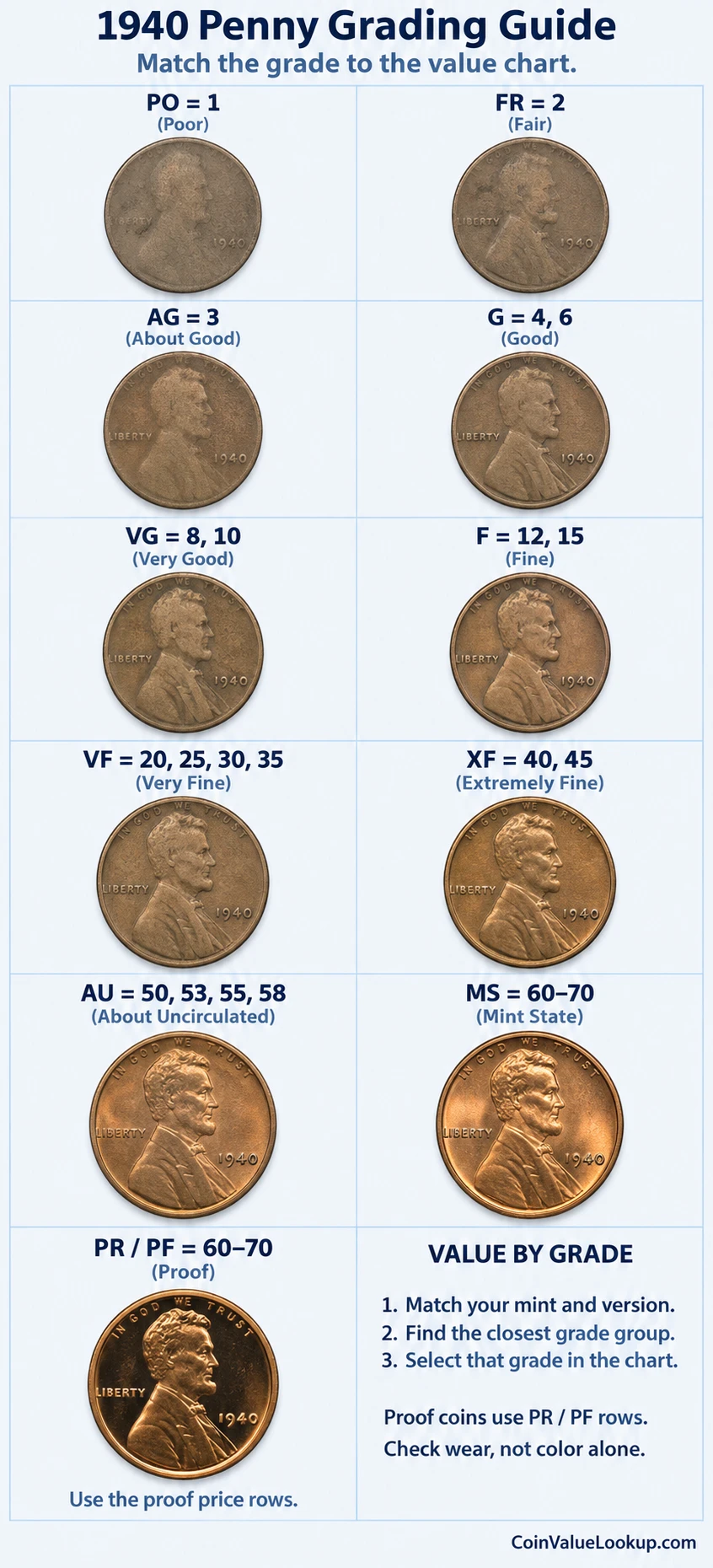
Start with Lincoln's cheekbone and jaw. In high grades those surfaces are smooth and rounded with full luster.
As a coin wears, the cheek flattens first, then the hair detail above the ear softens. On the reverse, check the individual wheat grains and the fine parallel lines between the stalks.
A coin graded Good-4 will show a clear outline of Lincoln but almost no hair or ear detail, and the wheat ears will be mostly flat. An MS63 coin should have full design detail, remaining mint luster, and only minor contact marks.
Compare your coin to the reference image to judge where it falls.
Keep in mind that a weak original strike can leave soft spots that look like wear but are not. Also treat color, spots, corrosion and evidence of cleaning as separate factors when evaluating appeal.
A brown uncirculated coin and a red uncirculated coin are not the same market conversation.
Step 3: Check 1940 Wheat Penny Value by Mint and Version
1940 Wheat Penny
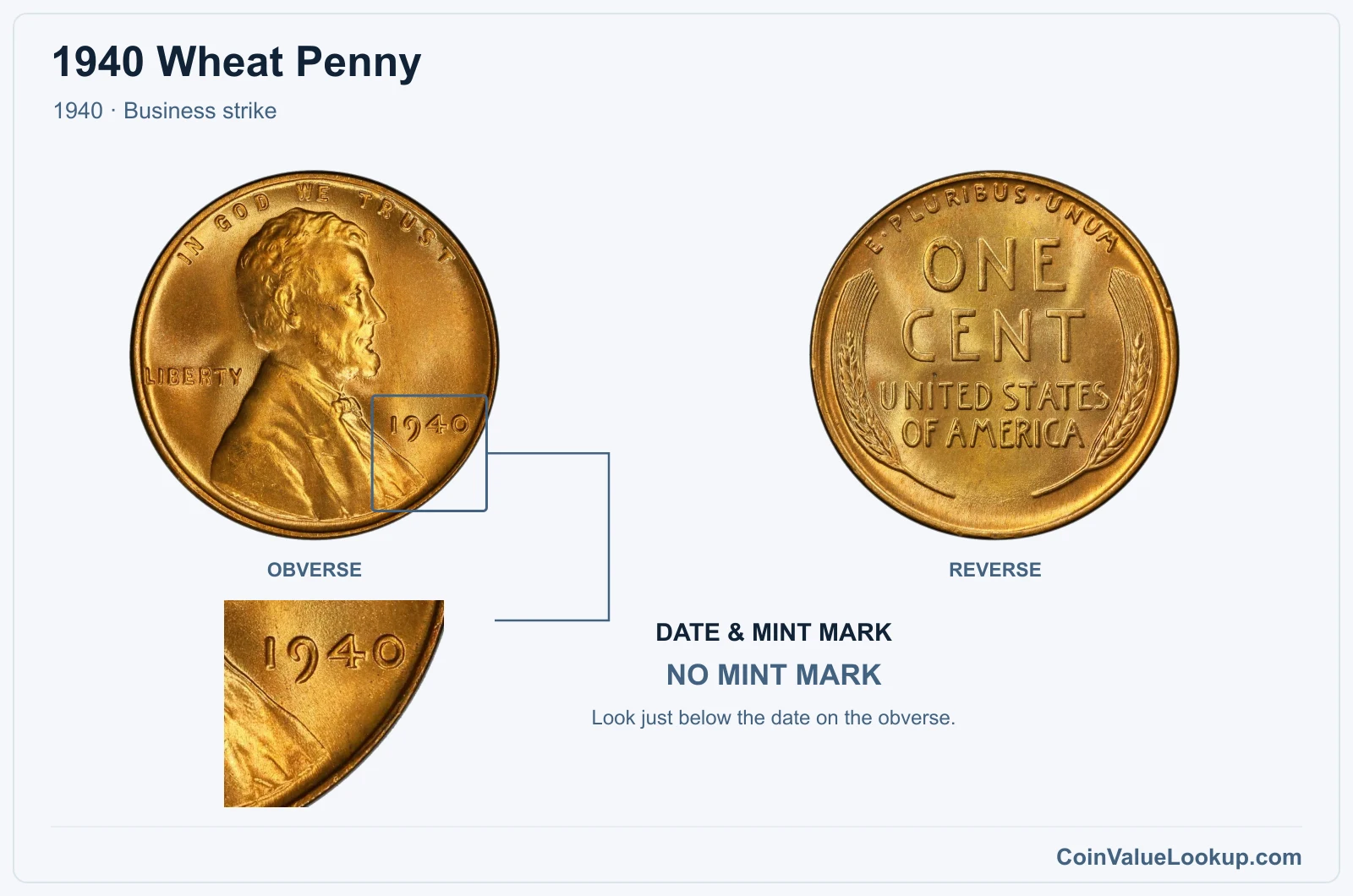
The 1940 Philadelphia cent carries no mintmark. It is the most common branch of the year for pocket change survivors.
In circulated grades around Good-4 these trade near $0.18, climbing to about $3.62 at MS63 according to guide estimates.
Look for original luster and clean surfaces on any uncirculated example. A coin that has been cleaned or shows heavy contact marks will not bring guide-level prices, even if the detail looks sharp.
Color is not specified in these guide figures, so do not assume the MS63 anchor reflects a certified red designation.
| Range | Grade | Price | Auction Records | Appraisal |
|---|---|---|---|---|
| PO | PO 1 | — | Coin Identifier | |
| FR | FR 2 | — | Coin Identifier | |
| AG | AG 3 | — | Coin Identifier | |
| G | G 4 | — | Coin Identifier | |
| G 6 | — | Coin Identifier | ||
| VG | VG 8 | — | Coin Identifier | |
| VG 10 | — | Coin Identifier | ||
| F | F 12 | — | Coin Identifier | |
| F 15 | — | Coin Identifier | ||
| VF | VF 20 | — | Coin Identifier | |
| VF 25 | — | Coin Identifier | ||
| VF 30 | — | Coin Identifier | ||
| VF 35 | — | Coin Identifier | ||
| XF | XF 40 | — | Coin Identifier | |
| XF 45 | — | Coin Identifier | ||
| AU | AU 50 | — | Coin Identifier | |
| AU 53 | — | Coin Identifier | ||
| AU 55 | — | Coin Identifier | ||
| AU 58 | — | Coin Identifier | ||
| MS | MS 60 | — | Coin Identifier | |
| MS 61 | — | Coin Identifier | ||
| MS 62 | — | Coin Identifier | ||
| MS 63 | — | Coin Identifier | ||
| MS 64 | — | Coin Identifier | ||
| MS 65 | Coin Identifier | |||
| MS 66 | Coin Identifier | |||
| MS 67 | Coin Identifier | |||
| MS 68 | Coin Identifier | |||
| MS 69 | — | — | — | |
| MS 70 | — | — | — |
1940 Wheat Penny — D
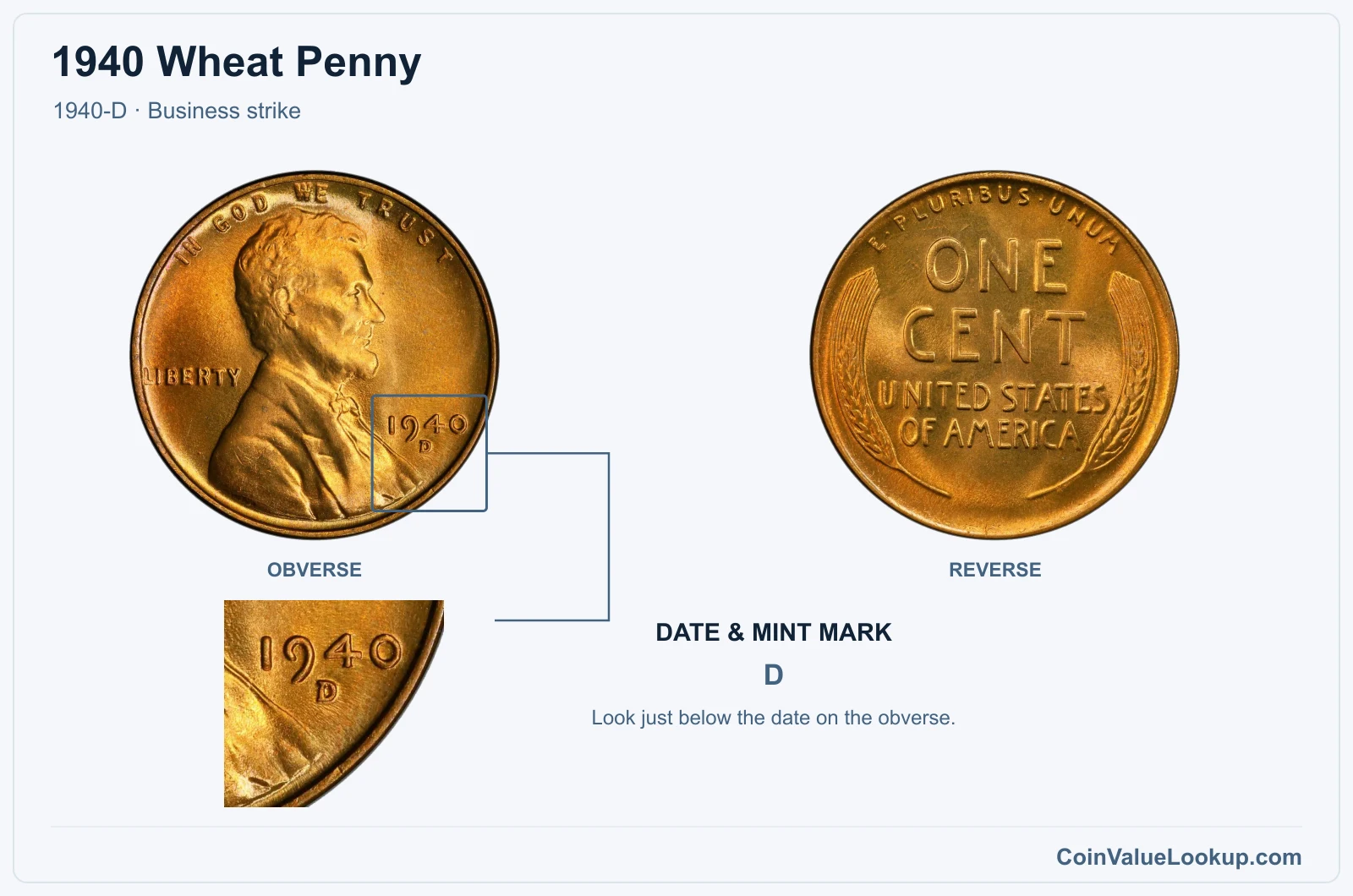
The 1940-D carries a small "D" mintmark below the date. Denver produced a large run this year, so circulated pieces are easy to find near $0.18 at Good-4.
Uncirculated examples reach about $4.96 at MS63 in guide estimates.
Denver cents from this era can show softer strikes than Philadelphia, especially on the hair curls above Lincoln's ear. That is a die characteristic, not wear.
Judge wear from luster loss and high-point flattening on the cheek and jaw instead.
Coin Value Lookup is a handy place to look up values for other dates and mints in the Wheat Penny series while you are sorting through a group.
| Range | Grade | Price | Auction Records | Appraisal |
|---|---|---|---|---|
| PO | PO 1 | — | Coin Identifier | |
| FR | FR 2 | — | Coin Identifier | |
| AG | AG 3 | — | Coin Identifier | |
| G | G 4 | — | Coin Identifier | |
| G 6 | — | Coin Identifier | ||
| VG | VG 8 | — | Coin Identifier | |
| VG 10 | — | Coin Identifier | ||
| F | F 12 | — | Coin Identifier | |
| F 15 | — | Coin Identifier | ||
| VF | VF 20 | — | Coin Identifier | |
| VF 25 | — | Coin Identifier | ||
| VF 30 | — | Coin Identifier | ||
| VF 35 | — | Coin Identifier | ||
| XF | XF 40 | — | Coin Identifier | |
| XF 45 | — | Coin Identifier | ||
| AU | AU 50 | — | Coin Identifier | |
| AU 53 | — | Coin Identifier | ||
| AU 55 | — | Coin Identifier | ||
| AU 58 | — | Coin Identifier | ||
| MS | MS 60 | — | Coin Identifier | |
| MS 61 | — | Coin Identifier | ||
| MS 62 | — | Coin Identifier | ||
| MS 63 | — | Coin Identifier | ||
| MS 64 | — | Coin Identifier | ||
| MS 65 | Coin Identifier | |||
| MS 66 | Coin Identifier | |||
| MS 67 | Coin Identifier | |||
| MS 68 | Coin Identifier | |||
| MS 69 | — | — | — | |
| MS 70 | — | — | — |
1940 Wheat Penny — S
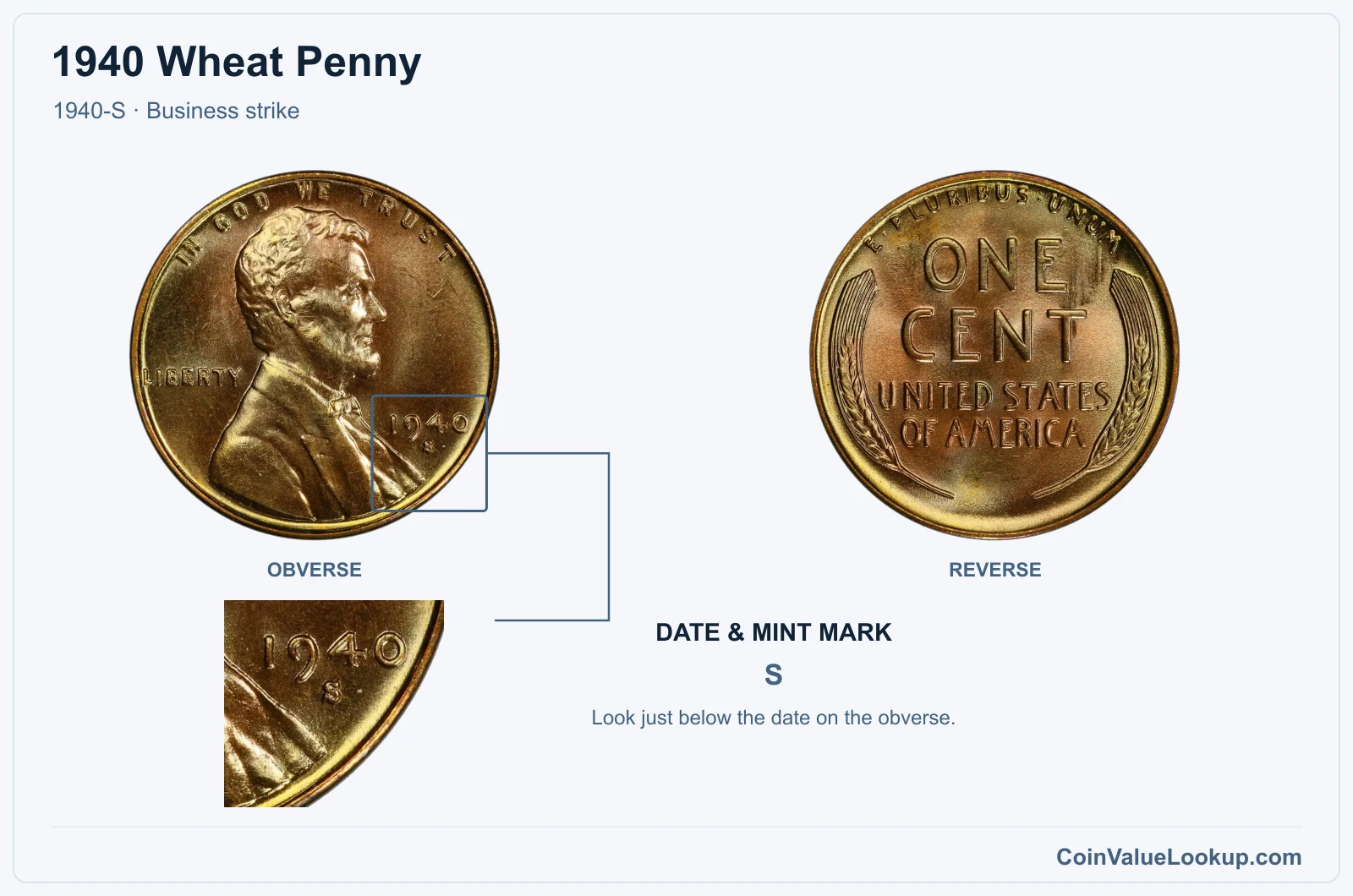
The 1940-S has a small "S" mintmark below the date, identifying it as a San Francisco product. Circulated examples sit around $0.18 at Good-4, while MS63 coins reach roughly $4.96 per guide estimates.
San Francisco strikes from 1940 are plentiful in lower grades but get more competitive in fully uncirculated condition with original surfaces. As with all branches, the guide anchor does not specify color, so a certified red coin may trade differently than these figures suggest.
| Range | Grade | Price | Auction Records | Appraisal |
|---|---|---|---|---|
| PO | PO 1 | — | Coin Identifier | |
| FR | FR 2 | — | Coin Identifier | |
| AG | AG 3 | — | Coin Identifier | |
| G | G 4 | — | Coin Identifier | |
| G 6 | — | Coin Identifier | ||
| VG | VG 8 | — | Coin Identifier | |
| VG 10 | — | Coin Identifier | ||
| F | F 12 | — | Coin Identifier | |
| F 15 | — | Coin Identifier | ||
| VF | VF 20 | — | Coin Identifier | |
| VF 25 | — | Coin Identifier | ||
| VF 30 | — | Coin Identifier | ||
| VF 35 | — | Coin Identifier | ||
| XF | XF 40 | — | Coin Identifier | |
| XF 45 | — | Coin Identifier | ||
| AU | AU 50 | — | Coin Identifier | |
| AU 53 | — | Coin Identifier | ||
| AU 55 | — | Coin Identifier | ||
| AU 58 | — | Coin Identifier | ||
| MS | MS 60 | — | Coin Identifier | |
| MS 61 | — | Coin Identifier | ||
| MS 62 | — | Coin Identifier | ||
| MS 63 | Coin Identifier | |||
| MS 64 | Coin Identifier | |||
| MS 65 | Coin Identifier | |||
| MS 66 | Coin Identifier | |||
| MS 67 | Coin Identifier | |||
| MS 68 | Coin Identifier | |||
| MS 69 | — | — | — | |
| MS 70 | — | — | — |
1940 Wheat Penny — PR
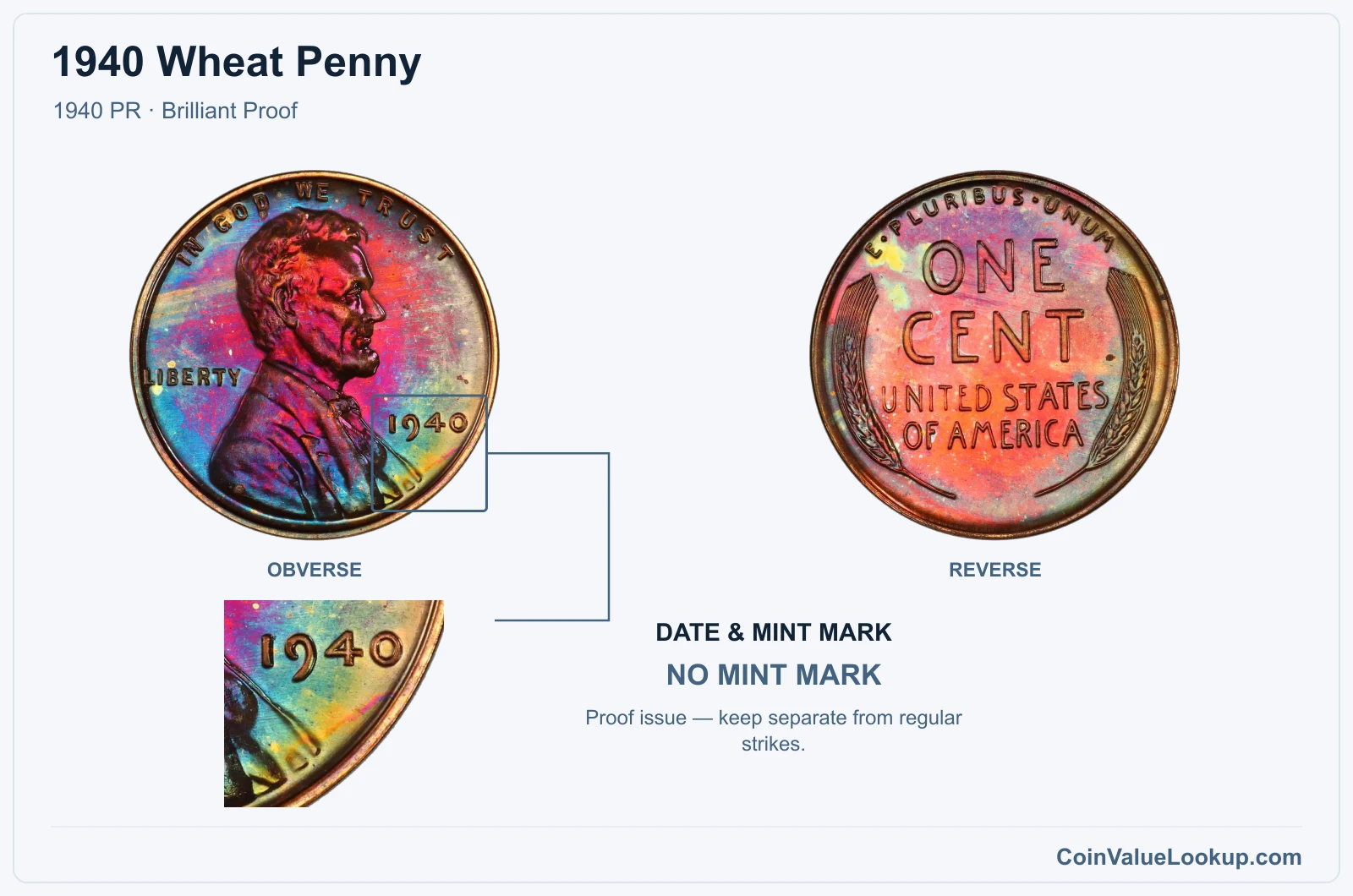
The 1940 Proof was struck at Philadelphia with specially prepared dies and polished planchets, producing brilliant mirrored fields. These were sold to collectors, not released into circulation.
A PR63 example lists at about $56 in guide estimates.
To tell a genuine proof from a polished circulation cent, look for sharp, squared-off rims, fully struck design elements and deeply reflective flat surfaces. A real proof will also show minimal or no contact marks from bag handling, because it was never dumped into a bin with thousands of other coins.
Cameo or deep cameo contrast designations describe the degree of frost on the raised design against those mirror fields; they are collector preferences, not error categories.
| Range | Grade | Price | Auction Records | Appraisal |
|---|---|---|---|---|
| PR | PR 1 | — | Coin Identifier | |
| PR 2 | — | Coin Identifier | ||
| PR 3 | — | Coin Identifier | ||
| PR 4 | — | Coin Identifier | ||
| PR 6 | — | Coin Identifier | ||
| PR 8 | — | Coin Identifier | ||
| PR 10 | — | Coin Identifier | ||
| PR 12 | — | Coin Identifier | ||
| PR 15 | — | Coin Identifier | ||
| PR 20 | — | Coin Identifier | ||
| PR 25 | — | Coin Identifier | ||
| PR 30 | — | Coin Identifier | ||
| PR 35 | — | Coin Identifier | ||
| PR 40 | — | Coin Identifier | ||
| PR 45 | — | Coin Identifier | ||
| PR 50 | — | Coin Identifier | ||
| PR 53 | — | Coin Identifier | ||
| PR 55 | — | Coin Identifier | ||
| PR 58 | — | Coin Identifier | ||
| PR 60 | — | Coin Identifier | ||
| PR 61 | — | Coin Identifier | ||
| PR 62 | — | Coin Identifier | ||
| PR 63 | Coin Identifier | |||
| PR 64 | Coin Identifier | |||
| PR 65 | — | Coin Identifier | ||
| PR 66 | — | Coin Identifier | ||
| PR 67 | — | — | — | |
| PR 68 | — | — | — | |
| PR 69 | — | — | — | |
| PR 70 | — | — | — |
1940 Wheat Penny Error List
1. 1940 Wheat Penny — Doubled Die Obverse
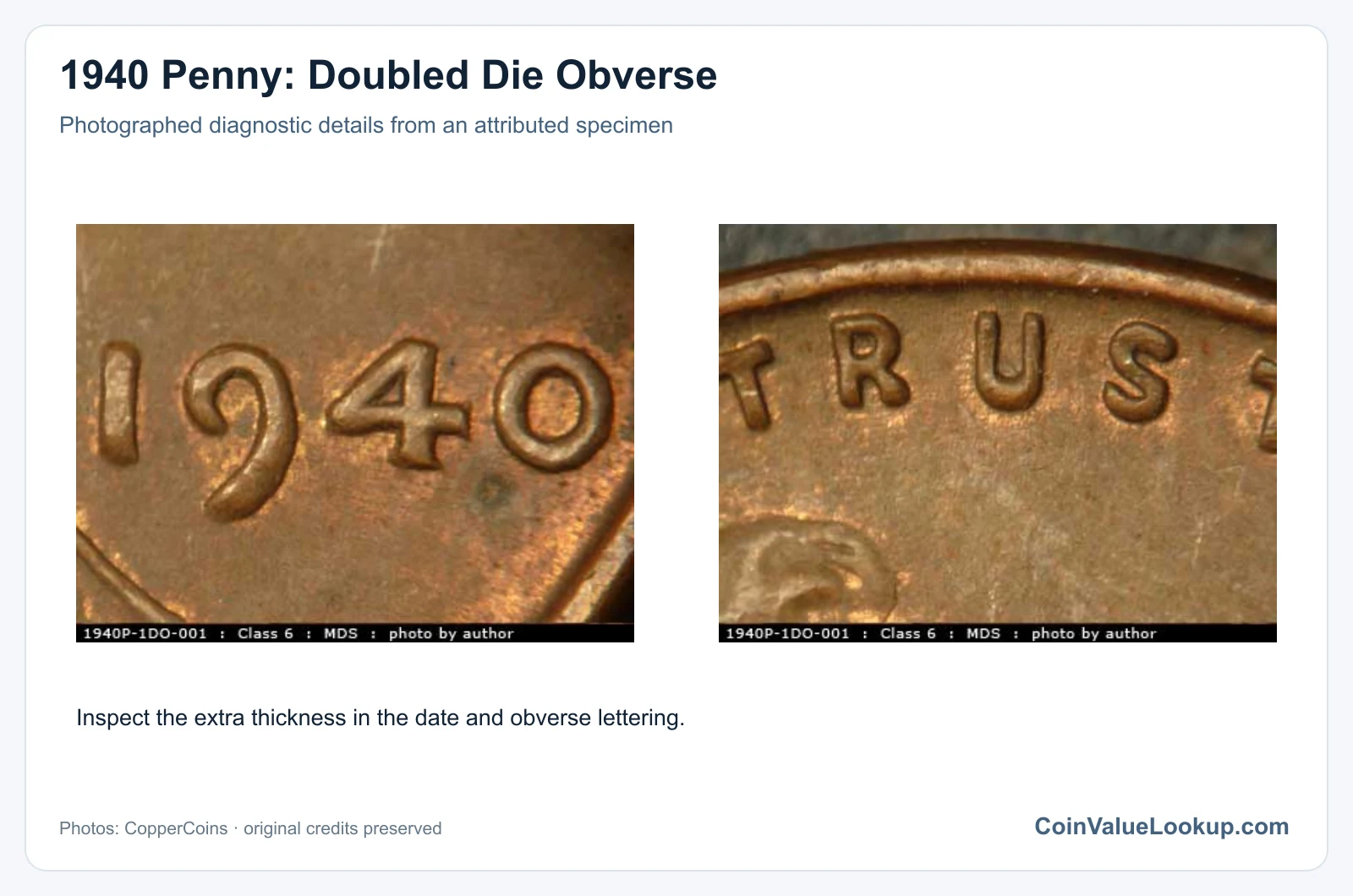
A doubled die obverse on a 1940 Wheat cent shows consistent doubling on obverse lettering or design elements. Under magnification you should see separation or notching on features like LIBERTY, IN GOD WE TRUST or the date numerals.
The doubling will appear in the same position on every affected coin struck from that die.
Do not confuse this with machine doubling, which produces flat, shelf-like distortion rather than distinct raised separation. Reflections and worn die contours can also mimic doubling under certain lighting.
Value depends on the authenticated identity of the specific doubled die, the severity of the doubling and the coin's overall condition. Have any suspect coin examined by a grading service before assuming a premium.
2. 1940 Wheat Penny — Repunched Mintmark
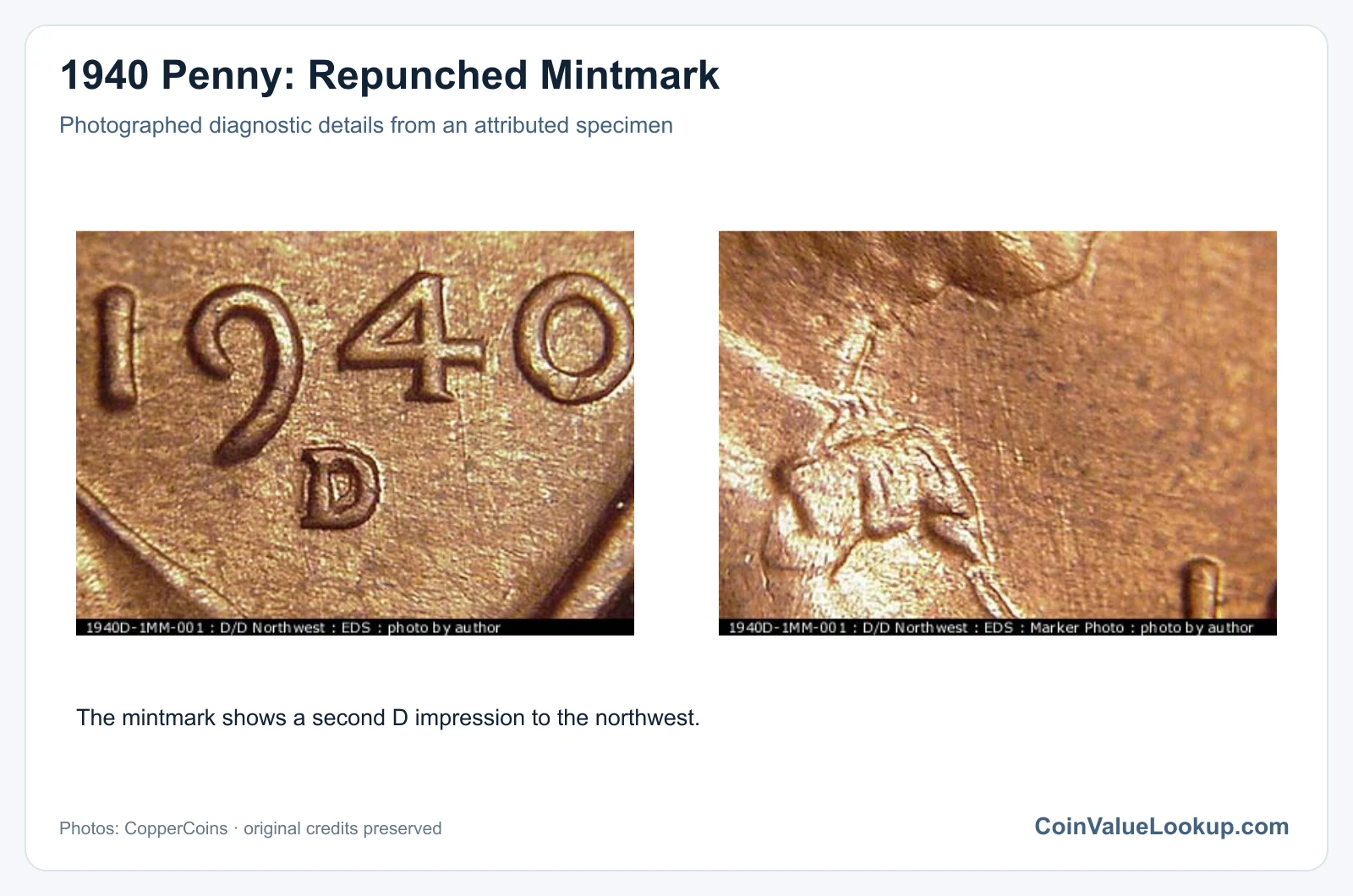
A repunched mintmark appears on Denver or San Francisco cents only, since Philadelphia coins carry no mintmark to repunch. Look closely at the D or S for traces of an earlier punch in a slightly different position.
You may see a second serif, a shadow outline or extra thickness on one side of the letter.
Machine doubling on the mintmark looks different: it produces a flat shelf rather than a separately positioned image. Die chips or corrosion around the mark can also fool you.
Compare your coin at matching magnification to a known normal mintmark from the same year and mint. Pricing depends entirely on the specific variety, its visual strength and the coin's grade, so professional authentication is the way to establish what you have.
3. 1940 Wheat Penny — Off-Center Strike
An off-center strike happens when the planchet is not seated properly in the collar before the dies come together. The result is a shifted design with an unstruck crescent of blank metal on one side.
The farther off-center, the more dramatic the coin looks, but the date must remain visible for most collectors to care.
A clipped planchet or one-sided die misalignment can look similar at first glance, and post-mint damage like a vise strike can flatten part of the design. True off-center errors show a complete, sharp design on the struck portion that just happens to be displaced.
Individual value depends on the percentage of off-center shift, date visibility and the coin's condition, so each piece needs its own assessment.
4. 1940 Wheat Penny — Clipped Planchet
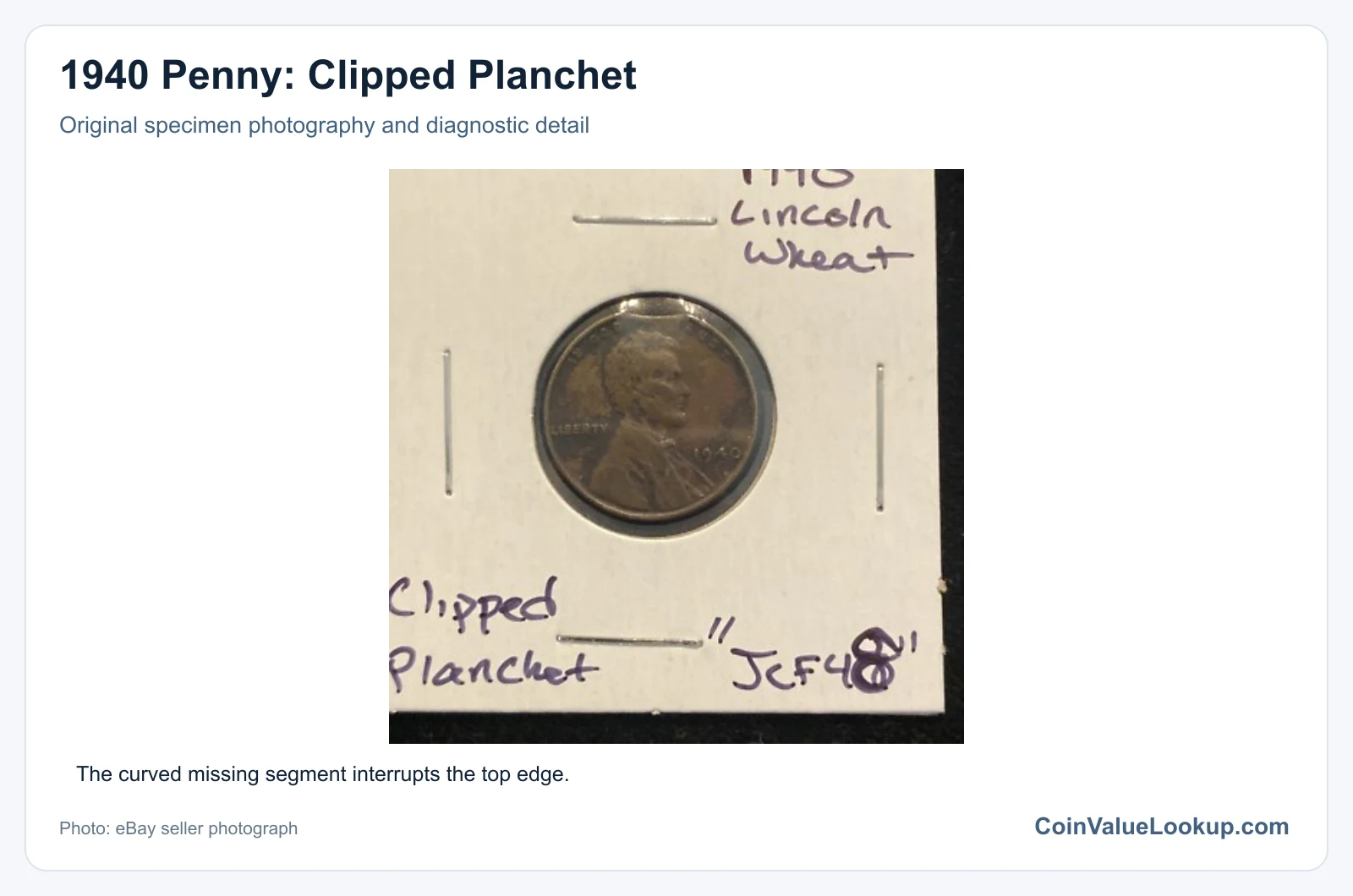
A clipped planchet error occurs when the blank is punched from strip metal that overlaps a previously punched hole, leaving a curved missing section. Straight clips and ragged clips also exist but are less common on this series.
A genuine clip usually shows a smooth, rounded edge at the missing area and may display weakness in the design directly opposite the clip, known as the Blakesley effect.
Filed edges, deliberate cuts and heavy corrosion can mimic a clip, so examine the edge texture carefully. The metal flow near a real clip will look natural and gradual rather than sharp or tool-marked.
Pricing varies with clip size, type and the coin's overall grade; each example should be evaluated individually.
5. 1940 Wheat Penny — Lamination / Split Planchet
Lamination errors on a 1940 Wheat cent appear as peeling layers, retained metal flaps or visible separation within the copper alloy. These result from impurities or gas trapped in the planchet before striking.
You might see a thin sheet lifting away from the surface or a section that has already broken off, leaving an exposed underlayer.
Photograph both the affected face and the coin's edge together, because edge views help confirm the split is through the metal itself. Scrapes, corrosion pitting and deliberately altered coins can look somewhat similar.
A genuine lamination will follow the contour of the metal's internal structure rather than showing sharp tool marks. Value depends on size, location and visual impact, assessed on a coin-by-coin basis.
6. 1940 Wheat Penny — Die Crack / Die Chip
Die cracks appear as thin raised lines on the coin's surface, tracing where the steel die itself fractured during use. Die chips are small raised blobs where a piece of the die broke away.
If a crack reaches the rim and removes a chunk of the die face, the result is called a cud, which is a flat, featureless raised area at the edge.
These are all raised features, which distinguishes them from scratches and incuse marks that cut into the surface. Corrosion deposits and foreign material stuck to the coin can also create bumps, so check that the feature is metallic and integral to the strike.
Each die crack or chip is valued individually based on its size, location and the coin's condition.
7. 1940 Wheat Penny — BIE Die Break
A BIE error is a specific type of die break found on Lincoln cents. It shows up as a small raised vertical bar or blob between the letters B and E in LIBERTY, caused by a chip in the die face at that location.
The name comes from the visual impression of an extra letter "I" appearing in the word.
Look at LIBERTY under magnification. A genuine BIE will be raised metal, the same color and texture as the surrounding design, sitting in the space between B and E.
Dirt, organic deposits or a scratch can mimic the look, so clean the area gently and re-examine. These are collected as a minor variety.
Value depends on the clarity of the feature and the coin's overall grade.
8. 1940 Wheat Penny — Wrong Planchet / Off-Metal Strike
A wrong-planchet error means the 1940 cent design was struck on a blank intended for a different denomination or composition. The coin's weight, diameter and edge will not match normal cent specifications of about 3.11 grams and a plain edge.
The design may be incomplete if the blank was smaller than a standard cent planchet.
To check, weigh the coin carefully on a precise scale and measure its diameter. Compare your readings against known specifications for other denominations of the era.
Plated coins, acid-treated coins and deliberate alterations can change a coin's appearance and weight, so look for signs of tampering. Authentication by a third-party grading service is essential before claiming this error, because each confirmed example is evaluated on its own merits.