1969 Lincoln Penny Coin Value: How Much Is It Worth?
Most 1969 Lincoln pennies you pull from a jar are worth roughly face value in circulated condition. A USA Coin Book guide estimate puts an ordinary uncirculated example at about $1.24 in MS65.
The real action is in the scarce 1969-S doubled die obverse and a handful of legitimate mint errors that can dramatically change the picture.
Fast Way to Identify Your 1969 Lincoln Penny
Snap clear photos of both the front and back of your 1969 penny and upload them to our identifier. It will help with a preliminary identification of your coin's mint mark, condition and version.
This is not a substitute for professional authentication, but it gives you a solid starting point before you dig deeper.
1969 Penny Value
Upload both sides of your 1969 Lincoln Penny.
Front Obverse
Upload photo
Back Reverse
Upload photo
Which 1969 Lincoln Penny Versions Are Worth Money?
- The 1969-S doubled die obverse is the headline variety for this year. Look for strong, separated doubling on the date and obverse lettering on S-mint business strikes.
- Well-preserved uncirculated coins with original red copper color and authenticated mint errors each require individual assessment based on identity, condition and severity.
Step 1: Identify Your 1969 Lincoln Penny Mint Mark and Version
The 1969 Lincoln penny carries the familiar Lincoln portrait on the obverse and the Lincoln Memorial on the reverse. The alloy is 95% copper and 5% zinc, weighing a nominal 3.11 grams with a plain edge.
These are not the copper-plated zinc cents that came later.
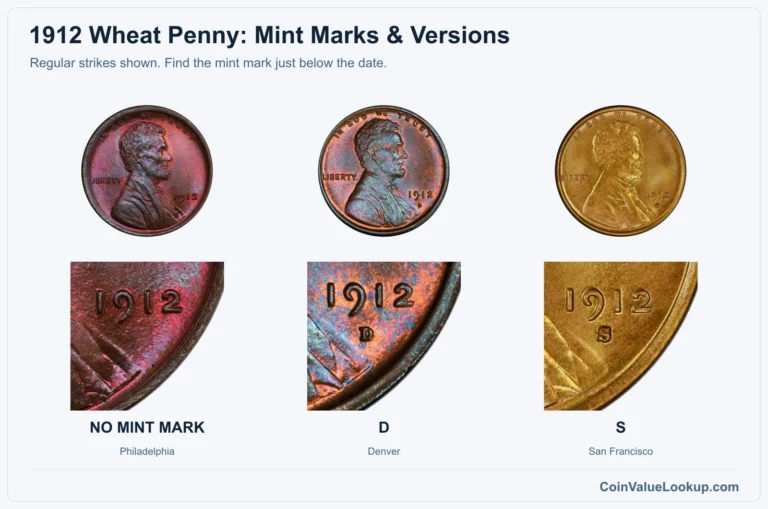
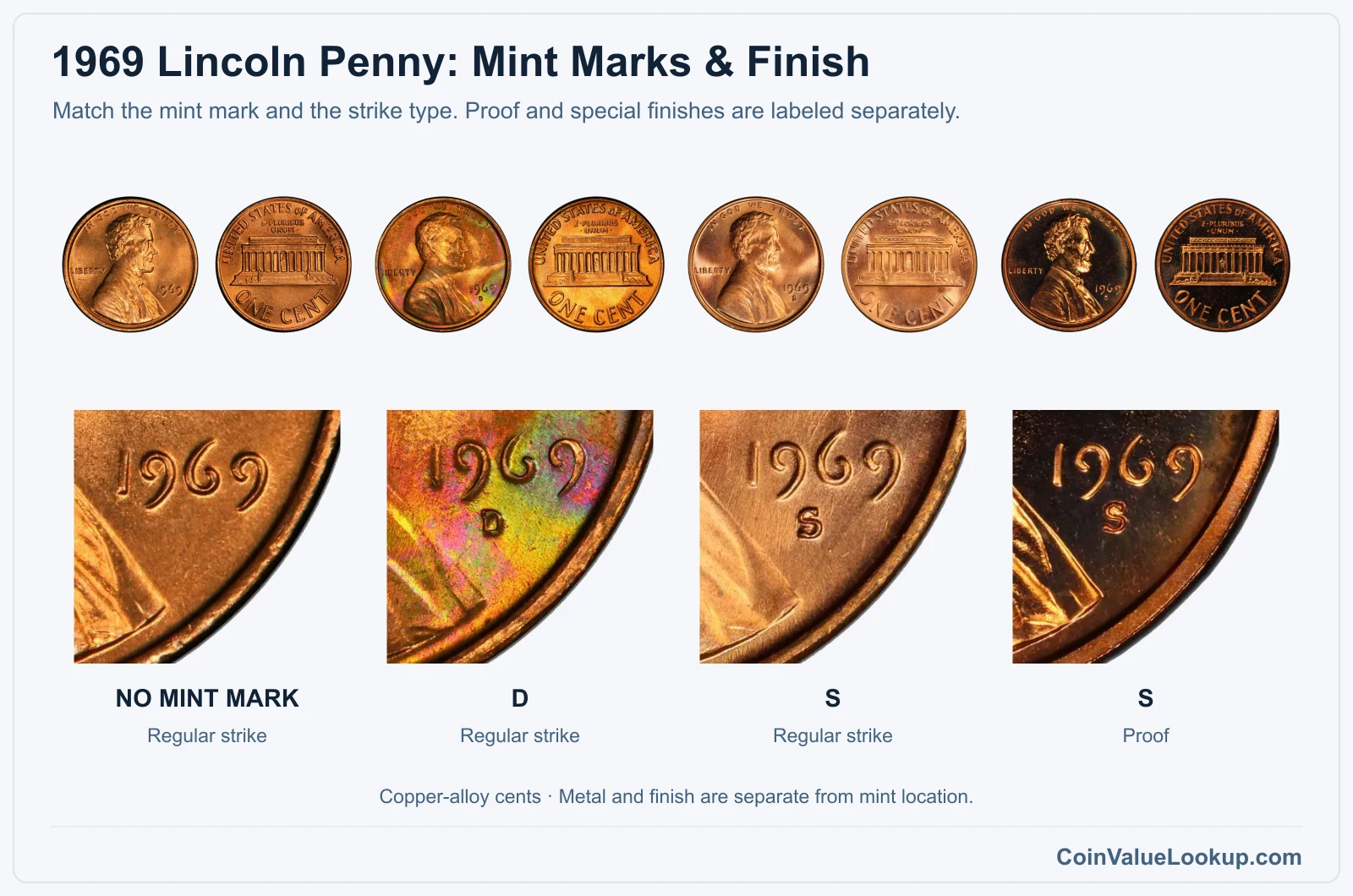
First, confirm the date reads 1969. Then look just below the date for a small letter: D, S or nothing at all.
No letter means the coin is cataloged as a Philadelphia/no-mintmark issue; the absent letter alone does not prove or disprove anything unusual.
Business strikes exist for no-mintmark, D and S branches. A separate S proof was also struck for collectors, and it is a different finish entirely from the S business strike.
Do not confuse the two.
Copper color designations, Red (RD), Red-Brown (RB) and Brown (BN), describe how much original surface color remains. They are not different alloys.
A coin can be fully uncirculated and still Brown.
Watch out for altered, plated or chemically cleaned coins. A shiny surface does not equal a mint error, and a darkened coin is not necessarily worn.
Step 2: Check Your 1969 Lincoln Penny Grade
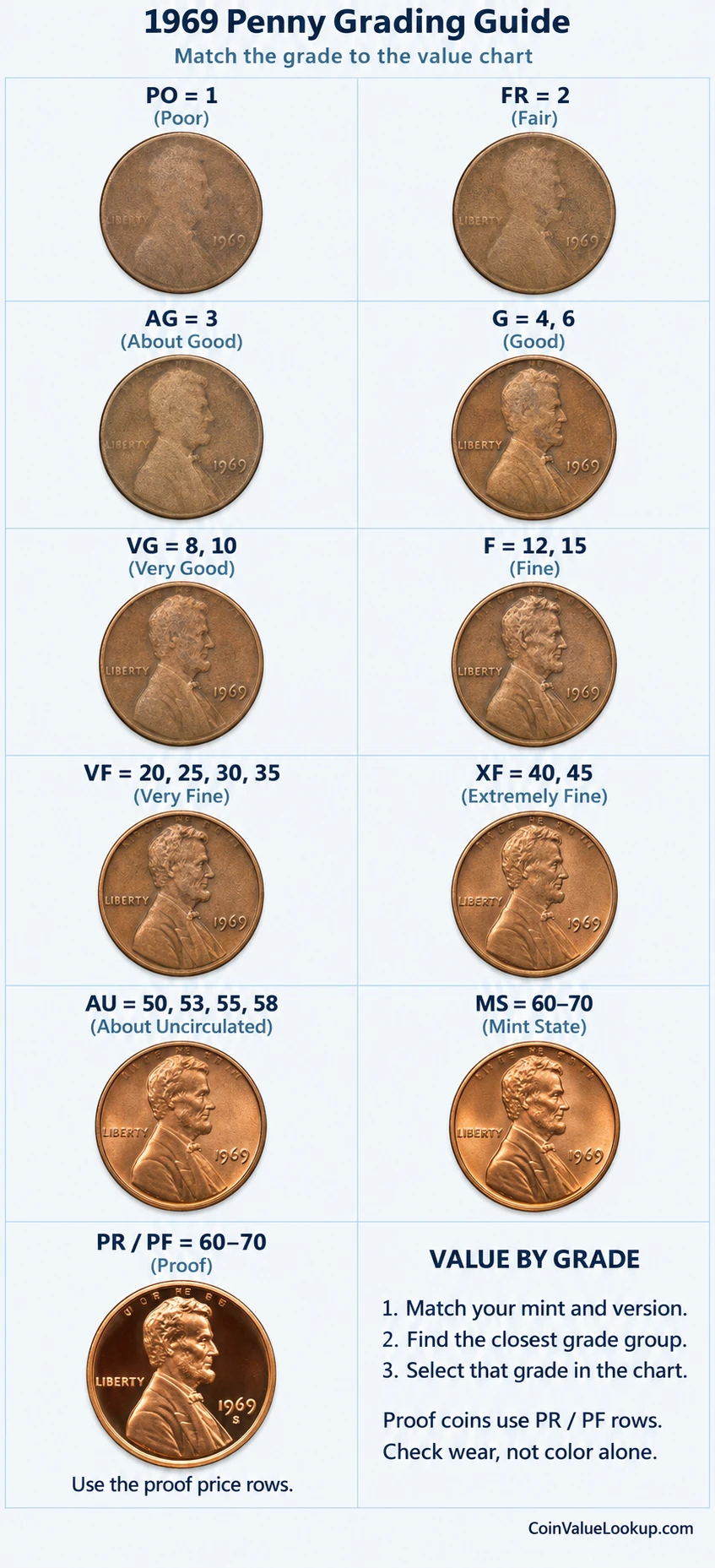
Start on the obverse. Check Lincoln's cheek, jawline and the hair detail just above the ear.
These high points lose definition first as a coin circulates.
Flip it over. The Memorial roof and the columns between the openings are the reverse wear checkpoints.
Fuzzy columns mean the coin saw real use.
Separate contact marks, which are random dings from other coins, from actual wear. A coin can have bag marks and still be uncirculated if luster remains intact across the fields.
Dark copper tone does not equal wear; bright copper may signal cleaning.
Use the comparison image to match your coin's detail against known grade examples. Proof finish and copper-color designation are tracked separately from the numeric grade, so make sure you are comparing apples to apples.
Step 3: Check 1969 Lincoln Penny Value by Mint and Version
1969 Lincoln Penny — No Mint Mark — Business
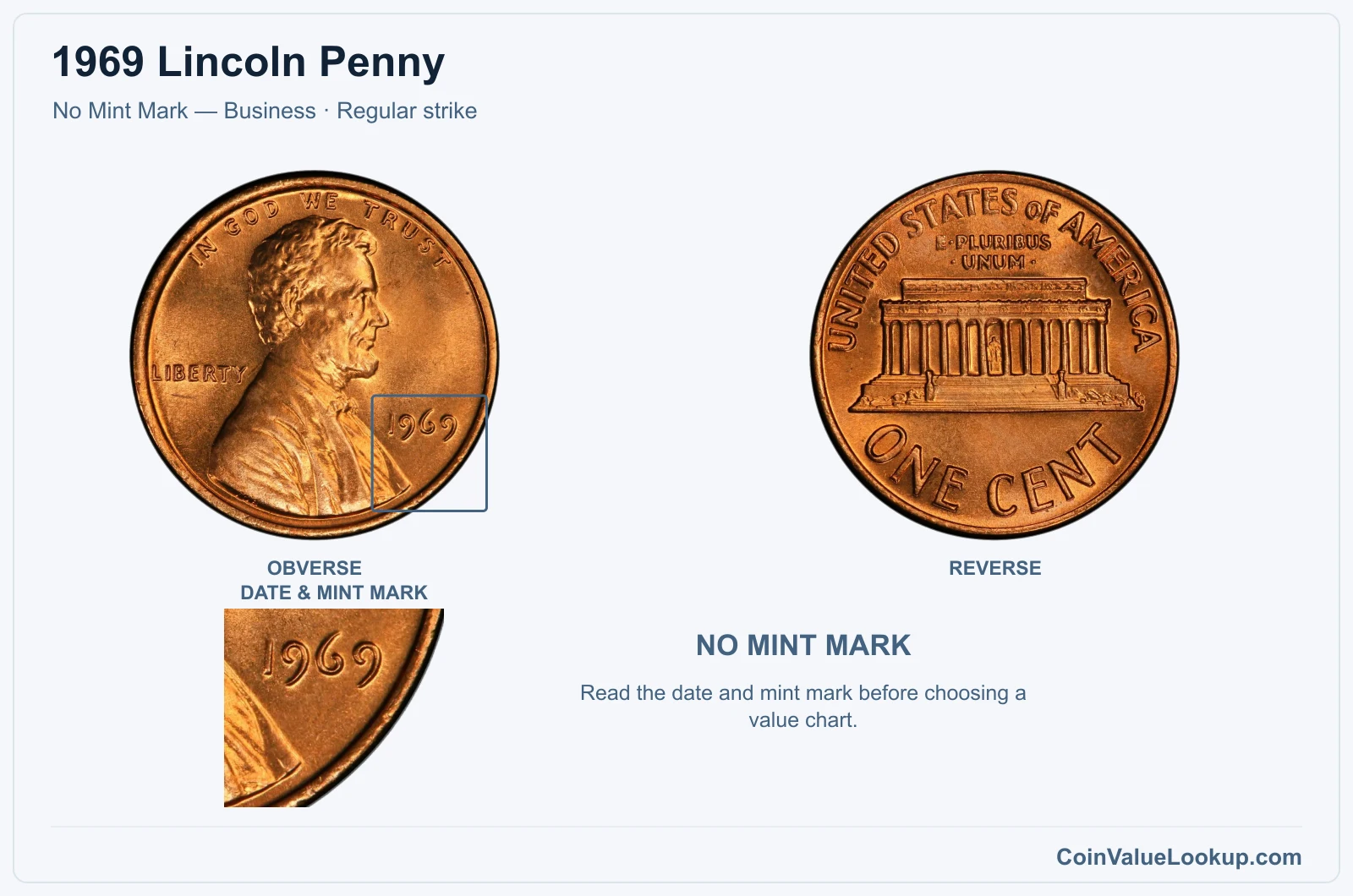
The 1969 no-mintmark penny is a standard Philadelphia-catalog business strike. Look below the date: no letter should appear.
The alloy is 95% copper and 5% zinc at 3.11 grams.
In worn condition these trade near face value. A USA Coin Book guide estimate places an MS65 example at about $1.24.
Copper color matters at the uncirculated level, so note whether your coin is BN, RB or RD before comparing prices.
Range Grade
Price1969 No Mint Mark — Business (BN) Price1969 No Mint Mark — Business (RB) Price1969 No Mint Mark — Business (RD) Auction Records Appraisal PO PO 1
—
Coin Identifier FR FR 2
—
Coin Identifier AG AG 3
—
Coin Identifier G G 4
—
Coin Identifier
G 6
—
Coin Identifier VG VG 8
—
Coin Identifier
VG 10
—
Coin Identifier F F 12
—
Coin Identifier
F 15
—
Coin Identifier VF VF 20
—
Coin Identifier
VF 25
—
Coin Identifier
VF 30
—
Coin Identifier
VF 35
—
Coin Identifier XF XF 40
—
Coin Identifier
XF 45
—
Coin Identifier AU AU 50
—
Coin Identifier
AU 53
—
Coin Identifier
AU 55
—
Coin Identifier
AU 58
—
Coin Identifier MS MS 60
—
—
Coin Identifier
MS 61
—
—
Coin Identifier
MS 62
—
Coin Identifier
MS 63
—
Coin Identifier
MS 64
Coin Identifier
MS 65
—
Coin Identifier
MS 66
—
Coin Identifier
MS 67
—
Coin Identifier
MS 68
—
—
—
—
—
MS 69
—
—
—
—
—
MS 70
—
—
—
—
—
1969 Lincoln Penny — D — Business
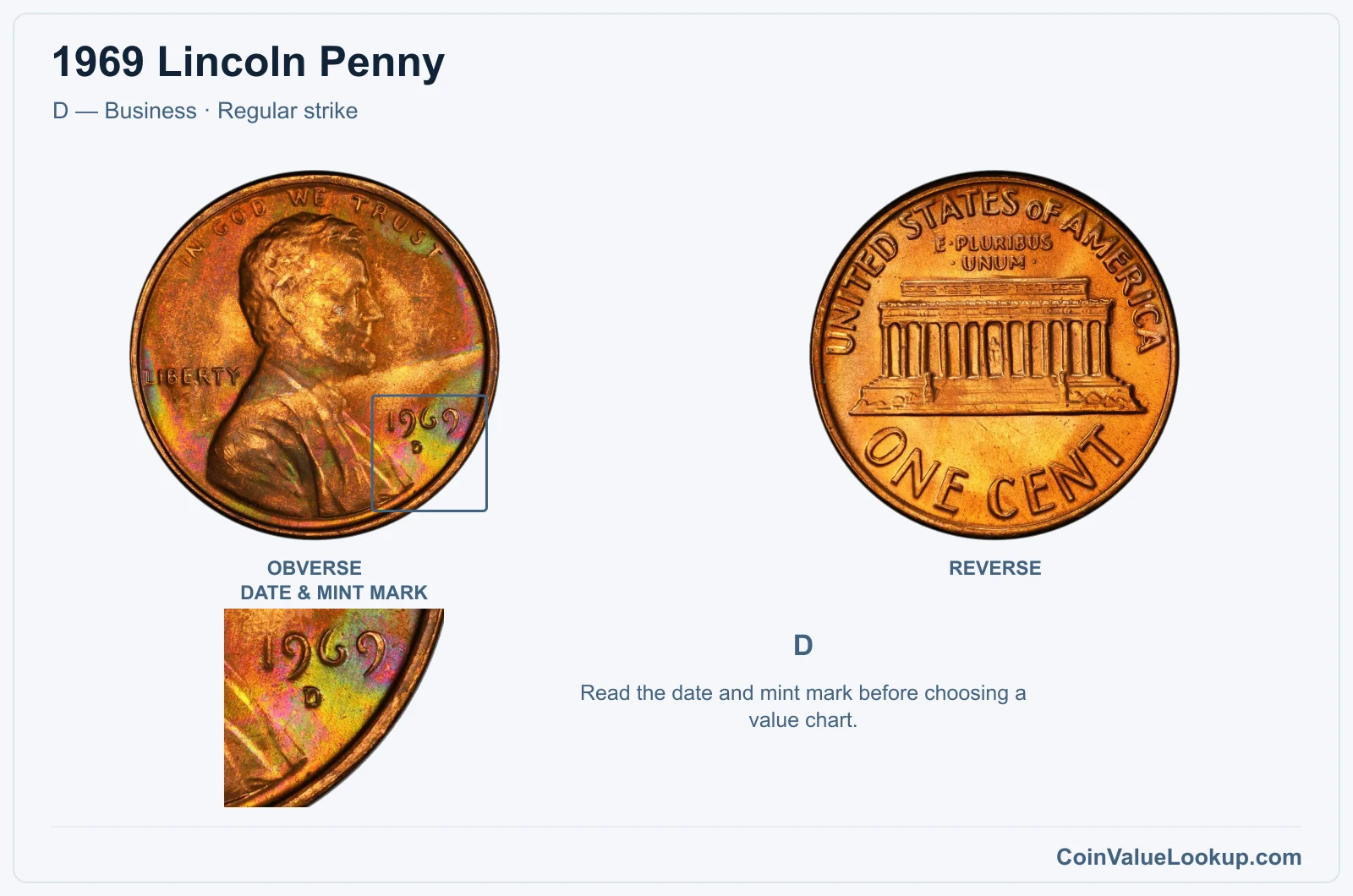
Denver struck a large run of 1969-D cents. The small D sits just below the date on the obverse.
Same 95% copper alloy and 3.11-gram weight as the other branches.
Circulated examples are common and worth very little above face. The USA Coin Book guide estimate for MS65 is approximately $1.24.
As with every copper Lincoln, original red color commands a premium over brown or red-brown at equivalent grades.
Range Grade
Price1969 D — Business (BN) Price1969 D — Business (RB) Price1969 D — Business (RD) Auction Records Appraisal PO PO 1
—
Coin Identifier FR FR 2
—
Coin Identifier AG AG 3
—
Coin Identifier G G 4
—
Coin Identifier
G 6
—
Coin Identifier VG VG 8
—
Coin Identifier
VG 10
—
Coin Identifier F F 12
—
Coin Identifier
F 15
—
Coin Identifier VF VF 20
—
Coin Identifier
VF 25
—
Coin Identifier
VF 30
—
Coin Identifier
VF 35
—
Coin Identifier XF XF 40
—
Coin Identifier
XF 45
—
Coin Identifier AU AU 50
—
Coin Identifier
AU 53
—
Coin Identifier
AU 55
—
Coin Identifier
AU 58
—
Coin Identifier MS MS 60
—
Coin Identifier
MS 61
—
Coin Identifier
MS 62
—
Coin Identifier
MS 63
—
Coin Identifier
MS 64
Coin Identifier
MS 65
Coin Identifier
MS 66
—
Coin Identifier
MS 67
—
—
Coin Identifier
MS 68
—
—
—
—
—
MS 69
—
—
—
—
—
MS 70
—
—
—
—
—
1969 Lincoln Penny — S — Business
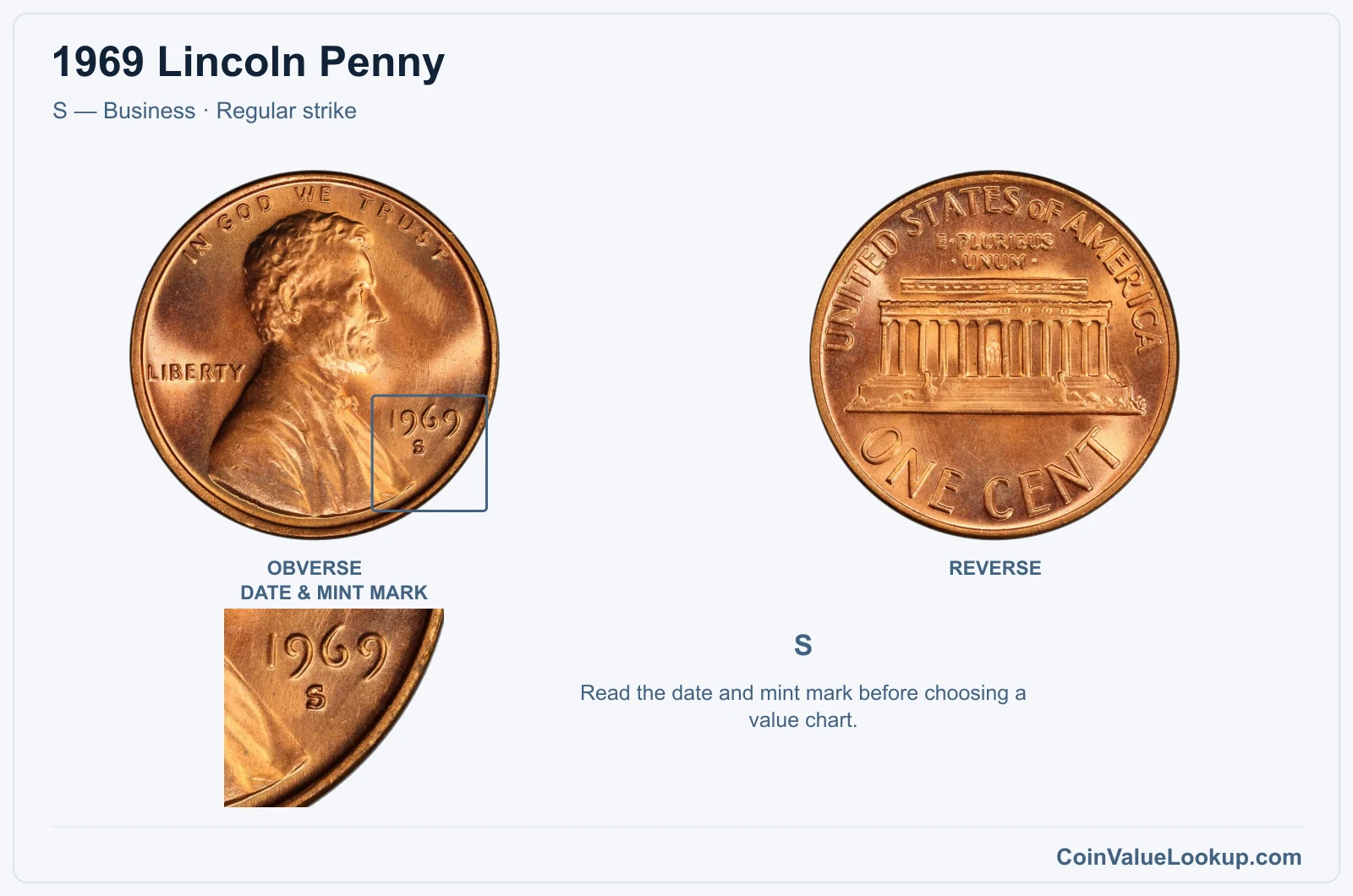
The 1969-S business strike carries a small S below the date. This is the branch that produced the famous doubled die obverse, so every S-mint cent deserves a close look at the date and lettering.
Ordinary, non-error 1969-S business strikes are not rare. A USA Coin Book guide estimate puts MS65 at roughly $1.24.
Still, because authenticated doubled die specimens exist on this exact branch, even a routine 1969-S is worth a second glance under magnification before you toss it back in the pile.
Range Grade
Price1969 S — Business (BN) Price1969 S — Business (RB) Price1969 S — Business (RD) Auction Records Appraisal PO PO 1
—
Coin Identifier FR FR 2
—
Coin Identifier AG AG 3
—
Coin Identifier G G 4
—
Coin Identifier
G 6
—
Coin Identifier VG VG 8
—
Coin Identifier
VG 10
—
Coin Identifier F F 12
—
Coin Identifier
F 15
—
Coin Identifier VF VF 20
—
Coin Identifier
VF 25
—
Coin Identifier
VF 30
—
Coin Identifier
VF 35
—
Coin Identifier XF XF 40
—
Coin Identifier
XF 45
—
Coin Identifier AU AU 50
—
Coin Identifier
AU 53
—
Coin Identifier
AU 55
—
Coin Identifier
AU 58
—
Coin Identifier MS MS 60
—
—
Coin Identifier
MS 61
—
Coin Identifier
MS 62
—
Coin Identifier
MS 63
—
Coin Identifier
MS 64
Coin Identifier
MS 65
Coin Identifier
MS 66
—
Coin Identifier
MS 67
—
—
Coin Identifier
MS 68
—
—
—
Coin Identifier
MS 69
—
—
—
—
—
MS 70
—
—
—
—
—
1969 Lincoln Penny — S — Proof
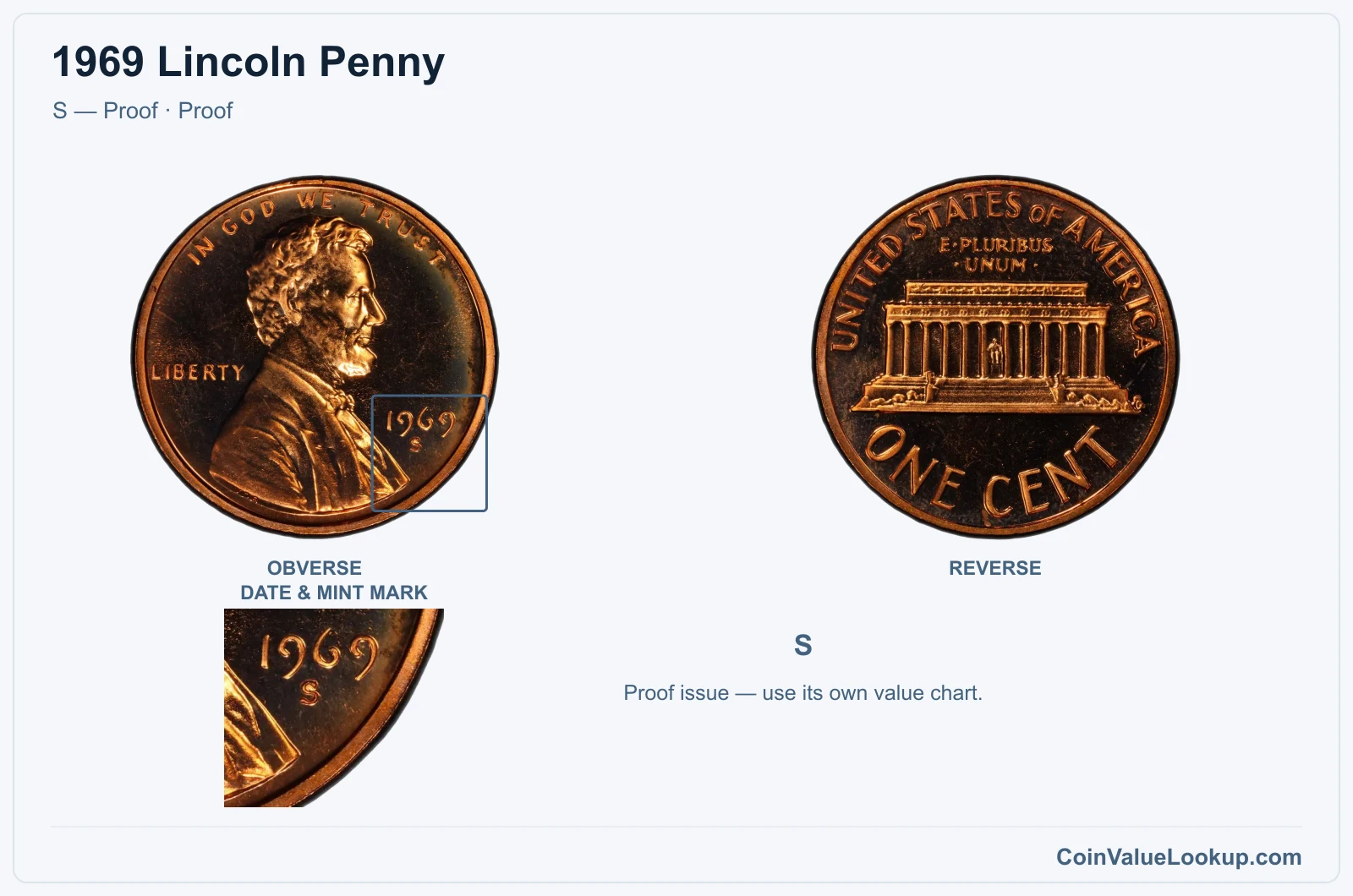
San Francisco also struck 1969-S proof cents for collector sets. These have mirror fields, sharp rims and a distinctly different surface from business strikes.
Coin Value Lookup can help you explore guides for proof and business-strike Lincoln cents side by side, so you can compare finishes and values across different years.
The USA Coin Book guide estimate for a PR65 proof is about $1.24. Surface hairlines reduce proof grades quickly, so handle these by the edges.
Cameo contrast and copper color designation are tracked separately and affect desirability.
Range Grade
Price1969 S — Proof (CAM) Price1969 S — Proof (DCAM) Auction Records Appraisal PR PR 1
—
Coin Identifier
PR 2
—
Coin Identifier
PR 3
—
Coin Identifier
PR 4
—
Coin Identifier
PR 6
—
Coin Identifier
PR 8
—
Coin Identifier
PR 10
—
Coin Identifier
PR 12
—
Coin Identifier
PR 15
—
Coin Identifier
PR 20
—
Coin Identifier
PR 25
—
Coin Identifier
PR 30
—
Coin Identifier
PR 35
—
Coin Identifier
PR 40
—
Coin Identifier
PR 45
—
Coin Identifier
PR 50
—
Coin Identifier
PR 53
—
Coin Identifier
PR 55
—
Coin Identifier
PR 58
—
Coin Identifier
PR 60
—
Coin Identifier
PR 61
—
Coin Identifier
PR 62
—
Coin Identifier
PR 63
—
Coin Identifier
PR 64
—
Coin Identifier
PR 65
Coin Identifier
PR 66
Coin Identifier
PR 67
Coin Identifier
PR 68
Coin Identifier
PR 69
Coin Identifier
PR 70
—
—
—
—
1969 Lincoln Penny — S — Major Doubled Die Obverse
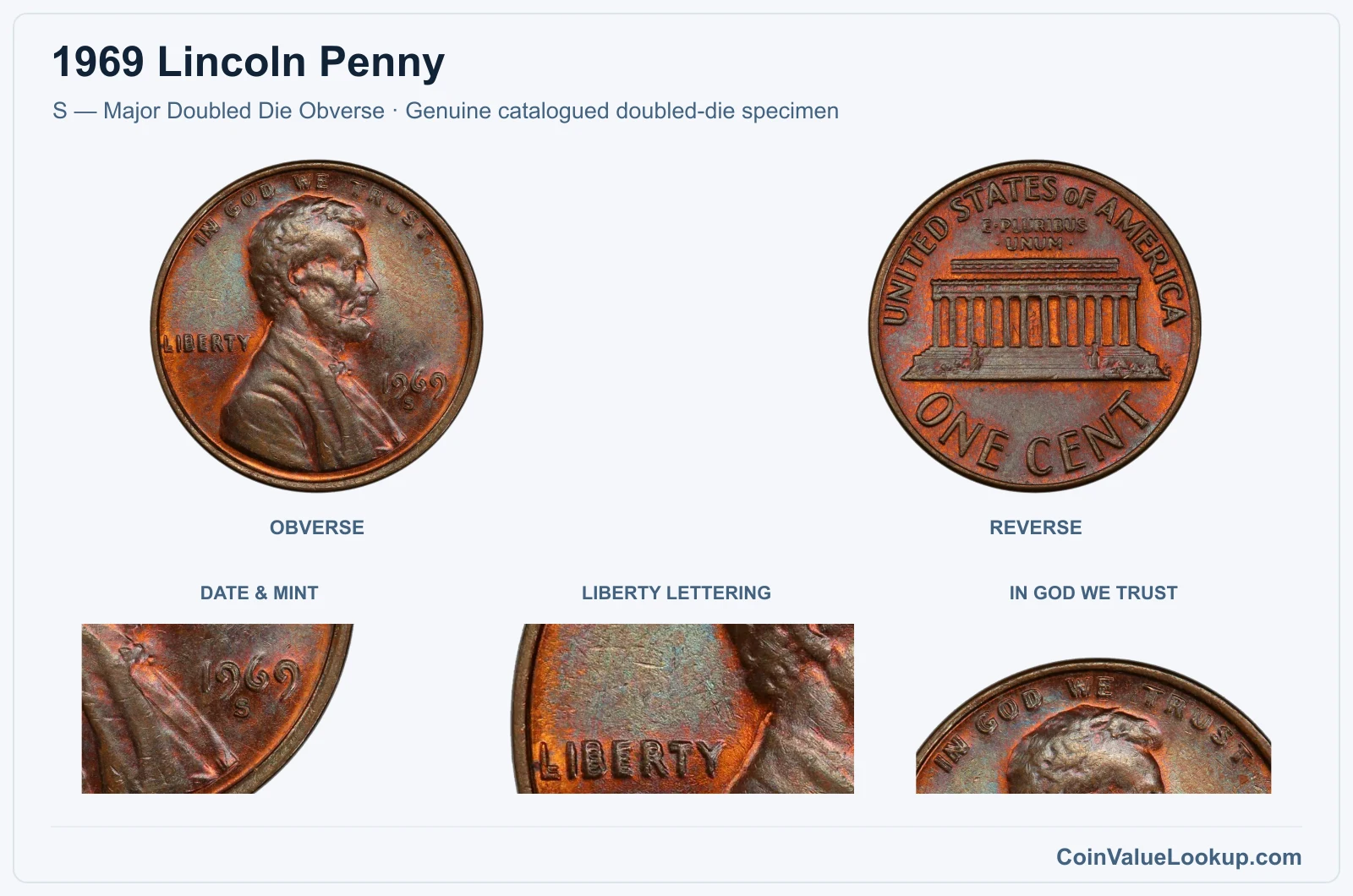
This is the one everyone is looking for. The 1969-S doubled die obverse is a major recognized variety showing strong, separated doubling on the date, LIBERTY and IN GOD WE TRUST.
It occurs only on S-mint business strikes.
To identify it, compare the date numerals and obverse letters to an attributed specimen. You should see clear, raised secondary outlines, not flat shelf-like distortion.
Machine doubling, which is common and worth nothing extra, produces a flat, shelf-like appearance rather than full raised letter forms.
No single adopted price range covers this variety. Authenticated examples are evaluated individually based on the strength of the doubling, the coin's grade and its copper-color preservation.
Professional third-party authentication is essential before assigning serious value.
Range Grade
Price1969 S — Major Doubled Die Obverse (BN) Price1969 S — Major Doubled Die Obverse (RB) Price1969 S — Major Doubled Die Obverse (RD) Auction Records Appraisal PO PO 1
—
Coin Identifier FR FR 2
—
Coin Identifier AG AG 3
—
Coin Identifier G G 4
—
Coin Identifier
G 6
—
Coin Identifier VG VG 8
—
Coin Identifier
VG 10
—
Coin Identifier F F 12
—
Coin Identifier
F 15
—
Coin Identifier VF VF 20
—
Coin Identifier
VF 25
—
Coin Identifier
VF 30
—
Coin Identifier
VF 35
—
Coin Identifier XF XF 40
—
Coin Identifier
XF 45
Coin Identifier AU AU 50
Coin Identifier
AU 53
Coin Identifier
AU 55
Coin Identifier
AU 58
Coin Identifier MS MS 60
—
Coin Identifier
MS 61
Coin Identifier
MS 62
Coin Identifier
MS 63
Coin Identifier
MS 64
—
Coin Identifier
MS 65
—
—
Coin Identifier
MS 66
—
—
—
Coin Identifier
MS 67
—
—
—
—
—
MS 68
—
—
—
—
—
MS 69
—
—
—
—
—
MS 70
—
—
—
—
—
1969 Lincoln Penny Error List
1. 1969 Lincoln Penny — Doubled Die Obverse
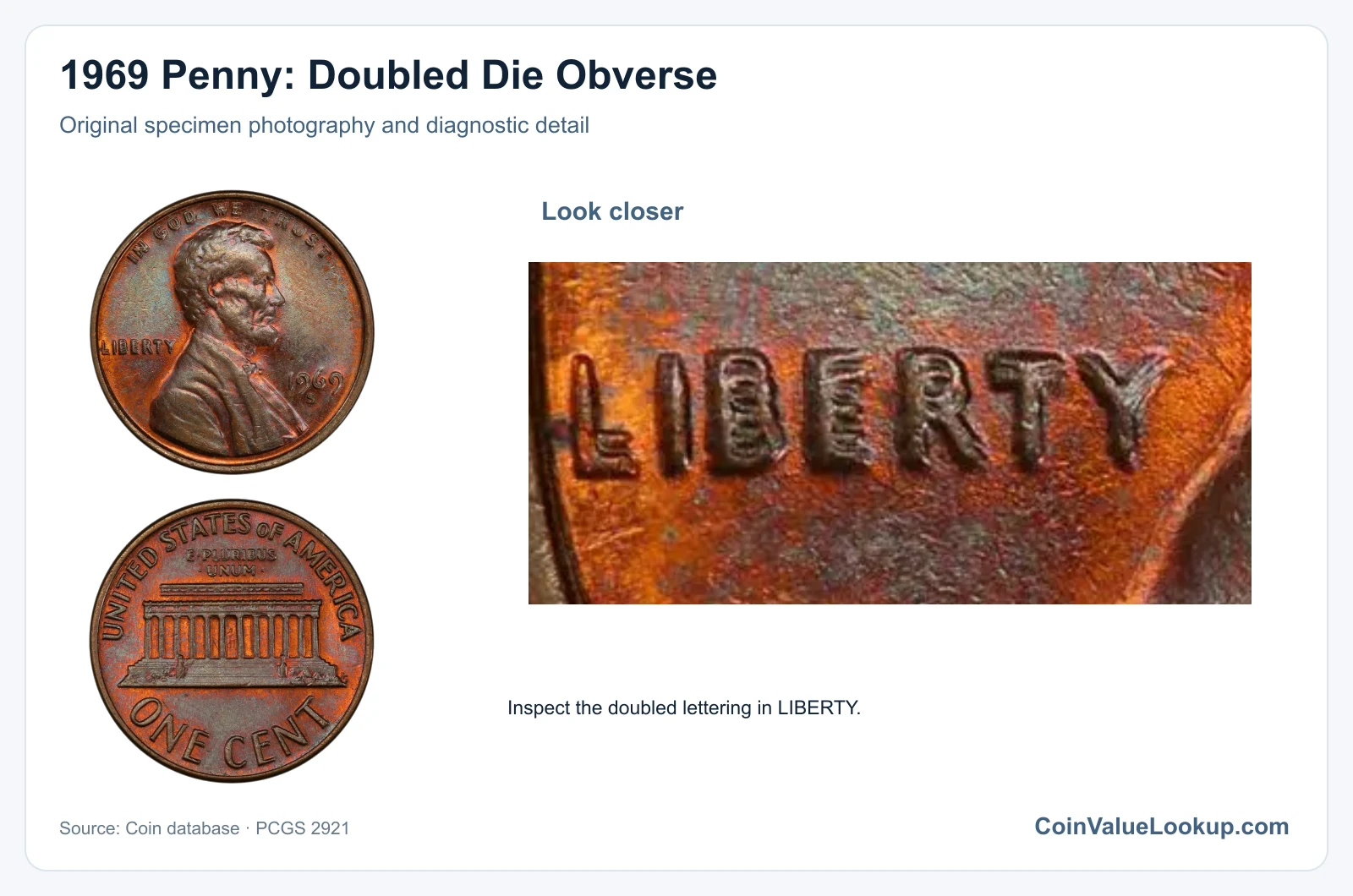
The major 1969-S doubled die obverse shows raised, clearly separated outlines on the date digits and obverse inscriptions. This applies specifically to S-mint business strikes.
Compare your coin's lettering to an attributed major specimen. Genuine doubling produces full, raised secondary letter and digit profiles.
Machine doubling, by contrast, leaves flat, shelf-like shelves that lack independent relief. A faint shadow near the mintmark alone does not establish a doubled die.
No adopted price range is available for this variety. Each coin is assessed individually based on authenticated identity, the degree of visible doubling, overall condition and copper-color preservation.
Professional authentication by a recognized third-party grading service is strongly recommended before buying or selling.
2. 1969 Lincoln Penny — Double Strike on a Foreign Blank
This combined error involves a 1969 no-mintmark cent struck twice on a foreign blank, specifically a Canadian 10-cent planchet weighing just 2.12 grams. That is dramatically lighter than the normal 3.11-gram copper cent blank.
You need two things to confirm it: the wrong planchet and two overlapping strike impressions. An ordinary plated cent or a simple doubled die will not show both characteristics.
Check the weight first, then look for two distinct sets of design elements.
An NGC MS62 example of this combined error sold for $2,760 at auction in May 2007. That is a single recorded sale, not a market range.
Any similar piece would require professional authentication of both the blank attribution and the double-strike status.
3. 1969 Lincoln Penny — Double Strike, Both Off Center
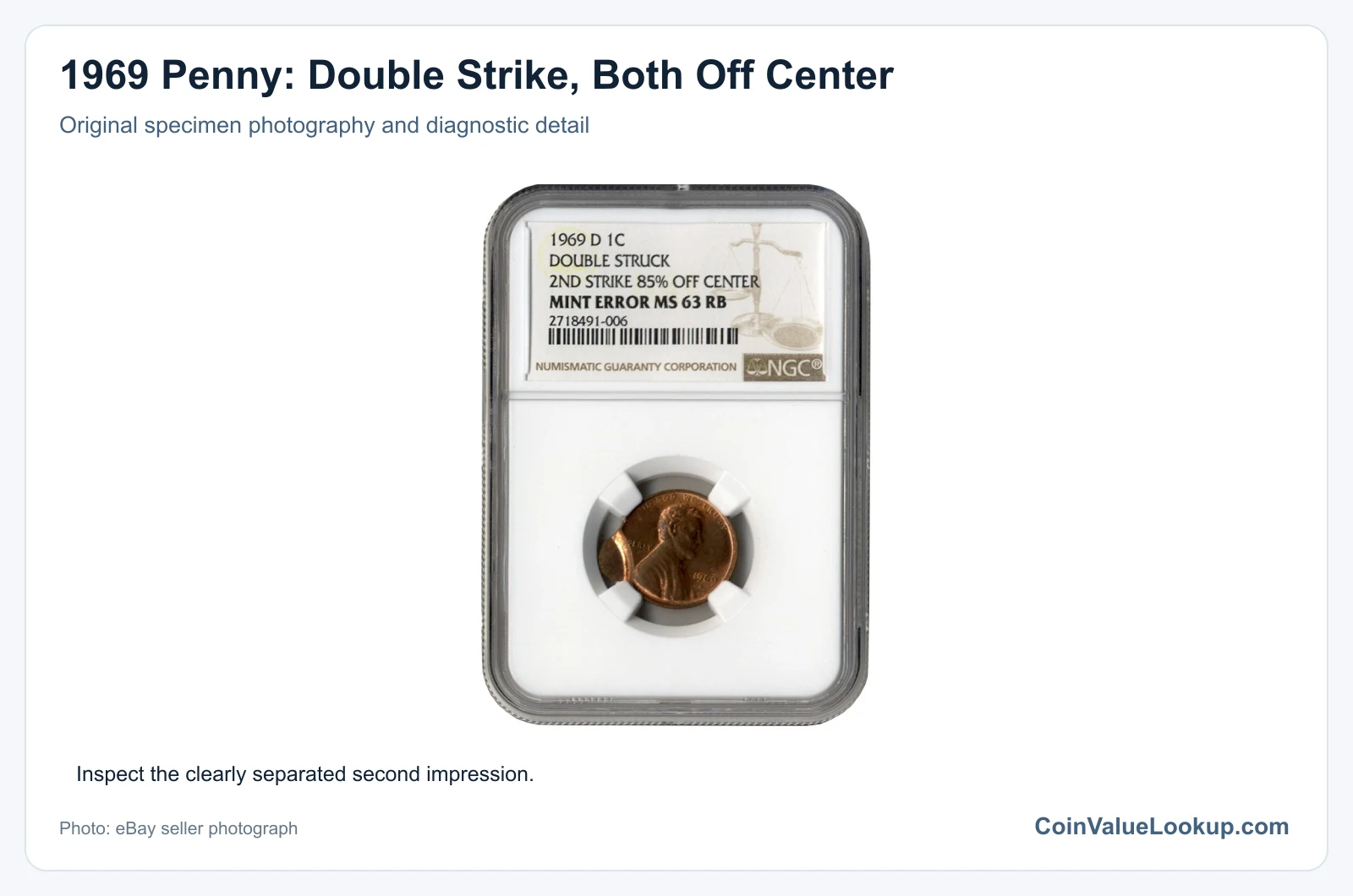
A 1969-D cent exists that was struck twice, both times severely off center, at 85% and 96% off center respectively. The result is two small, separated design impressions on a mostly blank planchet.
To confirm this error, you need visible date and D-mintmark evidence on at least one impression, plus clear boundaries showing two distinct strikes. A vise-damaged coin or an undated blank with a rim bump will not show two genuine strike impressions.
A PCGS MS62 Brown example sold for $109 in March 2025. That is one recorded sale, not a guaranteed market value.
Condition, the amount of visible design and the clarity of both impressions all affect what a given piece might bring.
4. 1969 Lincoln Penny — Off-Center Strike
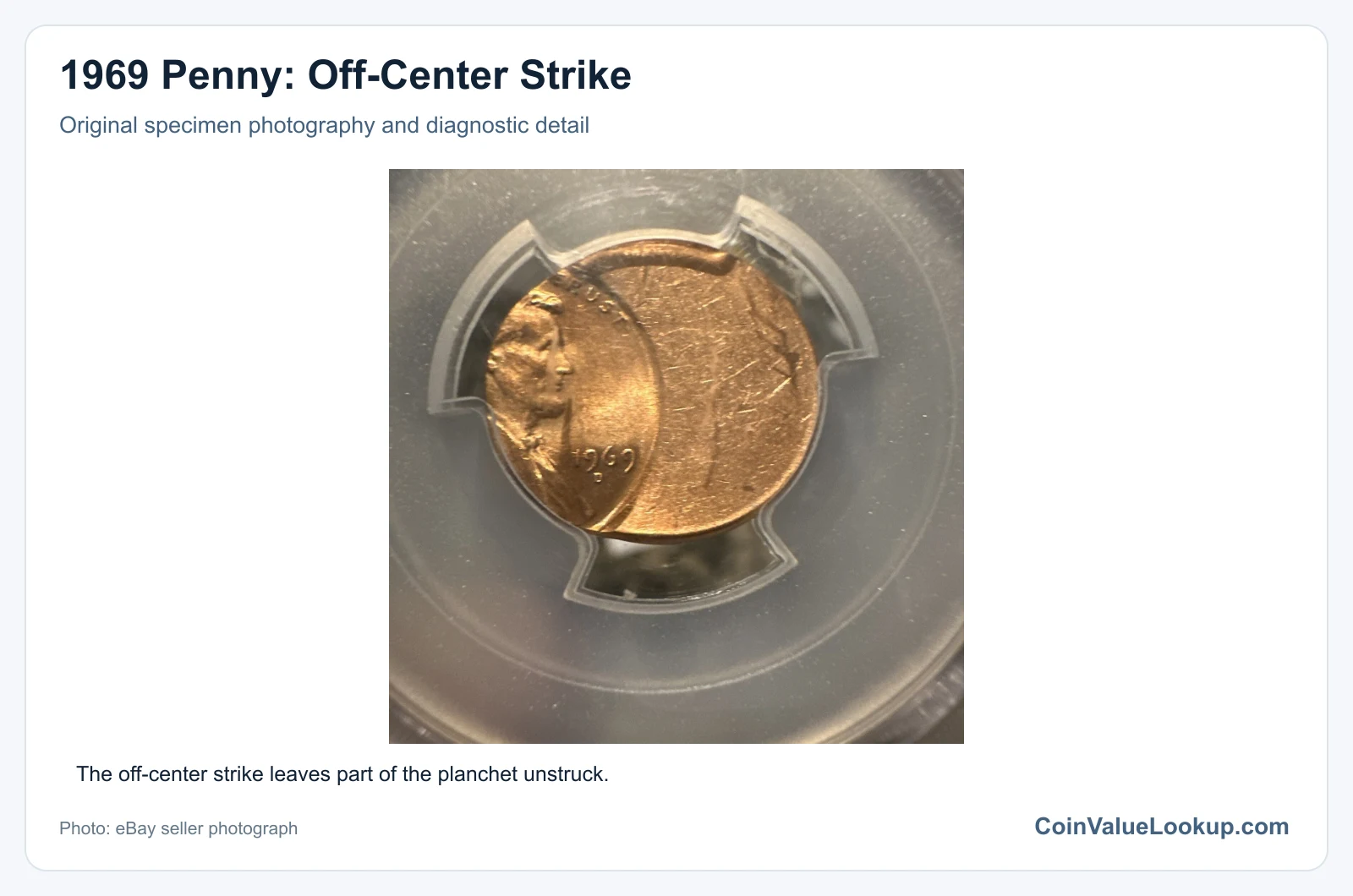
An off-center strike happens when the planchet is not seated properly in the collar during striking. The design shifts to one side, leaving an unstruck crescent of blank metal on the opposite edge.
The key diagnostic is a displaced design paired with that characteristic blank crescent. A visible date is important for attribution and typically increases desirability.
Do not confuse an off-center strike with a clipped planchet, a one-sided die misalignment or post-mint flattening, all of which can superficially mimic the look.
No specific price range is adopted for this error on 1969 cents. Value depends on the percentage of off-center shift, whether the date is readable, and overall condition.
Each piece should be evaluated individually.
5. 1969 Lincoln Penny — Lamination / Split Planchet
A lamination or split planchet error occurs when the metal separates into layers. On a 1969 cent you may see peeling copper, a retained flap or a visible split along the coin's edge.
Photograph the edge and the affected face together to document the separation. Genuine lamination shows irregular metal layers consistent with the original alloy.
Post-mint scraping, corrosion pitting or a deliberately cut coin can look similar but will show tool marks or surface patterns that differ from natural alloy separation.
No adopted price range covers this error for 1969 cents. Condition, the size and visibility of the affected area, and whether the coin is otherwise well preserved all factor into individual assessment.
6. 1969 Lincoln Penny — Clipped Planchet
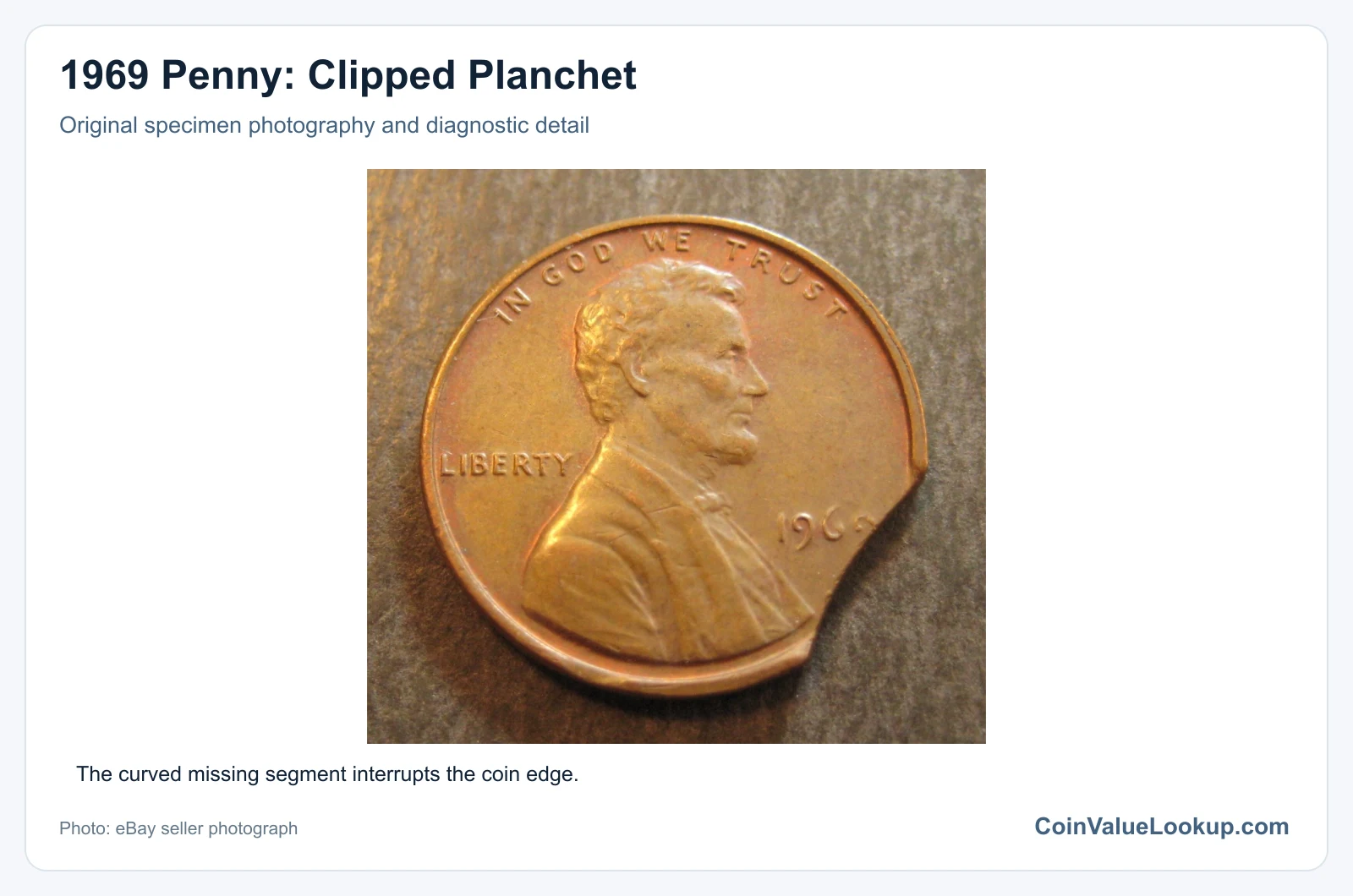
A clipped planchet error means a portion of the original blank is missing, typically a curved bite from overlapping punches at the blank-cutting stage. Straight or ragged clips also exist.
Look for a missing section with edge texture consistent with the original planchet. Metal-flow weakness on the side opposite the clip, called the Blakesley effect, can help confirm authenticity.
A filed notch, an edge cut or corrosion damage will usually show tool marks or pitting that a genuine clip does not.
No specific price range is adopted for clipped 1969 cents. The size of the clip, the coin's overall condition and the visibility of confirming diagnostics all influence how a given example is evaluated.
7. 1969 Lincoln Penny — Missing FG Initials
On the reverse of some 1969-D cents, the designer's FG initials beside the Memorial are missing or nearly invisible. This is attributed to overpolishing of the reverse die during its service life, which gradually removed the shallow initials.
Inspect the area to the right of the Memorial under even, direct light. On a genuine No FG variety, the surrounding Memorial detail remains relatively sharp while the initials are absent or ghostly.
If the entire lower reverse is mushy, you are more likely looking at ordinary wear or a grease-filled die, not a true variety.
Deliberate removal of the initials will usually leave scratches or a disturbed surface. No adopted price range is available; value depends on the clarity of the missing initials and the coin's overall condition.
8. 1969 Lincoln Penny — Brockage
A brockage occurs when a previously struck coin sticks to a die and impresses its design into the next planchet in mirror-image incuse form. For 1969, catalog sources list an off-center brockage on a D-mint cent.
Look for one normal side and one side showing a sunken, reversed mirror image of either the obverse or reverse design. The incuse impression should align consistently in one direction.
Compare carefully: a die clash leaves faint ghost lines in the fields but does not produce a deep incuse image, and two coins pressed together outside the mint will lack the uniform depth and alignment of a true brockage.
No adopted price range covers this error. Each example is evaluated individually based on how complete the brockage impression is, the coin's grade and overall eye appeal.