1939 Wheat Penny Coin Value: How Much Is It Worth?
A 1939 Wheat Penny in well-worn condition starts around $0.18 at Good-4 grade and can reach roughly $6.25 at MS63, depending on which mint struck it. Those guide figures cover the three ordinary circulation branches; proofs, recognized errors and major varieties carry separate pricing.
Original surfaces, color and the degree of wear all affect what a specific coin will bring.
Fast Way to Identify Your 1939 Wheat Penny
Snap a clear photo of both the front and back of your 1939 cent and upload them here for a preliminary identification. Good lighting at a slight angle helps show the mintmark, surface texture and any doubling.
This step can help you figure out which branch and approximate condition range your coin falls into before you dig deeper.
1939 Wheat Penny Value
Upload both sides of your 1939 Wheat Penny.
Front Obverse
Upload photo
Back Reverse
Upload photo
Which 1939 Wheat Penny Versions Are Worth Money?
- The 1939-D (Denver) branch carries the highest listed circulation guide values, reaching about $6.25 at MS63 versus lower figures for Philadelphia and San Francisco.
- Philadelphia brilliant proofs from 1939 are a distinct collector finish, with a guide value near $69 at PR63 — well above any circulation branch at comparable quality.
- Recognized error categories such as doubled die obverse, repunched mintmark, off-center strikes and clipped planchets can add value when authenticated, though pricing depends on the individual coin.
Step 1: Identify Your 1939 Wheat Penny Mint Mark and Version
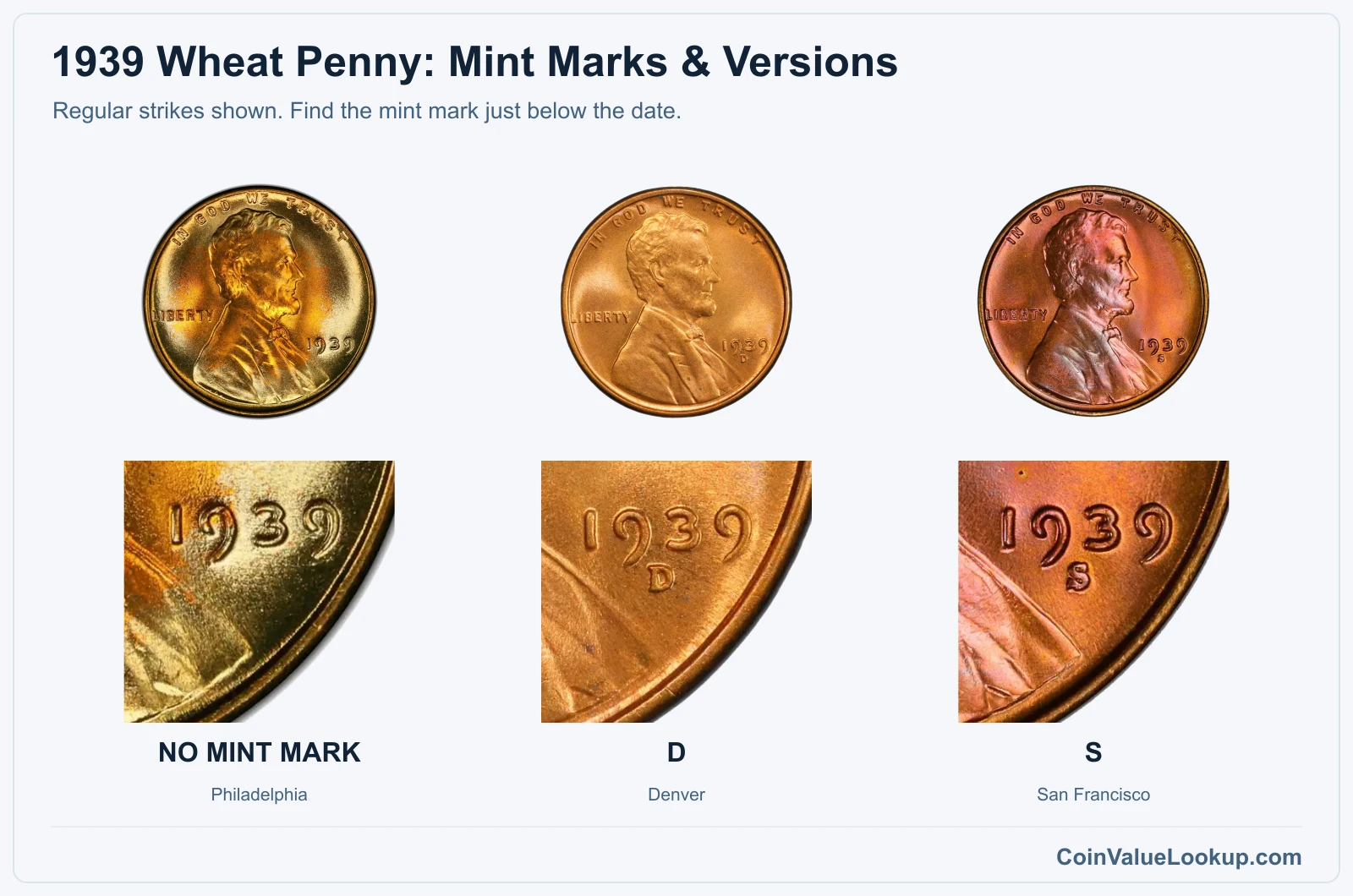
Flip your coin to the reverse first and confirm the two wheat ears flanking ONE CENT — that is the Wheat reverse design used on Lincoln cents through 1958. The coin is struck in a 95% copper alloy with 5% tin and zinc, weighs about 3.11 grams and has a plain (smooth) edge.
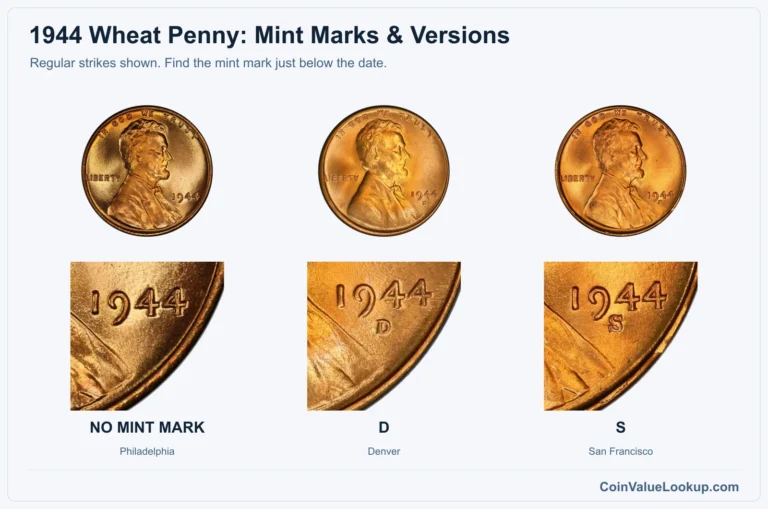
Now look below the date on the obverse. No letter means Philadelphia.
A small "D" means Denver, and a small "S" means San Francisco. All three mints produced circulation strikes in 1939.
Philadelphia also struck brilliant proof cents for collectors that year. Proofs have sharply mirrored fields and razor-sharp design edges — a polished or well-preserved circulation coin is not a proof, no matter how shiny it looks.
Color designations like red, red-brown and brown describe the surface toning, not the manufacturing method.
Step 2: Check Your 1939 Wheat Penny Grade
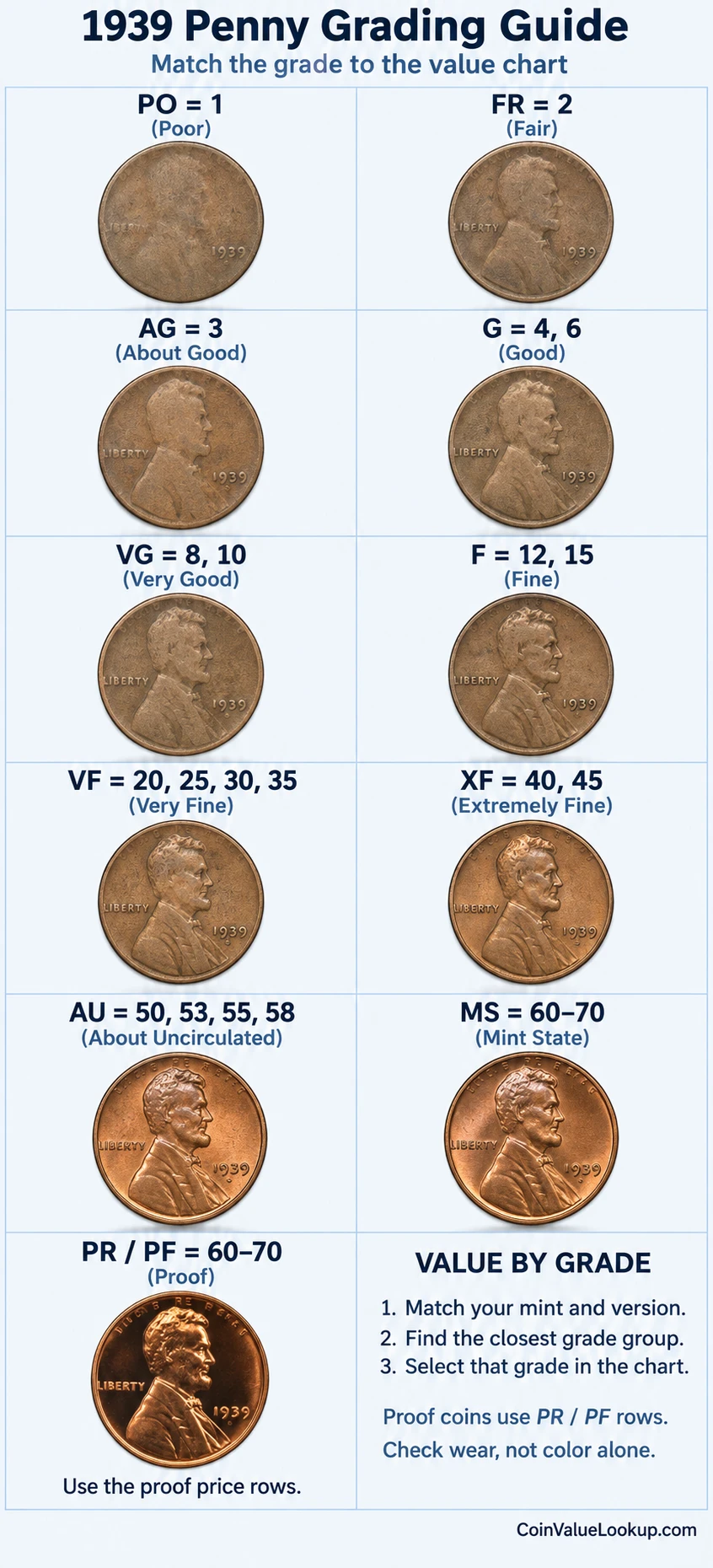
Start with Lincoln's cheekbone and jawline on the obverse — these are the highest points and the first to show friction. In lower grades the cheek flattens into the field and jaw detail disappears.
Move to the hair above the ear; individual strands should be distinct on a higher-grade coin.
On the reverse, check the wheat stalks for complete parallel lines and sharp grain tips. A coin grading around Good-4 will have a very smooth portrait with the outline still clear, while an MS63 example retains full original luster with only minor contact marks.
Use the comparison image to match your coin's wear pattern. A weak original strike can leave soft detail that mimics wear, so look for luster breaks on the high points as your best clue.
Cleaning, spots and corrosion are separate condition factors that reduce a coin's appeal regardless of the technical wear grade.
Step 3: Check 1939 Wheat Penny Value by Mint and Version
1939 Wheat Penny
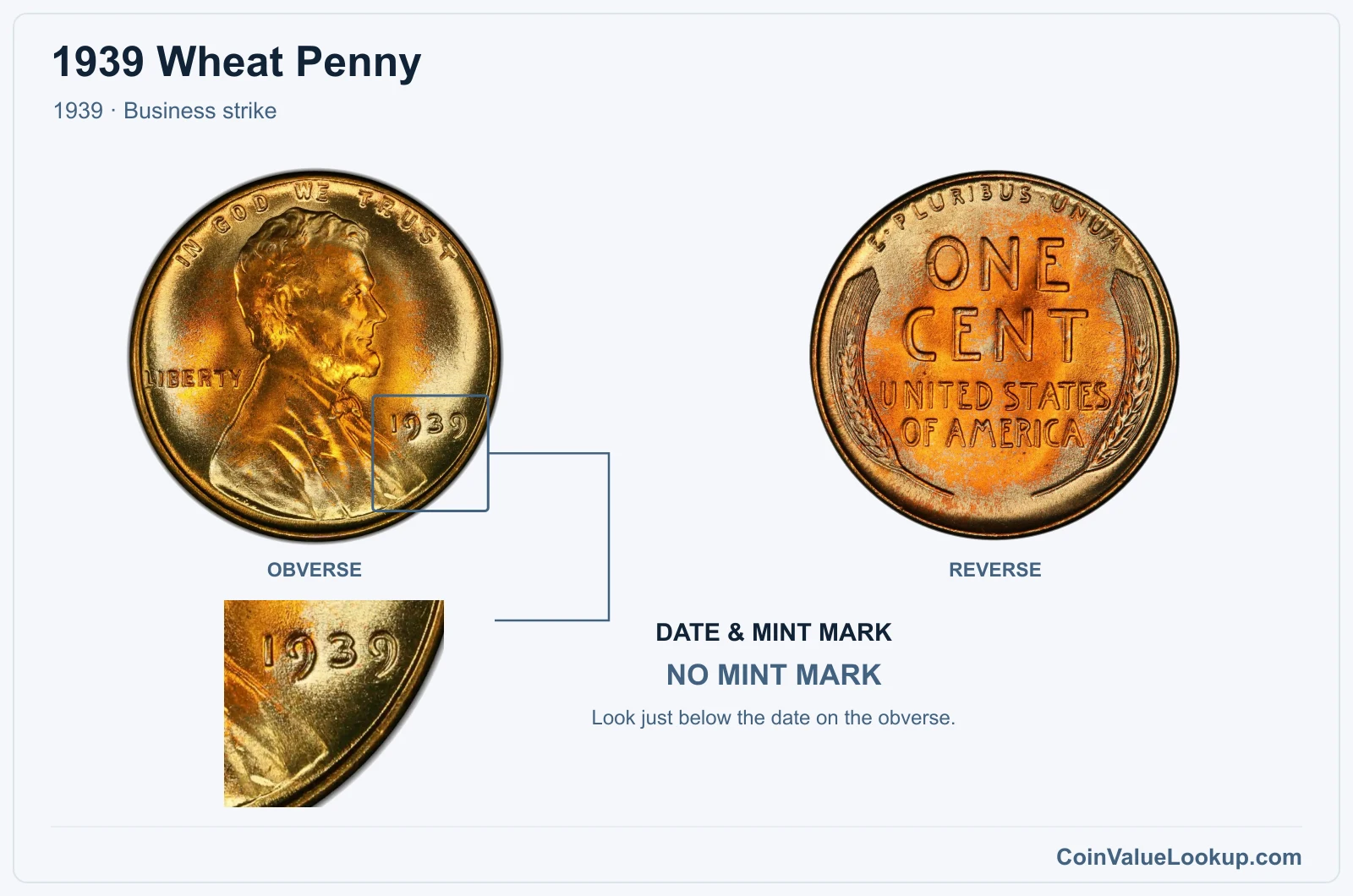
The 1939 Philadelphia cent has no mintmark below the date. In circulated condition a guide estimate places it around $0.18 at Good-4, climbing to roughly $3.62 at MS63.
That makes it one of the more affordable entries in the late-1930s Wheat cent run.
Because the guide does not specify a color designation, do not assume the MS63 figure represents a certified red example. A coin with full original copper-red color would typically bring more than one toned to brown, even at the same technical grade.
| Range | Grade | Price | Auction Records | Appraisal |
|---|---|---|---|---|
| PO | PO 1 | — | Coin Identifier | |
| FR | FR 2 | — | Coin Identifier | |
| AG | AG 3 | — | Coin Identifier | |
| G | G 4 | — | Coin Identifier | |
| G 6 | — | Coin Identifier | ||
| VG | VG 8 | — | Coin Identifier | |
| VG 10 | — | Coin Identifier | ||
| F | F 12 | — | Coin Identifier | |
| F 15 | — | Coin Identifier | ||
| VF | VF 20 | — | Coin Identifier | |
| VF 25 | — | Coin Identifier | ||
| VF 30 | — | Coin Identifier | ||
| VF 35 | — | Coin Identifier | ||
| XF | XF 40 | — | Coin Identifier | |
| XF 45 | — | Coin Identifier | ||
| AU | AU 50 | — | Coin Identifier | |
| AU 53 | — | Coin Identifier | ||
| AU 55 | — | Coin Identifier | ||
| AU 58 | — | Coin Identifier | ||
| MS | MS 60 | — | Coin Identifier | |
| MS 61 | — | Coin Identifier | ||
| MS 62 | — | Coin Identifier | ||
| MS 63 | — | Coin Identifier | ||
| MS 64 | Coin Identifier | |||
| MS 65 | Coin Identifier | |||
| MS 66 | Coin Identifier | |||
| MS 67 | Coin Identifier | |||
| MS 68 | Coin Identifier | |||
| MS 69 | — | — | — | |
| MS 70 | — | — | — |
1939 Wheat Penny — D
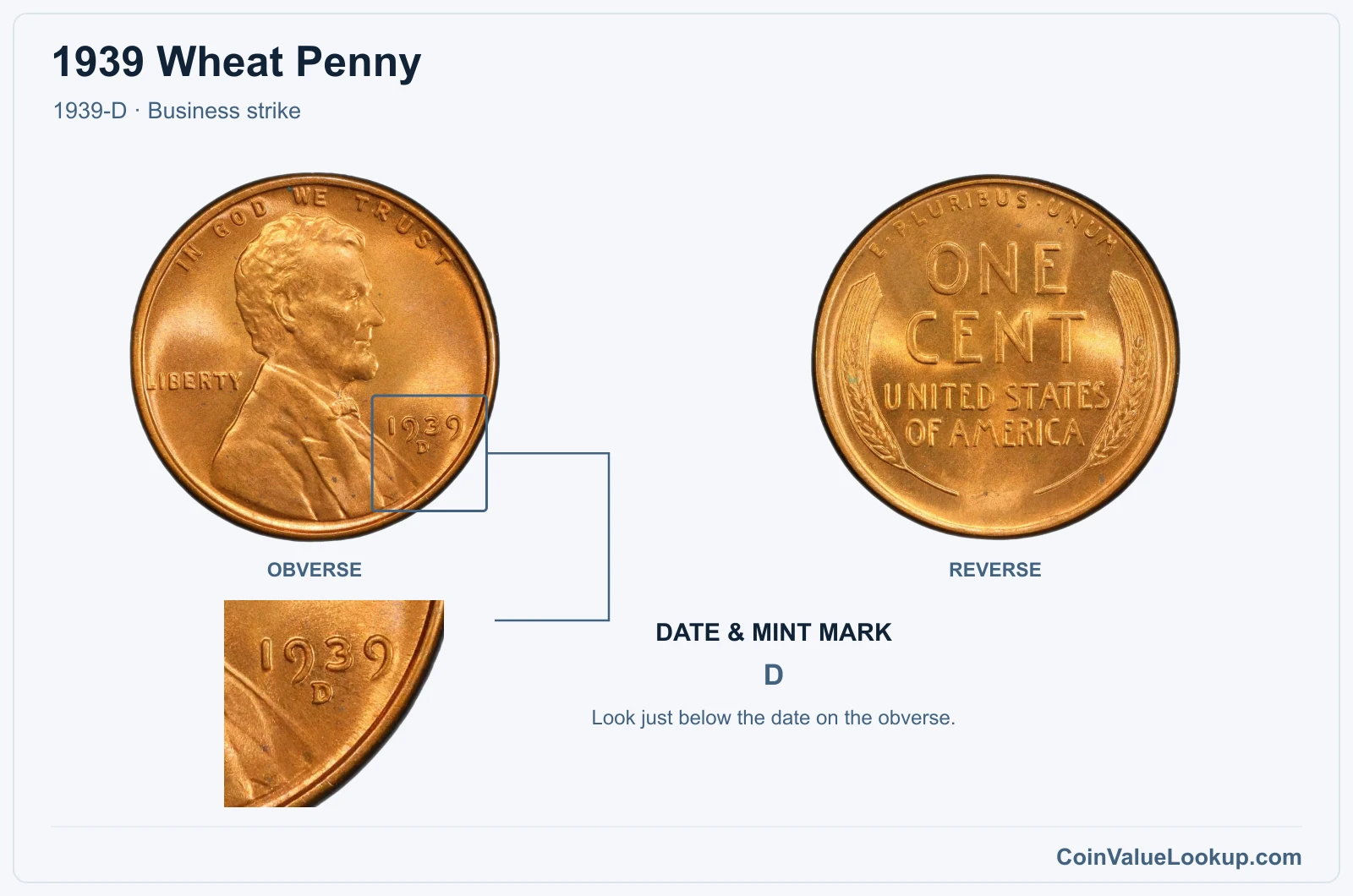
Look for the small "D" mintmark below the date. The 1939-D carries a guide estimate of about $0.61 at Good-4 and roughly $6.25 at MS63, the highest circulation-strike figures among the three 1939 mints.
Denver cents of this era sometimes come with softer strikes, so check the hair detail and wheat lines carefully before attributing softness to wear. As with the Philadelphia issue, the guide price does not distinguish color, so a strong original red surface could command more than the listed figure suggests.
Coin Value Lookup is a good starting point if you want to look up guide values for other dates and mints in the Wheat cent series. It can save you time when you are sorting through a batch of old pennies.
| Range | Grade | Price | Auction Records | Appraisal |
|---|---|---|---|---|
| PO | PO 1 | — | Coin Identifier | |
| FR | FR 2 | — | Coin Identifier | |
| AG | AG 3 | — | Coin Identifier | |
| G | G 4 | — | Coin Identifier | |
| G 6 | — | Coin Identifier | ||
| VG | VG 8 | — | Coin Identifier | |
| VG 10 | — | Coin Identifier | ||
| F | F 12 | — | Coin Identifier | |
| F 15 | — | Coin Identifier | ||
| VF | VF 20 | — | Coin Identifier | |
| VF 25 | — | Coin Identifier | ||
| VF 30 | — | Coin Identifier | ||
| VF 35 | — | Coin Identifier | ||
| XF | XF 40 | — | Coin Identifier | |
| XF 45 | — | Coin Identifier | ||
| AU | AU 50 | — | Coin Identifier | |
| AU 53 | — | Coin Identifier | ||
| AU 55 | — | Coin Identifier | ||
| AU 58 | — | Coin Identifier | ||
| MS | MS 60 | — | Coin Identifier | |
| MS 61 | — | Coin Identifier | ||
| MS 62 | — | Coin Identifier | ||
| MS 63 | Coin Identifier | |||
| MS 64 | Coin Identifier | |||
| MS 65 | Coin Identifier | |||
| MS 66 | Coin Identifier | |||
| MS 67 | Coin Identifier | |||
| MS 68 | Coin Identifier | |||
| MS 69 | — | — | — | |
| MS 70 | — | — | — |
1939 Wheat Penny — S
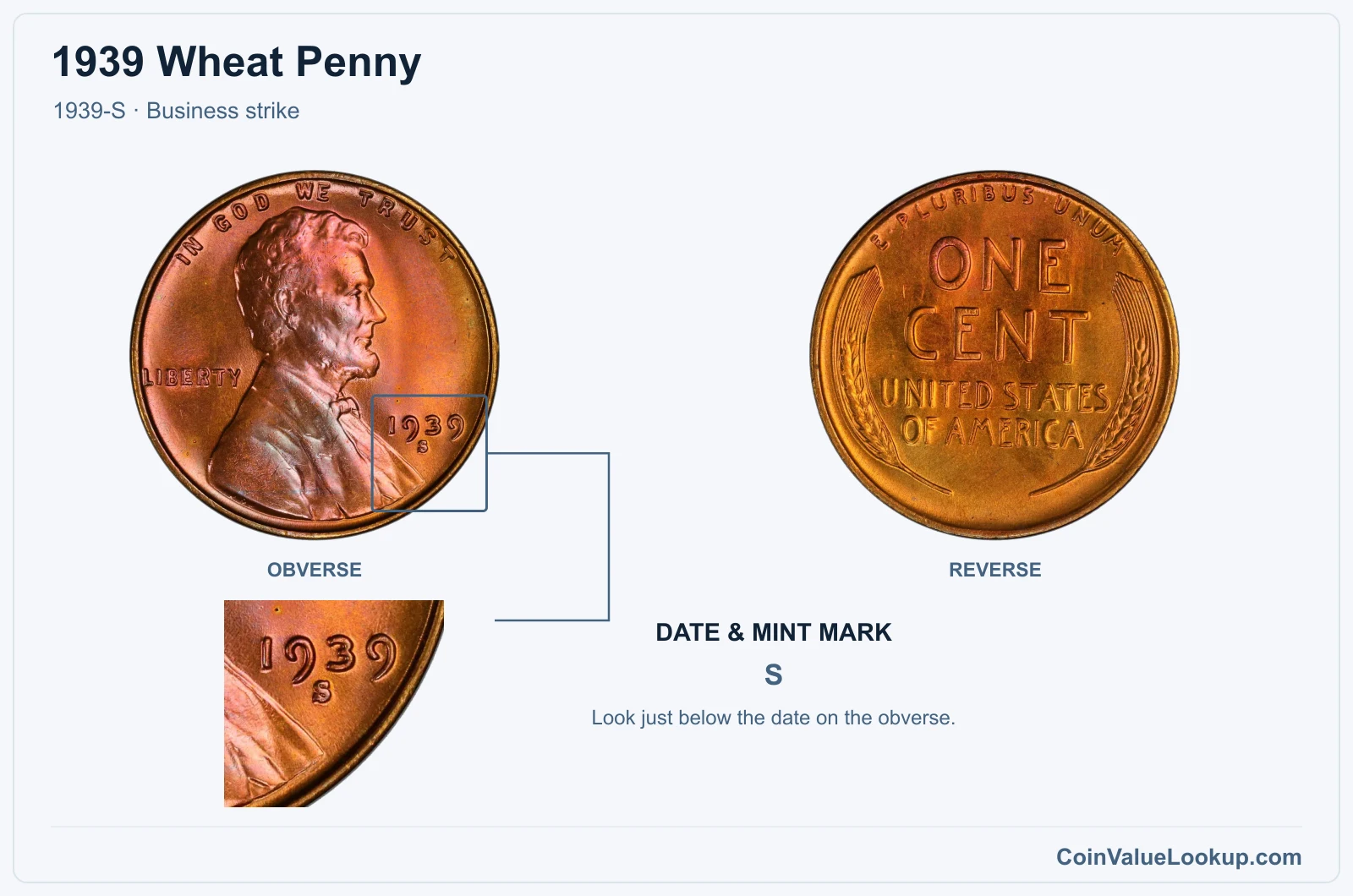
The 1939-S carries a small "S" mintmark below the date. Guide estimates put it at about $0.18 in Good-4 and around $4.96 at MS63, sitting between the Philadelphia and Denver branches in uncirculated value.
San Francisco cents from 1939 are common in lower grades but a bit harder to find with strong luster and clean surfaces at the Mint State level. Match your coin's mint, grade and surface quality carefully before applying any published figure.
| Range | Grade | Price | Auction Records | Appraisal |
|---|---|---|---|---|
| PO | PO 1 | — | Coin Identifier | |
| FR | FR 2 | — | Coin Identifier | |
| AG | AG 3 | — | Coin Identifier | |
| G | G 4 | — | Coin Identifier | |
| G 6 | — | Coin Identifier | ||
| VG | VG 8 | — | Coin Identifier | |
| VG 10 | — | Coin Identifier | ||
| F | F 12 | — | Coin Identifier | |
| F 15 | — | Coin Identifier | ||
| VF | VF 20 | — | Coin Identifier | |
| VF 25 | — | Coin Identifier | ||
| VF 30 | — | Coin Identifier | ||
| VF 35 | — | Coin Identifier | ||
| XF | XF 40 | — | Coin Identifier | |
| XF 45 | — | Coin Identifier | ||
| AU | AU 50 | — | Coin Identifier | |
| AU 53 | — | Coin Identifier | ||
| AU 55 | — | Coin Identifier | ||
| AU 58 | — | Coin Identifier | ||
| MS | MS 60 | — | Coin Identifier | |
| MS 61 | — | Coin Identifier | ||
| MS 62 | — | Coin Identifier | ||
| MS 63 | Coin Identifier | |||
| MS 64 | Coin Identifier | |||
| MS 65 | Coin Identifier | |||
| MS 66 | Coin Identifier | |||
| MS 67 | — | Coin Identifier | ||
| MS 68 | — | — | — | |
| MS 69 | — | — | — | |
| MS 70 | — | — | — |
1939 Wheat Penny — PR
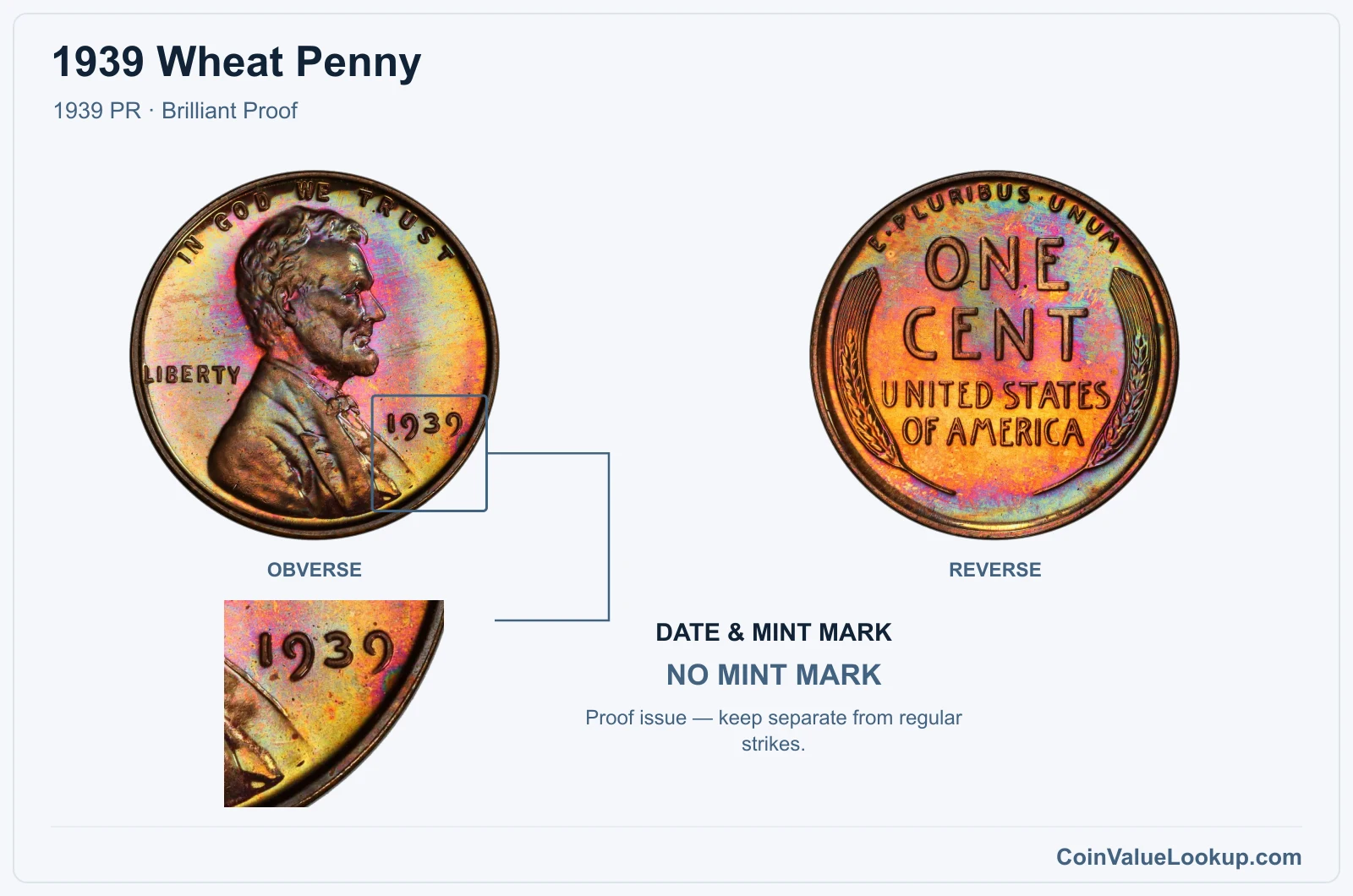
Philadelphia also produced brilliant proof cents in 1939 for direct sale to collectors. These coins show deeply mirrored fields and exceptionally sharp design edges — every strand of Lincoln's hair should be distinct.
A guide estimate places the 1939 proof at about $69 in PR63.
Proof is a method of manufacture, not a grade above Mint State. The 1939 issue falls in the brilliant proof era that followed the earlier 1936 satin-finish proofs.
Contrast designations like cameo or deep cameo describe the degree of frost on the devices against the mirrored field; they are not errors.
If your coin simply looks shiny, compare it side-by-side with a known proof image. A polished or lightly circulated business strike will not have the same square-edged detail or mirror depth, no matter how carefully it was stored.
| Range | Grade | Price | Auction Records | Appraisal |
|---|---|---|---|---|
| PR | PR 1 | — | Coin Identifier | |
| PR 2 | — | Coin Identifier | ||
| PR 3 | — | Coin Identifier | ||
| PR 4 | — | Coin Identifier | ||
| PR 6 | — | Coin Identifier | ||
| PR 8 | — | Coin Identifier | ||
| PR 10 | — | Coin Identifier | ||
| PR 12 | — | Coin Identifier | ||
| PR 15 | — | Coin Identifier | ||
| PR 20 | — | Coin Identifier | ||
| PR 25 | — | Coin Identifier | ||
| PR 30 | — | Coin Identifier | ||
| PR 35 | — | Coin Identifier | ||
| PR 40 | — | Coin Identifier | ||
| PR 45 | — | Coin Identifier | ||
| PR 50 | — | Coin Identifier | ||
| PR 53 | — | Coin Identifier | ||
| PR 55 | — | Coin Identifier | ||
| PR 58 | — | Coin Identifier | ||
| PR 60 | — | Coin Identifier | ||
| PR 61 | — | Coin Identifier | ||
| PR 62 | — | Coin Identifier | ||
| PR 63 | — | Coin Identifier | ||
| PR 64 | — | Coin Identifier | ||
| PR 65 | Coin Identifier | |||
| PR 66 | — | — | — | |
| PR 67 | — | — | — | |
| PR 68 | — | — | — | |
| PR 69 | — | — | — | |
| PR 70 | — | — | — |
1939 Wheat Penny Error List
1. 1939 Wheat Penny — Doubled Die Obverse
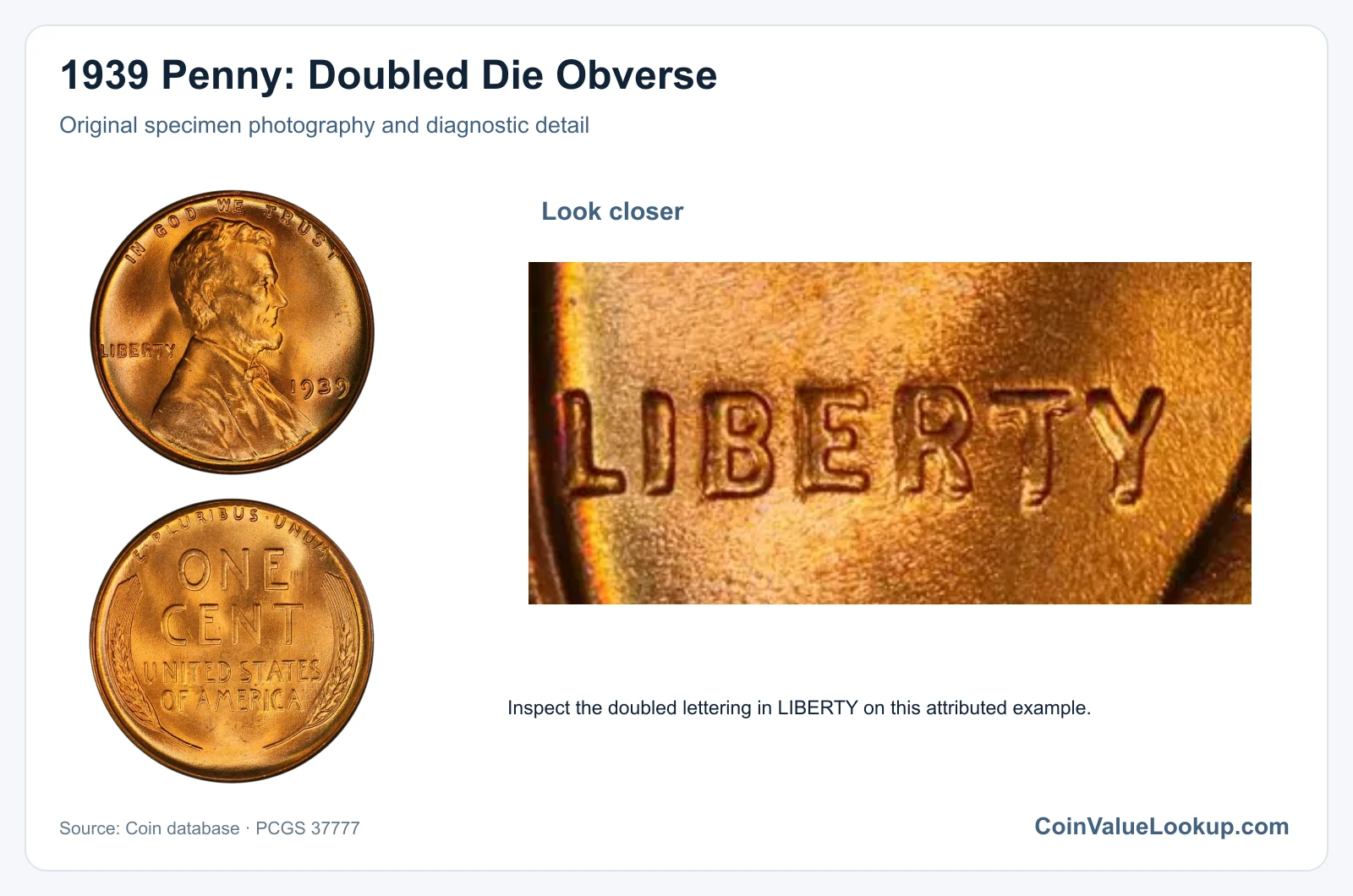
A doubled die obverse on a 1939 Wheat cent shows consistent doubling on obverse lettering or design elements — look for separation, notching or a shelf-like secondary image on letters such as LIBERTY or IN GOD WE TRUST. The doubling should repeat the same way on every affected letter, which distinguishes it from random machine doubling that tends to produce flat, shelf-like distortion without the sharp secondary image.
Compare your coin to a normal 1939 cent under the same lighting and magnification. Reflections and worn die contours can mimic doubling to the untrained eye.
No specific price range is supported for this variety; value depends on the authenticated identity of the die, the severity of the doubling and the coin's overall condition. Professional authentication is the safest path if you suspect a genuine doubled die.
2. 1939 Wheat Penny — BIE Die Break
A BIE die break shows up as a small raised bump or vertical bridge between the letters B and E in LIBERTY. It is caused by a crack or chip in the die that fills with metal during striking, creating a blob that can look like a capital I wedged between the two letters.
Inspect the area closely under magnification. The raised material should have the same surface texture as the surrounding design, not the look of something stuck on top.
Dirt, scratches and glue residue can mimic a die break, so clean lighting is important. A genuine BIE will also often show a faint crack line extending from the blob into the surrounding field or rim.
No specific price range is adopted for this error on the 1939 cent. Value depends on the clarity of the break, the coin's grade and overall eye appeal, assessed individually.
3. 1939 Wheat Penny — Off-Center Strike
An off-center strike happens when the planchet is not properly seated between the dies, producing a coin with a displaced design and a blank crescent where no impression was made. The most collectible examples retain a full, readable date — without the date, identification and value drop sharply.
Look at the blank area: it should be smooth, unstruck metal with a natural edge, not a flat spot caused by post-mint damage. A clipped planchet, one-sided die misalignment or something smashed after leaving the mint can look similar at first glance, so examine both sides carefully.
No supported price range exists for a 1939 off-center cent in the current data. Value varies widely based on the percentage of off-center shift, date visibility, mint and the coin's condition.
Professional grading services can encapsulate and label the error, which helps with resale.
4. 1939 Wheat Penny — Repunched Mintmark
A repunched mintmark occurs when the mintmark punch was applied more than once in slightly different positions, leaving traces of an earlier impression near the final letter. This error applies only to the 1939-D and 1939-S branches — Philadelphia coins carry no mintmark, so no repunched mintmark is possible there.
Under magnification, look for a secondary outline, notch or remnant of a D or S at a different angle or position from the primary mark. Compare to a normal mintmark at the same magnification; the difference is usually subtle but consistent.
Machine doubling on the mintmark, small die chips and corrosion around the letter can all create lookalike effects. No specific price range is adopted for this variety.
Each coin's value depends on the clarity of the repunching, the specific die identified and the overall grade.
5. 1939 Wheat Penny — Clipped Planchet
A clipped planchet error means the blank was incompletely punched from the copper strip before striking, leaving a missing curved, straight or irregular section along the edge. The missing area will have a natural metal-flow texture, and you may notice design weakness on the opposite side of the coin — metal could not flow fully into the die at that point.
Check the edge carefully. A genuine clip shows a smooth or slightly fibrous break consistent with the original blanking process, not the sharp, filed look of post-mint damage.
Corrosion eating into an edge or a deliberate notch cut after striking can fool you if you are not comparing the edge texture under magnification.
No supported price range is available for a 1939 clipped planchet cent. Value depends on the size and type of clip, whether the date remains fully visible and the coin's overall condition.
Authentication helps confirm the error originated at the mint.