2000 Lincoln Penny Coin Value: How Much Is It Worth?
Most 2000 Lincoln pennies you pull from a jar are worth face value — one cent. In uncirculated condition around MS65, a guide estimate puts the Philadelphia or Denver issue at roughly $0.36, while a San Francisco proof at PR65 runs about $4.96 according to USA Coin Book.
Special varieties like the Wide AM reverse and authenticated Cheerios promotional cents occupy their own pricing tier, and error coins are assessed individually. These are grade-specific retail estimates, not guaranteed offers.
Fast Way to Identify Your 2000 Lincoln Penny
Snap clear photos of the front and back of your 2000 penny and upload them here for a preliminary identification. Good lighting at a slight angle helps capture surface detail and any mint mark below the date.
This step can help sort your coin into the right branch — Philadelphia, Denver, S proof, or a potential variety — before you dig deeper into condition and value.
2000 Penny Value
Upload both sides of your 2000 Lincoln Penny.
Front Obverse
Upload photo
Back Reverse
Upload photo
Which 2000 Lincoln Penny Versions Are Worth Money?
- A Philadelphia business strike with Wide AM reverse spacing can reach around $25 at MS65, far above a normal Close AM cent at the same grade.
- San Francisco proofs carry a guide value near $4.96 at PR65; cameo and deep-cameo designations are graded separately and can add premium.
- Cheerios promotional cents require original packaging or recognized provenance — a loose 2000 penny cannot claim this attribution on its own.
- Error coins such as doubled dies, off-center strikes, and unplated planchets are valued individually based on authenticated identity and condition.
Step 1: Identify Your 2000 Lincoln Penny Mint Mark and Version
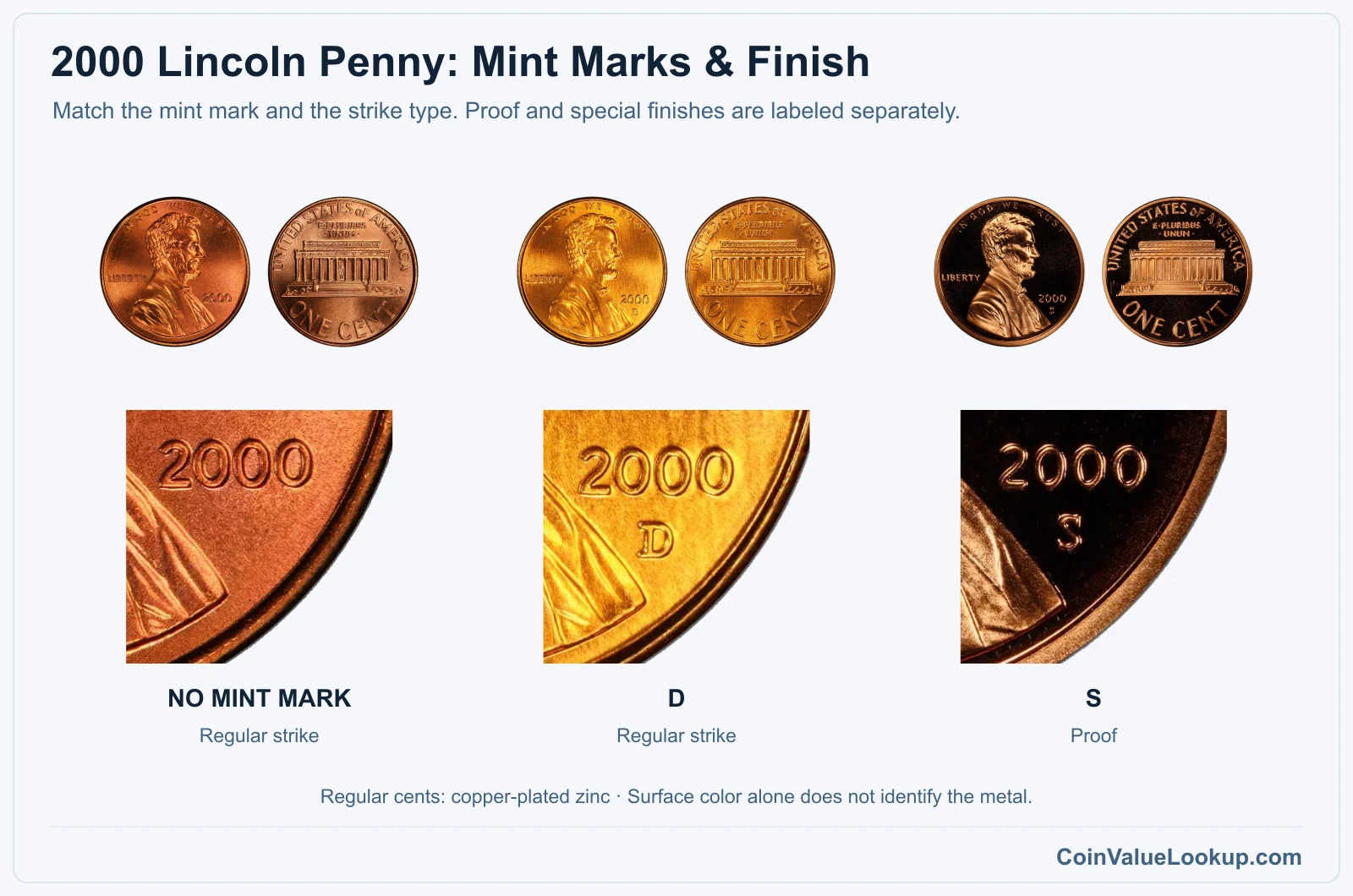
Start by looking just below the date on the obverse. No letter means Philadelphia.
A small "D" means Denver. An "S" indicates a San Francisco proof, which will have mirrored fields and sharp, frosted devices — it was made for collectors, not pocket change.
All regular 2000 cents are copper-plated zinc, weighing about 2.50 grams with a plain edge and 19.05 mm diameter. The reverse is the Lincoln Memorial design used from 1959 through 2008.
Color alone — whether it looks copper, gray, or something else — cannot prove a different alloy.
For the important AM varieties, flip the coin over and look at the word AMERICA along the bottom of the Memorial reverse. On a normal 2000 business strike the A and M are close together (Close AM).
On a normal 2000-S proof, the A and M are spaced apart (Wide AM). If you find a Philadelphia business strike where A and M are clearly separated, that is the scarcer Wide AM variety worth investigating further.
Step 2: Check Your 2000 Lincoln Penny Grade
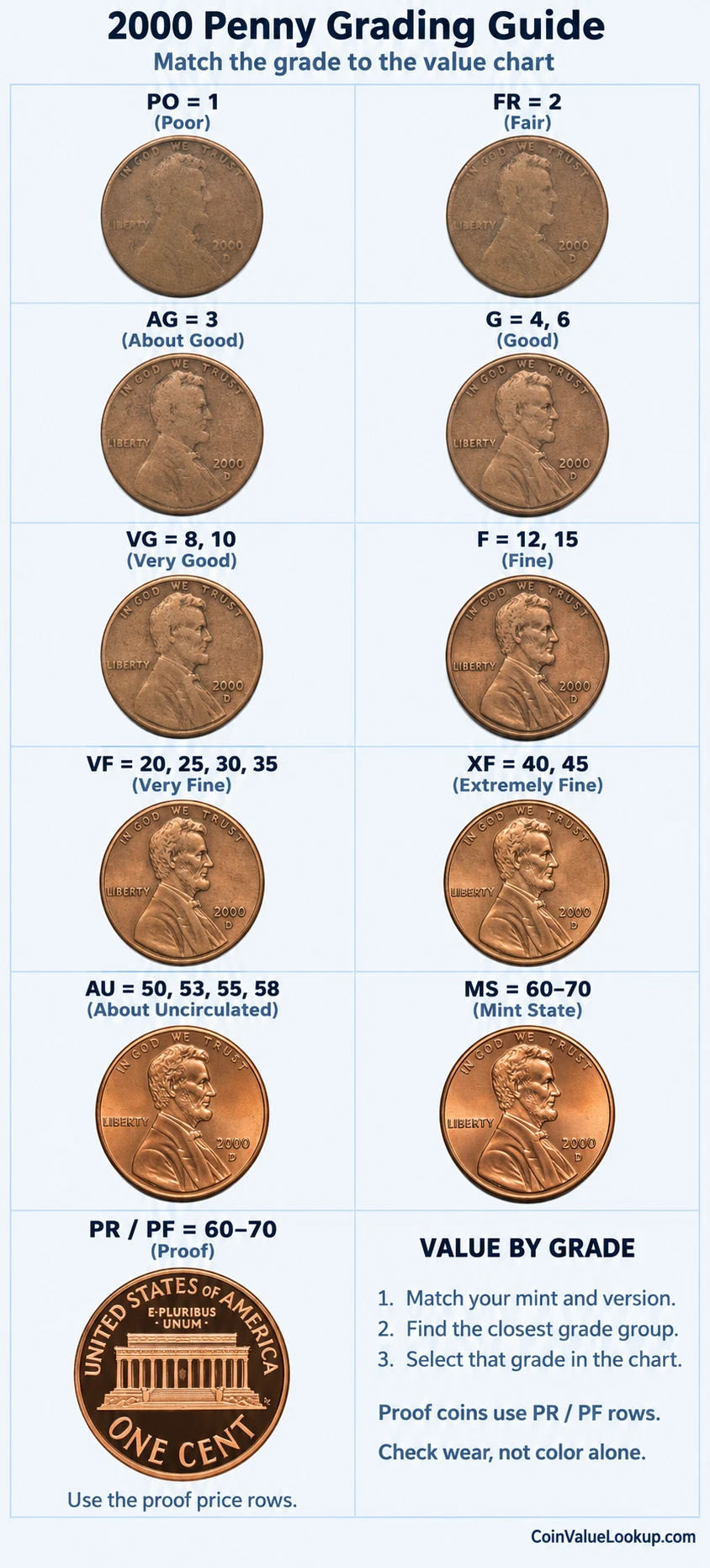
Focus first on Lincoln's cheekbone, jawline, and the hair detail above his ear — these are the highest points and the first places to show wear. Then flip the coin and check the columns and horizontal lines of the Memorial.
A coin with full detail and original luster across both sides is a candidate for Mint State grades.
Red, red-brown, and brown are color designations, not grades. A coin can be technically uncirculated but have toned to brown; that affects market value separately from the wear grade.
Corrosion spots, cleaning, and heavy contact marks also reduce a coin's appeal regardless of how little actual wear is present. Use the comparison image to match your coin's detail level against known grade examples.
Step 3: Check 2000 Lincoln Penny Value by Mint and Version
2000 Lincoln Penny
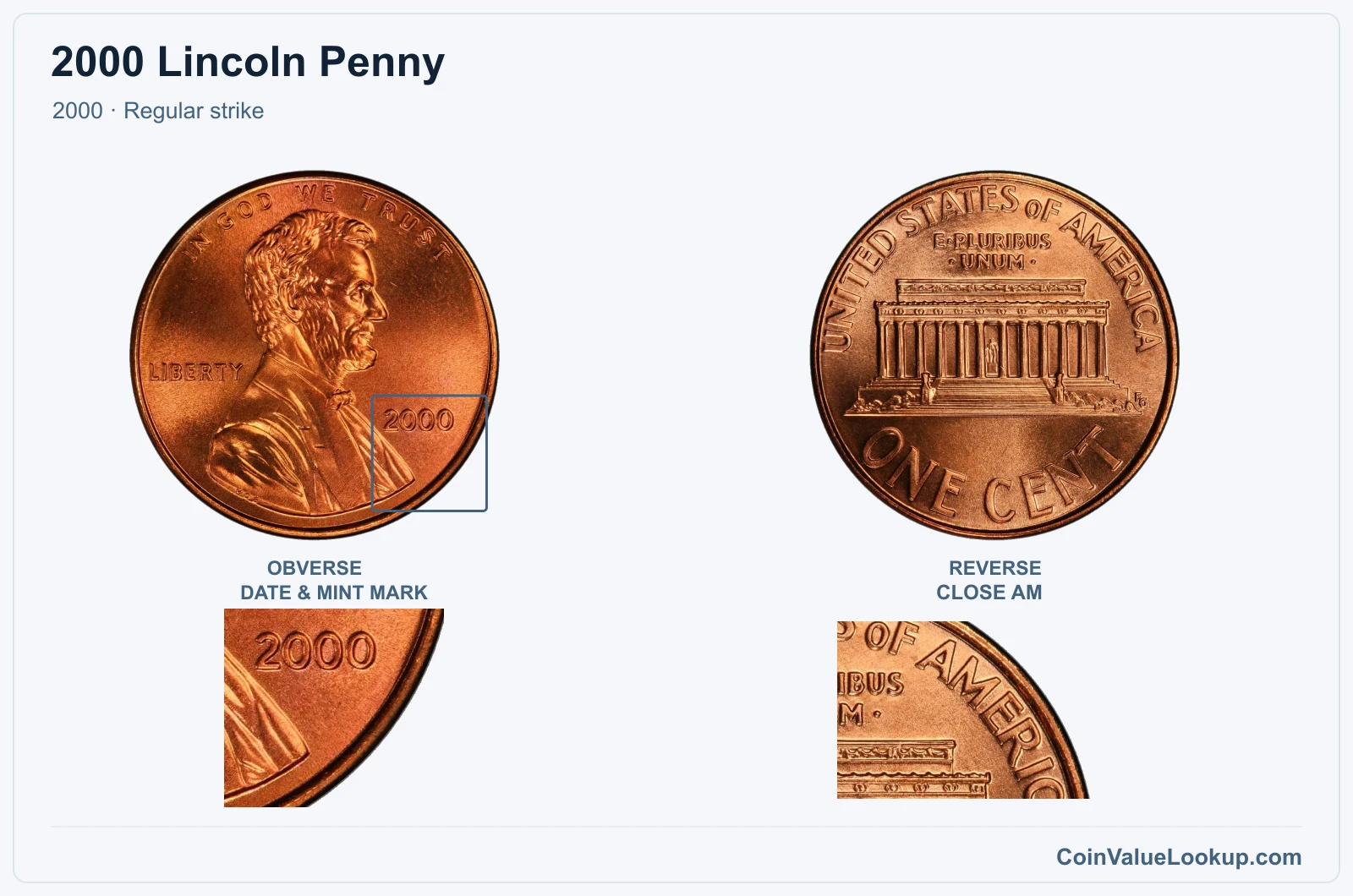
The 2000 Philadelphia cent has no mint mark below the date. It is a copper-plated zinc business strike weighing about 2.50 grams.
The normal reverse for this issue uses Close AM spacing in AMERICA — the letters A and M nearly touch.
A USA Coin Book guide estimate places this coin at about $0.36 in MS65 condition. In circulated grades, it is a face-value coin.
Uncirculated examples are common; what matters most is clean, original surfaces with strong remaining luster and minimal contact marks.
| Range | Grade | Price | Auction Records | Appraisal |
|---|---|---|---|---|
| PO | PO 1 | — | Coin Identifier | |
| FR | FR 2 | — | Coin Identifier | |
| AG | AG 3 | — | Coin Identifier | |
| G | G 4 | — | Coin Identifier | |
| G 6 | — | Coin Identifier | ||
| VG | VG 8 | — | Coin Identifier | |
| VG 10 | — | Coin Identifier | ||
| F | F 12 | — | Coin Identifier | |
| F 15 | — | Coin Identifier | ||
| VF | VF 20 | — | Coin Identifier | |
| VF 25 | — | Coin Identifier | ||
| VF 30 | — | Coin Identifier | ||
| VF 35 | — | Coin Identifier | ||
| XF | XF 40 | — | Coin Identifier | |
| XF 45 | — | Coin Identifier | ||
| AU | AU 50 | — | Coin Identifier | |
| AU 53 | — | Coin Identifier | ||
| AU 55 | — | Coin Identifier | ||
| AU 58 | — | Coin Identifier | ||
| MS | MS 60 | — | Coin Identifier | |
| MS 61 | — | Coin Identifier | ||
| MS 62 | — | Coin Identifier | ||
| MS 63 | — | Coin Identifier | ||
| MS 64 | — | Coin Identifier | ||
| MS 65 | Coin Identifier | |||
| MS 66 | Coin Identifier | |||
| MS 67 | Coin Identifier | |||
| MS 68 | Coin Identifier | |||
| MS 69 | Coin Identifier | |||
| MS 70 | — | — | — |
2000 Lincoln Penny — D
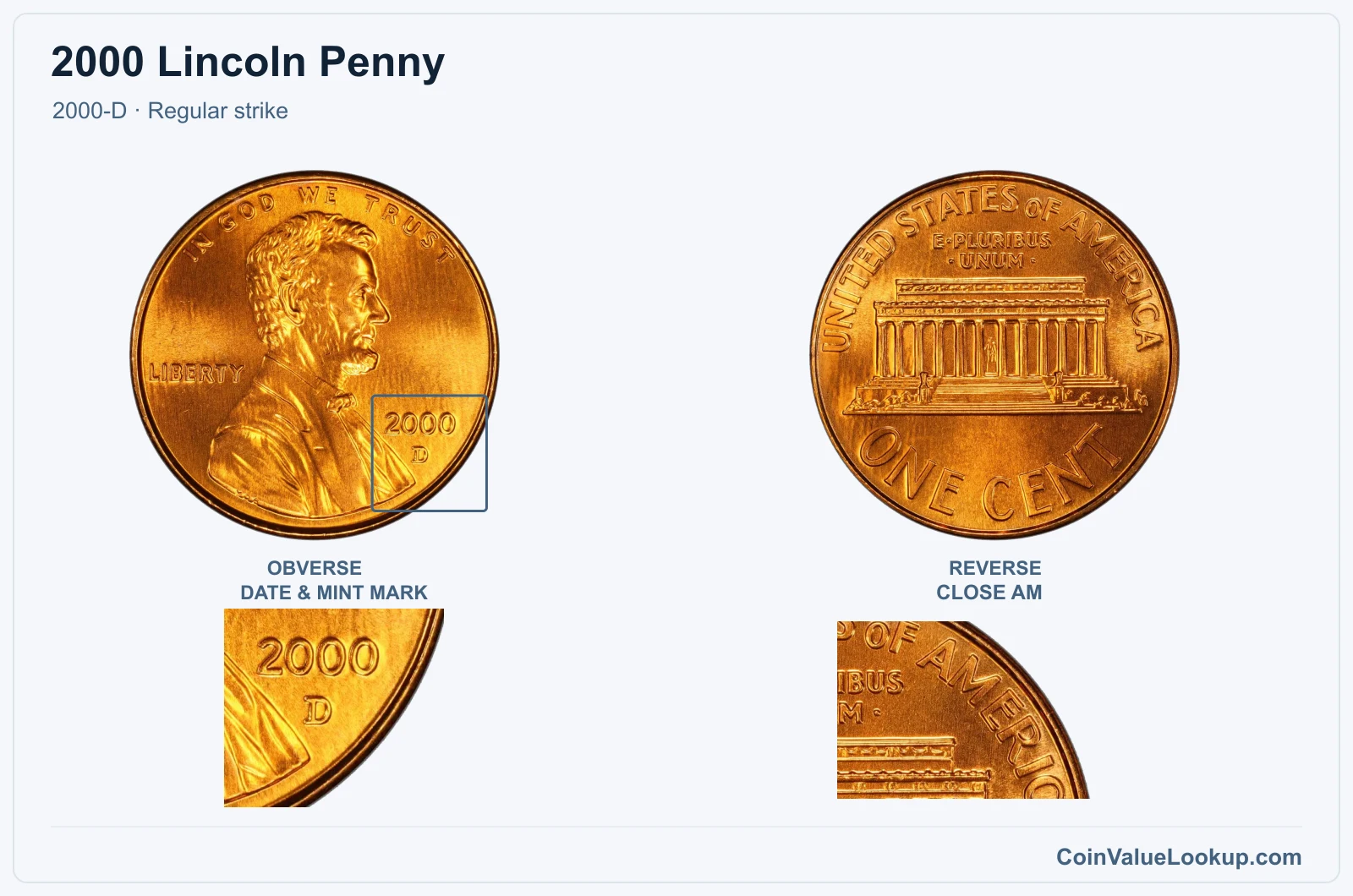
Look for the small "D" mint mark below the date. Denver struck these in large quantities, same copper-plated zinc composition and Close AM reverse as Philadelphia.
At MS65, the USA Coin Book guide estimate is also around $0.36. Like its Philadelphia counterpart, circulated examples trade at face value.
An uncirculated Denver cent with full red color and no distracting marks is the kind worth setting aside, but it is not a scarce coin by any measure.
Coin Value Lookup is a handy starting point if you are sorting through other dates and denominations and want to compare guide values quickly.
| Range | Grade | Price | Auction Records | Appraisal |
|---|---|---|---|---|
| PO | PO 1 | — | Coin Identifier | |
| FR | FR 2 | — | Coin Identifier | |
| AG | AG 3 | — | Coin Identifier | |
| G | G 4 | — | Coin Identifier | |
| G 6 | — | Coin Identifier | ||
| VG | VG 8 | — | Coin Identifier | |
| VG 10 | — | Coin Identifier | ||
| F | F 12 | — | Coin Identifier | |
| F 15 | — | Coin Identifier | ||
| VF | VF 20 | — | Coin Identifier | |
| VF 25 | — | Coin Identifier | ||
| VF 30 | — | Coin Identifier | ||
| VF 35 | — | Coin Identifier | ||
| XF | XF 40 | — | Coin Identifier | |
| XF 45 | — | Coin Identifier | ||
| AU | AU 50 | — | Coin Identifier | |
| AU 53 | — | Coin Identifier | ||
| AU 55 | — | Coin Identifier | ||
| AU 58 | — | Coin Identifier | ||
| MS | MS 60 | — | Coin Identifier | |
| MS 61 | — | Coin Identifier | ||
| MS 62 | — | Coin Identifier | ||
| MS 63 | — | Coin Identifier | ||
| MS 64 | — | Coin Identifier | ||
| MS 65 | Coin Identifier | |||
| MS 66 | Coin Identifier | |||
| MS 67 | Coin Identifier | |||
| MS 68 | Coin Identifier | |||
| MS 69 | Coin Identifier | |||
| MS 70 | — | — | — |
2000 Lincoln Penny — S PR
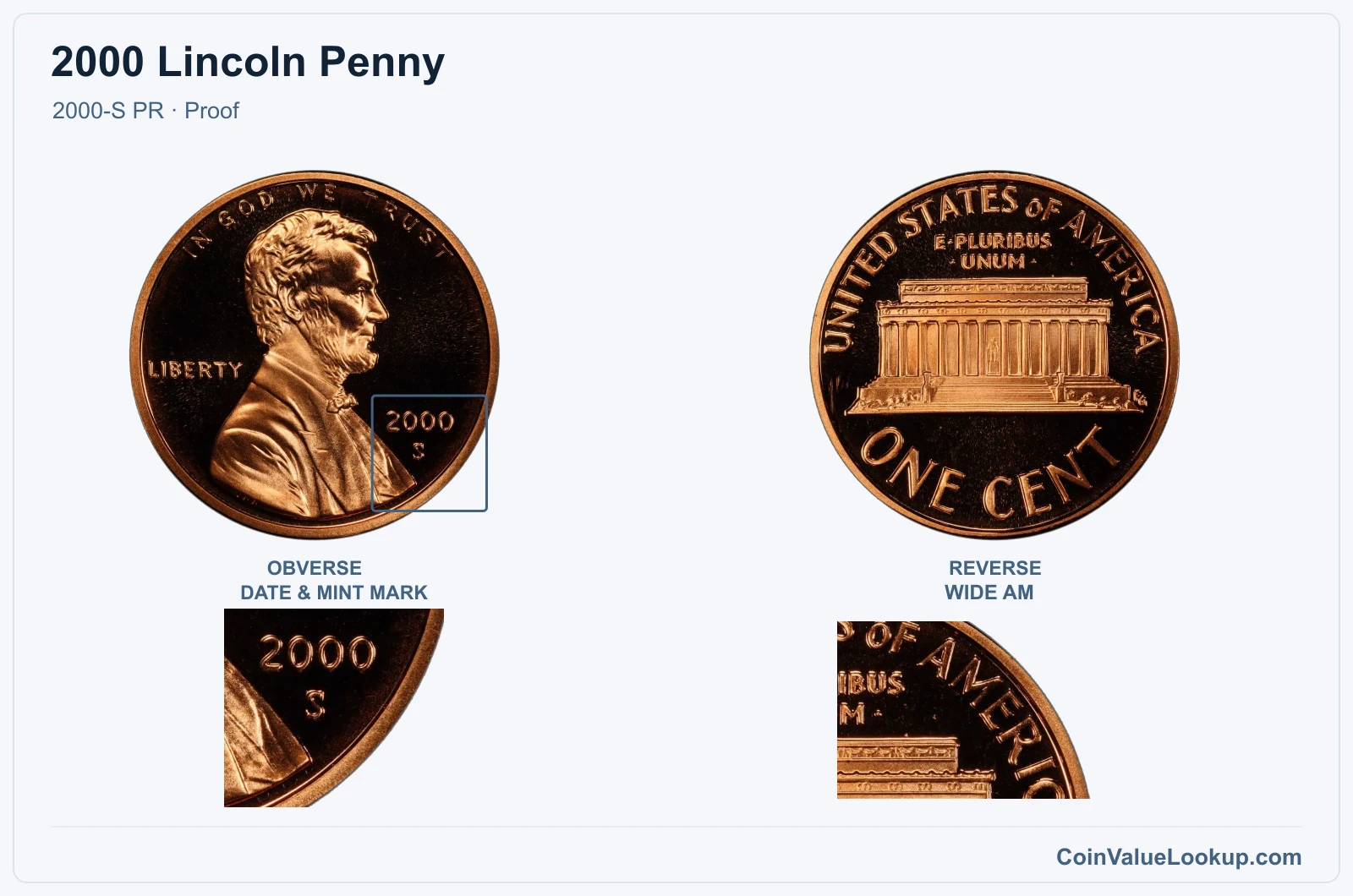
The 2000-S proof cent was struck at San Francisco for collector sets and carries an "S" mint mark. It has mirrored fields and sharply detailed devices — this is a manufacturing finish, not a higher grade than Mint State.
The normal reverse for a proof of this era uses Wide AM spacing.
At PR65, the USA Coin Book guide estimate is about $4.96. Cameo (CAM) and deep cameo (DCAM) designations describe the contrast between frosted devices and reflective fields and are graded separately.
Compare your proof only against proof-grade references, not circulation-grade ones.
| Range | Grade | Price | Auction Records | Appraisal |
|---|---|---|---|---|
| PR | PR 1 | — | Coin Identifier | |
| PR 2 | — | Coin Identifier | ||
| PR 3 | — | Coin Identifier | ||
| PR 4 | — | Coin Identifier | ||
| PR 6 | — | Coin Identifier | ||
| PR 8 | — | Coin Identifier | ||
| PR 10 | — | Coin Identifier | ||
| PR 12 | — | Coin Identifier | ||
| PR 15 | — | Coin Identifier | ||
| PR 20 | — | Coin Identifier | ||
| PR 25 | — | Coin Identifier | ||
| PR 30 | — | Coin Identifier | ||
| PR 35 | — | Coin Identifier | ||
| PR 40 | — | Coin Identifier | ||
| PR 45 | — | Coin Identifier | ||
| PR 50 | — | Coin Identifier | ||
| PR 53 | — | Coin Identifier | ||
| PR 55 | — | Coin Identifier | ||
| PR 58 | — | Coin Identifier | ||
| PR 60 | Coin Identifier | |||
| PR 61 | — | Coin Identifier | ||
| PR 62 | — | Coin Identifier | ||
| PR 63 | — | Coin Identifier | ||
| PR 64 | Coin Identifier | |||
| PR 65 | — | Coin Identifier | ||
| PR 66 | — | Coin Identifier | ||
| PR 67 | Coin Identifier | |||
| PR 68 | Coin Identifier | |||
| PR 69 | Coin Identifier | |||
| PR 70 | Coin Identifier |
2000 Lincoln Penny — Philadelphia Wide AM
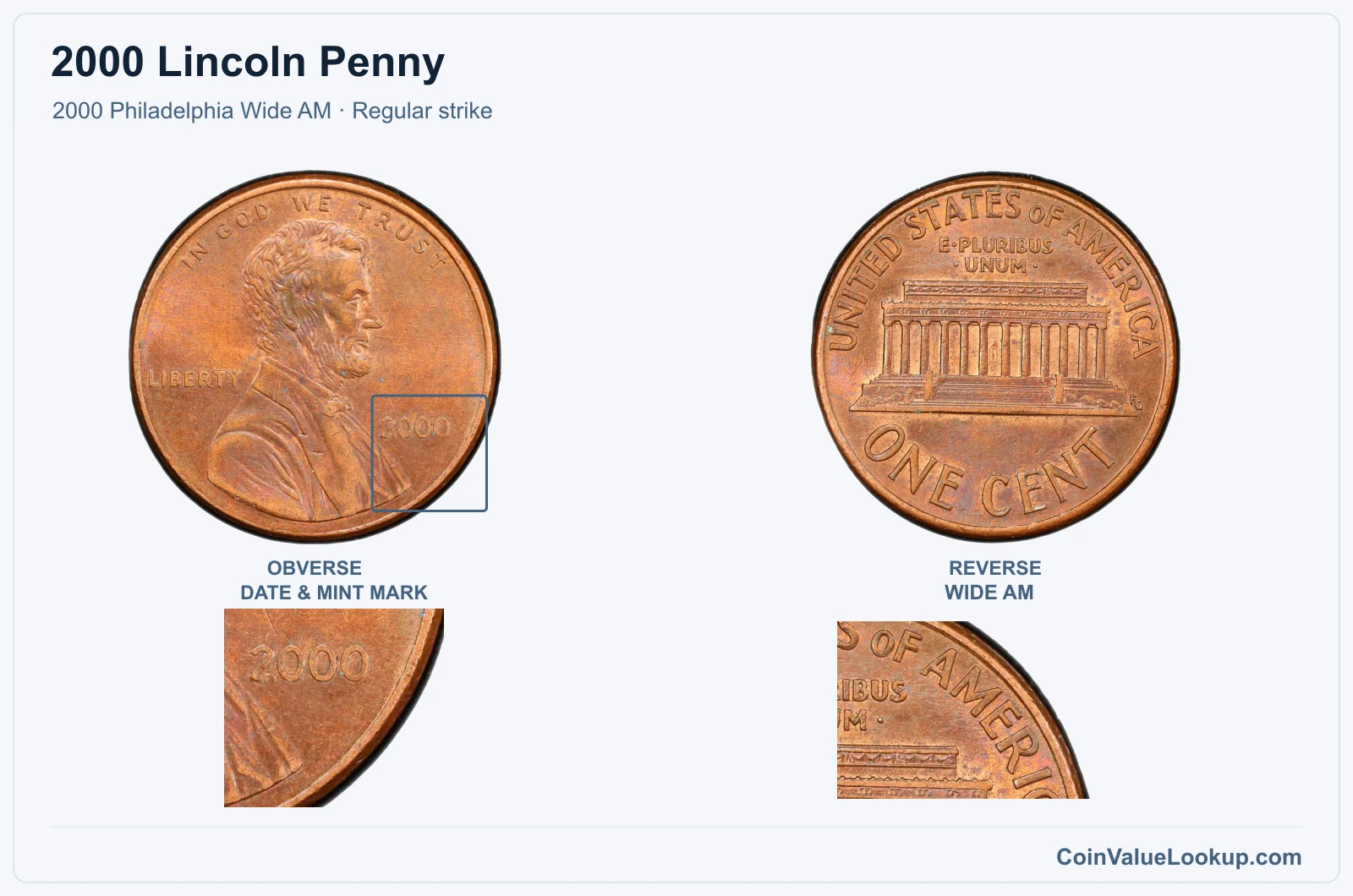
This is the one worth a close look. On a normal 2000 Philadelphia business strike, the A and M in AMERICA are squeezed together (Close AM).
The Wide AM variety shows a visible gap between those letters — the reverse die normally reserved for proof coinage was used on a circulation strike.
To confirm, compare the AM spacing and also look at the position of the designer's initials FG relative to the Memorial building. Both details together help distinguish a true Wide AM from wishful thinking.
At MS65, the USA Coin Book guide estimate is around $25, a significant jump from the $0.36 of a regular Close AM cent. PCGS recognizes Wide AM circulation cents for 1998, 1999, and 2000, with 1999 being the scarcest of the three.
Range Grade
Price2000 Philadelphia Wide AM (BN) Price2000 Philadelphia Wide AM (RB) Price2000 Philadelphia Wide AM (RD) Auction Records Appraisal PO PO 1
—
Coin Identifier FR FR 2
—
Coin Identifier AG AG 3
—
Coin Identifier G G 4
—
Coin Identifier
G 6
—
Coin Identifier VG VG 8
—
Coin Identifier
VG 10
—
Coin Identifier F F 12
—
Coin Identifier
F 15
—
Coin Identifier VF VF 20
—
Coin Identifier
VF 25
—
Coin Identifier
VF 30
—
Coin Identifier
VF 35
—
Coin Identifier XF XF 40
—
Coin Identifier
XF 45
—
Coin Identifier AU AU 50
—
Coin Identifier
AU 53
—
Coin Identifier
AU 55
—
Coin Identifier
AU 58
—
Coin Identifier MS MS 60
—
Coin Identifier
MS 61
—
Coin Identifier
MS 62
Coin Identifier
MS 63
—
Coin Identifier
MS 64
Coin Identifier
MS 65
Coin Identifier
MS 66
—
—
Coin Identifier
MS 67
—
—
Coin Identifier
MS 68
—
—
—
Coin Identifier
MS 69
—
—
—
—
—
MS 70
—
—
—
—
—
2000 Lincoln Penny — Cheerios promotional cent
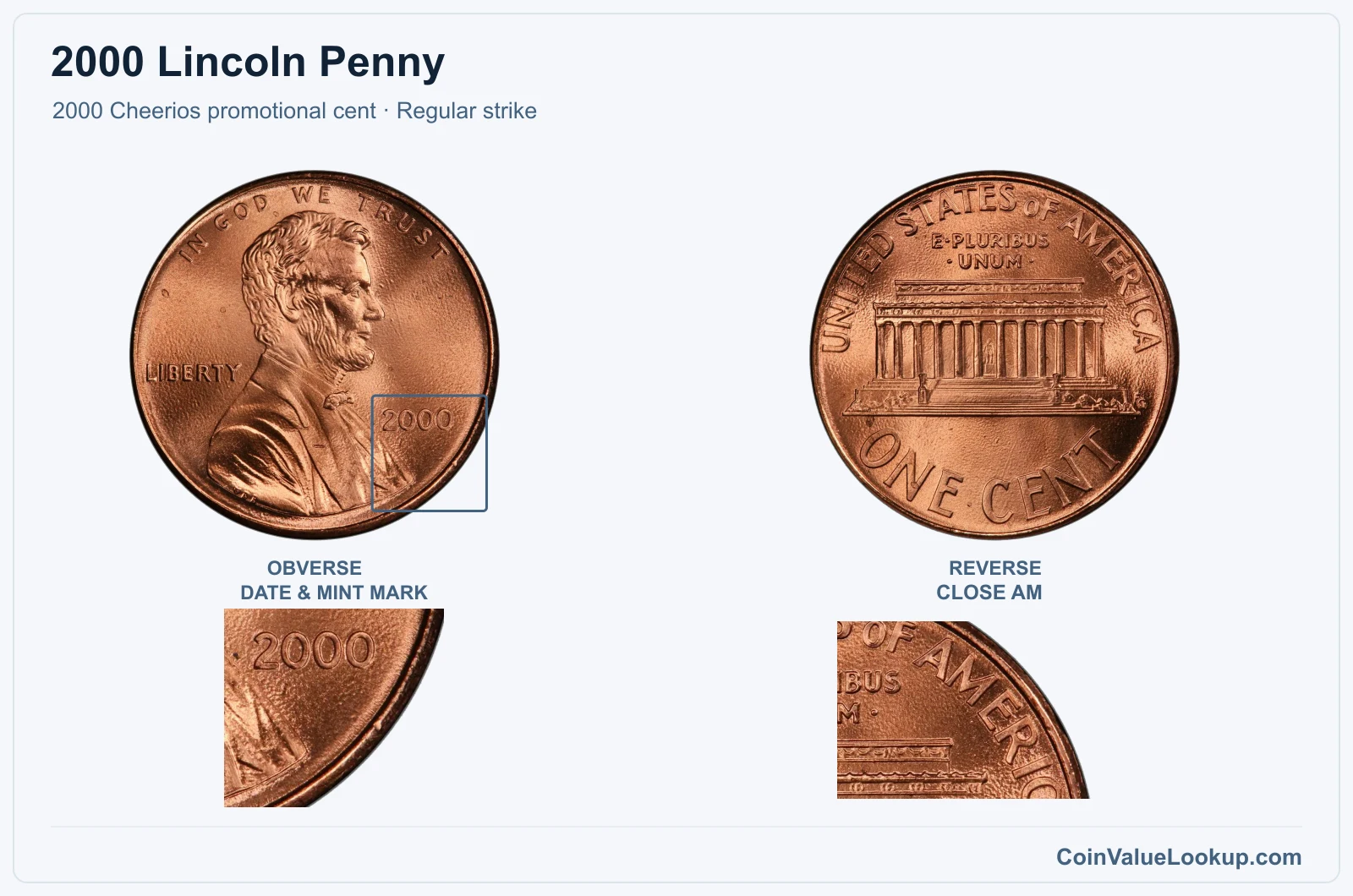
In 2000, certain Lincoln cents were included in Cheerios cereal boxes as part of a promotional campaign. These are separately attributed by grading services, but the key requirement is provenance — you need the original promotional packaging or a recognized chain of custody tying the coin to that promotion.
A loose 2000 Philadelphia cent sitting in your change jar cannot claim Cheerios attribution just because it matches the date. There is no die variety or minting difference that distinguishes a Cheerios cent from a regular 2000 cent by appearance alone.
Value depends on authenticated identity and condition, and each coin is assessed individually.
Range Grade
Price2000 Cheerios promotional cent (BN) Price2000 Cheerios promotional cent (RB) Price2000 Cheerios promotional cent (RD) Auction Records Appraisal PO PO 1
—
Coin Identifier FR FR 2
—
Coin Identifier AG AG 3
—
Coin Identifier G G 4
—
Coin Identifier
G 6
—
Coin Identifier VG VG 8
—
Coin Identifier
VG 10
—
Coin Identifier F F 12
—
Coin Identifier
F 15
—
Coin Identifier VF VF 20
—
Coin Identifier
VF 25
—
Coin Identifier
VF 30
—
Coin Identifier
VF 35
—
Coin Identifier XF XF 40
—
Coin Identifier
XF 45
—
Coin Identifier AU AU 50
—
Coin Identifier
AU 53
—
Coin Identifier
AU 55
—
Coin Identifier
AU 58
—
Coin Identifier MS MS 60
—
Coin Identifier
MS 61
—
Coin Identifier
MS 62
—
Coin Identifier
MS 63
—
Coin Identifier
MS 64
Coin Identifier
MS 65
—
Coin Identifier
MS 66
Coin Identifier
MS 67
—
—
Coin Identifier
MS 68
—
—
Coin Identifier
MS 69
—
—
—
—
—
MS 70
—
—
—
—
—
2000 Lincoln Penny Error List
1. 2000 Lincoln Penny — Doubled Die
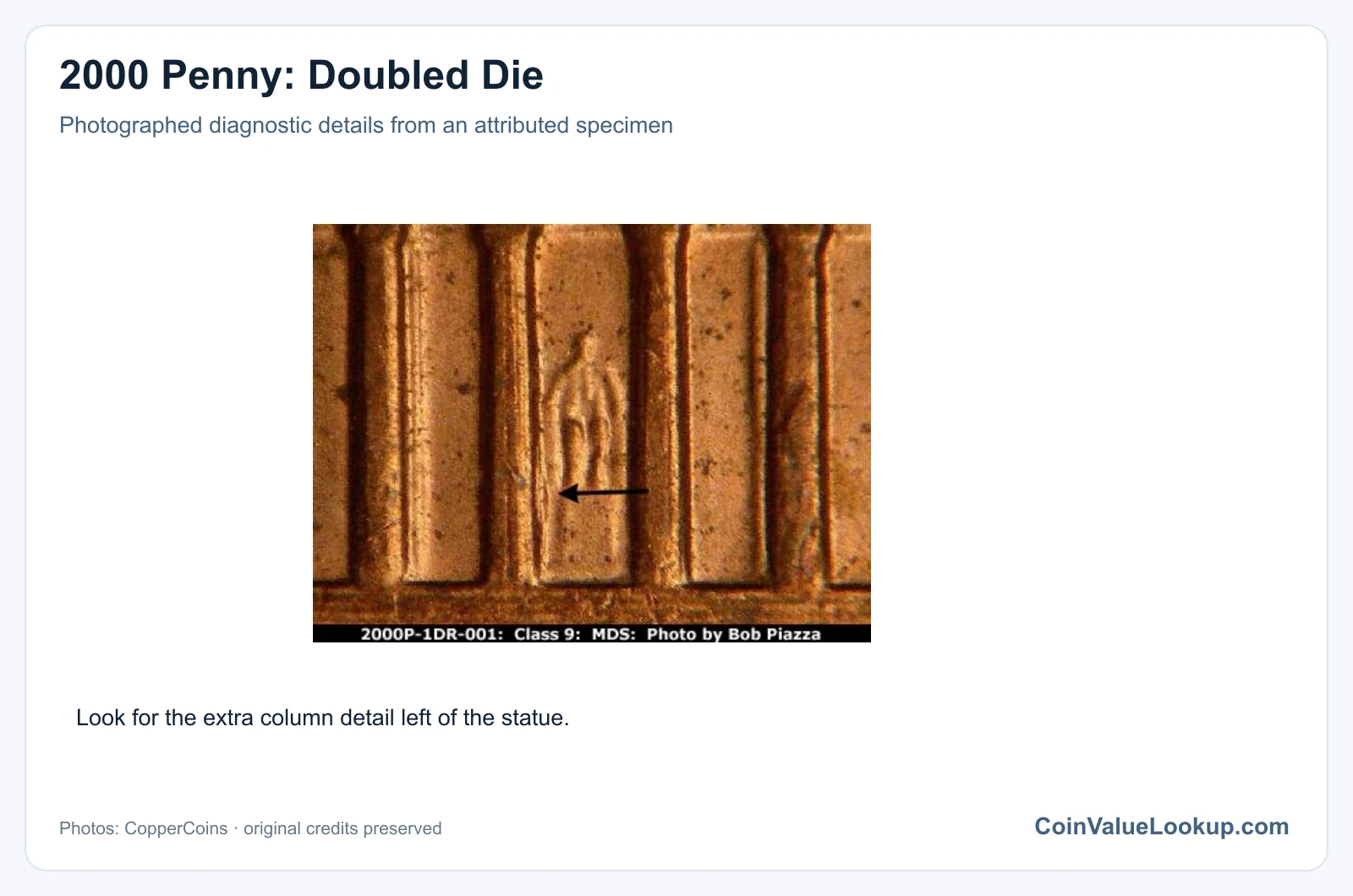
A doubled die on a 2000 Lincoln cent shows consistent separation or notching on design elements — look especially at the lettering, date digits, and Lincoln's profile. The doubling is struck into the coin from a defective die, so it appears uniform and repeatable across coins from the same die.
Do not confuse this with machine doubling, which creates flat, shelf-like distortion rather than true design separation. Reflections and post-mint impressions can also mimic doubling under certain lighting.
Authentic doubled dies are assessed individually based on the strength of the doubling, the specific die identified, and the coin's overall condition. Third-party authentication is the standard way to confirm attribution.
2. 2000 Lincoln Penny — Off-Center Strike
An off-center strike happens when the planchet is not properly seated between the dies. The result is a displaced design with an unstruck crescent of blank metal on one side.
The more off-center the strike, and the more of the date that remains visible, the more interesting it becomes to collectors.
Don't mistake a clipped planchet or one-sided die misalignment for an off-center error — a true off-center coin has the entire design shifted in one direction with a smooth blank area. Post-mint flattening or damage can also create misleading shapes.
Value depends on the percentage of off-center displacement, date visibility, and the coin's condition, each assessed individually.
3. 2000 Lincoln Penny — Brockage
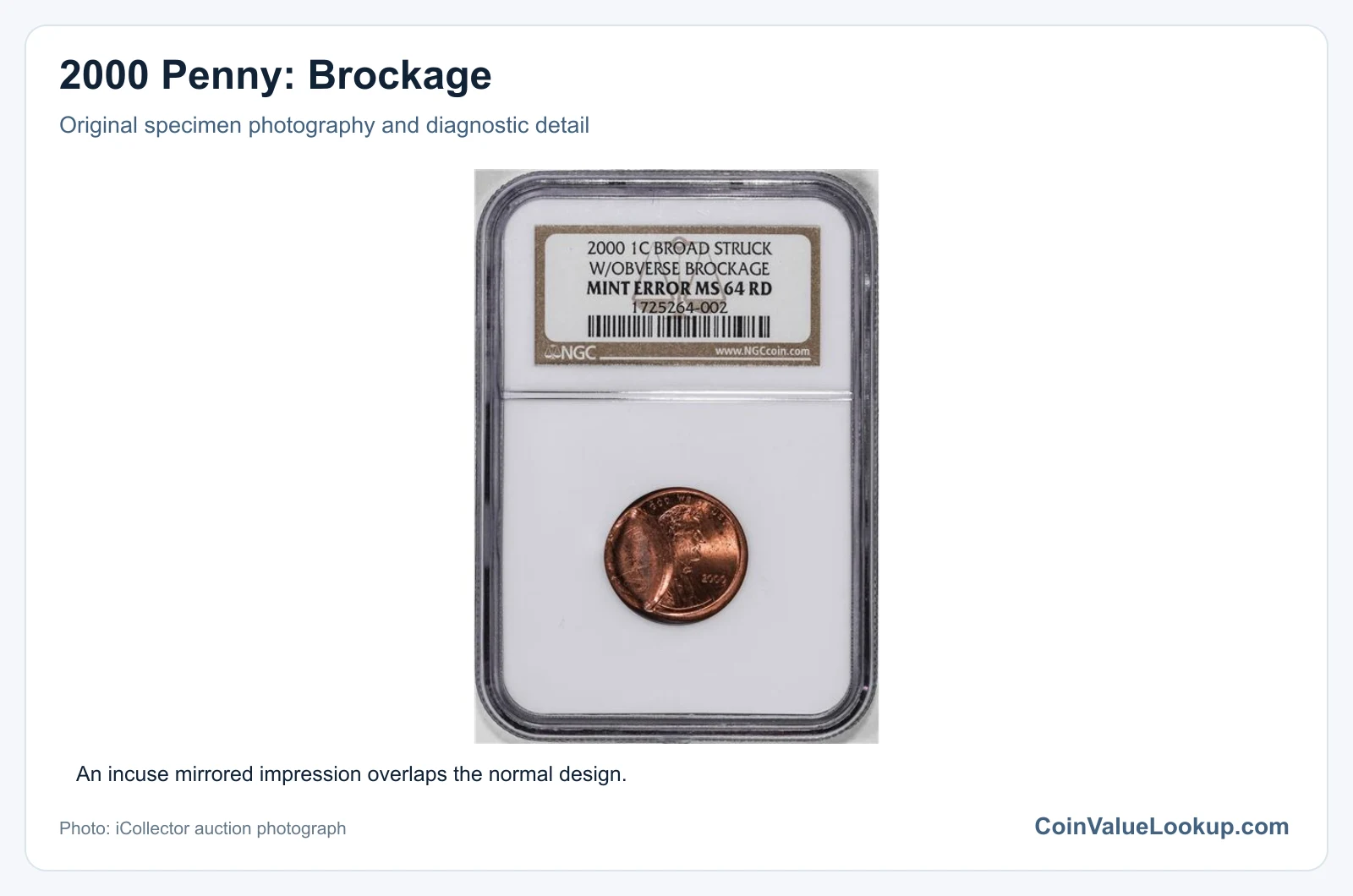
A brockage occurs when a previously struck coin stays on a die and impresses its image into the next blank. The result is one normal side and one side with an incuse, mirror-image design — Lincoln facing the wrong direction, for example, sunken into the surface.
Compare both sides carefully. The incuse impression should show reversed detail matching the design, not random marks.
A die clash — where the dies strike each other without a planchet — leaves a faint ghost image but not a fully incuse mirror impression. Coins pressed together after leaving the mint can also look suspicious.
Genuine brockages on modern cents are uncommon and each is valued individually based on its clarity and condition.
4. 2000 Lincoln Penny — Die Cap / Capped-Die Strike
A die cap forms when a struck coin sticks to the upper die and gets struck repeatedly against incoming blanks. The adhered coin becomes cupped and bowl-shaped over successive strikes, and the coins struck beneath it receive progressively distorted impressions.
You might find either the cap itself — a cupped, multi-struck coin — or a coin that was struck through the cap, showing a weak or distorted image on one side. Do not confuse a bent coin or one damaged in a vise with a genuine die cap.
A legitimate cap has a distinctive cupped shape with evidence of multiple strikes. These are assessed individually, with authentication recommended.
5. 2000 Lincoln Penny — Wrong Planchet / Off-Metal Strike
A wrong-planchet error means a 2000 Lincoln cent design was struck on a blank intended for a different denomination or composition. To check, compare your coin's weight, diameter, and edge to the standard 2.50 grams, 19.05 mm, and plain edge of a normal cent.
If your coin is noticeably heavier, lighter, larger, smaller, or has a reeded edge, it could be a candidate. But look carefully — plating loss, corrosion, acid treatment, and deliberate alteration can all change a coin's appearance and apparent weight.
Professional authentication with precise measurement is the way to confirm this type of error. Each is valued individually.
6. 2000 Lincoln Penny — Unplated / Partly Unplated Planchet
A 2000 cent struck on an unplated or partly unplated zinc planchet will look silvery-gray where the copper plating is absent. The exposed zinc surface has a distinctly different color and texture from normal copper-covered cents.
The tricky part is distinguishing a genuine unplated error — where the copper coating was missing before striking — from a coin that has been chemically stripped, corroded, or environmentally damaged after the fact. On a genuine unplated cent, the design detail in bare zinc areas should be sharp and undisturbed, with no signs of chemical residue or pitting from acid.
Weight and edge examination also help. Each coin is assessed individually based on its authenticated identity and condition.
7. 2000 Lincoln Penny — Struck-Through Error
A struck-through error occurs when foreign material — grease, a thread, a metal fragment, or debris — sits between the die and the planchet during striking. The result is a localized depression or incomplete design element where the obstruction blocked the die's impression.
Grease-filled dies tend to produce soft, filled-in areas, while a retained foreign object can leave a distinct impression of its shape. Compare any suspicious area against normal wear, scratches, or cleaning damage — those affect the surface differently and do not create the crisp-edged depressions typical of a struck-through.
Each struck-through error is valued individually based on what caused it, how dramatic the effect is, and the coin's overall condition.
8. 2000 Lincoln Penny — Wide AM circulation reverse
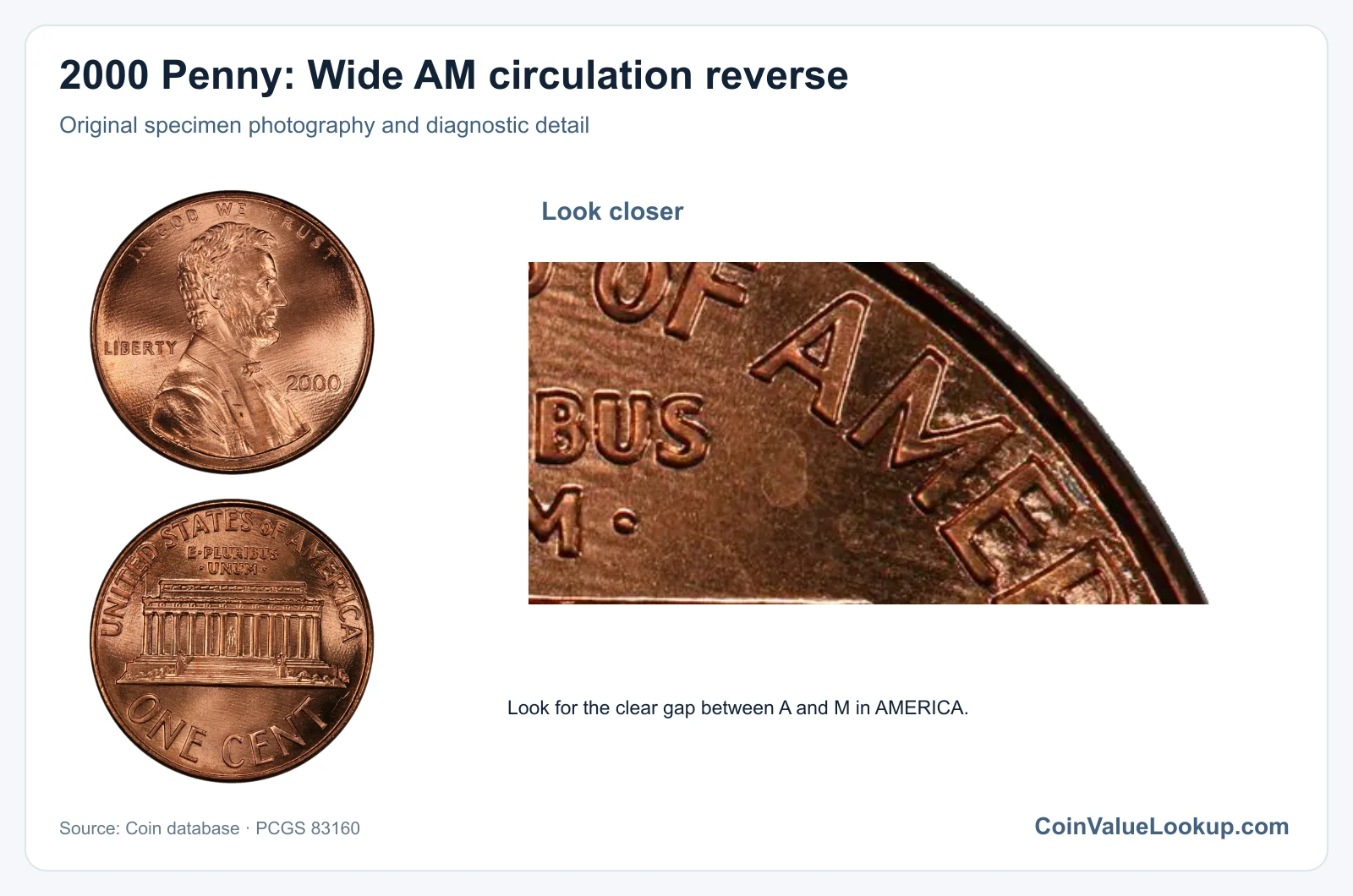
The Wide AM on a 2000 Philadelphia circulation cent is a recognized variety where the reverse die — normally used for proofs — was paired with a business-strike obverse. The A and M in AMERICA are clearly separated rather than nearly touching as on the normal Close AM business-strike reverse.
To verify, compare both the AM spacing and the FG initials near the Memorial building against a known Close AM example. A normal 2000-S proof also has Wide AM spacing, so this variety applies only to Philadelphia business strikes with no mint mark.
Damage to the lettering or die deterioration can sometimes create the illusion of wider spacing, so look for consistent, clean separation. Each Wide AM cent is valued based on its condition and confirmed attribution.