2000 Jefferson Nickel Coin Value: How Much Is It Worth?
Most 2000 Jefferson nickels are worth a small premium above face value, if anything. For standard Philadelphia and Denver business strikes, retail guide estimates run roughly $0.30 in MS60 to $1.24 in MS65, according to USA Coin Book.
Proofs from San Francisco occupy a separate collector market. Genuine mint errors on this date can carry significantly higher values, so those are worth a closer look.
Fast Way to Identify Your 2000 Jefferson Nickel
The quickest way to start figuring out what you have is to upload clear photos of the front and back of your coin. Our identifier can offer a preliminary identification of the mint, finish and basic version.
It is not a substitute for professional authentication or grading, but it gives you a solid starting point for further research.
2000 Jefferson Nickel Value
Upload both sides of your 2000 Jefferson Nickel.
Front Obverse
Upload photo
Back Reverse
Upload photo
Which 2000 Jefferson Nickel Versions Are Worth Money?
- San Francisco proofs (2000-S) carry a guide value around $3.08 in PR65 — modest, but well above the face value of worn P or D examples.
- Genuine striking errors such as off-center strikes, triple strikes and wrong-planchet errors have sold individually for far more than ordinary examples; authentication is essential.
- The 2000-P triple-struck nickel saw one Heritage Auctions sale of $480 in October 2022, showing the premium dramatic errors can command.
- Condition matters even on common dates: a pristine MS65 business strike guides at $1.24, while a typical circulated piece is essentially worth face value.
Step 1: Identify Your 2000 Jefferson Nickel Mint Mark and Version
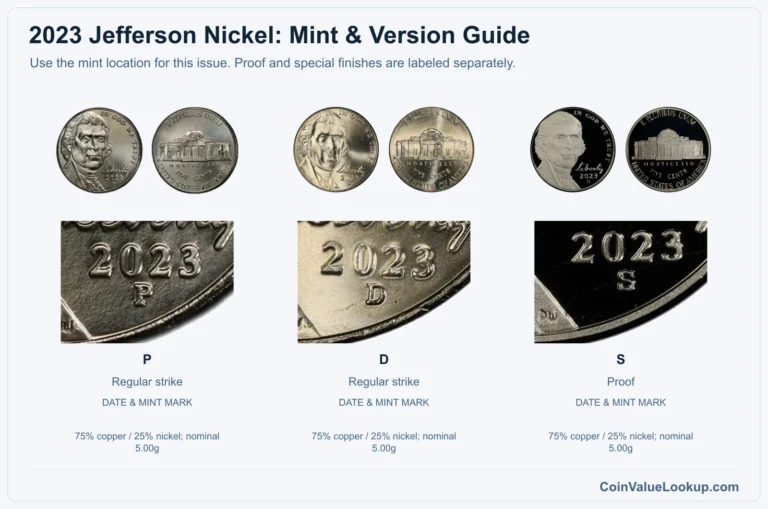
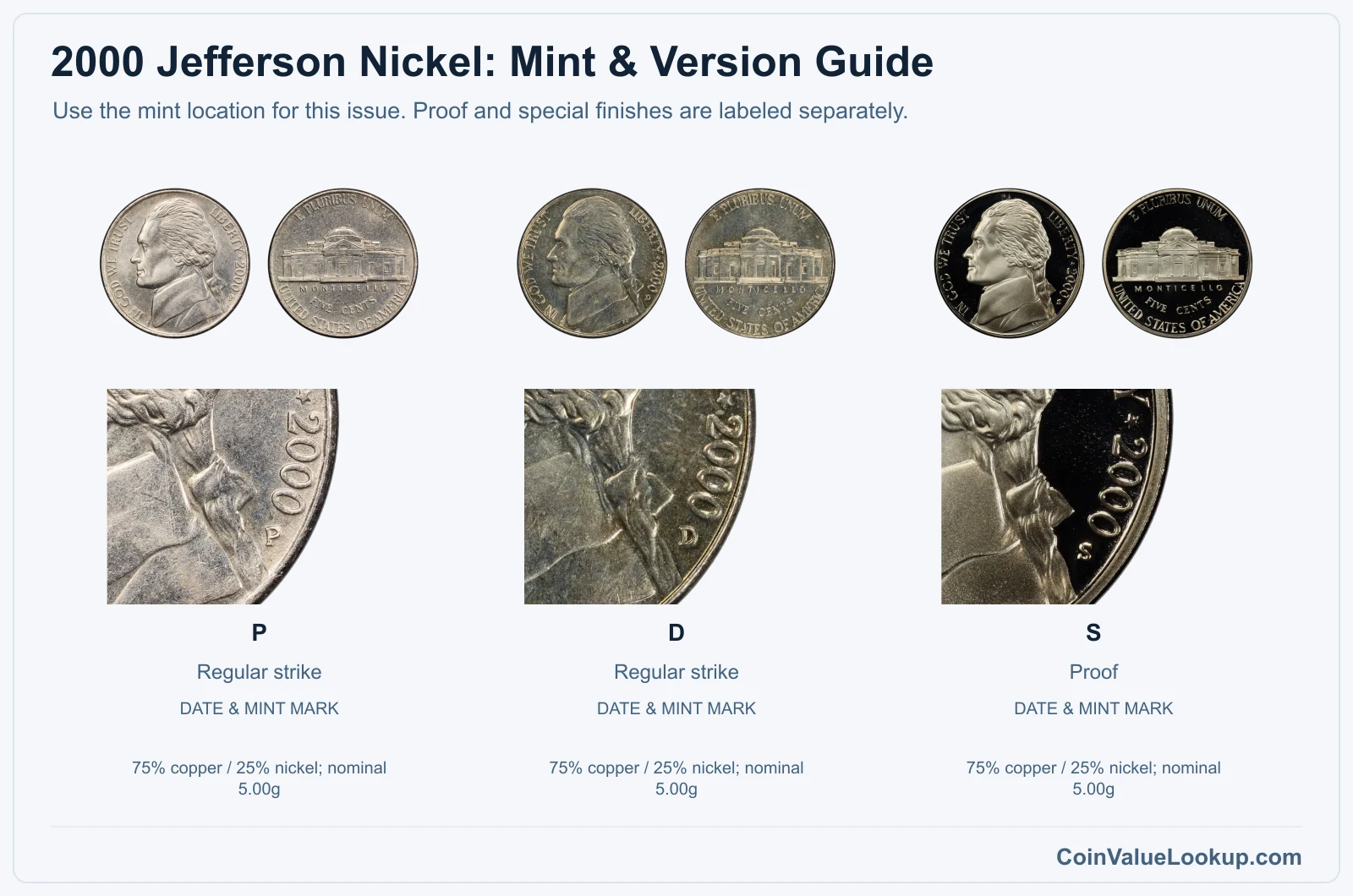
Start by reading the date on the obverse — you need "2000" — and then look for the small mintmark letter near the right side of Jefferson's portrait. A "P" means Philadelphia, a "D" means Denver, and an "S" means San Francisco (proof only).
No mintmark at all still indicates Philadelphia on nickels of this era.
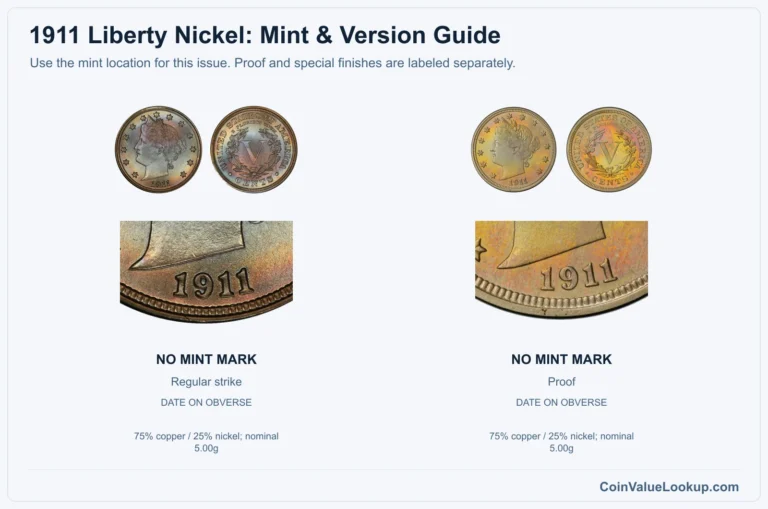
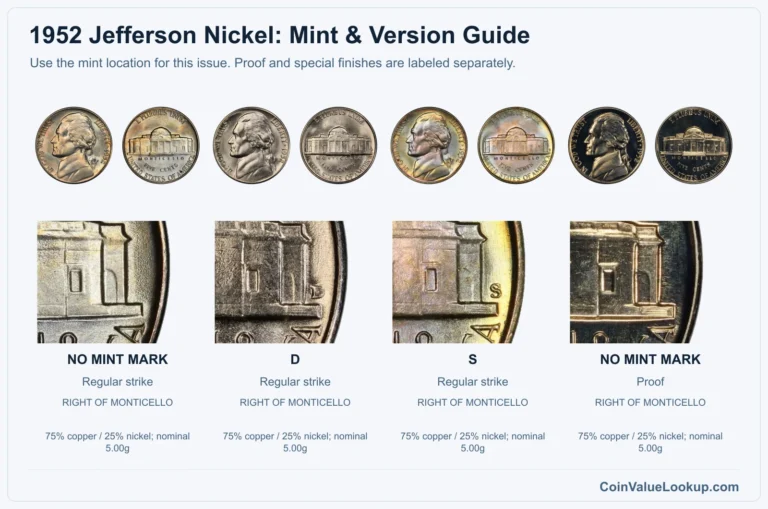
The 2000 nickel uses the classic Jefferson profile on the obverse and the Monticello building on the reverse. This is important because later dates in the series changed the portrait and reverse designs.
Make sure your coin matches both sides before looking up prices.
The standard composition is 75% copper and 25% nickel, weighing about 5.00 grams with a plain (smooth) edge and a diameter of 21.2 mm. Color alone does not tell you the alloy — a copper-toned nickel may be environmentally damaged rather than struck on a wrong planchet.
Weight and authentication matter more than appearance when something looks unusual.
Step 2: Check Your 2000 Jefferson Nickel Grade
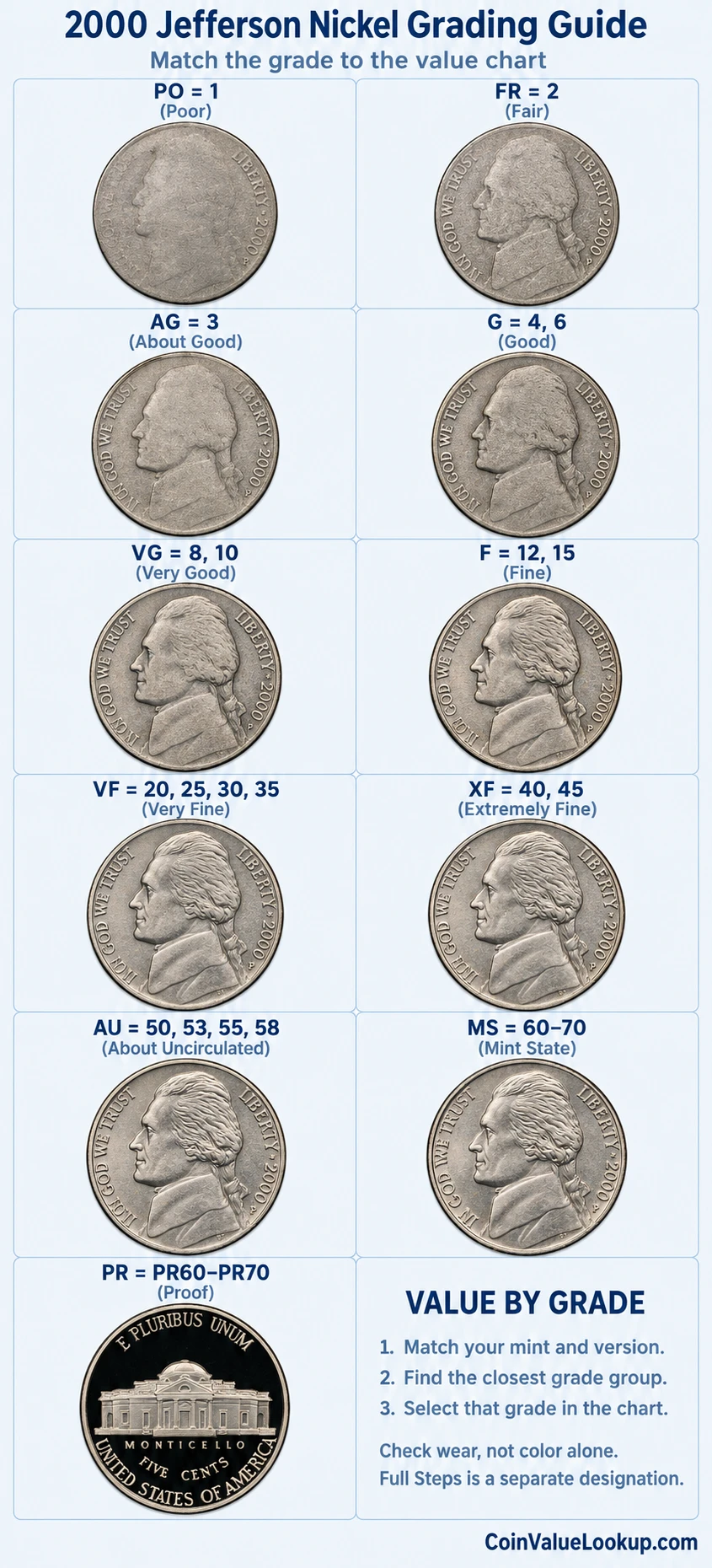
To judge the condition of a 2000 Jefferson nickel, focus first on the high points of Jefferson's cheek, jawline and hair detail. These are the first areas to show friction and loss of luster.
A coin with full original mint luster and no visible wear qualifies as Mint State.
Within Mint State, the difference between MS60 and MS65 comes down to contact marks and surface quality. An MS60 coin can have noticeable bag marks and scuffs, while an MS65 piece will appear clean and well-struck to the unaided eye.
Use the comparison image to see how these grades differ on the same design.
On the reverse, the steps of Monticello can appear mushy even on uncirculated coins. That is a strike characteristic, not a sign of wear.
Do not confuse a weakly struck set of steps with a circulated coin.
Proof coins have mirror fields and frosted devices — they grade on a PR scale. Comparing a proof to a business strike is apples to oranges, so always match your coin's finish to the correct grading lane.
Step 3: Check 2000 Jefferson Nickel Value by Mint and Version
2000 Jefferson Nickel — P — Business strike
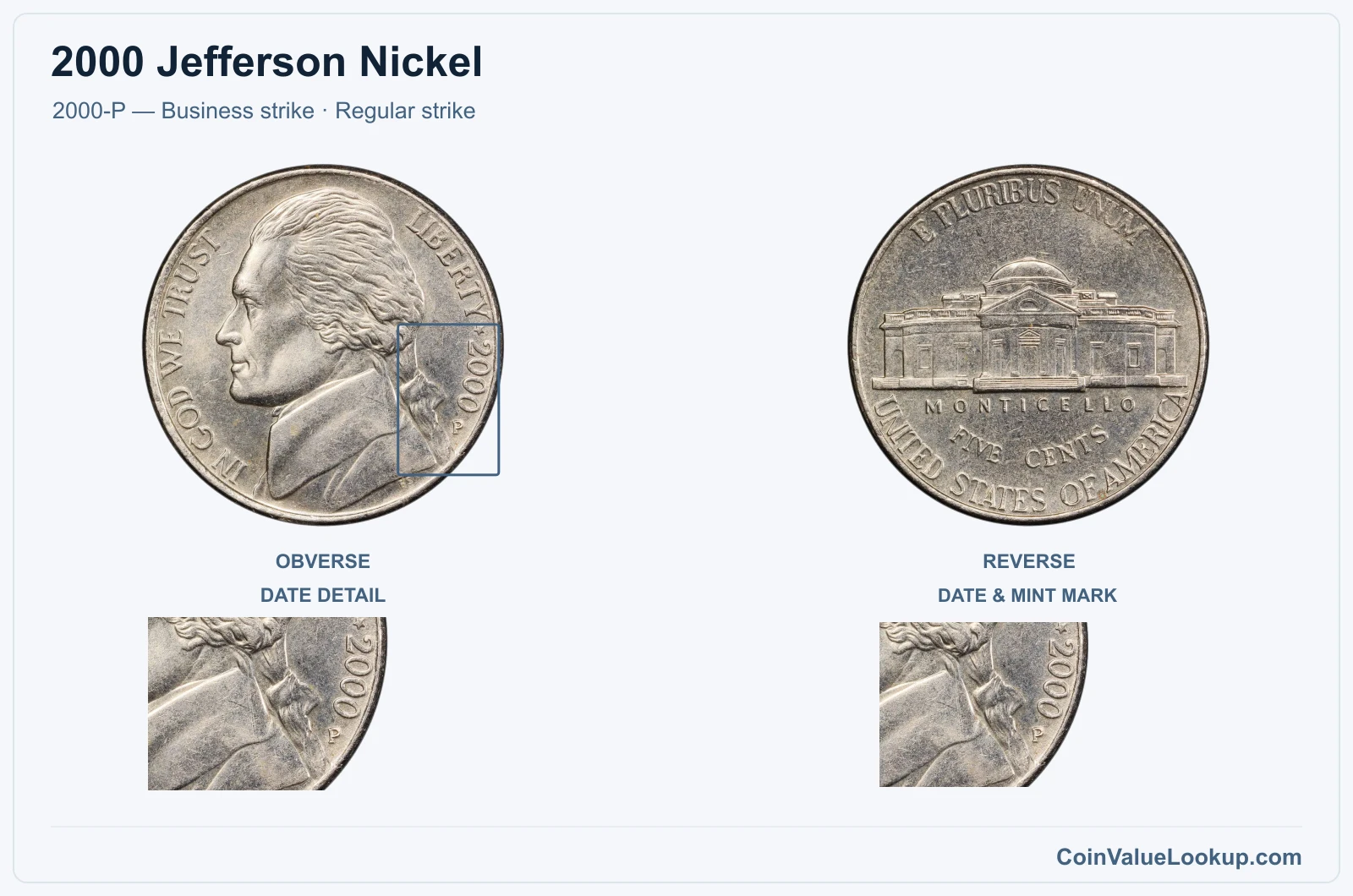
The 2000-P is a Philadelphia business strike on the standard 75% copper, 25% nickel planchet, weighing 5.00 grams. It carries the familiar Jefferson profile obverse and Monticello reverse.
Hundreds of millions were made, so circulated examples are just five-cent coins.
In uncirculated condition, USA Coin Book lists a guide estimate of about $0.30 at MS60 and $1.24 at MS65. These are retail guide figures, not guaranteed buy prices.
The "P" mintmark sits to the right of Jefferson's portrait. Look for that letter, full luster and minimal bag marks to assess where your coin falls.
| Range | Grade | Price | Auction Records | Appraisal |
|---|---|---|---|---|
| PO | PO 1 | — | Coin Identifier | |
| FR | FR 2 | — | Coin Identifier | |
| AG | AG 3 | — | Coin Identifier | |
| G | G 4 | — | Coin Identifier | |
| G 6 | — | Coin Identifier | ||
| VG | VG 8 | — | Coin Identifier | |
| VG 10 | — | Coin Identifier | ||
| F | F 12 | — | Coin Identifier | |
| F 15 | — | Coin Identifier | ||
| VF | VF 20 | — | Coin Identifier | |
| VF 25 | — | Coin Identifier | ||
| VF 30 | — | Coin Identifier | ||
| VF 35 | — | Coin Identifier | ||
| XF | XF 40 | — | Coin Identifier | |
| XF 45 | — | Coin Identifier | ||
| AU | AU 50 | — | Coin Identifier | |
| AU 53 | — | Coin Identifier | ||
| AU 55 | — | Coin Identifier | ||
| AU 58 | — | Coin Identifier | ||
| MS | MS 60 | — | Coin Identifier | |
| MS 61 | — | Coin Identifier | ||
| MS 62 | — | Coin Identifier | ||
| MS 63 | — | Coin Identifier | ||
| MS 64 | Coin Identifier | |||
| MS 65 | Coin Identifier | |||
| MS 66 | Coin Identifier | |||
| MS 67 | Coin Identifier | |||
| MS 68 | — | — | — | |
| MS 69 | — | — | — | |
| MS 70 | — | — | — |
2000 Jefferson Nickel — D — Business strike
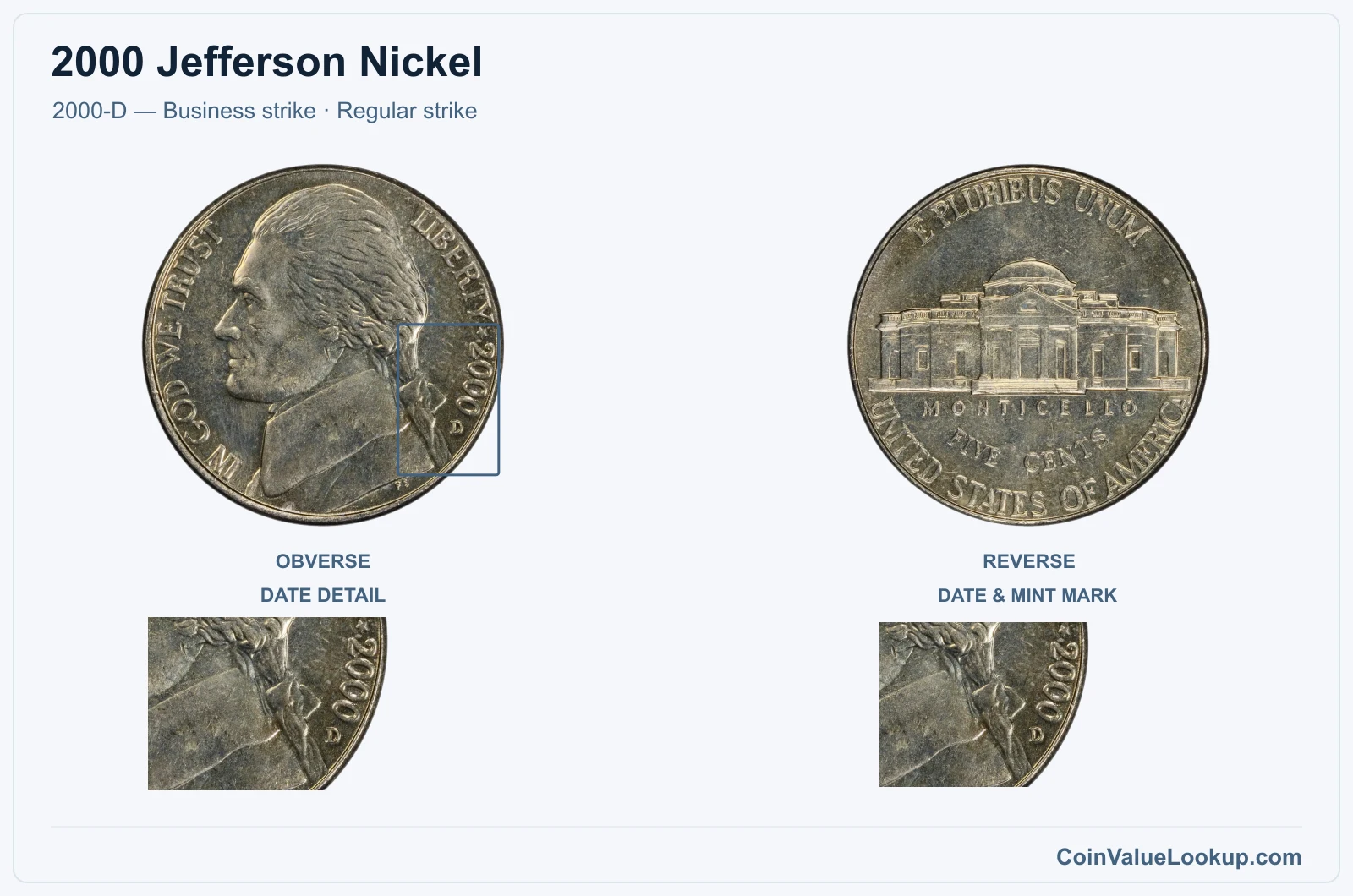
The 2000-D was struck at the Denver Mint and shares the same design, alloy and weight as its Philadelphia sibling. You will find a small "D" mintmark on the obverse near Jefferson's ponytail.
Guide values from USA Coin Book are identical to the P mint version: roughly $0.30 at MS60 and $1.24 at MS65. In practice, neither mint commands a premium over the other at these grades for ordinary strikes.
A nice uncirculated roll-fresh example is a fine type coin, but nothing to retire on.
Coin Value Lookup is a handy place to look up guides for other dates and denominations in the Jefferson nickel series if you are working through a collection.
| Range | Grade | Price | Auction Records | Appraisal |
|---|---|---|---|---|
| PO | PO 1 | — | Coin Identifier | |
| FR | FR 2 | — | Coin Identifier | |
| AG | AG 3 | — | Coin Identifier | |
| G | G 4 | — | Coin Identifier | |
| G 6 | — | Coin Identifier | ||
| VG | VG 8 | — | Coin Identifier | |
| VG 10 | — | Coin Identifier | ||
| F | F 12 | — | Coin Identifier | |
| F 15 | — | Coin Identifier | ||
| VF | VF 20 | — | Coin Identifier | |
| VF 25 | — | Coin Identifier | ||
| VF 30 | — | Coin Identifier | ||
| VF 35 | — | Coin Identifier | ||
| XF | XF 40 | — | Coin Identifier | |
| XF 45 | — | Coin Identifier | ||
| AU | AU 50 | — | Coin Identifier | |
| AU 53 | — | Coin Identifier | ||
| AU 55 | — | Coin Identifier | ||
| AU 58 | — | Coin Identifier | ||
| MS | MS 60 | — | Coin Identifier | |
| MS 61 | — | Coin Identifier | ||
| MS 62 | — | Coin Identifier | ||
| MS 63 | — | Coin Identifier | ||
| MS 64 | — | Coin Identifier | ||
| MS 65 | — | Coin Identifier | ||
| MS 66 | — | Coin Identifier | ||
| MS 67 | — | — | — | |
| MS 68 | — | — | — | |
| MS 69 | — | — | — | |
| MS 70 | — | — | — |
2000 Jefferson Nickel — S PR — Proof
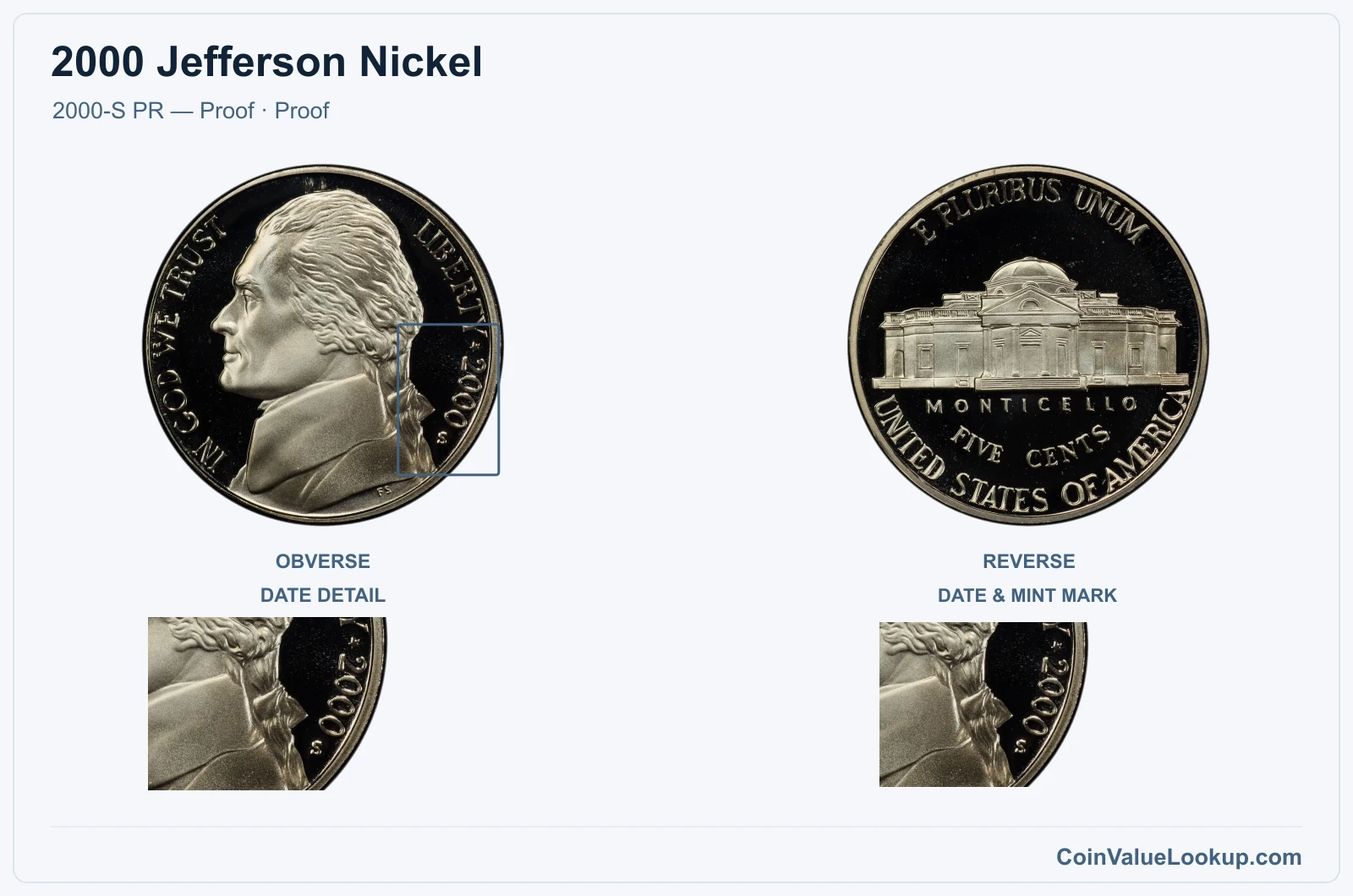
The 2000-S proof was produced at the San Francisco Mint exclusively for collector sets, not for circulation. It features mirror-like fields and sharply frosted devices — the hallmark of the proof manufacturing process.
Look for the "S" mintmark on the obverse.
USA Coin Book lists a guide estimate of approximately $3.08 at PR65. That is a starting reference for a generic proof without additional designations.
Proof is a finish, not a grade above Mint State, so a PR65 proof is not inherently "better" than an MS65 business strike — they are different products. Most examples from original mint sets survive in high proof grades.
| Range | Grade | Price | Auction Records | Appraisal |
|---|---|---|---|---|
| PR | PR 1 | — | Coin Identifier | |
| PR 2 | — | Coin Identifier | ||
| PR 3 | — | Coin Identifier | ||
| PR 4 | — | Coin Identifier | ||
| PR 6 | — | Coin Identifier | ||
| PR 8 | — | Coin Identifier | ||
| PR 10 | — | Coin Identifier | ||
| PR 12 | — | Coin Identifier | ||
| PR 15 | — | Coin Identifier | ||
| PR 20 | — | Coin Identifier | ||
| PR 25 | — | Coin Identifier | ||
| PR 30 | — | Coin Identifier | ||
| PR 35 | — | Coin Identifier | ||
| PR 40 | — | Coin Identifier | ||
| PR 45 | — | Coin Identifier | ||
| PR 50 | — | Coin Identifier | ||
| PR 53 | — | Coin Identifier | ||
| PR 55 | — | Coin Identifier | ||
| PR 58 | — | Coin Identifier | ||
| PR 60 | — | Coin Identifier | ||
| PR 61 | — | Coin Identifier | ||
| PR 62 | — | Coin Identifier | ||
| PR 63 | — | Coin Identifier | ||
| PR 64 | — | Coin Identifier | ||
| PR 65 | — | Coin Identifier | ||
| PR 66 | — | Coin Identifier | ||
| PR 67 | — | Coin Identifier | ||
| PR 68 | Coin Identifier | |||
| PR 69 | Coin Identifier | |||
| PR 70 | Coin Identifier |
2000 Jefferson Nickel Error List
1. 2000 Jefferson Nickel — Struck on a cent planchet
A 2000 nickel struck on a cent planchet occurs when a copper-plated zinc blank intended for a Lincoln cent ends up in the nickel press. The result is a coin that weighs around 2.5 grams instead of 5.0 grams, with the nickel's design on a smaller, copper-colored disc.
Outer legends are typically cropped because the blank is too small for the nickel dies.
One known example is a P-mint piece graded NGC MS66 Red. Color alone is not enough to confirm this error — a normal nickel that has been plated or exposed to chemicals can look coppery.
Weight is the critical first check. Professional authentication and attribution are needed to confirm the wrong planchet.
Value depends on the specific coin's condition and how well the error is documented; no standard price range applies.
2. 2000 Jefferson Nickel — Off-center strike
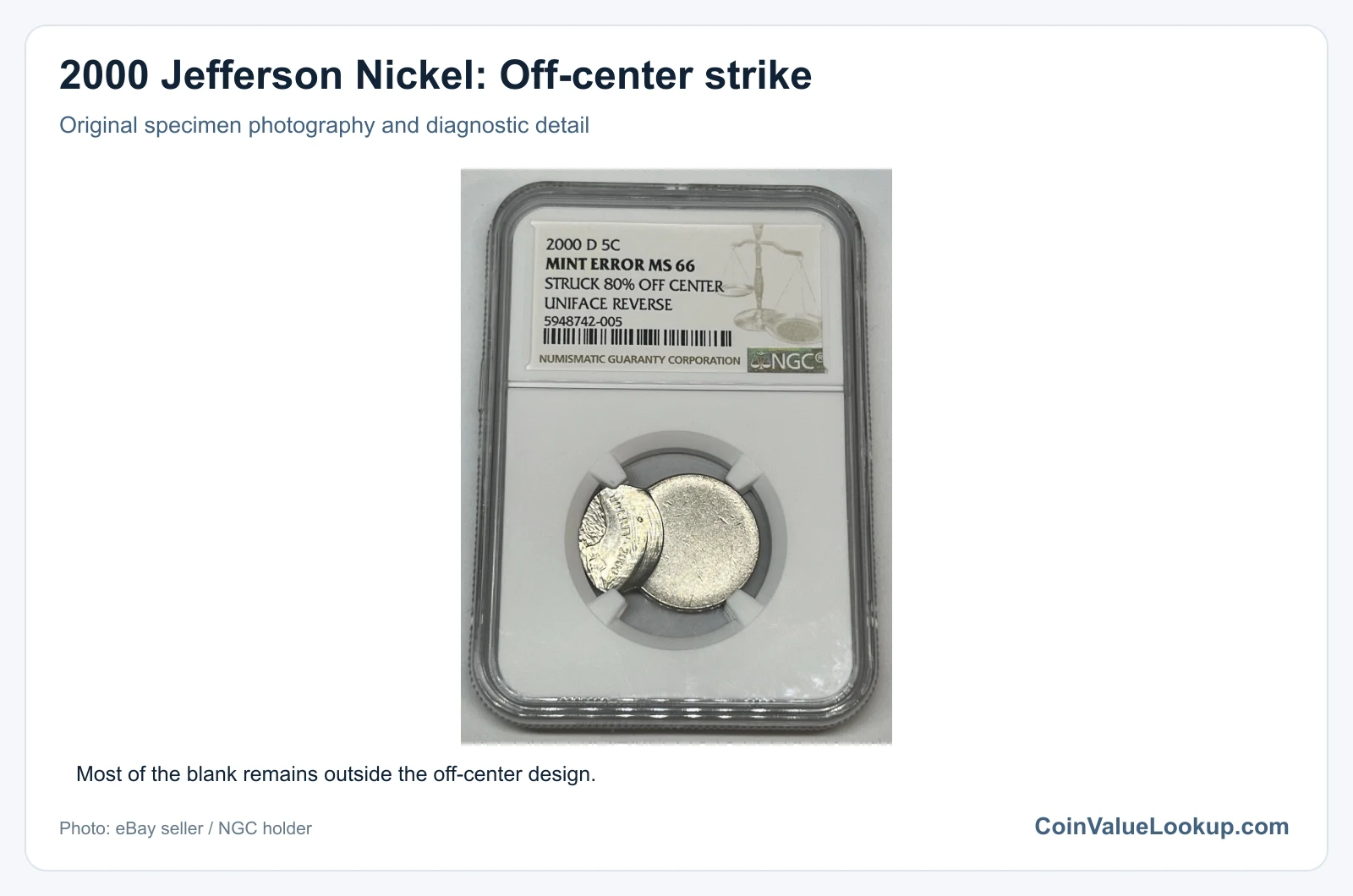
An off-center strike happens when the planchet is not seated properly in the collar, so one side of the coin receives a full impression while the opposite side is blank. The result is a crescent-shaped unstruck area with the design shifted away from center.
One documented example is a 2000-D nickel struck roughly 85% off center at the 4:00 position, graded NGC MS65. That is a dramatic miss — most of the design is absent.
The date must still be visible for the coin to be attributed to 2000. Be careful not to confuse an off-center strike with a misaligned die, a clipped planchet or post-mint rim damage.
Each coin's value depends on the degree of displacement, date visibility and certified grade.
3. 2000 Jefferson Nickel — Triple strike
A triple-struck nickel shows three distinct impressions of the die because the coin failed to eject from the press between strikes. You can see overlapping design elements — multiple outlines of Jefferson's portrait or Monticello — that are clearly separate impressions rather than the flat shelf of machine doubling.
A 2000-P example graded ANACS MS65 sold through Heritage Auctions in October 2022 for $480. That single result is not a guaranteed market price, but it illustrates the premium a dramatic multi-strike error can bring.
Do not confuse this with a doubled die, which is a single impression from a die that was itself improperly made. A vise-job or novelty squeeze can also mimic extra impressions; authentication matters.
4. 2000 Jefferson Nickel — Double denomination on a struck cent
A double-denomination error means a nickel was struck over an already-struck Lincoln cent. On the finished coin you can see residual Lincoln Memorial and Lincoln portrait elements beneath the Jefferson nickel design.
Both denominations coexist on one piece of metal.
One known example is a 2000-P nickel struck over a 2000 Lincoln cent, graded NGC MS67 Red. The copper coloring and undertype design distinguish it from a simple wrong-planchet strike on an unused cent blank.
Because these are rare and dramatic, each coin's value depends on its individual identity, the clarity of both designs and the certified grade. No standard price range exists; professional authentication is essential.
5. 2000 Jefferson Nickel — Die Crack / Die Chip
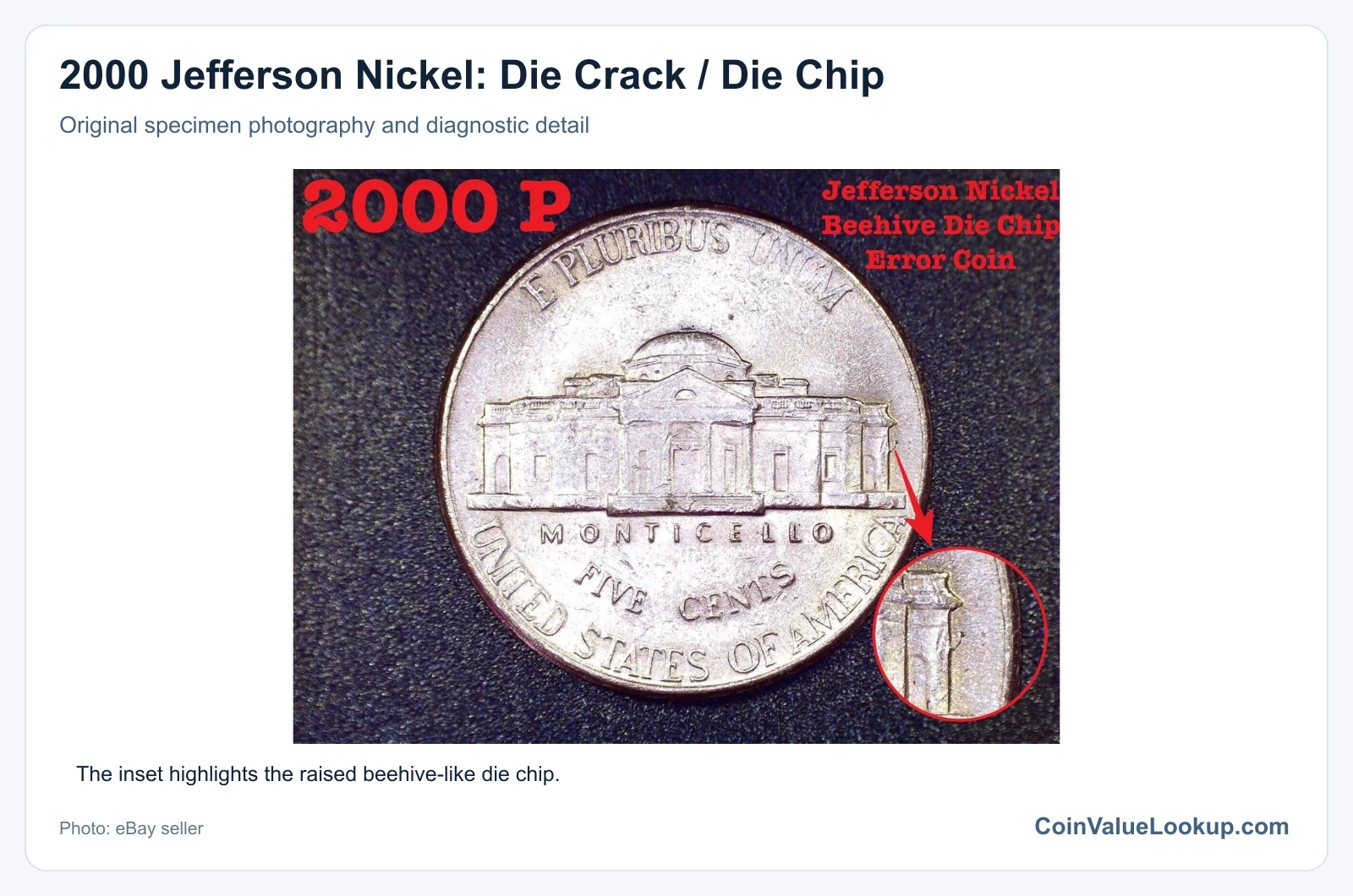
Die cracks and die chips appear as raised lines or small raised blobs on the coin's surface. They originate from damage to the steel die itself — a crack transfers as a thin raised ridge, while a chip leaves a small raised lump where metal filled the void.
A rim-connected break large enough to form a distinct raised area is sometimes called a cud.
The 2000 nickel has been reported with retained die break errors. Condition of the coin, size and location of the break, and whether both sides are affected all influence collectibility.
Do not confuse raised die cracks with incuse scratches, corrosion pitting or foreign material stuck to the surface — those are post-mint issues, not die errors.
6. 2000 Jefferson Nickel — Indented Strike
An indented strike occurs when a second blank or foreign object overlaps the planchet during striking. The result is a bounded depressed area on one side of the coin where the overlapping piece blocked the die, leaving that section with no design detail or a sunken impression.
The 2000 nickel has been reported in this error category. The size and position of the indent determine collector interest — a large, centered indent is more dramatic than a small one near the rim.
Do not confuse an indent with a post-mint dent from being dropped or squeezed. A brockage, by contrast, will show a mirrored design within the depressed area, not a blank depression.
Authentication confirms whether the mark is a genuine strike error.
7. 2000 Jefferson Nickel — Struck-Through Error
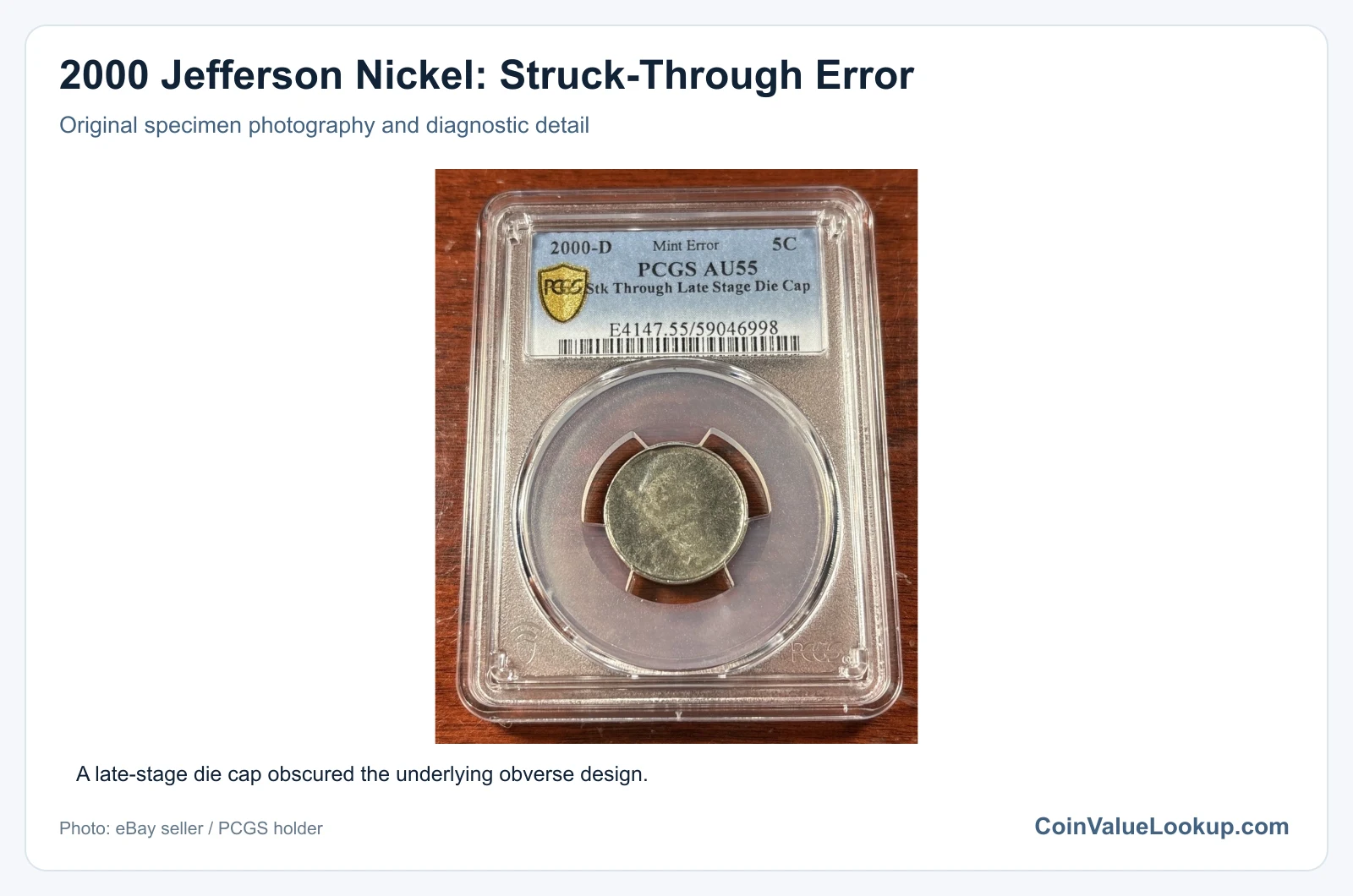
A struck-through error happens when foreign material — often grease, a cloth fragment or a metal shaving — sits between the die and the planchet at the moment of striking. The obstructed area shows a localized depression or incomplete design where the material prevented full contact.
The 2000 nickel has been reported with struck-through-grease errors specifically. Grease fill typically produces a smooth, flat area where design details are simply missing, as opposed to the textured impression left by a retained foreign object.
Do not mistake normal die wear, cleaning damage or ordinary weak strikes for a struck-through error. Value depends on how large the affected area is, which design elements are obscured and the overall coin condition.
8. 2000 Jefferson Nickel — Clashed Dies
Clashed dies result when the obverse and reverse dies strike each other without a planchet between them. The impact transfers faint traces of one die's design onto the opposing die.
Every coin struck afterward carries ghostly outlines of the opposite side's features in the fields.
On a 2000 nickel, look for traces of Monticello's outline in the open field around Jefferson's portrait, or parts of Jefferson's profile visible in the fields around Monticello. These marks align with the expected opposite-die features — random scratches or raised lines from damage will not line up that way.
A brockage is a different error entirely, involving a struck coin rather than a bare die. Value depends on the strength and visibility of the clash marks.
9. 2000 Jefferson Nickel — Misaligned Die
A misaligned die error occurs when one die is shifted horizontally relative to the other, so the obverse and reverse designs are not centered on the same axis. One side of the coin will have a wider rim on one edge and a narrower rim on the opposite edge, while the other side remains normally centered.
This is different from an off-center strike, where the entire planchet is displaced and part of the design is missing. With a misaligned die, the full design is present on both sides — it is just shifted on one face.
Do not confuse it with a tilted photograph or post-mint rim damage. The 2000 nickel has been reported in this category.
The degree of displacement and overall coin condition determine collector interest.
10. 2000 Jefferson Nickel — Improper Annealing
Improper annealing occurs during planchet preparation when the metal is heated incorrectly, producing unusual surface texture or discoloration that carries through the striking process. The coin may look dark, streaky or have a rough, granular surface that differs from a normal mint-luster finish.
The 2000 nickel has been reported with this type of planchet error. Appearance alone is a screening clue, not proof of the cause — environmental toning, corrosion, or exposure to heat after minting can mimic the look.
The edge and overall surface should be compared to a normal example. Professional attribution is necessary to confirm that the discoloration originated before striking rather than after.
Value depends on how clearly the error presents and the coin's certified condition.