2000 Kennedy Half Dollar Coin Value: How Much Is It Worth?
The 2000 Kennedy half dollar carries a face value of fifty cents, and most circulated clad examples are worth exactly that. Collector guide estimates for specific mint, finish and grade combinations range from roughly $3.62 to $36.00, according to USA Coin Book.
Before you assume yours is ordinary, you need to confirm the mintmark, material and finish — proofs and silver issues occupy a different price tier entirely.
Fast Way to Identify Your 2000 Kennedy Half Dollar
Snap a clear photo of the front and back of your 2000 half dollar and upload both images. Our identifier can give you a preliminary read on the mint, finish and general condition.
It is not a substitute for professional authentication or exact grading, but it is a solid first step toward figuring out what you have.
2000 Kennedy Half Dollar Value
Upload both sides of your 2000 Kennedy Half Dollar.
Front Obverse
Upload photo
Back Reverse
Upload photo
Which 2000 Kennedy Half Dollar Versions Are Worth Money?
- The 2000-S silver proof commands the highest guide estimate at $36.00 in PR65 — confirm the 90% silver composition before assuming you have one.
- Clad proofs from San Francisco carry a PR65 guide estimate of $6.25, well above face value but far below the silver version.
- Mint-made errors such as off-center strikes, doubled dies or clipped planchets have been reported for this date and can affect value depending on condition and severity.
Step 1: Identify Your 2000 Kennedy Half Dollar Mint Mark and Version
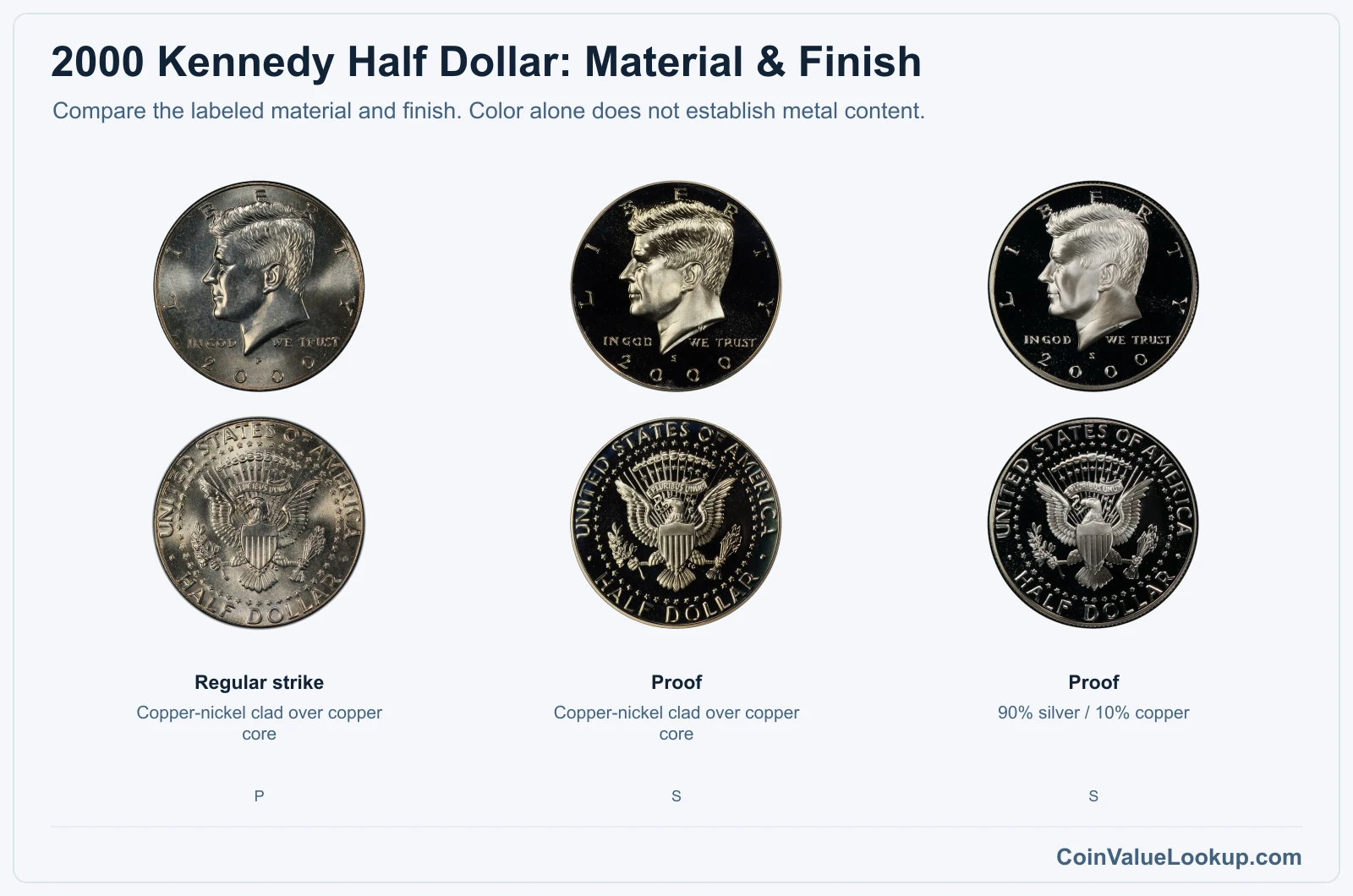
Start with the mintmark. It sits on the obverse just below Kennedy's portrait, above the date.
A "P" means Philadelphia, "D" means Denver, and "S" means San Francisco. Philadelphia coins from 1980 onward carry the P mark.
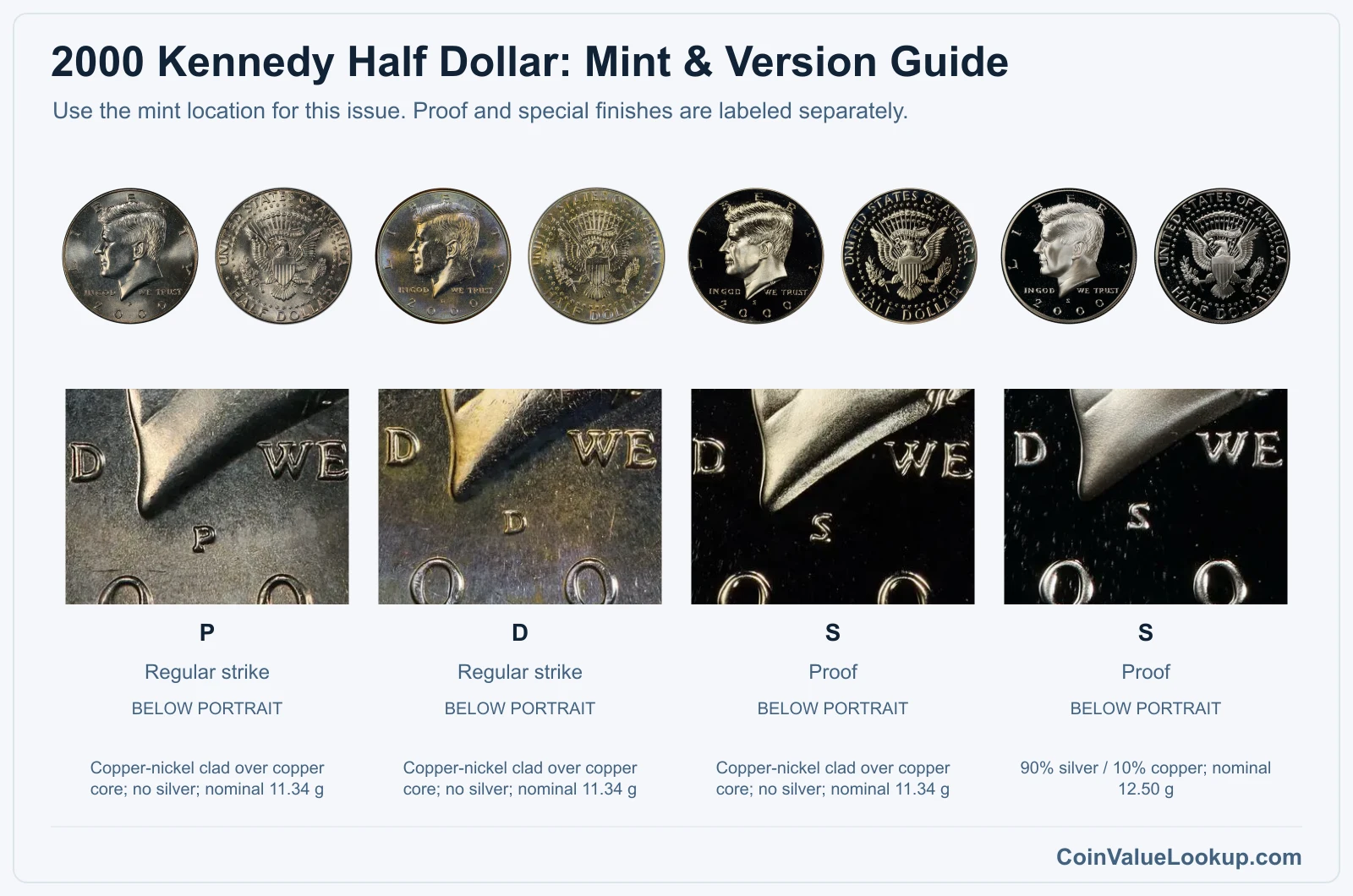
Both P and D strikes are copper-nickel clad business issues — no silver content. The S mint produced two distinct proof versions this year: a clad proof and a 90% silver proof.
Same mintmark, different metal.
To tell them apart, compare weight and edge. The silver proof weighs about 12.50 grams versus roughly 11.34 grams for the clad.
On the edge of a clad coin you may see the copper core peeking through; a silver proof has a uniform silver-white edge. Toning, lighting and wear can fool you, so weigh the coin if you are uncertain.
The initials "FG" on the reverse near the eagle's tail feathers belong to designer Frank Gasparro. Weak or missing initials from die wear or grease fill are not automatically a recognized variety — confirm with a reputable grading service before drawing conclusions.
Step 2: Check Your 2000 Kennedy Half Dollar Grade
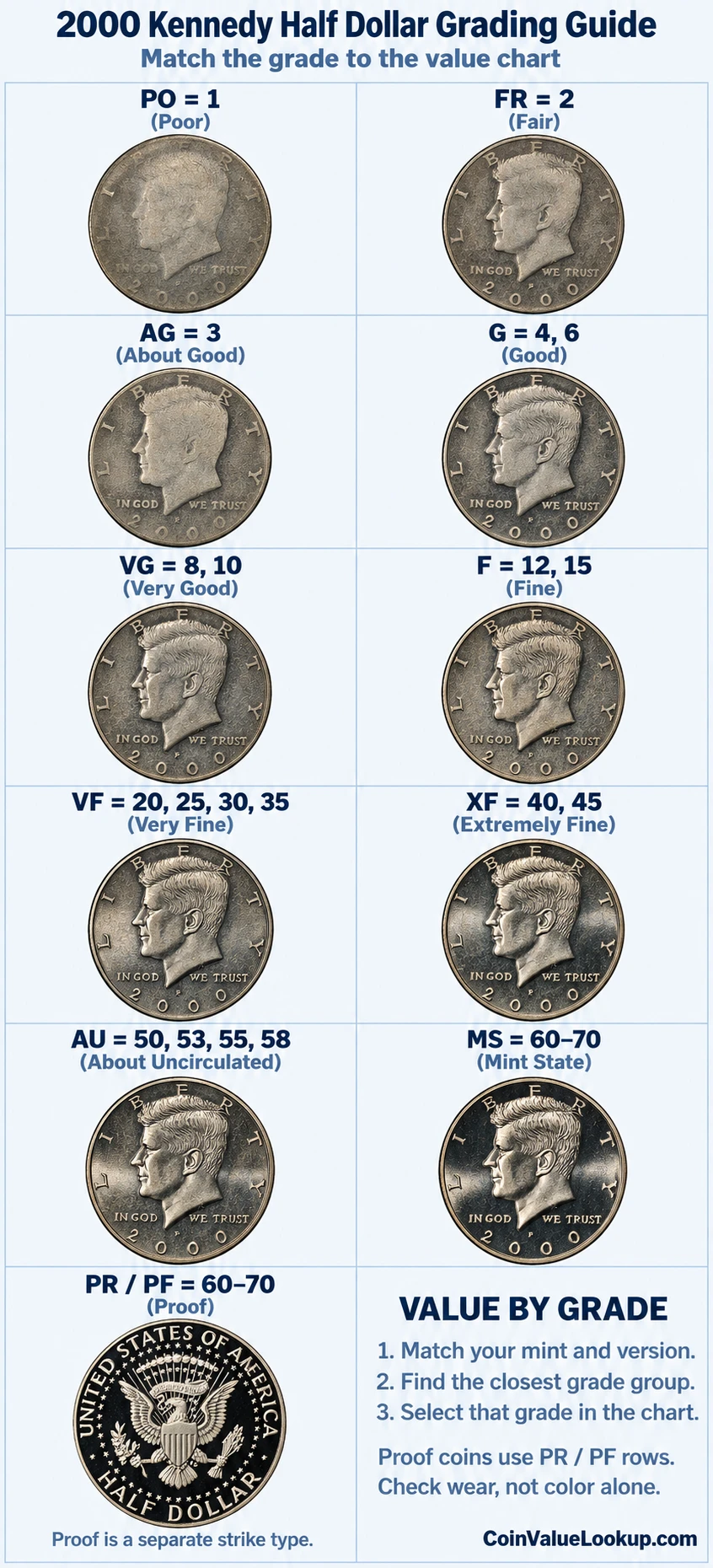
Focus on Kennedy's cheek and jawline first. That flat area picks up wear quickly, so any smoothing there tells you the coin has circulated.
Then check the hair above the ear — on a fresh Mint State coin those strands are sharp and individually defined.
Flip the coin over and examine the eagle's breast and the tops of the wing feathers. Rub marks here are another early sign of wear.
A coin can look shiny and still grade below Mint State if those high points are flat.
Bag marks are a different animal. They come from coins banging together in mint bags, not from spending.
A half dollar covered in tiny nicks might still be uncirculated, but it will grade lower than a clean example. Use the comparison image to calibrate your eye.
Proofs deserve their own standard. Grade them by looking for hairlines from mishandling, haze on the mirror fields and contact marks on the frosted devices.
A proof with heavy hairlines can grade well below one with clean surfaces, even if neither ever saw a cash register.
Step 3: Check 2000 Kennedy Half Dollar Value by Mint and Version
2000 Kennedy Half Dollar — P — clad business
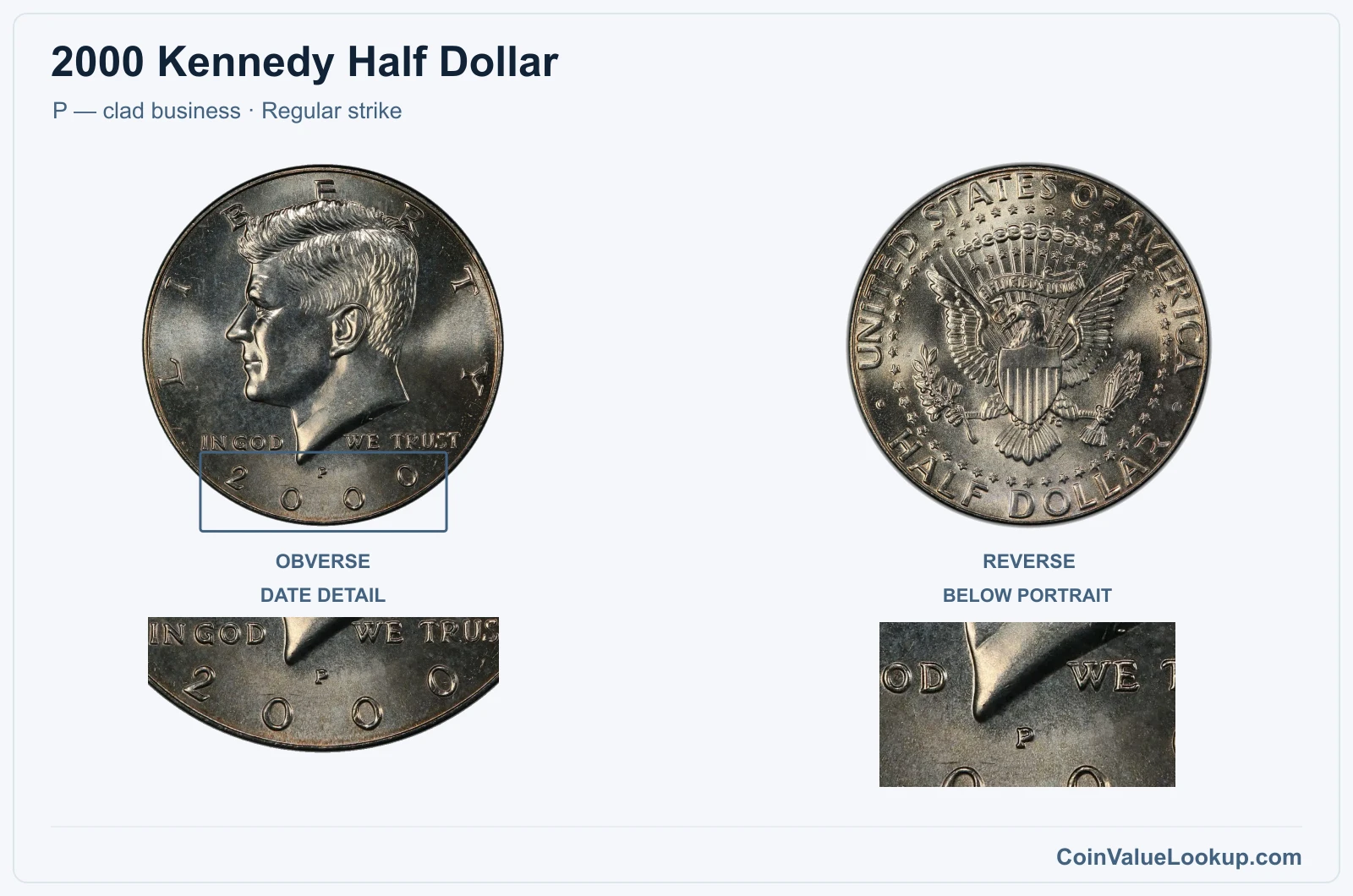
The 2000-P is the Philadelphia business strike, made from copper-nickel clad and weighing about 11.34 grams. Look for the "P" mintmark beneath Kennedy's portrait.
Millions were struck, so circulated examples trade at face value without a second thought.
In well-preserved condition the picture changes slightly. A USA Coin Book guide estimate puts an MS65 example at around $3.62.
That is not retirement money, but it does mean a sharp, mark-free roll coin is worth pulling aside.
Range Grade
Price Auction Records Appraisal PO PO 1
—
Coin Identifier FR FR 2
—
Coin Identifier AG AG 3
—
Coin Identifier G G 4
—
Coin Identifier
G 6
—
Coin Identifier VG VG 8
—
Coin Identifier
VG 10
—
Coin Identifier F F 12
—
Coin Identifier
F 15
—
Coin Identifier VF VF 20
—
Coin Identifier
VF 25
—
Coin Identifier
VF 30
—
Coin Identifier
VF 35
—
Coin Identifier XF XF 40
—
Coin Identifier
XF 45
—
Coin Identifier AU AU 50
—
Coin Identifier
AU 53
—
Coin Identifier
AU 55
—
Coin Identifier
AU 58
—
Coin Identifier MS MS 60
—
Coin Identifier
MS 61
—
Coin Identifier
MS 62
—
Coin Identifier
MS 63
—
Coin Identifier
MS 64
Coin Identifier
MS 65
—
Coin Identifier
MS 66
—
Coin Identifier
MS 67
Coin Identifier
MS 68
Coin Identifier
MS 69
—
—
—
MS 70
—
—
—
2000 Kennedy Half Dollar — D — clad business
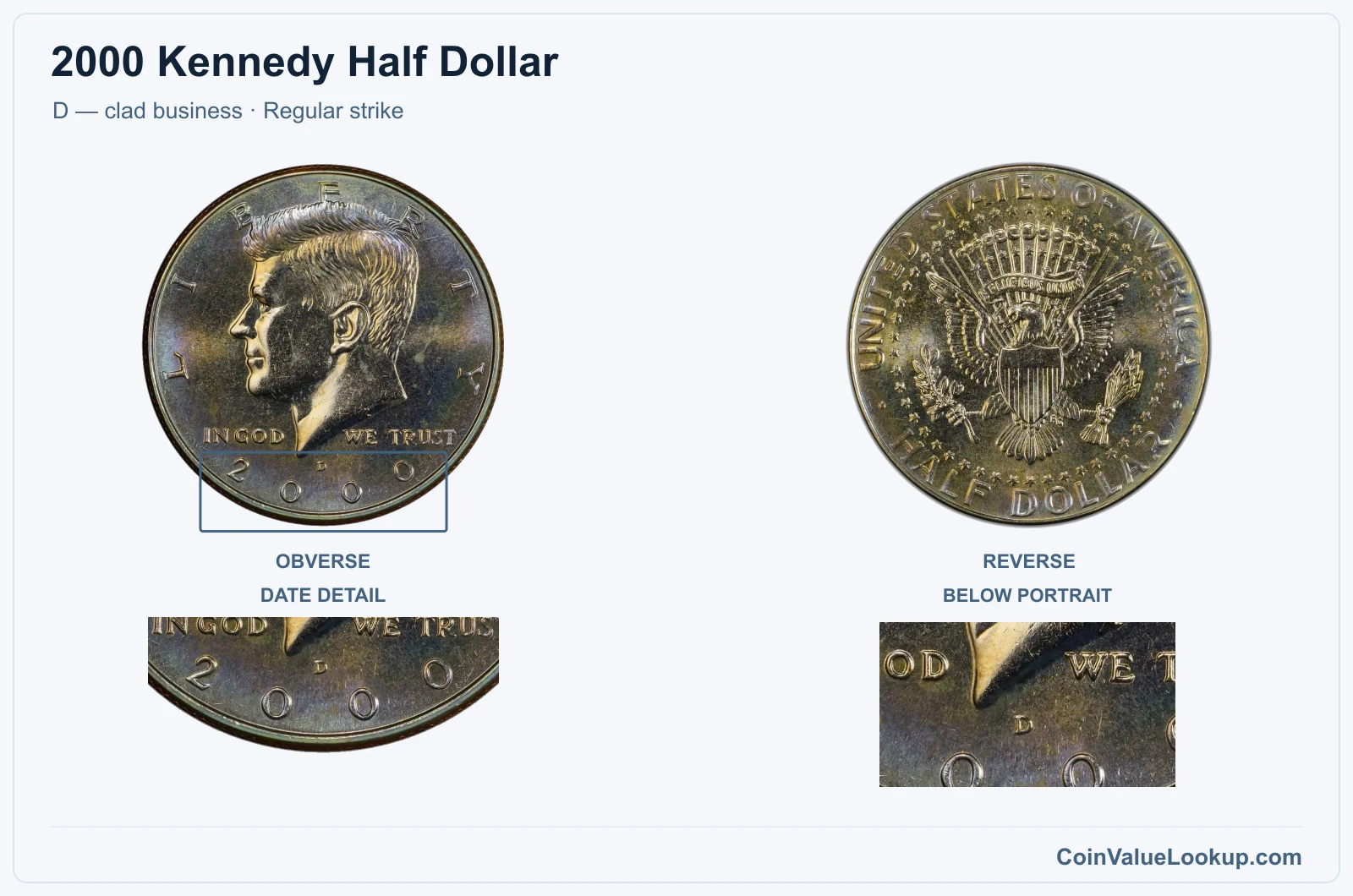
The 2000-D is Denver's clad business strike — same copper-nickel composition and 11.34-gram weight as the Philadelphia issue. The "D" mintmark sits in the same spot below Kennedy's portrait.
Circulated pieces are face-value coins. The USA Coin Book guide estimate for an MS65 example is about $3.62.
As with the P, it takes a coin with minimal bag marks and full luster to reach that level. If yours came from a bank roll and still looks untouched, it is worth a closer look.
Coin Value Lookup is a good starting point if you want to compare values for other Kennedy half dollar dates and mints.
Range Grade
Price Auction Records Appraisal PO PO 1
—
Coin Identifier FR FR 2
—
Coin Identifier AG AG 3
—
Coin Identifier G G 4
—
Coin Identifier
G 6
—
Coin Identifier VG VG 8
—
Coin Identifier
VG 10
—
Coin Identifier F F 12
—
Coin Identifier
F 15
—
Coin Identifier VF VF 20
—
Coin Identifier
VF 25
—
Coin Identifier
VF 30
—
Coin Identifier
VF 35
—
Coin Identifier XF XF 40
—
Coin Identifier
XF 45
—
Coin Identifier AU AU 50
—
Coin Identifier
AU 53
—
Coin Identifier
AU 55
—
Coin Identifier
AU 58
—
Coin Identifier MS MS 60
—
Coin Identifier
MS 61
—
Coin Identifier
MS 62
—
Coin Identifier
MS 63
—
Coin Identifier
MS 64
Coin Identifier
MS 65
Coin Identifier
MS 66
Coin Identifier
MS 67
Coin Identifier
MS 68
—
—
—
MS 69
—
—
—
MS 70
—
—
—
2000 Kennedy Half Dollar — S — clad proof
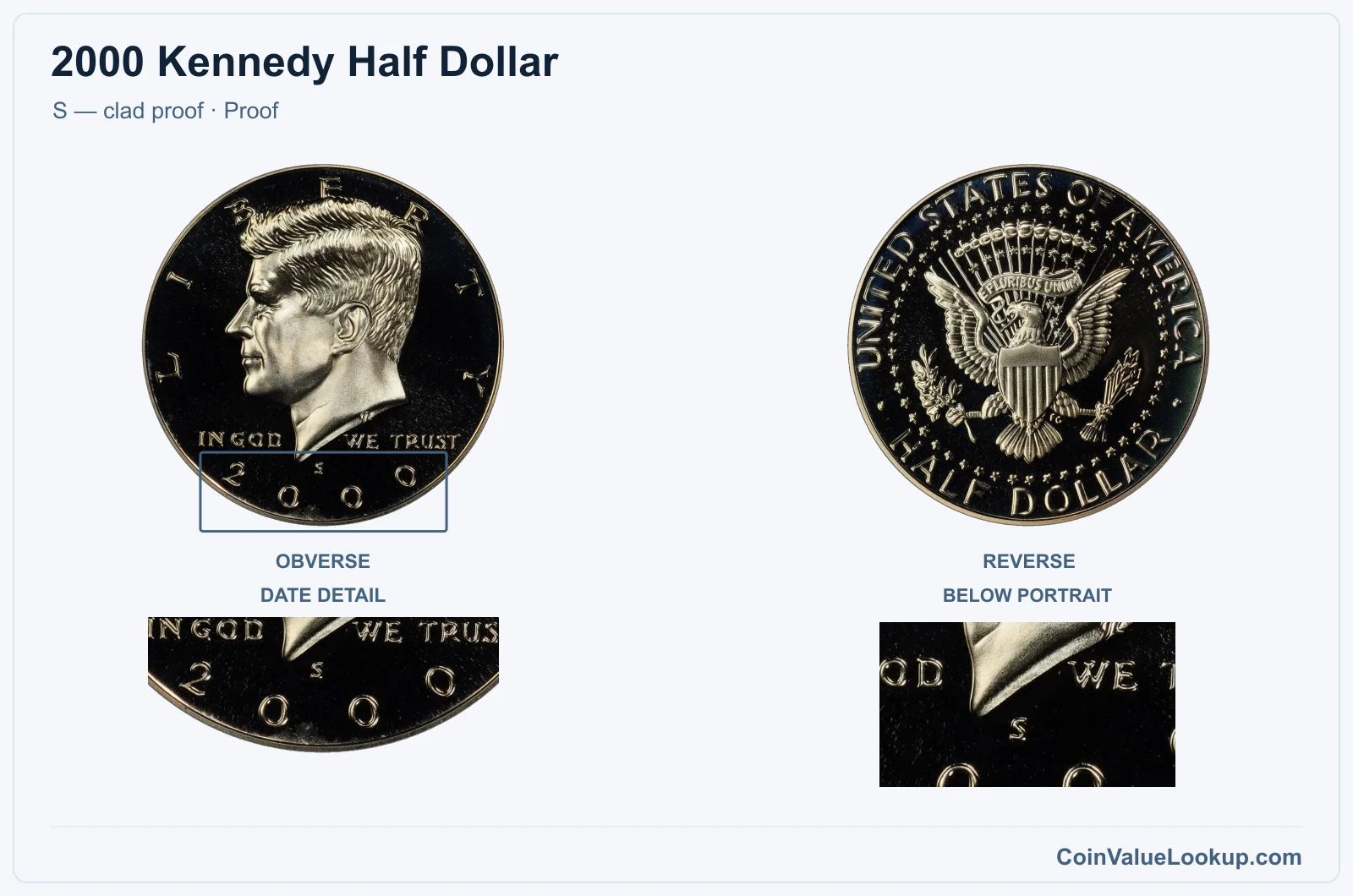
The 2000-S clad proof was produced at San Francisco for collector sets. It is copper-nickel clad — no silver — despite sharing the "S" mintmark with the silver proof.
Look for mirror-like fields and frosted raised devices; that combination is the hallmark of proof manufacture.
USA Coin Book estimates a PR65 example at $6.25. Grade depends heavily on surface quality: hairlines from improper handling, haze on the fields, or contact marks on the portrait all drag the grade down.
If yours came sealed in the original government packaging, it is likely in solid shape.
Range Grade
Price Auction Records Appraisal PR PR 1
—
Coin Identifier
PR 2
—
Coin Identifier
PR 3
—
Coin Identifier
PR 4
—
Coin Identifier
PR 6
—
Coin Identifier
PR 8
—
Coin Identifier
PR 10
—
Coin Identifier
PR 12
—
Coin Identifier
PR 15
—
Coin Identifier
PR 20
—
Coin Identifier
PR 25
—
Coin Identifier
PR 30
—
Coin Identifier
PR 35
—
Coin Identifier
PR 40
—
Coin Identifier
PR 45
—
Coin Identifier
PR 50
—
Coin Identifier
PR 53
—
Coin Identifier
PR 55
—
Coin Identifier
PR 58
—
Coin Identifier
PR 60
—
Coin Identifier
PR 61
—
Coin Identifier
PR 62
—
Coin Identifier
PR 63
Coin Identifier
PR 64
—
Coin Identifier
PR 65
—
Coin Identifier
PR 66
—
Coin Identifier
PR 67
Coin Identifier
PR 68
—
Coin Identifier
PR 69
Coin Identifier
PR 70
Coin Identifier
2000 Kennedy Half Dollar — S — silver proof
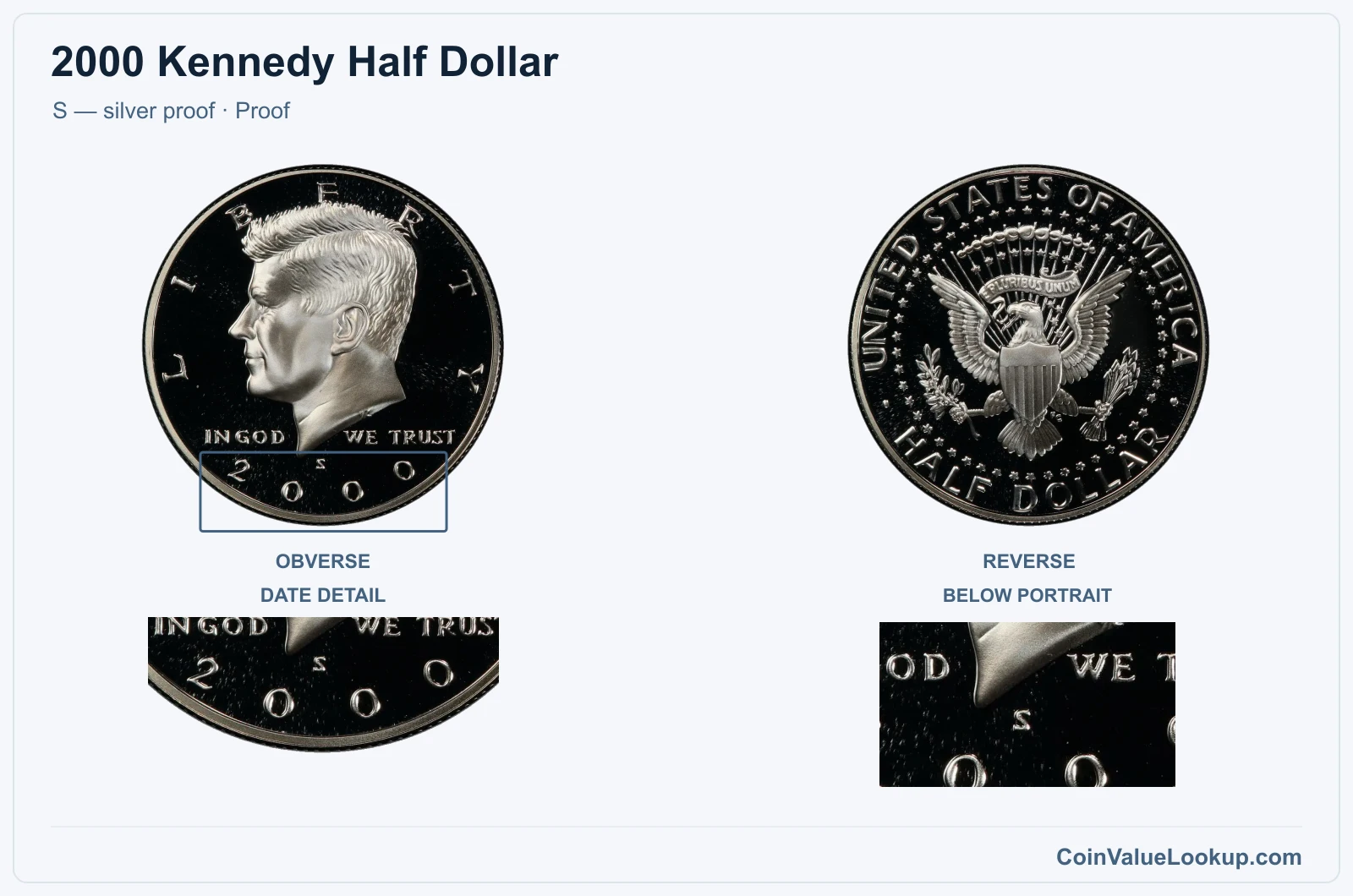
This is the one people are looking for. The 2000-S silver proof is struck in 90% silver and 10% copper, weighing approximately 12.50 grams — noticeably heavier than the 11.34-gram clad version.
Both carry an "S" mintmark, so weight or edge inspection is the deciding factor.
USA Coin Book puts the PR65 guide estimate at $36.00, making it the most valuable standard-issue branch for this date by a wide margin. That premium comes from the silver content combined with the proof finish and lower collector-set mintage.
Check the edge carefully. A silver proof shows a consistent silver-white color all the way through, while the clad proof may reveal a darker copper-toned core stripe.
When in doubt, a precise scale settles the question fast.
Range Grade
Price Auction Records Appraisal PR PR 1
—
Coin Identifier
PR 2
—
Coin Identifier
PR 3
—
Coin Identifier
PR 4
—
Coin Identifier
PR 6
—
Coin Identifier
PR 8
—
Coin Identifier
PR 10
—
Coin Identifier
PR 12
—
Coin Identifier
PR 15
—
Coin Identifier
PR 20
—
Coin Identifier
PR 25
—
Coin Identifier
PR 30
—
Coin Identifier
PR 35
—
Coin Identifier
PR 40
—
Coin Identifier
PR 45
—
Coin Identifier
PR 50
—
Coin Identifier
PR 53
—
Coin Identifier
PR 55
—
Coin Identifier
PR 58
—
Coin Identifier
PR 60
—
Coin Identifier
PR 61
—
Coin Identifier
PR 62
—
Coin Identifier
PR 63
Coin Identifier
PR 64
—
Coin Identifier
PR 65
—
Coin Identifier
PR 66
—
Coin Identifier
PR 67
Coin Identifier
PR 68
—
Coin Identifier
PR 69
Coin Identifier
PR 70
Coin Identifier
2000 Kennedy Half Dollar Error List
1. 2000 Kennedy Half Dollar — Off-Center Strike
An off-center strike happens when the planchet is not seated properly between the dies. The result is a displaced design with an unstruck crescent of blank metal along one edge.
The more dramatic the shift, the more collector interest — but the date and mintmark should still be visible for maximum appeal.
Condition and the degree of misalignment both matter when assessing value; no single guide price covers every scenario. Look at the crescent edge: it should be raw blank metal, not a filed or damaged rim.
A clipped planchet or post-mint flattening can mimic parts of this error, so compare carefully before concluding you have an off-center piece.
2. 2000 Kennedy Half Dollar — Doubled Die Obverse
A doubled die obverse on a 2000 Kennedy half shows consistent doubling in the lettering, date or portrait details on the front of the coin. The key word is consistent — every example struck from that die should show the same separation or notching in the same places.
Compare your coin to a normal example under the same lighting. Genuine hub doubling produces a distinct secondary image with depth, not a flat shelf.
Machine doubling, which is far more common, tends to look like a shiny, flat shelf of displaced metal and carries little premium. Reflections and worn die contours can also create misleading shadows.
Value depends on the strength and visibility of the doubling, plus overall coin condition.
3. 2000 Kennedy Half Dollar — Doubled Die Reverse
A doubled die reverse affects the back of the coin — the eagle, lettering or other design elements. Like the obverse version, true hub doubling is die-specific and repeatable across every coin struck from that die.
Examine reverse legends and design contours against a normal 2000 half dollar. Look for clear separation or notching in the same spot on multiple letters rather than a single random anomaly.
Machine doubling leaves a flat, shelf-like displacement and is far less collectible. Random nicks or damage can also trick the eye under magnification.
No specific guide price is available here. Value depends on which die, how strong the doubling is and the coin's condition.
4. 2000 Kennedy Half Dollar — Clipped Planchet
A clipped planchet error means part of the blank was missing before the coin was struck. It can appear as a curved bite (most common), a straight edge or a ragged section, depending on what went wrong at the blanking stage.
Look at the affected area closely. Genuine clips often show metal-flow weakness on the opposite side of the coin — the strike could not fully fill the die where the metal was missing.
The edge at the clip should look natural, not filed or cut. Post-mint damage like someone taking a pair of tin snips to the rim is a different story entirely.
Value depends on the size and type of clip plus overall condition. No standard guide price is available for this error on the 2000 date.
5. 2000 Kennedy Half Dollar — Improper Annealing
An improperly annealed planchet did not receive the correct heat treatment before striking. The visual result can range from dark, streaky discoloration to an unusual matte or rough surface texture that looks nothing like a normal coin.
This one is tricky to confirm at home. Environmental toning, corrosion and coins exposed to heat after they left the mint can all produce similar appearances.
The surface texture and the way it interacts with the design details are screening clues, not definitive proof of a mint error.
No guide price is available for this error on the 2000 Kennedy half. Professional attribution is especially useful here because the line between a mint process error and post-mint damage is blurry without metallurgical context.
6. 2000 Kennedy Half Dollar — Rotated Dies
A rotated die error means one die was turned from its normal position during striking. On a standard US coin, if you hold the obverse upright and flip the coin top to bottom, the reverse should also appear upright.
Any deviation from that alignment is a rotation.
Small rotations of a few degrees are relatively common and do not generate much collector excitement. Larger rotations — say 45 degrees or more — are scarcer and more visually dramatic.
A full 180-degree rotation, called a medal turn, is the most sought after.
Before you celebrate, make sure you are not just looking at a rotated photograph or holding the coin at an angle. Flip the coin physically along its vertical axis and compare.
No specific guide price is adopted for rotated die errors on the 2000 half dollar; value varies with the degree of rotation and overall condition.