2006 Kennedy Half Dollar Coin Value: How Much Is It Worth?
The 2006 Kennedy half dollar carries a face value of 50 cents, and most worn clad examples are worth exactly that. Collector guide estimates for specific mint, finish and grade combinations range from about $2.50 to $32.00 according to USA Coin Book.
Before checking a price chart, you need to identify whether your coin is an ordinary business strike, a satin specimen from a mint set, a clad proof or a silver proof. Each branch has its own value track.
Fast Way to Identify Your 2006 Kennedy Half Dollar
The quickest way to start is to snap clear photos of both sides of your coin and upload them here. A preliminary identification can help you figure out the mint, finish type and general condition so you know which branch of the value chart applies.
Good lighting and a steady hand go a long way.
2006 Kennedy Half Dollar Value
Upload both sides of your 2006 Kennedy Half Dollar.
Front Obverse
Upload photo
Back Reverse
Upload photo
Which 2006 Kennedy Half Dollar Versions Are Worth Money?
- The 2006-S silver proof at PR65 carries a USA Coin Book guide estimate of $32.00, the highest listed value among the year's branches, driven by its 90% silver content.
- Satin-finish specimens from both P and D mints are a distinct collector finish; value depends on authenticated identity and condition rather than a standard business-strike scale.
- Clad proofs from San Francisco carry a PR65 guide estimate of $6.25, well above face value when properly preserved.
- Mint-made errors such as doubled dies, off-center strikes and wrong-planchet coins have been reported for 2006 and can carry premiums based on visibility and severity.
Step 1: Identify Your 2006 Kennedy Half Dollar Mint Mark and Version
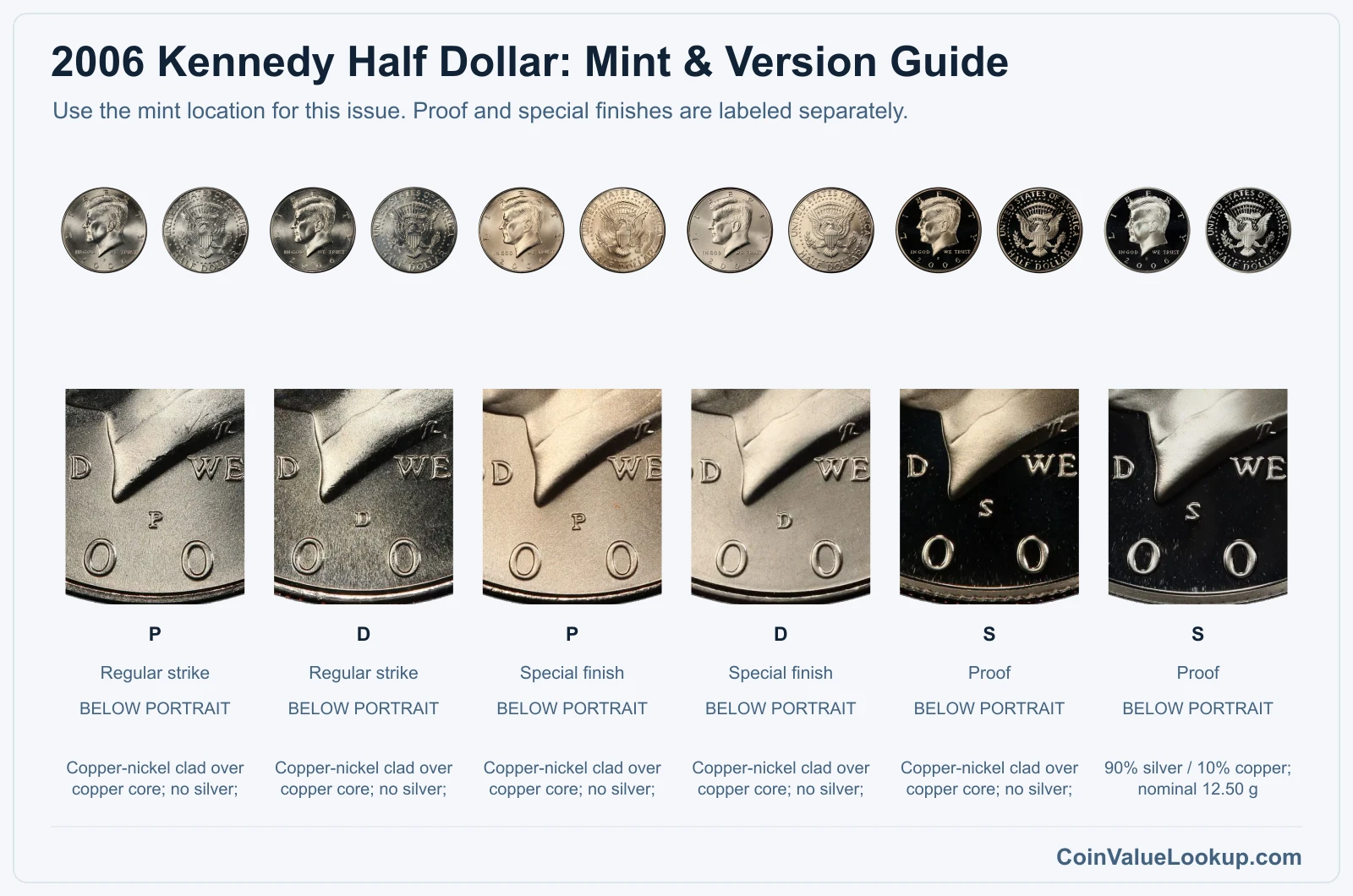
Flip your coin to the obverse, Kennedy's portrait side. The mintmark sits beneath the portrait, just above the date.
A "P" means Philadelphia, a "D" means Denver, and an "S" means San Francisco. All three mints produced 2006 halves, but each in different finishes.
Philadelphia and Denver struck both ordinary business-strike coins and special satin-finish specimens packaged in uncirculated mint sets. San Francisco produced clad proofs and 90% silver proofs.
The S mintmark alone does not tell you whether you have a clad or silver proof.
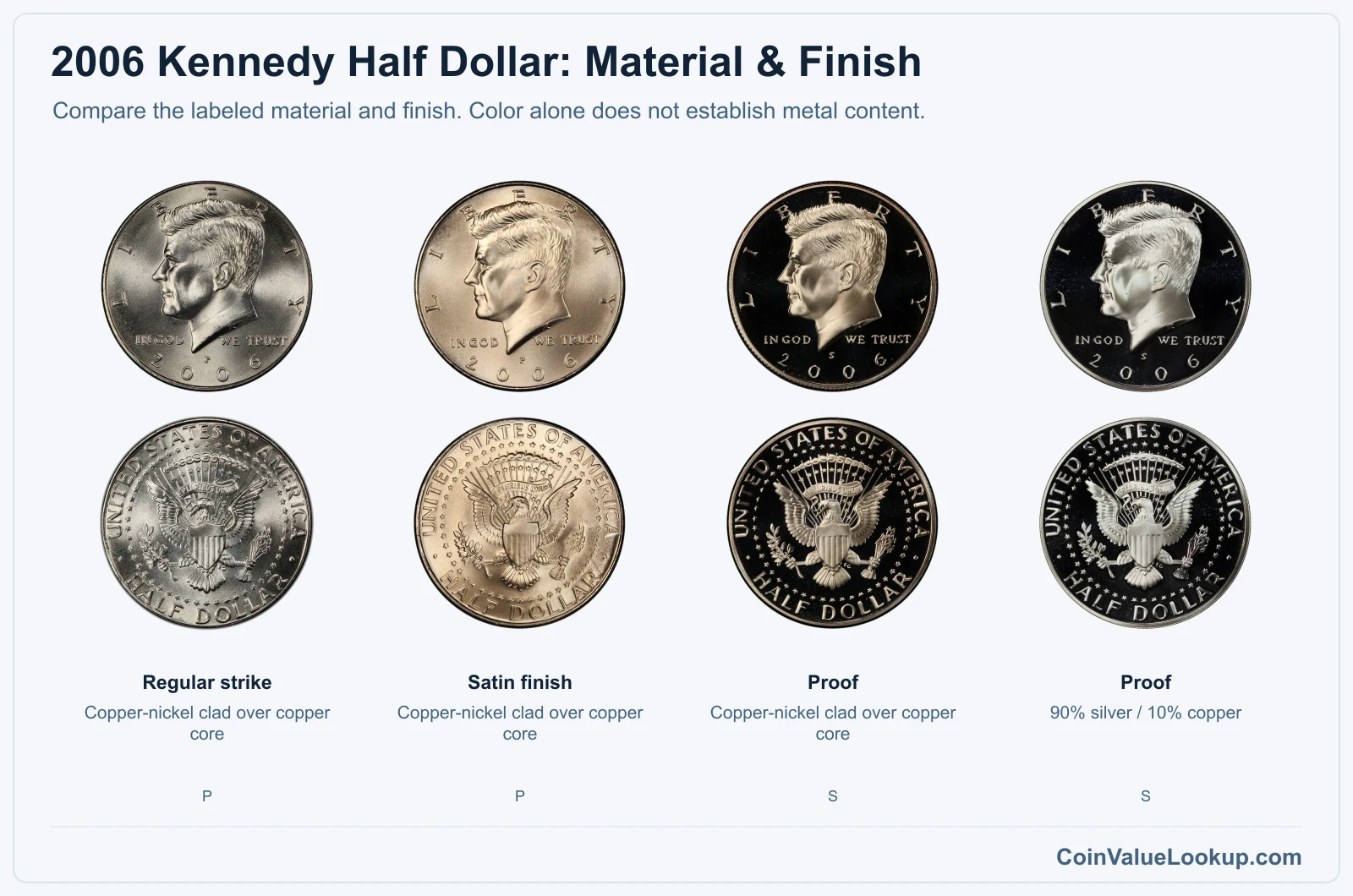
To separate clad from silver, compare weight. A standard clad half weighs about 11.34 grams; the 90% silver proof weighs about 12.50 grams.
If you do not have a scale, check the edge. A clad coin shows a visible copper-colored stripe between the outer layers, while a silver proof edge is uniformly silver-toned.
Toning, plating and lighting can fool the eye, so weigh when possible.
Satin specimens have a distinctive soft, matte-like texture across both fields and devices. That finish was intentional, not a sign of wear.
If your coin came from a sealed 2006 mint set, it is almost certainly the satin version. Do not confuse ordinary dullness or light wear with a satin surface.
Step 2: Check Your 2006 Kennedy Half Dollar Grade
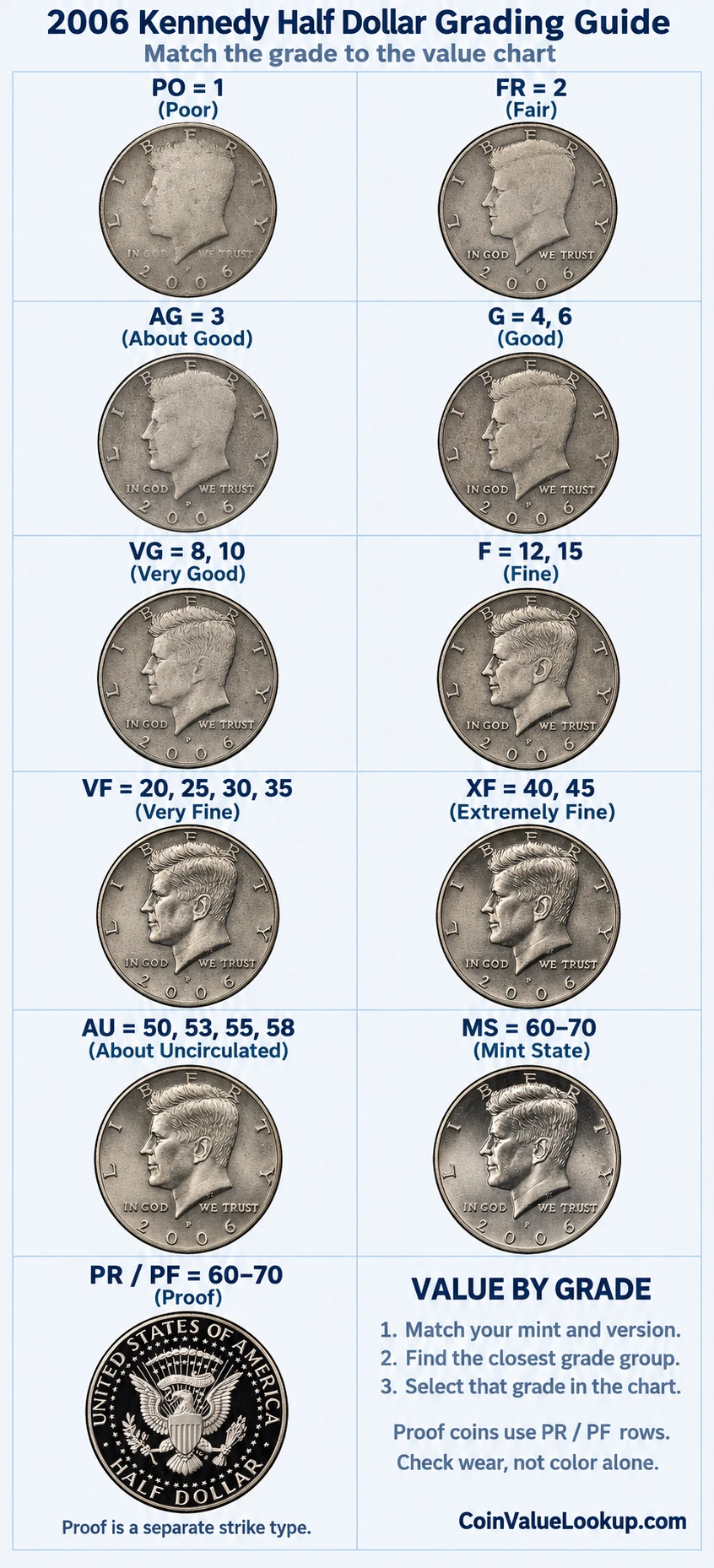
Start by looking at Kennedy's cheek and the line of his jaw. On a well-preserved coin these areas are smooth but show full original luster.
As the coin circulates, the cheek flattens first and loses its rounded contour.
Next examine the hair above his ear. High-grade coins retain every strand; lower grades show progressive blending until the hair becomes a featureless patch.
On the reverse, check the eagle's breast feathers and the tops of the wings for the same kind of smoothing.
Bag marks are different from wear. A coin can be technically uncirculated yet covered in tiny nicks from jostling against other coins in a mint bag.
These contact marks lower the grade without indicating circulation. Use the comparison image to gauge the difference.
Proofs are graded on a separate scale. Look for hairlines, which are fine scratches from handling or improper cleaning, and haze that clouds the mirror fields.
A pristine proof has deep reflective fields with sharp frosted devices and zero contact marks.
Step 3: Check 2006 Kennedy Half Dollar Value by Mint and Version
2006 Kennedy Half Dollar — P — clad business
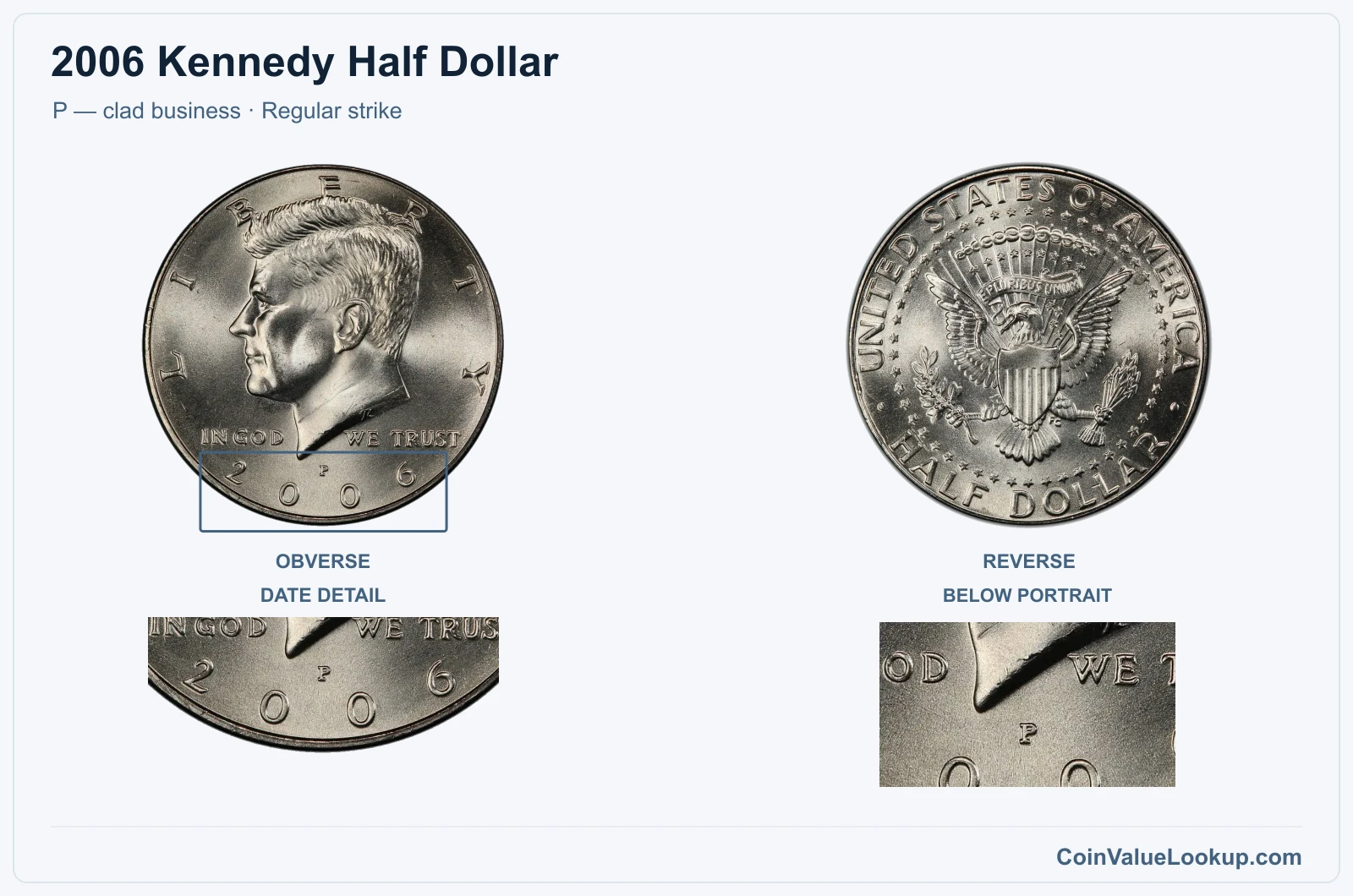
The 2006-P business-strike half dollar is copper-nickel clad over a copper core, weighing about 11.34 grams. Look for the "P" mintmark beneath Kennedy's portrait.
These were produced primarily for collector distribution rather than everyday pocket change, so many survive in original high-grade condition.
At MS65, USA Coin Book lists a guide estimate of $2.50. Worn examples that ended up in circulation after someone broke open a set are typically worth face value.
If your coin still has original luster and minimal bag marks, it sits in that collectible range.
Range Grade
Price Auction Records Appraisal PO PO 1
—
Coin Identifier FR FR 2
—
Coin Identifier AG AG 3
—
Coin Identifier G G 4
—
Coin Identifier
G 6
—
Coin Identifier VG VG 8
—
Coin Identifier
VG 10
—
Coin Identifier F F 12
—
Coin Identifier
F 15
—
Coin Identifier VF VF 20
—
Coin Identifier
VF 25
—
Coin Identifier
VF 30
—
Coin Identifier
VF 35
—
Coin Identifier XF XF 40
—
Coin Identifier
XF 45
—
Coin Identifier AU AU 50
—
Coin Identifier
AU 53
—
Coin Identifier
AU 55
—
Coin Identifier
AU 58
—
Coin Identifier MS MS 60
—
Coin Identifier
MS 61
—
Coin Identifier
MS 62
—
Coin Identifier
MS 63
—
Coin Identifier
MS 64
—
Coin Identifier
MS 65
—
Coin Identifier
MS 66
Coin Identifier
MS 67
Coin Identifier
MS 68
Coin Identifier
MS 69
—
—
—
MS 70
—
—
—
2006 Kennedy Half Dollar — P — clad satin specimen
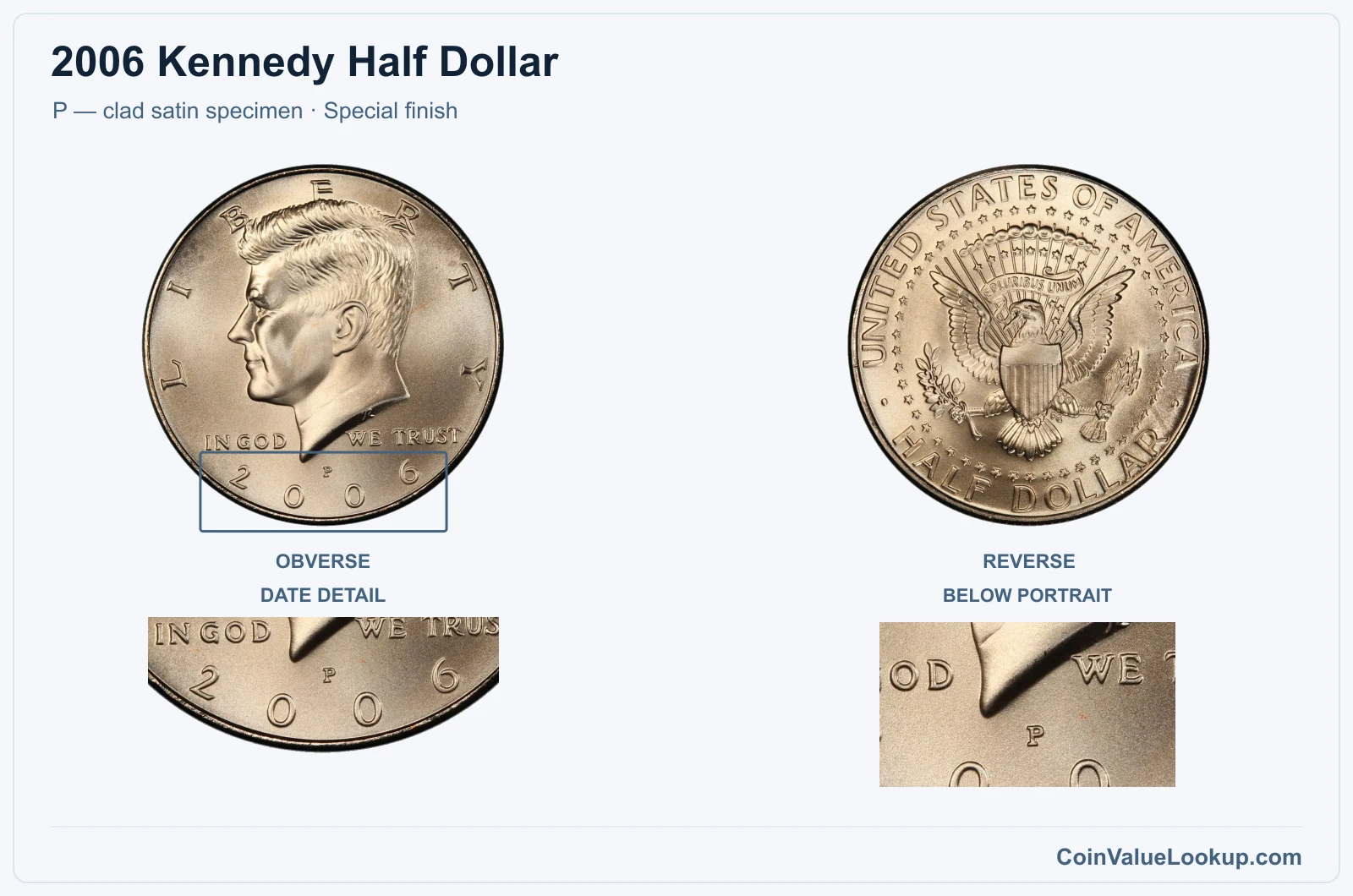
The 2006-P satin specimen was packaged in the official uncirculated mint set and has a deliberately soft, even surface texture across both sides. It is the same copper-nickel clad composition and weight as the business strike, but the manufacturing finish is different, so it belongs on a separate value track.
Do not call a coin satin just because it looks dull. Genuine satin specimens have a uniform matte sheen across fields and devices, without the cartwheel luster of a business strike.
If your coin came sealed in a 2006 mint set, that is strong evidence. Value depends on authenticated identity and condition; no standard guide estimate is adopted for this branch.
Coin Value Lookup can help you look up other Kennedy half dollar years and finishes if you are sorting through a collection.
Range Grade
Price Auction Records Appraisal SP SP 1
—
Coin Identifier
SP 2
—
Coin Identifier
SP 3
—
Coin Identifier
SP 4
—
Coin Identifier
SP 6
—
Coin Identifier
SP 8
—
Coin Identifier
SP 10
—
Coin Identifier
SP 12
—
Coin Identifier
SP 15
—
Coin Identifier
SP 20
—
Coin Identifier
SP 25
—
Coin Identifier
SP 30
—
Coin Identifier
SP 35
—
Coin Identifier
SP 40
—
Coin Identifier
SP 45
—
Coin Identifier
SP 50
—
Coin Identifier
SP 53
—
Coin Identifier
SP 55
—
Coin Identifier
SP 58
—
Coin Identifier
SP 60
—
Coin Identifier
SP 61
—
Coin Identifier
SP 62
—
Coin Identifier
SP 63
—
Coin Identifier
SP 64
—
Coin Identifier
SP 65
—
Coin Identifier
SP 66
Coin Identifier
SP 67
Coin Identifier
SP 68
Coin Identifier
SP 69
Coin Identifier
SP 70
—
—
—
2006 Kennedy Half Dollar — D — clad business
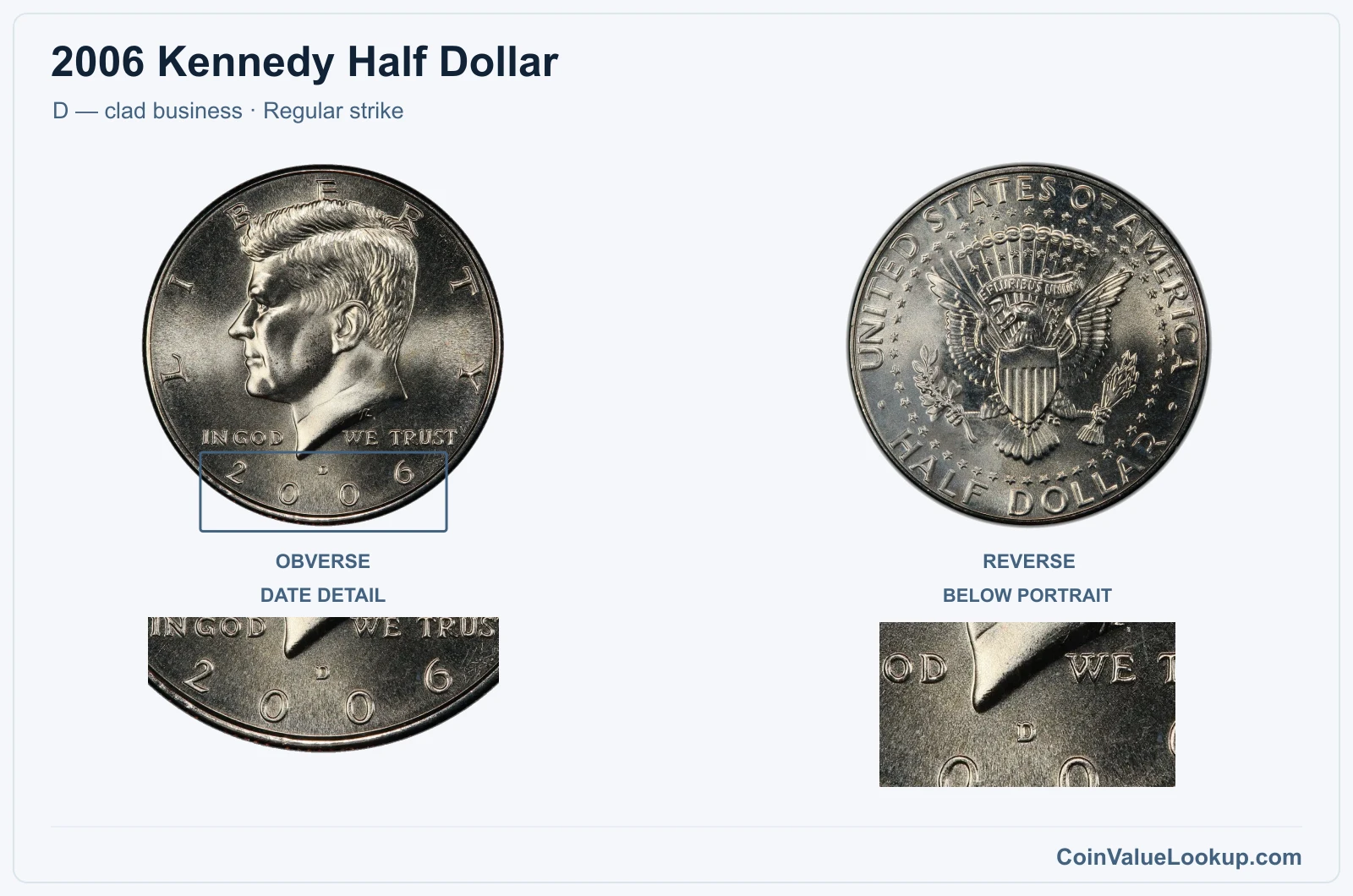
The 2006-D half dollar is the Denver Mint's clad business strike. Check for the "D" mintmark beneath Kennedy's portrait.
Like the Philadelphia issue, most of this year's Denver halves went into mint sets rather than bank rolls, so survivors in high grade are common.
USA Coin Book lists a guide estimate of $2.50 at MS65. A circulated example with visible cheek and hair wear is a face-value coin.
If yours still has full luster, check for bag marks that might keep it below the MS65 threshold.
Range Grade
Price Auction Records Appraisal PO PO 1
—
Coin Identifier FR FR 2
—
Coin Identifier AG AG 3
—
Coin Identifier G G 4
—
Coin Identifier
G 6
—
Coin Identifier VG VG 8
—
Coin Identifier
VG 10
—
Coin Identifier F F 12
—
Coin Identifier
F 15
—
Coin Identifier VF VF 20
—
Coin Identifier
VF 25
—
Coin Identifier
VF 30
—
Coin Identifier
VF 35
—
Coin Identifier XF XF 40
—
Coin Identifier
XF 45
—
Coin Identifier AU AU 50
—
Coin Identifier
AU 53
—
Coin Identifier
AU 55
—
Coin Identifier
AU 58
—
Coin Identifier MS MS 60
—
Coin Identifier
MS 61
—
Coin Identifier
MS 62
—
Coin Identifier
MS 63
—
Coin Identifier
MS 64
—
Coin Identifier
MS 65
—
Coin Identifier
MS 66
Coin Identifier
MS 67
Coin Identifier
MS 68
Coin Identifier
MS 69
—
—
—
MS 70
—
—
—
2006 Kennedy Half Dollar — D — clad satin specimen
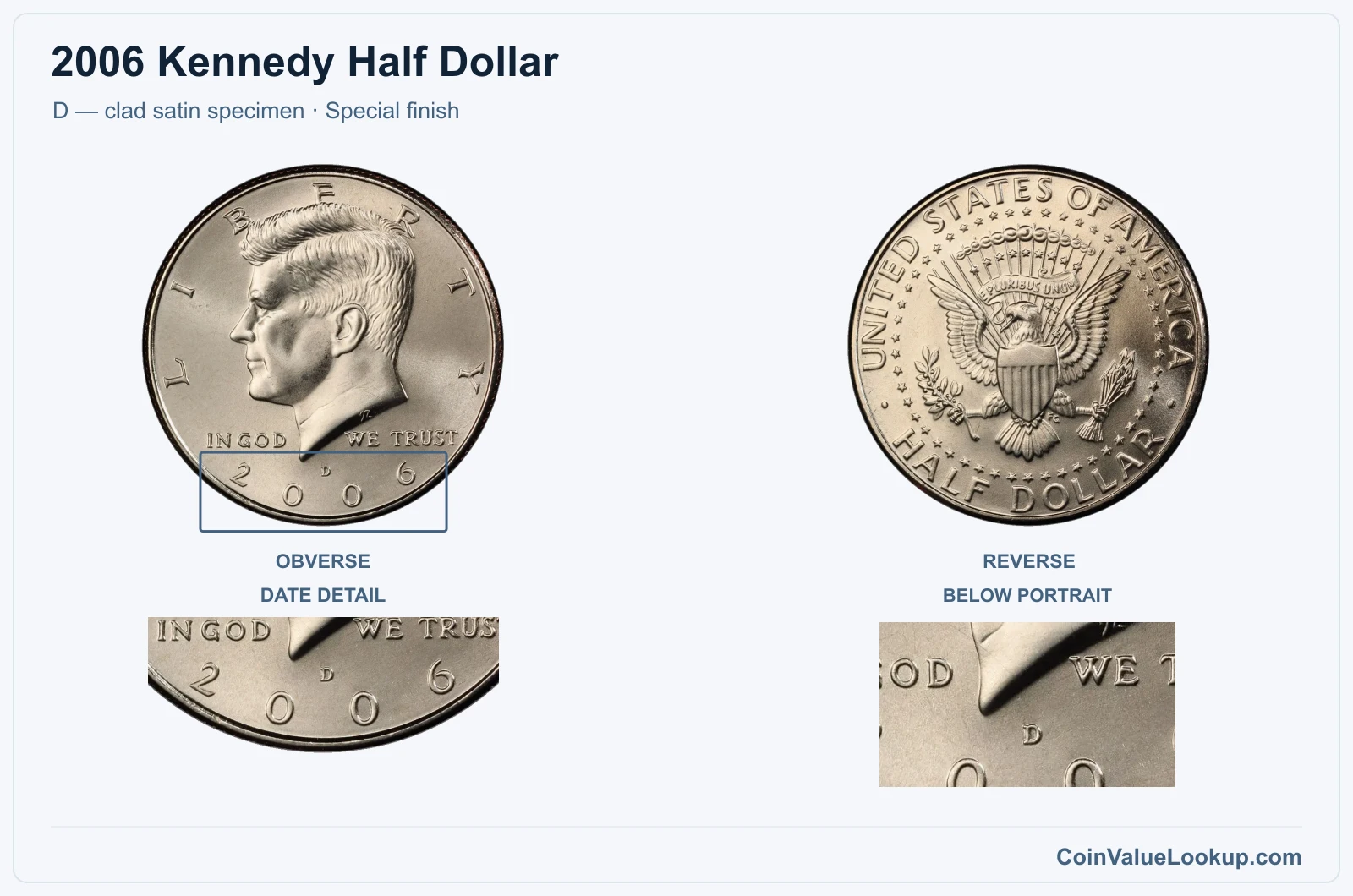
The 2006-D satin specimen is Denver's counterpart to the Philadelphia satin half, sharing the same copper-nickel clad composition and intentional matte finish. It was sold exclusively in 2006 uncirculated mint sets.
Identifying it requires more than just seeing a "D" mintmark. The surface should show a consistent soft texture without the bright reflective luster of a business strike or the mirrored fields of a proof.
Packaging provenance helps confirm the finish. No standard guide estimate is adopted for this branch, so value depends on authenticated identity and condition.
Range Grade
Price Auction Records Appraisal SP SP 1
—
Coin Identifier
SP 2
—
Coin Identifier
SP 3
—
Coin Identifier
SP 4
—
Coin Identifier
SP 6
—
Coin Identifier
SP 8
—
Coin Identifier
SP 10
—
Coin Identifier
SP 12
—
Coin Identifier
SP 15
—
Coin Identifier
SP 20
—
Coin Identifier
SP 25
—
Coin Identifier
SP 30
—
Coin Identifier
SP 35
—
Coin Identifier
SP 40
—
Coin Identifier
SP 45
—
Coin Identifier
SP 50
—
Coin Identifier
SP 53
—
Coin Identifier
SP 55
—
Coin Identifier
SP 58
—
Coin Identifier
SP 60
—
Coin Identifier
SP 61
—
Coin Identifier
SP 62
—
Coin Identifier
SP 63
—
Coin Identifier
SP 64
—
Coin Identifier
SP 65
—
Coin Identifier
SP 66
—
Coin Identifier
SP 67
Coin Identifier
SP 68
Coin Identifier
SP 69
Coin Identifier
SP 70
—
—
—
2006 Kennedy Half Dollar — S — clad proof
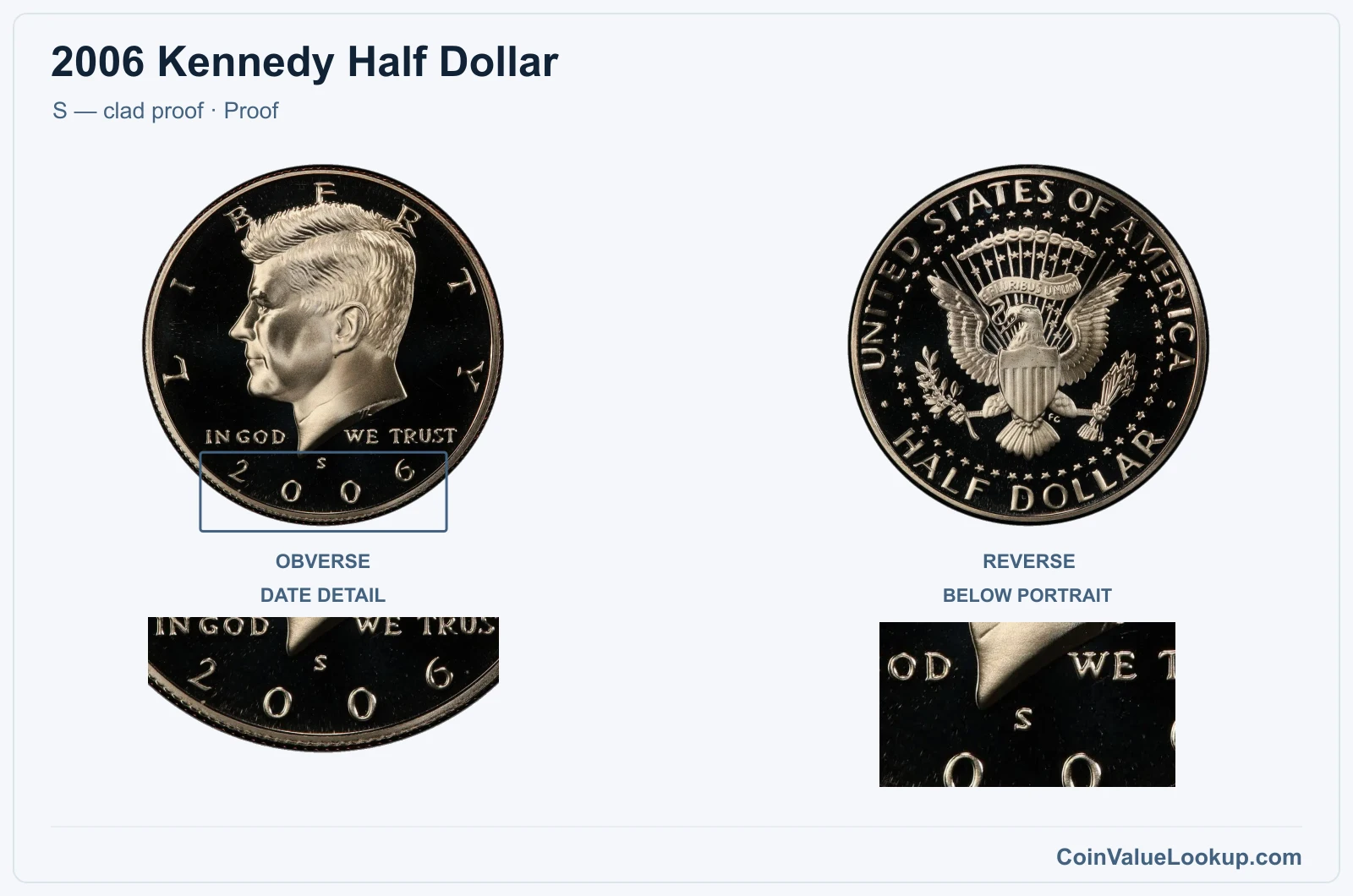
The 2006-S clad proof was struck at San Francisco on copper-nickel clad planchets. It features mirror-like fields with frosted portrait and eagle devices, the hallmark of proof manufacture.
This is not silver; it is the same alloy as the business strikes.
At PR65, USA Coin Book lists a guide estimate of $6.25. Look for hairlines and haze that would lower the grade.
A clean, well-stored proof with deep mirrors and sharp frost is what collectors want. Since both clad and silver proofs carry the S mintmark, check edge color or weigh the coin to confirm you have the clad version.
Range Grade
Price Auction Records Appraisal PR PR 1
—
Coin Identifier
PR 2
—
Coin Identifier
PR 3
—
Coin Identifier
PR 4
—
Coin Identifier
PR 6
—
Coin Identifier
PR 8
—
Coin Identifier
PR 10
—
Coin Identifier
PR 12
—
Coin Identifier
PR 15
—
Coin Identifier
PR 20
—
Coin Identifier
PR 25
—
Coin Identifier
PR 30
—
Coin Identifier
PR 35
—
Coin Identifier
PR 40
—
Coin Identifier
PR 45
—
Coin Identifier
PR 50
—
Coin Identifier
PR 53
—
Coin Identifier
PR 55
—
Coin Identifier
PR 58
—
Coin Identifier
PR 60
—
Coin Identifier
PR 61
—
Coin Identifier
PR 62
—
Coin Identifier
PR 63
—
Coin Identifier
PR 64
—
Coin Identifier
PR 65
—
Coin Identifier
PR 66
—
Coin Identifier
PR 67
—
Coin Identifier
PR 68
—
Coin Identifier
PR 69
Coin Identifier
PR 70
Coin Identifier
2006 Kennedy Half Dollar — S — silver proof
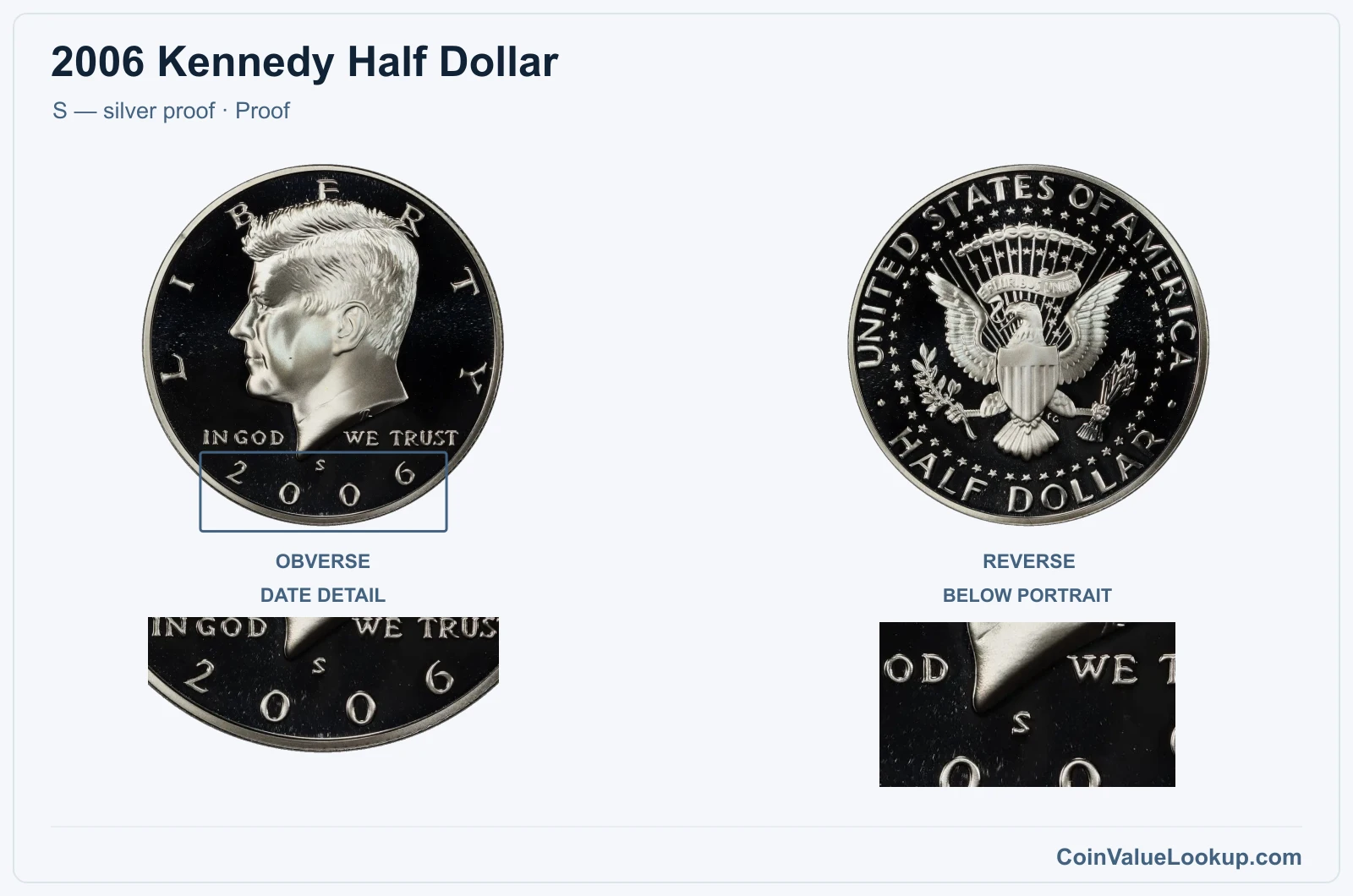
The 2006-S silver proof is the premium branch for this date, struck on a 90% silver, 10% copper planchet weighing approximately 12.50 grams. It carries the same S mintmark as the clad proof, so the mintmark alone does not confirm silver content.
Weigh it or examine the edge for a uniformly silver-toned stripe.
USA Coin Book lists a guide estimate of $32.00 at PR65. The silver content provides a built-in floor tied to metal prices, and collector demand adds a further premium for well-preserved examples.
Handle it by the edges and store it in its original government capsule whenever possible.
Range Grade
Price Auction Records Appraisal PR PR 1
—
Coin Identifier
PR 2
—
Coin Identifier
PR 3
—
Coin Identifier
PR 4
—
Coin Identifier
PR 6
—
Coin Identifier
PR 8
—
Coin Identifier
PR 10
—
Coin Identifier
PR 12
—
Coin Identifier
PR 15
—
Coin Identifier
PR 20
—
Coin Identifier
PR 25
—
Coin Identifier
PR 30
—
Coin Identifier
PR 35
—
Coin Identifier
PR 40
—
Coin Identifier
PR 45
—
Coin Identifier
PR 50
—
Coin Identifier
PR 53
—
Coin Identifier
PR 55
—
Coin Identifier
PR 58
—
Coin Identifier
PR 60
—
Coin Identifier
PR 61
—
Coin Identifier
PR 62
—
Coin Identifier
PR 63
—
Coin Identifier
PR 64
—
Coin Identifier
PR 65
—
Coin Identifier
PR 66
—
Coin Identifier
PR 67
—
Coin Identifier
PR 68
—
Coin Identifier
PR 69
Coin Identifier
PR 70
Coin Identifier
2006 Kennedy Half Dollar Error List
1. 2006 Kennedy Half Dollar — Doubled Die Obverse
A 2006-P doubled die obverse has been reported for this date. The doubling appears as consistent separation or notching on obverse lettering or design elements.
To check, compare your coin's inscriptions and profile details against a normal 2006-P under the same lighting and magnification.
What you are looking for is uniform doubling that follows the same direction across multiple letters or features. Machine doubling, by contrast, tends to produce a flat shelf on one side of a letter without the raised, rounded secondary image of a true doubled die.
Reflections and worn die contours can also mimic doubling under certain angles.
Value depends on the visibility and extent of the doubling as well as the coin's overall condition. No standard guide price is adopted for this variety.
2. 2006 Kennedy Half Dollar — Off-Center Strike
A 2006-D off-center strike has been reported. On such a coin, the design is shifted away from center, leaving an unstruck crescent of blank planchet along one edge.
The amount of displacement matters: a barely noticeable shift is minor, while a dramatic 10-50% off-center strike with the date still visible commands the most collector interest.
Do not confuse an off-center strike with a clipped planchet, which shows a curved bite out of the edge, or with post-mint flattening from damage. A genuine off-center coin will have the entire design uniformly displaced, not just one side squished.
Value depends on how far off center the strike landed, whether the date remains readable, and the coin's overall condition. No standard guide price is adopted for this error.
3. 2006 Kennedy Half Dollar — Struck-Through Error
A 2006-S proof struck-through error has been reported. This happens when foreign material, such as grease, thread or a metal fragment, sits between the die and the planchet during striking.
The result is a localized depression or an impression of the obstruction pressed into the coin's surface.
On a proof, struck-through errors are especially visible because the mirror fields make any disruption obvious. Look for an area where the design is incomplete, mushy or shows a distinct outline of something that should not be there.
Grease-filled dies produce soft, filled-in letters; a retained foreign object leaves a sharper impression.
Do not mistake wear, cleaning scratches or ordinary weak strike detail for a struck-through error. Value depends on the size, location and clarity of the obstruction mark, as well as overall coin condition.
No standard guide price is adopted.
4. 2006 Kennedy Half Dollar — Lamination / Split Planchet
A 2006 satin-finish planchet lamination error has been reported. Lamination occurs when the metal layers of the planchet fail to bond properly, resulting in peeling, flaking or a visible crack where the metal separates.
A retained flap that is still attached is generally more desirable to collectors than one that has broken away entirely.
Photograph both the affected face and the edge of the coin together, since edge views often show the split most clearly. Compare against normal clad edge appearance.
This is different from surface scraping, corrosion pitting or a deliberately altered coin. Genuine lamination follows the natural layered structure of the planchet rather than cutting across it in a random gouge pattern.
Value depends on the size and visibility of the separation and overall condition. No standard guide price is adopted.
5. 2006 Kennedy Half Dollar — Wrong Planchet / Off-Metal Strike
A 2006 wrong-planchet error has been reported, meaning a Kennedy half dollar die struck a blank intended for a different denomination or coin. The result is a coin that carries the half dollar design but has the wrong weight, diameter, edge or metal appearance compared to a standard clad half.
To check, weigh your coin on a precision scale and measure its diameter. Compare against the normal 11.34-gram, 30.6-mm specifications.
If the numbers are off significantly, you may have something unusual. The design may also appear incomplete if the blank was smaller than the die.
Plating, corrosion, acid treatment and deliberate alterations can all change a coin's weight and appearance, so rule those out before concluding you have a wrong-planchet strike. Value depends on the specific blank involved, design completeness and overall condition.
No standard guide price is adopted for this error.