1996 Kennedy Half Dollar Coin Value: How Much Is It Worth?
The 1996 Kennedy half dollar carries a face value of fifty cents, and most circulated clad examples are worth exactly that. Collector guide estimates for this date range from about $3.62 in high Mint State grades up to $55.00 for the silver proof version, depending on mint, finish and condition.
Before checking any price chart, you need to figure out whether your coin is an ordinary clad strike, a clad proof or the heavier silver proof.
Fast Way to Identify Your 1996 Kennedy Half Dollar
The quickest way to get started is to upload clear photos of both sides of your coin. A well-lit front image lets us read the mintmark and check Kennedy's portrait for wear, while the reverse confirms the eagle design and any anomalies.
Snap both sides and submit them for a preliminary identification of your coin's version and approximate condition.
1996 Kennedy Half Dollar Value
Upload both sides of your 1996 Kennedy Half Dollar.
Front Obverse
Upload photo
Back Reverse
Upload photo
Which 1996 Kennedy Half Dollar Versions Are Worth Money?
- The 1996 S silver proof at PR65 carries a guide estimate of $55.00, the highest listed value for this date — confirm the 90% silver composition before assuming you have one.
- Clad proofs from San Francisco (S mintmark, copper-nickel clad) are estimated around $12.00 at PR65, well above face value.
- High-grade uncirculated P or D business strikes at MS65 list at $3.62 each — modest, but still above face value if the coin is truly gem quality.
- Mint-made errors such as die clashes, off-center strikes and clipped planchets have been reported for this date and can add a premium depending on severity and condition.
Step 1: Identify Your 1996 Kennedy Half Dollar Mint Mark and Version
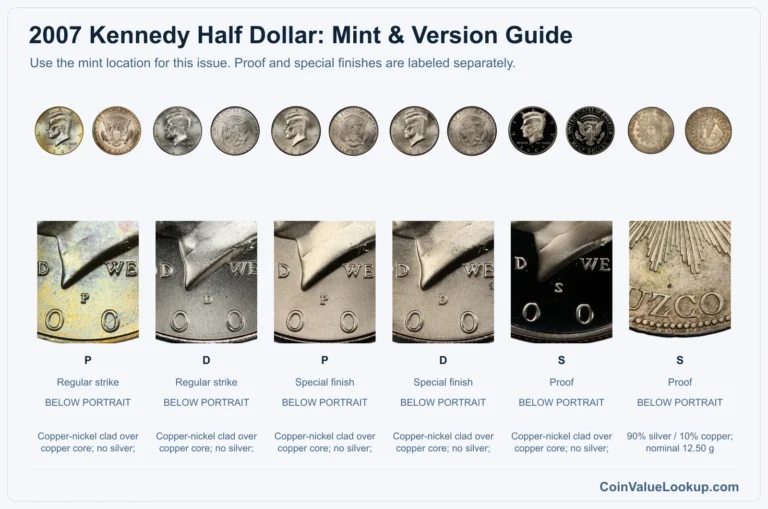
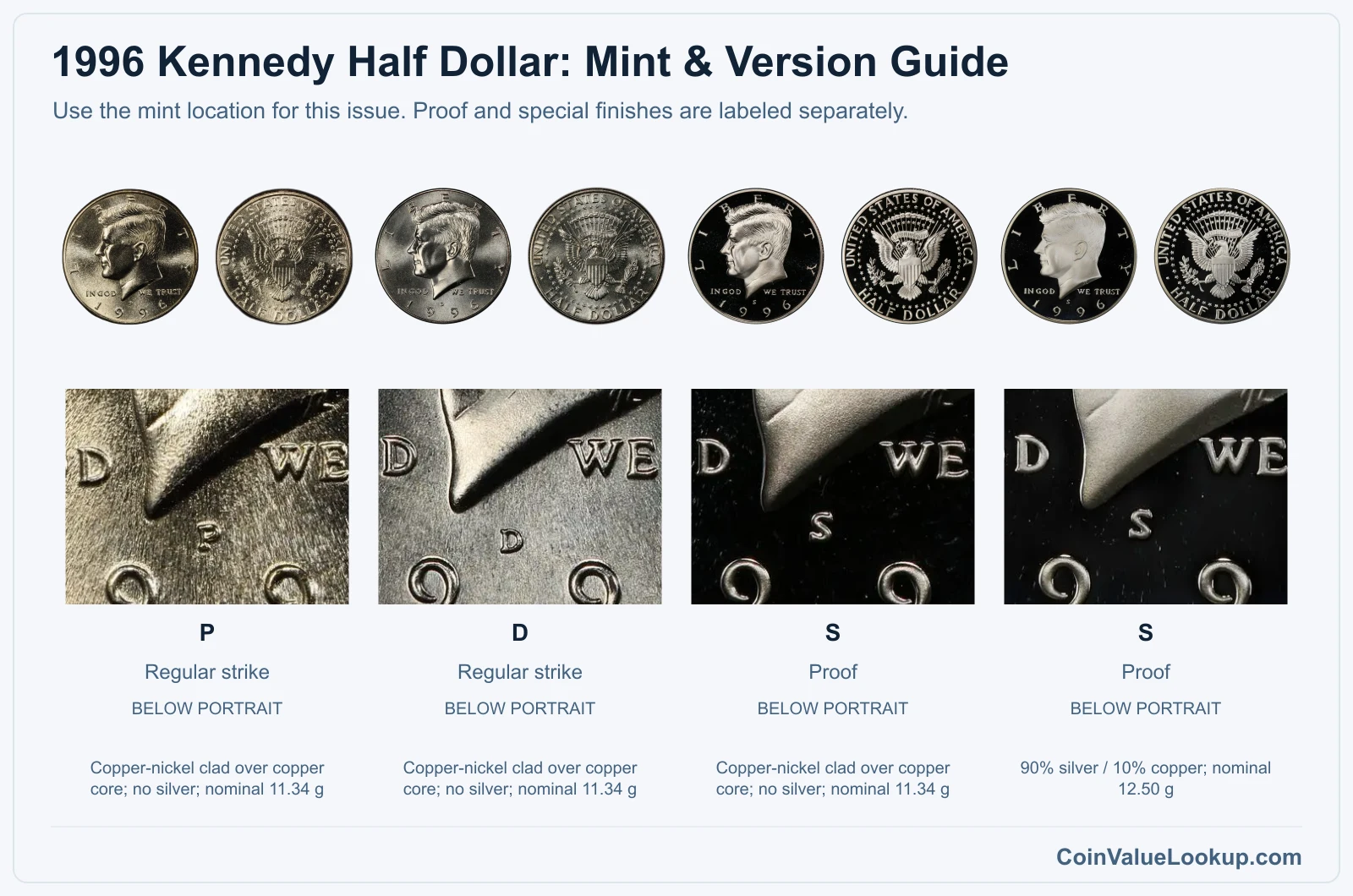
Flip your coin to the obverse and look just below Kennedy's portrait, above the date. That is where the mintmark lives.
A "P" means Philadelphia, a "D" means Denver, and an "S" means San Francisco. Philadelphia strikes from 1996 carry the P mark.
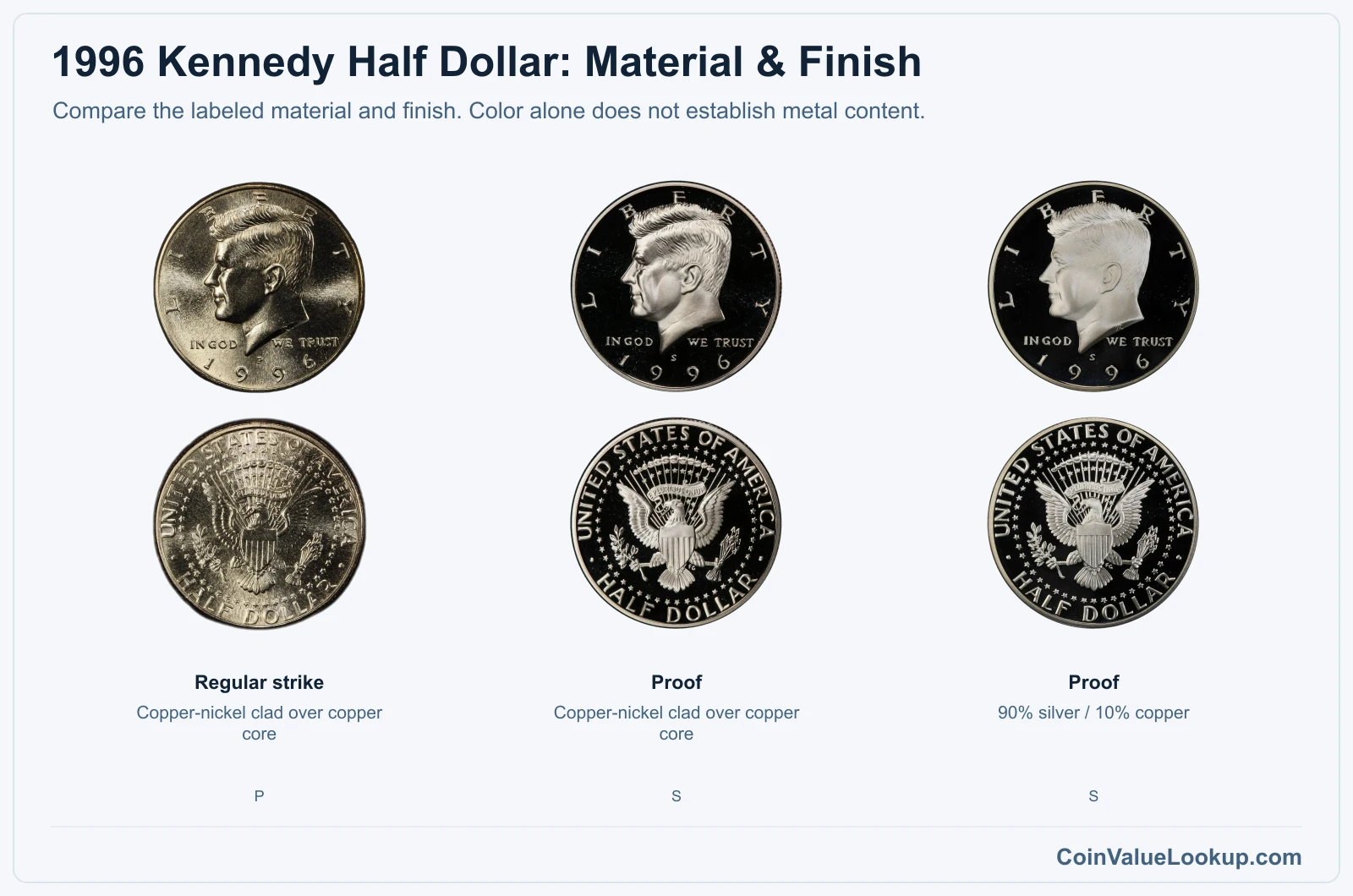
All P and D coins plus one S proof version are copper-nickel clad with no silver content, weighing about 11.34 grams. The second S proof is 90% silver and tips the scale at roughly 12.50 grams.
Both S versions share the same mintmark, so the letter alone will not tell you which one you have.
To separate the two S proofs, compare weight and edge color. A silver proof weighs more and shows a uniformly silver-gray edge, while the clad proof can reveal layering at the rim.
Original government packaging also helps confirm silver content. Do not rely on toning or lighting alone, as both can mimic the look of the other alloy.
Step 2: Check Your 1996 Kennedy Half Dollar Grade
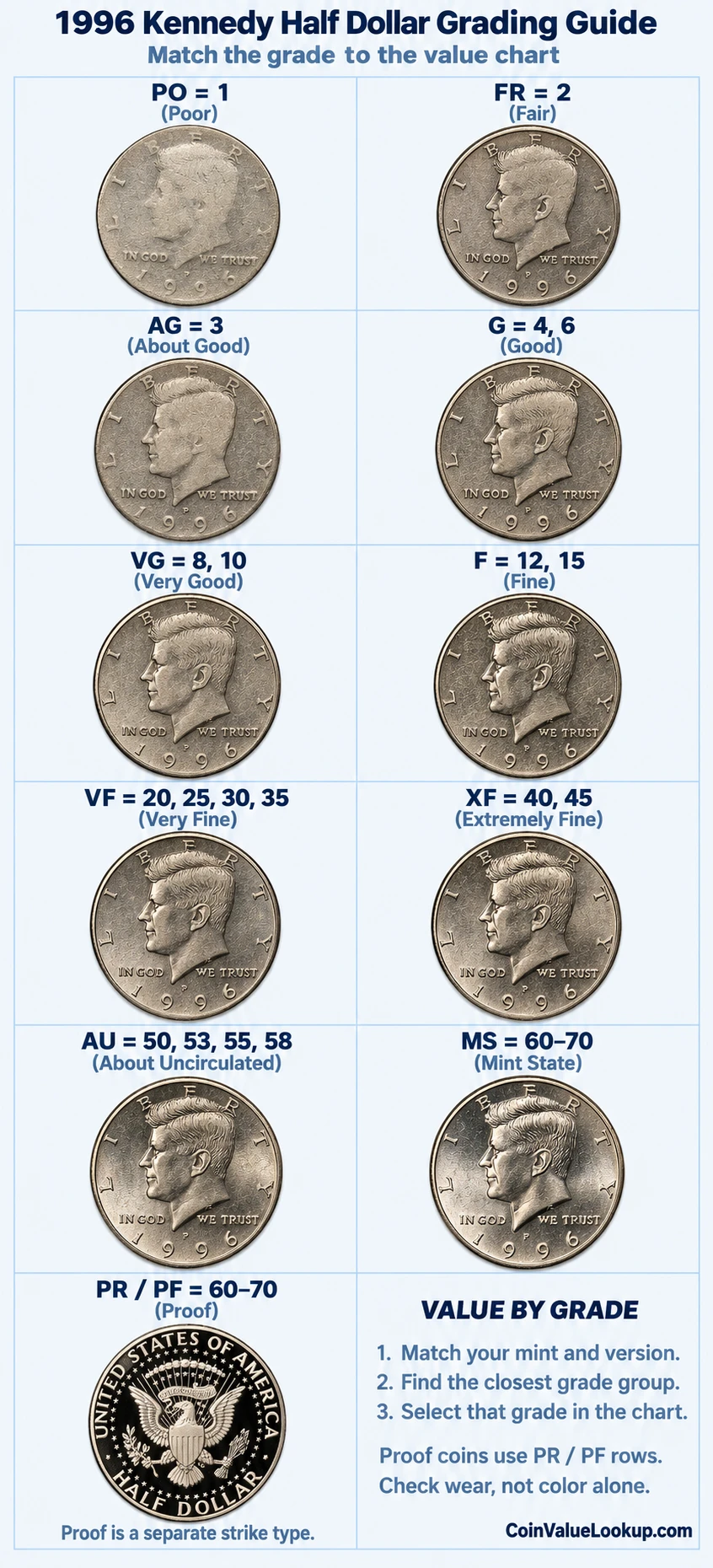
Start on the obverse. Kennedy's cheekbone and jawline pick up friction first, so rub marks there mean the coin has seen some circulation.
The hair above the ear is another early-wear spot; compare yours to the reference image to see how much detail remains.
On the reverse, check the eagle's breast feathers and the tops of the wings. Smooth, flat areas there confirm wear beyond Mint State.
Mint State coins can still look rough. Bag marks from coin-on-coin contact in bulk storage reduce eye appeal without being true wear.
A heavily bag-marked coin might technically be uncirculated yet grade lower than a lightly handled one.
Proofs get a separate evaluation. Look for hairlines from improper handling, haze from moisture exposure and contact marks on the mirror fields.
A proof graded PR65 should have minimal distractions in those reflective surfaces.
Coin Value Lookup is a handy starting point if you are working through several coins at once. You can look up guides for other Kennedy half dollar years or different denominations without digging through multiple sites.
Step 3: Check 1996 Kennedy Half Dollar Value by Mint and Version
1996 Kennedy Half Dollar — P — clad business
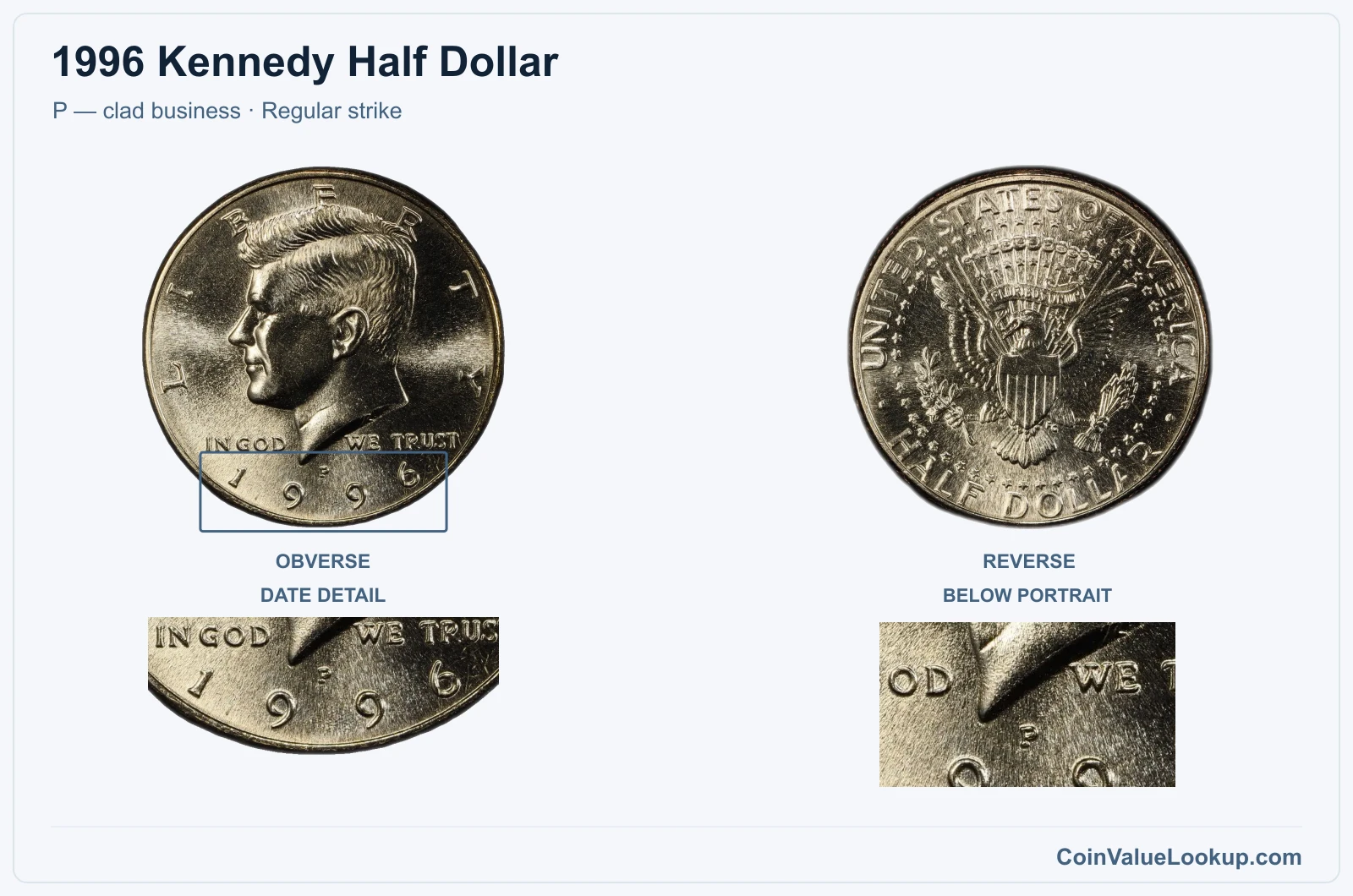
The 1996-P is a copper-nickel clad business strike from Philadelphia, marked with a small "P" below Kennedy's portrait. Millions were produced, and circulated examples are face-value coins.
In gem uncirculated condition, a USA Coin Book guide estimate puts MS65 at about $3.62. That is not a lot, but it beats fifty cents.
Look for original luster across both sides and minimal bag marks. If the cheek and hair above the ear still show sharp, frosty detail, you may have a coin worth grading.
Range Grade
Price Auction Records Appraisal PO PO 1
—
Coin Identifier FR FR 2
—
Coin Identifier AG AG 3
—
Coin Identifier G G 4
—
Coin Identifier
G 6
—
Coin Identifier VG VG 8
—
Coin Identifier
VG 10
—
Coin Identifier F F 12
—
Coin Identifier
F 15
—
Coin Identifier VF VF 20
—
Coin Identifier
VF 25
—
Coin Identifier
VF 30
—
Coin Identifier
VF 35
—
Coin Identifier XF XF 40
—
Coin Identifier
XF 45
—
Coin Identifier AU AU 50
—
Coin Identifier
AU 53
—
Coin Identifier
AU 55
—
Coin Identifier
AU 58
—
Coin Identifier MS MS 60
—
Coin Identifier
MS 61
—
Coin Identifier
MS 62
Coin Identifier
MS 63
—
Coin Identifier
MS 64
Coin Identifier
MS 65
—
Coin Identifier
MS 66
Coin Identifier
MS 67
Coin Identifier
MS 68
Coin Identifier
MS 69
—
—
—
MS 70
—
—
—
1996 Kennedy Half Dollar — D — clad business
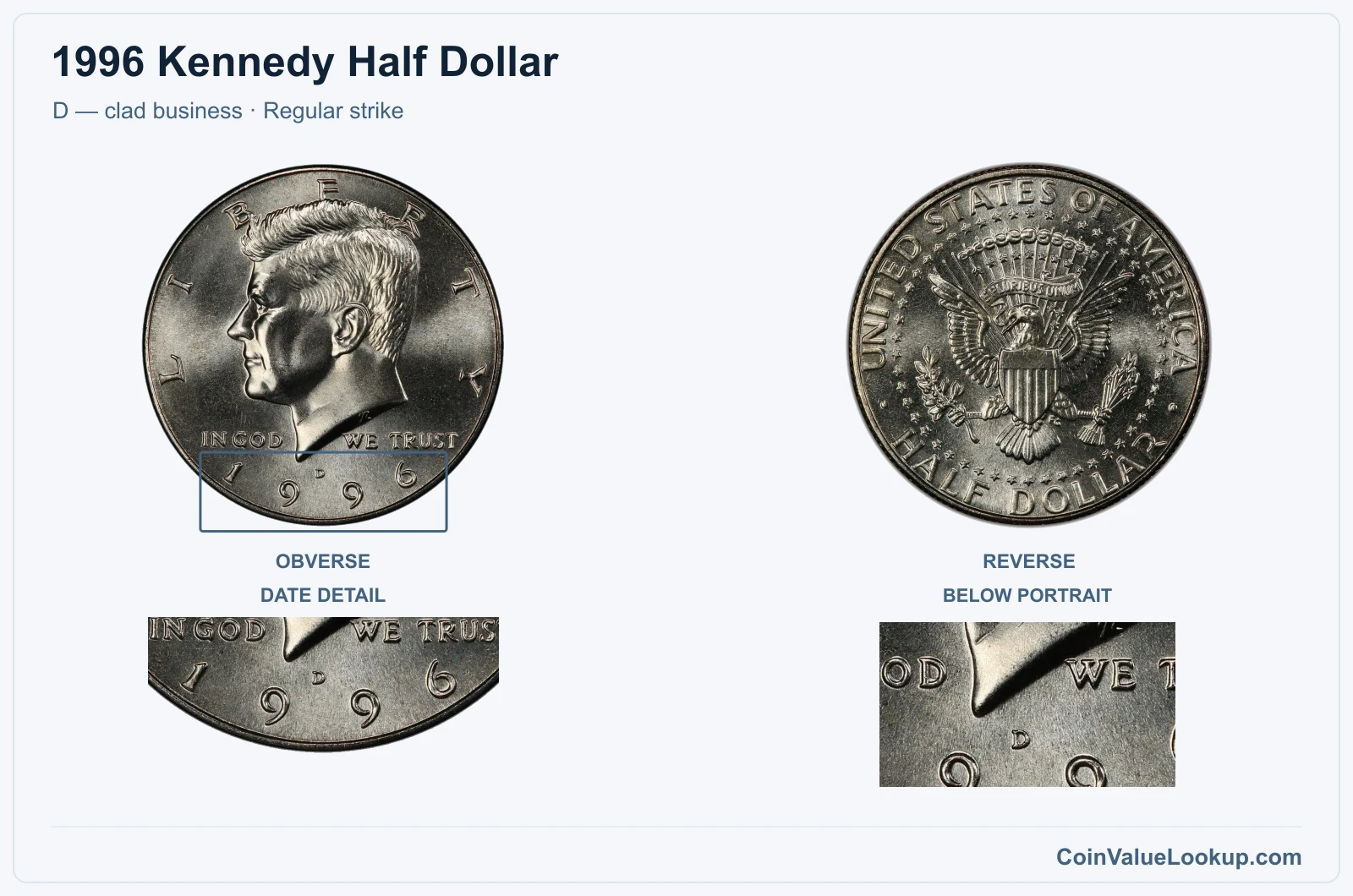
Denver's 1996-D half dollar is the same copper-nickel clad composition as the Philadelphia issue, identified by a "D" mintmark in the same position beneath Kennedy's portrait. Worn pieces trade at face value.
At MS65, the USA Coin Book guide estimate is $3.62, identical to the P version for this grade. Gem examples with clean fields and full luster are the ones worth setting aside.
Anything with obvious wear or heavy contact marks is a spender.
Range Grade
Price Auction Records Appraisal PO PO 1
—
Coin Identifier FR FR 2
—
Coin Identifier AG AG 3
—
Coin Identifier G G 4
—
Coin Identifier
G 6
—
Coin Identifier VG VG 8
—
Coin Identifier
VG 10
—
Coin Identifier F F 12
—
Coin Identifier
F 15
—
Coin Identifier VF VF 20
—
Coin Identifier
VF 25
—
Coin Identifier
VF 30
—
Coin Identifier
VF 35
—
Coin Identifier XF XF 40
—
Coin Identifier
XF 45
—
Coin Identifier AU AU 50
—
Coin Identifier
AU 53
—
Coin Identifier
AU 55
—
Coin Identifier
AU 58
—
Coin Identifier MS MS 60
—
Coin Identifier
MS 61
—
Coin Identifier
MS 62
—
Coin Identifier
MS 63
—
Coin Identifier
MS 64
—
Coin Identifier
MS 65
—
Coin Identifier
MS 66
Coin Identifier
MS 67
Coin Identifier
MS 68
Coin Identifier
MS 69
—
—
—
MS 70
—
—
—
1996 Kennedy Half Dollar — S — clad proof
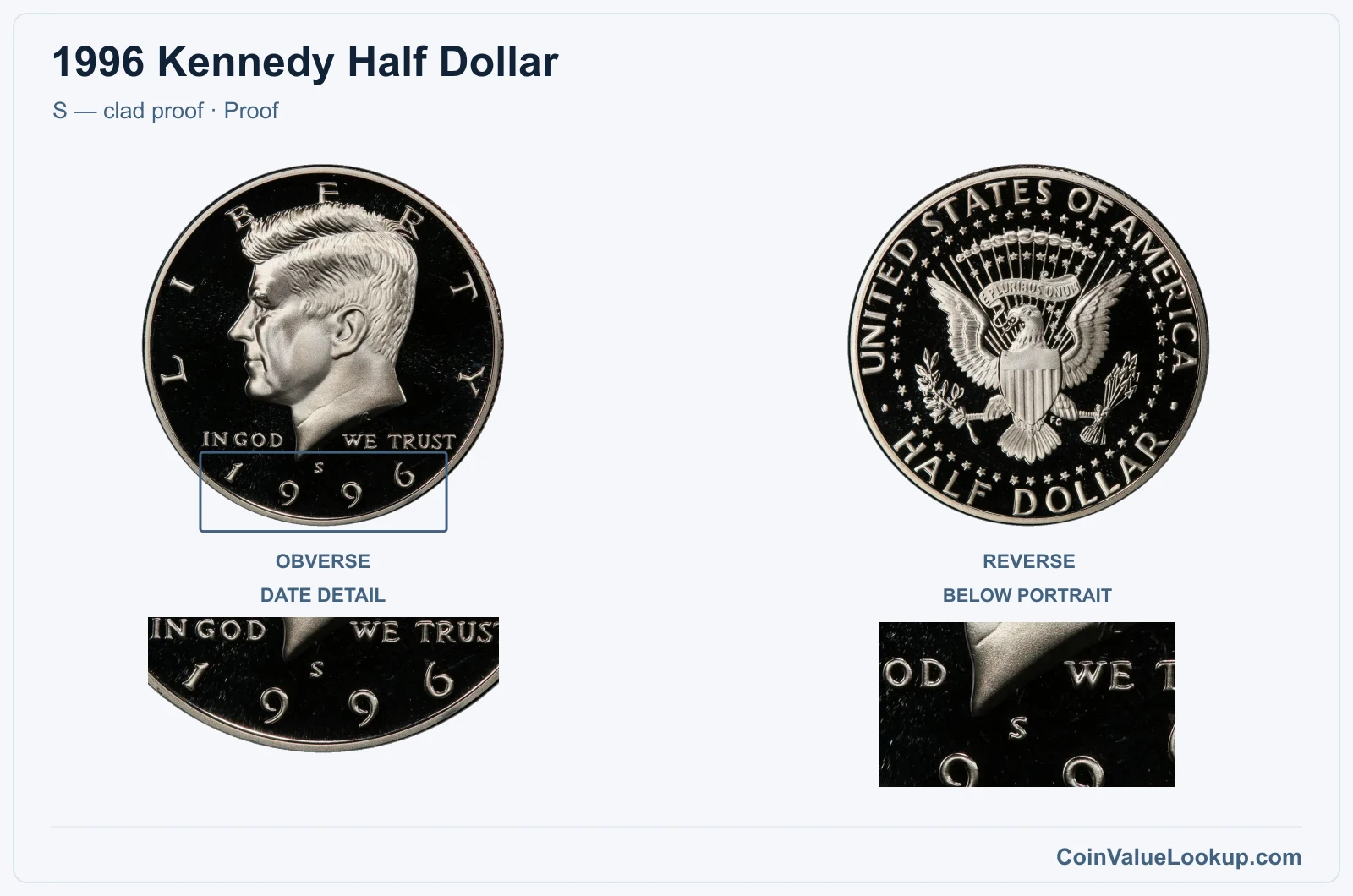
San Francisco produced a clad proof for 1996, struck on the same copper-nickel clad planchet used for business strikes. The "S" mintmark sits below Kennedy's portrait.
Look for mirror-like fields and frosted raised design elements, the hallmarks of proof production.
At PR65, the USA Coin Book guide estimate is $12.00. Hairlines from handling and haze from humidity are the main grade-killers.
These typically came in government proof sets, so finding one loose in a junk bin is less common but not impossible. Confirm the clad composition before assuming it is the silver version.
Range Grade
Price Auction Records Appraisal PR PR 1
—
Coin Identifier
PR 2
—
Coin Identifier
PR 3
—
Coin Identifier
PR 4
—
Coin Identifier
PR 6
—
Coin Identifier
PR 8
—
Coin Identifier
PR 10
—
Coin Identifier
PR 12
—
Coin Identifier
PR 15
—
Coin Identifier
PR 20
—
Coin Identifier
PR 25
—
Coin Identifier
PR 30
—
Coin Identifier
PR 35
—
Coin Identifier
PR 40
—
Coin Identifier
PR 45
—
Coin Identifier
PR 50
—
Coin Identifier
PR 53
—
Coin Identifier
PR 55
—
Coin Identifier
PR 58
—
Coin Identifier
PR 60
—
Coin Identifier
PR 61
—
Coin Identifier
PR 62
—
Coin Identifier
PR 63
—
Coin Identifier
PR 64
—
Coin Identifier
PR 65
—
Coin Identifier
PR 66
—
Coin Identifier
PR 67
—
Coin Identifier
PR 68
—
Coin Identifier
PR 69
Coin Identifier
PR 70
Coin Identifier
1996 Kennedy Half Dollar — S — silver proof
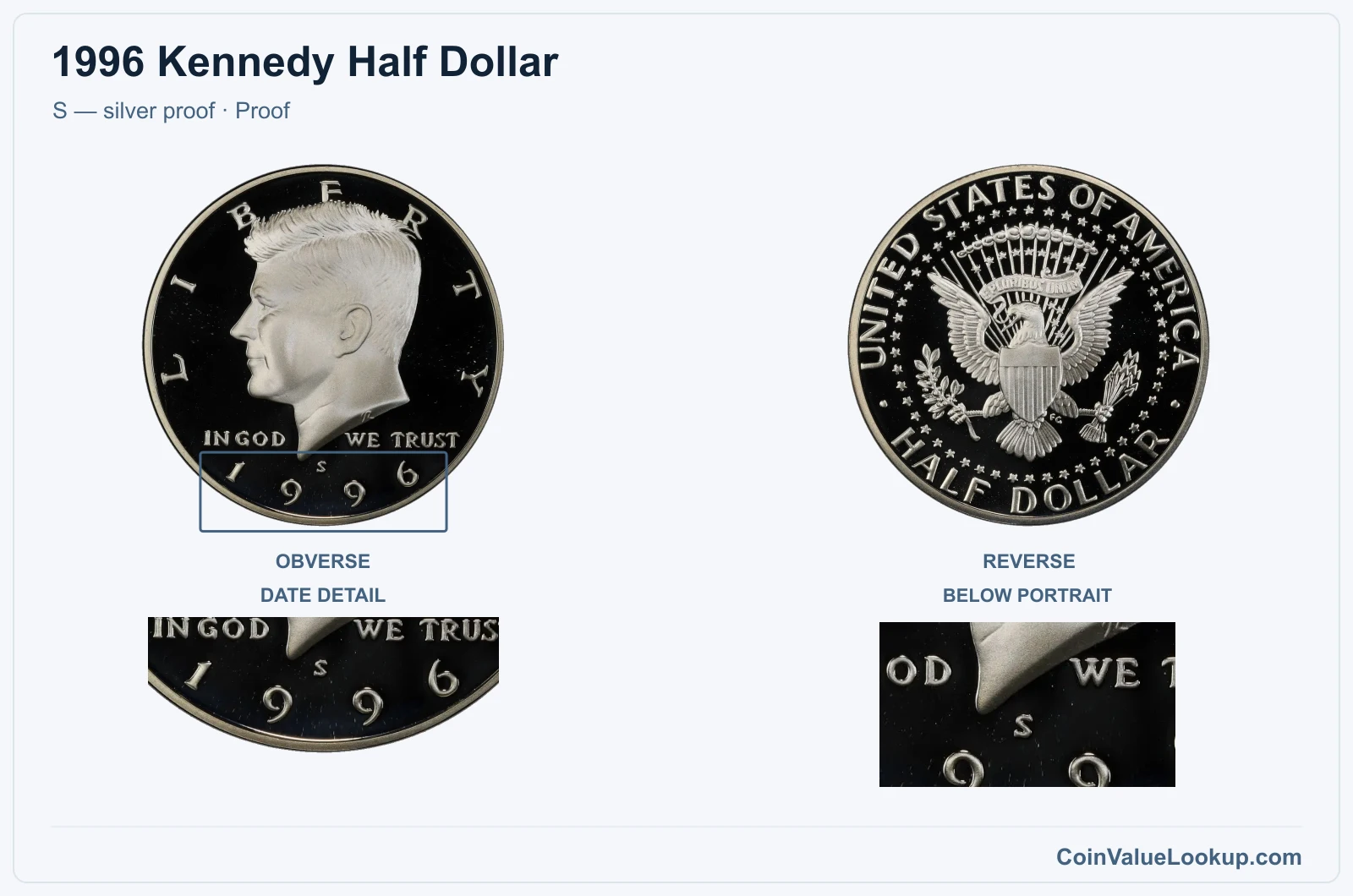
The 1996-S silver proof is the top-value branch for this year. It is struck on a 90% silver, 10% copper planchet weighing approximately 12.50 grams — noticeably heavier than the 11.34-gram clad version.
Both carry an "S" mintmark, so the letter alone does not confirm silver.
Weigh the coin or examine the edge. A clad coin may show a visible copper-colored layer at the rim; a silver proof will not.
Original mint packaging is another reliable indicator.
At PR65, the USA Coin Book guide estimate is $55.00. That makes it worth roughly ten times the face value even in a middling proof grade.
Protect the mirror surfaces from fingerprints and store it in a non-PVC holder if it is not already in one.
Range Grade
Price Auction Records Appraisal PR PR 1
—
Coin Identifier
PR 2
—
Coin Identifier
PR 3
—
Coin Identifier
PR 4
—
Coin Identifier
PR 6
—
Coin Identifier
PR 8
—
Coin Identifier
PR 10
—
Coin Identifier
PR 12
—
Coin Identifier
PR 15
—
Coin Identifier
PR 20
—
Coin Identifier
PR 25
—
Coin Identifier
PR 30
—
Coin Identifier
PR 35
—
Coin Identifier
PR 40
—
Coin Identifier
PR 45
—
Coin Identifier
PR 50
—
Coin Identifier
PR 53
—
Coin Identifier
PR 55
—
Coin Identifier
PR 58
—
Coin Identifier
PR 60
—
Coin Identifier
PR 61
—
Coin Identifier
PR 62
—
Coin Identifier
PR 63
—
Coin Identifier
PR 64
—
Coin Identifier
PR 65
—
Coin Identifier
PR 66
—
Coin Identifier
PR 67
—
Coin Identifier
PR 68
—
Coin Identifier
PR 69
Coin Identifier
PR 70
Coin Identifier
1996 Kennedy Half Dollar Error List
1. 1996 Kennedy Half Dollar — Clashed Dies
A die clash happens when the obverse and reverse dies strike each other without a planchet between them. The result is faint, mirror-image traces of the opposite design pressed into each die, which then transfer onto subsequent coins.
On a 1996 Kennedy half, look for ghostly outlines of the eagle on Kennedy's portrait or traces of Kennedy's hair on the eagle side. These impressions align with the normal striking orientation, which helps separate them from random scratches or damage.
Post-mint scratches tend to be incuse (cut into the surface) and randomly oriented, while clash marks are raised and follow the geometry of the opposing die. The value of a clashed-die coin depends on how visible and dramatic the transferred design is, along with overall condition.
2. 1996 Kennedy Half Dollar — Off-Center Strike
An off-center strike occurs when the planchet is not seated properly between the dies at the moment of impact. Part of the design is pushed toward one side, leaving an unstruck crescent of blank metal on the opposite edge.
For a 1996 Kennedy half, check whether the design is visibly shifted and a blank area is present. The most collectible examples retain a readable date despite the misalignment.
A coin struck only slightly off center — say 2–3% — is far less dramatic than one at 10% or more.
Do not confuse an off-center strike with a clipped planchet or with post-mint damage from being squeezed or flattened. The key diagnostic is the uniform blank crescent opposite the shift, with the rim missing entirely in that area.
3. 1996 Kennedy Half Dollar — Clipped Planchet
A clipped planchet error means a portion of the coin blank was missing before it was struck, usually because the blanking press punched into an area of strip already used. The result is a curved, straight or irregular bite out of the coin's edge.
On a 1996 Kennedy half, look for an area where the rim simply stops and the edge shows the original planchet shape rather than a struck rim. There is often a zone of design weakness directly opposite the clip, sometimes called the Blakesley effect.
Filed edges, deliberate cuts and corrosion can mimic a clip. Genuine clips show metal flow consistent with striking, not tool marks.
The size and type of clip, plus the coin's overall condition, determine how much extra value it carries.
4. 1996 Kennedy Half Dollar — Die Crack / Die Chip
Die cracks appear as thin, raised lines on a coin's surface. They form when a working die develops a fracture from repeated use.
A die chip is a small raised blob where a fragment of the die face has broken away.
On a 1996 Kennedy half, look for raised lines running across the fields or through lettering. If a crack extends from an interior point to the rim, the area of raised metal at the rim is sometimes called a cud.
These marks are raised above the surface because they correspond to a recessed crack in the die. That distinguishes them from scratches, which are incuse.
Corrosion bumps and foreign material stuck to the surface can also look similar, but they lack the linear, consistent profile of a die crack. Value depends on prominence and location.
5. 1996 Kennedy Half Dollar — Struck-Through Error
A struck-through error happens when foreign material sits between the die and the planchet during striking. Grease, cloth fibers, metal shavings or other debris can leave a depression or incomplete area in the design.
On a 1996 Kennedy half, look for a localized soft or sunken spot where the design detail is missing or blurred. Grease-filled die errors tend to produce smooth, shallow depressions, while a retained foreign object may leave a more defined impression with a distinct texture.
Do not mistake normal wear, cleaning or a weak strike for a struck-through error. Wear removes metal from high points across the whole coin, while a struck-through affects only the area where the obstruction sat.
The size, location and clarity of the impression all influence collectibility.