2007 Kennedy Half Dollar Coin Value: How Much Is It Worth?
The 2007 Kennedy half dollar carries a face value of 50 cents, and most ordinary clad examples are worth exactly that. Collector guide estimates for specific mint, finish and grade combinations range from about $2.50 to $35.00.
Before checking any price chart, you need to identify whether your coin is a regular business strike, a satin specimen from a mint set, a clad proof or a silver proof.
Fast Way to Identify Your 2007 Kennedy Half Dollar
Upload clear photos of both the front and back of your 2007 Kennedy half dollar for a preliminary identification. Good lighting on the surfaces helps distinguish satin finishes from regular strikes and reveals mintmark details.
This first step narrows down which version and value range apply to your specific coin.
2007 Kennedy Half Dollar Value
Upload both sides of your 2007 Kennedy Half Dollar.
Front Obverse
Upload photo
Back Reverse
Upload photo
Which 2007 Kennedy Half Dollar Versions Are Worth Money?
- Identify your mintmark (P, D, or S) and finish before assuming any value — the spread between versions is significant.
- The S silver proof at PR65 carries a USA Coin Book guide estimate around $35.00, well above the clad versions.
- Satin specimen coins from P and D mint sets require individual assessment based on authenticated identity and condition.
- Certain mint-made errors such as doubled dies or missing clad layers have been reported for this year and can add collector interest beyond standard values.
Step 1: Identify Your 2007 Kennedy Half Dollar Mint Mark and Version
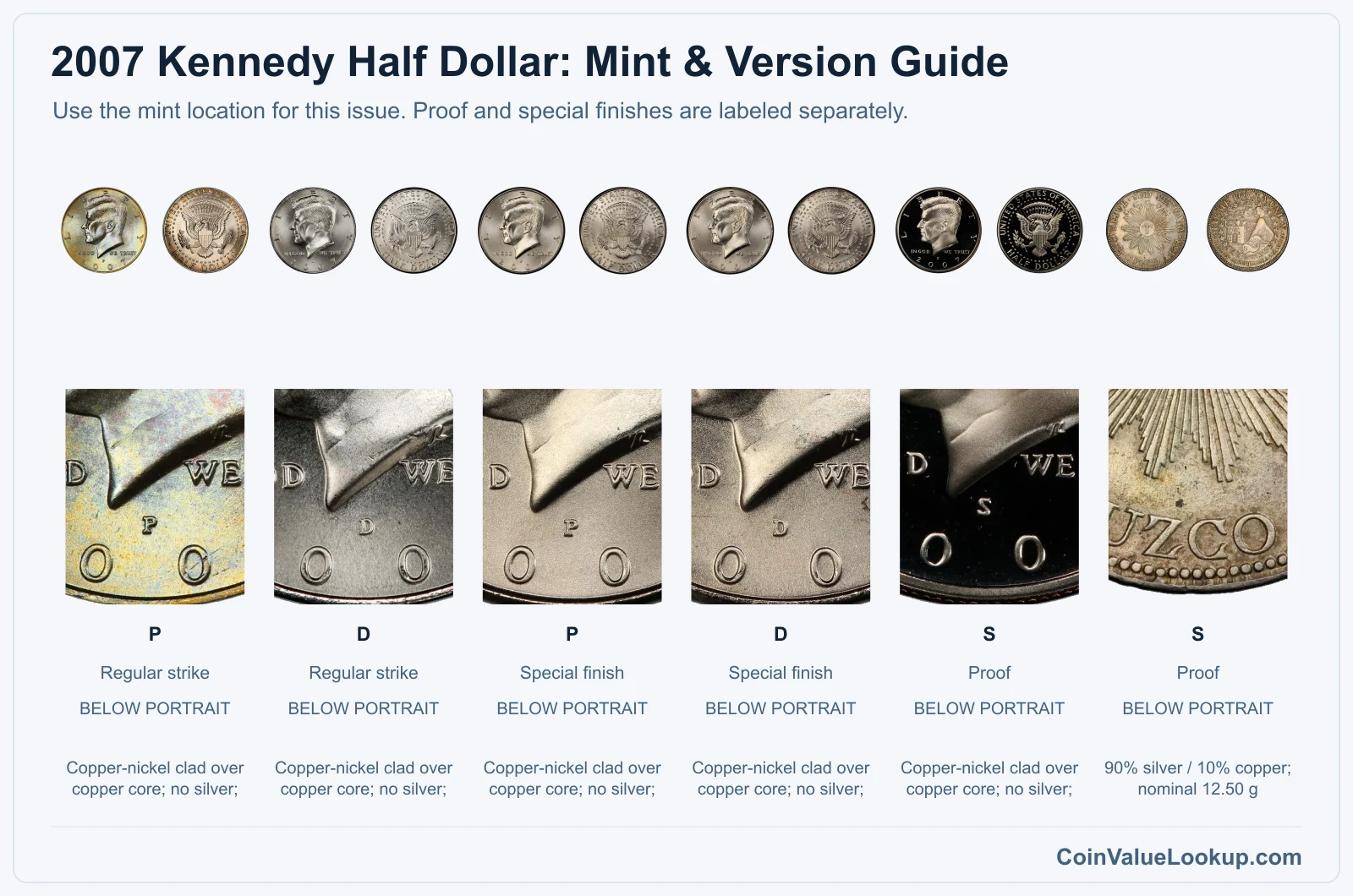
Flip your coin to the obverse and look beneath Kennedy's portrait, just above the date. You should see a small P, D or S mintmark.
P means Philadelphia, D means Denver, and S means San Francisco.
Both P and D mints produced clad business strikes and satin-finish specimens in 2007. The S mint produced two proofs: one in copper-nickel clad and one in 90% silver.
That is six distinct branches from a single year.
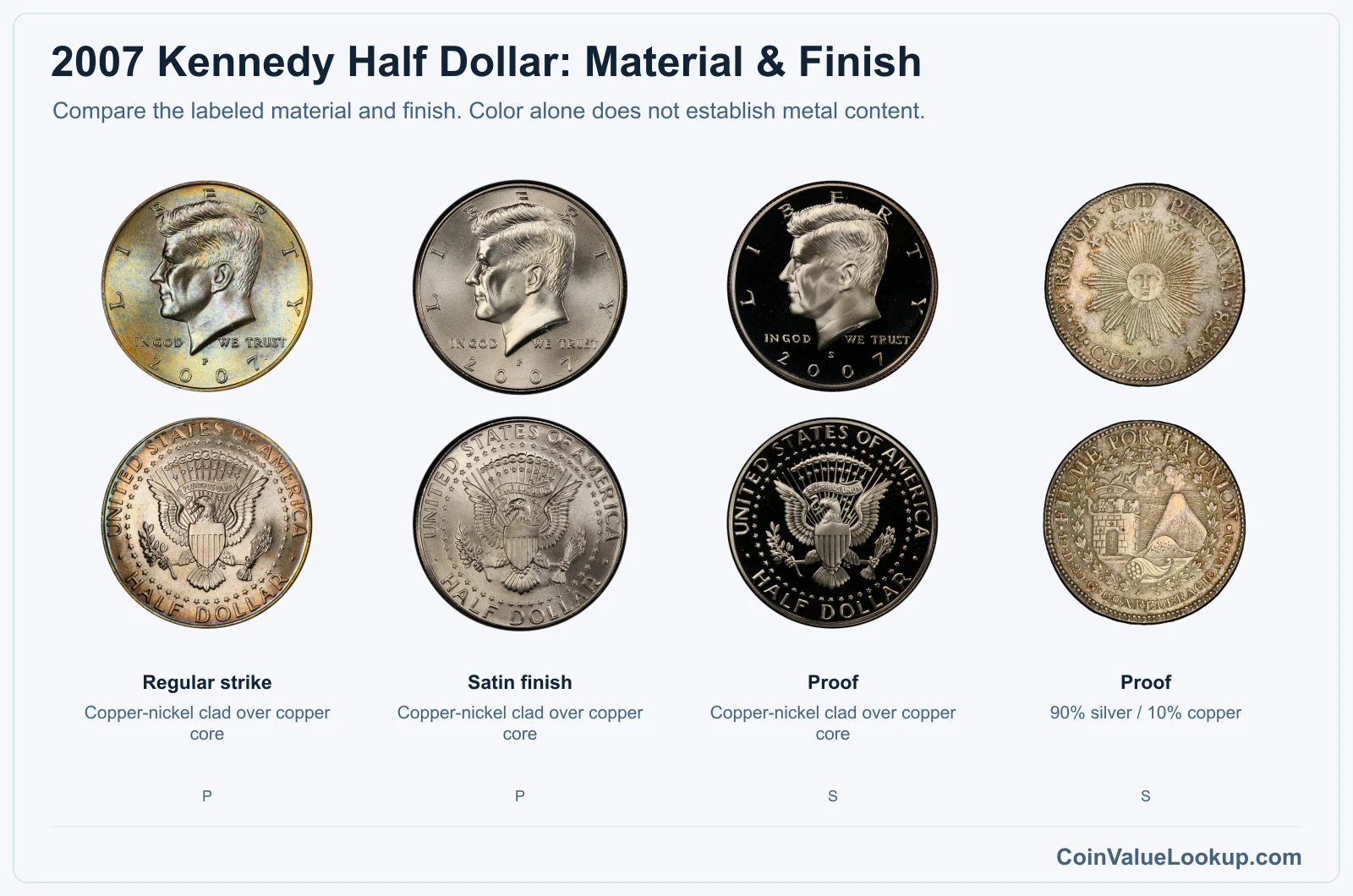
The satin specimen finish has a soft, even luster that differs from the cartwheel shine of a regular business strike. Do not assume a coin is satin just because it looks dull — wear can mimic that appearance.
Original mint-set packaging is the easiest confirmation.
To tell the silver proof apart from the clad proof, compare weight. The silver proof weighs about 12.50 grams versus roughly 11.34 grams for clad.
Edge color can help too, but toning and lighting sometimes fool the eye, so a scale is more reliable.
Step 2: Check Your 2007 Kennedy Half Dollar Grade
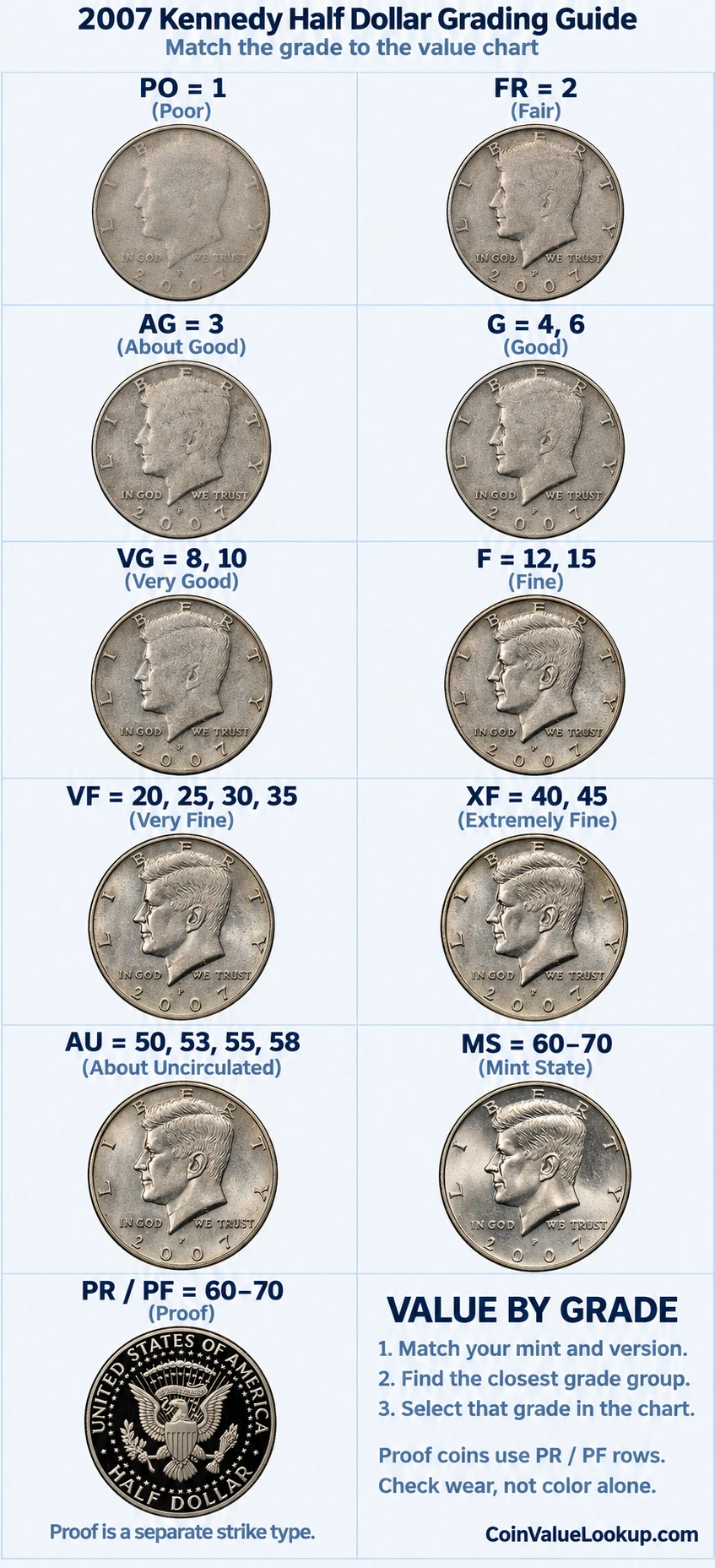
Start with Kennedy's cheek and jawline on the obverse. These high points lose detail first.
Look at the hair above his ear — on a well-preserved coin you can see individual strands; on a worn one, that area flattens into a smooth patch.
On the reverse, check the eagle's breast feathers and the tops of the wings. Flat spots there confirm circulation wear.
Bag marks are different from wear. A coin can be technically uncirculated but covered in small nicks and dings from contact with other coins during storage.
These marks lower the Mint State grade without indicating the coin was ever spent.
Proofs get graded on a separate scale. Look for hairline scratches across the mirror fields and any haze or clouding on the frosted devices.
Use the comparison image to calibrate your eye against known grade examples of the same type.
Step 3: Check 2007 Kennedy Half Dollar Value by Mint and Version
2007 Kennedy Half Dollar — P — clad business
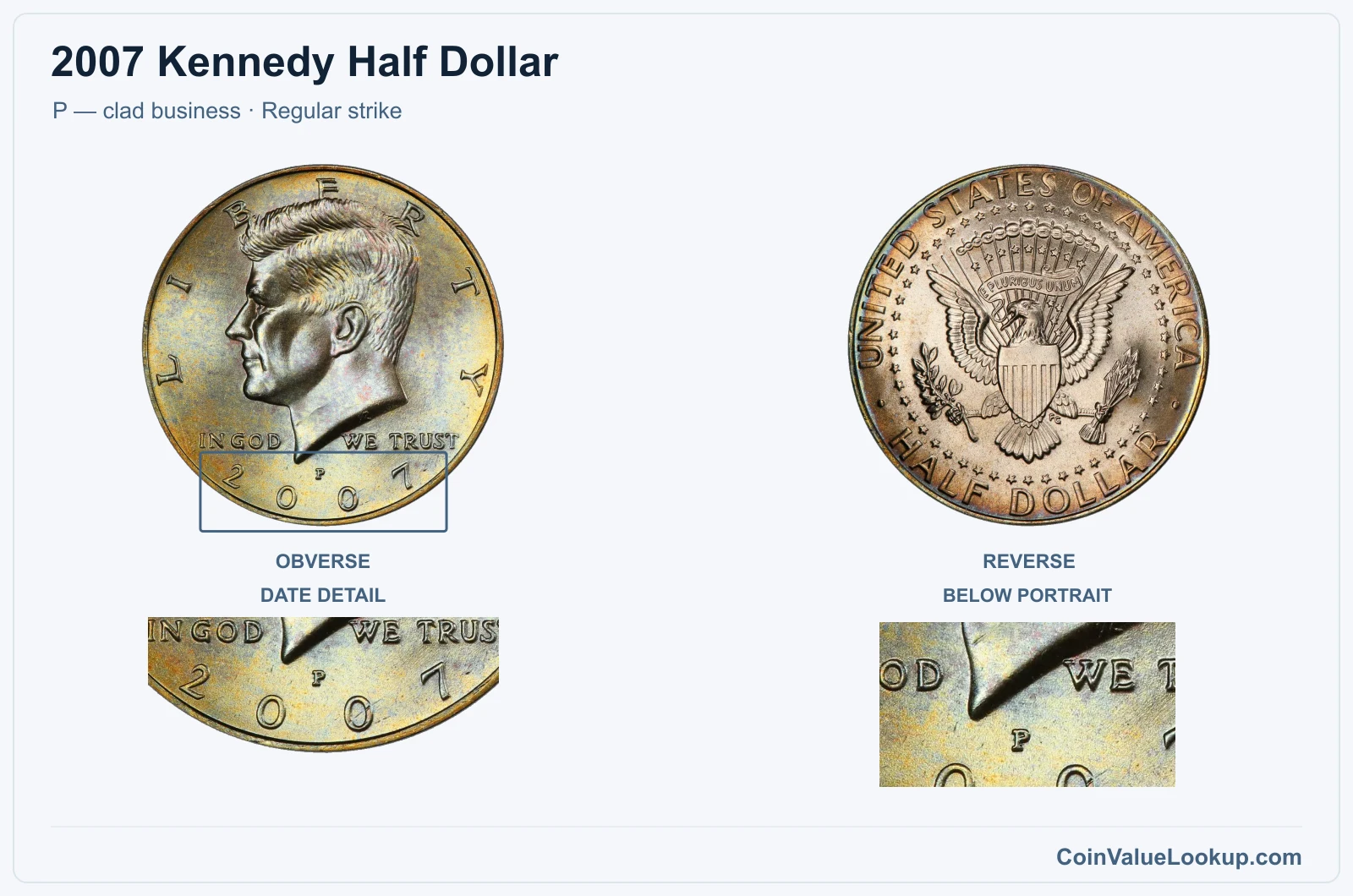
The 2007-P clad business strike is a copper-nickel clad coin weighing about 11.34 grams. Look for the P mintmark beneath Kennedy's portrait.
Most of these were sold in bags or rolls aimed at collectors rather than released into everyday circulation, so finding one with heavy wear usually means it escaped a set and got spent.
A worn example is typically a face-value coin. At MS65, the USA Coin Book guide estimate is about $2.50.
Original, well-preserved pieces with clean surfaces and strong luster are what collectors look for in this branch.
Range Grade
Price Auction Records Appraisal PO PO 1
—
Coin Identifier FR FR 2
—
Coin Identifier AG AG 3
—
Coin Identifier G G 4
—
Coin Identifier
G 6
—
Coin Identifier VG VG 8
—
Coin Identifier
VG 10
—
Coin Identifier F F 12
—
Coin Identifier
F 15
—
Coin Identifier VF VF 20
—
Coin Identifier
VF 25
—
Coin Identifier
VF 30
—
Coin Identifier
VF 35
—
Coin Identifier XF XF 40
—
Coin Identifier
XF 45
—
Coin Identifier AU AU 50
—
Coin Identifier
AU 53
—
Coin Identifier
AU 55
—
Coin Identifier
AU 58
—
Coin Identifier MS MS 60
—
Coin Identifier
MS 61
—
Coin Identifier
MS 62
—
Coin Identifier
MS 63
—
Coin Identifier
MS 64
—
Coin Identifier
MS 65
—
Coin Identifier
MS 66
—
Coin Identifier
MS 67
Coin Identifier
MS 68
Coin Identifier
MS 69
—
Coin Identifier
MS 70
—
—
—
2007 Kennedy Half Dollar — P — clad satin specimen
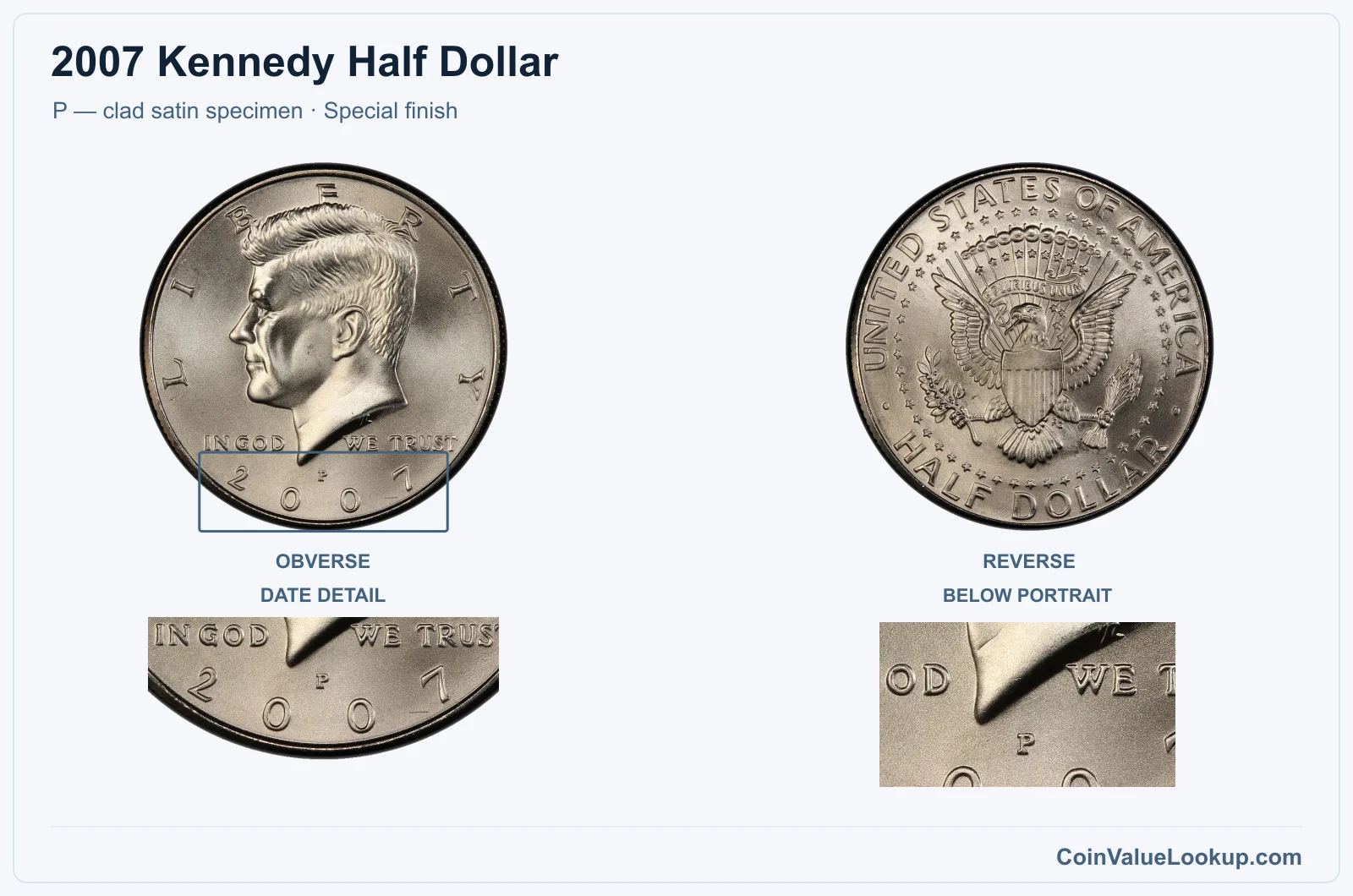
The 2007-P satin specimen came packaged in the U.S. Mint's annual uncirculated coin set. Its surface has an intentional soft, even texture — no sharp mirror fields and no frosty cartwheel.
It looks different from both a proof and a regular business strike.
Do not assume a coin is satin just because it appears muted. Wear, cleaning and environmental damage can dull a regular strike.
Confirming original mint-set packaging or professional authentication is the safest approach. No standard numeric guide range is adopted for this branch, so value depends on the individual coin's authenticated identity, condition and whether any errors are present.
Coin Value Lookup can help you explore guides for Kennedy halves and other series while you research your specific coin.
Range Grade
Price Auction Records Appraisal SP SP 1
—
Coin Identifier
SP 2
—
Coin Identifier
SP 3
—
Coin Identifier
SP 4
—
Coin Identifier
SP 6
—
Coin Identifier
SP 8
—
Coin Identifier
SP 10
—
Coin Identifier
SP 12
—
Coin Identifier
SP 15
—
Coin Identifier
SP 20
—
Coin Identifier
SP 25
—
Coin Identifier
SP 30
—
Coin Identifier
SP 35
—
Coin Identifier
SP 40
—
Coin Identifier
SP 45
—
Coin Identifier
SP 50
—
Coin Identifier
SP 53
—
Coin Identifier
SP 55
—
Coin Identifier
SP 58
—
Coin Identifier
SP 60
—
Coin Identifier
SP 61
—
Coin Identifier
SP 62
—
Coin Identifier
SP 63
—
Coin Identifier
SP 64
—
Coin Identifier
SP 65
—
Coin Identifier
SP 66
—
Coin Identifier
SP 67
Coin Identifier
SP 68
Coin Identifier
SP 69
Coin Identifier
SP 70
—
—
—
2007 Kennedy Half Dollar — D — clad business
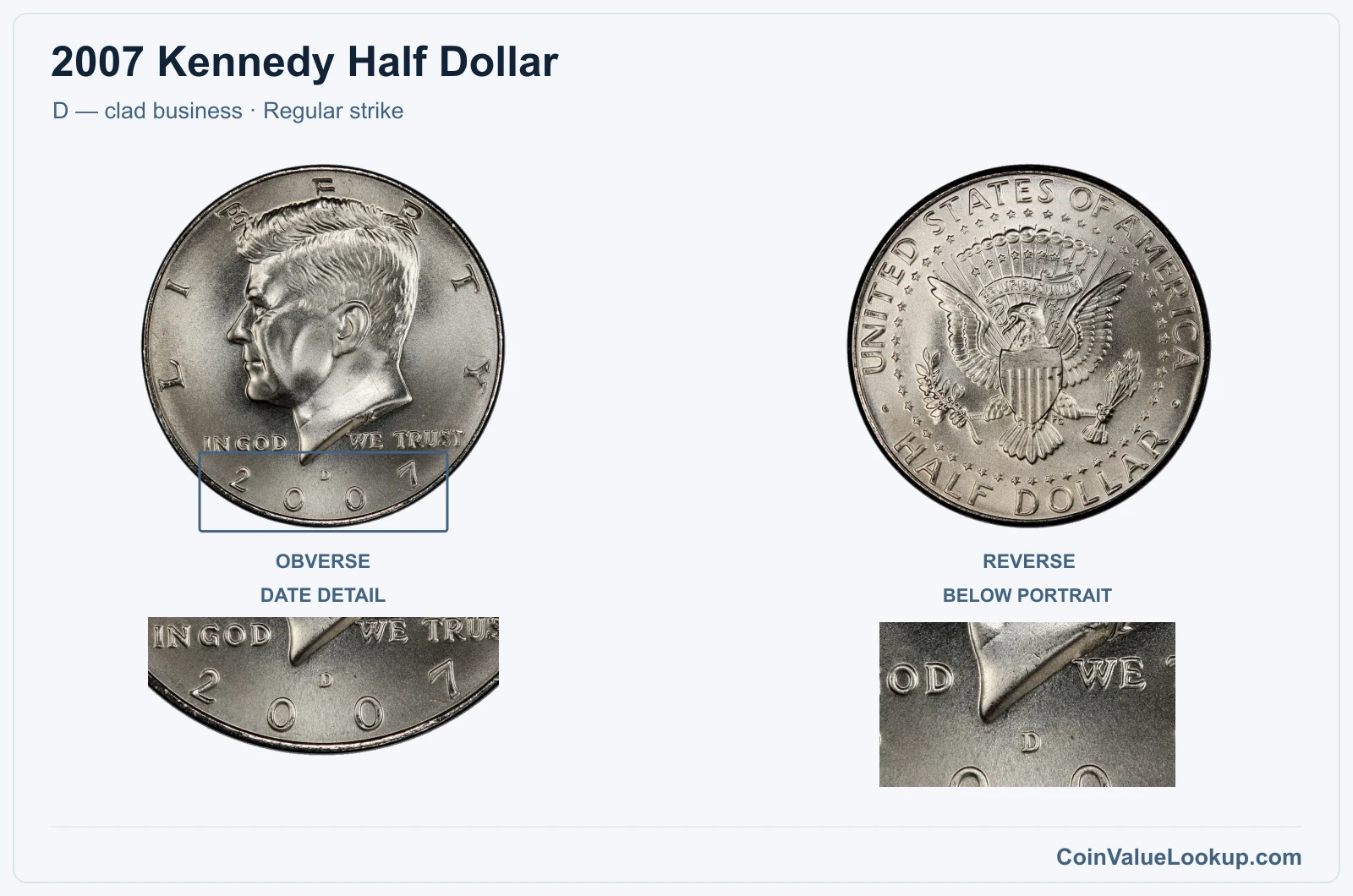
The 2007-D clad business strike carries a D mintmark beneath Kennedy's portrait. Like its Philadelphia counterpart, it is copper-nickel clad over a copper core at about 11.34 grams.
These were primarily distributed through collector channels rather than bank teller drawers.
At MS65, the USA Coin Book guide estimate sits around $2.50. A circulated example with visible wear is generally a face-value coin.
If yours came from an original mint bag or roll and has clean, mark-free surfaces, it is worth grading carefully against the comparison image.
Range Grade
Price Auction Records Appraisal PO PO 1
—
Coin Identifier FR FR 2
—
Coin Identifier AG AG 3
—
Coin Identifier G G 4
—
Coin Identifier
G 6
—
Coin Identifier VG VG 8
—
Coin Identifier
VG 10
—
Coin Identifier F F 12
—
Coin Identifier
F 15
—
Coin Identifier VF VF 20
—
Coin Identifier
VF 25
—
Coin Identifier
VF 30
—
Coin Identifier
VF 35
—
Coin Identifier XF XF 40
—
Coin Identifier
XF 45
—
Coin Identifier AU AU 50
—
Coin Identifier
AU 53
—
Coin Identifier
AU 55
—
Coin Identifier
AU 58
—
Coin Identifier MS MS 60
—
Coin Identifier
MS 61
—
Coin Identifier
MS 62
—
Coin Identifier
MS 63
—
Coin Identifier
MS 64
—
Coin Identifier
MS 65
—
Coin Identifier
MS 66
Coin Identifier
MS 67
Coin Identifier
MS 68
—
Coin Identifier
MS 69
—
—
—
MS 70
—
—
—
2007 Kennedy Half Dollar — D — clad satin specimen
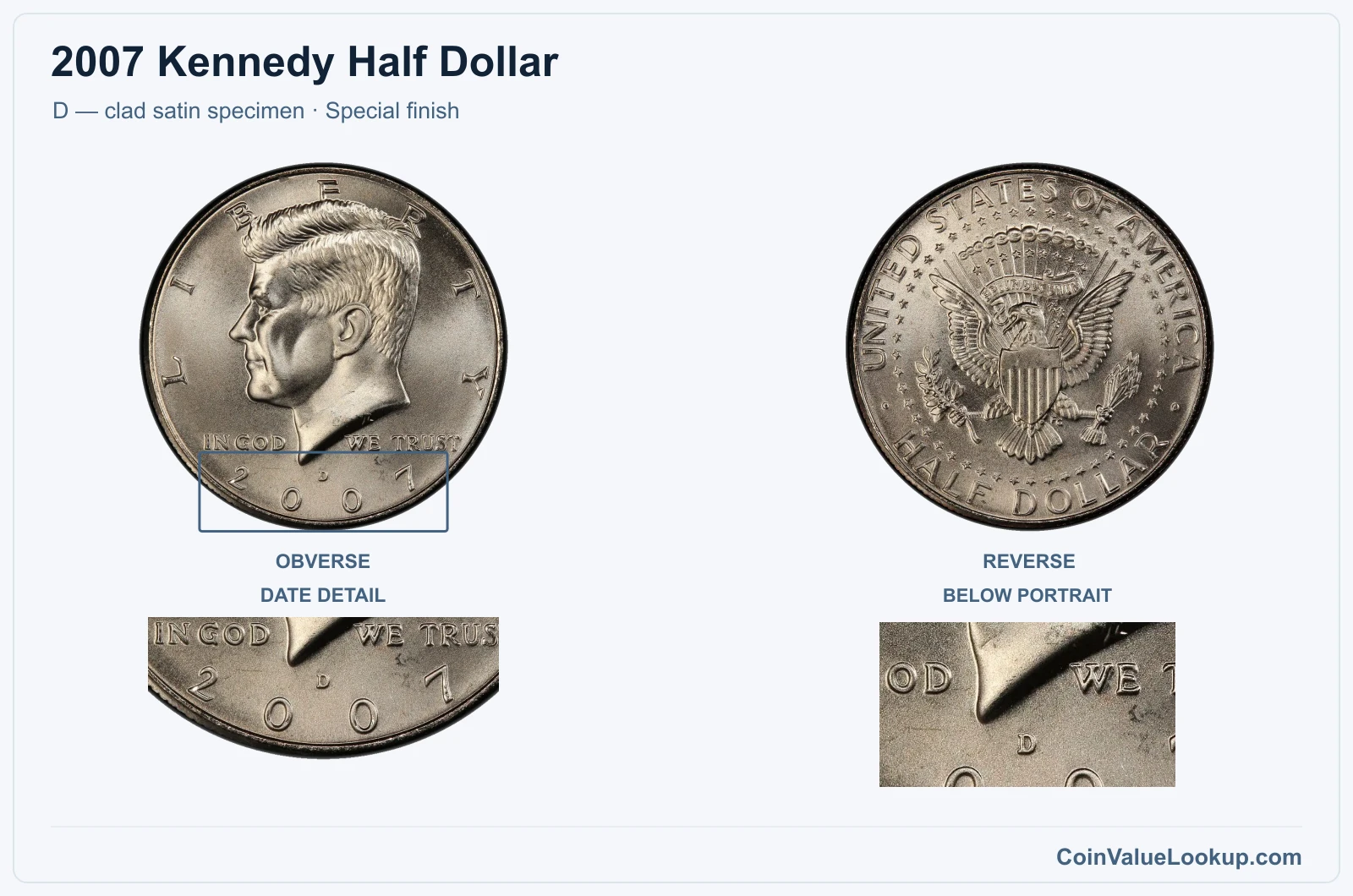
The 2007-D satin specimen was included in that year's U.S. Mint uncirculated set. It shares the same copper-nickel clad composition as the business strike but has the distinctive satin surface texture applied during manufacturing.
Dullness alone does not confirm a satin finish. Environmental toning or light wear on a regular strike can look similar.
Original packaging or third-party authentication is the clearest way to verify. No supported numeric guide range is adopted for this version, so each coin's value depends on its authenticated identity, preservation and any errors present.
Range Grade
Price Auction Records Appraisal SP SP 1
—
Coin Identifier
SP 2
—
Coin Identifier
SP 3
—
Coin Identifier
SP 4
—
Coin Identifier
SP 6
—
Coin Identifier
SP 8
—
Coin Identifier
SP 10
—
Coin Identifier
SP 12
—
Coin Identifier
SP 15
—
Coin Identifier
SP 20
—
Coin Identifier
SP 25
—
Coin Identifier
SP 30
—
Coin Identifier
SP 35
—
Coin Identifier
SP 40
—
Coin Identifier
SP 45
—
Coin Identifier
SP 50
—
Coin Identifier
SP 53
—
Coin Identifier
SP 55
—
Coin Identifier
SP 58
—
Coin Identifier
SP 60
—
Coin Identifier
SP 61
—
Coin Identifier
SP 62
—
Coin Identifier
SP 63
—
Coin Identifier
SP 64
—
Coin Identifier
SP 65
—
Coin Identifier
SP 66
—
Coin Identifier
SP 67
—
Coin Identifier
SP 68
Coin Identifier
SP 69
Coin Identifier
SP 70
—
Coin Identifier
2007 Kennedy Half Dollar — S — clad proof
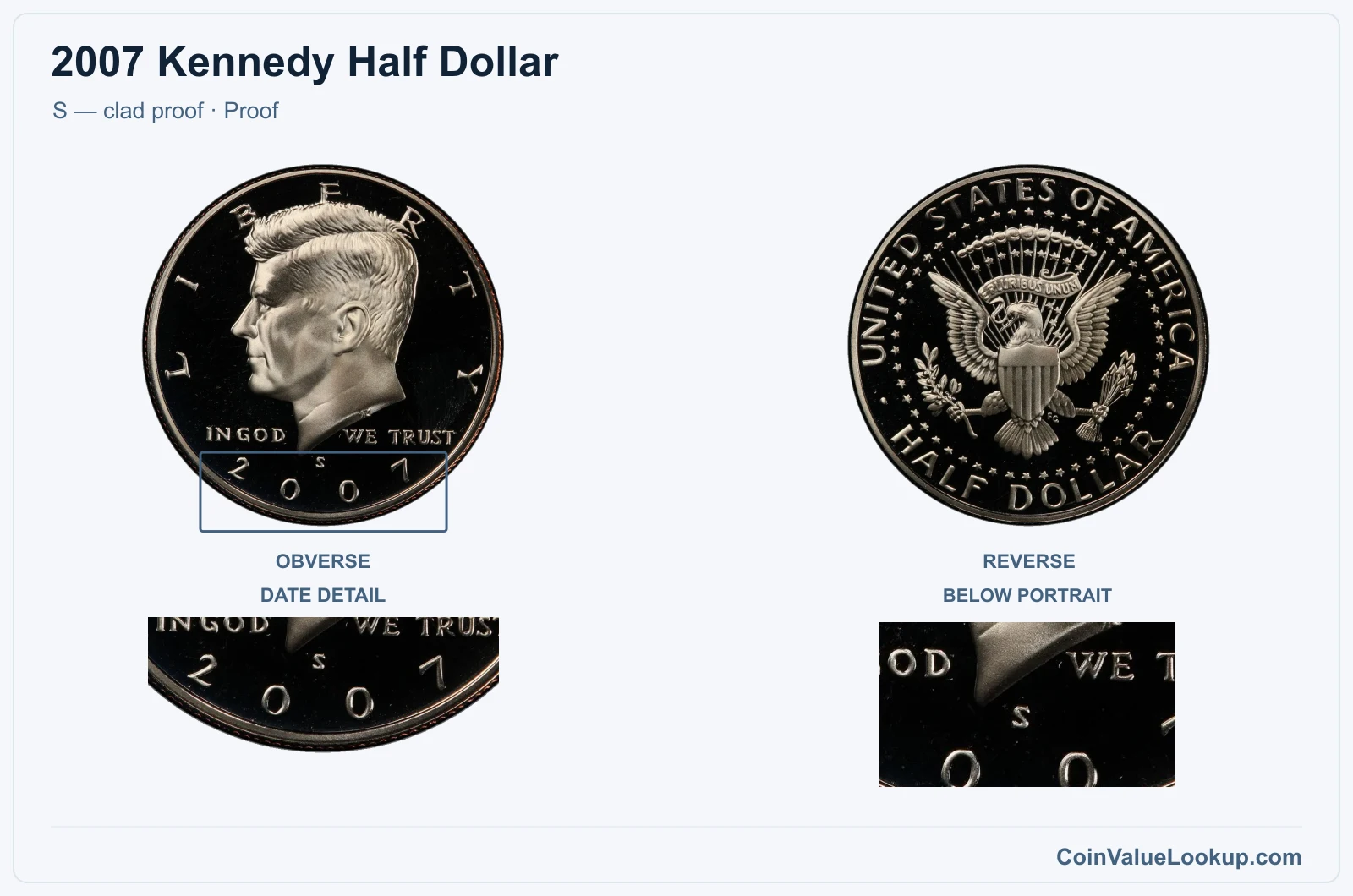
The 2007-S clad proof was struck at San Francisco in copper-nickel clad, not silver. It features mirror-like fields with frosted raised designs.
The S mintmark sits beneath Kennedy's portrait.
Both an S clad proof and an S silver proof exist for 2007, so the mintmark alone does not tell you which you have. Weight is the quickest separator: clad runs about 11.34 grams.
At PR65, the USA Coin Book guide estimate is around $6.25. Check for hairlines across those mirror fields — they are the biggest grade killers on proofs.
Range Grade
Price Auction Records Appraisal PR PR 1
—
Coin Identifier
PR 2
—
Coin Identifier
PR 3
—
Coin Identifier
PR 4
—
Coin Identifier
PR 6
—
Coin Identifier
PR 8
—
Coin Identifier
PR 10
—
Coin Identifier
PR 12
—
Coin Identifier
PR 15
—
Coin Identifier
PR 20
—
Coin Identifier
PR 25
—
Coin Identifier
PR 30
—
Coin Identifier
PR 35
—
Coin Identifier
PR 40
—
Coin Identifier
PR 45
—
Coin Identifier
PR 50
—
Coin Identifier
PR 53
—
Coin Identifier
PR 55
—
Coin Identifier
PR 58
—
Coin Identifier
PR 60
—
Coin Identifier
PR 61
—
Coin Identifier
PR 62
—
Coin Identifier
PR 63
—
Coin Identifier
PR 64
—
Coin Identifier
PR 65
—
Coin Identifier
PR 66
—
Coin Identifier
PR 67
—
Coin Identifier
PR 68
—
Coin Identifier
PR 69
Coin Identifier
PR 70
Coin Identifier
2007 Kennedy Half Dollar — S — silver proof
This is the one collectors pay the most attention to in the 2007 Kennedy half lineup. The S silver proof is struck in 90% silver and 10% copper, weighing approximately 12.50 grams.
That heavier weight compared to the 11.34-gram clad proof is your best physical clue.
At PR65, the USA Coin Book guide estimate is about $35.00. That is substantially above every other 2007 branch at comparable grades.
Pristine examples with deep mirror fields, strong frosted devices and no hairlines or haze will grade higher and may command more. Original government packaging helps confirm silver composition without needing a scale.
Range Grade
Price Auction Records Appraisal PR PR 1
—
Coin Identifier
PR 2
—
Coin Identifier
PR 3
—
Coin Identifier
PR 4
—
Coin Identifier
PR 6
—
Coin Identifier
PR 8
—
Coin Identifier
PR 10
—
Coin Identifier
PR 12
—
Coin Identifier
PR 15
—
Coin Identifier
PR 20
—
Coin Identifier
PR 25
—
Coin Identifier
PR 30
—
Coin Identifier
PR 35
—
Coin Identifier
PR 40
—
Coin Identifier
PR 45
—
Coin Identifier
PR 50
—
Coin Identifier
PR 53
—
Coin Identifier
PR 55
—
Coin Identifier
PR 58
—
Coin Identifier
PR 60
—
Coin Identifier
PR 61
—
Coin Identifier
PR 62
—
Coin Identifier
PR 63
—
Coin Identifier
PR 64
—
Coin Identifier
PR 65
—
Coin Identifier
PR 66
—
Coin Identifier
PR 67
—
Coin Identifier
PR 68
—
Coin Identifier
PR 69
Coin Identifier
PR 70
Coin Identifier
2007 Kennedy Half Dollar Error List
1. 2007 Kennedy Half Dollar — Missing FG Initials
On the reverse, look near the eagle's right leg (your left) for the small initials FG, which stand for designer Frank Gasparro. On a reported No FG variety, those letters are absent due to die polishing during manufacture, not simple wear.
The key distinction is whether surrounding details remain sharp. If the area around where the initials belong is also worn flat or mushy, the missing letters are probably just wear.
A genuine No FG error shows a clean, smooth field where the initials should be while nearby feathers and leg detail stay crisp.
Grease fill or deliberate post-mint removal can also erase the initials. Value depends on the specific coin's condition and how clearly the absence can be attributed to a die-polishing event rather than damage or wear.
2. 2007 Kennedy Half Dollar — Doubled Die
A doubled die occurs during die manufacture, producing consistent doubling on every coin struck by that die. On a 2007 Kennedy half, look for separation or notching on design elements — lettering, the date or profile details — that repeats in the same direction across the entire affected area.
This is different from machine doubling, which tends to show flat, shelf-like distortion rather than true design separation. Reflections under certain lighting can also mimic doubling, so rotate the coin and check from multiple angles.
Strength of the doubling matters. Subtle varieties need magnification to confirm, while dramatic examples are visible to the naked eye.
Value depends on the specific die, how prominent the doubling is and the coin's overall condition. No standard numeric price range is adopted for this error.
3. 2007 Kennedy Half Dollar — Missing Clad Layer
A missing clad layer error means one of the outer copper-nickel layers was absent before the coin was struck. The result is a coin that looks distinctly different on the affected side — often showing a copper-colored surface — and weighs noticeably less than the standard 11.34 grams.
Check the edge. On a normal clad half, you see a visible sandwich of layers.
A missing-clad coin will show an unusual edge profile on one side. Weigh the coin; a significant deviation from 11.34 grams supports the error.
Be careful with lookalikes. Toning, environmental corrosion, acid exposure or someone deliberately stripping the outer layer can all create a copper appearance.
Post-mint damage does not carry the same collector value. Condition, the affected side and verification of a genuine pre-strike absence all influence what a specific coin is worth.
4. 2007 Kennedy Half Dollar — Die Crack / Die Chip
Die cracks appear as thin raised lines on the coin's surface, caused by a fracture in the steel die. Die chips show up as small raised lumps where a piece of the die broke away.
Both are mint-made and visible as raised metal — the opposite of a scratch, which is incused.
To check, run your fingernail across a suspected line. If it catches as a ridge, that is consistent with a die crack.
A scratch will feel like a groove. Die cracks that extend from a design element to the rim are common; a larger break that removes part of the rim is called a cud and tends to draw more collector attention.
Corrosion, foreign material stuck to the surface or incuse scratches can look similar in photos but differ in feel. Value depends on the size, location and visibility of the crack or chip, along with the coin's overall grade.
5. 2007 Kennedy Half Dollar — Rotated Dies
U.S. coins are normally struck with a 180-degree die rotation — hold the obverse upright, flip the coin top to bottom, and the reverse should also appear upright. A rotated die error means the reverse appears turned to some degree off that normal axis.
To test, hold the obverse so Kennedy faces up. Flip the coin along its vertical axis (like turning a page).
The eagle on the reverse should be upright. If it is tilted, measure the approximate degrees of rotation.
Larger rotations are scarcer and generally more desirable to collectors.
Do not confuse a rotated die with a photograph taken at a weird angle or a coin simply turned sideways on a table. The test must be done physically.
Value depends on the degree of rotation and the coin's condition; no standard numeric range is adopted for this error.