1861 Liberty Seated Half Dollar Coin Value: How Much Is It Worth?
The 1861 Liberty Seated Half Dollar is a Civil War-era silver coin struck at three mints under two different governments. Philadelphia guide estimates run from about $79 in G4 to $456 in AU50.
New Orleans and San Francisco pieces, Proofs, and the rare Confederate-obverse variety each carry their own value scales, so identifying your exact version matters.
Fast Way to Identify Your 1861 Liberty Seated Half Dollar
Snap clear photos of both sides of your coin and upload them here for a preliminary identification. The front shows the date and Liberty's position; the back reveals the mintmark and reverse hub style.
Good lighting on the fields helps distinguish wear from weak strike. Two sharp images are all you need to get started.
1861 Liberty Seated Half Dollar Value
Upload both sides of your 1861 Liberty Seated Half Dollar.
Front Obverse
Upload photo
Back Reverse
Upload photo
Which 1861 Liberty Seated Half Dollar Versions Are Worth Money?
- New Orleans Confederate-obverse coins show a diagnostic crack from Liberty's nose toward the rim and are valued far above regular 1861-O pieces.
- New Orleans Louisiana Specimen coins are a special manufacture finish requiring professional authentication; no standard price range applies.
- Philadelphia Proofs in PR63 have sold around $2,005 according to guide data, a significant step above circulated Philadelphia strikes.
- New Orleans mint coins in AU50 carry guide estimates around $1,145, roughly double the San Francisco figure in the same grade.
- San Francisco pieces come in Large S and Medium S mintmark styles, each worth confirming under magnification.
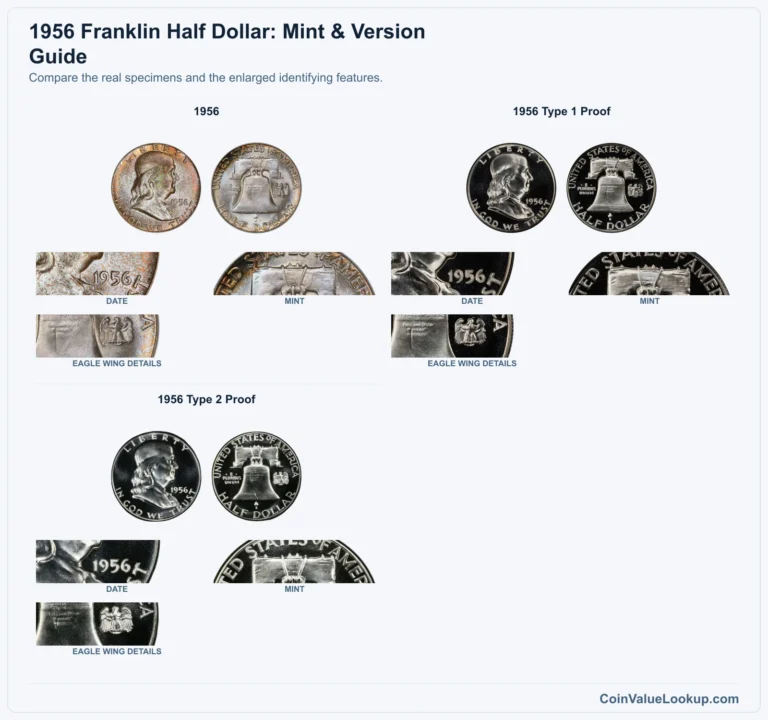
- Philadelphia strikes exist with both Type 1 and Type 2 reverse hubs; compare the base of the L in HALF and the eagle's left leg.
Step 1: Identify Your 1861 Liberty Seated Half Dollar Mint Mark and Version
First, confirm you are looking at a half dollar by reading HALF DOL. on the reverse.
A half dime or quarter can trip you up if the date is worn.
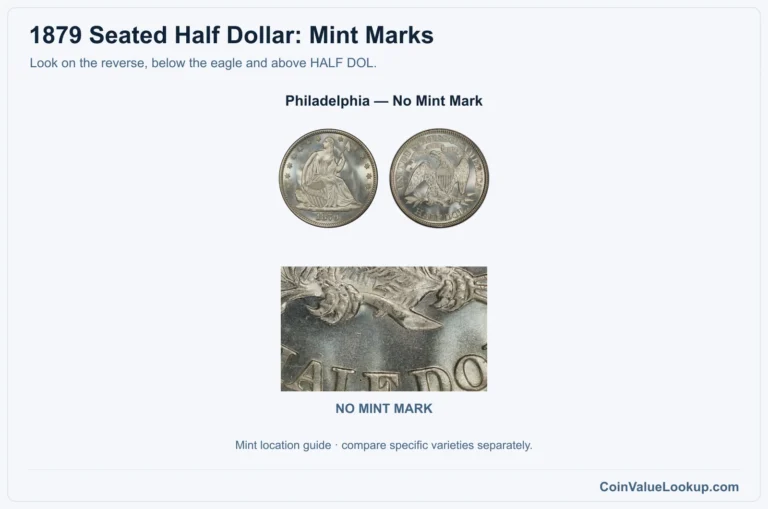
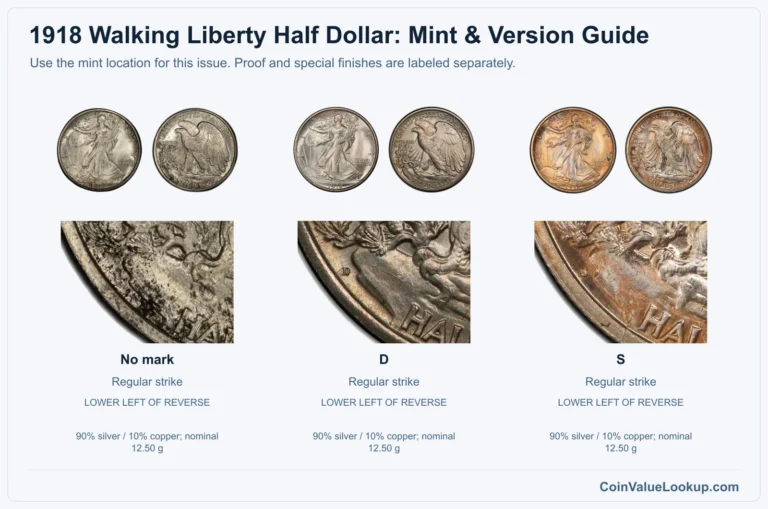
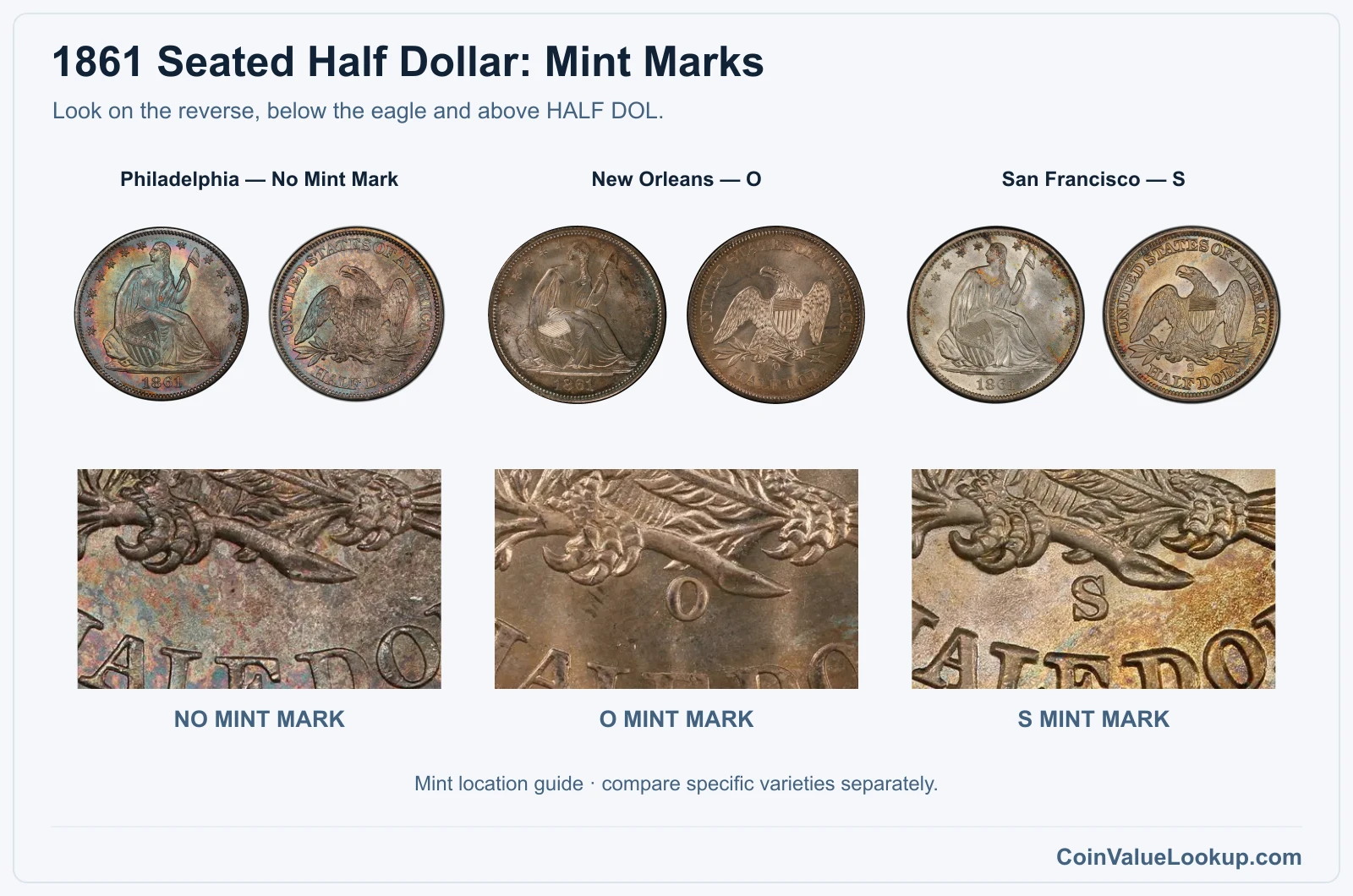
Philadelphia coins carry no mintmark. New Orleans pieces show an O below the eagle, and San Francisco coins display an S in the same spot.
Flip the coin over and look carefully; mintmarks on these are small.
All 1861 half dollars are 90% silver and 10% copper, weighing about 12.44 grams with a reeded edge. There is no motto above the eagle this year; the IN GOD WE TRUST banner did not appear until 1866.
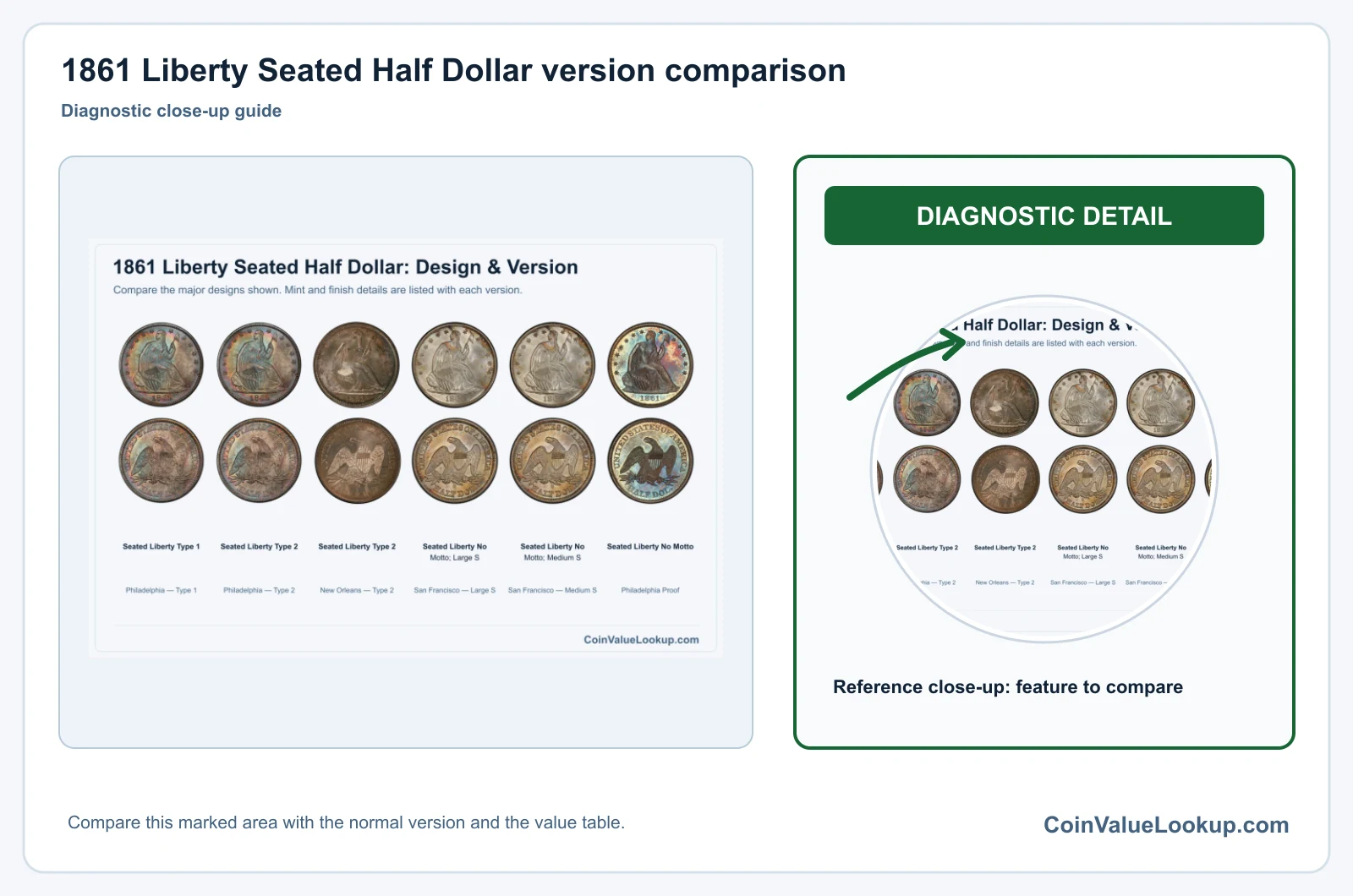
Type 1 versus Type 2 refers to the reverse hub, not an error. Type 1 has a short base on the letter L in HALF; Type 2 has a longer L base and a small lump near the eagle's left leg.
Both hubs were used at Philadelphia, so check both features.
Proof and Specimen are manufacturing finishes, not grades above Mint State. A bright circulated coin is not a Proof.
Step 2: Check Your 1861 Liberty Seated Half Dollar Grade
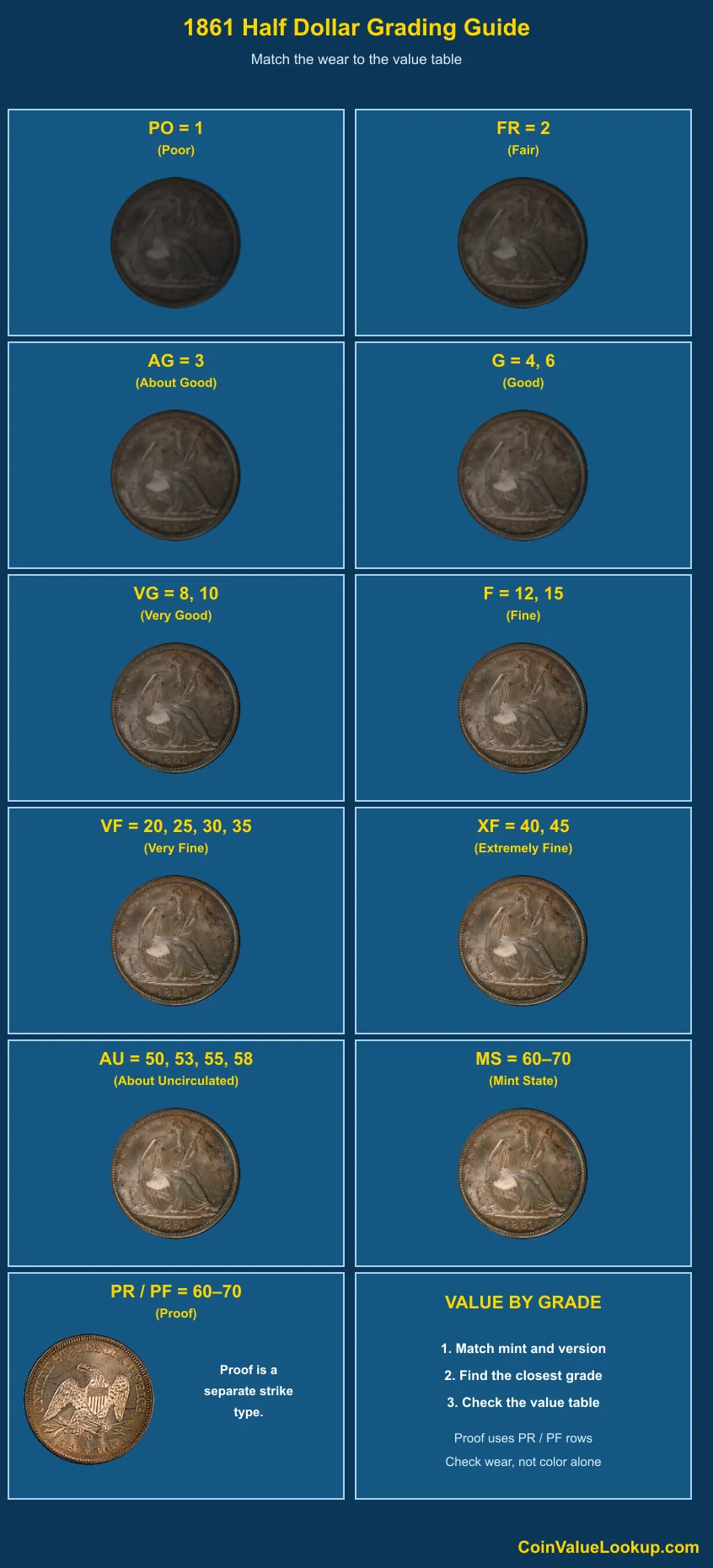
Start with Liberty herself. On a well-worn coin, her head blends into the cap, the breast flattens, and the knee disappears into the skirt folds.
The shield on her arm loses its horizontal lines early.
On the reverse, check the eagle's breast feathers, wing tips, and claws. These are the highest points and the first to smooth out.
Do not confuse a weakly struck area with actual wear. Wear removes luster and leaves a dull, flat surface.
A weak strike keeps some original cartwheel sheen even where detail is soft. Compare your coin to the grading image to see the difference side by side.
Always examine the edge and both fields for cleaning, scratches, or tooling. Cleaned or damaged coins trade well below guide estimates for the same grade.
Step 3: Check 1861 Liberty Seated Half Dollar Value by Mint and Version
1861 Liberty Seated Half Dollar — Philadelphia — Type 1
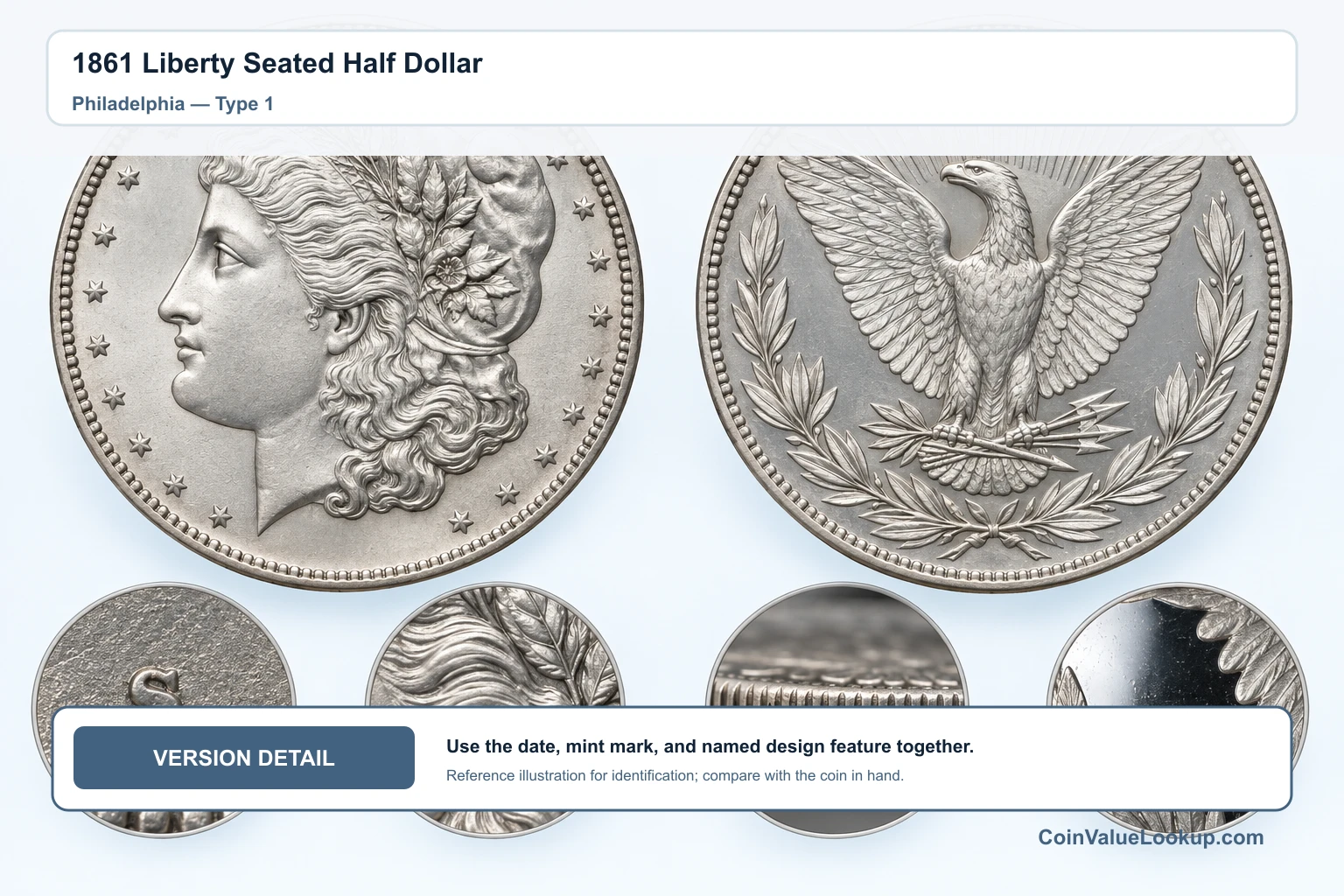
The Philadelphia Type 1 uses the older reverse hub with a short base on the L in HALF and no lump near the eagle's left leg. No mintmark appears on this coin.
Guide estimates place this version at about $79 in G4, $236 in VF20, and $456 in AU50. These figures are aggregate Philadelphia estimates and do not reflect a separate Type 1 premium.
To confirm the hub, compare the L base length and the eagle's leg area against a Type 2 example at the same scale.
Ordinary-issue reference: Ordinary-issue reference only: The table below shows prices for the 1861 Liberty Seated Half Dollar (regular strike). It does not represent the value of the specific Philadelphia — Type 1 variety or its variety premium. Year, mint, metal and strike type are matched; the specific variety is not priced by this table.
Range Grade
Price Auction Records Appraisal PO PO 1
—
Coin Identifier FR FR 2
—
Coin Identifier AG AG 3
—
Coin Identifier G G 4
—
Coin Identifier
G 6
—
Coin Identifier VG VG 8
—
Coin Identifier
VG 10
—
Coin Identifier F F 12
—
Coin Identifier
F 15
—
Coin Identifier VF VF 20
Coin Identifier
VF 25
Coin Identifier
VF 30
Coin Identifier
VF 35
Coin Identifier XF XF 40
Coin Identifier
XF 45
Coin Identifier AU AU 50
Coin Identifier
AU 53
Coin Identifier
AU 55
Coin Identifier
AU 58
Coin Identifier MS MS 60
Coin Identifier
MS 61
Coin Identifier
MS 62
Coin Identifier
MS 63
Coin Identifier
MS 64
Coin Identifier
MS 65
Coin Identifier
MS 66
Coin Identifier
MS 67
Coin Identifier
MS 68
—
—
—
MS 69
—
—
—
MS 70
—
—
—
1861 Liberty Seated Half Dollar — Philadelphia — Type 2
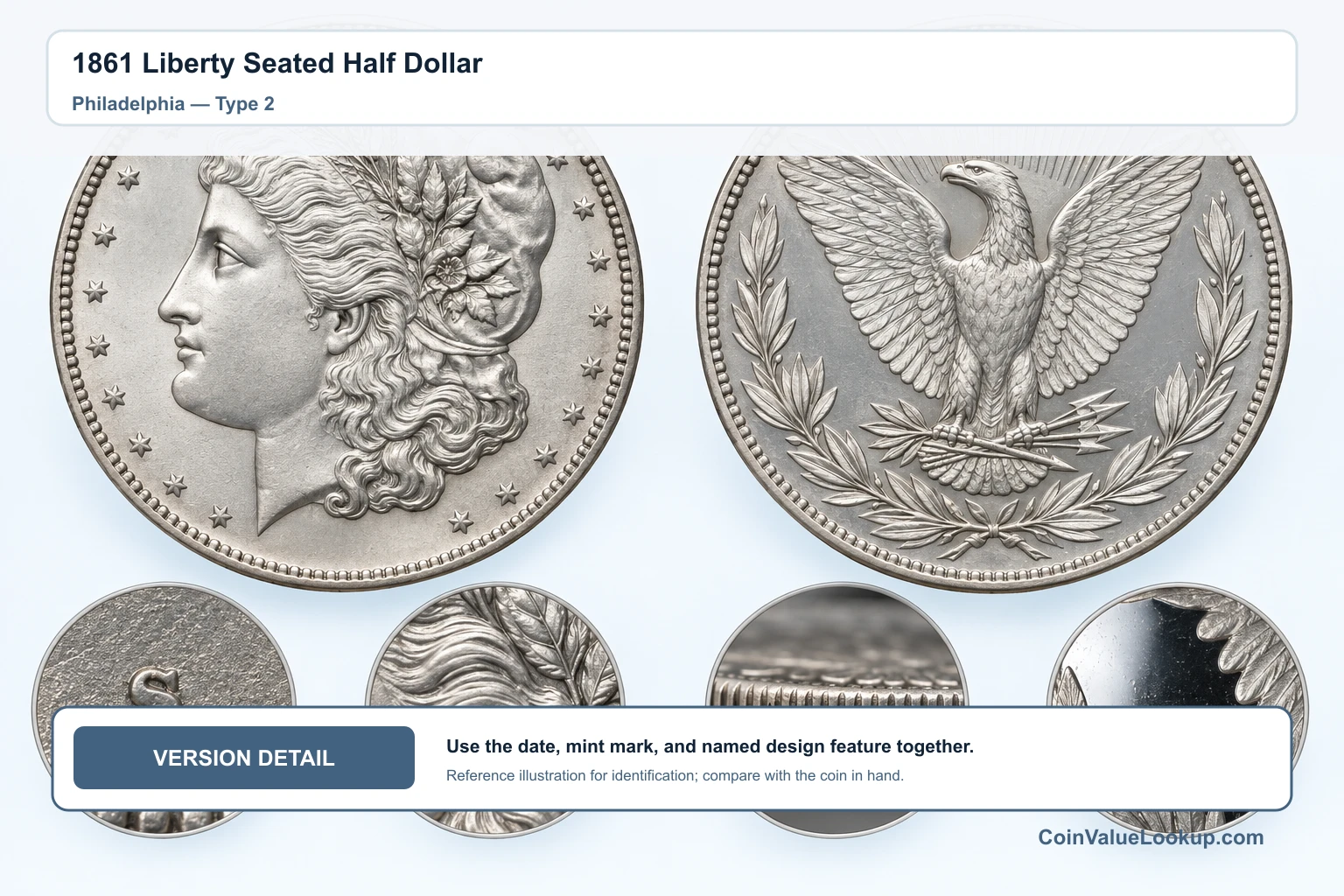
Philadelphia Type 2 shares the same date and mint as the Type 1 but uses the later reverse hub. Look for a longer base on the L in HALF and a small raised lump beside the eagle's left leg.
Guide estimates are the same aggregate Philadelphia figures: roughly $79 in G4, $236 in VF20, and $456 in AU50. No separate subtype premium is currently adopted.
The differences are subtle, so side-by-side comparison with a confirmed Type 1 is the easiest way to tell them apart.
Ordinary-issue reference: Ordinary-issue reference only: The table below shows prices for the 1861 Liberty Seated Half Dollar (regular strike). It does not represent the value of the specific Philadelphia — Type 2 variety or its variety premium. Year, mint, metal and strike type are matched; the specific variety is not priced by this table.
Range Grade
Price Auction Records Appraisal PO PO 1
—
Coin Identifier FR FR 2
—
Coin Identifier AG AG 3
—
Coin Identifier G G 4
—
Coin Identifier
G 6
—
Coin Identifier VG VG 8
—
Coin Identifier
VG 10
—
Coin Identifier F F 12
—
Coin Identifier
F 15
—
Coin Identifier VF VF 20
Coin Identifier
VF 25
Coin Identifier
VF 30
Coin Identifier
VF 35
Coin Identifier XF XF 40
Coin Identifier
XF 45
Coin Identifier AU AU 50
Coin Identifier
AU 53
Coin Identifier
AU 55
Coin Identifier
AU 58
Coin Identifier MS MS 60
Coin Identifier
MS 61
Coin Identifier
MS 62
Coin Identifier
MS 63
Coin Identifier
MS 64
Coin Identifier
MS 65
Coin Identifier
MS 66
Coin Identifier
MS 67
Coin Identifier
MS 68
—
—
—
MS 69
—
—
—
MS 70
—
—
—
1861 Liberty Seated Half Dollar — New Orleans — Type 2
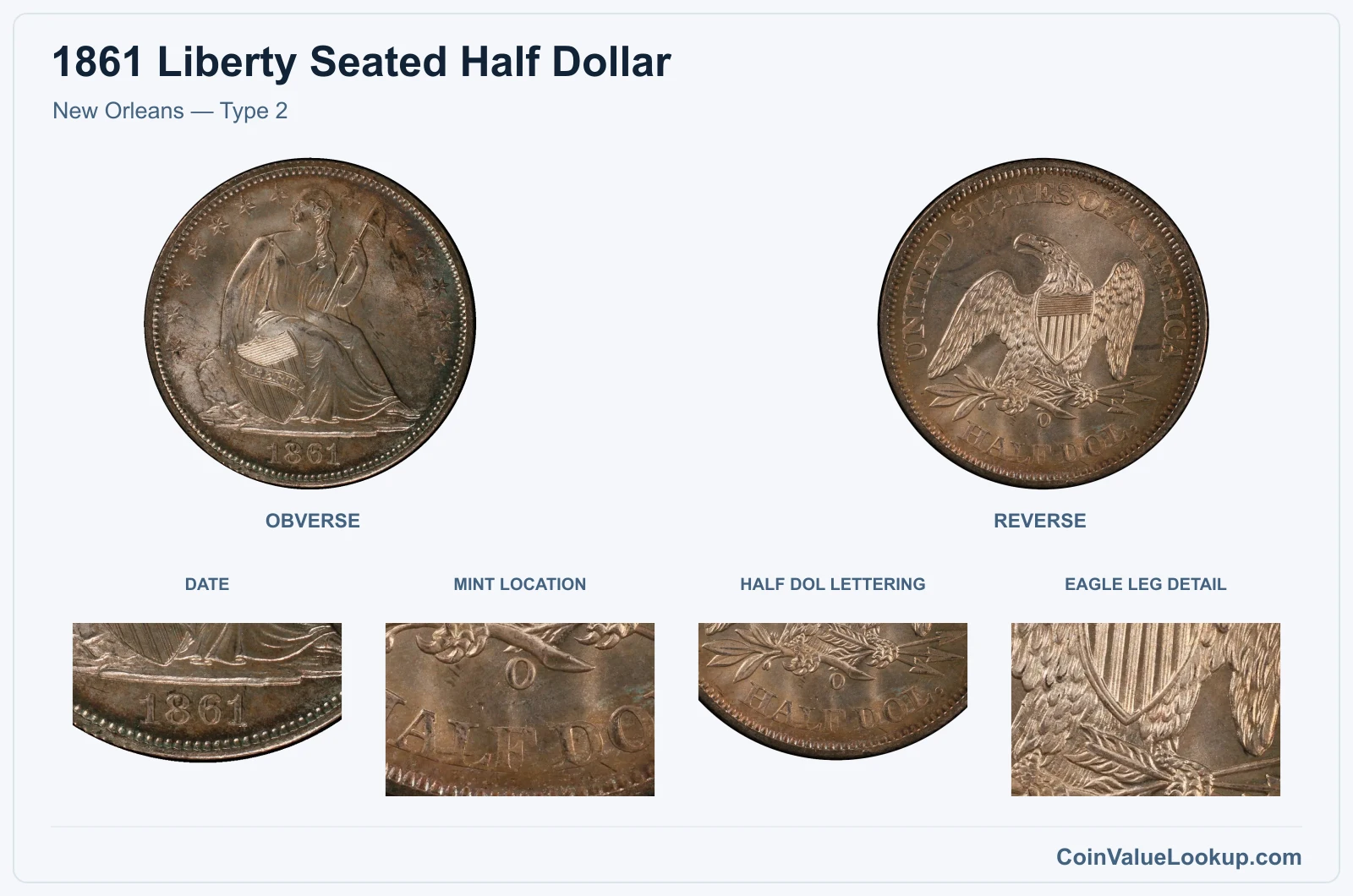
The New Orleans Type 2 is the standard federal-issue half dollar from the O mint in 1861. Look for the O mintmark below the eagle and the Type 2 reverse traits: long L base and eagle-leg lump.
Guide estimates run about $105 in G4, $242 in VF20, and $1,145 in AU50. That AU50 figure jumps noticeably above Philadelphia, reflecting lower survival rates in high grades.
Some O-mint coins come from shipwreck recoveries; that is a surface and provenance matter, not a different metal or finish.
Ordinary-issue reference: Ordinary-issue reference only: The table below shows prices for the 1861-O Liberty Seated Half Dollar (regular strike). It does not represent the value of the specific New Orleans — Type 2 variety or its variety premium. Year, mint, metal and strike type are matched; the specific variety is not priced by this table.
Range Grade
Price Auction Records Appraisal PO PO 1
Coin Identifier FR FR 2
—
Coin Identifier AG AG 3
—
Coin Identifier G G 4
—
Coin Identifier
G 6
Coin Identifier VG VG 8
Coin Identifier
VG 10
Coin Identifier F F 12
Coin Identifier
F 15
Coin Identifier VF VF 20
Coin Identifier
VF 25
Coin Identifier
VF 30
Coin Identifier
VF 35
Coin Identifier XF XF 40
Coin Identifier
XF 45
Coin Identifier AU AU 50
Coin Identifier
AU 53
Coin Identifier
AU 55
Coin Identifier
AU 58
Coin Identifier MS MS 60
Coin Identifier
MS 61
Coin Identifier
MS 62
Coin Identifier
MS 63
Coin Identifier
MS 64
Coin Identifier
MS 65
Coin Identifier
MS 66
Coin Identifier
MS 67
—
—
—
MS 68
—
—
—
MS 69
—
—
—
MS 70
—
—
—
1861 Liberty Seated Half Dollar — San Francisco — Large S
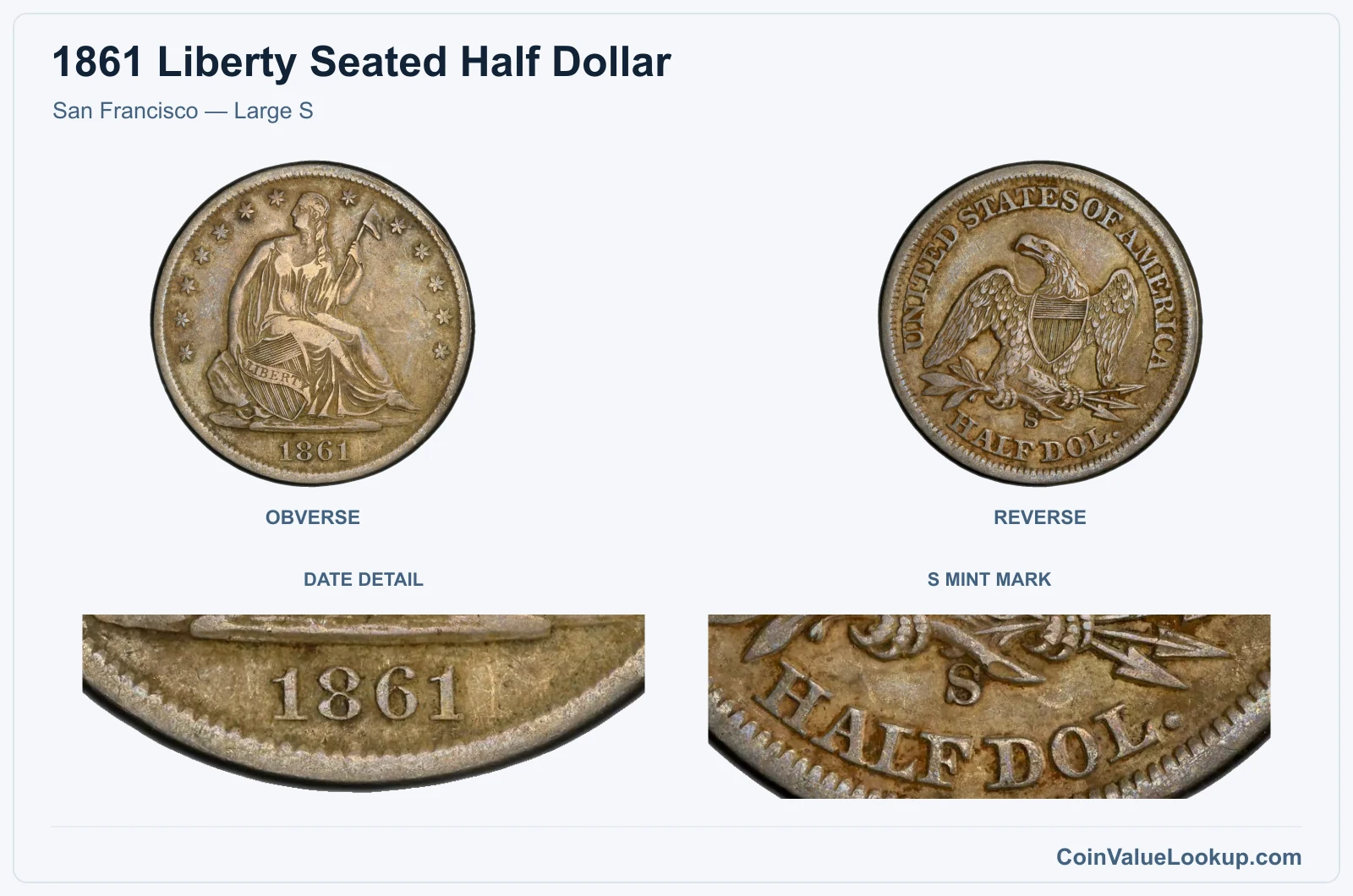
The San Francisco Large S shows a taller, broader S mintmark below the eagle. Compare it at the same magnification against the Medium S to see the size difference clearly.
Aggregate S-mint guide estimates are about $91 in G4, $331 in VF20, and $739 in AU50. No separate premium for the Large S punch has been adopted.
A small or broken punch is not the same as a removed mintmark, so look at overall letter proportions rather than surface damage.
Ordinary-issue reference: Ordinary-issue reference only: The table below shows prices for the 1861-S Liberty Seated Half Dollar (regular strike). It does not represent the value of the specific San Francisco — Large S variety or its variety premium. Year, mint, metal and strike type are matched; the specific variety is not priced by this table.
Range Grade
Price Auction Records Appraisal PO PO 1
—
Coin Identifier FR FR 2
—
Coin Identifier AG AG 3
—
Coin Identifier G G 4
Coin Identifier
G 6
—
Coin Identifier VG VG 8
—
Coin Identifier
VG 10
—
Coin Identifier F F 12
—
Coin Identifier
F 15
—
Coin Identifier VF VF 20
Coin Identifier
VF 25
Coin Identifier
VF 30
Coin Identifier
VF 35
Coin Identifier XF XF 40
Coin Identifier
XF 45
Coin Identifier AU AU 50
Coin Identifier
AU 53
Coin Identifier
AU 55
Coin Identifier
AU 58
Coin Identifier MS MS 60
Coin Identifier
MS 61
Coin Identifier
MS 62
Coin Identifier
MS 63
Coin Identifier
MS 64
Coin Identifier
MS 65
Coin Identifier
MS 66
Coin Identifier
MS 67
—
—
—
MS 68
—
—
—
MS 69
—
—
—
MS 70
—
—
—
1861 Liberty Seated Half Dollar — San Francisco — Medium S
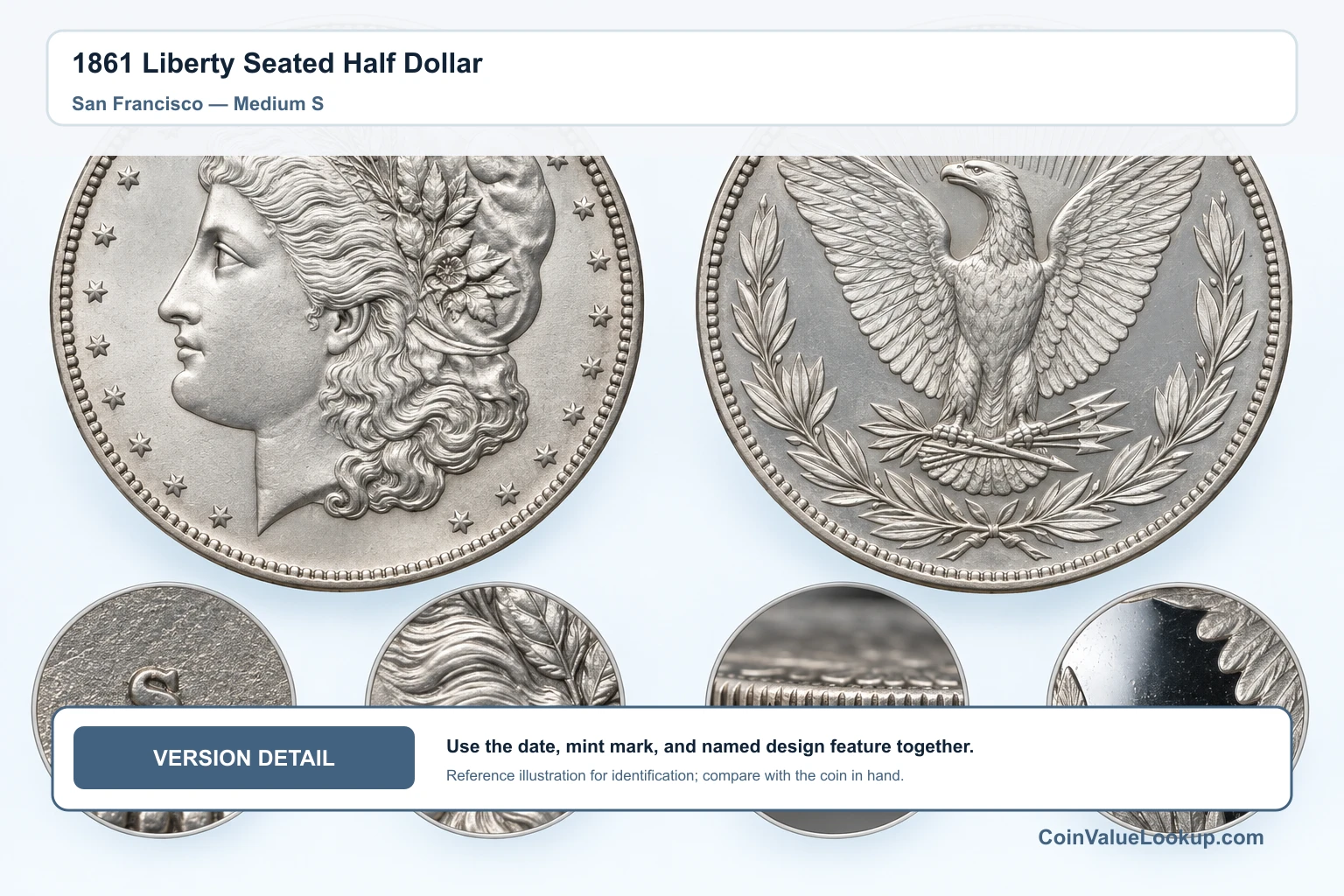
The Medium S variety uses a noticeably smaller mintmark punch than the Large S. Hold both styles side by side at the same scale and the height difference becomes obvious.
Aggregate S-mint guide values are identical to the Large S listing: roughly $91 in G4, $331 in VF20, and $739 in AU50. Until subtype-specific data is established, these shared figures are the best available reference.
Confirm the full dated obverse too, since a partial date can make any mintmark comparison moot.
Coin Value Lookup is a good starting point if you want to compare this coin's guide values against other Liberty Seated dates and mints.
Ordinary-issue reference: Ordinary-issue reference only: The table below shows prices for the 1861-S Liberty Seated Half Dollar (regular strike). It does not represent the value of the specific San Francisco — Medium S variety or its variety premium. Year, mint, metal and strike type are matched; the specific variety is not priced by this table.
Range Grade
Price Auction Records Appraisal PO PO 1
—
Coin Identifier FR FR 2
—
Coin Identifier AG AG 3
—
Coin Identifier G G 4
Coin Identifier
G 6
—
Coin Identifier VG VG 8
—
Coin Identifier
VG 10
—
Coin Identifier F F 12
—
Coin Identifier
F 15
—
Coin Identifier VF VF 20
Coin Identifier
VF 25
Coin Identifier
VF 30
Coin Identifier
VF 35
Coin Identifier XF XF 40
Coin Identifier
XF 45
Coin Identifier AU AU 50
Coin Identifier
AU 53
Coin Identifier
AU 55
Coin Identifier
AU 58
Coin Identifier MS MS 60
Coin Identifier
MS 61
Coin Identifier
MS 62
Coin Identifier
MS 63
Coin Identifier
MS 64
Coin Identifier
MS 65
Coin Identifier
MS 66
Coin Identifier
MS 67
—
—
—
MS 68
—
—
—
MS 69
—
—
—
MS 70
—
—
—
1861 Liberty Seated Half Dollar — Philadelphia Proof
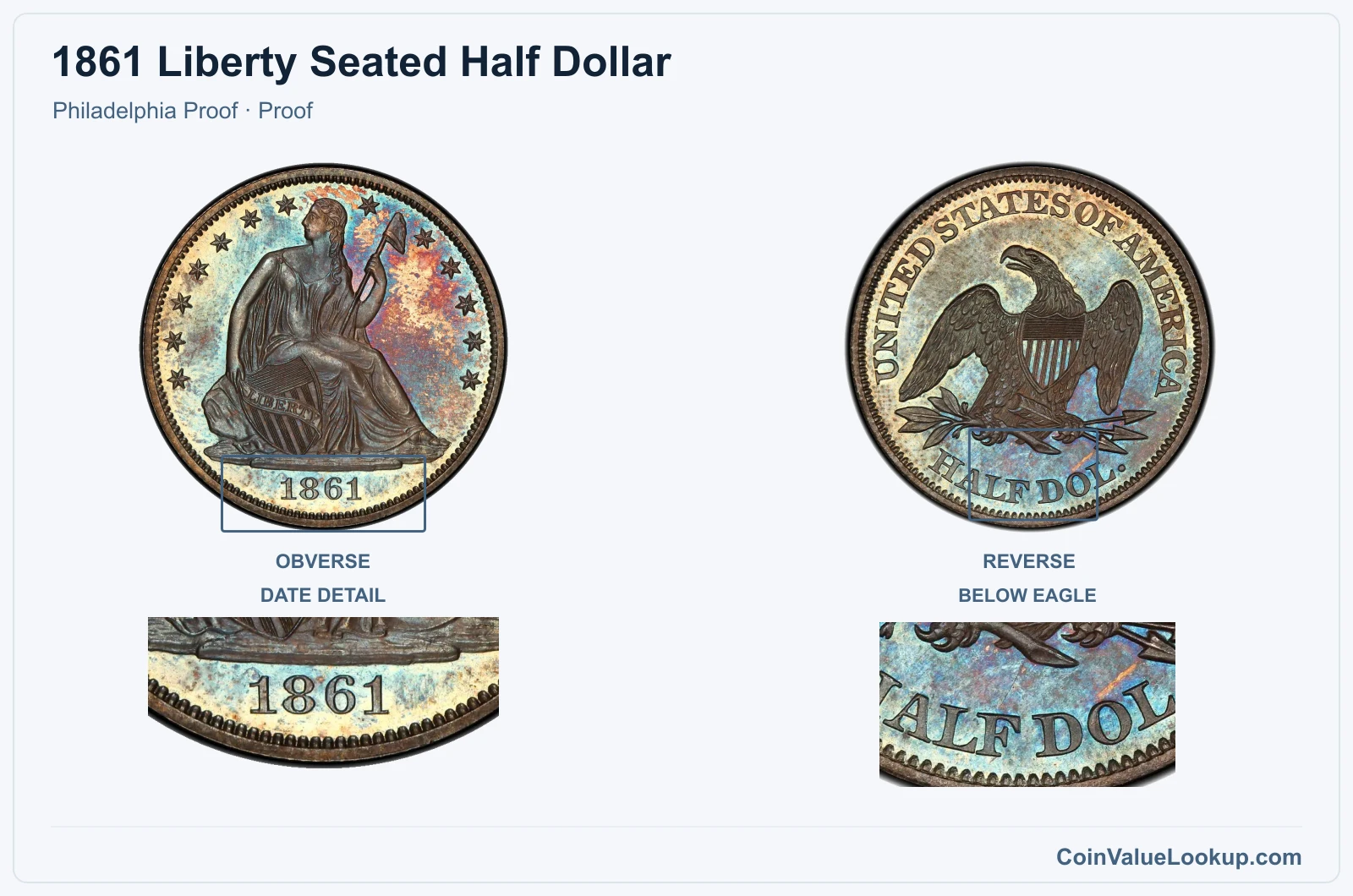
Philadelphia Proofs were struck with polished dies and planchets, producing mirror-like fields and sharp rims. Do not assume a coin is a Proof just because it looks shiny; genuine Proofs have a specific surface character that circulated coins never replicate.
A guide estimate of about $2,005 in PR63 gives you a reference point. Cameo and Deep Cameo designations stay within the Proof branch and can adjust the value further.
Authentication by a major grading service is the safest way to confirm a real Proof, since the mintage was small and fakes exist.
Range Grade
Price Auction Records Appraisal PR PR 1
—
Coin Identifier
PR 2
—
Coin Identifier
PR 3
—
Coin Identifier
PR 4
—
Coin Identifier
PR 6
—
Coin Identifier
PR 8
—
Coin Identifier
PR 10
—
Coin Identifier
PR 12
—
Coin Identifier
PR 15
—
Coin Identifier
PR 20
—
Coin Identifier
PR 25
—
Coin Identifier
PR 30
—
Coin Identifier
PR 35
—
Coin Identifier
PR 40
—
Coin Identifier
PR 45
—
Coin Identifier
PR 50
—
Coin Identifier
PR 53
Coin Identifier
PR 55
—
Coin Identifier
PR 58
—
Coin Identifier
PR 60
—
Coin Identifier
PR 61
Coin Identifier
PR 62
Coin Identifier
PR 63
Coin Identifier
PR 64
Coin Identifier
PR 65
Coin Identifier
PR 66
Coin Identifier
PR 67
Coin Identifier
PR 68
—
—
—
PR 69
—
—
—
PR 70
—
—
—
1861 Liberty Seated Half Dollar — New Orleans — Confederate Obverse
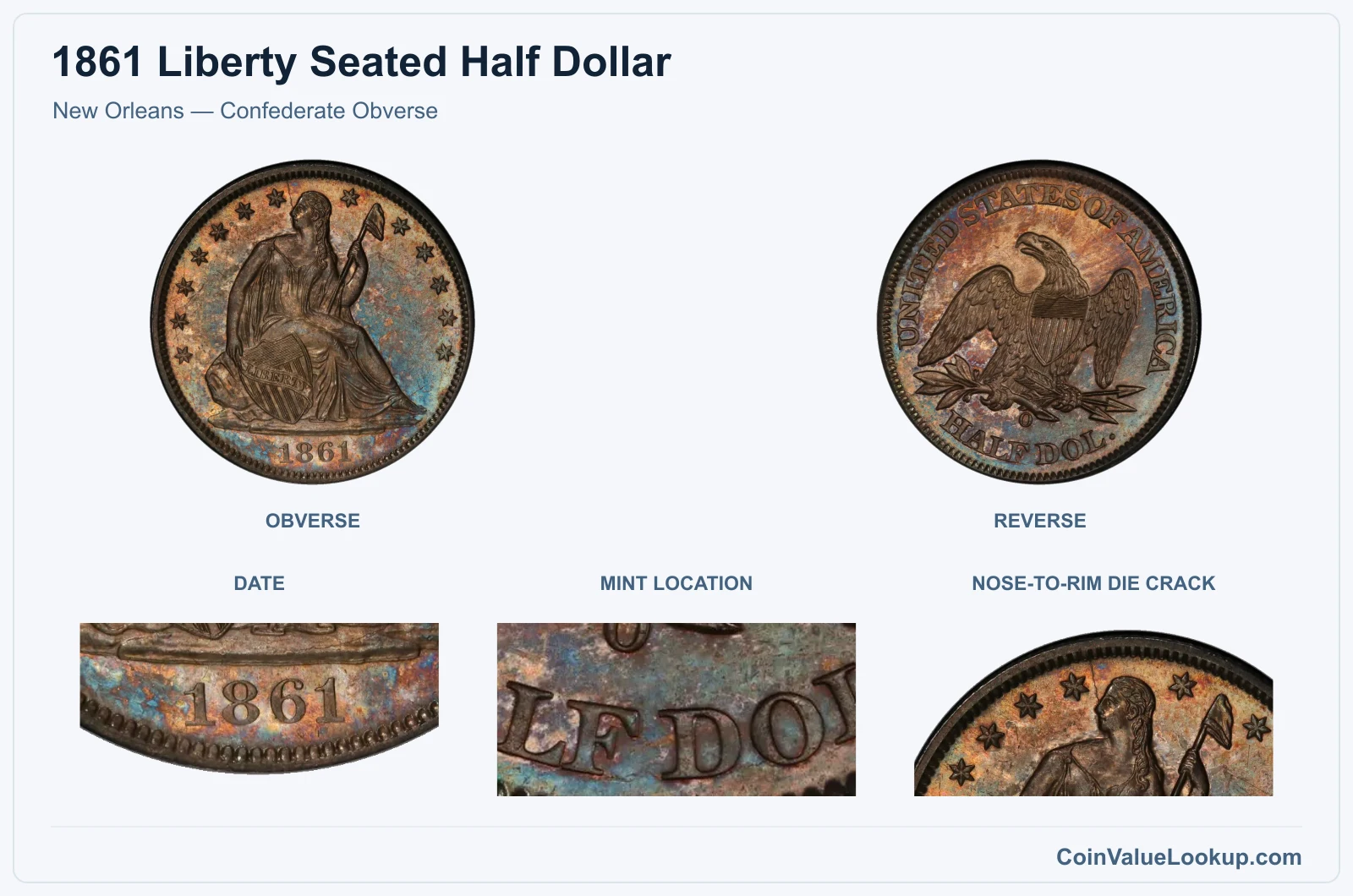
This is the famous Confederate-obverse 1861-O half dollar. After Louisiana seceded and Confederate forces took over the New Orleans Mint, they continued striking half dollars using the existing federal dies.
The key diagnostic is a die crack running from Liberty's nose toward the rim on the obverse.
Not every 1861-O coin is a Confederate issue. Only coins showing that specific crack pattern and die state qualify.
Four original Confederate-reverse coins and later restrikes are entirely separate specialist pieces and should not be confused with this variety.
Guide estimates place the Confederate obverse at about $456 in G4, $2,129 in VF20, and $5,238 in AU50. These figures reflect the historical premium collectors place on a coin struck under Confederate authority.
Range Grade
Price Auction Records Appraisal PO PO 1
—
Coin Identifier FR FR 2
—
Coin Identifier AG AG 3
Coin Identifier G G 4
Coin Identifier
G 6
Coin Identifier VG VG 8
Coin Identifier
VG 10
Coin Identifier F F 12
Coin Identifier
F 15
Coin Identifier VF VF 20
Coin Identifier
VF 25
Coin Identifier
VF 30
Coin Identifier
VF 35
Coin Identifier XF XF 40
Coin Identifier
XF 45
Coin Identifier AU AU 50
Coin Identifier
AU 53
Coin Identifier
AU 55
Coin Identifier
AU 58
Coin Identifier MS MS 60
Coin Identifier
MS 61
—
Coin Identifier
MS 62
Coin Identifier
MS 63
Coin Identifier
MS 64
—
—
—
MS 65
—
—
—
MS 66
—
—
—
MS 67
—
—
—
MS 68
—
—
—
MS 69
—
—
—
MS 70
—
—
—
1861 Liberty Seated Half Dollar — New Orleans — Louisiana Specimen
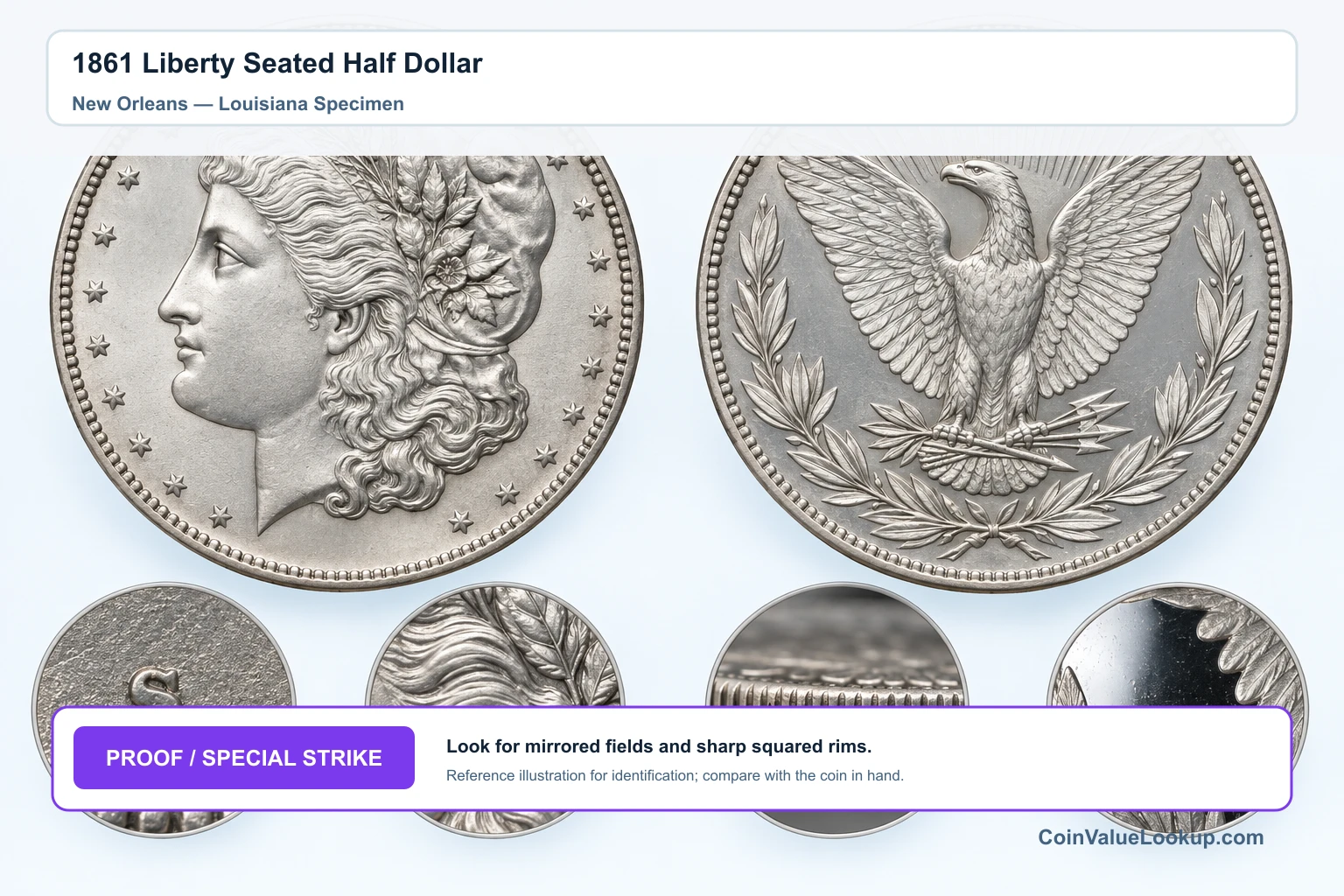
The Louisiana Specimen is a special-manufacture 1861-O coin with characteristics distinct from ordinary circulation strikes. An NGC Specimen 62 example graded as Louisiana W-4 is documented in reference archives.
A normal circulation coin that happens to have reflective fields does not qualify as a Specimen. Authentication and attribution by a recognized grading service are essential for this variety.
No standard numeric price range has been adopted; each coin's value depends on its authenticated identity, condition, and any associated errors. If you think you have one, professional evaluation is the only responsible next step.
Range Grade
Price Auction Records Appraisal SP SP 1
—
Coin Identifier
SP 2
—
Coin Identifier
SP 3
—
Coin Identifier
SP 4
—
Coin Identifier
SP 6
—
Coin Identifier
SP 8
—
Coin Identifier
SP 10
—
Coin Identifier
SP 12
—
Coin Identifier
SP 15
—
Coin Identifier
SP 20
—
Coin Identifier
SP 25
—
Coin Identifier
SP 30
—
Coin Identifier
SP 35
—
Coin Identifier
SP 40
—
Coin Identifier
SP 45
—
Coin Identifier
SP 50
—
Coin Identifier
SP 53
—
Coin Identifier
SP 55
—
Coin Identifier
SP 58
—
Coin Identifier
SP 60
—
Coin Identifier
SP 61
—
Coin Identifier
SP 62
—
Coin Identifier
SP 63
—
Coin Identifier
SP 64
—
—
—
SP 65
—
—
—
SP 66
—
—
—
SP 67
—
—
—
SP 68
—
—
—
SP 69
—
—
—
SP 70
—
—
—
1861 Liberty Seated Half Dollar Error List
1. 1861 Liberty Seated Half Dollar — Die Crack / Die Chip
The most historically significant die crack on the 1861 half dollar runs from Liberty's nose toward the rim on certain New Orleans coins. This crack appears as raised metal on the coin's surface because it corresponds to a fracture in the steel die.
It is a primary diagnostic used to attribute the Confederate-obverse variety.
Not every crack on an 1861-O coin means you have a Confederate piece. The crack must match the documented die state.
Incuse scratches, corrosion lines, or foreign material sitting on the surface are not die cracks; a genuine crack is raised above the surrounding field.
Condition, visibility, and the specific die state all affect value. No standard price range for cracked-die coins has been adopted outside the Confederate-obverse listing.
2. 1861 Liberty Seated Half Dollar — Die Gouge / Named Raised-Line Variety
The 1861-O Speared Olive Bud is a named variety caused by a die gouge on the reverse. It appears as a raised line near the olive branch, and it is part of the die itself, meaning every coin from that die pair shows it.
Do not confuse this with an incuse scratch or random surface damage. A die gouge produces raised metal; a scratch cuts into the surface.
Compare the olive branch area on your coin against a normal 1861-O reverse to see if the line matches the documented position.
The value depends on the coin's overall condition, the visibility of the gouge, and collector demand for the specific variety. No standard price range has been adopted for this error.
3. 1861 Liberty Seated Half Dollar — Clashed Dies
Die clashes on the 1861 half dollar have been reported on San Francisco strikes. A clash happens when the obverse and reverse dies strike each other without a planchet between them, transferring faint outlines of the opposing design onto each die.
The result is ghostly design elements visible in the fields of subsequently struck coins.
Look for traces of the eagle's outline on the obverse fields or Liberty's profile faintly showing on the reverse. These marks are raised and follow the contour of the opposite die's design.
Scratches, random raised lines, and brockage impressions are different and should not be mistaken for clashes.
Value depends on how bold the clash is and the coin's overall grade. No specific price range for clashed 1861 half dollars has been adopted.
4. 1861 Liberty Seated Half Dollar — Die Break / Cud
Die breaks and cuds on the 1861 half dollar have been documented on San Francisco issues, particularly near the eagle's wing area on the reverse. A cud is a raised, featureless blob of metal at the rim where a piece of the die has broken away.
Interior raised patches that do not connect to the rim are properly called die breaks, not cuds.
Check the rim carefully. A rim dent is damage to the coin after striking; it pushes metal inward.
A cud is flat, blobby, and was formed during the strike. Corrosion can also mimic a break, so look for the smooth, raised texture that only comes from a broken die.
No specific price range has been adopted for these breaks. Value depends on size, location, and the coin's condition.