1911 Barber Half Dollar Coin Value: How Much Is It Worth?
A 1911 Barber Half Dollar in well-worn Good-4 condition starts around $44 based on a USA Coin Book retail guide snapshot, while a Mint State MS63 example can reach roughly $1049 to $2092 depending on the mint. Proof strikes and error varieties occupy their own price tiers.
Three business-strike mints were active this year — Philadelphia, Denver, and San Francisco — plus a Philadelphia Proof issue, so knowing exactly what you have matters before you look at any value chart.
Fast Way to Identify Your 1911 Barber Half Dollar
The quickest way to start figuring out what your 1911 Barber Half is worth is to snap clear photos of the front and back and upload them for a preliminary identification. This helps confirm the date, mintmark location, and overall condition.
It is not a substitute for professional authentication or exact grading, but it gives you a solid starting point.
1911 Barber Half Dollar Value
Upload both sides of your 1911 Barber Half Dollar.
Front Obverse
Upload photo
Back Reverse
Upload photo
Which 1911 Barber Half Dollar Versions Are Worth Money?
- The 1911-S in MS63 reaches about $2,092 per USA Coin Book — roughly double the Philadelphia and Denver versions at the same grade — making it the standout business strike to check.
- A Philadelphia Proof in PR63 is valued around $1,363 by the same guide; genuine Proofs show mirrored fields and sharp rim detail that no amount of polishing can replicate.
- Upper circulated and original-surface Mint State coins of any mint are substantially more valuable than heavily worn pieces, so condition and lack of cleaning matter.
- A reported 1911-S repunched mintmark (S/S) variety exists; value depends on the specific punch, visibility, and condition of the individual coin.
- An inverted-S mintmark has been survey-listed for 1911-S, though no respondent specimen was recorded — a confirmed example could carry a premium.
Step 1: Identify Your 1911 Barber Half Dollar Mint Mark and Version
The 1911 Barber Half Dollar shows Liberty facing right on the obverse, wearing a Phrygian cap and laurel wreath, with the date at the bottom. The reverse features a heraldic eagle with HALF DOLLAR below.
All regular issues are struck in 90% silver and 10% copper, weighing about 12.5 grams with a 30.6 mm diameter and a reeded edge.
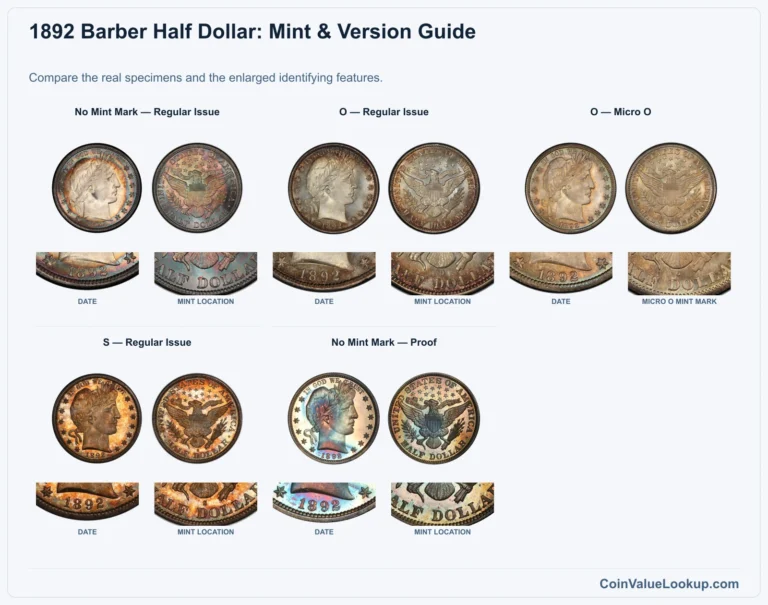
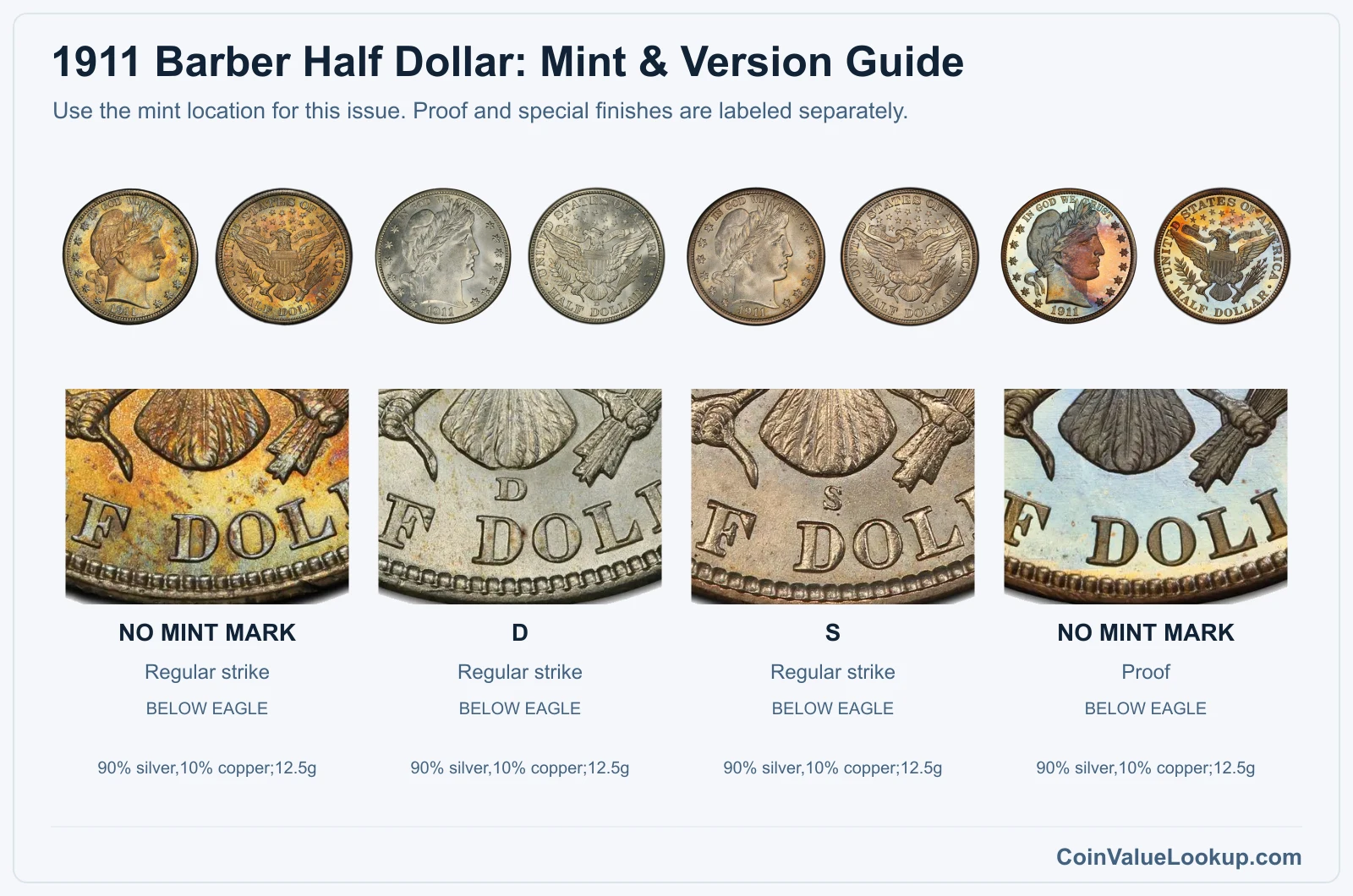
To identify the mint, flip the coin to the reverse and look just below the eagle's tail feathers, above the words HALF DOLLAR. Philadelphia coins carry no mintmark at all.
Denver coins show a small "D" in that spot, and San Francisco coins display an "S."
Three business-strike versions exist for this date: P (no mintmark), D, and S. Philadelphia also produced Proof strikes.
A reported inverted-S variety is a separate category from the S/S repunched mintmark — they are not the same thing. Neither can be confirmed on your coin by survey listing alone; each requires direct examination of the actual mintmark under magnification.
Step 2: Check Your 1911 Barber Half Dollar Grade
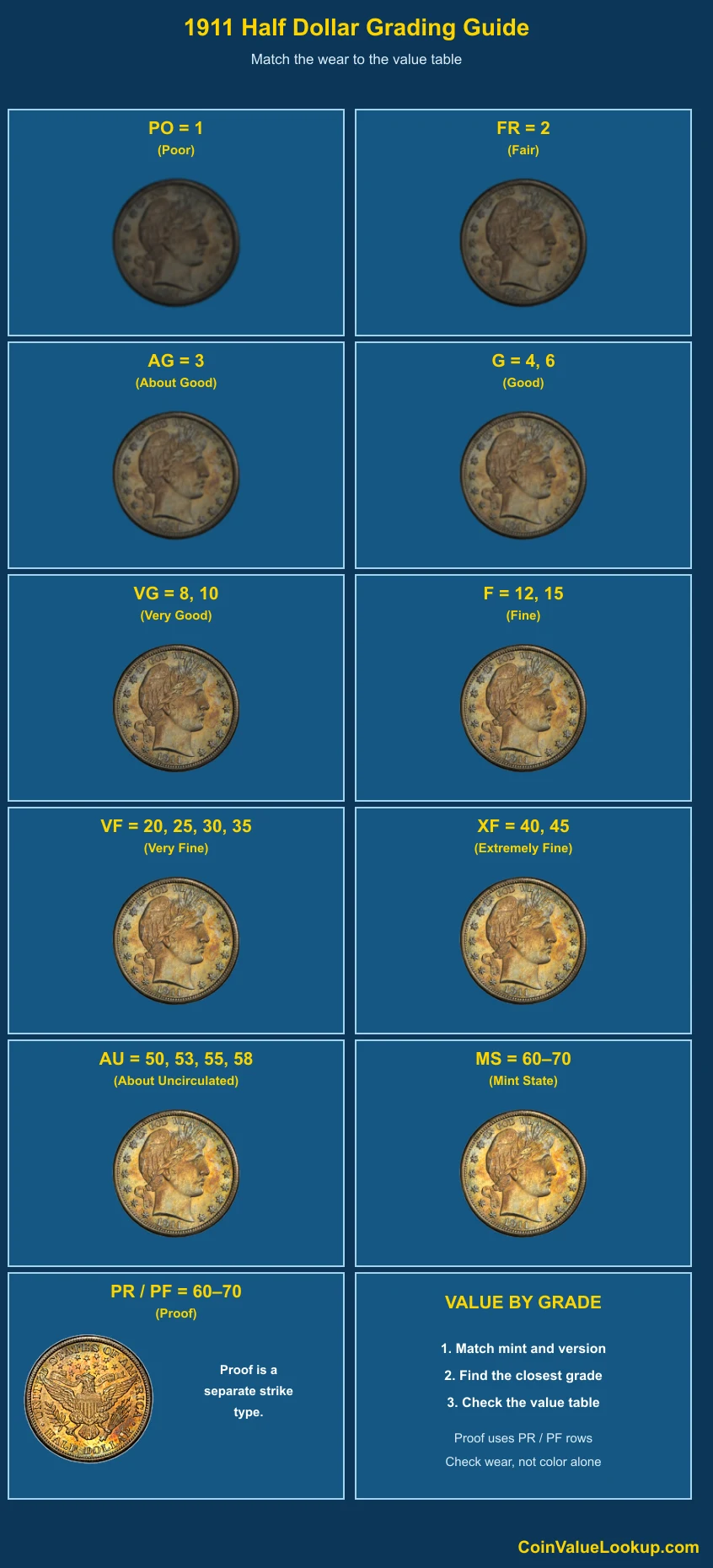
Start by checking Liberty's cheek and the hair detail above her ear. On a well-circulated coin, the cheek will be flat and smooth, with the hair strands merged together.
A coin grading around Very Good will still show some separation in the hair but the headband reading LIBERTY will be incomplete.
On the reverse, examine the eagle's head, wing tips, and tail feathers. Sharp feather detail suggests a higher grade.
Compare your coin against the grade comparison image to see where it falls.
Don't rely solely on how many letters of LIBERTY you can read. Hub changes during the Barber series altered how those letters wore, so a coin that lost a letter or two might not be as worn as you think.
Also, weak details at the eagle's claws or arrow feathers can indicate a soft strike rather than heavy circulation — luster in protected areas is your clue there.
Remember that Proof is a special manufacturing finish with mirrored fields, not a grade above Mint State. Polishing a business strike does not create a Proof.
Step 3: Check 1911 Barber Half Dollar Value by Mint and Version
1911 Barber Half Dollar — No Mint Mark — Regular Issue
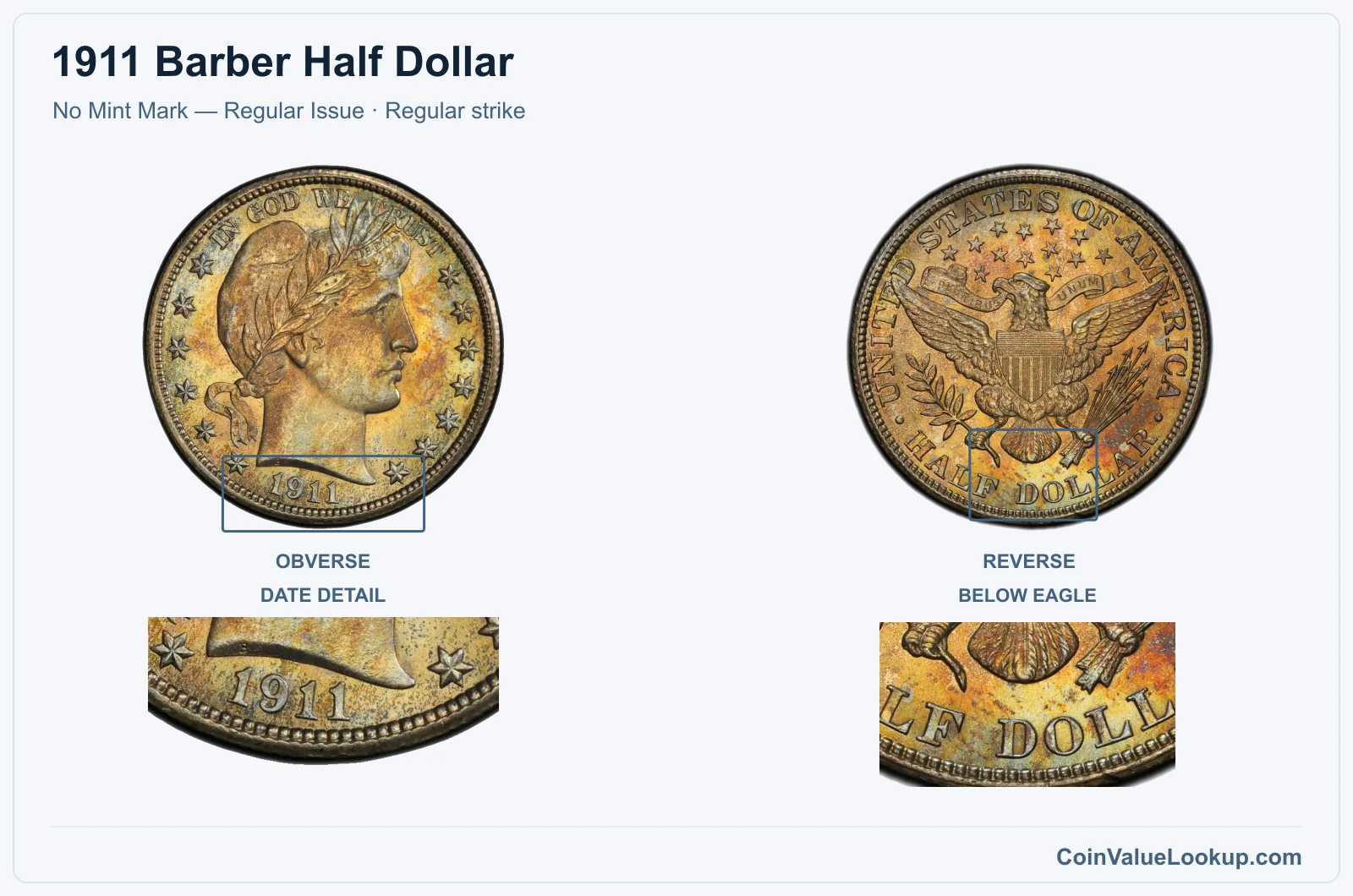
The 1911 Philadelphia Half Dollar has no mintmark — that blank space below the eagle's tail is normal. USA Coin Book lists it at about $44 in G4 and around $1,049 in MS63.
Most surviving examples are well circulated, so finding one with original luster is a real plus.
When evaluating this version, look at the full obverse and reverse, not just the date. Original surfaces free of cleaning or tooling hold more appeal than a coin that has been scrubbed bright.
A coin with natural gray or golden toning and honest wear will generally outperform a harshly cleaned piece at the same technical grade.
Range Grade
Price Auction Records Appraisal PO PO 1
—
Coin Identifier FR FR 2
—
Coin Identifier AG AG 3
—
Coin Identifier G G 4
—
Coin Identifier
G 6
Coin Identifier VG VG 8
Coin Identifier
VG 10
Coin Identifier F F 12
Coin Identifier
F 15
Coin Identifier VF VF 20
Coin Identifier
VF 25
Coin Identifier
VF 30
Coin Identifier
VF 35
Coin Identifier XF XF 40
Coin Identifier
XF 45
Coin Identifier AU AU 50
Coin Identifier
AU 53
Coin Identifier
AU 55
Coin Identifier
AU 58
Coin Identifier MS MS 60
Coin Identifier
MS 61
Coin Identifier
MS 62
Coin Identifier
MS 63
Coin Identifier
MS 64
Coin Identifier
MS 65
Coin Identifier
MS 66
Coin Identifier
MS 67
Coin Identifier
MS 68
—
—
—
MS 69
—
—
—
MS 70
—
—
—
1911 Barber Half Dollar — D — Regular Issue
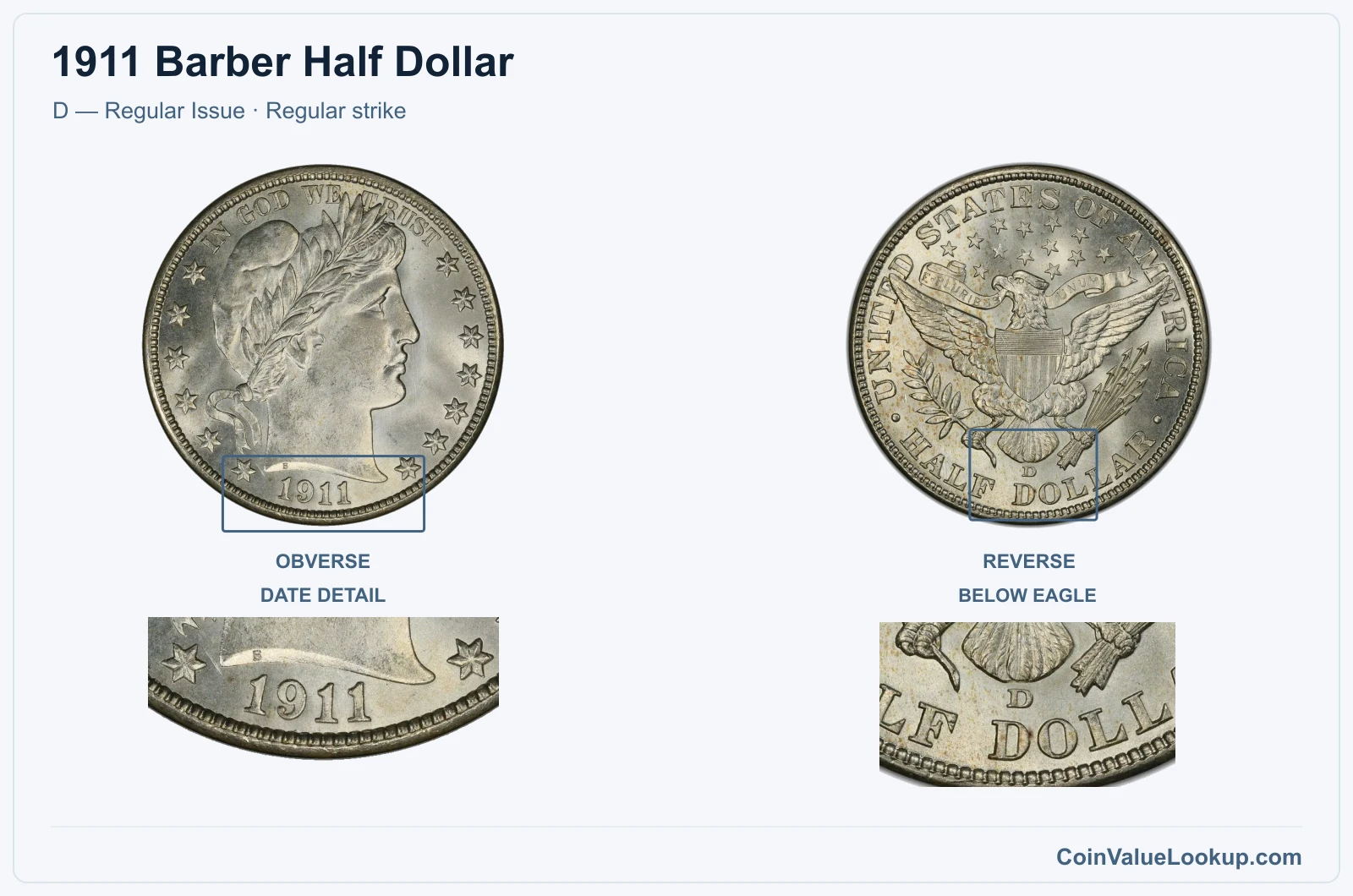
The 1911-D carries a small "D" mintmark below the eagle's tail feathers. Guide values sit at roughly $44 in G4 and about $1,049 in MS63 per USA Coin Book.
Denver Barber Halves are widely collected, and the 1911-D is an available date in circulated grades.
Confirm the mintmark under magnification before assuming you have a Denver coin — wear can make a "D" look ambiguous. As with all Barber halves, original problem-free surfaces matter.
A coin with even, natural wear is far more desirable than one that has been cleaned or damaged, even if both land at the same grade number.
Range Grade
Price Auction Records Appraisal PO PO 1
—
Coin Identifier FR FR 2
—
Coin Identifier AG AG 3
—
Coin Identifier G G 4
—
Coin Identifier
G 6
—
Coin Identifier VG VG 8
—
Coin Identifier
VG 10
—
Coin Identifier F F 12
Coin Identifier
F 15
Coin Identifier VF VF 20
Coin Identifier
VF 25
Coin Identifier
VF 30
Coin Identifier
VF 35
Coin Identifier XF XF 40
Coin Identifier
XF 45
Coin Identifier AU AU 50
Coin Identifier
AU 53
Coin Identifier
AU 55
Coin Identifier
AU 58
Coin Identifier MS MS 60
Coin Identifier
MS 61
Coin Identifier
MS 62
Coin Identifier
MS 63
Coin Identifier
MS 64
Coin Identifier
MS 65
Coin Identifier
MS 66
Coin Identifier
MS 67
Coin Identifier
MS 68
—
—
—
MS 69
—
—
—
MS 70
—
—
—
1911 Barber Half Dollar — S — Regular Issue
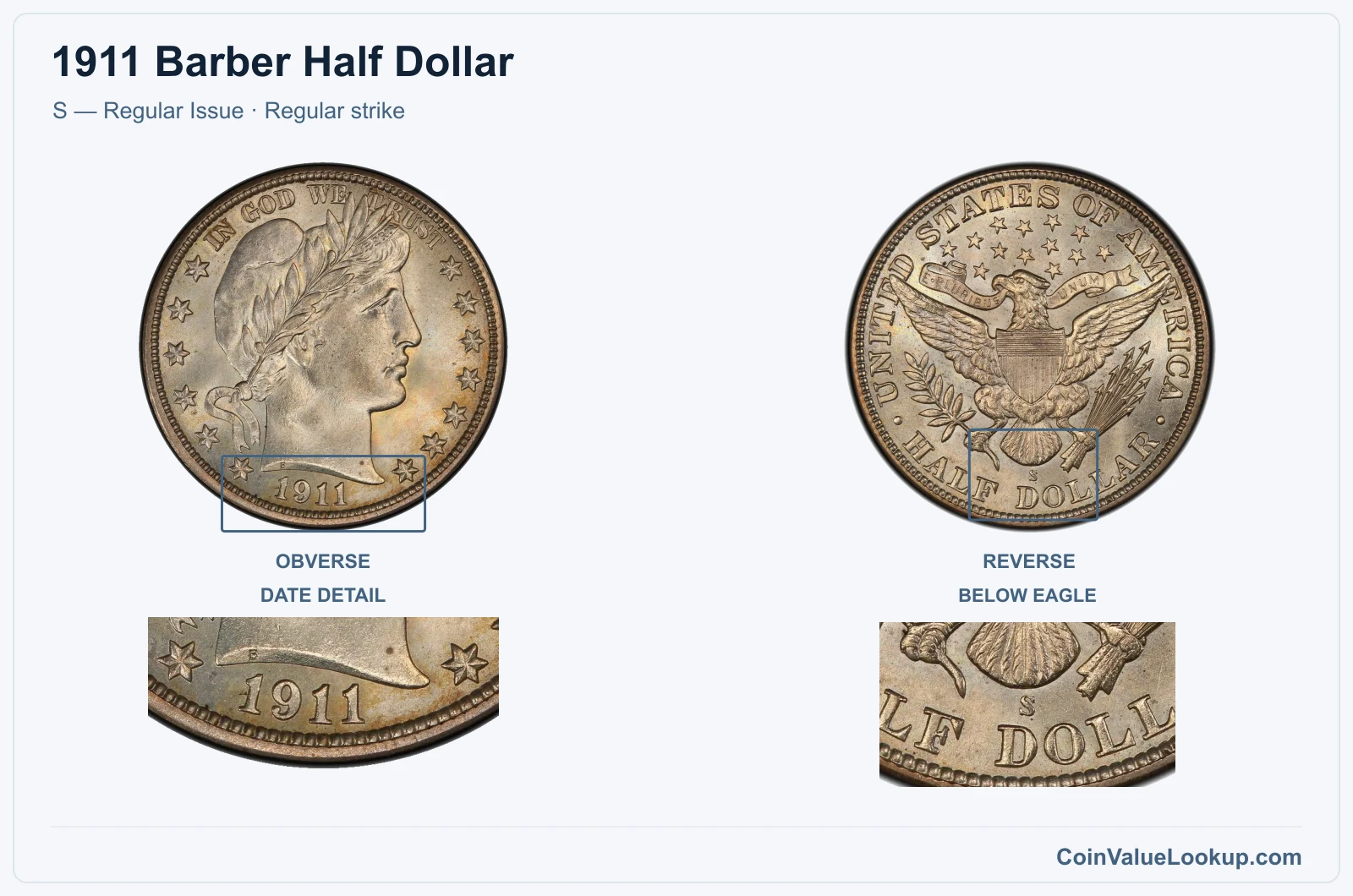
Look for the "S" mintmark below the eagle's tail. The 1911-S starts at about $44 in G4, matching the other mints, but jumps to approximately $2,092 in MS63 according to USA Coin Book — nearly twice the Philadelphia and Denver figures at that grade.
That spread tells you Mint State survivors are scarce relative to demand.
Coin Value Lookup is a good place to look up guides for other dates and denominations in the Barber series if you are working through a collection.
Be aware that two distinct mintmark varieties have been reported for the 1911-S: a repunched S/S and an inverted S. These are separate issues.
Identifying either one requires careful comparison of your mintmark against a known normal example at equal magnification, not just a quick glance.
Range Grade
Price Auction Records Appraisal PO PO 1
—
Coin Identifier FR FR 2
—
Coin Identifier AG AG 3
—
Coin Identifier G G 4
—
Coin Identifier
G 6
—
Coin Identifier VG VG 8
—
Coin Identifier
VG 10
Coin Identifier F F 12
Coin Identifier
F 15
Coin Identifier VF VF 20
Coin Identifier
VF 25
Coin Identifier
VF 30
Coin Identifier
VF 35
Coin Identifier XF XF 40
Coin Identifier
XF 45
Coin Identifier AU AU 50
Coin Identifier
AU 53
Coin Identifier
AU 55
Coin Identifier
AU 58
Coin Identifier MS MS 60
—
Coin Identifier
MS 61
—
Coin Identifier
MS 62
Coin Identifier
MS 63
Coin Identifier
MS 64
Coin Identifier
MS 65
Coin Identifier
MS 66
Coin Identifier
MS 67
Coin Identifier
MS 68
—
—
—
MS 69
—
—
—
MS 70
—
—
—
1911 Barber Half Dollar — No Mint Mark — Proof
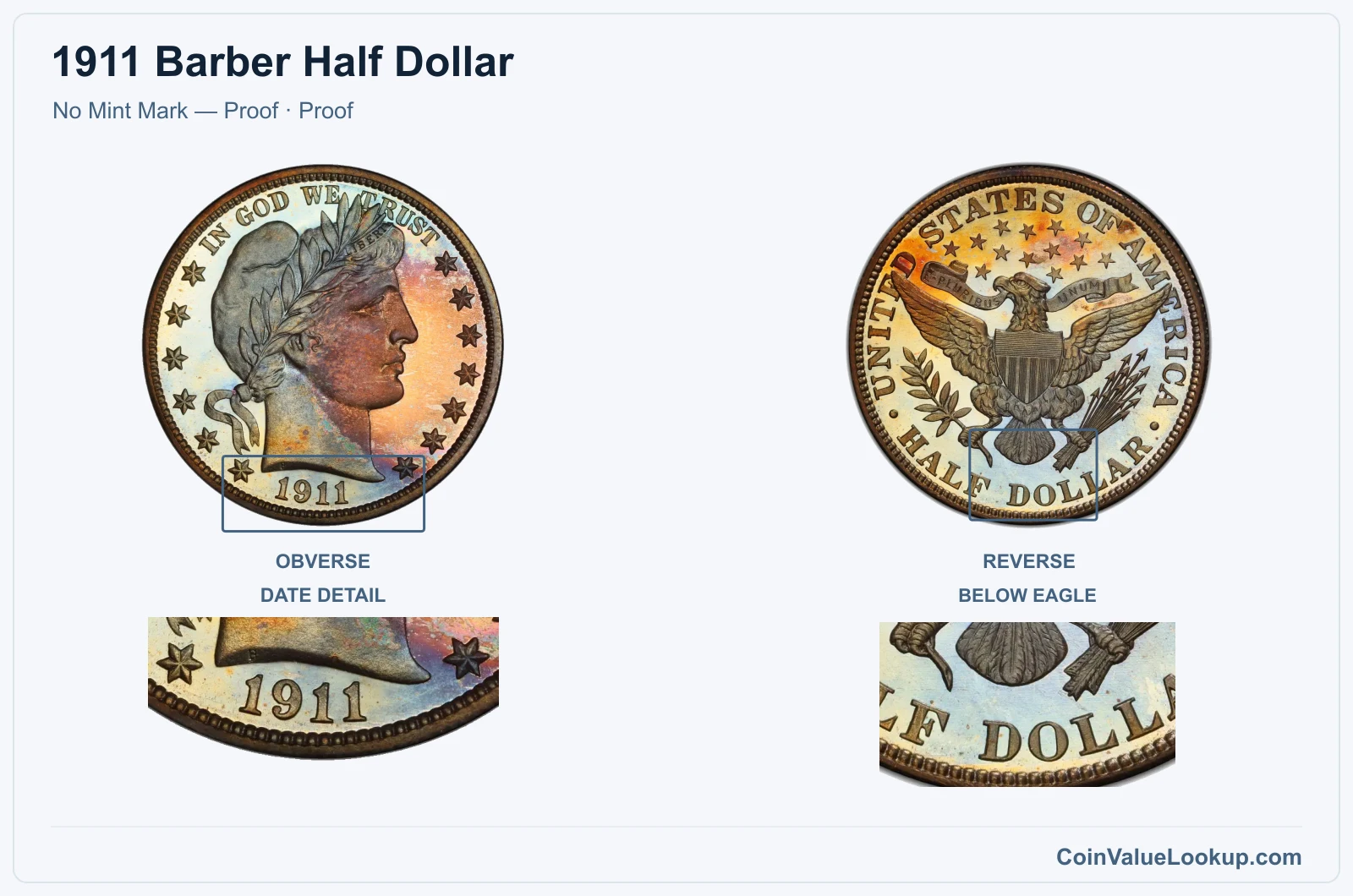
Philadelphia Proof Barber Halves were struck for collectors, not circulation. The 1911 Proof is listed at about $1,363 in PR63 by USA Coin Book.
Genuine Proofs display deeply mirrored fields, crisp squared-off rims, and full detail on both Liberty's hair and the eagle's feathers.
Do not confuse a polished business strike with a Proof. Polishing removes metal and leaves hairlines that run in random directions, while a true Proof's reflectivity comes from specially prepared dies and planchets.
If you suspect you have a Proof, compare the rim profile and field quality against a known example. Any cameo contrast you see should be evaluated within the Proof category, not treated as evidence of a new mint branch.
Range Grade
Price Auction Records Appraisal PR PR 1
—
Coin Identifier
PR 2
—
Coin Identifier
PR 3
—
Coin Identifier
PR 4
—
Coin Identifier
PR 6
—
Coin Identifier
PR 8
—
Coin Identifier
PR 10
—
Coin Identifier
PR 12
—
Coin Identifier
PR 15
—
Coin Identifier
PR 20
—
Coin Identifier
PR 25
—
Coin Identifier
PR 30
—
Coin Identifier
PR 35
—
Coin Identifier
PR 40
—
Coin Identifier
PR 45
—
Coin Identifier
PR 50
—
Coin Identifier
PR 53
—
Coin Identifier
PR 55
—
Coin Identifier
PR 58
—
Coin Identifier
PR 60
Coin Identifier
PR 61
Coin Identifier
PR 62
Coin Identifier
PR 63
Coin Identifier
PR 64
Coin Identifier
PR 65
Coin Identifier
PR 66
Coin Identifier
PR 67
Coin Identifier
PR 68
Coin Identifier
PR 69
—
Coin Identifier
PR 70
—
—
—
1911 Barber Half Dollar Error List
1. 1911 Barber Half Dollar — Repunched Mintmark
A repunched mintmark (S/S) has been reported for the 1911-S Barber Half Dollar. This occurs when the mintmark punch was applied more than once in slightly different positions, leaving traces of the first impression visible alongside the final one.
To check, examine the "S" mintmark under at least 5x magnification. Look for a secondary outline, a doubled serif, or a shadow of another "S" partially overlapping the primary mark.
Compare your coin's mintmark side-by-side with a normal 1911-S at the same scale.
Don't confuse a repunched mintmark with machine doubling, which produces flat shelf-like doubling, or with a die chip or corrosion that adds irregular material near the letter. No specific price range is established here because value depends on the visibility of the repunching, overall coin condition, and third-party confirmation.
2. 1911 Barber Half Dollar — Inverted Mintmark
An inverted mintmark has been survey-listed for the 1911-S, meaning the "S" punch was reportedly entered upside down into the die. However, no respondent specimen was recorded in the society survey, so this variety remains a listed candidate rather than a confirmed, widely examined piece.
If you suspect your 1911-S has an inverted "S," compare the orientation of the letter carefully against a normal same-year mintmark at equal magnification. A standard "S" has specific serif directions and curve proportions that reverse when the punch is flipped.
Be careful not to mistake an ordinary punch style, a repunched mark, or post-strike damage for an inverted orientation. No numerical price is established for this variety, as value would depend on confirmation, the coin's condition, and how clearly the inversion presents.
Professional attribution would be important for any claim.
3. 1911 Barber Half Dollar — Rotated Dies
A 180-degree rotated reverse has been cataloged for a 1911 Barber Half Dollar in a mixed error lot by Davissons. On a normal U.S. coin, if you hold the obverse upright and flip the coin top-to-bottom, the reverse should also appear upright.
A rotated die error means the reverse appears turned — in this case reportedly a full 180 degrees, so the eagle would be completely upside down.
To test, hold the obverse face-up with Liberty's head at the top. Flip the coin along its vertical axis.
If the eagle is inverted, you may have a rotated die coin.
Make sure you are not simply looking at a photograph that was independently rotated, or holding the coin sideways. No specific price range is adopted for this error, as value depends on the degree of rotation, the coin's condition, and independent verification.