1901 Barber Half Dollar Coin Value: How Much Is It Worth?
The 1901 Barber Half Dollar ranges from about $44 in G4 to $8,614 in MS63 across its business-strike versions, according to a USA Coin Book guide snapshot. Philadelphia, New Orleans, and San Francisco all struck this date, and each mint produced coins with two different obverse hub types.
The San Francisco issue is the scarcest of the three mints, while proofs were struck only at Philadelphia.
Fast Way to Identify Your 1901 Barber Half Dollar
Upload clear photos of both the front and back of your 1901 Barber Half Dollar for a preliminary identification. This helps confirm the mintmark location, obverse hub type, and overall condition.
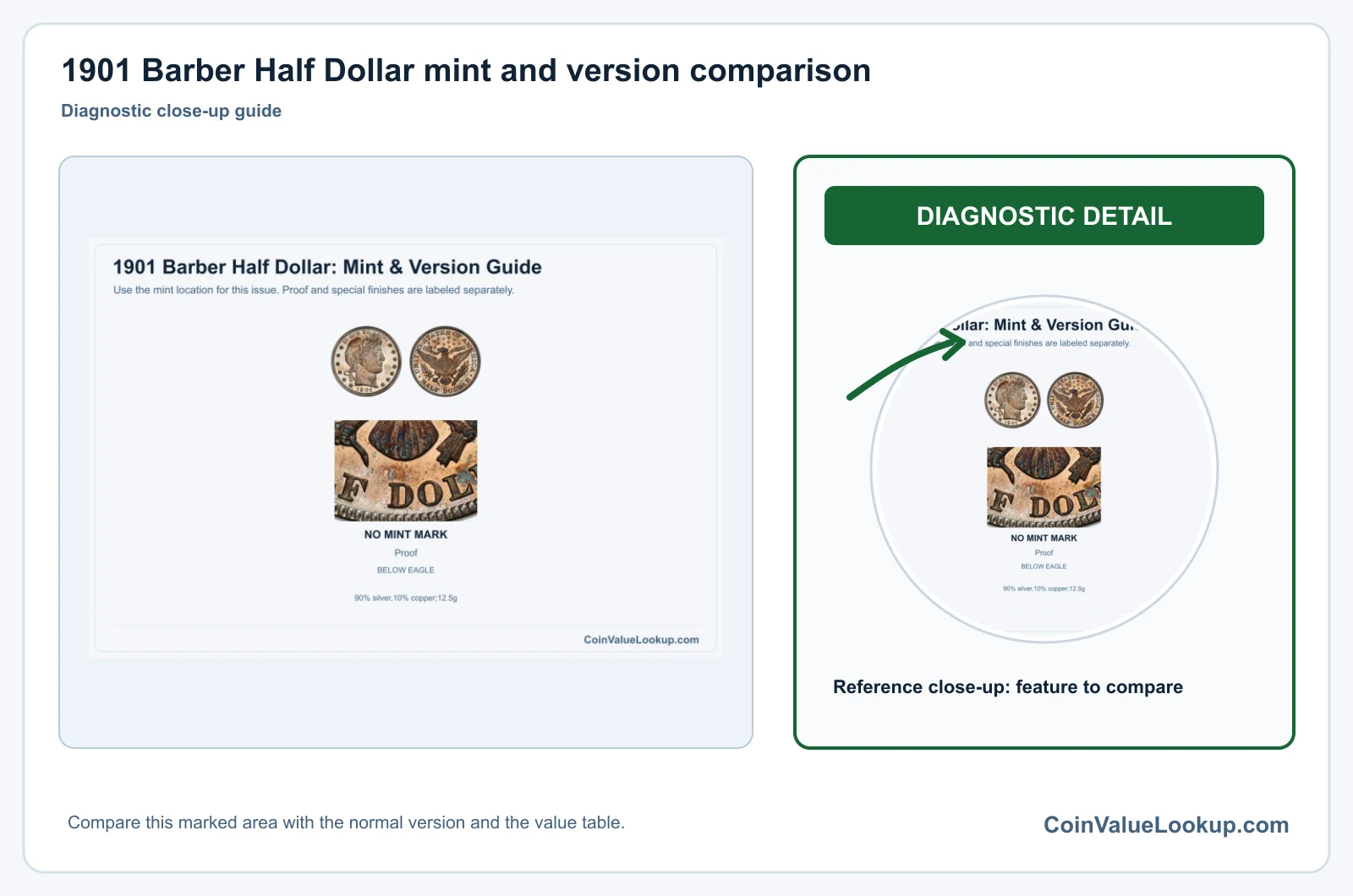
Look below the eagle's tail feathers and above HALF DOLLAR on the reverse for an O or S mintmark — no letter means Philadelphia.
1901 Barber Half Dollar Value
Upload both sides of your 1901 Barber Half Dollar.
Front Obverse
Upload photo
Back Reverse
Upload photo
Which 1901 Barber Half Dollar Versions Are Worth Money?
- The San Francisco mint (S mintmark) versions are the scarcest for 1901, with guide values reaching around $8,614 at MS63 — well above the Philadelphia or New Orleans issues at that grade.
- New Orleans (O mintmark) coins carry guide estimates up to about $5,124 at MS63, making original, problem-free examples in upper grades worth pursuing.
- Original Proofs struck at Philadelphia are valued around $1,363 at PR63 and are identified by genuinely mirrored fields and crisp rim detail, not by polishing.
- Both Type II and Type III obverse hubs exist for all three mints; confirming which hub your coin uses is essential for accurate attribution.
- Problem-free coins in upper circulated and Mint State grades can be dramatically more valuable than heavily worn pieces at any mint.
Step 1: Identify Your 1901 Barber Half Dollar Mint Mark and Version
Start with the basics: confirm the 1901 date on the obverse and HALF DOLLAR on the reverse. The obverse shows Liberty's head facing right with a laurel wreath and cap, while the reverse features a heraldic eagle.
All regular 1901 Barber halves are struck in 90% silver and 10% copper, weigh about 12.5 grams, measure 30.6 mm across, and have a reeded edge. These specs are the same across all three mints.
Mintmark location matters. Flip the coin over and look just below the eagle's tail feathers, centered above the words HALF DOLLAR.
An "O" means New Orleans, an "S" means San Francisco. No letter at all means Philadelphia.
The trickier part is the hub type. The 1901 date appears with both Type II and Type III obverse hubs at all three mints.
On a Type II obverse, you can see central ear cartilage detail inside Liberty's ear. On a Type III obverse, the ear lobe is fuller and more prominent.
Comparing your coin side-by-side with a known example of each type is the most reliable way to tell them apart.
These hub changes also affected how quickly LIBERTY wears on the headband, so do not rely on the headband letters alone when assessing your coin.
Step 2: Check Your 1901 Barber Half Dollar Grade
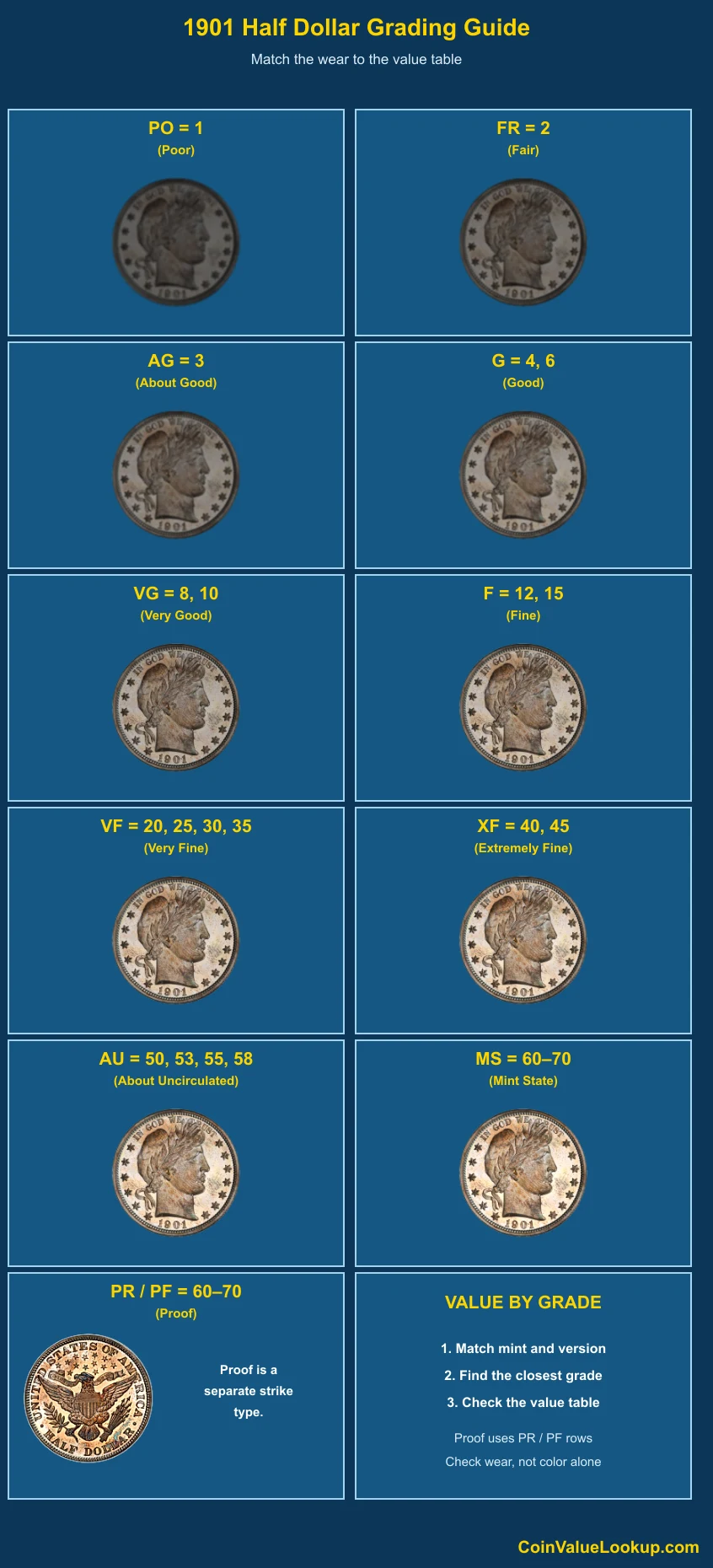
When grading a 1901 Barber Half, check Liberty's cheek, the hair above the forehead, and the headband on the obverse. On the reverse, focus on the eagle's head, wing tips, and tail feathers.
Use the comparison image to match your coin's wear pattern against known grade examples.
Be careful with New Orleans coins. Weak strikes at the eagle's claws and arrow feathers are common on O-mint Barber halves and can mimic wear.
Look at luster in the fields to help distinguish a soft strike from actual friction.
Do not grade solely by reading LIBERTY on the headband. The hub transition between Type II and Type III changed how that lettering wears, so two coins at the same grade can look slightly different in that area.
Evaluate the entire coin.
Remember that Proof is a method of manufacture — mirrored fields, sharp rims, special striking — not a grade above Mint State. A polished circulation strike is not a Proof, no matter how shiny it looks.
Step 3: Check 1901 Barber Half Dollar Value by Mint and Version
1901 Barber Half Dollar — No Mint Mark — Type II Obverse
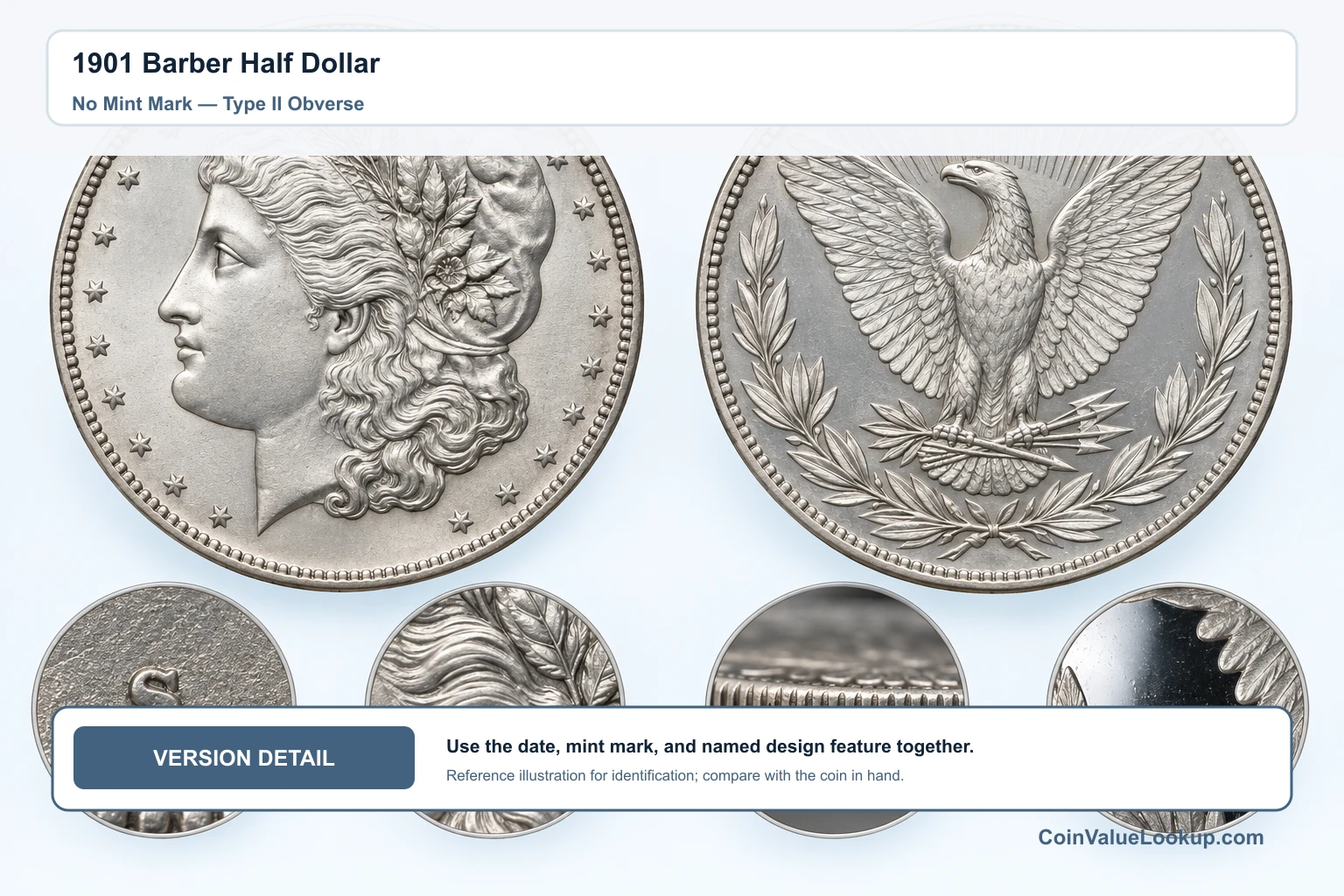
The Philadelphia Type II has no mintmark anywhere on the coin. To confirm the Type II hub, look inside Liberty's ear on the obverse — you should see defined central ear cartilage.
This detail distinguishes it from the Type III, which shows a fuller, more rounded ear lobe instead.
USA Coin Book guide estimates place this version at about $44 in G4 and around $1,145 in MS63. Philadelphia coins tend to be the most available of the three mints for 1901, so finding one is not especially difficult.
Finding one in solid Mint State condition with original surfaces, though, is a different story.
Ordinary-issue reference: Ordinary-issue reference only: The table below shows prices for the 1901 Barber Half Dollar (regular strike). It does not represent the value of the specific No Mint Mark — Type II Obverse variety or its variety premium. Year, mint, metal and strike type are matched; the specific variety is not priced by this table.
Range Grade
Price Auction Records Appraisal PO PO 1
—
Coin Identifier FR FR 2
—
Coin Identifier AG AG 3
—
Coin Identifier G G 4
—
Coin Identifier
G 6
—
Coin Identifier VG VG 8
Coin Identifier
VG 10
—
Coin Identifier F F 12
Coin Identifier
F 15
Coin Identifier VF VF 20
Coin Identifier
VF 25
Coin Identifier
VF 30
Coin Identifier
VF 35
Coin Identifier XF XF 40
Coin Identifier
XF 45
Coin Identifier AU AU 50
Coin Identifier
AU 53
Coin Identifier
AU 55
Coin Identifier
AU 58
Coin Identifier MS MS 60
Coin Identifier
MS 61
Coin Identifier
MS 62
Coin Identifier
MS 63
Coin Identifier
MS 64
Coin Identifier
MS 65
Coin Identifier
MS 66
Coin Identifier
MS 67
Coin Identifier
MS 68
—
—
—
MS 69
—
—
—
MS 70
—
—
—
1901 Barber Half Dollar — No Mint Mark — Type III Obverse
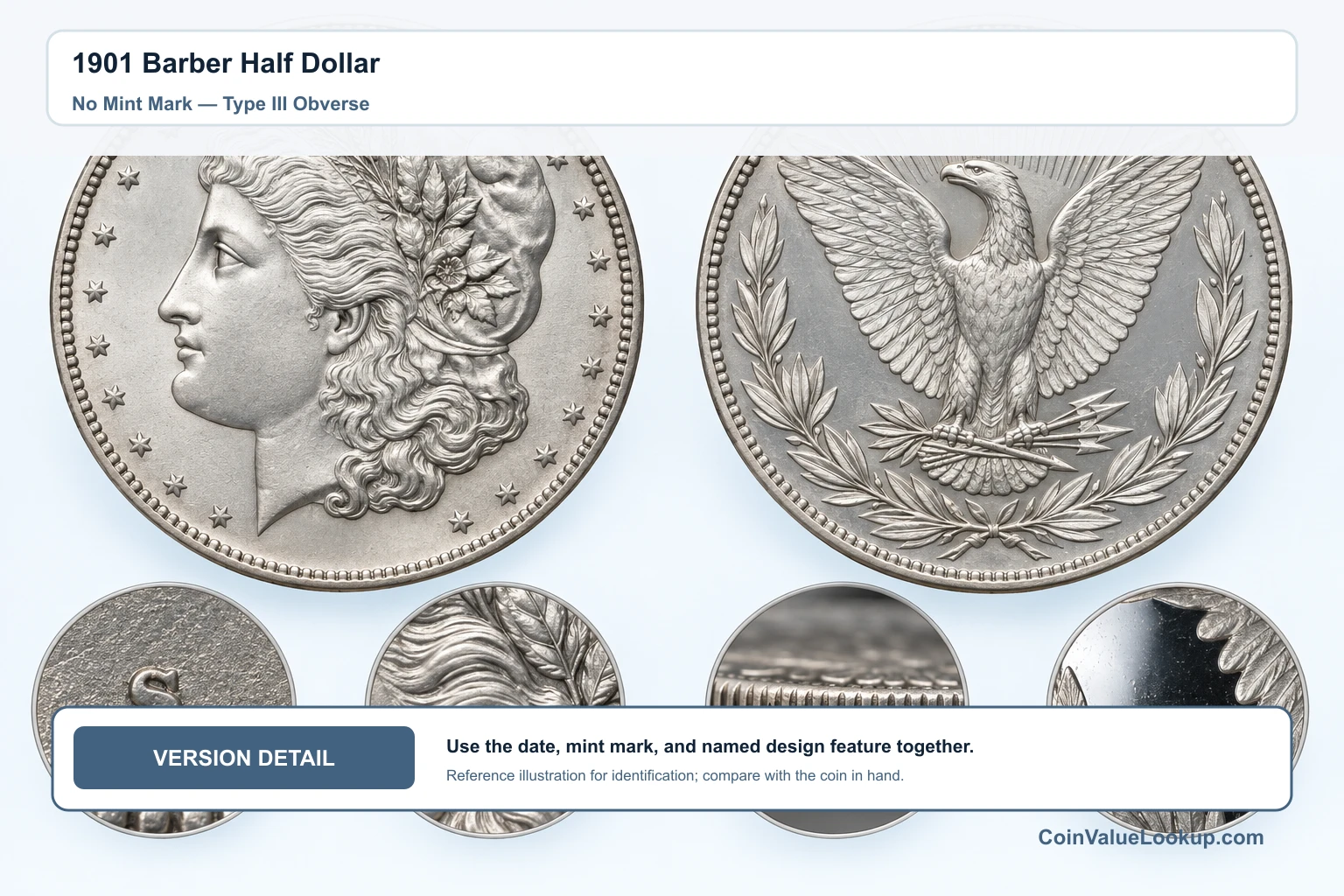
Same mint, different hub. The Philadelphia Type III also lacks a mintmark, but the obverse was struck from a later hub where Liberty's ear lobe appears fuller and more prominent.
The central ear cartilage visible on Type II coins is less defined here.
Guide estimates from USA Coin Book are about $44 at G4 and roughly $1,145 at MS63, the same pooled range as the Type II. Side-by-side comparison with a known Type II example is the easiest way to confirm which hub you have.
The headband LIBERTY also wears differently between hubs, so grading both types requires whole-coin evaluation.
Ordinary-issue reference: Ordinary-issue reference only: The table below shows prices for the 1901 Barber Half Dollar (regular strike). It does not represent the value of the specific No Mint Mark — Type III Obverse variety or its variety premium. Year, mint, metal and strike type are matched; the specific variety is not priced by this table.
Range Grade
Price Auction Records Appraisal PO PO 1
—
Coin Identifier FR FR 2
—
Coin Identifier AG AG 3
—
Coin Identifier G G 4
—
Coin Identifier
G 6
—
Coin Identifier VG VG 8
Coin Identifier
VG 10
—
Coin Identifier F F 12
Coin Identifier
F 15
Coin Identifier VF VF 20
Coin Identifier
VF 25
Coin Identifier
VF 30
Coin Identifier
VF 35
Coin Identifier XF XF 40
Coin Identifier
XF 45
Coin Identifier AU AU 50
Coin Identifier
AU 53
Coin Identifier
AU 55
Coin Identifier
AU 58
Coin Identifier MS MS 60
Coin Identifier
MS 61
Coin Identifier
MS 62
Coin Identifier
MS 63
Coin Identifier
MS 64
Coin Identifier
MS 65
Coin Identifier
MS 66
Coin Identifier
MS 67
Coin Identifier
MS 68
—
—
—
MS 69
—
—
—
MS 70
—
—
—
1901 Barber Half Dollar — O — Type II Obverse
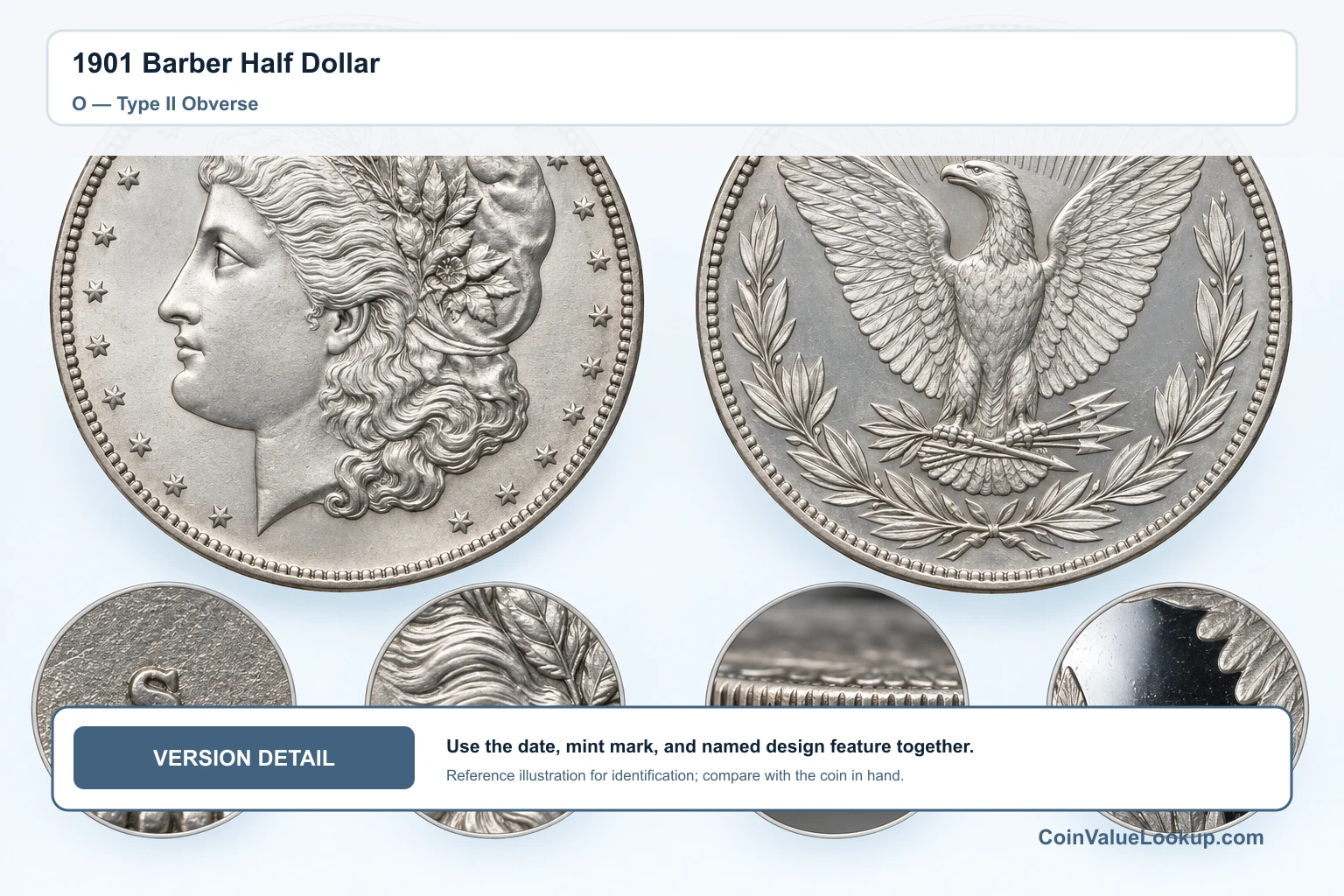
Look below the eagle's tail for an "O" mintmark to confirm a New Orleans strike. The Type II obverse shows central ear cartilage inside Liberty's ear.
New Orleans Barber halves are sometimes weakly struck at the eagle's claws and arrow feathers — this is a production characteristic, not wear.
USA Coin Book estimates run about $57 at G4 and around $5,124 at MS63. That MS63 figure is substantially higher than Philadelphia, reflecting the greater difficulty of finding O-mint coins in upper grades with strong eye appeal and no problems.
Ordinary-issue reference: Ordinary-issue reference only: The table below shows prices for the 1901-O Barber Half Dollar (regular strike). It does not represent the value of the specific O — Type II Obverse variety or its variety premium. Year, mint, metal and strike type are matched; the specific variety is not priced by this table.
Range Grade
Price Auction Records Appraisal PO PO 1
—
Coin Identifier FR FR 2
—
Coin Identifier AG AG 3
Coin Identifier G G 4
Coin Identifier
G 6
Coin Identifier VG VG 8
Coin Identifier
VG 10
Coin Identifier F F 12
Coin Identifier
F 15
Coin Identifier VF VF 20
Coin Identifier
VF 25
Coin Identifier
VF 30
—
Coin Identifier
VF 35
Coin Identifier XF XF 40
Coin Identifier
XF 45
Coin Identifier AU AU 50
Coin Identifier
AU 53
Coin Identifier
AU 55
Coin Identifier
AU 58
Coin Identifier MS MS 60
Coin Identifier
MS 61
Coin Identifier
MS 62
Coin Identifier
MS 63
Coin Identifier
MS 64
Coin Identifier
MS 65
Coin Identifier
MS 66
Coin Identifier
MS 67
Coin Identifier
MS 68
—
—
—
MS 69
—
—
—
MS 70
—
—
—
1901 Barber Half Dollar — O — Type III Obverse
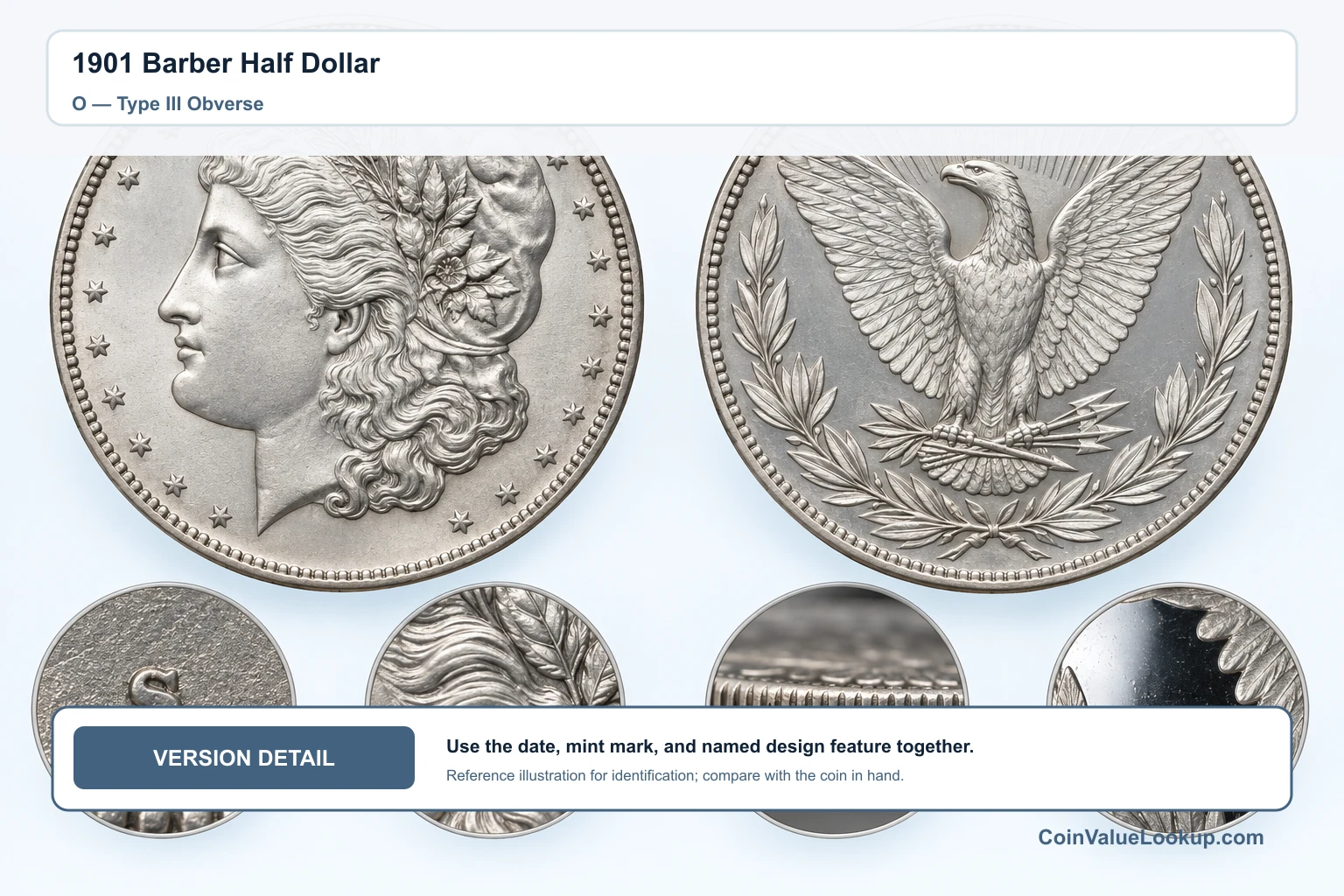
The New Orleans Type III shares the "O" mintmark below the eagle's tail but was produced from the later hub with the fuller ear lobe on Liberty. Compare the ear area carefully; the difference is subtle but visible under moderate magnification.
Guide values match the O-mint Type II at about $57 in G4 and roughly $5,124 in MS63 per USA Coin Book. As with all O-mint Barber halves, separate genuine wear from strike softness by checking field luster.
A coin can look mushy at the eagle yet still retain full luster in the surrounding fields, which points to strike rather than circulation.
Ordinary-issue reference: Ordinary-issue reference only: The table below shows prices for the 1901-O Barber Half Dollar (regular strike). It does not represent the value of the specific O — Type III Obverse variety or its variety premium. Year, mint, metal and strike type are matched; the specific variety is not priced by this table.
Range Grade
Price Auction Records Appraisal PO PO 1
—
Coin Identifier FR FR 2
—
Coin Identifier AG AG 3
Coin Identifier G G 4
Coin Identifier
G 6
Coin Identifier VG VG 8
Coin Identifier
VG 10
Coin Identifier F F 12
Coin Identifier
F 15
Coin Identifier VF VF 20
Coin Identifier
VF 25
Coin Identifier
VF 30
—
Coin Identifier
VF 35
Coin Identifier XF XF 40
Coin Identifier
XF 45
Coin Identifier AU AU 50
Coin Identifier
AU 53
Coin Identifier
AU 55
Coin Identifier
AU 58
Coin Identifier MS MS 60
Coin Identifier
MS 61
Coin Identifier
MS 62
Coin Identifier
MS 63
Coin Identifier
MS 64
Coin Identifier
MS 65
Coin Identifier
MS 66
Coin Identifier
MS 67
Coin Identifier
MS 68
—
—
—
MS 69
—
—
—
MS 70
—
—
—
1901 Barber Half Dollar — S — Type II Obverse
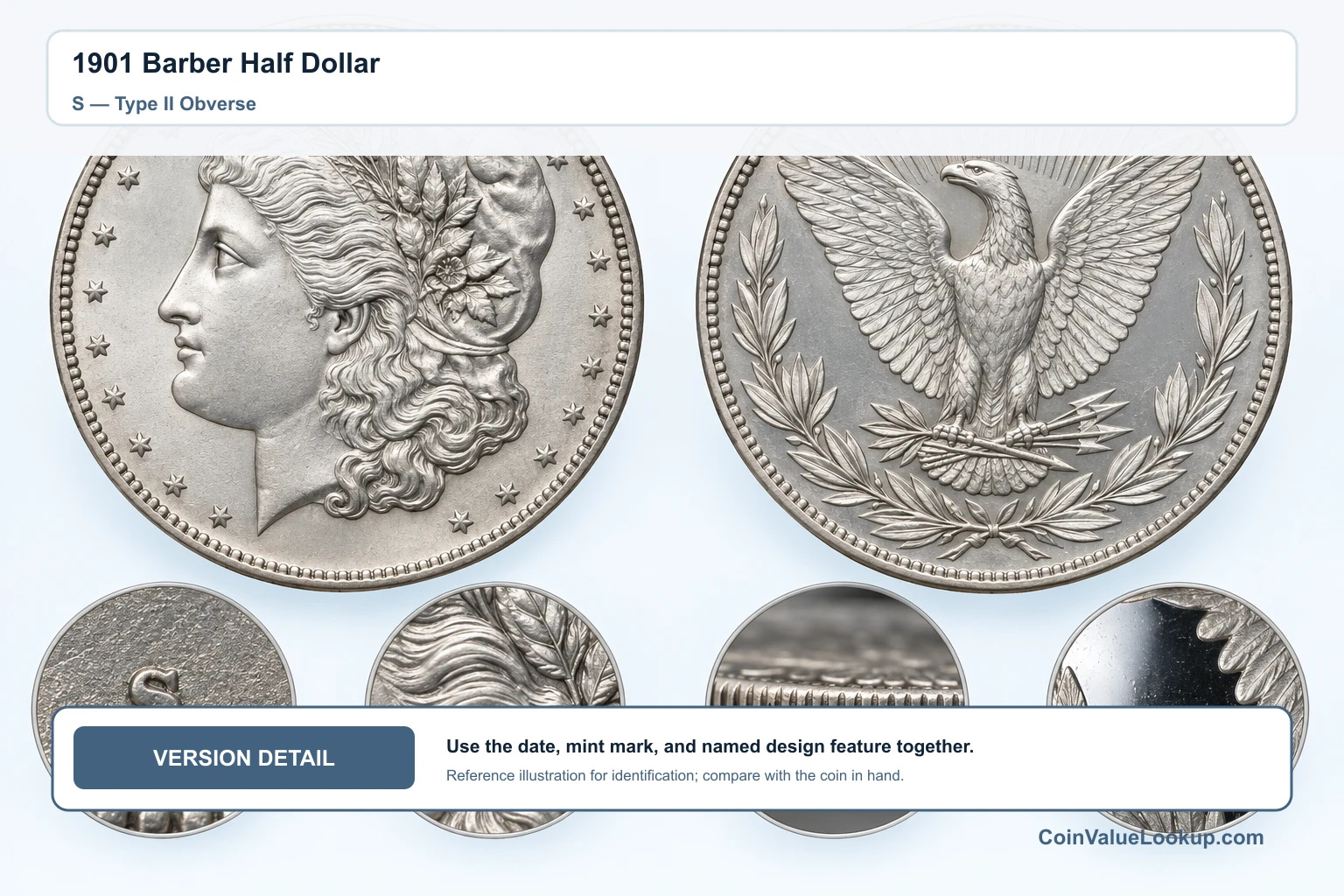
The San Francisco Type II carries an "S" mintmark below the eagle's tail feathers. On the obverse, you will see central ear cartilage detail inside Liberty's ear, confirming the Type II hub.
This is the scarce mint for 1901. USA Coin Book guide estimates start around $79 at G4 and reach approximately $8,614 at MS63 — the highest of any regular business strike for this date.
Even in well-worn grades, the S-mint commands a noticeable premium over Philadelphia and New Orleans. Problem-free, original examples in any grade above VF deserve careful attention.
Coin Value Lookup is a useful starting point if you want to look up guide values for other Barber half dates or denominations while sorting through your coins.
Ordinary-issue reference: Ordinary-issue reference only: The table below shows prices for the 1901-S Barber Half Dollar (regular strike). It does not represent the value of the specific S — Type II Obverse variety or its variety premium. Year, mint, metal and strike type are matched; the specific variety is not priced by this table.
Range Grade
Price Auction Records Appraisal PO PO 1
—
Coin Identifier FR FR 2
Coin Identifier AG AG 3
Coin Identifier G G 4
Coin Identifier
G 6
Coin Identifier VG VG 8
Coin Identifier
VG 10
Coin Identifier F F 12
Coin Identifier
F 15
Coin Identifier VF VF 20
Coin Identifier
VF 25
Coin Identifier
VF 30
Coin Identifier
VF 35
Coin Identifier XF XF 40
Coin Identifier
XF 45
Coin Identifier AU AU 50
Coin Identifier
AU 53
Coin Identifier
AU 55
Coin Identifier
AU 58
Coin Identifier MS MS 60
Coin Identifier
MS 61
Coin Identifier
MS 62
Coin Identifier
MS 63
Coin Identifier
MS 64
Coin Identifier
MS 65
Coin Identifier
MS 66
Coin Identifier
MS 67
Coin Identifier
MS 68
—
—
—
MS 69
—
—
—
MS 70
—
—
—
1901 Barber Half Dollar — S — Type III Obverse
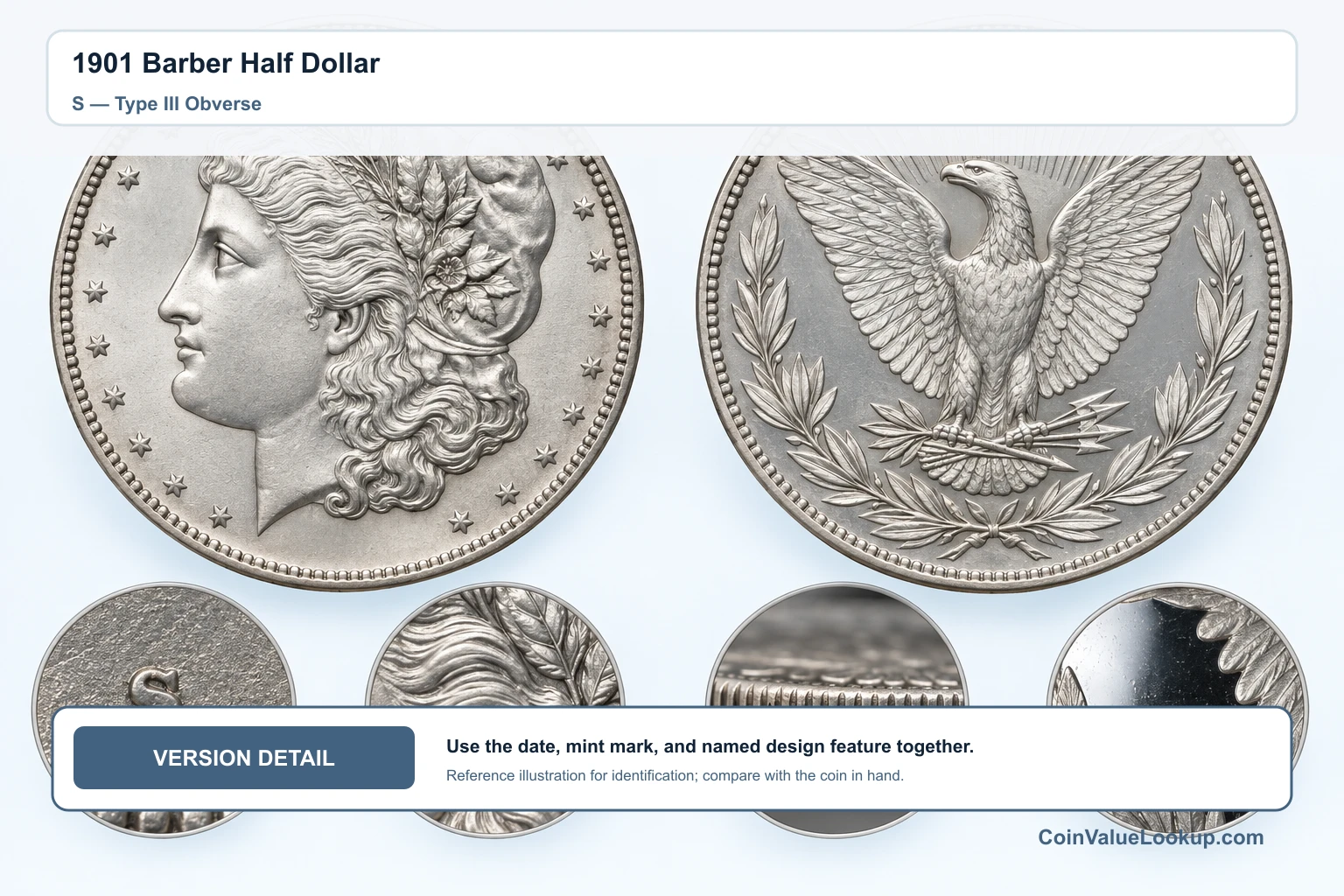
Same San Francisco mint, later hub. The Type III obverse displays a fuller ear lobe where the Type II shows defined cartilage.
The "S" mintmark sits below the eagle's tail on the reverse, same as the Type II.
Guide estimates from USA Coin Book are about $79 at G4 and around $8,614 at MS63. The S-mint's relative scarcity applies equally to both hub types.
Collectors prize original, uncleaned surfaces on these — a lightly circulated S-mint half with honest wear will often attract more interest than a cleaned Mint State coin that has lost its natural toning and luster.
Ordinary-issue reference: Ordinary-issue reference only: The table below shows prices for the 1901-S Barber Half Dollar (regular strike). It does not represent the value of the specific S — Type III Obverse variety or its variety premium. Year, mint, metal and strike type are matched; the specific variety is not priced by this table.
Range Grade
Price Auction Records Appraisal PO PO 1
—
Coin Identifier FR FR 2
Coin Identifier AG AG 3
Coin Identifier G G 4
Coin Identifier
G 6
Coin Identifier VG VG 8
Coin Identifier
VG 10
Coin Identifier F F 12
Coin Identifier
F 15
Coin Identifier VF VF 20
Coin Identifier
VF 25
Coin Identifier
VF 30
Coin Identifier
VF 35
Coin Identifier XF XF 40
Coin Identifier
XF 45
Coin Identifier AU AU 50
Coin Identifier
AU 53
Coin Identifier
AU 55
Coin Identifier
AU 58
Coin Identifier MS MS 60
Coin Identifier
MS 61
Coin Identifier
MS 62
Coin Identifier
MS 63
Coin Identifier
MS 64
Coin Identifier
MS 65
Coin Identifier
MS 66
Coin Identifier
MS 67
Coin Identifier
MS 68
—
—
—
MS 69
—
—
—
MS 70
—
—
—
1901 Barber Half Dollar — No Mint Mark — Proof
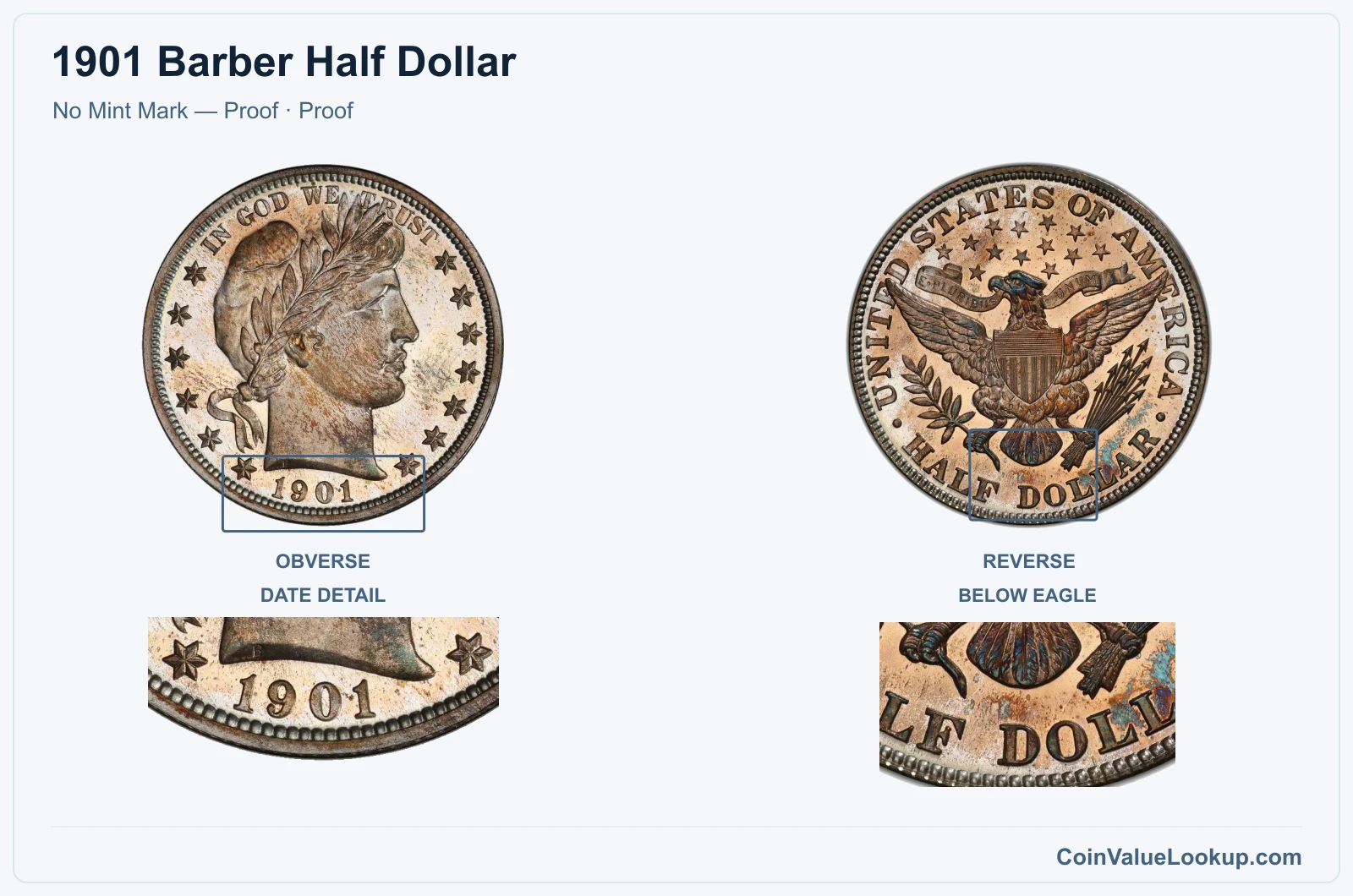
Philadelphia struck Proof Barber halves for collectors in 1901. Genuine Proofs have deeply mirrored fields, razor-sharp rim detail, and fully struck design elements.
These characteristics come from specially prepared dies and planchets, not from polishing a business strike.
USA Coin Book places the PR63 estimate at about $1,363. When evaluating a suspected Proof, look for uniform reflectivity across the fields and compare the rim sharpness to a known business strike of the same date.
Hairlines from cleaning are common on older Proofs and will affect the grade. Polishing a circulated coin cannot create genuine Proof surfaces, so mirror-like shine alone does not qualify a coin as Proof.
Range Grade
Price Auction Records Appraisal PR PR 1
—
Coin Identifier
PR 2
—
Coin Identifier
PR 3
—
Coin Identifier
PR 4
—
Coin Identifier
PR 6
—
Coin Identifier
PR 8
—
Coin Identifier
PR 10
—
Coin Identifier
PR 12
—
Coin Identifier
PR 15
—
Coin Identifier
PR 20
—
Coin Identifier
PR 25
—
Coin Identifier
PR 30
—
Coin Identifier
PR 35
—
Coin Identifier
PR 40
—
Coin Identifier
PR 45
—
Coin Identifier
PR 50
—
Coin Identifier
PR 53
Coin Identifier
PR 55
Coin Identifier
PR 58
Coin Identifier
PR 60
Coin Identifier
PR 61
Coin Identifier
PR 62
Coin Identifier
PR 63
Coin Identifier
PR 64
Coin Identifier
PR 65
Coin Identifier
PR 66
Coin Identifier
PR 67
Coin Identifier
PR 68
Coin Identifier
PR 69
—
—
—
PR 70
—
—
—