1901 Barber Dime Coin Value: How Much Is It Worth?
The 1901 Barber Dime is a solid silver collectible that spans a wide value range depending on mint and condition. Guide estimates for ordinary business strikes run from about $12.26 at G4 for a Philadelphia coin up to around $2,632 at MS63 for the scarce San Francisco issue.
Proofs and specific varieties sit on their own scale entirely.
Fast Way to Identify Your 1901 Barber Dime
The quickest way to start figuring out what you have is to upload clear photos of both sides of your coin. A front shot captures the date and Liberty's condition, while the back reveals the mintmark and wreath details.
Submit both for a preliminary identification to help narrow down your coin's mint and version.
1901 Barber Dime Value
Upload both sides of your 1901 Barber Dime.
Front Obverse
Upload photo
Back Reverse
Upload photo
Which 1901 Barber Dime Versions Are Worth Money?
- The 1901-S Barber Dime commands the highest guide values among the three mints, with estimates reaching about $2,632 at MS63 versus $253 for Philadelphia at the same grade.
- The 1901-O carries guide estimates around $1,348 at MS63, making unworn New Orleans coins significantly more valuable than the Philadelphia issue in comparable condition.
- A reverse hub transition produced two ribbon styles on the 1901 wreath; the recognized 1901-O II/II hub combination is a specific collectible variety.
- Repunched mintmark and off-center strike errors have been reported for the 1901 Dime and can carry premiums depending on visibility and condition.
Step 1: Identify Your 1901 Barber Dime Mint Mark and Version
You are looking for Charles Barber's right-facing Liberty head on the front and a wreath enclosing ONE DIME on the back. If your coin shows a winged Liberty cap, that is a Mercury Dime, not a Barber.
Get that sorted first.
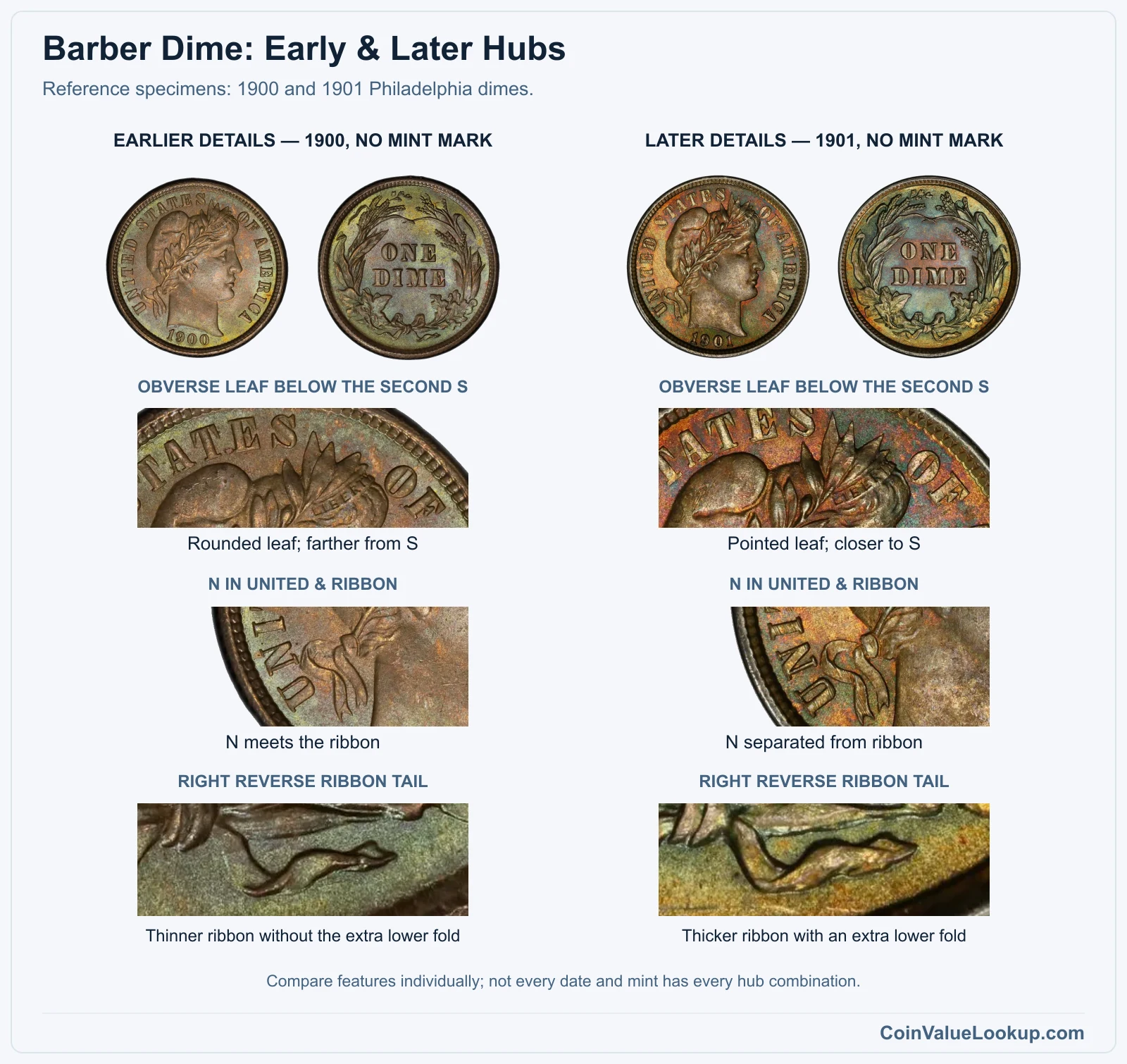
Three mints struck 1901 Barber Dimes for circulation: Philadelphia, New Orleans, and San Francisco. The mintmark sits just below the wreath bow on the reverse.
No letter means Philadelphia; an O is New Orleans; an S is San Francisco.
All standard 1901 Barber Dimes are 90% silver and 10% copper, weighing 2.5 grams with a 17.9 mm diameter and a reeded edge. If your coin feels too light or the edge is smooth, something is off.
One design detail worth knowing: there was a reverse hub transition around this time. The earlier hub shows a thin right ribbon on the wreath, while the later hub has a thicker ribbon with an extra fold on the underside.
Both types appear on 1901 coins, and the 1901-O is specifically recognized in the II/II hub combination. Flip the coin over and compare the ribbon carefully.
Step 2: Check Your 1901 Barber Dime Grade
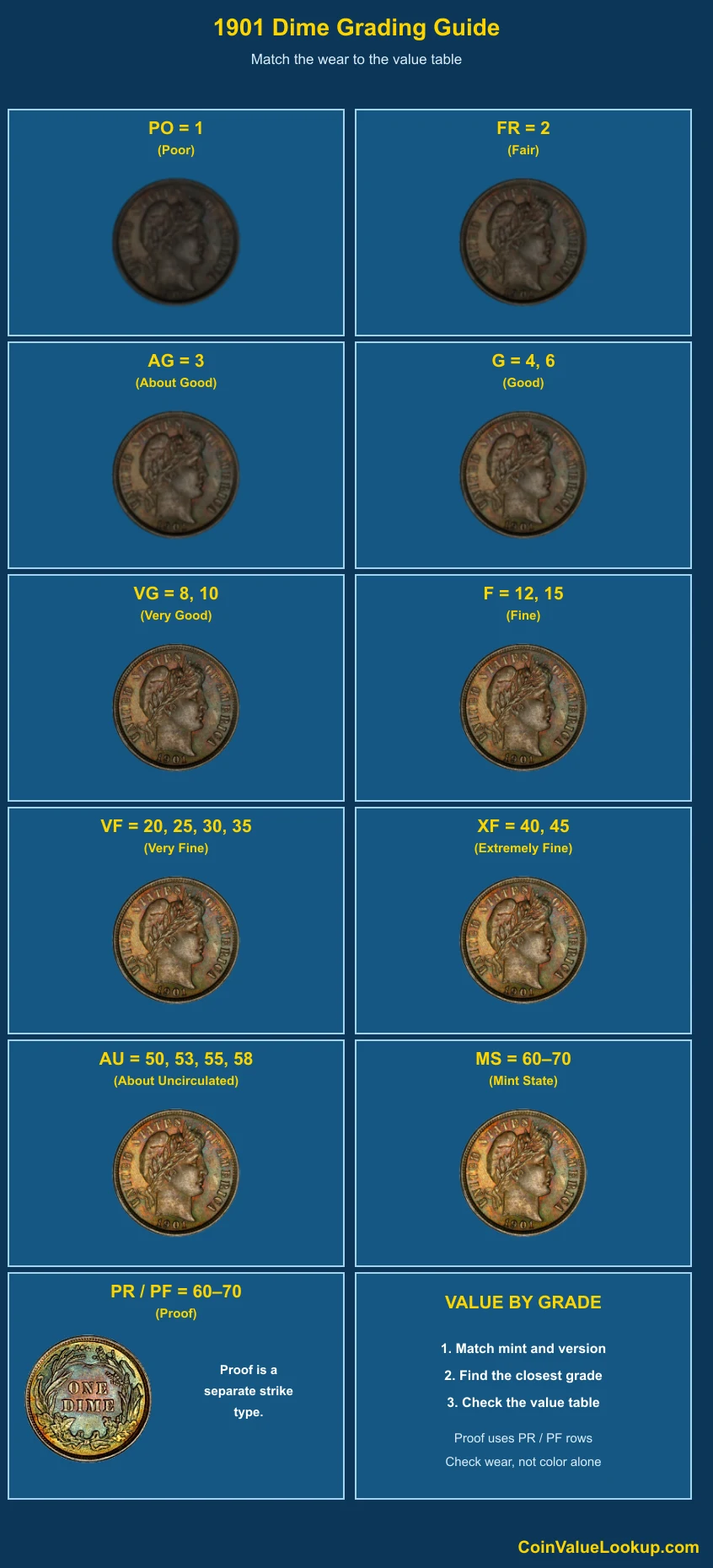
Do not grade a Barber Dime by counting letters in LIBERTY alone. That old shortcut misses half the picture.
Instead, look at the full headband, the hair detail above the ear, the smoothness of Liberty's cheek, the wreath leaves, and the rim sharpness together.
A coin grading around G4 will show a clear date and outline of Liberty, but most interior detail is worn flat. By VF territory the headband letters are partly visible and hair strands begin to separate.
At MS63 you should see unbroken, original luster across the entire surface with only minor contact marks.
New Orleans coins are notorious for soft strikes, so a mushy headband does not always mean heavy wear. The hub change around 1900–1901 also affects detail strength on the obverse.
Compare your coin against the grading image to judge actual circulation wear versus strike weakness.
Proof is a manufacturing method, not a grade above Mint State. Proofs have mirrored fields and razor-sharp rims from specially prepared dies.
Cleaned or hairlined Mint State coins are not proofs, no matter how shiny they look.
Step 3: Check 1901 Barber Dime Value by Mint and Version
1901 Barber Dime — No Mint Mark — Silver Circulation
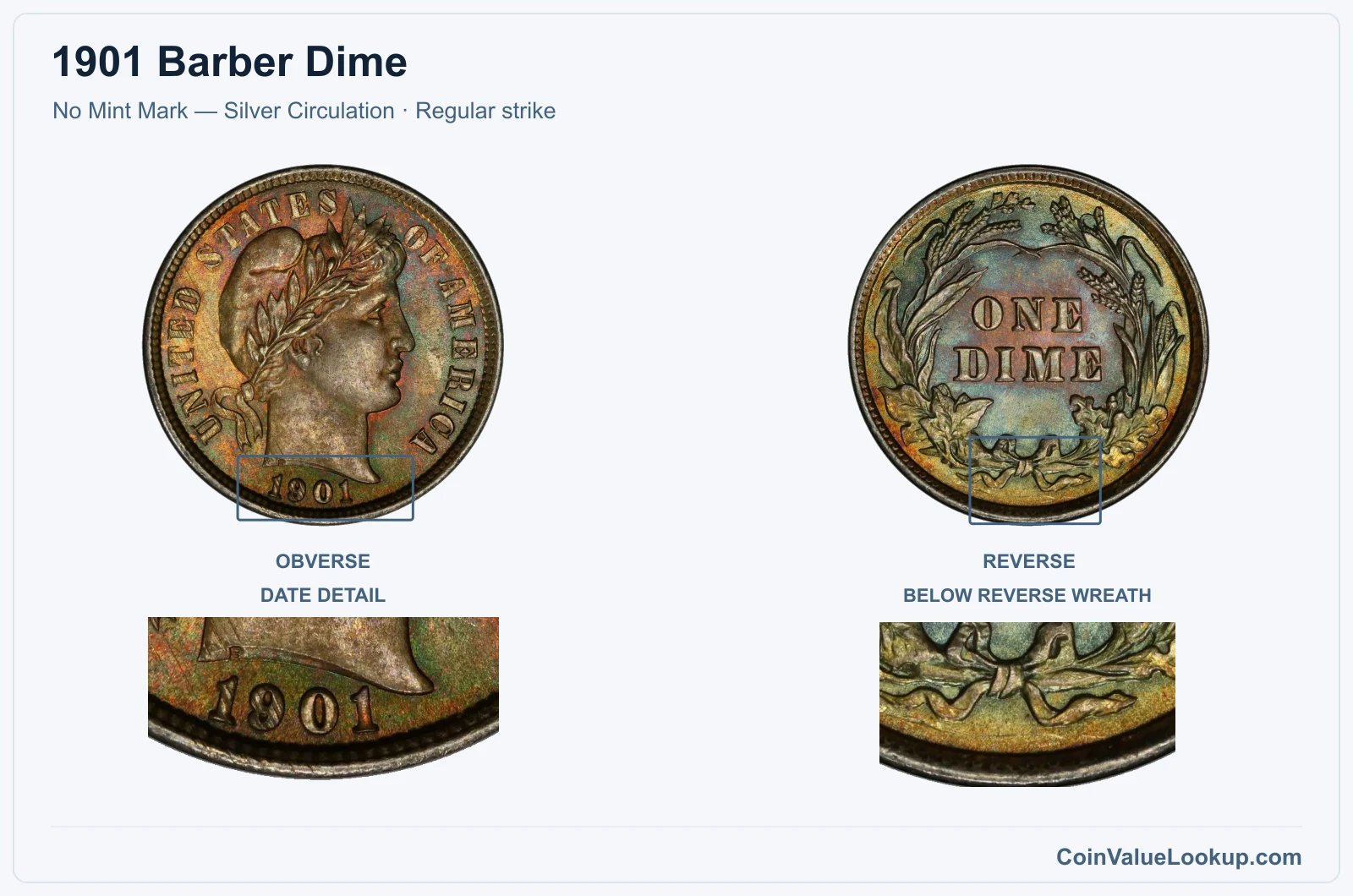
The Philadelphia 1901 Barber Dime carries no mintmark. Look below the wreath bow on the reverse: a blank space confirms Philadelphia origin.
This is the most available of the three 1901 mints.
Guide estimates place this coin at about $12.26 in G4 and around $253 in MS63. The reverse hub transition applies here too, so check whether your coin has the thin right ribbon or the thicker ribbon with the extra underside fold.
Both hub types can appear on Philadelphia strikes, and that detail is worth noting when you describe your coin to other collectors.
Range Grade
Price Auction Records Appraisal PO PO 1
—
Coin Identifier FR FR 2
—
Coin Identifier AG AG 3
Coin Identifier G G 4
—
Coin Identifier
G 6
—
Coin Identifier VG VG 8
—
Coin Identifier
VG 10
—
Coin Identifier F F 12
—
Coin Identifier
F 15
—
Coin Identifier VF VF 20
—
Coin Identifier
VF 25
—
Coin Identifier
VF 30
—
Coin Identifier
VF 35
—
Coin Identifier XF XF 40
Coin Identifier
XF 45
—
Coin Identifier AU AU 50
Coin Identifier
AU 53
Coin Identifier
AU 55
Coin Identifier
AU 58
Coin Identifier MS MS 60
—
Coin Identifier
MS 61
Coin Identifier
MS 62
Coin Identifier
MS 63
Coin Identifier
MS 64
Coin Identifier
MS 65
Coin Identifier
MS 66
Coin Identifier
MS 67
Coin Identifier
MS 68
—
—
—
MS 69
—
—
—
MS 70
—
—
—
1901 Barber Dime — O — Silver Circulation
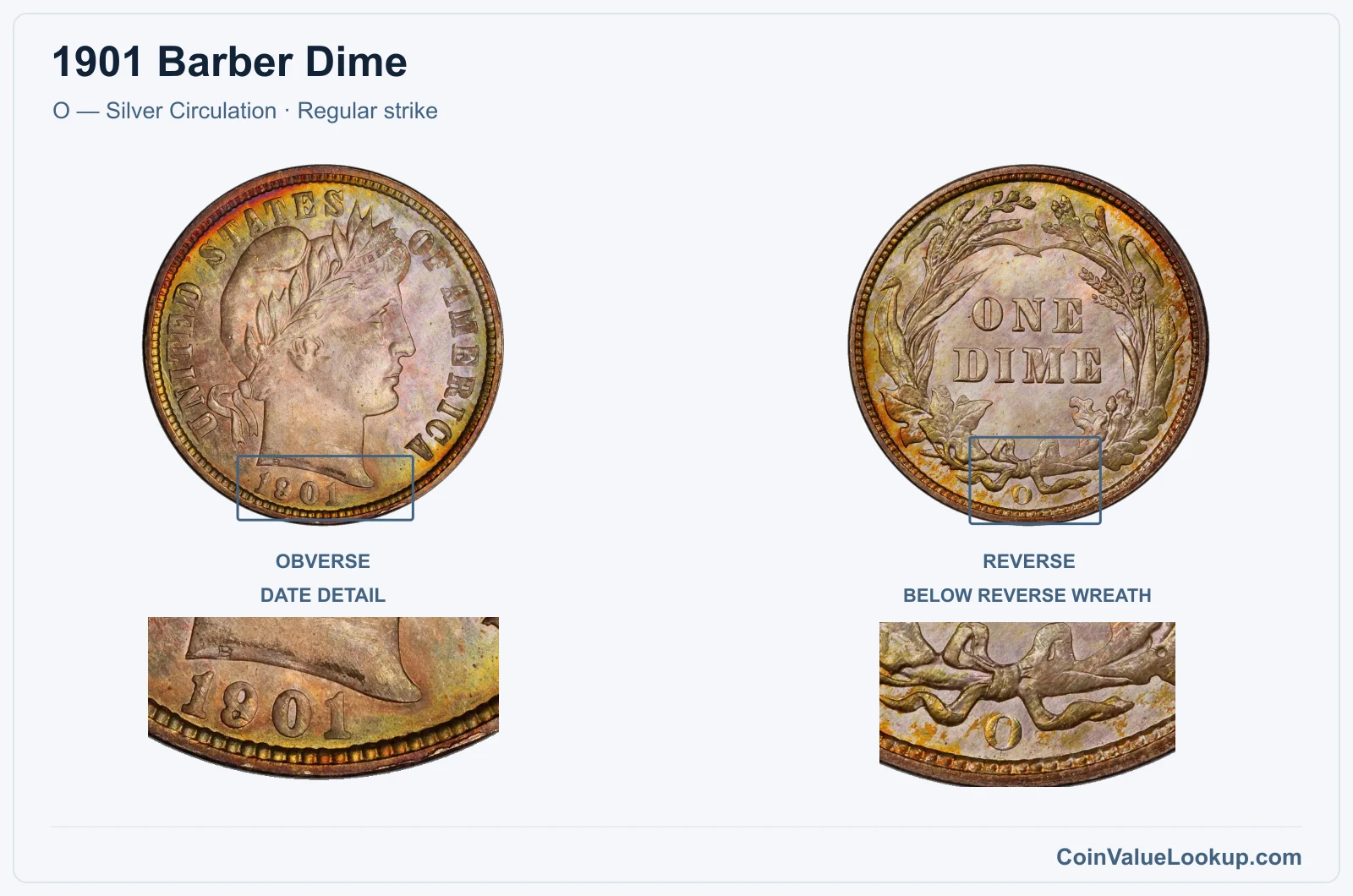
A small O below the wreath bow identifies the New Orleans mint. This issue is specifically recognized in the II/II reverse hub combination, meaning both the obverse and reverse use the later hub style with a thicker ribbon and extra fold.
Guide estimates run about $15 at G4 and roughly $1,348 at MS63. That jump tells you condition matters enormously here.
New Orleans strikes are often softer than Philadelphia or San Francisco products, so do not mistake weak strike detail for heavy wear. Compare the headband and ribbon carefully against the grading image before drawing conclusions about your coin's grade.
Coin Value Lookup is a handy starting point when you want to look up guides for other dates and mints in the Barber Dime series.
Range Grade
Price Auction Records Appraisal PO PO 1
—
Coin Identifier FR FR 2
—
Coin Identifier AG AG 3
—
Coin Identifier G G 4
—
Coin Identifier
G 6
—
Coin Identifier VG VG 8
—
Coin Identifier
VG 10
—
Coin Identifier F F 12
—
Coin Identifier
F 15
—
Coin Identifier VF VF 20
—
Coin Identifier
VF 25
—
Coin Identifier
VF 30
—
Coin Identifier
VF 35
—
Coin Identifier XF XF 40
Coin Identifier
XF 45
Coin Identifier AU AU 50
Coin Identifier
AU 53
Coin Identifier
AU 55
Coin Identifier
AU 58
Coin Identifier MS MS 60
Coin Identifier
MS 61
Coin Identifier
MS 62
Coin Identifier
MS 63
Coin Identifier
MS 64
Coin Identifier
MS 65
Coin Identifier
MS 66
Coin Identifier
MS 67
Coin Identifier
MS 68
—
—
—
MS 69
—
—
—
MS 70
—
—
—
1901 Barber Dime — S — Silver Circulation
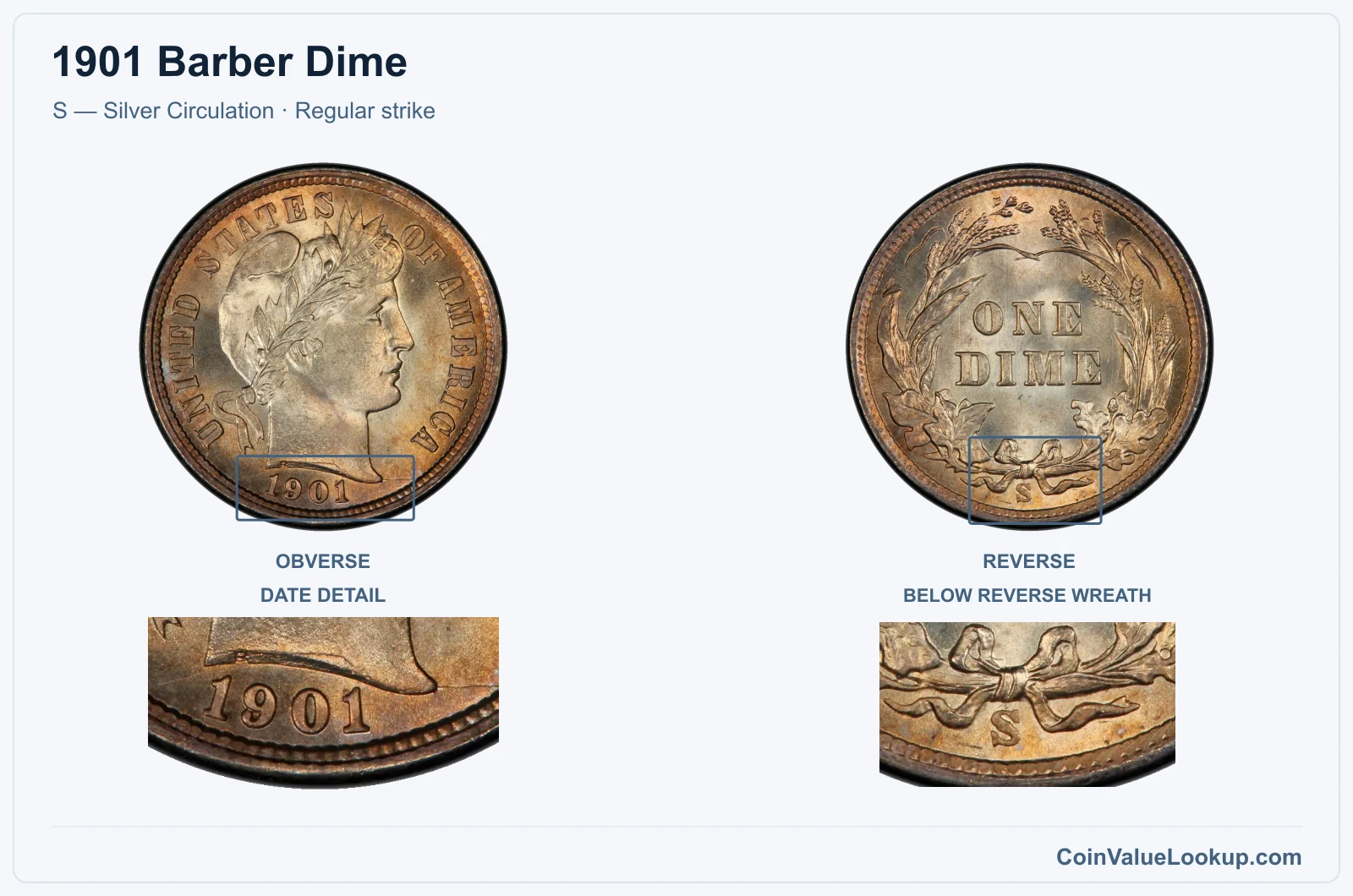
An S mintmark below the wreath bow means San Francisco. Among the three business-strike mints, the 1901-S carries the steepest guide values by a wide margin.
Expect roughly $126 at G4 and around $2,632 at MS63 based on guide estimates. Even in low grades this coin costs meaningfully more than its Philadelphia and New Orleans siblings, which signals genuine scarcity in collector hands.
As with all 1901 dimes, inspect the reverse ribbon to determine whether your coin has the earlier thin ribbon or the later thicker ribbon with the extra underside fold. Original, uncleaned surfaces are critical for realizing strong values, so resist the urge to polish it.
Range Grade
Price Auction Records Appraisal PO PO 1
—
Coin Identifier FR FR 2
—
Coin Identifier AG AG 3
Coin Identifier G G 4
Coin Identifier
G 6
Coin Identifier VG VG 8
Coin Identifier
VG 10
Coin Identifier F F 12
Coin Identifier
F 15
Coin Identifier VF VF 20
Coin Identifier
VF 25
Coin Identifier
VF 30
Coin Identifier
VF 35
Coin Identifier XF XF 40
Coin Identifier
XF 45
Coin Identifier AU AU 50
Coin Identifier
AU 53
Coin Identifier
AU 55
Coin Identifier
AU 58
Coin Identifier MS MS 60
Coin Identifier
MS 61
Coin Identifier
MS 62
Coin Identifier
MS 63
Coin Identifier
MS 64
Coin Identifier
MS 65
Coin Identifier
MS 66
Coin Identifier
MS 67
Coin Identifier
MS 68
Coin Identifier
MS 69
—
—
—
MS 70
—
—
—
1901 Barber Dime — No Mint Mark — Brilliant Silver Proof
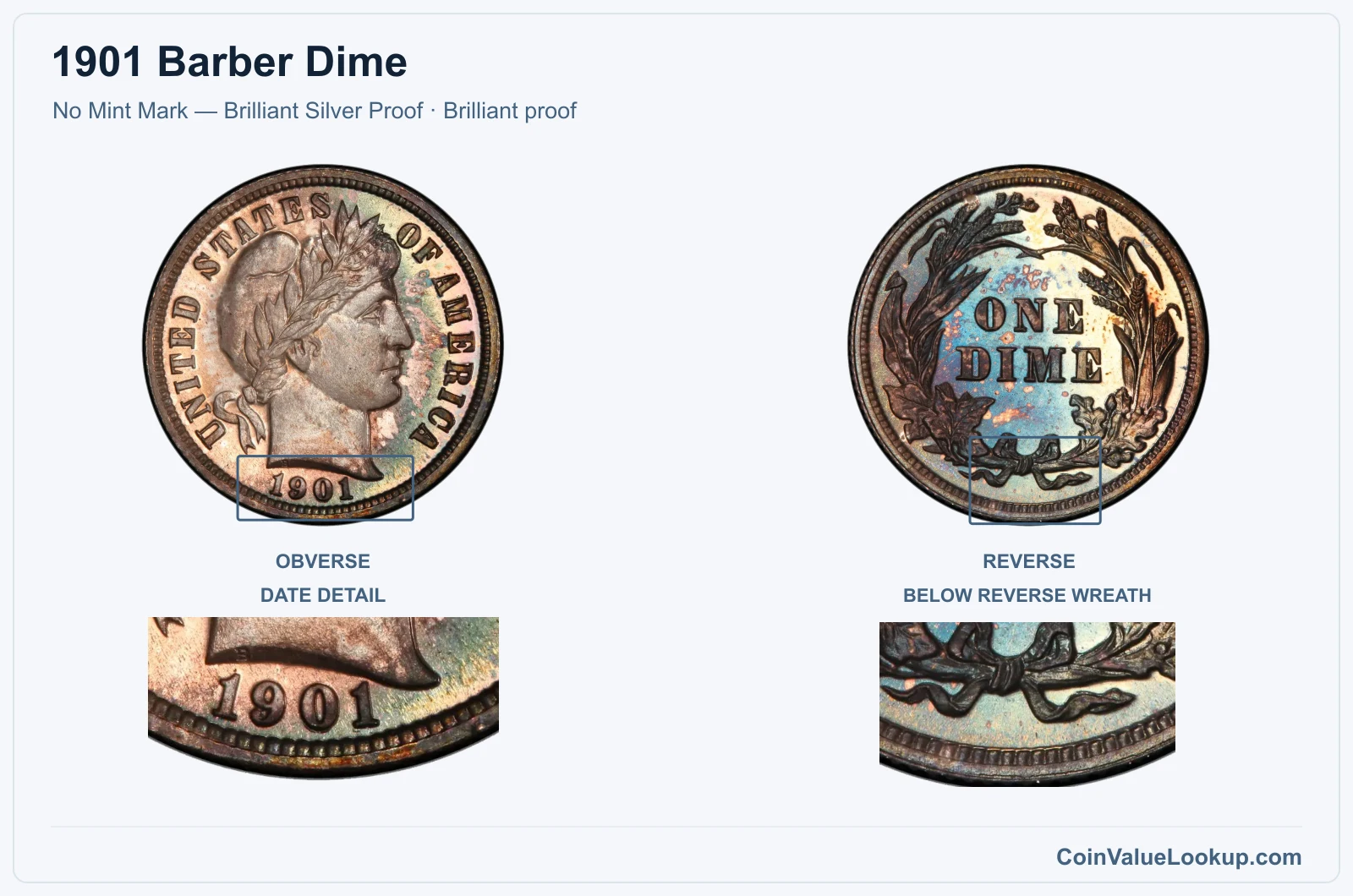
Philadelphia produced brilliant proof Barber Dimes throughout the series run. A genuine proof displays mirrored fields and exceptionally sharp rim and device edges that no amount of careful circulation strike will replicate.
The guide estimate for a PR63 example is about $616. Cameo and Deep Cameo designations reflect the degree of contrast between frosted devices and mirrored fields; these are separate tiers and should not be priced using the standard PR63 figure.
Contrast on Barber proofs can vary, and later dates in the series sometimes show weaker frosting. Examine your coin under angled light to check for true mirror surfaces versus a cleaned business strike that just happens to be shiny.
Range Grade
Price Auction Records Appraisal PR PR 1
—
Coin Identifier
PR 2
—
Coin Identifier
PR 3
—
Coin Identifier
PR 4
—
Coin Identifier
PR 6
—
Coin Identifier
PR 8
—
Coin Identifier
PR 10
—
Coin Identifier
PR 12
—
Coin Identifier
PR 15
—
Coin Identifier
PR 20
—
Coin Identifier
PR 25
—
Coin Identifier
PR 30
—
Coin Identifier
PR 35
—
Coin Identifier
PR 40
—
Coin Identifier
PR 45
—
Coin Identifier
PR 50
—
Coin Identifier
PR 53
—
Coin Identifier
PR 55
—
Coin Identifier
PR 58
—
Coin Identifier
PR 60
Coin Identifier
PR 61
Coin Identifier
PR 62
Coin Identifier
PR 63
Coin Identifier
PR 64
Coin Identifier
PR 65
Coin Identifier
PR 66
Coin Identifier
PR 67
Coin Identifier
PR 68
Coin Identifier
PR 69
—
—
—
PR 70
—
—
—
1901 Barber Dime Error List
1. 1901 Barber Dime — Repunched Mintmark
A repunched mintmark occurs when the mintmark punch was applied more than once in slightly different positions on the working die. On a 1901 Dime, inspect the O or S mintmark under magnification for traces of a second impression, such as a shadow, notch, or partial duplicate letter overlapping the primary mark.
Compare your mintmark against a normal example at the same magnification. Machine doubling can leave flat, shelf-like doubling around the letter that looks similar at first glance but lacks the raised, separated profile of a true repunched mintmark.
Die chips or corrosion pitting near the letter can also mimic an extra impression.
No specific price range is established here. Value depends on the clarity of the repunching, the overall condition of the coin, and collector demand for the particular variety.
2. 1901 Barber Dime — Off-Center Strike
An off-center strike happens when the coin blank is not properly seated between the dies at the moment of striking. The result is a design that is shifted to one side with an unstruck crescent of blank metal on the opposite edge.
For a 1901 Dime, the date must remain visible for the coin to be attributed to the year, which is the main factor that separates a collectible off-center error from an interesting but unidentifiable blank. Look at the crescent edge: it should be smooth and unstruck, not jagged or bent.
A clipped planchet shows a curved bite out of an otherwise centered design, and post-mint damage from a vise or hammer can flatten one side without the telltale crescent shape.
No specific price range is established. Value depends on the percentage of off-center shift, date visibility, and the coin's overall condition.