1927 Mercury Dime Coin Value: How Much Is It Worth?
A 1927 Mercury dime in well-worn condition starts around $7.16 in Good-4, while top-grade uncirculated examples can reach roughly $1,678 depending on the mint. Three mints produced this date — Philadelphia, Denver, and San Francisco — each carrying different premiums in higher grades.
Full Bands designations and specific mint versions shift value considerably.
Fast Way to Identify Your 1927 Mercury Dime
The quickest way to figure out what you have is to snap clear photos of both sides of your coin and upload them here. Our identifier can give you a preliminary read on the mint, date, and overall type.
It is not a substitute for professional grading or authentication, but it is a solid starting point for narrowing things down.
1927 Mercury Dime Value
Upload both sides of your 1927 Mercury Dime.
Front Obverse
Upload photo
Back Reverse
Upload photo
Which 1927 Mercury Dime Versions Are Worth Money?
- The 1927-S (San Francisco) carries the highest guide value in MS-65 at about $1,678, making it the version to watch in uncirculated grades.
- The 1927-D (Denver) is close behind, listed around $1,526 in MS-65 — a significant jump from its $7.80 value in G-4.
- Philadelphia examples are the most affordable in high grade, with an MS-65 guide estimate near $189, but original Mint State surfaces still carry a premium over worn coins.
- Full Bands designation on any mint version can push value above standard Mint State prices, though exact FB premiums are not included in the guide figures here.
- Recognized striking errors such as off-center strikes or die cracks can add value depending on severity and visual appeal.
Step 1: Identify Your 1927 Mercury Dime Mint Mark and Version
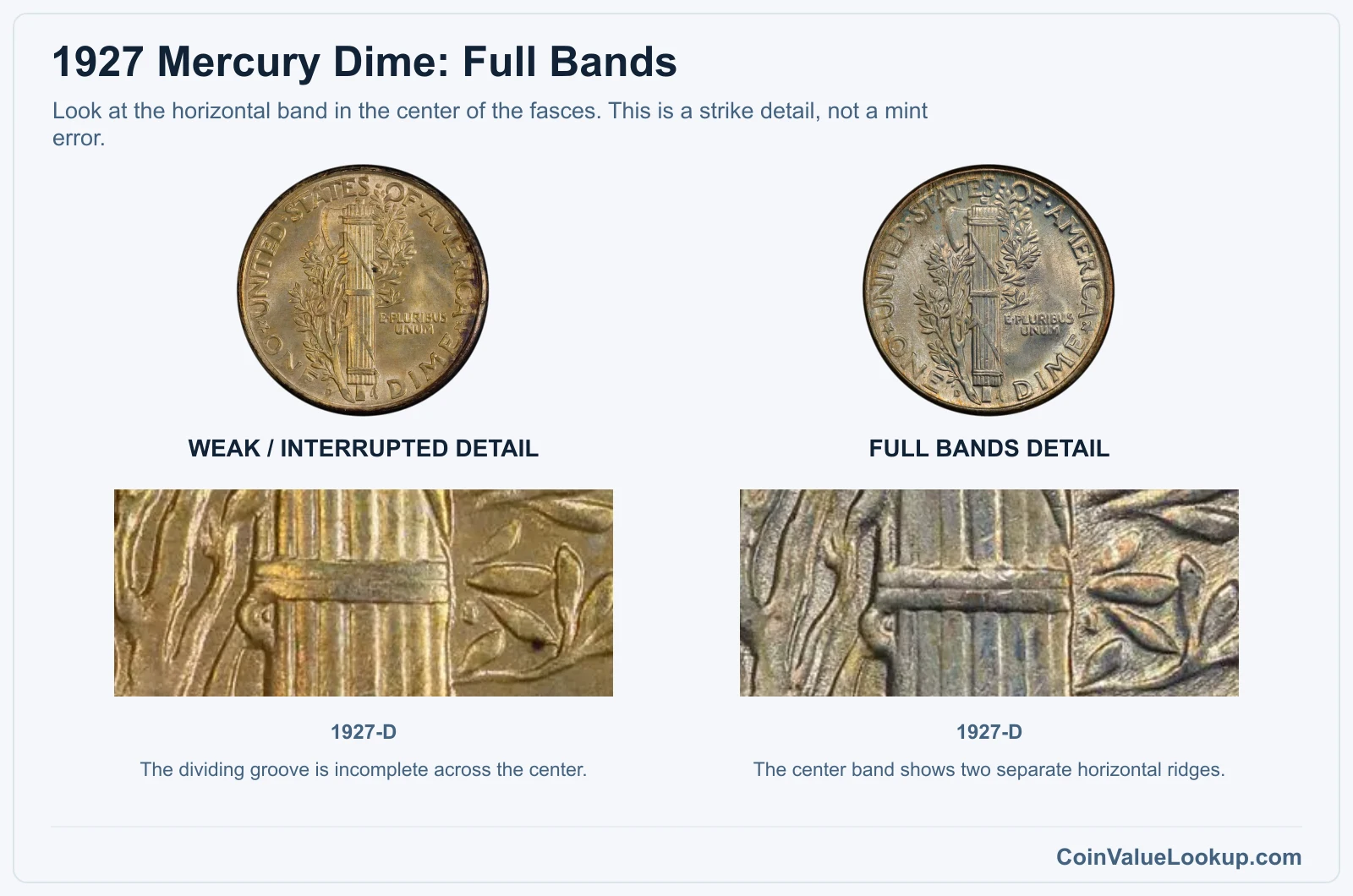
Three business-strike versions exist for 1927: Philadelphia (no mint mark), Denver (D), and San Francisco (S). No proofs were struck this year.
Look on the reverse, to the lower left of the word ONE near the base of the fasces — that is where the D or S mint mark sits. No letter means Philadelphia.
The small "AW" monogram on the obverse near the date is designer Adolph Weinman's initials, not a mint mark. Every 1927 dime is struck in 90% silver and 10% copper, weighs about 2.5 grams, and measures 17.9 mm with a reeded edge.
All three mints share that same composition.
Coin Value Lookup is a handy place to look up guides for Mercury dimes and other series when you want to compare values across years and mints.
Step 2: Check Your 1927 Mercury Dime Grade
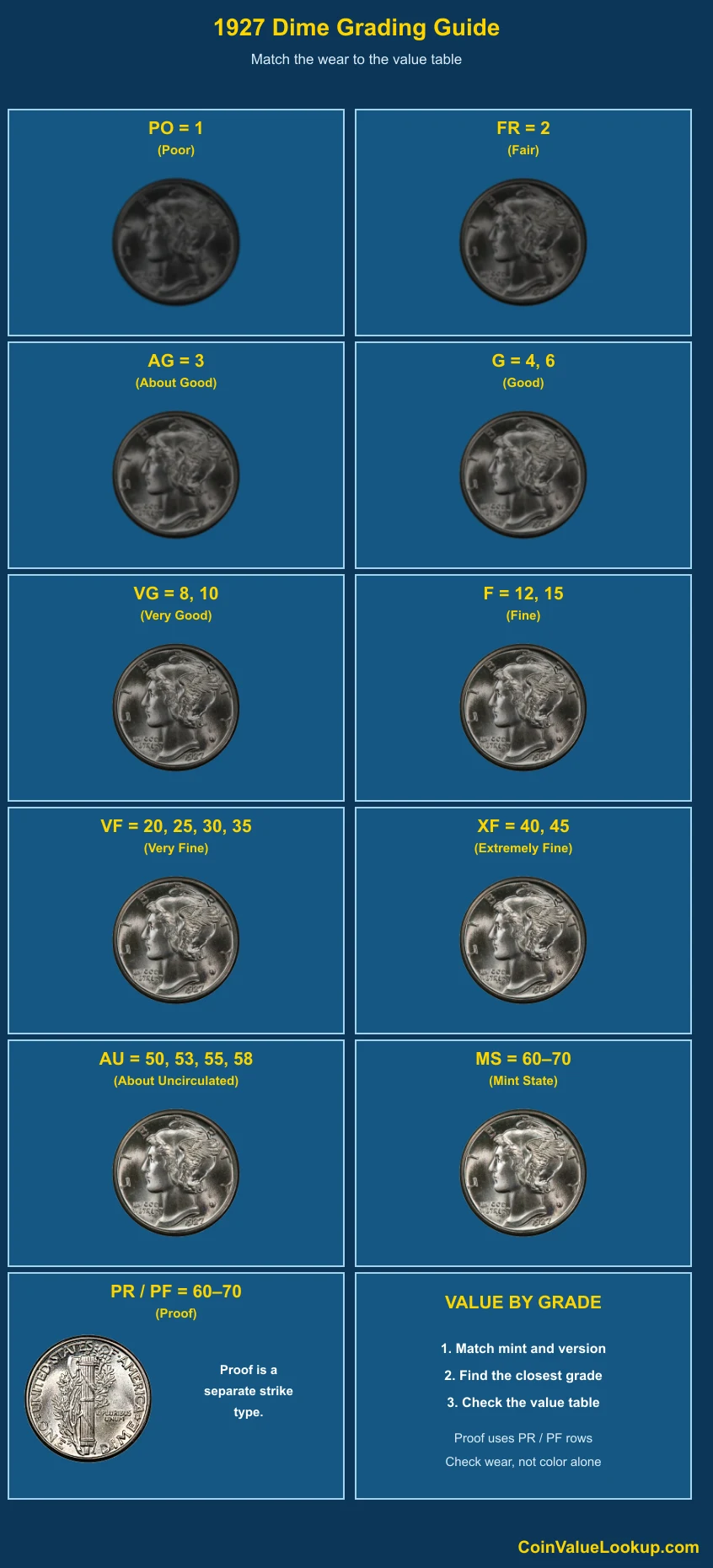
Start by checking Liberty's hair detail above and in front of her ear. On a well-worn coin, those strands merge into a flat area.
The wings on the cap lose definition next, followed by the central fasces bands on the reverse.
Luster matters as much as detail. A coin can show full design elements but still grade below Mint State if the original cartwheel sheen is broken.
Contact marks, bag abrasion, and evidence of cleaning all factor in.
Use the comparison image to match your coin's wear pattern against known grade benchmarks. Weak bands or soft peripheral lettering do not automatically mean heavy circulation — branch-mint strikes from Denver and San Francisco were sometimes soft from the press.
A separate Full Bands evaluation checks whether the horizontal bands on the fasces are fully separated; different grading services may apply slightly different criteria for that designation.
Step 3: Check 1927 Mercury Dime Value by Mint and Version
1927 Mercury Dime — No Mint Mark — Silver Circulation
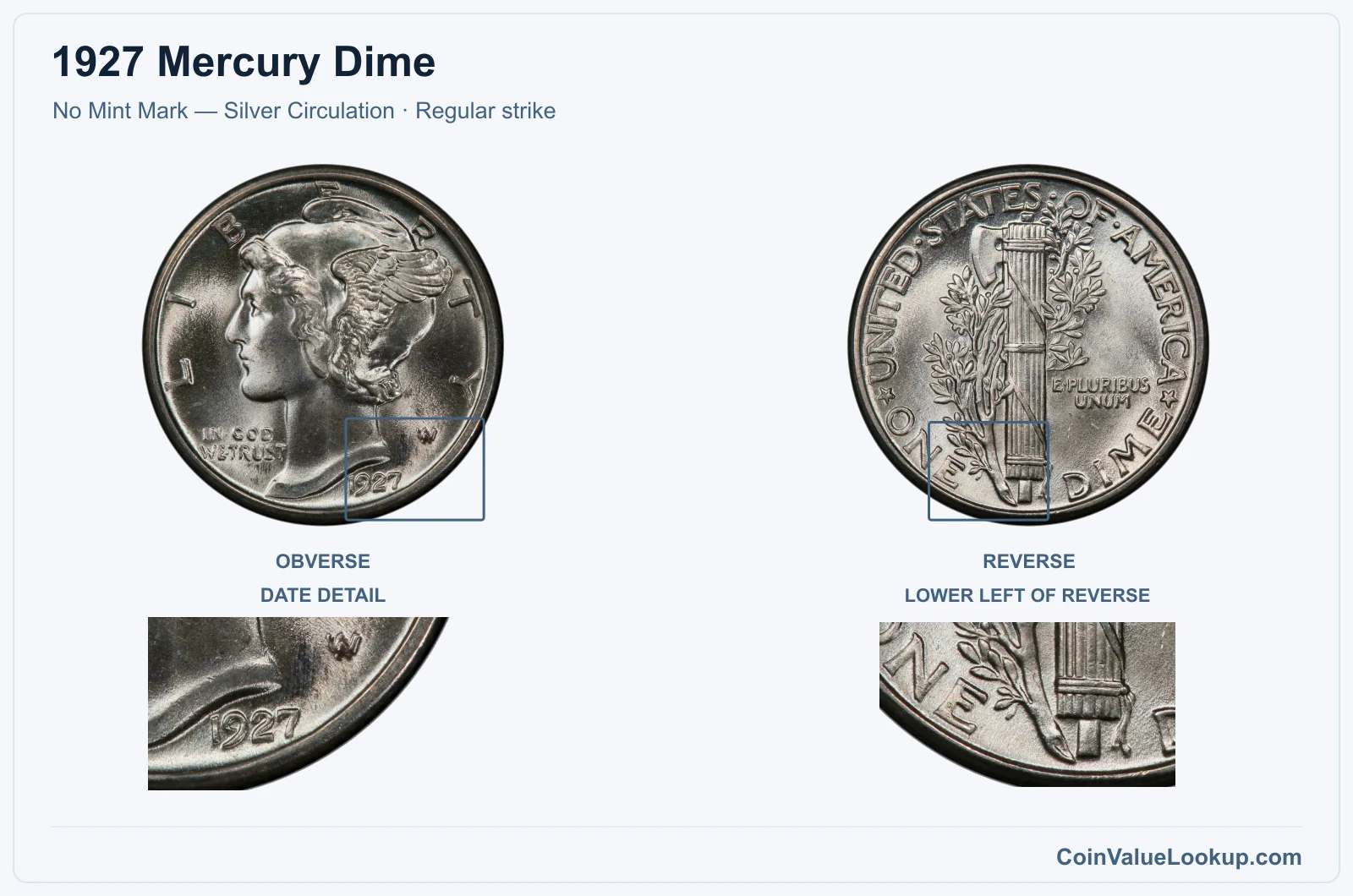
The 1927 Philadelphia dime has no mint mark — just an open space on the lower-left reverse. It is the most common of the three mints in circulated grades, with a guide value around $7.16 in G-4.
In MS-65, the guide estimate sits near $189, making it considerably more affordable than its Denver or San Francisco siblings at the same grade. Original luster and clean surfaces matter.
Full Bands examples exist and trade at a premium, but the standard MS-65 figure here does not include FB pricing. If your coin has sharp, fully separated horizontal bands on the fasces, it is worth investigating further with a grading service.
Range Grade
Price Auction Records Appraisal PO PO 1
—
Coin Identifier FR FR 2
—
Coin Identifier AG AG 3
—
Coin Identifier G G 4
—
Coin Identifier
G 6
—
Coin Identifier VG VG 8
—
Coin Identifier
VG 10
—
Coin Identifier F F 12
—
Coin Identifier
F 15
—
Coin Identifier VF VF 20
—
Coin Identifier
VF 25
—
Coin Identifier
VF 30
—
Coin Identifier
VF 35
—
Coin Identifier XF XF 40
—
Coin Identifier
XF 45
—
Coin Identifier AU AU 50
—
Coin Identifier
AU 53
—
Coin Identifier
AU 55
—
Coin Identifier
AU 58
Coin Identifier MS MS 60
—
Coin Identifier
MS 61
—
Coin Identifier
MS 62
Coin Identifier
MS 63
Coin Identifier
MS 64
Coin Identifier
MS 65
Coin Identifier
MS 66
Coin Identifier
MS 67
Coin Identifier
MS 68
—
—
—
MS 69
—
—
—
MS 70
—
—
—
1927 Mercury Dime — D — Silver Circulation
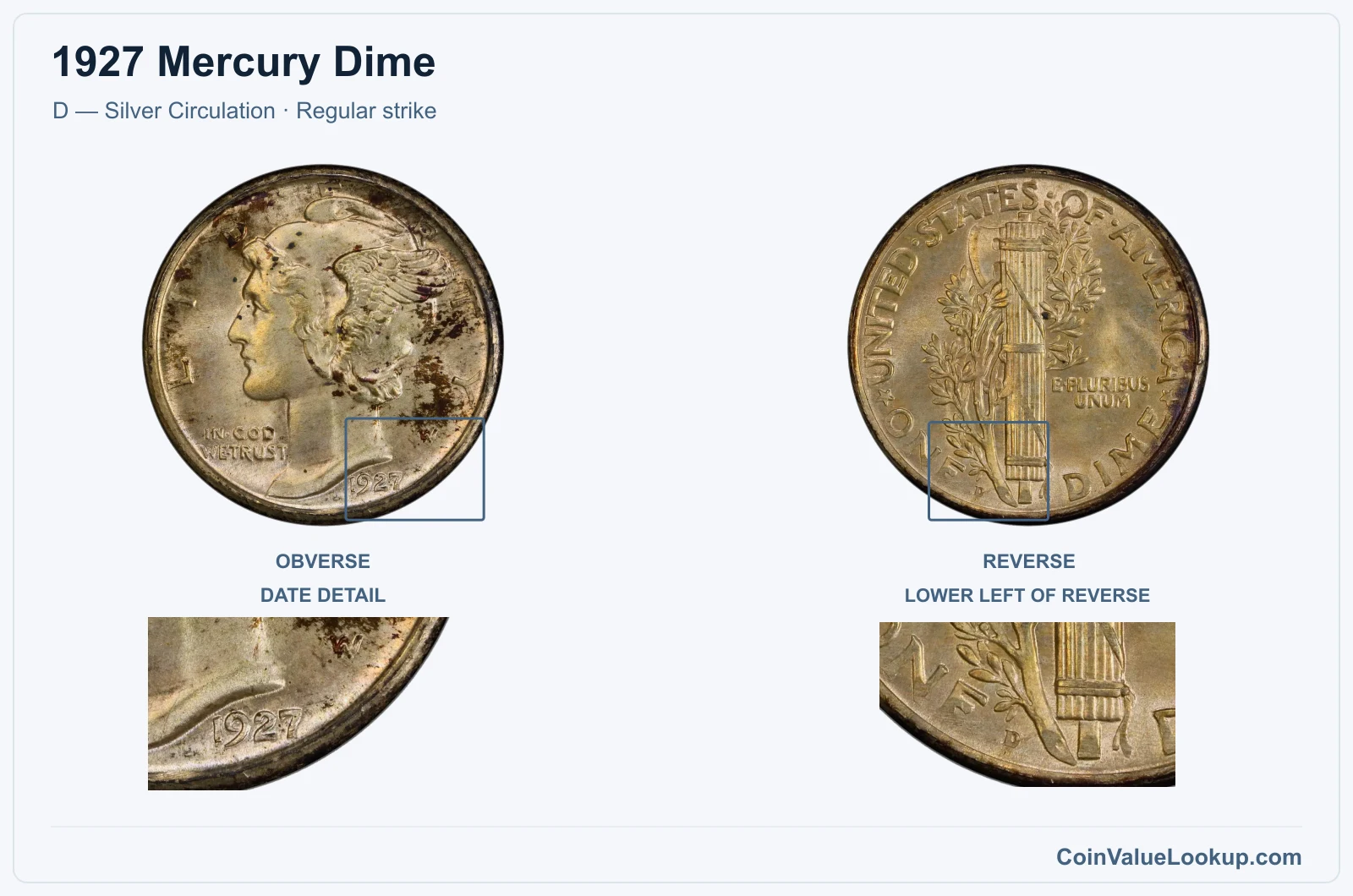
Look for a small "D" on the reverse to the lower left of ONE. The 1927-D starts at about $7.80 in G-4, only slightly above the Philadelphia issue in low grades.
The real gap shows up in Mint State.
At MS-65, the guide estimate jumps to roughly $1,526. That steep climb reflects how few Denver dimes survived with full original luster and minimal contact marks.
Softly struck examples are common from this mint, so do not confuse a weak strike with wear. Full Bands coins would command additional premiums above the standard MS-65 figure, but no separate FB value is included here.
A genuine uncirculated 1927-D with strong detail is a coin worth having graded.
Range Grade
Price Auction Records Appraisal PO PO 1
—
Coin Identifier FR FR 2
—
Coin Identifier AG AG 3
—
Coin Identifier G G 4
—
Coin Identifier
G 6
—
Coin Identifier VG VG 8
—
Coin Identifier
VG 10
—
Coin Identifier F F 12
—
Coin Identifier
F 15
Coin Identifier VF VF 20
—
Coin Identifier
VF 25
—
Coin Identifier
VF 30
—
Coin Identifier
VF 35
Coin Identifier XF XF 40
Coin Identifier
XF 45
Coin Identifier AU AU 50
Coin Identifier
AU 53
Coin Identifier
AU 55
Coin Identifier
AU 58
Coin Identifier MS MS 60
Coin Identifier
MS 61
Coin Identifier
MS 62
Coin Identifier
MS 63
Coin Identifier
MS 64
Coin Identifier
MS 65
Coin Identifier
MS 66
Coin Identifier
MS 67
—
—
—
MS 68
—
—
—
MS 69
—
—
—
MS 70
—
—
—
1927 Mercury Dime — S — Silver Circulation
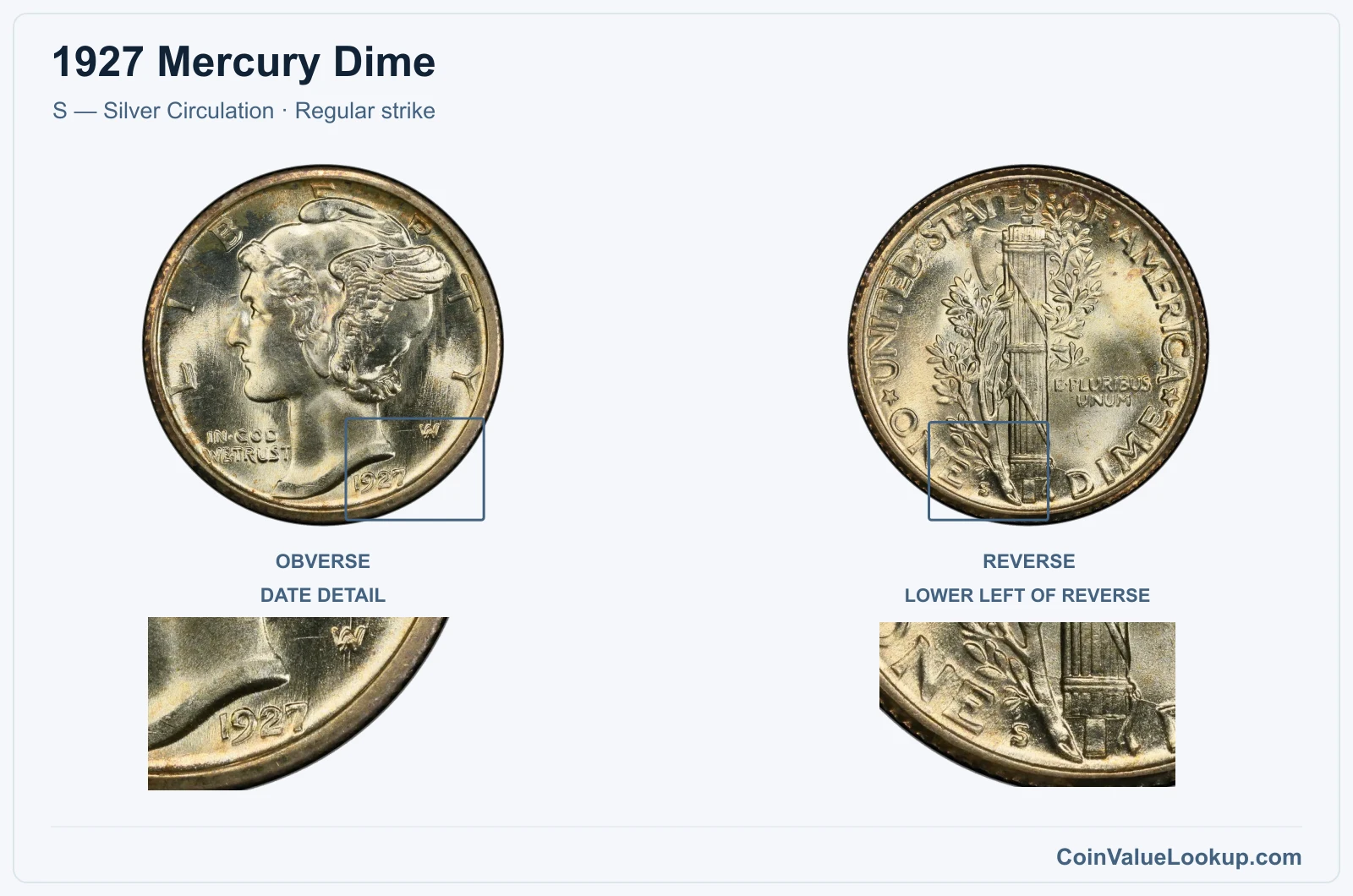
The San Francisco issue carries an "S" mint mark in the same lower-left reverse location. In G-4, it guides at about $7.46 — middle of the pack for the year.
The story changes in uncirculated condition. At MS-65, the guide value reaches approximately $1,678, the highest of the three 1927 mints at that grade level.
San Francisco dimes from this era often came with softer strikes, so truly sharp, lustrous survivors are scarce. As with the other mints, Full Bands designation would add value beyond the standard MS-65 figure listed here, but that premium is evaluated separately.
If you have an original, bright 1927-S with sharp fasces bands, professional grading is worth considering.
Range Grade
Price Auction Records Appraisal PO PO 1
—
Coin Identifier FR FR 2
—
Coin Identifier AG AG 3
—
Coin Identifier G G 4
—
Coin Identifier
G 6
—
Coin Identifier VG VG 8
—
Coin Identifier
VG 10
—
Coin Identifier F F 12
—
Coin Identifier
F 15
Coin Identifier VF VF 20
—
Coin Identifier
VF 25
—
Coin Identifier
VF 30
—
Coin Identifier
VF 35
—
Coin Identifier XF XF 40
Coin Identifier
XF 45
Coin Identifier AU AU 50
Coin Identifier
AU 53
Coin Identifier
AU 55
Coin Identifier
AU 58
Coin Identifier MS MS 60
Coin Identifier
MS 61
Coin Identifier
MS 62
Coin Identifier
MS 63
Coin Identifier
MS 64
Coin Identifier
MS 65
Coin Identifier
MS 66
Coin Identifier
MS 67
Coin Identifier
MS 68
—
—
—
MS 69
—
—
—
MS 70
—
—
—
1927 Mercury Dime Error List
1. 1927 Mercury Dime — Off-Center Strike
An off-center strike happens when the planchet is not properly seated in the collar before the dies come together. The result is a crescent-shaped blank area on one side of the coin, with the entire design shifted in the opposite direction.
On a 1927 dime, the key detail is whether the date remains visible — off-center pieces that retain a readable date are far more collectible than those where the date has been pushed off the edge. The percentage of off-center displacement and the overall condition of the struck portion both affect desirability.
No specific price range is available for this error, so individual assessment is necessary.
Do not confuse an off-center strike with a clipped planchet, a one-sided die misalignment, or post-mint damage from being pressed or flattened. The displaced design should be consistent and uniform, not irregular.
2. 1927 Mercury Dime — Die Crack / Die Chip
Die cracks appear as thin raised lines on the coin's surface, formed when a working die develops a fracture and the metal flows into the gap during striking. Die chips are small raised blobs from a piece of the die face breaking away.
Both are mint-made and can appear on any 1927 dime regardless of mint.
A crack that connects from the interior of the design out to the rim is relatively common. A larger break at the rim — sometimes called a cud — is a more dramatic variety.
Interior chips can be subtle and easy to overlook.
No specific price data is available for die crack or die chip errors on the 1927 dime, so value depends on the size, location, and visual impact of the break, along with the coin's overall condition. Be careful not to mistake incuse scratches, surface corrosion, or foreign material stuck to the coin for genuine raised die-crack lines.
Authentic die cracks are raised above the field, not recessed.