1879 Liberty Seated Dime Coin Value: How Much Is It Worth?
The 1879 Liberty Seated Dime is a coin worth paying attention to. With retail guide estimates running from about $253 in G4 (a well-worn but readable grade) up to around $794 in MS63 (a lightly handled, lustrous example) for the Philadelphia business strike, even circulated pieces carry real value.
Only Philadelphia produced dimes this year, in both circulation-strike and Proof formats, and the business-strike mintage was low enough that finding one in any condition is a minor event.
Fast Way to Identify Your 1879 Liberty Seated Dime
If you have an 1879 dime and want a quick read on what you are holding, snap clear photos of both the front and back under good lighting and upload them here. Our identifier can give you a preliminary take on the coin's version and condition based on those images.
It is not a substitute for professional certification, but it is a solid first step.
1879 Liberty Seated Dime Value
Upload both sides of your 1879 Liberty Seated Dime.
Front Obverse
Upload photo
Back Reverse
Upload photo
Which 1879 Liberty Seated Dime Versions Are Worth Money?
- The Philadelphia business strike in G4 carries a guide estimate around $253, reflecting the low mintage that makes even worn examples collectible.
- An MS63 business strike jumps to roughly $794, rewarding coins that survived with strong luster and minimal contact marks.
- The Proof version in PR63 is estimated near $725, but confirming genuine Proof manufacture is essential before applying Proof pricing.
- Repunched Date and Die Crack varieties are reported for this date and can add collector interest depending on visibility and condition.
Step 1: Identify Your 1879 Liberty Seated Dime Mint Mark and Version
The 1879 dime carries the Legend Obverse design with UNITED STATES OF AMERICA around a seated Liberty, paired with an agricultural wreath reverse reading ONE DIME. Make sure you are looking at a dime and not a half dime; the half dime series ended in 1873.
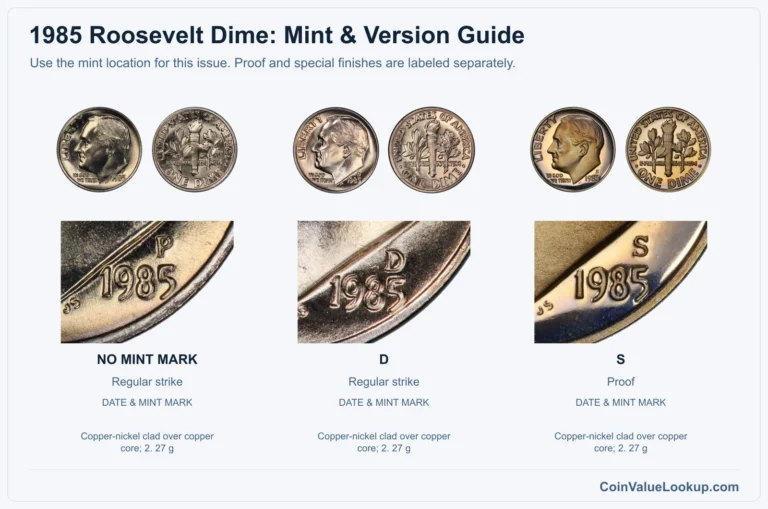
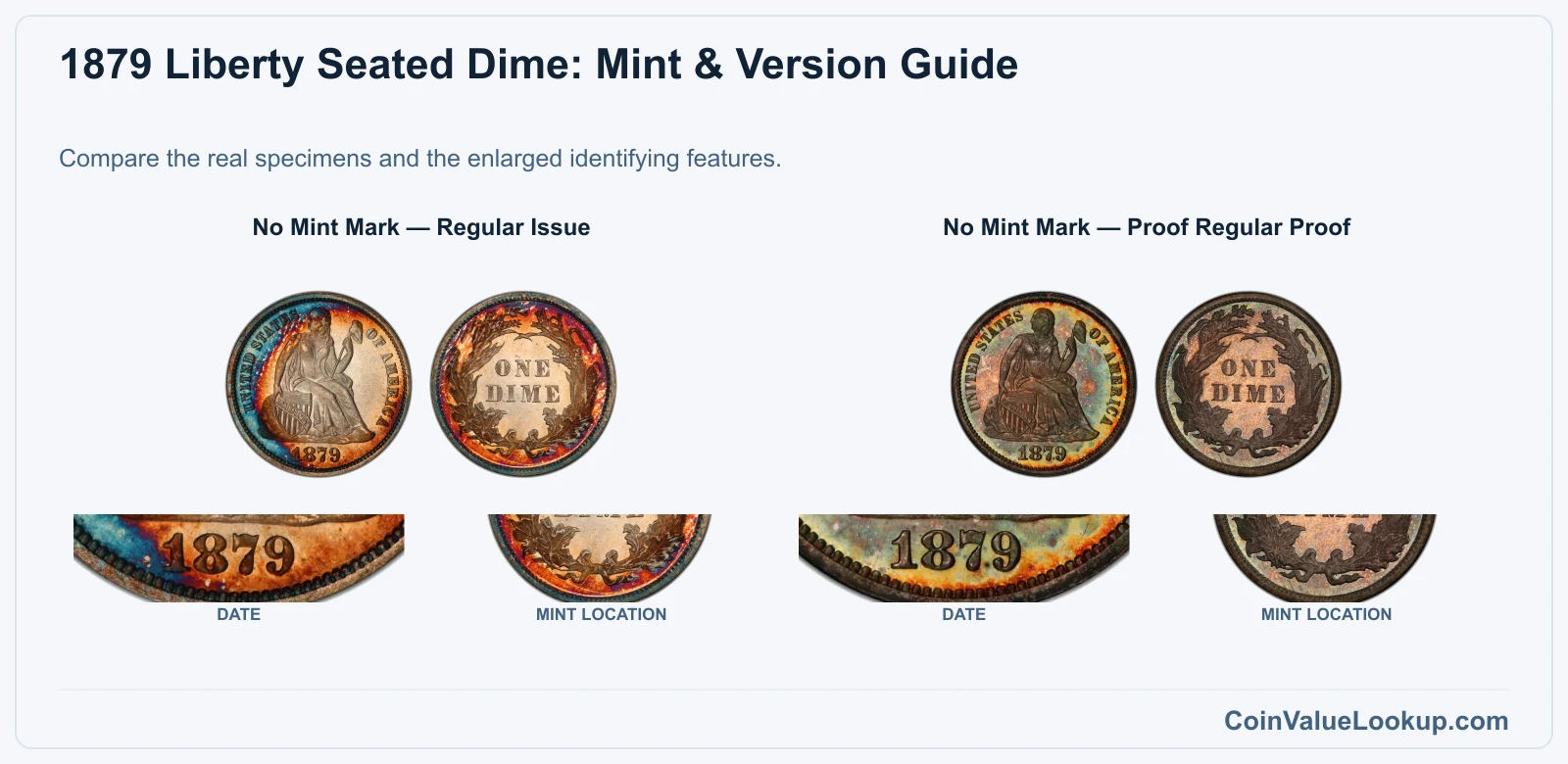
Philadelphia struck all 1879 dimes, so there is no mintmark on a genuine example. If you see an S, CC or O mintmark near the reverse wreath bow, you are looking at a different date or a problem coin.
The coin is 90% silver and 10% copper, weighs a nominal 2.50 grams, and measures 17.9mm across with a reeded edge. A kitchen scale can help you spot fakes or heavily damaged pieces that have lost metal.
Because the business-strike mintage was small, do not assume every nice-looking 1879 dime is a Proof. Many surviving circulation strikes were lightly used and still look sharp.
Actual Proofs have distinctive mirror fields from special die preparation, which we cover below.
Step 2: Check Your 1879 Liberty Seated Dime Grade
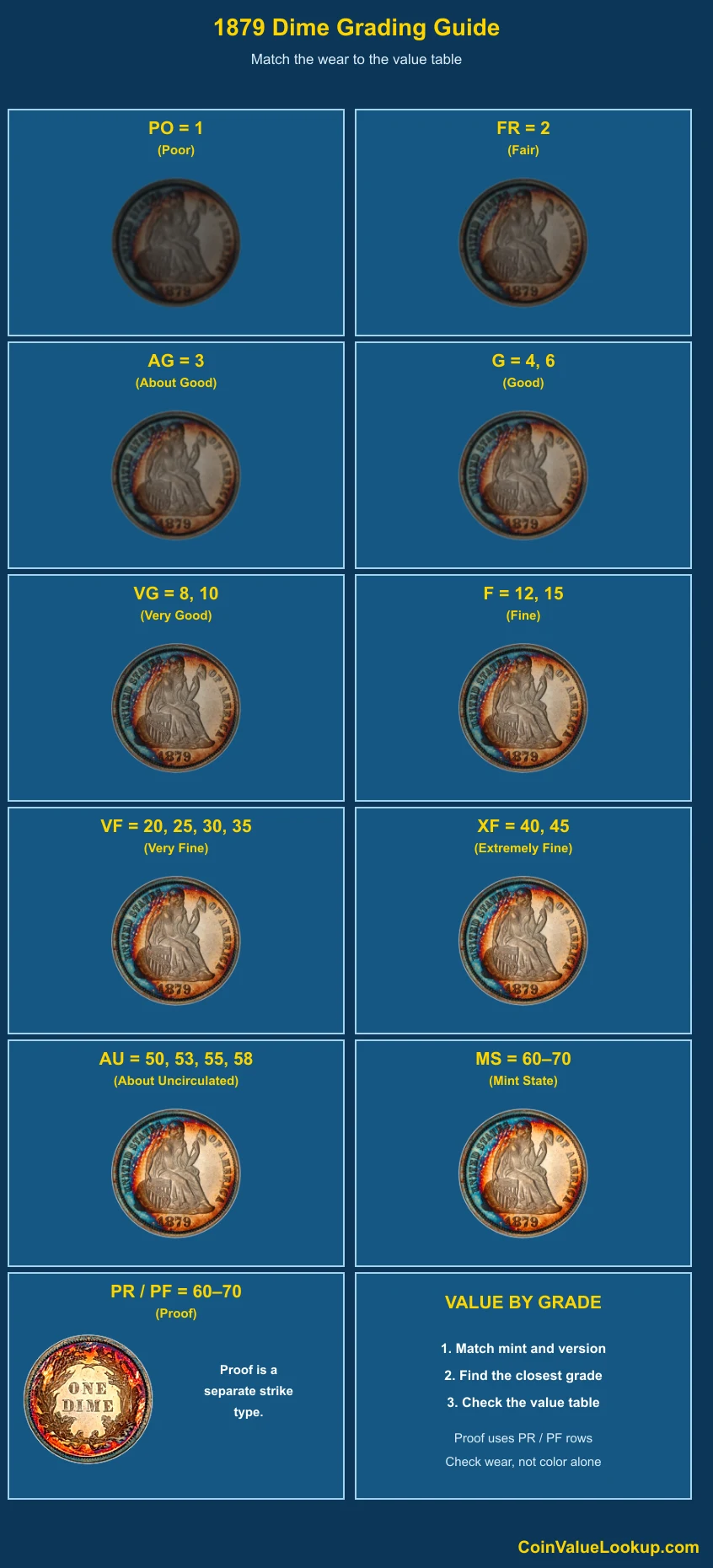
Start with Liberty's head on the obverse. Hair detail above the ear and at the bun wears first.
Next check the breast, knee and the horizontal lines on the shield; these are high points that friction hits early.
On the reverse, the highest wreath leaves lose definition before the lower ones. Compare both sides together when judging a grade, because uneven wear or a weak strike on one side can mislead you.
Luster matters as much as detail. A coin with full design sharpness but dull, cleaned surfaces will grade lower than you might expect from the details alone.
Look at the comparison image to see how wear progresses across different grade levels.
Weak strikes and tired dies can soften design elements without any circulation at all, so do not confuse soft detail with heavy wear. And a polished coin is never a Proof, no matter how shiny it gets.
Step 3: Check 1879 Liberty Seated Dime Value by Mint and Version
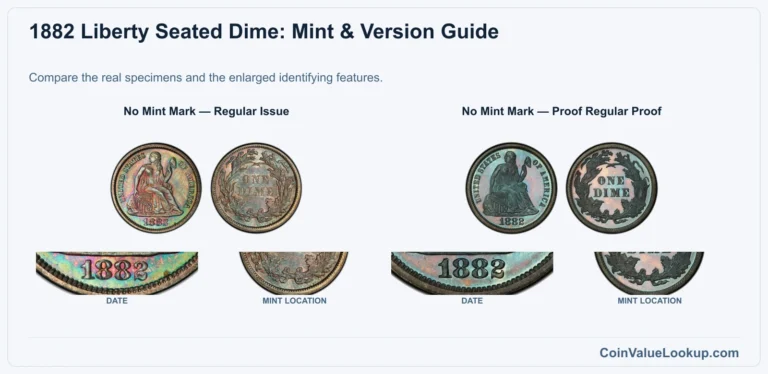
1879 Liberty Seated Dime — No Mint Mark — Regular Issue
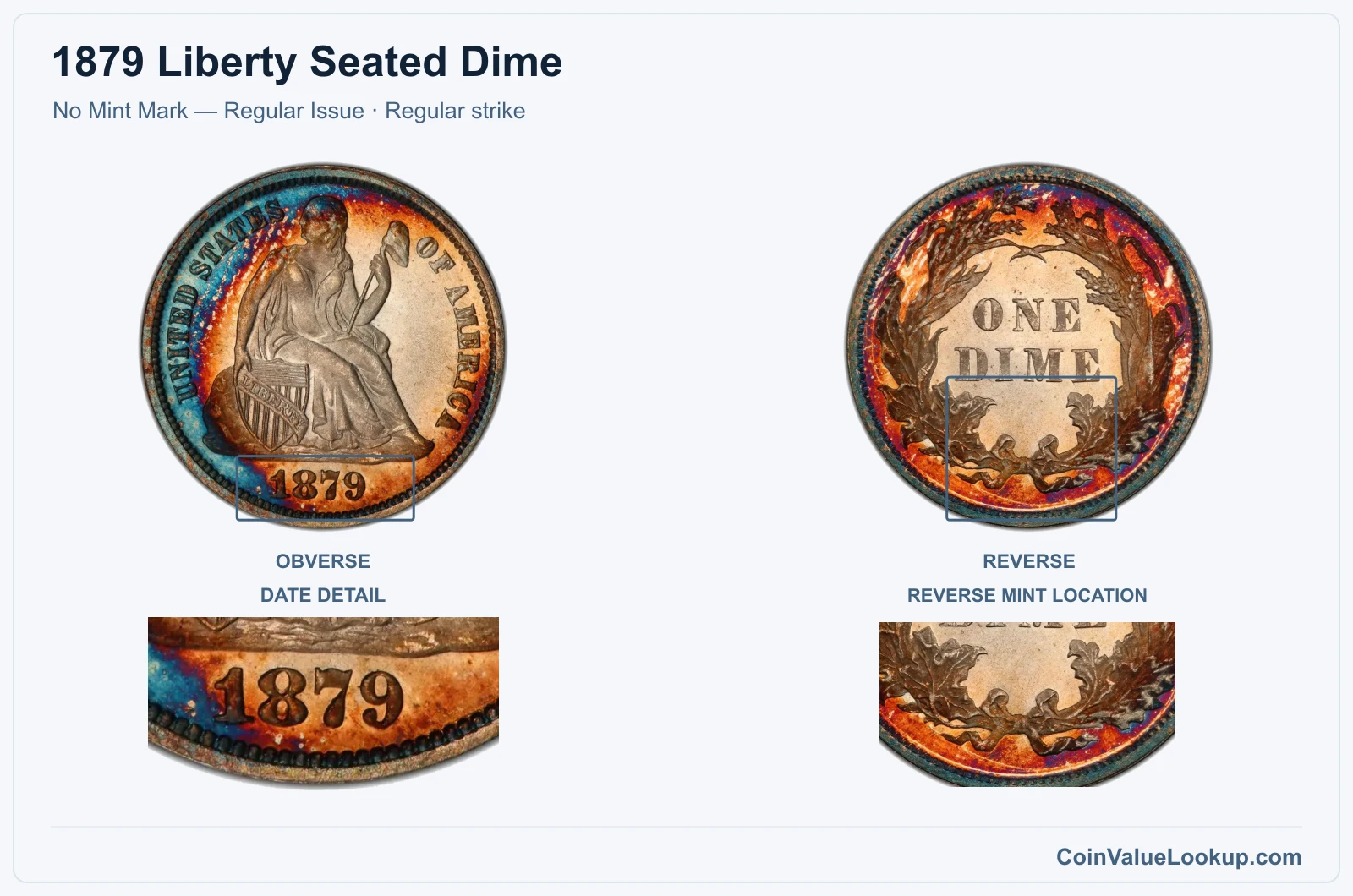
The 1879 Philadelphia business-strike dime has no mintmark. It was produced in small numbers, which is why even a well-circulated example in G4 carries a retail guide estimate around $253 according to USA Coin Book, climbing to roughly $794 at MS63.
Look for the Legend Obverse with UNITED STATES OF AMERICA encircling Liberty, and the ONE DIME agricultural wreath reverse. The coin is 90% silver, weighs about 2.50 grams and has a reeded edge.
Because so few were struck for commerce, surviving pieces with original surfaces are genuinely scarce. Do not mistake a lightly circulated business strike for a Proof just because it still has some shine.
Range Grade
Price Auction Records Appraisal PO PO 1
—
Coin Identifier FR FR 2
—
Coin Identifier AG AG 3
Coin Identifier G G 4
—
Coin Identifier
G 6
—
Coin Identifier VG VG 8
Coin Identifier
VG 10
—
Coin Identifier F F 12
Coin Identifier
F 15
Coin Identifier VF VF 20
—
Coin Identifier
VF 25
—
Coin Identifier
VF 30
Coin Identifier
VF 35
—
Coin Identifier XF XF 40
Coin Identifier
XF 45
Coin Identifier AU AU 50
Coin Identifier
AU 53
Coin Identifier
AU 55
Coin Identifier
AU 58
Coin Identifier MS MS 60
Coin Identifier
MS 61
Coin Identifier
MS 62
Coin Identifier
MS 63
Coin Identifier
MS 64
Coin Identifier
MS 65
Coin Identifier
MS 66
Coin Identifier
MS 67
Coin Identifier
MS 68
Coin Identifier
MS 69
—
—
—
MS 70
—
—
—
1879 Liberty Seated Dime — No Mint Mark — Proof Regular Proof
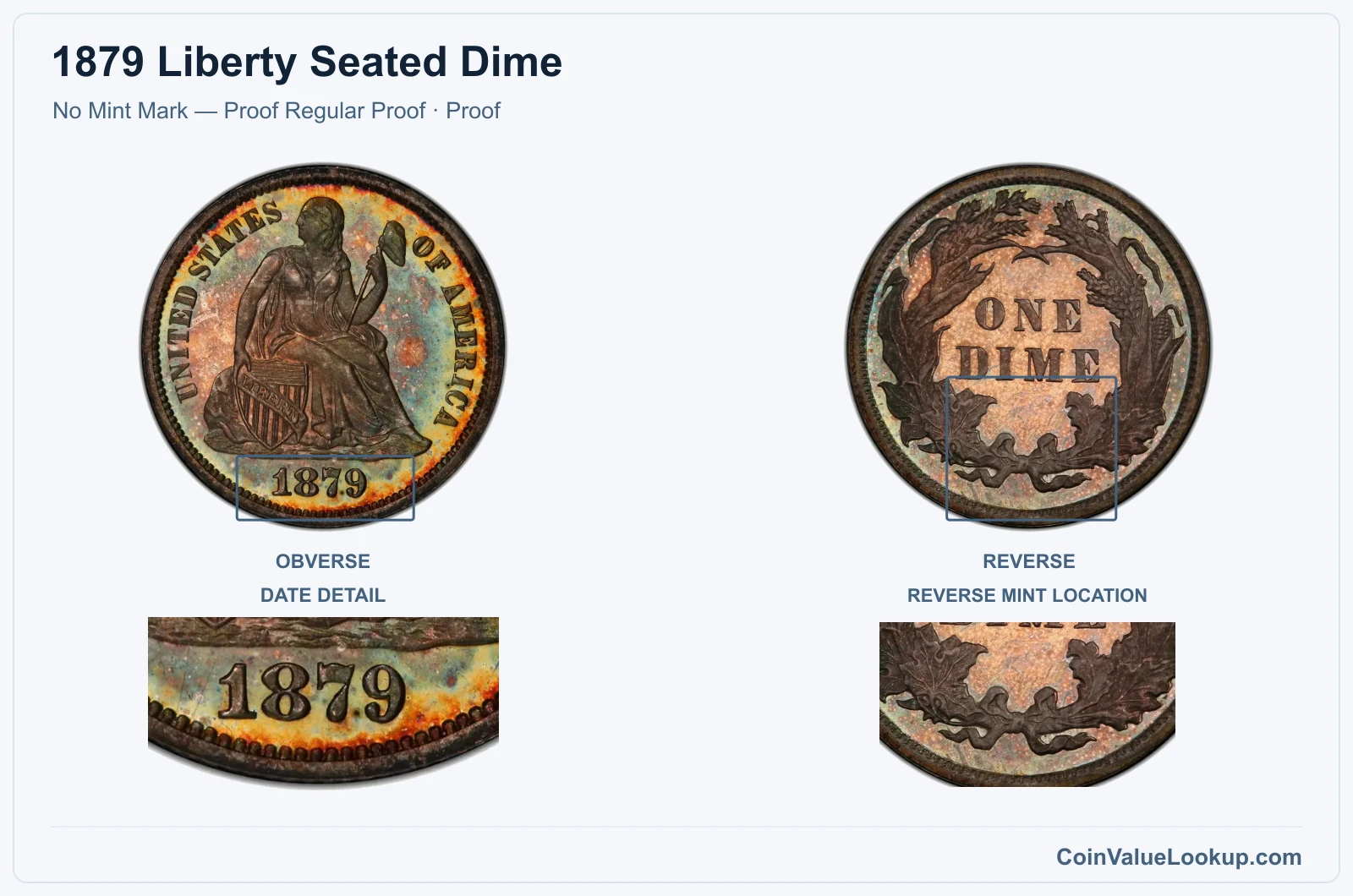
Philadelphia also struck Proof dimes in 1879, and a PR63 example carries a USA Coin Book guide estimate near $725. That is actually a bit less than the MS63 business strike, which tells you something about relative survival rates.
A genuine Proof will show deeply mirrored fields from polished dies and carefully prepared planchets. The design elements are usually sharply struck because Proof dies received multiple impressions.
Look closely at the flat open fields around Liberty and inside the wreath; on a real Proof these should be reflective and smooth, not just bright.
Hairlines from old cleanings or improper storage are common on Proofs and will affect the grade. A brilliant coin is not automatically a Proof.
Brilliance can come from cleaning or from a fresh business strike that was never spent. The die preparation and field quality are what separate the two.
Coin Value Lookup is a good place to start when you want to look up guide values for other dates in the Liberty Seated Dime series or compare across denominations.
Range Grade
Price Auction Records Appraisal PR PR 1
—
Coin Identifier
PR 2
—
Coin Identifier
PR 3
—
Coin Identifier
PR 4
—
Coin Identifier
PR 6
—
Coin Identifier
PR 8
—
Coin Identifier
PR 10
—
Coin Identifier
PR 12
—
Coin Identifier
PR 15
—
Coin Identifier
PR 20
—
Coin Identifier
PR 25
—
Coin Identifier
PR 30
—
Coin Identifier
PR 35
—
Coin Identifier
PR 40
—
Coin Identifier
PR 45
—
Coin Identifier
PR 50
—
Coin Identifier
PR 53
—
Coin Identifier
PR 55
Coin Identifier
PR 58
—
Coin Identifier
PR 60
—
Coin Identifier
PR 61
Coin Identifier
PR 62
Coin Identifier
PR 63
Coin Identifier
PR 64
Coin Identifier
PR 65
Coin Identifier
PR 66
Coin Identifier
PR 67
Coin Identifier
PR 68
Coin Identifier
PR 69
—
—
—
PR 70
—
—
—
1879 Liberty Seated Dime Error List
1. 1879 Liberty Seated Dime — Repunched Date
A Repunched Date on the 1879 dime shows remnants of an earlier punch position near one or more of the date numerals. The die was set up, the date punched in, and then repositioned slightly before a second impression.
The result is traces of the first attempt visible as extra outlines or shifted serifs beside the final digits.
This is different from machine doubling, which affects the entire design and usually appears flat and shelf-like. A repunched date is confined to the numerals and shows depth consistent with a deliberate punch.
It is also not the same as post-strike damage, where a hit can push metal around a digit without the clean doubled outline.
No specific price range is adopted for this variety. Value depends on how visible the repunching is, the overall condition of the coin, and collector demand for the particular punch position.
A bold, easily seen repunch on a well-preserved coin will naturally attract more interest than a faint one on a worn piece.
2. 1879 Liberty Seated Dime — Die Crack / Die Chip
Die cracks appear as thin raised lines on the coin's surface, running from the rim inward or connecting design elements. Die chips show up as small raised blobs where a fragment broke away from the die face.
Both are reported for 1879 Philadelphia dimes and reflect progressive die deterioration during the press run.
A rim-connected break that displaces metal into a raised lump is called a cud, which is distinct from an interior crack or chip. When examining your coin, look for raised irregularities rather than incuse ones.
Scratches, corrosion or debris stuck to the surface sit in or on the metal, while die cracks and chips are raised because the damaged area of the die created a void that filled with metal during striking.
No adopted price range exists for these die-state features on the 1879 dime. Collector premium depends on the size, location and visual impact of the crack or chip, alongside the coin's overall grade.